
Lighting for Profits Episodes
Lighting for Profits is your #1 source for all things landscape lighting. Whether you are looking to learn about lighting design, lighting installation, or just need helpful tips on how to start or grow your landscape lighting business, you are in the right place.
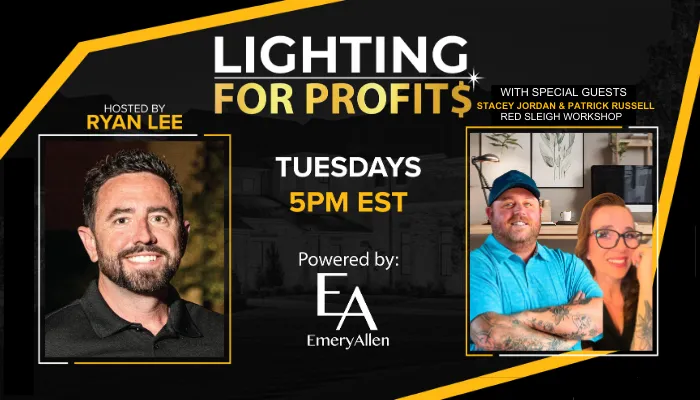
Stacey Jordan & Patrick Russell - Light It & Scale It
Lighting for Profits - Episode 234
In this episode, we sit down with Patrick Russell and Stacey Jordan of Red Sleigh Workshop, who share how holiday lighting and décor businesses can grow from small installer teams into scalable, profitable operations. Patrick dives into the operational systems behind successful companies—from sales and production to crew management and logistics—while Stacey brings over 20 years of industry experience working on large-scale décor programs for cities, malls, and resorts across the U.S., teaching installers how to land bigger jobs, price confidently, and turn seasonal hustle into real business growth. Together, they reveal the strategies that help lighting businesses level up and confidently step into the commercial market.
Watch the episode
Episode Transcript
Welcome to Lighting for Profits powered by EmeryAllen
Welcome to Lighting for Profits.
All Light, All Light, All Light, powered by EmeryAllen.
Here is your host, Ryan Lee.
What's up? What's up? Kicking off another show. I'm trying to give Emery Allen some love on this, mug, and it just doesn't work. My lighting's weird. But, shout out Emory Allen for hooking me up with a cool mug. Keeps your drinks cold. What's up, guys?
Ryan Lee: We're up past 100 reviews on Lighting for Profits
Ryan Lee, the host of Lighting for Profits, powered by Emory Allen. And, we got an awesome show today. If you're looking to start or grow a landscape lighting business, or should I say an outdoor lighting business, because we're going to be talking holiday lighting and it's only March. in fact, we're going to help you guys learn how to not just acquire but close these high ticket, commercial holiday lighting jobs. we got Stacy Jordan and Patrick Russell in the house today with Red Sleigh Workshop. I love that name, Red Sleigh Workshop. It's just so good. I'm hoping that they have a lot of fun with that in their marketing. You know, like, slay the season. I think I saw that one. so really, really cool to have them joining me today. and, you know, as, as always, we're here to educate, to motivate, to help you dominate. And thank you guys so much for your support. We're up past 100 reviews. that feels really good. I've been trying for like five years. It only took us five years to get to 100 reviews. So how long will it take to get to 200? Hopefully less than five years. but seriously, thank you guys so much for taking the time to find the stars, to write the reviews. It's not easy. and so if you're bored one day and you're like, you know what? I have not given Ryan Lee a five star review. Go to Apple, go to the app, look for podcast, scroll down about halfway and then you'll see these stars. And then you click the five stars and then you actually below it says write a review. You click write a review, you do that and then good things happen. Gonna be a great show. Like I said, in just a few minutes, we got Stacy Jordan and Patrick Russell with Red Sleigh Workshop. And, we're going to be talking holiday lighting in the middle of March. spring has sprung. It's time to go.
The older I get, the more intentional I get about landscape lighting
So, before we have them on, I do want to bring up something. it's been on my mind lately. it was basically after Light It Up Expo had a lot of people asking me. They, we had, literally, I think we had like 100 people come to the landscape lighting class. The fundamentals, a lot of new businesses jumping into landscape lighting. They already have an existing holiday lighting business and they're kind of like, well, yeah, people are asking me if I do landscape lighting and I'm not going to tell them no anymore. And so they went through the training and I was talking to a lot of different people about a lot of different things. But one thing that I realized is the older I get, the more, I would say the more intentional I get. You know, when I was young, I was just more reckless and you just don't care about life and you just don't know. Like, you don't think about like opportunity costs and you just don't think about consequences. When you get older, you start thinking about consequences. You know, it's like, maybe I shouldn't go as fast on my skis or my snowboard because like, I might get hurt. And if I get hurt, then what, what are the consequences? Right. As a kid, you just don't think of that stuff. So the older I get, the more intentional I get, the more aware, I would say, the more situational awareness. My emotional intelligence is definitely increasing. in my 20s, I don't know if I had any emotional intelligence, but, I'm working on it. Okay. And so I started, I was thinking about like some of the common denominators of like myself and like my top clients. Like what, what, what, what is the difference? Is it the way they think? Is it the actions they take? Like what, what are the common denominators between a successful person versus just someone who just stays average? Right? And the thing that came to my mind the other day was simplicity. Okay. And simplicity is honestly just become one of my character traits because I don't like to overcomplicate things anytime. Even when I listen to someone, it sounds complicated. I just stop listening and then I have a lot of questions and then I just give up because I'm like, that, sounds complicated. And so it doesn't matter whether we're talking about design, installation, sales, marketing, pricing, like everything I teach. And people sometimes have these great epiphanies after I teach them something so simple. And it's because they were overcomplicating it. It's because my method is so simple that almost like a 12 year old could do it. Right? And that's what I'm realizing is like, that's what successful People are, they don't overcomplicate things. I know when I overcomplicate and overthink things, then things either typically take too long to realize, right. Or, and causing me, then I get to get discouraged and bored and sometimes they just never happen. Right. But when I keep things simple, I get results. Like, that's what we want, right? And so I lighted up Expo. I was talking with, several groups and was reminded of something very, very simple that I used to do in my lighting business and teach. And now I teach. so when I, when I first hired my, my first salesperson, I mean, of course I was worried. I was like, well, I mean, are they going to be able to sell how I sell? Like, how are they going to know where to put the lights and what lights to use and how am I going to teach them this design process? Because it's not like maybe like a, an H vac or a roof or something like that where it's just like, oh, it's just, just order this thing or whatever. Like the cool thing about landscape lighting is there's a design element. And the hard part about landscape lighting is there's a design element. Right? And so, I was, I was worried like, how long is it going to take this person to get up to speed where I am and how long am I willing to make less money because I'm going to hire this individual? And I found out after talking with a bunch of people at Light it Up that they had similar concerns for similar situations either for themselves or their team members. They're asking me like, well, how long does it take to learn design? And when I hire someone, how long is it going to take them? And I'm like, like 10 minutes. Like what, 10 minutes. And so, I think I called it my, my two minute or my five minute design class, which kind of turned into like seven or eight minutes. And so I want to share my five minute design process with you if, if that's okay today because this is what will help you learn design very, very quickly. Okay. And this is what you need to have in your arsenal if you want to be able to close deals on the spot. also, this is not going to be a popular episode. I'm going to get some shade, I'm going to get some hate. Because if someone's been in the industry a long time and it took them 30 years to get where they're at to learn design, they're not going to like the fact that I can teach it to you in under 10 minutes. Okay? Also, I'm not claiming that in my 10 minute or, or 8 minute or 5 minute design class I'm about to give you is going to make you an expert lighting designer. Okay? This is just to get started. This is the fundamentals, but this is you taking imperfect action instead of waiting for this perfect epiphany, and this perfect process to be in your lab. Because the reality is the people who've been doing it 30 years, they're still getting better, they're still perfecting their process and they're still learning things. And so you could wait 30 years to start, or you could just start now with my imperfect lighting design under 8 minute course. So I'll give that to you right now.
Most people want the front of their house lit, okay?
So, basically when most people call for lights, you know, they could be calling for front yard, backyard, but I found that most people, they want the front of their house lit, okay? And, they want to see their castle. They want to feel something different when they show up. Because normally what happens is they'll be driving down the neighborhood like, wow, that house looks cool. What's different? Oh, it's the lighting. And so they call you. Like, we want our house to look like that. And so let's just say someone calls you and you're lighting up the architectural portion of a house. This is, this is how you do it. It can be this simple. Okay. You're going to basically put a spotlight, okay. On each side of the window. Okay. So houses usually have windows on them, right? And, so like, let's say there's the end of a house and then there's a window in between that gap. You're just going to center a light. You're going to put that light about 15 inches away from the house. Now, later on, I'm probably going to teach you some other design skills where maybe it's 18 inches, maybe it's 12 inches. But for now, we're just going to make it super easy because this is our imperfect lighting design class. 15 inches away from the house and you're going to aim the spotlight one click in. One click in means one click in. Okay? Don't overthink it. One click in, you're going to want all your fixtures to be aimed the same. One click in, and you're going to put those lights on each sides of the windows all the way across the front of the house. And then you're going to put a light on each side of the front entry. Most people miss out on that. You want the front Entry to be a focal point. You want people to guide people to that front door. So if you leave it dark and it seems kind of scary, they're not going to want to walk there. Right? So a, light on each side of the window, A, light on each side of the front entry. And then let's say there's a wall where there's like not a window, but you feel like there maybe could have been a window there. You're going to use the same spacing that you were using when there was a window. Right. And so now you know, like, okay, if there's a house with like four windows and it's got the front entry and then there's a wall without a gap, like, you know, okay, I'm going to have about 12 to 14 lights here. Right. And it might depend on like how the windows are set up and stuff like that, how close they are to each other and whatnot. But that's, that's kind of it. That's how you light a house. And then what you do is you go, okay, on a one story section of a house, okay, if it's one story, you're going to use a 60 degree. You're going to use like a 4 watt light, 60 degree. Now if you buy from a manufacturer and they sell a 58 degree, it's fine. It's almost the same as 60. Don't overthink it. Right. And then what happens if the house jumps up to a second story portion? Sometimes on the side of the house you'll be like one story, right. And then toward the middle it might jump up to a second story. Now you're going to change from a 60 degree to a 40 degree. If your manufacturer uses 38 degree, then use a 38 degree. It's almost the same as a 40. Okay. So I'm just trying to keep this as simple as I can. And now you're a lighting designer. Now you can light the front of a house and then you go, well, what about the second story? Well you know what, you can put a light in the gutter, a ah, wash light. Okay. I don't, I don't like to use spotlights close up to the windows and one. Because now you have to figure out how to get wire on a shingle and drill into someone's roof that you may not want to do. I like to keep it in the gutter. But also because from a design standpoint, I like it because the light from the ground looks like it's traveling all the Way to the top. And what happens with light? It tends to spread out and get a little bit softer the further it gets away from the source.
Right.
And so it looks more natural, and it's easier. Right. So you're just going to mount wash lights in the gutters to light dormers or second stories. Right. Stuff like that. And then you're going to run that wire down the downspout and come out in the ground, where it goes into the ground. So now all of a sudden, you can light a house. And then you're like, oh, well, what about the trees? Yeah, well, we need to. So small, decorative, like Japanese maples. They might only have one light, right? Crepe myrtle, small one might only have one light. A little bit bigger crape myrtle might have two larger crepe myrtle might have three palm trees. Two lights, right? One on each side. So that way you get that, like, kind of dark, stripe down the middle. And now all of a sudden, you get a big. Let's say you want to light the path. And by the front step, there's a big oak tree. Well, that oak tree, you could put a couple moonlights. So they're up in the. In the tree about 25ft down. Shine it down through some limbs and canopy to create that shadowy dappling effect on the ground. Now you've got a design coming together, right? But further out on the path, the tree's not close enough to hit that, but there is a bed. There is a, landscape bed on each side and some boulders. So we'll just plant a path light there, and we'll stagger those approximately every 8 to 12ft. Now, all of a sudden, you can put together a design very, very quickly without knowing everything. You're gonna need to know later on to become that expert.
Lighting design can be overwhelming or it can be super simple
Right? And so I want to encourage you guys to not overcomplicate things. Lighting design can be overwhelming or it can be super simple. And when I taught this to my very first salesperson, he went out and I'm not. Not joking, sold his very first job on the spot. It was a $6,000 job. He got a $3,000 deposit just by using these same design principles. Now, did we take pictures of it and submit for a design award? No.
Okay?
But any light is better than no light. Your homeowners, your clients are going to love it, okay? And you're going to look back 30 years from now and go, I can't believe I did that. That doesn't look very good. But it's going to look pretty dang good compared to what everyone else is doing. Okay? But as you, as you progress and you attend illy, the International Landscape Lighting Institute, they will help you learn advanced design, okay? Where you're going to start varying light levels and you're going to have, focal points and depth and all sorts of different things. But right now you just need to get started because the problem is if you overcomplicate it and delay the start, you're going to get frustrated and you're going to want to quit and give up. And you can't afford to quit and give up. You need this in your life. You need something different for your family. This is how you build and change your trajectory and build a legacy. Right? And if you let all that go just because of overwhelm, like, you're missing out on millions of dollars of potential and building an awesome outdoor lighting business. So encourage you to get started. Don't listen to what other people are telling you. This is the way. This is the way to get started. Go do 5 installs, 10 installs, 20 installs. You'll get better yourself. Go do demos and you can see what it looks like when you put a light 15 inches away from a house. Certain houses you might go 18 inches, certain houses you might go 12. You'll learn these things over the time, but don't let these, the fear of, of doubt hold you back. You know what I mean? you, you got to take action. And that's my. I don't know how long that went, but it was. That's supposed to be my less than 10 minute, imperfect lighting design class. So I, People found that very helpful. I had a guy message me over the weekend, and all he did was come to light up expo, went to a class, joined our lighting academy, like our very low ticket thing, went through the whole thing in the weekend and set up a demo. He did two demos. He's still working on one. He hasn't, he hasn't gotten no, but he hasn't got a yes yet. And he already closed it. One deal for $6,000, right? That. It's just like the perfect example. And he's already got nine more demos set up. So his odds of success are much greater than someone who doesn't have nine demos set up. Okay. He's probably going to look back later and be like, that $6,000 install should have been a $9,000 install. Should have been a $12,000 install. He's going to know more later. That's okay. Those people are going to be grateful that they spent $6,000 because they're going to have lights on their property and it's going to look badass. It's going to look like what he showed them. Right? So don't let the. The fair, the fear of failure hold you back. You have to take action. I love it when I get people messaging me those stories of them taking action.
Emory Allen makes premium LED lamps for lighting professionals who demand the best
All right, speaking of taking action, actually, I don't have a good tie in. Listen, friends, don't let friends install garbage lamps. If you want less callbacks and more referrals and more repeat business, start with Emory Allen. Emory Allen makes premium LED lamps for lighting professionals who demand the best. Don't settle for less. Upgrade your designs and installations today with Emory Allen. Reach out to Jackson lryallen. com to learn more and take advantage of their contractor pricing. Just email jacksonlryallen. com that's Jackson L as in the letter L@emryallen. com and don't forget to mention that you heard about them. here on Lighting for Profits. To get that discounted contractor pricing, just email jackson laten. com.
Stacy and Patrick join us for a podcast therapy session
okay, guys, it's that time. I know Stacy and Patrick are ready, so let's get the show on the road. Should we? Yeah, I think we should. Sometimes I forget where my buttons are. Where is it? Or can I do hard things? I could do hard things. I can do this. I could do this. Welcome, welcome, welcome to the show. Stacy and Patrick. What's up, guys?
What's, up?
What's up? How are you?
Oh, I'm just loving it. Podcast day is one of my favorite days for sure. So I'm stoked, to have you guys on the show.
Well, I'm glad you found your buttons because that music was good.
Right?
So hard. Like, one day when I grow up, I'm gonna have a producer or. I don't even know what they call them, but someone who hits buttons for you, right?
Yeah. Stacey's good at pushing buttons, so.
Oh, is she? We should talk about. That's what this really is, is a therapy session.
We need that.
Yeah, I guess I gotta be careful what I. What I wish for. No, I don't want anyone pushing my buttons.
Right.
Patrick Russell and Stacy Jordan are founders of Red Sleigh Workshop
Well, excited to have you guys on. Do me a favor before we jump into this. we had you guys on maybe a month ago right before Light It Up Expo, and we were talking about red slaying, you know, talking about Light Up Expo, but this is a little bit different. We're going to dive into not just what you guys do, but like, really how you guys help people and give away some gold nuggets today for people, but just for those that don't know you. I know you guys have been around in the industry a long time, but, just do a quick introduction of yourselves.
Okay. you want to go first, Patrick?
Yeah, I'm, Patrick Russell. I'm the executive vice president of Red Slate Workshop. I've been in the Christmas industry mostly as a residential installer and then getting into commercial and met Stacy, and we started Red Sleigh last year in 2025. And she's a wealth of knowledge and with my business background kind of it was a really good match for us to be able to help elevate installers companies. So we just went full throttle and, you know, wanted to help as many people as we could. So it's been a really fun journey. and yeah, it's just, we're just getting busier and busier and just looking forward to it.
Sweet. Love it.
Yeah. And I'm Stacy Jordan and I'm founder of Red Sleigh Workshop. And, after two decades in the commercial Christmas industry, I decided that it was time to help, installers do what I do best. Right. I've worked with, cities, shopping centers, theme parks, all the big major places around the country to help design and implement these large scale commercial Christmas projects. And most people don't realize that there, there are, places spending, you know, not just like $50,000, but like a million dollars on their Christmas out there in the US and, and there's installers out there that have no idea it's right in their backyard. So I'm here to help help them get there.
I love that. I definitely want to get into that. Like, okay, what, what is the possibility, what is the potential here? Because even when I got into landscape lighting, I had no idea. I thought $4,000 was like a huge job. You know what I mean? And then you meet someone and their, their average job is 10, and then someone's average job is 50 and then 100. It's just like, it's just so cool to get inspired by that.
We just finished up Light Up Expo a couple weeks ago
So, well, let's jump into it. First, I want to thank you guys because honestly, like, we just finished up Light Up Expo a couple weeks ago. You guys were so generous. You guys were a sponsor of one of our VIP dinners, which was so fun, going to the Hibachi and stuff like that. Then we went the next night to the, like, more Bar and grill place, but super nice of you guys. I don't, I don't know if people realize like, how much effort goes into these shows and, and like, we can't put on an epic experience if we don't have, like, generous sponsors like you guys. So for you guys being willing to like, be somewhat new into the this scene and just be generous and like, hey, how can we help? you guys also gave away a ton of stuff or we had that epic raffle we got. I need to make a bigger deal of this. I'm literally going to go online and like, do tons of posts about this because we gave away over $30,000 worth of stuff at Light It Up Expo.
Insanity.
It was wild.
Like, I'm like, holy cow, that's a big deal. And I, I kind of forgot because there was so many other cool things happening, but I was like, oh my gosh, guys, we gave away like $33,000 and then the grand prize winner was like a sixteen thousand dollar package, right? I'm like, what? Yeah, that's, that's crazy.
You guys gave away some awesome prizes at Light It Up Expo
So you guys gave away, tell us what you guys gave away. Like, you had a couple, you know, smaller still cool things, but then you gave like an epic one away.
Yeah, go ahead.
Yeah, we, we gave away, some two hour consultations that we do, that Stacy does to kind of help people find out where their business is at and where they want to be and kind of how to get there. So we gave a couple of those, consultations away. We gave out a Yeti Ah, Cooler. I mean, I've been working outdoors for a while, so I know how awesome it is to win a Yeti Cooler. I've never personally won one, but I finally got to give one away. So, I know how, you know, you always want your drinks and stuff to stay cold and those yetis do a good job. So. And then, Stacy, tell them about our, like, we, we added to the grand prize. And I will say I haven't been to Hibachi in a long time. And it was, it was so much fun. I'd forgotten how fun it was. And then when we went to the bar and grill, that was, it was equally as fun. We, we had a really good time. And, after meeting you and talking with you a bit, it was so easy for us to just be like, hey, how can we help? What can we do, to support you and the Light It Up Expo. So, thank you for inviting us and yeah, Stacy, what was our, what was Our grand prize thing.
We also gave away restaurant gift cards to the restaurants
Well, we also gave away restaurant gift cards to the restaurants. Yeah. And then the grand prize was a ticket to our training which is coming up in May and that's in person here in San Antonio. It's a $2,995 value. So it's like, you know, $3,000 ticket. it includes their hotel room and all their food for the, that they're here. So super exciting. And the guy who won it, like, he definitely needs it because he's in the industry. I've known his, his wife for many years. We've, we've crossed paths over the last 15 years as she's been in the industry. So it's really cool that, that he got that ticket and so I thought
it was cool too.
Hopefully they both can come. Hopefully they're both going to come. We'll see.
Seriously, that was so generous of you guys because again, you could have been like, hey, we're going to give away a, a ticket to our thing. But you got to get your own hotel and you got to pay for your own food. And like that's kind of the temptation when you give stuff away is like, how can we give something but have it not cost us? And you guys didn't do that. Maybe you thought of it but you didn't do that. So I was like, dang, like, that's just amazing. And so I think I just really want to pause and like celebrate you guys because again, like, I don't think we could put, pull off what we did if we didn't have your support. So thank you guys so much. I appreciate it.
Yeah, well, thank you for having us. Definitely.
It was definitely worth it. It was, it was great. I mean, honestly, even being there as a vendor, we got to sit in on some stuff and we both walked away. You know, we learned so much at your Lighting Up Expo that, you know, we've already started implementing some of the stuff that we learned. So it's fun to go there as a vendor and meet everybody, but then, you know, kind of sneak away and go to some of the classes and learn some stuff ourselves. So it was, it was a really
good time and I loved, I actually loved it when he, it was Heath Haslip that won the grand prize. And I heard Kerry like scream. I'm like, this is awesome because when you do these raffles, it's totally random, you know, and sometimes like someone wins and you, you just like don't know who they are. So you're not like that stuff. I mean, it's cool to give away $16,000 worth of stuff, but when it is someone you know, you're like, yes. Like, you're. You're a little bit more excited about it. So that was fun.
Definitely.
Yeah. It was good that it was someone that can use it, because we. We met a couple people, during the vendor hours that were like, I don't want to do Christmas. I'm not doing Christmas. You know, they had zero interest in Christmas. So I was like. To see it go to Heath, it was awesome. because we, like, say Stacy had met his wife a few times, and we had met them during the vendor hours. So the fact that it went to them and we know how much they can use it and it'll benefit them, it was really awesome to see that.
Yeah, it was cool. There was someone else who, like, they. I can't remember what it was. They won it, but they couldn't use it either. They didn't want to or couldn't or something like that. And they sold it. Like, they sold it because someone. Someone came to them and, like, if you don't want that, I want that. Like, they really wanted that. And they got it at, like, you know, fraction of the price. Like, I can't remember what it was, but it was literally like, I don't care. Just give me, like, a hundred bucks, you know, and it was worth, like, 1500 bucks. And they're, like, serious, you know, so, yeah, no matter what, someone's going to walk away a winner and be able to use things there well.
Red Sleigh helps installers transition from residential to commercial Christmas projects
So let's talk about Red Sleigh. it's primarily commercial focused. Is that right?
Yes, yes. So we focus on Commercial Christmas. What we like to do is take, installers who are already in the industry, in the Christmas industry, and help them to go to that next level into the commercial side of it. Because they already have their crews, they already have their trucks. They already have their other businesses. If they're landscapers, they already have that business going on. So they have crews, they have people, and we just try to help them learn about how the commercial decor world works, because it's very different than the residential world.
And why do you focus on that? Why. Why not help them just scale residential? Where. Where did you come up with this idea to be like, no, you guys are missing out.
The company, the company I started in was only Commercial Christmas. I never worked on a residential project. Never at. At all. That's what Patrick's. Patrick's a residential guy. I'M the commercial Christmas person. So the company that I worked for for 17 years, we did only commercial Christmas. I started there when they were already in business, I think maybe 10 years or something. And they, did one season of residential and then they switched over to commercial. And this was back in like the late 90s. And they, And that's when they started the company and that's all they did was commercial. So that's all I. I've learned is how to, sell and design commercial Christmas projects.
So I don't know if there's. If maybe this is already taken. I don't want to, like, you know, cause drama. But if not, what if we called you the commercial Queen of Christmas?
You can call me that. People have called me that. Yes. There's no official title.
I hate it when I make up stuff that's already made up fingers. Once I was like, dude, we should do like, it's like chicken fingers, but they're steak fingers. And they're like, yeah, they're in the aisle over there frozen. Like, damn it.
There's already chicken fingers.
Steak fingers.
There is. I've never heard of that before.
Me either. Until I invented them and they were already. There's. I invent stuff almost every day that's already invented. Yeah, right.
Well, to, to go on to. What Stacy was saying as well is, when she was working at her other companies, she was selling products to residential installers as well. And they would be like, hey, I want to go bid this mall. You know, what do I do? And so she would actually kind of coach them, saying, hey, this is what you need to do. Then, they would buy the product and they'd be like, how do I install this? So she would, you know, help them through the whole process. And she, you know, she realized there was a real niche for teaching residential installers how to get into commercial Christmas because they just didn't know what to do. They wanted, you know, they didn't know how to find those contracts. They didn't know how to, you know, a 20 foot panel tree scared them. They were like, we don't know how to do this. It's super intimidated by it. so that's where she really saw the need for Red Slate workshop to come in and really help these people. these installers make that leap from residential to commercial because there's, there's a lot of learning curves. you could lose quite a bit of money pretty quick if you, you know, don't know what you're doing. So.
Yeah, While you were talking, a rocket took off and I just thought, that's cool. It sounds like we're taking off.
Yeah.
I live, I live right by an Air Force base here in San Antonio. So I, I remember when I moved here, I said, I told my realtor I didn't want to live by an airport. And I live 20. Yeah. So I live 20 minutes from San Antonio airport, but I live right by Air Force base.
Yeah. Well, you should have asked. So you said airport.
What are some differences between residential and commercial Christmas projects
Well, so what are some differences when it comes to commercials? So like you said earlier, Stacy, like they already have a crew, they already like know how to install Christmas. what's different?
Well, when you're doing a residential project, you're, you're decorating a house, you're doing roof line lighting, possibly some tree lighting in front, putting up a wreath, a couple pieces of garland, possibly. It's not very many. Many more than, much more than that. Right. There's, there could be some animated pieces that you do depending on how crazy you get in the residential side. But most people just put up some C7 or C9 lights with commercial Christmas. You're transforming downtown areas, you're transforming cities, you're transforming shopping centers and malls into winter wonderlands. And it's just a completely, it's a much larger scale pieces that you're putting together too. Patrick mentioned a 20 foot panel tree. Well, there's also 10 foot reindeer and 12 foot walk through ornament rings that are really simple to put together but seem so intimidating until you've actually tried to do it. At our training, that was in February, we had a eight foot wreath that we put together as one of our stations and our training stations and people who put it together were so surprised. Our trainees were so surprised how simple it was to do. They just thought it was something like outrageously hard and it was not. What was the fastest time, Patrick? On one of our crews that did it? Eight minutes. They put together the wreath in eight minutes. Right. You know, as they were thinking that it would take them hours to do eight minutes.
Wow.
So I mean, it's just when you're learning how to to how to bid the projects, how to, how to land the projects, that's something that they're not confident in that and we're here to help them have that confidence because even if they've never done it before, I've probably done it before or Patrick has done it before and we can, we're here to give them help build that Confidence. And I've got, I can't tell you how many times just the last couple of weeks people have said I turned down a bid because I didn't know how to do it. I was afraid to do it. And they don't have to be afraid if they're working with us because we'll help them. I can't guarantee they'll win it, but they'll at least be in the game. They'll at least be in it.
Yeah. So what if someone has an opportunity right now instead of saying no? I mean obviously they got your workshop coming up. But what if they need to get something now? Like how can you, how can you offer value to them now instead of next month?
They can email or call me and I'll, and we'll set aside time for them, get them on the calendar and go through the project with them. We we charge for consultation but we also charge per project too. We have an in house designer that helps design projects. We also have all the vendors in the industry work where we work with them and so we have all their products available to, to design and choose from. And, and we're just here for them and we're happy to walk through whatever they need. And I usually do the initial 15 minute consultation is free and then if they're interested in diving deeper, we can do a two hour, $500 session. And then if they want design work, we charge per design or per hour depending on how their project is. So I mean we can build it however they, they need it to be built but we're here for them because we want them to feel confident that they can do it.
Okay, very cool.
You inspire us, Ryan, to be generous. Really? Yes. I agree 100%.
And by the way, you just reminded me, I meant to say it earlier but at the end of this show, again speaking of your guys generosity, you guys are going to get generous again. We've got a kind of a cool different couple options to hook people up. So make sure you guys wait till the end.
So yeah, you inspire us, Ryan, to be generous.
Really?
Yes.
That's good. I try to, you know, I try to, I've learned this and again I talked at the beginning of the show. My maturity now is a lot greater than it used to be and I'm hoping five years from now I'll even be more mature. But I've learned kind of the hard way that the more you give, the more you get. You know, I used to be like, what's in it for me? And you know, like, well, how can I get and how Can I get. It's like, that only gets you so far, and sometimes it still doesn't make sense. It feels like magic. I'm like, the more I give the. My life is epic. Like, everything just works out. You just don't have to think about yourself. You just think about others and, you know, you never have to think about yourself. It's amazing. It's like magic that.
I agree 100%. And we. We bring the Christmas magic. You bring the lighting magic, landscape lighting magic. We bring the Christmas magic. So.
I know. Well, I love it. There's so many, I guess, parallels to what we're doing, because I'm the same thing. It's like, I don't want to help someone start their very, very first business. It's not that I don't want to help those people. It's just. That's not my special power. like, go hire a cpa, like, get an attorney, whatever. But if someone has an existing business, then you. You. You're. You understand this, too. Like, they're sitting on a gold mine of opportunity. And that's like, let's just unlock that, and let's just go so much faster than you even knew is possible. So we are doing a lot of these same things in parallel, which is why, I just love what you guys are doing.
Right, because you're. I mean, when it comes to parallel in ours, like, when it comes to landscape lighting, they're. Those companies are actually, like, perfectly positioned to go into commercial Christmas, because, like I said, they have the trucks, they have the. The crews. They already have a business. They know what. What they're doing as far as how much their labor costs. And all those things are what we go into a lot when we're training people. But they're missing that commercial playbook. They're missing that roadmap. And that's what we really help them do. We help them grow in that way to be able to say yes to these other projects and not be afraid of them. So.
When you first get into the commercial Christmas industry, it's overwhelming
So I got.
I got a couple questions. So when I. When I create, like, new content or a new training or anything like that, all I do is I just go and be like, okay, what. What. What did I not know a year ago, five years ago, 10 years ago, 20 years ago? Right. And so, you know, depending on what I'm teaching, I'll tap into different areas, but there's stuff I don't know now. And so I'm like, okay, I want to ask you guys a question that I guarantee somebody else has this question because my initial thought is like, yeah, cool, I've got a landscape lighting business, but it's landscape lighting and it's residential. I don't, I don't know any mayors, I don't know any mall owners. Like, I can go knock a door, residential door. I'm pretty comfortable with that. I can send an email out to my clients. But how in the heck am I supposed to get in with a mall? Who. That mall's been there 20 years. Don't they already have a lighting company? Doesn't the city already have someone that install? Like, how am I going to do this? Like, that seems overwhelming.
It, it is. I mean when you first get into the commercial Christmas industry, it's, that's, that's the main question. How, how do you get in? You know, a lot of, a lot of the residential guys, they think, oh, well, I'm just going to up my Facebook, marketing and I'm going to spend more money and these companies are going to see how awesome I am and they're going to call me and say, hey, we loved your Facebook ad. You know, come to our Christmas lights. And that, that really, I mean it happens occasionally, very seldomly. But most of the time you have to go out and find them. So a lot of the companies, a lot of the cities, they do RFPs, so they put out a request for proposal or a request for bid and so you have to go find those and then, you know, go through the steps of the site walks and they have all these deadlines that you have to follow. And then as far as malls go, Stacy can talk more about that. She's the expert on malls and theme parks and stuff like that.
Why? Because she likes to go shopping? Is that what you're 100?
Yeah. So she, I, I have a big Amazon guy. Like it's my favorite thing. But Stacy want, still wants to go to brick and mortars and shop.
So I really do, I really do. So I mean I'm at your. I'm just gonna segue into something else real quick, but still try to keep on the subject.
How do installers become five mile famous as a business owner
at your training at, at Lighted Up Expo, Ashley Bissing was there and for one love social and she had, you know, she got on Facebook and we had this, this whole, she had us post pictures right in that training session and it was, it was viral on, on Facebook that day. but she talks about being five mile famous in, in your area, right? How do you become five male famous as a business owner? And I love that concept. And with the commercial Christmas, I say that these installers or landscape lighting folks should become like 50 mile famous. Right? However far they're willing to travel, they should be looking at all of those places within that local area. All the cities and municipalities, all the downtown districts, all of their shopping centers, the lifestyle centers, the resorts, hotels, all the hoas, all the planned communities, all those places have decor budgets. And that's the part that people don't realize when you're going to someone's house. They may think, oh, it's going to cost me three or $400 to get lights done. They find out it's $2,000, they'll be like, oh, that's not going to work for me. But at a, at a commercial project, they have a budget already. They know what they've been spending. Yes, they may have been there for 20 years or 30 years and they've been spending a certain amount every year. Say the mall spends $50,000 a year on their old decor. Well, they may be unhappy with their current vendor. They may have to get three or four other bids every year on that project from local vendors or from people out of state, depending on how they're doing their bidding process. And if you're, if you as the local installer aren't there to bid it, then you're never going to even know it exists. You could be walking away from a half million dollar project just because you didn't make the phone call to find out if they had a bid opening or not. Yeah, there's so much business out there.
How do they, who do they talk to? You know, like, do they, is there a list they can call on? And do they walk into the front office of the city? Like how do they get started?
Well, for cities usually it's going to be an RFP process. So there's different ways you can do it. You can, there's agencies that have that can, that you can buy the yearly, subscriptions for and they'll send you all the RFPs via email that come up in your local, local state for your industry. So whether it's for landscape lighting or for Christmas lighting or event lighting or, or pole banners, things like that, it'll come up as those, those codes come through the city websites. You'll get that, that response and that costs money. Or you can go to your local city website and just register as a vendor on their site with your company information. And if you qualify as a vendor, which you need to have you know, your EIN number, your sometimes A city business license, depending on how the city operates. If you have all that, then you'll become a vendor and they will send you the information based on what business you're doing. As those RFPs, requests for proposals get presented to the out to the world because they have to go out to bid. And that's how it is for most cities and counties. But places like, downtown associations may not have to do that. You may have to just go find out who's your downtown association. also, shopping centers may not have to do that. You can cold call and walk into a shopping center, especially a mall, because those property managers are on site. So it's usually either the marketing manager or the property manager for a shopping center or a mall. But the Internet has all the information now like on, LinkedIn, everyone's on there. All that's the place to be. If you're in the lighting industry or the landscape industry and you're looking to get into commercial and you're not on LinkedIn, you are not in it, you got to get on there because that's where they live. That's where all these people live and post and talk to people, their peers in the same types of industries that they're in. And, and that's where you can find the information pretty quick. And it is, it is a cold call. People don't like to cold call, but I love to cold call. So that's really what it is, is there's, there's not really any secret to it. It's just a matter of which, which industries are you going to be going after? who do you want to work with? And then having to go find out who they are is really the part that's, that gets complicated. But LinkedIn helps a lot if you know who you're looking for.
There's going to be people that listen to this and go, yeah, I'm not cold call. I'm not going on LinkedIn. And then there's going to be the other, the few. It's like the 80, 20 rule. They're going to be like, dude, this is dope. They're going to go do that. They're going to message 100 property managers and hear back from 5 and sell or whatever.
Yeah, that's, it really is odds like that, 100. It's like that. You can get a hundred leads in and they could be warm leads or they could be cold calls and you're going to get two people to respond. But that's just, that's just what it's like in this industry and a lot of times you're building it long term. And that's what I, where I look at like being in this, this is my 23rd year in the industry, right? And some of the relationships that I know, I've had them for 15 or 20 years, but you have to take the time. A lot of times the budgets don't come around for two to three years. Sometimes they're in a five year contract. But if you don't know that, then how can you be there when the contract is up? Right. I'm thinking long term. I've been in this industry so long, like I plan on still being in it in another 10 years, right. So I'm gonna, I'm gonna play that long game. I'm gonna wait, right? And I'm gonna make sure those people are, that I know who they are and keep on it. And if, if you're a business owner, that's how you should also be as well, you know, playing that longer game.
Every RFP is different. Sometimes it says no, no exceptions allowed
Here's my next question. Because I did, I did kind of what you're saying. I'm not gonna say I was all star, you know, like prime example, but I was like, hey, we should, we should look at some commercial, whatever. And I cold called some people and whatnot and all of a sudden I got like a few RFPs, okay. And I was like, I had to Google what RFP was. Like, hey, I got a request for a proposal. And then like they had all this stuff on there. And then I was like, I don't want to fill this out. And if I would have known, I could have just paid you for consulting and of course I would have done that because I'm buying back my time. and I'm going to learn through that process. Even if I don't use you forever, I'm going to pay you for the first five or whatever so I can learn the process, you know. And then, it's so confusing because like, am I competing now on like, here's the scope of work, Am I able to differentiate myself and throw out, hey, what if we did a 50 foot tower tree as well? Or do I have to give them just what they ask and I have to be the lowest price because I, I don't like that.
Yeah, yeah, you don't, you don't know. Every RFP is different. It definitely varies. But there are a lot of things that are similar in most RFPs. The main thing is you have to read it and, and know what they're looking for and give them exactly what they're asking for. Sometimes they're going to say you need to fill out your proposal A, B, C, D, E. And if it's not in that order, you will be disqualified. So if you're not reading it, sometimes you have to also get like a bond or certain insurance requirements. There's all kinds of things. But we go over that in, in our, and we have a whole bunch of checklists for that, like a whole bunch of notes, about that. But but you, you never know. That's the part that is so interesting that there's no black and white answer for that. Sometimes they want new decor, sometimes they have existing decor, sometimes they want a, three year program, sometimes they want an annual program, sometimes they just want labor. Like it's all different. It's all different.
Is it, is it weird if like, so they have their like scope and then I give them exactly what they asked abcdef. but I also say, hey, I'm also gonna just throw this out there as an idea. And we spent quite a bit of time downtown. My family's down there all the time, whatever it is. And I think what would be really cool is to do this, this and this. And we could, we could space this out over the next three years. Like this year we're gonna do this giant snowflake. Next year we're gonna add these trees. Rgb, whatever. And then the third year we're gonna add this. Is that okay to give them exactly what they want, but then also throw out your own ideas to help differentiate you.
It depends on the wording in their rfp. Sometimes it says no, no exceptions allowed. Sometimes it says give us your ideas. But here's the thing. If you're getting the rfp, you're going to get the contact information of the people who are in charge of it. You don't, you wouldn't have to, if you submit the rfp, that's great, as they're requesting it, but you have the information now you can jump on the phone after the RFP is submitted because you can't usually make phone calls during the RFP process. But once it's submitted, you could call and say, hey, I'm going to shoot you over an email. I, I put my RFP in for this holiday, lighting project for downtown. I'm going to send you some ideas just so you can show the team and see if they're interested in anything else. Then you can shoot over an email. It's not a cold call. You You've already, you know who they are, you know the contact they're there, you know the procurement person or you know the city manager assistant that's handling it, or whoever it is, public works person. You'll have that information because you'll know who it is and you can pitch that to them. I'm always pitching things to people all the time, even if they're existing clients, like I'm going to pitch whatever to them. And sometimes it takes years to get that. I mean, one of the biggest theme parks I worked for, they would buy maybe 50,000 a year or so, which wasn't a lot considering they're a theme park. And it took like 10 years till they finally got the $300,000 budget right. But I sat there and every year would sell them $50,000 worth, every single year, until finally the big money came in for that, for the project they wanted to get. So you never know, when that's going to happen. And if you're not communicating with them, then you really will never know.
So how do you win an RFP then? Like, what's the, is it just come down to price? Like what, what is it? Not always who fills it out the best?
Sometimes it's, sometimes it's about price, but sometimes there's this whole scoring system, there's like a matrix. Sometimes they put in there, sometimes they don't. So it just depends on the city. Sometimes it's weighted, on your location, on whether you're a woman owned business or not, whether you are, whether you, I mean, there's just different weighted results that they use sometimes, but not every time. And sometimes it's the lowest bidder.
Would you recommend that people have a woman owned business?
Would I? Of course I'd recommend that.
I think I would too.
And minority owned. Yeah, both of those minority and women owned are bonuses to have in a lot of RFPs too, especially for larger cities and municipalities. They, they do favor that, but that's just, that's just a weight in, that's just a number in their overall scoring system. Sometimes like being a local or a women owned business might be like a 10 points out of 100 points or something. Something, but we don't know. And sometimes they never give results and you don't even know what happened. So it's pretty, it's pretty, interesting.
So it's, it's a numbers game. You're not going to just like put all your eggs in one basket and hope to get this $150,000 contract with one city?
Nope.
Right. Yeah, you're, you're bidding, you know, 10 or 20. So just throwing the numbers out there. You're, you're looking at all your cost, what you want to do some. I mean, we just bid one recently that was just labor, that's all. As the city had all their stuff and they just wanted, okay, how much are you going to charge us to put everything up and take everything down?
Yeah, and we're not doing labor. We have a subcontractor working with that.
But we weren't the, the low price leader. But we also, we were in the middle. but the contractor that we're working with has been in the industry for 10 years. So the other low price, bid was a landscaping company that doesn't do Christmas lights, but they just felt like they needed to do it this year. So they also. Look at that. How long have you been in the business?
It's about building that, building that relationship with your prospective client
What's your, you know, because, yeah, the city can save some money by going with them. But as anything, you know, the lowest price isn't always the best price. So you, you got to convey your, your worth. So, yeah, you're not the lowest bid, but you know, you're going to be the best person for them to work with.
So when you get a contract, like you said with that amusement park you had, I mean, obviously if you have a three year contract, you feel pretty good about the three years, but after that they're going to send out another rfp. other than just like over delivering, is there anything you can do to like maintain that relationship? To wait yourself to win the next one?
Well, it is about building that, building that relationship. But it's there's really no secret to that either. It really would depends on what they're looking for. I think it's a matter of just understanding what your client needs and giving them that and asking questions and not being afraid to, to ask those questions. A lot of times when these RFPs come around, they give an answer. Well, most of the time they have a date, say, say they have a date, you know, a week after they put the RFP out into the world for when you can give questions for it. And a lot of times, like my company or the company that I'm working with that's bidding it are the only ones that ask any questions for the RFP that comes back because they post it on the, on the web. They say, here's the questions and answers, Q&As. Because they have to do it by a certain date, it's all, you know, dated and deliverables. And sometimes we're the only ones that ask questions. Which I think is outrageous is there's five or six people reading this rfp. Why do they have no questions? Right. So I think really asking questions, understanding is really important.
I would think that would help you if I'm the person putting out the RFP and someone just fills it out and they don't have questions. But this one is like, hey, we want to make sure we're like taking care of you and can we do this? Can we do that?
Right.
It feels like you're a little bit more attentive anyway.
Exactly. I think that it definitely showing up for any site walks for the RFP is really important as well. They sometimes, sometimes they have a, ah, in person site walk and you get to also walk with all the other vendors that are bidding on the project or not bidding the project. But a lot of times you have to sign, you have to show up. and sometimes it says you don't have to show up. But if, even if it says you don't have to show up, I would still show up to the sitewalk or the pre bid meeting every time. Because you want to see a couple of things. You want to see who is there bidding it with you and you also want to meet the client that you're working with and you also want to see the area that you're decorating or that you're proposing to decorate. Because during that walk you might find out things that aren't written on that rfp. A lot of times people write it out. Whoever writes it out doesn't even really, they don't even really read it. So sometimes there's lots of.
Don't even know what they're asking for. I feel like.
Exactly. Yeah. They expect someone like us to be the experts to come in and tell them what they need. And if you don't walk it, you don't meet with them, you don't ask them the questions, you're not going to know what they need. And and if you don't know what they need, you can't give it to them.
So let's take like, you know, municipalities pretty much probably always rfp. But what about like a smaller shopping center or an HOA or something like that? Did they, did they say it was like, hey, we can you call on them? And like can we give you a quote? And like it's. I don't think they are as formal always. Right?
Yeah. So the, the Call is super simple, right? This is. This is the secret right here. Everyone's gonna hear it today from. From me. Hearing it right from Red Slate Workshop. This is a secret. Are you the one that handles Christmas at whatever. Whatever center? Yes or no? If they say yes, awesome. Can I give you a competitive quote? That's it. That's all you got to do, because they are waiting for your call.
I'm assuming on those ones, you can differentiate yourself and m. Be like, hey, why aren't you guys doing a tower tree over here? Or why. Why haven't you thought of this kind of jab who their existing person is, right?
Yeah, I try to jab at them. My knives aren't out.
I'm just like, why? Why don't you guys have any creativity around here?
You gotta be careful what you say. Sometimes the people you're talking to are the ones who designed it. You don't want to go in there and say, oh, gosh, I saw your program looked like crap yesterday or last year. You know what? Who thought of that?
Imagine that. I bet that doesn't surprise you, but I've actually done that. Oops. It looks really good for an amateur.
Getting to know your clients is key to building relationships
You love multicolored and pink. I love multicolored and pink. I mean, that's amazing. Yeah, but no, it's, It's really. Until you're actually in front of the people you're dealing with, it's really hard to, To know that you have to get in front of them, ask the questions, get them on the phone, get them in person. I mean, my favorite thing to do, especially with shopping center property managers, people like that, they're meeting with vendors all the time. They're meeting with electrical vendors. They're meeting with roofers. They're meeting with their concrete people. They're people who go and, you know, do their window washing. They're meeting with all these people all the time. The Christmas people are the fun people, right? We're the fun ones. So I'm. I'm calling them up and I'm saying, hey, let's go to lunch. Like, I'll look at their shopping center ahead of time. Like, oh, I see you have a Cheesecake Factory on site. Like, let's meet for lunch. There's. And we'll go to Cheesecake Factory. Why? Because we want to talk about Christmas, and I want to find out what they do, and we'll get to know them, and we talk for 30 minutes about their kids and their hockey team or whatever, and then we talk the last 10 minutes about, about their program, and that's about building those relationships and getting to know your client.
Going for everything, commercial businesses included, hoas are great starting points
So what, what is kind of the sweet spot? What are like your most successful clients doing? Are they focused on just one, like just municipalities, or they kind of, you know, going. Going for everything, commercial businesses included, hoas, or like, like what, what's, what's. Where's the, the sweet spot?
Well, I mean, the sweet spot is, is there's certain industries, right, that are, that are really great to start out with. I think if you're just starting out, doing the HOAs are really a great segue into going to the commercial side. I don't consider hoas really commercial because they're still residential. The residential adjacent, like residential plus is what hoas are, right? Same thing with it, with like a Chick Fil A or something like that. Like, that's a residential plus because it's not like a whole program. So, just, I would say starting with hoas, starting with, smaller shopping centers in the area, like, maybe there's some pole banners they can put up, or maybe just do some tree lighting in the entryways, things like that, just to get in the door, or just refined lighting at the shopping center. So, that's a really easy way to go in there and segue into these larger projects. But I would say focusing on the larger cities, municipalities in the areas where you can definitely start, because you want to get those bids in front of you, you want to get the RFPs in front of you so you can understand what's happening in your local area. Because if, if you're here and you're not looking at it, you're never going to be part of it. So I say that's a great place to start. And then places like any resorts around you, that's a good place to start as well, because, you know, they're decorating hotels, resorts are decorating. And a lot of times the hotels or resorts around you don't have any exterior decor. Everything's inside. So if you, if they already have it inside decor program, they may just want labor for that or they may not need that at all, but you can offer the exterior products for them. A lot of times those places have separate, vendors who work inside and outside. So it's a good opportunity. And, you know, during the season is the time to go check all that out. I mean, right now we're prospecting all those places, but when the season hits, if you're not out there prospecting during the holiday season, Then you're missing all of it because you'll see who's decorating, who's not.
That's good stuff. I like it. So don't do what I did and, get overwhelmed with like, one rfp.
Just call us.
You need to help you. Yeah, exactly. Like call Stacy, call Patrick. And that's the thing. You need to like, just like anything else in life, like, you need to practice before you're going to be an expert. So of course, if you don't land your first one or two or ten or whatever, like, it's because you sucked at it. So you need to suck at it long enough to be good at it so that you can become an expert. So that makes sense.
And it's not giving up too. And also, like, if you don't like to cold call, we have, partners that we work with that, ah, are actually doing cold calling for some of my clients. So some of my clients have, also signed up with our friends Lindsay and Emily at Biz in a Box Solutions. And they, Emily actually came to your Lighted Up Expo. She was there walking around with us and she came to a couple of classes with us. but they, have a call center that are, that they're training specifically for commercial Christmas calls. So they're like, they've, they've taken it and ran with it because they're like, we know this is a need because these owner operators don't want to pick up the phone. They don't have to. We're going to get people to do it for them, right? So if you don't, if you don't want to do that, we'll help you do that too. Like, we have. We. I'm here to help make that roadmap to get, be successful in commercial and then fill those gaps, right? If you don't want to make a phone call, that's fine. You don't, if you don't want to drive around town, that's fine too. Like, we're gonna find someone to do it. Like you said, you. You buy back your time. Right?
So, so sweet. There's no excuse to fail, you guys.
There is no.
On your team.
Yeah. Confidence. Be confident and you'll get there.
I love it. Well, thanks, guys. Yeah. go ahead, Patrick.
Red Slate Workshop specializes in cold calling for commercial projects
Well, I was just gonna say for, for all the people out there who are scared of cold calling, let me tell you, I started cold calling last year and I was terrified, right? I was like, oh, my gosh, I'm just gonna call this person up out of the blue. What am I gonna say? And the first couple calls, it's like anything you do, the first couple calls that you get just like, oh, well, you know, someone answered. What do I do? You know, and it's, they weren't supposed to answer. Yeah, yeah, I was just gonna leave you a voicemail, you know, so, you know, it's like being terrified that, okay, you've left a couple voicemails, now you got someone on the phone. You know, just what I find that helps the most is do a little research about the property. You know, if, you know, just go on LinkedIn, Google, whatever. If you can find the person, then you can kind of, of look them up on social media and kind of okay, you know who you're gonna call. You kind of get a little bit about them, but it's not that scary. And if you make a little script that you kind of read for the first couple times, after you do it a couple times, it just, it becomes second nature and you just, you know, it just is so easy. I was, I was so terrified of doing it last year, but it got super easy and I actually, I actually really enjoy it. It's the challenge of, you know, just calling someone out of the blue and getting them to, to you know, pick your company to do their HOA or you know, go to lunch to be able to talk about their shopping mall. And it's, it's such a challenge that it's, and it's so like, it was so weird for me, but I, I really loved it and it's not that hard, but you just got to do a little prep first and it just makes the process a lot easier.
Right. And I mean Red Slate Workshop is here to help on all kinds of levels too. Right. So one of my clients right now, I'm working with them for a, a trade show that up and coming. We're doing a trade show plan implementation plan for their sales team. I'm working on that with them. I have cold call training with another client that I'm working with. We're going to go through an hour about how to cold call specifically for commercial projects. So I have a lot of, you know, one off trainings that I'll do for people specifically for what their needs are. And we usually find out what those gaps are during our two hour consultation because a lot of these installers that I'm talking to and operators, they already have the skills to install these larger projects or get these projects, but they just really need that simple confidence that, that and that plan to go after those projects. And once they have the plan and they get a little confidence, then they'll be successful and we're here with them every step of the way. And and sometimes it's, it's funny, one of my clients, he's, he's always like, you got to hold my hand here. Like I promise I want to be a success story, but just you got to tell me what to do every step of the way. I'm like, I'm here for you, you know, no problem. And you know, I'm, I just have, I have a lot of I have a lot of confidence that there is so much business out there in this industry. It's a multi billion dollar industry. Like the, the people that I work with in the amount of business that we're doing is just a little, tiny, tiny bit in the huge scope of, of how much Christmas business is actually out there in the USA and around the world. There's room for a lot of great installers to go into this business.
Totally agree.
Brandon Vaughn: If you want something that you have never had
Well, I want to get to what your guys offer. You guys have a little cool giveaway you're going to do. it remind just hearing both of you guys just talk about like, okay, getting uncomfortable and stuff like that. It was Brandon Vaughn that shared a quote somewhere along the lines at expo that said, if you want something that you have never had, you're gonna have to be willing to do something you've never done. right. And so like it's one thing to set a goal like oh, I want to sell 500 in commercial this year. But like not really, not, not if you're will if you're not willing to do something you've never done. And that's the cool thing is like you guys are telling them like, hey, you actually don't even have to do a lot of that. Like we're going to do the heavy lifting for you. Whether it's you or your partners or Patrick. He just volunteered to do everyone's cold calling for him.
You heard that, you heard it here first on landscape lighting Secrets.
I told you, anything you say can, we'll be used against you. You had your warning. but it's cool. Like you're gonna have to get uncomfortable. Guys. Whatever you want, like it's there. There's so much opportunity. It doesn't matter if it's landscape lighting, it doesn't matter if it's commercial holiday, like whatever you want, like go out and get it and, and I think that's a great kind of message to end on.
Patrick: We have commercial Christmas training coming up in San Antonio next month
So what are you guys doing? You guys are going to hook up our listeners, for a limited time anyway, because.
Right. limited time, yeah.
So what's the dealio?
Well, the dealio is we have commercial Christmas training, a two day training coming up in San Antonio and that's happening May 7th and 8th coming up. and we have some spaces open for that. We keep it small, but we have a couple spaces open. And we're offering your listeners the Bogo deal that we gave at Light It Up Expo where you buy one, get one free. And that includes your hotel and your food for the two days at the training, which is amazing. That was Patrick's idea because he's been, he's been to so many trainings and he's been like, I, I really want people in the same place. I want them to not to worry about food and where they're staying and that way just they're there to learn and you know, experience. and so we're doing a buy one, get one free. So what? That also includes the two hour consultation. So, I, the way that I like to segue into working with somebody is a two hour consultation. It normally costs 500, but we're giving away the consultation included with your, with your two day training. That way we can get to know you and help you fill those gaps and give you a roadmap even before you come to the training. You can start right away. And we're also because of you, because you inspired us so much to be so giving. we're also giving, a hundred dollars off the two hour consultation. If you just want to have the consultation and not come to the training, so, or do both, either way, very cool. So there's two offers. One buy one get one for the training, 2009, 95, that's the price. But that includes two people, two days in person in San Antonio. And then our hundred dollars off the two hour consultation is available and that offer expires on Friday, 3, 20, 26,
in a few days. Guys, take advantage of this. I'm, I'm not kidding. I mean this is such an opportunity to level up. I know our friend Tim, Crouch was at your last one and that guy's got a lot of experience, been in the industry and I mean he was raving about it, you know what I mean? So I don't care if you're brand new or you're like, oh, I already know everything. Like you're gonna get something out of it. So that's a smoking deal. I appreciate you guys giving that to our audience. Thank you so much.
Well, we appreciate you and your, and your audience, so we appreciate you and what you do for the, for your industry and in ours too. So it's been, it's been really great watching you over the last few years grow your business and, and the Light Up Expo was such an amazing event for us. it's just so, it's so inspiring.
Cool.
I love it.
Thank you.
Well, how do people get in touch with you? what's. Is it the website or how do they take advantage of these. The bogo. The Bogo, Patrick.
Yeah. So they can go to red slaveworkshop. com. there's a contact form. Just contact us. Or, we are on all the socials. So we were on Facebook, Instagram, the tick tock, LinkedIn. and then the last option would be to just email us. So it's patrickedsleighworkshop, ah. com or staceydsleyworkshop. com. you just mentioned that you, you heard it from, the light landscape Lighting Secrets. And, we'll just, we can, set everything up for you and get you going.
Yeah, just say Ryan sent me.
Ryan sent me.
Ryan, you gotta say, oh, yeah, I'll light all light.
I got it right here. If they, if they, that's awesome. If they don't. If they don't mention all light. All light. All light in the, subject line, then they, they don't qualify.
I've been wearing this almost every day.
I love it. That's so cool. I mean, listen, I. In the next few years, everyone's gonna be wearing those everywhere, you know, it's a lot. I like that idea, Patrick. So if, if they're, if they're not good at following instructions, they're probably not gonna be good in, in your training anyway. So they have to put all light. All light. All light in the subject and then they get the bogo. If not.
That's right.
That's right. Okay, that was awesome. Thank you guys so much. I appreciate it.
Thank you.
Yeah.
All right, guys, go check them out. Go to red slateworkshop. com or email them patrickedslay, workshop. com or stacydslay workshop. com. thanks, guys. Have a great day.
All right, thanks so much.
See you.
All.
© Landscape Lighting Secrets. All rights reserved.