
Lighting for Profits Episodes
Lighting for Profits is your #1 source for all things landscape lighting. Whether you are looking to learn about lighting design, lighting installation, or just need helpful tips on how to start or grow your landscape lighting business, you are in the right place.
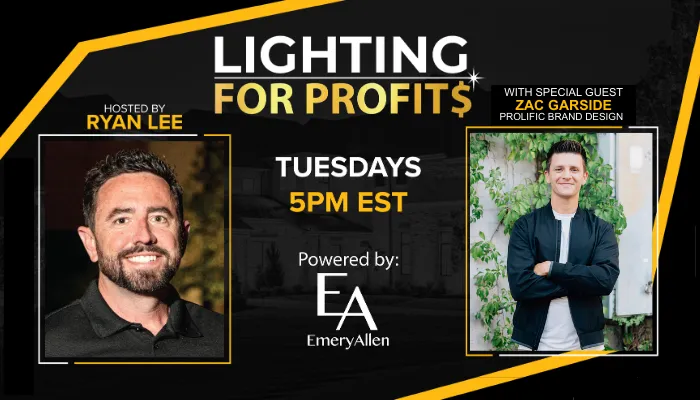
Zac Garside - The Growth Playbook
Lighting for Profits - Episode 229
Zac is on a mission to achieve the impossible: build wealth while raising a young family. From 8 years climbing the ranks at Power Selling Pros to launching and merging his own email marketing agency, Zac now leads Prolific, helping home service contractors grow their business through strategic branding, vehicle wraps, and email marketing. Tune in to hear his journey, insights, and strategies for standing out in the inbox and on the road.
Watch the episode
Episode Transcript
Welcome to Lighting for Profits powered by EmeryAllen
Welcome to Lighting for Profits.
All light. All light. All light. Powered by EmeryAllen.
Here is your host, Ryan Lee.
Oh, light. All light, all light. Man, I love this show. I don't know why, but it's amazing because I get to, nerd out on lighting. At the same time I get to interview amazing guests. And I think I probably take more notes than anyone. But, welcome to Lighting for Profits powered by Emory Allen. I'm your host, Ryan Lee. And and yep, it's true. It's official. We're still. We're the number one landscape lighting show in Logan, Utah. The number one landscape lighting show in Logan, Utah. Excited because my guest today is actually, man, I forgot to ask you, Zach. I know it's not. Is it Hiram? Where? It's somewhere. Is it Hiram? It is Hiram. Okay, so it's real close to Logan and my daughter's up there going to school and I met my wife up there and so it's just awesome. So I love, having any guest on that that knows cool stuff and Zach's one of those guys, but he's also living in Logan. It's like paradise. Not, not every winter is paradise, but in the summer's for sure. So excited to have him on. And, he is with prolific brand design. We're gonna be talking about, branding. Imagine that. We're gonna be talking about, email marketing. We're gonna be talking about some small and simple things that you can do to make big moves in your business. So, will be joined with, Zach Garside in just a few minutes. just as a reminder, still accepting five star reviews on Apple, Spotify, I don't care where. Just five star reviews would be great, but specifically on Apple would be pretty cool because we're stuck at 90, we're trying to get to 100. And it's like, how do I not know 10 more people that would just give me a five star review on Apple. So hook me up. It would feel really good and I would. Thank you.
Light it Up Expo is happening March 3 through 6 in Orlando
and, man, we're about a month out. Light it Up Expo, is happening soon. Orlando, Florida, March 3 through 6. It is filling up. We're about 80% capacity. So if you want a ticket, now is your chance. Lightitup expo. com. and what is filling up even before the tickets sell out are our, pre show classes. So if you want to get the intro to landscape lighting or, or the intro to permanent lighting, those are close to filling up. The advanced holiday lighting, the advanced Christmas lighting That's not like, hey, what is a C9 and what's a male and a female plug? It's more like, how do I scale my business? You already know how to do 50 grand, 100 grand a year, but you want to do 750 grand in like eight weeks. That's the advanced one. Okay, those are going to fill up because we have more tickets to Light It Up Expo than can fit in the pre show classes. So those are first come, first serve basis, which means you don't get to be like, hey, I thought you said it comes with it like it does, it's free, it's included, but you have it's first come, first serve basis. So once they fill up, they fill up. There's no more seats. We can't make hotels bigger. we're at a capacity. Okay. So telling you guys, you're not going to want to miss out. In fact, we just announced earlier today we're doing an outdoor audio. Outdoor audio. So a lot of people are like, have been asking me, like, how do I learn and what products to use and all this stuff. Well, we're doing an outdoor audio, what, Wednesday, March 4, from 9 to 9 to noon, where you can literally get hands on training and see how incredible the outdoor audio sounds. And you can add that on as an additional profit center for your business as well. So, so many cool things are just falling into place and I can't wait to see you guys all in Orlando. Go get your ticket right now before your future self will thank you and your future self will beat you up if you don't. So, so go hook yourself up, get yourself a present.
Zach Garside will be speaking on Lighting for Profits today
Come hang out in sunny Orlando, March three through six again, guys, here in just a few minutes, grateful, to be joined by Zach Garside with Prolific. And it's gonna be an awesome conversation. He's actually gonna be speaking. He's one of our main speakers at Light it Up Expo. And what's so cool is all the speakers that we've like choreographed and put together in place, everything is just there to support you, everything there is to support your business. And it's not like theory of like, hey, this, this is what might happen in five years. Like you're going to learn from people who are doing the things and they've already helped their clients improve their ROIs and things like this. So, can't wait to learn myself from Zach on stage. But today we're going to learn from him here on Lighting for Profits.
When I started my lighting business, it was just a dream
So before we have him on. I just want to share a couple things. So, lately I've had on my mind that, you know, there's so many different ways to win in business, and there's a lot of different ways to lose, too. And, you know, I have people ask me all the time, like, lots of different questions around, like, well, how long should the average landscape lighting install take? And, how much should I charge for my hourly labor rate? How much should I charge per fixture? How many people make up an ideal crew size? Is it 2? Is it 3? Is it 4? How much. What's your. What's gross margin? Like, how much should that be in landscape lighting? what should your net profit be? Right? And like any good coach, I will tell you, the answer to all of these questions is the same. And it is. It depends. Okay? It depends because there are so many variables, and there's so many, different goals and different phases of your business where it really does depend. And so I remember when I started my lighting business, it was. It was just a dream at the time, right? My brother and I decided to start this business, and this was our, like, back of napkin, maybe front of napkin math. We just were like, okay, well, an average job is going to be around $4,000, because he had done two jobs, and they were four grand. So we're like, dude, what if we just do, like, three jobs a week? You know, we're not greedy. We'll just do three a week instead of five, right? So it's like, okay, 12,000. All right, 12,000 four weeks in a month. All right, that's 48,000. Let's just round up to 50, because, you know, why not? And so you times that by 12, and then you're at 600 grand, and we're like, dude, 600 grand. And, like, the products, they don't cost that much. so it's probably, like $200,000 in, materials and labor. And so we're like, dang, like, we're going to have $400,000 to split, so we'll be each making 200 grand. And, I was, like, pretty stoked at that because I had never made that kind of money. And, like, I was making. I just graduated college. I was making, like, $8 an hour or something. You know, it wasn't. I wasn't making crazy money, right? Then I got my sales job, and I was making 100 grand. So I was like, well, if I could go from 100 to 200, like, and have my own business, like, that would be pretty sweet. Well, that's not what happened. Okay? What really happened was we sold some jobs, we made some money, and then we spent some money. Okay? And this is, if you were to, like, film it or write it on paper, like, I didn't have a budget, I didn't have a bookkeeper. Like, it probably would have looked just like this, right? Then we sold more jobs, we made more money, and we spent more money. And at first, you know, I was able to pay myself, like, a decent amount of, It wasn't 100 grand, but I would. I would call it like a living wage, you know, Like, I don't remember how much it was, but it was like, oh, pay myself like five or six thousand dollars a month or whatever. We had a, just one, you know, baby daughter at the time. We didn't need a ton of money, so I was just paying myself enough to survive. But then about 15, 18 months in, I remember being like, what happened? Like, where's the money? we didn't have enough money for payroll. It was like, well, how are we gonna pay everybody? And so naturally, we paid everyone else and didn't pay ourselves. Right? what I didn't realize is that as we grew, we, you know, we, like, got another truck. we, increased our insurance. like, we started to incur more expenses. But my pricing and my sales process didn't change at all. My throughput didn't change at all. I didn't even know what throughput was at the time. I had basically increased my overhead and expenses and didn't change anything else. Right? And so I discovered that really over the next few months of barely getting by, I mean, sometimes I'd pay myself, but there was a stretch, I remember, of at least four months in a row where I just couldn't pay myself. like, nothing. And I. I just knew, okay, well, something. Something's got to change. We needed a. An adjustment in our operations, right? we'd basically just grown into something I didn't account for. so we needed to overhaul our pricing, we need to overhaul our sales process and really kind of analyze, like, what was happening here. And these are, you know, really, like, pricing your cells and your throughput are really like these silent but deadly killers in your business. And, I think that's probably true for any business, but I know specifically for landscape lighting, for sure. So, number one, our pricing had to change, right? We clearly weren't making enough money to scale. I mean, we weren't even making enough Money to survive and stay afloat. So I knew our pricing had to change. Number two, our sales process had to change. Okay. We were taking too much time to close deals. Because what I would do is I'd go meet with people and I would say, hey, which option works best for you? And they'd so this one. And I'd close them. Or they'd say, I don't know, we got to think about it. I'm like, okay, so when do you guys want to get back to me? And I would leave and I wouldn't close the deal, and I would follow up with these people, like relentlessly calling them, calling them, texting them, calling them, calling them, right? And most of the time never hearing back. Most time getting ghosted. But every once in a while I get one.
Per throughput determines your cash flow. It determines if you can scale
So I'd be like, I'm going to keep following up. Right? But that, that took a lot of stress, it took a lot of energy, and it was a lot of wasted time. So I knew our sales process had to change. And then number three, even when we did sell like a good, like decent sized job, we really had no plan in place for like, how long it should take. Okay. Like, I never thought of this at all. It was just like, you just sell a job and then you go do it and it's like, if it takes two days, it takes two days. What do you want me to do here? Right? So what I found is like a one day job that I thought would take a day would turn into like a day and a half. Maybe not even a full day and a half. It's just like, hey. The guy's like, hey, we didn't finish. We just need to stop by in the morning for a couple hours. I'm like, yeah, no worries, you know, like, we'll just do that and, and then like a three day job would turn into like a four day job or a five day job. And I'm like, eh, it's cool. We're not booked out that far anyway. We'll just go do that. Well, this is, this is why it's silent but deadly. Okay? Because like, I had no idea that I was just like building a charitable charity. I wasn't building a business. I was literally building, a non profit. I wasn't job costing. I didn't know how much I was making or in this case losing. Right? And I didn't understand this thing, called throughput. And throughput is simply like how fast and profitably your work turns into cash. Okay. And I see this I've seen this now, the past few years that we've been doing landscape lighting secrets. People come into our program, they raise their price. And I'm talking huge. Some people were charging, like, 200 bucks a light. They're now charging 400 bucks a light. That's not like a small change. They've doubled their price, right? Some people are already at 350, and they go to 400. Some people are at 400, and they go to 500, right? Everyone comes in, we help them raise their price. We help them with belief, we help them with confidence. We help them change their process and everything. Okay? So, like, done. They make more money. We help them with their sales process. Okay? They go from, like, two or three appointments to, like, one call close. Show up 45 minutes, 60 minutes later. Here's your design, here's your quote. Give me the deposit. Let's get you on the schedule. It's like. It's awesome. Like, they're streamlining their processes, and then they're still broke. I'm like, what's going on? I've helped you make so much money.
Why are.
You don't have any money? And it's this. It's this thing called throughput. And I found this out by, again, just kind of like, peeling back the onion and finding these things out. And chances are, throughput might be killing your business. and this is the. This is really, like, throughput determines your cash flow. It determines if you're. If you're running a chaotic business versus a calm business. It determines if you can scale because it doesn't matter how much money you collect. It only matters how much you keep. Right? And this is where a lot of the profit just falls out the back end. And so, I see it all the time, people even reaching a million dollars, $2 million, and, like, they don't have anything to show for it. And it's not because their pricing's off. It doesn't. Not because their sales process off is because their throughput. And so I want you guys to start doing this. Start measuring the time that it takes you to do your installs. If you have, let's say a, we'll just pick a small job, like a $5,000 job. Let's just say, okay, you have a $5,000 job. You're gonna have to. You're gonna have to know some numbers here. You have to start job costing this to figure out how long did it take? Was there three guys on there? How much are you paying them? How much are you making how much were the materials, and then you're gonna figure out what your profit was.
There's a thing called daily overhead. And I'm not gonna go into the details right now
There's a thing called daily overhead. Okay? And I'm not gonna go into the details right now on how to calculate this, but when you figure out what your daily overhead rate is, this is basically the amount of money it costs you to wake up every day, regardless of like if you sell a job or not. Okay, well, and a lot of business. The first time I did mine, it was over 1500 bucks. And then it was 2,500 and that was 3, 500. I was like, what? I thought, I thought I was making so much more money. It's like, well, yeah, that's what you thought, but that's not reality. And so if your daily overhead rate is $1500 and you sell a $5000 job, the materials on that $5000 is probably gonna be about 25%. Okay? So let's say that's 1500. And then you got like all these other things. So if you don't finish that in a day, then the next day you go back instantly you're setting fifteen hundred dollars on fire, right? So you go from potentially profiting fifteen hundred dollars on a job to now, if you go back the next day, that fifteen hundred dollars goes straight into it, and then all of a sudden you're broke. And if you were only planning on making $1,000 on that job and you go back the next day and it costs you 1500, you. You just lost $500. Right? And so I want to bring this to your attention because you can be doing a lot of things, right? But then like failing on the back end, failing on the delivery, failing on, on this part of the business, and it's costing you way more than you even know, right? And, so I want to encourage you guys to do that. Spend some time like away from the day to day and analyzing. Like literally schedule like Thursday afternoon every week to be like, no, this is my data day. Like, this is when I can really crunch the numbers and figure out, are we, should we even be in business? Should we even keep doing this the way we're doing it? these are eye opening experiences that will help you adjust other things because you might be selling these awesome jobs. But if it's that custom and it's taking that long, well then maybe you need to charge more money, right? Or if it's not that custom and your guys are taking a long time m, maybe you shouldn't be paying them hourly. Maybe they know what they're Doing. Right. But what if you gave them an incentive and a performance pay that they had an incentive to knock that out, and they could go from making 150 a day to 250 a day if they just had some incentive. Right. So there's some things that you can do to, account and adjust for this once you figure out what your throughput is and that you actually have a problem. But something needs to change because it doesn't make sense to keep selling more jobs, increasing more revenue if there's no more profit to follow.
Emory Allen makes premium LED lamps for lighting professionals who demand the best
Okay, so that's what's on my mind. And I, got off my chest, so I feel better already. Hope you feel good too. Hey, you know what? Friends don't let friends install garbage lamps. If you want less callbacks and more referrals and more repeat business, stick with Emory Allen. Emory Allen makes premium LED lamps for lighting professionals who demand the best. Don't settle for less. Upgrade your designs and installations today with Emory Allen. Reach out to tom gmaryn. com and he will hook you up with that discounted contractor pricing. Just mention that you heard about him here on Lighting for Profits, and he, will hook you up again. It's his email, tomgmeryallen. com and, make sure you mention, my name. He'll hook you up. And Tom G and Emory Allen are the platinum sponsor of Light it up, so. So come hang out in Florida and learn some stuff. All right, I think it's time, let's get our, music going and get Zach on the show.
Zach Garstad is the founder of Prolific Brand Design
Welcome to the show, Mr. Zach Garsad. What's up, Zach? What's up, man? Thanks for joining me.
Do your thing, man.
Yeah, thanks. I appreciate it. I love it. I've always wanted to be like, a, like a radio dj. So I'm like, dude, I get to do it every week.
Yeah, I hear you. That's cool.
Well, thanks for joining me. And, how's. How's Logan? What's the weather like up there?
It is so warm outside right now. It is. It is crazy. I mean, you probably know and you're probably tattoo.
I can't believe it. Logan's. It's never warm. It's always cold in the winter.
We have frequently, we've gone multiple times. So, like, North Carolina, Florida, Texas, looking for another place to live. And we always say the reason why is because nothing beats a Cache Valley summer. But almost everything beats a Cache Valley winter. Until this year. This year, winter has been basically spring, while the rest of the country is getting dumped down with snow.
I know. I think maybe that's going to raise the, the real estate rates. People are going to be like, actually, like you said, nothing beats a Cache Valley summer. but everything beats a Cache Valley winter. But now it's like the dream place.
Snowboarding has sucked because of it. But yeah.
Do you go to Beaver?
Yep.
How? How? I haven't been there for seriously. I don't know how many years, but like 20. 20 years probably. Yeah.
Yeah.
Has it changed?
Yeah. I mean, I don't know. I only, I only started going there five years ago, so I don't know what happened during the 15 years between you and I.
That's awesome.
Trading Places. Yeah.
Well, thanks for joining me. do just a quick intro. Who is Zach Garside and, And who is Prolific?
Yes, my name is Zach Garstad. I, I'm based here in Hiram, Utah as was mentioned, basically my whole career is a mission to do the impossible, which is build wealth and a young family at the same time. I, in 2023 I started an email marketing agency helping home service businesses, H vac, Garage door lighting, plumbing, etc, make more money from their email lists. And then in 2025 I merged that business with Prolific Brand Design. So we now help contractors stand out on the road and in the inbox with premium strategic, logo design, truck wrap design and email marketing. for eight years before that I was a, I worked at Power Selling Pros doing call center training. I was, I served in every position there from quality assurance to coach to head of sales to CEO before I left to do my email marketing agency.
I love the I don't know if that's the tagline. Stand out on the road and in the in the inbox.
Unofficial. That's my personal tagline.
I like it.
Yeah, we're, yeah, that's we, we kind of go. Our tagline is strategy first, branding and email. But yeah, when I'm out kind of talking about it more practically, it's stand out on the road and in the inbox.
Yeah, I like it.
How did you get started in email marketing in 2018
I, you know, I was going to ask you about more of like the on the road stuff, but now I'm thinking, how did you get started in email marketing in 2018?
yeah, in 2018 I did an internship@digital marketer. com, if you're familiar with Ryan Dice or. Ah. So I interned there in 2018 and I was just getting into marketing. Like I, I didn't really know much at All. So I worked with, like, the content team, the sales team, the SEO team, the paid ads team, social media. But the guy who I was most interested in was Ben Griffin. Ben was the copywriter for Digital Marketer. And I thought it was magical how, he could sit down, type an email, hit send, and poof, money would appear. Yeah, I was like, I got to figure that out. I got to figure out that skill. No matter what else I do, I have to figure out that skill. So when I finished my internship, I went back to my job at Power Selling Pros. And I said, hey, do we have an email list? They're like, yeah, I think we've got a couple thousand names on there. So I said, would you mind if I just, like, give it a whirl? See what, see what I can do? That was in 2018 again. So it's been now almost eight years since I've been doing email marketing. I just got really good at it at Power Selling Pros, in 2020, when the pandemic hit and we couldn't go to conferences or trade shows anymore, that was really the time for me to show, hey, I can monetize an email list. You know, like, we, we can't go to shows right now. We can't go market on the road like we usually do, but we can hit up these email contacts. So that was when I really, stepped into it as, like, this is a legit. This is gonna be one of our top marketing channels. And I just became really great at it. And then Megan likes, in 2023, when I was. When I knew I wanted to start my own business, but I didn't know what yet. she suggested to me, why don't you try an email campaign for me? So I went into her window cleaning business. Jeff likes clean windows. And it was either September or October when we had this conversation. So they wanted to pre sell Christmas lights installation, get that going. So that was the very first campaign I ever did for a client. It was let's sell Christmas lights installs. And we had their CSRs completely overflowing with responses, and leads. They could, they couldn't even keep up with the number of people who replied wanting a quote. For Christmas lights installation, that is. And the rest is, as they say, history.
Dude, I love the way the world works because I love Megan. She's my favorite. And then of course, it. It ties into Christmas lights. Like, that's just. It's just like poetry. That's beautiful.
That was cool.
I learned. So I learned about Email marketing from Russell Brunson. And, I don't remember when there was no, like, epiphany moment or whatever, but I know in this business, I started just making content and like, putting stuff out there. It's like, hey, if you want this thing, just like put. Put your name and email here. And I was building a list without even like an offer. I just knew, like, the value of building a list. It's kind of like just like control the traffic, you know, because you need traffic and you can buy traffic on Google, you can buy it on Facebook. And like, what if they just decide to raise. Like, what if it just costs like, triple. Like, that's scary situation, you know what I mean? Like, yeah, there's. There's economics involved in supply and demand and all that, but still, like. Or like, what if it just went down? Or there's so many things. And so I did learn the value several years ago about just like owning your own traffic. And that's the beautiful thing to me about an email list is any business can own their own traffic and it doesn't cost. It's not that much. You're an email away from filling up your CSRs and your install schedules and everything else. So that's way cool.
That's right. it's the only channel that you have total control over. I get a very common reaction when I tell people we have an email marketing agency, which is some version of email is dead. I don't check my own emails. Nobody checks email anymore. Either my. All my emails in the spam or the trash folder. I, had a leader at a major private equity company recently say to me, I've made a post like, hey, we're going to be the best. The best email marketers in the world. And he goes, this is the most depressing thing I've ever read. Okay. Block.
Did you email him? That's.
Did I. No, no, it was just a post I made online. Yeah, I just said something like, just manifesting this, you know, within a few short years, we're going to be the best email marketers on the planet. Like, every business who wants to get good at email will come to us. And he goes, this is the most depressing thing I've read all day.
So awesome.
I was like, all right, well, anyway, back to your.
I would have just asked him, can you. What's your email address? You know?
Yeah, would you mind giving me your email so I can make sure you're not getting any of our.
Email is a Channel you control, you own. And it's just demand generation
Well, but, I. Email is a Channel you control, you own. Like, when people say those things to me, oh, emails, dead emails, this. Those same people have no problem building their business on social media or Google, or Google business profile or LSA or AI. Now, platforms, you have zero control and influence over platforms that don't care about, you don't know you have. It makes no difference to them whatsoever whether your business is successful. I find it much, much more relaxing than running my business to know I have a list of people who want to hear from me. And if I ever need business, if I ever need to get a couple demos on the calendar, if I ever need to fill my board with jobs, I can literally send an email today saying, hey, I've got a couple openings this week. Who wants them? And pretty reliably, as long as you've done the groundwork of building that relationship, put those people on your calendar. Tremendously powerful.
Yeah, no, I love it. I'm actually talking later this week at another lighting conference. And, I'm going to be talking about different levers you can pull in your business. And it's not specifically email marketing, but it's just demand generation. And, people say, I want more leads. It's like, well, but what are you doing? And I'm talking about generating demand. You don't wait for demand. And that's what email marketing is like. It's like you said, like, if you, if you need to fill, Fill a gap or whatever. I literally. I had my landscape lighting business and we were doing fine, you know, but I didn't even. I certainly wasn't. I had a list, but I wasn't using it. You know what I mean? And so I literally sent out one email like you're talking about. And I was like, hey, we do have some gaps for Christmas sites. We only sent it to, like, our top, you know, 20 or 30 clients. We didn't even have that much room. We only wanted, like, two jobs. This lady calls me, I go out, meet with her, and she's like, oh, my gosh, we're so glad you emailed us. I'm like, really? Like, that's the weirdest reaction. Everyone else talks trash on email and, like, stop spamming me and all this stuff. I'm like, really? And she's like, yeah, my husband. I were just talking the other day, like, we couldn't remember for the life of us who did our outdoor lighting. And we knew we wanted to find you, but we couldn't remember who it was. And the crazy thing is, Zach, these people had just spent, like, $40,000 with us, like, two or three months prior. And so this is a huge learning moment. Like, everything's just, like, going off in my mind. Like, wait, why are we not keeping in touch with our clients? You mentioned, like, maintaining that relationship. Why. Why aren't we adding more value to the relationship? I got that 40k and was like, cha Ching, let's go. And then that's all I did with it. And so, ever since that moment, we literally switched on. Like, hey, let's. Let's keep emailing these people every week. Let's maintain a relationship, because no one should forget who they spent $40,000 with. Like, that's a. It's, like, depressing thinking about it. So that was a huge learning moment for me. And I didn't. I wasn't a copywriter. I'm sure I wasn't even doing it all right, and it was working. You know what I mean?
Did. I mean, you hit the nail on the head? It's. Every business owner I know will say, our relationship with our customer is important. And yet when they collect money and then move on to the next thing, what are you doing to keep the relationship? And the answer 90% of the time is nothing, Absolutely nothing. So you say the relationship matters, but you're not doing anything to nurture the relationship. You know which relationships suck? The ones where you only show up when you need something. And that's how most businesses treat it. They treat their email list like, hey, we send emails when we need jobs, when we are desperate. And then you show up and people are kind of like, who are you? What is this? I forgot, What. Forgot what's going on here. Spam, delete, ignore. But if you're consistent in building the relationship. If I had a lighting company, landscape lighting company, or Christmas lighting company, this is what I would do every single time I finish a job. I would say to the homeowner, hey, John, it's been an absolute pleasure. Thank you so much for allowing us to come out and install these lights for you. Just so you know, once a week, I send out a. I, send out a message to all my favorite customers, or I give them discounts on local places in town where we share advice on, like, how to preserve the integrity of the lighting we've installed for your home, discounts, things of that nature. Are you cool if I add you to that list? Awesome. Thanks, John. Every single week, I'm sending something. Sometimes it's a personal story, sometimes it's a, hey, I Just worked out a deal with the pizza. With the local pizza place. So everybody who comes and mentions this email gets 10% off. Go enjoy dinner this Friday night. Right? send them some tips. Give them a warning, like, tell them about some customer who messed up their lighting situation. And make sure nobody else makes the same mistakes. And of course, always include an offer. Give them something to buy from you. I would do that every single week.
50 to 60% of people open every single email you send
In the beginning, I'm gonna have 1, 2, 5, 10, 20 people on my list. But in five years, if you're aggressive in growing your business on all the other channels, you could have thousands of people on this list where 50 to 60% of them open every single email you send. Every time you send something, you book a job. And when you walk around in your community, people will. I promise, I promise because this has happened to me. This happens to my clients. You will walk through your community and people will say to you, hey, I get your emails. I love them. Thanks for sending those. I got, that was a great email you sent the other day. That was so funny, that joke you told. Or, Megan likes recently told me this about Jeff's company. She was like, we'll walk around and people will be like, oh, my gosh, Jeff, I get your emails. Or when I was doing it for Powersign Pros, I'd go to a conference and literally I had people who would say to me, oh, my gosh, me and my CSRs read your email. Do you mind if I take a picture to show the team back home?
That's so sweet.
I'm like an email celebrity out here, dude. When you post something on social media, the algorithm is designed such that maybe 3 to 5% of the people who follow you will see any given post. we all know almost no one sees what you post. This isn't 2010 anymore where you can post a status update and all your friends see what's going on in your life. It's optimized for us to. It's not optimized for us to engage with contacts and friends. It's now optimized for us to passively consume the content of influencers. Email is not that way. It is about the connection. It's about the relationship. If you can successfully build that over a long period of time, think five years, not five weeks. Untold riches await you.
Yes, dude, that might be. That might be even a better tagline. Untold riches await you.
Yeah, maybe I'll just, Ally. That's the headline on, the website.
Yeah, we're Definitely adding it. I have no equity in the company, but I'm saying collectively we're making that change.
Fantastic.
you mentioned a couple things in there that I think you glanced over, because this is what you do all day, every day. But, and I've had, I've had people like that too. I'll meet them at conferences and they're like, dude, can I just say I love your emails. And I'm like, this is making my day. Like, no one else in the history of the world, like, everyone else is like, you know, unsubscribe, unsubscribe, spam, spam. And it's, it's because, like you said that you need to add value. So when you're adding value, how often, like, are you saying at the bottom is like, P.S. take advantage of this, our, maintenance offer, or should you do, like, a ratio of, like, value to offers? Like, how much is too much?
Excellent question.
People become a customer because of value, it's relationship, M. M.
So one of the biggest mistakes that most business owners make in their marketing is believing that the reason the customer became a customer is the same reason they will stay a customer. M. But those two things are very different. People become a customer because of value. You solve a problem, you solve it at a reasonable price, and you solve it in a reasonable time frame. The reason they stay a customer is not value, it's relationship. Of course, value, values, table stakes. Like when people say, give value, give value. Well, no, duh, you're a business. Like, that's literally what you're supposed to do. That's not good advice. When people say, give value, I go, of course. Like, that's literally the only reason people pay us is because we can provide value. I'm talking about loyalty, though. I'm talking about being the only service provider you think of when something goes wrong or when they need something. That's not value, that's relationship. M. And those are two different things. So when people get on my email list, it's because I gave them some sort of value, but they stay on the list because of the relationship they develop with me. Every email I send reveals something about me and my business. It reveals something about how I do things. It reveals my values. It reveals the way that we're different from other people in a, way in order to strengthen the relationship. But I almost never go about email marketing thinking, how can I create value? How can I add value in this email? People write value emails every single day, and no one ever reads them. Because honestly, value content is commoditized. It is literally a commodity on the Internet. Now, AI can write a value email, right? I could go to AI and say, make me a list of the five best, you know, landscape lighting providers, rank, order them by price and whether it's accurate or not, it'll do it. Yeah, it'll, it'll create that content. And then I send it to my list and say, look, I, I sent a valuable piece of content to my list, but is it, is it valuable if I could get it from anywhere else? And you're anywhere. What I can't get from anywhere else is entertainment value, Something that makes me laugh. you know that. Have you ever heard the term the nose breath laugh where you're reading something or watching something and you just chuckle under your breath? We call it the nose breath laugh. And I want the nose breath laugh. Every time I send something, I want them to read it. I want them to go, oh my gosh, this is not just valuable, this is insightful. This is fun. Think about the context in which people consume content or read their email specifically. Generally speaking, it is not to be productive, it is to pass time. You're standing in line at the grocery store, you're on the toilet, you're stuck in traffic, you're bored out of your mind. You're just waiting for the waiter or waitress to bring you your food. It's moments of boredom. And what do we want when we're bored? We want entertainment. So I very rarely again think of it as how do I add value in this email? What's the value to sales ratio? It's relationship, relationship, relationship, entertainment, entertainment. And I just, I just include links to the stuff that we do. So let's, I'll give you an example right now. Okay. you, let's use Beaver Ski resources. We have that kind of like connection. Okay. The last time you went to Beaver was 20 years ago? Yes. Yeah, I went last week. So what we're going to do here is I'm going to be you. I'm going to sell tickets to your event using this little entertaining relationship building story here. I would say in the email, hey, what's up? It's Ryan Lee. 20 years ago was the last time I went to this ski resort in Utah called Beaver. I used to go all the time when I was in college and it was awesome. They had these incredible lifts, they had this awesome terrain park. But then just the other day, I was reminded of this place because I talked to a guy who went there last week and I asked him, what's changed? what's changed in the last 20 years. And he was. He was listening. All these things have changed. They've got these new lifts on the east side. They've got these new snow machines. They've got these new types of passes. And I realized, wow, this place is, like, unrecognizable to me because it's been 20 years since I've gone there. And it made me realize how many of our customers, how many of your customers have no idea what you can do for them today because you haven't reached out to them in what is the equivalent of 20 years? You haven't reached out in six months, in a year and two years. If you've got a bunch of customers from the past that you haven't done business with in a long time, then I want to encourage you to come to the Light It Up Expo in Orlando on March 3rd through 5th. Going to have a speaker there. His name is Zach. And Zach's going to give you strategies, the A through Z playbook on how to take your list of pass leads and customers and make it feel like you just did business with them yesterday, not 20 years ago. Click the link below to order your tickets. Enter promo code. You know, Zach for 10% off.
Dude, that's sick.
So you see what I did there, right?
We're literally going to do. We're. We're getting that transcript, and we're just going to send that out.
but it's. There's, like a framework there, right?
There's this happened, which made me realize. Which means you should come to the event
There's this happened, which made me realize. Which means this happened. I was talking to Zach. It's been 20 years that I went to the ski resort. I wonder what's changed. Made me realize. I wonder how many of my customers would feel that way about me if they saw me for the first time today. Which means you should come to the event where you're going to get the strategy on how to turn your old customers into new customers again. I learned that framework from a guy named Jay Kunzo. and I have dozens others like it that we use to take your list, take ordinary, mundane things going on in your business and turn it into sales material.
Oh, I love it, man. Now, this is good, because I feel like I've, like, I know enough to be dangerous, you know, like, this is just taking it to the next level. Like, okay, I know about, like, a hook, and, you know, you gotta have a storytelling and stuff like that. But this is just. This just makes it so much better.
What's an average open rate before people start working with you
I was gonna ask you this question. I. I'm still gonna ask it, but I Think I kind of know the answer. well, what, what's an average before people start working with you? What's like an average open rate? Because you said a number that was pretty high. 50 to 60%. I don't think most people are getting that, on their own.
Yeah, that's our norm. Like, if we're not there, it's, we're disappointed. Most people are in like 50, not 50. Sorry. 15 to 20% is what they think is good. Typically. What that tells me is you have a spam folder problem. Like, people aren't even seeing your emails. And this is a big reason why a lot of business owners think email doesn't work. It's because their emails are going straight to spam.
Because it's not working.
You just don't have the fundamentals set up correctly. There's, there's certain technical elements that need to be in place and you have to have a certain level of engagement with your list to get to the inbox. So what we tend to do is we're going to a business and they're doing 16% open rates. So first is, all right, let's make sure your domain is authenticated, because a lot of businesses don't have that. That's basically just a fancy way of saying we need to prove to Gmail and Yahoo that you are who you say you are. If you email from ryan@lightingforprofits. if you haven't authenticated that domain, what's stopping me from setting up an account on mailchimp today and saying, I am Ryan lightningforprofits. dot com and now Gmail and Yahoo are like, which one is it? We don't know. Neither of them have authenticated the domain. So we do that. It's a little technical. And then we take the email list and we break it up into chunks of 300 people at a time. And I only want to send it to 300 people on the first day, and then I want to send it to the next 300 people on the second day. And it's got to be something that's super irresistible that they're going to want to open. Because over, the course of a month, 300 people a day, I could probably get a 50 to 60% open rate. That's going to be a lot harder to do. If you send it to your full list, you say 10,000 people all in one day, you're probably only going to get 15 to 20 because Gmail and Yahoo aren't delivering that email. People aren't familiar with you, but chunking it up allows you to kind of slowly, day by day, show Gmail, show these email service providers. We're reputable. Look, 50% of people open every email we send. And then you restore the sender reputation and get high engagement.
Dude, that's sweet. All right, so I'm gonna hire you, and then you should just, like, we should be totally transparent and make fun of my system. You know what I mean? Like, you like. Yeah, look, we started working with Ryan. He was here, and then he didn't even have his domain authenticated. Like, I. I don't even know what we have. You know what I mean? So, yeah, it would be good. We, we'll literally use my business as, like, a case study to be like, yeah, this guy, this guy was getting results and he did everything wrong. And then now look at what's happening with his business. So I'm in. I mean, my business is different than, like, a home service business, but still, a lot of these rules are. They're universal. So.
Yeah.
How about the, subject line? How much does that matter?
it matters not as much as the from line. think about that. Think about it this way. If your mom sent you an email today and she literally forgot to put a subject line, it just says from Mom. no subject. Would you open it? Yeah, I know, I know I would. Yeah, it's your mother.
Yeah.
So the from name matters a lot more than the subject name, because if I trust the name that the email comes from, I'm inclined to open it regardless of what the subject line says. so I. That's why we put such a high emphasis on the relationship, on the trust factor. Because I want people, when they open their inbox and they see Zach Garsite sent them an email, I want them to get excited. You know, what's that going to sell me today? What's that going to say today? What's the take of the day? Same with Ryan Lee. Same with fill in the blank with the name of the person listening to this. So the from name matters a lot more. The subject line matters to give a tease, you know, you could use curiosity, you could use a shock effect subject line, you could use just plain value, like how to fill in the blank. I like to kind of give story teasers in my subject lines. for example, I recently did one that was, My ancestors got mad at me was the subject line of my email. And it's like my ancestors got mad. What are we talking about here? Right yeah, people open it and read the email. so I don't have a formula like A plus B equals C, boom, they open the email. it's all about reading the room.
You know, people always in relationships, this is intuitive. If you have something important you want to say to someone
You know, people always in relationships, this is intuitive. If you have something important you want to say to someone in your life, you read the room. Is this the right time? Is this the right place? I want to have a serious conversation with my wife about something. You read the room. Is this the right moment? Or do I need to wait until the moment is more appropriate so we're in a better environment? It's the same thing with your list. Read the room. What's going to get them to open today, right now, if you're in, you know, I'm not going to get political, but like, if you live in Minneapolis right now where there's all an incredible amount of political upheaval happening and you're trying to send out some like silly promotional email with some joke, I don't know. Read the room, dude. Like it's.
Have you heard about our annual maintenance program?
Like all of our, all of our technicians are background checked, drug tested. Dude, you gotta read, you gotta read the room when you're sending out stuff, you know what I'm saying? Like, that's just, that's my best advice for like, what's the subject line? Read the room. What's going to get the open right now? Think right now in this moment. What can we do?
And will you ever test those? Like, will you change those to see if you get the same email, gets a different open rate with a different subject or anything like that?
It has to be a big enough list. You know, I think a lot of businesses worries or at least think about split testing different variations of things when it really doesn't make sense for them to do so. Like, if you have 4,000 people on your list, it doesn't matter, okay? You're not going to get any, you're not going to get a meaningful, any meaningful data from a split test at that list size. you have to have like 50, 100, 200,000 people on your list for split tests to be meaningful. And we have very few clients who are in that, that realm. You know, that's more like tech, e commerce type companies.
So at that point you're like, that one didn't hit, but they're getting another one next week anyway.
Basically. Yeah. And a lot of our companies, clients, we send two emails a week, so it's like we're doing another one in 48 hours. Yeah, you know, okay, I mean, what's it going to tell you if you send two subject lines and ten more people open? B? Like, I mean, I don't know. This is just not significant enough in my opinion.
Most home service businesses do a poor job of advertising for leads
Do you have any advice for people that don't have a list, or maybe they only have a couple hundred people on there and, and are listening to this, going, damn, like, yeah, I'm, I'm buying into this, but I don't have, like, how can they grow their list?
Yeah. M. I think one thing is what I mentioned earlier. If I own my own lighting company, every time you serve a customer, every single time you finish a job, ask that customer for permission to send them messages every week where you give them discounts on local places in town, tips on your services and so on. Just make sure that you have that built into your process that you're opting people in every single time you serve them. The second thing is, most home service businesses I know do a pretty poor job of advertising for leads. Pretty much all the advertising that I see in the industry is advertising for sales. You're up, you're optimizing for the people who are ready to buy right now, and you should do that like that. That's obviously good practice. But I also really like when a company runs a good lead magnet campaign. If I've got a lighting company, I bet you there's a, there's a very small percentage of people in your market who know they want to install permanent lighting or landscape lighting or holiday lighting. Okay? So obviously we want to get those people, but what about the other 50% of your market that has thought about it, but just need some nurturing? They need that, like, show up in their inbox 10, 20, 30 times before they're ready to go. So I'd run an ad in a market like that. This says something to the effect of, just to keep it general, If you're about to get on the ladder, right? if. If you're looking at that ladder in your, in your garage right now thinking, I'm gonna have to get up and put up some light soon. Enter your primary email address below and we're gonna send you this free PDF. We put together on 10 different ways to make it so that you. To install lighting so you never have to hop on the ladder again, you know, And I'd run some campaign like, destroy the ladder. I'd do some social videos where someone's on their ladder and I'm like, hey, come here, come here, buddy. Guy gets down from his ladder, and then I throw the ladder to the ground and I break it into a million pieces or something to the effect of that, right? Where they got to enter their information to get this video or this guide on how to never use the ladder again, which is, of course, get permanent lighting installed, have somebody else install lighting that's not permanent, et cetera.
I love it. Now, it's well said. Like you said, I think 102% of businesses are advertising for sales, not for leads. And they're just like. I get so mad when it's like, I don't know. They're just tire kickers. And I'm like, well, yeah. Do you know what a funnel is? You know, like, they don't even know what permanent lighting is yet. Why would they just give you $10,000? So, you have to account for that, right? And the messaging is different. And it's like, I love. I just love the way you word it and everything, because then all you're trying to do is just get an email, and then you're building that list. Building that list. When you build that list, you build a relationship, puts them further down in the funnel. Now they're ready to buy. Finally hits that one email on a Thursday at whatever time you send it out. And it's like, cool, now we. Now we got a sell, not just a lead. And, I mean, I don't know, what's your experience? Sometimes it could take months, if not years, to warm people up, right?
Yeah, it can take a long time.
It takes seven touch points for someone with your brand to become a customer
I mean, this is why, you know, I'll make a little segue here to what we do with branding. But why branding matters? Because the traditional mentality, right, Is it takes seven touch points for someone with your brand to want to do business with you. That's a very vague and general number. It's kind of like saying happiness doesn't improve after $80,000 a year. I'm like, you have our kids. Yeah. I think we're getting pretty dangerous with these general numbers here.
Yeah.
But when people say that kind of stuff, it takes 10, 15 touch points for someone to become a customer. I go, what if it took less? What if your brand was. What if your brand was strong enough that it didn't take that many? Because here's what most companies do, right? And I'm gonna, I'm gonna make some people feel slightly called out. Not intentionally. It comes with love, though. It comes from a place of love. This is my opinion. Most companies don't advertise themselves Very well. They advertise what they do. So most lighting companies, if you, if I were to put 20 logos and websites of lighting companies up on the screen right now, it would be extremely similar from one company to the next. Most companies would have very similar type of logo, very similar font, very similar website. In the roofing industry in particular, I see this all the time, where every single company has a roof in their logo.
It's that same one too. It's not that clip on one. I've seen it.
And if they've got an M at the beginning, it's like, oh, clever. You know, you turn the M smart.
Mike. Why would I need a branding agency? I can do that.
So most companies are, are doing a poor job of advertising for themselves, but they're doing a good job of advertising for the service in general. So all you're doing is making people think lighting, lighting, lighting, but they're not making them think of you.
I, like that.
You know what I'm saying?
They're creating a ton of awareness and leads for their competition. Who has better?
Exactly. They're, you're basically creating touch points for the industry so that it's like 1, 2, 3, 4, 5, 6 and then this. It's not the seventh touch point with you, it's the seventh touch point in general. And they go, oh, yeah, lighting. I've been thinking about this forever. Let's do business with these guys. And it's the first time they've ever seen that brand before.
Yeah.
So you did all this legwork only for them to buy with someone else because you didn't brand yourself, distinguish yourself enough from the competition to be that person when they're ready. That's the branding.
Yeah, I love it.
Ryan Can: We merge email marketing with branding to help companies grow
Let's, let's talk about it because, they, they, it's kind of interesting because on like the, on the outside it's like, oh, wait, you, you merged email marketing with branding. Like, that doesn't make sense, but they actually, it actually does quite a bit. I like it. but let's talk more specifically on the branding side, where, what you said they're advertising for the industry. Like what they do, not who they are. How does someone fix that?
Yeah, when we go through a brand design process with a company, so we have a, we do logo design and truck wrap design. It's like the product. But how we get there is we sit down with our clients and we try to answer three things. Number one, what's your core belief? What do you stand for? Number two, what's your brand personality. There are 12 types of brand personalities. One of them is yours. And then number three is, what's the story you want people to tell about you? So all these three things, core belief, personality, and story, help us understand who you are. Not what anyone else is doing, not what the opportunities in the market are, but genuinely, when you're at your best, who are you, what makes you you, what makes you different from everyone else? And then based on that, we create a logo. We create a brand strategy for, like, how you behave and how you look in the market. I'll give you an example, a big example than a micro example. Okay, a big example would be, You ever heard of this? that's a pretty small example, actually. There's this hotel in California called, I think it's called the Castle Hotel. And at the Castle Hotel, if you're going, if you're hanging out at the pool, there's a red phone on the brick wall by the pool, and underneath it, it's labeled Popsicle Hotline. So anytime you or your kids are thirsty or you want a snack, you go over, you grab the red phone and you. You request which flavor of popsicle you want. And then somebody in a tuxedo with white gloves on comes out and brings you a popsicle on a platter. Now look at the smile on your face, right?
Sick. Yeah.
Just me telling you about that. You're like, that's cool. That's unique. That's different. That's something I'm going to remember. What do they say, Ryan, when you go to Chick Fil A and you say, thank you.
My pleasure.
They say, my pleasure. When you go to the Doubletree Hotel, which we're going to go to for your event next month, what do they do when you check in?
Give you a warm cookie.
They give you a warm cookie. This is. We call this emblematic touch points. These are moments in the customer journey where you do something that's undeniably you. It's not something you could copy or duplicate. It's not something a guru could teach you. It's just we know who we are. We know what we stand for, and this is something that we do. You know what I'm saying?
I like that.
and again, we create visuals to go with. We create a logo. Like, we have companies that are all in the same industry. I could show you slides, and I will. In fact, at the conference, I have a slide in my deck that has three companies who all provide identical services. They do the same thing, but they look completely distinct from one another because they design their logos and their wraps to be based on who they are, their personality, and what they want to represent. And so you look at the three of them and at first glance you'd be like, there's no way these companies offer the same thing. And that's what's beautiful about it.
Interesting. That's crazy, dude. I love geeking out on this stuff. It makes. I want to start a lighting business just so I can have a new brand. Like, can we do that? Is it possible? Because I, don't know. That would be the hard way because I already have, like, a lot of good things going. So is that possible to do? Can I do that with my, my branding now? Can I still. I just want to go through that same process 100%.
Yeah, yeah, absolutely. I mean, that's what we do, right? Companies, our clients have businesses, right? They have established businesses and revenue and in many cases brands. But generally the two triggers are, you know, we just saw a competitor do a rebrand and they, their vans pop, man. They like, they stand out in the market. We want, we want that for ourselves. Or it'll just be somebody who's known from the beginning, like, yeah, you know, our brand is okay, but we've never really put the thought and intent into it to make it something that's truly unforgettable. Let's do that now. And so they come to us to kind of get a refresh going and we rebrand them.
How do we get the word out sooner? You know, I'm, I feel like I'm kind of in the same boat where, like, someone will find out about me and they'll find out about landscape lighting secrets and like, oh, yeah, yeah. Like, do you actually think that this would help you? Yes, but you said you can't afford it. Like, they, they, they're, they're. It's like an expense versus investment mentality. Scarcity, abundance, all this stuff. But I truly believe in what you guys are doing. I know that branding makes a difference. And I know if I tell them to run my play, increasing their price, closing deals on the spot, high quality leads, you run that same play with weak branding versus branding with you guys. It's not even close. The results are going to be totally different. But I don't know how to convince people of that, like, because I'm like, oh, no, I, I'm just using this logo for now. I'm going to do that later.
Everything, everything you do works better when you have a strong brand
You know, let me, let me get some sales, under my belt. And I'm like, but you're setting yourself up for success, you know, or you're not setting yourself up for success by doing it that way. Like, let's, let's run the play with the right branding in place because it's easier to charge a premium price. It's easier to close deals. Like, it's, you already have trust, like all these things. So I don't know, like, how could we get the word out sooner instead of having a rebrand five years in?
It's a fantastic question. So I'll say a couple things. One, marketing is. This is the, the spark, if you will. You know, the, the lighter brand is the fuel. Okay? So if you've got an enormous pile of giant logs, that means you've got a strong brand, which kind of emphasizes your point. Everything, everything you do works better when you have a strong brand. We have a client recently who just put a case study together for. And they reduce their cost to acquire a customer from $214 to $93 just going through the rebrand process. Right. So you know, you're literally getting double the customers. Yeah, you cut it in half. But here's what I'd say. Your logo and your brand are not the same thing. Your logo doesn't matter until you know what your brand is. I see on the opposite of what you're talking about. I have seen plenty of companies in this industry come and go who have beautiful logos that look great, but they don't know who they are, what they stand for. It's just aesthetics. It's just a fancy paint job. So the brand is, again, what do you believe? What do you stand for? What's your personality? How do you act? How do you want the market to perceive you? That doesn't have that much to do with your logo. The logo is a symbol, okay? When we pledge allegiance, we pledge allegiance to the, the flag. We don't pledge allegiance to the country because what. The flag is a symbol of everything the country represents, everything the country aspires for. Which came first? The country. Right? We had this nation, we had these ideals and these values that we were striving to live into. And then we created a symbol to represent it. That's what the flag was. A, business is the same thing. When a business comes to us, we actually don't even start the logo process until we've worked with them on. Do you know who you are? Do you know what you stand for? Do you know what your core belief is? Like, how are you going to act in the market. What's unique about you? What are your values? And then you really need to get that into the bones and into the DNA of your people. Know, who you are and act like it is what I like to say, and then tell your customers about it, which is where email comes into play, because you get to build that relationship with them.
So when you say, like, a logo is different from a brand, and you've seen these companies that have a great logo, they awesome paint job, are you saying they're not acting the part? They're not delivering the warm cookie? They're not doing the. The Popsicle red phone. They're just not doing the things that make them unique.
Everything they're doing is for show. Everything they're doing is for, spectacle, not for substance.
Zachary: The logo for Sriracha sauce is atrocious
Okay, let me give you a great example. Sriracha sauce. Okay. I love Sriracha sauce. Do you like Sriracha sauce? Sure.
I don't know that I love it. I like it. Yeah.
I like it. Every time I go to a, you know, an appropriately ethnically themed restaurant, like, there's Sriracha sauce there. Okay. I love Sriracha sauce. And, do you want to know something about Sriracha sauce? It's got the worst logo on earth. When you look at the bottle on sir of Sriracha sauce, there's like, 12 different typefaces on that thing. The logo is atrocious. I mean, that is a. That is a objectively bad design. But they would be fools to try and recreate it and rebrand or put a new logo on it. It would be foolish to do so because the brand is not what the logo looks like. It's what's inside the bottle. And so every. Every company that's tried to recreate or compete with Sriracha sauce with more beautiful packaging, no one has ever completed to recreating the success of Sriracha.
That's crazy.
there was a. I, thought.
Sriracha sauce was like Kleenex. Like, I thought there was only one. Like, Sriracha. Is that the brand that's literally.
Yeah, that's. It's. I mean, to be honest with you, I don't know the technicalities. All I know is, in my mind, when I need Sriracha Sauce, there's only one option. Kind of like with Kleenex or Tylenol or.
Yeah, I just thought it was like. Yeah, that's like. Yeah, I'm gonna go. I'm gonna, like, study this now, because I just thought it was. So you're right. Yeah.
We could jam all day. We could talk about. I don't know, we could talk about clear. I. I know exactly what you're getting to do. You remember when Jaguar, the car brand, rebranded last year?
Oh, yeah.
this was like super viral because everyone goes, what the heck is that, dude?
Yep.
You just traded in a brand, a symbol, which was the, the, the silver lettering with the actual Jaguar on top of it. A symbol of masculinity and strength and class. You traded that in for some obscure artsy curve lettering that like it. Whether you think it looks better or not does not matter. It's. Does it look like who they are? And the answer was an unequivocal absolutely not. Yet. The same deal with Cracker Barrel last summer.
Oh, yeah.
When Cracker Barrel rebranded. And it was like this huge firestorm of backlash on the Internet. Dude, people who don't even eat at Cracker Barrel were enraged about this thing.
I think I even made an AI around around it. I think I got involved. I'm like, I've only eaten there once.
I've never eaten there. But I was like, I was all there for the controversy, you know, and you're looking at that. People are so outraged about this stupid logo change. Why? Well, it had nothing to do with the logo. It had to do with betrayal. It had to do with the fact that Cracker Barrel looks a certain way because it represents a certain ideal, a certain image in your mind.
Yeah.
Whether you eat, there or not. And so when they changed it to the plain old whatever, just Cracker Barrel logo and they tried to modernize it, people had a fit because they're like, no, that's not who you are. Stop trying to be something that you're not. That was the real issue.
Yeah.
so it's all, again, it's all about, who are you? What do you represent? Be yourself. Right. Like when I send emails for marketing, on my personal list, every single email at the bottom, I put Zach. And then in my middle name, I put something to do with the email gar side. So my ancestors got mad at me. I'll go back to that example. The sign off. Was Zach going to try to not get yelled at by my forebears, Garside. So I always have this kind of like this funny little nose, breath, laugh, make you smirk sign off at the end. That's just my thing. Right.
Ties into the subject.
Yeah. Nobody ever taught me to do that, though. That wasn't like an email best practices course I took that told Me to do that.
It was just, it just felt like a funny thing to do
It was just, it just felt like a funny thing to do. People liked it. It kind of caught on. And on the rare occasion that I forget to put it or I don't do it, I'll get a comment. Where's the middle name, dude? Where's the middle name? You know, like, where's the, where's the tie in at the end here?
They're looking for it. I love it. That's cool. I'm such a, like a marketing guy and a sales guy and like, you know, let's. We got to grow and all this. I forget about the other side of it where you're, you're team members and, and building, community and you know, recruiting and just. And building your team. Like, how much, how much does branding have to go into that?
you know, people.
Hiring advice is way better than leadership advice, I think
This is an interesting one because I have, like, I have a. This is one where I'm more opinionated than factual. Right. I, think everybody has their own motivations for why they do what they do, why they work, the jobs that they work. And it's. I kind of tend to disagree with the advice around, like, Simon Sinequest's famous book, start with why. I don't know. I don't. Like. I used to be really into that kind of stuff, but at some point I realized that your company, your culture, your brand, it's supposed to attract people who resonate with it. Right, Right. I agree. But too many people think of it as a shortcut to attract everybody. Like, if we have a good brand, everyone's going to want to work, work here. Or if we have good leadership, we can motivate anyone. And I just don't think that's right. I think you got to have an idea in your mind. Who do we really want to attract? Who. Who's the best consumer of our product? Who's the best possible person to work here? Because if we are truly ourselves, we will attract those people, like, with leadership advice. I think most leadership advice is. Is crap. I think it's just trying to make the most of a bad situation. Hiring advice is way better than leadership advice. I would rather hire 10 a people. A plus players who don't need me.
Like hand less leadership.
Yeah, yeah. Then go through all the endless courses and books on trying to lead and motivate people. And it's like, you know, again, a lot of leadership and culture and how to improve team morale, I think is, again, how to make the most of a bad situation. How do you make the situation Right. In the first place. That's where knowing who you are, what you represent is all about. Have you ever heard of a. There's a company called Ridiculously Nice Collections. You ever heard of these guys? It's a collections company. You know, they. They call me chasing on people who they call and chase down people who owe money. And they're ridiculously nice, and it's like their signature thing, you know, we're super nice. I don't remember the exact statistic, but it's something like. Well over half the employees at Ridiculously Nice Collections are, ah, people they collected from.
So sweet.
I'm not joking. This is 100% true. And it's like, that's how you build a good culture.
Right?
Is again, you just know who you are. We're ridiculously nice. And you attract people who are into that. There's Liquid Death, the water company. You've seen these guys around in advertising and it's like, in your face. Hard metal advertising. It's water, for heaven's sakes. You know?
Have you been to. Have you been to Dick's Restaurant?
I have not.
Oh, man, we gotta go. I don't even know where one is, but it's like Vegas, California, something like that. And they're ridiculously rude.
There you go.
Oh, I've heard of Stop being a dick. You know, like they're. They're dicks in there.
Oh, yeah, okay. I've heard of this place.
Yeah, they lean into it.
They know who they are. And if you're a jerk, if you're like, everybody in my life hates me. And then you go there, you're like, this is my place. You know, I need to get. I need to get a job here. You're not asking what's the culture like here at Dicks? All you know is they're rude. You're rude. Like, this is a.
It's a perfect fit. Yeah, you're going to start that same.
Day you interview Liquid Death is like that. if you had walked, if the owners of Liquid Death, a founder. So if they had gone to a business investor and been like, we have an idea for a water bottle. A water company. We're sell water and cans. They'd be like, dude, get out of here. But they're like, no, no, no, we know who we are. Like, we know how we're going to go about this. And, they recently posted a job online. I wish I could remember the exact language they used, but they posted a job for a designer. And it was like they were just Describing the liquid death Persona. Right. What it means to be a part of this company, who we are, what we stand for. And that's all the convincing they needed to do to find the right fit employees. in the home services, there's this, ah, ah, there's this company, Service Champions.
Service Champions is a company that encourages customers to do good deeds for free
That's her name, Service Champions. Leland Smith is the owner and they have this tagline, good deeds for free. Every time they send a technician out to a customer's home, they are encouraged to find a good deed they can do for free. Take out the trash, sweep up the floor, or do something that's not part of the job. And people see that and they're like, I like good deeds for free, dude. That's that one thing. That, and having stories documented about what that does for people is way more effective than any 20 point PowerPoint presentation or about page or why you should come work here. People just see the evidence.
Yeah.
That's laid before them.
Well, I, I just see a common trend. There's businesses that suffer with, oh man, I, I can't attract high quality leads. And they're also the same. People are like, I don't know, I just, I suck at hiring. You know, there's no, there's no good people out in the workforce. You know, it's like, well, I see, I see these awesome branded companies that don't seem to have a problem with either. They constantly have a flow of work. They constantly have like a wait list to even work there. It's like, hey, we can interview you, but we don't have any openings right now. And I don't know, that's why I say I could, I could nerd out on this stuff all the time just because I think there's so much impact in getting the core. And I don't know, that's just kind of what I'm calling it right now. But if you, if you can get like your core, your foundation built right, everything becomes easier. And you just see people like that have a weak foundation struggling and they're higher up and they're like, what's wrong with me? Like, why is that guy getting so much traction? Why is it like, well, your foundation is weak, so yeah, if you're at that point, it is time to rebrand. And I would say if you're, if you're listening to this and you're not that far along yet, like it would make sense to invest in your brand, to do this now so that you're not beating your head against the wall and Doing it the hard way because you can, you can do it either way. There's, there's people doing it the hard way, and you can win. You just have to work harder and make less money.
Here's my. This is my motivational, inspirational, message to that business owner.
At some point along the way, you forgot who you are
Okay, Send us off.
If you started your business, you got some traction, you had a reasonable amount of success, but you are now stuck. You now find yourself on a plateau where you're either grinding it out, dreading getting up in the morning, or figuring out how the heck are we going to break past this and start growing again. At some point along the way, I'm willing to bet you forgot who you are. You forgot how to be yourself. You started acting like everybody else. You started acting like the image of a successful business owner that you had planted in your mind by someone when you were growing up. My advice would be try to go back to being who you really are. Try to, go back to your roots and ask yourself, how would I behave if there was nothing on the line? How would I behave? How would I act? How would I sell if I could just be me unapologetically, if I didn't have to appeal to, like, the market or be professional or all this nonsense? How can you be more of yourself and be that way? Just act like it. Just act like you used to. I, I have to remind myself this all the time because I get caught up in. Sometimes I feel like there's marketing Zach, there's business, leaders Zach, and then there's just me. There's my me, myself, and I. And most of the time, I get a much better response from the market and from my team when I'm just myself. And you got to build little things into your workflow, into your day that help you remind yourself of who you are and who you are at your best. Like, for me, the first thing I do when I sign into work every day, we have a slack channel with sign ins where you say, like, hey, I'm here. I put a meme every single day. Like, I literally just go find, I search epic entrance gif or meme and I'll just put something funny that's like me arriving in style or me falling from the sky or me jumping out of a hole in the ground just because that little, like, tiny act, it helps me to kind of center on who I am at my best and not take things so seriously. So that would be my advice, is go back to figuring out who, who you really are. where did you lose that along the way. How can you bring it back?
Yeah, well said. I, and I appreciate that just personally, because I struggle with the same thing. It's like, oh, wait, I. I have to show up as the Ryan Lee that, like, they expect me to be or whatever. I'm like, no, but I. That's not who I am. Like, I'm just going to keep doing me and you.
That's not how you got them in the first place.
Exactly.
That's not what attracted them to you.
I know. You know, so it's a good reminder to everybody. And I think a lot of people are going to resonate with that because you do see a lot on social media. You do see, oh, well, they're doing that. I should do that. It's like, why? Yeah. As well said, dude, that was awesome. Great conversation.
If people want to get a hold of you, they want to reach out
Is there anything else? Well, I guess, if people want to get a hold of you, they want to get a hold of Prolific. What's the best way to, reach out?
Yeah, all you got to do is go to getprolific. com G, E T P R O L I F I c getprolific. com you can look at our services. You can also get on our email list and see what the heck I'm doing every day to, entertain, build a relationship and monetize our list. I study our approach for yourself.
Not a bad idea, guys. Go to get prolific .com. get on the email list. I'm going to. I mean, I, I'm always trying to study approaches and doing all this stuff, so. Plus, I like being entertained as well. So, that was awesome.
Ryan Saagar: Next month, I'm doing speaking in Orlando
Is there anything else we need to bring up before we wrap it up?
No, I'm super excited for the, super excited for your event. Next month, I'm going to be doing speaking. I'm also going to be leading a roundtable. Yeah, we'll, we'll be able to dive deep on all the stuff. If you're a business owner and you're like, man, I need to figure some of this stuff out, come workshop it with us. You know, we can work on it together in Orlando.
Yeah, it's going to be an awesome opportunity. Guys. Go to lightedup expo .com, get your ticket. Zach's going to be speaking. and then, like he said, it's going to be one of these workshop, round tables. So that's. It's going to be awesome. It's like super intimate. Give you a chance to really get, like, good feedback from him. pick up on some of his jokes and things like that. Whatever you need. Come check him out. Looking forward to it. So thanks a lot, Zach. I really appreciate you, man.
Thank you, Ryan. You, too.
All right, guys, have an awesome day. Don't forget to get your ticket. We'll see you next month. Let's go. Orlando. Sa.
© Landscape Lighting Secrets. All rights reserved.