
The Content Hub
Want access to FREE amazing content from Ryan?
Lighting for Profits is your #1 source for all things landscape lighting. Whether you are looking to learn about lighting design, lighting installation, or just need helpful tips on how to start or grow your landscape lighting business, you are in the right place.
With over 14 years of experience in the landscape lighting industry, Ryan Lee reveals the secrets behind his success growing and exiting a multi million dollar landscape lighting company. Click one of the links below to check out the Lighting For Profits podcast, and discover how to go from overworked business operator, to 7 figure owner.
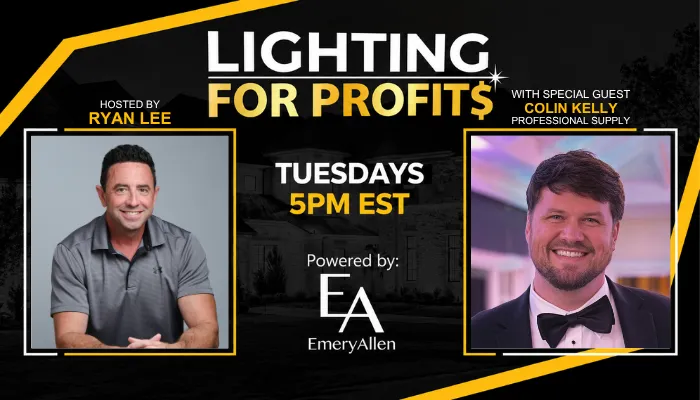
Colin Kelly - The Power of Systems
Lighting for Profits - Episode 264
Colin Kelly, CEO of Professional Supply, shares how he helped transform a family-grown business into a distributor serving customers nationwide. From modernizing warehouse operations and shipping over 2,500 packages daily to building expert teams and strengthening customer relationships, Colin reveals the strategies behind scaling a wholesale distribution business while maintaining speed, accuracy, and personalized service.
Watch the episode
Episode Transcript
Welcome to Lighting for Profits.
All light. All light. All light.
Powered by Emery Allen. Here is your host, Ryan Lee.
All right. A lot. All light. Let's go. Welcome, welcome, welcome to the number one, the number one landscape lighting show in Virginia Beach, Virginia. It's gonna be an epic show, you guys. Um, I think, I think I had a travel problem or something, so last week I missed, which I've been, like, super consistent, so I felt bad for missing, which means I'm bringing extra energy, extra ammunition for today's show. We're gonna have an epic one today. I got, uh, my guest today is Mr. Colin Kelly with Professional Supply. And, um, look, this is going to be one of those shows where we kind of, we kind of get into some topics. Maybe they'll be controversial, I don't know. We'll see, see what Colin's up to today, See how he's feeling. Uh, but I know for me, I'm feeling extra spicy. So, um, it's gonna be a cool show.
Guest Introduction and Promotion of Light It Up Expo Event Details
Colin, um, Kelly, he is with Professional Supply. So we're not gonna just be talking about, like, distribution and products, although we'll talk a little bit about that. But we're gonna talk about ways that you can grow your business. See, I, I think that one of the advantages that suppliers have is they get to see, like, who's killing it and like, who's not. And they. There's trends, there's like, uh, patterns that, uh, evolve. And I want to kind of ask him, like, what. What are some of these trends that he sees? Like, how. Why is. Why does he have one customer that's absolutely killing it, uh, and then another one who's just like, complaining like, oh, slow. And sometimes they're in the same market. Right. Um, so, uh, you know, a lot of people like to make excuses, and I think when you tap into some of the people around you, you can really see what's working. What's not. So excited about today's conversation? Um, reminder. We have started to promote Light it Up Expo. This one is going to be the best show we've ever done, partly because it's only the third one that we've done. Okay, I'll be honest. But also because what we're planning is going to be insane. So, um, we're just getting better and better. Um, we have so much more support from different vendors, sponsors, which means we get to now over deliver. So, um, it's going to be an awesome show. If you have not got your ticket, go get it now. Um, we are going to kind of do what other shows have done where, like, the closer you get to it, the price actually goes up. So I highly, highly recommend you get your ticket now. Light it up expo. com. we got general admission. We got VIP, um, different options for you to, uh, grow your business. So get your ticket for yourself, Bring your team. It's going to be an epic event. Go to light it up expo. com. and, um, again, we're going to have Mr. Colin Kelly with Professional Supply on the show in just a couple of minutes. Before we have him on, um, there's.
Business Lesson from Costco Meatloaf: Providing Options and Understanding Customer Value
There's. There's two things, actually. Two things specifically that a $20 meatloaf can teach you about your business. And the second one, well, we will explain a mistake that you're probably already making pretty regularly in your business. Okay? So I figured this out, believe it or not, at Costco the other day. Um, I don't know why, but, uh, it has been a long time since I've been to Costco. And, uh, my wife and the kids, they were leaving, and they said, hey, we're going to Costco. And I go, I'll come. And my son, my Max, looks at me. He's like, wait, you. You're coming? Because he knows I actually, like, usually hate going to the store, especially Costco on a Saturday, because, you know, there's just a lot of people, and you're like, get me out of here. Um, but I don't know. I don't think it was a Saturday. And I don't know, I just felt, uh, maybe I. Maybe I need to get out more. But, um, uh, Max was surprised that I wanted to go. So we go to Costco. We're walking around. We go back to, like, the back section where all the meats are, and then right next to. There's there's this, uh, there's these prepared meals. And one of the, uh, meals was a meatloaf with mashed potatoes, and it was all ready to go. All you need to do is grab it and, like, warm it up. It's already cooked and warm, uh, it up and eat it. So that's cool. And I'm thinking, I'm sitting there looking at, like, man, there's definitely nights where I would totally buy that. In fact, right now I'm thinking. I'm thinking about this story, thinking, damn, I wish I had the meatloaf to just throw it in right now. Um, the thing is, it's a $20 meatloaf. Um, and you could. You could for sure buy the ingredients to make that meatloaf. For way less than 20 bucks. Probably. Probably less than half price. Um, honestly. But, you know, on the right night, like, I. You come home from work, like, I don't want to do anything. I just want dinner, okay? And, you know, I don't want to figure out, like, okay, well, what are we going to make? And then we got to get the ingredients. You got to prep everything, and then you got to cook it. Then you got to clean it up, right? Um, I just want to put something in, warm it up, feed my family. And so I'm standing there looking at this meatloaf, thinking, you know what? This is exactly what happens in our businesses. Um, because you guys have seen this. It happens all the time in the Facebook groups. There's a contractor somewhere looking at another's company's price, saying, what? Like, why. Why would you charge. How can you charge that much? Like, don't you feel guilty? Or, like, you know, 600 bucks a light? That's crazy. You can buy these. You can buy fixtures for, like, 50 bucks. And the wires, only a couple hundred. And the transformers, couple hundred. I mean, that installation should only cost, you know, a couple grand. And here you are charging 600 bucks a light. Well, you know, you can go buy ground beef, and you can buy potatoes, like, pretty cheap, you know, and it's going to be less than the $20 meatloaf that's already, like, prepared for you. And to be honest, like, next time, I'm going to buy it. Like, I have, like, um. It's not buyer's remorse. I can't think of the term. It's like, the opposite of buyer's remorse, because I didn't buy it. Regret. I don't know. I'm like, damn it, I should have bought the meatloaf. It would have made the story better, because then I would have ate it and be like, dang, that was good. But two lessons here, okay? So the first one is you've got to give people options. Okay? There's some nights, even me, like, I actually enjoy cooking.
Marketing Strategies: Tailoring Offers and Understanding Perceived Value in Business
Like, not all the time and not in all scenarios, but there's times where I, uh, truly enjoy cooking. So some nights, I might want to cook. Some nights, maybe we already got something planned. Um, sometimes. Maybe we have more time, sometimes less time. Um, but some nights, you know, getting dinner handled for, like, 20 bucks, I mean, duh, I would be easy. You know, it's, like, already done. And I'm the. I'm the same person, same bank account, but different situation. Okay? So think about your customers. Um, Somebody might want to light up the front yard of their house right now. Somebody else might want the front, the back, the trees, the pathways, like, the whole experience. And someone might just want to do, like, in phases. Okay. And the key is to, like, strike while the iron is hot. Because again, like, you don't know, like, maybe, like, maybe today they're, like, in buying mode and they just got their promotion or they just sold their company or they had some type of bonus come in or something like that, and like, let's go. They're ready to go. So if you just offer them the one thing and they would have bought the whole thing, then maybe next week, like, someone gets hurt in their family or dies or something bad happens, and now they're not ready to do that. Right? And it might be the opposite where, like, maybe you're thinking, oh, man, these guys clearly have money. I'm just going to show them the whole shebang. And now you overwhelm them. Doesn't, um, mean they can't afford it. It's just that they're not quite ready for that. Okay? So you need to give them a few clear options that they can choose what makes the best sense for them. Okay. If you only offer what you would personally buy, then you're most likely leaving out the exact thing that they wanted. Um, you know, this, this particular situation is the meatloaf. But, like, you can go buy mushrooms, um, and you can go buy. Pay a little bit more to already have them sliced. You can go buy fruit, or you can pay a little bit more and already have it in the fruit dish. It's. It's the same fruit. It just costs more. Right? And so you, you, you don't want to compare yourselves to others and be like, oh, well, why, why are they charging so much? You should be charging the maximum amount that someone's willing to pay. Because if someone's willing to pay double to have their fruit chopped, then to them, that's the value. And you could think that's crazy. Like, well, I would just buy the fruit myself and chop it, and it's way less. That's cool. That's. That's you, you know, and if someone, someone offered you options, that would be the option that you chose.
The Second Business Lesson: Target Marketing and Avoiding Self-Imposed Limitations
But the key is to make options. Okay, um, uh, the second lesson is knowing who you are marketing to. Okay? So imagine standing next to the prepared meatloaf in Costco trying to convince someone to buy it who, like, loves cooking meatloaf. It's like a recipe passed down from generation to generation. From their great grandmother or whatever. They. And they really enjoy making it. They got the time. They already have the ingredients at home. Like, you're probably going to have a tough time selling them, um, this prepared meatloaf, okay? But a parent who's, you know, coming home from work, who's stressed out, picking up kids, running kids to practice, you know, trying to figure out dinner. 20 bucks. Cha ching. They probably pay 30, you know, like 20 bucks is a really good deal. And so imagine that you keep marketing your premium lighting service to people who enjoy doing everything themselves. They have the time and they want the cheapest possible way to get a few lights in the ground. That's happening all over in the world right now. Okay? And what's happening is that that's a major problem. You're marketing this premium service to people who don't really understand your offer and think it's crazy that someone would buy sliced fruit when they can just slice it themselves. Why would someone buy this prepared meatloaf when you could just make it yourself for less? You're trying to convince someone something that's completely insane to them, and then you're letting that affect you because you hear enough no's and pretty soon you start to believe them. And pretty soon you start to question everything. You know, maybe my price is too high. Marketing doesn't work. Facebook ads don't work. Google Ads don't work. You know how many times I hear this stuff? Like, it has driven me to the point where I am so freaking close, you guys. So close. If I didn't have a 12 year old at home and a 14 and 17, I would have already started my own outdoor lighting business again. Because I just need to show you that, like, those are just excuses, like, your pricing is not too high. Your m marketing does work. People in your area will pay that. Not everybody will, but the right person at the right time absolutely will. And so you know, how many of those conversations, uh, that are convincing you that maybe you're not worth it are people that actually want what you're selling? Okay? There are homeowners out there that want someone to design it, want someone to install it, make it look incredible. Answer the phone if something goes wrong. Sign up for your protection plan. They want to come home and enjoy it. Okay? And so really finding these people, this deserves just as much attention as figuring out what to say when you get in front of them. Okay? So you know, and when you get in front of them, you've already let such a small audience, like, influence your feelings and Emotions that, uh, now all of a sudden you feel guilty about charging for a service that they want. You're like, I don't know. Because you know in the back of your mind, like, why would they pay more for this fruit? It's the same as the fruit over there. And now you feel bad. It's like, no, no, that's what they want. Okay? So you're honestly, you're handling something that they would gladly pay to have handled. Your knowledge, your time, your team, your process, your follow through is they all have value. Okay?
Recap of Costco Meatloaf Lesson and Encouragement for Action
So give people clear options. Pay attention to who you're trying to reach, and remember that your willingness to do something yourself doesn't determine what someone else will happily pay to have done for them. Okay? So kind of crazy. That was just a trip to Costco, guys. I mean, can you imagine being one of my kids? Um, I go to Costco the first time forever and somehow come out with a business lesson, uh, from a meatloaf. So Max, uh, if Max probably doesn't listen to this, but he's probably stoked that I'm not going to go to Costco next time. So go make it happen, guys. That's my Costco meatloaf message of the day.
Preview of a Debate: Quality Design vs. Quality Products and the Importance of Quality
What do we got here? Oh, there we go. Hey, uh, by the way, what's more important? I told you, we're gonna get spicy. Quality design or quality products? Well, we're gonna find out at Light it Up Expo. I figured we'll do a cage match and let everyone fight, so we'll get people that, uh, because there's a lot of wrestlers in the community and everyone wants to fight each other. So we're going to do, like, sales. We'll have, like, someone represent sales. It's not me. I don't know how to fight, so I just get my ass kicked. But sales versus design, and then we'll do design versus products, and then marketing versus sales. What do you guys think it might be? It might be kind of cool. Uh, but no, seriously, if you're not installing quality product, uh, you're constantly going to have callbacks. Your customers just aren't going to love you the way they should. It's going to be really, really hard to grow your business. But if you do use quality products, it's just so much easier. So it does give you a competitive advantage. Yes. Sometimes you have to pay more. But I highly, highly recommend, use Emory Allen. And actually their pricing is not, not high, just so you know. Um, and they've got the, uh, the hookup all you need to do is email jackson l@emryallen. com and he will hook you up with the discounted contractor price. Write down this email right now, send it to him and say, jackson, hook me up with that Emory Allen. His email again is Jackson L as in the letter L, Jackson L dot com. And don't forget to mention that you heard about him here on Lighting for Profits and he will hook you up. All right, guys, it is time M to get our guest on the show. I hope you guys are ready. Let's crank it up, let's get a drink and let's go.
Guest Introduction and Background: Colin Kelly from Professional Supply
Welcome. Welcome to the show, Mr. Colin Kelly. What's up, Colin?
How are you, Ryan? I'm good
and I am fired up today. I'm just feeling spicy. I took a week off and I'm like, let's go, let's do a cage.
Oh, yeah, I don't want any, uh, Billy Coggins in that, that cage match. I'm not doing the wrestler.
Yeah, I'm pretty sure as I've kind of explored this topic, I think people just have conceded that he would win.
Yeah, I don't want any part of that.
But someone has to be either crazy enough or dumb enough to, uh, to, to challenge him. You know what I mean?
Yeah.
Uh, what's up? Tom Garber. Thanks for joining the show. He says hello. Hey, Colin.
Hey, Tom.
Um, well, I'm excited, uh, to do the cage match. We'll see. I think, you know, Billy would probably kick everyone's ass, but, you know, maybe if he goes through a bunch of rounds then someone could take him. But we'll see. Um, well, thanks for joining me, man. How are you doing?
I'm doing great. Appreciate you having me on. Absolutely,
man. Looking forward to having you on the show. I, um, guess. Do you want to just do a quick introduction first of who you are and kind of what your background is?
Sure.
Family Business Dynamics: Career Path, Learning the Ropes, and Forging an Independent Route
Um, so Colin Kelly, I'm with Professional Supply. We, um, have locations in South Florida and in Virginia Beach. Family owned business. My folks started the business 1980 and um, we got into landscape lighting in the late 80s and uh, have been, been doing it ever since. So growing, uh, the team, growing, growing the product lines and trying, uh, to service, service landscape, lighting professionals the best we can.
Nice, man. So growing up, did you know you were going to be like, working in the family business or were you ever thinking, oh, maybe I want to go carve my own route? Like, what was that like?
You know, I was a, uh, I was really interested in not being Involved in the family business originally and uh, uh, I worked in the family business early. Um, you know, I think I'd like to go down as hall of fame and the uh, floor sweeping division there. Um, they
still talk about you.
Yeah, best, Best in the corner. There's some guys who will fight me on the uh, on the uh, best. Best of getting the corners clean. But, um,
bring them to light it up. We'll put them in the cage and see what happens.
Yeah, we um. But yeah, enjoyed it. Grew up in it. Did it, you know, was. It was in the warehouse. Young and uh, driving trucks as soon as I had driver's license and moving around, looking at product driving, worked for reps and with reps and really probably uh, got in and got in early and then wanted to forge my own path, started my own business on the outside and then came back in, uh, about 15, 16 years back now. So, so
really. Okay, so you did, you started at the bottom. You were sweeping the floors. Do it like you had a bunch of different roles early on.
Yeah, we were, um, you know, my folks, folks brought us in in the summer and um, I was doing all sorts of odd jobs and in different verticals of the business too. We, I worked in the plumbing side, I worked in the lighting side, irrigation side. Um, you know, went out in the field with people and um, my folks did me a real, real service by, by forcing me into learning, learning the business from the ground up. From install through the, um, you know, through the distribution warehouse side. I, um, I really like the sales piece and being out. I started getting out a little bit on the road and seeing customers and that little customer connections probably what drew me back to wanting to be back involved with the business years back now.
Entrepreneurial Drive: The Tendency Towards Harder Paths and Proving Oneself
So,
so I'm, I'm curious because, um, I just recently had a conversation with someone else, similar topic, I guess. Were you, were you, were you like tying, like, were you thinking like, okay, if I succeed, but if it's in the family business like then, then people are going to be like, oh, well, of course, because, you know, it was a family business and you wanted to be able to prove something else on your own. Was that kind of the driving factor to go do something else?
Yeah, and I think we're, you know, competitive group here. Um, my folks both college athletes. I, I college athlete here, myself and my brother. Um, so competitive group that wants to, want to push and I think I wanted to go out and forge my own path and that was a lot of it. Um, and I think too, we were, we Were probably your standard old school distributor. Um, until, until, you know, not so recently, but pretty recent. Um, you look at the business and it was brown boxes and warehousing and trucking. Um, I don't think there was a lot originally that was drawing a 18, 19, 20 year old kid or kid post college into excited about it, you know. And um, I think as we, we got into it and I started to see what we could do, that's what got me fired up. My folks great. Built a great business. But um, you know, you think about distribution, it's, it's a lot of brown boxes, a lot of dusty warehouses and trucking kind of, you know, what is this? Um, like anything, I think you get into the people and the people part of it will get you excited. You know, our staff, our people. Um, and then you start meeting customers and installers and go, okay, this is, this is how they did it for so long and stayed interested because that's, that's where the excitement is. You know, the customer base are. And then our, uh, our people.
Yeah. Well, it's interesting because I, I, you know, I didn't have a family business to like make that decision. I was, it was never an option, you know. But I still have felt and I think almost every entrepreneur has this, where there's this tendency and I don't know why, to, to almost choose the harder path. Like we have something to prove. Like, um, there was an entrepreneur who was like, came, he was like a, an immigrant and he wanted to like prove like, hey, I don't need help and da da da. And, and even me, like, I never, I didn't hire my first coach until six years ago. And I'm like, was that like intentional? Was like, why? It's so weird how like, why would you not want to take advantage of the resources in front of you? And so many people are like that. There's people that won't join Landscape Lighting seekers because they feel like it's like the easy way out. I'm like, what, what? I don't understand that. You know, it's like, um, there's so many resources available whether you come from a family owned business or not. But my point is like, why would you not like for me, I'm going to be picking your brain on this show today because I want to, like, I want to, I want to get the advantage. Like, I feel like I'm gonna, I'm gonna, I'm gonna use the resources around me to be a better person. You know, if you can give me parenting Tips and, uh, business tips and all those things. I'm gonna take them, and I'm not gonna be like, no, I'm gonna do it the hard way. I just go on my own.
Yeah,
but I don't know. Why do you think that is?
You know, I think it's, uh, Everyone. All these entrepreneurs and all these folks, it's, um, high tolerance of pain, it's ability to kind of take a beating and get back up and, uh, you know, not. Not quit. And I think that was it. I. I, um, really, really wanted to do something on my own and, um, enjoyed my time on my own out there in the world. But, um, yeah, when. When the time came and the opportunity arose, I. I wanted back in. I think I'd probably taken my beatings on the outside and said, okay, there's a good opportunity here. There's. There's a lot of good things that could happen here if I come back in. I think it too, you know, you mature through that.
Lessons from Family Legacy: The Importance of People, Team Building, and Customer Relations
That early day of going, hey, like you said, you didn't hire your coach till six years ago.
Yeah,
you get out on your own, you take a beating and say, okay, if I could team up with other people and know what they're doing. Um, and, you know, my parents in particular, and, you know, Ardsley down in Florida for us, and my uncle. I have an uncle in the business, Rob Murphy. And I think those guys really, they were in the business, they take the beating first, and I got to come in and kind of look over the top and say, okay, teach me the way. Um, that worked out. Well, it's worked out real well for us.
What's something that your parents taught you about the business, um, that maybe you appreciate more now than you did back then?
I think our big piece is people. Our people, especially M. You know, I've been incredibly lucky to come in and be able to operate the business. And, um, look at, you know, the retirements we've had internally. Um, we do not have a lot of new staff. Uh, rarely do we add new bodies in our management teams or in our, um, you know, in our executive team or sales team. So, uh, around the horn. I mean, 15 to 20 years is kind of standard around here. And we've got guys in the 30s, high 30s. We've retired multiple folks in the last couple years.
Nice.
Um, and I think really that that treatment of our people and how you. How you build a team and then how you treat your people, um, I would tell you that rings true. Obviously, a lot of, you know, as A company gets turned over and executive leadership, uh, you know, a lot of family agreements, but really wasn't a hard one to say, hey, you have to do this. This was something that you can really see that it's worked for us as a family. And then, you know, the whole team is just a different. I mean, everyone's been around a long time. Um, so the institutional knowledge, the little things that go on in the building where you can turn around and say, hey, you know, what happened? We're talking about stories from 1992, 1985, you know, early 2000s, this happened, and you've got these folks internally. I think that's probably, you know, the biggest piece was watch my folks and how they treated people and how they treated our team and then how we treat. How they treated customers. Um, you know, I think we. We've done a pretty good job of, uh, keeping people happy over the years, which, obviously, you got to keep your own team happy, and then the, uh, that revenue source of the customer keeping them happy is another challenge on its own, but, uh, something I think we've done pretty well.
Yeah, I appreciate your perspective. I think it's interesting because when I work with so many different business owners on the design, installation side, and one of, if not m. The biggest thing that they struggle with, even though they say, like, oh, I need more leads, everything else. To me, the biggest thing they struggle with is they don't get what you just said. Um, they're not investing in their people.
Cultivating a Positive Company Culture: Empowering Employees and Fostering Longevity
And so they're complaining a lot about, like, oh, man, it's just hard to find good people. And, man, this guy left and I can't keep them. And it's like, well, maybe you're doing something wrong, you know, Like, I would. I would love to, like, they should go, like, spend a day or two with you and just, like, shadow you and, like, follow you around and, like, see what that company culture looks like and, like, how you built it and everything else. Because, you know, it's. It's rare to get someone to stick around 30 years, 35 years, whatever. A lot of our. A lot of these people in this industry can't get someone to stick around for, like, 30 days. So, um, you're obviously doing something right over there. And I think. Is there. Is there anything you can share, like, other than just saying, like, oh, it's about the people? Like, is. What do you guys do intentionally to, like, make sure that these people feel valued, feel loved, and feel like they're part of the family and not just working for A paycheck.
I think we're. We're big on pushing people into leadership. Um, we talk about it a lot, and it's. It's very intentional. On our side is, you know, we don't. I'm not someone, uh, personally not someone who's going to hawk over your shoulder. And I think our management stuff is the same. The same. Um, we're really looking for people who want to excel in whatever position they're currently in and move up. I think that longevity piece is too. Like, how do you hire somebody? And you look at who we have. Um, you know, our VPs, our two VPs in the state of Florida are guys who started in high school with us and are now vice presidents of the company. You know, we're warehouse and truck.
That's awesome. Yeah, that's sweet.
You know, wild. And you sit there and go, there's. You don't. You don't get those stories a lot. Um, and ours are wild enough that they sound fake.
Driving Change: Transitioning from Paper to Digital Systems in Distribution
I mean, you'd think I was making it up. They're pretty interesting. Um, but I think the intentional piece of trying to have people function on their own, understand their voices, their voice can be heard. There's, um, days I tell people, you know, like, I'm gonna throw you out of my office with your crazy idea. But, uh, you know, bring it. I'll tell you it's good. I'll tell you it's bad, but don't. Don't be shy. Um, so I think we try to empower folks to do the next thing. And I think at the end of the day, it's always about our customer. Um, with our team, you know, we're outward looking, saying, hey, how is the customer reacting? How does the customer feel about this? When you give people opportunities to really interact with the customer, from warehouse personnel who are, say, handing an order over, a truck driver who's delivering on site to inside salesperson who's getting somebody out of a jam, an outside salesperson who might have a bigger relationship, uh, is having dinner with people and knows our customers, families and kids and things like that. I think people get connected. Um, and we give a lot of freedom to, you know, go out and create relationships and tell us how things are and bring us feedback. And I think that's been a big, big driver. Um, I don't want to micromanage. The vice presidents, the company don't want to micromanage. We just want to be. We want to be good at what we do, and we want people to be happy While they're doing it. I think that that shows.
I'm listening. I'm just turning off the camera. Okay. No, that's great stuff, man. So, uh, maybe paint the vision better. Like, okay, there's a career ladder here. Um, there's opportunity for advancement, leadership. Um, and then, you know, let. Making sure their voice feels heard, like they can come back with ideas. In fact, it's encouraged and stuff like that. So that's great. Um, how about. And so you've been back 15, 16 years, did you say?
Yeah, about that.
Okay, uh, what's something that you wanted, uh, to change?
Navigating Technological Advancements: ERP Systems and the Embrace of AI
You know, maybe it was day one, maybe it was year one. I don't know how long. I don't know how. I'm just always interested in this family dynamic. But what's something that you wanted to change? That took a little convincing.
I was, uh, I was a big proponent of breaking out of the paper age in the business. Um, we were. We, we again, you know, the look of the 1980s, 1990s, early 2000s, distributor file cabinets and printers and paper and. And guys walking around with a stack of, you know, a clipboard.
That's awesome. Yeah.
The pen on a lanyard around their neck. Um, you know, boxes. I don't know how many pens. We went through m. Copy machines. It was like, you know, an episode of the Office in here. It was like, did they deliver the paper so we can print the orders? Um, you know, it was. It was that. And I was a big, big proponent of we've got to get digital. Um, and rolling back to the previous question is, you know, you talk about then longevity, longevity of employees came with age of employees handling digital devices as we went digital. Um, so you went from guys who'd been there 25 years who were used to going to the printer, grabbing the order, picking the order into like, hey, here's your iPad. Uh,
and what was that? Like, did they want to quit?
You know, I was, um, I was thinking, uh, about wearing a helmet most days to not be hit over the iPad. So
they're like, oh, cool. A weapon.
Yeah, uh, it was. It was a big change. Um, and, you know, like, hey, you just can't pick this off the shelf. You got to scan it. Or you, you know, a lot of. A lot of major stuff. And these. These teams were well trained, oiled machines doing it the old way. Um, so day. Day one, that was one of my big pieces. I really wanted to make that change. It took a lot of convincing. Um, and then, you know, you can probably ask Anyone who's in the distribution world or in the manufacturing world about changing an ERP system, um, and you know, you'll, you'll put a target on your back with everybody in the building when you change those erps over. Um, the systems are rough and then the research going in to change them and picking the right one, high pressure situation, um, I don't wish it on anybody. Anytime I get this manufacturer emails like we're, you know, we're closed for three days for inventory and ERP change, I kind of grimace and go, oh, you're gonna have a, gonna have a fun, fun week.
The AI Revolution: Adopting and Integrating Artificial Intelligence in Business Operations
Bless your soul.
Yeah.
Well, I mean we're going through that same thing right now with AI. Have you guys, are you experiencing issues with that? Are you not adopting it yet? Like, what, what's that going to be like?
I would tell you we are incredibly forward adopters, um, to the point we may need to dial it back a bit. Um, but we are, we are in the game. We're using AI in our purchasing tools, trying to predict, uh, you know, product purchases from manufacturers, we are trying to predict sales. Um, we're breaking down data even deeper than we do. I think, you know, the big evolution of professional supply was, you know, 10 years ago an Excel sheet was a curse word around here and now it's something that that's passed around frequently. Um, we are parsing data, we are trying to get better, trying to figure out trends, trying to make sure that we're, we can service better, trying um, to make sure inventories are correct. So I think there's a lot with it. I, um, I know Jeanette Gonzales heavily uses the AI and help with design work and fixture finding. So we've got a lot of adopters. I have One of the VPs in Virginia, strong user, um, Ross Rich, and he just continues to find ways to improve what we're doing with the AI and kind of question things we might have just let go in the old days. We're now looking into. I, um, think the next step for us is really trying to dial in getting everybody on one point platform. We're starting to see some of that business stuff with Claude and chat, um, and Grok as well. Like you know, where you can go and have a business suite there and add users and debt, or I think they call them seats, but add seats. Um, so there's more collaboration internally with it. Um, right now I think everyone's kind of one on one in their own world with it, so.
Gotcha. Okay,
cool.
Well,
quick,
uh, it's dude, it's insane. It's like Grox the one and then Claude, then ChatGPT and it's just like, it's gonna be an Interesting next 12 to 24 months, that's for sure.
I'm operating all three in a pro account right now. Um, and across my phone screen, my home phone screen is, you know, Gemini, Grok, Claude and Chat. Um, and yeah, I think it's, you know, the next difficult decision beyond an ERP choice a couple years back was, uh, is now. Yeah. What do you go with? You know, what do you choose and how do you do it?
Professional Supply's Competitive Edge: Expertise, Brand Portfolio, and Global Reach
And maybe it's too, um. But it's coming big time, it's coming quick. And start talking to installers. I'm pretty impressed with guys who are neck deep in usage of it already. You know, quoting and CRM creation and you know, app creation, all sorts of things. It's pretty wild.
Well, I do want to, uh, I do want to ask you about, you know, you guys have visibility into obviously purchasing, which ties into at least me, like, okay, how m. How well these contractors are doing. Um, but before I ask you about like, the difference between like a successful and a maybe a struggling lighting contractor, um, I want to ask you about you guys. So like, you know, there's lots of. I know people are going to want to know. There's lots of different distributors out there. Um, there's direct to. To contractor manufacturers, tons of landscape mining, um, suppliers. Um, what. What makes professional supply different?
It's a good question. So we, we are an original distributor of landscapes, landscape lighting, landscape supplies. Um, we've been in it a long time. Uh, the longevity, you know, doesn't, doesn't drive sales, but it's, it's the people, I think. So you're talking expert level stuff. We're in a lot of verticals and I think, um, in distribution. And when I say verticals, I mean we're in the plumbing and H Vac business. Um, we're in the landscape supply business, we're in the irrigation supply business and we're in the landscape lighting supply business. And really what we're kind of considering outdoor living turf and irrigation and pergolas and furniture and all these things that come with that. Fire pits and so there's a lot of places in the business to sell product. But I think what we've really done is gone after the experts. Um, as we enter a vertical or we've been involved in the vertical, we are dialed into getting the best people in the industry into our sales team or onto our sales teams to do that. You know, Elvis, we have Elvis Poker down in Florida, Jeanette Gonzalez, Lewis Arsley. We have these guys who know the lighting business, um, and are experts in those fields. So I think we're able to offer a service. Um, we also are heavy on brands. I mean, we have, I always say we, we have everything but fx. Um, and we've got a lot of product on the shelf. We can ship quick. Um, we pick, pack and ship up to 2,500 items a day, single, uh, orders. So we're, we're able to move product quickly and move it efficiently. Um, and I think we offer the expertise when it comes down to a design problem, a fixture problem, uh, how do I use this or what do I do? Um, what. I think it's interesting about lighting. It's always. It's so subjective, but the best guys in the industry are still having issues. Hey, how do I do this? What do you think about this? Or want to bounce an idea? We're not just order takers. Um, and I think distribution for the most part is starting to turn into that. The big guys are turning into that. You can't walk into a branch and say, hey, I, you know, I need help. So we've really focused on making sure that we're, we're experts in our field. Um, you know, Elvis, Jeanette, Louis, those guys really just crushing it. Know their stuff, know what's going on. Um, that's the big difference, I think it's, it's. We have the stock, we have the product lines. Um, we can get it to you quick, and we know where our inventory is. Part of that digital revolution for us is, you know, we know it's on shelf three. We know the overstocks on shelf 10, you know, up top. And we're going to tell you we got it and we're going to get in the box and get it to you, um, and we're going to truck it to you in South Florida. We're going to truck it to you and, you know, the state of Virginia, northeast, North Carolina, or we're going to put it in a FedEx box and get it to you, you know, within one to four days across the country.
So you guys aren't just regional. I mean, you guys will supply, like, how. What is your geographic territory?
We are shipping all 50 states, um, right now. And we ship Caribbean, uh, Bahamas, Latin America,
I think. I mean, you're gonna have to prove that to me, uh, especially the Caribbean one. When, when should we test this
uh, you know, I think we have a job coming up. Yeah, yeah, I
want
to,
I'm, I don't have much faith. I have to see it to believe it. So.
Yeah, we would check any C code and uh, you know, if there is one and wherever that location we'll
check something. I'm sure we can find something to check.
Yeah, those are interesting. I love those jobs too because when they're American customers traveling to do the jobs, those are always fun because there's a lot of pressure to get product dialed perfectly. You know, tools there, everything down there, fight through customs, um, and then when we're shipping to the customers that are existing, you know, nationals of those countries, um, a little less pressure, uh, but always fun to see these big projects happen. You know, resorts and you know, high end rental properties and the States, uh, wild, the stuff that, that happens, you know, Latin America and uh, and uh, Bahamas, Caribbean.
International Projects: Navigating Challenges and Opportunities in the Caribbean and Latin America
Cool stuff. Big projects.
What's, what's the uh, power supply situation in the Caribbean?
You know, different. Different all over. Uh,
yeah,
yeah, we're doing
so. And what do you do? I mean, is
it.
Yeah. How do you, how do you solve that?
I am uh, I am neck deep in a Vista catalog. They seem to be our guys for that uh, little Vista transformer and they've got a lot of configurations which saves me. But uh,
is it just a matter of getting like, like Vista has like lots of different transformers for that and then it's the same product.
Same product, yep, exactly. 12 volt down and, and make it happen.
That makes it sweet. Okay. Well, yeah, I don't know. I, I don't. Maybe I'm the only one, but I feel like there's like guys that daydream like oh man, that would be cool to go get, you know, a villa or an island or whatever, something like that. So um, what, how are guys getting those jobs? Do you know what the lead source is on those?
You know there's a lot of um, the American installers that are, that are getting those jobs oftentimes are doing work for folks who either own these properties or um, get referred. Um, the resort properties are all over the board on how those guys are getting those jobs. That's always interesting to see. Um, but you need to land a 2 or 300 light resort job repair and then you're talking all your fun stuff with your coastal product and severe salt and salt air and all that fun stuff that you got to fight through. Product selection gets to be a major, major thing and um, oftentimes being told what to use, these installers getting told what to use or they're making recommendations just depending on the job. But, um, yeah, always a fun. Always a fun one to get done. Get it palletized, get it to, you know, freight forward in Miami or Fort Lauderdale and move it on down the road.
Introducing 'You Make the Call' Game and Call Source Promotion
All, uh, Right. Very cool. So, um, before we find out which, I'm really excited to get your opinion on this, um, like, what some of your most successful clients are doing. Um, we've got a new segment. We've got a new game. Are you, Are you down to play the. You make the call game with me right now?
I'm in.
Okay. This is gonna be fun because, you know, it's. It kind of just like, it's a little bit more relaxed. We get to find out the, like, take the mask off. Who is calling? Kelly. Um, so this is a new segment. It's by Call Source. So Call Source. You know, a lot of guys, they'll go out and get tons of leads, go give a bunch of bids, and then there's people they forgot to even follow up with. So Call Source is actually a US based call center. They'll call them and you can give them 40, 50 clients and they'll just call them until they buy or die. So it's pretty awesome. Um, and they're doing 50 off your first month for, um, podcast listeners. So if you guys want to check them out, just go to try.callsource.c om lfp it's in the show notes as well. Try it out. CallSource. com LFP but, uh, this cool new game called you make the call. So you're ready?
I'm ready.
All right. NBA or mlb?
NBA.
You Make the Call: Sports, Vacation, and Food Preferences
NBA or NHL?
Oh, NBA.
NBA or NFL?
NFL.
All right, so that's the top one. Uh, who's your team?
Uh, I'm a. Sorry, sorry. South Florida sports fan. So it's. I'm a Dolphins guy. It's tough. It's tough to be a Dolphins fan.
It's tough to be almost in any fan. I feel like, I mean, I grew up, uh, a 49ers fan just because in Utah we didn't have a team. And that's who was on TV. 40, uh, 9ers and the Bears, because my family's from Chicago and then Cubs fan. So we've had Cubs. Got to. We had some excitement there for a few years, but before that it was terrible.
You've seen the playoffs in football, The Niners. I mean, we're. We're.
Oh, yeah.
Drought.
Oh, yeah. No, you're screwed. Yeah. Um, all right, favorite vacation? Mountain. Uh, cabin or beach house?
Beach house.
What's your favorite beach you've ever been to?
Oh, I love that, uh, that beach in, um, in Harbor Island. That pig sands beach. Pretty beach.
Where's
that? Bahamas.
Okay. Haven't been there, so
gotta get there. It's. It's wild.
That's where I should go.
Yeah, that's. That's worth the trip. Eleuthera. And then jump, uh, over to Harbor Island.
What's the. What's the resort? Where do you stay?
You know, we stay, uh, we've stayed at a house there, um, on the beach in the past. It's awesome. I mean, it's. It's one of those shockers. And I'm a Florida guy originally, and that's. That beach and harbor is legit.
All right, I'll be hitting you up on that one.
Yeah.
Um, all right, so what about, uh, food? Mexican, uh, or barbecue
Mexican.
Mexican or steak?
Uh,
well, yeah, if you're gonna have Mexican, it comes with margaritas.
As long as the teal is there. I'm in. Uh, I'll just take on round two.
Oh, you're gonna go steak?
Yeah, I'll go steak on round two. But
there's, uh, no margaritas with this steak,
just tequila.
All right. Um, it sounds. I don't need to do an alcohol one. We know it's tequila.
Yeah. There you go.
Steak or sushi?
Oh, man. We were in, uh, we were in Japan last March. I'll tell you, the sushi. So do. Do Japanese sushi. It's different. Different ball game.
That was good.
Yeah. Tough to be.
All right, you get to pick one. You get a customer who orders a lot but is always a headache or a smaller customer who's easy to work with.
Ah, smaller customer easy to work with.
Yeah, just. Now, you. You don't have to name names, but if you want to name names, like who. Who is it? No, they know who they are. They know who they are. Um, all right, so a. Um. All right, if you're starting over, uh, an established business with an outdated system. Outdated systems. Or a startup with a clean slate.
Oh, that's a good one. Oh, um, I think I go clean slate.
Would you
see. Yeah, a lot of. A lot of knowledge. Now, mind you, I, you know, I. We've watched the industry consolidate, you know, by the. By the. By the other guys out after your, uh, after you get your startup going and, and you can grow it. But, um, I think the clean slate pick Everything. Know the systems. We've taken a beating on learning all these systems and all these different things. I think a nice, clean slate would be good.
Okay. Um, incredible food with terrible service or average food with incredible service.
You know, I, uh. I could do incredible food, terrible service. I'm in.
You could?
Yeah.
I feel like I don't know if I appreciate food enough to be able to choose that option, and terrible service pisses me off.
Yeah.
But I also don't drink tequila, so I think that might have something to do with it.
We could fix that, you know, next time I see it.
But what if. What if you're like, dude, I just need another drink? And, like, you can't get.
Yeah, you're in a jam, you better help you with some good people.
Is that not just piss you off?
Yeah, they'll drive you nuts.
That's why I'm like,
give
me the check.
Next drink. Just need a water, something.
Yeah, you can't. And you can see over there where you shouldn't help yourself, but you could. I don't know. That's why I'm more m of like, just give me the average food, incredible service,
making me rethink my answer.
Hey, this is. You make the call. You make the call. All right, last, uh, one instantly. Well, is this. Let's see. Is this last one? No, we got two more. I think your team would appreciate this. Uh, let your team see your camera roll or your YouTube watch history.
Oh, um, I think camera roll.
All right, bring them in. They're waiting outside. Come on in, guys. Grab his phone. You. You chose. It was not my choice. All right, so they get to see your camera roll for the next work party. That'll be fun.
Perfect. I'm in.
Um, and then the last one. Instantly become an incredible chef or an incredible musician.
Musician. Ah. I mean, that's a. That's one, you know, Always want to be able to play an instrument. I never got there.
Yeah, you never did?
No. Never could figure it out. I feel like, you know, it's a great party trick.
What a loser. Yeah, me either.
You Make the Call: Career Paths, Travel, and Musical Talents
There's guys who just sit down at a party and just start playing the piano.
Oh, I'm so jealous. They're so never,
never swinging.
Yeah. What. What instrument would you. Would you automatically be incredible at?
I think, you know, you gotta. Gotta go guitar, right? That's the, you know, chick stick the guitar. I'm happily married, but, I mean, it's. It's.
She would love you more. We know this. Yeah,
Guaranteed.
Yeah.
The piano, though, too. I mean those, those folks who just sit down. I just, I, I was sitting somewhere the other day and some 8 year old kid popped in and just started jamming. It's like, wow,
that, that would be mine. It'd be the piano.
Yeah.
Just. There's a guy I follow on Instagram and I'm not gay, but if I was, you know what I'm saying? And he, it's just awesome. Like, I'm like, dude, I want to go to one of his concerts sometime. He's mostly in Europe, but, um, and it's just harder. You know, a guitar you could actually transport and most, you could like find a guitar in a room. Sometimes pianos don't transport well, but like the public
items, I'm always shocked where they are. They're, you know, they're in a hotel lobby or they're in a bar. There's, there's somewhere you can, you can find them.
You can find one. Yeah.
Uninvited. The uninvited piano. Sit down.
Concluding the 'You Make the Call' Game and Transitioning Back to Business
That's, that's legit. Get in there and just, you know, start jamming.
Yeah, that would be cool. Hey, well, thanks for playing. You make the call. Kind of fun. Get to know our guests in a different, different way. So now people know that you are an alcoholic. So that's cool.
It's good.
Trends in Success: Simplicity, Brand Consistency, and Efficient Design in Landscaping
Um, now that's, that's a lot of fun. Um, okay, let's get back to business here. Let's get back to business. So you deal with, you've dealt with so many different contractors and not just in landscape lighting, but lots of different industries, but might as well keep it to landscape lighting, I guess. Um, what, what are some of the trends you see among like you, you got these successful guys who just seem to keep doing these massive orders. Massive orders. And then you got the other guys that are just always complaining and just not, not doing so well. Have you, have you found any trends you can help us identify?
Yeah, I think, uh, the thing that I see is, is really the simplicity. And the guys who do the best are the simple, simple. You know, they've got a brand or they've got skus they use and they use them on repeat. Um, they're also not afraid of their price. They're not afraid to hand a quote over. Um, but I think it's, it's simplicity and design. They're using, you know, six, seven, eight fixtures max. Um, they're buying them on repeat. They know, they know when things look good, when they don't. And that's, that's really the start of it, I think, um, you need to go back to like, all those business basics. It's the day one stuff like, do you answer your phone? Um, do you show up on time when you tell a customer? But when you get beyond that, I really do think the trend is simplicity. Um, the designs are extravagant, but they're doing it with five, six fixtures and they're buying them over and over and over. Um, they know what's on their job and they know that they know how to get it in the ground.
Yeah, it's, it's cool to hear you say that because I, I'm a fan of that. And I think in, in our, in the, the, the landscape lighting world, there's, there tends to be. And it's not just black and white, but there's tends to be like the designer and then the, the business person, you know, and the designer is kind of like anti. What you just said. Like, no, because now I only have five or six options and I want to be able to, you know, pick from this one and pick from this one. And like, again, it's not always like that, but if we're kind of, you know, separating it, uh, that's kind of what happens. And like, there's the artist side who wants to have like 36 different options and then can't scale, and then there's the business side who takes the heat. Like, they're not an artist. Although I, like you said, I still believe it's possible to be an artist and to have a pretty extravagant, uh, design, but not going more than 10 SKUs or whatever.
Yeah, And I think it's the simplicity game. They get out, they get the quotes done. Um, you know, big jobs, small jobs. Um, I will tell you the interesting thing that I see though, is that even with our most successful customers, they all do it a little bit different. Um, be it how they design or how they install or how they do things. I'm always really fascinated by the fact that we have this successful client base and they all do it a little different. If it's product differently, if it's their wire choice and they only use, you know, a number 10 or they, they only do things a certain way. They use this connector. This is them. And, um, you know, I was talking about the other day, somebody. We've got a guy who spray paints. He, you know, he's got 12 different color spray paints in his, in his truck and he walks out and hits the spots with a blue, you know, a blue dot of spray paints, a 60 degree up light, um, and the orange is a path light and all these different things. We got guys who flag it. We've got guys who you know, go out,
he spray paints the house, I'm assuming because you got to
perfect.
Yeah. Show the beam angle. I like that.
But it's um, you know, I think there's all these ways to do it and then it rolls back into. Yeah. Is it, is it efficient? Is it profitable? You know, does the house look good, does the property look good after? Um, but again it's, it's back to, it's pretty, these guys keep it tight, a tight path how they do it and they know what they're up to. And the right stuff's on the truck, the right stuff's with the labor crew or the installer. And um, they get in and out quick and the jobs look great.
Inventory Management: Ordering Strategies and Warehouse Operations
Are most ordering per project, uh, do they ever order any extra inventory? How does that work?
So we service the gambit of different, different guys in that um, I'll tell you that is that too differs. I mean we have some very, very high volume customers and we, we go from job, job, you know, being picked up by you know, one of their install crews, um, you know, and sit there in the warehouse and watch four or five orders go out, you know, to different crews that they have um, per day. Uh, we have the guys who stock and stock heavy, you know, hundreds of fixtures per sku at a time. Um, I'm always interested to see. It's just different, you know, different ways to execute. Um,
so you mean locally they'll send a crew or multiple crews into your place and eat a donut and waste time.
So we do a lot of will call and yeah, so there's still, is, there's still a lot of counter business, um, and a lot of, a lot of walk in. But um, we are heavy duty on will call. You know, jobs called in, they'll be there at 7:30 to pick up and crew rolls in, make sure they've got everything they need. Um, and they're picking up, you know, job one, job two, job three, you know, different, different product leaving on different trucks going out, especially with these larger contractors. So
I, I, I honestly can't imagine why that is unless it's, they're just not organized enough to know the day before, like or two days before. This is what we need.
I think there's a lot of um, a lot of like 7am 7:30 in the morning pickup and they're on the job site, you know, 8, 8:30, um after they swing by our place and um, you know, those orders are called in, you know, for pickup. Different days we watch them, watch them come through. And some guys are last minute. Um, you know, pays to be a heavy stocker when you get a big order and need it in 20 minutes.
Cost-Saving Pitfalls: Homemade Solutions and the Value of Service Documentation
But, uh, uh, a lot of it's pretty organized. You know, big orders coming through and pick up day and time, and they're ready to go. They know they're dialed.
What are, what are some things where you see contractors maybe trying to save money that I don't know if it ends up costing them more, but it could, uh. Are there, are there people wasting time and energy on things that maybe they shouldn't?
You know, it is, uh. I'm always shocked in Florida how many, how many homemade risers there are. Spray painted pvc.
I think I invented that by the way. I'm like. And then I was like, wait, you can buy these?
Yeah. Um, yeah, some of the junk we see that gets handmade in a, in the back somewhere. Um, you know, always, always interesting to see what gets, gets done in South Florida. Uh,
yeah. That's a great example though. It's like, hey, I could save my 12 bucks here or whatever. But then they're just wasting time spray painting and then it doesn't look as good and. Yeah, that makes sense.
Yeah. Anything
else?
Distributor Partnerships: Navigating Brand Loyalty and Product Innovation
You know, there's probably a lot of them. Um, uh, I think it's, uh. I always see the big issue on service. I think we see nobody, nobody can remember what they did on a job seven, eight years ago as they go back for Service. Was it 2,700k? Was it 3,000k? What fixtures were on there? What brand were they using at the time? Um, so I think there's a lot, you know, a lot of issue with that. And guys are like, I'll take, you know, take a seven watt lamp, a five watt lamp, give it to me in 40 and 60 and 27 and 3,000 and
uh, then do they bring back the one they didn't use?
You know, I'm, we're hoping they don't, but you know, I know. Yeah,
that's annoying. Okay, so documentation would help a ton of.
Yeah, yeah, I see that coming. Like, I think, I think we're starting to see the, this digital trans, like digital transformation for the contractors. And you know, we've seen, got guys developing apps and uh, building some things that are gonna be pretty interesting coming that should help these service contractors that are out there. Because it is, it is hard. Like where's the wire, what connectors there, what fixtures there, what being, you know, what, what's the Kelvin temp? Um, that's a pain. It's tough stuff, tough stuff to manage. You know, for these smaller contractors, even the bigger ones, tough to manage.
Uh, what are some questions or maybe just one question that a contractor should be asking their distributor that most people aren't. Maybe you're surprised by. It's like, uh, do they not know we do this or any resources that you can provide.
I think the big change in landscape lighting since I've been involved is we're doing a lot less guiding into product, product, product category, or you know, I shouldn't say product category, but manufacturers than we used to. So I think a lot of guys come in with a predetermined. I'm a, you know, I'm a WEC guy, I'm a dower guy, I'm a Kichler guy, I'm a Loomian guy, I'm a cast guy. Um, you know, I, they, they come in with the opinion. Um, so I think we're, we're always trying to guide towards, hey, this is, this could be helpful. You might use this product, you know, exclusively. But have you thought about this here? Um, when we get those guys, there's a lot less asking of hey, what else is really popular? Like what's, what's going on? Um, and I think we're always trying to look at it. I'm a product guy. I really, you know, I've got stuff all over this office. I mean, if you can look over that way. I mean I have piles of lights, different things I'm testing and people send me, um, but I'd love to, you know the guys who come in and ask, hey, what's, what's popular? What, what do you think is really lasting in the industry, especially South Florida is brutal. I mean you've got weather sprinklers, irrigation systems, heat, humidity. Um, I mean it's, we know what works. I can, our staff can tell you what lasts and what makes an integrated fixture, what makes drop in fixture work and what brands are performing and what are not. But, um, there's a lot less questioning of hey, what should I use Than there used to be.
The Evolution of Product Lines: Integrated vs. Modular Fixtures and Lumens
Why is that, do you think?
I think guys are really tied to brands and I think the manufacturers are doing a great job getting out and really tying people to their brand. M. I also think you get into the situation where, you know, you get educated in a product, a product line especially, and these guys are experts in it, they know, you know, they know exactly what they're doing with that product. As you're getting more technical in some of these lines with, you know, uh, the beam spread changing and the lumen output changes and uh, more of the toys and high end stuff, um, those guys are locked into that. Um, and I think there's, there's a lot of community in that too as you get going with these different brands.
Yeah,
guys are diehards for the manufacturers they install for or install. And I think that's, that's kind of a cool thing. Um, you know, we do a lot of manufacturing trips and different things and like you see these guys, they, they love it, they love their brand.
Where do you think it makes sense to like, because I, I see the value there. Like you said, like, hey, the, the top guys are just limiting their skus. Like just kind of do the same thing. Over here, over here, over here. But then all of a sudden maybe there is something that you should look at. How does someone navigate that to be like, wait, how long should I stay in my lane before the innovation isn't catching up to these, what these other brands might be doing? Is it worth the switch or not?
Yeah, I think that's the big one. Um, and we've got, I have a list of diehards, you know, guys who are locked in and we've seen that switch. I think, you know, for me, you know, our bigger, our bigger lines, the, the Wacs, the Kichlers, the Dowers. And then, and then seeing like Lumion creep in. Um, and I think like a product like Lumion like all sudden got people interested going, wait a second, you've got this little module you can thread a little top on and wait, if it fails, I can unthread it. I mean it's, that got people going, ooh, maybe I need to move away. Um, so you see some creeping from brands. Um, I think some of that, like that, that example exactly is like the, you know, the first one we really saw where they intruded into people, into the larger brands. I think, um, at least people in a tough spot, especially when there's a competitive product or something that really works. And you know, you install product. When you get something that's easy and it works and you don't have a huge headache, it makes life easy. Um, and that, that'll change, that really will change that installer's mind. I, I think that's the big piece that we see is, uh, when there's low risk, you know, Again, that product unthread, that RCA adapter and boom. Where you change it out if it fails. So your risk is out. Um, you know you got high lumen output. You got something that works. It's, it's stylish, it looks nice, finish is good. That, that's how things change I think.
Controversial Opinion: The Misuse of Color Lighting in Landscape Design
Um, where people just can't ignore it for, for too long.
Yeah, no, I agree. I know one of the, one of the questions I guess I should have asked you, are you a drop in integrated or modular kind of guy?
I am. Um, so I think I'm a little bit of everything.
That was a good answer from
a
distributor there.
Yeah. Very careful and safe. Um,
trick question.
I am so Florida, Florida distribution. And we are high lumen output zone. Um, a lot of lumens being thrown around in Florida. Um, very different than our Virginia, my Virginia market where I live, where it's, you know, I always joke around with these Florida guys throwing around 1200,000, 2000 lumens that, you know, we're taking 5 watt lamps and dimming them down. Or an integrated fixture. You know,
they're like, I need more, three or four more.
Yeah. Do you have 2200 lumens? Yeah, I mean it's, it gets thrown around. Um, but I think uh, I like the integrated. This, this module, I call it finigrated. Like the fake integrated, um, module stuff is phenomenal. Um, really the improvement side too, like in the drop in bulbs is insane. Drop in lamps, I mean Emory Allen stuff. Rolling over 800 lumens. I know brilliance is coming soon with that. It's, you know, Tom Garber's really got that going on right now, um, with being able to punch lumens out. Pretty wild.
Mhm.
Um. Out of drop in Mr. 16. So, um, where we're fighting for lumens down in Florida and I think in certain parts of the country trying to get it higher and higher. Um, you're seeing the drop in catch up. I assume we're going to keep seeing integrated jump up. Um, you know, WAC's done a phenomenal job pushing to 2000, the 2000 mark on their integrated product. They've got a, they've got a couple little hidden products that we, we love that, that pump out some serious light. Um, they're a little hornets, a great little fixture at 800 lumens. So I'm, I'm in between. That's a good question. I'm, I'm a little bit of everything. Go to my house. I've got, I have I have everybody at my house. It's a.
That's awesome.
Yeah.
Little showroom there. Well, yeah, I think. I mean, a lot of people ask me the same question, like, all right, what should I use? And I'm like, who's. Who's listening to this call? No, but, like, for me, it really comes down to, like, there's, uh, a lot of different quality manufacturers out there. And so, like, it. It. I'm gonna base the, uh. Uh, the decision more on, like, what else? What is everybody else doing? Because I want to be different, you know, and so, um, not the only factor, but that's a big factor, because if everyone in my. If I'm going up against three bids every time and it's always loomian, I'm probably not going to use them. I need something to differentiate myself. So, um, not a knock on them or anything like that. It's just. I'm going to find someone different. And that goes true for any brand that you're running up against. So how about this? Uh, our last controversial question. What's an opinion that you have about the outdoor lighting industry that might get you in trouble on today's show?
Oh, um.
Let it out. I'll get you some tequila.
I don't think. I think about 95% of the crowd that's installing color light and color fixtures have no idea what they're doing
in what way.
I think the designs are awful.
Okay.
I think. I think designing colors its own animal, and I think it's. It needs to be taught. And I think we're just at the precipice of it. And. And I love all the color stuff coming down the pipe from all these manufacturers, but, man, do some of those jobs look terrible.
And are you talking the rgb, like, landscape lighting or the roof line stuff?
Oh, uh, roofline stuff's different. Different topic. Which is. I'm a. No, I think that stuff
hard. No there. Yeah, but you are. So you're specifically talking about RGB landscape lighting, and people don't know what they're doing.
Yeah, I think. I think most of the guys dropping it in are treating it like white, and I think it looks rough. Um, and I think there's. There's a whole crew coming. I think that'll learn how to design through that with these RGB landscape lighting fixtures. I think it'll be. It'll be there. And there's. I think there's a couple guys out there that can do it now. Um, but I think those jobs are expensive. They're using More fixtures than probably a white job would need, a white color job would need, or, you know, just a white CCT job would need. Um, I think it's, it's, it's interesting.
The Future of Color Lighting: Design Challenges and Potential
So you're, you're saying. Yeah, they, they're designing it like it's, uh, 3,3000k or whatever, but then it changes colors and it's like, okay, that, that looks terrible.
Yeah, yeah. Do we need to illuminate that? Live oak and red. Um, it's cool for Halloween. Yeah. Like, what are we doing with this? Um, so I think that. I think there's going to be a whole new design world of color long term. Um, I think there's a couple guys who kind of got it down already. Um, those jobs really stand out. Um, but I think that's the next thing is we're going to get more color fixtures from more manufacturers and we're going to just see more purple trees if we don't get it under control.
Closing Remarks: Professional Supply's Offerings and Contact Information
All right, that's awesome, man. Well, before we wrap up, is there anything that you want to leave, uh, our listeners with, any piece of advice or anything you want to leave them with and we'll wrap it up?
No, we're, um, Appreciate you having me. Um, if you need anything from Professional Supply, Jeanette, Elvis, myself, glad to help you. And, um, yeah, fired up. We'll see you soon, hopefully. And really, uh, appreciate you having us on.
Okay. Awesome, man. Well, um, yeah, it was great, man. Thanks for coming on the show and looking forward to doing more stuff with you guys. Looking forward to having you at Light It Up. Um, and, uh, yeah, I guess what's the, uh, website? What's the best way to get ahold of you if people want to reach out?
Professionalsupply, uh, dot com. You can jump on and start an account and, um, sales team will reach out to you pretty quick after that. We're, um, we're answering, uh, real fast on that. So check us out. You can see product lines, different things we've got, and, uh, be glad to have anyone who wants to looking for a new distributor, second distributor, third distributor, whatever it is. Um, need design help. Need. Need. Want to talk. Just want to, uh, you know, see what we've got going on. Glad to have you. If you're local, stop into a branch and come see us in Florida or Virginia Beach. South Florida. Virginia Beach. Glad to have you.
Sweet. Professional Supply dot com. Is that correct?
Nailed it.
Cool. All right, guys, go check them out. Thanks so much for coming on the show, Colin. I appreciate you. We'll talk to you later. Everyone have an awesome week.
Thanks, Ryan.
Colin Kelly - The Power of Systems
Lighting for Profits - Episode 264
Colin Kelly, CEO of Professional Supply, shares how he helped transform a family-grown business into a distributor serving customers nationwide. From modernizing warehouse operations and shipping over 2,500 packages daily to building expert teams and strengthening customer relationships, Colin reveals the strategies behind scaling a wholesale distribution business while maintaining speed, accuracy, and personalized service.
Watch the episode
Episode Transcript
Welcome to Lighting for Profits.
All light. All light. All light.
Powered by Emery Allen. Here is your host, Ryan Lee.
All right. A lot. All light. Let's go. Welcome, welcome, welcome to the number one, the number one landscape lighting show in Virginia Beach, Virginia. It's gonna be an epic show, you guys. Um, I think, I think I had a travel problem or something, so last week I missed, which I've been, like, super consistent, so I felt bad for missing, which means I'm bringing extra energy, extra ammunition for today's show. We're gonna have an epic one today. I got, uh, my guest today is Mr. Colin Kelly with Professional Supply. And, um, look, this is going to be one of those shows where we kind of, we kind of get into some topics. Maybe they'll be controversial, I don't know. We'll see, see what Colin's up to today, See how he's feeling. Uh, but I know for me, I'm feeling extra spicy. So, um, it's gonna be a cool show.
Guest Introduction and Promotion of Light It Up Expo Event Details
Colin, um, Kelly, he is with Professional Supply. So we're not gonna just be talking about, like, distribution and products, although we'll talk a little bit about that. But we're gonna talk about ways that you can grow your business. See, I, I think that one of the advantages that suppliers have is they get to see, like, who's killing it and like, who's not. And they. There's trends, there's like, uh, patterns that, uh, evolve. And I want to kind of ask him, like, what. What are some of these trends that he sees? Like, how. Why is. Why does he have one customer that's absolutely killing it, uh, and then another one who's just like, complaining like, oh, slow. And sometimes they're in the same market. Right. Um, so, uh, you know, a lot of people like to make excuses, and I think when you tap into some of the people around you, you can really see what's working. What's not. So excited about today's conversation? Um, reminder. We have started to promote Light it Up Expo. This one is going to be the best show we've ever done, partly because it's only the third one that we've done. Okay, I'll be honest. But also because what we're planning is going to be insane. So, um, we're just getting better and better. Um, we have so much more support from different vendors, sponsors, which means we get to now over deliver. So, um, it's going to be an awesome show. If you have not got your ticket, go get it now. Um, we are going to kind of do what other shows have done where, like, the closer you get to it, the price actually goes up. So I highly, highly recommend you get your ticket now. Light it up expo. com. we got general admission. We got VIP, um, different options for you to, uh, grow your business. So get your ticket for yourself, Bring your team. It's going to be an epic event. Go to light it up expo. com. and, um, again, we're going to have Mr. Colin Kelly with Professional Supply on the show in just a couple of minutes. Before we have him on, um, there's.
Business Lesson from Costco Meatloaf: Providing Options and Understanding Customer Value
There's. There's two things, actually. Two things specifically that a $20 meatloaf can teach you about your business. And the second one, well, we will explain a mistake that you're probably already making pretty regularly in your business. Okay? So I figured this out, believe it or not, at Costco the other day. Um, I don't know why, but, uh, it has been a long time since I've been to Costco. And, uh, my wife and the kids, they were leaving, and they said, hey, we're going to Costco. And I go, I'll come. And my son, my Max, looks at me. He's like, wait, you. You're coming? Because he knows I actually, like, usually hate going to the store, especially Costco on a Saturday, because, you know, there's just a lot of people, and you're like, get me out of here. Um, but I don't know. I don't think it was a Saturday. And I don't know, I just felt, uh, maybe I. Maybe I need to get out more. But, um, uh, Max was surprised that I wanted to go. So we go to Costco. We're walking around. We go back to, like, the back section where all the meats are, and then right next to. There's there's this, uh, there's these prepared meals. And one of the, uh, meals was a meatloaf with mashed potatoes, and it was all ready to go. All you need to do is grab it and, like, warm it up. It's already cooked and warm, uh, it up and eat it. So that's cool. And I'm thinking, I'm sitting there looking at, like, man, there's definitely nights where I would totally buy that. In fact, right now I'm thinking. I'm thinking about this story, thinking, damn, I wish I had the meatloaf to just throw it in right now. Um, the thing is, it's a $20 meatloaf. Um, and you could. You could for sure buy the ingredients to make that meatloaf. For way less than 20 bucks. Probably. Probably less than half price. Um, honestly. But, you know, on the right night, like, I. You come home from work, like, I don't want to do anything. I just want dinner, okay? And, you know, I don't want to figure out, like, okay, well, what are we going to make? And then we got to get the ingredients. You got to prep everything, and then you got to cook it. Then you got to clean it up, right? Um, I just want to put something in, warm it up, feed my family. And so I'm standing there looking at this meatloaf, thinking, you know what? This is exactly what happens in our businesses. Um, because you guys have seen this. It happens all the time in the Facebook groups. There's a contractor somewhere looking at another's company's price, saying, what? Like, why. Why would you charge. How can you charge that much? Like, don't you feel guilty? Or, like, you know, 600 bucks a light? That's crazy. You can buy these. You can buy fixtures for, like, 50 bucks. And the wires, only a couple hundred. And the transformers, couple hundred. I mean, that installation should only cost, you know, a couple grand. And here you are charging 600 bucks a light. Well, you know, you can go buy ground beef, and you can buy potatoes, like, pretty cheap, you know, and it's going to be less than the $20 meatloaf that's already, like, prepared for you. And to be honest, like, next time, I'm going to buy it. Like, I have, like, um. It's not buyer's remorse. I can't think of the term. It's like, the opposite of buyer's remorse, because I didn't buy it. Regret. I don't know. I'm like, damn it, I should have bought the meatloaf. It would have made the story better, because then I would have ate it and be like, dang, that was good. But two lessons here, okay? So the first one is you've got to give people options. Okay? There's some nights, even me, like, I actually enjoy cooking.
Marketing Strategies: Tailoring Offers and Understanding Perceived Value in Business
Like, not all the time and not in all scenarios, but there's times where I, uh, truly enjoy cooking. So some nights, I might want to cook. Some nights, maybe we already got something planned. Um, sometimes. Maybe we have more time, sometimes less time. Um, but some nights, you know, getting dinner handled for, like, 20 bucks, I mean, duh, I would be easy. You know, it's, like, already done. And I'm the. I'm the same person, same bank account, but different situation. Okay? So think about your customers. Um, Somebody might want to light up the front yard of their house right now. Somebody else might want the front, the back, the trees, the pathways, like, the whole experience. And someone might just want to do, like, in phases. Okay. And the key is to, like, strike while the iron is hot. Because again, like, you don't know, like, maybe, like, maybe today they're, like, in buying mode and they just got their promotion or they just sold their company or they had some type of bonus come in or something like that, and like, let's go. They're ready to go. So if you just offer them the one thing and they would have bought the whole thing, then maybe next week, like, someone gets hurt in their family or dies or something bad happens, and now they're not ready to do that. Right? And it might be the opposite where, like, maybe you're thinking, oh, man, these guys clearly have money. I'm just going to show them the whole shebang. And now you overwhelm them. Doesn't, um, mean they can't afford it. It's just that they're not quite ready for that. Okay? So you need to give them a few clear options that they can choose what makes the best sense for them. Okay. If you only offer what you would personally buy, then you're most likely leaving out the exact thing that they wanted. Um, you know, this, this particular situation is the meatloaf. But, like, you can go buy mushrooms, um, and you can go buy. Pay a little bit more to already have them sliced. You can go buy fruit, or you can pay a little bit more and already have it in the fruit dish. It's. It's the same fruit. It just costs more. Right? And so you, you, you don't want to compare yourselves to others and be like, oh, well, why, why are they charging so much? You should be charging the maximum amount that someone's willing to pay. Because if someone's willing to pay double to have their fruit chopped, then to them, that's the value. And you could think that's crazy. Like, well, I would just buy the fruit myself and chop it, and it's way less. That's cool. That's. That's you, you know, and if someone, someone offered you options, that would be the option that you chose.
The Second Business Lesson: Target Marketing and Avoiding Self-Imposed Limitations
But the key is to make options. Okay, um, uh, the second lesson is knowing who you are marketing to. Okay? So imagine standing next to the prepared meatloaf in Costco trying to convince someone to buy it who, like, loves cooking meatloaf. It's like a recipe passed down from generation to generation. From their great grandmother or whatever. They. And they really enjoy making it. They got the time. They already have the ingredients at home. Like, you're probably going to have a tough time selling them, um, this prepared meatloaf, okay? But a parent who's, you know, coming home from work, who's stressed out, picking up kids, running kids to practice, you know, trying to figure out dinner. 20 bucks. Cha ching. They probably pay 30, you know, like 20 bucks is a really good deal. And so imagine that you keep marketing your premium lighting service to people who enjoy doing everything themselves. They have the time and they want the cheapest possible way to get a few lights in the ground. That's happening all over in the world right now. Okay? And what's happening is that that's a major problem. You're marketing this premium service to people who don't really understand your offer and think it's crazy that someone would buy sliced fruit when they can just slice it themselves. Why would someone buy this prepared meatloaf when you could just make it yourself for less? You're trying to convince someone something that's completely insane to them, and then you're letting that affect you because you hear enough no's and pretty soon you start to believe them. And pretty soon you start to question everything. You know, maybe my price is too high. Marketing doesn't work. Facebook ads don't work. Google Ads don't work. You know how many times I hear this stuff? Like, it has driven me to the point where I am so freaking close, you guys. So close. If I didn't have a 12 year old at home and a 14 and 17, I would have already started my own outdoor lighting business again. Because I just need to show you that, like, those are just excuses, like, your pricing is not too high. Your m marketing does work. People in your area will pay that. Not everybody will, but the right person at the right time absolutely will. And so you know, how many of those conversations, uh, that are convincing you that maybe you're not worth it are people that actually want what you're selling? Okay? There are homeowners out there that want someone to design it, want someone to install it, make it look incredible. Answer the phone if something goes wrong. Sign up for your protection plan. They want to come home and enjoy it. Okay? And so really finding these people, this deserves just as much attention as figuring out what to say when you get in front of them. Okay? So you know, and when you get in front of them, you've already let such a small audience, like, influence your feelings and Emotions that, uh, now all of a sudden you feel guilty about charging for a service that they want. You're like, I don't know. Because you know in the back of your mind, like, why would they pay more for this fruit? It's the same as the fruit over there. And now you feel bad. It's like, no, no, that's what they want. Okay? So you're honestly, you're handling something that they would gladly pay to have handled. Your knowledge, your time, your team, your process, your follow through is they all have value. Okay?
Recap of Costco Meatloaf Lesson and Encouragement for Action
So give people clear options. Pay attention to who you're trying to reach, and remember that your willingness to do something yourself doesn't determine what someone else will happily pay to have done for them. Okay? So kind of crazy. That was just a trip to Costco, guys. I mean, can you imagine being one of my kids? Um, I go to Costco the first time forever and somehow come out with a business lesson, uh, from a meatloaf. So Max, uh, if Max probably doesn't listen to this, but he's probably stoked that I'm not going to go to Costco next time. So go make it happen, guys. That's my Costco meatloaf message of the day.
Preview of a Debate: Quality Design vs. Quality Products and the Importance of Quality
What do we got here? Oh, there we go. Hey, uh, by the way, what's more important? I told you, we're gonna get spicy. Quality design or quality products? Well, we're gonna find out at Light it Up Expo. I figured we'll do a cage match and let everyone fight, so we'll get people that, uh, because there's a lot of wrestlers in the community and everyone wants to fight each other. So we're going to do, like, sales. We'll have, like, someone represent sales. It's not me. I don't know how to fight, so I just get my ass kicked. But sales versus design, and then we'll do design versus products, and then marketing versus sales. What do you guys think it might be? It might be kind of cool. Uh, but no, seriously, if you're not installing quality product, uh, you're constantly going to have callbacks. Your customers just aren't going to love you the way they should. It's going to be really, really hard to grow your business. But if you do use quality products, it's just so much easier. So it does give you a competitive advantage. Yes. Sometimes you have to pay more. But I highly, highly recommend, use Emory Allen. And actually their pricing is not, not high, just so you know. Um, and they've got the, uh, the hookup all you need to do is email jackson l@emryallen. com and he will hook you up with the discounted contractor price. Write down this email right now, send it to him and say, jackson, hook me up with that Emory Allen. His email again is Jackson L as in the letter L, Jackson L dot com. And don't forget to mention that you heard about him here on Lighting for Profits and he will hook you up. All right, guys, it is time M to get our guest on the show. I hope you guys are ready. Let's crank it up, let's get a drink and let's go.
Guest Introduction and Background: Colin Kelly from Professional Supply
Welcome. Welcome to the show, Mr. Colin Kelly. What's up, Colin?
How are you, Ryan? I'm good
and I am fired up today. I'm just feeling spicy. I took a week off and I'm like, let's go, let's do a cage.
Oh, yeah, I don't want any, uh, Billy Coggins in that, that cage match. I'm not doing the wrestler.
Yeah, I'm pretty sure as I've kind of explored this topic, I think people just have conceded that he would win.
Yeah, I don't want any part of that.
But someone has to be either crazy enough or dumb enough to, uh, to, to challenge him. You know what I mean?
Yeah.
Uh, what's up? Tom Garber. Thanks for joining the show. He says hello. Hey, Colin.
Hey, Tom.
Um, well, I'm excited, uh, to do the cage match. We'll see. I think, you know, Billy would probably kick everyone's ass, but, you know, maybe if he goes through a bunch of rounds then someone could take him. But we'll see. Um, well, thanks for joining me, man. How are you doing?
I'm doing great. Appreciate you having me on. Absolutely,
man. Looking forward to having you on the show. I, um, guess. Do you want to just do a quick introduction first of who you are and kind of what your background is?
Sure.
Family Business Dynamics: Career Path, Learning the Ropes, and Forging an Independent Route
Um, so Colin Kelly, I'm with Professional Supply. We, um, have locations in South Florida and in Virginia Beach. Family owned business. My folks started the business 1980 and um, we got into landscape lighting in the late 80s and uh, have been, been doing it ever since. So growing, uh, the team, growing, growing the product lines and trying, uh, to service, service landscape, lighting professionals the best we can.
Nice, man. So growing up, did you know you were going to be like, working in the family business or were you ever thinking, oh, maybe I want to go carve my own route? Like, what was that like?
You know, I was a, uh, I was really interested in not being Involved in the family business originally and uh, uh, I worked in the family business early. Um, you know, I think I'd like to go down as hall of fame and the uh, floor sweeping division there. Um, they
still talk about you.
Yeah, best, Best in the corner. There's some guys who will fight me on the uh, on the uh, best. Best of getting the corners clean. But, um,
bring them to light it up. We'll put them in the cage and see what happens.
Yeah, we um. But yeah, enjoyed it. Grew up in it. Did it, you know, was. It was in the warehouse. Young and uh, driving trucks as soon as I had driver's license and moving around, looking at product driving, worked for reps and with reps and really probably uh, got in and got in early and then wanted to forge my own path, started my own business on the outside and then came back in, uh, about 15, 16 years back now. So, so
really. Okay, so you did, you started at the bottom. You were sweeping the floors. Do it like you had a bunch of different roles early on.
Yeah, we were, um, you know, my folks, folks brought us in in the summer and um, I was doing all sorts of odd jobs and in different verticals of the business too. We, I worked in the plumbing side, I worked in the lighting side, irrigation side. Um, you know, went out in the field with people and um, my folks did me a real, real service by, by forcing me into learning, learning the business from the ground up. From install through the, um, you know, through the distribution warehouse side. I, um, I really like the sales piece and being out. I started getting out a little bit on the road and seeing customers and that little customer connections probably what drew me back to wanting to be back involved with the business years back now.
Entrepreneurial Drive: The Tendency Towards Harder Paths and Proving Oneself
So,
so I'm, I'm curious because, um, I just recently had a conversation with someone else, similar topic, I guess. Were you, were you, were you like tying, like, were you thinking like, okay, if I succeed, but if it's in the family business like then, then people are going to be like, oh, well, of course, because, you know, it was a family business and you wanted to be able to prove something else on your own. Was that kind of the driving factor to go do something else?
Yeah, and I think we're, you know, competitive group here. Um, my folks both college athletes. I, I college athlete here, myself and my brother. Um, so competitive group that wants to, want to push and I think I wanted to go out and forge my own path and that was a lot of it. Um, and I think too, we were, we Were probably your standard old school distributor. Um, until, until, you know, not so recently, but pretty recent. Um, you look at the business and it was brown boxes and warehousing and trucking. Um, I don't think there was a lot originally that was drawing a 18, 19, 20 year old kid or kid post college into excited about it, you know. And um, I think as we, we got into it and I started to see what we could do, that's what got me fired up. My folks great. Built a great business. But um, you know, you think about distribution, it's, it's a lot of brown boxes, a lot of dusty warehouses and trucking kind of, you know, what is this? Um, like anything, I think you get into the people and the people part of it will get you excited. You know, our staff, our people. Um, and then you start meeting customers and installers and go, okay, this is, this is how they did it for so long and stayed interested because that's, that's where the excitement is. You know, the customer base are. And then our, uh, our people.
Yeah. Well, it's interesting because I, I, you know, I didn't have a family business to like make that decision. I was, it was never an option, you know. But I still have felt and I think almost every entrepreneur has this, where there's this tendency and I don't know why, to, to almost choose the harder path. Like we have something to prove. Like, um, there was an entrepreneur who was like, came, he was like a, an immigrant and he wanted to like prove like, hey, I don't need help and da da da. And, and even me, like, I never, I didn't hire my first coach until six years ago. And I'm like, was that like intentional? Was like, why? It's so weird how like, why would you not want to take advantage of the resources in front of you? And so many people are like that. There's people that won't join Landscape Lighting seekers because they feel like it's like the easy way out. I'm like, what, what? I don't understand that. You know, it's like, um, there's so many resources available whether you come from a family owned business or not. But my point is like, why would you not like for me, I'm going to be picking your brain on this show today because I want to, like, I want to, I want to get the advantage. Like, I feel like I'm gonna, I'm gonna, I'm gonna use the resources around me to be a better person. You know, if you can give me parenting Tips and, uh, business tips and all those things. I'm gonna take them, and I'm not gonna be like, no, I'm gonna do it the hard way. I just go on my own.
Yeah,
but I don't know. Why do you think that is?
You know, I think it's, uh, Everyone. All these entrepreneurs and all these folks, it's, um, high tolerance of pain, it's ability to kind of take a beating and get back up and, uh, you know, not. Not quit. And I think that was it. I. I, um, really, really wanted to do something on my own and, um, enjoyed my time on my own out there in the world. But, um, yeah, when. When the time came and the opportunity arose, I. I wanted back in. I think I'd probably taken my beatings on the outside and said, okay, there's a good opportunity here. There's. There's a lot of good things that could happen here if I come back in. I think it too, you know, you mature through that.
Lessons from Family Legacy: The Importance of People, Team Building, and Customer Relations
That early day of going, hey, like you said, you didn't hire your coach till six years ago.
Yeah,
you get out on your own, you take a beating and say, okay, if I could team up with other people and know what they're doing. Um, and, you know, my parents in particular, and, you know, Ardsley down in Florida for us, and my uncle. I have an uncle in the business, Rob Murphy. And I think those guys really, they were in the business, they take the beating first, and I got to come in and kind of look over the top and say, okay, teach me the way. Um, that worked out. Well, it's worked out real well for us.
What's something that your parents taught you about the business, um, that maybe you appreciate more now than you did back then?
I think our big piece is people. Our people, especially M. You know, I've been incredibly lucky to come in and be able to operate the business. And, um, look at, you know, the retirements we've had internally. Um, we do not have a lot of new staff. Uh, rarely do we add new bodies in our management teams or in our, um, you know, in our executive team or sales team. So, uh, around the horn. I mean, 15 to 20 years is kind of standard around here. And we've got guys in the 30s, high 30s. We've retired multiple folks in the last couple years.
Nice.
Um, and I think really that that treatment of our people and how you. How you build a team and then how you treat your people, um, I would tell you that rings true. Obviously, a lot of, you know, as A company gets turned over and executive leadership, uh, you know, a lot of family agreements, but really wasn't a hard one to say, hey, you have to do this. This was something that you can really see that it's worked for us as a family. And then, you know, the whole team is just a different. I mean, everyone's been around a long time. Um, so the institutional knowledge, the little things that go on in the building where you can turn around and say, hey, you know, what happened? We're talking about stories from 1992, 1985, you know, early 2000s, this happened, and you've got these folks internally. I think that's probably, you know, the biggest piece was watch my folks and how they treated people and how they treated our team and then how we treat. How they treated customers. Um, you know, I think we. We've done a pretty good job of, uh, keeping people happy over the years, which, obviously, you got to keep your own team happy, and then the, uh, that revenue source of the customer keeping them happy is another challenge on its own, but, uh, something I think we've done pretty well.
Yeah, I appreciate your perspective. I think it's interesting because when I work with so many different business owners on the design, installation side, and one of, if not m. The biggest thing that they struggle with, even though they say, like, oh, I need more leads, everything else. To me, the biggest thing they struggle with is they don't get what you just said. Um, they're not investing in their people.
Cultivating a Positive Company Culture: Empowering Employees and Fostering Longevity
And so they're complaining a lot about, like, oh, man, it's just hard to find good people. And, man, this guy left and I can't keep them. And it's like, well, maybe you're doing something wrong, you know, Like, I would. I would love to, like, they should go, like, spend a day or two with you and just, like, shadow you and, like, follow you around and, like, see what that company culture looks like and, like, how you built it and everything else. Because, you know, it's. It's rare to get someone to stick around 30 years, 35 years, whatever. A lot of our. A lot of these people in this industry can't get someone to stick around for, like, 30 days. So, um, you're obviously doing something right over there. And I think. Is there. Is there anything you can share, like, other than just saying, like, oh, it's about the people? Like, is. What do you guys do intentionally to, like, make sure that these people feel valued, feel loved, and feel like they're part of the family and not just working for A paycheck.
I think we're. We're big on pushing people into leadership. Um, we talk about it a lot, and it's. It's very intentional. On our side is, you know, we don't. I'm not someone, uh, personally not someone who's going to hawk over your shoulder. And I think our management stuff is the same. The same. Um, we're really looking for people who want to excel in whatever position they're currently in and move up. I think that longevity piece is too. Like, how do you hire somebody? And you look at who we have. Um, you know, our VPs, our two VPs in the state of Florida are guys who started in high school with us and are now vice presidents of the company. You know, we're warehouse and truck.
That's awesome. Yeah, that's sweet.
You know, wild. And you sit there and go, there's. You don't. You don't get those stories a lot. Um, and ours are wild enough that they sound fake.
Driving Change: Transitioning from Paper to Digital Systems in Distribution
I mean, you'd think I was making it up. They're pretty interesting. Um, but I think the intentional piece of trying to have people function on their own, understand their voices, their voice can be heard. There's, um, days I tell people, you know, like, I'm gonna throw you out of my office with your crazy idea. But, uh, you know, bring it. I'll tell you it's good. I'll tell you it's bad, but don't. Don't be shy. Um, so I think we try to empower folks to do the next thing. And I think at the end of the day, it's always about our customer. Um, with our team, you know, we're outward looking, saying, hey, how is the customer reacting? How does the customer feel about this? When you give people opportunities to really interact with the customer, from warehouse personnel who are, say, handing an order over, a truck driver who's delivering on site to inside salesperson who's getting somebody out of a jam, an outside salesperson who might have a bigger relationship, uh, is having dinner with people and knows our customers, families and kids and things like that. I think people get connected. Um, and we give a lot of freedom to, you know, go out and create relationships and tell us how things are and bring us feedback. And I think that's been a big, big driver. Um, I don't want to micromanage. The vice presidents, the company don't want to micromanage. We just want to be. We want to be good at what we do, and we want people to be happy While they're doing it. I think that that shows.
I'm listening. I'm just turning off the camera. Okay. No, that's great stuff, man. So, uh, maybe paint the vision better. Like, okay, there's a career ladder here. Um, there's opportunity for advancement, leadership. Um, and then, you know, let. Making sure their voice feels heard, like they can come back with ideas. In fact, it's encouraged and stuff like that. So that's great. Um, how about. And so you've been back 15, 16 years, did you say?
Yeah, about that.
Okay, uh, what's something that you wanted, uh, to change?
Navigating Technological Advancements: ERP Systems and the Embrace of AI
You know, maybe it was day one, maybe it was year one. I don't know how long. I don't know how. I'm just always interested in this family dynamic. But what's something that you wanted to change? That took a little convincing.
I was, uh, I was a big proponent of breaking out of the paper age in the business. Um, we were. We, we again, you know, the look of the 1980s, 1990s, early 2000s, distributor file cabinets and printers and paper and. And guys walking around with a stack of, you know, a clipboard.
That's awesome. Yeah.
The pen on a lanyard around their neck. Um, you know, boxes. I don't know how many pens. We went through m. Copy machines. It was like, you know, an episode of the Office in here. It was like, did they deliver the paper so we can print the orders? Um, you know, it was. It was that. And I was a big, big proponent of we've got to get digital. Um, and rolling back to the previous question is, you know, you talk about then longevity, longevity of employees came with age of employees handling digital devices as we went digital. Um, so you went from guys who'd been there 25 years who were used to going to the printer, grabbing the order, picking the order into like, hey, here's your iPad. Uh,
and what was that? Like, did they want to quit?
You know, I was, um, I was thinking, uh, about wearing a helmet most days to not be hit over the iPad. So
they're like, oh, cool. A weapon.
Yeah, uh, it was. It was a big change. Um, and, you know, like, hey, you just can't pick this off the shelf. You got to scan it. Or you, you know, a lot of. A lot of major stuff. And these. These teams were well trained, oiled machines doing it the old way. Um, so day. Day one, that was one of my big pieces. I really wanted to make that change. It took a lot of convincing. Um, and then, you know, you can probably ask Anyone who's in the distribution world or in the manufacturing world about changing an ERP system, um, and you know, you'll, you'll put a target on your back with everybody in the building when you change those erps over. Um, the systems are rough and then the research going in to change them and picking the right one, high pressure situation, um, I don't wish it on anybody. Anytime I get this manufacturer emails like we're, you know, we're closed for three days for inventory and ERP change, I kind of grimace and go, oh, you're gonna have a, gonna have a fun, fun week.
The AI Revolution: Adopting and Integrating Artificial Intelligence in Business Operations
Bless your soul.
Yeah.
Well, I mean we're going through that same thing right now with AI. Have you guys, are you experiencing issues with that? Are you not adopting it yet? Like, what, what's that going to be like?
I would tell you we are incredibly forward adopters, um, to the point we may need to dial it back a bit. Um, but we are, we are in the game. We're using AI in our purchasing tools, trying to predict, uh, you know, product purchases from manufacturers, we are trying to predict sales. Um, we're breaking down data even deeper than we do. I think, you know, the big evolution of professional supply was, you know, 10 years ago an Excel sheet was a curse word around here and now it's something that that's passed around frequently. Um, we are parsing data, we are trying to get better, trying to figure out trends, trying to make sure that we're, we can service better, trying um, to make sure inventories are correct. So I think there's a lot with it. I, um, I know Jeanette Gonzales heavily uses the AI and help with design work and fixture finding. So we've got a lot of adopters. I have One of the VPs in Virginia, strong user, um, Ross Rich, and he just continues to find ways to improve what we're doing with the AI and kind of question things we might have just let go in the old days. We're now looking into. I, um, think the next step for us is really trying to dial in getting everybody on one point platform. We're starting to see some of that business stuff with Claude and chat, um, and Grok as well. Like you know, where you can go and have a business suite there and add users and debt, or I think they call them seats, but add seats. Um, so there's more collaboration internally with it. Um, right now I think everyone's kind of one on one in their own world with it, so.
Gotcha. Okay,
cool.
Well,
quick,
uh, it's dude, it's insane. It's like Grox the one and then Claude, then ChatGPT and it's just like, it's gonna be an Interesting next 12 to 24 months, that's for sure.
I'm operating all three in a pro account right now. Um, and across my phone screen, my home phone screen is, you know, Gemini, Grok, Claude and Chat. Um, and yeah, I think it's, you know, the next difficult decision beyond an ERP choice a couple years back was, uh, is now. Yeah. What do you go with? You know, what do you choose and how do you do it?
Professional Supply's Competitive Edge: Expertise, Brand Portfolio, and Global Reach
And maybe it's too, um. But it's coming big time, it's coming quick. And start talking to installers. I'm pretty impressed with guys who are neck deep in usage of it already. You know, quoting and CRM creation and you know, app creation, all sorts of things. It's pretty wild.
Well, I do want to, uh, I do want to ask you about, you know, you guys have visibility into obviously purchasing, which ties into at least me, like, okay, how m. How well these contractors are doing. Um, but before I ask you about like, the difference between like a successful and a maybe a struggling lighting contractor, um, I want to ask you about you guys. So like, you know, there's lots of. I know people are going to want to know. There's lots of different distributors out there. Um, there's direct to. To contractor manufacturers, tons of landscape mining, um, suppliers. Um, what. What makes professional supply different?
It's a good question. So we, we are an original distributor of landscapes, landscape lighting, landscape supplies. Um, we've been in it a long time. Uh, the longevity, you know, doesn't, doesn't drive sales, but it's, it's the people, I think. So you're talking expert level stuff. We're in a lot of verticals and I think, um, in distribution. And when I say verticals, I mean we're in the plumbing and H Vac business. Um, we're in the landscape supply business, we're in the irrigation supply business and we're in the landscape lighting supply business. And really what we're kind of considering outdoor living turf and irrigation and pergolas and furniture and all these things that come with that. Fire pits and so there's a lot of places in the business to sell product. But I think what we've really done is gone after the experts. Um, as we enter a vertical or we've been involved in the vertical, we are dialed into getting the best people in the industry into our sales team or onto our sales teams to do that. You know, Elvis, we have Elvis Poker down in Florida, Jeanette Gonzalez, Lewis Arsley. We have these guys who know the lighting business, um, and are experts in those fields. So I think we're able to offer a service. Um, we also are heavy on brands. I mean, we have, I always say we, we have everything but fx. Um, and we've got a lot of product on the shelf. We can ship quick. Um, we pick, pack and ship up to 2,500 items a day, single, uh, orders. So we're, we're able to move product quickly and move it efficiently. Um, and I think we offer the expertise when it comes down to a design problem, a fixture problem, uh, how do I use this or what do I do? Um, what. I think it's interesting about lighting. It's always. It's so subjective, but the best guys in the industry are still having issues. Hey, how do I do this? What do you think about this? Or want to bounce an idea? We're not just order takers. Um, and I think distribution for the most part is starting to turn into that. The big guys are turning into that. You can't walk into a branch and say, hey, I, you know, I need help. So we've really focused on making sure that we're, we're experts in our field. Um, you know, Elvis, Jeanette, Louis, those guys really just crushing it. Know their stuff, know what's going on. Um, that's the big difference, I think it's, it's. We have the stock, we have the product lines. Um, we can get it to you quick, and we know where our inventory is. Part of that digital revolution for us is, you know, we know it's on shelf three. We know the overstocks on shelf 10, you know, up top. And we're going to tell you we got it and we're going to get in the box and get it to you, um, and we're going to truck it to you in South Florida. We're going to truck it to you and, you know, the state of Virginia, northeast, North Carolina, or we're going to put it in a FedEx box and get it to you, you know, within one to four days across the country.
So you guys aren't just regional. I mean, you guys will supply, like, how. What is your geographic territory?
We are shipping all 50 states, um, right now. And we ship Caribbean, uh, Bahamas, Latin America,
I think. I mean, you're gonna have to prove that to me, uh, especially the Caribbean one. When, when should we test this
uh, you know, I think we have a job coming up. Yeah, yeah, I
want
to,
I'm, I don't have much faith. I have to see it to believe it. So.
Yeah, we would check any C code and uh, you know, if there is one and wherever that location we'll
check something. I'm sure we can find something to check.
Yeah, those are interesting. I love those jobs too because when they're American customers traveling to do the jobs, those are always fun because there's a lot of pressure to get product dialed perfectly. You know, tools there, everything down there, fight through customs, um, and then when we're shipping to the customers that are existing, you know, nationals of those countries, um, a little less pressure, uh, but always fun to see these big projects happen. You know, resorts and you know, high end rental properties and the States, uh, wild, the stuff that, that happens, you know, Latin America and uh, and uh, Bahamas, Caribbean.
International Projects: Navigating Challenges and Opportunities in the Caribbean and Latin America
Cool stuff. Big projects.
What's, what's the uh, power supply situation in the Caribbean?
You know, different. Different all over. Uh,
yeah,
yeah, we're doing
so. And what do you do? I mean, is
it.
Yeah. How do you, how do you solve that?
I am uh, I am neck deep in a Vista catalog. They seem to be our guys for that uh, little Vista transformer and they've got a lot of configurations which saves me. But uh,
is it just a matter of getting like, like Vista has like lots of different transformers for that and then it's the same product.
Same product, yep, exactly. 12 volt down and, and make it happen.
That makes it sweet. Okay. Well, yeah, I don't know. I, I don't. Maybe I'm the only one, but I feel like there's like guys that daydream like oh man, that would be cool to go get, you know, a villa or an island or whatever, something like that. So um, what, how are guys getting those jobs? Do you know what the lead source is on those?
You know there's a lot of um, the American installers that are, that are getting those jobs oftentimes are doing work for folks who either own these properties or um, get referred. Um, the resort properties are all over the board on how those guys are getting those jobs. That's always interesting to see. Um, but you need to land a 2 or 300 light resort job repair and then you're talking all your fun stuff with your coastal product and severe salt and salt air and all that fun stuff that you got to fight through. Product selection gets to be a major, major thing and um, oftentimes being told what to use, these installers getting told what to use or they're making recommendations just depending on the job. But, um, yeah, always a fun. Always a fun one to get done. Get it palletized, get it to, you know, freight forward in Miami or Fort Lauderdale and move it on down the road.
Introducing 'You Make the Call' Game and Call Source Promotion
All, uh, Right. Very cool. So, um, before we find out which, I'm really excited to get your opinion on this, um, like, what some of your most successful clients are doing. Um, we've got a new segment. We've got a new game. Are you, Are you down to play the. You make the call game with me right now?
I'm in.
Okay. This is gonna be fun because, you know, it's. It kind of just like, it's a little bit more relaxed. We get to find out the, like, take the mask off. Who is calling? Kelly. Um, so this is a new segment. It's by Call Source. So Call Source. You know, a lot of guys, they'll go out and get tons of leads, go give a bunch of bids, and then there's people they forgot to even follow up with. So Call Source is actually a US based call center. They'll call them and you can give them 40, 50 clients and they'll just call them until they buy or die. So it's pretty awesome. Um, and they're doing 50 off your first month for, um, podcast listeners. So if you guys want to check them out, just go to try.callsource.c om lfp it's in the show notes as well. Try it out. CallSource. com LFP but, uh, this cool new game called you make the call. So you're ready?
I'm ready.
All right. NBA or mlb?
NBA.
You Make the Call: Sports, Vacation, and Food Preferences
NBA or NHL?
Oh, NBA.
NBA or NFL?
NFL.
All right, so that's the top one. Uh, who's your team?
Uh, I'm a. Sorry, sorry. South Florida sports fan. So it's. I'm a Dolphins guy. It's tough. It's tough to be a Dolphins fan.
It's tough to be almost in any fan. I feel like, I mean, I grew up, uh, a 49ers fan just because in Utah we didn't have a team. And that's who was on TV. 40, uh, 9ers and the Bears, because my family's from Chicago and then Cubs fan. So we've had Cubs. Got to. We had some excitement there for a few years, but before that it was terrible.
You've seen the playoffs in football, The Niners. I mean, we're. We're.
Oh, yeah.
Drought.
Oh, yeah. No, you're screwed. Yeah. Um, all right, favorite vacation? Mountain. Uh, cabin or beach house?
Beach house.
What's your favorite beach you've ever been to?
Oh, I love that, uh, that beach in, um, in Harbor Island. That pig sands beach. Pretty beach.
Where's
that? Bahamas.
Okay. Haven't been there, so
gotta get there. It's. It's wild.
That's where I should go.
Yeah, that's. That's worth the trip. Eleuthera. And then jump, uh, over to Harbor Island.
What's the. What's the resort? Where do you stay?
You know, we stay, uh, we've stayed at a house there, um, on the beach in the past. It's awesome. I mean, it's. It's one of those shockers. And I'm a Florida guy originally, and that's. That beach and harbor is legit.
All right, I'll be hitting you up on that one.
Yeah.
Um, all right, so what about, uh, food? Mexican, uh, or barbecue
Mexican.
Mexican or steak?
Uh,
well, yeah, if you're gonna have Mexican, it comes with margaritas.
As long as the teal is there. I'm in. Uh, I'll just take on round two.
Oh, you're gonna go steak?
Yeah, I'll go steak on round two. But
there's, uh, no margaritas with this steak,
just tequila.
All right. Um, it sounds. I don't need to do an alcohol one. We know it's tequila.
Yeah. There you go.
Steak or sushi?
Oh, man. We were in, uh, we were in Japan last March. I'll tell you, the sushi. So do. Do Japanese sushi. It's different. Different ball game.
That was good.
Yeah. Tough to be.
All right, you get to pick one. You get a customer who orders a lot but is always a headache or a smaller customer who's easy to work with.
Ah, smaller customer easy to work with.
Yeah, just. Now, you. You don't have to name names, but if you want to name names, like who. Who is it? No, they know who they are. They know who they are. Um, all right, so a. Um. All right, if you're starting over, uh, an established business with an outdated system. Outdated systems. Or a startup with a clean slate.
Oh, that's a good one. Oh, um, I think I go clean slate.
Would you
see. Yeah, a lot of. A lot of knowledge. Now, mind you, I, you know, I. We've watched the industry consolidate, you know, by the. By the. By the other guys out after your, uh, after you get your startup going and, and you can grow it. But, um, I think the clean slate pick Everything. Know the systems. We've taken a beating on learning all these systems and all these different things. I think a nice, clean slate would be good.
Okay. Um, incredible food with terrible service or average food with incredible service.
You know, I, uh. I could do incredible food, terrible service. I'm in.
You could?
Yeah.
I feel like I don't know if I appreciate food enough to be able to choose that option, and terrible service pisses me off.
Yeah.
But I also don't drink tequila, so I think that might have something to do with it.
We could fix that, you know, next time I see it.
But what if. What if you're like, dude, I just need another drink? And, like, you can't get.
Yeah, you're in a jam, you better help you with some good people.
Is that not just piss you off?
Yeah, they'll drive you nuts.
That's why I'm like,
give
me the check.
Next drink. Just need a water, something.
Yeah, you can't. And you can see over there where you shouldn't help yourself, but you could. I don't know. That's why I'm more m of like, just give me the average food, incredible service,
making me rethink my answer.
Hey, this is. You make the call. You make the call. All right, last, uh, one instantly. Well, is this. Let's see. Is this last one? No, we got two more. I think your team would appreciate this. Uh, let your team see your camera roll or your YouTube watch history.
Oh, um, I think camera roll.
All right, bring them in. They're waiting outside. Come on in, guys. Grab his phone. You. You chose. It was not my choice. All right, so they get to see your camera roll for the next work party. That'll be fun.
Perfect. I'm in.
Um, and then the last one. Instantly become an incredible chef or an incredible musician.
Musician. Ah. I mean, that's a. That's one, you know, Always want to be able to play an instrument. I never got there.
Yeah, you never did?
No. Never could figure it out. I feel like, you know, it's a great party trick.
What a loser. Yeah, me either.
You Make the Call: Career Paths, Travel, and Musical Talents
There's guys who just sit down at a party and just start playing the piano.
Oh, I'm so jealous. They're so never,
never swinging.
Yeah. What. What instrument would you. Would you automatically be incredible at?
I think, you know, you gotta. Gotta go guitar, right? That's the, you know, chick stick the guitar. I'm happily married, but, I mean, it's. It's.
She would love you more. We know this. Yeah,
Guaranteed.
Yeah.
The piano, though, too. I mean those, those folks who just sit down. I just, I, I was sitting somewhere the other day and some 8 year old kid popped in and just started jamming. It's like, wow,
that, that would be mine. It'd be the piano.
Yeah.
Just. There's a guy I follow on Instagram and I'm not gay, but if I was, you know what I'm saying? And he, it's just awesome. Like, I'm like, dude, I want to go to one of his concerts sometime. He's mostly in Europe, but, um, and it's just harder. You know, a guitar you could actually transport and most, you could like find a guitar in a room. Sometimes pianos don't transport well, but like the public
items, I'm always shocked where they are. They're, you know, they're in a hotel lobby or they're in a bar. There's, there's somewhere you can, you can find them.
You can find one. Yeah.
Uninvited. The uninvited piano. Sit down.
Concluding the 'You Make the Call' Game and Transitioning Back to Business
That's, that's legit. Get in there and just, you know, start jamming.
Yeah, that would be cool. Hey, well, thanks for playing. You make the call. Kind of fun. Get to know our guests in a different, different way. So now people know that you are an alcoholic. So that's cool.
It's good.
Trends in Success: Simplicity, Brand Consistency, and Efficient Design in Landscaping
Um, now that's, that's a lot of fun. Um, okay, let's get back to business here. Let's get back to business. So you deal with, you've dealt with so many different contractors and not just in landscape lighting, but lots of different industries, but might as well keep it to landscape lighting, I guess. Um, what, what are some of the trends you see among like you, you got these successful guys who just seem to keep doing these massive orders. Massive orders. And then you got the other guys that are just always complaining and just not, not doing so well. Have you, have you found any trends you can help us identify?
Yeah, I think, uh, the thing that I see is, is really the simplicity. And the guys who do the best are the simple, simple. You know, they've got a brand or they've got skus they use and they use them on repeat. Um, they're also not afraid of their price. They're not afraid to hand a quote over. Um, but I think it's, it's simplicity and design. They're using, you know, six, seven, eight fixtures max. Um, they're buying them on repeat. They know, they know when things look good, when they don't. And that's, that's really the start of it, I think, um, you need to go back to like, all those business basics. It's the day one stuff like, do you answer your phone? Um, do you show up on time when you tell a customer? But when you get beyond that, I really do think the trend is simplicity. Um, the designs are extravagant, but they're doing it with five, six fixtures and they're buying them over and over and over. Um, they know what's on their job and they know that they know how to get it in the ground.
Yeah, it's, it's cool to hear you say that because I, I'm a fan of that. And I think in, in our, in the, the, the landscape lighting world, there's, there tends to be. And it's not just black and white, but there's tends to be like the designer and then the, the business person, you know, and the designer is kind of like anti. What you just said. Like, no, because now I only have five or six options and I want to be able to, you know, pick from this one and pick from this one. And like, again, it's not always like that, but if we're kind of, you know, separating it, uh, that's kind of what happens. And like, there's the artist side who wants to have like 36 different options and then can't scale, and then there's the business side who takes the heat. Like, they're not an artist. Although I, like you said, I still believe it's possible to be an artist and to have a pretty extravagant, uh, design, but not going more than 10 SKUs or whatever.
Yeah, And I think it's the simplicity game. They get out, they get the quotes done. Um, you know, big jobs, small jobs. Um, I will tell you the interesting thing that I see though, is that even with our most successful customers, they all do it a little bit different. Um, be it how they design or how they install or how they do things. I'm always really fascinated by the fact that we have this successful client base and they all do it a little different. If it's product differently, if it's their wire choice and they only use, you know, a number 10 or they, they only do things a certain way. They use this connector. This is them. And, um, you know, I was talking about the other day, somebody. We've got a guy who spray paints. He, you know, he's got 12 different color spray paints in his, in his truck and he walks out and hits the spots with a blue, you know, a blue dot of spray paints, a 60 degree up light, um, and the orange is a path light and all these different things. We got guys who flag it. We've got guys who you know, go out,
he spray paints the house, I'm assuming because you got to
perfect.
Yeah. Show the beam angle. I like that.
But it's um, you know, I think there's all these ways to do it and then it rolls back into. Yeah. Is it, is it efficient? Is it profitable? You know, does the house look good, does the property look good after? Um, but again it's, it's back to, it's pretty, these guys keep it tight, a tight path how they do it and they know what they're up to. And the right stuff's on the truck, the right stuff's with the labor crew or the installer. And um, they get in and out quick and the jobs look great.
Inventory Management: Ordering Strategies and Warehouse Operations
Are most ordering per project, uh, do they ever order any extra inventory? How does that work?
So we service the gambit of different, different guys in that um, I'll tell you that is that too differs. I mean we have some very, very high volume customers and we, we go from job, job, you know, being picked up by you know, one of their install crews, um, you know, and sit there in the warehouse and watch four or five orders go out, you know, to different crews that they have um, per day. Uh, we have the guys who stock and stock heavy, you know, hundreds of fixtures per sku at a time. Um, I'm always interested to see. It's just different, you know, different ways to execute. Um,
so you mean locally they'll send a crew or multiple crews into your place and eat a donut and waste time.
So we do a lot of will call and yeah, so there's still, is, there's still a lot of counter business, um, and a lot of, a lot of walk in. But um, we are heavy duty on will call. You know, jobs called in, they'll be there at 7:30 to pick up and crew rolls in, make sure they've got everything they need. Um, and they're picking up, you know, job one, job two, job three, you know, different, different product leaving on different trucks going out, especially with these larger contractors. So
I, I, I honestly can't imagine why that is unless it's, they're just not organized enough to know the day before, like or two days before. This is what we need.
I think there's a lot of um, a lot of like 7am 7:30 in the morning pickup and they're on the job site, you know, 8, 8:30, um after they swing by our place and um, you know, those orders are called in, you know, for pickup. Different days we watch them, watch them come through. And some guys are last minute. Um, you know, pays to be a heavy stocker when you get a big order and need it in 20 minutes.
Cost-Saving Pitfalls: Homemade Solutions and the Value of Service Documentation
But, uh, uh, a lot of it's pretty organized. You know, big orders coming through and pick up day and time, and they're ready to go. They know they're dialed.
What are, what are some things where you see contractors maybe trying to save money that I don't know if it ends up costing them more, but it could, uh. Are there, are there people wasting time and energy on things that maybe they shouldn't?
You know, it is, uh. I'm always shocked in Florida how many, how many homemade risers there are. Spray painted pvc.
I think I invented that by the way. I'm like. And then I was like, wait, you can buy these?
Yeah. Um, yeah, some of the junk we see that gets handmade in a, in the back somewhere. Um, you know, always, always interesting to see what gets, gets done in South Florida. Uh,
yeah. That's a great example though. It's like, hey, I could save my 12 bucks here or whatever. But then they're just wasting time spray painting and then it doesn't look as good and. Yeah, that makes sense.
Yeah. Anything
else?
Distributor Partnerships: Navigating Brand Loyalty and Product Innovation
You know, there's probably a lot of them. Um, uh, I think it's, uh. I always see the big issue on service. I think we see nobody, nobody can remember what they did on a job seven, eight years ago as they go back for Service. Was it 2,700k? Was it 3,000k? What fixtures were on there? What brand were they using at the time? Um, so I think there's a lot, you know, a lot of issue with that. And guys are like, I'll take, you know, take a seven watt lamp, a five watt lamp, give it to me in 40 and 60 and 27 and 3,000 and
uh, then do they bring back the one they didn't use?
You know, I'm, we're hoping they don't, but you know, I know. Yeah,
that's annoying. Okay, so documentation would help a ton of.
Yeah, yeah, I see that coming. Like, I think, I think we're starting to see the, this digital trans, like digital transformation for the contractors. And you know, we've seen, got guys developing apps and uh, building some things that are gonna be pretty interesting coming that should help these service contractors that are out there. Because it is, it is hard. Like where's the wire, what connectors there, what fixtures there, what being, you know, what, what's the Kelvin temp? Um, that's a pain. It's tough stuff, tough stuff to manage. You know, for these smaller contractors, even the bigger ones, tough to manage.
Uh, what are some questions or maybe just one question that a contractor should be asking their distributor that most people aren't. Maybe you're surprised by. It's like, uh, do they not know we do this or any resources that you can provide.
I think the big change in landscape lighting since I've been involved is we're doing a lot less guiding into product, product, product category, or you know, I shouldn't say product category, but manufacturers than we used to. So I think a lot of guys come in with a predetermined. I'm a, you know, I'm a WEC guy, I'm a dower guy, I'm a Kichler guy, I'm a Loomian guy, I'm a cast guy. Um, you know, I, they, they come in with the opinion. Um, so I think we're, we're always trying to guide towards, hey, this is, this could be helpful. You might use this product, you know, exclusively. But have you thought about this here? Um, when we get those guys, there's a lot less asking of hey, what else is really popular? Like what's, what's going on? Um, and I think we're always trying to look at it. I'm a product guy. I really, you know, I've got stuff all over this office. I mean, if you can look over that way. I mean I have piles of lights, different things I'm testing and people send me, um, but I'd love to, you know the guys who come in and ask, hey, what's, what's popular? What, what do you think is really lasting in the industry, especially South Florida is brutal. I mean you've got weather sprinklers, irrigation systems, heat, humidity. Um, I mean it's, we know what works. I can, our staff can tell you what lasts and what makes an integrated fixture, what makes drop in fixture work and what brands are performing and what are not. But, um, there's a lot less questioning of hey, what should I use Than there used to be.
The Evolution of Product Lines: Integrated vs. Modular Fixtures and Lumens
Why is that, do you think?
I think guys are really tied to brands and I think the manufacturers are doing a great job getting out and really tying people to their brand. M. I also think you get into the situation where, you know, you get educated in a product, a product line especially, and these guys are experts in it, they know, you know, they know exactly what they're doing with that product. As you're getting more technical in some of these lines with, you know, uh, the beam spread changing and the lumen output changes and uh, more of the toys and high end stuff, um, those guys are locked into that. Um, and I think there's, there's a lot of community in that too as you get going with these different brands.
Yeah,
guys are diehards for the manufacturers they install for or install. And I think that's, that's kind of a cool thing. Um, you know, we do a lot of manufacturing trips and different things and like you see these guys, they, they love it, they love their brand.
Where do you think it makes sense to like, because I, I see the value there. Like you said, like, hey, the, the top guys are just limiting their skus. Like just kind of do the same thing. Over here, over here, over here. But then all of a sudden maybe there is something that you should look at. How does someone navigate that to be like, wait, how long should I stay in my lane before the innovation isn't catching up to these, what these other brands might be doing? Is it worth the switch or not?
Yeah, I think that's the big one. Um, and we've got, I have a list of diehards, you know, guys who are locked in and we've seen that switch. I think, you know, for me, you know, our bigger, our bigger lines, the, the Wacs, the Kichlers, the Dowers. And then, and then seeing like Lumion creep in. Um, and I think like a product like Lumion like all sudden got people interested going, wait a second, you've got this little module you can thread a little top on and wait, if it fails, I can unthread it. I mean it's, that got people going, ooh, maybe I need to move away. Um, so you see some creeping from brands. Um, I think some of that, like that, that example exactly is like the, you know, the first one we really saw where they intruded into people, into the larger brands. I think, um, at least people in a tough spot, especially when there's a competitive product or something that really works. And you know, you install product. When you get something that's easy and it works and you don't have a huge headache, it makes life easy. Um, and that, that'll change, that really will change that installer's mind. I, I think that's the big piece that we see is, uh, when there's low risk, you know, Again, that product unthread, that RCA adapter and boom. Where you change it out if it fails. So your risk is out. Um, you know you got high lumen output. You got something that works. It's, it's stylish, it looks nice, finish is good. That, that's how things change I think.
Controversial Opinion: The Misuse of Color Lighting in Landscape Design
Um, where people just can't ignore it for, for too long.
Yeah, no, I agree. I know one of the, one of the questions I guess I should have asked you, are you a drop in integrated or modular kind of guy?
I am. Um, so I think I'm a little bit of everything.
That was a good answer from
a
distributor there.
Yeah. Very careful and safe. Um,
trick question.
I am so Florida, Florida distribution. And we are high lumen output zone. Um, a lot of lumens being thrown around in Florida. Um, very different than our Virginia, my Virginia market where I live, where it's, you know, I always joke around with these Florida guys throwing around 1200,000, 2000 lumens that, you know, we're taking 5 watt lamps and dimming them down. Or an integrated fixture. You know,
they're like, I need more, three or four more.
Yeah. Do you have 2200 lumens? Yeah, I mean it's, it gets thrown around. Um, but I think uh, I like the integrated. This, this module, I call it finigrated. Like the fake integrated, um, module stuff is phenomenal. Um, really the improvement side too, like in the drop in bulbs is insane. Drop in lamps, I mean Emory Allen stuff. Rolling over 800 lumens. I know brilliance is coming soon with that. It's, you know, Tom Garber's really got that going on right now, um, with being able to punch lumens out. Pretty wild.
Mhm.
Um. Out of drop in Mr. 16. So, um, where we're fighting for lumens down in Florida and I think in certain parts of the country trying to get it higher and higher. Um, you're seeing the drop in catch up. I assume we're going to keep seeing integrated jump up. Um, you know, WAC's done a phenomenal job pushing to 2000, the 2000 mark on their integrated product. They've got a, they've got a couple little hidden products that we, we love that, that pump out some serious light. Um, they're a little hornets, a great little fixture at 800 lumens. So I'm, I'm in between. That's a good question. I'm, I'm a little bit of everything. Go to my house. I've got, I have I have everybody at my house. It's a.
That's awesome.
Yeah.
Little showroom there. Well, yeah, I think. I mean, a lot of people ask me the same question, like, all right, what should I use? And I'm like, who's. Who's listening to this call? No, but, like, for me, it really comes down to, like, there's, uh, a lot of different quality manufacturers out there. And so, like, it. It. I'm gonna base the, uh. Uh, the decision more on, like, what else? What is everybody else doing? Because I want to be different, you know, and so, um, not the only factor, but that's a big factor, because if everyone in my. If I'm going up against three bids every time and it's always loomian, I'm probably not going to use them. I need something to differentiate myself. So, um, not a knock on them or anything like that. It's just. I'm going to find someone different. And that goes true for any brand that you're running up against. So how about this? Uh, our last controversial question. What's an opinion that you have about the outdoor lighting industry that might get you in trouble on today's show?
Oh, um.
Let it out. I'll get you some tequila.
I don't think. I think about 95% of the crowd that's installing color light and color fixtures have no idea what they're doing
in what way.
I think the designs are awful.
Okay.
I think. I think designing colors its own animal, and I think it's. It needs to be taught. And I think we're just at the precipice of it. And. And I love all the color stuff coming down the pipe from all these manufacturers, but, man, do some of those jobs look terrible.
And are you talking the rgb, like, landscape lighting or the roof line stuff?
Oh, uh, roofline stuff's different. Different topic. Which is. I'm a. No, I think that stuff
hard. No there. Yeah, but you are. So you're specifically talking about RGB landscape lighting, and people don't know what they're doing.
Yeah, I think. I think most of the guys dropping it in are treating it like white, and I think it looks rough. Um, and I think there's. There's a whole crew coming. I think that'll learn how to design through that with these RGB landscape lighting fixtures. I think it'll be. It'll be there. And there's. I think there's a couple guys out there that can do it now. Um, but I think those jobs are expensive. They're using More fixtures than probably a white job would need, a white color job would need, or, you know, just a white CCT job would need. Um, I think it's, it's, it's interesting.
The Future of Color Lighting: Design Challenges and Potential
So you're, you're saying. Yeah, they, they're designing it like it's, uh, 3,3000k or whatever, but then it changes colors and it's like, okay, that, that looks terrible.
Yeah, yeah. Do we need to illuminate that? Live oak and red. Um, it's cool for Halloween. Yeah. Like, what are we doing with this? Um, so I think that. I think there's going to be a whole new design world of color long term. Um, I think there's a couple guys who kind of got it down already. Um, those jobs really stand out. Um, but I think that's the next thing is we're going to get more color fixtures from more manufacturers and we're going to just see more purple trees if we don't get it under control.
Closing Remarks: Professional Supply's Offerings and Contact Information
All right, that's awesome, man. Well, before we wrap up, is there anything that you want to leave, uh, our listeners with, any piece of advice or anything you want to leave them with and we'll wrap it up?
No, we're, um, Appreciate you having me. Um, if you need anything from Professional Supply, Jeanette, Elvis, myself, glad to help you. And, um, yeah, fired up. We'll see you soon, hopefully. And really, uh, appreciate you having us on.
Okay. Awesome, man. Well, um, yeah, it was great, man. Thanks for coming on the show and looking forward to doing more stuff with you guys. Looking forward to having you at Light It Up. Um, and, uh, yeah, I guess what's the, uh, website? What's the best way to get ahold of you if people want to reach out?
Professionalsupply, uh, dot com. You can jump on and start an account and, um, sales team will reach out to you pretty quick after that. We're, um, we're answering, uh, real fast on that. So check us out. You can see product lines, different things we've got, and, uh, be glad to have anyone who wants to looking for a new distributor, second distributor, third distributor, whatever it is. Um, need design help. Need. Need. Want to talk. Just want to, uh, you know, see what we've got going on. Glad to have you. If you're local, stop into a branch and come see us in Florida or Virginia Beach. South Florida. Virginia Beach. Glad to have you.
Sweet. Professional Supply dot com. Is that correct?
Nailed it.
Cool. All right, guys, go check them out. Thanks so much for coming on the show, Colin. I appreciate you. We'll talk to you later. Everyone have an awesome week.
Thanks, Ryan.
© Landscape Lighting Secrets. All rights reserved.