
The Content Hub
Want access to FREE amazing content from Ryan?
Lighting for Profits is your #1 source for all things landscape lighting. Whether you are looking to learn about lighting design, lighting installation, or just need helpful tips on how to start or grow your landscape lighting business, you are in the right place.
With over 14 years of experience in the landscape lighting industry, Ryan Lee reveals the secrets behind his success growing and exiting a multi million dollar landscape lighting company. Click one of the links below to check out the Lighting For Profits podcast, and discover how to go from overworked business operator, to 7 figure owner.
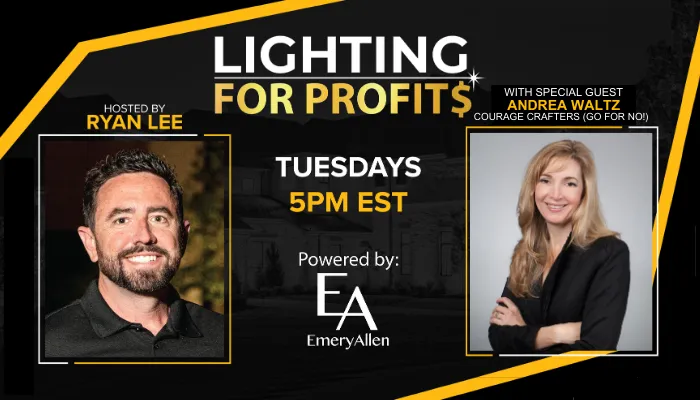
Andrea Waltz - The Power of No
Lighting for Profits - Episode 227
What if rejection wasn’t a setback - but a strategy? In this episode, we sit down with Andrea Waltz, co-founder of Courage Crafters and co-author of the best-selling book Go for No!. With nearly 20 years of experience teaching professionals across industries, Andrea reveals how embracing failure, rejection, and the word “no” can become the fastest path to success. Discover the mindset shift that transformed sales, confidence, and results for thousands worldwide.
Watch the episode
Episode Transcript
Lighting for Profits is about increasing your profits with landscape lighting
Welcome to Lighting for Profits. All Light, All Light, All Light. Powered by EmeryAllen. Here is your host, Ryan Lee. All light, all light, all light. Welcome, welcome, welcome to the number one, the number one landscape lighting show in Orlando, Florida. It's going to be an awesome show. In fact, Orlando, Florida is where we're doing Light It Up Expo coming up in, in just, I don't know, six weeks, something like that. So it's going to be an awesome time. Got a great show lined up for you today. We're going to be talking about who doesn't want to make more money, who doesn't want to increase their conversion rate, who doesn't want to make more sales. after all it is called Lighting for Profits. So let's increase your profits today. I'll be joined by Andrea Waltz, the co author of Go for no. And by the way guys, if you have not read that book, going to want to read it, especially after you listen to today's episode. And actually Andrea is going to be speaking at Light It Up Expo as one of our keynotes. So really excited to have her on and allow our audience to get to know her and and her story. Just really excited for today's show. So, by the way guys, speaking about Light It Up Expo, it is coming up soon so get your tickets now. at some point it will sell out. we have limited space in the room and so, it's getting fuller. That's all I'm going to say. Okay, we have pre show classes that are also getting fuller. Is fuller a word? I don't know. They're getting more full. whatever it is, it's happening. And so if you're wanting to break into landscape lighting and get hands on training, that class is filling up. Same with permanent lighting, same with Christmas lighting. Okay, so if you want any of those you, it's free with your ticket but you do have to register those because again limited seating available and so go to lightitup expo. com, get your ticket. If you have questions, of course reach out. But what are you waiting for? Start taking action.
We keep getting reviews for the podcast
Let's go. Light it Up Expo. thank you guys for the reviews. We keep getting reviews for the podcast. Thank you guys so much. If you have not yet done so, I want to invite you to go give me that five star review on Apple or Spotify, but I'm really close to Apple. I think we're at like 89. We're going for a hundred baby. So see if you can help me out. And again, in just a few minutes, we're going to have Andrea Waltz, the co author of Go for no, an amazing book, that, really kind of helps simplify things. At least that's what happened for me when I read it. I was like, okay, this gives me, this gives me like a new meaning, a new direction in life, right? And so we're gonna have Andrea on.
Uncertainty is something that holds everybody back, right?
And of course, before I have her on, I want to share something that's been on my mind, that I think this is something that holds everybody back. Doesn't matter if we're talking sales, it doesn't matter if we're talking business, it doesn't matter if we're talking just personal life. And I remember when I first started my lighting business, I kept, I had a sales position, I was selling software. And, I kept that job for a year. I moved from Utah to Texas to start the lighting business. I kept that job for a year because I was unsure if the business was going to work, right? I was unsure of my ability. I mean, how all this doubt and fear and everything else. And so I kept that job. And really what it was, was I was uncertain, right? And so, a couple years I was after, like, I think it was two or two or three years, I don't know, I was answering all the phone calls and I was getting really busy. Like that was good, sales were good. But now I had more to do and I was afraid to hire an office manager because I was unsure if I could afford to continue to pay her. Uncertainty. Right then I needed a shop. I need a place, an office. I need, to keep our, you know, store our trucks and you know, have the admin work out of. But again, I was unsure if I could afford that rent, every single month. Uncertainty. And then I remember growing up later, we, you know, started to get more sales and got an office admin, got the shop, got more trucks, more crews, and I was stuck for a couple years at about 1, just over 1 million, 1.1, 1.2 million in sales. And I knew that I needed to hire another salesperson, but I was unsure if I would have enough sales and leads to support this other salesperson uncertainty. So that kind of opened up a new problem. I was like, well, if I want to get more leads, then I'm going to need to increase more my advertising. but I was unsure if the advertising was going to work and I don't want to waste my money. I had A little bit of money in savings now, but I don't want to waste that because I worked like crazy for that, right? Uncertainty. You know, it's crazy because I learned so much through the 12 years of operating my lighting business. And then here's what's crazy. It's not that I became this guy who never has fear, never has doubt. I'm always certain about every decision, right? When I started Landscape Lighting Secrets, I was unsure if I could actually help people. I mean, I had a proven framework, I had a proven process, but could I actually help someone else? And so I decided to go out and find someone who's already done what I had done. This is the. My first experience ever hiring a coach. I'd never been in part of a mastermind. I'd never been part of a community or anything like that. And there was a guy, his name was Sam Ovens. And everyone in the. The coaching space or the information space kept saying his name. It's like, how did you get to this point? How did you do this? How did you this. Well, this guy's name kept coming up. So I reach out, I get on a sales call, and I presented with the pitch, I guess, right? And the. And the. And the guy, David Dre, goes. David tells me it was. I think it was 5,800 bucks, 6,800 bucks. I can't remember exactly how much it was, but, I remember thinking, crap, like, is this what I really want to do? Like, what if it doesn't work? And all the doubt and all the fear and all the uncertainty hitting me, right? And luckily, I had exercised this portion of my mindset and my ability to make decisions, that I made the decision to move forward. Because even though there was uncertainty, like, is it going to work? I knew it worked for other people, but, like, is it going to work for me? I had learned that the uncertainty wasn't about something else. It wasn't about this person being able to deliver or the offer. They had evidence, they had testimonials. I knew people that it worked for, but I was uncertain of myself. And so how did I exercise this muscle? Well, it's because I had made decisions. I had bought a truck that I didn't know if I could even afford. I bought a house that I wasn't sure I was, I could afford. I had hired an office manager that I wasn't sure if I could afford. And when I did those things, it created belief in myself and it created certainty. So when I went to hire the coach, to help me build landscape, lighting secrets. The only thing that I was certain about is if I didn't hire them, it would take me a long ass time to figure this out. If I didn't hire them, I'd probably be more likely to screw it up. I had a lot more certainty that I should hire them than uncertainty. Then what if it doesn't work? Okay?
Always compare the downside and the upside when making a decision
And I'm sharing this with you because this is a. Uncertainty is, is one of the things that holds people back the most in their business, in their relationships, in the way they live their life. And so I want to give you guys a couple tools that have helped me figure this out, okay? One, one tool is comparing the downside with, with the upside. So maybe the easiest way to explain this is when I make a decision. Okay, let's just say it's, you know, it could be a truck. Like if you're like, oh, should I buy this $60,000 truck? Well, what is the upside of that and what is the downside? Okay, same could be for again joining the coaching program. Okay, let's say if it was 6,800 bucks, the downside is like, I waste $6,800, okay? Like, I waste that plus whatever time I put into that. But there's like a, it ends the downside. Like at some point you realize, this wasn't for me, I got ripped off, I didn't learn anything, I didn't use it, whatever. It. That's the downside. $6,800 net in the negative, plus some negative time, right? But what is the upside? The upside is, wow, I could, build this awesome community and program and, and it could be worth hundreds of thousands, millions of dollars. So when I compare those, the downside of the upside, it's a no brainer. You're buying a truck for $60,000. Here's what's crazy about this. And same thing for coaching. Like, that's the worst case scenario, okay? What if you don't get the best case and what if you don't get the worst case? What if you learn a couple things along the way and now you have these tools that help you the rest of your life, okay? And so it doesn't always cost you the full amount of the actual expenditure. And same thing with like a truck. If you have a $60,000 truck and you buy it and you're like, you know what? This isn't the color I wanted or it's not going to work out or whatever, it doesn't cost you $60,000 because you can resell that truck. Now there's depreciation, all these other things. You might not be able to get the $60,000 back, but you're not going to go down to zero. Okay? It might cost you 15,000. So the, the downside might only cost you 15,000, but what's the upside of buying a new truck? Well, now all of a sudden, you can get it wrapped, okay? And now you can get more clients, and now you can generate hundreds of thousands, if not millions of dollars because of that truck. So always compare the downside and the upside and realize that the downside is never all the way down at the bottom. Okay? Again, if I would have spent $6,800 in this, in this community, and I didn't, it wasn't everything I wanted, okay? Which actually was more. But let's say it wasn't everything I wanted, at least I would have taken away a couple things that helped me fast track my success. So maybe I can add some of that money back and maybe it only cost me $2,000, $3,000, or maybe I only made $5,000 off of it, $10,000 off it, but at least I didn't lose money, right? And so, so many people have so much fear because they're using their logic to say, oh, it's a $6,800 investment, an $80,000 truck. Well, that's not, that's if everything, worst case scenario happens. But you can make things happen. So that doesn't, that doesn't happen. So that's number one. Compare the downside to the upside and how bad is it actually? Because it's never as bad as you think it is. And then you have to ask yourself the question, where does certainty come from? Okay, think about when you, when you want to know an answer. So like, if, if you knew something was going to work out, okay, if you knew that you were going to come to Light It Up Expo and you were going to get what you wanted out of the next phase of your life, for example, or if you knew that you were going to join Landscape Lighting Secrets and you could get a return on your investment, I mean, would you do it? Right? And that's like the opposite of uncertainty. That's certainty, right? So certainty comes from what? It comes from results. Because you, if you knew that result was going to happen, would you do it? You know, so if you're afraid to bungee jump because you're like, the thing might break, but if you knew it wasn't going to break, would you do It. And you're like, yeah, I would. Okay, well that's because it's a result. The result is the thing didn't break, you survived. Right? And so certainty comes from results. So how do we get results? Results come from taking action. Okay? And so when we take action, we get a result and then we get certainty. And then here's what's crazy. When we take that action, we get a certain result, then we get certainty. Sometimes the certainty is like, yeah, I knew I shouldn't have done that. We're not a hundred percent here. Like, everything doesn't always work out the exact way we want, but we do get certainty one way or the other. I know I shouldn't do that again, right? So certainty comes from results. So we take action, we get results, then we get certainty. That increases our belief in ourselves. Right? And so that's really what happened to me is I learned over the years how to become a better decision maker by taking action, getting result, building certainty, which built my belief and ability in myself to make certain decisions. So when we believe in something, we're more likely to take action toward it. Right? So it, really everything starts with belief because once you believe, it's a lot easier to take action, which gives you a result, which adds to the certainty. Okay. And it's this really flywheel that starts to build. And this, this is, this is a trend that I see amongst the most successful people out there. They believe that they're going to succeed, whereas the, the, and it's an abundance mindset, they believe that truck is going to be an investment, to be a tool to help them make money. They believe joining that coaching program is going to help them, Whereas the scarcity mindset, people, they believe as well, but it's the opposite. They believe it's not going to work. Why not? What if it doesn't work for me? And they have negative belief system. So you can rewire your brain, you can start making these decisions, you can start believing in yourself, believing positively instead of negatively.
So many people are holding back because uncertainty is holding them back
So that's the crazy stuff that's going on my mind this week is there's so many people that are such good people, such good people with so much potential in front of them, and uncertainty is the thing that's holding them back. So I want to encourage you to work on this, work on your belief system, start taking action, measuring the results, building your belief, building your certainty in yourself and, and know that it's okay. Not everything's going to work out, not everything's going to be perfect. You might invest $6,800, $80,000, whatever that number is. But it's not an $80,000 decision. It's the risk is maybe 10,000. The risk is a lot less than the full expense because you're always going to get some of it back. And that's helped me, and I hope it can help you.
Emory Allen makes premium LED lamps for lighting professionals who demand the best
All right, guys. Hey, by the way, if you've been listening for a while, you know I care about the client experience. And, it's an easy way. It's an easy way to differentiate from your competition because, I mean, even just answering the phone, right? Some people don't even answer the phone. Some people don't follow up, call their clients back. Like differentiation, right? So don't let a bad lamp ruin your client experience. Emory Allen makes premium LED lamps for lighting professionals who demand the best. Don't settle for less. Upgrade your designs and installations today with Emery Allen. Reach out to tom gmarylen. com to learn more and take advantage of their contractor pricing. Don't forget to mention that you heard about them here on Lighting for Profits. Get that discounted contractor price. Just email tom gmeryallen. com by the way, come hang out with Tom and the Emory Allen family at Light It Up Expo as well. Thanks, Emerald. You guys are seriously awesome. Thank you.
All right, guys, now it's time. I've been teasing. I'm excited for today's show
All right, guys, now it's time. So I've been teasing. I've been telling you guys that Andrea's gonna be joining us. The co author of Go for no. I think it's time to get her on the show. What do you guys say? I'm ready. I'm excited for today's show. I got some personal questions myself that we still haven't gotten answered.
Andrea Waltz: I missed my calling as a dj
Welcome to the show, Ms. M. Andrea Waltz. How are you?
Andrea Ryan, I am so glad to be with you. And I have to say, you're you. You are so incredibly good at what you do. But you, also missed your calling as a dj. I'm just telling you right now.
Listen, it might be like I've got. I've got a secret fascination with it. I. I think I should be a dj. Like, one day, I should just be one, too. Thank you.
Yeah. Yes.
It'S fun. I. I don't know. I love it and I love. That's.
It's.
When I first heard about what a podcast was. This was, like, years ago, right after I graduated high school. It's been. Or, sorry, college, like 2005. This guy was listening. He was, like, listening to a. He told me a podcast. I'm like, people listen to a podcast. I just thought it was the dumbest thing. And now I have my own podcast, so I'm like, this is kind of cool. This is fun.
So, yeah. Yeah. Well, I'm. I'm so excited for our conversation today.
Thanks for joining me. Really. appreciate it. Looking forward to having you at Light up as well.
Andrea Johnson teaches people how to think differently about the word no
do you want to just do a quick introduction of who Andrea is?
Yeah. So, I teach people in every business and industry how to think differently about the word no in order to increase their sales and profits, which is what Light it up is all about. That's what we're going to talk about. And, primarily, in relationship to rejection, we talk a lot about mindset. We talk a lot about different strategies that you can employ in order to get more no's and by virtue of doing that, get more yeses. So, and I just want to add, too, as somebody who also, like, I loved what you said about certainty. And I look back at the events and the things that I spent money on and did and how the payoff was for those. There's nothing like being in the room with other people who do what you do. But I just want to give a. A reframe as well, which is when you take every. I'll call them excuses. When you take every reason or excuse as to why you can't come to Light it up, you can't afford the travel, you can't afford the time away from your business, whatever, those things that you come up with are the exact reasons why you need to be there. Because it's those excuses, if you will, that are the things that you can solve by coming to an event like this. So you get the solutions so you can move beyond those.
Yeah, I love that. Well said. And it is hard because it's like the. The chicken and the egg. You know, people are like, no, I hear what you're saying, but I don't have time because, you know, my business can't run without, like, at some point, you're gonna have to draw the line in the sand, you know, I mean, if you're going to take the same actions last year but expect different results this year, it's just. Just not going to happen.
For sure. Yeah.
No, I'm super excited. you are one of our keynotes at Light Up Expo. And, I don't know. I. I'm. This is like, this is a big deal for us. You know, I'm like, I read your book and then I got to meet you and then now you're coming to our, our show and you're going to just add so much to it. So I'm kind of like super, fanning over here.
Light It Up Expo is a live event that takes your material to new level
what, what are you most excited about? Like, what are, what are people going to miss if they don't show up?
Yeah. so reading the book is one thing. we really take our material and we, bring it to life and we bring it to life in a very different way. So I, I guess I would call it experiencing. Go for no. Live is very different from anything that you could read or any video that, you could watch. We really, Everything that we do at live events is different than anything else we're able to do. I guess I'll put it that way because we're in a room full of people, so we get to play the Go for no game. We do different exercises. you know, it's just a whole different experience than maybe watching a video where honestly, you know, it's kind of like the same information, or even listening to a podcast. Like you've got to be in the room and experience it, which I think will leave such a, A, better memory. And if you think about it, it's like the things that you experience in person in terms of m. Creating, those memories and being able to act on them are so different than, because we all consume tons and tons of content. Look at all the scrolling we do. And what do you remember the next day? You don't remember anything. So, yeah, the live event is a whole different level.
Yeah, that's really cool. I'm glad you shared that. that's any event that I do. I try to call it an experience. And that's what Light It Up Expo is. It is an experience because, because of those reasons, like, it's one thing to read something in a book, or maybe we talk about it today or whatever, but you have that experience that truly locks it in and makes it. Makes, it part of your being. So I'm glad we're on the same page there.
Ryan: It took us 10 years to finally hit number one on Amazon
I want you to brag a little bit on what you guys have done. I'm reading the stats on the, you guys hit the number one Amazon selling list, when you, when you came out with the book, and then it's still among the top 50 sales books ever.
Yeah, well, thanks for that, Ryan. And you're right. I kind of, I kind of, I was so excited to talk about, the reasons why to come to the event. I Cut my introduction short. All right. So, my business partner, Richard Fenton, and I, wrote this book. Go for no. We actually wrote it. It's called Quite Old. I will just say that right now. But the principles in the book are timeless and that. That's really all that matters. So, we wrote the book in about 2000. We struggled. We struggled. It took us 10 years to finally hit number one in the sales category on Amazon. And ever since we did that, for the last 15, well, 16 now, I guess it has been in the top 50 of sales books. And that's why when you've said, hey, tell people what you do, we really help people in every business and industry. So if you're, you know, whatever, service you provide, and that's why we're speaking for, you know, at your event, you have to deal with no, and you have a fear of no. And you, you second guess and you make assumptions, and you, you make all of these very natural human mistakes, all kind of designed to not get rejection and go for no really flips that on. On its head. And so in whatever we do, in whatever endeavor we're trying to succeed at, rejection is part of it. We've got to learn how to embrace it, and we've got to learn how to value it and then do something with it.
Yeah, I actually, I know you might not love it, but I love that it's like part of the story that it took 10 years to take off. It, like, makes the story even better. It's like, of course.
Yeah. And I have to tell you, we want it. There were times we wanted to quit. Oh, my God. Just wanted to quit. And then it's like, sometimes we want to quit. And then we would. We would be like, you know what? Let's just. Okay, let's just quit just for, like, tonight. And then we wake up the next morning and be like, who are we kidding? We don't want to quit. Let's, let's. Let's go. We can do this.
Yeah, you just need some more no's.
Richard started his career working for his dad in the car business
So how did, how did you learn these things? Like, where did this book come from?
So Richard, started his career working, for his dad in the car business. And he was selling, he was selling fleet. Ah, cars. So like corporate vehicles. and he was really growing up in his father. His father was like the sales legend, and he wanted to get away from being in his father's sales legend shadow. So he moved to California and he got another job in sales. but this time it was in retail sales. He ended up having this fantastic sale on the day his district manager was visiting the store, this guy whose name was Harold. And Harold comes over to Richard after he has this fabulous sale. And he says, out of curiosity, Richard, what did that customer say no to? To which Richard was like, what do you mean? I just had this fantastic sale, right? And Harold's like, yeah, I know everything the guy said yes to. I'm just curious, what did that customer say no to? And Richard reviewed the sale in his head and he said, harold, that customer didn't say no to anything. And then Harold asked him the really important question, which was, how did you know he was done? Then how did you know he was done? Like, if the guy never said no to anything, how did you decide he was done? And the truth was, is that Richard had his own mental spending limit. and we're going to do a fun exercise with this, by the way, at the event. So Richard like hit his own mental spending limit and decided that, you know what that customer was done. He, and, and really it was based on Richard's own pocketbook. So this was kind of the very beginning of Richard's go for no experience. Learn kind of having this experience and then deciding, you know what, I just need to go for no. Like, I, I, I, I know that yes is the destination, but no is how you get there. and that's what he did. And he became an award winning salesperson and manager and trainer. And eventually we met. And so Ryan, he tells me this story and I actually was the opposite of him. Like, I thought I was like this fantastic salesperson. And then when he told me the story, I went, actually, you know what? I don't like hearing no. That's the truth. And I thought about how I would interact with customers sometimes, about how I would kind of look them up and down and be like, m, they're not going to buy what I think they're going to buy. So I'm going to show them this, right? And this may resonate with some listeners right now, right? You, you, you look at what, you look at somebody's house, you look at what they have and you go like, okay, I'm going to recommend this package because you figure that's what I can get away with. That's the, that's going to be the, the easy yes. So you make all these assumptions. And so I, I recognized, I got honest with myself and I thought, okay, I'm avoiding hearing no, even though I'm not as bad as Where Richard was where he didn't want to hear no at all, but I do it in my own way. So I told him, I'm like, this concept is freaking amazing. Like, I just love this. And I applied it, at my job and got great results. And then eventually he was like, you know what? We need to start a business together. And I said, yes, let's do it. And we decided we were going to write a book. And, To your uncertainty point. Yeah, it was just uncertainty. Every day, uncertainty, uncertainty, uncertainty. But we just kept kind of moving forward. And, we specialized in the retail industry because that's where both of us come from. And that was the launching point. And. And now for the last 20 plus years, I have done nothing but study rejection, and what to do when you encounter it and how to think differently about it and every aspect you can think of when it comes to the word no. I just love it. This is my passion.
I love it.
Show people what's possible and let them come back and say, okay
Thanks for sharing. I remember I had an experience, ah. Where I learned a portion of this, where, we got a lead. I was just a few years into the lighting industry, but the lead was like, the neighborhood next to mine. And I was like, this is not good because I didn't live in our normal clientele's neighborhood. So it was a $300,000 house. And I was like, should I even go? I mean, it was right by my house. So I was like, yeah, I'll go. And I, meet with them. And I'm instantly doing what you're talking about. I'm like, you know what? They're probably not going to do this, so I'm not going to show those ideas. But this guy was at least savvy enough to be like, well, do you got anything else? Like, I hadn't, I hadn't, I hadn't sold him, you know, I mean, he, he was asking me like, well, is there anything else? I'm like, well, yeah, I mean, we could, we could go crazy here. I could do this and this and this. But I don't know how much you guys want to spend. I was scared. And he's like, yeah, well, well, how much would that be? And so I'm like, okay. So we keep going and we keep going and we kept going. And, finally at the end, it ended up being $11,000 project, which again, that's not that big. We've got clients that are doing jobs that are hundreds of thousands of dollars. But for me, at the time, $11,000 was a ton of money, especially for the neighborhood it was in. And I. I literally. He must have seen the look on my face. I was like, okay, and you ready to move forward? He's like, yeah. Like, oh, my gosh. And he said something that just, I'll always laugh about. He said, what Mrs. Martin wants, Mrs. Martin gets. Like, I didn't understand that principle. I didn't understand that these people are doing this not just for. They're not buying lighting, they're buying this experience or they're. He's. He's doing this as an act of love toward his wife and showing that he can do these things and he lives well within his means, obviously, and stuff like that. So to your point about, like, what did they say no to? Like, a lot of times we do limit opportunities because we judge their appearance or their ability, and we're missing out on so much. And it's not even about, like, oh, you could have sold $10,000 here. Sometimes we're presenting a lighting design to someone that's just underwhelming because we're trying to fit this imaginary budget. But what if we blew them away? What if we did get them to say no to things and say, wow, that seems a little excessive. Could we scale it back here? And now we've at least impressed them and differentiated ourselves from the guy who's selling lights. Now we're actually a lighting designer selling a vision.
That's so true. Yeah. Show people what's possible and let them come back and say, okay, how much? Wait, no, that's not going to work for us. And then you can. And then really. And this is kind of a phenomenon that we call subtract off selling. So it's show, like, the, like, show what is possible. Be that designer. Be that consultant, if you will. And that means that hopefully you ask some good questions. So. So you got a feel for, like, what their hot buttons are, what they. What they're into, all of that. Then you show this, great package what's possible, and then let them subtract off the stuff that, you know, they're not as excited about.
Why is that so important that they do say no to something?
Yeah. Well, because until somebody says no, you truly don't know what their limits are. Right. it's actually far easier to show somebody what's possible and let them have the agency to pull you back and to say no to things and to be okay with that, rather than to try to start at the bottom. Show somebody something that's really, I guess, basic, and then continue to Add on and ask and add on that. That is actually what feels salesy. and that actually is what. What you're really doing there is you're making the customer, the client go through a process that's kind of painful, as opposed to showing them everything and letting them. Letting them make the decisions. So it really puts them in the driver's seat. So much better.
I like it.
Go for no is a mindset that layers on top of whatever you do
Well, you know, there's a lot of sales trainings out there and books and stuff like that. A lot of them are on closing. Obviously, you guys, you know, your book focused on getting no's. Why. Why is going for no more powerful than going for yes?
Yeah. Well, here's the thing. Everybody knows that they can say no, right? Customers and clients, already know that they can say no to you when you make it, psychologically safe. And you actually help people understand that no is a perfectly acceptable answer. It's amazing how people relax and they're far more open to hearing what you have to say. And so the yes actually becomes that much easier. So one of the things, like a cool thing to do is just to look at your entire process. And in our book, it's a fable. So we're not teaching, like, this total go for note. This is not a system because to your point, like, there are tons of sales training programs out there. There are sales training programs that probably a lot of people listening to this have, like, hey, this is kind of how. This is our process. This is how we do it. So go for no is really a mindset and philosophy that layers on top of whatever you do. But in general, in the most general sense, every business kind of goes through the same thing, which is you've got a funnel, right? You. You get leads at the top of that funnel. Wherever, wherever your leads are coming from, whether it's social media, whether it's referrals from people in the neighborhood, you know, whatever, and, people calling you off of ads. And so at the very top of the funnel, that idea of go for no begins. And so the idea is, can you maybe start filtering out people who are not as qualified for what you have? So we. This is like disqualification. But then at every step of the funnel after that, during your presentation, during your visit, then coming back, making the proposal, the final close, like the final close should be so effortless and easy because hopefully what you've done at every step of the way is you've. You have heard no enough to where at the very end, after hearing no to. To what doesn't work and what people want. Then the final question of, okay, is this something that you want? Like, is so easy and so effortless because they've gotten rid of everything that doesn't work. And if you can. If you look at the opposite of that, which is selling and just trying to hear yes, what it is, is it's asking, say it's not disqualifying, anybody. Right? You don't ask any. Any qualifying questions whatsoever to kind of find out about your potential client. You then, make a presentation or you. And you gather information, and you never ask questions that could lead to no answers. You're only. You're just trying to get yes, right? You're just trying to get yes. And so by the time you make the proposal and try to close, you really don't have good information. And you're just trying to close. You're just trying to quickly close and get the yes. And that's where things go really wrong on the back end. That's when you get complaints and. And it doesn't go well.
Go for no strategy is about focusing on getting no's instead of yeses
So sorry, Ryan, I can talk forever about this. To wrap up. To wrap up. The answer to this question, I swear I will shut up. Is, no is so powerful because it makes getting yeses so much easier.
Okay, I like it. How about in. So, like, I know when I had my sales job, as I was launching my lighting business, my goal was literally just to call a hundred people a day. And I was. I became the top rep simply because of that. People just would get tired after 60, you know, or be like, man, I've. I've gotten so many no's. Like, rejection sucks. Like, it. I don't know. You just.
It's.
It's hard to deal with. So one thing that I try to teach people is go after referral partners. Because if we can build a relationship with like a. A really big home builder or a pool builder, someone who's already in front of our ideal client. It's just like, it's so awesome. You're not marketing in their mailbox, you're marketing through their front door. Right? But where most people give up is they make a list. They'll call 20 or 30 people, and they just hear a bunch of no's. So how can they apply this go for no strategy and realize that? How can they turn that and celebrate those no's instead of focusing on the yeses?
Yeah. So the fundamental idea of go for no actually is exactly what you talk. You're talking about, like, edits. Very basic. And I hate to say this because this is not what I want go for no to be known for. But it is, it is kind of that numbers game aspect, right? It's like if you, if you want one. Yes. And you, you learn after time that it takes you 99 times 99, you know, attempts to talk to somebody, then you know, you have to make basically 100 dials. And so there is kind of this quantity game that we all have to play depending on your business of you've got to make a certain number of reach outs. And that's why you're right, dialing in your marketing, is so smart. And it's not that it shuts down that idea of quantity because obviously the more leads you have coming in, especially if they're qualified, the better. so for most of the people listening to this, their opportunities to go for no are probably more on the quality side, making quality presentations, things like that. But on the numbers side it's true. It's just like the more that you numb yourself to know, the more the more irons in the fire, the more hooks in the water. And even from a marketing standpoint, go for no is true. Like get how many people are, how many people know what you do. we spoke for a company, just a couple weeks ago, in insurance and I, the founder of the company told me, he's like there is no excuse. And I thought this was so good for he, he says this is what I tell my people. There's no excuse for everyone in your network who knows you to not know what you do. Like they should all be able to easily say, oh, this is what this person does. And so if you're like basic friends, family, neighbors, not to mention referral partners, like we haven't even gotten there. But if they don't know what you do, then you're, I mean, start there. Like you're making your marketing really difficult. So the whole idea is, you know, quantity matters. And, and I think that's what you were saying. And, and, and so people have to start there with quantity.
There are two kinds of rejection in business: explicit and implicit
Yeah, well, yeah, let's talk about that. Because it does start with quantity and then it goes to quality. But like we, we just live in a world where the loudest, literally the loudest business person on, on Facebook, on, on, in emails, in, on Google, whoever is like the loudest is going to win. It has nothing to do with if you're the best. And so most people are afraid to be loud. Well, I wouldn't want to see, you know, this, this, this Post again. I've already posted it. Like, how many people actually saw your post? Like, you could post the exact same thing, like, four times a day. And that doesn't mean people are going to see it four times. Right. And people are afraid of this go for no strategy. Well, what if they do? It's like, people can unsubscribe, they can not follow you. They can delete your emails, unsubscribe from the list, whatever. So, like, it truly is this M M mindset and mentality of, like, no, you have to be loud, you have to be obnoxious. And if you're like, well, I don't want to be loud, well, then don't expect to be great. I mean, that's really what it comes down to. Like, at some point, enough people have to know about you, you know, and there's a lot of people that are loud, that are less talented than you, that are less qualified than you, but they're willing to go for no. They're willing to get the rejection and. And maybe be like, oh, well, what? Did you hear what Ryan said? Or whatever. It's like, I don't care. I'm willing to go through that because I believe in my message. I believe in the conversion, that I can help with people. And so, yeah, if I get made fun of or people delete my emails or block me on social media, it's like, it's worth it. I don't care. I'm truly going for no.
I love that you said that. And something that, we don't often talk about in our presentation, so I can talk about it here, too, is there's two kinds of rejection. One is explicit rejection, where I ask you, hey, Ryan, can I be on your podcast? And you go, no, Andrea. Ah, no, thanks. That's very explicit. Then there's the implicit rejection. I email you. I'm like, hey, can I be on your podcast? You don't email me back, or I advertise and I don't hear anything, or I put a post up on Instagram and nobody likes it. Nobody comments. They're both actually very powerful. And to your point, they're both. They both can really have wreak havoc on one's mindset. So you. You're so. You're so right. You've got to get over that idea of everything. Everyone's paying attention to me. Everyone knows what I'm doing. Oh, this person didn't like it. Or they unsubscribed. It's like they're not even thinking about you. And so, one of the things that we will talk about though at, the conference is kind of how to get off that yes, no emotional roller coaster where you do pay a lot of attention to the yeses and the no's and the failures and the successes and how detrimental that is to really, honestly your mental health. But just to I mean, it really will sidetrack you in your business. So you've got to like, get over that corner quickly. Coca Cola still advertises. Like, who in their right mind needs to see an ad for Coke? Like, I think we all get it by now. And yet still. So, I mean, that's your perfect example.
Yeah, that's true. I know, I know so many talented business owners that are just unwilling to put them out, themselves out there. And I think you're right. I think it is more implicit. I don't think it's a lot of people telling them like, to their face, you suck. I hate you. I don't want this. Like, I think it's just like, well, I posted before and no one, no one did anything. And I think this game, this game is like, no, you, you gotta, you gotta, you know, make your own rules. And, and that's, that's really kind of what go for no for me is like, yeah, you can create your own rules and I can just focus on like, cool. If I have to get 99 no's to get one yes, well, what do I got to do to get 99 no's? And every day can be a win because you're like, dude, I got five, I got five no's today. Like, that's awesome. I sent out, 200 emails and no one replied. So, all right, send out 200 more tomorrow.
Yep, that's exactly right. And that is just about being persistent. you talked in your opening message about certainty and belief in yourself. And you know, it's, it's. Belief is required. But here's the thing that, you know, if you send out the 200 messages, you're going to get some rejections. Implicit, explicit, both kind of both kinds probably. If you don't send out the 200 emails, nothing is going to happen. Literally nothing. And so the belief and the action are, it's chicken and egg. They, It's a cycle. You can't have one without the other.
So how do we go about, like, starting this, how do we go about building this culture of, you know, rewarding no's as progress instead of just the wins and the yeses?
Yeah, so celebrating your nose when you get them is a big part of it. But even before that, and I said that we don't have a system, per se, but there is kind of a. A process, which is, if you're listening to this and you're like, this is cool, I kind of get it.
Look at your entire business funnel and identify opportunities you have to go for
What do I do first? Well, first of all, look at your entire kind of business funnel and think about all of the opportunities that you have, the times that you have to go for. No. So it stop starts at the very top with your marketing, throughout your process, all the way to closing, and then even at the kind of the bottom of the funnel, which, if Richard and I were talking about this the other day, we're like, you know what? It's not really a funnel. It's an hourglass. Because you think of, like, the funnel being really wide at the top for all the leads, and then it gets skinnier as. As the process goes, and as you whittle away, the people that are kind of like, no, change my mind, don't want to do it. Too expensive, whatever, whatever, whatever. and kind of drift. And then it gets really skinny to the people you close, and then it's an hourglass because it opens up at the bottom again and gets wider. And those are where you can ask for reviews, where you can ask for referrals, and how we all know how incredibly important those are. So create a no awareness in your business and look for all of the opportunities you and your salespeople have to get no's, and then work on executing in all of those areas. Start with your marketing, start at the top, and then just look at every opportunity. Are we. Are we hearing yes? Are we hearing no? Where are we asking? Where are we not asking? and I think every business is guilty of this, including me, for sure. Is, are we asking for referrals? Are we asking for reviews? Right. And if you're not hearing no to those things, then you got to be.
Asking, yeah, I like it because most of the time, if you do, like, an assessment on your company, like, okay, what's broken? But I like this strategy, too, of saying, like, well, where are people saying yes? And if it's easy for us to close deals, for example, well, then some, like, what could we fix? Like, do we raise our price? Do we offer, ah, a bigger lighting package? Do we offer more expensive? Now we go all brass. Do we do color changing lights? Like, one of my coaches calls it a decoy offer. but it's essentially like showing them this huge Thing, right? To say, like, hey, light. Your lighting project could, in this same design, be as high as $30,000. Now, most people do this one. It's only 15. And so it's giving them this thing to say no to. To be like, oh, yeah, we're not. We're not crazy people. We're not gonna spend $15,000 on lights. Let's just do 15. Whereas if you only do the $15,000 offer, they're like, 15,000. That seems like a lot for lights. They don't know that it could be 30. They don't ha. They. They can't say no to something. So I think it's evaluating everything, like you said, not just the areas where you are getting no's. Of course, if you're getting a lot of no's, then you can go, okay, what can we do to get 98 no's and two yeses instead of 90 no's and one yes. Like, we can work on our quality, but it's also evaluating those areas to say, okay, how do I get more, knows where I'm getting yeses now.
Exactly. And I'm sure everyone listening to this has had the. The thing happen where you present and you give the price, and the person you're talking to goes like, oh, yeah, okay, no worries. Yep, fine. And you go like, oh, no. That was way too easy. Obviously, I came in. I mean, there should have been some pushback, right? I mean, if you're not getting any pushback or have somebody hesitating or somebody going like, oh, wait a minute. Why. Why is it, why is it this much? Then? You are not selling to your full potential. You're. You're not offering everything that this person could want. And then. But it's you. As soon as that happens, it's too late. You can't go back and go, like, wait, wait, wait. You said yes to. That was way too easy. You said yes too fast. Let me show you what I really should have recommended to you. No, that's embarrassing. That's why you always need to show the best possible option. And it's weird. Some people just want the best. Some people think that putting Christmas lights out and having. Having Christmas lights put on Alice is insane. And they would never spend that much money, and they would never do it even if they were a multi, multi millionaire. And some people don't have a lot of money. But that's just really important to them. They have kids and they want to, like, do it up. We, we can't be the judge of that.
Yeah, I agree. Yeah. I mean, and I'll say this in, in landscape lighting and I guess permanent lighting and holiday lighting as well, we do get a lot of sticker shock people. There's not a lot of like lay downs like, oh, that only 15,000. You know, like, most of the time people are, And so I think that that leads to their, their unwillingness to, to go for no. Cause they're like, I'm already getting a lot of no's, you know, and obviously, you know, we teach them strategy about how to improve their sales process and build value and stuff like that.
Go for no strategy can help you avoid getting too many no's
But do you have any advice for the people that are like, andrea, I get no all the time. What are you, are you kidding me? Like, I want more yeses. How can go for no help me even though I feel like I'm already getting too many?
Yeah, I think, well, you probably are better at this than I am because this is such a go for yes. Like, this is a go for yes tactic, right? We want to get more yeses. We want to get more, we want to get fewer no's. but I, I will say that, I'm a big fan of context and I think that when you, kind of lay out information for people in advance by explaining to them what the process is, throwing out a couple numbers that are higher than, you know, that then maybe you even know that the project is going to be. I think that kind of helps psychologically prepare people for what's coming. And that's part of it, I think. The other part, that's pretty awesome.
I call it the Price Marinade. And we do that, we throw out a, a huge number that's we're not going to get up to, because we want them to experience that sticker shock, they're going to have it. So like, let's get it over with and then they can say no to that. Yeah, we're not spending that number, but it does allow you that room and options to give them to say yes. So yeah, a lot of those people, I say it's. If you're getting too many no's, it's not that the go for no strategy is not working. You're just. You have a broken process. You know, you're not building value. There's something else broken on in there and it can help you identify what areas you need to fix.
And that's, such a good point. When you go for no at every step of the process, then when you are getting a lot of no's. It is, it is data and that's what makes no's valuable. Hopefully you're looking at that data and going, wow. We keep breaking down at the point that we're showing the price. And so we need to become better at step stepping up the game beforehand, not later, now.
Ryan: Objection handling is not something that we're experts in
So I'll throw this back to you, Ryan. I imagine because people are getting a lot of no's. They're probably really, really interested. Correct me if I'm wrong in objection handling.
Oh yeah.
So objection handling is definitely, not something that we're experts in because we're focusing on getting no's early and. But I will say this, one of the, one of the books that we wrote as kind of a follow up to Go for no, which I was so excited to write this one. It's called when they say no. And it's kind of 44 strategies, tactics, mindset, things that you want to make sure that you do when you, when you do get a no. So one of them is like, are you talking to the right person? So making sure in advance. There was a company, I, can't remember what it was. I remember Richard telling me about this, that absolutely ref. The salespeople absolutely refused to go to the home even if the customer called and was like, I want you to come and give me an estimate. I think it was Windows. Come give me an estimate. And they would say, okay, so who's the decision maker? And, and the person would be like, my husband and I. Is your husband going to be there when we come give the estimate? No. Then they go like, no, then we're not coming. We have, we are only coming unless you both are there and can sit through this, this thing where we look at everything and give you the estimate. Because they knew that it would always fall apart because the decision maker was not. Only one half of the decision maker was in the room. Right? Only one of them. And so they made this rule that it was like, we, this is how we present. We make sure that the decision makers, in this case both. Both people who own the home are there and have. Both have the power to say yes. And then they close. Like their closing ratio went way up. And so, that idea of, of how can we manage some of these objections earlier? Another thing that that we talk about a little bit is in addition to making sure you're talking to the right person is have that offer, have that kind of subtract off selling offer right away. So if you get that no. Then kind of say, well, what of this that I've shown you, and I'm sure you teach this. Would you be willing. Would you like to get rid of. What can we kind of pull and how does that number fit if we were to pull that and do this number? So, you know, there are, There are ways of getting around those no's. And even though objections isn't our specialty, I so believe in the most important mindset that you should have is don't just get that no and run. Like, stay engaged with it, work with it, ask more questions. Like, it doesn't have to be the end of the process.
Yeah, that's so true, though. I've got, like, so many different scenarios. again, going back to referral partners, I called on this pool builder. this was back in the day. And they go, oh, we already have a lighting company. And a lot of people would be like, okay. Click. Right? And I was like, okay, how long have you been working with them? You know, I mean, I'm willing to, like, keep asking questions until they're done with the conversation. I don't know. Like, I don't know. These questions. I'd like to know. And if they don't want to answer, that's fine. They'll tell me, right? And they go, oh, we've been working with these guys for a long time. Oh, okay. Totally understand. I'm like, I. I'm not. If you guys are loyal, I appreciate that. In fact, if we were working together, I would want you to be loyal to me, too. So that's actually really good. I appreciate that. But I said, would you mind if I just check in from time to time, like, every quarter, and just make sure that they're doing a good job? No, not a problem. That'd be fine. And so I got a no, but I kind of got a yes, right? And so I kept checking in. It literally took me two years. I'm not kidding, Andrea. Of stopping by this company at least every quarter, sometimes every month, if I had time, right? And I would stop in, and they'd be like, no, we're good, we're good, we're good. Finally, one day I go in, and he's like, got good news for you. I'm like, no way. He's like, yeah, they've been doing this, and they've been screwing our clients over, blah, blah, blah. And I'm like, all right. And so literally, like you said, it's not just going for no. You're using that no as a tool to get to the yes. as a data point. To be like, should we even be in front of this client? And in your example is great. Like, no, you probably shouldn't. Unless both decision makers are there. And if people are like, well, I can't charge those prices, Ryan, and I can't close deals on the spot. It's like, are you in front of the right client? Because the right client doesn't want to get multiple bids. You think they want multiple people in their house? You think they want to think about it for two weeks? No. The right person wants to move forward and they want to pay more.
You have data now that tells you the way you're doing it is not working
They've hired cheap contractors. They know what that's like. So it's not that, if you're getting no's already, it doesn't mean all hope is lost. It just you have data now that tells you the way you're doing it is not working.
Right. Right. Ryan, no wonder you do what you do because that's like such a masterclass right there in the perfect go for no attitude. And how important, and we'll talk about this too, at, the event, how important follow up is to the process and getting permission to follow up and just, you know, staying engaged with people.
Whenever you're closing and you feel some friction with the price, remember
So that was awesome. I just thought the phrase that I was trying to remember when we were talking about, like, pricing and it's something Richard and I call close on the difference. So whenever you're closing and you feel some friction with the price, remember, it's, it's not that they were expecting to pay zero for lighting. I mean, people have you out at their house, you've. You've taken a look at things and there's the price. Right. It's not that they thought it was going to be zero, but it's whatever that it, that it. Whatever they had in their minds versus what you have. And so remember that you're not trying to close. Like if it's 11, you quote $12,000, you're not trying to close $12,000. You're trying to close the difference between what they thought it would be and what it is. And so when you can help them understand what they're getting with that difference. So maybe in their mind they thought it was going to be 10. So they're gonna get everything they want, everything that you discussed for $2,000. So just focus on the $2,000.
Ryan shares a funny story about bidding on a vacation to Fiji for charity
And if you do, I have time to share one funny story.
Yeah. No, I love this.
Okay.
Yeah.
So, we were at this charity event for the Humane Society, and we Were bidding on this vacation to fiji island. And it got up to $12,000. And I couldn't even believe that Richard was bidding on it. I was like, oh, my God, this is so crazy, because I wasn't prepared to spend $12,000 on anything that night at this event. But we had too much wine.
So charity.
Yeah, it's totally for charity. Yes, totally worth it. so then the auctioneer is like, 12,200. And the other. He. It was between Richard and this other bidder. He. Another bidder put their paddle down. And Richard was like, oh, should I put my paddle down? And then the. They had, like, runners. And the runner came over and whispered to him and said, you're not going to go to Fiji for $200. So it wasn't about the 12. Like, the 12,000 was spent right in. In. In our heads. It was like, no, this is just 200. So anyway, we got the trip for $12,200.
Because it was basically 200, though.
Yeah, it was $200 for the whole thing. Yeah, it's close on the difference.
Dude, I love that. Now, that's huge. Because I've had experiences like this. Again, I'm always telling people, like, yeah, charge a premium, Charge a premium, but, like, get the deal. So this says it way better than I've ever put it. I had a lady call me one time again. I would follow up, follow up, Decent sized project. And she's like, you know what, Ryan, we really liked you, but we're going to go with this other company, which was kind of rare. Usually when people are going to go with someone else, they just ghost you and you just can't get a hold of them and stuff like that. But I thought, well, she did call me back to tell me this. So I go, so when you say going, you. You're. You've made the decision. Like, you've gave. You gave them a deposit. You sign the agreement or, like, you want to go with them? And she's like, well, no, I mean, we wanted to go with you, but, you know, these guys are just so much. But she didn't try to negotiate. Okay. She just said, yeah, we're going to go with them because they're much cheaper. And I was like, well, so, like, price. I mean, price aside, like, you would go with us. Yeah. And I was like, Well, so what do we got to do? Like, do I just have to, like, get closer to your price? Like, get closer to that and we could earn your business? And she said, yeah, probably. And I'M like, oh, well, then let's do something. And then just quick conversation on the phone. And I was like, well, what would it have to be? And blah, blah, blah. So, yeah, I knock off, you know, a few thousand dollars. Of course I took some lights out and stuff. But we got to the point where all of a sudden she was calling me back to tell me, hey, we really liked you, but we're going with someone else again. She wasn't even calling back to negotiate. Now I earn her business just from that, like, simple thing alone. But the way you worded certain things and, like, I think I'm going to start talking about that. Like, wait, so you're going to lose out on this opportunity? You said you would go with us if price was not a factor, and you're going to lose out on this opportunity over 1500 bucks. Because it's not a, it's not a $12,000 deal. It's just 1,500 at the point.
I like that. Right? Exactly. And I love that story, too, because that's, the perfect way to isolate.
I think the mindset you just have to have is to work with these things
Like, you took that objection and you isolated it. So it's like, okay, so everything's cool except, just this one thing. So if this one thing wasn't a factor, you'd go with me? Like, you just isolated the price. It's kind of like if, if the, we're talking about spouse. Like, so if you're, you have to think about it because your spouse isn't here. But let's just say that your spouse was here and they were, like, totally on board and totally excited. you know, and, and we're like, yes, I want to do this. Then you would be, then you'd be good. And they go like, yes, so now you know that it's a true objection and you can work with that.
I love it. I know. Because a lot of times it's like, well, I, I think, you know, my spouse is going to say this or that. You're like, oh, okay, now we're getting somewhere.
Exactly, exactly. You learn so much. I think the mindset you just have to have is, don't, like, work with these things. Work with the, the stalling and the rejection. And it's, it's all part of the communication. And you have to have courage to communicate. You have to have courage to ask questions and to stick with it even when it feels awkward.
Man, this has been so good. I, I seriously, I can't wait for Light It Up Expo. I can't wait to see you guys on the main stage. come see Andrea. Come see Richard. They're going to be. I don't know. I've never been part of his experience. All I did was read the book, and I thought, man, that was an awesome book. And then I started doing some, like, poking around. I'm like, wait, they speak at events. Wait, we have an event? Like. So I reached out and we connected, and now I'm super excited. So this is going to be really good. I know. I'm personally looking forward to it. and a lot of others are as well. So thanks for joining me here. If people want to get ahold of you, what's the best way to do that? Or if they want to get a copy of the book?
Yeah, books, on Amazon. Go for no. I'm go for no at. Go for no on all the social media platforms. So. Easy to find.
Okay. Yeah, easy to find. Love it.
Ryan: I'm super excited for Light it Up Expo this year
did we forget, Is there anything else that we need to talk about?
I don't think so. I think we're good. Yeah. Super fun, though. I love the conversation.
Okay. Love it. Well, super excited. I mean, honestly, last year was our first year to do Light it Up Expo, and we, didn't have any, like, big keynotes. I mean, I think that they're. They're awesome people in the industry and stuff like that, but this is kind of a new thing for us, so I'm excited to have you guys there. And, we've got some special surprises that we're working up for attendees, and I know you guys do as well, so can't wait to, hang out with you and Richard in Orlando, and it's gonna be a blast.
Cool. Thank you, Ryan.
All right, thanks, everyone.
Andrea: Start creating awareness, guys. That's step one
I guess as we're wrapping up while I find the music, what's one thing that they should implement from the, Go for no principles?
Oh, you know what? Just start with the no awareness. Just look and start paying attention to, you know, where you need to start going for now. That's step one.
Love it. All right, start creating awareness, guys. Go do it. All right, guys, have an awesome week. We'll see you next Tuesday here at Lighting for Profits, and I'm hoping to see as many people as possible in Orlando. Andrea, thanks so much. Appreciate you. See you guys.
Andrea Waltz - The Power of No
Lighting for Profits - Episode 227
What if rejection wasn’t a setback - but a strategy? In this episode, we sit down with Andrea Waltz, co-founder of Courage Crafters and co-author of the best-selling book Go for No!. With nearly 20 years of experience teaching professionals across industries, Andrea reveals how embracing failure, rejection, and the word “no” can become the fastest path to success. Discover the mindset shift that transformed sales, confidence, and results for thousands worldwide.
Watch the episode
Episode Transcript
Lighting for Profits is about increasing your profits with landscape lighting
Welcome to Lighting for Profits. All Light, All Light, All Light. Powered by EmeryAllen. Here is your host, Ryan Lee. All light, all light, all light. Welcome, welcome, welcome to the number one, the number one landscape lighting show in Orlando, Florida. It's going to be an awesome show. In fact, Orlando, Florida is where we're doing Light It Up Expo coming up in, in just, I don't know, six weeks, something like that. So it's going to be an awesome time. Got a great show lined up for you today. We're going to be talking about who doesn't want to make more money, who doesn't want to increase their conversion rate, who doesn't want to make more sales. after all it is called Lighting for Profits. So let's increase your profits today. I'll be joined by Andrea Waltz, the co author of Go for no. And by the way guys, if you have not read that book, going to want to read it, especially after you listen to today's episode. And actually Andrea is going to be speaking at Light It Up Expo as one of our keynotes. So really excited to have her on and allow our audience to get to know her and and her story. Just really excited for today's show. So, by the way guys, speaking about Light It Up Expo, it is coming up soon so get your tickets now. at some point it will sell out. we have limited space in the room and so, it's getting fuller. That's all I'm going to say. Okay, we have pre show classes that are also getting fuller. Is fuller a word? I don't know. They're getting more full. whatever it is, it's happening. And so if you're wanting to break into landscape lighting and get hands on training, that class is filling up. Same with permanent lighting, same with Christmas lighting. Okay, so if you want any of those you, it's free with your ticket but you do have to register those because again limited seating available and so go to lightitup expo. com, get your ticket. If you have questions, of course reach out. But what are you waiting for? Start taking action.
We keep getting reviews for the podcast
Let's go. Light it Up Expo. thank you guys for the reviews. We keep getting reviews for the podcast. Thank you guys so much. If you have not yet done so, I want to invite you to go give me that five star review on Apple or Spotify, but I'm really close to Apple. I think we're at like 89. We're going for a hundred baby. So see if you can help me out. And again, in just a few minutes, we're going to have Andrea Waltz, the co author of Go for no, an amazing book, that, really kind of helps simplify things. At least that's what happened for me when I read it. I was like, okay, this gives me, this gives me like a new meaning, a new direction in life, right? And so we're gonna have Andrea on.
Uncertainty is something that holds everybody back, right?
And of course, before I have her on, I want to share something that's been on my mind, that I think this is something that holds everybody back. Doesn't matter if we're talking sales, it doesn't matter if we're talking business, it doesn't matter if we're talking just personal life. And I remember when I first started my lighting business, I kept, I had a sales position, I was selling software. And, I kept that job for a year. I moved from Utah to Texas to start the lighting business. I kept that job for a year because I was unsure if the business was going to work, right? I was unsure of my ability. I mean, how all this doubt and fear and everything else. And so I kept that job. And really what it was, was I was uncertain, right? And so, a couple years I was after, like, I think it was two or two or three years, I don't know, I was answering all the phone calls and I was getting really busy. Like that was good, sales were good. But now I had more to do and I was afraid to hire an office manager because I was unsure if I could afford to continue to pay her. Uncertainty. Right then I needed a shop. I need a place, an office. I need, to keep our, you know, store our trucks and you know, have the admin work out of. But again, I was unsure if I could afford that rent, every single month. Uncertainty. And then I remember growing up later, we, you know, started to get more sales and got an office admin, got the shop, got more trucks, more crews, and I was stuck for a couple years at about 1, just over 1 million, 1.1, 1.2 million in sales. And I knew that I needed to hire another salesperson, but I was unsure if I would have enough sales and leads to support this other salesperson uncertainty. So that kind of opened up a new problem. I was like, well, if I want to get more leads, then I'm going to need to increase more my advertising. but I was unsure if the advertising was going to work and I don't want to waste my money. I had A little bit of money in savings now, but I don't want to waste that because I worked like crazy for that, right? Uncertainty. You know, it's crazy because I learned so much through the 12 years of operating my lighting business. And then here's what's crazy. It's not that I became this guy who never has fear, never has doubt. I'm always certain about every decision, right? When I started Landscape Lighting Secrets, I was unsure if I could actually help people. I mean, I had a proven framework, I had a proven process, but could I actually help someone else? And so I decided to go out and find someone who's already done what I had done. This is the. My first experience ever hiring a coach. I'd never been in part of a mastermind. I'd never been part of a community or anything like that. And there was a guy, his name was Sam Ovens. And everyone in the. The coaching space or the information space kept saying his name. It's like, how did you get to this point? How did you do this? How did you this. Well, this guy's name kept coming up. So I reach out, I get on a sales call, and I presented with the pitch, I guess, right? And the. And the. And the guy, David Dre, goes. David tells me it was. I think it was 5,800 bucks, 6,800 bucks. I can't remember exactly how much it was, but, I remember thinking, crap, like, is this what I really want to do? Like, what if it doesn't work? And all the doubt and all the fear and all the uncertainty hitting me, right? And luckily, I had exercised this portion of my mindset and my ability to make decisions, that I made the decision to move forward. Because even though there was uncertainty, like, is it going to work? I knew it worked for other people, but, like, is it going to work for me? I had learned that the uncertainty wasn't about something else. It wasn't about this person being able to deliver or the offer. They had evidence, they had testimonials. I knew people that it worked for, but I was uncertain of myself. And so how did I exercise this muscle? Well, it's because I had made decisions. I had bought a truck that I didn't know if I could even afford. I bought a house that I wasn't sure I was, I could afford. I had hired an office manager that I wasn't sure if I could afford. And when I did those things, it created belief in myself and it created certainty. So when I went to hire the coach, to help me build landscape, lighting secrets. The only thing that I was certain about is if I didn't hire them, it would take me a long ass time to figure this out. If I didn't hire them, I'd probably be more likely to screw it up. I had a lot more certainty that I should hire them than uncertainty. Then what if it doesn't work? Okay?
Always compare the downside and the upside when making a decision
And I'm sharing this with you because this is a. Uncertainty is, is one of the things that holds people back the most in their business, in their relationships, in the way they live their life. And so I want to give you guys a couple tools that have helped me figure this out, okay? One, one tool is comparing the downside with, with the upside. So maybe the easiest way to explain this is when I make a decision. Okay, let's just say it's, you know, it could be a truck. Like if you're like, oh, should I buy this $60,000 truck? Well, what is the upside of that and what is the downside? Okay, same could be for again joining the coaching program. Okay, let's say if it was 6,800 bucks, the downside is like, I waste $6,800, okay? Like, I waste that plus whatever time I put into that. But there's like a, it ends the downside. Like at some point you realize, this wasn't for me, I got ripped off, I didn't learn anything, I didn't use it, whatever. It. That's the downside. $6,800 net in the negative, plus some negative time, right? But what is the upside? The upside is, wow, I could, build this awesome community and program and, and it could be worth hundreds of thousands, millions of dollars. So when I compare those, the downside of the upside, it's a no brainer. You're buying a truck for $60,000. Here's what's crazy about this. And same thing for coaching. Like, that's the worst case scenario, okay? What if you don't get the best case and what if you don't get the worst case? What if you learn a couple things along the way and now you have these tools that help you the rest of your life, okay? And so it doesn't always cost you the full amount of the actual expenditure. And same thing with like a truck. If you have a $60,000 truck and you buy it and you're like, you know what? This isn't the color I wanted or it's not going to work out or whatever, it doesn't cost you $60,000 because you can resell that truck. Now there's depreciation, all these other things. You might not be able to get the $60,000 back, but you're not going to go down to zero. Okay? It might cost you 15,000. So the, the downside might only cost you 15,000, but what's the upside of buying a new truck? Well, now all of a sudden, you can get it wrapped, okay? And now you can get more clients, and now you can generate hundreds of thousands, if not millions of dollars because of that truck. So always compare the downside and the upside and realize that the downside is never all the way down at the bottom. Okay? Again, if I would have spent $6,800 in this, in this community, and I didn't, it wasn't everything I wanted, okay? Which actually was more. But let's say it wasn't everything I wanted, at least I would have taken away a couple things that helped me fast track my success. So maybe I can add some of that money back and maybe it only cost me $2,000, $3,000, or maybe I only made $5,000 off of it, $10,000 off it, but at least I didn't lose money, right? And so, so many people have so much fear because they're using their logic to say, oh, it's a $6,800 investment, an $80,000 truck. Well, that's not, that's if everything, worst case scenario happens. But you can make things happen. So that doesn't, that doesn't happen. So that's number one. Compare the downside to the upside and how bad is it actually? Because it's never as bad as you think it is. And then you have to ask yourself the question, where does certainty come from? Okay, think about when you, when you want to know an answer. So like, if, if you knew something was going to work out, okay, if you knew that you were going to come to Light It Up Expo and you were going to get what you wanted out of the next phase of your life, for example, or if you knew that you were going to join Landscape Lighting Secrets and you could get a return on your investment, I mean, would you do it? Right? And that's like the opposite of uncertainty. That's certainty, right? So certainty comes from what? It comes from results. Because you, if you knew that result was going to happen, would you do it? You know, so if you're afraid to bungee jump because you're like, the thing might break, but if you knew it wasn't going to break, would you do It. And you're like, yeah, I would. Okay, well that's because it's a result. The result is the thing didn't break, you survived. Right? And so certainty comes from results. So how do we get results? Results come from taking action. Okay? And so when we take action, we get a result and then we get certainty. And then here's what's crazy. When we take that action, we get a certain result, then we get certainty. Sometimes the certainty is like, yeah, I knew I shouldn't have done that. We're not a hundred percent here. Like, everything doesn't always work out the exact way we want, but we do get certainty one way or the other. I know I shouldn't do that again, right? So certainty comes from results. So we take action, we get results, then we get certainty. That increases our belief in ourselves. Right? And so that's really what happened to me is I learned over the years how to become a better decision maker by taking action, getting result, building certainty, which built my belief and ability in myself to make certain decisions. So when we believe in something, we're more likely to take action toward it. Right? So it, really everything starts with belief because once you believe, it's a lot easier to take action, which gives you a result, which adds to the certainty. Okay. And it's this really flywheel that starts to build. And this, this is, this is a trend that I see amongst the most successful people out there. They believe that they're going to succeed, whereas the, the, and it's an abundance mindset, they believe that truck is going to be an investment, to be a tool to help them make money. They believe joining that coaching program is going to help them, Whereas the scarcity mindset, people, they believe as well, but it's the opposite. They believe it's not going to work. Why not? What if it doesn't work for me? And they have negative belief system. So you can rewire your brain, you can start making these decisions, you can start believing in yourself, believing positively instead of negatively.
So many people are holding back because uncertainty is holding them back
So that's the crazy stuff that's going on my mind this week is there's so many people that are such good people, such good people with so much potential in front of them, and uncertainty is the thing that's holding them back. So I want to encourage you to work on this, work on your belief system, start taking action, measuring the results, building your belief, building your certainty in yourself and, and know that it's okay. Not everything's going to work out, not everything's going to be perfect. You might invest $6,800, $80,000, whatever that number is. But it's not an $80,000 decision. It's the risk is maybe 10,000. The risk is a lot less than the full expense because you're always going to get some of it back. And that's helped me, and I hope it can help you.
Emory Allen makes premium LED lamps for lighting professionals who demand the best
All right, guys. Hey, by the way, if you've been listening for a while, you know I care about the client experience. And, it's an easy way. It's an easy way to differentiate from your competition because, I mean, even just answering the phone, right? Some people don't even answer the phone. Some people don't follow up, call their clients back. Like differentiation, right? So don't let a bad lamp ruin your client experience. Emory Allen makes premium LED lamps for lighting professionals who demand the best. Don't settle for less. Upgrade your designs and installations today with Emery Allen. Reach out to tom gmarylen. com to learn more and take advantage of their contractor pricing. Don't forget to mention that you heard about them here on Lighting for Profits. Get that discounted contractor price. Just email tom gmeryallen. com by the way, come hang out with Tom and the Emory Allen family at Light It Up Expo as well. Thanks, Emerald. You guys are seriously awesome. Thank you.
All right, guys, now it's time. I've been teasing. I'm excited for today's show
All right, guys, now it's time. So I've been teasing. I've been telling you guys that Andrea's gonna be joining us. The co author of Go for no. I think it's time to get her on the show. What do you guys say? I'm ready. I'm excited for today's show. I got some personal questions myself that we still haven't gotten answered.
Andrea Waltz: I missed my calling as a dj
Welcome to the show, Ms. M. Andrea Waltz. How are you?
Andrea Ryan, I am so glad to be with you. And I have to say, you're you. You are so incredibly good at what you do. But you, also missed your calling as a dj. I'm just telling you right now.
Listen, it might be like I've got. I've got a secret fascination with it. I. I think I should be a dj. Like, one day, I should just be one, too. Thank you.
Yeah. Yes.
It'S fun. I. I don't know. I love it and I love. That's.
It's.
When I first heard about what a podcast was. This was, like, years ago, right after I graduated high school. It's been. Or, sorry, college, like 2005. This guy was listening. He was, like, listening to a. He told me a podcast. I'm like, people listen to a podcast. I just thought it was the dumbest thing. And now I have my own podcast, so I'm like, this is kind of cool. This is fun.
So, yeah. Yeah. Well, I'm. I'm so excited for our conversation today.
Thanks for joining me. Really. appreciate it. Looking forward to having you at Light up as well.
Andrea Johnson teaches people how to think differently about the word no
do you want to just do a quick introduction of who Andrea is?
Yeah. So, I teach people in every business and industry how to think differently about the word no in order to increase their sales and profits, which is what Light it up is all about. That's what we're going to talk about. And, primarily, in relationship to rejection, we talk a lot about mindset. We talk a lot about different strategies that you can employ in order to get more no's and by virtue of doing that, get more yeses. So, and I just want to add, too, as somebody who also, like, I loved what you said about certainty. And I look back at the events and the things that I spent money on and did and how the payoff was for those. There's nothing like being in the room with other people who do what you do. But I just want to give a. A reframe as well, which is when you take every. I'll call them excuses. When you take every reason or excuse as to why you can't come to Light it up, you can't afford the travel, you can't afford the time away from your business, whatever, those things that you come up with are the exact reasons why you need to be there. Because it's those excuses, if you will, that are the things that you can solve by coming to an event like this. So you get the solutions so you can move beyond those.
Yeah, I love that. Well said. And it is hard because it's like the. The chicken and the egg. You know, people are like, no, I hear what you're saying, but I don't have time because, you know, my business can't run without, like, at some point, you're gonna have to draw the line in the sand, you know, I mean, if you're going to take the same actions last year but expect different results this year, it's just. Just not going to happen.
For sure. Yeah.
No, I'm super excited. you are one of our keynotes at Light Up Expo. And, I don't know. I. I'm. This is like, this is a big deal for us. You know, I'm like, I read your book and then I got to meet you and then now you're coming to our, our show and you're going to just add so much to it. So I'm kind of like super, fanning over here.
Light It Up Expo is a live event that takes your material to new level
what, what are you most excited about? Like, what are, what are people going to miss if they don't show up?
Yeah. so reading the book is one thing. we really take our material and we, bring it to life and we bring it to life in a very different way. So I, I guess I would call it experiencing. Go for no. Live is very different from anything that you could read or any video that, you could watch. We really, Everything that we do at live events is different than anything else we're able to do. I guess I'll put it that way because we're in a room full of people, so we get to play the Go for no game. We do different exercises. you know, it's just a whole different experience than maybe watching a video where honestly, you know, it's kind of like the same information, or even listening to a podcast. Like you've got to be in the room and experience it, which I think will leave such a, A, better memory. And if you think about it, it's like the things that you experience in person in terms of m. Creating, those memories and being able to act on them are so different than, because we all consume tons and tons of content. Look at all the scrolling we do. And what do you remember the next day? You don't remember anything. So, yeah, the live event is a whole different level.
Yeah, that's really cool. I'm glad you shared that. that's any event that I do. I try to call it an experience. And that's what Light It Up Expo is. It is an experience because, because of those reasons, like, it's one thing to read something in a book, or maybe we talk about it today or whatever, but you have that experience that truly locks it in and makes it. Makes, it part of your being. So I'm glad we're on the same page there.
Ryan: It took us 10 years to finally hit number one on Amazon
I want you to brag a little bit on what you guys have done. I'm reading the stats on the, you guys hit the number one Amazon selling list, when you, when you came out with the book, and then it's still among the top 50 sales books ever.
Yeah, well, thanks for that, Ryan. And you're right. I kind of, I kind of, I was so excited to talk about, the reasons why to come to the event. I Cut my introduction short. All right. So, my business partner, Richard Fenton, and I, wrote this book. Go for no. We actually wrote it. It's called Quite Old. I will just say that right now. But the principles in the book are timeless and that. That's really all that matters. So, we wrote the book in about 2000. We struggled. We struggled. It took us 10 years to finally hit number one in the sales category on Amazon. And ever since we did that, for the last 15, well, 16 now, I guess it has been in the top 50 of sales books. And that's why when you've said, hey, tell people what you do, we really help people in every business and industry. So if you're, you know, whatever, service you provide, and that's why we're speaking for, you know, at your event, you have to deal with no, and you have a fear of no. And you, you second guess and you make assumptions, and you, you make all of these very natural human mistakes, all kind of designed to not get rejection and go for no really flips that on. On its head. And so in whatever we do, in whatever endeavor we're trying to succeed at, rejection is part of it. We've got to learn how to embrace it, and we've got to learn how to value it and then do something with it.
Yeah, I actually, I know you might not love it, but I love that it's like part of the story that it took 10 years to take off. It, like, makes the story even better. It's like, of course.
Yeah. And I have to tell you, we want it. There were times we wanted to quit. Oh, my God. Just wanted to quit. And then it's like, sometimes we want to quit. And then we would. We would be like, you know what? Let's just. Okay, let's just quit just for, like, tonight. And then we wake up the next morning and be like, who are we kidding? We don't want to quit. Let's, let's. Let's go. We can do this.
Yeah, you just need some more no's.
Richard started his career working for his dad in the car business
So how did, how did you learn these things? Like, where did this book come from?
So Richard, started his career working, for his dad in the car business. And he was selling, he was selling fleet. Ah, cars. So like corporate vehicles. and he was really growing up in his father. His father was like the sales legend, and he wanted to get away from being in his father's sales legend shadow. So he moved to California and he got another job in sales. but this time it was in retail sales. He ended up having this fantastic sale on the day his district manager was visiting the store, this guy whose name was Harold. And Harold comes over to Richard after he has this fabulous sale. And he says, out of curiosity, Richard, what did that customer say no to? To which Richard was like, what do you mean? I just had this fantastic sale, right? And Harold's like, yeah, I know everything the guy said yes to. I'm just curious, what did that customer say no to? And Richard reviewed the sale in his head and he said, harold, that customer didn't say no to anything. And then Harold asked him the really important question, which was, how did you know he was done? Then how did you know he was done? Like, if the guy never said no to anything, how did you decide he was done? And the truth was, is that Richard had his own mental spending limit. and we're going to do a fun exercise with this, by the way, at the event. So Richard like hit his own mental spending limit and decided that, you know what that customer was done. He, and, and really it was based on Richard's own pocketbook. So this was kind of the very beginning of Richard's go for no experience. Learn kind of having this experience and then deciding, you know what, I just need to go for no. Like, I, I, I, I know that yes is the destination, but no is how you get there. and that's what he did. And he became an award winning salesperson and manager and trainer. And eventually we met. And so Ryan, he tells me this story and I actually was the opposite of him. Like, I thought I was like this fantastic salesperson. And then when he told me the story, I went, actually, you know what? I don't like hearing no. That's the truth. And I thought about how I would interact with customers sometimes, about how I would kind of look them up and down and be like, m, they're not going to buy what I think they're going to buy. So I'm going to show them this, right? And this may resonate with some listeners right now, right? You, you, you look at what, you look at somebody's house, you look at what they have and you go like, okay, I'm going to recommend this package because you figure that's what I can get away with. That's the, that's going to be the, the easy yes. So you make all these assumptions. And so I, I recognized, I got honest with myself and I thought, okay, I'm avoiding hearing no, even though I'm not as bad as Where Richard was where he didn't want to hear no at all, but I do it in my own way. So I told him, I'm like, this concept is freaking amazing. Like, I just love this. And I applied it, at my job and got great results. And then eventually he was like, you know what? We need to start a business together. And I said, yes, let's do it. And we decided we were going to write a book. And, To your uncertainty point. Yeah, it was just uncertainty. Every day, uncertainty, uncertainty, uncertainty. But we just kept kind of moving forward. And, we specialized in the retail industry because that's where both of us come from. And that was the launching point. And. And now for the last 20 plus years, I have done nothing but study rejection, and what to do when you encounter it and how to think differently about it and every aspect you can think of when it comes to the word no. I just love it. This is my passion.
I love it.
Show people what's possible and let them come back and say, okay
Thanks for sharing. I remember I had an experience, ah. Where I learned a portion of this, where, we got a lead. I was just a few years into the lighting industry, but the lead was like, the neighborhood next to mine. And I was like, this is not good because I didn't live in our normal clientele's neighborhood. So it was a $300,000 house. And I was like, should I even go? I mean, it was right by my house. So I was like, yeah, I'll go. And I, meet with them. And I'm instantly doing what you're talking about. I'm like, you know what? They're probably not going to do this, so I'm not going to show those ideas. But this guy was at least savvy enough to be like, well, do you got anything else? Like, I hadn't, I hadn't, I hadn't sold him, you know, I mean, he, he was asking me like, well, is there anything else? I'm like, well, yeah, I mean, we could, we could go crazy here. I could do this and this and this. But I don't know how much you guys want to spend. I was scared. And he's like, yeah, well, well, how much would that be? And so I'm like, okay. So we keep going and we keep going and we kept going. And, finally at the end, it ended up being $11,000 project, which again, that's not that big. We've got clients that are doing jobs that are hundreds of thousands of dollars. But for me, at the time, $11,000 was a ton of money, especially for the neighborhood it was in. And I. I literally. He must have seen the look on my face. I was like, okay, and you ready to move forward? He's like, yeah. Like, oh, my gosh. And he said something that just, I'll always laugh about. He said, what Mrs. Martin wants, Mrs. Martin gets. Like, I didn't understand that principle. I didn't understand that these people are doing this not just for. They're not buying lighting, they're buying this experience or they're. He's. He's doing this as an act of love toward his wife and showing that he can do these things and he lives well within his means, obviously, and stuff like that. So to your point about, like, what did they say no to? Like, a lot of times we do limit opportunities because we judge their appearance or their ability, and we're missing out on so much. And it's not even about, like, oh, you could have sold $10,000 here. Sometimes we're presenting a lighting design to someone that's just underwhelming because we're trying to fit this imaginary budget. But what if we blew them away? What if we did get them to say no to things and say, wow, that seems a little excessive. Could we scale it back here? And now we've at least impressed them and differentiated ourselves from the guy who's selling lights. Now we're actually a lighting designer selling a vision.
That's so true. Yeah. Show people what's possible and let them come back and say, okay, how much? Wait, no, that's not going to work for us. And then you can. And then really. And this is kind of a phenomenon that we call subtract off selling. So it's show, like, the, like, show what is possible. Be that designer. Be that consultant, if you will. And that means that hopefully you ask some good questions. So. So you got a feel for, like, what their hot buttons are, what they. What they're into, all of that. Then you show this, great package what's possible, and then let them subtract off the stuff that, you know, they're not as excited about.
Why is that so important that they do say no to something?
Yeah. Well, because until somebody says no, you truly don't know what their limits are. Right. it's actually far easier to show somebody what's possible and let them have the agency to pull you back and to say no to things and to be okay with that, rather than to try to start at the bottom. Show somebody something that's really, I guess, basic, and then continue to Add on and ask and add on that. That is actually what feels salesy. and that actually is what. What you're really doing there is you're making the customer, the client go through a process that's kind of painful, as opposed to showing them everything and letting them. Letting them make the decisions. So it really puts them in the driver's seat. So much better.
I like it.
Go for no is a mindset that layers on top of whatever you do
Well, you know, there's a lot of sales trainings out there and books and stuff like that. A lot of them are on closing. Obviously, you guys, you know, your book focused on getting no's. Why. Why is going for no more powerful than going for yes?
Yeah. Well, here's the thing. Everybody knows that they can say no, right? Customers and clients, already know that they can say no to you when you make it, psychologically safe. And you actually help people understand that no is a perfectly acceptable answer. It's amazing how people relax and they're far more open to hearing what you have to say. And so the yes actually becomes that much easier. So one of the things, like a cool thing to do is just to look at your entire process. And in our book, it's a fable. So we're not teaching, like, this total go for note. This is not a system because to your point, like, there are tons of sales training programs out there. There are sales training programs that probably a lot of people listening to this have, like, hey, this is kind of how. This is our process. This is how we do it. So go for no is really a mindset and philosophy that layers on top of whatever you do. But in general, in the most general sense, every business kind of goes through the same thing, which is you've got a funnel, right? You. You get leads at the top of that funnel. Wherever, wherever your leads are coming from, whether it's social media, whether it's referrals from people in the neighborhood, you know, whatever, and, people calling you off of ads. And so at the very top of the funnel, that idea of go for no begins. And so the idea is, can you maybe start filtering out people who are not as qualified for what you have? So we. This is like disqualification. But then at every step of the funnel after that, during your presentation, during your visit, then coming back, making the proposal, the final close, like the final close should be so effortless and easy because hopefully what you've done at every step of the way is you've. You have heard no enough to where at the very end, after hearing no to. To what doesn't work and what people want. Then the final question of, okay, is this something that you want? Like, is so easy and so effortless because they've gotten rid of everything that doesn't work. And if you can. If you look at the opposite of that, which is selling and just trying to hear yes, what it is, is it's asking, say it's not disqualifying, anybody. Right? You don't ask any. Any qualifying questions whatsoever to kind of find out about your potential client. You then, make a presentation or you. And you gather information, and you never ask questions that could lead to no answers. You're only. You're just trying to get yes, right? You're just trying to get yes. And so by the time you make the proposal and try to close, you really don't have good information. And you're just trying to close. You're just trying to quickly close and get the yes. And that's where things go really wrong on the back end. That's when you get complaints and. And it doesn't go well.
Go for no strategy is about focusing on getting no's instead of yeses
So sorry, Ryan, I can talk forever about this. To wrap up. To wrap up. The answer to this question, I swear I will shut up. Is, no is so powerful because it makes getting yeses so much easier.
Okay, I like it. How about in. So, like, I know when I had my sales job, as I was launching my lighting business, my goal was literally just to call a hundred people a day. And I was. I became the top rep simply because of that. People just would get tired after 60, you know, or be like, man, I've. I've gotten so many no's. Like, rejection sucks. Like, it. I don't know. You just.
It's.
It's hard to deal with. So one thing that I try to teach people is go after referral partners. Because if we can build a relationship with like a. A really big home builder or a pool builder, someone who's already in front of our ideal client. It's just like, it's so awesome. You're not marketing in their mailbox, you're marketing through their front door. Right? But where most people give up is they make a list. They'll call 20 or 30 people, and they just hear a bunch of no's. So how can they apply this go for no strategy and realize that? How can they turn that and celebrate those no's instead of focusing on the yeses?
Yeah. So the fundamental idea of go for no actually is exactly what you talk. You're talking about, like, edits. Very basic. And I hate to say this because this is not what I want go for no to be known for. But it is, it is kind of that numbers game aspect, right? It's like if you, if you want one. Yes. And you, you learn after time that it takes you 99 times 99, you know, attempts to talk to somebody, then you know, you have to make basically 100 dials. And so there is kind of this quantity game that we all have to play depending on your business of you've got to make a certain number of reach outs. And that's why you're right, dialing in your marketing, is so smart. And it's not that it shuts down that idea of quantity because obviously the more leads you have coming in, especially if they're qualified, the better. so for most of the people listening to this, their opportunities to go for no are probably more on the quality side, making quality presentations, things like that. But on the numbers side it's true. It's just like the more that you numb yourself to know, the more the more irons in the fire, the more hooks in the water. And even from a marketing standpoint, go for no is true. Like get how many people are, how many people know what you do. we spoke for a company, just a couple weeks ago, in insurance and I, the founder of the company told me, he's like there is no excuse. And I thought this was so good for he, he says this is what I tell my people. There's no excuse for everyone in your network who knows you to not know what you do. Like they should all be able to easily say, oh, this is what this person does. And so if you're like basic friends, family, neighbors, not to mention referral partners, like we haven't even gotten there. But if they don't know what you do, then you're, I mean, start there. Like you're making your marketing really difficult. So the whole idea is, you know, quantity matters. And, and I think that's what you were saying. And, and, and so people have to start there with quantity.
There are two kinds of rejection in business: explicit and implicit
Yeah, well, yeah, let's talk about that. Because it does start with quantity and then it goes to quality. But like we, we just live in a world where the loudest, literally the loudest business person on, on Facebook, on, on, in emails, in, on Google, whoever is like the loudest is going to win. It has nothing to do with if you're the best. And so most people are afraid to be loud. Well, I wouldn't want to see, you know, this, this, this Post again. I've already posted it. Like, how many people actually saw your post? Like, you could post the exact same thing, like, four times a day. And that doesn't mean people are going to see it four times. Right. And people are afraid of this go for no strategy. Well, what if they do? It's like, people can unsubscribe, they can not follow you. They can delete your emails, unsubscribe from the list, whatever. So, like, it truly is this M M mindset and mentality of, like, no, you have to be loud, you have to be obnoxious. And if you're like, well, I don't want to be loud, well, then don't expect to be great. I mean, that's really what it comes down to. Like, at some point, enough people have to know about you, you know, and there's a lot of people that are loud, that are less talented than you, that are less qualified than you, but they're willing to go for no. They're willing to get the rejection and. And maybe be like, oh, well, what? Did you hear what Ryan said? Or whatever. It's like, I don't care. I'm willing to go through that because I believe in my message. I believe in the conversion, that I can help with people. And so, yeah, if I get made fun of or people delete my emails or block me on social media, it's like, it's worth it. I don't care. I'm truly going for no.
I love that you said that. And something that, we don't often talk about in our presentation, so I can talk about it here, too, is there's two kinds of rejection. One is explicit rejection, where I ask you, hey, Ryan, can I be on your podcast? And you go, no, Andrea. Ah, no, thanks. That's very explicit. Then there's the implicit rejection. I email you. I'm like, hey, can I be on your podcast? You don't email me back, or I advertise and I don't hear anything, or I put a post up on Instagram and nobody likes it. Nobody comments. They're both actually very powerful. And to your point, they're both. They both can really have wreak havoc on one's mindset. So you. You're so. You're so right. You've got to get over that idea of everything. Everyone's paying attention to me. Everyone knows what I'm doing. Oh, this person didn't like it. Or they unsubscribed. It's like they're not even thinking about you. And so, one of the things that we will talk about though at, the conference is kind of how to get off that yes, no emotional roller coaster where you do pay a lot of attention to the yeses and the no's and the failures and the successes and how detrimental that is to really, honestly your mental health. But just to I mean, it really will sidetrack you in your business. So you've got to like, get over that corner quickly. Coca Cola still advertises. Like, who in their right mind needs to see an ad for Coke? Like, I think we all get it by now. And yet still. So, I mean, that's your perfect example.
Yeah, that's true. I know, I know so many talented business owners that are just unwilling to put them out, themselves out there. And I think you're right. I think it is more implicit. I don't think it's a lot of people telling them like, to their face, you suck. I hate you. I don't want this. Like, I think it's just like, well, I posted before and no one, no one did anything. And I think this game, this game is like, no, you, you gotta, you gotta, you know, make your own rules. And, and that's, that's really kind of what go for no for me is like, yeah, you can create your own rules and I can just focus on like, cool. If I have to get 99 no's to get one yes, well, what do I got to do to get 99 no's? And every day can be a win because you're like, dude, I got five, I got five no's today. Like, that's awesome. I sent out, 200 emails and no one replied. So, all right, send out 200 more tomorrow.
Yep, that's exactly right. And that is just about being persistent. you talked in your opening message about certainty and belief in yourself. And you know, it's, it's. Belief is required. But here's the thing that, you know, if you send out the 200 messages, you're going to get some rejections. Implicit, explicit, both kind of both kinds probably. If you don't send out the 200 emails, nothing is going to happen. Literally nothing. And so the belief and the action are, it's chicken and egg. They, It's a cycle. You can't have one without the other.
So how do we go about, like, starting this, how do we go about building this culture of, you know, rewarding no's as progress instead of just the wins and the yeses?
Yeah, so celebrating your nose when you get them is a big part of it. But even before that, and I said that we don't have a system, per se, but there is kind of a. A process, which is, if you're listening to this and you're like, this is cool, I kind of get it.
Look at your entire business funnel and identify opportunities you have to go for
What do I do first? Well, first of all, look at your entire kind of business funnel and think about all of the opportunities that you have, the times that you have to go for. No. So it stop starts at the very top with your marketing, throughout your process, all the way to closing, and then even at the kind of the bottom of the funnel, which, if Richard and I were talking about this the other day, we're like, you know what? It's not really a funnel. It's an hourglass. Because you think of, like, the funnel being really wide at the top for all the leads, and then it gets skinnier as. As the process goes, and as you whittle away, the people that are kind of like, no, change my mind, don't want to do it. Too expensive, whatever, whatever, whatever. and kind of drift. And then it gets really skinny to the people you close, and then it's an hourglass because it opens up at the bottom again and gets wider. And those are where you can ask for reviews, where you can ask for referrals, and how we all know how incredibly important those are. So create a no awareness in your business and look for all of the opportunities you and your salespeople have to get no's, and then work on executing in all of those areas. Start with your marketing, start at the top, and then just look at every opportunity. Are we. Are we hearing yes? Are we hearing no? Where are we asking? Where are we not asking? and I think every business is guilty of this, including me, for sure. Is, are we asking for referrals? Are we asking for reviews? Right. And if you're not hearing no to those things, then you got to be.
Asking, yeah, I like it because most of the time, if you do, like, an assessment on your company, like, okay, what's broken? But I like this strategy, too, of saying, like, well, where are people saying yes? And if it's easy for us to close deals, for example, well, then some, like, what could we fix? Like, do we raise our price? Do we offer, ah, a bigger lighting package? Do we offer more expensive? Now we go all brass. Do we do color changing lights? Like, one of my coaches calls it a decoy offer. but it's essentially like showing them this huge Thing, right? To say, like, hey, light. Your lighting project could, in this same design, be as high as $30,000. Now, most people do this one. It's only 15. And so it's giving them this thing to say no to. To be like, oh, yeah, we're not. We're not crazy people. We're not gonna spend $15,000 on lights. Let's just do 15. Whereas if you only do the $15,000 offer, they're like, 15,000. That seems like a lot for lights. They don't know that it could be 30. They don't ha. They. They can't say no to something. So I think it's evaluating everything, like you said, not just the areas where you are getting no's. Of course, if you're getting a lot of no's, then you can go, okay, what can we do to get 98 no's and two yeses instead of 90 no's and one yes. Like, we can work on our quality, but it's also evaluating those areas to say, okay, how do I get more, knows where I'm getting yeses now.
Exactly. And I'm sure everyone listening to this has had the. The thing happen where you present and you give the price, and the person you're talking to goes like, oh, yeah, okay, no worries. Yep, fine. And you go like, oh, no. That was way too easy. Obviously, I came in. I mean, there should have been some pushback, right? I mean, if you're not getting any pushback or have somebody hesitating or somebody going like, oh, wait a minute. Why. Why is it, why is it this much? Then? You are not selling to your full potential. You're. You're not offering everything that this person could want. And then. But it's you. As soon as that happens, it's too late. You can't go back and go, like, wait, wait, wait. You said yes to. That was way too easy. You said yes too fast. Let me show you what I really should have recommended to you. No, that's embarrassing. That's why you always need to show the best possible option. And it's weird. Some people just want the best. Some people think that putting Christmas lights out and having. Having Christmas lights put on Alice is insane. And they would never spend that much money, and they would never do it even if they were a multi, multi millionaire. And some people don't have a lot of money. But that's just really important to them. They have kids and they want to, like, do it up. We, we can't be the judge of that.
Yeah, I agree. Yeah. I mean, and I'll say this in, in landscape lighting and I guess permanent lighting and holiday lighting as well, we do get a lot of sticker shock people. There's not a lot of like lay downs like, oh, that only 15,000. You know, like, most of the time people are, And so I think that that leads to their, their unwillingness to, to go for no. Cause they're like, I'm already getting a lot of no's, you know, and obviously, you know, we teach them strategy about how to improve their sales process and build value and stuff like that.
Go for no strategy can help you avoid getting too many no's
But do you have any advice for the people that are like, andrea, I get no all the time. What are you, are you kidding me? Like, I want more yeses. How can go for no help me even though I feel like I'm already getting too many?
Yeah, I think, well, you probably are better at this than I am because this is such a go for yes. Like, this is a go for yes tactic, right? We want to get more yeses. We want to get more, we want to get fewer no's. but I, I will say that, I'm a big fan of context and I think that when you, kind of lay out information for people in advance by explaining to them what the process is, throwing out a couple numbers that are higher than, you know, that then maybe you even know that the project is going to be. I think that kind of helps psychologically prepare people for what's coming. And that's part of it, I think. The other part, that's pretty awesome.
I call it the Price Marinade. And we do that, we throw out a, a huge number that's we're not going to get up to, because we want them to experience that sticker shock, they're going to have it. So like, let's get it over with and then they can say no to that. Yeah, we're not spending that number, but it does allow you that room and options to give them to say yes. So yeah, a lot of those people, I say it's. If you're getting too many no's, it's not that the go for no strategy is not working. You're just. You have a broken process. You know, you're not building value. There's something else broken on in there and it can help you identify what areas you need to fix.
And that's, such a good point. When you go for no at every step of the process, then when you are getting a lot of no's. It is, it is data and that's what makes no's valuable. Hopefully you're looking at that data and going, wow. We keep breaking down at the point that we're showing the price. And so we need to become better at step stepping up the game beforehand, not later, now.
Ryan: Objection handling is not something that we're experts in
So I'll throw this back to you, Ryan. I imagine because people are getting a lot of no's. They're probably really, really interested. Correct me if I'm wrong in objection handling.
Oh yeah.
So objection handling is definitely, not something that we're experts in because we're focusing on getting no's early and. But I will say this, one of the, one of the books that we wrote as kind of a follow up to Go for no, which I was so excited to write this one. It's called when they say no. And it's kind of 44 strategies, tactics, mindset, things that you want to make sure that you do when you, when you do get a no. So one of them is like, are you talking to the right person? So making sure in advance. There was a company, I, can't remember what it was. I remember Richard telling me about this, that absolutely ref. The salespeople absolutely refused to go to the home even if the customer called and was like, I want you to come and give me an estimate. I think it was Windows. Come give me an estimate. And they would say, okay, so who's the decision maker? And, and the person would be like, my husband and I. Is your husband going to be there when we come give the estimate? No. Then they go like, no, then we're not coming. We have, we are only coming unless you both are there and can sit through this, this thing where we look at everything and give you the estimate. Because they knew that it would always fall apart because the decision maker was not. Only one half of the decision maker was in the room. Right? Only one of them. And so they made this rule that it was like, we, this is how we present. We make sure that the decision makers, in this case both. Both people who own the home are there and have. Both have the power to say yes. And then they close. Like their closing ratio went way up. And so, that idea of, of how can we manage some of these objections earlier? Another thing that that we talk about a little bit is in addition to making sure you're talking to the right person is have that offer, have that kind of subtract off selling offer right away. So if you get that no. Then kind of say, well, what of this that I've shown you, and I'm sure you teach this. Would you be willing. Would you like to get rid of. What can we kind of pull and how does that number fit if we were to pull that and do this number? So, you know, there are, There are ways of getting around those no's. And even though objections isn't our specialty, I so believe in the most important mindset that you should have is don't just get that no and run. Like, stay engaged with it, work with it, ask more questions. Like, it doesn't have to be the end of the process.
Yeah, that's so true, though. I've got, like, so many different scenarios. again, going back to referral partners, I called on this pool builder. this was back in the day. And they go, oh, we already have a lighting company. And a lot of people would be like, okay. Click. Right? And I was like, okay, how long have you been working with them? You know, I mean, I'm willing to, like, keep asking questions until they're done with the conversation. I don't know. Like, I don't know. These questions. I'd like to know. And if they don't want to answer, that's fine. They'll tell me, right? And they go, oh, we've been working with these guys for a long time. Oh, okay. Totally understand. I'm like, I. I'm not. If you guys are loyal, I appreciate that. In fact, if we were working together, I would want you to be loyal to me, too. So that's actually really good. I appreciate that. But I said, would you mind if I just check in from time to time, like, every quarter, and just make sure that they're doing a good job? No, not a problem. That'd be fine. And so I got a no, but I kind of got a yes, right? And so I kept checking in. It literally took me two years. I'm not kidding, Andrea. Of stopping by this company at least every quarter, sometimes every month, if I had time, right? And I would stop in, and they'd be like, no, we're good, we're good, we're good. Finally, one day I go in, and he's like, got good news for you. I'm like, no way. He's like, yeah, they've been doing this, and they've been screwing our clients over, blah, blah, blah. And I'm like, all right. And so literally, like you said, it's not just going for no. You're using that no as a tool to get to the yes. as a data point. To be like, should we even be in front of this client? And in your example is great. Like, no, you probably shouldn't. Unless both decision makers are there. And if people are like, well, I can't charge those prices, Ryan, and I can't close deals on the spot. It's like, are you in front of the right client? Because the right client doesn't want to get multiple bids. You think they want multiple people in their house? You think they want to think about it for two weeks? No. The right person wants to move forward and they want to pay more.
You have data now that tells you the way you're doing it is not working
They've hired cheap contractors. They know what that's like. So it's not that, if you're getting no's already, it doesn't mean all hope is lost. It just you have data now that tells you the way you're doing it is not working.
Right. Right. Ryan, no wonder you do what you do because that's like such a masterclass right there in the perfect go for no attitude. And how important, and we'll talk about this too, at, the event, how important follow up is to the process and getting permission to follow up and just, you know, staying engaged with people.
Whenever you're closing and you feel some friction with the price, remember
So that was awesome. I just thought the phrase that I was trying to remember when we were talking about, like, pricing and it's something Richard and I call close on the difference. So whenever you're closing and you feel some friction with the price, remember, it's, it's not that they were expecting to pay zero for lighting. I mean, people have you out at their house, you've. You've taken a look at things and there's the price. Right. It's not that they thought it was going to be zero, but it's whatever that it, that it. Whatever they had in their minds versus what you have. And so remember that you're not trying to close. Like if it's 11, you quote $12,000, you're not trying to close $12,000. You're trying to close the difference between what they thought it would be and what it is. And so when you can help them understand what they're getting with that difference. So maybe in their mind they thought it was going to be 10. So they're gonna get everything they want, everything that you discussed for $2,000. So just focus on the $2,000.
Ryan shares a funny story about bidding on a vacation to Fiji for charity
And if you do, I have time to share one funny story.
Yeah. No, I love this.
Okay.
Yeah.
So, we were at this charity event for the Humane Society, and we Were bidding on this vacation to fiji island. And it got up to $12,000. And I couldn't even believe that Richard was bidding on it. I was like, oh, my God, this is so crazy, because I wasn't prepared to spend $12,000 on anything that night at this event. But we had too much wine.
So charity.
Yeah, it's totally for charity. Yes, totally worth it. so then the auctioneer is like, 12,200. And the other. He. It was between Richard and this other bidder. He. Another bidder put their paddle down. And Richard was like, oh, should I put my paddle down? And then the. They had, like, runners. And the runner came over and whispered to him and said, you're not going to go to Fiji for $200. So it wasn't about the 12. Like, the 12,000 was spent right in. In. In our heads. It was like, no, this is just 200. So anyway, we got the trip for $12,200.
Because it was basically 200, though.
Yeah, it was $200 for the whole thing. Yeah, it's close on the difference.
Dude, I love that. Now, that's huge. Because I've had experiences like this. Again, I'm always telling people, like, yeah, charge a premium, Charge a premium, but, like, get the deal. So this says it way better than I've ever put it. I had a lady call me one time again. I would follow up, follow up, Decent sized project. And she's like, you know what, Ryan, we really liked you, but we're going to go with this other company, which was kind of rare. Usually when people are going to go with someone else, they just ghost you and you just can't get a hold of them and stuff like that. But I thought, well, she did call me back to tell me this. So I go, so when you say going, you. You're. You've made the decision. Like, you've gave. You gave them a deposit. You sign the agreement or, like, you want to go with them? And she's like, well, no, I mean, we wanted to go with you, but, you know, these guys are just so much. But she didn't try to negotiate. Okay. She just said, yeah, we're going to go with them because they're much cheaper. And I was like, well, so, like, price. I mean, price aside, like, you would go with us. Yeah. And I was like, Well, so what do we got to do? Like, do I just have to, like, get closer to your price? Like, get closer to that and we could earn your business? And she said, yeah, probably. And I'M like, oh, well, then let's do something. And then just quick conversation on the phone. And I was like, well, what would it have to be? And blah, blah, blah. So, yeah, I knock off, you know, a few thousand dollars. Of course I took some lights out and stuff. But we got to the point where all of a sudden she was calling me back to tell me, hey, we really liked you, but we're going with someone else again. She wasn't even calling back to negotiate. Now I earn her business just from that, like, simple thing alone. But the way you worded certain things and, like, I think I'm going to start talking about that. Like, wait, so you're going to lose out on this opportunity? You said you would go with us if price was not a factor, and you're going to lose out on this opportunity over 1500 bucks. Because it's not a, it's not a $12,000 deal. It's just 1,500 at the point.
I like that. Right? Exactly. And I love that story, too, because that's, the perfect way to isolate.
I think the mindset you just have to have is to work with these things
Like, you took that objection and you isolated it. So it's like, okay, so everything's cool except, just this one thing. So if this one thing wasn't a factor, you'd go with me? Like, you just isolated the price. It's kind of like if, if the, we're talking about spouse. Like, so if you're, you have to think about it because your spouse isn't here. But let's just say that your spouse was here and they were, like, totally on board and totally excited. you know, and, and we're like, yes, I want to do this. Then you would be, then you'd be good. And they go like, yes, so now you know that it's a true objection and you can work with that.
I love it. I know. Because a lot of times it's like, well, I, I think, you know, my spouse is going to say this or that. You're like, oh, okay, now we're getting somewhere.
Exactly, exactly. You learn so much. I think the mindset you just have to have is, don't, like, work with these things. Work with the, the stalling and the rejection. And it's, it's all part of the communication. And you have to have courage to communicate. You have to have courage to ask questions and to stick with it even when it feels awkward.
Man, this has been so good. I, I seriously, I can't wait for Light It Up Expo. I can't wait to see you guys on the main stage. come see Andrea. Come see Richard. They're going to be. I don't know. I've never been part of his experience. All I did was read the book, and I thought, man, that was an awesome book. And then I started doing some, like, poking around. I'm like, wait, they speak at events. Wait, we have an event? Like. So I reached out and we connected, and now I'm super excited. So this is going to be really good. I know. I'm personally looking forward to it. and a lot of others are as well. So thanks for joining me here. If people want to get ahold of you, what's the best way to do that? Or if they want to get a copy of the book?
Yeah, books, on Amazon. Go for no. I'm go for no at. Go for no on all the social media platforms. So. Easy to find.
Okay. Yeah, easy to find. Love it.
Ryan: I'm super excited for Light it Up Expo this year
did we forget, Is there anything else that we need to talk about?
I don't think so. I think we're good. Yeah. Super fun, though. I love the conversation.
Okay. Love it. Well, super excited. I mean, honestly, last year was our first year to do Light it Up Expo, and we, didn't have any, like, big keynotes. I mean, I think that they're. They're awesome people in the industry and stuff like that, but this is kind of a new thing for us, so I'm excited to have you guys there. And, we've got some special surprises that we're working up for attendees, and I know you guys do as well, so can't wait to, hang out with you and Richard in Orlando, and it's gonna be a blast.
Cool. Thank you, Ryan.
All right, thanks, everyone.
Andrea: Start creating awareness, guys. That's step one
I guess as we're wrapping up while I find the music, what's one thing that they should implement from the, Go for no principles?
Oh, you know what? Just start with the no awareness. Just look and start paying attention to, you know, where you need to start going for now. That's step one.
Love it. All right, start creating awareness, guys. Go do it. All right, guys, have an awesome week. We'll see you next Tuesday here at Lighting for Profits, and I'm hoping to see as many people as possible in Orlando. Andrea, thanks so much. Appreciate you. See you guys.
© Landscape Lighting Secrets. All rights reserved.