
The Content Hub
Want access to FREE amazing content from Ryan?
Lighting for Profits is your #1 source for all things landscape lighting. Whether you are looking to learn about lighting design, lighting installation, or just need helpful tips on how to start or grow your landscape lighting business, you are in the right place.
With over 14 years of experience in the landscape lighting industry, Ryan Lee reveals the secrets behind his success growing and exiting a multi million dollar landscape lighting company. Click one of the links below to check out the Lighting For Profits podcast, and discover how to go from overworked business operator, to 7 figure owner.
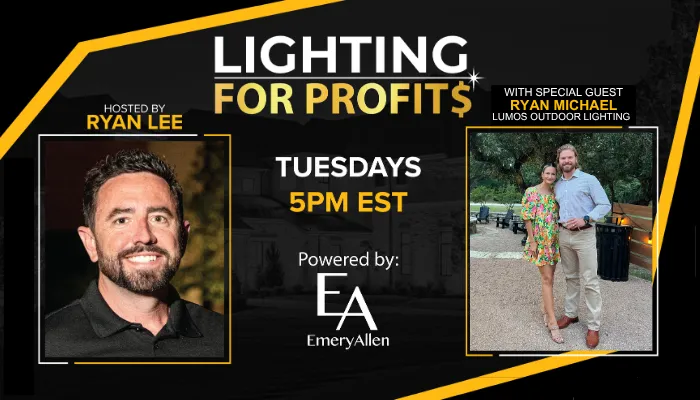
Ryan Michael - 1% Better
Lighting for Profits - Episode 248
For six years, he's been a devoted husband to Becca and a proud father to two beautiful daughters. Whether in fitness, business, family life, or the lighting industry, he believes in one simple principle: show up every day and get 1% better. Join us as we dive into his journey, lessons learned, and the mindset that fuels growth both personally and professionally. And when he's not working or spending time with family, you'll probably find him chasing ducks in the great outdoors.
Watch the episode
Episode Transcript
Welcome to Lighting for Profits. Powered by EmeryAllen
Welcome to Lighting for Profits. All light, all light, all light. Powered by EmeryAllen.
Here is your host, Ryan Lee.
Oh, light. All light, all light. Welcome, welcome, welcome to the number one landscape lighting show in Waco, Texas. Holy cow. What's going on? We're going big today. We're in Waco, of all places, close to my old stomping grounds. So getting close there to, uh, North Texas. Really excited for today's show, guys. We got the founder, the man himself, Mr. Ryan Michael of Loomis Outdoor Lighting. And, uh, you know, it's no secret, I think I might be my biggest fan. I love this show, you guys. I literally, if you guys could see I'm taking notes when our guests are talking, like, I freaking love this show. Um, and I think it's because, like, I didn't have this when I had my lighting business and I'm like, trying to basically create all this stuff for the landscape lighting community of all the stuff I wish I would have had. And, um, what's cool about today's episode? Um, Ryan has become a friend of mine and it's just like, he's just young, he's hungry, he's passionate, and he's absolutely killing it in the landscape lighting space. And he hasn't been around that long, which is even more incredible. So, um, yeah, there's going to be a little bit inspiration, but we're really going to kind of get down to like, okay, what are you doing? Like, how are you getting such traction? Because quite frankly, he's doing better than people that have been in the industry like, 10, 15 years. And he's just out of the gate. Right. I think he's been in the industry now, uh, 15 months. So don't turn it off because you're like, 15 months. Like, he's doing big numbers. I won't. I'll let him tell you the numbers, but, um, doing really cool things. So excited to have Ryan on in just a few minutes. Um, as always, just want to thank you guys so much for your support and then hopefully guilt or shame, a few of you, if you have not given me a five star review, um, go ahead and do that now before we have Ryan. Come on, Apple. Um, Spotify. Five star review. It would feel good. Thank you. Um, and, uh, I don't know if you believe in the law of reciprocity, but I do. So you actually get more, uh, when you give more. So if you guys want to hook me up a five star review, I'm not saying you will get more reviews, but you might get more reviews in your business too. So, uh, but no, either way, even if you don't give me a 5 star review, still appreciate the support. Uh, this is such a cool show. We get to bring on different guests, uh, different designers, installers, manufacturers, industry, uh, providers. Like, so many different angles, so many different things. So make sure you guys are picking something up on every single episode that you can help, um, make your business better.
The hardest part about growing an outdoor lighting business is growing an employee
Before we have Ryan on, I, um, was. I was thinking of, um, something. And, um, I was thinking, you know what? You know what the hardest part about growing an outdoor lighting business is? Well, it's growing an outdoor lighting business. It's just all hard. It's not easy all the time. But for some reason, you're a crazy entrepreneur. So am I. I can't explain why, but you have the bug and it's like, it doesn't matter if it's hard. Uh, you just are addicted to it and it's just fun. Um, but the truthful part is everybody that I talk to almost has one thing in common. Everyone loves designing, selling, and installing lights. All right? And some people like installing more than selling, and some people like selling more than installing. Whatever, right? But at the end of the day, like, that's kind of what we want to do. We just kind of want to, like, design, sell, and install lights, right? That's. That's why we're here. We like it because we do the project and the look on our customer's face, like, that's really what we're going for, right? And to be able to think, like, I created that, like, that's crazy. Like, that's amazing. Your house looks okay, but look at it now. It looks amazing, right? Um, but we just want to, like, get better at design, hang out with rich people. Um, that's not a bad business. Like, that's kind of a cool industry to be it. Like, it's awesome. But eventually, you know, after a few years, you decide, you know, I don't know, that I really want a job. I want to build a business. So then what happens is you go hire some people and now you have a business almost because the, uh, people that you hire, um, they steal from you or they quit or they go do jobs in your van, um, for your customers and take the money. Um, I don't. Maybe that's just me. Is that. Did that only happen to me? Is that a reality for everyone? Um, I went through some crazy scenarios, right? Um, but at some point, you deal with some employee or team member issues, right? And so you realize along this journey,
you go, you know what?
I need to learn how to become a better manager. I need to learn how to become a better leader. So what do you do? Well, you go read a leadership book, you go listen to a leadership podcast. Um, you watch some leadership reels. I don't know, you do something to learn how to become a better leader, right? And so you then hire someone else. And the good news is the problem gets better. The bad news is it doesn't actually ever go away. And so I want to tell you guys the secret. People always give me a hard time. What's the secret? Right, um, the secret is there are no secrets. But the hack, this is the hack. Um, this is the way to drastically improve your leadership and your management skills, build culture and finally scale a business. Would that, would that be important? Would that be cool to know? Because I think I figured it out and it's not what you think. Okay?
The key to being an effective leader is just hiring A plus players
Um, like everything else, this is why I talk about money so much. And I know it scares people and I know it makes people feel dirty because people you're not supposed to talk about making money because that means you're greedy. And that's just not true. If you run a business, you need to make a profit, okay? If not, start a non profit and don't make any money, right? But everything starts with profit and business, okay? Because if you make a shit ton of money, then you can open up a lot of doors, okay? So you need to make more money than you're making now. Whatever you're making now, you need to make more. And when you make more money now, suddenly instead of hiring a B and some of you guys hire C and even d players for 25 an hour. Instead of that, you can now afford to hire and invest in an A Plus player for 35, 45, $55 an hour. That's it. I mean, I know that might seem simple because most of the stuff in life and in business, it actually is simple. Doesn't mean it's easy, but it usually is simple. But that's it. Instead of working on, well, what can I do to become a better leader and a better manager? Like, it's really hard to be an effective leader when you're dealing with a B or a C player. Someone who's just not built to show up on time, someone who's not just, who's not built to understand accountability, to take ownership, to take pride in what they're doing. BNC players, they don't think like that. So you're you're wasting your time trying to become a better leader, and then you're just throwing it all away when you're trying to lead a BRC player. Like, the key is to just hire better people. Hire an A plus player. Hire someone that doesn't need really effective leadership, really effective management, because they take ownership. It's who they are. They see a version of them in you, right? And they're thinking, man, this would be cool. I want to do this one day. And the problem is, a lot of you are afraid to hire an A player. And why is that? What happens if they start their own business? What if they become my competitor? So you settle. Instead of hiring an A player that might compete with you, you settle and you hire a B or C player out of your fear and insecurities. And then you wonder, well, why? Why can't I make this business work? You gotta let everything go. You gotta stop thinking that way. You gotta stop thinking, oh, uh, well, what if, what if, what if, what if? Well, what if you empowered your person to say, hey, would you ever want to have your own lighting business? What if we set you up with a location? What? Instead of fighting your fear, what if you just went with it? What if you let your fear guide you on this and you just lean in and all sudden this A plus player starts your second location, or he runs your first location and you start the second. Lots of different possibilities here. But why would you sabotage yourself and hire a B or C player out of your fear and insecurity? I'm telling you right now, the key to being an effective leader is just hiring A plus players. It gets so much easier. How do I know this? Well, I've screwed it all up. I've done all the wrong things, guys, okay? So if you can learn from my mistakes, it's going to cost you a lot less over time. So again, people say all the time, learn from your mistakes. It's like, why just learn from someone else's. It's way easier. So I don't know, maybe I'm wrong. Maybe disagree. Maybe you feel like I should read a book on culture. Again, I've read all the books on culture, leadership, management, all this stuff. Not all, but, you know, a lot of them. And it's like, the only time I'm a really good leader is when I have really good people around me. Because all those skills and strategies, they just don't work. When the guy doesn't show up on time, when the guy's like, okay, and then just literally disregards what you say? So go hire some A plus players. If you need to burn the ship down, just start over. You might need to do that. That might seem crazy, but some of you guys need to start over.
Emory Allen makes premium LED lamps for lighting professionals who demand the best
All right, um, where we at? Oh, yeah, you know what? Um, we have to thank Emory Allen. You guys know this. Friends don't let friends install subpar lamps. In fact, Emery Allen makes premium LED lamps, uh, for lighting professionals who demand the best. So don't settle for less. Make sure to upgrade your designs and your installations with using Emory Allen. If you want the hookup, just email Jackson L. It's Jackson and then the letter l@emryallen. com to learn more and take advantage of their contractor pricing. Just email jackson l@emryallen. com. he will hook you up with that discounted contractor price. Just do mention that you heard about them here on Lighting for Profits. Notice that Texas, uh, flavor to the music today. Oh, yeah. All right, guys, I, um, told you we got an awesome guest. We got Mr. Ryan Michael coming on with Loomis. So let's get the, uh, let's get the music going for Ryan. What do you guys say? Welcome. Welcome to the show, Mr. Ryan Michael. What's up, Ryan?
What's up? Uh, man, how are you?
I'm loving life, man. Things are great. Thanks for asking. How are you doing?
I'm doing great. I'm super thrilled to be here. Thanks for having me, man.
Absolutely, man. I'm, I'm really stoked because, I mean, sometimes I'll have a vendor on that, like, I don't really know. Well, like, I believe in their service and I think they'll help the lighting industry, but I'm kind of like, what am I going to talk about where this is just like, man, I mean, we hung out at my house. You know what I mean? Like, this is just going to be a fun conversation. I think people are going to get a lot out of it. So thank you for taking the time
to be here, man. Absolutely.
Ryan Michael founded Majestic Outdoor Lighting in 2025
Do you want to just do a, A, uh, quick introduction of, of who, who you are and where your company is and what the heck you do?
Yeah. So, uh, Ryan Michael, um, born and bred in Dallas, Texas. My, uh, wife and I moved down to Waco, Texas. Hour and a half south. Uh, it's hour and a half between Dallas, DFW and Austin. Uh, my husband, dad to t, two beautiful little baby girls, two and a half year old and a four month old. So we're in the thick of it. And, uh, I love business. I Love Jesus. I love hunting and I love lighting.
So man, that's like the perfect bio if you think about it. One, I love that you lead with like I'm a husband and a dad, you know what I mean? Like I love Jesus. I just. You love hunting, you love lighting. Like what else is there to life, you know what I mean?
Yeah, that's right.
That's so cool. Well um, I'm excited to have you on. I think you're going to inspire a lot of people. Um, do me a favor, do just do a quick introduction. Like when, when did you find out about the outdoor lighting industry and, and how did you start your business?
Yep. So uh, coming out of school, I graduated right before COVID played uh, basketball at DBU outside of Dallas at a D2 school and uh, spent the first few years of my career in software sales, learning business development, learning how to sell. Sold a different variety of different software products. Uh, my dad was a landscape uh, designer in DFW growing up uh, in the park cities. And so I knew a little bit about uh, landscape and didn't know anything about lighting. But it was something that he always admired and liked but didn't do. Um, fast forward 24, 2024, working in software, have the opportunity to go start a hunting club with some buddies in Oklahoma. And uh, long story short, it didn't work out. I'd left my full time role in software to start this new venture and didn't pan out. And so uh, how long did you
try before you realized it's not working? Man?
It was a uh, it was a real estate, private uh, high end membership deal. And uh, it was one of those things where like just the timing didn't work out and the deal kind of fell through and we got kicked out of the deal and I had been looking, I knew I was going to start a company. I didn't know what but I liked home service, home improvement. I once I wanted something that was higher gross margin and something that was niche and uh, so um, once that you know, I'd already left my kush sales job in software and needed to kind of make something happen. And uh, within a couple months, within you know, two, three months of that deal falling through, I had somehow decided on landscape lighting and uh, chose it. And so uh, I signed up for Light It Up Expo February of 2025. Didn't know the first thing about a landscape lighting fixture or really much anything. Uh, I could talk about the, the connection to you and Majestic Ryan, my dad would use Majestic and had Used Majestic a few times at his personal properties in Dallas. And so I went on LinkedIn, I typed in M. Majestic Outdoor Lighting. Found you found what you were doing with the, uh, landscape lighting secrets and signed up for Light It Up Expo without a business formed.
I dude this. So this is crazy because we, we got on a phone call, it was probably about a month before Light It Up Expo. I don't remember a month or two before. And your, you and your dad were on there and I was like, how the heck did you guys like. Because you were talking about like, just start coming, like you hadn't even started it yet. And I'm like, but how did you guys do that? And he's like, oh, well, yeah, I, the crazy thing is I used you guys. I used Majestic. I'm like, are you serious? Like how that's crazy. Like just the, the small world of that. Um, did that have any bearing? Like, did, did your dad have any influence on saying like, hey, you should, you should start a landscape lighting business or at least look at it?
Yeah. So, um, absolutely want to honor my dad. We started this together. He was actually in ministry and then, uh, we kind of got it going. He was able to leave his full time role in ministry and then partner with me. Um, and so it was just something that we both liked and felt like
we could do it.
And so we were crazy enough to choose it. Um, he didn't know much about, you know, the business. Um, so it worked out. Yeah, it is working out.
That's so cool. That's awesome.
How did you come up with the idea to start with the brand
So you decided to start this lighting business. Um, when did you come up with the brand and the, the website and the, the wrap and the design and all that stuff?
Yeah. So, um, I liked kind of the vintage service brand. I've always liked that. A lot of companies are starting to do that now in H VAC and plumbing, electrical. And I wanted something that was different, kind of a clean, retro brand. Um, I remember in Florida, uh, emailing back and forth during your conference with my graphic designer in the Philippines, just kind of putting the finishing touches, logo and the branding. But, uh, I just wanted something that wasn't Central Texas or you know, Dallas or Texas. I want something that we could scale to multiple locations and was kind of a one liner and so came up with Lumos. It's light and Latin. It's also the light spell in Harry Potter. But that's not why I chose it. But, uh, yeah, I just kind of liked it and we went with it. Um, so.
Well, I'm just I'm kind of amazed because, you know, I, I deal with a lot of people that are, they're coming, they've got another business. Um, a lot of them are doing like, holiday lighting or something like that, but they're like, man, a lot of people are asking m me about landscape lighting. And so they, they come in and like, to be honest, a lot of their brands are really weak. Um, you mentioned one, like, they might do like a region specific, like, oh, Central Texas or, um, maybe even one that's like a, ah, Santa's Christmas lights or, you know, something like that. It's like, that's not going to work for landscape lighting. How, how did you come up with that idea to like, start with the brand instead of, like, start and then invest in the brand? Because I think that's genius. I think it's the right way to do it, but I don't think most people think that way. They think, oh, brand, I can't invest in that yet. I'll make some money and then work on my brand.
Yeah, I mean, I think, I think, uh, I am obsessed with customer experience, branding. You know, a lot of these companies at a high level. Um, I was talking to my lead tech today. Like, it starts with, it starts with the brand, right? You know, the end product is putting lights in the ground. But like, every single touch point matters, from first impression to uniforms to, you know, how clean that van is and, you know, your, your proposal and your business cards, like, all that stuff matters. And so it's just something I love and I'm passionate about. And I think from day one, um, I wanted, you know, I was just really intentional about how we were going to be as a business. And I'm just kind of a, you know, I'm obsessive about, hey, we're going to do it the right way and we're going to be organized, we're going to be intentional and we're, uh, going to do it right. So that's, that's what I've tried to do up to this point.
That's cool. I remember you posted something in our group and I mean, again, you were like two weeks into the, to the business, but, but it was like one of the coolest videos I'd ever seen for an outdoor lighting business. And it was like your social media, something, whatever. And it was like, I think you were in it, your dad was in it, and the van pulls up and all this stuff. And I was like, dude, how does it already? How does he already look that good? I mean, you looked day one better than some companies have been around 10, 15 years. And that's the thing, like you mentioned, like, there's some really talented lighting designers, there's some really talented people out there, but they just don't understand branding. They don't understand client experience. They think the client experience is the design. It's like, no, no, it starts well before that. And so those people are missing out on tons of opportunities because, I mean, if they had to compete with you, it would be a no brainer. They're just not going to get the job. And so, um, I'm hoping people are taking notes on that to be like, hey, really evaluate your brand from the very beginning. Because I could teach someone like the most perfect sales script in the world, but it's just not going to be as effective with a weak brand. It's just not, you know, um, it's, it really starts with that. So, I mean, congrats to you for. I guess I don't know why you think that way, but for thinking that way and, and really starting with the foundation because now everything you do is just that much easier, to be honest.
Yeah, I appreciate it. And I think too like, you know, looking at guys like Tommy Mello and uh, there's company companies out there that are expensive to rebrand and kind of create the whole brand package. Kick charge is one of them. Right. Um, I wasn't going to spend 20 grand, you know, day one to do that. And so I was like, hey, how can we do that in house to kind of replicate that model and just make it look something similar, you know how I would want it. So.
Yeah, well, there's the phrase still, uh, like an artist, you know what I mean? It's like, find what's working. Like you said, there's retro. You didn't invent the retro brand. Uh, you just made it work for the brand that you were wanting to build. So plus you tied in lighting. I mean, it's, it's, it's really cool.
Ryan Lee started Landscape Lighting Secrets in 2025
Um, all right, so you decide, okay, I'm starting this business, I'm gonna start the brand. Um, you decide to go to Light It Up Expo. Did you have any goals going into there? Did you have any intention? Were you were anything you were like really trying to get out of it or like, what was your mindset at this point?
Um, I think it was. Is Ryan Lee legit? What is this industry? Can I do this? You know? Um, I think it was all the above. I mean, I didn't have the LLC formed until you know, a week after we got back. Um, and then we launched April 1, you know, taking on clients and so yeah, I mean it was kind of the man M. Am I all in on this? And then I've got to figure out how to do this before we open up. Right. And so how quickly can I just, you know, pay for access, get around guys that are doing it at a high level and then be able to execute on it and charge, you know, high dollar for it.
So uh, did this and we're talking, let's see, this was 2025.
Yep.
So light it up was like the first, first part of March 2025. Did you join Landscape Lighting Secrets then? I think you joined at that event
or was it right after you joined at that event?
Okay, so you, you went into like, I don't even know if I can do this. Skeptical. Is this even real? To like investing some serious money into yourself at the event?
100% okay. Yep.
That sounds crazy. And then um, obviously still like not sure. Uncertainty and stuff like that. What'd you do after that? You said you got your llc, you finalized your truck wrap. How did you start getting jobs?
Yeah, um, I think it really is such a, um, a mindset belief. Right. I mean it was just like I can do this. Like we're going to do this. And so I don't know if we're going to come in and do, you know, a million dollars year one. But like I, I knew that I could get in front of people, establish trust and, and I think I do. Naturally I'm by no means we, you know, this different conversation. But like I'm not, I am not a world class lighting designer. I think I'm good. Like I have like, I think I have a good eye for design and I take pride in my designs. But I can sell, I can build trust and I can get people on board with, with the vision and with the mission of what we're doing. And sue has come home, learn it and you know, started with me, uh, putting lights in the ground and just learning how to do this, doing a couple friends and families, doing my parents and doing my house. And um, and then it was go time to open up and launch.
So you got some practice, did your own lights, friends and family.
How did you start getting traction? Like what'd you do to start reaching out
How did you actually start getting ah, traction? Like what'd you do to start reaching out to people? Did you start paid ads? Was it organic? Like knocking doors, talking to people that you knew? Uh, how did you, how did you get started?
Yeah, um, I mean we did everything I Think, uh, yard signs, door hangers, started posting on socials, um, got the website up and running to the best of our abilities. I think my goal was like, hey, let's get some, some portfolio make. You know, it's like you're just starting, right? I don't even know what you're doing, but, um, friends and family just getting, getting pitches, right. And just trying to get installs in and, and start to build the brand and start to really learn what we were doing. And um, tons of nighttime demos, um, which I, I believe in.
And did you have demos that you went and did and didn't close?
Um, I remember my first, first, uh, nighttime demo ever, right. With a guy in town. And uh, I remember it was, I probably came in way too high, but it was a 17,000$. And uh, and I was so, I was so nervous of, to, to get that number out of my mouth. I remember I was so nervous and it ended up not getting that job. Looking back, I'm like, man, I should have put that in, you know, for seven or whatever. But um, yeah, it's just like, man, okay, what do we got to do to make this happen? And I'm, um, and it was just, you know, we are going to make this work. Um, and so that's referrals. Um, you know, just get in front of people. You just gotta let no one knows who you are and what you do. And I'm such a believer in get in front of people, take a referral, partner cookies or drinks or coffee and just make it happen, you know? Did you, if you want it that
first year, did you have a revenue goal? I mean, this was April that you launched. Did you have a goal to December or 12 months or anything like that?
Yeah. So, I mean it was, it was 350,000. Um, it was 350,000, which I kind of, I don't know where we got that number, but it was like, man, let's just see if we can prove the concept, um, in July. So April, May, June, July, you know, four, three, four months after we launched, uh, we landed a $170,000 project.
Nice. So four months in, you land a project that's half your goal.
Yeah, it was, it was a killer. Like I, I, it turned out phenomenal.
What was, uh, what was the lead source on that?
That was a custom home builder. Yeah, a friend, friend of ours.
And that, uh, was just you telling him, hey, when you're ready, we can do lighting for you, we can do demos.
Yeah, I knew, um, I'm not A technician. You know, I knew that my, uh, best role and what my gifting is and what I want to do is build a business. Right. I want to work on the business, I want to put the right people on the ship. I want to invest in my guys and find good labor and find good team players so that uh, you know, two months in I was out of the field and we had made our first full time hire and uh, we're able to start kind of piecing together the team because I knew that, hey, I got to drive sales, I've got to build referral partners, I've got to work on the business. Um, it's not going to be in the best interest of the company for me to be actually putting in lights at this point. And so it was continuing to learn design and building the brand from there.
If you focused solely on sales, on design, you'd be this far along
So what'd you end up doing in 2025?
Total?
Total sales?
We, uh, did about 800,000.
That's insane. Yeah, uh, goal was 350. And you did 800. Hate it when that happens. You didn't hit your goal.
Yeah, yeah. And it, yeah, it's just, I uh, mean a lot of it too. The Lord's provision really is. And just waking up. I mean I'm just, you know, I'm such a believer in how can we get better today. There's always things to do, right, in a small business and I'm, I'm doing stuff that we probably, you know, shouldn't be doing at our size, you know, um, but I just think there's always things we can be doing from a business standpoint to be better, um, to develop our installers, to build the brand. Just little tweaks. And so that's, that's what I'm. And we by no means have it figured out. I mean we're at that phase now where it's like sops, right? You know, it's all those things from ordering product to, you know, binning projects to keeping guys incentivized to office manager stuff. You know, we just signed a lease on our first, you know, warehouse. So all those things.
That's awesome, man. I remember um, at the last secret summit, it was like you and the boys, like Paul V. And a couple other guys were hanging out and I was like, all right, see you guys later. And then you're like, wait, wait, we got a question for you and I. I suck at hanging out. I don't know why. I'm just like, all right, it's 9 o'.
Clock.
I'm going to Bed guys. But uh, that was actually fun because you guys got me to stick around a little bit longer. And the question was, I think, uh, well, no. Do you remember what it was? It was like on a spec, it was a spectrum design designer or business guy. Yeah. Like what's, what's more important, you know, on. If you had to put it on the spectrum, like what percentage would you be? Sales versus design. And uh, I think I, I think I was afraid of judgment because my, the first number that came to my mind, I was like 90% sales.
Yeah.
But I didn't say that. I said uh, 75%. And then I was like, am I going to get backlash? Are these guys going to hate me because I, I'm anti design, you know, or whatever? And uh, and then I was like, all right guys, the truth is, I was going to say 90, you know, because I just, I mean you're like witness of it. You know what I mean? Like you said, like, it's not that you're putting in bad designs, but certainly you're only 15 months in. Your, your designs are going to get way better over time, you know, um, and uh, you know, 10 years from now, of course your designs are going to be better than they are now. You'll just know more stuff, you'll have more experience. But if you would have just focused as much energy and effort that you did on sales, on design, there's just no way you'd be this far along.
Right.
Which is not possible. So I, I'm just a huge fan of it. It doesn't mean that I'm anti design. It doesn't mean. I don't think it's important. I just think if you're going to run a business, you got to focus on sales and design can certainly support that, especially when you get into higher end projects and stuff like that. For sure.
How good of a designer do you have to be for a $10,000 job
Um, but the average, I mean we look at the average landscape lighting project, you know, in the U.S. i mean it's, it's a 10, $12,000 job at, at most, on average, you know. So how good of a designer do you have to be to do a $10,000 job?
Right?
I don't know. I feel like it's. You can only put so many lights on that, you know, small holly tree.
Right? Yeah. Shout out to Paul. That's my dude right there.
Yeah, Paul. Uh, he got passionate about. I do. Where, where was he at? I think he was, I think he
was like 80 something.
He was, he was high on the cells. Where, where are you at? On the uh, the spectrum man.
I think it just depends on what, what your, what's your goal? Like what do you want? Right. I mean, I think I um, want to build a good company or I want to build a big company. Right. And I, and I'm, we're going to be excellent, we're going to be great. Um, but I don't want to build a 1 to 2 million dollar a year lighting company. Right. And so, um, I think you have to run a landscape lighting business, like a business. And I think you can absolutely have phenomenal designs. And you know, I think we do amazing work. I take pride in our work. You know, it's really important to have that expertise and to be able to paint the vision and deliver on that. And uh, and so yeah, I would say I'm Probably, I'm probably 85, 15, 90, 10.
My man. My man. You're worse than me.
But I've got, I've got tons of respect for, you know, all the lighting designer, all these amazing designers out there. Absolutely. So I learned from them every day.
Yeah, well, and I'm so, I've been in the industry 19 years and I'm still learning, you know, and, and, and you know, like the first time I went to Illy, uh, of course I learned stuff like I don't know everything. How would I know everything? You know what I mean? So, um, I think when I went to there, my eyes were opened up. I'm like, oh, cool. And what's cool when you do learn design, like Jan, the Jan Moyer style, I mean she teaches to put like 56 lights per tree. So actually you're gonna make more money if you're a better designer, you know what I mean? So there's, that's where like maybe the spectrum shifts as you get better at design. But I think for people starting out, it's just, you know, like there's people that focus so much on design because they have that artist side to them where they're like, no, I want to, I want to be a true artist and designer. And I'm like, yeah, but if you don't make enough money, you're going to be poor, you're going to be out of business. So you owe it to yourself to make enough money to build a business that can serve people, that can really provide people with those high level designs. And that's why I'm so passionate about what I do is because there's, there's uh, Illy's already there, you know what I mean? Like they're going to teach you all the stuff you need to know about design. What am I going to teach you that's better than that? So, um, but the problem is there's just so many talented lighting people out there that just don't know how to run a business, don't know how to charge the premium price, um, so that they can afford the A plus players that I was talking about. So that they can afford to do high quality material, high quality designs. Um, and you mentioned it like the high quality customer experience. You know, a lot of these guys can't afford to answer their phone to take care of their customer where when I answer my phone I'm excited to talk to my customers. So, um, I just do, I think it's awesome.
So you're only 15 months in, you've already passed the million dollar mark
So you're only 15 months in, you've already passed the million dollar mark, which is freaking incredible. Um, what, what, what, what, what if, you know, obviously that sounds great, but what were some of the hardships getting there? And I know we're only 15 months in, you know what I mean? It's like we'll have this conversation again like at your 10 year mark. But like so far this little infant, 15 month old, you know what, what have would have been some of the things that could have put you out.
Yeah, no, absolutely. Uh, I mean it's certainly. I just want to keep reiterating. Um, uh, you know, we, I by no means have it all figured out, right. And uh, we're gonna keep, we're gonna keep growing and we're gonna keep getting better. I have no, no doubt about that. Um, but it's challenging you starting a business from scratch. You know, no franchise, uh, bootstrapped, um, you gotta be optimistic and you gotta, you gotta wake up and want it. And as people know who get into this industry early on, it's like the phone's not ringing. You know, it's like Google's not, they're not clicking on your website. And so I just remember days like man, don't try not to get too low when the phone's not ringing. It's like, man, you know, we've got one project this week or like, or our next project's not till next Tuesday. And so that's challenging. And then I um, mentioned my dad and I started this together. Um, I went through a buyout, we had another partner, um, which is a separate conversation, but uh, one wasn't working out. And um, hindsight 20 20, I would not have brought on an outside partner in this business. And so went through a buyout process. For six, seven months of that first year. Um, and it was just grueling, right? It was just kind of like an anchor tying me down and really distracting and meanwhile trying to drive revenue and trying to grow and do all the things. But, um, was in the middle of just a kind of drag down, knockout, uh, buyout and was able to close on that deal two months ago and, um, take over, you know, full ownership of the business. But that was certainly a challenge, I think.
All the stuff I ever post on Instagram is a highlight reel
I think that's kind of what's crazy is like, you know, the first part of the show we're talking about the highlight reel. All the stuff I ever post on Instagram is a highlight reel. You know, I mean, oh my gosh, look at me with my family. I'm not gonna like film when I'm like arguing with my kids because not, not that I don't want to be authentic. It's just like I'm a positive person. I'm an optimistic person. I'm just gonna post optimistic stuff. Right? Um, but the reality of the situation is it doesn't matter like how successful someone is. We're all human beings, we're all going through shit, you know. And so to me, that's what's even more impressive about your story is like you were able to get to that 800k and now you're over a million, like going through some stuff that, let's face it, only a handful of people even knew about. You know what I mean? And so you're able to wake up, put on that face and like, let's go like, we got big things to do. I can't let that bother me. You can only control the controllables. So well done on that.
You said you wouldn't have done a partner had you known what you know now
What would you do differently? You said you wouldn't take, you wouldn't have done a partner had you known what you know now. What.
Yeah.
Uh, why did you even have a partner? What was some of your fears? What? Because what I want to do, I think there's people out there that are. Either some people are in business now, I've talked to them and they're considering taking on a partner, like a financial partner. Um, there's people that are going to start a business and considering partnerships. Um, what, what have you learned through this process that you would either tell yourself or someone else listening?
Yeah, I mean, I would say, and I'm not anti partners. Right. And there may, there may be a world to get to where I want to go in this business that I take on, you know, a partner. Um, I think we have a Little bit to go, things to figure out before we do that. But uh, it, it is like a marriage when you have somebody else on that operating agreement and they have, you know, equity in your business. Um, you know, you just, you better be careful who you get in bed with. And uh, I think in this business, because of what we do, um, you don't need a partner by any means to get started. Uh, and so I would, I would, I would caution anybody to really think through who they're bringing on as a partner and what value they're adding. Um, and I think it's like, you know, it's like if they, if they're going to put in a substantial amount of capital at the right time, they're going to be in it with you in the fight. Um, you know, those are, uh, or they have access, right, they have, you know, access to a plethora of, you know, the ideal referral partners. Um, you know, just, just be careful. That's what I would say. And so I, and I didn't know what I didn't know. Right. You know, first business starting from scratch, um, I was bringing on someone that was a high net worth individual that had grown a company to five major markets in Texas and is now completely removed. And uh, that I thought would help, you know, help us get there collectively. And it just. That won the story.
Well, yeah, I mean on paper you're like, hey, I'm gonna partner with this guy. That's been where I want to be. So what, what were maybe some red flags that you could identify next time if all of a sudden you're presented with the situation, because I think most people in your situation probably would have done the same thing. It's like, hey, this guy's big time. He's, he's able to go into multi market. That's what I want to do. Let's go.
Yeah, I just, I think, I think uh, I didn't, I didn't have the, the longevity of the relationship. I mean I had known this guy for less than six months and I jumped in eager uh, to get going and didn't do my diligence to be honest, uh, on just past partnerships.
You've had several partnerships that haven't worked out
Tell me more about yourself. You know, you want to know everything. You want to know what his goals are and, or her and you know, why they're partnering and what they're trying to get out of it. And you uh, know, early startup days, you know, even where we're at now, it's, it's uh, I want to leave money in the business. Right. To continue to grow and invest and, you know, hire that next guy. And, um, you know, it just takes a lot of money in a service business to build the engine and to operate.
Yeah.
You know, so, um, it just got to a point where I was like, man, I can't. I can't continue to do this. And, uh, for my peace of mind, I have. I have to get him out. And by the way, it's not. It wasn't some, you know, easy pull this out of the company checking account and be done with it, you know, it was. It was painful. Really painful. Like, it'll. It's, uh. It's gonna set me back a little bit, but I think I believe in what we're doing and where we're gonna go, and so it's all going to work out.
Yeah. Well, I mean, I'm excited for you. I know when I chatted with you before, it's like, right now, I know it freaking hurts. It's like the worst thing ever. Like, I can't believe I have to do this, but a couple years from now, you'll be like, oh, man, that was. That was definitely the right call. I think I just want to echo, like, because I've had several partnerships actually, and some of them work, some of them haven't. And that's what I've learned is, like, you get kind of excited. It's kind of like the dating. You know, you, uh, compared it to, like, uh, marriage. You're kind of dating, like, hey, man, that's kind of cool. It's kind of fun, whatever and flirty and whatnot. But you really gotta, like, map out the future and say, well, okay, what happens if it succeeds? What happens if it fails? Right? And, you know, if it succeeds, like, well, then what? Like, are you're just gonna take these draws or are you gonna get paid for this? Whatever. And it's like, those things have to be ironed out early on, um, because you could still have, you know, a successful partner. But it's just. It's just a matter of, like, ironing those things out and making sure, you know, because later on it's too late. And then all of a sudden, you guys think you agreed on different things, and it's, uh, it's a problem. So.
Yep.
So what does the business look like now? Like, you got installers
So what does the business look like now? What's the. Like, you got installers. Are you doing the sales? Um, you got someone answering the phones? Is that you? Like, what. What does kind of the organization look like?
Yeah, so, um, I'm still. We're Working it out, man. We've got, uh, three techs right now. Um, I've got a lead installer he's been with. He actually just had his one year yesterday, so he came on, okay, June 16th of last year and got, um, some great installers. Really fortunate with that. Um, a couple guys have been doing this for a long time and got climbers and, um, and then actually had my sister working for me as my admin. And I just hired a new kind, um, of op specialist admin, uh, who's actually in South Africa. So she's m. Running the phones and, uh, ordering a product, and, um, kind of the glue of the back end. And then, uh, I'm doing the sales and trying to work on the business and, um, move the needle, continue to grow.
So I know the partnership was kind of a. I don't know. I mean, it's like, at first it was the good thing, and then it was the bad thing, whatever. But now that that's behind you, how are things going? Like, what's. Are you. Are you back on track? You back in Ryan, Michael, let's take over the world mode?
Absolutely. Yeah. I mean, I couldn't be more thrilled. Uh, just feels. I mean, it's like anchor off my back. And, uh, yeah, we've had. We've had three, um, awesome months consecutively, and some awesome pipeline. We've got a commercial, uh, project that's going to kick off at the end of October, which will be our biggest project yet. And, uh, yeah, just. Just trying to continue to go where we want to go. I mean, feeling. Feeling really optimistic and, um, starting to hit a little bit of that summer slowdown. But, I mean, there's, you know, there's. There's always people out there that want what we have. Yes, well, people always doing stuff.
I mean, you're in Texas, so. Yeah, as soon as July and August, even right now a little bit. Right. But July and August. I. I know. I mean, my business was there. People, uh, going out of town, vacation, all this stuff. The thing that I found was that helped at least minimize, if not eliminate that, like, huge down spike is referral partners. Because like you said, there's always something going on. So someone's always building a pool, outdoor kitchen, doing their landscaping, rebuilding a house, building a house. All those things. I mean, they don't. They're not dictated by seasons. Right. So, um, are you. Are you able or have you gotten some. Some pretty decent referral partners out of the gate?
Yeah, we have, um. Yeah, pool builders, landscape architects. That home builder that I mentioned. Um, but I mean it's uh, that is 100 where my focus is right now. It's, it's getting in and building relationships with referral partners and so just nurturing relationships and going after new ones. And um, I very much strongly feel that that is the unlock in this business, right to kind of, to grow. Right. And in my head the uh, the yard sign, the, the meta post, the Google, my business, um, the calling off Google, that's all the cherry on top once you have that base of referral partners. Um, because like you said, I mean there's always people putting, you know, at least where we're at, you know, Central Texas dfw, there's always somebody doing a three, four hundred thousand dollar backyard remodel and a new house being built.
Do you have a favorite referral partner type so far? Um, landscapers that don't do lighting
So do you have a favorite referral partner type so far?
Um, landscapers that don't do lighting, um, pool builders have been, have been good for us. Um, yeah, landscape architects. So I feel like home builders, home builders have been challenging for us. Um, you know, because a lot of times, you know, they may be over budget, right. And they're, I like a clean handoff to the homeowner so we could deal with them directly. Um, but we're trying to grow in that area for sure.
Yeah. There it's kind of hard because they're kind of the best and the worst at the same time, you know, like for reasons you mentioned because like if you could get in with the home builder, like they kind of control a lot of stuff that goes on. It's their home.
Right.
Um, one thing that helped me was we would just let them do their thing, you know, and they would sell the house and they do all the things and whatnot. And then we finally figured out this method where the home builder um, would about a couple months before, usually before like the driveways are getting poured, the flat work and stuff, they would just send out an email that said, hey, as we near the completion of our project, a lot of our customers previously have asked about outdoor lighting. If that's something you want to do. We can introduce you to Ryan with Lumos. He's our lighting specialist. And that way if it's something you guys want to consider, I mean they can even do free demos, stuff like that. So super like soft intro. And then a lot of times that customer would, and he would copy me, right? So then they would reply and say oh yeah, like let's do it, uh, or set up an appointment or whatever. And if not then at least I Had the email and then I could follow up with them. But that worked really well for, for home builders. Instead of like trying to get it within the project or within budget or anything like that. Because I learned that the homeowners have different buckets. And so they. If they've already spent 2 million on the house, like, well, even if they had a $2 million budget, they probably spent 2.4. Right. They're already over. So they're already depressed and they don't want to give the builder more money. But that doesn't mean they're broke. They're still going to go buy a $500,000 car. So we just have to create a different bucket and be. And be like, oh, you should just use these guys. And so now it's not the builder doing it, it's Lumos.
Absolutely. I love that.
Waco is a growing city in Central Texas
Um, so how much of your work. I know you're in Waco. Um, I feel like when I. The only thing I know about Waco is the reality show. Um, and then when I would, I would drive through Waco to go somewhere else, you know, like to go to Austin or San Antonio. But I mean, how big is it? Is it big enough? Like, do you guys do lighting there? Like, there's people spending money on landscape lighting.
Phenomenal customers here. Um, yeah. I mean, ah, population of Waco is 185, 200,000. Right. I mean, so it's, it's a small town on paper. Um, but it's a, it's a, it's a growing city in Central Texas. There's a lot, you know, that is coming to Waco and you know, Baylor is here and big university in Texas. Um, and so yeah, and I think too in my head, um, I knew that Waco was kind of almost the prove the concept, right. Get good at what we do and uh, that we would also focus on growing our business and footprint in Dallas, where I'm from. And uh, and so we absolutely, you know, uh, we'll be there all next week doing projects. But, um, we serve DFW and have done some awesome stuff in Fort Worth. And um. And so I would say we're probably 60, 40 Dallas to Waco right now as far as revenue. Okay. Um, but, but very much, I mean, very much focused on continuing to. No one is doing what we do in the Waco area. We've got some great companies in Austin and we haven't traveled down there, but, uh, we're an hour, hour 30 from. From Dallas, you know. And so we're very much serving Both markets.
Waco is growing and I'm very optimistic about the next five years
You said you got a big or I guess it sounds like your biggest project coming up. It's commercial. Uh, it's in Waco.
Mhm.
That's cool. Biggest project in Waco, Texas.
Yeah. Ah. And there's. And I think, you know, we've done some awesome projects here. So um, yeah, it's, it's get. Waco is growing and I'm, I'm very optimistic about the next five, ten years here.
Yeah, well, it's good timing for you. I mean, you know, establish that footprint and in my opinion, I pick on the small towns. I probably shouldn't. I mean, but I do. But it's almost like if you, if you can prove it in Waco, then I mean like you said, it's a couple hundred thousand people. There's just so much more opportunity in the Dallas Fort Worth area. So it's like, hey, if I can do this here, I can do this anywhere.
100%.
Yeah. Um, as you, as you've kind of grown, what. Is there anything that you've picked up from someone else that you feel like has had a pretty big impact on the way you do things or some of the success that you're having as
far as in the community, in the lighting world.
Yeah. Lighting or outside, I mean, could be from another industry.
Yeah, I mean I would think too.
Back to your question of what's contributed to Yalls early success
Back to your question of uh, what's contributed to Yalls early success? I mean your program has been pivotal. Right. We wouldn't be anywhere close to where we are today without it. And just the community. And um, I love being around guys in this space and just learning from guys that have been doing this and uh, have formed some awesome relationships. You know, Paul, Val, um, all types of dudes. And so that's been huge. Um, trying to think what else. I mean, I just love general business content in general and uh, you know, Josh Latimer has been a big inspiration of taking stuff from him and met. I found out about him that same, that same day and ah, it lighted up. Um, but yeah, I think that's what comes to mind. Ton of different sources.
What is your favorite part of landscape botting? Secrets
What? What? I mean maybe you did, maybe you said it. But I'll ask you again, but what, what, what is your favorite part of, of landscape botting? Secrets.
Um, the community, hands down. Yeah, just, just uh, I think the magic happens. I'm super excited about Secrets. But I think uh, getting in the room with guys, you know, we see their brands and we see their projects and just getting to know them, hear their story and what they're doing that's working and coming home and implementing that. I think that's, that is the secret sauce of, of secrets.
So yeah, it's interesting you say that because when I, when I started it, I didn't realize what was possible. I mean I had, I didn't know what I didn't know, right? So I thought I was starting a training like platform. It's like, here's some scripts, here's some tools, here's what I did in my business, just do that, right? And that's what it was. But then as it started to grow from you know, four members to 10 to 15, to 30 to 50 to now over a hundred, like that community, I had no idea, I didn't know what community was. I'd never been part of a community, you know what I mean? And so it's so cool to see like uh, you guys have no idea how rewarding it is. When I hear that you guys are calling each other offline and like I said, when I'm at the events or whatever, I'll see everyone chilling in the same restaurant up until 3am and whatever. I'm like, holy cow, like that's amazing. And I, and I, and I had that epiphany of like, man, it's not, this isn't about training. I mean, yeah, of course we want to provide training and stuff like that, but it truly is about, you know, surrounding yourself with other people that are on your same mission, that have big goals, big dreams. Because honestly like most of our neighbors and our just circle of friends that don't get what we do, they're like, I don't know how landscape lighting, like yeah, you must be working for the cartel or something. Like you can't make money putting lights in the ground. You know, they just don't get it. And so when you get around these communities and then all sudden you're telling me I don't want to just build a three million dollar business, I'm like, let's go. You know, you got big goals, you got big dreams. That's going to inspire someone else to just think a little bit bigger. They might, they might have wanted to do a million dollar business and now they'll do a 2 million, you know, and someone is gonna, was gonna do 2, now they'll do 3, 3 to 5, 5 to 10, 10 to 20, whatever it is. So I, I personally didn't know and I, I think that's the biggest value. We had a guy the other day that was um, considering joining our program and I actually didn't talk to him as one of the guys on our team. And he's like, but I want to do one on ones with Ryan. And, uh, and so he ended up calling him, like, why, why would you want to do one on ones with me? Like that. That's not the point of the. Like, no. Like, I'm just one guy. Like, you think I know all the answers? Like, heck no. The community is the benefit. That's the value. Like, because you can go ask a question and get a hundred different responses and opinions and bounce different ideas and be like, oh, I really like the way he operates. I don't like him so much, but I like to hear whatever. So, yeah, uh, it's, it definitely is about the community. It's not about getting a one on one. It's not about that at all. It's about surrounding yourselves with other big thinkers. And, you know, the first time I had learned that you could do a $500,000 lighting project was when I met Greg Matthews. And now I heard he just did. He just told me he did one over a million dollars. Mike. Holy crap. That's awesome.
Yep. Absolutely.
That's cool.
What's your average ticket for lighting jobs right now
Well, um, all right. Is there anything else? Did we cover everything? Feel like we kind of got everything on my, uh, mind. Oh, yeah. What, what's been kind of your average ticket? Like, are you doing, you know, ten thousand dollar jobs? Are you doing fifty thousand dollar jobs? You said you had the, the big boy, which is sweet.
Yeah, yeah. We, uh, let's say what's. What's. I, uh, mean our average ticket's 12,000 right now. Um, we had a 55,000 or $50,000 deal come through yesterday. Residential home.
Heck, yeah.
But, uh, I'd say, yeah, anywhere from 10 to 15 is our average ticket.
Okay, Very cool. Yeah, I feel like that's, that's pretty normal. I mean, you know, like, uh, that's like an average lighting job. And then you get the big boys, you get the 50s and the hundreds and stuff like that. So, um, that's really cool.
What advice would you give to someone starting a lighting business
Well, I guess just to wrap it up, um, is there any advice that you'd give your, you know, younger self 15 months ago or, uh, to someone who's listening, who's maybe. Because, you know, we have people that listen that are. There's people that are like, still thinking about starting a lighting business. There's people that just started. They're stuck at 200k. There's people that are doing a million, but they've been stuck there for a while. There's a Lot of people, a lot at that, like 4 to 700k. And they've been stuck there for years and they're not going to do anything else unless they change something. What advice would you give?
Um, I would say the mind, the, your mindset and what you feed yourself is everything and then keep, get around big thinkers. That's something that's been so encouraging for me is I'm trying to think through and I've got to get there. Of course I've got a long way to go. But how do we build a 10, 15, 20 million dollar lighting business? Lighting and outdoor audio, you know, And I think it's possible. And so, and I don't know anybody that's doing it, but I uh, want to do it. And so I think get around big thinkers. You have to wake up every day with tenacity and intentionality to go make it happen or else you're gonna, you're not, you know, you have to do the things that are going to get you to that next hire coaches, get around people, invest in yourself, eat well, take care of yourself. All those things matter. And so um, I'm trying to do the same thing that I'm, that I'm preaching.
I love it man. That's so cool. You know, there's always the person who does the unthinkable. You know, there's the four minute mile, there's the person who invented the light bulb, there's the self driving cars, like all this stuff. So that's my vision too, man. I love it because there's so many people that have been in the industry a long time that just don't know what's possible. And we have proof from other industries that I mean even in the H Vac industry they used to, they used to just have like million dollar companies and now they have hundred million dollar companies. Like that doesn't even make sense, you know. And so it's just going to be so cool to see who it is that breaks the four minute mile in the outdoor lighting industry. It's going to be cool. Come on, let's go. Well, I want to give you a public shout out. Um, you were at my house. Uh, last year. Um, we did, I think was it, it was one of the training. We had a training at my house. And, and you're like, come on, let's go for a run. I'm like, oh yeah, okay, let's go for a run. And um, it was hot outside and we weren't running. And uh, man, I just freaking loved it. And then just hanging out at the house. And it really inspired me because, you know, you mentioned your favorite thing about Secrets is the community, and we're really doubling down on that. We're really, like, making sure that, like, we're giving every opportunity to build community here. And so after that, uh, run and just, like, you know, afternoon evening hangout session, I was like, we need to do this more often. And so I decided I'm going to invite people to my house. And so this year, we did it. We did our first one last, uh, month. We got another one coming up next month for our Friday fly ins. So we should. We should call it the Ryan Michael, uh, Friday fly ins because, uh, you were definitely the guy who inspired that. So thank you.
That's a blast. Oh, yeah, that was super fun. That's. That's what it's all about. Just getting together in person, and that's so fun.
Ryan, congrats on your success, man. I'm excited for you
All right, man, well, I appreciate you coming on the show. Thank you so much. And seriously, congrats on your success, man. You're. You're just getting started, though. I'm excited for you.
Yeah, we can. I don't know if we can call it success yet, but we're. We're working.
Uh, you're there, man. I appreciate it. Hey, if people want to, uh, get a hold of you, um, to hire you, work with you, partner with you, whatever it is, what's the best way to do that?
Yeah, you can, uh, you can find us on Instagram, LinkedIn, you can find me on LinkedIn, but Bluemost Outdoor lighting, uh, Facebook, um, or find me personally. But yeah, happy to chat with anybody. Love connecting with folks and so reach out. Would love to connect.
Love it, man. Thanks for coming on the show. I appreciate you.
Hey, uh, thank you, brother.
Okay. See you, Ryan. See everybody.
Ryan Michael - 1% Better
Lighting for Profits - Episode 248
For six years, he's been a devoted husband to Becca and a proud father to two beautiful daughters. Whether in fitness, business, family life, or the lighting industry, he believes in one simple principle: show up every day and get 1% better. Join us as we dive into his journey, lessons learned, and the mindset that fuels growth both personally and professionally. And when he's not working or spending time with family, you'll probably find him chasing ducks in the great outdoors.
Watch the episode
Episode Transcript
Welcome to Lighting for Profits. Powered by EmeryAllen
Welcome to Lighting for Profits. All light, all light, all light. Powered by EmeryAllen.
Here is your host, Ryan Lee.
Oh, light. All light, all light. Welcome, welcome, welcome to the number one landscape lighting show in Waco, Texas. Holy cow. What's going on? We're going big today. We're in Waco, of all places, close to my old stomping grounds. So getting close there to, uh, North Texas. Really excited for today's show, guys. We got the founder, the man himself, Mr. Ryan Michael of Loomis Outdoor Lighting. And, uh, you know, it's no secret, I think I might be my biggest fan. I love this show, you guys. I literally, if you guys could see I'm taking notes when our guests are talking, like, I freaking love this show. Um, and I think it's because, like, I didn't have this when I had my lighting business and I'm like, trying to basically create all this stuff for the landscape lighting community of all the stuff I wish I would have had. And, um, what's cool about today's episode? Um, Ryan has become a friend of mine and it's just like, he's just young, he's hungry, he's passionate, and he's absolutely killing it in the landscape lighting space. And he hasn't been around that long, which is even more incredible. So, um, yeah, there's going to be a little bit inspiration, but we're really going to kind of get down to like, okay, what are you doing? Like, how are you getting such traction? Because quite frankly, he's doing better than people that have been in the industry like, 10, 15 years. And he's just out of the gate. Right. I think he's been in the industry now, uh, 15 months. So don't turn it off because you're like, 15 months. Like, he's doing big numbers. I won't. I'll let him tell you the numbers, but, um, doing really cool things. So excited to have Ryan on in just a few minutes. Um, as always, just want to thank you guys so much for your support and then hopefully guilt or shame, a few of you, if you have not given me a five star review, um, go ahead and do that now before we have Ryan. Come on, Apple. Um, Spotify. Five star review. It would feel good. Thank you. Um, and, uh, I don't know if you believe in the law of reciprocity, but I do. So you actually get more, uh, when you give more. So if you guys want to hook me up a five star review, I'm not saying you will get more reviews, but you might get more reviews in your business too. So, uh, but no, either way, even if you don't give me a 5 star review, still appreciate the support. Uh, this is such a cool show. We get to bring on different guests, uh, different designers, installers, manufacturers, industry, uh, providers. Like, so many different angles, so many different things. So make sure you guys are picking something up on every single episode that you can help, um, make your business better.
The hardest part about growing an outdoor lighting business is growing an employee
Before we have Ryan on, I, um, was. I was thinking of, um, something. And, um, I was thinking, you know what? You know what the hardest part about growing an outdoor lighting business is? Well, it's growing an outdoor lighting business. It's just all hard. It's not easy all the time. But for some reason, you're a crazy entrepreneur. So am I. I can't explain why, but you have the bug and it's like, it doesn't matter if it's hard. Uh, you just are addicted to it and it's just fun. Um, but the truthful part is everybody that I talk to almost has one thing in common. Everyone loves designing, selling, and installing lights. All right? And some people like installing more than selling, and some people like selling more than installing. Whatever, right? But at the end of the day, like, that's kind of what we want to do. We just kind of want to, like, design, sell, and install lights, right? That's. That's why we're here. We like it because we do the project and the look on our customer's face, like, that's really what we're going for, right? And to be able to think, like, I created that, like, that's crazy. Like, that's amazing. Your house looks okay, but look at it now. It looks amazing, right? Um, but we just want to, like, get better at design, hang out with rich people. Um, that's not a bad business. Like, that's kind of a cool industry to be it. Like, it's awesome. But eventually, you know, after a few years, you decide, you know, I don't know, that I really want a job. I want to build a business. So then what happens is you go hire some people and now you have a business almost because the, uh, people that you hire, um, they steal from you or they quit or they go do jobs in your van, um, for your customers and take the money. Um, I don't. Maybe that's just me. Is that. Did that only happen to me? Is that a reality for everyone? Um, I went through some crazy scenarios, right? Um, but at some point, you deal with some employee or team member issues, right? And so you realize along this journey,
you go, you know what?
I need to learn how to become a better manager. I need to learn how to become a better leader. So what do you do? Well, you go read a leadership book, you go listen to a leadership podcast. Um, you watch some leadership reels. I don't know, you do something to learn how to become a better leader, right? And so you then hire someone else. And the good news is the problem gets better. The bad news is it doesn't actually ever go away. And so I want to tell you guys the secret. People always give me a hard time. What's the secret? Right, um, the secret is there are no secrets. But the hack, this is the hack. Um, this is the way to drastically improve your leadership and your management skills, build culture and finally scale a business. Would that, would that be important? Would that be cool to know? Because I think I figured it out and it's not what you think. Okay?
The key to being an effective leader is just hiring A plus players
Um, like everything else, this is why I talk about money so much. And I know it scares people and I know it makes people feel dirty because people you're not supposed to talk about making money because that means you're greedy. And that's just not true. If you run a business, you need to make a profit, okay? If not, start a non profit and don't make any money, right? But everything starts with profit and business, okay? Because if you make a shit ton of money, then you can open up a lot of doors, okay? So you need to make more money than you're making now. Whatever you're making now, you need to make more. And when you make more money now, suddenly instead of hiring a B and some of you guys hire C and even d players for 25 an hour. Instead of that, you can now afford to hire and invest in an A Plus player for 35, 45, $55 an hour. That's it. I mean, I know that might seem simple because most of the stuff in life and in business, it actually is simple. Doesn't mean it's easy, but it usually is simple. But that's it. Instead of working on, well, what can I do to become a better leader and a better manager? Like, it's really hard to be an effective leader when you're dealing with a B or a C player. Someone who's just not built to show up on time, someone who's not just, who's not built to understand accountability, to take ownership, to take pride in what they're doing. BNC players, they don't think like that. So you're you're wasting your time trying to become a better leader, and then you're just throwing it all away when you're trying to lead a BRC player. Like, the key is to just hire better people. Hire an A plus player. Hire someone that doesn't need really effective leadership, really effective management, because they take ownership. It's who they are. They see a version of them in you, right? And they're thinking, man, this would be cool. I want to do this one day. And the problem is, a lot of you are afraid to hire an A player. And why is that? What happens if they start their own business? What if they become my competitor? So you settle. Instead of hiring an A player that might compete with you, you settle and you hire a B or C player out of your fear and insecurities. And then you wonder, well, why? Why can't I make this business work? You gotta let everything go. You gotta stop thinking that way. You gotta stop thinking, oh, uh, well, what if, what if, what if, what if? Well, what if you empowered your person to say, hey, would you ever want to have your own lighting business? What if we set you up with a location? What? Instead of fighting your fear, what if you just went with it? What if you let your fear guide you on this and you just lean in and all sudden this A plus player starts your second location, or he runs your first location and you start the second. Lots of different possibilities here. But why would you sabotage yourself and hire a B or C player out of your fear and insecurity? I'm telling you right now, the key to being an effective leader is just hiring A plus players. It gets so much easier. How do I know this? Well, I've screwed it all up. I've done all the wrong things, guys, okay? So if you can learn from my mistakes, it's going to cost you a lot less over time. So again, people say all the time, learn from your mistakes. It's like, why just learn from someone else's. It's way easier. So I don't know, maybe I'm wrong. Maybe disagree. Maybe you feel like I should read a book on culture. Again, I've read all the books on culture, leadership, management, all this stuff. Not all, but, you know, a lot of them. And it's like, the only time I'm a really good leader is when I have really good people around me. Because all those skills and strategies, they just don't work. When the guy doesn't show up on time, when the guy's like, okay, and then just literally disregards what you say? So go hire some A plus players. If you need to burn the ship down, just start over. You might need to do that. That might seem crazy, but some of you guys need to start over.
Emory Allen makes premium LED lamps for lighting professionals who demand the best
All right, um, where we at? Oh, yeah, you know what? Um, we have to thank Emory Allen. You guys know this. Friends don't let friends install subpar lamps. In fact, Emery Allen makes premium LED lamps, uh, for lighting professionals who demand the best. So don't settle for less. Make sure to upgrade your designs and your installations with using Emory Allen. If you want the hookup, just email Jackson L. It's Jackson and then the letter l@emryallen. com to learn more and take advantage of their contractor pricing. Just email jackson l@emryallen. com. he will hook you up with that discounted contractor price. Just do mention that you heard about them here on Lighting for Profits. Notice that Texas, uh, flavor to the music today. Oh, yeah. All right, guys, I, um, told you we got an awesome guest. We got Mr. Ryan Michael coming on with Loomis. So let's get the, uh, let's get the music going for Ryan. What do you guys say? Welcome. Welcome to the show, Mr. Ryan Michael. What's up, Ryan?
What's up? Uh, man, how are you?
I'm loving life, man. Things are great. Thanks for asking. How are you doing?
I'm doing great. I'm super thrilled to be here. Thanks for having me, man.
Absolutely, man. I'm, I'm really stoked because, I mean, sometimes I'll have a vendor on that, like, I don't really know. Well, like, I believe in their service and I think they'll help the lighting industry, but I'm kind of like, what am I going to talk about where this is just like, man, I mean, we hung out at my house. You know what I mean? Like, this is just going to be a fun conversation. I think people are going to get a lot out of it. So thank you for taking the time
to be here, man. Absolutely.
Ryan Michael founded Majestic Outdoor Lighting in 2025
Do you want to just do a, A, uh, quick introduction of, of who, who you are and where your company is and what the heck you do?
Yeah. So, uh, Ryan Michael, um, born and bred in Dallas, Texas. My, uh, wife and I moved down to Waco, Texas. Hour and a half south. Uh, it's hour and a half between Dallas, DFW and Austin. Uh, my husband, dad to t, two beautiful little baby girls, two and a half year old and a four month old. So we're in the thick of it. And, uh, I love business. I Love Jesus. I love hunting and I love lighting.
So man, that's like the perfect bio if you think about it. One, I love that you lead with like I'm a husband and a dad, you know what I mean? Like I love Jesus. I just. You love hunting, you love lighting. Like what else is there to life, you know what I mean?
Yeah, that's right.
That's so cool. Well um, I'm excited to have you on. I think you're going to inspire a lot of people. Um, do me a favor, do just do a quick introduction. Like when, when did you find out about the outdoor lighting industry and, and how did you start your business?
Yep. So uh, coming out of school, I graduated right before COVID played uh, basketball at DBU outside of Dallas at a D2 school and uh, spent the first few years of my career in software sales, learning business development, learning how to sell. Sold a different variety of different software products. Uh, my dad was a landscape uh, designer in DFW growing up uh, in the park cities. And so I knew a little bit about uh, landscape and didn't know anything about lighting. But it was something that he always admired and liked but didn't do. Um, fast forward 24, 2024, working in software, have the opportunity to go start a hunting club with some buddies in Oklahoma. And uh, long story short, it didn't work out. I'd left my full time role in software to start this new venture and didn't pan out. And so uh, how long did you
try before you realized it's not working? Man?
It was a uh, it was a real estate, private uh, high end membership deal. And uh, it was one of those things where like just the timing didn't work out and the deal kind of fell through and we got kicked out of the deal and I had been looking, I knew I was going to start a company. I didn't know what but I liked home service, home improvement. I once I wanted something that was higher gross margin and something that was niche and uh, so um, once that you know, I'd already left my kush sales job in software and needed to kind of make something happen. And uh, within a couple months, within you know, two, three months of that deal falling through, I had somehow decided on landscape lighting and uh, chose it. And so uh, I signed up for Light It Up Expo February of 2025. Didn't know the first thing about a landscape lighting fixture or really much anything. Uh, I could talk about the, the connection to you and Majestic Ryan, my dad would use Majestic and had Used Majestic a few times at his personal properties in Dallas. And so I went on LinkedIn, I typed in M. Majestic Outdoor Lighting. Found you found what you were doing with the, uh, landscape lighting secrets and signed up for Light It Up Expo without a business formed.
I dude this. So this is crazy because we, we got on a phone call, it was probably about a month before Light It Up Expo. I don't remember a month or two before. And your, you and your dad were on there and I was like, how the heck did you guys like. Because you were talking about like, just start coming, like you hadn't even started it yet. And I'm like, but how did you guys do that? And he's like, oh, well, yeah, I, the crazy thing is I used you guys. I used Majestic. I'm like, are you serious? Like how that's crazy. Like just the, the small world of that. Um, did that have any bearing? Like, did, did your dad have any influence on saying like, hey, you should, you should start a landscape lighting business or at least look at it?
Yeah. So, um, absolutely want to honor my dad. We started this together. He was actually in ministry and then, uh, we kind of got it going. He was able to leave his full time role in ministry and then partner with me. Um, and so it was just something that we both liked and felt like
we could do it.
And so we were crazy enough to choose it. Um, he didn't know much about, you know, the business. Um, so it worked out. Yeah, it is working out.
That's so cool. That's awesome.
How did you come up with the idea to start with the brand
So you decided to start this lighting business. Um, when did you come up with the brand and the, the website and the, the wrap and the design and all that stuff?
Yeah. So, um, I liked kind of the vintage service brand. I've always liked that. A lot of companies are starting to do that now in H VAC and plumbing, electrical. And I wanted something that was different, kind of a clean, retro brand. Um, I remember in Florida, uh, emailing back and forth during your conference with my graphic designer in the Philippines, just kind of putting the finishing touches, logo and the branding. But, uh, I just wanted something that wasn't Central Texas or you know, Dallas or Texas. I want something that we could scale to multiple locations and was kind of a one liner and so came up with Lumos. It's light and Latin. It's also the light spell in Harry Potter. But that's not why I chose it. But, uh, yeah, I just kind of liked it and we went with it. Um, so.
Well, I'm just I'm kind of amazed because, you know, I, I deal with a lot of people that are, they're coming, they've got another business. Um, a lot of them are doing like, holiday lighting or something like that, but they're like, man, a lot of people are asking m me about landscape lighting. And so they, they come in and like, to be honest, a lot of their brands are really weak. Um, you mentioned one, like, they might do like a region specific, like, oh, Central Texas or, um, maybe even one that's like a, ah, Santa's Christmas lights or, you know, something like that. It's like, that's not going to work for landscape lighting. How, how did you come up with that idea to like, start with the brand instead of, like, start and then invest in the brand? Because I think that's genius. I think it's the right way to do it, but I don't think most people think that way. They think, oh, brand, I can't invest in that yet. I'll make some money and then work on my brand.
Yeah, I mean, I think, I think, uh, I am obsessed with customer experience, branding. You know, a lot of these companies at a high level. Um, I was talking to my lead tech today. Like, it starts with, it starts with the brand, right? You know, the end product is putting lights in the ground. But like, every single touch point matters, from first impression to uniforms to, you know, how clean that van is and, you know, your, your proposal and your business cards, like, all that stuff matters. And so it's just something I love and I'm passionate about. And I think from day one, um, I wanted, you know, I was just really intentional about how we were going to be as a business. And I'm just kind of a, you know, I'm obsessive about, hey, we're going to do it the right way and we're going to be organized, we're going to be intentional and we're, uh, going to do it right. So that's, that's what I've tried to do up to this point.
That's cool. I remember you posted something in our group and I mean, again, you were like two weeks into the, to the business, but, but it was like one of the coolest videos I'd ever seen for an outdoor lighting business. And it was like your social media, something, whatever. And it was like, I think you were in it, your dad was in it, and the van pulls up and all this stuff. And I was like, dude, how does it already? How does he already look that good? I mean, you looked day one better than some companies have been around 10, 15 years. And that's the thing, like you mentioned, like, there's some really talented lighting designers, there's some really talented people out there, but they just don't understand branding. They don't understand client experience. They think the client experience is the design. It's like, no, no, it starts well before that. And so those people are missing out on tons of opportunities because, I mean, if they had to compete with you, it would be a no brainer. They're just not going to get the job. And so, um, I'm hoping people are taking notes on that to be like, hey, really evaluate your brand from the very beginning. Because I could teach someone like the most perfect sales script in the world, but it's just not going to be as effective with a weak brand. It's just not, you know, um, it's, it really starts with that. So, I mean, congrats to you for. I guess I don't know why you think that way, but for thinking that way and, and really starting with the foundation because now everything you do is just that much easier, to be honest.
Yeah, I appreciate it. And I think too like, you know, looking at guys like Tommy Mello and uh, there's company companies out there that are expensive to rebrand and kind of create the whole brand package. Kick charge is one of them. Right. Um, I wasn't going to spend 20 grand, you know, day one to do that. And so I was like, hey, how can we do that in house to kind of replicate that model and just make it look something similar, you know how I would want it. So.
Yeah, well, there's the phrase still, uh, like an artist, you know what I mean? It's like, find what's working. Like you said, there's retro. You didn't invent the retro brand. Uh, you just made it work for the brand that you were wanting to build. So plus you tied in lighting. I mean, it's, it's, it's really cool.
Ryan Lee started Landscape Lighting Secrets in 2025
Um, all right, so you decide, okay, I'm starting this business, I'm gonna start the brand. Um, you decide to go to Light It Up Expo. Did you have any goals going into there? Did you have any intention? Were you were anything you were like really trying to get out of it or like, what was your mindset at this point?
Um, I think it was. Is Ryan Lee legit? What is this industry? Can I do this? You know? Um, I think it was all the above. I mean, I didn't have the LLC formed until you know, a week after we got back. Um, and then we launched April 1, you know, taking on clients and so yeah, I mean it was kind of the man M. Am I all in on this? And then I've got to figure out how to do this before we open up. Right. And so how quickly can I just, you know, pay for access, get around guys that are doing it at a high level and then be able to execute on it and charge, you know, high dollar for it.
So uh, did this and we're talking, let's see, this was 2025.
Yep.
So light it up was like the first, first part of March 2025. Did you join Landscape Lighting Secrets then? I think you joined at that event
or was it right after you joined at that event?
Okay, so you, you went into like, I don't even know if I can do this. Skeptical. Is this even real? To like investing some serious money into yourself at the event?
100% okay. Yep.
That sounds crazy. And then um, obviously still like not sure. Uncertainty and stuff like that. What'd you do after that? You said you got your llc, you finalized your truck wrap. How did you start getting jobs?
Yeah, um, I think it really is such a, um, a mindset belief. Right. I mean it was just like I can do this. Like we're going to do this. And so I don't know if we're going to come in and do, you know, a million dollars year one. But like I, I knew that I could get in front of people, establish trust and, and I think I do. Naturally I'm by no means we, you know, this different conversation. But like I'm not, I am not a world class lighting designer. I think I'm good. Like I have like, I think I have a good eye for design and I take pride in my designs. But I can sell, I can build trust and I can get people on board with, with the vision and with the mission of what we're doing. And sue has come home, learn it and you know, started with me, uh, putting lights in the ground and just learning how to do this, doing a couple friends and families, doing my parents and doing my house. And um, and then it was go time to open up and launch.
So you got some practice, did your own lights, friends and family.
How did you start getting traction? Like what'd you do to start reaching out
How did you actually start getting ah, traction? Like what'd you do to start reaching out to people? Did you start paid ads? Was it organic? Like knocking doors, talking to people that you knew? Uh, how did you, how did you get started?
Yeah, um, I mean we did everything I Think, uh, yard signs, door hangers, started posting on socials, um, got the website up and running to the best of our abilities. I think my goal was like, hey, let's get some, some portfolio make. You know, it's like you're just starting, right? I don't even know what you're doing, but, um, friends and family just getting, getting pitches, right. And just trying to get installs in and, and start to build the brand and start to really learn what we were doing. And um, tons of nighttime demos, um, which I, I believe in.
And did you have demos that you went and did and didn't close?
Um, I remember my first, first, uh, nighttime demo ever, right. With a guy in town. And uh, I remember it was, I probably came in way too high, but it was a 17,000$. And uh, and I was so, I was so nervous of, to, to get that number out of my mouth. I remember I was so nervous and it ended up not getting that job. Looking back, I'm like, man, I should have put that in, you know, for seven or whatever. But um, yeah, it's just like, man, okay, what do we got to do to make this happen? And I'm, um, and it was just, you know, we are going to make this work. Um, and so that's referrals. Um, you know, just get in front of people. You just gotta let no one knows who you are and what you do. And I'm such a believer in get in front of people, take a referral, partner cookies or drinks or coffee and just make it happen, you know? Did you, if you want it that
first year, did you have a revenue goal? I mean, this was April that you launched. Did you have a goal to December or 12 months or anything like that?
Yeah. So, I mean it was, it was 350,000. Um, it was 350,000, which I kind of, I don't know where we got that number, but it was like, man, let's just see if we can prove the concept, um, in July. So April, May, June, July, you know, four, three, four months after we launched, uh, we landed a $170,000 project.
Nice. So four months in, you land a project that's half your goal.
Yeah, it was, it was a killer. Like I, I, it turned out phenomenal.
What was, uh, what was the lead source on that?
That was a custom home builder. Yeah, a friend, friend of ours.
And that, uh, was just you telling him, hey, when you're ready, we can do lighting for you, we can do demos.
Yeah, I knew, um, I'm not A technician. You know, I knew that my, uh, best role and what my gifting is and what I want to do is build a business. Right. I want to work on the business, I want to put the right people on the ship. I want to invest in my guys and find good labor and find good team players so that uh, you know, two months in I was out of the field and we had made our first full time hire and uh, we're able to start kind of piecing together the team because I knew that, hey, I got to drive sales, I've got to build referral partners, I've got to work on the business. Um, it's not going to be in the best interest of the company for me to be actually putting in lights at this point. And so it was continuing to learn design and building the brand from there.
If you focused solely on sales, on design, you'd be this far along
So what'd you end up doing in 2025?
Total?
Total sales?
We, uh, did about 800,000.
That's insane. Yeah, uh, goal was 350. And you did 800. Hate it when that happens. You didn't hit your goal.
Yeah, yeah. And it, yeah, it's just, I uh, mean a lot of it too. The Lord's provision really is. And just waking up. I mean I'm just, you know, I'm such a believer in how can we get better today. There's always things to do, right, in a small business and I'm, I'm doing stuff that we probably, you know, shouldn't be doing at our size, you know, um, but I just think there's always things we can be doing from a business standpoint to be better, um, to develop our installers, to build the brand. Just little tweaks. And so that's, that's what I'm. And we by no means have it figured out. I mean we're at that phase now where it's like sops, right? You know, it's all those things from ordering product to, you know, binning projects to keeping guys incentivized to office manager stuff. You know, we just signed a lease on our first, you know, warehouse. So all those things.
That's awesome, man. I remember um, at the last secret summit, it was like you and the boys, like Paul V. And a couple other guys were hanging out and I was like, all right, see you guys later. And then you're like, wait, wait, we got a question for you and I. I suck at hanging out. I don't know why. I'm just like, all right, it's 9 o'.
Clock.
I'm going to Bed guys. But uh, that was actually fun because you guys got me to stick around a little bit longer. And the question was, I think, uh, well, no. Do you remember what it was? It was like on a spec, it was a spectrum design designer or business guy. Yeah. Like what's, what's more important, you know, on. If you had to put it on the spectrum, like what percentage would you be? Sales versus design. And uh, I think I, I think I was afraid of judgment because my, the first number that came to my mind, I was like 90% sales.
Yeah.
But I didn't say that. I said uh, 75%. And then I was like, am I going to get backlash? Are these guys going to hate me because I, I'm anti design, you know, or whatever? And uh, and then I was like, all right guys, the truth is, I was going to say 90, you know, because I just, I mean you're like witness of it. You know what I mean? Like you said, like, it's not that you're putting in bad designs, but certainly you're only 15 months in. Your, your designs are going to get way better over time, you know, um, and uh, you know, 10 years from now, of course your designs are going to be better than they are now. You'll just know more stuff, you'll have more experience. But if you would have just focused as much energy and effort that you did on sales, on design, there's just no way you'd be this far along.
Right.
Which is not possible. So I, I'm just a huge fan of it. It doesn't mean that I'm anti design. It doesn't mean. I don't think it's important. I just think if you're going to run a business, you got to focus on sales and design can certainly support that, especially when you get into higher end projects and stuff like that. For sure.
How good of a designer do you have to be for a $10,000 job
Um, but the average, I mean we look at the average landscape lighting project, you know, in the U.S. i mean it's, it's a 10, $12,000 job at, at most, on average, you know. So how good of a designer do you have to be to do a $10,000 job?
Right?
I don't know. I feel like it's. You can only put so many lights on that, you know, small holly tree.
Right? Yeah. Shout out to Paul. That's my dude right there.
Yeah, Paul. Uh, he got passionate about. I do. Where, where was he at? I think he was, I think he
was like 80 something.
He was, he was high on the cells. Where, where are you at? On the uh, the spectrum man.
I think it just depends on what, what your, what's your goal? Like what do you want? Right. I mean, I think I um, want to build a good company or I want to build a big company. Right. And I, and I'm, we're going to be excellent, we're going to be great. Um, but I don't want to build a 1 to 2 million dollar a year lighting company. Right. And so, um, I think you have to run a landscape lighting business, like a business. And I think you can absolutely have phenomenal designs. And you know, I think we do amazing work. I take pride in our work. You know, it's really important to have that expertise and to be able to paint the vision and deliver on that. And uh, and so yeah, I would say I'm Probably, I'm probably 85, 15, 90, 10.
My man. My man. You're worse than me.
But I've got, I've got tons of respect for, you know, all the lighting designer, all these amazing designers out there. Absolutely. So I learned from them every day.
Yeah, well, and I'm so, I've been in the industry 19 years and I'm still learning, you know, and, and, and you know, like the first time I went to Illy, uh, of course I learned stuff like I don't know everything. How would I know everything? You know what I mean? So, um, I think when I went to there, my eyes were opened up. I'm like, oh, cool. And what's cool when you do learn design, like Jan, the Jan Moyer style, I mean she teaches to put like 56 lights per tree. So actually you're gonna make more money if you're a better designer, you know what I mean? So there's, that's where like maybe the spectrum shifts as you get better at design. But I think for people starting out, it's just, you know, like there's people that focus so much on design because they have that artist side to them where they're like, no, I want to, I want to be a true artist and designer. And I'm like, yeah, but if you don't make enough money, you're going to be poor, you're going to be out of business. So you owe it to yourself to make enough money to build a business that can serve people, that can really provide people with those high level designs. And that's why I'm so passionate about what I do is because there's, there's uh, Illy's already there, you know what I mean? Like they're going to teach you all the stuff you need to know about design. What am I going to teach you that's better than that? So, um, but the problem is there's just so many talented lighting people out there that just don't know how to run a business, don't know how to charge the premium price, um, so that they can afford the A plus players that I was talking about. So that they can afford to do high quality material, high quality designs. Um, and you mentioned it like the high quality customer experience. You know, a lot of these guys can't afford to answer their phone to take care of their customer where when I answer my phone I'm excited to talk to my customers. So, um, I just do, I think it's awesome.
So you're only 15 months in, you've already passed the million dollar mark
So you're only 15 months in, you've already passed the million dollar mark, which is freaking incredible. Um, what, what, what, what, what if, you know, obviously that sounds great, but what were some of the hardships getting there? And I know we're only 15 months in, you know what I mean? It's like we'll have this conversation again like at your 10 year mark. But like so far this little infant, 15 month old, you know what, what have would have been some of the things that could have put you out.
Yeah, no, absolutely. Uh, I mean it's certainly. I just want to keep reiterating. Um, uh, you know, we, I by no means have it all figured out, right. And uh, we're gonna keep, we're gonna keep growing and we're gonna keep getting better. I have no, no doubt about that. Um, but it's challenging you starting a business from scratch. You know, no franchise, uh, bootstrapped, um, you gotta be optimistic and you gotta, you gotta wake up and want it. And as people know who get into this industry early on, it's like the phone's not ringing. You know, it's like Google's not, they're not clicking on your website. And so I just remember days like man, don't try not to get too low when the phone's not ringing. It's like, man, you know, we've got one project this week or like, or our next project's not till next Tuesday. And so that's challenging. And then I um, mentioned my dad and I started this together. Um, I went through a buyout, we had another partner, um, which is a separate conversation, but uh, one wasn't working out. And um, hindsight 20 20, I would not have brought on an outside partner in this business. And so went through a buyout process. For six, seven months of that first year. Um, and it was just grueling, right? It was just kind of like an anchor tying me down and really distracting and meanwhile trying to drive revenue and trying to grow and do all the things. But, um, was in the middle of just a kind of drag down, knockout, uh, buyout and was able to close on that deal two months ago and, um, take over, you know, full ownership of the business. But that was certainly a challenge, I think.
All the stuff I ever post on Instagram is a highlight reel
I think that's kind of what's crazy is like, you know, the first part of the show we're talking about the highlight reel. All the stuff I ever post on Instagram is a highlight reel. You know, I mean, oh my gosh, look at me with my family. I'm not gonna like film when I'm like arguing with my kids because not, not that I don't want to be authentic. It's just like I'm a positive person. I'm an optimistic person. I'm just gonna post optimistic stuff. Right? Um, but the reality of the situation is it doesn't matter like how successful someone is. We're all human beings, we're all going through shit, you know. And so to me, that's what's even more impressive about your story is like you were able to get to that 800k and now you're over a million, like going through some stuff that, let's face it, only a handful of people even knew about. You know what I mean? And so you're able to wake up, put on that face and like, let's go like, we got big things to do. I can't let that bother me. You can only control the controllables. So well done on that.
You said you wouldn't have done a partner had you known what you know now
What would you do differently? You said you wouldn't take, you wouldn't have done a partner had you known what you know now. What.
Yeah.
Uh, why did you even have a partner? What was some of your fears? What? Because what I want to do, I think there's people out there that are. Either some people are in business now, I've talked to them and they're considering taking on a partner, like a financial partner. Um, there's people that are going to start a business and considering partnerships. Um, what, what have you learned through this process that you would either tell yourself or someone else listening?
Yeah, I mean, I would say, and I'm not anti partners. Right. And there may, there may be a world to get to where I want to go in this business that I take on, you know, a partner. Um, I think we have a Little bit to go, things to figure out before we do that. But uh, it, it is like a marriage when you have somebody else on that operating agreement and they have, you know, equity in your business. Um, you know, you just, you better be careful who you get in bed with. And uh, I think in this business, because of what we do, um, you don't need a partner by any means to get started. Uh, and so I would, I would, I would caution anybody to really think through who they're bringing on as a partner and what value they're adding. Um, and I think it's like, you know, it's like if they, if they're going to put in a substantial amount of capital at the right time, they're going to be in it with you in the fight. Um, you know, those are, uh, or they have access, right, they have, you know, access to a plethora of, you know, the ideal referral partners. Um, you know, just, just be careful. That's what I would say. And so I, and I didn't know what I didn't know. Right. You know, first business starting from scratch, um, I was bringing on someone that was a high net worth individual that had grown a company to five major markets in Texas and is now completely removed. And uh, that I thought would help, you know, help us get there collectively. And it just. That won the story.
Well, yeah, I mean on paper you're like, hey, I'm gonna partner with this guy. That's been where I want to be. So what, what were maybe some red flags that you could identify next time if all of a sudden you're presented with the situation, because I think most people in your situation probably would have done the same thing. It's like, hey, this guy's big time. He's, he's able to go into multi market. That's what I want to do. Let's go.
Yeah, I just, I think, I think uh, I didn't, I didn't have the, the longevity of the relationship. I mean I had known this guy for less than six months and I jumped in eager uh, to get going and didn't do my diligence to be honest, uh, on just past partnerships.
You've had several partnerships that haven't worked out
Tell me more about yourself. You know, you want to know everything. You want to know what his goals are and, or her and you know, why they're partnering and what they're trying to get out of it. And you uh, know, early startup days, you know, even where we're at now, it's, it's uh, I want to leave money in the business. Right. To continue to grow and invest and, you know, hire that next guy. And, um, you know, it just takes a lot of money in a service business to build the engine and to operate.
Yeah.
You know, so, um, it just got to a point where I was like, man, I can't. I can't continue to do this. And, uh, for my peace of mind, I have. I have to get him out. And by the way, it's not. It wasn't some, you know, easy pull this out of the company checking account and be done with it, you know, it was. It was painful. Really painful. Like, it'll. It's, uh. It's gonna set me back a little bit, but I think I believe in what we're doing and where we're gonna go, and so it's all going to work out.
Yeah. Well, I mean, I'm excited for you. I know when I chatted with you before, it's like, right now, I know it freaking hurts. It's like the worst thing ever. Like, I can't believe I have to do this, but a couple years from now, you'll be like, oh, man, that was. That was definitely the right call. I think I just want to echo, like, because I've had several partnerships actually, and some of them work, some of them haven't. And that's what I've learned is, like, you get kind of excited. It's kind of like the dating. You know, you, uh, compared it to, like, uh, marriage. You're kind of dating, like, hey, man, that's kind of cool. It's kind of fun, whatever and flirty and whatnot. But you really gotta, like, map out the future and say, well, okay, what happens if it succeeds? What happens if it fails? Right? And, you know, if it succeeds, like, well, then what? Like, are you're just gonna take these draws or are you gonna get paid for this? Whatever. And it's like, those things have to be ironed out early on, um, because you could still have, you know, a successful partner. But it's just. It's just a matter of, like, ironing those things out and making sure, you know, because later on it's too late. And then all of a sudden, you guys think you agreed on different things, and it's, uh, it's a problem. So.
Yep.
So what does the business look like now? Like, you got installers
So what does the business look like now? What's the. Like, you got installers. Are you doing the sales? Um, you got someone answering the phones? Is that you? Like, what. What does kind of the organization look like?
Yeah, so, um, I'm still. We're Working it out, man. We've got, uh, three techs right now. Um, I've got a lead installer he's been with. He actually just had his one year yesterday, so he came on, okay, June 16th of last year and got, um, some great installers. Really fortunate with that. Um, a couple guys have been doing this for a long time and got climbers and, um, and then actually had my sister working for me as my admin. And I just hired a new kind, um, of op specialist admin, uh, who's actually in South Africa. So she's m. Running the phones and, uh, ordering a product, and, um, kind of the glue of the back end. And then, uh, I'm doing the sales and trying to work on the business and, um, move the needle, continue to grow.
So I know the partnership was kind of a. I don't know. I mean, it's like, at first it was the good thing, and then it was the bad thing, whatever. But now that that's behind you, how are things going? Like, what's. Are you. Are you back on track? You back in Ryan, Michael, let's take over the world mode?
Absolutely. Yeah. I mean, I couldn't be more thrilled. Uh, just feels. I mean, it's like anchor off my back. And, uh, yeah, we've had. We've had three, um, awesome months consecutively, and some awesome pipeline. We've got a commercial, uh, project that's going to kick off at the end of October, which will be our biggest project yet. And, uh, yeah, just. Just trying to continue to go where we want to go. I mean, feeling. Feeling really optimistic and, um, starting to hit a little bit of that summer slowdown. But, I mean, there's, you know, there's. There's always people out there that want what we have. Yes, well, people always doing stuff.
I mean, you're in Texas, so. Yeah, as soon as July and August, even right now a little bit. Right. But July and August. I. I know. I mean, my business was there. People, uh, going out of town, vacation, all this stuff. The thing that I found was that helped at least minimize, if not eliminate that, like, huge down spike is referral partners. Because like you said, there's always something going on. So someone's always building a pool, outdoor kitchen, doing their landscaping, rebuilding a house, building a house. All those things. I mean, they don't. They're not dictated by seasons. Right. So, um, are you. Are you able or have you gotten some. Some pretty decent referral partners out of the gate?
Yeah, we have, um. Yeah, pool builders, landscape architects. That home builder that I mentioned. Um, but I mean it's uh, that is 100 where my focus is right now. It's, it's getting in and building relationships with referral partners and so just nurturing relationships and going after new ones. And um, I very much strongly feel that that is the unlock in this business, right to kind of, to grow. Right. And in my head the uh, the yard sign, the, the meta post, the Google, my business, um, the calling off Google, that's all the cherry on top once you have that base of referral partners. Um, because like you said, I mean there's always people putting, you know, at least where we're at, you know, Central Texas dfw, there's always somebody doing a three, four hundred thousand dollar backyard remodel and a new house being built.
Do you have a favorite referral partner type so far? Um, landscapers that don't do lighting
So do you have a favorite referral partner type so far?
Um, landscapers that don't do lighting, um, pool builders have been, have been good for us. Um, yeah, landscape architects. So I feel like home builders, home builders have been challenging for us. Um, you know, because a lot of times, you know, they may be over budget, right. And they're, I like a clean handoff to the homeowner so we could deal with them directly. Um, but we're trying to grow in that area for sure.
Yeah. There it's kind of hard because they're kind of the best and the worst at the same time, you know, like for reasons you mentioned because like if you could get in with the home builder, like they kind of control a lot of stuff that goes on. It's their home.
Right.
Um, one thing that helped me was we would just let them do their thing, you know, and they would sell the house and they do all the things and whatnot. And then we finally figured out this method where the home builder um, would about a couple months before, usually before like the driveways are getting poured, the flat work and stuff, they would just send out an email that said, hey, as we near the completion of our project, a lot of our customers previously have asked about outdoor lighting. If that's something you want to do. We can introduce you to Ryan with Lumos. He's our lighting specialist. And that way if it's something you guys want to consider, I mean they can even do free demos, stuff like that. So super like soft intro. And then a lot of times that customer would, and he would copy me, right? So then they would reply and say oh yeah, like let's do it, uh, or set up an appointment or whatever. And if not then at least I Had the email and then I could follow up with them. But that worked really well for, for home builders. Instead of like trying to get it within the project or within budget or anything like that. Because I learned that the homeowners have different buckets. And so they. If they've already spent 2 million on the house, like, well, even if they had a $2 million budget, they probably spent 2.4. Right. They're already over. So they're already depressed and they don't want to give the builder more money. But that doesn't mean they're broke. They're still going to go buy a $500,000 car. So we just have to create a different bucket and be. And be like, oh, you should just use these guys. And so now it's not the builder doing it, it's Lumos.
Absolutely. I love that.
Waco is a growing city in Central Texas
Um, so how much of your work. I know you're in Waco. Um, I feel like when I. The only thing I know about Waco is the reality show. Um, and then when I would, I would drive through Waco to go somewhere else, you know, like to go to Austin or San Antonio. But I mean, how big is it? Is it big enough? Like, do you guys do lighting there? Like, there's people spending money on landscape lighting.
Phenomenal customers here. Um, yeah. I mean, ah, population of Waco is 185, 200,000. Right. I mean, so it's, it's a small town on paper. Um, but it's a, it's a, it's a growing city in Central Texas. There's a lot, you know, that is coming to Waco and you know, Baylor is here and big university in Texas. Um, and so yeah, and I think too in my head, um, I knew that Waco was kind of almost the prove the concept, right. Get good at what we do and uh, that we would also focus on growing our business and footprint in Dallas, where I'm from. And uh, and so we absolutely, you know, uh, we'll be there all next week doing projects. But, um, we serve DFW and have done some awesome stuff in Fort Worth. And um. And so I would say we're probably 60, 40 Dallas to Waco right now as far as revenue. Okay. Um, but, but very much, I mean, very much focused on continuing to. No one is doing what we do in the Waco area. We've got some great companies in Austin and we haven't traveled down there, but, uh, we're an hour, hour 30 from. From Dallas, you know. And so we're very much serving Both markets.
Waco is growing and I'm very optimistic about the next five years
You said you got a big or I guess it sounds like your biggest project coming up. It's commercial. Uh, it's in Waco.
Mhm.
That's cool. Biggest project in Waco, Texas.
Yeah. Ah. And there's. And I think, you know, we've done some awesome projects here. So um, yeah, it's, it's get. Waco is growing and I'm, I'm very optimistic about the next five, ten years here.
Yeah, well, it's good timing for you. I mean, you know, establish that footprint and in my opinion, I pick on the small towns. I probably shouldn't. I mean, but I do. But it's almost like if you, if you can prove it in Waco, then I mean like you said, it's a couple hundred thousand people. There's just so much more opportunity in the Dallas Fort Worth area. So it's like, hey, if I can do this here, I can do this anywhere.
100%.
Yeah. Um, as you, as you've kind of grown, what. Is there anything that you've picked up from someone else that you feel like has had a pretty big impact on the way you do things or some of the success that you're having as
far as in the community, in the lighting world.
Yeah. Lighting or outside, I mean, could be from another industry.
Yeah, I mean I would think too.
Back to your question of what's contributed to Yalls early success
Back to your question of uh, what's contributed to Yalls early success? I mean your program has been pivotal. Right. We wouldn't be anywhere close to where we are today without it. And just the community. And um, I love being around guys in this space and just learning from guys that have been doing this and uh, have formed some awesome relationships. You know, Paul, Val, um, all types of dudes. And so that's been huge. Um, trying to think what else. I mean, I just love general business content in general and uh, you know, Josh Latimer has been a big inspiration of taking stuff from him and met. I found out about him that same, that same day and ah, it lighted up. Um, but yeah, I think that's what comes to mind. Ton of different sources.
What is your favorite part of landscape botting? Secrets
What? What? I mean maybe you did, maybe you said it. But I'll ask you again, but what, what, what is your favorite part of, of landscape botting? Secrets.
Um, the community, hands down. Yeah, just, just uh, I think the magic happens. I'm super excited about Secrets. But I think uh, getting in the room with guys, you know, we see their brands and we see their projects and just getting to know them, hear their story and what they're doing that's working and coming home and implementing that. I think that's, that is the secret sauce of, of secrets.
So yeah, it's interesting you say that because when I, when I started it, I didn't realize what was possible. I mean I had, I didn't know what I didn't know, right? So I thought I was starting a training like platform. It's like, here's some scripts, here's some tools, here's what I did in my business, just do that, right? And that's what it was. But then as it started to grow from you know, four members to 10 to 15, to 30 to 50 to now over a hundred, like that community, I had no idea, I didn't know what community was. I'd never been part of a community, you know what I mean? And so it's so cool to see like uh, you guys have no idea how rewarding it is. When I hear that you guys are calling each other offline and like I said, when I'm at the events or whatever, I'll see everyone chilling in the same restaurant up until 3am and whatever. I'm like, holy cow, like that's amazing. And I, and I, and I had that epiphany of like, man, it's not, this isn't about training. I mean, yeah, of course we want to provide training and stuff like that, but it truly is about, you know, surrounding yourself with other people that are on your same mission, that have big goals, big dreams. Because honestly like most of our neighbors and our just circle of friends that don't get what we do, they're like, I don't know how landscape lighting, like yeah, you must be working for the cartel or something. Like you can't make money putting lights in the ground. You know, they just don't get it. And so when you get around these communities and then all sudden you're telling me I don't want to just build a three million dollar business, I'm like, let's go. You know, you got big goals, you got big dreams. That's going to inspire someone else to just think a little bit bigger. They might, they might have wanted to do a million dollar business and now they'll do a 2 million, you know, and someone is gonna, was gonna do 2, now they'll do 3, 3 to 5, 5 to 10, 10 to 20, whatever it is. So I, I personally didn't know and I, I think that's the biggest value. We had a guy the other day that was um, considering joining our program and I actually didn't talk to him as one of the guys on our team. And he's like, but I want to do one on ones with Ryan. And, uh, and so he ended up calling him, like, why, why would you want to do one on ones with me? Like that. That's not the point of the. Like, no. Like, I'm just one guy. Like, you think I know all the answers? Like, heck no. The community is the benefit. That's the value. Like, because you can go ask a question and get a hundred different responses and opinions and bounce different ideas and be like, oh, I really like the way he operates. I don't like him so much, but I like to hear whatever. So, yeah, uh, it's, it definitely is about the community. It's not about getting a one on one. It's not about that at all. It's about surrounding yourselves with other big thinkers. And, you know, the first time I had learned that you could do a $500,000 lighting project was when I met Greg Matthews. And now I heard he just did. He just told me he did one over a million dollars. Mike. Holy crap. That's awesome.
Yep. Absolutely.
That's cool.
What's your average ticket for lighting jobs right now
Well, um, all right. Is there anything else? Did we cover everything? Feel like we kind of got everything on my, uh, mind. Oh, yeah. What, what's been kind of your average ticket? Like, are you doing, you know, ten thousand dollar jobs? Are you doing fifty thousand dollar jobs? You said you had the, the big boy, which is sweet.
Yeah, yeah. We, uh, let's say what's. What's. I, uh, mean our average ticket's 12,000 right now. Um, we had a 55,000 or $50,000 deal come through yesterday. Residential home.
Heck, yeah.
But, uh, I'd say, yeah, anywhere from 10 to 15 is our average ticket.
Okay, Very cool. Yeah, I feel like that's, that's pretty normal. I mean, you know, like, uh, that's like an average lighting job. And then you get the big boys, you get the 50s and the hundreds and stuff like that. So, um, that's really cool.
What advice would you give to someone starting a lighting business
Well, I guess just to wrap it up, um, is there any advice that you'd give your, you know, younger self 15 months ago or, uh, to someone who's listening, who's maybe. Because, you know, we have people that listen that are. There's people that are like, still thinking about starting a lighting business. There's people that just started. They're stuck at 200k. There's people that are doing a million, but they've been stuck there for a while. There's a Lot of people, a lot at that, like 4 to 700k. And they've been stuck there for years and they're not going to do anything else unless they change something. What advice would you give?
Um, I would say the mind, the, your mindset and what you feed yourself is everything and then keep, get around big thinkers. That's something that's been so encouraging for me is I'm trying to think through and I've got to get there. Of course I've got a long way to go. But how do we build a 10, 15, 20 million dollar lighting business? Lighting and outdoor audio, you know, And I think it's possible. And so, and I don't know anybody that's doing it, but I uh, want to do it. And so I think get around big thinkers. You have to wake up every day with tenacity and intentionality to go make it happen or else you're gonna, you're not, you know, you have to do the things that are going to get you to that next hire coaches, get around people, invest in yourself, eat well, take care of yourself. All those things matter. And so um, I'm trying to do the same thing that I'm, that I'm preaching.
I love it man. That's so cool. You know, there's always the person who does the unthinkable. You know, there's the four minute mile, there's the person who invented the light bulb, there's the self driving cars, like all this stuff. So that's my vision too, man. I love it because there's so many people that have been in the industry a long time that just don't know what's possible. And we have proof from other industries that I mean even in the H Vac industry they used to, they used to just have like million dollar companies and now they have hundred million dollar companies. Like that doesn't even make sense, you know. And so it's just going to be so cool to see who it is that breaks the four minute mile in the outdoor lighting industry. It's going to be cool. Come on, let's go. Well, I want to give you a public shout out. Um, you were at my house. Uh, last year. Um, we did, I think was it, it was one of the training. We had a training at my house. And, and you're like, come on, let's go for a run. I'm like, oh yeah, okay, let's go for a run. And um, it was hot outside and we weren't running. And uh, man, I just freaking loved it. And then just hanging out at the house. And it really inspired me because, you know, you mentioned your favorite thing about Secrets is the community, and we're really doubling down on that. We're really, like, making sure that, like, we're giving every opportunity to build community here. And so after that, uh, run and just, like, you know, afternoon evening hangout session, I was like, we need to do this more often. And so I decided I'm going to invite people to my house. And so this year, we did it. We did our first one last, uh, month. We got another one coming up next month for our Friday fly ins. So we should. We should call it the Ryan Michael, uh, Friday fly ins because, uh, you were definitely the guy who inspired that. So thank you.
That's a blast. Oh, yeah, that was super fun. That's. That's what it's all about. Just getting together in person, and that's so fun.
Ryan, congrats on your success, man. I'm excited for you
All right, man, well, I appreciate you coming on the show. Thank you so much. And seriously, congrats on your success, man. You're. You're just getting started, though. I'm excited for you.
Yeah, we can. I don't know if we can call it success yet, but we're. We're working.
Uh, you're there, man. I appreciate it. Hey, if people want to, uh, get a hold of you, um, to hire you, work with you, partner with you, whatever it is, what's the best way to do that?
Yeah, you can, uh, you can find us on Instagram, LinkedIn, you can find me on LinkedIn, but Bluemost Outdoor lighting, uh, Facebook, um, or find me personally. But yeah, happy to chat with anybody. Love connecting with folks and so reach out. Would love to connect.
Love it, man. Thanks for coming on the show. I appreciate you.
Hey, uh, thank you, brother.
Okay. See you, Ryan. See everybody.
© Landscape Lighting Secrets. All rights reserved.