
The Content Hub
Want access to FREE amazing content from Ryan?
Lighting for Profits is your #1 source for all things landscape lighting. Whether you are looking to learn about lighting design, lighting installation, or just need helpful tips on how to start or grow your landscape lighting business, you are in the right place.
With over 14 years of experience in the landscape lighting industry, Ryan Lee reveals the secrets behind his success growing and exiting a multi million dollar landscape lighting company. Click one of the links below to check out the Lighting For Profits podcast, and discover how to go from overworked business operator, to 7 figure owner.
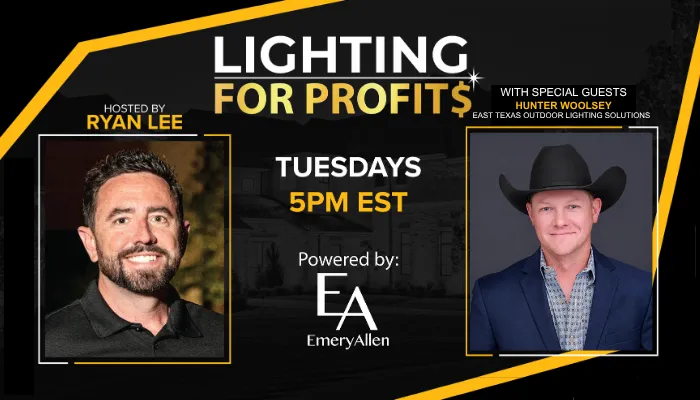
Hunter Woolsey - Beyond the Firehouse
Lighting for Profits - Episode 253
What does it take to build a successful business while serving as a firefighter? In this episode, Hunter Woolsey shares his journey of balancing life in the fire service with entrepreneurship. As the owner of East Texas Outdoor Lighting Solutions and Pegasus Outdoor Lighting, Hunter discusses the lessons he's learned about leadership, business growth, real estate investing, and creating opportunities beyond a traditional career. Whether you're an entrepreneur, business owner, or someone looking to build a life with greater freedom and purpose, this conversation is packed with practical insights and inspiration.
Watch the episode
Episode Transcript
Welcome to Lighting for Profits. Here is your host, Ryan Lee
Welcome to Lighting for Profits.
All light, all light, all light.
Powered by Emery Allen. Here is your host, Ryan Lee.
Oh, a lot, a lot of light.
If you're looking to start or grow a landscape lighting business today is going to be awesome
Welcome, welcome, welcome to the number one landscape lighting show in East Texas. Spreading like wildfire here. Uh, East Texas of all places. It's a little town called Athens. Number one landscape lighting show in Athens, Texas. If you're looking to start or grow a landscape lighting business, all day lighting, permanent lighting, anything like that, today is going to be an awesome show. Um, it's going to be so sweet. We got Hunter. Ah, okay. Hunter Woolsey, the owner, the founder of East Texas Outdoor Lighting Solutions. And I've, uh, gotten to know Hunter over the last, um, I say a couple years, but really maybe just a year and a half and um, he's absolutely killing it. Um, new to the industry but doing very, very, uh, cool things. And so it's going to be a little inspirational. But also he's like kind of an open book. So he's going to kind, uh, of share his journey with us and talk about the things that he's uh, doing in his business to move the needle and things that aren't working as well. So it's going to be a really, really cool, cool show. Um, I love having like, vendors and manufacturers and stuff on here, but I love having other outdoor lighting business owners on here that share their journey, their story, because is kind of just this weird industry. You guys like, how did we get into the outdoor lighting industry? Why are we so nerdy about it? I don't know, but it's amazing. I freaking love it. Um, so it's really, really cool to see like, how people found out about it and um, what they're doing with their businesses and stuff like that. So again, um, Hunter Woolsey, East Texas Outdoor Lighting Solutions is going to join us in just a couple minutes.
Secret summit coming up September 9th and 10th. You're going to want to register now
Before we get started. Want to remind you if you are in landscape lighting secrets. Um, we've got our members only event coming up next month, September 9th and 10th. You're going to want to get in on the 8th, leave on the 11th. We've got, um, uh, on the 8th at night. We got like a little opening social and stuff like that. We've invited a handful of vendors. M. It's going to be really, really cool. We've got some speakers coming. Um, it's really, really hard to get Dan Plata to an event because he's usually like hunting, fishing or drinking beer, but he's coming and so, um, he's going to be one of our speakers. Uh, we Got Jimmy Tompkins, we got, uh, Kenny Kaufman, we got Patrick Harder's Chris Applestadt. Um, maybe some more. If I forget your name, I'm sorry, but we're doing so many cool things. Roundtables, uh, breakouts. We've got, uh, 10k ideas. Last year we had over 40 people share a $10,000 idea. And this isn't like an idea like, hey, we should build a rocket ship and start, uh, Amazon or something like that. It's, it's actually an idea that they've done in their business to generate more than $10,000. So imagine if 40 people share. That's $400,000 worth of ideas. And in a very, very short period of time, um, so many cool things. So if you, um, haven't got your ticket yet, go to secretssummit. com, get your ticket, and, uh, if you're not in, you're like, oh, man, I don't know. I kind of want to join Landscape Lighting Seekers, but I don't dare, or I'm scared or whatever, or I think it's a scam. Like, maybe this is your time, you should do it because we've kind of been around a long time and, uh, we know we can help your business and this event is awesome. So if you're like, I don't know, I might join in October. Just join now because you're going to want to be at the event, uh, next, next, uh, next month. So that means you would need to, like, reach out to me, get on a call soon and we can figure out if it makes sense for you to join or not. So, really, uh, really excited. Secret summit coming up September 9th and 10th. But if you guys are coming. I know a lot of people told me I'm coming, but they haven't registered yet. Um, you still need to register because we got, like, we're, uh, feeding everyone lunch. Uh, we're doing the, ah, social before. We're doing dinners both nights. So, like, we got to make reservations. Plus, you guys know we got, like, tons of swag and we got to order all that. So, um, really excited for that. Um, again, in just a couple minutes. We got Hunter Woolsey with, uh, East Texas Outdoor Lighting Solutions. We're going to be talking about his journey, how he's gone from zero to lots of money in the past 18 months. I'll let him share whatever he wants to share, uh, with his numbers, but he's already earned the LMC Award, uh, the Lighting Millionaire Club for Landscape Lighting Secrets. And, uh, he has not been in the industry Very long. So that's really cool.
Hunter: Most people on coaching calls have some type of financial constraint
Um, okay, so before we have Hunter on, I want to share something real quick. Last night I was on a phone call until 9:30 my time. I'm in Utah, I'm in Mountain Standard Time, and I was on a phone with a guy that was in South Carolina. So it's 11:30 his time and we were nerding out on business and lighting and doing a strategy session. And we were talking about if landscape, um, lighting secrets was right for him. And uh, I, um, you know, he's like, wait, how long you been doing this? I'm like, since 2020. He's like, and you're, you're like on the phone with me at like 11 o' clock at night. Like, yeah, I love this stuff. I'm addicted to business. What do you, what do you want me to do? Right? And so, um, we get to the kind of. Toward the end, we hadn't really have time to finish up and it was late and he had to get going and I had to get going and stuff like that. But, um, I said, hey, before we, um, get on like the next call, um, where are we at like 1 to 10? And he's like, I think it's like an 8. And you know, he had a couple of concerns. I said, well, what are they? Um, and he had two concerns. He said, number one, I have some financial constraints. I've had some, uh, failed businesses. I've had some problems, uh, you know, personally and financially and stuff like that. And then another one was just time constraints. Like, I don't know, man, I'm busy. Like, I don't know, am I going to have time to like, show up to some of the coaching calls? And I was like, man, finally someone's honest, right? I mean, this guy. Those are two real constraints I think that most people have. It's like, man, you know, because if he was already doing well, um, he probably wouldn't be on the call. So most people that we get on these calls with these strategy sessions, they usually have some type of financial, financial constraint. That's why they're reaching out. That's why they want help, right? If they had already figured it out and had like hundreds of thousands of dollars, uh, sitting in their account, those people don't usually reach out to us. So it makes sense that he has, you know, some concerns and some financial constraints. And then from a time standpoint also, I'm like, not surprised. You know, it's like, ah, that makes sense. Because if you had more time, what would you be doing with that time to grow your business to eliminate the financial constraint. Okay. And so, um, I get it, you know, like, um, it's. It's really, really hard. It's kind of like the chicken and the egg. It's like, you know, you need to invest in marketing, but you don't have any money because you don't have any leads and you don't have any business. But it's like, I need business so that I can afford marketing. All right? So I was trying to figure it out. Um, but I will say this. Like, um, if you keep doing what you've been doing that's gotten you to the point that you're at right now, well, then you're going to keep doing those same things, which means you're going to keep getting the same result, which means six months from now, you're going to still have financial constraints, you're still going to have time constraints. That's just, that's not even like a theory. That's just like science. It's just facts at this point. Right? So, you know, from a financial standpoint, I'm like, hey, let, let's not really talk about that right now because honestly, like, I can show you how like an investment in landscape lighting secrets can not quite instantly, it's not like magic, but very, very quickly can, uh, turn into an roi. Right? And we've got some like, payment options and stuff like that where, like, I don't think, um, if you're really bought into this idea and you think it can help you get to where you want to go, like the financial thing really isn't that big of a deal.
Let's talk about the time thing because this is where a lot of people screw up
Let's talk about the time thing because this is where I see a lot of people screwing up in their businesses. Um, myself included, by the way. I don't talk about these things in a holier than thou, like, hey, I've figured it all out and it's so easy. And what's wrong with you? When I say you, I actually mean me. I mean we. Right? Um, but time constraints, okay? Um, this, this is going to happen the rest of your life until you decide to like, take a stand, draw a line in the sand and say, no, not anymore. Okay? Because so many people, I hear people, whether it's them considering joining our program and joining like the landscape lighting secret movement, or them thinking, oh, should I hire a marketing company or should I hire this person or any type of decision in their business, maybe this is you too. Uh, it's like, I'll do that tomorrow. Maybe, um, next week, uh, next month. You know what? Next year. Next year. Right. Um, but when are you going to take control of your business? Because, I mean, nine times out of 10, if you own a small business, your business owns you. Like, you're not taking the reins. You're basically like, um, very. You're running your business with reaction. Mindset. Mindset. You're not like proactively making decisions to make your business work for you. So I want to ask you if I came into your business and I did a time audit or you just handed over your phone for five minutes and I looked and I saw where your time was just on your phone. Okay. Because your phone is just one element of this, of this game. Right? But if I saw how much time you were wasting every single day on social media. Okay, a lot of people say they want certain things. Oh, I want to build a seven figure business or I want to build a multi million dollar lighting business. Um, but then why didn't you do that? It's been five years, it's been ten years. Um, it's one thing to say it, and then your actions are really kind of showing what you really want. Because if you really wanted it, you would start behaving, uh, differently. You would start making decisions differently and taking different actions. And so, um, who are you getting advice from? Like, where is your time? Who are you giving your time to? Um, you know, I'm. I love Alex or Mosey. Um, I love Tommy Mello. I love Russell Brunson. In fact, Russell asked me to speak at his event. I don't know if you guys know this. I'm speaking at Funnel Hacking Live next month, which is crazy, the biggest speaking event I've ever done. So, yes, I love these people. They do amazing things. But like, have they ever ran a multimillion dollar outdoor lighting business? Okay, they're talking about like all these things. Sales, marketing, scaling, hiring, leadership, all that. And uh, it's great stuff. But like, why are you trying to learn how to scale a hundred million dollar business when you haven't even gotten to a million dollar business in 12 months? To me, it just doesn't make any sense. Again, it's not bad advice. It's just like, it's not the thing, it's not the constraint in your business. And in fact, it's creating more constraint, it's creating a time constraint because you don't have time to work on your business because you're listening to a podcast, even this podcast, if you're not implementing the advice that you hear from our guests, then maybe you shouldn't listen and, you know, maybe I shouldn't say implement. Like, you don't have to implement something every single time. Like, sometimes it's just good to get inspiration, right? It's like, man, sometimes we do need to just feel good. Sometimes we just need some motivation. I get that. Right. But not every single day. Like, you've got to do something with the knowledge that you learn. You have to implement, you have to take action. Otherwise you're filling up time. And then you say the same thing. I don't have time. I don't have time to work on my business. I don't have time to know my numbers. I don't have time to meet with this marketing company. I don't have time to, uh, build an sop. I don't have time to hire my replacement. I don't have time to do training for my people. I mean, you just keep saying the same thing over and over, and then nothing changes. And you wonder, like, oh, uh, why is it so hard? And the most successful businesses in the world, they didn't accidentally become successful. It was very intentional. In fact, we're gonna, we're gonna talk about a lot of this stuff and, and what steps you can take. Uh, we're gonna talk about this at Secret Summit, uh, next month, um, how to, like, get intentional about growing your business. Because it's not magic. It's not, it's literally deciding what you want, when you want it by, and then reverse engineering the steps. Okay?
If you're listening to Alex Hermosi on how to scale business
And so, um, again, like, there's so many good people out there. There's so much good content, books, all these things. Like, I've even recommended a lot of these people. Right? But the problem is, if you're listening to Alex Hermosi on how to scale a hundred million dollar business, and you hadn't even gotten to 1 million per year or 3 million per year or even 2 million. Like, what are you doing? Right? Um, and I don't know. I've never scaled a hundred million dollar business. So, like, yeah, at some point, like, you should, like, listen to those things and implement. But if you're just filling your time with noise, that's not valuable. Okay? And so you got to put on the blinders. You literally got to, like, put on the blinders, eliminate these distractions. And it's hard because they're good things. So you don't think of them as a distraction. You think of it as a good thing. But do the thing that, you know that you keep saying you want to do, I want to hire my replacement. I want to build this business. But then you just keep doing the same actions, right? And, you know, being a business owner is not about. It's not this. You don't. It's not a badge of honor to work more hours. Like, I used to think that. I used to think I'll, uh, just out hustle. Like, I'll just work crazy hours, you know, um, my life, when I. I would say the last, like the last couple years, uh, before I sold my lighting business, got, um, really good. It's because a few years before that I got really intentional. And it took a few years of being me, being intentional to actually get all the pieces in place. Right. It was, again, was not magic. It was not a flip of a switch. It was still a lot of hard work. But so, yeah, we're looking at, like, the last decade of my life. I've never been happier being a business owner because I actually got intentional and I do the activities that I want to do, right? And so, um, I just want to encourage you, like, put on the blinders and, yeah, you might have to turn off the hermosis. Like, you might have to not listen to the podcast. And I'm even saying about this podcast, right? I mean, why, Why? I don't want to. I don't want you to waste your time. Like, if you're gonna just listen to it and be like, oh, man, that was great. Why was it great? Like, what are you going to do differently about it, about your situation? You know, um, it's gaining the knowledge and then doing everything in your power to make sure you put all the pieces, all the people in the right place, the right software, do the necessary activities so you actually build a business and get rid of your job. Okay, but seriously, it's always about implementation. Um, I say always. Like I said, inspiration, motivation, Those are good things. Um, and that's why we have this community. Because sometimes you go home and your family doesn't get it. Your circle of friends that doesn't own a business doesn't get it. Um, we're super nerdy with outdoor lighting. You know, we're weird. So, um, that's okay. But I just want to encourage you guys. It's like time should never. Like, that should never be one of your constraints, because you can solve that. And if you've had the same constraint year over year or month over month, even, like, it's time to solve the constraint, identify what your constraint is. What's the thing holding you back? The One big domino. If you got rid of that, that you could solve everything. In most cases, it's time, right? Like, if you just got rid of all the noise and now you had more time to be able to work on, okay, if I was going to hire someone, what would have to be true? And, like, reverse engineer these steps, suddenly you're going to start inching closer and closer to your goal instead of just staying coasting. And as human beings, we tend to coast. We tend to, um, get in our comfort zones, and we stay in those comfort zones. Um, and it happens even at the different levels. So even when people join Landscape Lighting Secrets, they level up their business, but then they stay in that comfort zone. I'm like, no, no, get out of that. Like, as soon as you start to get comfortable, you got to look for the next thing. As soon as you're like, oh, I don't mind, I'll do sales. Like, no, no, replace yourself as a salesperson. Um, whatever it is, get uncomfortable. That's where all the growth happens. So the next time you have a decision, you're like, I don't know, it seems uncomfortable. Think about making the decision 180 degrees from the way you normally do it and try it out. And this is how I. By the way, this is just kind of. Just kind of going off the cuff here. But this is how I make decisions based on risk. So let's say you're confronted with a decision. Um, it could be buying a truck. Um, what's the risk of buying that truck? I mean, if you're buying an $80,000 truck, is it. Is it really risking $80,000? Um, if you do a marketing. Well, my answer is, no, it's not 80,000, because if you sold the truck tomorrow, you wouldn't be able to get 80 grand for it, but it wouldn't be worth zero. You could sell it for 60. So it might. That decision might be worth $20,000. And it's not a $80,000 risk. It's a $20,000 risk. Okay, but here's how I do it. So if I'm considering joining, I have a coach. Um, I either always have a coach or I'm in a mentorship program or a community.
You've got to compare the downside to the upside, and then it should be easy
Or if you're going to go to an event or anything like that, you can go, okay, what is the consequences? Like, what's the risk of doing this? What's the upside? What's the downside if the upside. Okay, if the upside is, like, huge, like, I could, like, really make my money back, and then Some on this deal. And the downside is like, well, worst case scenario, I would be out $20,000. I'm making up a number here. But the worst case is you're out 20,000. But there's something that has an opportunity to make you, like, you know, $50,000 a year the rest of your life. Let's just say, like, I'm going to weigh those consequences, right? And then if I go, well, man, so the downside risk is 20,000. If I do that and it doesn't work and I'm not dead, versus if I do this and it does work, like, there's tremendous upside, People still don't know how to make that decision. So here's how to make that decision easier. You say, okay, what if the upside was small? Like, what if you had to invest $20,000 and it could maybe, if everything went great, give you $5,000 a year the rest of your life? I think most people would go, that sounds dumb. That's. No, I'm not doing that. Because you understand that the upside is so small compared to the downside. So why in your mind does that work, but it doesn't work when you go the other way around? And the. The downside is so small compared to the tremendous upside. I don't know if that makes sense to you. The way I explained it in my head, it totally does. But you've got to compare the downside to the upside, and then it should be easy. If the upside is tiny compared to a large downside, there's no way in hell you're going to do that. It's just a dumb decision. So if that makes sense and that's logically making sense, then why doesn't it make sense the other way around, where the downside is tiny and the upside is large, like you're going to pull the trigger all day long. So the simple framework that helps me make decisions, and I may have complicated it.
Stop settling for cheap, unreliable lamps that ruin your projects and your reputation
All right, guys, I, um, do want to. Oh, wait. What's going on here? Oh, there it is. I want to thank Emory Allen. Uh, and by the way, stop settling for cheap, unreliable lamps that ruin your projects and your reputation. Emory Allen's line of premium LED lamps deliver the performance, longevity and color consistency your clients expect. Don't settle for less. Upgrade your designs and installations today with Emory Allen. All you need to do is reach out to jackson l. @emryallen. com and, uh, he will hook you up with that discounted contractor price and just mentioned that you heard about him here on Lighting for Profits Again, his email is his name. His first name is Jackson, and his last name starts with L. So jackson l@emryallen. com. just email jackson l@emryallen dot com.
All right, guys, I think it's time to, uh, get our guest coming on
All right, guys, I think it's time to, uh, get our guest coming on. What do you guys say? I'm ready if you're ready. Welcome to the show, Mr. Hunter Woolsey. What's up?
What's up? What's up, Ryan? How are you?
I'm doing good, man. I'm excited to, uh, talk with, uh. I guess I'm. I was gonna say fellow Texan. I'm a utahn. That I'm a wannabe Texan.
We'll take you. We'll take you.
Yeah, I saw, uh, Actually, I saw a bunch of bumper stickers when I was there, and. And one of them was, uh, I, uh, wasn't born here, but I got here as fast as I could.
Yeah, I've seen that one. That was a great monologue coming in. I, uh, felt like you were really speaking. Speaking to me. Yeah, that's the, uh, that's the good, uh, judge of a Sunday morning church sermon. If the preacher's talking directly to you, you know, you're looking around like, am I the only one in here? Yeah, that was good.
You looking me in the eyes. Yeah, that's awesome. Well, I. I do appreciate that. I mean, sometimes I like. I, like, prepare these thoughts as I'm eating chick fil A, um, in the drive through, and then I'm like, is it coming out like I want it to in my head? I don't know, so.
Well, it took me back. Yeah, it took me back to our first phone call, um, when I told you that I'd rather fail running this like a business than succeed running it like another job. And so you kind of went along those same lines, so it was good.
That's huge, man.
Hunter Woolsey is a landscape lighting technician based in East Texas
Well, um, I'm excited to, uh, have you kind of share your story. Um, do you want to just do a quick introduction of yourself?
Yeah. I'm Hunter Woolsey. Uh, my wife Ashley, my son Jack and I live here in East Texas. Athens, Texas. I'm a fireman in Dallas. I, um, was a serial entrepreneur, uh, prior to finding landscape lighting. I feel like this is something that's going to be around for a while. Hopefully I'm done searching for side jobs. Um, but born and raised in Texas. Um, I love to hunt and fish. I don't get to do that so much anymore now that I've, uh, had my second career of landscape Lighting, um, that's pretty much me.
That's cool. I appreciate it.
You were a serial entrepreneur and then you landed on landscape lighting
Uh, so, uh, I want to, I want to hit on this serial entrepreneur thing because I think there, you know, I think a lot of people are like that. Like once you get the bug, you're like, man, I don't know, I don't really want to work for someone or whatever. But I mean, who, who knows? Like what, what kind of business am I supposed to start? Why do you say that? You kind of, you were a serial entrepreneur and then you kind of landed on landscape lighting. Now what were some of the things you did that you thought might work but that wasn't you?
Well, when you're a fireman, uh, the first thing you learn when you get to the training academy is you're supposed to have a side job. So we all go get a side job. That's the first thing we do. So I worked for a few of the older firemen that had businesses for a while and then I was like, well, I'm going to go do something on my own. I think the first uh, thing that I did was I had a chimney sweep business, so didn't know anything about chimney sweeping. Got on YouTube and watched some videos and figured out how to do it and built a pretty good seasonal business. Um, but I was it. I was the marketing director, the CEO, the Google Ads guy, the, the cleaner, the admin. I did everything. And um, so I got burned out with it. So after that I sold that business and moved on to gutters, uh, started a gutter company with a guy. We, um, did the same thing, did it for a few years, got burned out. All the while I had been doing Christmas lights. Um, but that was one or two months out of the year. We didn't ever tell anyone. We just did it for people around town that, that we knew or word of mouth. Um, and I guess fast forward to uh, when I got into landscape lighting secrets. I was still doing Christmas lights. But that kind of, I made a decision one day I was like, I mean they're selling the Christmas lights or I'm going to figure out how to make this a year round thing. But I'm tired of getting on roofs and doing Christmas lights every year.
Okay, that's interesting. Well, it kind of ties into like the first thing you said. You'd rather fail as a, you know, trying to build this as a real business than succeed as just a job. Um, I think that's interesting because I, it's, you know, when you do these businesses and you start One. And it either doesn't work or you sell it because you don't love it or whatever the reason is. Um, you can kind of start to feel like, I don't know, should I, should I be doing this? Maybe I should just be happy with my life or go get a job or whatever it is. But I think that they're just all stepping stones. I think it just prepares you to so like, you, you are who you are now because you went through the fiery furnace and you now know it's like, no, I ain't doing, I ain't doing business like that anymore. Like, Exactly. Build a business this time and not get a job.
Yeah, well, the excitement for me is building it, I think. And then once I felt like I built it, built it to, you know, where I was comfortable and it was bringing in extra money, then it got boring, I guess, you know, it would. I wasn't building anymore. Now I was just doing the work, which is supposed to hire people.
Yeah. And then you were like, no, I ain't doing that. I'll just sell it.
Uh, right.
What, what changed your mind here where you're thinking, okay, I'll actually hire people and do a business instead of just sell it.
That, um, that was the deal with Christmas lights. And, and there was an opportunity that came up in town. A guy was selling a, uh, AV company. And I was like, man, I could do that. I could have my, you know, AV guys that are installing, you know, TVs on the wall or surround sound speakers, things like that. They could also do Christmas lights. Um, and so I called a buddy of mine, Bill. Um, he was on the board for, of CDF for years. He's been in the AV business for 30, 40 years. And I called him and I was like, what do you think about me getting into the AV business? And he's like, man, I'm not going to tell you not to, but I'm going to tell you it's not just getting in and going installing movie theaters in people's houses. Like, it's pretty in depth deal. And so he said, why don't you, why don't you consider landscape lighting? He's like, it kind of goes hand in hand. If you want to keep going with home integration and things like that, you could take it even further. But just start with landscape lights. It goes along with your Christmas lighting. And, um, you know, that, that was kind of what got me interested in looking that direction.
You're still a full time firefighter and you're doing holiday lighting
All right, so you're doing holiday lighting, you're full time firefighter and you're still a full time firefighter. How many more years till you got till retirement?
Uh, to a full retirement. I have about 18 more years.
Okay.
I'm hoping maybe to cut that down a little bit. Okay.
Um, but just like I want to remind people, like, you are still a full time firefighter. What's your schedule there? You do how, uh, many days?
Yeah, 24 hours on, 48 hours off, so about 54 hours a week.
Okay. And that's just the gig. Like, everyone knows that. Like, uh, all right, my day's off. I'm gonna go do something else to make some side money, Right?
Yeah.
Okay, cool.
You started East Texas Outdoor lighting in January 2025. How did you, um, how did you get started
So you're doing holiday lighting. You talk to Bill. You're like, okay, well, I guess I'll Google landscape lighting and see what that's all about. Uh, right. How did you, um, how did you get started in it?
Yeah. So obviously driving back and forth to the fire station. It's about an hour and a half drive for me. Um, so I'm always listening to a podcast. I was interested in real estate for a while, so it was all real estate podcasts. Um, but then when I started looking at landscape lighting, I found lighting for profits. And, um, I went back to the. I can't remember how many episodes there were when I first started watching it, but I went all the way back to the first episode and I just started listening to everyone that I could, trying to learn as much as I could. I mean, I had plenty of time driving back and forth, you know, six or seven hours a week to listen to the podcast. So, uh, I guess this was about October of 2024, uh, when I started listening to the podcast. And, um, I guess fast forward to January. I finally took you up on the offer to. That you presented in the podcast to give you a call to talk to you about landscape lighting secrets.
Yeah. Okay, so I remember that now. You were. And again, I didn't know, like, some of this story. Right. But I remember talking to you on the phone. So you just. In 24, you did Christmas, uh, lighting. You still, still doing that. Do you remember what your, what you produced that year?
Yeah, um, in 24, we did 40, 000. Um, it was a partner and I. And, um, Jacob and I. I ended up buying him out later when I started the, the lighting deal. Not because of anything, we're great friends, still get along really good. Um, I was just spending money on advertising and I didn't know how we were going to break it up, so I just offered to buy the Christmas lights. So That I could just take it all and run with one company.
Yeah. And is that when you started East Texas Outdoor lighting? Was that January 2025?
Yes.
Okay, so we get on the phone, and I don't know. I can't remember if you, like, did you join? Right then?
I joined. Shortly after we hung up, um, I said, I need to talk to Ashley. You gave me a bunch of, um, sales tactics to try to trick me.
Yeah, exactly. Are you sure? Like, because if a man doesn't need to talk to his wife, does he?
Right. Yeah. So, uh, then, uh, we jumped off the phone, visited for a minute, and she's like, I got a good feeling about it. And I said, I do, too. So I shot you a text, and we ran with it from there.
Brian M. learned how to do landscape lighting through Light It Up Expo
All right, so you start January 2025. Um, did you hadn't.
I still hadn't installed a lighting job before I joined.
Yeah. All you had was $40,000 of holiday lighting the year before.
Yeah.
When did you do your first job?
I wanted. It was pretty soon after that. Um, I did one job. It was my grandpa's house here in Athens. Um, I didn't make any money. I just charged him for material. M. But I did that job right before I left for the first Light it up expo that I went to.
Okay, so you literally. Did you learn how to do landscape lighting just by going through, like, Lighting Academy online? Uh,
yes. Yeah. I watched some videos. I had an idea of how to do it. Um, but, yeah, pretty much watching the videos and doing everything told me everything I did wrong on the install, and then I was able to build from there.
Well, I think it's awesome because I do tell people. Like, listen, if you've never done it before, I mean, I can show you a video. I can tell you all that stuff. But the reality of the situation is if I teach you how to ride a bike and I show you the videos and I tell you about balance and pedaling and all that stuff, you're probably still going to fall and scrape your knee. And so you got a choice at that time to be like, oh, that guy sucks at teaching how to ride bikes. Or you can be like, oh, yeah, I know now when the handlebars dip, I got to pull them up. Or I do. That's why he said I need to keep pedaling so that I have balance or whatever. So, um, yeah, at some point, whether it's learning landscape lighting or riding a bike, you do got to go on your own. You got to go do your first install, which is Great. You did it on someone's house, you know, so if they can't yell at you too much.
Right? Yeah. Yeah.
Okay. That's cool. So you did it. You did a job. You came to Light It Up Expo. This was our very first one, actually. Um, I probably didn't tell you that. I probably told you. Oh, yeah, we've been doing these a long time.
Yeah, yeah. Seasoned here.
Seasoned lighted Up Expo pros. Uh, but that was 20, 25. Um, and uh, then what?
Uh, so, um, got to light it up. And uh, the first people I met when I got there was Kenny, uh, and tj. And so, um, that was really cool. Um, and really, that first Lighted up is when I realized it's not just, you know, the calls and the coaching program, it's the community more than anything. And uh, those guys have had my back and answered the phone whenever I needed anything, when I've been in a bind, when I needed a shoulder to cry because I don't know what to do. So they've been, it's been amazing, uh, getting to know them. Um, uh, they've been huge for me. Um, but just the community itself. I met so many people at that first Light it up that I still talk to today. And it's pretty neat how quick you can just get in a room with like minded people and, and really learn from it and, uh, create a real relationship. Yeah, Yeah.
I think it's because we are just all so weird and like, you're just not going to find any weirdos on your street. You know what I mean? Right.
Yeah.
Um, tell, tell the story. What just happened? Actually, we were just chatting before this. We were talking yesterday. You told me. Yeah. Well, can you share that story?
Yeah, yeah, yeah. So we had a permanent roof lighting project we've been working on and um, it's been whipping our butt. Like it's, it's been a struggle. Um, we've, uh, I don't know how far in detail you want me to go, but we've, we've, uh.
You don't have to go into all the details. Yeah, it's been a pain. You've been back and forth trying to make it right for the client.
We have. And understandably frustrated, but we've been doing everything we can. Um, but I. You told me to call, uh, Brian. How? Or we kind of on our con. During our conversation yesterday, we came to the conclusion that I needed to call Brian. You sent me Brian's number. Brian told me one little deal that took him 30 seconds to explain. We went to the job today and we did it and it fixed everything. And it was like, cali, why didn't I call you 70 hours ago? We've been diagnosing this thing for weeks, so.
Well, it's crazy because I didn't even think. I mean, it wasn't me. Like, hey, why don't you just call Brian? Like, it was just us talking, and then it was like, do you know anyone? And whatever, and it just kind of happened organically. But that, that is the power of community.
Community quickly becomes your number one valuable asset in any business
That, that one phone call, I mean, yesterday when we were talking, I was kind of advising you to just, you know, take one for the team and you're gonna lose 18k and. Sorry, that's the cost of doing business, bro. You know, like, that's where we kind of were leaving it at. It's like, let's just do one more Hail Mary and see if we get this. But, um, you know, I'm glad you bring up community, because honestly, when I started Landscape, buying Secrets and even up Expo and all these other things, like, I'm always. I put like, a ton of pressure on myself. I'm like, okay, like, I gotta make sure, like, the content's good and we got, like, the right training and all these things and. And we literally have more training than any other outdoor. I mean, it's not even close. Like, we are the only training, like, platform out there, I feel like. Um, but the thing that I never really thought of or, like, really relied on and is amazing is community. Like, it's quickly. Because it quickly becomes, like, the number one valuable asset to. To build that, like, have these different contacts and stuff like that. Whether it's troubleshooting or something like that, or learning about a new product or a new way to do business or anything like that. So, um, I would say it's. It's also the way that you're handling yourself because there's people that go to Light It Up Expo or even join landscape lighting secrets, but don't show up to the calls, they don't show up to the training, they don't go introduce themselves to a stranger. Um, I think you got to be willing to be vulnerable, put yourself out there, accept the fact that there's people that know more than you and that you know more than the person behind you. And it's like, um. So I think props to you for, like, putting yourself out there too.
Yeah, I've always. I guess I've. I've never really had a problem with. With being the. The guy in the Room that doesn't know the most. You know, I. Being in those rooms, and I like being around people that can. Can help you grow, and hopefully you can. You can provide value to them as well.
Sean Keller says since joining landscape lighting secrets, his business has flourished
So talk to us about some of your numbers that you've done. I mean, you go to. You did your first job for family, basically for free. Then you come to light up Expo. This was only, you know, um, maybe 18 months ago. Um, you get out there, start working. What. What. How'd you do. How'd you do that first month? How'd you do the first six months? How'd you do the first year? And so on?
It was a struggle. Um, July of last year is when we actually put up a good month. And I think it was. It might have been like 30,000. But before that, you know, our months were a couple hundred bucks, maybe a couple thousand dollars, we'd get a job or, you know, but nothing. Nothing really of any size. And then July of last year is when we really picked up steam, and we thankfully had been, you know, picking up every month. Um, I think we hit our high month in December of last year, and then we hit another high month this year in March. But, um, since we joined landscape lighting secrets, um, in January, like, uh, I got, like you were talking about before we got the LMC Award, uh, last week at the QT and wherever Darcy lives. Keller. Uh, so we stopped in there and picked that up, um, which is pretty cool. So I'm proud of that one because I remember. I can't remember if it was the first. It might have been at first lighted up just seeing those up on the screen and thinking, man, how cool would that be to have hanging on your wall and then to. To finally. Finally get it on the wall? Like, it, uh. I've had my eye on it for a while, so it's. It's cool to make it. Make it happen.
I mean, it's. It's like record speed because, like, again, you never installing. Like, some people come in and they've already. They already know how to do landscape lighting, and of course, we can help them. But, um, you know, when you. When you join or again, I was talking to this guy last night on the phone. He's a small town in South Carolina, and he's asking me about, like, well, what's. What's possible. I'm like, man, I got to be careful. Because when Hunter joined, I probably been like, oh, you know, I know where you live. East. East Texas. You know, you might do, like, you know, 500 grand a year or something like that, you know, I don't know. That would just be, like, my natural judgmental response, you know, because I know. And, um, like, you just come out and kill it. And so you actually change my mindset to, like, hey, why. Why am I judging people? Why am I, like, I don't want to limit them. And so I told the guy that I'm like, yeah, there's guy named Hunter. He lives in a small town in East Texas, and he's done over a million dollars, and he's only been in the program for 18 months. And most of that was done. Really did about a million bucks in 12 months. So, um, I don't want to limit you. Like, you know, go do some $5,000 jobs, maybe do some $10,000 jobs, get up to some 20s, some 50s, and it is what it is. So, um, what. What do you think was the difference? Like, you think it was just like a learning curve those first few months to help you start getting ramped up?
Yeah, just. And Sean and I are seeing this with the. With starting Pegasus. It just takes so long to get everything in place, to get the advertising going and approved on Google and your website where you want it, and Google to recognize that you're a real business and start getting reviews. I think it just takes a. A few months of reflex time just to get everything in place.
Why do you think you had so much traction and success out of the gate
Why do you think you had so much traction and success out of the gate? I mean, when I say out of the gate, you said yourself there's a few months of, like, ramp up, but then you had your 30k in July, and then, you know, you just kind of kept going up from there. But, um, what do you think the difference is between you and someone else who comes in and gets more. I'll call it mediocre or less than mediocre success.
Right. I think, um. I think the deal with the fire department, like. And let me back up. I don't tell any of my customers I'm firemen. I want them to think that I'm a. I'm a lighting guy, and that's what I do full time, and I'm going to be there when you need me. Um, if any of them. Watch this. Uh, this is just a skit. I'm not actually a fireman. Uh, no. Yeah. Um, but I think having the. The security of the fire department helped me because, you know, if. If you told me in the program we need to spend this much on marketing, I would go spend that much on marketing, and I wasn't worried. About I'm just taking house money at that point and spending it on marketing. And it worked. Which, you know, if I, I did have to pay my mortgage with that money, I might have tried to save up a little bit more before I started spending it on marketing. So I think it holds me back in the sense that it's 54 hours of my week that I'm there, that I can't focus on things, on the business. Sometimes I come home and I'm, you know, I'm worn out. I don't want to, you know, work on the business. Um, so it can be a drawback. But it, it was also a bit of a safety net as well.
I could see that. Yeah, you've, you definitely got some advantages and disadvantages because right. Someone else who's just full time lighting guy has 54 more hours than you.
Right?
Just saying.
Exactly. Yep.
I mean that's, that's their unfair advantage toward you. Your unfair advantage is like, well, yeah, I'll just, I don't, I don't have to pay myself, uh, from this new business right out of the gate.
Right?
Yeah. Um, no, that's cool.
Well, talk about marketing and talk about some of those risks
Well, talk about marketing and talk about some of those risks. What are some things that you tried that um, maybe didn't work or at least didn't work right away that you thought maybe maybe I shouldn't do this. Um, and then we'll talk about some of the things that worked.
Um, I would say there's, I feel like most everything that we've done has brought value. Um, you know, whether it, whether it be Google or Facebook marketing, they've all. I feel like we've at least kind of broke even from them. Some of them have been better for us. Um, but I, I don't think any of them, I don't, I definitely don't regret doing any of them. Um, and really at this point it's really just Facebook, Google Breeze leads, and then organic Google.
Um, but have you, have you not like, uh, done any, any of those or your truck wrap or yard signs or anything where you did it and like expecting a result faster and like going maybe a month, like kind of starting to question like, I don't know, should I, maybe I shouldn't do this or maybe I should cancel it or any like, responses like that?
The truck wrap, I felt like it took a long time before I found a client to call and say we saw your truck. It's happened a few times since. Um, but I still didn't regret it because I felt like we had Authority. When we pulled up, like, when they saw our truck pull up, they knew this is a legitimate company that's. That's gonna do a good job. So I feel like it helps there. And people, whether they say they saw your truck or they saw it in the neighborhood, and then they looked you up on Google and maybe they didn't mention the truck grab, but I'm sure it. I'm sure it made a difference in their mind, you know, when they see it driving around.
Yeah, well, I, again, I'm just trying to, like, there's common denominators to people that are getting traction in this industry. And you got to pay to play. You know, you don't have to start that way. Um, a lot of these guys already have an existing business, so it's like, okay, you got existing holiday lighting clients. Let's send an email, text, phone call to them. You can get a couple jobs from that. Then you got to turn that profit now. Now that's when you got to pay to play. And some of this stuff works fast. Like, it is almost like a flip of a switch. And within a couple weeks, you're going to get some. Some business. Some of it, it takes a little bit longer. And so, um, if you don't have the cojones to stay in the game long enough, you're just gonna. You're just blowing money that first month or two, and then instead of it turning into an Investment Month 3 through 12, you just blew your money, you know?
Exactly. Yeah, no, I 100% agree with that. And I do remember having conversations with the marketing companies that we have, um, more. So early on, when I'm like, do we need to do something different? Is this working? They're like, just give us a little bit of time. They throw a bunch of algorithm words at you, and you're supposed to just believe them. And I do, and it works. So.
So, um, the problem is a lot of people have been burned by marketing companies that said the same thing. So they hear that and that triggers them, and it'll be like, oh, like, how long do I wait? You know? Um, but I think you, you mentioned it's like, it's all the things. It's. It's truly the marketing mix you've got. You're not just relying on one lead source, which is important because if one lead source is slow this month, um, you're not out of business, and the other one's supporting it, and you're able to measure it across the aggregate and over a longer period of time. It's. That's really the only way marketing works. So did you. Did you know that, like, from your other businesses or, like, what gave you the courage to do that?
Um, I think just the switch in mindset of wanting to run it like a business. Like, talking to you and talking to guys that light it up. And I remember having a conversation with Kenny, like, which one of these should I do? And he's like, one of them. All of them. You got to do all of them. So, um, I. I think just. And then that's one thing that's. That's nice. You know, if I call a lighting company here in town or in Tyler or Dallas or wherever and say, hey, ah, what do y' all do for marketing? They're gonna say, who are you? I'm a lighting company down the road. Figure it out. You know, I feel like that's probably the answer I'm gonna get. Um, or they're at least gonna hold their cards close. Um, with this group, you get. You get the whole deal. Like, you get the full story. Yeah, I did this and it didn't work, but I stuck with it. Or, you know, I'm running all these. And some are better some months, some are better other months. But I think just talking to people and trusting it's worked for them, it's got to work for me is helpful.
I don't know why. I just, uh, we're going to keep recording because the podcast is still recording, but it. I think it stopped streaming live to Facebook. Not sure why. Um, okay.
This segment is brought to you by Call Source. So, um, Call Source helps busy lighting contractors
Hey, so one thing I want to do. We got this. Um, I still have a bunch more questions for you, but I started this new segment. It's kind of fun. Some of them are fun, some of them are business, uh, based, but just help the audience kind of get to know you a little bit better. It's called you make the Call. Okay. Oh, wait, I even have. Ah, yes, we have some background music. So it's called you make the Call. It's brought to you by Call Source. They're a new partner of ours. Um, because whether it's a tough business decision or a tough life decision, sometimes you just have to make the call. Right? So, um, Call Source basically helps busy lighting contractors that don't always have time to follow up on every unbooked call, Unsold estimate form, fill, canceled appointment. That's where Call Source comes in. So they got us based outbound, um, call center they access as an extension of your team, using trained live CSR experts to reconnect with Prospects schedule more appointments and help recover revenue that may otherwise slip through the cracks. So if you guys want to learn more about them, visit callsource.com and schedule a demo. If you're in landscape loting secrets, I was just telling Hunter, you guys get three free months, which is really cool. So, um, they're going to, like, tap into your clients for you. You can assign who you want them to call and help, uh, you recover some revenue that's just sitting out there waiting for you. So. Thank you, call source. Um, Hunter, you ready to play? Make, uh, the call.
Let's go.
Would you rather have unlimited tacos for life or unlimited barbecue for life
All right, so, um, let's see. Would you rather need some music? Yeah. Would you rather have unlimited tacos for life or unlimited barbecue for life?
I'm gonna go barbecue.
Okay. I don't know. I was like, 50, 50 on that. From Texas, you know?
Uh, yeah, that was a tough one.
All right, would you rather be able to skip every red light for a year or. No, you'll never get a speeding ticket for a year.
No, you'll never get a speeding ticket for a year.
I thought that would be the case. All right, um, would you rather be the first through the door on every call as a fireman or always be the one driving the truck?
I'm gonna always be the one driving the engine.
All right, uh, well, that's what you're doing now. You are the driver, right?
That's what I'm doing. I'm better embrace my job.
Yeah. Okay, cool. Yeah, yeah, Damien asked me to ask that one. Um, would you rather have a fire truck siren that only plays Taylor Swift or Britney Spears?
Taylor Swift, for sure.
Okay. We got a Swifty on our hands.
Yeah. Oh, yeah.
Here we go. Here we go. All right. Can we. Can you make that happen? See if you guys can make that happen. Do a video.
We, um. Can I stop the game?
Yeah, the game is we're going. Yeah, go ahead.
On the ambulance, we used to have these amplifiers or microphones you could talk into, like, police, you know, to. And it would play outside of the. Of the ambulance, and we would go through neighborhoods and play music. All the kids would come out and dance, play along with the ambulance.
So the fire trucks don't have the. The walkies or whatever the things they do.
But we don't have any radios in there, so we can't play any music to the. To the public like we can on the ambulance.
Well, just next time you guys are. You got a slow day, just, uh, use your phone, get some Swift music going on there. Send me the video.
We'll do it tomorrow.
All right. Um. All right. Would you rather get a one hour? Oh, yeah. Get one hour with any business, mentor, living or dead, or get $25,000 in free advertising. Business.
Uh, mentor, for sure.
One hour. Do you. Do you know who that would be? Living, living or dead?
I don't. I don't. Uh, I pretty much take an hour of Kenny's time a week. He's. He's one of my mentors, so I'm not gonna waste it on him. All right. Until he stops answering.
Exactly. Yeah. All, uh.
Right.
Cool. Um, all right.
Would you rather take down holiday lights in freak snowstorm or install them in 110 degree weather
Would you rather take down holiday lights in a freak snowstorm or install them in 110 degree weather?
Heat and Solomon. 110 heat?
Really?
Yeah.
You're not. You're not, uh, snow guy? Huh?
No, I mean, the lights don't roll up good when they're cold. Might fall off the roof. I can take the heat, so I'm used to that.
Would you rather only be able to do permanent lighting the rest of your life but make more money or only be able to do landscape lighting the rest of your life but make less money? Landscape lighting and make less money?
Yeah. All right. I'll get a. I'll get a third job.
Yeah. I mean, we can be. We can remain friends. Yeah, that's. That's my new filter. I'm just gonna ask people that question, like. All right, you're dead today. All right.
Would you rather use path lights on every job forever or down lights forever
And, uh, finally, uh, would you rather have to use path lights on every job forever or never be able to use down lights forever?
Um, never be able to use down lights,
so you have to use path lights on every job forever, I thought.
Would you rather. You said, would you rather have to use path lights.
Yeah. What did I say? Hold on. Uh, would you rather have to use path lights on every job forever or never be able to use down lights forever?
But if I. Either way, I use path lights.
Crap. Hold on. I don't think so. Let's see. Would you rather have to. You have to.
You.
You either. No, the choice is you have to use path lights on every single job forever. Like I would say.
Oh, like some portion of the job.
Yeah, you have to do, like, on every. Let's say on every job forever, or you just can never use down lights forever?
No, I would use path lights on every job.
That's what you're doing. All right.
Yeah.
Okay, man. Well, um, thank you, call source, and thanks for playing. You make the call, Hunter. Yeah, um, we can go back to our regularly scheduled Interview. But, um, I think it's kind of fun, you know, get to know, um, get to know him.
You really get to know someone when you play.
Make the call, you know?
Yeah.
Um, well, that's good. We can, uh, remain friends.
What's been the hardest part of growing your outdoor lighting business
Um, so I want to ask you a little bit about the. The good, the bad, the ugly of growing a business. Um, you've obviously had great success so far. Um, what's been, like, what's been the hardest part of. Of growing your outdoor lighting business?
I think, um, the hardest part's just juggling the roles, trying to. Trying to do everything. And, you know, I've been working on that, like, trying to get out of the field where I can work more on the business. And I got two great guys right now in that role. Um, but then it's just the next thing. Um, so now, you know, we spent a little time away in New Mexico and we came back home, and I think I was telling you yesterday I had, uh, 19 jobs to go bid in the next week or so. And it's like I was in the car for 10 hours yesterday, just driving around, and I was in the car, you know, most of the morning today. So I think, I think that's the hardest part is as you grow, you just haven't. You keep having to make hard decisions on when you're going to hire, who you're going to hire. And so I think that's probably the, the hardest part of, of having a business and running it like a real business.
Yeah. Well, um, it's awesome, by the way. You go out of town and come back to 19 appointments. Uh, yeah.
Great.
That's like appointments, not leads. Right?
Right. Yep.
Yeah. That's sweet.
How much do you spend on marketing every single month for your business
What, uh, how much are you spending, uh, on marketing every single month?
Uh, I don't know exactly, um, because I'm not a good business owner, so I can't tell you exactly what the number is, but I would say Google with the, you know, Google, they're managing our website, um, and then also managing the ads with ad spend. We're probably around 3,500amonth for all of that. And then, uh, Facebook, where I think around 4 to 5,000amonth with ad spend and management fees. Um, Breeze leads were around 1700amonth. So I, I definitely didn't have any idea how much it costs to run a business.
Yeah, I mean, but that's. I mean, just quick math, you're at 10 grand a month right there. Uh, and then that's without, like, you know, like a truck wrap isn't Ongoing, it's a one time deal. Um, yard signs, door hangers, swag, like some type of that, that type of stuff. But still 10 grand a month. I think, I don't, I don't think most people realize that. You know, they're just like, I don't know why, it's just so slow right now and I just can't, I can't do more than 3, 400 grand a year. And like, well, because you're not making the phone ring, you know, you've got to be willing to pay to play. So um, for me, you know, if you have a seven figure business, if you're doing million dollars, ten grand a month is about right. Um, it's about 10% of uh, of revenue. And personally I'm willing to spend more than that because I'm like you. It's like, well, uh, how much do I really need to make? I mean, especially if I'm in growth phase, like I want to pay myself as little as possible, reinvest it back into the business. So I can pay 15, maybe even 20% because I know that I'm going to get more business out of those same customers you paid for them once. I'm really good at getting the repeat, the referral, all that. Whereas a lot of business owners aren't good at that. And so it's like they pay once and then they got to pay again later on. And you know, you can, you can go out of business quick that way. So I think it's, I appreciate you sharing those numbers because I don't, I don't think people realize it's like you're not going to just wake up and have a million dollar business.
Right? Yeah, yeah, it's definitely a lot more, a lot more than I thought it would be. You know, when you, you have like your first good month and you, you see the money and you're like, man, I am killing it. Like, and then you start looking at insurance and diesel and everything else. Phone bills and speeding tickets, speeding tickets and tacos. And you get down to the end of the month and there's not a lot left.
So it's, it's so frustrating because like you, uh, there's, there's, you don't learn that anyway. Where are you going to learn that? And you go out and you, you know, you serve your client, you do everything right and you take care of your team members and you buy them lunch and you do all this stuff and then it's just like, man, where, where'd all the money Go. It's so frustrating. That's why I'm such a proponent and people think I'm like, greedy and all this other stuff, which is. That's fine. You can think what you want. But, like, you, you have a duty as a business owner to make as much money as possible. Um, you, you literally yesterday were ready to just like, lose $18,000 to make it right for a client. You know what I mean?
Right.
Um, yeah. There's so many things that just aren't going to show up on a P. L. They're not going to show up on a budget, on a forecast, all these types of things. Um, and what, what if marketing goes slow for the next three weeks? You still got guys to pay, you still got a family to feed, you still got insurance to pay and truck payments and all this stuff. So it's like, yeah, it's our responsibility to make as much money as possible. Um, and profit, really, not just revenue, but profit as possible to make sure that, like, yeah, we'll be fine if it's slow for a month, we'll be fine if it's slow for three months. Because we're financially responsible on the front end. We're charging the right price so that we can afford to answer our customer's phone call and be like, yeah, whatever you need, we got you. Instead of being like, why is that lady calling again?
Yeah, that, uh, that warranty that you put behind your products, worthless if you're not there to service it.
Absolutely.
How do you manage your time between multiple jobs in a family
Um, what's, um, what do you, what do you do to manage your time? I mean, you're full time firefighter, full time outdoor lighting company, full time father, husband. Like, how do you do that between multiple jobs in a family?
Yeah, um, I think. And I'm still working on this, but just being intentional about setting time aside for certain things. Um, I'm, um. Like, probably a lot of business owners, you know, one of the things you learn is how to let go of certain things. So I guess about, I guess, I don't know, maybe six or eight months ago, I hired a assistant. Um, at the time, she was living in El Paso. She since moved back here. So she was essentially started as a virtual assistant and still kind of is. She works, she works from home, but when we went out of town, I got like three phone calls as soon as we got there, back to back. And I remember Jack saying, are you going to work the whole time we're here? And it's was like. And so I immediately just forwarded my phone number, my work cell, to Joanna. And so she's been answering all the calls I've. Which was the goal when she started, which. She has her own phone and she does a lot of calls and text from that. But I forwarded my number to her. It was really nice for my work phone not to ring for two weeks. So now I'm. I've been home for a few days and I haven't. I haven't taken it back yet. She's still. She's still got it. So, uh, yeah.
I don't know why we tell ourselves when we start these businesses that we have to do everything. I don't. I'm just like, just. I don't. We just think that, you know, it's like, no, you can be a business owner. It's okay. You don't have to feel guilty that other people are doing stuff. You're paying them, you know.
Right.
You're actually creating. You're helping the economy, you're helping someone else. You're providing for another family. Like, it's okay. Like, they, they find joy and satisfaction out of doing things that you really don't, you know? So, yeah, I think, I think that's huge.
Hunter Lee says he wants to leave the fire department to start a business
Um, what, what, what is your goal? What's your plan? Um, like you said, you, you really want this to be a business. Um, it's not easy. There's. There's things that just pull you back into weeds every day. You know, you know what I'm talking about? Um, what's your goal? Do you have a time frame for this? Um, what's. What's the plan?
You know, my goal is to be. Has been, um, since I've started gaining traction with landscape lighting, was to be able to leave the fire department at any point after I hit my 20 year mark, which is two more years. Um, so if I can get to that 20 year mark, I'm. I may not leave then. I may, I may keep working, but I just want to have the flexibility to. To be able to leave at that point. Um, you know, East Texas is going well. Sean and I have opened, uh, Pegasus and got the ball rolling there. That's our Dallas, uh, branch for outdoor lighting. Um, so we're excited about that one. I think it'll be kind of interesting and challenging to be in a bigger market. Um, but if the Lee's can do it, you know, anybody can do it really. In Dallas.
Right. We paved the way. It's like, I've been saying that for years. Like, come on, prove me right.
So now we're excited to get and get in Dallas and kind of learn the bigger market, and it'll be a lot of fun.
Play with the big boys. Um, well, it's kind of interesting and cool. I've, um, joked around a little bit with you, but I'm like, I don't know if I'm joking. You've inspired other people to start businesses, right?
Yeah, um, for sure. A few firemen have. Um, I think you've met most of them.
Yeah.
Um, so.
And they're saying the same thing, dude, if Hunter can do this, anybody can do this.
Yes. Yeah. And that's what I tell them.
Yeah. It's pretty awesome, man. I'm, um, telling you, man, you need to start a fireman lighting secrets. Uh, we'll do that together because.
Yeah.
Um, you got an awesome story. You, uh, you're just a good dude. You got a good vibe about you. Like, you're. You're doing the right things, and you do come across as, like, don't take this the wrong way, but you just come across as, like, it's just a normal dude, and you're, like, just kicking butt. It's, like, freaking awesome. So it's inspiring. And. And I think it. It's good for the world. I mean, you. You've inspired others to start their businesses. You're partnering with one. Um, just so many good things. So, um, keep. Keep doing what you're doing, man. It's awesome.
I appreciate that.
I asked you about your sales process and how you overcome objections
I. We didn't have time because I was going to ask you about your sales process and how you overcome objections, because I know you're really good at that, and you're going to probably start your own sales, uh, training on that soon, right?
Yeah, yeah. I'm, uh, pretty much natural born salesman's. Uh, no.
These old ladies tell you they want to think about it. What do you say when. When you're in their kitchen?
All right, we'll see y' all later.
It works 60 of the time. It works 100 of the time.
Yeah. Uh, I have told people, you know, I feel like I don't know what it is because I listen to, you know, sales stuff and listen to guys talk about overcoming objections, and I know it's. I need to work on it. Like, I really do need to. To get a better process down. Every once in a while. I'll have a, you know, one that I'll just ask one more question and it works out. But for the most part, if someone says they need to think about it, I'm not very good at getting past that. And so I Do I do need to work on it? Um, but I think, I think, uh, my follow up, I follow up, you know, pretty consistently. Um, at least for the first week or two. I'm, I'm texting them pretty regularly to try to, try to move the needle a little bit. But I think, like you said, like, I, I just have. I guess I'm able to just build trust with people maybe is what it is. Um, but I feel like if I could work on my sales process, I can probably do a little bit better.
Yeah, I mean, you, you definitely have a gift with people. And so, like, I think that's like kind of your unfair advantage because you're, you have that, that, that rapport quickly and stuff like that. You have a lot of trust. I think you can have that ability to act. Ask the extra one or two normally, uh, awkward questions, like, to you just naturally, you're like, no, that's not me. But they, they wouldn't think it's weird if, if. And you've done it, you know, you've had, you've had those experiences where you're like, okay, well, no worries. Think about it as long as you want or whatever. And then you're like, before I go, I mean, if there's anything that, you know what you're going to think about, maybe there's something I can do to help. And before you know it, they're like, well, come to think of it, like, what could we do to get the price down? Oh, we can move a couple lights out. Okay, let's do it. And you close the deal. And it's like, okay, that wasn't dirty, you know, like, that was just you, uh, helping someone make a, uh, educated decision. And they had some concerns. They were afraid to ask you for a deal. You were afraid to ask them a question. And I think that's your, like, secret sauce is you. If you can learn that and you just start asking that additional question, like, every single time and realize you're not going to offend anyone. Uh, you're probably going to help at least 50% of the people just make a decision on the spot. And not everyone will. There's still people that, like, when we had our conversation, like, dude, yeah, you got to talk to your wife. Like, okay, like, go talk to your wife, you know, um, right. Those things happen for sure. But a lot of people are like, they want to make the decision, but they also don't want to be rude to you, you know, and they don't want to, like, ask you something that might offend you or ask you for a deal or something like that. And you're like, ask me for a deal, I'll give you one. You know, like, yeah, I'm just trying to earn your business.
Exactly.
Any advice you have for someone just learning about outdoor lighting
Well, anything that you'd want to leave the uh, the listeners with, um, you know, there's probably someone like you that's just learning about outdoor lighting, um, listening, any, any advice you'd give them.
Yeah, I would just say, I don't want to say, don't come in with expectations, but I do remember when I was at the first Light it up and, and hearing people talk about, you know, I've done a $20,000 job or a $50,000 job or $100,000 job. And I remember sitting there thinking to myself, I'm in rural East Texas, there's no hundred thousand dollar landscape lighting jobs here or there's no $20,000 landscape lighting jobs. And I was okay with that. I was like, I'll do, you know, four or five $6,000 landscape lighting jobs. And that's way more than the, you know, $125 I was charging to sweep a chimney. So that'd be great for, um, and so I would just say don't put a cap on, on what you're, what the market's capable of and what you're capable of. Um, I remember when I did get home from Landscape Lighting Seeker or from uh, Light It Up Expo, it had been, you know, some time passed and we had got a $27,000 job and I was like, holy crap. And it was one of those, like I, I bid the whole thing there on site, gave him a quote. I did have to follow up every day for a month, but we got the job. And he did tell me when, when we got the job. The reason we went with you is because the other guy never followed up.
Wow.
And so, um, and the other guy was a Dallas fireman as well.
That's incredible. But, uh, did you know him?
Yeah, I did.
I mean, did you know that he was bidding it?
I did.
Oh, that's awesome.
I did. Um, but, and then you get a fifty thousand dollar job and then you get, we haven't done a hundred thousand, but we've done a ninety two thousand dollar job. And it's like you keep saying it, I keep saying to myself, it's not possible. But then it keeps happening. I'm like, well that's a one off deal and then it'll happen again. It's, it's out there and there's people that. That want to spend the money and. And want their place to look nice, and you just gotta. Just gotta find them. So.
Great advice. That's awesome, man. And congrats. I mean, 27, 50, 92. I mean, these are even me. I've been in the industry since 2007, and I still am just like, man, that's incredible. You know, like, it's just. It's freaking awesome. Um, we. We, like, people want this stuff, you know, they. They. They really do. And it, like, they're thanking you. Like, hey, here's 92K. Thank you. You're like, what? Like, yeah, here.
Well, the most. The most fun thing about this, like, verse. Chimney sweeping or gutters or anything like that. Nobody's happy to pay you. Like, oh, I got gutters. Here's the money. Oh, you swept my chimney. Here's the money. I got a new insurance policy. I did insurance for a while. Here's the money. But with this, when. When people pay you at the end, they're excited. Like, they're proud to show their house off, and they're glad to give you the money. So it's. It's a. Definitely a different feeling. And a lot makes it a really cool industry to be in.
It is cool.
Hunter's website is www. ESEX outdoor lighting solutions
All right, man. Well, Hunter, I appreciate you, man. Thanks for coming on here, sharing your story. Um, really inspiring, really cool stuff. I. I seriously appreciate you. Um, if people want to get a hold of you, what's your website? What's. What's the best way to find, uh, out about East Texas.
Yeah. Website is www.etus Lighting. com. then they can look us up on Facebook. They can look me up on Facebook or our, uh, ESEX outdoor lighting solutions.
Love it.
Ryan: Thanks for coming on, Hunter. Looking forward to seeing what you build
All right, well, Hunter, that was awesome, man. Like I said, thanks for coming on here. Thanks for, uh, opening up, telling us that you, uh, would rather have barbecue for life and listen to Taylor Swift. So I appreciate that.
Yeah, absolutely. Thanks for having me, Ryan. Appreciate it.
But congrats. Looking forward to seeing what you build, man. And, uh, I'm going to help you, uh, hold. Hold you accountable to your goal here in the next two years, where it's like, hey, this business is running. I. I can keep working if I want or I don't need to.
Perfect. That's what I need.
Let's do it, man. All right. Thanks, Hunter. Appreciate you, man.
All right. You bet. Thank you.
All right, guys. Follow the steps. Now the hard part
All right, guys. Now the hard part. Just go do what he did, and it's not that hard. Look, Hunter, if he could do it, anyone could do it.
Anybody.
If I could do it. I'm telling you, anyone could do it, Guys. Go do it. Just follow the. Follow the steps. Have a great week.
Hunter Woolsey - Beyond the Firehouse
Lighting for Profits - Episode 253
What does it take to build a successful business while serving as a firefighter? In this episode, Hunter Woolsey shares his journey of balancing life in the fire service with entrepreneurship. As the owner of East Texas Outdoor Lighting Solutions and Pegasus Outdoor Lighting, Hunter discusses the lessons he's learned about leadership, business growth, real estate investing, and creating opportunities beyond a traditional career. Whether you're an entrepreneur, business owner, or someone looking to build a life with greater freedom and purpose, this conversation is packed with practical insights and inspiration.
Watch the episode
Episode Transcript
Welcome to Lighting for Profits. Here is your host, Ryan Lee
Welcome to Lighting for Profits.
All light, all light, all light.
Powered by Emery Allen. Here is your host, Ryan Lee.
Oh, a lot, a lot of light.
If you're looking to start or grow a landscape lighting business today is going to be awesome
Welcome, welcome, welcome to the number one landscape lighting show in East Texas. Spreading like wildfire here. Uh, East Texas of all places. It's a little town called Athens. Number one landscape lighting show in Athens, Texas. If you're looking to start or grow a landscape lighting business, all day lighting, permanent lighting, anything like that, today is going to be an awesome show. Um, it's going to be so sweet. We got Hunter. Ah, okay. Hunter Woolsey, the owner, the founder of East Texas Outdoor Lighting Solutions. And I've, uh, gotten to know Hunter over the last, um, I say a couple years, but really maybe just a year and a half and um, he's absolutely killing it. Um, new to the industry but doing very, very, uh, cool things. And so it's going to be a little inspirational. But also he's like kind of an open book. So he's going to kind, uh, of share his journey with us and talk about the things that he's uh, doing in his business to move the needle and things that aren't working as well. So it's going to be a really, really cool, cool show. Um, I love having like, vendors and manufacturers and stuff on here, but I love having other outdoor lighting business owners on here that share their journey, their story, because is kind of just this weird industry. You guys like, how did we get into the outdoor lighting industry? Why are we so nerdy about it? I don't know, but it's amazing. I freaking love it. Um, so it's really, really cool to see like, how people found out about it and um, what they're doing with their businesses and stuff like that. So again, um, Hunter Woolsey, East Texas Outdoor Lighting Solutions is going to join us in just a couple minutes.
Secret summit coming up September 9th and 10th. You're going to want to register now
Before we get started. Want to remind you if you are in landscape lighting secrets. Um, we've got our members only event coming up next month, September 9th and 10th. You're going to want to get in on the 8th, leave on the 11th. We've got, um, uh, on the 8th at night. We got like a little opening social and stuff like that. We've invited a handful of vendors. M. It's going to be really, really cool. We've got some speakers coming. Um, it's really, really hard to get Dan Plata to an event because he's usually like hunting, fishing or drinking beer, but he's coming and so, um, he's going to be one of our speakers. Uh, we Got Jimmy Tompkins, we got, uh, Kenny Kaufman, we got Patrick Harder's Chris Applestadt. Um, maybe some more. If I forget your name, I'm sorry, but we're doing so many cool things. Roundtables, uh, breakouts. We've got, uh, 10k ideas. Last year we had over 40 people share a $10,000 idea. And this isn't like an idea like, hey, we should build a rocket ship and start, uh, Amazon or something like that. It's, it's actually an idea that they've done in their business to generate more than $10,000. So imagine if 40 people share. That's $400,000 worth of ideas. And in a very, very short period of time, um, so many cool things. So if you, um, haven't got your ticket yet, go to secretssummit. com, get your ticket, and, uh, if you're not in, you're like, oh, man, I don't know. I kind of want to join Landscape Lighting Seekers, but I don't dare, or I'm scared or whatever, or I think it's a scam. Like, maybe this is your time, you should do it because we've kind of been around a long time and, uh, we know we can help your business and this event is awesome. So if you're like, I don't know, I might join in October. Just join now because you're going to want to be at the event, uh, next, next, uh, next month. So that means you would need to, like, reach out to me, get on a call soon and we can figure out if it makes sense for you to join or not. So, really, uh, really excited. Secret summit coming up September 9th and 10th. But if you guys are coming. I know a lot of people told me I'm coming, but they haven't registered yet. Um, you still need to register because we got, like, we're, uh, feeding everyone lunch. Uh, we're doing the, ah, social before. We're doing dinners both nights. So, like, we got to make reservations. Plus, you guys know we got, like, tons of swag and we got to order all that. So, um, really excited for that. Um, again, in just a couple minutes. We got Hunter Woolsey with, uh, East Texas Outdoor Lighting Solutions. We're going to be talking about his journey, how he's gone from zero to lots of money in the past 18 months. I'll let him share whatever he wants to share, uh, with his numbers, but he's already earned the LMC Award, uh, the Lighting Millionaire Club for Landscape Lighting Secrets. And, uh, he has not been in the industry Very long. So that's really cool.
Hunter: Most people on coaching calls have some type of financial constraint
Um, okay, so before we have Hunter on, I want to share something real quick. Last night I was on a phone call until 9:30 my time. I'm in Utah, I'm in Mountain Standard Time, and I was on a phone with a guy that was in South Carolina. So it's 11:30 his time and we were nerding out on business and lighting and doing a strategy session. And we were talking about if landscape, um, lighting secrets was right for him. And uh, I, um, you know, he's like, wait, how long you been doing this? I'm like, since 2020. He's like, and you're, you're like on the phone with me at like 11 o' clock at night. Like, yeah, I love this stuff. I'm addicted to business. What do you, what do you want me to do? Right? And so, um, we get to the kind of. Toward the end, we hadn't really have time to finish up and it was late and he had to get going and I had to get going and stuff like that. But, um, I said, hey, before we, um, get on like the next call, um, where are we at like 1 to 10? And he's like, I think it's like an 8. And you know, he had a couple of concerns. I said, well, what are they? Um, and he had two concerns. He said, number one, I have some financial constraints. I've had some, uh, failed businesses. I've had some problems, uh, you know, personally and financially and stuff like that. And then another one was just time constraints. Like, I don't know, man, I'm busy. Like, I don't know, am I going to have time to like, show up to some of the coaching calls? And I was like, man, finally someone's honest, right? I mean, this guy. Those are two real constraints I think that most people have. It's like, man, you know, because if he was already doing well, um, he probably wouldn't be on the call. So most people that we get on these calls with these strategy sessions, they usually have some type of financial, financial constraint. That's why they're reaching out. That's why they want help, right? If they had already figured it out and had like hundreds of thousands of dollars, uh, sitting in their account, those people don't usually reach out to us. So it makes sense that he has, you know, some concerns and some financial constraints. And then from a time standpoint also, I'm like, not surprised. You know, it's like, ah, that makes sense. Because if you had more time, what would you be doing with that time to grow your business to eliminate the financial constraint. Okay. And so, um, I get it, you know, like, um, it's. It's really, really hard. It's kind of like the chicken and the egg. It's like, you know, you need to invest in marketing, but you don't have any money because you don't have any leads and you don't have any business. But it's like, I need business so that I can afford marketing. All right? So I was trying to figure it out. Um, but I will say this. Like, um, if you keep doing what you've been doing that's gotten you to the point that you're at right now, well, then you're going to keep doing those same things, which means you're going to keep getting the same result, which means six months from now, you're going to still have financial constraints, you're still going to have time constraints. That's just, that's not even like a theory. That's just like science. It's just facts at this point. Right? So, you know, from a financial standpoint, I'm like, hey, let, let's not really talk about that right now because honestly, like, I can show you how like an investment in landscape lighting secrets can not quite instantly, it's not like magic, but very, very quickly can, uh, turn into an roi. Right? And we've got some like, payment options and stuff like that where, like, I don't think, um, if you're really bought into this idea and you think it can help you get to where you want to go, like the financial thing really isn't that big of a deal.
Let's talk about the time thing because this is where a lot of people screw up
Let's talk about the time thing because this is where I see a lot of people screwing up in their businesses. Um, myself included, by the way. I don't talk about these things in a holier than thou, like, hey, I've figured it all out and it's so easy. And what's wrong with you? When I say you, I actually mean me. I mean we. Right? Um, but time constraints, okay? Um, this, this is going to happen the rest of your life until you decide to like, take a stand, draw a line in the sand and say, no, not anymore. Okay? Because so many people, I hear people, whether it's them considering joining our program and joining like the landscape lighting secret movement, or them thinking, oh, should I hire a marketing company or should I hire this person or any type of decision in their business, maybe this is you too. Uh, it's like, I'll do that tomorrow. Maybe, um, next week, uh, next month. You know what? Next year. Next year. Right. Um, but when are you going to take control of your business? Because, I mean, nine times out of 10, if you own a small business, your business owns you. Like, you're not taking the reins. You're basically like, um, very. You're running your business with reaction. Mindset. Mindset. You're not like proactively making decisions to make your business work for you. So I want to ask you if I came into your business and I did a time audit or you just handed over your phone for five minutes and I looked and I saw where your time was just on your phone. Okay. Because your phone is just one element of this, of this game. Right? But if I saw how much time you were wasting every single day on social media. Okay, a lot of people say they want certain things. Oh, I want to build a seven figure business or I want to build a multi million dollar lighting business. Um, but then why didn't you do that? It's been five years, it's been ten years. Um, it's one thing to say it, and then your actions are really kind of showing what you really want. Because if you really wanted it, you would start behaving, uh, differently. You would start making decisions differently and taking different actions. And so, um, who are you getting advice from? Like, where is your time? Who are you giving your time to? Um, you know, I'm. I love Alex or Mosey. Um, I love Tommy Mello. I love Russell Brunson. In fact, Russell asked me to speak at his event. I don't know if you guys know this. I'm speaking at Funnel Hacking Live next month, which is crazy, the biggest speaking event I've ever done. So, yes, I love these people. They do amazing things. But like, have they ever ran a multimillion dollar outdoor lighting business? Okay, they're talking about like all these things. Sales, marketing, scaling, hiring, leadership, all that. And uh, it's great stuff. But like, why are you trying to learn how to scale a hundred million dollar business when you haven't even gotten to a million dollar business in 12 months? To me, it just doesn't make any sense. Again, it's not bad advice. It's just like, it's not the thing, it's not the constraint in your business. And in fact, it's creating more constraint, it's creating a time constraint because you don't have time to work on your business because you're listening to a podcast, even this podcast, if you're not implementing the advice that you hear from our guests, then maybe you shouldn't listen and, you know, maybe I shouldn't say implement. Like, you don't have to implement something every single time. Like, sometimes it's just good to get inspiration, right? It's like, man, sometimes we do need to just feel good. Sometimes we just need some motivation. I get that. Right. But not every single day. Like, you've got to do something with the knowledge that you learn. You have to implement, you have to take action. Otherwise you're filling up time. And then you say the same thing. I don't have time. I don't have time to work on my business. I don't have time to know my numbers. I don't have time to meet with this marketing company. I don't have time to, uh, build an sop. I don't have time to hire my replacement. I don't have time to do training for my people. I mean, you just keep saying the same thing over and over, and then nothing changes. And you wonder, like, oh, uh, why is it so hard? And the most successful businesses in the world, they didn't accidentally become successful. It was very intentional. In fact, we're gonna, we're gonna talk about a lot of this stuff and, and what steps you can take. Uh, we're gonna talk about this at Secret Summit, uh, next month, um, how to, like, get intentional about growing your business. Because it's not magic. It's not, it's literally deciding what you want, when you want it by, and then reverse engineering the steps. Okay?
If you're listening to Alex Hermosi on how to scale business
And so, um, again, like, there's so many good people out there. There's so much good content, books, all these things. Like, I've even recommended a lot of these people. Right? But the problem is, if you're listening to Alex Hermosi on how to scale a hundred million dollar business, and you hadn't even gotten to 1 million per year or 3 million per year or even 2 million. Like, what are you doing? Right? Um, and I don't know. I've never scaled a hundred million dollar business. So, like, yeah, at some point, like, you should, like, listen to those things and implement. But if you're just filling your time with noise, that's not valuable. Okay? And so you got to put on the blinders. You literally got to, like, put on the blinders, eliminate these distractions. And it's hard because they're good things. So you don't think of them as a distraction. You think of it as a good thing. But do the thing that, you know that you keep saying you want to do, I want to hire my replacement. I want to build this business. But then you just keep doing the same actions, right? And, you know, being a business owner is not about. It's not this. You don't. It's not a badge of honor to work more hours. Like, I used to think that. I used to think I'll, uh, just out hustle. Like, I'll just work crazy hours, you know, um, my life, when I. I would say the last, like the last couple years, uh, before I sold my lighting business, got, um, really good. It's because a few years before that I got really intentional. And it took a few years of being me, being intentional to actually get all the pieces in place. Right. It was, again, was not magic. It was not a flip of a switch. It was still a lot of hard work. But so, yeah, we're looking at, like, the last decade of my life. I've never been happier being a business owner because I actually got intentional and I do the activities that I want to do, right? And so, um, I just want to encourage you, like, put on the blinders and, yeah, you might have to turn off the hermosis. Like, you might have to not listen to the podcast. And I'm even saying about this podcast, right? I mean, why, Why? I don't want to. I don't want you to waste your time. Like, if you're gonna just listen to it and be like, oh, man, that was great. Why was it great? Like, what are you going to do differently about it, about your situation? You know, um, it's gaining the knowledge and then doing everything in your power to make sure you put all the pieces, all the people in the right place, the right software, do the necessary activities so you actually build a business and get rid of your job. Okay, but seriously, it's always about implementation. Um, I say always. Like I said, inspiration, motivation, Those are good things. Um, and that's why we have this community. Because sometimes you go home and your family doesn't get it. Your circle of friends that doesn't own a business doesn't get it. Um, we're super nerdy with outdoor lighting. You know, we're weird. So, um, that's okay. But I just want to encourage you guys. It's like time should never. Like, that should never be one of your constraints, because you can solve that. And if you've had the same constraint year over year or month over month, even, like, it's time to solve the constraint, identify what your constraint is. What's the thing holding you back? The One big domino. If you got rid of that, that you could solve everything. In most cases, it's time, right? Like, if you just got rid of all the noise and now you had more time to be able to work on, okay, if I was going to hire someone, what would have to be true? And, like, reverse engineer these steps, suddenly you're going to start inching closer and closer to your goal instead of just staying coasting. And as human beings, we tend to coast. We tend to, um, get in our comfort zones, and we stay in those comfort zones. Um, and it happens even at the different levels. So even when people join Landscape Lighting Secrets, they level up their business, but then they stay in that comfort zone. I'm like, no, no, get out of that. Like, as soon as you start to get comfortable, you got to look for the next thing. As soon as you're like, oh, I don't mind, I'll do sales. Like, no, no, replace yourself as a salesperson. Um, whatever it is, get uncomfortable. That's where all the growth happens. So the next time you have a decision, you're like, I don't know, it seems uncomfortable. Think about making the decision 180 degrees from the way you normally do it and try it out. And this is how I. By the way, this is just kind of. Just kind of going off the cuff here. But this is how I make decisions based on risk. So let's say you're confronted with a decision. Um, it could be buying a truck. Um, what's the risk of buying that truck? I mean, if you're buying an $80,000 truck, is it. Is it really risking $80,000? Um, if you do a marketing. Well, my answer is, no, it's not 80,000, because if you sold the truck tomorrow, you wouldn't be able to get 80 grand for it, but it wouldn't be worth zero. You could sell it for 60. So it might. That decision might be worth $20,000. And it's not a $80,000 risk. It's a $20,000 risk. Okay, but here's how I do it. So if I'm considering joining, I have a coach. Um, I either always have a coach or I'm in a mentorship program or a community.
You've got to compare the downside to the upside, and then it should be easy
Or if you're going to go to an event or anything like that, you can go, okay, what is the consequences? Like, what's the risk of doing this? What's the upside? What's the downside if the upside. Okay, if the upside is, like, huge, like, I could, like, really make my money back, and then Some on this deal. And the downside is like, well, worst case scenario, I would be out $20,000. I'm making up a number here. But the worst case is you're out 20,000. But there's something that has an opportunity to make you, like, you know, $50,000 a year the rest of your life. Let's just say, like, I'm going to weigh those consequences, right? And then if I go, well, man, so the downside risk is 20,000. If I do that and it doesn't work and I'm not dead, versus if I do this and it does work, like, there's tremendous upside, People still don't know how to make that decision. So here's how to make that decision easier. You say, okay, what if the upside was small? Like, what if you had to invest $20,000 and it could maybe, if everything went great, give you $5,000 a year the rest of your life? I think most people would go, that sounds dumb. That's. No, I'm not doing that. Because you understand that the upside is so small compared to the downside. So why in your mind does that work, but it doesn't work when you go the other way around? And the. The downside is so small compared to the tremendous upside. I don't know if that makes sense to you. The way I explained it in my head, it totally does. But you've got to compare the downside to the upside, and then it should be easy. If the upside is tiny compared to a large downside, there's no way in hell you're going to do that. It's just a dumb decision. So if that makes sense and that's logically making sense, then why doesn't it make sense the other way around, where the downside is tiny and the upside is large, like you're going to pull the trigger all day long. So the simple framework that helps me make decisions, and I may have complicated it.
Stop settling for cheap, unreliable lamps that ruin your projects and your reputation
All right, guys, I, um, do want to. Oh, wait. What's going on here? Oh, there it is. I want to thank Emory Allen. Uh, and by the way, stop settling for cheap, unreliable lamps that ruin your projects and your reputation. Emory Allen's line of premium LED lamps deliver the performance, longevity and color consistency your clients expect. Don't settle for less. Upgrade your designs and installations today with Emory Allen. All you need to do is reach out to jackson l. @emryallen. com and, uh, he will hook you up with that discounted contractor price and just mentioned that you heard about him here on Lighting for Profits Again, his email is his name. His first name is Jackson, and his last name starts with L. So jackson l@emryallen. com. just email jackson l@emryallen dot com.
All right, guys, I think it's time to, uh, get our guest coming on
All right, guys, I think it's time to, uh, get our guest coming on. What do you guys say? I'm ready if you're ready. Welcome to the show, Mr. Hunter Woolsey. What's up?
What's up? What's up, Ryan? How are you?
I'm doing good, man. I'm excited to, uh, talk with, uh. I guess I'm. I was gonna say fellow Texan. I'm a utahn. That I'm a wannabe Texan.
We'll take you. We'll take you.
Yeah, I saw, uh, Actually, I saw a bunch of bumper stickers when I was there, and. And one of them was, uh, I, uh, wasn't born here, but I got here as fast as I could.
Yeah, I've seen that one. That was a great monologue coming in. I, uh, felt like you were really speaking. Speaking to me. Yeah, that's the, uh, that's the good, uh, judge of a Sunday morning church sermon. If the preacher's talking directly to you, you know, you're looking around like, am I the only one in here? Yeah, that was good.
You looking me in the eyes. Yeah, that's awesome. Well, I. I do appreciate that. I mean, sometimes I like. I, like, prepare these thoughts as I'm eating chick fil A, um, in the drive through, and then I'm like, is it coming out like I want it to in my head? I don't know, so.
Well, it took me back. Yeah, it took me back to our first phone call, um, when I told you that I'd rather fail running this like a business than succeed running it like another job. And so you kind of went along those same lines, so it was good.
That's huge, man.
Hunter Woolsey is a landscape lighting technician based in East Texas
Well, um, I'm excited to, uh, have you kind of share your story. Um, do you want to just do a quick introduction of yourself?
Yeah. I'm Hunter Woolsey. Uh, my wife Ashley, my son Jack and I live here in East Texas. Athens, Texas. I'm a fireman in Dallas. I, um, was a serial entrepreneur, uh, prior to finding landscape lighting. I feel like this is something that's going to be around for a while. Hopefully I'm done searching for side jobs. Um, but born and raised in Texas. Um, I love to hunt and fish. I don't get to do that so much anymore now that I've, uh, had my second career of landscape Lighting, um, that's pretty much me.
That's cool. I appreciate it.
You were a serial entrepreneur and then you landed on landscape lighting
Uh, so, uh, I want to, I want to hit on this serial entrepreneur thing because I think there, you know, I think a lot of people are like that. Like once you get the bug, you're like, man, I don't know, I don't really want to work for someone or whatever. But I mean, who, who knows? Like what, what kind of business am I supposed to start? Why do you say that? You kind of, you were a serial entrepreneur and then you kind of landed on landscape lighting. Now what were some of the things you did that you thought might work but that wasn't you?
Well, when you're a fireman, uh, the first thing you learn when you get to the training academy is you're supposed to have a side job. So we all go get a side job. That's the first thing we do. So I worked for a few of the older firemen that had businesses for a while and then I was like, well, I'm going to go do something on my own. I think the first uh, thing that I did was I had a chimney sweep business, so didn't know anything about chimney sweeping. Got on YouTube and watched some videos and figured out how to do it and built a pretty good seasonal business. Um, but I was it. I was the marketing director, the CEO, the Google Ads guy, the, the cleaner, the admin. I did everything. And um, so I got burned out with it. So after that I sold that business and moved on to gutters, uh, started a gutter company with a guy. We, um, did the same thing, did it for a few years, got burned out. All the while I had been doing Christmas lights. Um, but that was one or two months out of the year. We didn't ever tell anyone. We just did it for people around town that, that we knew or word of mouth. Um, and I guess fast forward to uh, when I got into landscape lighting secrets. I was still doing Christmas lights. But that kind of, I made a decision one day I was like, I mean they're selling the Christmas lights or I'm going to figure out how to make this a year round thing. But I'm tired of getting on roofs and doing Christmas lights every year.
Okay, that's interesting. Well, it kind of ties into like the first thing you said. You'd rather fail as a, you know, trying to build this as a real business than succeed as just a job. Um, I think that's interesting because I, it's, you know, when you do these businesses and you start One. And it either doesn't work or you sell it because you don't love it or whatever the reason is. Um, you can kind of start to feel like, I don't know, should I, should I be doing this? Maybe I should just be happy with my life or go get a job or whatever it is. But I think that they're just all stepping stones. I think it just prepares you to so like, you, you are who you are now because you went through the fiery furnace and you now know it's like, no, I ain't doing, I ain't doing business like that anymore. Like, Exactly. Build a business this time and not get a job.
Yeah, well, the excitement for me is building it, I think. And then once I felt like I built it, built it to, you know, where I was comfortable and it was bringing in extra money, then it got boring, I guess, you know, it would. I wasn't building anymore. Now I was just doing the work, which is supposed to hire people.
Yeah. And then you were like, no, I ain't doing that. I'll just sell it.
Uh, right.
What, what changed your mind here where you're thinking, okay, I'll actually hire people and do a business instead of just sell it.
That, um, that was the deal with Christmas lights. And, and there was an opportunity that came up in town. A guy was selling a, uh, AV company. And I was like, man, I could do that. I could have my, you know, AV guys that are installing, you know, TVs on the wall or surround sound speakers, things like that. They could also do Christmas lights. Um, and so I called a buddy of mine, Bill. Um, he was on the board for, of CDF for years. He's been in the AV business for 30, 40 years. And I called him and I was like, what do you think about me getting into the AV business? And he's like, man, I'm not going to tell you not to, but I'm going to tell you it's not just getting in and going installing movie theaters in people's houses. Like, it's pretty in depth deal. And so he said, why don't you, why don't you consider landscape lighting? He's like, it kind of goes hand in hand. If you want to keep going with home integration and things like that, you could take it even further. But just start with landscape lights. It goes along with your Christmas lighting. And, um, you know, that, that was kind of what got me interested in looking that direction.
You're still a full time firefighter and you're doing holiday lighting
All right, so you're doing holiday lighting, you're full time firefighter and you're still a full time firefighter. How many more years till you got till retirement?
Uh, to a full retirement. I have about 18 more years.
Okay.
I'm hoping maybe to cut that down a little bit. Okay.
Um, but just like I want to remind people, like, you are still a full time firefighter. What's your schedule there? You do how, uh, many days?
Yeah, 24 hours on, 48 hours off, so about 54 hours a week.
Okay. And that's just the gig. Like, everyone knows that. Like, uh, all right, my day's off. I'm gonna go do something else to make some side money, Right?
Yeah.
Okay, cool.
You started East Texas Outdoor lighting in January 2025. How did you, um, how did you get started
So you're doing holiday lighting. You talk to Bill. You're like, okay, well, I guess I'll Google landscape lighting and see what that's all about. Uh, right. How did you, um, how did you get started in it?
Yeah. So obviously driving back and forth to the fire station. It's about an hour and a half drive for me. Um, so I'm always listening to a podcast. I was interested in real estate for a while, so it was all real estate podcasts. Um, but then when I started looking at landscape lighting, I found lighting for profits. And, um, I went back to the. I can't remember how many episodes there were when I first started watching it, but I went all the way back to the first episode and I just started listening to everyone that I could, trying to learn as much as I could. I mean, I had plenty of time driving back and forth, you know, six or seven hours a week to listen to the podcast. So, uh, I guess this was about October of 2024, uh, when I started listening to the podcast. And, um, I guess fast forward to January. I finally took you up on the offer to. That you presented in the podcast to give you a call to talk to you about landscape lighting secrets.
Yeah. Okay, so I remember that now. You were. And again, I didn't know, like, some of this story. Right. But I remember talking to you on the phone. So you just. In 24, you did Christmas, uh, lighting. You still, still doing that. Do you remember what your, what you produced that year?
Yeah, um, in 24, we did 40, 000. Um, it was a partner and I. And, um, Jacob and I. I ended up buying him out later when I started the, the lighting deal. Not because of anything, we're great friends, still get along really good. Um, I was just spending money on advertising and I didn't know how we were going to break it up, so I just offered to buy the Christmas lights. So That I could just take it all and run with one company.
Yeah. And is that when you started East Texas Outdoor lighting? Was that January 2025?
Yes.
Okay, so we get on the phone, and I don't know. I can't remember if you, like, did you join? Right then?
I joined. Shortly after we hung up, um, I said, I need to talk to Ashley. You gave me a bunch of, um, sales tactics to try to trick me.
Yeah, exactly. Are you sure? Like, because if a man doesn't need to talk to his wife, does he?
Right. Yeah. So, uh, then, uh, we jumped off the phone, visited for a minute, and she's like, I got a good feeling about it. And I said, I do, too. So I shot you a text, and we ran with it from there.
Brian M. learned how to do landscape lighting through Light It Up Expo
All right, so you start January 2025. Um, did you hadn't.
I still hadn't installed a lighting job before I joined.
Yeah. All you had was $40,000 of holiday lighting the year before.
Yeah.
When did you do your first job?
I wanted. It was pretty soon after that. Um, I did one job. It was my grandpa's house here in Athens. Um, I didn't make any money. I just charged him for material. M. But I did that job right before I left for the first Light it up expo that I went to.
Okay, so you literally. Did you learn how to do landscape lighting just by going through, like, Lighting Academy online? Uh,
yes. Yeah. I watched some videos. I had an idea of how to do it. Um, but, yeah, pretty much watching the videos and doing everything told me everything I did wrong on the install, and then I was able to build from there.
Well, I think it's awesome because I do tell people. Like, listen, if you've never done it before, I mean, I can show you a video. I can tell you all that stuff. But the reality of the situation is if I teach you how to ride a bike and I show you the videos and I tell you about balance and pedaling and all that stuff, you're probably still going to fall and scrape your knee. And so you got a choice at that time to be like, oh, that guy sucks at teaching how to ride bikes. Or you can be like, oh, yeah, I know now when the handlebars dip, I got to pull them up. Or I do. That's why he said I need to keep pedaling so that I have balance or whatever. So, um, yeah, at some point, whether it's learning landscape lighting or riding a bike, you do got to go on your own. You got to go do your first install, which is Great. You did it on someone's house, you know, so if they can't yell at you too much.
Right? Yeah. Yeah.
Okay. That's cool. So you did it. You did a job. You came to Light It Up Expo. This was our very first one, actually. Um, I probably didn't tell you that. I probably told you. Oh, yeah, we've been doing these a long time.
Yeah, yeah. Seasoned here.
Seasoned lighted Up Expo pros. Uh, but that was 20, 25. Um, and uh, then what?
Uh, so, um, got to light it up. And uh, the first people I met when I got there was Kenny, uh, and tj. And so, um, that was really cool. Um, and really, that first Lighted up is when I realized it's not just, you know, the calls and the coaching program, it's the community more than anything. And uh, those guys have had my back and answered the phone whenever I needed anything, when I've been in a bind, when I needed a shoulder to cry because I don't know what to do. So they've been, it's been amazing, uh, getting to know them. Um, uh, they've been huge for me. Um, but just the community itself. I met so many people at that first Light it up that I still talk to today. And it's pretty neat how quick you can just get in a room with like minded people and, and really learn from it and, uh, create a real relationship. Yeah, Yeah.
I think it's because we are just all so weird and like, you're just not going to find any weirdos on your street. You know what I mean? Right.
Yeah.
Um, tell, tell the story. What just happened? Actually, we were just chatting before this. We were talking yesterday. You told me. Yeah. Well, can you share that story?
Yeah, yeah, yeah. So we had a permanent roof lighting project we've been working on and um, it's been whipping our butt. Like it's, it's been a struggle. Um, we've, uh, I don't know how far in detail you want me to go, but we've, we've, uh.
You don't have to go into all the details. Yeah, it's been a pain. You've been back and forth trying to make it right for the client.
We have. And understandably frustrated, but we've been doing everything we can. Um, but I. You told me to call, uh, Brian. How? Or we kind of on our con. During our conversation yesterday, we came to the conclusion that I needed to call Brian. You sent me Brian's number. Brian told me one little deal that took him 30 seconds to explain. We went to the job today and we did it and it fixed everything. And it was like, cali, why didn't I call you 70 hours ago? We've been diagnosing this thing for weeks, so.
Well, it's crazy because I didn't even think. I mean, it wasn't me. Like, hey, why don't you just call Brian? Like, it was just us talking, and then it was like, do you know anyone? And whatever, and it just kind of happened organically. But that, that is the power of community.
Community quickly becomes your number one valuable asset in any business
That, that one phone call, I mean, yesterday when we were talking, I was kind of advising you to just, you know, take one for the team and you're gonna lose 18k and. Sorry, that's the cost of doing business, bro. You know, like, that's where we kind of were leaving it at. It's like, let's just do one more Hail Mary and see if we get this. But, um, you know, I'm glad you bring up community, because honestly, when I started Landscape, buying Secrets and even up Expo and all these other things, like, I'm always. I put like, a ton of pressure on myself. I'm like, okay, like, I gotta make sure, like, the content's good and we got, like, the right training and all these things and. And we literally have more training than any other outdoor. I mean, it's not even close. Like, we are the only training, like, platform out there, I feel like. Um, but the thing that I never really thought of or, like, really relied on and is amazing is community. Like, it's quickly. Because it quickly becomes, like, the number one valuable asset to. To build that, like, have these different contacts and stuff like that. Whether it's troubleshooting or something like that, or learning about a new product or a new way to do business or anything like that. So, um, I would say it's. It's also the way that you're handling yourself because there's people that go to Light It Up Expo or even join landscape lighting secrets, but don't show up to the calls, they don't show up to the training, they don't go introduce themselves to a stranger. Um, I think you got to be willing to be vulnerable, put yourself out there, accept the fact that there's people that know more than you and that you know more than the person behind you. And it's like, um. So I think props to you for, like, putting yourself out there too.
Yeah, I've always. I guess I've. I've never really had a problem with. With being the. The guy in the Room that doesn't know the most. You know, I. Being in those rooms, and I like being around people that can. Can help you grow, and hopefully you can. You can provide value to them as well.
Sean Keller says since joining landscape lighting secrets, his business has flourished
So talk to us about some of your numbers that you've done. I mean, you go to. You did your first job for family, basically for free. Then you come to light up Expo. This was only, you know, um, maybe 18 months ago. Um, you get out there, start working. What. What. How'd you do. How'd you do that first month? How'd you do the first six months? How'd you do the first year? And so on?
It was a struggle. Um, July of last year is when we actually put up a good month. And I think it was. It might have been like 30,000. But before that, you know, our months were a couple hundred bucks, maybe a couple thousand dollars, we'd get a job or, you know, but nothing. Nothing really of any size. And then July of last year is when we really picked up steam, and we thankfully had been, you know, picking up every month. Um, I think we hit our high month in December of last year, and then we hit another high month this year in March. But, um, since we joined landscape lighting secrets, um, in January, like, uh, I got, like you were talking about before we got the LMC Award, uh, last week at the QT and wherever Darcy lives. Keller. Uh, so we stopped in there and picked that up, um, which is pretty cool. So I'm proud of that one because I remember. I can't remember if it was the first. It might have been at first lighted up just seeing those up on the screen and thinking, man, how cool would that be to have hanging on your wall and then to. To finally. Finally get it on the wall? Like, it, uh. I've had my eye on it for a while, so it's. It's cool to make it. Make it happen.
I mean, it's. It's like record speed because, like, again, you never installing. Like, some people come in and they've already. They already know how to do landscape lighting, and of course, we can help them. But, um, you know, when you. When you join or again, I was talking to this guy last night on the phone. He's a small town in South Carolina, and he's asking me about, like, well, what's. What's possible. I'm like, man, I got to be careful. Because when Hunter joined, I probably been like, oh, you know, I know where you live. East. East Texas. You know, you might do, like, you know, 500 grand a year or something like that, you know, I don't know. That would just be, like, my natural judgmental response, you know, because I know. And, um, like, you just come out and kill it. And so you actually change my mindset to, like, hey, why. Why am I judging people? Why am I, like, I don't want to limit them. And so I told the guy that I'm like, yeah, there's guy named Hunter. He lives in a small town in East Texas, and he's done over a million dollars, and he's only been in the program for 18 months. And most of that was done. Really did about a million bucks in 12 months. So, um, I don't want to limit you. Like, you know, go do some $5,000 jobs, maybe do some $10,000 jobs, get up to some 20s, some 50s, and it is what it is. So, um, what. What do you think was the difference? Like, you think it was just like a learning curve those first few months to help you start getting ramped up?
Yeah, just. And Sean and I are seeing this with the. With starting Pegasus. It just takes so long to get everything in place, to get the advertising going and approved on Google and your website where you want it, and Google to recognize that you're a real business and start getting reviews. I think it just takes a. A few months of reflex time just to get everything in place.
Why do you think you had so much traction and success out of the gate
Why do you think you had so much traction and success out of the gate? I mean, when I say out of the gate, you said yourself there's a few months of, like, ramp up, but then you had your 30k in July, and then, you know, you just kind of kept going up from there. But, um, what do you think the difference is between you and someone else who comes in and gets more. I'll call it mediocre or less than mediocre success.
Right. I think, um. I think the deal with the fire department, like. And let me back up. I don't tell any of my customers I'm firemen. I want them to think that I'm a. I'm a lighting guy, and that's what I do full time, and I'm going to be there when you need me. Um, if any of them. Watch this. Uh, this is just a skit. I'm not actually a fireman. Uh, no. Yeah. Um, but I think having the. The security of the fire department helped me because, you know, if. If you told me in the program we need to spend this much on marketing, I would go spend that much on marketing, and I wasn't worried. About I'm just taking house money at that point and spending it on marketing. And it worked. Which, you know, if I, I did have to pay my mortgage with that money, I might have tried to save up a little bit more before I started spending it on marketing. So I think it holds me back in the sense that it's 54 hours of my week that I'm there, that I can't focus on things, on the business. Sometimes I come home and I'm, you know, I'm worn out. I don't want to, you know, work on the business. Um, so it can be a drawback. But it, it was also a bit of a safety net as well.
I could see that. Yeah, you've, you definitely got some advantages and disadvantages because right. Someone else who's just full time lighting guy has 54 more hours than you.
Right?
Just saying.
Exactly. Yep.
I mean that's, that's their unfair advantage toward you. Your unfair advantage is like, well, yeah, I'll just, I don't, I don't have to pay myself, uh, from this new business right out of the gate.
Right?
Yeah. Um, no, that's cool.
Well, talk about marketing and talk about some of those risks
Well, talk about marketing and talk about some of those risks. What are some things that you tried that um, maybe didn't work or at least didn't work right away that you thought maybe maybe I shouldn't do this. Um, and then we'll talk about some of the things that worked.
Um, I would say there's, I feel like most everything that we've done has brought value. Um, you know, whether it, whether it be Google or Facebook marketing, they've all. I feel like we've at least kind of broke even from them. Some of them have been better for us. Um, but I, I don't think any of them, I don't, I definitely don't regret doing any of them. Um, and really at this point it's really just Facebook, Google Breeze leads, and then organic Google.
Um, but have you, have you not like, uh, done any, any of those or your truck wrap or yard signs or anything where you did it and like expecting a result faster and like going maybe a month, like kind of starting to question like, I don't know, should I, maybe I shouldn't do this or maybe I should cancel it or any like, responses like that?
The truck wrap, I felt like it took a long time before I found a client to call and say we saw your truck. It's happened a few times since. Um, but I still didn't regret it because I felt like we had Authority. When we pulled up, like, when they saw our truck pull up, they knew this is a legitimate company that's. That's gonna do a good job. So I feel like it helps there. And people, whether they say they saw your truck or they saw it in the neighborhood, and then they looked you up on Google and maybe they didn't mention the truck grab, but I'm sure it. I'm sure it made a difference in their mind, you know, when they see it driving around.
Yeah, well, I, again, I'm just trying to, like, there's common denominators to people that are getting traction in this industry. And you got to pay to play. You know, you don't have to start that way. Um, a lot of these guys already have an existing business, so it's like, okay, you got existing holiday lighting clients. Let's send an email, text, phone call to them. You can get a couple jobs from that. Then you got to turn that profit now. Now that's when you got to pay to play. And some of this stuff works fast. Like, it is almost like a flip of a switch. And within a couple weeks, you're going to get some. Some business. Some of it, it takes a little bit longer. And so, um, if you don't have the cojones to stay in the game long enough, you're just gonna. You're just blowing money that first month or two, and then instead of it turning into an Investment Month 3 through 12, you just blew your money, you know?
Exactly. Yeah, no, I 100% agree with that. And I do remember having conversations with the marketing companies that we have, um, more. So early on, when I'm like, do we need to do something different? Is this working? They're like, just give us a little bit of time. They throw a bunch of algorithm words at you, and you're supposed to just believe them. And I do, and it works. So.
So, um, the problem is a lot of people have been burned by marketing companies that said the same thing. So they hear that and that triggers them, and it'll be like, oh, like, how long do I wait? You know? Um, but I think you, you mentioned it's like, it's all the things. It's. It's truly the marketing mix you've got. You're not just relying on one lead source, which is important because if one lead source is slow this month, um, you're not out of business, and the other one's supporting it, and you're able to measure it across the aggregate and over a longer period of time. It's. That's really the only way marketing works. So did you. Did you know that, like, from your other businesses or, like, what gave you the courage to do that?
Um, I think just the switch in mindset of wanting to run it like a business. Like, talking to you and talking to guys that light it up. And I remember having a conversation with Kenny, like, which one of these should I do? And he's like, one of them. All of them. You got to do all of them. So, um, I. I think just. And then that's one thing that's. That's nice. You know, if I call a lighting company here in town or in Tyler or Dallas or wherever and say, hey, ah, what do y' all do for marketing? They're gonna say, who are you? I'm a lighting company down the road. Figure it out. You know, I feel like that's probably the answer I'm gonna get. Um, or they're at least gonna hold their cards close. Um, with this group, you get. You get the whole deal. Like, you get the full story. Yeah, I did this and it didn't work, but I stuck with it. Or, you know, I'm running all these. And some are better some months, some are better other months. But I think just talking to people and trusting it's worked for them, it's got to work for me is helpful.
I don't know why. I just, uh, we're going to keep recording because the podcast is still recording, but it. I think it stopped streaming live to Facebook. Not sure why. Um, okay.
This segment is brought to you by Call Source. So, um, Call Source helps busy lighting contractors
Hey, so one thing I want to do. We got this. Um, I still have a bunch more questions for you, but I started this new segment. It's kind of fun. Some of them are fun, some of them are business, uh, based, but just help the audience kind of get to know you a little bit better. It's called you make the Call. Okay. Oh, wait, I even have. Ah, yes, we have some background music. So it's called you make the Call. It's brought to you by Call Source. They're a new partner of ours. Um, because whether it's a tough business decision or a tough life decision, sometimes you just have to make the call. Right? So, um, Call Source basically helps busy lighting contractors that don't always have time to follow up on every unbooked call, Unsold estimate form, fill, canceled appointment. That's where Call Source comes in. So they got us based outbound, um, call center they access as an extension of your team, using trained live CSR experts to reconnect with Prospects schedule more appointments and help recover revenue that may otherwise slip through the cracks. So if you guys want to learn more about them, visit callsource.com and schedule a demo. If you're in landscape loting secrets, I was just telling Hunter, you guys get three free months, which is really cool. So, um, they're going to, like, tap into your clients for you. You can assign who you want them to call and help, uh, you recover some revenue that's just sitting out there waiting for you. So. Thank you, call source. Um, Hunter, you ready to play? Make, uh, the call.
Let's go.
Would you rather have unlimited tacos for life or unlimited barbecue for life
All right, so, um, let's see. Would you rather need some music? Yeah. Would you rather have unlimited tacos for life or unlimited barbecue for life?
I'm gonna go barbecue.
Okay. I don't know. I was like, 50, 50 on that. From Texas, you know?
Uh, yeah, that was a tough one.
All right, would you rather be able to skip every red light for a year or. No, you'll never get a speeding ticket for a year.
No, you'll never get a speeding ticket for a year.
I thought that would be the case. All right, um, would you rather be the first through the door on every call as a fireman or always be the one driving the truck?
I'm gonna always be the one driving the engine.
All right, uh, well, that's what you're doing now. You are the driver, right?
That's what I'm doing. I'm better embrace my job.
Yeah. Okay, cool. Yeah, yeah, Damien asked me to ask that one. Um, would you rather have a fire truck siren that only plays Taylor Swift or Britney Spears?
Taylor Swift, for sure.
Okay. We got a Swifty on our hands.
Yeah. Oh, yeah.
Here we go. Here we go. All right. Can we. Can you make that happen? See if you guys can make that happen. Do a video.
We, um. Can I stop the game?
Yeah, the game is we're going. Yeah, go ahead.
On the ambulance, we used to have these amplifiers or microphones you could talk into, like, police, you know, to. And it would play outside of the. Of the ambulance, and we would go through neighborhoods and play music. All the kids would come out and dance, play along with the ambulance.
So the fire trucks don't have the. The walkies or whatever the things they do.
But we don't have any radios in there, so we can't play any music to the. To the public like we can on the ambulance.
Well, just next time you guys are. You got a slow day, just, uh, use your phone, get some Swift music going on there. Send me the video.
We'll do it tomorrow.
All right. Um. All right. Would you rather get a one hour? Oh, yeah. Get one hour with any business, mentor, living or dead, or get $25,000 in free advertising. Business.
Uh, mentor, for sure.
One hour. Do you. Do you know who that would be? Living, living or dead?
I don't. I don't. Uh, I pretty much take an hour of Kenny's time a week. He's. He's one of my mentors, so I'm not gonna waste it on him. All right. Until he stops answering.
Exactly. Yeah. All, uh.
Right.
Cool. Um, all right.
Would you rather take down holiday lights in freak snowstorm or install them in 110 degree weather
Would you rather take down holiday lights in a freak snowstorm or install them in 110 degree weather?
Heat and Solomon. 110 heat?
Really?
Yeah.
You're not. You're not, uh, snow guy? Huh?
No, I mean, the lights don't roll up good when they're cold. Might fall off the roof. I can take the heat, so I'm used to that.
Would you rather only be able to do permanent lighting the rest of your life but make more money or only be able to do landscape lighting the rest of your life but make less money? Landscape lighting and make less money?
Yeah. All right. I'll get a. I'll get a third job.
Yeah. I mean, we can be. We can remain friends. Yeah, that's. That's my new filter. I'm just gonna ask people that question, like. All right, you're dead today. All right.
Would you rather use path lights on every job forever or down lights forever
And, uh, finally, uh, would you rather have to use path lights on every job forever or never be able to use down lights forever?
Um, never be able to use down lights,
so you have to use path lights on every job forever, I thought.
Would you rather. You said, would you rather have to use path lights.
Yeah. What did I say? Hold on. Uh, would you rather have to use path lights on every job forever or never be able to use down lights forever?
But if I. Either way, I use path lights.
Crap. Hold on. I don't think so. Let's see. Would you rather have to. You have to.
You.
You either. No, the choice is you have to use path lights on every single job forever. Like I would say.
Oh, like some portion of the job.
Yeah, you have to do, like, on every. Let's say on every job forever, or you just can never use down lights forever?
No, I would use path lights on every job.
That's what you're doing. All right.
Yeah.
Okay, man. Well, um, thank you, call source, and thanks for playing. You make the call, Hunter. Yeah, um, we can go back to our regularly scheduled Interview. But, um, I think it's kind of fun, you know, get to know, um, get to know him.
You really get to know someone when you play.
Make the call, you know?
Yeah.
Um, well, that's good. We can, uh, remain friends.
What's been the hardest part of growing your outdoor lighting business
Um, so I want to ask you a little bit about the. The good, the bad, the ugly of growing a business. Um, you've obviously had great success so far. Um, what's been, like, what's been the hardest part of. Of growing your outdoor lighting business?
I think, um, the hardest part's just juggling the roles, trying to. Trying to do everything. And, you know, I've been working on that, like, trying to get out of the field where I can work more on the business. And I got two great guys right now in that role. Um, but then it's just the next thing. Um, so now, you know, we spent a little time away in New Mexico and we came back home, and I think I was telling you yesterday I had, uh, 19 jobs to go bid in the next week or so. And it's like I was in the car for 10 hours yesterday, just driving around, and I was in the car, you know, most of the morning today. So I think, I think that's the hardest part is as you grow, you just haven't. You keep having to make hard decisions on when you're going to hire, who you're going to hire. And so I think that's probably the, the hardest part of, of having a business and running it like a real business.
Yeah. Well, um, it's awesome, by the way. You go out of town and come back to 19 appointments. Uh, yeah.
Great.
That's like appointments, not leads. Right?
Right. Yep.
Yeah. That's sweet.
How much do you spend on marketing every single month for your business
What, uh, how much are you spending, uh, on marketing every single month?
Uh, I don't know exactly, um, because I'm not a good business owner, so I can't tell you exactly what the number is, but I would say Google with the, you know, Google, they're managing our website, um, and then also managing the ads with ad spend. We're probably around 3,500amonth for all of that. And then, uh, Facebook, where I think around 4 to 5,000amonth with ad spend and management fees. Um, Breeze leads were around 1700amonth. So I, I definitely didn't have any idea how much it costs to run a business.
Yeah, I mean, but that's. I mean, just quick math, you're at 10 grand a month right there. Uh, and then that's without, like, you know, like a truck wrap isn't Ongoing, it's a one time deal. Um, yard signs, door hangers, swag, like some type of that, that type of stuff. But still 10 grand a month. I think, I don't, I don't think most people realize that. You know, they're just like, I don't know why, it's just so slow right now and I just can't, I can't do more than 3, 400 grand a year. And like, well, because you're not making the phone ring, you know, you've got to be willing to pay to play. So um, for me, you know, if you have a seven figure business, if you're doing million dollars, ten grand a month is about right. Um, it's about 10% of uh, of revenue. And personally I'm willing to spend more than that because I'm like you. It's like, well, uh, how much do I really need to make? I mean, especially if I'm in growth phase, like I want to pay myself as little as possible, reinvest it back into the business. So I can pay 15, maybe even 20% because I know that I'm going to get more business out of those same customers you paid for them once. I'm really good at getting the repeat, the referral, all that. Whereas a lot of business owners aren't good at that. And so it's like they pay once and then they got to pay again later on. And you know, you can, you can go out of business quick that way. So I think it's, I appreciate you sharing those numbers because I don't, I don't think people realize it's like you're not going to just wake up and have a million dollar business.
Right? Yeah, yeah, it's definitely a lot more, a lot more than I thought it would be. You know, when you, you have like your first good month and you, you see the money and you're like, man, I am killing it. Like, and then you start looking at insurance and diesel and everything else. Phone bills and speeding tickets, speeding tickets and tacos. And you get down to the end of the month and there's not a lot left.
So it's, it's so frustrating because like you, uh, there's, there's, you don't learn that anyway. Where are you going to learn that? And you go out and you, you know, you serve your client, you do everything right and you take care of your team members and you buy them lunch and you do all this stuff and then it's just like, man, where, where'd all the money Go. It's so frustrating. That's why I'm such a proponent and people think I'm like, greedy and all this other stuff, which is. That's fine. You can think what you want. But, like, you, you have a duty as a business owner to make as much money as possible. Um, you, you literally yesterday were ready to just like, lose $18,000 to make it right for a client. You know what I mean?
Right.
Um, yeah. There's so many things that just aren't going to show up on a P. L. They're not going to show up on a budget, on a forecast, all these types of things. Um, and what, what if marketing goes slow for the next three weeks? You still got guys to pay, you still got a family to feed, you still got insurance to pay and truck payments and all this stuff. So it's like, yeah, it's our responsibility to make as much money as possible. Um, and profit, really, not just revenue, but profit as possible to make sure that, like, yeah, we'll be fine if it's slow for a month, we'll be fine if it's slow for three months. Because we're financially responsible on the front end. We're charging the right price so that we can afford to answer our customer's phone call and be like, yeah, whatever you need, we got you. Instead of being like, why is that lady calling again?
Yeah, that, uh, that warranty that you put behind your products, worthless if you're not there to service it.
Absolutely.
How do you manage your time between multiple jobs in a family
Um, what's, um, what do you, what do you do to manage your time? I mean, you're full time firefighter, full time outdoor lighting company, full time father, husband. Like, how do you do that between multiple jobs in a family?
Yeah, um, I think. And I'm still working on this, but just being intentional about setting time aside for certain things. Um, I'm, um. Like, probably a lot of business owners, you know, one of the things you learn is how to let go of certain things. So I guess about, I guess, I don't know, maybe six or eight months ago, I hired a assistant. Um, at the time, she was living in El Paso. She since moved back here. So she was essentially started as a virtual assistant and still kind of is. She works, she works from home, but when we went out of town, I got like three phone calls as soon as we got there, back to back. And I remember Jack saying, are you going to work the whole time we're here? And it's was like. And so I immediately just forwarded my phone number, my work cell, to Joanna. And so she's been answering all the calls I've. Which was the goal when she started, which. She has her own phone and she does a lot of calls and text from that. But I forwarded my number to her. It was really nice for my work phone not to ring for two weeks. So now I'm. I've been home for a few days and I haven't. I haven't taken it back yet. She's still. She's still got it. So, uh, yeah.
I don't know why we tell ourselves when we start these businesses that we have to do everything. I don't. I'm just like, just. I don't. We just think that, you know, it's like, no, you can be a business owner. It's okay. You don't have to feel guilty that other people are doing stuff. You're paying them, you know.
Right.
You're actually creating. You're helping the economy, you're helping someone else. You're providing for another family. Like, it's okay. Like, they, they find joy and satisfaction out of doing things that you really don't, you know? So, yeah, I think, I think that's huge.
Hunter Lee says he wants to leave the fire department to start a business
Um, what, what, what is your goal? What's your plan? Um, like you said, you, you really want this to be a business. Um, it's not easy. There's. There's things that just pull you back into weeds every day. You know, you know what I'm talking about? Um, what's your goal? Do you have a time frame for this? Um, what's. What's the plan?
You know, my goal is to be. Has been, um, since I've started gaining traction with landscape lighting, was to be able to leave the fire department at any point after I hit my 20 year mark, which is two more years. Um, so if I can get to that 20 year mark, I'm. I may not leave then. I may, I may keep working, but I just want to have the flexibility to. To be able to leave at that point. Um, you know, East Texas is going well. Sean and I have opened, uh, Pegasus and got the ball rolling there. That's our Dallas, uh, branch for outdoor lighting. Um, so we're excited about that one. I think it'll be kind of interesting and challenging to be in a bigger market. Um, but if the Lee's can do it, you know, anybody can do it really. In Dallas.
Right. We paved the way. It's like, I've been saying that for years. Like, come on, prove me right.
So now we're excited to get and get in Dallas and kind of learn the bigger market, and it'll be a lot of fun.
Play with the big boys. Um, well, it's kind of interesting and cool. I've, um, joked around a little bit with you, but I'm like, I don't know if I'm joking. You've inspired other people to start businesses, right?
Yeah, um, for sure. A few firemen have. Um, I think you've met most of them.
Yeah.
Um, so.
And they're saying the same thing, dude, if Hunter can do this, anybody can do this.
Yes. Yeah. And that's what I tell them.
Yeah. It's pretty awesome, man. I'm, um, telling you, man, you need to start a fireman lighting secrets. Uh, we'll do that together because.
Yeah.
Um, you got an awesome story. You, uh, you're just a good dude. You got a good vibe about you. Like, you're. You're doing the right things, and you do come across as, like, don't take this the wrong way, but you just come across as, like, it's just a normal dude, and you're, like, just kicking butt. It's, like, freaking awesome. So it's inspiring. And. And I think it. It's good for the world. I mean, you. You've inspired others to start their businesses. You're partnering with one. Um, just so many good things. So, um, keep. Keep doing what you're doing, man. It's awesome.
I appreciate that.
I asked you about your sales process and how you overcome objections
I. We didn't have time because I was going to ask you about your sales process and how you overcome objections, because I know you're really good at that, and you're going to probably start your own sales, uh, training on that soon, right?
Yeah, yeah. I'm, uh, pretty much natural born salesman's. Uh, no.
These old ladies tell you they want to think about it. What do you say when. When you're in their kitchen?
All right, we'll see y' all later.
It works 60 of the time. It works 100 of the time.
Yeah. Uh, I have told people, you know, I feel like I don't know what it is because I listen to, you know, sales stuff and listen to guys talk about overcoming objections, and I know it's. I need to work on it. Like, I really do need to. To get a better process down. Every once in a while. I'll have a, you know, one that I'll just ask one more question and it works out. But for the most part, if someone says they need to think about it, I'm not very good at getting past that. And so I Do I do need to work on it? Um, but I think, I think, uh, my follow up, I follow up, you know, pretty consistently. Um, at least for the first week or two. I'm, I'm texting them pretty regularly to try to, try to move the needle a little bit. But I think, like you said, like, I, I just have. I guess I'm able to just build trust with people maybe is what it is. Um, but I feel like if I could work on my sales process, I can probably do a little bit better.
Yeah, I mean, you, you definitely have a gift with people. And so, like, I think that's like kind of your unfair advantage because you're, you have that, that, that rapport quickly and stuff like that. You have a lot of trust. I think you can have that ability to act. Ask the extra one or two normally, uh, awkward questions, like, to you just naturally, you're like, no, that's not me. But they, they wouldn't think it's weird if, if. And you've done it, you know, you've had, you've had those experiences where you're like, okay, well, no worries. Think about it as long as you want or whatever. And then you're like, before I go, I mean, if there's anything that, you know what you're going to think about, maybe there's something I can do to help. And before you know it, they're like, well, come to think of it, like, what could we do to get the price down? Oh, we can move a couple lights out. Okay, let's do it. And you close the deal. And it's like, okay, that wasn't dirty, you know, like, that was just you, uh, helping someone make a, uh, educated decision. And they had some concerns. They were afraid to ask you for a deal. You were afraid to ask them a question. And I think that's your, like, secret sauce is you. If you can learn that and you just start asking that additional question, like, every single time and realize you're not going to offend anyone. Uh, you're probably going to help at least 50% of the people just make a decision on the spot. And not everyone will. There's still people that, like, when we had our conversation, like, dude, yeah, you got to talk to your wife. Like, okay, like, go talk to your wife, you know, um, right. Those things happen for sure. But a lot of people are like, they want to make the decision, but they also don't want to be rude to you, you know, and they don't want to, like, ask you something that might offend you or ask you for a deal or something like that. And you're like, ask me for a deal, I'll give you one. You know, like, yeah, I'm just trying to earn your business.
Exactly.
Any advice you have for someone just learning about outdoor lighting
Well, anything that you'd want to leave the uh, the listeners with, um, you know, there's probably someone like you that's just learning about outdoor lighting, um, listening, any, any advice you'd give them.
Yeah, I would just say, I don't want to say, don't come in with expectations, but I do remember when I was at the first Light it up and, and hearing people talk about, you know, I've done a $20,000 job or a $50,000 job or $100,000 job. And I remember sitting there thinking to myself, I'm in rural East Texas, there's no hundred thousand dollar landscape lighting jobs here or there's no $20,000 landscape lighting jobs. And I was okay with that. I was like, I'll do, you know, four or five $6,000 landscape lighting jobs. And that's way more than the, you know, $125 I was charging to sweep a chimney. So that'd be great for, um, and so I would just say don't put a cap on, on what you're, what the market's capable of and what you're capable of. Um, I remember when I did get home from Landscape Lighting Seeker or from uh, Light It Up Expo, it had been, you know, some time passed and we had got a $27,000 job and I was like, holy crap. And it was one of those, like I, I bid the whole thing there on site, gave him a quote. I did have to follow up every day for a month, but we got the job. And he did tell me when, when we got the job. The reason we went with you is because the other guy never followed up.
Wow.
And so, um, and the other guy was a Dallas fireman as well.
That's incredible. But, uh, did you know him?
Yeah, I did.
I mean, did you know that he was bidding it?
I did.
Oh, that's awesome.
I did. Um, but, and then you get a fifty thousand dollar job and then you get, we haven't done a hundred thousand, but we've done a ninety two thousand dollar job. And it's like you keep saying it, I keep saying to myself, it's not possible. But then it keeps happening. I'm like, well that's a one off deal and then it'll happen again. It's, it's out there and there's people that. That want to spend the money and. And want their place to look nice, and you just gotta. Just gotta find them. So.
Great advice. That's awesome, man. And congrats. I mean, 27, 50, 92. I mean, these are even me. I've been in the industry since 2007, and I still am just like, man, that's incredible. You know, like, it's just. It's freaking awesome. Um, we. We, like, people want this stuff, you know, they. They. They really do. And it, like, they're thanking you. Like, hey, here's 92K. Thank you. You're like, what? Like, yeah, here.
Well, the most. The most fun thing about this, like, verse. Chimney sweeping or gutters or anything like that. Nobody's happy to pay you. Like, oh, I got gutters. Here's the money. Oh, you swept my chimney. Here's the money. I got a new insurance policy. I did insurance for a while. Here's the money. But with this, when. When people pay you at the end, they're excited. Like, they're proud to show their house off, and they're glad to give you the money. So it's. It's a. Definitely a different feeling. And a lot makes it a really cool industry to be in.
It is cool.
Hunter's website is www. ESEX outdoor lighting solutions
All right, man. Well, Hunter, I appreciate you, man. Thanks for coming on here, sharing your story. Um, really inspiring, really cool stuff. I. I seriously appreciate you. Um, if people want to get a hold of you, what's your website? What's. What's the best way to find, uh, out about East Texas.
Yeah. Website is www.etus Lighting. com. then they can look us up on Facebook. They can look me up on Facebook or our, uh, ESEX outdoor lighting solutions.
Love it.
Ryan: Thanks for coming on, Hunter. Looking forward to seeing what you build
All right, well, Hunter, that was awesome, man. Like I said, thanks for coming on here. Thanks for, uh, opening up, telling us that you, uh, would rather have barbecue for life and listen to Taylor Swift. So I appreciate that.
Yeah, absolutely. Thanks for having me, Ryan. Appreciate it.
But congrats. Looking forward to seeing what you build, man. And, uh, I'm going to help you, uh, hold. Hold you accountable to your goal here in the next two years, where it's like, hey, this business is running. I. I can keep working if I want or I don't need to.
Perfect. That's what I need.
Let's do it, man. All right. Thanks, Hunter. Appreciate you, man.
All right. You bet. Thank you.
All right, guys. Follow the steps. Now the hard part
All right, guys. Now the hard part. Just go do what he did, and it's not that hard. Look, Hunter, if he could do it, anyone could do it.
Anybody.
If I could do it. I'm telling you, anyone could do it, Guys. Go do it. Just follow the. Follow the steps. Have a great week.
© Landscape Lighting Secrets. All rights reserved.