
The Content Hub
Want access to FREE amazing content from Ryan?
Lighting for Profits is your #1 source for all things landscape lighting. Whether you are looking to learn about lighting design, lighting installation, or just need helpful tips on how to start or grow your landscape lighting business, you are in the right place.
With over 14 years of experience in the landscape lighting industry, Ryan Lee reveals the secrets behind his success growing and exiting a multi million dollar landscape lighting company. Click one of the links below to check out the Lighting For Profits podcast, and discover how to go from overworked business operator, to 7 figure owner.
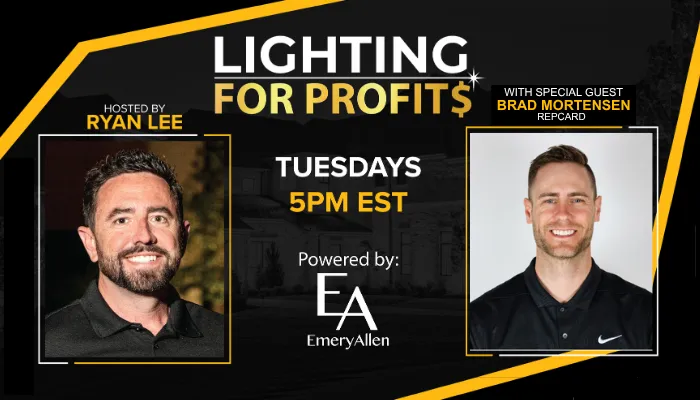
Brad Mortensen - Sales to Scale
Lighting for Profits - Episode 255
Brad Mortensen, Founder and CEO of RepCard, joins us to share his journey from door-to-door sales and sales leadership to building a technology platform used by thousands of businesses across the field sales industry. We talk about the challenges that inspired RepCard, how technology can help sales teams simplify operations and close more business, and the lessons Brad has learned about entrepreneurship, leadership, faith, and family along the way.
Watch the episode
Episode Transcript
Welcome to Lighting for Profits. All light. All lie, powered by EmeryAllen.
Welcome to Lighting for Profits.
All light. All light. All light, powered by EmeryAllen.
Here is your host, Ryan Lee.
All right. A lot. All light.
Ryan Lee: Rep Card is a startup that helps you grow your business
Welcome, welcome, welcome to the number one, the number one outdoor lighting show in Gilbert, Arizona. We are going viral today, baby. Maybe, maybe even Mesa. I don't know. We'll find out. But, uh, guys, I'm Ryan Lee, your host of Lighting for Profits powered by Emory Allen. And, uh, we got an awesome show. Um, we're gonna talk about something new. I, I've got this idea. I've seen it work in other industries and I know it's going to work in ours. Um, and it's starting to happen. There's already people starting to do this. Um, we've got the founder, the CEO of Rep Card, Mr. Brad Mortensen. And uh, Brad doesn't know this, but Brad is kind of like my, uh, my secret find for 2026. Um, I had no idea what it really. I was looking for his product and um, I was at, uh, Dita Decon, and right across I was helping, uh, Jimmy Tompkins with Omni, out with his booth. And right across from us was Rep Card. And these guys had an awesome booth, awesome swag. I mean, that was just entertaining to see, like how they brought people in and stuff like that. And I was like, rep card, I don't know what that is. So I go over and I start talking. I'm like, dude, what's your number? Like, we, we got to connect and, and actually we, uh, we hired Brad and his team to come help us out with, uh, Light It Up Expo. Just like it was like a month after that. I mean it was really, really fast. So really cool surprise find. So I'm excited to have him on the show. We're going to talk about what Rep Card is and how it can help you and your business. Um, but, um, it's kind of cool. He's like, ah, he's just like a blue collar. Not even blue collar, just like door knocker, like, trying to make money now. Tech startup, founder, really cool story. So we'll have him on in just a few minutes. Um, thank you guys so much for your support, for your reviews. They keep coming in. We're up to, ah, over 100, 113 or something like that on Apple. Um, some more on Spotify as well. So, um, if you have not, I'm just gonna ask again and probably every week give me that five star review. Mention your favorite episode and maybe it's Brad. Maybe it's gonna be this episode. Your favorite episode. But, um, you know, give uh, a shout out to, uh, one of your favorite guests, uh, someone who's made an impact in your life, someone who's helped you do something big in your business. So thank you guys so much for your support.
Why does every event that you go to have to always end in a sales pitch
Um, so before we have Brad on, I want to just talk about something real quick because this happened, um, just yesterday. Um, I saw in this post, I got tagged on it and um, I really am like super intentional about like, don't be on social media on Sunday and like hide your phone and stuff like that. I'm not the best at it, but I'm like getting better at it. And so the post actually happened on like Saturday or Sunday, but I saw it yesterday and uh, there was someone basically complaining on there and they were like, man, like, why do, why do events like, suck? And they weren't saying like events sucked, but they were pissed because it's like, why does every event that you go to have to always end in a sales pitch? Like why does it always, you always have to be in someone's funnel? And um, they just wanted to go to the event, right? And um, here's what's interesting. Like, I actually used to completely agree with them. You know, it's like, yeah, if you just pay for the event, then don't you want to just get the event? Like, I don't need a sales pitch. Whatever. Um, in fact, when I first started putting on events, my very first event was called Landscape Lighting Live. And it was two day event. We sold tickets for like 1500 bucks. Um, we got, I can't remember, it was like 20 people or 30 people or something like that. It was, it was intentionally small. It sold out. I was like, oh my gosh. And I was just grateful that people were like investing in themselves and, and coming to this new event that I had never done before. And I wanted to just over deliver. So I just gave them value and value and value. And it was like, honestly maybe too much value because they were like, you could just tell they were drinking from a fire hose. And uh, that was it. At the end. I knew I'd seen other events make offers. So I was tempted, like, should I make an offer? But I'm like, no, if they, if they want to join Landscape Lighting Secrets, they'll just come ask me like, duh, uh, like why would they not do that? Well, um, I did that for. I think that I did that two times and then the third or the fourth time, uh, by then I had a coach ask me. Uh, we were talking through some things. And my coach goes, hey, um, so what's your offer? Like, what. What's your offer? At the end of the event, I'm like, I don't make an offer. And he's like, you don't make an offer? Why. Why would you not make an offer? I'm like, well, because they paid, you know, the 1500 or the 2000 or whatever for the thing. And I gave him the thing. He's like, but don't you, like, believe in what you're doing? And would it not help them if they joined your program after that, or do they have everything they need now? And m. I'm like, well, of course it would help them. And he's like, well, then you should make them an offer. And I was like, okay, um, yes, you're right. And I started thinking about this, and I'm like, wait. Like, I do believe in what I'm selling. You know, everyone's afraid of the word sells anymore. Um, I believe in what we're doing. It can change people's lives. It can change people's businesses. So I'm like, why am I afraid to tell them about it? And I was afraid because I had, uh, seen other people have the same reaction and say the same thing of like, oh, here comes another sales pitch, or whatever. And I had this epiphany, and I was like, you know what? Screw that. I don't care. I know that if I make an offer, I have something valuable that can help someone.
At one event, I didn't make an offer but people bought the offer
And so on the very next event, I made an offer at the very end. And what was crazy is people bought the offer. People joined the program. I can't remember how many. Three people, four people? Something like that. And, um, so a lot of people didn't, but some people did. And I'm like, wait a minute. So before, when I didn't make an offer, no one joined. And when I did make an offer, people joined. I didn't change the room. I didn't change the. The. The pitch. You know, I mean, I didn't change. Like, everything was the same. The program was the same. The value was the same. The only thing changed was I just allowed them to make a decision. I asked them to make a decision, right? And. And it's crazy because people thanked me afterwards. They're like, man, thank you so much. I. I actually needed this push. I needed this nudge because I probably, you know, like, most people aren't going to come up to me after and, like, get more outside their comfort zone. They needed to know, like, what's they needed me to guide them and funnel them. That's why it's called a funnel, right? To, like, the next logical decision. Right? And so, um, it's interesting. I mean, when people hear about sales and, you know, the pitch and everything else, people get so defensive and people get angry. And. And I do get this, by the way. If you go to an event and it's like, you know, um, 10% value and then like pitch after pitch after pitch, like, I totally get that at my events, like, no one's allowed to pitch except for me. Okay? So there is going to be a pitch, but it's like 99% value and 1% pitch. So, like, why. Why get so mad? You know what I mean? Like, just. Just take the nuggets and go about your own business. You don't have to say yes to the thing, right? And so there is a big difference. Like, I realized that people. People actually don't hate being sold. They hate feeling like they've been tricked into being sold. Right? Because I think that. I think there's a difference. I think, you know, um, like I said, there's some of those events that are, um. You know, maybe they're intentionally holding the useful stuff or there's not a lot of value unless you buy the thing. But, um, that's just bad selling. Do you know what I mean? Like, if you're really good at sales. In fact, I. I think I'm really good at sales. Not because I'm good at m. Making people, like, make a decision that they wouldn't otherwise make. I'm just helping them make an educated decision. Um, but there. But I think that's what the problem is, is bad selling gives, you know, like, selling a bad name. Okay? And so, um, if I spent an entire day helping you, you know, like, I teach you everything I can. I help you identify a problem, I show you what's possible. And then at the end, I'm like, hey, if. If you want help actually implementing this, here's how I can help you. What's wrong with that? You know, Um, I think if I. If I don't make that offer, then that's like a bigger disservice to you, right? So think about this. In your world, when you're. When you're talking to homeowners about landscape lighting, um, this happens all the time. Someone invites you into their home. Um, they literally call you and, like, schedule an appointment. They tell you what they want. You walk their property, you ask questions, you create a design, you show them what you recommend and then you're like not asking for the sale because you're afraid to sound salesy. It's like, but they hired you because you're the supposed expert, right? They need you to guide them to that ability to make a decision. And you could say something as simple as like, hey, listen, based on everything you told me, here's what I recommend. Would you like to get on this, on the schedule? I mean, that, that could be the pitch. You know what I mean? Um, it's not even really pitching. You're literally just helping someone make an educated decision. You're guiding them, you're, you're advising them. You're a trusted advisor, you're a helper, you're the expert that they invited into their home. And so some people are pretty good at that. Like, they'll be like, okay, here it is. Like, which option works best for you?
Whatever.
And then how many times do you guys hear them say something like, well, yeah, looks good. But um, yeah, we just got to talk about it and we'll get back to you. Or we're going to get some other quotes or whatever it is, right? There's usually some type of objection. I mean, the lay down sales are great. I love those. It's like, okay, they saw the value and they're like, let's go.
Most contractors don't want to sound salesy when talking to potential clients
There's already trust built through your marketing or through a referral or whatever. But what about when they say they want to think about it? Because most contractors at this point are just like, oh man, I don't want to sound salesy. No worries. Yep, see you later. I'll just uh, I'll shoot you an email and you guys let me know when you're ready out the door. They don't want to be pushy, they don't want to be salesy. They don't want the homeowner dislike, um, them. Um, but think about this. Like, are you actually helping them? Because that's not very helpful. Like you're thinking, oh, I don't want to, I don't want to sound like a jerk and be pushy. But it's like, I mean, how much value are providing to that conversation? You're doing them a disservice to if you don't ask at least one more question, you know, uh, when they say I got to think about. Sure, no problem. What, uh, what specifically did you guys want to think about? Just so I know, after you guys do talk about it, what are some things that are going to come up? Is it the design? Is it the um, investment. Um, is there. Someone else needs to be involved in the decision? Um, is there. Did I miss something? You're not trying to trap people. You're just trying to understand them. And when you, when you, like, forget the script for a minute and just realize that you're just like, human connection here. You're just trying to understand someone, see what their problem is, if it aligns with your solution, and they just, they just don't know what that, that gap looks like, and you have, like, the bridge to get them there, then why would you not be willing to ask them another question? You're not saying, like, you're not pressuring. I need you to buy this because I need to make the sale. Because if I don't, I'm going to get fired. Or if I don't, I can't make my, My mortgage payment or whatever. My kids got to keep eating ramen. You know, that's. That's pressuring. Leadership is more like, hey, you know, based on everything what you told me, I mean, here's. Here's what I genuinely believe you should do. I mean, they did call you because you're the supposed expert. You know what I mean? So I just want to encourage you guys, um, to not be afraid of sales again. If just that word I know is like, cringy to most people or people are afraid of it, and it's like, oh, oh, I'm. I'm convincing someone to do something they. Against their will. Like, that's not the case, you know, and if you don't believe that you really are the solution, then maybe you got some work to do. Maybe your business isn't as good as it could. Maybe your, uh, your product or service, your delivery isn't as good. Because once you're proud of it and you know that the consequence of them not moving forward with you today has, like, consequent, like, they could go with your competition. Like, do you do. Does your competition do a great job? If they do, then what. What value are you going to show? That's. That's higher. Otherwise you can't expect to sell. At least get a no. Like, I'm there to get a yes or no because I got to think about it. Or, you know, we'll get back to you later. That's just not really a decision. Um, I'd rather them tell me now, and I could be like, cool, Give me some quick feedback. Like, well, what would have made it different for you? What would have helped us, um, earn your business today? And then you get feedback and then you get better on the next one. So, um, I just want to encourage you guys to, to realize that, honestly, like, you don't have to apologize for selling, okay? You're not out. Don't manipulate people. Like, don't pressure people into buying something they don't need. Um, you're not trying to, um, sell something you don't believe in. But when you've listened to somebody, you understand their problem and you genuinely believe that you can help them, then make the freaking offer. Like, that's. That's all it is. Okay? Um, so I personally think it's a disservice letting people think about it, because all that means is you just didn't build enough value or trust. Because if they trusted you, if they trusted you, even if it was more money than they wanted to spend, they would find a way to work with you. They would be like, okay, well, you know, we can't spend 15, but we got 10. What can we do for 10? Like, they would find a way to work with you. So they just don't trust you. So just be better at sales, be better at building trust, be better at building value. And I promise your conversions are going to go through the roof. And it's when you stop thinking about money and start thinking about impact and how you can help people and serve your community. You're not going to have to worry about money because it's just. It's like a byproduct of the whole, whole system. So that's my rant for the day. So, um, yes, normally if you do come to an event, I'm probably going to make an offer. If you don't like that, well, then you don't have to come to the event. But even if you're at the event, you could just be like, no, like, leave the last two minutes. You can stay for the whole two days and then just leave the last two minutes and, um, you'll probably be fine. Let's see. So, uh, real quick before we have Brad on, uh, hey, stop settling for cheap, unreliable lamps that ruin your projects and your reputation. Emory Allen's line of premium LED lamps deliver the performance, longevity and color consistency your clients expect. Trusted by lighting designers and installers around the country and backed by decades of lighting expertise. Uh, make sure to check out Emery Allen. All you need to do is email jackson l. @emryallen .com. he will hook you up with that discounted contractor pricing. Just email jackson lry allen. com and, uh, mention that you heard about him here on Lighting for Profits. That's Jackson L, the letter l.jackson l,em. com.
All right, I think it's time. Let's get our guest coming on here. Brad Mortensen. Welcome, welcome to the show.
All right, I think it's time. Let's get our guest coming on here. Be a fun conversation today. Welcome, welcome to the show. Mr. Brad Mortensen. What's up, Brad?
Yo, how are you man?
Looking forward to hanging out for a bit. Thanks for uh, joining us on the show. I'm doing great, thanks for asking.
Awesome, man. I'm glad to be here. Um, yeah, that was awesome letting you rip, hearing you rip behind stage.
So I can't help it. You know, it's like I, I started doing that because I want this show to be about you. I really do. But like, if I don't get it out of my system, I'm always like, oh yeah. And then this and this and this. So I'm like, selfish. Just get the, get out of my system.
So I, Yeah, dude, I could turn into the host real quick.
Start.
Yeah, it's asking you questions.
Well, dude, I'm, I'm super pumped to have you on here. Like I said, you're kind of like my surprise find of the year. Um, didn't even know I was really looking for your product and stuff like that. And we were across from you, uh, at ah, D to D Con. And then someone's like, oh yeah, that's Brad. He's the owner. I'm like, oh cool, I'll go talk to him. And next thing you know, we got you guys at Lighted Up Expo. You guys were awesome. I mean you guys did all of a, um, huge thing for our vendors, you know, to be able and, and really our attendees too, so everyone could connect, uh, scanning badges, stuff like that.
Rep Card helps door to door sales guys leverage their time through software
Um, do you want to just do a quick introduction of who, who Brad is and who rep card is?
Yeah, let's do it. So, um, when I was 2 years old. Just kidding.
Um, not that much of an intro. Yeah.
So, um, I got into door to door sales forever ago and spent uh, 10 plus years doing, doing sales and realized there was a gap in the way, you know, door to door guys were going to market and figured out a way to help them leverage their time through, through software. And so started Rep Card and as we got into building our product, it started out as a digital business card which allowed two people to connect and start this new relationship and had some follow up tools and things like that. We started going to these conferences. The first one we ever went to was D2D con. The second one is back in 2019 and I just saw this also this huge gap in how these conferences were done. Like, these attendees are trying to connect with vendors and learn more about their stuff. Vendors are trying to get their info, and they have the fishbowl, put the business card in and win the tv. And all of it was there for vendors to get information from attendees, and then attendees are there to learn from speakers. And so we ended up creating a registration product within our tool that you guys used at your show or your conference. Um, just allowing attendees to connect with attendees and vendors and attendees to exchange info, but ultimately to leave the event empowered with more relationship.
Yeah, I mean, it was super beneficial, not just for us as the host, but even for the attendees to be able to connect with each other and with vendors and. And just sharing that information. And I know that's just a fraction of what your software does. Like, you've. Like, you said you've kind of iterated and keep adding and stacking to it. Um, you know, it's crazy. I. I just had this, uh. I just. This was like, last week, I ran into one of my neighbors at the grocery store here, and he's, uh, running for office and, um, like, Congress something or whatever and all. I was like, really? So he's like, yeah, man, I've been out knocking doors like crazy. And then he's like, shows me on the. He pulls up his app and I go, wait a minute. Is that. Is that rep card? He's like, yeah, that's rep card. I'm like, sweet. He was using it to keep track of his doors and everything else.
So, yeah, you have to connect. Connect with me on who that was.
Yeah, that was. That was cool.
Boma is the boomer effect of giving and serving
Um, talk about the boomerang. Talk about what is boomer effect.
Boma. So you can see behind the boom effect is everywhere. Um, for us, it's at the. The heart of what rep card is. I mean, like I said, it started out as a digital business card. And that's the beginning of a new relationship. And we believe in being givers and serving those relationships from the very beginning. You meet somebody new, and it's like, how can I give? How can I serve? Um, you talked about in your monologue just like that beginning part of the sale, the trust. And I believe it starts before you walk up to the door, the way you carry yourself and then that initial interaction, and are you there to serve and give? And the, uh, boomer, you know, it's a boomerang. So, you know, you throw a boomerang. If you throw it right, it comes back. And in life, when you give and serve, and pour into relationships, typically something comes back and that's not necessarily why you do it, but it's just a byproduct of doing things for the right reason. And uh, life typically will, will treat you well on the other side. And so, um, our, our mission with the software is to help sales reps win in the field so they can spend more time with their families. And we believe if we do that well, um, that, you know, the person paying the bill for the software will be happy because it'll be generating more sales and we'll have a long, long term client. So it's kind of all wrapped into the booma, the boom effect of life. And uh, it's everywhere for us.
I love it. It's cool. It's on the inside of your hats. I, um, know my assistant was, uh, she there or I gave her hat, I can't remember. But she wears your hat all the time. Um, I, I love it. Lately I've been kind of, uh, talking about that inside of our community landscape lighting secrets of like, man, it's so true. Like the more you give, the more you get. And, and it really is the boom effect. It's like, it's so much easier. Have you noticed that it's like easier to help someone else than help yourself? Like, I know the things I need to do to be a better person, that's just too hard. You know what? I can do that right now. Let me just help someone else, right? And if I can help someone else and if I, if everyone's helping someone else, eventually someone's going to help me. It's just going to happen. And it is way easier to help someone else and help yourself. So I love that philosophy of yours.
I mean, yeah, I think if you're, if you're listening to this and you're in a rut in life, whether it's personally with the relationship, you know, in business, like if you can just have that trigger that you're like, I need to go serve and give. Maybe it's hey, I'm gonna go knock the next door and be like, hey, we're, we're giving away five free lights. Uh, he doesn't always have to be giving away something monetarily, but just find a way to give and serve. You know, there's that guy on YouTube that he's like a landscaper and he always goes and does like a crazy yard. He picks like the craziest yard and he like time lapses him like cleaning it up and obviously he gets some, some social out of it and some views and stuff. And why not? But to those people he's totally just like upgrading their, their yard and like, that's got to feel good. And he takes him what looks like a few hours, maybe half a day, and he's incorporated that into like part of his schedule. But um, it's, it just, it. Like you said it, usually you solve your own problems, um, when you're giving and serving and helping others. Cool.
I want to ask you about your experience with door to door sales
Well, I want to ask you a couple things about rep card, but before I do that, I want to ask you about uh, knocking doors. Because if, if, if someone has knocked doors, I mean I, I knocked doors for ah, a church mission like you, and then I knocked doors for uh, two summers. And uh, talk about that experience real quick. Like, were you, were you naturally good at it or did it take you a while? I mean you did it 12 years, so you obviously like figured some things out. What was that experience like?
Yeah, um, yeah, starting out, first day, I got dropped off in my neighborhood. Um, it was a little bit dark. I'd flown in earlier that day and so I got on the doors about 6 o'.
Clock.
I was selling pest control out in Dallas and they gave me a binder and they're like, hey. Like there wasn't much training. Like they do the trainings in the morning. So it's just kind of like, hey, here's the contract. Like you got to fill all these fields out to get a sale and. And I'm like, cool, just let me go. Like, I shadowed my buddy for like 10 doors and I, uh, he got close with a few customers and my like, probably my pride was like, oh, I probably could have closed that, you know, or whatever. And I also was thinking, I'm not making money watching him. And so there is value in slowing down and just listening to mentors and coaches. But I was like, just, dude, let me just rip the last few hours and see what happens. And I closed two deals and I just had that like, exciting moment of like, dude, like, I just created value. I made more money in those two hours than I ever had and any two hours of my life. And it was just like, I, I love that. Next day I sold three. The next day they had me up in front of everybody doing a training. I'm like, I don't even know what I'm doing. That day I got a zero. It was my, my only zero. That summer, my very first summer was that third day. I hated every cell. I couldn't believe that I worked that hard. For free. And I'm like, I'll never get a zero again. And I was just determined, um, from the beginning to, to just put up numbers. So I would say it came somewhat natural, but, um, which is good and bad for a lot of different reasons. But, um, yeah, that was kind of my first initial experience with door to door. First two or three days in.
That's awesome. So you got 12 years experience. I'm sure you learned a lot of lessons. Um, what did door to door teach you, uh, about business that you're not sure that maybe you could have learned, uh, anywhere else?
Um, it. It taught me, uh, to be grateful when things are hard is one of the big lessons I learned, um, because the doors don't care, you know, like, they don't each. Each door is its individual experience. So there's one lesson about, you know, no matter what happens on one door, don't let it affect the next. But they also don't know if you just had 12 rejections in a row. Like, they don't. They don't care. Like, they're not there to try to be like, oh, you've had 10 previous objections. I've been watching you come down my street, so I'm going to try to say yes or be nice to you. Um, and so ultimately, finding a way to be grateful that things are hard, um, for me was. Was a big breakthrough that I kind of fell into around, like, year six. And it really helped me, like, start to hit bigger numbers. Um, and what I mean by that is, like, when, when you're, when things are hard in sales, like, you can just complain that they're hard, but when you find a way to be grateful that they're hard, um, it's actually what makes the job exciting because it offers such a big payout, and so it offers a big payout because it's hard. So then when it's hard, if you complain that it's hard, then you're complaining about the thing that actually gives you the opportunity that you wanted. So it's kind of this, like, conundrum. And so you find a way to just be grateful when it's hard, when it's 110, when it's muggy, when it's hot, when it's cold, when the sale cancels that you just sold 10 minutes ago, like, find a way to, like, have some gratitude there. And it allowed me to hit bigger numbers than I ever had because I was always trying to solve that problem. Like, oh, when's it going to get easy? I'm five, six years in. Like, why is it still so hard?
I love the way you said that.
Shifted my mindset to, like, find gratitude when it's hard. Because that's actually why you chose this job. Yeah. Allowed me to just be free on the doors.
I love that. In fact, right before we went live, I was talking to you about landscape lighting and why I'm, like, so in love with it. Of all you got Christmas lighting, permanent lighting, landscape lighting, and, like, well, of those three, a lot of people are like, well, I'll just do permanent because it's easier. You know, landscape lighting is too hard to sell. I'm like, that's why I love it. Yeah, I love it. Like, uh, it's. It's awesome because it's hard. And most people, they hit that resistance, they just quit. It's just easier to go back. It's easier to go sell something else. It's easier to not do it. It's like. But that's why it's freaking awesome. Like, it's such a cool industry, why you're in it.
So, yeah, you can't. You can't give up just a little bit of resistance. It's a good way to say it.
What do you think is the hardest part of knocking doors
What. What do you think is the hardest part of knocking doors?
Uh, for me, the thing that I noticed after training hundreds, you know, recruiting and interviewing thousands of reps, um, is really just showing up the consistency. Um, I saw so many guys start out hot, sell four in their first day, and then fizzle after a week and a half. I saw people quit after one hour. Top people quit after one door. And so it's like the consistency of just showing up. Um, door to door is already designed to have mentorship built into it. A lot of other industries, you have to pay for mentorship, um, but because it sales and people are typically making an override or some type of commission when you get a sale, ideally, and it doesn't always work like this, but ideally, they're incentivized to help grow you and to help you become better because they are aligned and they. Their compensation is based on your performance as well. And so you get all different kinds of leadership and door to door. But ideally, there's a great structure in place. And so if you show up every day and you lean into that leadership, they will help you grow, but you have to just show up. It was crazy to hear all the different excuses people come up with. You know, grandma always dies in the first week. Um, you know, they run out of gas, they got to get their Oil change. They forgot to go grocery shopping. Like just everything, every excuse. But it's like if your, your team meets at 11 o' clock every day and you work till 6 or it's a, you know, maybe it's a 4pm to 9pm sale or. My first summer of pest control was summer sales. So it was nine to nine. Like whatever that hour is. Those hours are like, commit to that and show up. And um, I've got a, I've got a buddy that didn't get a sale for two months.
Dang. And he still kept showing up.
Now he's just insane. It's changed his life. And he's 20 years into the industry, but it's like his first two months, I mean, awkward, weird, like and I didn't know him then. He, these are how uh, he described. But he's like, dude, I was awkward. Like I couldn't like get out of my own way. Like just everything was working against him, but he just stuck to it. And um, that was in pest control where like you typically just like find a cell every now and then.
Really bad.
Yeah, apparently. And obviously he was young, didn't have much money, bills, was able to like fumble his way through those first few months. Not everybody has two months. So.
Yeah.
Um, but anyways, consistency just like show up. You're not going to, to like just accidentally be good at door to door. You need to show up and put the time in, um, and you will, will see results. And then after that first little bit, you kind of establish like, okay, this is about how good I am. And then from there you can grow and, and it can be a, just such an amazing industry for you.
It's so true for, I mean, I mean you're talking door to door sales, but just really anything sales in general, marketing, uh, leadership and learning any new skill. I just think that's just like the big differentiator to those who succeed and those who fail. It's like, man, both good people, same desire. Just one quits one just like too impatient and doesn't realize like, dude, you just got to go through the reps more. You got to go through the motions. You haven't given it long enough to succeed. You just got your failing over with. Like in a large like to go two months, that's, that's dang impressive. Right. But it makes sense that he had so much success after that because it's like you have no choice but to go up from here, you know?
Right.
Most people don't give it that long to experience the success.
Yeah, and, and just to kind of, I guess, drill home. My initial point of like the, the built in mentoring. I mean if you went and bought a guitar tomorrow and just like showed up every day for 30 minutes and started playing, you could figure some stuff out. But like you're gonna have to go hire a coach or you know, YouTube now is, is a great teacher. Uh, but still, um, whereas in door to door, like you don't just go randomly start knocking doors trying to sell lights and you don't have like a manufacturer or distrib, have a way to install a mic. So when you get a job in door to door, it's everything set up for you to win and you just have to show up. So if you're listening to this and you're new like and you're nervous, scared, you're on that day two, day three, your weekend, it's not going the way you think. Like just show up, show up and ask questions. And in uh, most companies, like I said, you're fully aligned. They want you to win, they want you to sell. They make money when you sell. So like just show up, lean in, ask questions and you'll be fine. Fine.
How do you determine when to be persistent in door to door sales
I, I follow some kids on social media that are knocking doors and they have channels and it's, they're filming their, some of their interactions and stuff. Uh, how do, how do you like as a, as a sales rep, determine the line between like, okay, when are you being like persistent because you believe in your offering whatever and you cross that line from going like persistent to an a hole that everyone hates? Like how do you know where that is?
Uh, oh man, I feel like for me I could just always just kind of tell. I know that's not like the best like replicatable answer but like um, for
me, because I've seen some where like they start and then they get pretty rejected, like get out of here or whatever, you know, and then they, they're able to throw in a line or use their humor or something and it salvages the cell and then it, that, that, that, that wall comes down and then they're able to do it. But then others, obviously there's just those people that are like anti, like I told you to not knock the door type thing.
Yeah, I feel like in sales the first thing you're doing is selling yourself. So you start out with whatever your best approach is. I like to use icebreakers. Talk about their car, their shirt, their hat, their hair, like their kid, their dog. Like something that was like different in every door. It made door to door fun for me because I wasn't a robot. And it also made me feel more human. So I'm trying to sell myself, sell them on the fact that I'm here to just, like, talk. I'm human. I'm here to, like, offer them something. But then as the conversation goes on, it can be really quick, and door to door, where they're like, dude, like, no, like, I'm not interested, man. Like, if you can respond with, um. I don't know what the word is, um, but just respond with love. I don't know if that's the right word. But just with, like, keeping in mind that they're human and maybe, you know, something just happened in their world. Maybe they got something cooking on the stove. And they didn't mention, like, there could be a lot of pressures that are there. That's okay. You're there to get the sale. They're there to. To potentially buy and. And whatever. So, um, the minute that it gets away from, like, that you're. You're. You're not looking at them as a human anymore, and they're an object or something to be funny, or the camera's rolling and you're like, you'll kind of feel it. I feel. And that's that. That divide where it's like, dude, it's time to cut it. And if you keep going, that's where it turns into the story online or, like, the cops getting called, and then you have to move it, move territory. And. And so, um, you know, I always thought, like, if I could walk away from the door laughing, smiling, like, I won that door, um, maybe not financially, but, like, you're not there to win every door. You know, make every shot. It's just the nature of the beast. So you understand the nature of it. Like, you want to win as many as you can, but, like, you're not gonna win every door no matter what you do. So it's. For me, it was always kind of a feeling, and I crossed the line a few times, but I rarely had the cops called. Like, even my teams that I. That I ran. Like, it just. You just tried to run good business. So.
Yeah, no, I hear you.
Summer: We started a new segment. It's called make the call
Um, okay, so, um, we started a new segment. I want. I want to play this game with you. It's called, um, you make the call. It's called make the call. So I'm just gonna ask you a series of questions like this or that or, you know, what would you do? Whatever. Summer. Some are personal, some are business. Summer, you know, Your experience, whatever. Um, we've got a new partner of the show called, uh, Call Source. And in fact, so they have basically us bound, uh, out or us based outbound call center. So a lot of our people listening have like small teams or like, they're, they're answering their own phone. They have missed phone calls, um, deals that didn't go through. They're not able to follow up. What's cool is like, yeah, there's AI but there's like an actual human calling. And they'll, they'll, they'll stay with those accounts and do follow ups. They do like call tracking and a bunch of things else. I was just talking to these guys this last week and they said, hey, you know what, we want to do something special for your audience. So you guys, if you're listening, they'll give you 50% off your first month for all LFP listeners. So, um, all you need to do is go to try.callsource. com LFP kind of, kind of long, but try.callsource. com lfp uh, we'll put that in the show notes too. But if you go there, they'll give you 50% off your first month to try them out. But book a demo, check it out, see if it makes sense for you. Um, but we're going to play you make the call. You down? Are you down? No.
Yep.
All right, so thank you. Call Source. And, uh, for Brad.
Would you rather have the ability to instantly know when someone is lying to you
Would you rather have the ability to instantly know when someone is lying to you or instantly know what they actually think about you?
Uh, probably if they're lying to me.
All right. Um, you don't care what people think about you. That's good to know.
Yeah, yeah. Honestly, I don't.
Would you rather do.
But I don't.
Yeah, yeah, we all do. You know what I mean? But like, it would be better to know if someone's lying to you, I think. Would you rather have to knock doors for eight hours in 110°, uh, Phoenix heat or eight hours in a Utah snowstorm?
The heat all day, really?
I'd totally rather be in that snowstorm. Oh, yeah, that's why you live there. It makes sense.
I knocked doors on my mission in Chile in the cold rain and I, I don't know that. That was kind of fun though. You, you get a little more sympathy. The heat. People just don't even open the door.
Yeah, exactly.
I don't know what's the toss up?
Would, uh, you rather be able to instantly make anyone trust you or instantly make anyone like You?
Oh, trust, for sure. Love it.
You're starting from zero with no brand, no database, no referrals
Um, all right, so you're starting from zero. No brand, no database, no referrals. And you need to make a sale today. You got one choice. You're going to. Are you going to knock 100 doors or make 100 cold calls?
Knock 100 doors for sure.
All right. I thought that might be the case. Um, would you have rather have the greatest salesperson in the world working for you, but you know they're leaving in 12 months? Or a pretty good salesperson who's guaranteed to stay for 10 years?
Oh, shoot.
Um, top guy leaving in 12 months or pretty good, guaranteed for 10 years?
Probably the top guy. I mean, when. When guys came and left. Like, the fact that you can tell that story that, hey, they came here, they gave it their all, they crushed it, and now they're on to something bigger and better. Like, it's a great recruiting story so you can find more people.
Yeah, that's true. I like it.
You have 10 grand to grow your business, whether it's marketing or hiring
All right, you got 10. 10 grand to grow the business. You spend it on marketing, hiring someone or investing in yourself.
Um, probably marketing. Cool.
Um, I'm starting a bit. Or. Yeah, no, yeah. I'm starting a business tomorrow, and you get to give me one. Only one unfair advantage. You can either give me an incredible product people genuinely want, but I'm just an average salesperson, or you give me an average product, but I'm one of the greatest salespeople in the world.
Oh, uh, shoot.
Um,
probably a good product. The good product route.
Good product. Yeah.
Yeah.
Even me. I was, like, torn on that one. But it's like, good products, they kind of are. You can hire an average salesperson and
look at the Apple Store. No one's paid commission, the product is insane, and people just show up to buy it.
Yeah.
Take orders.
Okay, last one. Uh, would you rather make a million dollars a year working 20 hours
Okay, last one. Uh, would you rather make a million dollars a year working 20 hours a week or $5 million a year working 60 hours?
Depends on what stage of life, but probably the first one at the stage of life I'm in right now.
Yeah, you got four kids?
Yeah, four kids and my wife. And just busy schedules and. Yeah.
All right, well, thanks for playing. You, uh, make the call, Brad. We just started that a few weeks ago, but I kind of like it. Some intel into our guests and, like, who they are and stuff like that.
Yeah, it's good. You mix up the questions, too, if you need.
All right, well, thank you. Call Source. And, guys, check those out. Uh, again, it's try.callsource .com LFB get 50 off your first month.
Rep Card started as a digital business card to help reps win
Uh, okay, so let's talk about Rep Card. Um, talk to us about, I mean I know you said it started off as like digital business card. Um, how did it um, evolve into what it is now where it's like you've got this whole sales operating system. Um.
Yeah. So in the middle of knocking all those doors, we created the digital business card to do some automated follow up and help reps win. You know, you know you engage with these customers at their door or whatever and they don't buy and that's okay sometimes. And so you send them your card and it lets you know when they, when they look at your card. And then from there people just started asking for all kinds of other features. You know, they wanted a canvassing tool, they wanted leaderboards, they wanted competitions, they wanted chat, they wanted, um, just all these different, uh, you know, a calendar tool. And so we being a bootstrapped company, we just had to listen. We couldn't afford to just go and spend tens of thousands of hundreds, thousands of dollars and miss the mark like you can if you're funded. And so we believe that um, you know, our audience, our users kind of were able to help us guide the product. Um, and that's how it went from you know, what it was in 2019 to what it is today, just listening to our users.
So you're, you're, you know, you established in like the, the regular door to door space, you know like pest control and uh, alarms and ah, solar and all those types of things. But I truly believe that um, that this is, I mean I've, I've, I've had someone knock on my door to sell me like uh, outdoor living. Now I've had, obviously you've had roofing and stuff like that, but different industries. And again now I'm starting to see outdoor lighting pick up, especially permanent lighting. Um, what, what are some of the things that it does? Because you said like okay, canvassing and stuff like that. But talk a little bit about some of the feature like benefit, what Rep Card does and how it could help someone get door to door.
The overall benefit of the system is that you have a process for your company. So when a new rep starts, um, what you don't want to do is give them access to five different platforms. That's just hard to kind of get them into it from just a, uh, you know, just an organizational standpoint like creating five logins. So with Rep Card, ultimately you're handing them a login and behind that login they have the ability to do all those things that I talked about, to be able to get trained, to be able to go knock, to be able to follow up, to be able to, you know, coordinate with setters and closers, to be able to check a leaderboard, you know, check out the competitions that they may be a part of or thrown into. And so we're not just providing a bunch of features, we're creating an operating system so that their organization can scale. Um, I know for me, when I built my initial door to door company, um, it was like recruiting people was painful and exciting at the same time because I knew that it meant I had to go do a bunch of work. And I wasn't afraid of the work. I just kind of didn't know, know everything to do and, and, and have the process. And so it's like you meet somebody and as you're pitching them, like, dude, come join us, come hang, come knock doors, come make some good money. My, my head was going like, that means I got to go make another binder. This is years ago, but in the good old days, like, I gotta go make another binder. I've gotta do this. I've like. And so it was just like, processes were everywhere. I had to go create a login for this or do that or like. And so, um, that's what it solves ultimately for, for business owners.
You guys have some basic training that comes standard with your rep card
So I want to talk about a little bit because I've had the same thing where I was, I remember thinking, man, like, we're an okay company, but we're not like the best. So like, it's hard to be in the mindset that, to think you're going to recruit an A player when you're not really sold on your own systems and training and everything else. Because it just feels like unethical. Like, I don't want to tell someone we're awesome when I know we're not that awesome. So you, you naturally recruit a B or a C player and then you complain like, oh man, it's so hard to find good people. Um, when you talk about training and stuff like that, you guys have the training itself or that's still like something that the actual, um, like lighting company would provide.
Yeah, so we have some basic training in our LMS that comes standard with your rep card. It's pretty generic though. It's about communication and resilience and um, uh, work ethic and you know, ethics, uh, like, stuff like that. So it's not industry specific, it's more generalized. Uh, but within that training system, they can add Their own content that makes it more specific about their brand. And then we did just build a coach, a AI coach where that does come industry specific and it comes with an AI brain for that industry. You can then add your own content to it and the coach is then, you know, equipped with everything you want it to know for your reps to go and role play and practice off the doors, um, or coming back from the doors or going to the doors whenever in correlation meeting, um, for them to practice and get scored and rated and um, you know, against the AI coach. So that's kind of been the evolution of our lms. Our training system is going from just videos and folders of content to more of an AI approach.
Very cool.
At some point is AI going to replace salespeople or enhance them
Yeah, well, and I was going to ask about AI because like, I don't know, at some point is AI going to replace salespeople or is it just going to enhance and, and create these like, AI superhuman salespeople?
Yeah, it's just, it's always going to enhance. I mean, people miss the connection. You think of COVID or a time when the connection goes away. Um, or maybe if you're listening, you've just recently gone to a, a show, you know, an event and you meet all these people and it's like, it can be such a game changer. Maybe you've taken a break from going if you've been in the industry for a while. Like, people crave connection. So, um, I think there's always going to be a door to door community and the AI is just going to empower the stuff we're doing with some of the AI tools. I'm like, it blows my mind of how we did it 15 years ago, knocking doors and the tools. You can offer a rep now, day one, for, you know, 30, 40, 50 bucks a month. I'm like, what is going on? But I, um, think it's just helping them get past that learning curve at the beginning and get into higher production faster. Yeah, it's gonna go away.
Not everyone's into sports. And I get that. Most people don't like baseball
I talk about like, not everyone's into sports. And I get that. Uh, and especially baseball. Most people don't like baseball. I'm weird. I love baseball. Um, these guys play. I mean, they make millions of dollars. They make a lot of money. They play baseball every day pretty much for like nine months. It's like this longest season. But before the game, they're sitting there doing practice, they're batting practice, they're throwing, like, what? Why would these guys need to practice? They played last night. They got done playing at midnight. And then as, uh, Salespeople. And in our world, I mean like a big lighting company is going on like four appointments a day. Like that's a lot. Most people aren't even going on four appointments a week or even a month. Some people are really slow, right? So like, let's just say you're going on for a day. Like that's not that much. Like when are you practicing, when are you training? Like when are you, if you really want to be that multi million dollar, you want to make a hundred million dollars a year. Like some of these athletes, like they have insane work ethic. They're, they're not settling for like, yeah, I did, I did, I did four appointments yesterday. I'll be good. And then we expect this greatness. So I love that you guys are, you know, like taking that upon yourselves and adding that in there and the AI sales coach and all this stuff. Because I think that's, that's going to be a huge differentiator moving forward is the people that adopt that and really take it serious. I mean like, you can't, can't fail after that. You're going to be better.
Yeah, well, dude, you bring up a good point. My son plays a ton of baseball and so I played it all growing up and love it, but I've like fell in love with the game again because of him. Um, and yeah, it is crazy. It's probably the one of the longer sports, two, three hours. I mean they, they did, you know, a few years ago, did the pitch clock and stuff to try to shorten it, but for the longest time it was like a three to four hour game.
Yeah.
And then they get done at midnight and then dude, you go the field the next day and they're, they're taking like little baby ground balls, like doing like these like small little uh, exercises to, to just like keep your head right.
And so even between the innings they're like, I'm just gonna throw the ball and you're gonna get a grounder like this. You've never done this before.
It's so true. Yeah. In between that, that's actually true. And it's just like, what in the world is going on? Um, um, probably cause it's the hardest sport. I mean you're trying to hit a round ball, round bat, 90 miles an hour, whatever. But you know, you translate that to door to door and it's like, dude, when do you have time? Right? Um, and you do, but we're trying to make it convenient. Meaning you're in your car a lot. Especially if you're chasing leads or, sorry, if you're doing, like, cherry picking or you're running appointments, you have a chunk of time in the car. Um, but even driving to and from Area, my first summer, we drove an hour one way to area. So we drive an hour and then knock, and then do the whole thing with lunch and whatever, but then get done at 9:15, 9:30, 9:45, your last appointment, and you're driving an hour back to the office. And so the drive time is where we're going to fit our AI in. So you just click a button, Boom. And you're now getting coached. You're doing role plays. You're getting coached. It knows what happened at your last appointment, and it's giving you guidance. And so that's the time where it's like, if you can click a button, then you're going to be in the hot seat and getting coached, um, during the day, during the workout.
I love it. I mean, you guys are just. You're providing that solution, and I just. The more and more I'm involved in what I'm doing now, I just realize there's a huge gap in between what people say they want and the actions that they're taking to achieve the said result. It's like, and I. And I. I. I'm guilty of this, too. I'm not as guilty as I used to be because I'm intentionally, like, I'm aware of this. I have, like, more awareness. But I used to be like, oh, man, I want to do $10 million a year, $100 million a year. It's like when I. When I. When I had this, like, epiphany of, like, no, I don't. Like, I got four kids at home, too. That's the last thing that I want to do right now because I know what it takes to do that, right? So a lot of times we say, oh, I want to do this. It's like, okay, then. Are you willing to take grounders in between innings? Are you willing to be there early, three hours before the game, stay an hour late? Are you willing to do the coaching? Uh, you could make an excuse back. I've already knocked, you know, 300 doors today. Or.
Yeah, I love this song. You know, my favorite song came on, and I don't want to press the play button for coaching because the dumbest thing. But it's like, like you said, are you trying to hit a million, 10 million, or are you just trying to, like, have a job?
Yeah, exactly. Well, dude, I love what you guys are doing, um, if people want to reach out to you, they want to reach out to Rep Card, find out more information, see, um, if it may be a good fit for them. What's the best way, uh, for them to do that?
Yeah, the easiest way is just to go to repcard. com and book a demo with our team. And, uh, they're awesome. They'll help right size Rep Card to your business, um, and really help you find the.
Rep Card is a company that helps you win big games
The feature, the product, the service that you need to help you guys win. Um, you can go follow us on social anywhere. It's Rep Card app. Um, and that's where we're always pushing out, like, new updates, the things that are the fun things that we're up to. Um, but go talk to our team. Just go to the website, book a call and. And we'd love to see how we can, what we can do to help.
Love it, man.
Do we want to have you guys back at Light It Up Expo next month
Anything else we need to, uh, share with the world today? The lighting, the outdoor lighting nerd world?
Um, no, no, this has been great.
All right, man. Well, I appreciate you jumping on here, Brad. And, uh, I know, I know. We're, uh, we've already got it down. Hopefully. You guys, uh, do we want to have you guys back at Light It Up Expo? It's march one through four, um, in Las Vegas, so kind of a crappy location, I know. But, uh, march one through four, it's gonna be awesome. So hopefully Rep Card will be there, uh, to help everyone facilitate, uh, their digital business cards and stuff like that. So thanks for coming on, Brad. Appreciate you, man.
Thanks, Ryan.
All right, guys, go take some action. Look into Rep Card. Make it happen
All right, guys, go take some action. Look into Rep Card. And, uh, listen, guys, the people five years from now that take action today are going to start seeing the results, right? And you're going to look back and go, dang it. Why? They start knocking doors. I should have done that. Go do it. Make it happen. See you guys.
Brad Mortensen - Sales to Scale
Lighting for Profits - Episode 255
Brad Mortensen, Founder and CEO of RepCard, joins us to share his journey from door-to-door sales and sales leadership to building a technology platform used by thousands of businesses across the field sales industry. We talk about the challenges that inspired RepCard, how technology can help sales teams simplify operations and close more business, and the lessons Brad has learned about entrepreneurship, leadership, faith, and family along the way.
Watch the episode
Episode Transcript
Welcome to Lighting for Profits. All light. All lie, powered by EmeryAllen.
Welcome to Lighting for Profits.
All light. All light. All light, powered by EmeryAllen.
Here is your host, Ryan Lee.
All right. A lot. All light.
Ryan Lee: Rep Card is a startup that helps you grow your business
Welcome, welcome, welcome to the number one, the number one outdoor lighting show in Gilbert, Arizona. We are going viral today, baby. Maybe, maybe even Mesa. I don't know. We'll find out. But, uh, guys, I'm Ryan Lee, your host of Lighting for Profits powered by Emory Allen. And, uh, we got an awesome show. Um, we're gonna talk about something new. I, I've got this idea. I've seen it work in other industries and I know it's going to work in ours. Um, and it's starting to happen. There's already people starting to do this. Um, we've got the founder, the CEO of Rep Card, Mr. Brad Mortensen. And uh, Brad doesn't know this, but Brad is kind of like my, uh, my secret find for 2026. Um, I had no idea what it really. I was looking for his product and um, I was at, uh, Dita Decon, and right across I was helping, uh, Jimmy Tompkins with Omni, out with his booth. And right across from us was Rep Card. And these guys had an awesome booth, awesome swag. I mean, that was just entertaining to see, like how they brought people in and stuff like that. And I was like, rep card, I don't know what that is. So I go over and I start talking. I'm like, dude, what's your number? Like, we, we got to connect and, and actually we, uh, we hired Brad and his team to come help us out with, uh, Light It Up Expo. Just like it was like a month after that. I mean it was really, really fast. So really cool surprise find. So I'm excited to have him on the show. We're going to talk about what Rep Card is and how it can help you and your business. Um, but, um, it's kind of cool. He's like, ah, he's just like a blue collar. Not even blue collar, just like door knocker, like, trying to make money now. Tech startup, founder, really cool story. So we'll have him on in just a few minutes. Um, thank you guys so much for your support, for your reviews. They keep coming in. We're up to, ah, over 100, 113 or something like that on Apple. Um, some more on Spotify as well. So, um, if you have not, I'm just gonna ask again and probably every week give me that five star review. Mention your favorite episode and maybe it's Brad. Maybe it's gonna be this episode. Your favorite episode. But, um, you know, give uh, a shout out to, uh, one of your favorite guests, uh, someone who's made an impact in your life, someone who's helped you do something big in your business. So thank you guys so much for your support.
Why does every event that you go to have to always end in a sales pitch
Um, so before we have Brad on, I want to just talk about something real quick because this happened, um, just yesterday. Um, I saw in this post, I got tagged on it and um, I really am like super intentional about like, don't be on social media on Sunday and like hide your phone and stuff like that. I'm not the best at it, but I'm like getting better at it. And so the post actually happened on like Saturday or Sunday, but I saw it yesterday and uh, there was someone basically complaining on there and they were like, man, like, why do, why do events like, suck? And they weren't saying like events sucked, but they were pissed because it's like, why does every event that you go to have to always end in a sales pitch? Like why does it always, you always have to be in someone's funnel? And um, they just wanted to go to the event, right? And um, here's what's interesting. Like, I actually used to completely agree with them. You know, it's like, yeah, if you just pay for the event, then don't you want to just get the event? Like, I don't need a sales pitch. Whatever. Um, in fact, when I first started putting on events, my very first event was called Landscape Lighting Live. And it was two day event. We sold tickets for like 1500 bucks. Um, we got, I can't remember, it was like 20 people or 30 people or something like that. It was, it was intentionally small. It sold out. I was like, oh my gosh. And I was just grateful that people were like investing in themselves and, and coming to this new event that I had never done before. And I wanted to just over deliver. So I just gave them value and value and value. And it was like, honestly maybe too much value because they were like, you could just tell they were drinking from a fire hose. And uh, that was it. At the end. I knew I'd seen other events make offers. So I was tempted, like, should I make an offer? But I'm like, no, if they, if they want to join Landscape Lighting Secrets, they'll just come ask me like, duh, uh, like why would they not do that? Well, um, I did that for. I think that I did that two times and then the third or the fourth time, uh, by then I had a coach ask me. Uh, we were talking through some things. And my coach goes, hey, um, so what's your offer? Like, what. What's your offer? At the end of the event, I'm like, I don't make an offer. And he's like, you don't make an offer? Why. Why would you not make an offer? I'm like, well, because they paid, you know, the 1500 or the 2000 or whatever for the thing. And I gave him the thing. He's like, but don't you, like, believe in what you're doing? And would it not help them if they joined your program after that, or do they have everything they need now? And m. I'm like, well, of course it would help them. And he's like, well, then you should make them an offer. And I was like, okay, um, yes, you're right. And I started thinking about this, and I'm like, wait. Like, I do believe in what I'm selling. You know, everyone's afraid of the word sells anymore. Um, I believe in what we're doing. It can change people's lives. It can change people's businesses. So I'm like, why am I afraid to tell them about it? And I was afraid because I had, uh, seen other people have the same reaction and say the same thing of like, oh, here comes another sales pitch, or whatever. And I had this epiphany, and I was like, you know what? Screw that. I don't care. I know that if I make an offer, I have something valuable that can help someone.
At one event, I didn't make an offer but people bought the offer
And so on the very next event, I made an offer at the very end. And what was crazy is people bought the offer. People joined the program. I can't remember how many. Three people, four people? Something like that. And, um, so a lot of people didn't, but some people did. And I'm like, wait a minute. So before, when I didn't make an offer, no one joined. And when I did make an offer, people joined. I didn't change the room. I didn't change the. The. The pitch. You know, I mean, I didn't change. Like, everything was the same. The program was the same. The value was the same. The only thing changed was I just allowed them to make a decision. I asked them to make a decision, right? And. And it's crazy because people thanked me afterwards. They're like, man, thank you so much. I. I actually needed this push. I needed this nudge because I probably, you know, like, most people aren't going to come up to me after and, like, get more outside their comfort zone. They needed to know, like, what's they needed me to guide them and funnel them. That's why it's called a funnel, right? To, like, the next logical decision. Right? And so, um, it's interesting. I mean, when people hear about sales and, you know, the pitch and everything else, people get so defensive and people get angry. And. And I do get this, by the way. If you go to an event and it's like, you know, um, 10% value and then like pitch after pitch after pitch, like, I totally get that at my events, like, no one's allowed to pitch except for me. Okay? So there is going to be a pitch, but it's like 99% value and 1% pitch. So, like, why. Why get so mad? You know what I mean? Like, just. Just take the nuggets and go about your own business. You don't have to say yes to the thing, right? And so there is a big difference. Like, I realized that people. People actually don't hate being sold. They hate feeling like they've been tricked into being sold. Right? Because I think that. I think there's a difference. I think, you know, um, like I said, there's some of those events that are, um. You know, maybe they're intentionally holding the useful stuff or there's not a lot of value unless you buy the thing. But, um, that's just bad selling. Do you know what I mean? Like, if you're really good at sales. In fact, I. I think I'm really good at sales. Not because I'm good at m. Making people, like, make a decision that they wouldn't otherwise make. I'm just helping them make an educated decision. Um, but there. But I think that's what the problem is, is bad selling gives, you know, like, selling a bad name. Okay? And so, um, if I spent an entire day helping you, you know, like, I teach you everything I can. I help you identify a problem, I show you what's possible. And then at the end, I'm like, hey, if. If you want help actually implementing this, here's how I can help you. What's wrong with that? You know, Um, I think if I. If I don't make that offer, then that's like a bigger disservice to you, right? So think about this. In your world, when you're. When you're talking to homeowners about landscape lighting, um, this happens all the time. Someone invites you into their home. Um, they literally call you and, like, schedule an appointment. They tell you what they want. You walk their property, you ask questions, you create a design, you show them what you recommend and then you're like not asking for the sale because you're afraid to sound salesy. It's like, but they hired you because you're the supposed expert, right? They need you to guide them to that ability to make a decision. And you could say something as simple as like, hey, listen, based on everything you told me, here's what I recommend. Would you like to get on this, on the schedule? I mean, that, that could be the pitch. You know what I mean? Um, it's not even really pitching. You're literally just helping someone make an educated decision. You're guiding them, you're, you're advising them. You're a trusted advisor, you're a helper, you're the expert that they invited into their home. And so some people are pretty good at that. Like, they'll be like, okay, here it is. Like, which option works best for you?
Whatever.
And then how many times do you guys hear them say something like, well, yeah, looks good. But um, yeah, we just got to talk about it and we'll get back to you. Or we're going to get some other quotes or whatever it is, right? There's usually some type of objection. I mean, the lay down sales are great. I love those. It's like, okay, they saw the value and they're like, let's go.
Most contractors don't want to sound salesy when talking to potential clients
There's already trust built through your marketing or through a referral or whatever. But what about when they say they want to think about it? Because most contractors at this point are just like, oh man, I don't want to sound salesy. No worries. Yep, see you later. I'll just uh, I'll shoot you an email and you guys let me know when you're ready out the door. They don't want to be pushy, they don't want to be salesy. They don't want the homeowner dislike, um, them. Um, but think about this. Like, are you actually helping them? Because that's not very helpful. Like you're thinking, oh, I don't want to, I don't want to sound like a jerk and be pushy. But it's like, I mean, how much value are providing to that conversation? You're doing them a disservice to if you don't ask at least one more question, you know, uh, when they say I got to think about. Sure, no problem. What, uh, what specifically did you guys want to think about? Just so I know, after you guys do talk about it, what are some things that are going to come up? Is it the design? Is it the um, investment. Um, is there. Someone else needs to be involved in the decision? Um, is there. Did I miss something? You're not trying to trap people. You're just trying to understand them. And when you, when you, like, forget the script for a minute and just realize that you're just like, human connection here. You're just trying to understand someone, see what their problem is, if it aligns with your solution, and they just, they just don't know what that, that gap looks like, and you have, like, the bridge to get them there, then why would you not be willing to ask them another question? You're not saying, like, you're not pressuring. I need you to buy this because I need to make the sale. Because if I don't, I'm going to get fired. Or if I don't, I can't make my, My mortgage payment or whatever. My kids got to keep eating ramen. You know, that's. That's pressuring. Leadership is more like, hey, you know, based on everything what you told me, I mean, here's. Here's what I genuinely believe you should do. I mean, they did call you because you're the supposed expert. You know what I mean? So I just want to encourage you guys, um, to not be afraid of sales again. If just that word I know is like, cringy to most people or people are afraid of it, and it's like, oh, oh, I'm. I'm convincing someone to do something they. Against their will. Like, that's not the case, you know, and if you don't believe that you really are the solution, then maybe you got some work to do. Maybe your business isn't as good as it could. Maybe your, uh, your product or service, your delivery isn't as good. Because once you're proud of it and you know that the consequence of them not moving forward with you today has, like, consequent, like, they could go with your competition. Like, do you do. Does your competition do a great job? If they do, then what. What value are you going to show? That's. That's higher. Otherwise you can't expect to sell. At least get a no. Like, I'm there to get a yes or no because I got to think about it. Or, you know, we'll get back to you later. That's just not really a decision. Um, I'd rather them tell me now, and I could be like, cool, Give me some quick feedback. Like, well, what would have made it different for you? What would have helped us, um, earn your business today? And then you get feedback and then you get better on the next one. So, um, I just want to encourage you guys to, to realize that, honestly, like, you don't have to apologize for selling, okay? You're not out. Don't manipulate people. Like, don't pressure people into buying something they don't need. Um, you're not trying to, um, sell something you don't believe in. But when you've listened to somebody, you understand their problem and you genuinely believe that you can help them, then make the freaking offer. Like, that's. That's all it is. Okay? Um, so I personally think it's a disservice letting people think about it, because all that means is you just didn't build enough value or trust. Because if they trusted you, if they trusted you, even if it was more money than they wanted to spend, they would find a way to work with you. They would be like, okay, well, you know, we can't spend 15, but we got 10. What can we do for 10? Like, they would find a way to work with you. So they just don't trust you. So just be better at sales, be better at building trust, be better at building value. And I promise your conversions are going to go through the roof. And it's when you stop thinking about money and start thinking about impact and how you can help people and serve your community. You're not going to have to worry about money because it's just. It's like a byproduct of the whole, whole system. So that's my rant for the day. So, um, yes, normally if you do come to an event, I'm probably going to make an offer. If you don't like that, well, then you don't have to come to the event. But even if you're at the event, you could just be like, no, like, leave the last two minutes. You can stay for the whole two days and then just leave the last two minutes and, um, you'll probably be fine. Let's see. So, uh, real quick before we have Brad on, uh, hey, stop settling for cheap, unreliable lamps that ruin your projects and your reputation. Emory Allen's line of premium LED lamps deliver the performance, longevity and color consistency your clients expect. Trusted by lighting designers and installers around the country and backed by decades of lighting expertise. Uh, make sure to check out Emery Allen. All you need to do is email jackson l. @emryallen .com. he will hook you up with that discounted contractor pricing. Just email jackson lry allen. com and, uh, mention that you heard about him here on Lighting for Profits. That's Jackson L, the letter l.jackson l,em. com.
All right, I think it's time. Let's get our guest coming on here. Brad Mortensen. Welcome, welcome to the show.
All right, I think it's time. Let's get our guest coming on here. Be a fun conversation today. Welcome, welcome to the show. Mr. Brad Mortensen. What's up, Brad?
Yo, how are you man?
Looking forward to hanging out for a bit. Thanks for uh, joining us on the show. I'm doing great, thanks for asking.
Awesome, man. I'm glad to be here. Um, yeah, that was awesome letting you rip, hearing you rip behind stage.
So I can't help it. You know, it's like I, I started doing that because I want this show to be about you. I really do. But like, if I don't get it out of my system, I'm always like, oh yeah. And then this and this and this. So I'm like, selfish. Just get the, get out of my system.
So I, Yeah, dude, I could turn into the host real quick.
Start.
Yeah, it's asking you questions.
Well, dude, I'm, I'm super pumped to have you on here. Like I said, you're kind of like my surprise find of the year. Um, didn't even know I was really looking for your product and stuff like that. And we were across from you, uh, at ah, D to D Con. And then someone's like, oh yeah, that's Brad. He's the owner. I'm like, oh cool, I'll go talk to him. And next thing you know, we got you guys at Lighted Up Expo. You guys were awesome. I mean you guys did all of a, um, huge thing for our vendors, you know, to be able and, and really our attendees too, so everyone could connect, uh, scanning badges, stuff like that.
Rep Card helps door to door sales guys leverage their time through software
Um, do you want to just do a quick introduction of who, who Brad is and who rep card is?
Yeah, let's do it. So, um, when I was 2 years old. Just kidding.
Um, not that much of an intro. Yeah.
So, um, I got into door to door sales forever ago and spent uh, 10 plus years doing, doing sales and realized there was a gap in the way, you know, door to door guys were going to market and figured out a way to help them leverage their time through, through software. And so started Rep Card and as we got into building our product, it started out as a digital business card which allowed two people to connect and start this new relationship and had some follow up tools and things like that. We started going to these conferences. The first one we ever went to was D2D con. The second one is back in 2019 and I just saw this also this huge gap in how these conferences were done. Like, these attendees are trying to connect with vendors and learn more about their stuff. Vendors are trying to get their info, and they have the fishbowl, put the business card in and win the tv. And all of it was there for vendors to get information from attendees, and then attendees are there to learn from speakers. And so we ended up creating a registration product within our tool that you guys used at your show or your conference. Um, just allowing attendees to connect with attendees and vendors and attendees to exchange info, but ultimately to leave the event empowered with more relationship.
Yeah, I mean, it was super beneficial, not just for us as the host, but even for the attendees to be able to connect with each other and with vendors and. And just sharing that information. And I know that's just a fraction of what your software does. Like, you've. Like, you said you've kind of iterated and keep adding and stacking to it. Um, you know, it's crazy. I. I just had this, uh. I just. This was like, last week, I ran into one of my neighbors at the grocery store here, and he's, uh, running for office and, um, like, Congress something or whatever and all. I was like, really? So he's like, yeah, man, I've been out knocking doors like crazy. And then he's like, shows me on the. He pulls up his app and I go, wait a minute. Is that. Is that rep card? He's like, yeah, that's rep card. I'm like, sweet. He was using it to keep track of his doors and everything else.
So, yeah, you have to connect. Connect with me on who that was.
Yeah, that was. That was cool.
Boma is the boomer effect of giving and serving
Um, talk about the boomerang. Talk about what is boomer effect.
Boma. So you can see behind the boom effect is everywhere. Um, for us, it's at the. The heart of what rep card is. I mean, like I said, it started out as a digital business card. And that's the beginning of a new relationship. And we believe in being givers and serving those relationships from the very beginning. You meet somebody new, and it's like, how can I give? How can I serve? Um, you talked about in your monologue just like that beginning part of the sale, the trust. And I believe it starts before you walk up to the door, the way you carry yourself and then that initial interaction, and are you there to serve and give? And the, uh, boomer, you know, it's a boomerang. So, you know, you throw a boomerang. If you throw it right, it comes back. And in life, when you give and serve, and pour into relationships, typically something comes back and that's not necessarily why you do it, but it's just a byproduct of doing things for the right reason. And uh, life typically will, will treat you well on the other side. And so, um, our, our mission with the software is to help sales reps win in the field so they can spend more time with their families. And we believe if we do that well, um, that, you know, the person paying the bill for the software will be happy because it'll be generating more sales and we'll have a long, long term client. So it's kind of all wrapped into the booma, the boom effect of life. And uh, it's everywhere for us.
I love it. It's cool. It's on the inside of your hats. I, um, know my assistant was, uh, she there or I gave her hat, I can't remember. But she wears your hat all the time. Um, I, I love it. Lately I've been kind of, uh, talking about that inside of our community landscape lighting secrets of like, man, it's so true. Like the more you give, the more you get. And, and it really is the boom effect. It's like, it's so much easier. Have you noticed that it's like easier to help someone else than help yourself? Like, I know the things I need to do to be a better person, that's just too hard. You know what? I can do that right now. Let me just help someone else, right? And if I can help someone else and if I, if everyone's helping someone else, eventually someone's going to help me. It's just going to happen. And it is way easier to help someone else and help yourself. So I love that philosophy of yours.
I mean, yeah, I think if you're, if you're listening to this and you're in a rut in life, whether it's personally with the relationship, you know, in business, like if you can just have that trigger that you're like, I need to go serve and give. Maybe it's hey, I'm gonna go knock the next door and be like, hey, we're, we're giving away five free lights. Uh, he doesn't always have to be giving away something monetarily, but just find a way to give and serve. You know, there's that guy on YouTube that he's like a landscaper and he always goes and does like a crazy yard. He picks like the craziest yard and he like time lapses him like cleaning it up and obviously he gets some, some social out of it and some views and stuff. And why not? But to those people he's totally just like upgrading their, their yard and like, that's got to feel good. And he takes him what looks like a few hours, maybe half a day, and he's incorporated that into like part of his schedule. But um, it's, it just, it. Like you said it, usually you solve your own problems, um, when you're giving and serving and helping others. Cool.
I want to ask you about your experience with door to door sales
Well, I want to ask you a couple things about rep card, but before I do that, I want to ask you about uh, knocking doors. Because if, if, if someone has knocked doors, I mean I, I knocked doors for ah, a church mission like you, and then I knocked doors for uh, two summers. And uh, talk about that experience real quick. Like, were you, were you naturally good at it or did it take you a while? I mean you did it 12 years, so you obviously like figured some things out. What was that experience like?
Yeah, um, yeah, starting out, first day, I got dropped off in my neighborhood. Um, it was a little bit dark. I'd flown in earlier that day and so I got on the doors about 6 o'.
Clock.
I was selling pest control out in Dallas and they gave me a binder and they're like, hey. Like there wasn't much training. Like they do the trainings in the morning. So it's just kind of like, hey, here's the contract. Like you got to fill all these fields out to get a sale and. And I'm like, cool, just let me go. Like, I shadowed my buddy for like 10 doors and I, uh, he got close with a few customers and my like, probably my pride was like, oh, I probably could have closed that, you know, or whatever. And I also was thinking, I'm not making money watching him. And so there is value in slowing down and just listening to mentors and coaches. But I was like, just, dude, let me just rip the last few hours and see what happens. And I closed two deals and I just had that like, exciting moment of like, dude, like, I just created value. I made more money in those two hours than I ever had and any two hours of my life. And it was just like, I, I love that. Next day I sold three. The next day they had me up in front of everybody doing a training. I'm like, I don't even know what I'm doing. That day I got a zero. It was my, my only zero. That summer, my very first summer was that third day. I hated every cell. I couldn't believe that I worked that hard. For free. And I'm like, I'll never get a zero again. And I was just determined, um, from the beginning to, to just put up numbers. So I would say it came somewhat natural, but, um, which is good and bad for a lot of different reasons. But, um, yeah, that was kind of my first initial experience with door to door. First two or three days in.
That's awesome. So you got 12 years experience. I'm sure you learned a lot of lessons. Um, what did door to door teach you, uh, about business that you're not sure that maybe you could have learned, uh, anywhere else?
Um, it. It taught me, uh, to be grateful when things are hard is one of the big lessons I learned, um, because the doors don't care, you know, like, they don't each. Each door is its individual experience. So there's one lesson about, you know, no matter what happens on one door, don't let it affect the next. But they also don't know if you just had 12 rejections in a row. Like, they don't. They don't care. Like, they're not there to try to be like, oh, you've had 10 previous objections. I've been watching you come down my street, so I'm going to try to say yes or be nice to you. Um, and so ultimately, finding a way to be grateful that things are hard, um, for me was. Was a big breakthrough that I kind of fell into around, like, year six. And it really helped me, like, start to hit bigger numbers. Um, and what I mean by that is, like, when, when you're, when things are hard in sales, like, you can just complain that they're hard, but when you find a way to be grateful that they're hard, um, it's actually what makes the job exciting because it offers such a big payout, and so it offers a big payout because it's hard. So then when it's hard, if you complain that it's hard, then you're complaining about the thing that actually gives you the opportunity that you wanted. So it's kind of this, like, conundrum. And so you find a way to just be grateful when it's hard, when it's 110, when it's muggy, when it's hot, when it's cold, when the sale cancels that you just sold 10 minutes ago, like, find a way to, like, have some gratitude there. And it allowed me to hit bigger numbers than I ever had because I was always trying to solve that problem. Like, oh, when's it going to get easy? I'm five, six years in. Like, why is it still so hard?
I love the way you said that.
Shifted my mindset to, like, find gratitude when it's hard. Because that's actually why you chose this job. Yeah. Allowed me to just be free on the doors.
I love that. In fact, right before we went live, I was talking to you about landscape lighting and why I'm, like, so in love with it. Of all you got Christmas lighting, permanent lighting, landscape lighting, and, like, well, of those three, a lot of people are like, well, I'll just do permanent because it's easier. You know, landscape lighting is too hard to sell. I'm like, that's why I love it. Yeah, I love it. Like, uh, it's. It's awesome because it's hard. And most people, they hit that resistance, they just quit. It's just easier to go back. It's easier to go sell something else. It's easier to not do it. It's like. But that's why it's freaking awesome. Like, it's such a cool industry, why you're in it.
So, yeah, you can't. You can't give up just a little bit of resistance. It's a good way to say it.
What do you think is the hardest part of knocking doors
What. What do you think is the hardest part of knocking doors?
Uh, for me, the thing that I noticed after training hundreds, you know, recruiting and interviewing thousands of reps, um, is really just showing up the consistency. Um, I saw so many guys start out hot, sell four in their first day, and then fizzle after a week and a half. I saw people quit after one hour. Top people quit after one door. And so it's like the consistency of just showing up. Um, door to door is already designed to have mentorship built into it. A lot of other industries, you have to pay for mentorship, um, but because it sales and people are typically making an override or some type of commission when you get a sale, ideally, and it doesn't always work like this, but ideally, they're incentivized to help grow you and to help you become better because they are aligned and they. Their compensation is based on your performance as well. And so you get all different kinds of leadership and door to door. But ideally, there's a great structure in place. And so if you show up every day and you lean into that leadership, they will help you grow, but you have to just show up. It was crazy to hear all the different excuses people come up with. You know, grandma always dies in the first week. Um, you know, they run out of gas, they got to get their Oil change. They forgot to go grocery shopping. Like just everything, every excuse. But it's like if your, your team meets at 11 o' clock every day and you work till 6 or it's a, you know, maybe it's a 4pm to 9pm sale or. My first summer of pest control was summer sales. So it was nine to nine. Like whatever that hour is. Those hours are like, commit to that and show up. And um, I've got a, I've got a buddy that didn't get a sale for two months.
Dang. And he still kept showing up.
Now he's just insane. It's changed his life. And he's 20 years into the industry, but it's like his first two months, I mean, awkward, weird, like and I didn't know him then. He, these are how uh, he described. But he's like, dude, I was awkward. Like I couldn't like get out of my own way. Like just everything was working against him, but he just stuck to it. And um, that was in pest control where like you typically just like find a cell every now and then.
Really bad.
Yeah, apparently. And obviously he was young, didn't have much money, bills, was able to like fumble his way through those first few months. Not everybody has two months. So.
Yeah.
Um, but anyways, consistency just like show up. You're not going to, to like just accidentally be good at door to door. You need to show up and put the time in, um, and you will, will see results. And then after that first little bit, you kind of establish like, okay, this is about how good I am. And then from there you can grow and, and it can be a, just such an amazing industry for you.
It's so true for, I mean, I mean you're talking door to door sales, but just really anything sales in general, marketing, uh, leadership and learning any new skill. I just think that's just like the big differentiator to those who succeed and those who fail. It's like, man, both good people, same desire. Just one quits one just like too impatient and doesn't realize like, dude, you just got to go through the reps more. You got to go through the motions. You haven't given it long enough to succeed. You just got your failing over with. Like in a large like to go two months, that's, that's dang impressive. Right. But it makes sense that he had so much success after that because it's like you have no choice but to go up from here, you know?
Right.
Most people don't give it that long to experience the success.
Yeah, and, and just to kind of, I guess, drill home. My initial point of like the, the built in mentoring. I mean if you went and bought a guitar tomorrow and just like showed up every day for 30 minutes and started playing, you could figure some stuff out. But like you're gonna have to go hire a coach or you know, YouTube now is, is a great teacher. Uh, but still, um, whereas in door to door, like you don't just go randomly start knocking doors trying to sell lights and you don't have like a manufacturer or distrib, have a way to install a mic. So when you get a job in door to door, it's everything set up for you to win and you just have to show up. So if you're listening to this and you're new like and you're nervous, scared, you're on that day two, day three, your weekend, it's not going the way you think. Like just show up, show up and ask questions. And in uh, most companies, like I said, you're fully aligned. They want you to win, they want you to sell. They make money when you sell. So like just show up, lean in, ask questions and you'll be fine. Fine.
How do you determine when to be persistent in door to door sales
I, I follow some kids on social media that are knocking doors and they have channels and it's, they're filming their, some of their interactions and stuff. Uh, how do, how do you like as a, as a sales rep, determine the line between like, okay, when are you being like persistent because you believe in your offering whatever and you cross that line from going like persistent to an a hole that everyone hates? Like how do you know where that is?
Uh, oh man, I feel like for me I could just always just kind of tell. I know that's not like the best like replicatable answer but like um, for
me, because I've seen some where like they start and then they get pretty rejected, like get out of here or whatever, you know, and then they, they're able to throw in a line or use their humor or something and it salvages the cell and then it, that, that, that, that wall comes down and then they're able to do it. But then others, obviously there's just those people that are like anti, like I told you to not knock the door type thing.
Yeah, I feel like in sales the first thing you're doing is selling yourself. So you start out with whatever your best approach is. I like to use icebreakers. Talk about their car, their shirt, their hat, their hair, like their kid, their dog. Like something that was like different in every door. It made door to door fun for me because I wasn't a robot. And it also made me feel more human. So I'm trying to sell myself, sell them on the fact that I'm here to just, like, talk. I'm human. I'm here to, like, offer them something. But then as the conversation goes on, it can be really quick, and door to door, where they're like, dude, like, no, like, I'm not interested, man. Like, if you can respond with, um. I don't know what the word is, um, but just respond with love. I don't know if that's the right word. But just with, like, keeping in mind that they're human and maybe, you know, something just happened in their world. Maybe they got something cooking on the stove. And they didn't mention, like, there could be a lot of pressures that are there. That's okay. You're there to get the sale. They're there to. To potentially buy and. And whatever. So, um, the minute that it gets away from, like, that you're. You're. You're not looking at them as a human anymore, and they're an object or something to be funny, or the camera's rolling and you're like, you'll kind of feel it. I feel. And that's that. That divide where it's like, dude, it's time to cut it. And if you keep going, that's where it turns into the story online or, like, the cops getting called, and then you have to move it, move territory. And. And so, um, you know, I always thought, like, if I could walk away from the door laughing, smiling, like, I won that door, um, maybe not financially, but, like, you're not there to win every door. You know, make every shot. It's just the nature of the beast. So you understand the nature of it. Like, you want to win as many as you can, but, like, you're not gonna win every door no matter what you do. So it's. For me, it was always kind of a feeling, and I crossed the line a few times, but I rarely had the cops called. Like, even my teams that I. That I ran. Like, it just. You just tried to run good business. So.
Yeah, no, I hear you.
Summer: We started a new segment. It's called make the call
Um, okay, so, um, we started a new segment. I want. I want to play this game with you. It's called, um, you make the call. It's called make the call. So I'm just gonna ask you a series of questions like this or that or, you know, what would you do? Whatever. Summer. Some are personal, some are business. Summer, you know, Your experience, whatever. Um, we've got a new partner of the show called, uh, Call Source. And in fact, so they have basically us bound, uh, out or us based outbound call center. So a lot of our people listening have like small teams or like, they're, they're answering their own phone. They have missed phone calls, um, deals that didn't go through. They're not able to follow up. What's cool is like, yeah, there's AI but there's like an actual human calling. And they'll, they'll, they'll stay with those accounts and do follow ups. They do like call tracking and a bunch of things else. I was just talking to these guys this last week and they said, hey, you know what, we want to do something special for your audience. So you guys, if you're listening, they'll give you 50% off your first month for all LFP listeners. So, um, all you need to do is go to try.callsource. com LFP kind of, kind of long, but try.callsource. com lfp uh, we'll put that in the show notes too. But if you go there, they'll give you 50% off your first month to try them out. But book a demo, check it out, see if it makes sense for you. Um, but we're going to play you make the call. You down? Are you down? No.
Yep.
All right, so thank you. Call Source. And, uh, for Brad.
Would you rather have the ability to instantly know when someone is lying to you
Would you rather have the ability to instantly know when someone is lying to you or instantly know what they actually think about you?
Uh, probably if they're lying to me.
All right. Um, you don't care what people think about you. That's good to know.
Yeah, yeah. Honestly, I don't.
Would you rather do.
But I don't.
Yeah, yeah, we all do. You know what I mean? But like, it would be better to know if someone's lying to you, I think. Would you rather have to knock doors for eight hours in 110°, uh, Phoenix heat or eight hours in a Utah snowstorm?
The heat all day, really?
I'd totally rather be in that snowstorm. Oh, yeah, that's why you live there. It makes sense.
I knocked doors on my mission in Chile in the cold rain and I, I don't know that. That was kind of fun though. You, you get a little more sympathy. The heat. People just don't even open the door.
Yeah, exactly.
I don't know what's the toss up?
Would, uh, you rather be able to instantly make anyone trust you or instantly make anyone like You?
Oh, trust, for sure. Love it.
You're starting from zero with no brand, no database, no referrals
Um, all right, so you're starting from zero. No brand, no database, no referrals. And you need to make a sale today. You got one choice. You're going to. Are you going to knock 100 doors or make 100 cold calls?
Knock 100 doors for sure.
All right. I thought that might be the case. Um, would you have rather have the greatest salesperson in the world working for you, but you know they're leaving in 12 months? Or a pretty good salesperson who's guaranteed to stay for 10 years?
Oh, shoot.
Um, top guy leaving in 12 months or pretty good, guaranteed for 10 years?
Probably the top guy. I mean, when. When guys came and left. Like, the fact that you can tell that story that, hey, they came here, they gave it their all, they crushed it, and now they're on to something bigger and better. Like, it's a great recruiting story so you can find more people.
Yeah, that's true. I like it.
You have 10 grand to grow your business, whether it's marketing or hiring
All right, you got 10. 10 grand to grow the business. You spend it on marketing, hiring someone or investing in yourself.
Um, probably marketing. Cool.
Um, I'm starting a bit. Or. Yeah, no, yeah. I'm starting a business tomorrow, and you get to give me one. Only one unfair advantage. You can either give me an incredible product people genuinely want, but I'm just an average salesperson, or you give me an average product, but I'm one of the greatest salespeople in the world.
Oh, uh, shoot.
Um,
probably a good product. The good product route.
Good product. Yeah.
Yeah.
Even me. I was, like, torn on that one. But it's like, good products, they kind of are. You can hire an average salesperson and
look at the Apple Store. No one's paid commission, the product is insane, and people just show up to buy it.
Yeah.
Take orders.
Okay, last one. Uh, would you rather make a million dollars a year working 20 hours
Okay, last one. Uh, would you rather make a million dollars a year working 20 hours a week or $5 million a year working 60 hours?
Depends on what stage of life, but probably the first one at the stage of life I'm in right now.
Yeah, you got four kids?
Yeah, four kids and my wife. And just busy schedules and. Yeah.
All right, well, thanks for playing. You, uh, make the call, Brad. We just started that a few weeks ago, but I kind of like it. Some intel into our guests and, like, who they are and stuff like that.
Yeah, it's good. You mix up the questions, too, if you need.
All right, well, thank you. Call Source. And, guys, check those out. Uh, again, it's try.callsource .com LFB get 50 off your first month.
Rep Card started as a digital business card to help reps win
Uh, okay, so let's talk about Rep Card. Um, talk to us about, I mean I know you said it started off as like digital business card. Um, how did it um, evolve into what it is now where it's like you've got this whole sales operating system. Um.
Yeah. So in the middle of knocking all those doors, we created the digital business card to do some automated follow up and help reps win. You know, you know you engage with these customers at their door or whatever and they don't buy and that's okay sometimes. And so you send them your card and it lets you know when they, when they look at your card. And then from there people just started asking for all kinds of other features. You know, they wanted a canvassing tool, they wanted leaderboards, they wanted competitions, they wanted chat, they wanted, um, just all these different, uh, you know, a calendar tool. And so we being a bootstrapped company, we just had to listen. We couldn't afford to just go and spend tens of thousands of hundreds, thousands of dollars and miss the mark like you can if you're funded. And so we believe that um, you know, our audience, our users kind of were able to help us guide the product. Um, and that's how it went from you know, what it was in 2019 to what it is today, just listening to our users.
So you're, you're, you know, you established in like the, the regular door to door space, you know like pest control and uh, alarms and ah, solar and all those types of things. But I truly believe that um, that this is, I mean I've, I've, I've had someone knock on my door to sell me like uh, outdoor living. Now I've had, obviously you've had roofing and stuff like that, but different industries. And again now I'm starting to see outdoor lighting pick up, especially permanent lighting. Um, what, what are some of the things that it does? Because you said like okay, canvassing and stuff like that. But talk a little bit about some of the feature like benefit, what Rep Card does and how it could help someone get door to door.
The overall benefit of the system is that you have a process for your company. So when a new rep starts, um, what you don't want to do is give them access to five different platforms. That's just hard to kind of get them into it from just a, uh, you know, just an organizational standpoint like creating five logins. So with Rep Card, ultimately you're handing them a login and behind that login they have the ability to do all those things that I talked about, to be able to get trained, to be able to go knock, to be able to follow up, to be able to, you know, coordinate with setters and closers, to be able to check a leaderboard, you know, check out the competitions that they may be a part of or thrown into. And so we're not just providing a bunch of features, we're creating an operating system so that their organization can scale. Um, I know for me, when I built my initial door to door company, um, it was like recruiting people was painful and exciting at the same time because I knew that it meant I had to go do a bunch of work. And I wasn't afraid of the work. I just kind of didn't know, know everything to do and, and, and have the process. And so it's like you meet somebody and as you're pitching them, like, dude, come join us, come hang, come knock doors, come make some good money. My, my head was going like, that means I got to go make another binder. This is years ago, but in the good old days, like, I gotta go make another binder. I've gotta do this. I've like. And so it was just like, processes were everywhere. I had to go create a login for this or do that or like. And so, um, that's what it solves ultimately for, for business owners.
You guys have some basic training that comes standard with your rep card
So I want to talk about a little bit because I've had the same thing where I was, I remember thinking, man, like, we're an okay company, but we're not like the best. So like, it's hard to be in the mindset that, to think you're going to recruit an A player when you're not really sold on your own systems and training and everything else. Because it just feels like unethical. Like, I don't want to tell someone we're awesome when I know we're not that awesome. So you, you naturally recruit a B or a C player and then you complain like, oh man, it's so hard to find good people. Um, when you talk about training and stuff like that, you guys have the training itself or that's still like something that the actual, um, like lighting company would provide.
Yeah, so we have some basic training in our LMS that comes standard with your rep card. It's pretty generic though. It's about communication and resilience and um, uh, work ethic and you know, ethics, uh, like, stuff like that. So it's not industry specific, it's more generalized. Uh, but within that training system, they can add Their own content that makes it more specific about their brand. And then we did just build a coach, a AI coach where that does come industry specific and it comes with an AI brain for that industry. You can then add your own content to it and the coach is then, you know, equipped with everything you want it to know for your reps to go and role play and practice off the doors, um, or coming back from the doors or going to the doors whenever in correlation meeting, um, for them to practice and get scored and rated and um, you know, against the AI coach. So that's kind of been the evolution of our lms. Our training system is going from just videos and folders of content to more of an AI approach.
Very cool.
At some point is AI going to replace salespeople or enhance them
Yeah, well, and I was going to ask about AI because like, I don't know, at some point is AI going to replace salespeople or is it just going to enhance and, and create these like, AI superhuman salespeople?
Yeah, it's just, it's always going to enhance. I mean, people miss the connection. You think of COVID or a time when the connection goes away. Um, or maybe if you're listening, you've just recently gone to a, a show, you know, an event and you meet all these people and it's like, it can be such a game changer. Maybe you've taken a break from going if you've been in the industry for a while. Like, people crave connection. So, um, I think there's always going to be a door to door community and the AI is just going to empower the stuff we're doing with some of the AI tools. I'm like, it blows my mind of how we did it 15 years ago, knocking doors and the tools. You can offer a rep now, day one, for, you know, 30, 40, 50 bucks a month. I'm like, what is going on? But I, um, think it's just helping them get past that learning curve at the beginning and get into higher production faster. Yeah, it's gonna go away.
Not everyone's into sports. And I get that. Most people don't like baseball
I talk about like, not everyone's into sports. And I get that. Uh, and especially baseball. Most people don't like baseball. I'm weird. I love baseball. Um, these guys play. I mean, they make millions of dollars. They make a lot of money. They play baseball every day pretty much for like nine months. It's like this longest season. But before the game, they're sitting there doing practice, they're batting practice, they're throwing, like, what? Why would these guys need to practice? They played last night. They got done playing at midnight. And then as, uh, Salespeople. And in our world, I mean like a big lighting company is going on like four appointments a day. Like that's a lot. Most people aren't even going on four appointments a week or even a month. Some people are really slow, right? So like, let's just say you're going on for a day. Like that's not that much. Like when are you practicing, when are you training? Like when are you, if you really want to be that multi million dollar, you want to make a hundred million dollars a year. Like some of these athletes, like they have insane work ethic. They're, they're not settling for like, yeah, I did, I did, I did four appointments yesterday. I'll be good. And then we expect this greatness. So I love that you guys are, you know, like taking that upon yourselves and adding that in there and the AI sales coach and all this stuff. Because I think that's, that's going to be a huge differentiator moving forward is the people that adopt that and really take it serious. I mean like, you can't, can't fail after that. You're going to be better.
Yeah, well, dude, you bring up a good point. My son plays a ton of baseball and so I played it all growing up and love it, but I've like fell in love with the game again because of him. Um, and yeah, it is crazy. It's probably the one of the longer sports, two, three hours. I mean they, they did, you know, a few years ago, did the pitch clock and stuff to try to shorten it, but for the longest time it was like a three to four hour game.
Yeah.
And then they get done at midnight and then dude, you go the field the next day and they're, they're taking like little baby ground balls, like doing like these like small little uh, exercises to, to just like keep your head right.
And so even between the innings they're like, I'm just gonna throw the ball and you're gonna get a grounder like this. You've never done this before.
It's so true. Yeah. In between that, that's actually true. And it's just like, what in the world is going on? Um, um, probably cause it's the hardest sport. I mean you're trying to hit a round ball, round bat, 90 miles an hour, whatever. But you know, you translate that to door to door and it's like, dude, when do you have time? Right? Um, and you do, but we're trying to make it convenient. Meaning you're in your car a lot. Especially if you're chasing leads or, sorry, if you're doing, like, cherry picking or you're running appointments, you have a chunk of time in the car. Um, but even driving to and from Area, my first summer, we drove an hour one way to area. So we drive an hour and then knock, and then do the whole thing with lunch and whatever, but then get done at 9:15, 9:30, 9:45, your last appointment, and you're driving an hour back to the office. And so the drive time is where we're going to fit our AI in. So you just click a button, Boom. And you're now getting coached. You're doing role plays. You're getting coached. It knows what happened at your last appointment, and it's giving you guidance. And so that's the time where it's like, if you can click a button, then you're going to be in the hot seat and getting coached, um, during the day, during the workout.
I love it. I mean, you guys are just. You're providing that solution, and I just. The more and more I'm involved in what I'm doing now, I just realize there's a huge gap in between what people say they want and the actions that they're taking to achieve the said result. It's like, and I. And I. I. I'm guilty of this, too. I'm not as guilty as I used to be because I'm intentionally, like, I'm aware of this. I have, like, more awareness. But I used to be like, oh, man, I want to do $10 million a year, $100 million a year. It's like when I. When I. When I had this, like, epiphany of, like, no, I don't. Like, I got four kids at home, too. That's the last thing that I want to do right now because I know what it takes to do that, right? So a lot of times we say, oh, I want to do this. It's like, okay, then. Are you willing to take grounders in between innings? Are you willing to be there early, three hours before the game, stay an hour late? Are you willing to do the coaching? Uh, you could make an excuse back. I've already knocked, you know, 300 doors today. Or.
Yeah, I love this song. You know, my favorite song came on, and I don't want to press the play button for coaching because the dumbest thing. But it's like, like you said, are you trying to hit a million, 10 million, or are you just trying to, like, have a job?
Yeah, exactly. Well, dude, I love what you guys are doing, um, if people want to reach out to you, they want to reach out to Rep Card, find out more information, see, um, if it may be a good fit for them. What's the best way, uh, for them to do that?
Yeah, the easiest way is just to go to repcard. com and book a demo with our team. And, uh, they're awesome. They'll help right size Rep Card to your business, um, and really help you find the.
Rep Card is a company that helps you win big games
The feature, the product, the service that you need to help you guys win. Um, you can go follow us on social anywhere. It's Rep Card app. Um, and that's where we're always pushing out, like, new updates, the things that are the fun things that we're up to. Um, but go talk to our team. Just go to the website, book a call and. And we'd love to see how we can, what we can do to help.
Love it, man.
Do we want to have you guys back at Light It Up Expo next month
Anything else we need to, uh, share with the world today? The lighting, the outdoor lighting nerd world?
Um, no, no, this has been great.
All right, man. Well, I appreciate you jumping on here, Brad. And, uh, I know, I know. We're, uh, we've already got it down. Hopefully. You guys, uh, do we want to have you guys back at Light It Up Expo? It's march one through four, um, in Las Vegas, so kind of a crappy location, I know. But, uh, march one through four, it's gonna be awesome. So hopefully Rep Card will be there, uh, to help everyone facilitate, uh, their digital business cards and stuff like that. So thanks for coming on, Brad. Appreciate you, man.
Thanks, Ryan.
All right, guys, go take some action. Look into Rep Card. Make it happen
All right, guys, go take some action. Look into Rep Card. And, uh, listen, guys, the people five years from now that take action today are going to start seeing the results, right? And you're going to look back and go, dang it. Why? They start knocking doors. I should have done that. Go do it. Make it happen. See you guys.
© Landscape Lighting Secrets. All rights reserved.