
The Content Hub
Want access to FREE amazing content from Ryan?
Lighting for Profits is your #1 source for all things landscape lighting. Whether you are looking to learn about lighting design, lighting installation, or just need helpful tips on how to start or grow your landscape lighting business, you are in the right place.
With over 14 years of experience in the landscape lighting industry, Ryan Lee reveals the secrets behind his success growing and exiting a multi million dollar landscape lighting company. Click one of the links below to check out the Lighting For Profits podcast, and discover how to go from overworked business operator, to 7 figure owner.
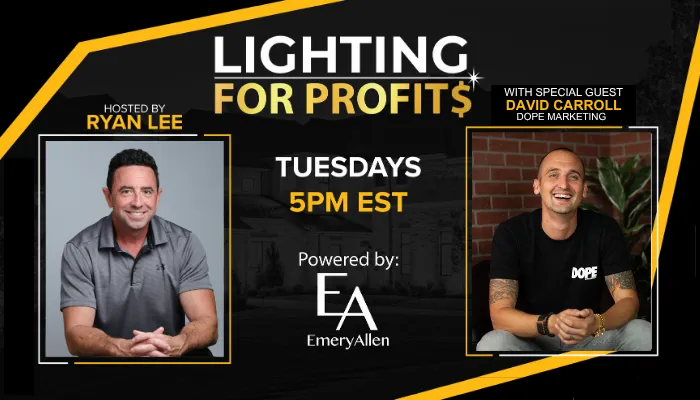
David Carroll - DOPE Growth
Lighting for Profits - Episode 256
Dave Carroll, founder of DOPE Marketing, joins the show to share how he went from building a successful home service business to helping businesses grow through direct mail and traditional marketing. Dave breaks down the power of automated direct mail, handwritten notes, and personalized gift boxes, and why these strategies can still make a big impact in today’s digital world. He also shares lessons from working with businesses ranging from local home service companies to major brands like Nike and Ashley Furniture.
Watch the episode
Episode Transcript
Ryan Lee: We're going to talk about marketing on Lighting for Profits
Welcome to Lighting for Profits.
All light.
All light. All Light.
Powered by EmeryAllen.
Here is your host, Ryan Lee. All light.
All light. All light. Welcome, welcome, welcome to the number one landscape lighting show in Minneapolis, Minnesota. I'm Ryan Lee, your host of Lighting for Profits powered by EmeryAllen. It's gonna be a dope show. We've got Mr. Dave Carroll, the founder of Dope marketing, uh, hanging out with us today and it is going to be dope. Um, we're going to talk about marketing and uh, I can't tell like if I'm, if I get more excited about marketing or sales and sometimes I'm like, are they the same thing? I don't know. So we're going to, we're going to nerd out on marketing. We're going to help you grow your outdoor lighting business. You know, as a business coach, I'm constantly looking for partners that can assist with my mission and, and honestly, like, I can tell people like what to do and like do these things, but if you don't have good marketing like it, you're just not going to be successful. I don't know how else to say it. So excited to have Dave Carroll, the founder of dope marketing, join us in just a couple minutes.
Landscape Lighting Secret is 256 episodes deep and we're not done
Uh, before we get started, I want to thank you guys for your support. We are 256 episodes deep. Um, I don't, I don't know how to lose you guys. Like, it might take me longer to win, but I'm going to win. And uh, I think the average podcast has like three or five episodes. So I think 256 is pretty good. Um, but we're not done. We're just getting started. So, um, thank you guys for your support. Um, honestly, if I started getting like a bunch of one star reviews, I'd probably quit. So thank you guys. Uh, we're up to over 100, I think 113, five star reviews on Apple and uh, 60 something on Spotify. So thank you guys. Thank you. And if you haven't, this is your guilt, guilt trip to, uh, go give me a five star review. Um, and uh, guys, in just a couple weeks we got Secret Summit coming up. So this is our members only event here in Park City, Utah. And uh, Park City, September 9th and 10th. Like it's probably the most beautiful time of the year. I'm excited to hang out with members of Landscape Lighting Secret. So if you're on the fence, you've got like a couple weeks, uh, maybe to uh, to join before you can come to that event. Um, it's a requirement. You got to be there. So that's going to be awesome. If you are a member, make sure a lot of, for a lot of you guys, it's free, you just have to register. Uh, so we can plan for the mills and uh, swag and stuff like that and then put it on your calendar. Light It Up Expo March one through fourth Las Vegas. Um, it's going to be a good time. We're going to get a lot of people to show up. I don't know how productive it's going to be because it's Vegas, but we're going to do our best. But put it on your calendar. Light it up Expo March 1 through 4, 2027. And again in just a couple minutes, we got Dave Carroll, the founder of Dope marketing on. So if you struggled with leads or trying to figure out marketing and you want to grow your business, this is going to be an ep, really. Ah, a dope episode for you.
A lot of business owners say they want a million dollar business
Uh, before we have him on, I want to talk about something. So, um, I guess, you know, I talk to a lot of, a lot of business owners every single week and a lot of people will say they want something, um, like I want a million dollar business or I want $5 million, whatever. And then, and then they find out like what the price tag is. Like, oh, like, I didn't know you had to do that. And I'm, uh, not, no, I don't want to do it, that I'm going to do it my way. It's like, well, do you really want that? Um, you know, and it is cool to see people's dreams. I mean, I'll get on like these discovery calls with people and strategy sessions and they're like, I want to, I want to open up a multi location and I want to go nationwide and all this stuff and it's like, that's cool. Like, I like dreams, but their actions are definitely not in alignment with what they're telling me. Right. And so, um, I started thinking anytime I have this like, thought, um, where I'm like, man, what's, what's wrong with you? All I do is like, look internally and look into my past and like, oh wait, I used to be the exact same way. Um, so when I started my lighting business, my brother, all I had never even installed a light before. And I came up with a goal of $1.2 million in my first year. And I'd never even, I didn't even know what landscape lighting was. The only thing I knew was that My brother had done a couple landscape lighting jobs, and he told me the first two jobs were like $4,000 each. So I was like, okay, well, $4,000. We could probably, we probably can't do one every day. That doesn't make sense. Like, but we could probably do three of those a week. I mean, just knock some doors, like do three a week. So instantly I had a $12,000 a week business times that by 50 some weeks, you're already at 600k. I'm like, dude, 600k? Well, he said 4,000 wasn't a very big job. So we'll probably do $8,000 jobs. So now all of a sudden you just double that. 600,000 times two, oh, $1.2 million business. That was my dream, that was my goal. And I was going to do that in the first 12 months. And so, um, we did not do 1.2 million. Um, we did 350,000 the first year. Um, which I actually was disappointed because I wanted to do 1.2, um, today. I mean, today, not today, but like, recently I've talked to people that have been in the industry, outdoor lighting industry for several years, and they still haven't broken 350,000. I'm like, dude, I didn't even know
what I was doing.
You can do more than you're doing, right? Um, and I didn't know what I didn't know. But, um, I decided after that first year of failure of not getting my goal, I was like, I guess I got to get intentional. What do I really want to build and how am I going to do it? And it wasn't perfect. It still isn't. But I took a lot of imperfect action. And so if you're one of those people saying, hey, I want to build a million dollar business, or a $3 million business, or 10, or whatever the number is, you have to get intentional. Because most of the time when we're not achieving our goals, it's not that we're not like, it's not that we're lazy. I mean, some people are, but most time you're working, it's just, you don't understand the difference between busy work and productive work. Right? And so, um, I've never met someone that's had any level of success that just accidentally, like, became financially free. Like, I don't know, just, I'm just lucky. Um, it's intentional, it's different, it's engineered. Okay? And so if you do some quick math and say, okay, I want to do a million dollar business, um, Are you willing, are you willing to do what it takes? Because if you want to build a million dollar business and you kind of have, like, you're newer to the market or your branding is kind of weak and no one knows who you are, you're not well established, are you willing to spend or invest a hundred thousand dollars to generate a million dollars worth of work? Because that's honestly what it's going to take. Like, you're just not, you're not going to magically appear with a million dollar business. And so, um, that's where I decided. I'm like, heck, I'd be willing to spend not just 100, but I'd be willing to spend 150, maybe even 200,000. And there's a longer story about like, you know, like, whoever can afford to spend the most to acquire a customer is going to win all day long. Because if you're really good at your backend systems and getting recurring revenue and getting uh, referrals, and not just waiting for referrals, but demanding them, and you have a machine built behind that, well then yeah, I'll spend 20%. Like, I'll do whatever I need to. Right? And so most people just don't understand these, these basic principles. It has to be engineered. And so, um, let's just say, for example, you, um, it's costing you $100 to get a lead. And some of you might go, oh, that's, I pay $50 a lead. It's like, well, again, let me just use this for an example because these numbers could change depending on like what size, project, average ticket, all these things, right? So but if you're going to spend a hundred thousand dollars and your average lead costs a hundred bucks, then that means you're going to generate about a thousand leads. Okay? And so, um, Thousand leads, right, Cool. Thousand leads. Like, I'm doing great. But, um, you're probably not even like get appointments with like 500 of them because one, you're not even answering every single phone call. Um, even if you do answer their call, are they qualified or is it just a realtor calling you? Like, there's a lot of different variables in there, right? And so you might get 300 leads out of those, or, I'm sorry, 300 appointments out of those thousand leads. And now all of a sudden you're like, okay, well I'm closing about 50%. So now you're like, okay, you have 150 sales and some of you are like, oh, I close at 90%. Like, okay, if you're closing at 90%. You've never done, uh, so you've never done Facebook ads. You've never done like cold marketing, right? And so, um, if you have 150 cells and your average ticket is 7, 500 bucks, well, congrats, you now have a formula for a 1.1 million dollar business, right? And so if your average ticket's higher, well, now you do more, right? Or maybe you close better, maybe it's higher, whatever. But what if, what if it cost you $200 for a lead and you run those same numbers now all of a sudden those same 150 sales is going to cost you more. And so now that's, it's just a, it's a, you're not going to get 150 sales. You're going to get, you know, 705 sales. And now you have a half a million dollar business set of 1.1. And so this is what I'm talking about. When you hear people say, like, oh, you need to know your numbers, it's not necessarily like being a math wizard or like being a nerdy accountant. You just need to like engineer your business around the numbers to make sure it's going to work. Because you can't just think of building a million dollar business and it happening. There's a book called Think and Grow Rich. And like, I'll just tell you, like, it. It's not. The strategy is not just laying in bed thinking and growing rich. Like, it starts with Think and grow Rich, but then you engineer and you make these things happen.
Your challenge is to define what it is you really want. Okay, and so what are you willing to give up
So, um, I want to encourage you guys. My challenge basically is like, like, define what it is you really want. Because it's easy to say you want a million, a multimillion dollar 100 million business, but are you willing to do the necessary activities to do that? Because if you want something that you don't have, you're going to have to be willing to do something you've never done. That's just the reality of the situation. Okay, and so what are you willing to give up? Because you can't just keep stacking things on, I'll do this and then this. Like, there's only so many hours in a day. So what are you willing to give up? Are you willing to give up control? Are you willing to give up some of your money? Are you willing to give up some of your time? Like, what is it that you're willing to. Willing to give up in order to get that? And that's why when you hear people talk about knowing Your why? And all this stuff matters because most people start to go down that path and then realize they don't want to sacrifice what it's going to take. And so, um, figure out what you're willing to give up and then literally create your plan and go get it. Because I promise you, it's possible. You just have to be willing to show up and be disciplined and show up to 256 episodes of a podcast that talks about outdoor lighting. Like, how lame is that? But, like, I already. I understand my mission, right? I know where I'm trying to go, and I'm willing to do whatever it takes to get there. So encourage, um, you guys to start knowing your numbers. Invest in marketing. We're going to be talking about marketing today, and that's the only way to make it happen. It's not just going to magically appear. Success isn't just waiting there and randomly, uh, choosing people. All right, uh, what was I going to do? Oh, yeah. Hey, uh, if you guys have been listening for a while, you know that I care about the client experience. Um, in fact, it's one of the easiest ways to differentiate yourself from your competition. So don't let a bad lamp ruin your client experience. Emory Allen makes premium LED lamps for lighting professionals who demand the best. So don't settle for less. Upgrade your designs and installations today with Emory Allen, and, uh, they're going to hook you up. Uh, just email Jackson L. You know, the letter L? Jackson Lry Allen dot com. That's JacksonLryAllen dot com. Send him an email and tell them you want that discounted contractor pricing mention that you heard about them here on Lighting for Profits, and they will hook you up. So thank you so much, Emory Allen. And, uh, it's kind of cool because a lot of people are using Emory Allen in the outdoor lighting industry. So, uh, don't be left behind today.
Dave Carroll is the CEO and founder of Dope Marketing
All right, guys, um, I think it's time. Hope Dave's ready. I'm ready. Let's get the show on the road. Let's get, get, uh, our guests coming on. Plus, I need a Dr. Welcome. Welcome to the show, Mr. Dave Carroll. What's up, Dave?
What up, everybody?
Excited to hang out, man? It's been a while.
It has been a while. Too long.
I know. Um, I was just thinking, you know, like, America is so dope because someone like you could find a solution to a problem and be like, I'm just going to start a business. I'm just going to do stuff and do things and, you know, hire employees and Create the economy and do all this stuff. So I'm excited to kind, uh, of dig into your story a little bit and catch, uh up and see where you guys are at right now.
Absolutely.
Well, um, do me a favor, Just do a quick introduction. You've been on the show before. Um, but for those that don't know you, who is Dave Carroll and who is Dope Marketing?
Um, my name is Dave. I'm the CEO and founder of a little company called Dope Marketing. We make direct mail and print really easy start, uh, on this journey. We turned six in October. Um, we are older than some of my children, um, which I have five of, uh, 13, all the way down to three. My beautiful wife that I've been with for 16 years is the counterpart to not only this business, we also own a cleaning and contracting company here in the Twin Cities we've had for 16 years. Um, and yeah, I was listening to, uh, backstage just listening to what you were saying on some of just the growth and the tenacity and the getting after it and like, do you want it and what are you willing to do? And I was just like living vicariously through that because that's been a lot of my career. Um, find a problem, come up with a solution, figure it out, get it in front a bunch of people and help some businesses.
That's cool, man. It's been cool to see your journey. And you know, a lot of, a lot of people have ideas, a lot of people have dreams and visions and like, oh, I'm gonna do this thing. But I mean, it's just, odds are not in your favor of winning if you're an entrepreneur, you know, and so what are some of the things. But, well, here's what I want to do.
Your company is kind of like a founder driven business
I want to kind of go around this, like, this personal journey, like, discussion first. And we're going to talk about dope, we're going to talk about all the cool things, marketing. But I see just from like my perspective, some of the stuff you're doing online and events you're doing and stuff like that. And it's like sometimes you're not talking about direct mail.
A lot of times I'm, um, personally not. We do live trainings and stuff now in our community and there's a lot of people in our business, you know, that are focused on like the sales side and what do we do and what's the problem? Can we solve? I've more taken the role. I consider it's kind of like a founder driven business. And not that every business is not founder driven. Founder driven, meaning like the podcast and the speaking and the trade shows and really, like, being the face of it. And I just don't really talk about what we do. Talk about what I do. I know.
Uh, it's cool, though, because you're on. You're on a mission, you know, like, you're, you're on, you're, you're. I can tell you're trying to better yourself, your family, your legacy that the people around you, the people that you work with, your clients. Like, I mean, it's a much bigger mission than like, hey, let's help people do direct mail.
Agreed, Agreed.
So talk about that a little bit.
Ryan Lee gave up drinking four years ago to focus on fitness and health
Like, um, well, uh, who's the coolest person you've met? You've got. You've gone to mastermind, you've hired coaches,
you've been to, like, the easy answer. Ryan Lee.
No, Come on. You just, Just. Because it's my show. Okay. Who's the second coolest person I've had
the opportunity to get close to? Some people that have really changed my life. We, uh, were just talking about Jesse Itzler, the. The Running man show that we're doing next month. My kind of, like, wellness journey. I, uh, I'll say just kind of getting my together. Started going over four years ago. Over four and a half years ago, um, me and my wife decided to quit drinking. Um, I was kind of like, out of town for me. Was kind of like I'd turn into the worst versions of myself for the late nights and the trade shows and the stuff I know you're talking about. Like, it's fun to have fun. I want everyone to, like, be happy and do what they do. For me, um, giving up drinking was a huge part of kind of like me just going into another chapter in life. And then with that, you know, you gotta replace habits with habits. Hopefully better ones. Got a lot into running. Uh, that's how I met Jesse and got in his men's group for three years. Got, um, into just fitness, health, wellness. Uh, found Puerto Rico two years ago. We, uh, spend kind of like about half the year down there now with our family. Um, but I just, I, I got around some people when I got on this. This. I'll just keep calling it, like, my wellness journey. That were just living life in a way that I really admired. You know, people make money and, and grow businesses and do all this stuff, but it's like, it's, it's, it's the things for me that we hear our whole lives, like, how Much time do you spend with your wife? How much time do you spend with your kids? How much time do you spend doing the things that. When I thought, you know, I think our definition of success, uh, changes as we get older. I used to think it was just like, how big can we get? How big can we grow? How fast can we grow? How many people can we help? And I realized my version of success was just a little bit different. On, like, do the people that depend on me love me? Do they care about me? Am I being the best version of myself so I can reciprocate, you know, what, being the man of my house or the leader of my business, like, what these people need? And I think that I just came to the realization that, like, if I'm not. If I'm not helping myself, who can I help? So took a look in the mirror and was just like, hey, I gotta. I gotta make some decisions and do some things different than I was doing them before. And it feels like a lot longer ago than, uh. Does it? Four and a half. It really does. Yeah.
How hard is that to give up drinking? I mean, it's just part of your normal lifestyle, and then you just don't do it.
So I love smoking cigarettes. My favorite thing. If I could do it all day with no effect on my health, I would do it all day. That has been harder over the, you know, 30 years that I've touched one of those things or whatever. Then drinking was a decision. I was like, we're just not going to do this anymore. And I'm around it. We go out, we're around people, we go to events, we go to stuff. I've never really had the urge. Not that anyone who's given up a habit before can just be like, yep, cold turkey. This one, I'm done. But drinking for me was if I would drink, I would do things, operate in ways, communicate in ways that I just wasn't very proud of. And there were things that led up to the decision being made, but for me, it was just like, that's just not me anymore. I just don't. I just don't do that. So that one somehow wasn't very hard for me. Um, I started getting really big into anyone that gets into health and fitness. I started, like, tracking my macros, just, like, logging everything I eat and doing that. That was hard. That's harder for me than. Than not drinking is, um, discipline of staying on top of. If that gives any relative example.
Yeah, totally. Well, I wonder why. Why it is kind of like this Because I feel like that's the same for me. I never really cared about my health or myself or anything. I was just like, well, I'm a provider, right? I think I just got to provide for my family. And then you start a business and so now you have a community and, and like, I don't. I don't know really. Like, have you, have you discovered why that is, like, why we go in that order and then we start to work on our health?
I think it, like, for me it was. I'm a very critical person, but of, like, more critical of myself than anyone else. But I felt like that would roll over and so when I would look at, like, I would get, uh, I started getting around people that I just saw how they were living their life and operating in disciplines they had and decisions they were making. I was like, if other people can do this, why can't I? Like, like just when you look at. So there's that saying around, like, if, if someone watched a movie of a day in your life, would you be proud to show it to them? It's one of the things I think about. Like, I, I just do the stuff. It's no different than any of the other people that you guys. I wake up early, I try to get a workout in, I try to eat good, try to not be super reactive with the people that depend on me during the day, um, try to put my phone away when I get home with my kids.
Ryan says being present is success, not living in the past
But these aren't things that, like, I made up. I just saw that, like, people were doing these disciplines and the way that they're, you know, it's one thing to be like, hyper focused on the growth of your business. Right? Uh, it's almost kind of easy, especially for people that were like, born to do this but didn't know it the whole time. And then you get a taste of what it's like to have some success and grow your business. Shit's addictive. And then it's like, you kind of get to a point with working like that. So I started my first business 16 years ago, and I'm a grinder. The, the 14, 16, 18 hour days. I love that. But then I would meet people that were older than me that would have regrets. They got the, you know, they got the watch or they got the plane or they got the thing. But then like, they've been divorced twice or their kids don't talk to. They look back on their life and they're not super proud of it. I turned 41 in November, had my first. My Daughter. My wife had my daughter. I was 27. And I've just had a lot of years of working really hard and I've always been a very present father. But like, when you're playing with your phone at night, checking emails, looking at stripe, making sure the thing, just because that's your dopamine hit like you found something that can constantly carry your interest. I just was very fortunate to see people older than me that went through that and regretted it. And I don't, I'm not big on, uh, regrets in life. I don't do that. You know, Gap in the Gain is one of the best books ever. And it allowed me to realize when I read that book for the first time was like just being present is success, not living in the past. Because that's depression. I'm depressed. Something happened before and I'm thinking about it, I'm going through it. Or you're too much in the future and now you're just anxious, like, what's going to happen? How do I plan for it? I got to see all the angles and overthink the why am I not
further along or whatever. Yep.
Yeah, but like, and I lived like that for a very long time. But what I realized, Ryan, is just like none of that serves anything. If you're like dwelling on the coulda, shoulda, would us, or you're over hyper focused on planning every move of what could happen, you're missing the stuff that's right in front of you. And uh, we all go through versions of that, but then it's like anything else, giving up a habit or making a decision to change. When you make a decision to change as a person, you don't flip a light switch. You form a discipline of changing a habit or behavior that eventually, over time of practicing that discipline, you act a little bit differently. Now the work isn't changing the thing, the work is catching the ginger ale when it bumps up, putting a lid on it, giving yourself a pat on the back and going in a different direction. And so for me, when I looked at like just the way I wanted to live my life, what I want, we all say we want more time, we want more money, we want the ability to not have a boss. We all want the same thing. But when you ask yourself that, you go back to those initial cliches that like year one to five, wherever you find yourself falling in this is like, do you actually have more time and are you actually making more money than you could if you were like, just had a job a lot of times the answer is probably no, but you get that dopamine hit and that success feeling of running your business. But can you get caught in that, that three to seven year trap of, like, you're growing, you're hiring, you're buying trucks or moving, shaking maybe, and open another location, but what are you exchanging for that? That was just something I always took really seriously.
I love it, man. I mean, you said it. You said it awesome. Because I feel like that's. That's why most of us delay the. The personal work is because, like, I'm not addicted to working out. Like, I'm not addicted to eating healthy. It sucks. You know, I am addicted to work. I could work 28 hours a day if you gave it to me, you know, it's freaking awesome. I get that dopamine. So I do want to check the email and all that. So it. It's like as much as you want to, like, have a cigarette, I don't want to work out. You know what I mean?
Like, it's. I didn't want to work out this morning, and I threw kettlebells around for 40 minutes and put a weighted vest on and got on a 12 incline on my treadmill because I know I'll feel better about myself and physically if I do that. But that decision, it's just as. Again, I. I kind of feel so, like, cliche is, you just do it, it's great for you. But now I feel worse if I don't, because I know I signed up for a plan and a program. I'm like, if I don't work out for three days, I'm, like, kind of feeling soggy. My energy's down. And I heard it was Gary Vee said this years ago. He's just like, I'll tell you what, I don't want to work out every morning, but I'll tell you, if I work out, I feel better if I do than if I don't. So when I have that moment, I'm like, I don't want to go do this. Like, do I want to feel like that later? Do I want to accept this now and just get out? And it's just like, it's that, it's. It's the, uh, anyone's into Kobe Bryant, dude. It's the mama mentality. You just sign that contract with yourself, you're gonna operate a certain way because that's who you are.
Yeah, I love it. Yeah. And for me, it's not as instant. It's not like, if I miss a workout today, I I kind of feel the same, but I, but I noticed like after like two or three days or especially a week, then you're like, okay, now I'm starting. It's like a, it's a delayed result. And so the dopamine of an addiction, in this case business, it's. It's instant. Like you get it right the, right away. So the, the. It's crazy. All the good stuff in life is hard and it's like, doesn't make sense to our human minds. But we have to challenge ourselves. We have to constantly get uncomfortable if we want that true happiness.
Amen.
Um, you know, I, I, um, I did a Spartan race. I can't even. It was like a month or two ago, I can't remember now. Tried to block it out, but it was freaking hard. It was way harder than I thought. I'd already done the race the year before.
As your business grows, it's hard to give up control
It took me an hour longer than. It sucked. I hurt my foot, all this stuff. So, and I was running a lot. I mean, I could run half a marathon and just go do that non stop after the race. I had hurt my foot and so I'm like, oh, obviously it's hurt. I can't. I didn't go to the doctor or anything. I don't think it was broken, but it was just like, I'm not going to run. That's, that's dumb. Then after like another week, I was like, oh, I probably shouldn't. You know, I started justifying and making excuses and then just going to run. Like after two, three weeks of not running at all, it was, it was freaking hard again. And I was like, what?
I'm a runner.
Like, I, I can't run like two, three miles consecutively. It's crazy. So that discipline pays off because you start to build momentum and get traction in that.
But it's the same thing in business, Ryan. It's like when you're busy and everything's going good and it feels great. Very few of us, especially in the first however many years in business, are like, this isn't gonna continue. And I have to think about the decisions I'm making now that affect it later. These disciplines roll in from our life, roll into our businesses so much. I'll tell you what, man, I don't know where we would be if I didn't make the decision to make some decisions, but it wouldn't be here. Like our, our glass ceilings of the ways that we operate in our personal life, our business is just a representation of ourselves. And so, like, when you look at some of the things that go the best in your business. I'd be willing to bet for those of you watching or listening, they're. The things you're good at are the things you like doing. But if you're not great at customer service, if you're not great at finance, if you're not great at systems and processes, naturally, it's hard to give up control. Like, and I've seen a lot of companies, mine included everyone that I've touched. Mark Cuban said, like, sales solves everything. And it does until your sales create problems that your systems can't handle, and then the shit breaks. Or you have a seasonal business, so you have ups and downs. And it's like, if I wouldn't have learned how to better, um, identify what was causing issues in our business, like, dude, I'm not a good. I'm good at making it. I'm better at spending it. I'm not good at managing it. Like, never happened. And when you grow a company, you know, like we have or any level business, doesn't matter if you're doing 100 grand a year, 100 mil, a year, anywhere in between. It's like you just. If you're not getting better at what you're not good at or not delegating it, you're going to get the same thing. And I know for me, I just have some aha moments, like, I got to give up control of this thing because I'm not good at it and it's not going right. But I would ignore things like, similarly, go out of town with the kids, and then you got a trade show and you don't work out for a week and a half, it's like I'm ignoring what I committed to. Yep. As your business grows, especially with your finances, and you get into these industries that are seasonal, it's predictable if you let it be. But, I mean, I've had. I've had. Over the past 16 years, I've had more issues of me, like, growing stuff and not paying attention to the money and then that kind of nipping us in the butt and having to figure that out probably than any other issue I've had running companies.
Yeah, yeah. Like you said, it's. It's our weakness. We don't want to pay attention to it because it doesn't give us any satisfaction.
No, dude, to sit down a finance meeting for me, my ears and my eyes are bleeding. I'm like, let me go sell something right now. And it's just like. But anything you neglect isn't going to get better.
Cool man, that's cool.
I, I do want to talk a little bit about dope marketing
I, I do want to talk a little bit about dope marketing. Um, I just think it's fascinating because you come from this like cleaning company, you know, like blue collar home service. Um, why did you decide to start dope? Like what were you seeing specific problems that you're solving now or you started on a different path or how did that come to fruition?
Four years after I got in my cleaning company I started a software business. Couldn't spell software. But what happened from that? We started selling lists, like lists of property managers showing people how to get work from them, like that type of stuff. And then I got in the world of data brokering, just like selling lists. But data brokering isn't just selling lists. You're doing like consulting. So I can get Ryan a list of people with high end homes that have high square footage, a little bit older, they need lights, like that type of stuff. But not just selling the list, it's the consulting of it, of how to use the list. So I was broker in mail. We're running ads for people, we're doing stuff. I got into agency space. We grew pretty big. We're doing like 400 grand a month like eight, nine years ago in Facebook and Google Ads. And I just saw the landscape which is like there's a lot of people doing this. Direct mail industries ran by 70 year old fat guys who suck at golf, whose kids don't want to work for them. Not a lot uh, of innovation or technology in that space. And I had been in the software side of things. I was like we can build a piece of software that does this. And just had an idea. There was, there was other companies out there that did it, there was other approaches but I was really looking at like instead of just selling mail and print, it was the data, the automations, it was exciting. There wasn't, there was just a landscape. You know, it's the blue ocean. Um, no one can spell AI yet. 6 years ago when we came out with this and it was just like it seemed like a space where I could help more businesses than just running ads for people or having a marketing company. So I just went all in.
That's awesome. And I know like it's, I've just kind of seen some of your journey going throughout this online and it's like you're, you're then all sudden you're going from like just a, kind of a small print shop to like we're buying a million dollar piece of equipment. Is that crazy when that that happens?
So one of my superpowers is risk tolerance.
I just freaking awesome though by the way.
Like I just don't overthink too much. I just have gotten this far, trust in my gut and I've thankfully gotten a little bit more right than I've gotten wrong. Wrong. Debt never scared me. I mean I own 93% of his business still to this day. We've never taken any investors or partners. We got a couple employees that invested some equity in single digits but like I just always wanted to carry the weight myself. And as we kept growing we had a lot of opportunities to partners and affiliate deals and I just had the horse blinders on. And I won't say it was the most un, the most conventional way to grow a business to where we got in the amount of time we did. But at the same time like it's my first time doing this too.
That's awesome man. That's cool.
Dave McDonald: Risk tolerance is interesting because I probably don't have
I. Risk tolerance is interesting because I probably don't have as much as you, but I still feel like I have a lot more than the average person. Like you're, you're probably like off the spectrum, you know, Like I just think that's what you kind of need. Like all the most successful you people you've met, they're not just like super conservative and waiting for the right time, are they?
I was having a conversation with my 6 year old about this the other day on ah, how like when you, when you decide that you're really frustrated about something, like there's one person that's in control of that feeling and it's you. So if you decide to be, you know, intimidated or scared or have any level of fear at all, like people jump out of airplanes every day. How do you feel about that? You, you know people, people take big loans to take a risk. People sign their life away to buy their dream home. They do. Like people make decisions every day, but the one person making that decision is also in control of how they feel about it. And for me I was just like, I try to not do dumb all the time, try my best, but I also am like if I have conviction that something's going to go a certain direction and I put myself in control of that result, is there to be scared of. Like it to me, it's that simple. It's how my brain works. I'm not saying everyone's wired that way or it's normal, but I'm um, not also talking about just like borrowing money. I remember when we got it was our third year at lion's share maintenance and we got a bunch of snowplow routes. I'm like, seasonal, we gotta get these snowplows. I met this guy that owned a bunch of gas stations and we underbid the out of the gas stations. And I bought this we with this van that I swore I needed next year that had no use. It was rear wheel drive, couldn't even use it over the winter. I bought, I signed a loan on this van. Had, uh, my driver's license, got suspended eight times. Bad insurance, all that stuff. So like the van payment was 450 bucks and the insurance was the same. It was like 450 was $900 a month. Couldn't afford it. Like, we did not have the budget over the winter allocated to afford a 900 payment a month. And when I got the van and we were out, like it snowed more that winter than any winter. We put these on contract. So it wasn't a per time we're out shooting, shoveling these things to this plow truck. I bought, bought and was just like. I look back on those decisions. If I was to give a business owner advice of like, do you need to put yourself in a position to be able to grow? I heard someone say one time, like in home service, like your office or your shop is kind of like your fishbowl. Like, how big is your shop? How many vehicles do you have? How it's like you can only grow capacity, right? Like, yeah, what you were saying, one job a day or three jobs a week. At four grand, I can get to a million, two. Like that type of thought where it's like, I just always took the approach to business that like someone is going to do. I'm not an engineer, I'm not an inventor. I'm not going to market with something for the first time. That's never been done before. I look at a problem, try to come up with a solution, try to get in front of as many people possible that have that problem that I can solve it for. And I just always took the approach with like growth. You had said it earlier, if someone came to me right now, said, Dave, you got to go borrow a hundred thousand dollars, but in 12 months you get a million in sales back what you do. I'm like, where's that vending machine? I'll put a hundred grand in every day, even if I don't have it, because then I can take on the responsibility to facilitate the work. And I know it comes from that. And I just believe that like everything that I'll ever do in this lifetime, a version of it has been done before. So I never approached something like, oh, I'm so scared to go do this because I'm like, scared to work at McDonald's.
That's such a good perspective, though. Like you said, we're not creators. Like, you're, you're not the first one to take out a loan on a piece of equipment. Like, I got this idea, you know, like, people have done it and it worked, so why would it not work for me? I like that too. It's like I'm more scared of working at McDonald's. Yeah. That's awesome.
I think running a business is hard. Clocking in McDonald's on second shift would be really difficult to live any type of life that you wanted to. And like, yeah, I don't even wanna. That scares me.
We started a new segment on our show called make the call
Hey, do you care if we play a quick game? We started a new segment on our show. Gotta, gotta break it up. So basically what it is, is, um, um, what I'm going to ask you some questions and you're just gonna, it's called make the call. You're gonna make the call. You're a CEO, you're a founder. You got to make hard decisions. So don't worry, they're easy. But, um, we basically have a new partner to the show called Call Source. And you, we all know the phrase fortune is in the follow up. Um, every business owner in the world knows that, but we don't do it. So that's why you hire a Call Source. They've got a, actually a us based, uh, call center and they act as like an extension of your team. So they follow up on old proposals, leads it in, book appointments, all that type of stuff. So it's like having your own CSR team, but you don't have to have the overhead of it. So, um, one of the things they're doing for lighting, for profits listeners, they're going to do 50% off your first month to just try them out. They do call tracking and a bunch of other stuff too. But book a demo. Just go to try.callsource.comlfp try.callsource .com lfp we'll put that in the, uh, show notes as well. But Dave, are you ready to play? You make the call.
Ready.
Okay.
Some of these customized to you because I know a little bit about your lifestyle
So, um, I've got some, I got some fun ones in here. I got some business ones. Um, but some of these are customized to you because I know a little bit about your lifestyle. Um, the first one, private jet or private yacht.
Jet all day jet.
I thought, I thought so, but I wasn't sure. I'm always, I'm always pleading, by the way, with my friends. I'm like, hey, whoever gets one, just save me a seat. I don't need it all the time, but just, just like a little corner, you know, I mean, I'll fly in the bathroom. I don't care, whatever it is, you know. Um, and I'm saving you one as well, so it goes both ways.
I'm working on it.
Mountains or beach? Do you do, do you ever go to the mountains? I know you got the place in Puerto Rico.
Yeah, I've climbed a mountain, actually.
Really? Which one?
They're fourteener. Really? Mount Albert.
Yeah. And, uh, that was just for funsy.
I was off the couch. Funsies.
All right, cool. Uh, fancy restaurant or hole in the wall with incredible food?
Hole in the wall.
What's your. What's been your favorite food, uh, or restaurant you've been to?
I like, uh, like I don't do with my program. I don't do like cheat meals. I just make sure to earn it. So like a good greasy hole in the wall burger.
Nice. Okay, uh, morning person or night person?
Morning. Super.
Uh, bowl tickets on the 50 yard line or front row tickets to your favorite band of all time?
We do it. We do a concert every year for my birthday. Front row. So. Front row at a concert.
Nice. What, what, what, uh, what, what's your favorite band?
Uh, the weekend was the last one we saw.
Oh, very cool. That's awesome.
What's more important, marketing or sales? Marketing. I think I'm converted to marketing
All right. Million dollars today or a 50, 50 shot at 10 million mill today. You're not going to gamble 50, 50 shot. Turn that, flip that one mil into 10. Uh, would you rather have five trucks doing 500k each or two trucks doing a million each?
Five.
Uh, more important. What's more important, marketing or sales?
Marketing.
I thought you might say that. I, I used to say sales, but I think I'm converted to marketing.
They gotta know about, about it before they can buy it. Like you can have good sales people, but they don't need leads. Like, what are you gonna do?
Yeah, I know because it really good marketing. You could have kind of like average reps and do very, very well. Uh, more leads or higher close rate.
Depends on the industry.
How about outdoor lighting, which I know you're just higher clothes, right? All right, I like that. Um, AI saves 20 hours or brings 20 leads.
Say it's 20 hours.
Are you guys using a lot of AI now?
I consider us top 10 of companies using AI in the country right now.
Cool. Um, have you, have you gone down the route of. I mean that's how you guys are using it. Um, throughout. Maybe an idea or two how a local outdoor lighting business.
Start talking to it about yourself. Hey, I'm Dave. I own this company. This is what I do. This is the problems I'm solving. This is what I'm good at. This is what I'm not. Interview me about my business and just talk to it every day. That's what I'd be doing.
Cool. Love it. Get it to know you. Would you rather have certainty or opportunity?
Opportunity.
Um, 10,000 postcards one time or 2500 four times all day?
2500 four times.
Cool. Um, do you see a lot of people screwing that up person?
I mean look, if something's working for you, keep working it. Don't listen to what the other guy's doing and make your decision. Like it's um. I think consistency is better. I think targeting is better. I think the world is a busy place and I'd rather, if, if you gave me the opportunity, I'd rather take four decent shots on goal than one great shot on goal.
Okay, so this, I probably already know the answer to the next one. 10,000 postcards to average homeowners or a thousand to perfect fit homeowners.
A thousand if I can do it a couple times. So like, like, if you think about like gutter cleaning. Right. Great lead gen for a business. If you're doing stuff like that just to get in front of, of the door, that's where I would go to like more leads versus a higher close rate because I want more shots on goal. I think that um, I would rather get in front of a thousand of my target customer than 10,000 of my not target customer.
Okay. Um, how about on a like show ah, prices on the mailer or make them call to find out.
Depends on the average ticket of the service. I really like to give someone a foot in the door. Like no brainer price to call on something under like 97 bucks or 199. Like give them something like yo, I want that deal so that you can talk to them.
Yeah.
If you're, if you're shooting for one thing like only high ticket jobs, I would be going more down the education route of giving them a reason like putting a problem in front of them that you can solve without a price. Then lower ticket, I like price. Higher ticket, I like no price at that.
Yeah, I like that a lot actually. Um, how about uh, the offer on there, Is it better to have 10 off or $500 off?
Always the dollar sign. No one understands a percentage. You think you're getting, like, the scam word now. Especially my kids. I can't stand the scam word. But it's like you don't know what. 10 off is something if you don't know what it costs. But everyone knows what 500 bills is.
Yep. Love it.
Don't ask in Facebook group what other people think your design should look like
Um, and finally, QR code on signs. On yard signs. Yay or nay?
We've tested this deeply. Our most scanned QR code we've ever created for lion's share ever is on a yard sign.
That's cool.
Out of any QR code we've ever put on anything ever. It's on a yard sign. I would look. I get into these threads. I get tagged a lot on the yard time stuff. And don't ask in the Facebook group what the other people think your design should look like. Just don't do that. A yard sign's a billboard. You have two kinds. You have one that's to generate leads. There's one sitting in the corner behind that refrigerator over there. I can't see it. Service and phone number with a QR code. The one you put in the lawns for the neighbors can have a little bit more. But no one needs like, your license number and your BBB logo and 18 colors and the whole. That's just selfish. Like, you have seconds like you're. I would rather have a QR code on there than your logo. We've done better with signs that just have, like, custom lighting, landscape lighting, and a phone number and a QR code than some Picasso and your character and your thing and animation, like, none of that shit matters. It's all selfish.
Okay, that's good stuff. Because, I mean, number one, like you said, people are going to these Facebook groups and asking it a question. Like they're asking God to non designers
that have no clue that just, like, want to be a jerk because their cat looked at them wrong.
And they're like, what should I do? And they get all this advice and I'm like, would someone stop them? Like, this is not. Uh. Well, I. I have played.
Me too. I gotta. I gotta set the car. I'm not that great. But, uh, what I've learned is, is I'm getting more into golfing. Is like, even if you're gonna go get a lesson, you have to pick the right guy or girl to get a lesson from, because you can't take as much feedback as they can give you when you go on a Facebook group, whether it's having your yard sign designed or what you should price a job like, ask yourself before you post that what you're actually asking for. Do you want feedback on your suggestion? Because that's one thing. Getting feedback from other professionals to make a decision. I saw this Guy Go through 18 iterations of a yard sign in three days on this group with a thousand comments on it and what he started with. And the end was a mix of 19 golf pros giving advice to a left handed and right handed dude at the same time.
Yep, now that's exactly what happens. It's so frustrating.
Why the branded one in the in the yard versus the one on the street corner
Um, so you, you were, you mentioned it but you mentioned it quickly. Why the two different signs you've got like the branded one in the in the yard versus the one on the street corner.
Talk about those being selfish feels good. And as a business owner you should get to do what you want to. And if you want your Picasso assignment, all the stuff and the services, the signs we put out in the parking lots in Home Depot or coming out of the daycares or the two in a row on the freeway exit, like our lead gen signs are just a little more basic because I only have so much of your attention to grab like power washing, roofing, phone number qr. They're going to snap that they're going to save in their phone. They're going to look at it later. That's what we're going for. If you're doing like exterior lighting is a great example or you're building pools or you're doing hardscapes like a bigger project. The advice that if you're going to be there for a couple days and the neighbors are going to drive by, if you want a little bit more on the sign, that's fine. I want business owners be able to like do what they want to for the branding of their company. You can go a little harder for the ones that you're not putting on the corner. But those busy just like try to notice this now when you drive around just today when you're getting off the freeway, look at some of the yard signs. The ones that you can remember that stick out are the simple ones. Those Picasso crazy 80 things going on. It's just, it's hard to digest in that quick little moment that you have that's more digestible for the guy walking his dog past the house where the truck's been there for three days.
Yeah, I still think your point is accurate though. Like can make this branded but you don't need to show them that you, you're on Instagram. You don't need that. They already know. They don't need to see. Like, um, you know, we, uh, repair and maintenance and free designs and new
commercial on your residential signs and the whole thing. Like, you care more than they do, so you should put yourself in their shoes for what they need to know.
Love it. Yeah, well said.
How much is a yard sign these days? I mean, let's say someone wants 100
How much is a yard sign these days? I mean, let's say someone wants to buy a hundred. How much is that?
Five bucks, Four to six bucks, depending on the time of year. They go up and down. I mean, okay, sometimes like gas prices, we can't control the, you know, the plastic goes up, the ink goes up, the thing. We had a deal running for like 4 bucks to sign for 100 for almost 8 months. And then our supplier pricing went up and now they're I think a hundred right now. Depending on where you're watching this. We're recording this in the middle of August. Um, or we're live the middle of August. Um, I think 100 signs, like 450, 500 bucks right around there, depending if you want rush shipping or not.
Yeah. 500 bucks to have your information in a hundred different places. Yeah, that's just dirt cheap.
One of the best investments you can make. That door hanger is great postcards, good look, everything's great. Go back to the 100,000 to get a million. How bad do you want to grow? Figure out something that works. Don't ask other people in Facebook groups what it should look like.
What, what do me, what else do people miss? Like, um, I hear people say, oh, I, I did door hangers. They don't work. When I hear someone say something like that, I'm like, well, just because they didn't work for you doesn't mean they won't work. Like you just did something wrong. Because I, they work for me.
We literally used to roll up. We'd take like paper like this and we do it on our printer and we do like gutter cleaning. And then it'd be like a little flyer, right? And we'd roll it like this. Me and Bryn would sit. We lived at my mom's house at the this time. We would sit and roll them. So it said gutter cleaning with rubber bands. We put them in big trash bags. And like I walked around for three summers putting those out on house there. A kid that worked for us got a gun pulled on him in like this super high end neighborhood because the guy thought he was walking around robbing houses. When people say something doesn't work, as a business owner, as a marketer, my natural reaction is you didn't try hard enough. Door hangers don't work for us. Uh, what does that mean? How does it not work? If someone has something in their hand that you're buying businesses informations on they can put in a drawer. How did that not work? It costs like 300 bucks to get 2500 door hangers. Right. Don't quote me on that. But around there, yeah, when something doesn't work, I think that's a mentality. Again, look, someone's like AI based tik tok ads from a satellite. Don't worry about. I can't. I don't know, I've never done that before. But these things that have been around forever, they all work if you just incorporate them. I think the thing that doesn't work. Let's go to door hangers for the example. We have done everything in our home service company to get people to pass out the door hangers around the jobs. That's been a hard job has to be reinforced. You got to remind them to do it. You're checking their truck. Did they put them out? We had guys throwing them away instead of putting them on doors. Like we've dealt with it all.
Yep.
Anyone seeing any impression of your business works. Now, would I advise you to go be the platinum sponsor on the golf cart or the shopping cart in your local area? Probably not. But if you have budget in your business and if you have forecast, if you actually do a quarterly and annual forecast and you actually have budget, you can find cheaper places that the impressions might not go. I got a million leads from that call tracking number. A bunch of QR code scans. But like, what do you have to pay to get people to see who you are so you can solve the problem that you started your business for? Simple answer, I guess.
Did you guys find a solution, um, to getting your guys to actually put out the door hangers and do the clovering and all that stuff in the
team meeting every week and have them like just make sure. Like we got to the point where managers drive around in neighborhoods and just make sure they're going out and it's, it's required. Like if you want to work here, this is part of what you do and then it's not. You know, I think. And I've been here before, right. I hired all my knucklehead crackhead buddies to work for me when we first started. Or any version. Family, friends, all of it. Right. You have to make the decision of what you enforce in your business. If you're a business owner, I can't get people to put out door hangers. It's like, I would question your hiring and management process.
Yeah.
Not to be hard on anyone, but just like, you tell them they got to do it, and then you put a system in place that shows that they do it and it's part of what they signed up for. If you're paying for their minutes during the day to sign the front of their paycheck, it's.
It's on the scorecard. It's just one of the things we
do like, and just don't make it so big of a deal. But then it's also like, as a business owner, if your best guy that you can send out a loan to do the good jobs refuses to do it, like, are you a business owner that accepts someone going against the rules or not? Because we've had that too.
Something to consider as you grow your business
Like, oh, we can't tell Bob to do that. He's not gonna, uh, he's Bob. It's Bob. Right. But like, if your business is only built around Bob, what if Bob gets hit by a bus? It's a word. Worst problem that he won't put out a door hanger or not do customer service calls. Something to consider as you grow.
Yeah.
Direct mail works best when you're busy, Dave says
All right. The last thing I want to ask you about is direct mail. I know I did very well with direct mail when I had my lighting business. I've got members of Landscape Lighting Secrets doing very well with direct mail. And then I still get the same other people. Oh, I tried. It didn't work. What. What are most people getting wrong? Is it the. The card stock? Is it the design? Is it the.
Nothing to do with that.
Targeting the freaking.
Don't send it on this paper. But the, the trying something once and saying it doesn't work because you didn't know what you were doing. It just like any other form of advertising. I tried Facebook ads. I tried this. I tried this. Um, direct mail works the best when you're busy. The thing that breaks my heart when I talk to business owners like, oh, we're busy, we're turning off the advertising. We have too many leads. There are times when, yes, if you have too many leads, you should not be super hyper focused on growing your business. If you're figuring out how to manage the amount of leads you're generating that can be seasonal in businesses, annual, whatever it is. A wise man once told me about 15 years ago, Dave, you want to be successful. Just never stop priming the pump. So, like, we have neighborhoods in the Twin Cities. We never stop mailing to or doing door hangers or running Facebook ads in, because we always want Dr. Jobs when it's not busy in those neighborhoods. And when people are actively searching or even getting a quote from you, whether they do the job or not, like, you're going to have more shots on goal when people are looking for things. So I think the worst thing a business owner can do, I'm not saying blow all your money when you're busy and you can't facilitate a leap. Not saying that. But you should be always looking at, like, what are your best neighborhoods and how are you constantly staying in front of those people? Like, the perfect jobs that you want, you can just look back in your CRM number matter what you're using, understanding where your target customer is, and when you get into budget and forecasting, it's just like looking at, I'm going to make sure I can spend a thousand bucks a month in these three neighborhoods every month. Rain, sleet, hail, snow, whatever. So they always know. And how that relates to direct mail is like, technology's helped a lot, man. There's no minimum on this stuff you can send. You know, pick 250 homes in Park City, Utah, that get a mailer every other week of the year. That would cost you, like, not that much money a year. And if you got one of those jobs, it would pay for it. We just take that approach. We do it a little bigger internally. Yeah, but I just think it's so important that, like, with mail, whether you've done it before, it works or not or it doesn't. Shameless sales pitch here. Every door. Direct mail is advanced dramatically, and we're doing some really cool stuff at dope with it. So if you've used mailer, you haven't before without just super pitching, we'd love to show you something that'll probably save you time and get you, you know, more jobs, because there's. There's ways to do everything right. We can't do SEO. We can't build your website. We can't run your Facebook ads. But what we can do is show you how to make mail work.
I love it, man. It's cool. Um, when someone does, I feel like the biggest thing they screw up is they. It's just a one and done. And I'm like, if you're. If you're just thinking you're going to just drop five grand and then that's your golden ticket. You might not want to start with this because you might just, like, you might not get your return instantly.
How long does it typically take to get traction with direct mail
How long does it typically take to get traction with direct mail? Like you said, hitting these people every other week or every other month or whatever it is, how long does that typically take?
So if I can tie it all together for a business that hasn't done direct mail before, I'm assuming in the lighting business, you guys have like a rush or gets busy before it gets cold in places where there's.
Yeah, like, right. Like September, October, November, big, big, big months for outdoor lighting.
We, we've done really well over the years with, um, every door, direct mail or targeted mail. You do either of them gutter cleaning and Christmas lights for the business that we own, you can drop as much of that stuff as possible during the right time and get a five times better result than other times of the year. You know, if you're sending out your first time doing direct mail and you're going to do it the weekend of July 4th because you're not busy, it's probably one of the worst decisions you can make with any advertising. Because kids are out of school, people are on vacation, no one's paying attention. But if you time it right, I mean, there are ways, you know, I don't want to go just the average marketing talk of, like, anything you try once won't work. It's true. But like, man, I can send a hundred thousand pieces of eddm, um, in the last, uh, week of September, in the first two weeks of October every year and make profit every single year, predictably, because people need their gutters cleaned. And then we can upsell them on other services. So there's times to, like, go big, go hard, go home, do a one drop. I would advise any business, you know, I try to, I try to look at marketing campaigns in, like, the ones that cost a couple hundred bucks. Unless you're passing out yard signs or door hangers like that, that'll work. You can literally spend hundreds of dollars and get it resolved. If you want to budget the proper direct mail campaign, I would look more at, like, spending like 1500 to 4 grand and kind of trying to split that up between two or three drops to, like, targeted neighborhoods where you already have work. That's one of the, like, easiest ways to almost guarantee success with mail. If you're, if you're going into a busy season, been open more than a year, you know, like when the phones start ringing just in general from the other stuff you're doing, that's the time to drop. And, like, I know dope. We do it a little bit faster than other companies. We can get mail anywhere in the country in four to eight days. So it's like, from a timing perspective. I remember the years, Ryan. We used to do this for holiday lights and gutter clean, like, super, super. Hundreds of thousands of pieces. You ride that wave for a couple weeks, like, through the busy season. What's great with mail is, like, you can do those big drops and kind of be like, all right, let's sit back and wait. And if you time that right, nothing's guaranteed in life, but, like, pretty close.
Yeah.
Yeah.
Nice, man. I like it. Well, if someone wants to reach, reach, uh, out to dope, uh, get a hold of you, follow you. What's the best way to do that?
Dopemarketing. com. we're all over the socials everywhere, too. Just look for the bald guy yelling about print mail on the Internet.
I love your energy. I love your passion. You're an inspiration, bro.
Dave Robbins offers some advice to young entrepreneurs on how to succeed
I, um, guess leave us with a, uh, some words of wisdom. What would you tell your younger self? What would you tell someone out there who is the hustler? They're the grinder. They haven't hit their momentum yet. Uh, what would you tell them?
Always give yourself permission to be curious, but know when it's time to slow down so that you can speed up.
Love it, man. Very, very good. Thanks, uh, so much for joining me, Dave. Guys, if you listen to this and you didn't get a bunch of gold nuggets, then you might need to just go get a job. Give up on your dreams. No, you might need to just go listen to it again. Uh, very, very cool stuff, guys. The hardest part is, of course, always implementation. So pick one thing that you got from Dave and just start, you know, get going. So I appreciate you, Dave. You're awesome, man. Uh, keep moving forward. All right, guys, have an awesome day. We'll see you next week.
David Carroll - DOPE Growth
Lighting for Profits - Episode 256
Dave Carroll, founder of DOPE Marketing, joins the show to share how he went from building a successful home service business to helping businesses grow through direct mail and traditional marketing. Dave breaks down the power of automated direct mail, handwritten notes, and personalized gift boxes, and why these strategies can still make a big impact in today’s digital world. He also shares lessons from working with businesses ranging from local home service companies to major brands like Nike and Ashley Furniture.
Watch the episode
Episode Transcript
Ryan Lee: We're going to talk about marketing on Lighting for Profits
Welcome to Lighting for Profits.
All light.
All light. All Light.
Powered by EmeryAllen.
Here is your host, Ryan Lee. All light.
All light. All light. Welcome, welcome, welcome to the number one landscape lighting show in Minneapolis, Minnesota. I'm Ryan Lee, your host of Lighting for Profits powered by EmeryAllen. It's gonna be a dope show. We've got Mr. Dave Carroll, the founder of Dope marketing, uh, hanging out with us today and it is going to be dope. Um, we're going to talk about marketing and uh, I can't tell like if I'm, if I get more excited about marketing or sales and sometimes I'm like, are they the same thing? I don't know. So we're going to, we're going to nerd out on marketing. We're going to help you grow your outdoor lighting business. You know, as a business coach, I'm constantly looking for partners that can assist with my mission and, and honestly, like, I can tell people like what to do and like do these things, but if you don't have good marketing like it, you're just not going to be successful. I don't know how else to say it. So excited to have Dave Carroll, the founder of dope marketing, join us in just a couple minutes.
Landscape Lighting Secret is 256 episodes deep and we're not done
Uh, before we get started, I want to thank you guys for your support. We are 256 episodes deep. Um, I don't, I don't know how to lose you guys. Like, it might take me longer to win, but I'm going to win. And uh, I think the average podcast has like three or five episodes. So I think 256 is pretty good. Um, but we're not done. We're just getting started. So, um, thank you guys for your support. Um, honestly, if I started getting like a bunch of one star reviews, I'd probably quit. So thank you guys. Uh, we're up to over 100, I think 113, five star reviews on Apple and uh, 60 something on Spotify. So thank you guys. Thank you. And if you haven't, this is your guilt, guilt trip to, uh, go give me a five star review. Um, and uh, guys, in just a couple weeks we got Secret Summit coming up. So this is our members only event here in Park City, Utah. And uh, Park City, September 9th and 10th. Like it's probably the most beautiful time of the year. I'm excited to hang out with members of Landscape Lighting Secret. So if you're on the fence, you've got like a couple weeks, uh, maybe to uh, to join before you can come to that event. Um, it's a requirement. You got to be there. So that's going to be awesome. If you are a member, make sure a lot of, for a lot of you guys, it's free, you just have to register. Uh, so we can plan for the mills and uh, swag and stuff like that and then put it on your calendar. Light It Up Expo March one through fourth Las Vegas. Um, it's going to be a good time. We're going to get a lot of people to show up. I don't know how productive it's going to be because it's Vegas, but we're going to do our best. But put it on your calendar. Light it up Expo March 1 through 4, 2027. And again in just a couple minutes, we got Dave Carroll, the founder of Dope marketing on. So if you struggled with leads or trying to figure out marketing and you want to grow your business, this is going to be an ep, really. Ah, a dope episode for you.
A lot of business owners say they want a million dollar business
Uh, before we have him on, I want to talk about something. So, um, I guess, you know, I talk to a lot of, a lot of business owners every single week and a lot of people will say they want something, um, like I want a million dollar business or I want $5 million, whatever. And then, and then they find out like what the price tag is. Like, oh, like, I didn't know you had to do that. And I'm, uh, not, no, I don't want to do it, that I'm going to do it my way. It's like, well, do you really want that? Um, you know, and it is cool to see people's dreams. I mean, I'll get on like these discovery calls with people and strategy sessions and they're like, I want to, I want to open up a multi location and I want to go nationwide and all this stuff and it's like, that's cool. Like, I like dreams, but their actions are definitely not in alignment with what they're telling me. Right. And so, um, I started thinking anytime I have this like, thought, um, where I'm like, man, what's, what's wrong with you? All I do is like, look internally and look into my past and like, oh wait, I used to be the exact same way. Um, so when I started my lighting business, my brother, all I had never even installed a light before. And I came up with a goal of $1.2 million in my first year. And I'd never even, I didn't even know what landscape lighting was. The only thing I knew was that My brother had done a couple landscape lighting jobs, and he told me the first two jobs were like $4,000 each. So I was like, okay, well, $4,000. We could probably, we probably can't do one every day. That doesn't make sense. Like, but we could probably do three of those a week. I mean, just knock some doors, like do three a week. So instantly I had a $12,000 a week business times that by 50 some weeks, you're already at 600k. I'm like, dude, 600k? Well, he said 4,000 wasn't a very big job. So we'll probably do $8,000 jobs. So now all of a sudden you just double that. 600,000 times two, oh, $1.2 million business. That was my dream, that was my goal. And I was going to do that in the first 12 months. And so, um, we did not do 1.2 million. Um, we did 350,000 the first year. Um, which I actually was disappointed because I wanted to do 1.2, um, today. I mean, today, not today, but like, recently I've talked to people that have been in the industry, outdoor lighting industry for several years, and they still haven't broken 350,000. I'm like, dude, I didn't even know
what I was doing.
You can do more than you're doing, right? Um, and I didn't know what I didn't know. But, um, I decided after that first year of failure of not getting my goal, I was like, I guess I got to get intentional. What do I really want to build and how am I going to do it? And it wasn't perfect. It still isn't. But I took a lot of imperfect action. And so if you're one of those people saying, hey, I want to build a million dollar business, or a $3 million business, or 10, or whatever the number is, you have to get intentional. Because most of the time when we're not achieving our goals, it's not that we're not like, it's not that we're lazy. I mean, some people are, but most time you're working, it's just, you don't understand the difference between busy work and productive work. Right? And so, um, I've never met someone that's had any level of success that just accidentally, like, became financially free. Like, I don't know, just, I'm just lucky. Um, it's intentional, it's different, it's engineered. Okay? And so if you do some quick math and say, okay, I want to do a million dollar business, um, Are you willing, are you willing to do what it takes? Because if you want to build a million dollar business and you kind of have, like, you're newer to the market or your branding is kind of weak and no one knows who you are, you're not well established, are you willing to spend or invest a hundred thousand dollars to generate a million dollars worth of work? Because that's honestly what it's going to take. Like, you're just not, you're not going to magically appear with a million dollar business. And so, um, that's where I decided. I'm like, heck, I'd be willing to spend not just 100, but I'd be willing to spend 150, maybe even 200,000. And there's a longer story about like, you know, like, whoever can afford to spend the most to acquire a customer is going to win all day long. Because if you're really good at your backend systems and getting recurring revenue and getting uh, referrals, and not just waiting for referrals, but demanding them, and you have a machine built behind that, well then yeah, I'll spend 20%. Like, I'll do whatever I need to. Right? And so most people just don't understand these, these basic principles. It has to be engineered. And so, um, let's just say, for example, you, um, it's costing you $100 to get a lead. And some of you might go, oh, that's, I pay $50 a lead. It's like, well, again, let me just use this for an example because these numbers could change depending on like what size, project, average ticket, all these things, right? So but if you're going to spend a hundred thousand dollars and your average lead costs a hundred bucks, then that means you're going to generate about a thousand leads. Okay? And so, um, Thousand leads, right, Cool. Thousand leads. Like, I'm doing great. But, um, you're probably not even like get appointments with like 500 of them because one, you're not even answering every single phone call. Um, even if you do answer their call, are they qualified or is it just a realtor calling you? Like, there's a lot of different variables in there, right? And so you might get 300 leads out of those, or, I'm sorry, 300 appointments out of those thousand leads. And now all of a sudden you're like, okay, well I'm closing about 50%. So now you're like, okay, you have 150 sales and some of you are like, oh, I close at 90%. Like, okay, if you're closing at 90%. You've never done, uh, so you've never done Facebook ads. You've never done like cold marketing, right? And so, um, if you have 150 cells and your average ticket is 7, 500 bucks, well, congrats, you now have a formula for a 1.1 million dollar business, right? And so if your average ticket's higher, well, now you do more, right? Or maybe you close better, maybe it's higher, whatever. But what if, what if it cost you $200 for a lead and you run those same numbers now all of a sudden those same 150 sales is going to cost you more. And so now that's, it's just a, it's a, you're not going to get 150 sales. You're going to get, you know, 705 sales. And now you have a half a million dollar business set of 1.1. And so this is what I'm talking about. When you hear people say, like, oh, you need to know your numbers, it's not necessarily like being a math wizard or like being a nerdy accountant. You just need to like engineer your business around the numbers to make sure it's going to work. Because you can't just think of building a million dollar business and it happening. There's a book called Think and Grow Rich. And like, I'll just tell you, like, it. It's not. The strategy is not just laying in bed thinking and growing rich. Like, it starts with Think and grow Rich, but then you engineer and you make these things happen.
Your challenge is to define what it is you really want. Okay, and so what are you willing to give up
So, um, I want to encourage you guys. My challenge basically is like, like, define what it is you really want. Because it's easy to say you want a million, a multimillion dollar 100 million business, but are you willing to do the necessary activities to do that? Because if you want something that you don't have, you're going to have to be willing to do something you've never done. That's just the reality of the situation. Okay, and so what are you willing to give up? Because you can't just keep stacking things on, I'll do this and then this. Like, there's only so many hours in a day. So what are you willing to give up? Are you willing to give up control? Are you willing to give up some of your money? Are you willing to give up some of your time? Like, what is it that you're willing to. Willing to give up in order to get that? And that's why when you hear people talk about knowing Your why? And all this stuff matters because most people start to go down that path and then realize they don't want to sacrifice what it's going to take. And so, um, figure out what you're willing to give up and then literally create your plan and go get it. Because I promise you, it's possible. You just have to be willing to show up and be disciplined and show up to 256 episodes of a podcast that talks about outdoor lighting. Like, how lame is that? But, like, I already. I understand my mission, right? I know where I'm trying to go, and I'm willing to do whatever it takes to get there. So encourage, um, you guys to start knowing your numbers. Invest in marketing. We're going to be talking about marketing today, and that's the only way to make it happen. It's not just going to magically appear. Success isn't just waiting there and randomly, uh, choosing people. All right, uh, what was I going to do? Oh, yeah. Hey, uh, if you guys have been listening for a while, you know that I care about the client experience. Um, in fact, it's one of the easiest ways to differentiate yourself from your competition. So don't let a bad lamp ruin your client experience. Emory Allen makes premium LED lamps for lighting professionals who demand the best. So don't settle for less. Upgrade your designs and installations today with Emory Allen, and, uh, they're going to hook you up. Uh, just email Jackson L. You know, the letter L? Jackson Lry Allen dot com. That's JacksonLryAllen dot com. Send him an email and tell them you want that discounted contractor pricing mention that you heard about them here on Lighting for Profits, and they will hook you up. So thank you so much, Emory Allen. And, uh, it's kind of cool because a lot of people are using Emory Allen in the outdoor lighting industry. So, uh, don't be left behind today.
Dave Carroll is the CEO and founder of Dope Marketing
All right, guys, um, I think it's time. Hope Dave's ready. I'm ready. Let's get the show on the road. Let's get, get, uh, our guests coming on. Plus, I need a Dr. Welcome. Welcome to the show, Mr. Dave Carroll. What's up, Dave?
What up, everybody?
Excited to hang out, man? It's been a while.
It has been a while. Too long.
I know. Um, I was just thinking, you know, like, America is so dope because someone like you could find a solution to a problem and be like, I'm just going to start a business. I'm just going to do stuff and do things and, you know, hire employees and Create the economy and do all this stuff. So I'm excited to kind, uh, of dig into your story a little bit and catch, uh up and see where you guys are at right now.
Absolutely.
Well, um, do me a favor, Just do a quick introduction. You've been on the show before. Um, but for those that don't know you, who is Dave Carroll and who is Dope Marketing?
Um, my name is Dave. I'm the CEO and founder of a little company called Dope Marketing. We make direct mail and print really easy start, uh, on this journey. We turned six in October. Um, we are older than some of my children, um, which I have five of, uh, 13, all the way down to three. My beautiful wife that I've been with for 16 years is the counterpart to not only this business, we also own a cleaning and contracting company here in the Twin Cities we've had for 16 years. Um, and yeah, I was listening to, uh, backstage just listening to what you were saying on some of just the growth and the tenacity and the getting after it and like, do you want it and what are you willing to do? And I was just like living vicariously through that because that's been a lot of my career. Um, find a problem, come up with a solution, figure it out, get it in front a bunch of people and help some businesses.
That's cool, man. It's been cool to see your journey. And you know, a lot of, a lot of people have ideas, a lot of people have dreams and visions and like, oh, I'm gonna do this thing. But I mean, it's just, odds are not in your favor of winning if you're an entrepreneur, you know, and so what are some of the things. But, well, here's what I want to do.
Your company is kind of like a founder driven business
I want to kind of go around this, like, this personal journey, like, discussion first. And we're going to talk about dope, we're going to talk about all the cool things, marketing. But I see just from like my perspective, some of the stuff you're doing online and events you're doing and stuff like that. And it's like sometimes you're not talking about direct mail.
A lot of times I'm, um, personally not. We do live trainings and stuff now in our community and there's a lot of people in our business, you know, that are focused on like the sales side and what do we do and what's the problem? Can we solve? I've more taken the role. I consider it's kind of like a founder driven business. And not that every business is not founder driven. Founder driven, meaning like the podcast and the speaking and the trade shows and really, like, being the face of it. And I just don't really talk about what we do. Talk about what I do. I know.
Uh, it's cool, though, because you're on. You're on a mission, you know, like, you're, you're on, you're, you're. I can tell you're trying to better yourself, your family, your legacy that the people around you, the people that you work with, your clients. Like, I mean, it's a much bigger mission than like, hey, let's help people do direct mail.
Agreed, Agreed.
So talk about that a little bit.
Ryan Lee gave up drinking four years ago to focus on fitness and health
Like, um, well, uh, who's the coolest person you've met? You've got. You've gone to mastermind, you've hired coaches,
you've been to, like, the easy answer. Ryan Lee.
No, Come on. You just, Just. Because it's my show. Okay. Who's the second coolest person I've had
the opportunity to get close to? Some people that have really changed my life. We, uh, were just talking about Jesse Itzler, the. The Running man show that we're doing next month. My kind of, like, wellness journey. I, uh, I'll say just kind of getting my together. Started going over four years ago. Over four and a half years ago, um, me and my wife decided to quit drinking. Um, I was kind of like, out of town for me. Was kind of like I'd turn into the worst versions of myself for the late nights and the trade shows and the stuff I know you're talking about. Like, it's fun to have fun. I want everyone to, like, be happy and do what they do. For me, um, giving up drinking was a huge part of kind of like me just going into another chapter in life. And then with that, you know, you gotta replace habits with habits. Hopefully better ones. Got a lot into running. Uh, that's how I met Jesse and got in his men's group for three years. Got, um, into just fitness, health, wellness. Uh, found Puerto Rico two years ago. We, uh, spend kind of like about half the year down there now with our family. Um, but I just, I, I got around some people when I got on this. This. I'll just keep calling it, like, my wellness journey. That were just living life in a way that I really admired. You know, people make money and, and grow businesses and do all this stuff, but it's like, it's, it's, it's the things for me that we hear our whole lives, like, how Much time do you spend with your wife? How much time do you spend with your kids? How much time do you spend doing the things that. When I thought, you know, I think our definition of success, uh, changes as we get older. I used to think it was just like, how big can we get? How big can we grow? How fast can we grow? How many people can we help? And I realized my version of success was just a little bit different. On, like, do the people that depend on me love me? Do they care about me? Am I being the best version of myself so I can reciprocate, you know, what, being the man of my house or the leader of my business, like, what these people need? And I think that I just came to the realization that, like, if I'm not. If I'm not helping myself, who can I help? So took a look in the mirror and was just like, hey, I gotta. I gotta make some decisions and do some things different than I was doing them before. And it feels like a lot longer ago than, uh. Does it? Four and a half. It really does. Yeah.
How hard is that to give up drinking? I mean, it's just part of your normal lifestyle, and then you just don't do it.
So I love smoking cigarettes. My favorite thing. If I could do it all day with no effect on my health, I would do it all day. That has been harder over the, you know, 30 years that I've touched one of those things or whatever. Then drinking was a decision. I was like, we're just not going to do this anymore. And I'm around it. We go out, we're around people, we go to events, we go to stuff. I've never really had the urge. Not that anyone who's given up a habit before can just be like, yep, cold turkey. This one, I'm done. But drinking for me was if I would drink, I would do things, operate in ways, communicate in ways that I just wasn't very proud of. And there were things that led up to the decision being made, but for me, it was just like, that's just not me anymore. I just don't. I just don't do that. So that one somehow wasn't very hard for me. Um, I started getting really big into anyone that gets into health and fitness. I started, like, tracking my macros, just, like, logging everything I eat and doing that. That was hard. That's harder for me than. Than not drinking is, um, discipline of staying on top of. If that gives any relative example.
Yeah, totally. Well, I wonder why. Why it is kind of like this Because I feel like that's the same for me. I never really cared about my health or myself or anything. I was just like, well, I'm a provider, right? I think I just got to provide for my family. And then you start a business and so now you have a community and, and like, I don't. I don't know really. Like, have you, have you discovered why that is, like, why we go in that order and then we start to work on our health?
I think it, like, for me it was. I'm a very critical person, but of, like, more critical of myself than anyone else. But I felt like that would roll over and so when I would look at, like, I would get, uh, I started getting around people that I just saw how they were living their life and operating in disciplines they had and decisions they were making. I was like, if other people can do this, why can't I? Like, like just when you look at. So there's that saying around, like, if, if someone watched a movie of a day in your life, would you be proud to show it to them? It's one of the things I think about. Like, I, I just do the stuff. It's no different than any of the other people that you guys. I wake up early, I try to get a workout in, I try to eat good, try to not be super reactive with the people that depend on me during the day, um, try to put my phone away when I get home with my kids.
Ryan says being present is success, not living in the past
But these aren't things that, like, I made up. I just saw that, like, people were doing these disciplines and the way that they're, you know, it's one thing to be like, hyper focused on the growth of your business. Right? Uh, it's almost kind of easy, especially for people that were like, born to do this but didn't know it the whole time. And then you get a taste of what it's like to have some success and grow your business. Shit's addictive. And then it's like, you kind of get to a point with working like that. So I started my first business 16 years ago, and I'm a grinder. The, the 14, 16, 18 hour days. I love that. But then I would meet people that were older than me that would have regrets. They got the, you know, they got the watch or they got the plane or they got the thing. But then like, they've been divorced twice or their kids don't talk to. They look back on their life and they're not super proud of it. I turned 41 in November, had my first. My Daughter. My wife had my daughter. I was 27. And I've just had a lot of years of working really hard and I've always been a very present father. But like, when you're playing with your phone at night, checking emails, looking at stripe, making sure the thing, just because that's your dopamine hit like you found something that can constantly carry your interest. I just was very fortunate to see people older than me that went through that and regretted it. And I don't, I'm not big on, uh, regrets in life. I don't do that. You know, Gap in the Gain is one of the best books ever. And it allowed me to realize when I read that book for the first time was like just being present is success, not living in the past. Because that's depression. I'm depressed. Something happened before and I'm thinking about it, I'm going through it. Or you're too much in the future and now you're just anxious, like, what's going to happen? How do I plan for it? I got to see all the angles and overthink the why am I not
further along or whatever. Yep.
Yeah, but like, and I lived like that for a very long time. But what I realized, Ryan, is just like none of that serves anything. If you're like dwelling on the coulda, shoulda, would us, or you're over hyper focused on planning every move of what could happen, you're missing the stuff that's right in front of you. And uh, we all go through versions of that, but then it's like anything else, giving up a habit or making a decision to change. When you make a decision to change as a person, you don't flip a light switch. You form a discipline of changing a habit or behavior that eventually, over time of practicing that discipline, you act a little bit differently. Now the work isn't changing the thing, the work is catching the ginger ale when it bumps up, putting a lid on it, giving yourself a pat on the back and going in a different direction. And so for me, when I looked at like just the way I wanted to live my life, what I want, we all say we want more time, we want more money, we want the ability to not have a boss. We all want the same thing. But when you ask yourself that, you go back to those initial cliches that like year one to five, wherever you find yourself falling in this is like, do you actually have more time and are you actually making more money than you could if you were like, just had a job a lot of times the answer is probably no, but you get that dopamine hit and that success feeling of running your business. But can you get caught in that, that three to seven year trap of, like, you're growing, you're hiring, you're buying trucks or moving, shaking maybe, and open another location, but what are you exchanging for that? That was just something I always took really seriously.
I love it, man. I mean, you said it. You said it awesome. Because I feel like that's. That's why most of us delay the. The personal work is because, like, I'm not addicted to working out. Like, I'm not addicted to eating healthy. It sucks. You know, I am addicted to work. I could work 28 hours a day if you gave it to me, you know, it's freaking awesome. I get that dopamine. So I do want to check the email and all that. So it. It's like as much as you want to, like, have a cigarette, I don't want to work out. You know what I mean?
Like, it's. I didn't want to work out this morning, and I threw kettlebells around for 40 minutes and put a weighted vest on and got on a 12 incline on my treadmill because I know I'll feel better about myself and physically if I do that. But that decision, it's just as. Again, I. I kind of feel so, like, cliche is, you just do it, it's great for you. But now I feel worse if I don't, because I know I signed up for a plan and a program. I'm like, if I don't work out for three days, I'm, like, kind of feeling soggy. My energy's down. And I heard it was Gary Vee said this years ago. He's just like, I'll tell you what, I don't want to work out every morning, but I'll tell you, if I work out, I feel better if I do than if I don't. So when I have that moment, I'm like, I don't want to go do this. Like, do I want to feel like that later? Do I want to accept this now and just get out? And it's just like, it's that, it's. It's the, uh, anyone's into Kobe Bryant, dude. It's the mama mentality. You just sign that contract with yourself, you're gonna operate a certain way because that's who you are.
Yeah, I love it. Yeah. And for me, it's not as instant. It's not like, if I miss a workout today, I I kind of feel the same, but I, but I noticed like after like two or three days or especially a week, then you're like, okay, now I'm starting. It's like a, it's a delayed result. And so the dopamine of an addiction, in this case business, it's. It's instant. Like you get it right the, right away. So the, the. It's crazy. All the good stuff in life is hard and it's like, doesn't make sense to our human minds. But we have to challenge ourselves. We have to constantly get uncomfortable if we want that true happiness.
Amen.
Um, you know, I, I, um, I did a Spartan race. I can't even. It was like a month or two ago, I can't remember now. Tried to block it out, but it was freaking hard. It was way harder than I thought. I'd already done the race the year before.
As your business grows, it's hard to give up control
It took me an hour longer than. It sucked. I hurt my foot, all this stuff. So, and I was running a lot. I mean, I could run half a marathon and just go do that non stop after the race. I had hurt my foot and so I'm like, oh, obviously it's hurt. I can't. I didn't go to the doctor or anything. I don't think it was broken, but it was just like, I'm not going to run. That's, that's dumb. Then after like another week, I was like, oh, I probably shouldn't. You know, I started justifying and making excuses and then just going to run. Like after two, three weeks of not running at all, it was, it was freaking hard again. And I was like, what?
I'm a runner.
Like, I, I can't run like two, three miles consecutively. It's crazy. So that discipline pays off because you start to build momentum and get traction in that.
But it's the same thing in business, Ryan. It's like when you're busy and everything's going good and it feels great. Very few of us, especially in the first however many years in business, are like, this isn't gonna continue. And I have to think about the decisions I'm making now that affect it later. These disciplines roll in from our life, roll into our businesses so much. I'll tell you what, man, I don't know where we would be if I didn't make the decision to make some decisions, but it wouldn't be here. Like our, our glass ceilings of the ways that we operate in our personal life, our business is just a representation of ourselves. And so, like, when you look at some of the things that go the best in your business. I'd be willing to bet for those of you watching or listening, they're. The things you're good at are the things you like doing. But if you're not great at customer service, if you're not great at finance, if you're not great at systems and processes, naturally, it's hard to give up control. Like, and I've seen a lot of companies, mine included everyone that I've touched. Mark Cuban said, like, sales solves everything. And it does until your sales create problems that your systems can't handle, and then the shit breaks. Or you have a seasonal business, so you have ups and downs. And it's like, if I wouldn't have learned how to better, um, identify what was causing issues in our business, like, dude, I'm not a good. I'm good at making it. I'm better at spending it. I'm not good at managing it. Like, never happened. And when you grow a company, you know, like we have or any level business, doesn't matter if you're doing 100 grand a year, 100 mil, a year, anywhere in between. It's like you just. If you're not getting better at what you're not good at or not delegating it, you're going to get the same thing. And I know for me, I just have some aha moments, like, I got to give up control of this thing because I'm not good at it and it's not going right. But I would ignore things like, similarly, go out of town with the kids, and then you got a trade show and you don't work out for a week and a half, it's like I'm ignoring what I committed to. Yep. As your business grows, especially with your finances, and you get into these industries that are seasonal, it's predictable if you let it be. But, I mean, I've had. I've had. Over the past 16 years, I've had more issues of me, like, growing stuff and not paying attention to the money and then that kind of nipping us in the butt and having to figure that out probably than any other issue I've had running companies.
Yeah, yeah. Like you said, it's. It's our weakness. We don't want to pay attention to it because it doesn't give us any satisfaction.
No, dude, to sit down a finance meeting for me, my ears and my eyes are bleeding. I'm like, let me go sell something right now. And it's just like. But anything you neglect isn't going to get better.
Cool man, that's cool.
I, I do want to talk a little bit about dope marketing
I, I do want to talk a little bit about dope marketing. Um, I just think it's fascinating because you come from this like cleaning company, you know, like blue collar home service. Um, why did you decide to start dope? Like what were you seeing specific problems that you're solving now or you started on a different path or how did that come to fruition?
Four years after I got in my cleaning company I started a software business. Couldn't spell software. But what happened from that? We started selling lists, like lists of property managers showing people how to get work from them, like that type of stuff. And then I got in the world of data brokering, just like selling lists. But data brokering isn't just selling lists. You're doing like consulting. So I can get Ryan a list of people with high end homes that have high square footage, a little bit older, they need lights, like that type of stuff. But not just selling the list, it's the consulting of it, of how to use the list. So I was broker in mail. We're running ads for people, we're doing stuff. I got into agency space. We grew pretty big. We're doing like 400 grand a month like eight, nine years ago in Facebook and Google Ads. And I just saw the landscape which is like there's a lot of people doing this. Direct mail industries ran by 70 year old fat guys who suck at golf, whose kids don't want to work for them. Not a lot uh, of innovation or technology in that space. And I had been in the software side of things. I was like we can build a piece of software that does this. And just had an idea. There was, there was other companies out there that did it, there was other approaches but I was really looking at like instead of just selling mail and print, it was the data, the automations, it was exciting. There wasn't, there was just a landscape. You know, it's the blue ocean. Um, no one can spell AI yet. 6 years ago when we came out with this and it was just like it seemed like a space where I could help more businesses than just running ads for people or having a marketing company. So I just went all in.
That's awesome. And I know like it's, I've just kind of seen some of your journey going throughout this online and it's like you're, you're then all sudden you're going from like just a, kind of a small print shop to like we're buying a million dollar piece of equipment. Is that crazy when that that happens?
So one of my superpowers is risk tolerance.
I just freaking awesome though by the way.
Like I just don't overthink too much. I just have gotten this far, trust in my gut and I've thankfully gotten a little bit more right than I've gotten wrong. Wrong. Debt never scared me. I mean I own 93% of his business still to this day. We've never taken any investors or partners. We got a couple employees that invested some equity in single digits but like I just always wanted to carry the weight myself. And as we kept growing we had a lot of opportunities to partners and affiliate deals and I just had the horse blinders on. And I won't say it was the most un, the most conventional way to grow a business to where we got in the amount of time we did. But at the same time like it's my first time doing this too.
That's awesome man. That's cool.
Dave McDonald: Risk tolerance is interesting because I probably don't have
I. Risk tolerance is interesting because I probably don't have as much as you, but I still feel like I have a lot more than the average person. Like you're, you're probably like off the spectrum, you know, Like I just think that's what you kind of need. Like all the most successful you people you've met, they're not just like super conservative and waiting for the right time, are they?
I was having a conversation with my 6 year old about this the other day on ah, how like when you, when you decide that you're really frustrated about something, like there's one person that's in control of that feeling and it's you. So if you decide to be, you know, intimidated or scared or have any level of fear at all, like people jump out of airplanes every day. How do you feel about that? You, you know people, people take big loans to take a risk. People sign their life away to buy their dream home. They do. Like people make decisions every day, but the one person making that decision is also in control of how they feel about it. And for me I was just like, I try to not do dumb all the time, try my best, but I also am like if I have conviction that something's going to go a certain direction and I put myself in control of that result, is there to be scared of. Like it to me, it's that simple. It's how my brain works. I'm not saying everyone's wired that way or it's normal, but I'm um, not also talking about just like borrowing money. I remember when we got it was our third year at lion's share maintenance and we got a bunch of snowplow routes. I'm like, seasonal, we gotta get these snowplows. I met this guy that owned a bunch of gas stations and we underbid the out of the gas stations. And I bought this we with this van that I swore I needed next year that had no use. It was rear wheel drive, couldn't even use it over the winter. I bought, I signed a loan on this van. Had, uh, my driver's license, got suspended eight times. Bad insurance, all that stuff. So like the van payment was 450 bucks and the insurance was the same. It was like 450 was $900 a month. Couldn't afford it. Like, we did not have the budget over the winter allocated to afford a 900 payment a month. And when I got the van and we were out, like it snowed more that winter than any winter. We put these on contract. So it wasn't a per time we're out shooting, shoveling these things to this plow truck. I bought, bought and was just like. I look back on those decisions. If I was to give a business owner advice of like, do you need to put yourself in a position to be able to grow? I heard someone say one time, like in home service, like your office or your shop is kind of like your fishbowl. Like, how big is your shop? How many vehicles do you have? How it's like you can only grow capacity, right? Like, yeah, what you were saying, one job a day or three jobs a week. At four grand, I can get to a million, two. Like that type of thought where it's like, I just always took the approach to business that like someone is going to do. I'm not an engineer, I'm not an inventor. I'm not going to market with something for the first time. That's never been done before. I look at a problem, try to come up with a solution, try to get in front of as many people possible that have that problem that I can solve it for. And I just always took the approach with like growth. You had said it earlier, if someone came to me right now, said, Dave, you got to go borrow a hundred thousand dollars, but in 12 months you get a million in sales back what you do. I'm like, where's that vending machine? I'll put a hundred grand in every day, even if I don't have it, because then I can take on the responsibility to facilitate the work. And I know it comes from that. And I just believe that like everything that I'll ever do in this lifetime, a version of it has been done before. So I never approached something like, oh, I'm so scared to go do this because I'm like, scared to work at McDonald's.
That's such a good perspective, though. Like you said, we're not creators. Like, you're, you're not the first one to take out a loan on a piece of equipment. Like, I got this idea, you know, like, people have done it and it worked, so why would it not work for me? I like that too. It's like I'm more scared of working at McDonald's. Yeah. That's awesome.
I think running a business is hard. Clocking in McDonald's on second shift would be really difficult to live any type of life that you wanted to. And like, yeah, I don't even wanna. That scares me.
We started a new segment on our show called make the call
Hey, do you care if we play a quick game? We started a new segment on our show. Gotta, gotta break it up. So basically what it is, is, um, um, what I'm going to ask you some questions and you're just gonna, it's called make the call. You're gonna make the call. You're a CEO, you're a founder. You got to make hard decisions. So don't worry, they're easy. But, um, we basically have a new partner to the show called Call Source. And you, we all know the phrase fortune is in the follow up. Um, every business owner in the world knows that, but we don't do it. So that's why you hire a Call Source. They've got a, actually a us based, uh, call center and they act as like an extension of your team. So they follow up on old proposals, leads it in, book appointments, all that type of stuff. So it's like having your own CSR team, but you don't have to have the overhead of it. So, um, one of the things they're doing for lighting, for profits listeners, they're going to do 50% off your first month to just try them out. They do call tracking and a bunch of other stuff too. But book a demo. Just go to try.callsource.comlfp try.callsource .com lfp we'll put that in the, uh, show notes as well. But Dave, are you ready to play? You make the call.
Ready.
Okay.
Some of these customized to you because I know a little bit about your lifestyle
So, um, I've got some, I got some fun ones in here. I got some business ones. Um, but some of these are customized to you because I know a little bit about your lifestyle. Um, the first one, private jet or private yacht.
Jet all day jet.
I thought, I thought so, but I wasn't sure. I'm always, I'm always pleading, by the way, with my friends. I'm like, hey, whoever gets one, just save me a seat. I don't need it all the time, but just, just like a little corner, you know, I mean, I'll fly in the bathroom. I don't care, whatever it is, you know. Um, and I'm saving you one as well, so it goes both ways.
I'm working on it.
Mountains or beach? Do you do, do you ever go to the mountains? I know you got the place in Puerto Rico.
Yeah, I've climbed a mountain, actually.
Really? Which one?
They're fourteener. Really? Mount Albert.
Yeah. And, uh, that was just for funsy.
I was off the couch. Funsies.
All right, cool. Uh, fancy restaurant or hole in the wall with incredible food?
Hole in the wall.
What's your. What's been your favorite food, uh, or restaurant you've been to?
I like, uh, like I don't do with my program. I don't do like cheat meals. I just make sure to earn it. So like a good greasy hole in the wall burger.
Nice. Okay, uh, morning person or night person?
Morning. Super.
Uh, bowl tickets on the 50 yard line or front row tickets to your favorite band of all time?
We do it. We do a concert every year for my birthday. Front row. So. Front row at a concert.
Nice. What, what, what, uh, what, what's your favorite band?
Uh, the weekend was the last one we saw.
Oh, very cool. That's awesome.
What's more important, marketing or sales? Marketing. I think I'm converted to marketing
All right. Million dollars today or a 50, 50 shot at 10 million mill today. You're not going to gamble 50, 50 shot. Turn that, flip that one mil into 10. Uh, would you rather have five trucks doing 500k each or two trucks doing a million each?
Five.
Uh, more important. What's more important, marketing or sales?
Marketing.
I thought you might say that. I, I used to say sales, but I think I'm converted to marketing.
They gotta know about, about it before they can buy it. Like you can have good sales people, but they don't need leads. Like, what are you gonna do?
Yeah, I know because it really good marketing. You could have kind of like average reps and do very, very well. Uh, more leads or higher close rate.
Depends on the industry.
How about outdoor lighting, which I know you're just higher clothes, right? All right, I like that. Um, AI saves 20 hours or brings 20 leads.
Say it's 20 hours.
Are you guys using a lot of AI now?
I consider us top 10 of companies using AI in the country right now.
Cool. Um, have you, have you gone down the route of. I mean that's how you guys are using it. Um, throughout. Maybe an idea or two how a local outdoor lighting business.
Start talking to it about yourself. Hey, I'm Dave. I own this company. This is what I do. This is the problems I'm solving. This is what I'm good at. This is what I'm not. Interview me about my business and just talk to it every day. That's what I'd be doing.
Cool. Love it. Get it to know you. Would you rather have certainty or opportunity?
Opportunity.
Um, 10,000 postcards one time or 2500 four times all day?
2500 four times.
Cool. Um, do you see a lot of people screwing that up person?
I mean look, if something's working for you, keep working it. Don't listen to what the other guy's doing and make your decision. Like it's um. I think consistency is better. I think targeting is better. I think the world is a busy place and I'd rather, if, if you gave me the opportunity, I'd rather take four decent shots on goal than one great shot on goal.
Okay, so this, I probably already know the answer to the next one. 10,000 postcards to average homeowners or a thousand to perfect fit homeowners.
A thousand if I can do it a couple times. So like, like, if you think about like gutter cleaning. Right. Great lead gen for a business. If you're doing stuff like that just to get in front of, of the door, that's where I would go to like more leads versus a higher close rate because I want more shots on goal. I think that um, I would rather get in front of a thousand of my target customer than 10,000 of my not target customer.
Okay. Um, how about on a like show ah, prices on the mailer or make them call to find out.
Depends on the average ticket of the service. I really like to give someone a foot in the door. Like no brainer price to call on something under like 97 bucks or 199. Like give them something like yo, I want that deal so that you can talk to them.
Yeah.
If you're, if you're shooting for one thing like only high ticket jobs, I would be going more down the education route of giving them a reason like putting a problem in front of them that you can solve without a price. Then lower ticket, I like price. Higher ticket, I like no price at that.
Yeah, I like that a lot actually. Um, how about uh, the offer on there, Is it better to have 10 off or $500 off?
Always the dollar sign. No one understands a percentage. You think you're getting, like, the scam word now. Especially my kids. I can't stand the scam word. But it's like you don't know what. 10 off is something if you don't know what it costs. But everyone knows what 500 bills is.
Yep. Love it.
Don't ask in Facebook group what other people think your design should look like
Um, and finally, QR code on signs. On yard signs. Yay or nay?
We've tested this deeply. Our most scanned QR code we've ever created for lion's share ever is on a yard sign.
That's cool.
Out of any QR code we've ever put on anything ever. It's on a yard sign. I would look. I get into these threads. I get tagged a lot on the yard time stuff. And don't ask in the Facebook group what the other people think your design should look like. Just don't do that. A yard sign's a billboard. You have two kinds. You have one that's to generate leads. There's one sitting in the corner behind that refrigerator over there. I can't see it. Service and phone number with a QR code. The one you put in the lawns for the neighbors can have a little bit more. But no one needs like, your license number and your BBB logo and 18 colors and the whole. That's just selfish. Like, you have seconds like you're. I would rather have a QR code on there than your logo. We've done better with signs that just have, like, custom lighting, landscape lighting, and a phone number and a QR code than some Picasso and your character and your thing and animation, like, none of that shit matters. It's all selfish.
Okay, that's good stuff. Because, I mean, number one, like you said, people are going to these Facebook groups and asking it a question. Like they're asking God to non designers
that have no clue that just, like, want to be a jerk because their cat looked at them wrong.
And they're like, what should I do? And they get all this advice and I'm like, would someone stop them? Like, this is not. Uh. Well, I. I have played.
Me too. I gotta. I gotta set the car. I'm not that great. But, uh, what I've learned is, is I'm getting more into golfing. Is like, even if you're gonna go get a lesson, you have to pick the right guy or girl to get a lesson from, because you can't take as much feedback as they can give you when you go on a Facebook group, whether it's having your yard sign designed or what you should price a job like, ask yourself before you post that what you're actually asking for. Do you want feedback on your suggestion? Because that's one thing. Getting feedback from other professionals to make a decision. I saw this Guy Go through 18 iterations of a yard sign in three days on this group with a thousand comments on it and what he started with. And the end was a mix of 19 golf pros giving advice to a left handed and right handed dude at the same time.
Yep, now that's exactly what happens. It's so frustrating.
Why the branded one in the in the yard versus the one on the street corner
Um, so you, you were, you mentioned it but you mentioned it quickly. Why the two different signs you've got like the branded one in the in the yard versus the one on the street corner.
Talk about those being selfish feels good. And as a business owner you should get to do what you want to. And if you want your Picasso assignment, all the stuff and the services, the signs we put out in the parking lots in Home Depot or coming out of the daycares or the two in a row on the freeway exit, like our lead gen signs are just a little more basic because I only have so much of your attention to grab like power washing, roofing, phone number qr. They're going to snap that they're going to save in their phone. They're going to look at it later. That's what we're going for. If you're doing like exterior lighting is a great example or you're building pools or you're doing hardscapes like a bigger project. The advice that if you're going to be there for a couple days and the neighbors are going to drive by, if you want a little bit more on the sign, that's fine. I want business owners be able to like do what they want to for the branding of their company. You can go a little harder for the ones that you're not putting on the corner. But those busy just like try to notice this now when you drive around just today when you're getting off the freeway, look at some of the yard signs. The ones that you can remember that stick out are the simple ones. Those Picasso crazy 80 things going on. It's just, it's hard to digest in that quick little moment that you have that's more digestible for the guy walking his dog past the house where the truck's been there for three days.
Yeah, I still think your point is accurate though. Like can make this branded but you don't need to show them that you, you're on Instagram. You don't need that. They already know. They don't need to see. Like, um, you know, we, uh, repair and maintenance and free designs and new
commercial on your residential signs and the whole thing. Like, you care more than they do, so you should put yourself in their shoes for what they need to know.
Love it. Yeah, well said.
How much is a yard sign these days? I mean, let's say someone wants 100
How much is a yard sign these days? I mean, let's say someone wants to buy a hundred. How much is that?
Five bucks, Four to six bucks, depending on the time of year. They go up and down. I mean, okay, sometimes like gas prices, we can't control the, you know, the plastic goes up, the ink goes up, the thing. We had a deal running for like 4 bucks to sign for 100 for almost 8 months. And then our supplier pricing went up and now they're I think a hundred right now. Depending on where you're watching this. We're recording this in the middle of August. Um, or we're live the middle of August. Um, I think 100 signs, like 450, 500 bucks right around there, depending if you want rush shipping or not.
Yeah. 500 bucks to have your information in a hundred different places. Yeah, that's just dirt cheap.
One of the best investments you can make. That door hanger is great postcards, good look, everything's great. Go back to the 100,000 to get a million. How bad do you want to grow? Figure out something that works. Don't ask other people in Facebook groups what it should look like.
What, what do me, what else do people miss? Like, um, I hear people say, oh, I, I did door hangers. They don't work. When I hear someone say something like that, I'm like, well, just because they didn't work for you doesn't mean they won't work. Like you just did something wrong. Because I, they work for me.
We literally used to roll up. We'd take like paper like this and we do it on our printer and we do like gutter cleaning. And then it'd be like a little flyer, right? And we'd roll it like this. Me and Bryn would sit. We lived at my mom's house at the this time. We would sit and roll them. So it said gutter cleaning with rubber bands. We put them in big trash bags. And like I walked around for three summers putting those out on house there. A kid that worked for us got a gun pulled on him in like this super high end neighborhood because the guy thought he was walking around robbing houses. When people say something doesn't work, as a business owner, as a marketer, my natural reaction is you didn't try hard enough. Door hangers don't work for us. Uh, what does that mean? How does it not work? If someone has something in their hand that you're buying businesses informations on they can put in a drawer. How did that not work? It costs like 300 bucks to get 2500 door hangers. Right. Don't quote me on that. But around there, yeah, when something doesn't work, I think that's a mentality. Again, look, someone's like AI based tik tok ads from a satellite. Don't worry about. I can't. I don't know, I've never done that before. But these things that have been around forever, they all work if you just incorporate them. I think the thing that doesn't work. Let's go to door hangers for the example. We have done everything in our home service company to get people to pass out the door hangers around the jobs. That's been a hard job has to be reinforced. You got to remind them to do it. You're checking their truck. Did they put them out? We had guys throwing them away instead of putting them on doors. Like we've dealt with it all.
Yep.
Anyone seeing any impression of your business works. Now, would I advise you to go be the platinum sponsor on the golf cart or the shopping cart in your local area? Probably not. But if you have budget in your business and if you have forecast, if you actually do a quarterly and annual forecast and you actually have budget, you can find cheaper places that the impressions might not go. I got a million leads from that call tracking number. A bunch of QR code scans. But like, what do you have to pay to get people to see who you are so you can solve the problem that you started your business for? Simple answer, I guess.
Did you guys find a solution, um, to getting your guys to actually put out the door hangers and do the clovering and all that stuff in the
team meeting every week and have them like just make sure. Like we got to the point where managers drive around in neighborhoods and just make sure they're going out and it's, it's required. Like if you want to work here, this is part of what you do and then it's not. You know, I think. And I've been here before, right. I hired all my knucklehead crackhead buddies to work for me when we first started. Or any version. Family, friends, all of it. Right. You have to make the decision of what you enforce in your business. If you're a business owner, I can't get people to put out door hangers. It's like, I would question your hiring and management process.
Yeah.
Not to be hard on anyone, but just like, you tell them they got to do it, and then you put a system in place that shows that they do it and it's part of what they signed up for. If you're paying for their minutes during the day to sign the front of their paycheck, it's.
It's on the scorecard. It's just one of the things we
do like, and just don't make it so big of a deal. But then it's also like, as a business owner, if your best guy that you can send out a loan to do the good jobs refuses to do it, like, are you a business owner that accepts someone going against the rules or not? Because we've had that too.
Something to consider as you grow your business
Like, oh, we can't tell Bob to do that. He's not gonna, uh, he's Bob. It's Bob. Right. But like, if your business is only built around Bob, what if Bob gets hit by a bus? It's a word. Worst problem that he won't put out a door hanger or not do customer service calls. Something to consider as you grow.
Yeah.
Direct mail works best when you're busy, Dave says
All right. The last thing I want to ask you about is direct mail. I know I did very well with direct mail when I had my lighting business. I've got members of Landscape Lighting Secrets doing very well with direct mail. And then I still get the same other people. Oh, I tried. It didn't work. What. What are most people getting wrong? Is it the. The card stock? Is it the design? Is it the.
Nothing to do with that.
Targeting the freaking.
Don't send it on this paper. But the, the trying something once and saying it doesn't work because you didn't know what you were doing. It just like any other form of advertising. I tried Facebook ads. I tried this. I tried this. Um, direct mail works the best when you're busy. The thing that breaks my heart when I talk to business owners like, oh, we're busy, we're turning off the advertising. We have too many leads. There are times when, yes, if you have too many leads, you should not be super hyper focused on growing your business. If you're figuring out how to manage the amount of leads you're generating that can be seasonal in businesses, annual, whatever it is. A wise man once told me about 15 years ago, Dave, you want to be successful. Just never stop priming the pump. So, like, we have neighborhoods in the Twin Cities. We never stop mailing to or doing door hangers or running Facebook ads in, because we always want Dr. Jobs when it's not busy in those neighborhoods. And when people are actively searching or even getting a quote from you, whether they do the job or not, like, you're going to have more shots on goal when people are looking for things. So I think the worst thing a business owner can do, I'm not saying blow all your money when you're busy and you can't facilitate a leap. Not saying that. But you should be always looking at, like, what are your best neighborhoods and how are you constantly staying in front of those people? Like, the perfect jobs that you want, you can just look back in your CRM number matter what you're using, understanding where your target customer is, and when you get into budget and forecasting, it's just like looking at, I'm going to make sure I can spend a thousand bucks a month in these three neighborhoods every month. Rain, sleet, hail, snow, whatever. So they always know. And how that relates to direct mail is like, technology's helped a lot, man. There's no minimum on this stuff you can send. You know, pick 250 homes in Park City, Utah, that get a mailer every other week of the year. That would cost you, like, not that much money a year. And if you got one of those jobs, it would pay for it. We just take that approach. We do it a little bigger internally. Yeah, but I just think it's so important that, like, with mail, whether you've done it before, it works or not or it doesn't. Shameless sales pitch here. Every door. Direct mail is advanced dramatically, and we're doing some really cool stuff at dope with it. So if you've used mailer, you haven't before without just super pitching, we'd love to show you something that'll probably save you time and get you, you know, more jobs, because there's. There's ways to do everything right. We can't do SEO. We can't build your website. We can't run your Facebook ads. But what we can do is show you how to make mail work.
I love it, man. It's cool. Um, when someone does, I feel like the biggest thing they screw up is they. It's just a one and done. And I'm like, if you're. If you're just thinking you're going to just drop five grand and then that's your golden ticket. You might not want to start with this because you might just, like, you might not get your return instantly.
How long does it typically take to get traction with direct mail
How long does it typically take to get traction with direct mail? Like you said, hitting these people every other week or every other month or whatever it is, how long does that typically take?
So if I can tie it all together for a business that hasn't done direct mail before, I'm assuming in the lighting business, you guys have like a rush or gets busy before it gets cold in places where there's.
Yeah, like, right. Like September, October, November, big, big, big months for outdoor lighting.
We, we've done really well over the years with, um, every door, direct mail or targeted mail. You do either of them gutter cleaning and Christmas lights for the business that we own, you can drop as much of that stuff as possible during the right time and get a five times better result than other times of the year. You know, if you're sending out your first time doing direct mail and you're going to do it the weekend of July 4th because you're not busy, it's probably one of the worst decisions you can make with any advertising. Because kids are out of school, people are on vacation, no one's paying attention. But if you time it right, I mean, there are ways, you know, I don't want to go just the average marketing talk of, like, anything you try once won't work. It's true. But like, man, I can send a hundred thousand pieces of eddm, um, in the last, uh, week of September, in the first two weeks of October every year and make profit every single year, predictably, because people need their gutters cleaned. And then we can upsell them on other services. So there's times to, like, go big, go hard, go home, do a one drop. I would advise any business, you know, I try to, I try to look at marketing campaigns in, like, the ones that cost a couple hundred bucks. Unless you're passing out yard signs or door hangers like that, that'll work. You can literally spend hundreds of dollars and get it resolved. If you want to budget the proper direct mail campaign, I would look more at, like, spending like 1500 to 4 grand and kind of trying to split that up between two or three drops to, like, targeted neighborhoods where you already have work. That's one of the, like, easiest ways to almost guarantee success with mail. If you're, if you're going into a busy season, been open more than a year, you know, like when the phones start ringing just in general from the other stuff you're doing, that's the time to drop. And, like, I know dope. We do it a little bit faster than other companies. We can get mail anywhere in the country in four to eight days. So it's like, from a timing perspective. I remember the years, Ryan. We used to do this for holiday lights and gutter clean, like, super, super. Hundreds of thousands of pieces. You ride that wave for a couple weeks, like, through the busy season. What's great with mail is, like, you can do those big drops and kind of be like, all right, let's sit back and wait. And if you time that right, nothing's guaranteed in life, but, like, pretty close.
Yeah.
Yeah.
Nice, man. I like it. Well, if someone wants to reach, reach, uh, out to dope, uh, get a hold of you, follow you. What's the best way to do that?
Dopemarketing. com. we're all over the socials everywhere, too. Just look for the bald guy yelling about print mail on the Internet.
I love your energy. I love your passion. You're an inspiration, bro.
Dave Robbins offers some advice to young entrepreneurs on how to succeed
I, um, guess leave us with a, uh, some words of wisdom. What would you tell your younger self? What would you tell someone out there who is the hustler? They're the grinder. They haven't hit their momentum yet. Uh, what would you tell them?
Always give yourself permission to be curious, but know when it's time to slow down so that you can speed up.
Love it, man. Very, very good. Thanks, uh, so much for joining me, Dave. Guys, if you listen to this and you didn't get a bunch of gold nuggets, then you might need to just go get a job. Give up on your dreams. No, you might need to just go listen to it again. Uh, very, very cool stuff, guys. The hardest part is, of course, always implementation. So pick one thing that you got from Dave and just start, you know, get going. So I appreciate you, Dave. You're awesome, man. Uh, keep moving forward. All right, guys, have an awesome day. We'll see you next week.
© Landscape Lighting Secrets. All rights reserved.