
The Content Hub
Want access to FREE amazing content from Ryan?
Lighting for Profits is your #1 source for all things landscape lighting. Whether you are looking to learn about lighting design, lighting installation, or just need helpful tips on how to start or grow your landscape lighting business, you are in the right place.
With over 14 years of experience in the landscape lighting industry, Ryan Lee reveals the secrets behind his success growing and exiting a multi million dollar landscape lighting company. Click one of the links below to check out the Lighting For Profits podcast, and discover how to go from overworked business operator, to 7 figure owner.

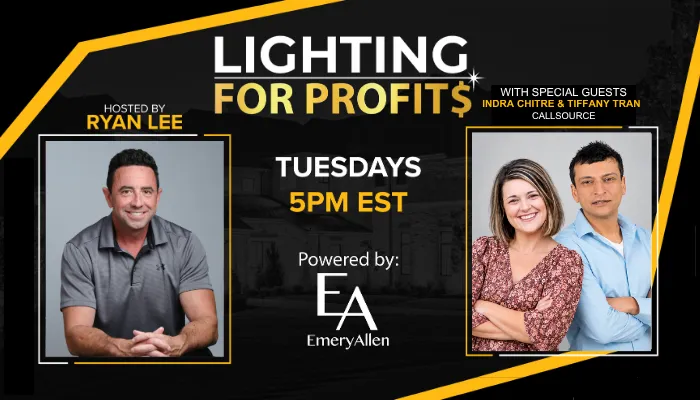
Indra Chitre & Tiffany Tran - Every Call Counts
Lighting for Profits - Episode 260
How can service businesses turn more calls and leads into actual customers?
In this episode, we’re joined by Indra Chitre, President & CFO at CallSource, and Tiffany Tran, Senior Director of Call Center Operations & Client Success at CallSource, to talk about lead conversion, customer experience, and smarter follow-up strategies.
With over a decade of experience at CallSource, Tiffany shares practical insights on missed calls, unsold estimates, past customers, outbound calling, and how businesses can build stronger systems that turn more opportunities into measurable revenue.
Watch the episode
Episode Transcript
Welcome to Lighting for Profits and Setting the Stage for Today's Discussion
Welcome to Lighting for Profits. All light. All light.
All Light. Powered by EmeryAllen. Here is your host, Ryan Lee.
All right. All light, all light. Welcome, welcome, welcome to the number one landscape lighting podcast in Calabasas, California. It's, uh, going to be an awesome show, guys. You know, almost every landscape lighting business owner that I talk to could be holiday lighting, permanent light, doesn't matter, any outdoor lighting company. I'm like, what's the number one thing you need help with? Almost everyone says I need more leads. But guess what? That's not what we're talking about today.
Identifying the Two Biggest Mistakes Holding Back Outdoor Lighting Companies Today
Because in my experience after work, like literally seeing behind the scenes of all these companies, I'm realizing that, yeah, leads, you know, at some point are important, but they're missing out on so many different things because of these two biggest mistakes I see outdoor lighting companies make. And so we're going to be talking about what those two mistakes are on today's podcast and what you can do about them and how you can overcome them so that then you can get more leads. So, um, super excited about that. Uh, in fact, today we've got Call, uh, Source on the show. They're a recent new, uh, partner of ours, which I'm so excited about because they're helping solve these two problems that I'm talking about.
Introducing Call Source and Highlighting Their Role in Solving Business Challenges
And, uh, we've got the president and CFO at Call Source, Indra Chitre, and we've got Tiffany Tran, the newest partner at Call Source, so excited to have both of them on. And it's, uh, going to be an excellent show. So make sure you guys stick around to find out what these two major, major problems are in your outdoor lighting business that you probably don't even aren't even aware of and what you can do to solve them. Uh, reminding you, um, that, um, Light it UP Expo happening March 1 through 4, 2027, if you are ready to get registered, which by the way, um, it's going to sell out there. I went and toured the room.
Event and Sponsor Shout-outs: Light it UP Expo and Lights for Decorators
There's only so many seats available and we're already trying to figure out how to ways, ways we can fit more people in there. But get your ticket@, ah, lightedup expo. com it's gonna be in Vegas. Go to lightedupexpo. com and you can find out all the details and, um, get your ticket there. Um, by the way, big shout out to lights, uh, for decorators and the owner, Jimmy Tompkins, whether you're doing landscape lighting, holiday lighting, permanent lighting, um, they're obviously an incredible resource. Great, uh, distributor products.
Highlighting Lights for Decorators' Business Growth Support and Training
But the Thing that I think separates them is their ability to help you grow your business. Uh, Jimmy came and spoke at, uh, Secret Summit and he's constantly giving back, um, with training and support. And they have tons of different training sessions, live training sessions throughout the year. So if you're looking to win your local market, go to lightsfordecorators. com, get in touch with their team and get the latest training schedule. Um, alright, so again guys, we've got Indra and Tiffany with call, uh, Source coming on in just a few minutes.
The Power of Community and Events in Achieving Personal and Business Dreams
Before we have them on, I've got something that I want to share. So actually this last week, um, I had the opportunity to live out, live out a dream of mine. Um, it was such a cool experience. Um, and I got to speak at Funnel Hacking Live. Now, I understand a lot of people in the lighting industry don't even know what Funnel Hacking Live is, and I'm not going to necessarily fill you like, in on all the different particulars, but I went to this event six years ago. Okay? This is why it's important. I went to this event six years ago right after I had sold my, my lighting business and I was trying to figure out what I wanted to do with my life. I had already started a small digital marketing agency. I had some, uh, businesses that I was running ads for and websites and getting reviews for and stuff like that. Um, and I go to this event not really even knowing why I was going. I just thought, well, I should probably get better at marketing and there's a lot of people going to this that are really smart marketers and so I should probably network, right? I go to this event and I entered the event not really knowing what I wanted to get out of it. And I'm not kidding, like, I left like three or four days later with this grand epiphany. And that was the start of the idea of landscape lighting secrets.
The Seed of an Idea: From Funnel Hacking Live to Landscape Lighting Secrets
Like the seed was planted and the idea was born in that room. Okay? And I remember sitting there and I see all these people on stage talking about their message and their dreams and their communities that they built. And I thought, man, I wonder if I could do that. I wonder if I could build an outdoor lighting community. And I thought to myself, like, how cool would it be to be on that stage one day? And I was like, oh man, that would be so cool to be able to share my story. And last week I got to live that dream. It was crazy. It was, it was just unreal.
Overcoming Fear and Pressure: Speaking on a Larger Stage and Living Dreams
I couldn't even believe that I got invited for one and then Just to go out there. There was such a range of emotions. And, uh, it was. I was. This was the most nervous I had been for any speaking engagement. Um, partly because, one, I'm used to speaking to crowds of like 50 or 100 or lighted up expo last year we had like two 77. So, like, that's a big crowd for me. This, the audience here was 2,000 people. So I was like, dang, like, I don't even know if I can do that. Um, and then the other reason was like, I'm okay, like, messing up if I'm going to mess up my own life. Like, if I go on my own stage and screw up, then people are just like, oh, you're an idiot. Um, and I'm okay with that because it's like, uh, it only affects me, right? But now I'm speaking on someone else else's stage. And there was a lot of pressure. I was like, I don't want to, like, let them down. I don't want to let their community down. And so I prepared a ton. I practiced this thing over and over and over, prepared, practiced it a couple more times, uh, in my hotel room, uh, the night before, and then went and did it. And it was such a cool experience. Um, and so the reason I'm sharing this with you is because I got to like, literally, like, live one of my dreams.
The Importance of Community and Mentorship in Achieving Business and Personal Growth
And I've been so lucky, I've been so blessed. Like, I've been able to live, like, several dreams of mine over the past few years. And I'm telling you this because, um, I realized that a couple things. Number one is when I owned my landscape lighting business, I wasn't around communities. I wasn't like, going to events. I wasn't, um, I didn't. I had never hired a coach. I had never been part of a mastermind. Like, those were all foreign concepts to me. And I believe, you know, and this is just my opinion, but I believe that, like, the reason why I've got to live so many of my dreams the past few years is because I've attached myself to other communities. I've attached myself to coaches that and masterminds. And I'm not just stuck in my little bubble and it's empowered me to, like, make bigger dreams. Like, normally in the past, I wouldn't be like, oh, I want to speak on that stage. Like, I want to. I want to create impact and influence in the world. Like that me, 10 years ago doesn't talk and think like that. It thinks like that. But then I remember like, shutting down my dreams. Cause I'm like, oh, it's probably not possible now. I don't have an idea that, that I, that I, that I don't think is possible.
Dreaming Bigger and Taking Action: The Journey of Unforeseen Business Opportunities
I might not know all the steps to get there, but, uh, it's empowered me to think bigger. So I want you guys to like, dream bigger.
Okay.
And then, um, the other thing is, even though I had the idea for Landscape Lighting Secrets, um, at that event six years ago, I didn't know what, I didn't know. I didn't know what the future was going to hold. I didn't, you know, I had no idea that I was going to start Lighting for Profits podcast. That for sure wasn't in my mind. I had no idea that I was going to start Landscape Lighting Lives. Um, that was not an idea in my mind. I had no idea I was going to start Light It Up Expo. Had no idea I was going to start Lighting Academy. Had no idea we were going to have different levels to our program and have luminary and lighting Legends. I had no idea that we were going to have our own buyers group. Like, all these things, I had no idea. I just thought, well, maybe I could go down this path and start this community and coaching program. And so you also don't know what you don't know. So stop stressing about having it all figured out. Like, the key is just to take action and you don't have to know all the different ways to get there. Just keep moving forward. Um, if your dream is to build a $5 million lighting business, you don't have to know all the steps how to get there.
Setting Checkpoints: The Key to Sustainable Growth and Avoiding Plateaus
Um, you probably haven't even sold a million dollars in a year yet. So why are you focused and worried about building a $5 million business? You need to figure out how to build a million dollar business first. You're usually focused on the wrong things. And so one of the things that I'm learning to do is not just build dreams and not just build goals, but build in checkpoints. Uh, this has become honestly, like, massive for me. Um, and I believe this is why. One of the reasons why I'm really starting to live my dreams running Light It Up Expo last year was a huge dream of mine. Um, uh, this podcast is a huge dream of mine. Like, I get to live these things out because of these checkpoints. Okay. And so, like, whether it's the podcast, Landscape Lighting Live, Light It Up Expo, uh, we've got a hundred members in Landscape Lighting Secrets now speaking at Funny Funnel Hacking Live. Uh, when you start to like realize your dreams, they, at least for me, they don't feel real. I'm like, okay, like that's insane that this is happening. But then like the next day, literally like the next day it's done, your dream is done. So what's next? Um, same thing. I remember hitting my first million dollar year in my landscape lighting business. It was like the coolest thing to strive for. And then once I got it, it was like, not that big of a deal, like, okay, now what? And um, the reason checkpoints are important because if you create these big goals and big dreams and then you hit them, you can almost get depressed because then you're like, well now what? Like I thought that I was supposed to work my whole life to that and I got it in two years, I got it in three years, I got it in six years, whatever it is, right? Um, so you need checkpoints. Otherwise you're not going to know your next destination and you're going to end up, you know, plateauing. And as an entrepreneur, if you're not growing, you're dying.
Implementing Daily and Weekly Checkpoints for Consistent Progress and Fun
And so if you've been stuck for a while, um, I've got this, this checkpoint thing that might be able to help you out. Um, come up with checkpoints that aren't very far out. So I know sometimes you'll hear people talk about like your 10 year vision and your three year, and even your one year like can, can seem too big, right? So come up with checkpoints that aren't far out. Like every month you should be hitting a major checkpoint. Okay? And if your checkpoint is like too far out, it will feel unachievable and your natural tendency is to think, well, uh, it's not possible. So I'm not going to move toward that. So I'm recommending that you come up with daily checkpoints. And these daily checkpoints are going to get you to your weekly checkpoints. Those weekly checkpoints will get you to your monthly checkpoints, the monthlies get you to your quarterlies, and your quarterlies get to your yearly checkpoints. Because business should be fun and it's so depressing sometimes when you're like, I don't know why I can't get traction. I know I'm capable of here, but I'm stuck here, right? Um, so have fun with it, gamify it, but build in these checkpoints and I promise you guys, you can live your dream. I can't believe how much I've been able to live of my dreams the past few years.
Applying the Checkpoint Strategy to Personal and Professional Life for Fulfillment
Um, and I'M talking about four or five business ones. But even with my family, some of the things that we've been able to do as a family has helped me feel like I'm a better husband, a better father. Right. And so it's not just business. Although I tend to talk more about that on the show because it's a business lighting business podcast. But come up with your different checkpoints on, like, who you want to be, uh, what type of leader, what type of, uh, you know, spouse you want to be, what type of, uh, parent you want to be, what type of business partner you want to be. And you can, you literally can create your own story, you can create your own dreams by just reverse engineering the destination and getting you there. But be careful, because I'm telling you, you will get to the point where you win and you get to your dream and you need another checkpoint built in. So, um, hopefully that will encourage at least one of you. That's my goal.
The Power of Actionable Advice and the Importance of Checkpoints Over Goals
I'm always speaking to one person on this show. If I can inspire you, if I can give you some type of. Not just motivation, but something you can go and implement in your business, then I feel like I've won the day. So, um, go out, create your checkpoints. Stop creating goals, because goals, what happens when you realize them or you don't like, you either get depressed because you didn't make it or you realize it and you realize it doesn't make you that happy. You need the next checkpoint to get you to your next destination. So, um, that's all I got to say about that.
Emory Allen's Premium LED Lamps: Quality and Reliability for Landscape Lighting Professionals
All right, guys, you know this. Friends don't let friends install garbage lamps. If you want less callbacks, more referrals, and repeat business, then stick with Emory Allen. Emory Allen makes premium LED lamps for lighting professionals who demand the best. Don't settle for less. Upgrade your designs and installations today with Emory Allen. Just reach out to jackson l@emeryallen. com to learn more and take advantage. Take advantage of their contractor pricing. Just email jacksonlryallen. com his name's Jackson Lebrecht, but you don't have to know how to spell Lebrecht because it's just jackson l@emryallen. com. don't forget to mention that you heard about him here on Lighting for Profits and he will hook you up to with that discounted contractor pricing. All right, I think it's time, I hope, uh, hope you guys are ready to find out the two major mistakes that most outdoor lighting companies are making. Let's get the music going. What do you guys say?
Introducing Call Source: A Vital Resource for Outdoor Lighting Businesses
Welcome to the show. Ms. Tiffany Tran and Indra. Indra Chitre.
Perfect. Thank you so much for having us run. Um, and what an amazing message to start this with, like, um, around the checkpoints. Dream bigger. I wish I had you in my ear, uh, every Monday morning.
Let's set it up, man. 6:00am let's go.
Let's do it now.
Thank you so much for saying that and thank you guys for joining me. Um, it's always, um, I don't know, this show has been so fun because I get to meet so many different types of people. Um, we have like lighting business owners on here. We have different types of vendors, manufacturers, distributors, um, someone like yourself. I consider you guys a resource to the lighting industry. And it's important for me to develop these relationships because in our group it's all about, I'm kind of like selling information. Um, um, do this, do this, do this. But if you don't have someone, you guys in their corner, it's hard to succeed. There's so many different ways to fail in business. And so I'm grateful that we got introduced. We got introduced by Trent Lowenstein. Kind of last minute, right before Light Up Expo. You guys come, you're a vendor, you guys get some traction and you're like, hey, we want to do more. So, um, thanks for coming on the show today.
Tiffany Tran's Role at Call Source: Client Relationships and Post-Sale Support
Excited to be here, super excited. Um, if you want to just do a quick introduction, um, let's start with Tiffany. Tiffany, you want to just introduce who you are and what you do at, uh, Call Source?
Yeah, ah, absolutely. Thanks, Ryan. So I'm Tiffany Tran. I head our call center here at Call Source as well as all of our. Anything post sale really falls under my wheelhouse. So all of our coaching and training, account management, all of those teams fall under my wheelhouse. So really my main goal is to build relationships with our clients and help our business grow.
Very cool. Awesome. And uh, how about you, Inder?
So I'm the president and CFO of Call Source, uh, which basically means anything that goes wrong is my fault. Tiffany will vouch for that.
Indra Chitre's Leadership at Call Source: Longevity, Innovation, and Industry Partnerships
Um, absolutely. And, uh, the interesting thing about Call Source, um, we service multiple vertical markets, uh, across different, uh, products and services. So there's always a constant evolution of the products and services we provide for those who don't know us. Uh, by the way, we are in business for 35 years, uh, going on to 36.
Um, congratulations. That's amazing by the way.
Thank you, thank you. Not many, uh, tech enabled services businesses have that Level of longevity. Right. So we are very proud at being able to, uh, identify needs of our clients, um, and then tailor our service offerings to those. So, super excited, uh, for the work we are doing with, uh, exterior lighting industry, for example. And, uh, thank you. Thank you, Ryan, for the partnership.
Looking forward to it. It's going to be awesome.
Introducing the 'You Make the Call' Game and the Importance of Leads vs. Process
Um, and actually later today, I'm excited because we're going to have you guys play this game that we came up with because of your sponsorship called you make the Call. So that's going to be kind of fun to have.
Love it.
The source partners play the game, you make the call.
Hopefully we get a passing grade.
We'll see.
We'll see.
There's no wrong answer, but today, maybe there is.
The Universal Need for Leads in Business: A Starting Point for Deeper Issues
Well, talk to us a little bit about. So I was kind of teasing at the beginning, like, uh, you know, and I'm not kidding, like, when I say, like, if I. When I get on these strategy sessions with business owners, I'm like, so what, what's, what's the number one thing you need help with right now? And almost everybody says the same thing, you know, I need more leads. And, and I get that.
Mistake #1: Neglecting Lead Nurturing and Focusing Solely on New Lead Generation
Like, you definitely need leads to, like, you know, survive in business, but at least from my perspective. And I. And I'd like to hear yours too, maybe especially from Tiffany. Like, what, what in your. When in your mind, like, what are, like, what are the biggest mistakes when you get on the phone with these business owners? What are the problems that you're seeing when you start to work with them?
Yeah, absolutely. I think one of the biggest things that I'm starting to find is to your point, everybody wants more leads, but they're not actually nurturing the leads that they have. Right. So they've already generated leads that are interested in the service that they provide, and they call them maybe once, then they put them into a texting campaign and don't ever really pay attention to them again. It's all automation. And one of the biggest things we've been finding is it's not just about making multiple outbound calls to them, but also at the right time.
Right.
So are we calling them when they're available? Are we calling them in the middle of their workday when they're in meetings and can't take our call?
Optimizing Call Times: Strategies for Reaching Customers When They Are Available
And so we tend to see this thing where it's like, hey, well, if I just generate one more lead, I 10 more leads, then I'll get more appointments. But really there's a wealth of revenue and appointments and customers already within their database that they're just not mining or tending to.
Interesting. So you're what, like, are most businesses just calling people back during business hours, and that's one of the reasons why they're not getting a hold of them?
That sounds like it's one of the biggest reasons. So one of the big things that we started transitioning to is the number one success rate we're seeing is if you make a phone call between 5 and 7pm in your local time zone. Right. Your customers are off work, they've dropped off their kids at activities, and then they can actually pick up the phone. Right. Or are we calling them after they've dropped their kids off before they get to the office and rotating those in?
Personal Anecdote: The Cost of Missed Calls and the Importance of Responsiveness
Or even Saturdays when there's less obligation at work and they can actually spend the time with you to talk through your project?
That's huge. Well, I've told this story, uh, before. It's like, when I was really young in business, I was literally in a tree changing a light bulb, missed a phone call, which was a normal day in my life. And I called the lady back. She's like, hey, um, thanks so much for calling, but we already got an appointment with someone else. We'll probably just go with them. And I was like, but, I mean, I come out and meet with you and go over design and everything. She's like, no, it's okay. You know, they answered their phone. And I was like, what? They answered their phone? Seriously? And so then I started to do the math in my head, and I was like, well, there's another one. I, um, I called a lot of people back, but they weren't. She was really nice. It was hard to even get mad at her because she was from Texas and she's super nice. They're all nice there. But if it was, I was at least frustrated with myself. And I realized there were so many other people that I had called back, you know, and for me, follow up maybe two or three times, and then I'm on to the next lead because I know I've got a, uh, hot lead tonight that's an inbound. It's. I'm going to make $10,000. So I tend to forget about those ones that I may have called once or twice. Right.
Yeah.
The Challenge of Follow-Up: Balancing Hustle with Consistent Customer Engagement
And I bet you that still going on today with all these, you know, young hustlers that are trying to make it, and there's so many, they're getting pulled in all the different directions. So I would have never thought to call them after hours, to be honest. Because like, yeah, I was, I wanted to be home with my family too. Right.
Yeah. I think that's a big thing. Right. Is that's why we forget that we need to call them later in the day because we're stuck in our after work lives and what do we need to focus on? And I think to your point, they're in the same situation. A lot of these guys don't have someone in the office who can answer those calls or they're doing multiple things. So the intent is there. They want to do it. They've actually hired the help, but they're wearing a million hats in the office. They have to get those invoices out, they have to make sure the projects get started, did the inventory get ordered. And so it's not always top of mind when there's other fires that they're putting out, which is where we're coming in and really helping them either build a structure and we've had clients that that's what they needed. Right. They needed us to show them the way of how to do that. But others, it's the continuous efforts and going back and circling them back a month later. Maybe timing wasn't right. The empathy of.
Empathy and Persistence: Understanding Customer Situations and the Value of Follow-Up
We just talked to someone in lighting the other day and a customer was like, thank you so much for reaching out. This fell off my plate because my husband passed away and this was a project he was working on. But now I'm ready to get this done because this year I won't be able to do it myself for lighting. So I'm really. Hop can get some help with that. And you just never know the situation. Right.
So, yeah, you're right. I think, uh, you know, at least for me. And I feel like I'm a, a lot like everyone else listening to this. It's like if I call someone a couple times and they don't call me back, it's like, okay, I can take a hint, you're not interested. But the truth is that's not true. You know, they, they, they're busy taking their kid to soccer or there was a, uh, death in the family. I mean, there's lots of different reasons why they might not be returning right now. But until they tell you, like, stop calling me, I've already hired someone else.
The Pitfalls of Automation: Text Drip Campaigns and the Need for Timely Connection
We don't know that they, like, they're still interested, right?
Yeah. And I think it's also part of it is like text drip campaigns are great, but how many advertisements do you get on your phone that you signed up for the advertisement so you could get that Extra discount and their phones blow up with those every day. Well, your text message just gets lost at the end of the day. So sometimes it's all about timing and connecting those two as well.
Nice. What do you think, Indra?
You know, um,
Process Optimization Over Advertising Spend: The Role of Call Source in Improving Outbound Efforts
uh, I was going
to say generally speaking, however, in the broader context of this discussion, ah, the answer is rarely ever that go ahead and spend more money with Google or any of the ad sources you are using. What Tiffany is talking about. You first need to optimize your processes. That may involve handling those processes internally or using an external company like Call Source before you spend more money on advertising. So rarely ever have we come across a, uh, retail business. Uh, retail meaning servicing a local market where they're not spending enough on advertising. Right. So from our standpoint, um, uh, extraordinarily important, uh, and how you prefaced this discussion, Ryan, it's not really about, oh, I need more leads. Um, it's almost always about, uh, perfecting your processes. And part of that is, uh, one of the biggest gaps we see is on the outbound efforts. A lot of companies these days are using AI tools, this, that and the above for the inbound side of things. Um, but we. One of the biggest needs that can help move the needle on the bottom line is, uh, perfecting your outbound processes. So in that broader framework, um, that's exactly what Call Source is helping solve.
The Crucial Role of Phone Skills and Handling Objections in Business Success
Okay, cool. So let's say that m. Whether they get trained by you or they figure it out on their own and they actually get the process down, how often do you run into companies that they just don't have the right phone skills like the language or the flow, the vibe of the call. Because I feel like I've heard people like, oh no, we do the follow ups and I'm like, dang, maybe they got it down. And then you listen to a call and you're like, what?
There's definitely the DNA of a company. Right. So the concept of. Because I myself, uh, outside of Call Source, I'm a local business owner. We do auto services. Um, my guys are good at auto. My guys are not experts at handling phone calls. Right. So I would say, ah, generally speaking, um, if you are in the business of exterior lighting, uh, you will have gaps on the phone skills side of things, uh, unless you come from that background of running a call center. Right. So it is more prevalent than we think. And then the second part to that is also a lot of times, um, depending on the scale of the business, right. The person handling the phone calls is, uh, Somebody in the family member is a family member. Right. So, um, and, um, let's say if your spouse, ah, your wife is handling the phone calls, it'd be kind of tricky to put, uh, some training in place. Right. So we come across a lot of those situations also. I, I would say, I mean, tiff, uh, you can go with the stats, but, um, my position is, generally speaking, phone skills are lacking, especially with retail businesses.
Is there, is there any, like, is there any, like, specific language, uh, or things that, you know, contractors are using that turns off prospects? Tiffany?
The Impact of Customer Service Voice: Making Clients Feel Valued and Prioritized
I think, honestly, one of the biggest things is feeling, making the customer feel like they're being rushed or they're hindering them from doing something else. Right. They're, they're a thorn in their side. They're not the top priority. And one of the regular conversations I have with my team, surprisingly enough, is a customer service voice is real. If you sound rushed, if you sound like you don't want to be engaged in the conversation, which is the number one thing we hear on calls, is they just don't seem like they want to be engaged in that conversation because they're putting a light in a tree. Right. Or they're doing something else while they're taking that call. If the customer doesn't feel like they're your priority at that point in time, they're going to think that to your business, they're not a priority in the long term. Right.
AI vs. Human Connection: The Risks of Impersonal Interactions and Empathy Gaps
And just expressing empathy for situations, understanding exactly what their needs are and making them feel heard, I think is probably the biggest change that most small businesses need to make is really understanding their needs and just making them feel like they're people. Right. And they are a priority.
If you don't mind, uh, taking two minutes and also explaining. So on one end, there is the people handling the phone calls. Right. But recently we came across an example where AI is handling the phone call. Yeah. Um, so the empathy and relating to the customer concept actually applies on both ends. So if you could take two minutes and explain what, what we just came, uh, across that, that will put things in perspective.
Yeah, absolutely. So we make callbacks for a client where they didn't book the call on the first call. Right. And our agents came across a call where the AI bot actually laughed at a customer and started chuckling multiple times. I think it was like three by the end of the call, and the customer was calling to cancel. And so she asks the AI outright, are you laughing at me? And it laughs again. And I think that's something that we forget Right. Like, the AI still has to be monitored even if we're using it. But I was baffled. I'm like, what do I do with this?
Like, yeah, that's crazy.
Like, but it happens, right? Or if there's something out of context that's happening in the office while you're taking calls, it's the same. It's the same concept. Right. If they hear all this noise in the background, they hear all these people talking, you don't feel like the priority. They're going to feel the same way as if the AI is laughing at you as they're talking to you about something serious.
Yeah, that's crazy. I mean, that's where AI just doesn't, um. It doesn't have empathy yet. Yet. Because I think it's gonna work.
Yeah. Yeah.
The Cost of Poor Phone Skills: Missed Opportunities and Reduced ROI in Marketing
It doesn't understand. It doesn't have context. It still has lacking those things. And of course, AI is awesome. It's changed all of our businesses in certain ways. But, um, I had someone. I cannot think of the specific example, but they called me. I had, like, an appointment with them, and then they, like, stood me up. And then they called me back. And I wish I had this, like, recorded, because it's. They said something along the lines of like, oh, hey, sorry about that. I was dealing with another customer, and I was just like, hold on. Like, first of all, like, I don't care about other customers. As a customer that has a need right here in this moment, I don't care. I do not care about other people in that moment. Like, you should have empathy. Uh, I don't. And then dealing with a customer, I was like, just such a simple thing that just turned me off so fast on, like, how they responded. Um, and we've all made mistakes. We've missed appointments, We've done things, but it's just like that. That outbound call to me was just a perfect example of what not to do, because it totally turned me off to the situation.
Yeah, I think you're right. I think that's a big one. And those are things like, we'll call cancel appointments for clients as well. And that's something that I reiterate to my team. I'm like, it's okay if we apologize for the mistake. Right? It's. It's okay if we come hat in hand and just say, hey, I'm so sorry, but we need to move your appointment. We don't like to do this, but those explanations go a long way with the customer versus just, oh, sorry, I was dealing with another customer. So I. I missed your appointment entirely. Right. It's how you approach them, how you come back to them. If something important happened, it just explaining that. I think we have to remember that everybody, they're people too. Right. And with AI growing, all the robot conversations growing, I think more than ever people are looking for that human connection to just actually be able to talk to someone when something goes wrong versus getting stuck in an infinite lo of I have a problem and I need to talk to a live agent. And you can't ever find that live agent and that call thread.
Yeah, that's why I think, uh, you know, I've been teasing it. That's why I think phone skills is one of the two major, major things.
The Financial Impact of Lacking Phone Skills on Marketing ROI and Business Growth
Because, you know, I encourage outdoor lighting businesses to spend as much as possible, to be honest, on customer, uh, acquisition marketing, those types of things. And when I was in growth mode and not really caring about bragging to my friends about my profit margin, I just wanted like to get market share. I was doing 15, even up to 20% of my revenue just spending on marketing. Well, you start, you spend those kind of. Even if you're spending 10%, it doesn't matter. Any money you're spending on marketing that then you piss off a client or have a missed opportunity. In our world, in landscape lighting, the average tickets around like 10 to $12,000. So it adds up quick I a lot. And so if you just miss out on like one or two a month, and in most cases I think it's more than that, but even just one or two a month, like, those were the deals that were going to make that, like, a lot of people will call me and say, yeah, I'm not going to do this. Um, I was using this company to do marketing for me. I'm not going to do it anymore because I'm not getting a good roi. Well, had they gotten those two extra deals that they should have gotten but they lacked the phone skills for their ROI would have been completely different. And now they're cutting off one of the arms and arteries of their business. And they're going to wonder, like, I don't know how these companies get to 2 million, 3 million, 5 million and beyond. Because you can't, unless you're investing in marketing and doing those things. And you can't do that if you're, if you lack the phone skills.
Correct. So you're in effect, if you try to solve the problem by spending money on marketing or more marketing, you're kind of compounding the issue.
Yeah, right. Yeah.
Prioritizing Follow-Up Efforts: Focusing on Recent Leads for Maximum Impact
Uh, so let's say you guys start working with a lighting company. Um, and maybe there's more options than this, but these were the three I came up with is like, who would you reach out to first? Would it be old estimates, uh, past customers or leads who never booked?
I think it just depends on timing. Right. So I know a lot of the landscaping guys right now are getting ready to prep for holiday lights. Right. So past customers might be your best target right now to generate that revenue. Someone, you know who's going to engage with your business or they've at least inquired or engaged before. I think those help if that's what you're focusing on. Um, I think it really truly depends on the situation. If there's past estimates that you haven't done any follow up on. Absolutely. And I think one big thing that clients tend to forget is like, hey, guys, what are the most recent ones you haven't talked to? And you start there and work backwards versus sometimes we'll get clients, they're like, hey, can you call everybody from January of this year and try to get them back? And I'm like, yeah, we can absolutely do that. But your highest value right now is everybody you've talked to in the last 45 days that you didn't maybe get to accept your proposal. There's still value in these other calls, but chances are you're going to find the highest return in the last 45 days.
That's good stuff right there. Yeah. Because I could see where the tendency is like, oh, let's just start with January 1st, and then work this way, and you're just not going to get a good result. So then you're probably going to want to give up because you're human.
Yeah, yeah, yeah.
You need that success. So that makes sense.
Yeah, it's. It's a mind game. Right.
Mastering the Art of Follow-Up: Asking the Right Questions to Overcome Objections
Especially when you're making that volume of calls. Because how many proposals have you given this year that weren't accepted? And if you can't get that traction, it definitely plays. It's a lot of extra effort if you can't get at least some easy wins.
What, what have you guys learned about, um, like, calls where, you know, you call back the customer and they just kind of are kicking the ball down the field? Not right now. It could be, I've got a project I got to finish, or for whatever reason, it ends up in the not right now situation. But we know that a lot of those can eventually become a buyer. And, uh, talk to us about kind of what you've learned throughout that process,
I think a big one, is still nurturing that lead. Right. Knowing and understanding and personalizing to their why that they're giving you? Because it keeps the conversation going or also understanding. I think one of the big questions we started asking is, what would it take for you to move forward? Is there something that's kind of blocking that, if that was removed, that we could help you with? But also just understanding and knowing if you tell them you're going to follow up on a certain day and time, that you make sure you do that. Right, because then it's showing that you've got that commitment and that consistency as you're approaching that lead.
You just said it super fast, so I think people are going to skip over it. But will you say what you just said again about asking them, um, what would have to be true or, uh, however you just worded that?
Yeah, absolutely. What would it take for you to move forward? So understanding what the true roadblock is for them, because I think sometimes we think they're trying to push the appointment off, but there's something that's actually preventing them. And that's the easiest objection that they can give you. Right. Is not right now I have this or my son's soccer was more expensive than I anticipated. And so sometimes it's just better. Understanding the actual roadblock, uh, of what would it take to move forward. If there was something I could do to help today, what would that be in order to get you to move forward with the project?
That's just so good. I, I literally, that's why I'm like, hold on, we got to talk about this for a second.
Yes.
Like, most people make, make the phone call. Hey, you know, we got, you know, we'll do it later. When I started asking that question, like, what would, like, what would it take for us to be able to move forward today? That changes everything. I mean, a lot of people will call them like, hey, I know it's been six months. Um, we're doing a deal right now. If you, if you move forward with us, we'll take off 10% or whatever. It's like, well, you don't know that that was the, the objection. You don't know that was what was holding them back. And so that is just a beautiful question. The way you worded it is even better than mine. I think about just, like, finding out what the real concern is. Sometimes it is like, no, hey, we're, we're definitely going to do it next week. We got the guy coming out to do the pool Design, and we want to make sure. Whatever. Oh, cool. So now you know, like, what the next steps are. Do we need to, uh, put down 10% to hold a deposit on the install schedule? Um, sometimes when I start asking that question, the weirdest stuff would come up. They'd be like, well, what's the warranty again? I'm like, oh, they just aren't sold yet. They just don't believe it yet. They just don't believe me. So I just have to, like, answer some more questions. And then it's like, all right, well, yeah, we're ready to go. And for some reason, they don't dare call you back and say, what was the warranty? I don't know why, but that's just how it is. And so, uh, asking the question that you just said is so awesome because it gets them, Allows them to open up and share the exact reason why they're not moving forward right now.
Yeah, absolutely. I think that we all get those roadblocks. Right. There's always something as to why we can't move forward right now. And to your point, maybe I'm just not fully sold yet on the idea of the project, and I just need to have an honest conversation to figure out where my needs really are and how I can be met there with the company.
The Long Game of Follow-Up: Building Trust and Securing Deals Over Time
Yeah, I've had people say, well, you know, what happens if a light goes out? And just questions that we probably already answered somewhere throughout the sales process. But, you know, we forget that we're experts in a certain field. And of course we know everything because we've been doing it for years. But these guys are trying to, like, learn all about outdoor lighting in a, uh, sometimes a 30 minute conversation. They're not going to retain all that information. And so just strictly that follow up has gotten me so many deals. I've had people actually that told me, man, we, we really did not want to go with you. Like, your price, like, just made us so mad. Like, how can you guys charge this much? We knew there was going to be, uh, another company that does the same quality of work. It's less price. We couldn't find them. And now we can't even get people to follow up with us. Just the fact that you kept checking in with us, sometimes it takes six months, a year, two years. Like, those are the deals that pay for your next marketing venture.
Yeah. I think it also shows your commitment to the customer. Right. You're not willing to forget about them after two weeks. And I think something in our human nature just lets us assimilate to that a little bit better.
Um, what is a. So you know, you guys, this is what you do for a living. I think I kind of want to serve, uh, two purposes here. Number one, there's people that are just going to be like, ah, I don't think I need to hire a call source.
Implementing a Balanced Follow-Up Process: Value, Cadence, and Timing
I want to do it on my own. So I want to give them like, okay, you guys should at least be doing these things. Um, and then when people realize it's not just about learning a script or two, it's about a whole process behind it, then they'll probably be like, okay, I tried it on my own, I'll reach out to call source. But I still like to give so much value where it's like, hey, at least go do these things. What, what would be like a sensible follow up process? What would that look like? That is not too spammy, that's not too desperate, but still it provides value in that relationship.
Yeah, absolutely. I think one of the biggest things that we've talked to clients about is putting in a true, what we call a call cadence on our side. To your point, Ryan, don't call them 10 times in one day. Don't send, you know, five text messages after you've called them. And you want to keep building value as you're talking to them. One of the biggest things that we do is we space out our initial call cadence to be at least two weeks and sometimes up to four weeks, depending on the feedback that we're getting. Just because it takes that time. Right. Changing to what we talked about earlier, changing the time that you're calling them to fit their schedule and not your schedule. If after hours doesn't work, maybe try typical lunch hours. Right. When you know that maybe, hey, they might be taking their lunch sometime between 11 and 1. So let's try to make some calls between 11 and 1 and shift that for the next one. If they said they weren't available at that time, respect that and try to move those along. And I think that's the biggest one is putting them in a cadence but sticking to it. Because typically we find we'll do a five call cadence, typically when we're starting with a lead before we put it back into a nurture campaign. But with that it's finding that right timing for the customer. But typically we're finding that they actually convert between calls 3 and 4, not calls 1 and 2 often enough, but typically between 3 and 4. But we also limit how much we're texting them during that call cadence. So we're only sending one or two text messages timed with our calls so they know who we are and why we're calling, versus, hey, I put a calling campaign, but I also sent them 11 text messages. So we'll make the recommendation to clients to, hey, scale back your. Your nurture campaign with your texting while you're making those phone calls and while we're making these calls. Because you want the best chance at success and not making them feel like you're. You're overwhelming them, I think is the biggest change most companies can make.
The 'You Make the Call' Game: Fun Questions and Call Source Partnership Details
Yeah. Very nice. Yeah, I think it's. It's hard because, like, you. Especially when you have like a. You're either. When you're, like, trying to fill your install schedule, you're just like, man, I'll take anything right now. A $3,000 deal, anything. Or when you, like, have a really nice size opportunity, $50,000, $100,000 or more. You're so anxious of, like, man, like. And if they knew what I knew, they would just be like, getting this done. And so, like, I think people tend to kind of like, come across as desperate for sure when they're following up because they, they just want it so bad.
Yeah.
I think to your point earlier too, right? Immediately offering a discount without knowing and understanding where the customer is. So that would probably be the second thing to change is just asking those questions to understand where their roadblock is versus just immediately offering to discount your product and your offering.
Yeah, makes sense. All, uh, right, guys, we're going to take a quick break because we got to play America's favorite game called you make the Call, powered by Call Source. You guys ready to play?
Let's do it.
Okay, this is, this is going to be fun. We've got some fun questions sprinkled in with some business ones. I've got some for Tiffany and Indra, but. Good way to get to know our guests here. Um, but yeah, powered by Call Source. So we know the fortune is in the follow up. Um, but Call Source makes it easy. Um, I had written down. What was I going to say? Oh, yeah. So here's the thing. Most lighting business owners, they know that it's like, yeah, there's money. You got to follow up, but I'm just too busy. And then we got families and got everything else. So honestly, guys, if you will partner with Call Source today, then let them do the follow up for you. This is buying back your time, uh, by definition. So, um, you guys put together a custom landing page. Try callsource. com LFP stands for lighting for Profits Schedule. Uh, a demo you guys are offering 50 off your first month to try out for, uh, podcast listeners. So thank you guys so much for your support.
Guest Preferences: Coffee vs. Dessert, Vacation Styles, and Dream Destinations
I appreciate it.
Thank you. Thank you, Ryan.
Okay, so, Tiffany, you have to give up coffee forever or give up dessert forever. Which one's it gonna be? You make the call?
Oh,
probably dessert.
She's giving up dessert. Okay. She loves that coffee. Indra, same question. Giving up coffee forever, give up dessert forever.
You know, I'm starting to get some grays, so I'll. I'll give up the sugar. The dessert. Yeah.
Yeah. All right, we got some coffee lovers in the house. If you guys want to. If you want to, uh, you know, form a good, uh, relationship with these guys, you know what to get them.
That's right.
Tiffany, you're gonna go on vacation. Are you gonna do a packed itinerary or no plans until you wake up each morning?
Probably a packed itinerary. My kids are in the adventure stage, so they like fun, new things to do, so we like to experience as much as we can with them.
All right, what's been your favorite vacation so far?
We did Thailand last year, which was a lot of fun with them.
Awesome.
Yeah, Yeah, I think so far, that's our favorite.
All right, um, and where's your dream vacation? Where do you want to go next?
Alaska.
Nice.
Alaska. If you ask my son, he'd say in our Antarctica, so we could go see penguins, but clearly he doesn't, uh, do all the paying of the bills for those.
Yeah, the season is coming up, right, For Alaska.
Yeah.
It's time.
Um, Indra, dream vacation. Mountain cabin or beach house or new city?
Well, okay, so I am blessed to live near the beach. I'll take the Malibu.
Well, yeah, so I didn't know. I mean, you live right there on the beach of Malibu, but I, uh, didn't know, like, would you go to some other, like, beachy destination, or would you want to go to the mountains?
Um. Um. Ah, Martin it is. I used to be a hiker, if you didn't know that, um, done Everest base camp and all that. And you did something enlightened with that. Yeah. Yeah. Wow.
See, this is why we do this. We find out all these weird things about Alaska and Thailand and hiking Everest. Uh, that's cool. Um, all right, Tiffany, you can become instantly great at one thing.
Instant Skills and Language Preferences: The Value of Communication and Connection
Cooking, dancing, or speaking another language.
Instantly.
Yeah.
Speaking another language.
Another language. All right, which. Which language would it be?
Vietnamese.
Really nice.
I look really random. My husband is Vietnamese. And so. Yes. Yeah, so makes sense. It would allow me to have a lot more conversations with his family, uh, and be able to teach my kids.
Investment Strategies: Demand Generation vs. Key Leaders and Business Profitability
So that would be wonderful.
Well, uh, I don't think we're too far off where we're going to get like something implanted on our brain where you're going to know Vietnamese in an instant.
So winning.
Um, indra, you got 100 grand to invest in a business? Do you hire a key leader or put into demand generation?
In my case, and the answer could differ for different people. Um, I would only invest in businesses that I understand. So if it's something re engineer DNA or a human genome, that that's not me.
Right.
So I would invest in something I understand. And in that case, um, demand gen would be number one priority.
All right, cool. Um, I got another one for you, Indra. You're looking to partner in a lighting business. You can finish the year at $2 million revenue, but only 5% profit margin or a, uh, $1.5 million with 20% margin. Which business would you rather invest in?
I ran the math. It's all about the net net cash flow.
Yeah. Well, the reason I asked it, because I was like, I don't know, like, what if you saw the opportunity and potential of the one with the lower margins and you thought, wow, there's a lot more that I could add value to. Obviously the one that's making 20 is more sexy right now.
I mean, it can go both ways. Right, Ryan? Because the thesis that is okay, if you, it's, it's, it's kind of like a turnaround situation. And if you make these four or five changes, then the margins will be comparable. Right. Um, I guess it all comes to risk versus return. Right. So if you are very confident that you can quickly engineer the turnaround because you've been through those multiple times, times in the past, I, I can see a case for that. Right. Um, in my case, um, not a lighting business owner. So I would, I would have a lower degree of certainty or confidence in my turnaround skill.
That makes sense.
Um, and I would go for the 1.5 million of the smaller business.
Higher margin.
But I also thought through that. Hey, uh, call source also does ad tracking. So maybe I'll push some, uh, advertisements around it and quickly go from 1.5 million to 2 million.
Yeah, yeah.
Right. So again, it's on an individual basis.
Balancing Appointment Volume and Quality: Addressing Sales Team Feedback
In my case, I would still go for the well run business if it's in an industry, uh, where I have not owned retail businesses. In the past.
Yeah, no, that's good. Good perspective. Because I. Yeah, well, I may be calling you
because.
All right, let's do it.
There's businesses that I'm like, hold on. I could. If I. If I was partner in that business, I'm. I haven't done it like you said. So I don't. My confidence is high now, but after you do one or two, it would be higher or lower. Um, but, yes, that's. This is why I love these conversations, because there's lots of different ways to win. All right, Tiffany, uh, your outbound team books plenty of appointments, but the sales team says many are poor fits. Oh. Do you tighten qualification and accept fewer appointments or keep volume high and tell the salesperson to stop whining and maybe get better salespeople?
Yeah. Oh, come on, Ryan. That's a tough one. Um, yeah, I think it's. It's. If I could, I would choose option C to do both at the same time.
Okay.
Uh, that's. Usually my middle of the road is I try to understand both sides, but likely there's a gap on both sides. Right. It's not necessarily just the number of appointments being booked. There's probably a quality issue as well. But if I had to choose, first step would be to review quality and take less appointments.
Okay. Yep. That's why you're a good leader, because you're always looking for the compromise.
That's right.
That's awesome. Very cool. Uh, Indra, you raise prices 15% and lose 20% of your jobs, but profit obviously improves. Do you hold the new price or lower it to win back market share?
Pricing Strategies and Capacity Optimization: Finding the Right Balance for Profitability
Great question. And again, it's so situational. Right. So from a theory standpoint, the most money you would make on the bottom line is when you are optimizing your capacity. Right. So if I have a, uh, I have built my infrastructure and have capacity to deliver a million dollars worth of services. However, I'm, uh, at half a million in revenues. No matter what, that business is going to lose money. Right. And you will not be able to solve that problem by increasing your prices. Right. So to me, generally, Ryan, it's not a pricing issue. Uh, it's. It's more about how much of your capacity you have absorbed in your operations. Uh, applies for retail businesses because retail business deal with a rigid, fixed capacity situation applies to our, uh, contact center, uh, that Tiffany runs. Right. I have X number of agents. There's so many quality calls we are going to make in a given day. Um, those issues generally not solved by pricing. But by, uh, optimizing your capacity.
That's so good. Um, that's why I can't stand Facebook groups, because someone will go ask a question and then they get a bunch of just awesome answers because this is the way to do it. And I'm just like, you don't have enough context to be able to provide good answer to that person because you don't understand their capacity. You don't understand their, their daily overhead. You don't understand like, yeah, there's so many lighting businesses that have like, actually pretty good pricing. Like, and then, then they, they, the capacity thing is interesting. They'll go and screw that up by doing like, they'll uh, have like two guys and they can only install like eight lights a day. And I'm like, well, that doesn't, just because that's your capacity today doesn't mean it should be your capacity. Like, there's other companies that can install 20 lights the same time, so 100.
And then imagine a situation when, uh, you're, you're, you're a startup, right? So you're trying to generate revenue, so you got to cover your overhead, right? In that case, uh, you should be okay taking a below market deal, right. To fill that capacity, right? However, if you are an established business running at 95% capacity, well, uh, you have the advantage. So you should price above market average. Right? So again, these are tricky questions and very situational.
So, um, it's okay. I've told you anything you say can and will be used against you.
Right? There we go.
That's right.
Um, trying to make it controversial. Yeah, I, I think I've got myself in trouble in the past because I, every business I've looked at in the lighting space needs to raise their price. They just, it's just, they do. But like you, you hit on it there. It's like there's a time and a season. Um, if you, if you have, you know, $1500, $2000 of overhead every single day, uh, and you're saying, no, I'm, you know, $12,000 or, or bust.
Premium provide.
Yeah, like you, you might need to do that job for 10 grand just to cover your overhead and break even. And people have the mentality, oh, if I'm not going to make money, I'd rather stay home. Well, just so you know, staying, you staying home is going to cost you that $2,000. So it actually costs you $2,000 to stay home. It's not, not free to stay home. So you got to at least go out and Break even. And I. And if people understood that, they would understand. It's not always just one thing like you're talking about. It's not just raising your price. It's not just capacity. It's how they all relate.
Dime a dozen people who are going to teach you, uh, okay, 100% is revenue, and then gross margin should be minimum 60.
The Nuances of Business Advice: Embracing 'It Depends' for Effective Coaching
And then EBITDA, uh, or pre tax should be 20. Well, under what framework? Right, right. Like, are you trying to maximize.
So anyhow, um, the easiest answer I've learned as a coach, if you. If you know you're dealing with a really good coach, if every single question they say, it depends, it used to frustrate me so bad, my coaches, they'd be like, it depends. I'm like, but just tell me what to do. And it's like you realize it really does just depend.
I'm glad you also get frustrated with that. That, Ryan, because that's my number one frustration with Indra is, wait, what does it depend on? Can we talk through that?
Tell me.
I don't understand. Just tell me the answer.
I can't. I can't finish off the week till I have the answer.
Yeah, that's right. That's right.
I know.
Business is such a journey, right. And it's an amazing journey. And, uh, there's no definitives. It's. It's all. It's all. It depends.
All right, last one for Tiffany. Uh, tightly scripted approach books more appointments, but some callers complain that it feels a little bit impersonal. Do you keep it because it performs or give the team more freedom even if bookings drop?
I've been here, I've been working in this space, ryan, for almost 14 years, and my stance has not changed. I don't ever think that a fully scripted approach is the right one. The reason being is the second someone asks a question that's not in your script, they don't know how to answer and they don't know what to say. Right. And so you're going to run yourself into a problem either way. If the basics are there and it's getting what you want accomplished, then you're still doing the same thing. Right. You just have to teach them how to hone it in. And I think that's all about how you approach your training with them. So not necessarily saying, hey, you have to follow this script word for word. Because I've seen it time and time again. No matter the business, no matter the industry, the second someone is following a rigid script, you get things like Are you a robot? Why, why can't you answer my question? And it happens, right? And so you have to be able to have a free flow conversation with someone as long as all of the important questions are being asked. As long as you're getting to the baseline of what you need in order to get out to, to the home, I think that that's more important by far.
Yeah, very well said. Yeah. Uh, more, more like following like a framework instead of a script, right?
Yep.
Framework vs. Script: Empowering Teams for Effective Customer Interactions
Absolutely.
That's cool guys. Thanks for playing. You make the call. Brought to you by Call Source. That was cool.
Thank you. This was a lot of fun. Thank you. Thank you.
Call Source Partnership and Call to Action: Improving Your Business Processes
Kind of good to get to know each other in a different way. Um, just remind you guys, go to try.callsource.com lfp we'll put it in the show notes as well. That is your custom landing page to get you 50% off your first month to try them out month to month. So you know, you're not, you're not committed to some three year deal or anything like that. Uh, I'm a big fan of Call Source. Highly, highly recommend you check them out for all the reasons we've been talking about today. Um, okay, so just a couple more questions and we wrap it up. Um, Indra, if you, if you were to go into a business, um, and I like putting you on the spot, I realize today this is my big epiphany. Uh, you go into a business, a landscape lighting business. Revenues, uh, up, but they're going, man, my revenue's up, but I still feel broke.
Diagnosing Financial Challenges: Revenue Up, Feeling Broke – Where to Look First
Where I know that you're going to say there's lots of different things, but where would you go look first?
Um, and by the way, that is that question so holds true for not just landscape lighting business. I, I'm pretty sure every business owner has had those thoughts, right?
Yeah, I've made a ton of money before and then I not have any.
So. So, so the scenario is revenues up, um, you're not making more. Uh, where do you go first? Again, your audience is not going to like my answers because again, this is not a definitive. Um, but generally speaking, Ryan, in a business that services the local market, right, And I'm saying generally speaking, not always because there are certain very complicated businesses like that. Um, there's seven or eight variables that if you check the box on those, you're going to do perfectly fine. Right? So as a business owner, you have signed up to work really hard, right? It's not where you are going to hire an expert and offload hard work in a local business. Unfortunately, till you get to a sufficient scale of 20, 30, 50 locations, uh, as a business owner, you're gonna stay in the grind. And if you have seven or eight variables, man, what's first and what's last?
Just take the time, uh, pick one and improve it.
Take one at a time. Take one at a time, right. And try to understand the biggest impact. Right? So if I were in landscape lighting business and let's say I would start with the P and L, right? I go, hey, I'm at 60 point margin, is that okay? Let me call up my friend Ryan. Hey, ryan, I'm generating 60 point gross margin is my cost of goods in line. And if it's not, can you get me in touch with your partners, Emre or whoever you recommend? Because I want to fix that next. Uh, my installers cost me 30 points for a given capacity absorption. Right. Again, it's to have it in perspective.
You.
Yeah.
Is that within reason? Right. So again, I'm, I promise I'm not gonna answer one question of yours definitively.
I think I figured that out.
Right? But business is more, more than, hey, here's a, uh, magic thing I figured out. Here's where the issue is and that's what I'm gonna solve. Because constraint points always move in a long term business, right? The moment you solve your gross margin issue, your constraint point moved elsewhere. There's never going to be the perfect balance. Again, my suggestion on the premise of the question is, um, as a business owner, look, you only have seven or eight variables. Just go through all those and then take the biggest constraint point, start there, but know full well that point's going to move. Then you are on to solving the next constraint point.
Yeah, no, that's good. I think the challenge with, uh, again, I feel like I represent the landscape lighting, the outdoor lighting community pretty well because I'm a lot like everybody else. Like, I just want to go sell lights and install lights. Like that's truly the dream. Like, I want to go to someone's house, meet with them, get to know them, look at all their cool cars, talk about their flashy vacation, see where they went hunting and be like, let me design this space for you to like make you feel like a freaking king and queen when you come home. And then I go and do that and then we install it and then we do a walkthrough at night and they're like, oh my gosh, this is better than we even thought. And they're so grateful to spend tens of thousands of dollars with me. That's the emotional hit that I want as a lighting designer, as a lighting business owner. And now you're telling me I got
to pay attention to numbers 100%, right? Like we, I hope, uh, we all got in the business that we enjoy doing. Right. So I hope every business owner that has that passion for their product or service. Right. Um, but there is an additional step. If you are, ah, signing up a lease for an office space where you have your employees, you have to, uh, put personal guarantees on it. Right? So it's not. So, yes, you must enjoy the trade you are in. But if you want to build something special, if you want to build something valuable that hopefully you can in the future sell or pass on to your kids and retire comfortably, um, very important to deep dive the business side of things. And for those, the audience on here, uh, obviously, you know, Ryan, I mean, uh, he's so fantastic. Uh, not just exterior lighting, but also business in general. I would say just give Ryan a call.
The Importance of Business Acumen: Working on Your Business, Not Just In It
Right? You have to pick up your phone, right?
Checks in the mail. Checks in the mail.
No, but, uh, the question was if I were in that position, I would do that. Right? So 100% with zero hesitation. Um, so again, seven or eight variables. That's, that's all we are talking about. Let's do it. Let's, let's, let's go build something special. Cool.
Well, thank you so much. I just want everyone to know, like, listening, like, this is why I love spending time with Indra. This is why we're partners now. On, he's, uh, sponsoring the podcast and like Lighted up expo and a bunch of other things. It's like when you get in a room like this and you realize, okay, like, there's someone that's made more money than me, built more businesses than me, built bigger teams than me. It's like, okay, well, if I want that, like, I gotta listen to them. And so, um, I understand most people don't want to sit there on a Tuesday afternoon and go over their numbers. But that's the key. Like, if you want to build an actual business, not a job, is. That's when I always say, like, working on your business, not in it. It's not the sexy part at all. But if you'll get uncomfortable and do the unsexy thing in your business, you can do more sexy stuff. Uh, but you got to do this. And that's, I believe that's part of your role as the business owner, as the CEO, is like, you've got to be the one to make data driven decisions. And you can't do that unless you know your numbers. So thank you for sharing that. I appreciate it.
Thank you.
Final Thoughts: Staying Connected to the Customer Experience and Business Fundamentals
Well, um, I guess that's pretty much it. I mean, um, is there anything else you guys want to share before we wrap up? Tiffany, about the call center, about, uh, advice, anything like that? Is there anything you guys want to share before we wrap up?
I think from my side, Ryan, I think just one thing to add to, to Indra's last point. I think just like you said, right, It. Sometimes you want to get out there and you want to do a design, you want to get that feeling again. And I think a big thing for me as, uh, my roles have changed over the last 14 years is sometimes I do still go and get my hands dirty to get that feeling, feeling back. Right? To go and just experience what it's like to be on the front lines with the customer and truly understand what are my customers experiencing right now. And am I building the right business based off of that experience? Right. And if I still get that same feeling, then I'm on the right track. But if I'm not, then something's wrong and something's got to change. And having to remember that at our core I think is super important.
Very cool. How about you, Andrew?
Amazing. Tough, Tough to go after Tiff. Um, um, but, um, uh, for closing, uh, look, it's, it's uh. By the way, Ryan, this was amazing. Thank you.
This made our second ever podcast. You guys did so good.
Gratitude and Looking Forward: Connecting with the Lighting Industry Network
I told you it was going to be easy. It was just going to be a hangout sesh.
So thank you, thank you, uh, to our audience. We are so excited to, to be addressing some of the core, uh, challenges that we have seen in the exterior lighting, uh, industry. Um, super thankful to be part of, uh, the network, the industry. And, um, looking forward to meeting everybody, uh, at the, uh, events and uh, all the best. We have a busy season coming up. Uh, so, uh, all the best to all your audience.
Right? Very cool. Thank you so much.
Thank you.
Well, if you do go check out, if you don't listen to my instructions and you just go Google call source, you can get on with our team, book a free demo, but do mention lighting for profit so you get the homie hookup or you just go straight to call or try.callsource. com LFP. It's in the show notes. Thank you so much, Indra. Thank you, Tiffany. You guys are amazing. Thank you so much.
Thanks Ryan. Thanks for having us thank you.
Hey, guys. Now just go do everything that you learned that you need to go do.
Closing Remarks: Take Action on What You've Learned and Keep Moving Forward
Have a great week, everyone. Keep moving forward.
Indra Chitre & Tiffany Tran - Every Call Counts
Lighting for Profits - Episode 260
How can service businesses turn more calls and leads into actual customers?
In this episode, we’re joined by Indra Chitre, President & CFO at CallSource, and Tiffany Tran, Senior Director of Call Center Operations & Client Success at CallSource, to talk about lead conversion, customer experience, and smarter follow-up strategies.
With over a decade of experience at CallSource, Tiffany shares practical insights on missed calls, unsold estimates, past customers, outbound calling, and how businesses can build stronger systems that turn more opportunities into measurable revenue.
Watch the episode
Episode Transcript
Welcome to Lighting for Profits and Setting the Stage for Today's Discussion
Welcome to Lighting for Profits. All light. All light.
All Light. Powered by EmeryAllen. Here is your host, Ryan Lee.
All right. All light, all light. Welcome, welcome, welcome to the number one landscape lighting podcast in Calabasas, California. It's, uh, going to be an awesome show, guys. You know, almost every landscape lighting business owner that I talk to could be holiday lighting, permanent light, doesn't matter, any outdoor lighting company. I'm like, what's the number one thing you need help with? Almost everyone says I need more leads. But guess what? That's not what we're talking about today.
Identifying the Two Biggest Mistakes Holding Back Outdoor Lighting Companies Today
Because in my experience after work, like literally seeing behind the scenes of all these companies, I'm realizing that, yeah, leads, you know, at some point are important, but they're missing out on so many different things because of these two biggest mistakes I see outdoor lighting companies make. And so we're going to be talking about what those two mistakes are on today's podcast and what you can do about them and how you can overcome them so that then you can get more leads. So, um, super excited about that. Uh, in fact, today we've got Call, uh, Source on the show. They're a recent new, uh, partner of ours, which I'm so excited about because they're helping solve these two problems that I'm talking about.
Introducing Call Source and Highlighting Their Role in Solving Business Challenges
And, uh, we've got the president and CFO at Call Source, Indra Chitre, and we've got Tiffany Tran, the newest partner at Call Source, so excited to have both of them on. And it's, uh, going to be an excellent show. So make sure you guys stick around to find out what these two major, major problems are in your outdoor lighting business that you probably don't even aren't even aware of and what you can do to solve them. Uh, reminding you, um, that, um, Light it UP Expo happening March 1 through 4, 2027, if you are ready to get registered, which by the way, um, it's going to sell out there. I went and toured the room.
Event and Sponsor Shout-outs: Light it UP Expo and Lights for Decorators
There's only so many seats available and we're already trying to figure out how to ways, ways we can fit more people in there. But get your ticket@, ah, lightedup expo. com it's gonna be in Vegas. Go to lightedupexpo. com and you can find out all the details and, um, get your ticket there. Um, by the way, big shout out to lights, uh, for decorators and the owner, Jimmy Tompkins, whether you're doing landscape lighting, holiday lighting, permanent lighting, um, they're obviously an incredible resource. Great, uh, distributor products.
Highlighting Lights for Decorators' Business Growth Support and Training
But the Thing that I think separates them is their ability to help you grow your business. Uh, Jimmy came and spoke at, uh, Secret Summit and he's constantly giving back, um, with training and support. And they have tons of different training sessions, live training sessions throughout the year. So if you're looking to win your local market, go to lightsfordecorators. com, get in touch with their team and get the latest training schedule. Um, alright, so again guys, we've got Indra and Tiffany with call, uh, Source coming on in just a few minutes.
The Power of Community and Events in Achieving Personal and Business Dreams
Before we have them on, I've got something that I want to share. So actually this last week, um, I had the opportunity to live out, live out a dream of mine. Um, it was such a cool experience. Um, and I got to speak at Funnel Hacking Live. Now, I understand a lot of people in the lighting industry don't even know what Funnel Hacking Live is, and I'm not going to necessarily fill you like, in on all the different particulars, but I went to this event six years ago. Okay? This is why it's important. I went to this event six years ago right after I had sold my, my lighting business and I was trying to figure out what I wanted to do with my life. I had already started a small digital marketing agency. I had some, uh, businesses that I was running ads for and websites and getting reviews for and stuff like that. Um, and I go to this event not really even knowing why I was going. I just thought, well, I should probably get better at marketing and there's a lot of people going to this that are really smart marketers and so I should probably network, right? I go to this event and I entered the event not really knowing what I wanted to get out of it. And I'm not kidding, like, I left like three or four days later with this grand epiphany. And that was the start of the idea of landscape lighting secrets.
The Seed of an Idea: From Funnel Hacking Live to Landscape Lighting Secrets
Like the seed was planted and the idea was born in that room. Okay? And I remember sitting there and I see all these people on stage talking about their message and their dreams and their communities that they built. And I thought, man, I wonder if I could do that. I wonder if I could build an outdoor lighting community. And I thought to myself, like, how cool would it be to be on that stage one day? And I was like, oh man, that would be so cool to be able to share my story. And last week I got to live that dream. It was crazy. It was, it was just unreal.
Overcoming Fear and Pressure: Speaking on a Larger Stage and Living Dreams
I couldn't even believe that I got invited for one and then Just to go out there. There was such a range of emotions. And, uh, it was. I was. This was the most nervous I had been for any speaking engagement. Um, partly because, one, I'm used to speaking to crowds of like 50 or 100 or lighted up expo last year we had like two 77. So, like, that's a big crowd for me. This, the audience here was 2,000 people. So I was like, dang, like, I don't even know if I can do that. Um, and then the other reason was like, I'm okay, like, messing up if I'm going to mess up my own life. Like, if I go on my own stage and screw up, then people are just like, oh, you're an idiot. Um, and I'm okay with that because it's like, uh, it only affects me, right? But now I'm speaking on someone else else's stage. And there was a lot of pressure. I was like, I don't want to, like, let them down. I don't want to let their community down. And so I prepared a ton. I practiced this thing over and over and over, prepared, practiced it a couple more times, uh, in my hotel room, uh, the night before, and then went and did it. And it was such a cool experience. Um, and so the reason I'm sharing this with you is because I got to like, literally, like, live one of my dreams.
The Importance of Community and Mentorship in Achieving Business and Personal Growth
And I've been so lucky, I've been so blessed. Like, I've been able to live, like, several dreams of mine over the past few years. And I'm telling you this because, um, I realized that a couple things. Number one is when I owned my landscape lighting business, I wasn't around communities. I wasn't like, going to events. I wasn't, um, I didn't. I had never hired a coach. I had never been part of a mastermind. Like, those were all foreign concepts to me. And I believe, you know, and this is just my opinion, but I believe that, like, the reason why I've got to live so many of my dreams the past few years is because I've attached myself to other communities. I've attached myself to coaches that and masterminds. And I'm not just stuck in my little bubble and it's empowered me to, like, make bigger dreams. Like, normally in the past, I wouldn't be like, oh, I want to speak on that stage. Like, I want to. I want to create impact and influence in the world. Like that me, 10 years ago doesn't talk and think like that. It thinks like that. But then I remember like, shutting down my dreams. Cause I'm like, oh, it's probably not possible now. I don't have an idea that, that I, that I, that I don't think is possible.
Dreaming Bigger and Taking Action: The Journey of Unforeseen Business Opportunities
I might not know all the steps to get there, but, uh, it's empowered me to think bigger. So I want you guys to like, dream bigger.
Okay.
And then, um, the other thing is, even though I had the idea for Landscape Lighting Secrets, um, at that event six years ago, I didn't know what, I didn't know. I didn't know what the future was going to hold. I didn't, you know, I had no idea that I was going to start Lighting for Profits podcast. That for sure wasn't in my mind. I had no idea that I was going to start Landscape Lighting Lives. Um, that was not an idea in my mind. I had no idea I was going to start Light It Up Expo. Had no idea I was going to start Lighting Academy. Had no idea we were going to have different levels to our program and have luminary and lighting Legends. I had no idea that we were going to have our own buyers group. Like, all these things, I had no idea. I just thought, well, maybe I could go down this path and start this community and coaching program. And so you also don't know what you don't know. So stop stressing about having it all figured out. Like, the key is just to take action and you don't have to know all the different ways to get there. Just keep moving forward. Um, if your dream is to build a $5 million lighting business, you don't have to know all the steps how to get there.
Setting Checkpoints: The Key to Sustainable Growth and Avoiding Plateaus
Um, you probably haven't even sold a million dollars in a year yet. So why are you focused and worried about building a $5 million business? You need to figure out how to build a million dollar business first. You're usually focused on the wrong things. And so one of the things that I'm learning to do is not just build dreams and not just build goals, but build in checkpoints. Uh, this has become honestly, like, massive for me. Um, and I believe this is why. One of the reasons why I'm really starting to live my dreams running Light It Up Expo last year was a huge dream of mine. Um, uh, this podcast is a huge dream of mine. Like, I get to live these things out because of these checkpoints. Okay. And so, like, whether it's the podcast, Landscape Lighting Live, Light It Up Expo, uh, we've got a hundred members in Landscape Lighting Secrets now speaking at Funny Funnel Hacking Live. Uh, when you start to like realize your dreams, they, at least for me, they don't feel real. I'm like, okay, like that's insane that this is happening. But then like the next day, literally like the next day it's done, your dream is done. So what's next? Um, same thing. I remember hitting my first million dollar year in my landscape lighting business. It was like the coolest thing to strive for. And then once I got it, it was like, not that big of a deal, like, okay, now what? And um, the reason checkpoints are important because if you create these big goals and big dreams and then you hit them, you can almost get depressed because then you're like, well now what? Like I thought that I was supposed to work my whole life to that and I got it in two years, I got it in three years, I got it in six years, whatever it is, right? Um, so you need checkpoints. Otherwise you're not going to know your next destination and you're going to end up, you know, plateauing. And as an entrepreneur, if you're not growing, you're dying.
Implementing Daily and Weekly Checkpoints for Consistent Progress and Fun
And so if you've been stuck for a while, um, I've got this, this checkpoint thing that might be able to help you out. Um, come up with checkpoints that aren't very far out. So I know sometimes you'll hear people talk about like your 10 year vision and your three year, and even your one year like can, can seem too big, right? So come up with checkpoints that aren't far out. Like every month you should be hitting a major checkpoint. Okay? And if your checkpoint is like too far out, it will feel unachievable and your natural tendency is to think, well, uh, it's not possible. So I'm not going to move toward that. So I'm recommending that you come up with daily checkpoints. And these daily checkpoints are going to get you to your weekly checkpoints. Those weekly checkpoints will get you to your monthly checkpoints, the monthlies get you to your quarterlies, and your quarterlies get to your yearly checkpoints. Because business should be fun and it's so depressing sometimes when you're like, I don't know why I can't get traction. I know I'm capable of here, but I'm stuck here, right? Um, so have fun with it, gamify it, but build in these checkpoints and I promise you guys, you can live your dream. I can't believe how much I've been able to live of my dreams the past few years.
Applying the Checkpoint Strategy to Personal and Professional Life for Fulfillment
Um, and I'M talking about four or five business ones. But even with my family, some of the things that we've been able to do as a family has helped me feel like I'm a better husband, a better father. Right. And so it's not just business. Although I tend to talk more about that on the show because it's a business lighting business podcast. But come up with your different checkpoints on, like, who you want to be, uh, what type of leader, what type of, uh, you know, spouse you want to be, what type of, uh, parent you want to be, what type of business partner you want to be. And you can, you literally can create your own story, you can create your own dreams by just reverse engineering the destination and getting you there. But be careful, because I'm telling you, you will get to the point where you win and you get to your dream and you need another checkpoint built in. So, um, hopefully that will encourage at least one of you. That's my goal.
The Power of Actionable Advice and the Importance of Checkpoints Over Goals
I'm always speaking to one person on this show. If I can inspire you, if I can give you some type of. Not just motivation, but something you can go and implement in your business, then I feel like I've won the day. So, um, go out, create your checkpoints. Stop creating goals, because goals, what happens when you realize them or you don't like, you either get depressed because you didn't make it or you realize it and you realize it doesn't make you that happy. You need the next checkpoint to get you to your next destination. So, um, that's all I got to say about that.
Emory Allen's Premium LED Lamps: Quality and Reliability for Landscape Lighting Professionals
All right, guys, you know this. Friends don't let friends install garbage lamps. If you want less callbacks, more referrals, and repeat business, then stick with Emory Allen. Emory Allen makes premium LED lamps for lighting professionals who demand the best. Don't settle for less. Upgrade your designs and installations today with Emory Allen. Just reach out to jackson l@emeryallen. com to learn more and take advantage. Take advantage of their contractor pricing. Just email jacksonlryallen. com his name's Jackson Lebrecht, but you don't have to know how to spell Lebrecht because it's just jackson l@emryallen. com. don't forget to mention that you heard about him here on Lighting for Profits and he will hook you up to with that discounted contractor pricing. All right, I think it's time, I hope, uh, hope you guys are ready to find out the two major mistakes that most outdoor lighting companies are making. Let's get the music going. What do you guys say?
Introducing Call Source: A Vital Resource for Outdoor Lighting Businesses
Welcome to the show. Ms. Tiffany Tran and Indra. Indra Chitre.
Perfect. Thank you so much for having us run. Um, and what an amazing message to start this with, like, um, around the checkpoints. Dream bigger. I wish I had you in my ear, uh, every Monday morning.
Let's set it up, man. 6:00am let's go.
Let's do it now.
Thank you so much for saying that and thank you guys for joining me. Um, it's always, um, I don't know, this show has been so fun because I get to meet so many different types of people. Um, we have like lighting business owners on here. We have different types of vendors, manufacturers, distributors, um, someone like yourself. I consider you guys a resource to the lighting industry. And it's important for me to develop these relationships because in our group it's all about, I'm kind of like selling information. Um, um, do this, do this, do this. But if you don't have someone, you guys in their corner, it's hard to succeed. There's so many different ways to fail in business. And so I'm grateful that we got introduced. We got introduced by Trent Lowenstein. Kind of last minute, right before Light Up Expo. You guys come, you're a vendor, you guys get some traction and you're like, hey, we want to do more. So, um, thanks for coming on the show today.
Tiffany Tran's Role at Call Source: Client Relationships and Post-Sale Support
Excited to be here, super excited. Um, if you want to just do a quick introduction, um, let's start with Tiffany. Tiffany, you want to just introduce who you are and what you do at, uh, Call Source?
Yeah, ah, absolutely. Thanks, Ryan. So I'm Tiffany Tran. I head our call center here at Call Source as well as all of our. Anything post sale really falls under my wheelhouse. So all of our coaching and training, account management, all of those teams fall under my wheelhouse. So really my main goal is to build relationships with our clients and help our business grow.
Very cool. Awesome. And uh, how about you, Inder?
So I'm the president and CFO of Call Source, uh, which basically means anything that goes wrong is my fault. Tiffany will vouch for that.
Indra Chitre's Leadership at Call Source: Longevity, Innovation, and Industry Partnerships
Um, absolutely. And, uh, the interesting thing about Call Source, um, we service multiple vertical markets, uh, across different, uh, products and services. So there's always a constant evolution of the products and services we provide for those who don't know us. Uh, by the way, we are in business for 35 years, uh, going on to 36.
Um, congratulations. That's amazing by the way.
Thank you, thank you. Not many, uh, tech enabled services businesses have that Level of longevity. Right. So we are very proud at being able to, uh, identify needs of our clients, um, and then tailor our service offerings to those. So, super excited, uh, for the work we are doing with, uh, exterior lighting industry, for example. And, uh, thank you. Thank you, Ryan, for the partnership.
Looking forward to it. It's going to be awesome.
Introducing the 'You Make the Call' Game and the Importance of Leads vs. Process
Um, and actually later today, I'm excited because we're going to have you guys play this game that we came up with because of your sponsorship called you make the Call. So that's going to be kind of fun to have.
Love it.
The source partners play the game, you make the call.
Hopefully we get a passing grade.
We'll see.
We'll see.
There's no wrong answer, but today, maybe there is.
The Universal Need for Leads in Business: A Starting Point for Deeper Issues
Well, talk to us a little bit about. So I was kind of teasing at the beginning, like, uh, you know, and I'm not kidding, like, when I say, like, if I. When I get on these strategy sessions with business owners, I'm like, so what, what's, what's the number one thing you need help with right now? And almost everybody says the same thing, you know, I need more leads. And, and I get that.
Mistake #1: Neglecting Lead Nurturing and Focusing Solely on New Lead Generation
Like, you definitely need leads to, like, you know, survive in business, but at least from my perspective. And I. And I'd like to hear yours too, maybe especially from Tiffany. Like, what, what in your. When in your mind, like, what are, like, what are the biggest mistakes when you get on the phone with these business owners? What are the problems that you're seeing when you start to work with them?
Yeah, absolutely. I think one of the biggest things that I'm starting to find is to your point, everybody wants more leads, but they're not actually nurturing the leads that they have. Right. So they've already generated leads that are interested in the service that they provide, and they call them maybe once, then they put them into a texting campaign and don't ever really pay attention to them again. It's all automation. And one of the biggest things we've been finding is it's not just about making multiple outbound calls to them, but also at the right time.
Right.
So are we calling them when they're available? Are we calling them in the middle of their workday when they're in meetings and can't take our call?
Optimizing Call Times: Strategies for Reaching Customers When They Are Available
And so we tend to see this thing where it's like, hey, well, if I just generate one more lead, I 10 more leads, then I'll get more appointments. But really there's a wealth of revenue and appointments and customers already within their database that they're just not mining or tending to.
Interesting. So you're what, like, are most businesses just calling people back during business hours, and that's one of the reasons why they're not getting a hold of them?
That sounds like it's one of the biggest reasons. So one of the big things that we started transitioning to is the number one success rate we're seeing is if you make a phone call between 5 and 7pm in your local time zone. Right. Your customers are off work, they've dropped off their kids at activities, and then they can actually pick up the phone. Right. Or are we calling them after they've dropped their kids off before they get to the office and rotating those in?
Personal Anecdote: The Cost of Missed Calls and the Importance of Responsiveness
Or even Saturdays when there's less obligation at work and they can actually spend the time with you to talk through your project?
That's huge. Well, I've told this story, uh, before. It's like, when I was really young in business, I was literally in a tree changing a light bulb, missed a phone call, which was a normal day in my life. And I called the lady back. She's like, hey, um, thanks so much for calling, but we already got an appointment with someone else. We'll probably just go with them. And I was like, but, I mean, I come out and meet with you and go over design and everything. She's like, no, it's okay. You know, they answered their phone. And I was like, what? They answered their phone? Seriously? And so then I started to do the math in my head, and I was like, well, there's another one. I, um, I called a lot of people back, but they weren't. She was really nice. It was hard to even get mad at her because she was from Texas and she's super nice. They're all nice there. But if it was, I was at least frustrated with myself. And I realized there were so many other people that I had called back, you know, and for me, follow up maybe two or three times, and then I'm on to the next lead because I know I've got a, uh, hot lead tonight that's an inbound. It's. I'm going to make $10,000. So I tend to forget about those ones that I may have called once or twice. Right.
Yeah.
The Challenge of Follow-Up: Balancing Hustle with Consistent Customer Engagement
And I bet you that still going on today with all these, you know, young hustlers that are trying to make it, and there's so many, they're getting pulled in all the different directions. So I would have never thought to call them after hours, to be honest. Because like, yeah, I was, I wanted to be home with my family too. Right.
Yeah. I think that's a big thing. Right. Is that's why we forget that we need to call them later in the day because we're stuck in our after work lives and what do we need to focus on? And I think to your point, they're in the same situation. A lot of these guys don't have someone in the office who can answer those calls or they're doing multiple things. So the intent is there. They want to do it. They've actually hired the help, but they're wearing a million hats in the office. They have to get those invoices out, they have to make sure the projects get started, did the inventory get ordered. And so it's not always top of mind when there's other fires that they're putting out, which is where we're coming in and really helping them either build a structure and we've had clients that that's what they needed. Right. They needed us to show them the way of how to do that. But others, it's the continuous efforts and going back and circling them back a month later. Maybe timing wasn't right. The empathy of.
Empathy and Persistence: Understanding Customer Situations and the Value of Follow-Up
We just talked to someone in lighting the other day and a customer was like, thank you so much for reaching out. This fell off my plate because my husband passed away and this was a project he was working on. But now I'm ready to get this done because this year I won't be able to do it myself for lighting. So I'm really. Hop can get some help with that. And you just never know the situation. Right.
So, yeah, you're right. I think, uh, you know, at least for me. And I feel like I'm a, a lot like everyone else listening to this. It's like if I call someone a couple times and they don't call me back, it's like, okay, I can take a hint, you're not interested. But the truth is that's not true. You know, they, they, they're busy taking their kid to soccer or there was a, uh, death in the family. I mean, there's lots of different reasons why they might not be returning right now. But until they tell you, like, stop calling me, I've already hired someone else.
The Pitfalls of Automation: Text Drip Campaigns and the Need for Timely Connection
We don't know that they, like, they're still interested, right?
Yeah. And I think it's also part of it is like text drip campaigns are great, but how many advertisements do you get on your phone that you signed up for the advertisement so you could get that Extra discount and their phones blow up with those every day. Well, your text message just gets lost at the end of the day. So sometimes it's all about timing and connecting those two as well.
Nice. What do you think, Indra?
You know, um,
Process Optimization Over Advertising Spend: The Role of Call Source in Improving Outbound Efforts
uh, I was going
to say generally speaking, however, in the broader context of this discussion, ah, the answer is rarely ever that go ahead and spend more money with Google or any of the ad sources you are using. What Tiffany is talking about. You first need to optimize your processes. That may involve handling those processes internally or using an external company like Call Source before you spend more money on advertising. So rarely ever have we come across a, uh, retail business. Uh, retail meaning servicing a local market where they're not spending enough on advertising. Right. So from our standpoint, um, uh, extraordinarily important, uh, and how you prefaced this discussion, Ryan, it's not really about, oh, I need more leads. Um, it's almost always about, uh, perfecting your processes. And part of that is, uh, one of the biggest gaps we see is on the outbound efforts. A lot of companies these days are using AI tools, this, that and the above for the inbound side of things. Um, but we. One of the biggest needs that can help move the needle on the bottom line is, uh, perfecting your outbound processes. So in that broader framework, um, that's exactly what Call Source is helping solve.
The Crucial Role of Phone Skills and Handling Objections in Business Success
Okay, cool. So let's say that m. Whether they get trained by you or they figure it out on their own and they actually get the process down, how often do you run into companies that they just don't have the right phone skills like the language or the flow, the vibe of the call. Because I feel like I've heard people like, oh no, we do the follow ups and I'm like, dang, maybe they got it down. And then you listen to a call and you're like, what?
There's definitely the DNA of a company. Right. So the concept of. Because I myself, uh, outside of Call Source, I'm a local business owner. We do auto services. Um, my guys are good at auto. My guys are not experts at handling phone calls. Right. So I would say, ah, generally speaking, um, if you are in the business of exterior lighting, uh, you will have gaps on the phone skills side of things, uh, unless you come from that background of running a call center. Right. So it is more prevalent than we think. And then the second part to that is also a lot of times, um, depending on the scale of the business, right. The person handling the phone calls is, uh, Somebody in the family member is a family member. Right. So, um, and, um, let's say if your spouse, ah, your wife is handling the phone calls, it'd be kind of tricky to put, uh, some training in place. Right. So we come across a lot of those situations also. I, I would say, I mean, tiff, uh, you can go with the stats, but, um, my position is, generally speaking, phone skills are lacking, especially with retail businesses.
Is there, is there any, like, is there any, like, specific language, uh, or things that, you know, contractors are using that turns off prospects? Tiffany?
The Impact of Customer Service Voice: Making Clients Feel Valued and Prioritized
I think, honestly, one of the biggest things is feeling, making the customer feel like they're being rushed or they're hindering them from doing something else. Right. They're, they're a thorn in their side. They're not the top priority. And one of the regular conversations I have with my team, surprisingly enough, is a customer service voice is real. If you sound rushed, if you sound like you don't want to be engaged in the conversation, which is the number one thing we hear on calls, is they just don't seem like they want to be engaged in that conversation because they're putting a light in a tree. Right. Or they're doing something else while they're taking that call. If the customer doesn't feel like they're your priority at that point in time, they're going to think that to your business, they're not a priority in the long term. Right.
AI vs. Human Connection: The Risks of Impersonal Interactions and Empathy Gaps
And just expressing empathy for situations, understanding exactly what their needs are and making them feel heard, I think is probably the biggest change that most small businesses need to make is really understanding their needs and just making them feel like they're people. Right. And they are a priority.
If you don't mind, uh, taking two minutes and also explaining. So on one end, there is the people handling the phone calls. Right. But recently we came across an example where AI is handling the phone call. Yeah. Um, so the empathy and relating to the customer concept actually applies on both ends. So if you could take two minutes and explain what, what we just came, uh, across that, that will put things in perspective.
Yeah, absolutely. So we make callbacks for a client where they didn't book the call on the first call. Right. And our agents came across a call where the AI bot actually laughed at a customer and started chuckling multiple times. I think it was like three by the end of the call, and the customer was calling to cancel. And so she asks the AI outright, are you laughing at me? And it laughs again. And I think that's something that we forget Right. Like, the AI still has to be monitored even if we're using it. But I was baffled. I'm like, what do I do with this?
Like, yeah, that's crazy.
Like, but it happens, right? Or if there's something out of context that's happening in the office while you're taking calls, it's the same. It's the same concept. Right. If they hear all this noise in the background, they hear all these people talking, you don't feel like the priority. They're going to feel the same way as if the AI is laughing at you as they're talking to you about something serious.
Yeah, that's crazy. I mean, that's where AI just doesn't, um. It doesn't have empathy yet. Yet. Because I think it's gonna work.
Yeah. Yeah.
The Cost of Poor Phone Skills: Missed Opportunities and Reduced ROI in Marketing
It doesn't understand. It doesn't have context. It still has lacking those things. And of course, AI is awesome. It's changed all of our businesses in certain ways. But, um, I had someone. I cannot think of the specific example, but they called me. I had, like, an appointment with them, and then they, like, stood me up. And then they called me back. And I wish I had this, like, recorded, because it's. They said something along the lines of like, oh, hey, sorry about that. I was dealing with another customer, and I was just like, hold on. Like, first of all, like, I don't care about other customers. As a customer that has a need right here in this moment, I don't care. I do not care about other people in that moment. Like, you should have empathy. Uh, I don't. And then dealing with a customer, I was like, just such a simple thing that just turned me off so fast on, like, how they responded. Um, and we've all made mistakes. We've missed appointments, We've done things, but it's just like that. That outbound call to me was just a perfect example of what not to do, because it totally turned me off to the situation.
Yeah, I think you're right. I think that's a big one. And those are things like, we'll call cancel appointments for clients as well. And that's something that I reiterate to my team. I'm like, it's okay if we apologize for the mistake. Right? It's. It's okay if we come hat in hand and just say, hey, I'm so sorry, but we need to move your appointment. We don't like to do this, but those explanations go a long way with the customer versus just, oh, sorry, I was dealing with another customer. So I. I missed your appointment entirely. Right. It's how you approach them, how you come back to them. If something important happened, it just explaining that. I think we have to remember that everybody, they're people too. Right. And with AI growing, all the robot conversations growing, I think more than ever people are looking for that human connection to just actually be able to talk to someone when something goes wrong versus getting stuck in an infinite lo of I have a problem and I need to talk to a live agent. And you can't ever find that live agent and that call thread.
Yeah, that's why I think, uh, you know, I've been teasing it. That's why I think phone skills is one of the two major, major things.
The Financial Impact of Lacking Phone Skills on Marketing ROI and Business Growth
Because, you know, I encourage outdoor lighting businesses to spend as much as possible, to be honest, on customer, uh, acquisition marketing, those types of things. And when I was in growth mode and not really caring about bragging to my friends about my profit margin, I just wanted like to get market share. I was doing 15, even up to 20% of my revenue just spending on marketing. Well, you start, you spend those kind of. Even if you're spending 10%, it doesn't matter. Any money you're spending on marketing that then you piss off a client or have a missed opportunity. In our world, in landscape lighting, the average tickets around like 10 to $12,000. So it adds up quick I a lot. And so if you just miss out on like one or two a month, and in most cases I think it's more than that, but even just one or two a month, like, those were the deals that were going to make that, like, a lot of people will call me and say, yeah, I'm not going to do this. Um, I was using this company to do marketing for me. I'm not going to do it anymore because I'm not getting a good roi. Well, had they gotten those two extra deals that they should have gotten but they lacked the phone skills for their ROI would have been completely different. And now they're cutting off one of the arms and arteries of their business. And they're going to wonder, like, I don't know how these companies get to 2 million, 3 million, 5 million and beyond. Because you can't, unless you're investing in marketing and doing those things. And you can't do that if you're, if you lack the phone skills.
Correct. So you're in effect, if you try to solve the problem by spending money on marketing or more marketing, you're kind of compounding the issue.
Yeah, right. Yeah.
Prioritizing Follow-Up Efforts: Focusing on Recent Leads for Maximum Impact
Uh, so let's say you guys start working with a lighting company. Um, and maybe there's more options than this, but these were the three I came up with is like, who would you reach out to first? Would it be old estimates, uh, past customers or leads who never booked?
I think it just depends on timing. Right. So I know a lot of the landscaping guys right now are getting ready to prep for holiday lights. Right. So past customers might be your best target right now to generate that revenue. Someone, you know who's going to engage with your business or they've at least inquired or engaged before. I think those help if that's what you're focusing on. Um, I think it really truly depends on the situation. If there's past estimates that you haven't done any follow up on. Absolutely. And I think one big thing that clients tend to forget is like, hey, guys, what are the most recent ones you haven't talked to? And you start there and work backwards versus sometimes we'll get clients, they're like, hey, can you call everybody from January of this year and try to get them back? And I'm like, yeah, we can absolutely do that. But your highest value right now is everybody you've talked to in the last 45 days that you didn't maybe get to accept your proposal. There's still value in these other calls, but chances are you're going to find the highest return in the last 45 days.
That's good stuff right there. Yeah. Because I could see where the tendency is like, oh, let's just start with January 1st, and then work this way, and you're just not going to get a good result. So then you're probably going to want to give up because you're human.
Yeah, yeah, yeah.
You need that success. So that makes sense.
Yeah, it's. It's a mind game. Right.
Mastering the Art of Follow-Up: Asking the Right Questions to Overcome Objections
Especially when you're making that volume of calls. Because how many proposals have you given this year that weren't accepted? And if you can't get that traction, it definitely plays. It's a lot of extra effort if you can't get at least some easy wins.
What, what have you guys learned about, um, like, calls where, you know, you call back the customer and they just kind of are kicking the ball down the field? Not right now. It could be, I've got a project I got to finish, or for whatever reason, it ends up in the not right now situation. But we know that a lot of those can eventually become a buyer. And, uh, talk to us about kind of what you've learned throughout that process,
I think a big one, is still nurturing that lead. Right. Knowing and understanding and personalizing to their why that they're giving you? Because it keeps the conversation going or also understanding. I think one of the big questions we started asking is, what would it take for you to move forward? Is there something that's kind of blocking that, if that was removed, that we could help you with? But also just understanding and knowing if you tell them you're going to follow up on a certain day and time, that you make sure you do that. Right, because then it's showing that you've got that commitment and that consistency as you're approaching that lead.
You just said it super fast, so I think people are going to skip over it. But will you say what you just said again about asking them, um, what would have to be true or, uh, however you just worded that?
Yeah, absolutely. What would it take for you to move forward? So understanding what the true roadblock is for them, because I think sometimes we think they're trying to push the appointment off, but there's something that's actually preventing them. And that's the easiest objection that they can give you. Right. Is not right now I have this or my son's soccer was more expensive than I anticipated. And so sometimes it's just better. Understanding the actual roadblock, uh, of what would it take to move forward. If there was something I could do to help today, what would that be in order to get you to move forward with the project?
That's just so good. I, I literally, that's why I'm like, hold on, we got to talk about this for a second.
Yes.
Like, most people make, make the phone call. Hey, you know, we got, you know, we'll do it later. When I started asking that question, like, what would, like, what would it take for us to be able to move forward today? That changes everything. I mean, a lot of people will call them like, hey, I know it's been six months. Um, we're doing a deal right now. If you, if you move forward with us, we'll take off 10% or whatever. It's like, well, you don't know that that was the, the objection. You don't know that was what was holding them back. And so that is just a beautiful question. The way you worded it is even better than mine. I think about just, like, finding out what the real concern is. Sometimes it is like, no, hey, we're, we're definitely going to do it next week. We got the guy coming out to do the pool Design, and we want to make sure. Whatever. Oh, cool. So now you know, like, what the next steps are. Do we need to, uh, put down 10% to hold a deposit on the install schedule? Um, sometimes when I start asking that question, the weirdest stuff would come up. They'd be like, well, what's the warranty again? I'm like, oh, they just aren't sold yet. They just don't believe it yet. They just don't believe me. So I just have to, like, answer some more questions. And then it's like, all right, well, yeah, we're ready to go. And for some reason, they don't dare call you back and say, what was the warranty? I don't know why, but that's just how it is. And so, uh, asking the question that you just said is so awesome because it gets them, Allows them to open up and share the exact reason why they're not moving forward right now.
Yeah, absolutely. I think that we all get those roadblocks. Right. There's always something as to why we can't move forward right now. And to your point, maybe I'm just not fully sold yet on the idea of the project, and I just need to have an honest conversation to figure out where my needs really are and how I can be met there with the company.
The Long Game of Follow-Up: Building Trust and Securing Deals Over Time
Yeah, I've had people say, well, you know, what happens if a light goes out? And just questions that we probably already answered somewhere throughout the sales process. But, you know, we forget that we're experts in a certain field. And of course we know everything because we've been doing it for years. But these guys are trying to, like, learn all about outdoor lighting in a, uh, sometimes a 30 minute conversation. They're not going to retain all that information. And so just strictly that follow up has gotten me so many deals. I've had people actually that told me, man, we, we really did not want to go with you. Like, your price, like, just made us so mad. Like, how can you guys charge this much? We knew there was going to be, uh, another company that does the same quality of work. It's less price. We couldn't find them. And now we can't even get people to follow up with us. Just the fact that you kept checking in with us, sometimes it takes six months, a year, two years. Like, those are the deals that pay for your next marketing venture.
Yeah. I think it also shows your commitment to the customer. Right. You're not willing to forget about them after two weeks. And I think something in our human nature just lets us assimilate to that a little bit better.
Um, what is a. So you know, you guys, this is what you do for a living. I think I kind of want to serve, uh, two purposes here. Number one, there's people that are just going to be like, ah, I don't think I need to hire a call source.
Implementing a Balanced Follow-Up Process: Value, Cadence, and Timing
I want to do it on my own. So I want to give them like, okay, you guys should at least be doing these things. Um, and then when people realize it's not just about learning a script or two, it's about a whole process behind it, then they'll probably be like, okay, I tried it on my own, I'll reach out to call source. But I still like to give so much value where it's like, hey, at least go do these things. What, what would be like a sensible follow up process? What would that look like? That is not too spammy, that's not too desperate, but still it provides value in that relationship.
Yeah, absolutely. I think one of the biggest things that we've talked to clients about is putting in a true, what we call a call cadence on our side. To your point, Ryan, don't call them 10 times in one day. Don't send, you know, five text messages after you've called them. And you want to keep building value as you're talking to them. One of the biggest things that we do is we space out our initial call cadence to be at least two weeks and sometimes up to four weeks, depending on the feedback that we're getting. Just because it takes that time. Right. Changing to what we talked about earlier, changing the time that you're calling them to fit their schedule and not your schedule. If after hours doesn't work, maybe try typical lunch hours. Right. When you know that maybe, hey, they might be taking their lunch sometime between 11 and 1. So let's try to make some calls between 11 and 1 and shift that for the next one. If they said they weren't available at that time, respect that and try to move those along. And I think that's the biggest one is putting them in a cadence but sticking to it. Because typically we find we'll do a five call cadence, typically when we're starting with a lead before we put it back into a nurture campaign. But with that it's finding that right timing for the customer. But typically we're finding that they actually convert between calls 3 and 4, not calls 1 and 2 often enough, but typically between 3 and 4. But we also limit how much we're texting them during that call cadence. So we're only sending one or two text messages timed with our calls so they know who we are and why we're calling, versus, hey, I put a calling campaign, but I also sent them 11 text messages. So we'll make the recommendation to clients to, hey, scale back your. Your nurture campaign with your texting while you're making those phone calls and while we're making these calls. Because you want the best chance at success and not making them feel like you're. You're overwhelming them, I think is the biggest change most companies can make.
The 'You Make the Call' Game: Fun Questions and Call Source Partnership Details
Yeah. Very nice. Yeah, I think it's. It's hard because, like, you. Especially when you have like a. You're either. When you're, like, trying to fill your install schedule, you're just like, man, I'll take anything right now. A $3,000 deal, anything. Or when you, like, have a really nice size opportunity, $50,000, $100,000 or more. You're so anxious of, like, man, like. And if they knew what I knew, they would just be like, getting this done. And so, like, I think people tend to kind of like, come across as desperate for sure when they're following up because they, they just want it so bad.
Yeah.
I think to your point earlier too, right? Immediately offering a discount without knowing and understanding where the customer is. So that would probably be the second thing to change is just asking those questions to understand where their roadblock is versus just immediately offering to discount your product and your offering.
Yeah, makes sense. All, uh, right, guys, we're going to take a quick break because we got to play America's favorite game called you make the Call, powered by Call Source. You guys ready to play?
Let's do it.
Okay, this is, this is going to be fun. We've got some fun questions sprinkled in with some business ones. I've got some for Tiffany and Indra, but. Good way to get to know our guests here. Um, but yeah, powered by Call Source. So we know the fortune is in the follow up. Um, but Call Source makes it easy. Um, I had written down. What was I going to say? Oh, yeah. So here's the thing. Most lighting business owners, they know that it's like, yeah, there's money. You got to follow up, but I'm just too busy. And then we got families and got everything else. So honestly, guys, if you will partner with Call Source today, then let them do the follow up for you. This is buying back your time, uh, by definition. So, um, you guys put together a custom landing page. Try callsource. com LFP stands for lighting for Profits Schedule. Uh, a demo you guys are offering 50 off your first month to try out for, uh, podcast listeners. So thank you guys so much for your support.
Guest Preferences: Coffee vs. Dessert, Vacation Styles, and Dream Destinations
I appreciate it.
Thank you. Thank you, Ryan.
Okay, so, Tiffany, you have to give up coffee forever or give up dessert forever. Which one's it gonna be? You make the call?
Oh,
probably dessert.
She's giving up dessert. Okay. She loves that coffee. Indra, same question. Giving up coffee forever, give up dessert forever.
You know, I'm starting to get some grays, so I'll. I'll give up the sugar. The dessert. Yeah.
Yeah. All right, we got some coffee lovers in the house. If you guys want to. If you want to, uh, you know, form a good, uh, relationship with these guys, you know what to get them.
That's right.
Tiffany, you're gonna go on vacation. Are you gonna do a packed itinerary or no plans until you wake up each morning?
Probably a packed itinerary. My kids are in the adventure stage, so they like fun, new things to do, so we like to experience as much as we can with them.
All right, what's been your favorite vacation so far?
We did Thailand last year, which was a lot of fun with them.
Awesome.
Yeah, Yeah, I think so far, that's our favorite.
All right, um, and where's your dream vacation? Where do you want to go next?
Alaska.
Nice.
Alaska. If you ask my son, he'd say in our Antarctica, so we could go see penguins, but clearly he doesn't, uh, do all the paying of the bills for those.
Yeah, the season is coming up, right, For Alaska.
Yeah.
It's time.
Um, Indra, dream vacation. Mountain cabin or beach house or new city?
Well, okay, so I am blessed to live near the beach. I'll take the Malibu.
Well, yeah, so I didn't know. I mean, you live right there on the beach of Malibu, but I, uh, didn't know, like, would you go to some other, like, beachy destination, or would you want to go to the mountains?
Um. Um. Ah, Martin it is. I used to be a hiker, if you didn't know that, um, done Everest base camp and all that. And you did something enlightened with that. Yeah. Yeah. Wow.
See, this is why we do this. We find out all these weird things about Alaska and Thailand and hiking Everest. Uh, that's cool. Um, all right, Tiffany, you can become instantly great at one thing.
Instant Skills and Language Preferences: The Value of Communication and Connection
Cooking, dancing, or speaking another language.
Instantly.
Yeah.
Speaking another language.
Another language. All right, which. Which language would it be?
Vietnamese.
Really nice.
I look really random. My husband is Vietnamese. And so. Yes. Yeah, so makes sense. It would allow me to have a lot more conversations with his family, uh, and be able to teach my kids.
Investment Strategies: Demand Generation vs. Key Leaders and Business Profitability
So that would be wonderful.
Well, uh, I don't think we're too far off where we're going to get like something implanted on our brain where you're going to know Vietnamese in an instant.
So winning.
Um, indra, you got 100 grand to invest in a business? Do you hire a key leader or put into demand generation?
In my case, and the answer could differ for different people. Um, I would only invest in businesses that I understand. So if it's something re engineer DNA or a human genome, that that's not me.
Right.
So I would invest in something I understand. And in that case, um, demand gen would be number one priority.
All right, cool. Um, I got another one for you, Indra. You're looking to partner in a lighting business. You can finish the year at $2 million revenue, but only 5% profit margin or a, uh, $1.5 million with 20% margin. Which business would you rather invest in?
I ran the math. It's all about the net net cash flow.
Yeah. Well, the reason I asked it, because I was like, I don't know, like, what if you saw the opportunity and potential of the one with the lower margins and you thought, wow, there's a lot more that I could add value to. Obviously the one that's making 20 is more sexy right now.
I mean, it can go both ways. Right, Ryan? Because the thesis that is okay, if you, it's, it's, it's kind of like a turnaround situation. And if you make these four or five changes, then the margins will be comparable. Right. Um, I guess it all comes to risk versus return. Right. So if you are very confident that you can quickly engineer the turnaround because you've been through those multiple times, times in the past, I, I can see a case for that. Right. Um, in my case, um, not a lighting business owner. So I would, I would have a lower degree of certainty or confidence in my turnaround skill.
That makes sense.
Um, and I would go for the 1.5 million of the smaller business.
Higher margin.
But I also thought through that. Hey, uh, call source also does ad tracking. So maybe I'll push some, uh, advertisements around it and quickly go from 1.5 million to 2 million.
Yeah, yeah.
Right. So again, it's on an individual basis.
Balancing Appointment Volume and Quality: Addressing Sales Team Feedback
In my case, I would still go for the well run business if it's in an industry, uh, where I have not owned retail businesses. In the past.
Yeah, no, that's good. Good perspective. Because I. Yeah, well, I may be calling you
because.
All right, let's do it.
There's businesses that I'm like, hold on. I could. If I. If I was partner in that business, I'm. I haven't done it like you said. So I don't. My confidence is high now, but after you do one or two, it would be higher or lower. Um, but, yes, that's. This is why I love these conversations, because there's lots of different ways to win. All right, Tiffany, uh, your outbound team books plenty of appointments, but the sales team says many are poor fits. Oh. Do you tighten qualification and accept fewer appointments or keep volume high and tell the salesperson to stop whining and maybe get better salespeople?
Yeah. Oh, come on, Ryan. That's a tough one. Um, yeah, I think it's. It's. If I could, I would choose option C to do both at the same time.
Okay.
Uh, that's. Usually my middle of the road is I try to understand both sides, but likely there's a gap on both sides. Right. It's not necessarily just the number of appointments being booked. There's probably a quality issue as well. But if I had to choose, first step would be to review quality and take less appointments.
Okay. Yep. That's why you're a good leader, because you're always looking for the compromise.
That's right.
That's awesome. Very cool. Uh, Indra, you raise prices 15% and lose 20% of your jobs, but profit obviously improves. Do you hold the new price or lower it to win back market share?
Pricing Strategies and Capacity Optimization: Finding the Right Balance for Profitability
Great question. And again, it's so situational. Right. So from a theory standpoint, the most money you would make on the bottom line is when you are optimizing your capacity. Right. So if I have a, uh, I have built my infrastructure and have capacity to deliver a million dollars worth of services. However, I'm, uh, at half a million in revenues. No matter what, that business is going to lose money. Right. And you will not be able to solve that problem by increasing your prices. Right. So to me, generally, Ryan, it's not a pricing issue. Uh, it's. It's more about how much of your capacity you have absorbed in your operations. Uh, applies for retail businesses because retail business deal with a rigid, fixed capacity situation applies to our, uh, contact center, uh, that Tiffany runs. Right. I have X number of agents. There's so many quality calls we are going to make in a given day. Um, those issues generally not solved by pricing. But by, uh, optimizing your capacity.
That's so good. Um, that's why I can't stand Facebook groups, because someone will go ask a question and then they get a bunch of just awesome answers because this is the way to do it. And I'm just like, you don't have enough context to be able to provide good answer to that person because you don't understand their capacity. You don't understand their, their daily overhead. You don't understand like, yeah, there's so many lighting businesses that have like, actually pretty good pricing. Like, and then, then they, they, the capacity thing is interesting. They'll go and screw that up by doing like, they'll uh, have like two guys and they can only install like eight lights a day. And I'm like, well, that doesn't, just because that's your capacity today doesn't mean it should be your capacity. Like, there's other companies that can install 20 lights the same time, so 100.
And then imagine a situation when, uh, you're, you're, you're a startup, right? So you're trying to generate revenue, so you got to cover your overhead, right? In that case, uh, you should be okay taking a below market deal, right. To fill that capacity, right? However, if you are an established business running at 95% capacity, well, uh, you have the advantage. So you should price above market average. Right? So again, these are tricky questions and very situational.
So, um, it's okay. I've told you anything you say can and will be used against you.
Right? There we go.
That's right.
Um, trying to make it controversial. Yeah, I, I think I've got myself in trouble in the past because I, every business I've looked at in the lighting space needs to raise their price. They just, it's just, they do. But like you, you hit on it there. It's like there's a time and a season. Um, if you, if you have, you know, $1500, $2000 of overhead every single day, uh, and you're saying, no, I'm, you know, $12,000 or, or bust.
Premium provide.
Yeah, like you, you might need to do that job for 10 grand just to cover your overhead and break even. And people have the mentality, oh, if I'm not going to make money, I'd rather stay home. Well, just so you know, staying, you staying home is going to cost you that $2,000. So it actually costs you $2,000 to stay home. It's not, not free to stay home. So you got to at least go out and Break even. And I. And if people understood that, they would understand. It's not always just one thing like you're talking about. It's not just raising your price. It's not just capacity. It's how they all relate.
Dime a dozen people who are going to teach you, uh, okay, 100% is revenue, and then gross margin should be minimum 60.
The Nuances of Business Advice: Embracing 'It Depends' for Effective Coaching
And then EBITDA, uh, or pre tax should be 20. Well, under what framework? Right, right. Like, are you trying to maximize.
So anyhow, um, the easiest answer I've learned as a coach, if you. If you know you're dealing with a really good coach, if every single question they say, it depends, it used to frustrate me so bad, my coaches, they'd be like, it depends. I'm like, but just tell me what to do. And it's like you realize it really does just depend.
I'm glad you also get frustrated with that. That, Ryan, because that's my number one frustration with Indra is, wait, what does it depend on? Can we talk through that?
Tell me.
I don't understand. Just tell me the answer.
I can't. I can't finish off the week till I have the answer.
Yeah, that's right. That's right.
I know.
Business is such a journey, right. And it's an amazing journey. And, uh, there's no definitives. It's. It's all. It's all. It depends.
All right, last one for Tiffany. Uh, tightly scripted approach books more appointments, but some callers complain that it feels a little bit impersonal. Do you keep it because it performs or give the team more freedom even if bookings drop?
I've been here, I've been working in this space, ryan, for almost 14 years, and my stance has not changed. I don't ever think that a fully scripted approach is the right one. The reason being is the second someone asks a question that's not in your script, they don't know how to answer and they don't know what to say. Right. And so you're going to run yourself into a problem either way. If the basics are there and it's getting what you want accomplished, then you're still doing the same thing. Right. You just have to teach them how to hone it in. And I think that's all about how you approach your training with them. So not necessarily saying, hey, you have to follow this script word for word. Because I've seen it time and time again. No matter the business, no matter the industry, the second someone is following a rigid script, you get things like Are you a robot? Why, why can't you answer my question? And it happens, right? And so you have to be able to have a free flow conversation with someone as long as all of the important questions are being asked. As long as you're getting to the baseline of what you need in order to get out to, to the home, I think that that's more important by far.
Yeah, very well said. Yeah. Uh, more, more like following like a framework instead of a script, right?
Yep.
Framework vs. Script: Empowering Teams for Effective Customer Interactions
Absolutely.
That's cool guys. Thanks for playing. You make the call. Brought to you by Call Source. That was cool.
Thank you. This was a lot of fun. Thank you. Thank you.
Call Source Partnership and Call to Action: Improving Your Business Processes
Kind of good to get to know each other in a different way. Um, just remind you guys, go to try.callsource.com lfp we'll put it in the show notes as well. That is your custom landing page to get you 50% off your first month to try them out month to month. So you know, you're not, you're not committed to some three year deal or anything like that. Uh, I'm a big fan of Call Source. Highly, highly recommend you check them out for all the reasons we've been talking about today. Um, okay, so just a couple more questions and we wrap it up. Um, Indra, if you, if you were to go into a business, um, and I like putting you on the spot, I realize today this is my big epiphany. Uh, you go into a business, a landscape lighting business. Revenues, uh, up, but they're going, man, my revenue's up, but I still feel broke.
Diagnosing Financial Challenges: Revenue Up, Feeling Broke – Where to Look First
Where I know that you're going to say there's lots of different things, but where would you go look first?
Um, and by the way, that is that question so holds true for not just landscape lighting business. I, I'm pretty sure every business owner has had those thoughts, right?
Yeah, I've made a ton of money before and then I not have any.
So. So, so the scenario is revenues up, um, you're not making more. Uh, where do you go first? Again, your audience is not going to like my answers because again, this is not a definitive. Um, but generally speaking, Ryan, in a business that services the local market, right, And I'm saying generally speaking, not always because there are certain very complicated businesses like that. Um, there's seven or eight variables that if you check the box on those, you're going to do perfectly fine. Right? So as a business owner, you have signed up to work really hard, right? It's not where you are going to hire an expert and offload hard work in a local business. Unfortunately, till you get to a sufficient scale of 20, 30, 50 locations, uh, as a business owner, you're gonna stay in the grind. And if you have seven or eight variables, man, what's first and what's last?
Just take the time, uh, pick one and improve it.
Take one at a time. Take one at a time, right. And try to understand the biggest impact. Right? So if I were in landscape lighting business and let's say I would start with the P and L, right? I go, hey, I'm at 60 point margin, is that okay? Let me call up my friend Ryan. Hey, ryan, I'm generating 60 point gross margin is my cost of goods in line. And if it's not, can you get me in touch with your partners, Emre or whoever you recommend? Because I want to fix that next. Uh, my installers cost me 30 points for a given capacity absorption. Right. Again, it's to have it in perspective.
You.
Yeah.
Is that within reason? Right. So again, I'm, I promise I'm not gonna answer one question of yours definitively.
I think I figured that out.
Right? But business is more, more than, hey, here's a, uh, magic thing I figured out. Here's where the issue is and that's what I'm gonna solve. Because constraint points always move in a long term business, right? The moment you solve your gross margin issue, your constraint point moved elsewhere. There's never going to be the perfect balance. Again, my suggestion on the premise of the question is, um, as a business owner, look, you only have seven or eight variables. Just go through all those and then take the biggest constraint point, start there, but know full well that point's going to move. Then you are on to solving the next constraint point.
Yeah, no, that's good. I think the challenge with, uh, again, I feel like I represent the landscape lighting, the outdoor lighting community pretty well because I'm a lot like everybody else. Like, I just want to go sell lights and install lights. Like that's truly the dream. Like, I want to go to someone's house, meet with them, get to know them, look at all their cool cars, talk about their flashy vacation, see where they went hunting and be like, let me design this space for you to like make you feel like a freaking king and queen when you come home. And then I go and do that and then we install it and then we do a walkthrough at night and they're like, oh my gosh, this is better than we even thought. And they're so grateful to spend tens of thousands of dollars with me. That's the emotional hit that I want as a lighting designer, as a lighting business owner. And now you're telling me I got
to pay attention to numbers 100%, right? Like we, I hope, uh, we all got in the business that we enjoy doing. Right. So I hope every business owner that has that passion for their product or service. Right. Um, but there is an additional step. If you are, ah, signing up a lease for an office space where you have your employees, you have to, uh, put personal guarantees on it. Right? So it's not. So, yes, you must enjoy the trade you are in. But if you want to build something special, if you want to build something valuable that hopefully you can in the future sell or pass on to your kids and retire comfortably, um, very important to deep dive the business side of things. And for those, the audience on here, uh, obviously, you know, Ryan, I mean, uh, he's so fantastic. Uh, not just exterior lighting, but also business in general. I would say just give Ryan a call.
The Importance of Business Acumen: Working on Your Business, Not Just In It
Right? You have to pick up your phone, right?
Checks in the mail. Checks in the mail.
No, but, uh, the question was if I were in that position, I would do that. Right? So 100% with zero hesitation. Um, so again, seven or eight variables. That's, that's all we are talking about. Let's do it. Let's, let's, let's go build something special. Cool.
Well, thank you so much. I just want everyone to know, like, listening, like, this is why I love spending time with Indra. This is why we're partners now. On, he's, uh, sponsoring the podcast and like Lighted up expo and a bunch of other things. It's like when you get in a room like this and you realize, okay, like, there's someone that's made more money than me, built more businesses than me, built bigger teams than me. It's like, okay, well, if I want that, like, I gotta listen to them. And so, um, I understand most people don't want to sit there on a Tuesday afternoon and go over their numbers. But that's the key. Like, if you want to build an actual business, not a job, is. That's when I always say, like, working on your business, not in it. It's not the sexy part at all. But if you'll get uncomfortable and do the unsexy thing in your business, you can do more sexy stuff. Uh, but you got to do this. And that's, I believe that's part of your role as the business owner, as the CEO, is like, you've got to be the one to make data driven decisions. And you can't do that unless you know your numbers. So thank you for sharing that. I appreciate it.
Thank you.
Final Thoughts: Staying Connected to the Customer Experience and Business Fundamentals
Well, um, I guess that's pretty much it. I mean, um, is there anything else you guys want to share before we wrap up? Tiffany, about the call center, about, uh, advice, anything like that? Is there anything you guys want to share before we wrap up?
I think from my side, Ryan, I think just one thing to add to, to Indra's last point. I think just like you said, right, It. Sometimes you want to get out there and you want to do a design, you want to get that feeling again. And I think a big thing for me as, uh, my roles have changed over the last 14 years is sometimes I do still go and get my hands dirty to get that feeling, feeling back. Right? To go and just experience what it's like to be on the front lines with the customer and truly understand what are my customers experiencing right now. And am I building the right business based off of that experience? Right. And if I still get that same feeling, then I'm on the right track. But if I'm not, then something's wrong and something's got to change. And having to remember that at our core I think is super important.
Very cool. How about you, Andrew?
Amazing. Tough, Tough to go after Tiff. Um, um, but, um, uh, for closing, uh, look, it's, it's uh. By the way, Ryan, this was amazing. Thank you.
This made our second ever podcast. You guys did so good.
Gratitude and Looking Forward: Connecting with the Lighting Industry Network
I told you it was going to be easy. It was just going to be a hangout sesh.
So thank you, thank you, uh, to our audience. We are so excited to, to be addressing some of the core, uh, challenges that we have seen in the exterior lighting, uh, industry. Um, super thankful to be part of, uh, the network, the industry. And, um, looking forward to meeting everybody, uh, at the, uh, events and uh, all the best. We have a busy season coming up. Uh, so, uh, all the best to all your audience.
Right? Very cool. Thank you so much.
Thank you.
Well, if you do go check out, if you don't listen to my instructions and you just go Google call source, you can get on with our team, book a free demo, but do mention lighting for profit so you get the homie hookup or you just go straight to call or try.callsource. com LFP. It's in the show notes. Thank you so much, Indra. Thank you, Tiffany. You guys are amazing. Thank you so much.
Thanks Ryan. Thanks for having us thank you.
Hey, guys. Now just go do everything that you learned that you need to go do.
Closing Remarks: Take Action on What You've Learned and Keep Moving Forward
Have a great week, everyone. Keep moving forward.
© Landscape Lighting Secrets. All rights reserved.