
The Content Hub
Want access to FREE amazing content from Ryan?
Lighting for Profits is your #1 source for all things landscape lighting. Whether you are looking to learn about lighting design, lighting installation, or just need helpful tips on how to start or grow your landscape lighting business, you are in the right place.
With over 14 years of experience in the landscape lighting industry, Ryan Lee reveals the secrets behind his success growing and exiting a multi million dollar landscape lighting company. Click one of the links below to check out the Lighting For Profits podcast, and discover how to go from overworked business operator, to 7 figure owner.
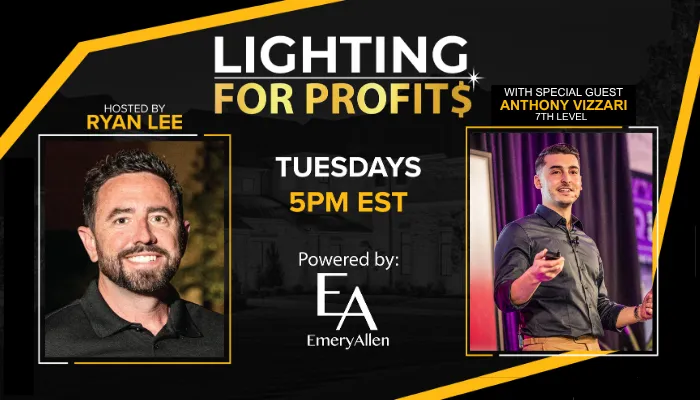
Anthony Vizzari - The New Sales Code
Lighting for Profits - Episode 239
In this episode, Anthony Vizzari—Senior Vice President at 7th Level—dives into redefining modern sales through empathy, authenticity, and purpose. With over $20M in personal sales and experience scaling elite sales teams worldwide, Anthony shares how NEPQ (Neuro-Emotional Persuasion Questioning) is transforming the way professionals connect, influence, and close. Discover how to sell without pressure, uncover real customer problems, and build trust that drives consistent results. This isn’t just about selling more—it’s about selling the right way.
Watch the episode
Episode Transcript
Ryan Lee: If you're looking to grow your business, focus on sales
Welcome to Lighting for Profits. All light, All light, All light, powered by EmeryAllen.
Here is your host, Ryan Lee.
Oh, light. All light, all light. Let's go, guys. We got an awesome show lined up. I'm Ryan Lee, the host of Lighting for Profits powered by EmeryAllen. we just got our 104th, 104th five star review on Apple, which is really cool. Thank you so much guys for your support. Support. that 104th five star review actually had, it was awesome. It said something like, you know, my wife rolls her eyes every time she hears all light, all light, all light. So I was like, you know what, let's keep it going. Let's see how many wives eyes we can roll with the all light, all light, all light. So we'll keep doing it as long as we can. Guys, we got an awesome show lined up for you. today we've got Mr. Anthony Vasari, and, he is the senior vice president of seventh level. And, also, I don't know if you guys know this, but we're trending as the number one, the number one landscape lighting show in Adelaide, Australia. Yeah, it's pretty cool. So, I guess that's southern Australia. I'm new to Australia. I should have done this interview in Australia because Anthony is, generous enough to,
I should have asked him.
I don't even know what time it is there. I think it's like 5am or something like that. But, he's generous enough to come, to a podcast with us even though we're in a completely different side, of the world, different hemisphere and everything. So, super excited to have him on. If, whether you think you need help or not with sales, this is your episode, this is your show. You're going to want to listen, rewind, rewatch this show several times. if you're looking to start or grow a landscape lighting business, or actually any business, and just get better at sales, this is your show. I had the opportunity to, hear from Anthony. Oh, it was about a month ago. I lost track of time. But somewhere around a month ago, he spoke at an event and I literally just like rushed him after. I was like, dude, we've got to get you on the show. He was just so, so good. So, really grateful that he, took me up on that offer and he's going to be with us today. So, before we have him on, and by the way, I love sales. You guys know this. I mean, it's just like, it's the Thing If I, if I had to just pick one area, you know the game of like, you can only do one thing, whatever. If I could just pick one area to focus on to help someone really not just grow their business, but improve it like exponentially, without a doubt, we would focus on sales. And of course there's lots of like, other areas of business that you want to improve, like marketing, people, production, customer service, admin, recruiting, training. I mean, the list goes on. There's lots of stuff that you need to do right, in business if you want to get to the next level. But I'm talking, I'm telling you, sales is number one on my list. It's always going to be because it's the number one thing that you can affect change, actually. Pretty easy compared to some of the other ones. Right? And, that's why I'm excited to have Anthony on. We're going to talk about some of those things that you can implement, and get really fast change in your business that then is going to help you make more money that can then kind of pay for these other fixes that you need in your business.
Getting better at sales and then getting more leads can create profit machine
So, it all, it all starts with sales and a, lot of people, when I get on these strategy, sessions, I'll ask them like, so what do you need the most help with? What's the number one thing you need in your business? And most everyone says, leads. I need more leads. Well, the problem is, that's not the problem. You see, if you just get more leads and you have this chaotic sales system which you think is decent, and now all of a sudden you have chaos. You're just, it's just chaotic. It's just more chaos, right? So if you get better at sales and then get more leads, well, now you're going to create a profit machine. And that, that's what this is all about. So we're going to talk about that today on this episode before we have Anthony on.
The reality of consequences help shape the decisions that we make in life
I was thinking about this the other day and I wanted to share it literally. Just take a minute because this is like super important. this is something that has drastically helped me transform areas of my life and for sure, my businesses. and it's, and it's this. The reality of consequences, okay? The reality of consequences help shape the decisions that we make in life. And so let me explain what that means. So if you, for example, if you, you have a lighting business and you are like, okay, I'm gonna go put out 100 yard signs a week, okay? And if you're putting out 100 yard signs. And you know that the consequence of the city that you're putting them out in, let's say that they're like, eh, they might get upset, they might remove them and they might call you. Okay. Then you know that the consequence is not, it's not a very brutal consequence. I mean, yeah, they take the yard signs down, it's annoying. You have to go out next weekend and you play that game, you know, Friday night and you go take them down like Sunday night or whatever. Like so they can be up a couple hours. Like you know the consequence. They're just going to, it might cost you a few hundred dollars a week in yard signs if, if they take them down because you don't take them down. Right. But here's where the reality of consequences change. So let's just say that that same city adopted a new law where now all of a sudden if they find one of your yard signs and you don't have a permit and they don't even allow permits to do this, that they give you one warning, but after that first warning, they now take your business license and you're not allowed to do business in that city. How do you think that's going to affect your decision making process? Are you still going to keep putting out the same amount of signs? Probably not. Right. And so the reality of that consequence is going to help shape the decision that you make. Right. This is really important. It might seem simple at first, but and it is simple, but it's still really important. Because you see, when I was growing my lighting business, there was great consequences pretty much every single day of me either performing or not performing. And the problem was I wasn't aware, I wasn't aware of the consequences. You know, I, I didn't realize the impact of my decisions at that time. I minimized things. I told myself, oh, it's fine, I've got time, I'll do it later, it's fine. There's other people doing worse than me. At least I should be grateful it did all these little things to minimize these these consequences. but when I, when I did realize the consequence, I would literally downplay, I'd minimize it. Right. And justify my decisions. And now it's easy to look back and be like, oh, well yeah, I mean I would have done that differently. I would have done this differently because I lived through the consequence and now I actually know the consequence. But, but when we're going through something, we don't actually always know, right? And so the Reason you don't have your dream business yet is because you haven't set a big enough consequence for failing, okay? You have accepted mediocrity. You probably didn't know this. You probably didn't. It wasn't a goal like, hey, I just want to be average. But it's the easier decision in the short term. You have accepted comfort, okay? You don't understand the consequence of staying where you're at. If you knew how much it was costing you to not grow and knew how big the consequence was, you would make different decisions. So what is the consequence? What is the consequence of you not growing this year? What is the consequence of you not hiring an admin this year? Not getting better at sales, not investing in yourself and getting help? What is the consequence? See, the greater the consequence, the greater the action that is taken. And if you minimize it, your actions will also be minimized. We're not guaranteed tomorrow, okay? So stop delaying, stop procrastinating, stop waiting. There is not going to be a better time, okay? One of my favorite phrases is, you know, the best time to plant a tree is 20 years ago. The second best time is today. It's time to move. Time to Goya. As my friend Pat Clark says, goya, get off your ass. Okay? Imagine your future self for a minute. Fast forward. Just in your mind, five, ten years down the road. Whatever, whatever version of you that you know, that you're capable of, you're not there yet. You have this dream, this fantasy, like, man, when I'm successful, this is what I'll do. This is where I'll be. This is who I'll associate with. This is what, this is how I'll sound. This is how I'll talk. This is where I'll be. Imagine that self. What are they doing? Okay? And I hope they're not doing the same thing that you're doing now. Okay? What decisions would they like you to make? Okay, what decisions would they like you to make? What is the consequence of you staying stuck? Decide today to make the hard decision. Get uncomfortable. If you want something you don't have, you have to be willing to do something you haven't done. You are not going to feel ready because you're not. In fact, if you were ready, you would have already done it. That's the whole point, right?
Make a list of your to do items and write down the consequences
So here's your homework. I want you to make a list, just a short list of a few of your to do items, okay? You've all got these lists in our. If not in our head, on our phone, somewhere. We've written them down. Hopefully write them down. And write down the consequence of you not doing them. Okay? Because you have justified your procrastination for too long. And again, the bigger the consequence, the bigger the action that you'll take. Stop making your your consequences or of your actions or inactions so small. Right? Stop minimizing all your decisions. Set the bar high. Put a consequence in place for not reaching it. You want a different result? Change the consequence and your future self will. Thank you.
Emory Allen's line of premium LED lamps deliver the performance your clients expect
All right, guys, again, we got Anthony Vazari coming up in just about a minute. Now stop settling for cheap, unreliable lamps that ruin your projects and your reputation. Emory Allen's line of premium LED lamps deliver the performance, longevity and color consistency your clients expect. Trusted by lighting designers and installers around the country and backed by decades of lighting expertise. Don't settle for less. Upgrade your designs and installations today with Emory Allen. All you need to do is reach out just by emailing Jackson L. Jacksonlryallen. com to learn more and take advantage of their contractor pricing, just email jacksonl.c om. don't forget to mention that you heard about them, here on Lighting for Profits. And get that discounted contractor pricing. Just email jackson lry allen. com.
Anthony Vasari joins the show to talk about his new book
Okay, guys, it is that time. Let's, let's get this show going. What do you guys say? We are about to transport to another country. Let's go. Welcome. Welcome to the show, Mr. Anthony Vasari. What's up, Anthony?
What's up, Brian?
Ryan Globe: Can you tell us the future? What is going to happen
Hey, you just transported not just to another country, but you just transported to the future. Because I'm a day ahead over here in Adelaide, Australia.
I love that. Can you tell us the future? What is going to happen? how many hours ahead are you? It's, eight, or what time? What time is it there?
It's nearly 10:00am my time, so we, yeah, quite, quite a few hours ahead.
Oh, yeah. So you're more than 12 hours ahead of us. So. Yeah. What is the future? Like, what, what stock should we buy? Like, tell us everything.
Just, stock up on oil. oil's drying out. I'm teasing Globe. Yeah. Who knows? Who knows what the future's like for you guys? The future is bright and the future is what you make of it. But we're here to talk about the present because I hear we've got a, group of business owners that are looking to level up. And I love what you're doing, Ryan. So thank you for having me on the show.
Absolutely, man. I heard you Speak. about a month ago. And I seriously was just like, okay, like we got to do. I got, you know, I'm trying to get people to join my program, of course, but I'm like, if they don't join mine, they need, they need help. Right? And so I'm like, everyone needs to join seventh level. I know you guys have lots of different options, so my goal is to give as much value away today as possible. You did that from stage very easily, it seemed like. So, yeah, let's just jump into it.
Anthony Vasari is the senior vice president of seventh level sales training
Do you want to just do a quick introduction of who you are and and why you're the, expert sales trainer?
Oh, yeah, I'm quite boring, so I'll give you a brief intro. So I'm Anthony Vasari, as was mentioned, and I'm the senior vice president of seventh level. Now, we are the largest B2C sales training company on the planet, and we are now the third largest in the B2B space. And essentially we are a sales training company that has a methodology that works with human behavior, not against it. See, as you and your clients would know, there's a lot of outdated, pushy advice and sales training and techniques out there that make you feel slimy and they make you feel manipulative. And I know your audience may resonate with this. Nobody got into this business to want to feel like a pushy salesperson that has to shove solutions down customers throats that they don't need. And because of this, it turns a lot of people off from sales, where we have a methodology which is built on human behavior and social dynamics, where it's not about making a sale, but it's about seeing if a sale can be made. So you feel really good about doing that. So we've trained 161 different industries, including your audience, one of the largest industries that we actually train. And yeah, we are now recognized as the, largest sales training company on the planet.
That's so cool. Yeah, Congrats. I mean, seriously, that's. That's incredible. I love, I love how you introduced yourself because for some reason I've. I've never felt like a dirty, salesperson. Right. So, like, I've just always felt like I'm adding value to the world, I'm helping people, you know, But I've learned along the way that there's a lot of people that do feel that way and they feel slimy and they feel like they're pushy and, and I've never understood it because I've just Always had this like, well, no, it's like I heard you say. I think I heard you say it. And I've even, You wrote it somewhere. It was like, if your solution genuinely helps people, you have a moral obligation to sell more of it. And I've just always felt like that. But most people are like, no, I know it's good, but, you know, it's their decision. I don't want to. If they want to think about it, then that's okay. I'm like, no, no, no. They're uneducated. They're.
They're not.
They're not ready. It's. You didn't do a good enough job showing them what's possible. One of my examples, which is maybe dumb, is like, if your dying grandma needed oxygen, if all she needed was oxygen tonight, and you were like, grandma, you should have oxygen. And she's like, no, I'm good. Or I got to think about it, or I got to get some other quotes, would you be fine just telling her, no, I got to think about it. I'm like, no, I'm going to do everything I can to convince her that she needs oxygen.
Yeah. It really comes down to experience. And a lot of people have just had a bad experience at some point in their lives with somebody trying to sell them something they probably didn't even need and trying to push it down their throat. So it's not that people hate sales, but they hate bad sales. But the connotation people have towards sales people is negative. In, Utah, you probably remember this. I remember asking the audience, hey, what's the first word that comes to your mind when I say the word sales? People start screaming things out like, pushy, sleazy, used car salesman. And these are the associations people have towards salespeople, particularly, because there's a lot of bad players out there. So the bad players, they give sales a bad name, and it affects people's perceptions of it. And the biggest issue I see with business owners, including your audience and your clients listening, is because they view sales in a bad light that is actually affecting their ability to sell. Because a lot of people don't like to identify as a salesperson. I hear this all the time, even from people in this industry, is they say, I'm, not in sales. I don't need to sell. Well, here's the thing. You're already selling every time you walk out on a property. Every time you're explaining your process, you're talking somebody through a quote. That is a sales conversation. But most business Owners, the reason they're failing and the reason their revenues are not where it needs to be is because they're doing so without any structure. And then they wonder why people ghost them, or they wonder why you've got a discount, your rate, and. Or your customers end up going with a cheaper competitor. So it's not that people hate sales. What I see is they hate bad sales and they try to disassociate themselves from being a salesperson rather than owning it. Because selling is a good thing. Selling is serving. You have a moral obligation to sell when you have a good product to sell, which I know your audience and your clients do.
That's awesome. So what's the first step? Like, okay, I accept that. And now I'm like, okay, how do I overcome that mindset of like, okay, it's not a dirty word.
Yeah. So once you've accepted it, once you've accepted that sales is a good thing, I think it stems back, how do you accept it? Where you have to actually have to sell a good product that you believe in. Do you genuinely believe in what you're selling is going to leave your customer better off? If the answer is yes, you've got a tick. If the answer is no, then you have a problem. So, do you generally believe it? Do you generally believe that selling is a good thing? Now, if you're selling lighting design, I mean, that's a good thing. You're, you're improving someone's, someone's feeling about their home. You are, making them have a smile on their face every time they arrive home. And the lighting and the ambience and the design aspect like this, this is a good thing. So you have to get good at understanding the result of what you're selling, not the thing. You're not selling lighting design, what are you truly selling? You're selling a happy home. You're selling a smile on your visitor's face when they come home and they see the design aspect. So a lot of people focus on selling the thing. They get all logistical with the thing, but you're not, you're selling the result of the thing. So my, my first thing I get, any audience that I'm training to do is, hey, what are you really selling here? You're not selling the thing. And once you've done that, then we need to start creating an actual sales process. See, most people out there, Ryan, you know this, they're just winging it. They're going out, they're having a different conversation with every single homeowner. They're not following any structure.
We map an entire sales process here at seventh level
When they get an objection, they maybe throw some random rebuttal they heard if they do that at all. Or they say no worries, just get back to me if you want to move forward. They're winging it and then they end up only closing the lay downs. So the next thing we actually sit down is we map an entire sales process here at seventh level. We've got a, we've got a methodology called nepq, which stands for Neuro Emotional Persuasion Questioning. And then we map out the exact questions you need to ask at every phase of the sales cycle to engage with a prospect, but ultimately get them to sell themselves.
Nice, I like that. Yeah, I like where you're going with this because I think it actually is going to translate across lots of different things.
Most objections are triggered responses, Ryan says
I think when most of us get into landscape lighting of all things, it wasn't by design. You know, we just like heard about it or you know, it like just, it was an accident and then you fall in love with it. And so it's, it's hard because some of these projects, I mean an average job's like 10 grand, but some of them could be like 50 grand, 100 grand, 500,000, like residential projects. And most of us weren't raised living in mansions and with pools and the ability to invest in outdoor lighting. So sometimes it's especially getting started, it's hard to be like, hey, you guys should spend 20 grand on lighting. And it's like what? It seems like a lot for us. We sell out of our own wallet. But especially when we're selling units, it's really hard. But when we're talking like, well no, I'm providing a transformation. I'm providing an experience every single night for the next 20 years for this family to be able to enjoy their backyard. It does make it a lot easier to feel like you're not selling and you're just helping them get it, gain an experience, you know.
Yeah, I think you hit it on the head there with a, huge issue. I see. And I've now trained over a hundred thousand sales people and one of the big components and the limitations I see is people selling out of their own wallet is they've got a limitation around money themselves. So especially if you didn't grow up with being able to invest in these sort of things, you're going to look at that and subconsciously induce objections from m your audience. Because subconsciously, if you're like, well I wouldn't spend 20k on this or 10k on this, then that's going to come out. That's going to affect your tone. Your tone will affect your perception of being able to help them as an expert, but it's also going to take away the three Cs, which you must have to get any SAL across the line. And that is certainty, confidence and conviction. People aren't attracted to the most knowledgeable person about landscaping design. They're attracted to the person that's most certain. They speak with conviction and they've got confidence. Because ultimately, at the end of the day, human beings just want to be led. They want to be led by somebody that is willing to lead them. And this goes back millions of years. Think of our ancestors living in tribal communities. There was always a leader of the pack and the leader was the person that people would look to for safety. Because if they didn't, well, if they didn't have a leader or someone guiding them, they were literally at risk of losing their life. And this carries forward through our primal brain, or we call it the reptilian brain. We've got these scripts that are running where we don't even know where they came from. Like for example, if you hold a, I've got a 10 month old at the moment, right? So if I hold my 10 month old up, what he does is he naturally just kicks his legs like this. Where does that come from? He can't walk yet, but where does that come from of, kicking the legs? Well, this is passed down through our primal brain, through our scripts that we run in our life, that moving the legs is an important thing to walk. So unfortunately, a lot of people are carrying these negative limitations which ultimately end up inducing objections. They get on to quote a job and the person says, I need to think about it. And they don't know where to go from there. But they triggered that response out from their prospect. And I want to say this, Ryan, most objections are triggered responses. Nobody, no client rolls out of bed in the morning and says, you know, when Ryan comes over today and he quotes me that job, I think I'm going to tell Ryan I need to think about it. That's what I think I'm going to tell Ryan. It's not premeditated. It's a triggered response or a knee jerk reaction. And it always comes back to something we either said, or did not ask or maybe something to do with our tone that triggered our response. The same way when you go into the store and you're greeted by some pushy sales rep in a Clothing boutique or a clothing store. What's the first thing most people end up saying when they say, hey, hey, how can I help today? What's the first thing out of people's mouth?
I'm good. Anything?
I'm just, I'm just looking.
I'm just looking. Yep.
Now they didn't wake up in the morning and say, you know what? When I go into that store, I'm going to say, I'm looking. It's a triggered response. So what every single person, every single business owner needs to understand is you are in control of this. You're the reason you're getting objections, meaning you're also the, you're also the solution if you know how to fix the right skills.
Dude, that's just, this is so good because that's empowering too because now I can do something about it if, if I couldn't, it's like, ah, maybe I should just quit, you know? that's cool. That's very empowering. So, I'm gonna go back because you just you do this every day. So you just lay down the law and, and you're like, yeah, no big deal.
How do you build confidence in business or in life
But let's go Back to the three Cs. Certainty, confidence, conviction. Is that just a matter of like getting better at your craft? Is it a matter of like, where do you recommend people focus here? Because it back in the 80s it was like, oh, people buy from people they trust. No, like, and trust. Yeah, this, this seemed like a, much more updated version of that. It's like, no, no, like they, they buy from people that has certainty, confidence and conviction. So how do we build those three Cs?
Yeah, well to touch on that is, I mean people buy from people they know like and trust. Well, you might know like and trust your grandma, but if grandma's coming over to sell you a thirty thousand dollar water filtration system doesn't mean you're buying it just because you know like and trust her. So there's more than that. People buy from people they know that they can get the result from, from. Everyone's got an idea in their mind of what they're looking for. People will buy from the person they have most confidence will get them that result. That's simply what it comes down to. Now how do we build upon this? Well, let me say when it comes to confidence, a lot of people believe are, if I just like look more confident, then I'll be more confident and things like this. The issue with confidence is confidence isn't Something you do, it's something you are like. You are confident. It's not something you do. How do you build confidence? It comes back to, number one, believing in your product. Like, what I get my clients to do, Ryan, is I literally get them to grab a blank piece of paper and grab a pen, and I make them write down 50 reasons why somebody should buy from them. 50 reasons why somebody should buy from them. Once they got the 50, which is hard to do, they start running out of reasons. At, number 20, once they get to 50, I say, great, now write me another 50, and I make them get to 100 reasons why someone should buy from you. People never do these exercises. This is the stuff that brings you confidence. And then when you are a confident person, how does a confident person show up? How do they speak? How do they dress? How do they look? See, a lot of people say, never judge a book by. By a cover. By its cover. Well, I hate to break it to you, but people do judge books by their covers. The moment your client makes an inquiry off a website or off an ad or if you're door knocking, they're judging you inside the first seven seconds. They're already picturing what you look like in their mind, even if they can't see you and you're on the phone. So you have to show up, and you have to speak with certainty. Now, this can be worked on because the more skilled you are, that's where you. You become more certain. The more skilled you are. If your skill level is low, think about younger, days. Did you ever play sport, Ryan? Back in the day?
Yeah. Basketball, baseball.
Cool. Basketball, baseball. Now, before you knew how to play, you probably weren't that confident. You weren't confident with being able to shoot hoops or swing the bat. But the more your skill level increased, as you got more skills, you probably became more confident. Why is that the case? Because our skill level can control our confidence. So whatever it is in business or in life, if you want to be more confident in anything, just get more skilled at it. And then you naturally will be more confident. You shop more. Everybody knows that one guy or gal that. That every time you're around, you're like, oh, that person's really confident. Were they born that way? No, they just have more belief in themselves, and they're happy with who they are. So you have to be happy with who you are. But you also have to start working on your skillset when it comes to sales. If you're not good at sales, you're not gonna Be confident. And you're gonna hate it, but the funny thing happens, the more you train, the more you get good, the more you know the right questions to ask at the right time, with the right tone. Hey, magically you feel more confident because you're good at it.
Love this.
Anthony says homeowners often feel obligated to take the lead when discussing lighting
Okay, so we got our three C's. Now we're, let's say we've, I don't know if we're gonna say mastered, but maybe we came up with 50 and we're not quite 100. But we feel better, we feel more confident, we feel more certain. we have more conviction. Now. You said we need to, we need to lead like you said. I mean, it's, it's, it's within us. I think the challenge for, obviously you build that, that confidence and everything that conviction leads to making it easier to be a leader. But sometimes in landscape lighting, you can go meet with these high net worth people. Yeah, they got nice house, fancy cars, and they, they, they tend to want to take charge from the beginning. I mean, as soon as that door opens. Ah, all right, let me tell you, whatever. and it's like, whoa, whoa, no, like, I'm in charge here. What recommendations do you have to. So people can take the reins and make sure that they are the leader, even though they have less money. But they need to lead this conversation. They are the qualified lighting designer. They're the expert. They need to lead this conversation. How do they, how do they take the reins back and do that?
Yeah, I love this because you said it. they are the expert. They are the expert. And the reason why the homeowner takes the lead is because in any social environment, going back to the tribal days, there always has to be a leader. And the biggest mistake is it's not even that the homeowners try to take the lead. It's the moment you go to the door, you're not leading. The homeowner feels obligated to take the lead because you're not taking it. This is, this is the biggest issue. So it's, how do we take control of the lead? So number one, as we go in, we're the ones setting the frame. We're the one setting the agenda, not the homeowner. So for example, most people would go to the door and they say, hey, I'm from xyz, you know, landscape lighting. you know, can I come in? And then they go silent. They don't say anything. The homeowner says, yep, let me show you what we want to do. And then Game over. You've basically lost the sale at that point. I believe every issue in sales is. Is an upstream problem or an upstream problem. The issue was never at the end when you got to think about it. It's what did you not do that led to a think about it. So the way we would take control of the conversation is we'd go to the door and say, hey, Ryan, it's just Anthony from XYZ Landscaping Design. Looks like you had caught us out to possibly look at upgrading the lighting on the home. Is that right? Yep. Come on in. As we go into the home, I'm taking charge. I would say, hey, and just so you're aware, the first part of today's visit, I'd say it's pretty basic. It's really for me to get a bit of an understanding of what you have in the home now as far as the lighting and what you might be looking for in lighting design, just to see what the gap looks like, just to see if we could help. And then towards the end, if you're like, hey, this might be what you're looking for, then I can walk you through some possible different options. Would that help you, Ryan? Ryan would say yes. And I go straight into asking a question.
If everybody just understands this one principle, it'll drastically change the sales
So. And there's a simple principle here. If everybody just understands this one principle, it'll drastically change the outcome of the sales they're making. And that is this. Questions. Control, focus. Focus controls feelings. Feelings drive decisions. If I ask anybody a hundred questions about the worst day of their life and they had to answer those questions, they're going to feel pretty bad. They're going to feel terrible. If we sat down and I asked them 100 questions about the best day of their life and they had to answer those questions at the end of that, how are they going to feel?
Awesome.
They're going to. They're going to feel awesome. They're going to feel amazing. So what that tells me is my questions can control what you focus on, and then what you focus on will control how you feel. And do human beings make decisions based on logic or do they make decisions based on emotion? Well, brain studies prove this. This is proven. This is. This is science, that human beings make decisions emotionally and then they justify it with logic. So. So when we go into a consult or an appointment, we have to be the ones asking the questions. And that's when the homeowners will drop their guard and they will feel safe, because now they're being led where they don't feel the need to have to
lead you, this is pure gold. Thank you. Seriously, this is so good. And I, I, I, I already know, I see people going into the home and doing exactly as you, as you said, leaving a gap, leaving, leaving some space that's uncomfortable. So I'm going to step in, I'm going to be the leader. And then even when they think they're going to take the reins back, they don't do it by asking these questions that you're talking about. They go into sales mode. Hey, let me tell you, let me tell you, that's just sales resistance all over it, right? Instead, of asking the question, creating that safe space. this is just, this is going to help so many people and I know this is like elementary stuff for you. You guys take this to the next level. But this is so important.
It's all foundational and you said something there really important that I want to mention. Where they go in the home and they start like telling based on human behavior. The least persuasive form of any communication is when you tell somebody something. So if I tell you, hey, these lights are the best for this reason or hey, we're the number one rated landscaping design company, lighting design company in this area. Because I am telling you that's the least persuasive form of communication. Think about it. Anyone that's got kids, if you tell your kids to do something, you tell them what do they do? I mean, they're going to push back.
Usually the opposite.
They're going to do the opposite. Exactly. So what we teach is not to tell, but get your prospect to tell themselves. For example, common issue I see is so Ryan, for your clients that'd be taking calls, inbound inquiries, somebody reaching out, or somebody on their team will be taking an inbound inquiry and they have to call the prospect. So most people make the mistake of saying, hey, it's Anthony here from Landscape Lighting. I saw you reached out on our website about getting some lights for your home. I'm glad we reached you reached out. just so you're aware where the number one rated landscape lighting design company in this area and there's a few ways we can help, we can help you with X, Y and Z. So what we'll do is we're going to come out and do an in person consultation. Telling, telling, telling, telling, telling. There's no questions being asked. So we would flip that. Okay. Because you're the most persuasive when you get your prospect to tell themselves. And I'll show you how we do that. Where I might call a lead and I might say, hey, Ryan. Yeah, Ryan, it's. It's Anthony. Anthony Vasari from Adelaide Landscape Lighting. Looks like you recently reached out about possibly getting some lighting upgrades for your home. Is that right? Yes, it is.
Using neutral language reduces sales resistance, says Anthony Vasari
I should probably start by asking, when you saw the ad, what was it maybe you saw that caused you to want to look into this a bit further? All right, pause. A couple of things I'm doing there. I'll break it down. Number one, my tone. See, ah, how my tone changed. What I'm doing is I'm using what's called a familiar tone rather than saying, hi, this is Anthony Vasari from Landscape Lighting. And the reason for my call today is, well, now you sound like every other person that's called them. But when I use a familiar tone, when I say, yeah, it's Anthony, Anthony Vasari from Adelaide Landscape Lighting. Looks like you'd reached out about putting, possibly getting some lighting upgrades for your home. Is that right? I'm using a familiar tone. Where have you ever had somebody call you or you've seen him in the street and say, yeah, it's me, it's Anthony. You don't remember, we went to school together. And in your mind you're like, how do I know this person? How do I know this person? But you go along with it, because it's a familiar tone. So we use that on the course. The second thing I'm doing is, is, yeah, it looks like you'd recently reached out about possibly we're using something called neutral language. See, a lot of people use assumptive language, but assumptive language is what triggers sales resistance. If you say, hey, looks like you called us because you want some help with the lighting. No, I just wanted to get some options. Oh, no, I just want to get a few different quotes. I'm just having a look. So when I use neutral language, like, looks like you reached out about possibly getting some help with some landscape lighting. Is that right? It drops the guard. It doesn't cause that wall to go up. And then the third thing I did there is I'm getting them to open up and tell me why they're there. So just out of curiosity, when you went through our ad, or just out of curiosity when you were on our website or when you were on our Instagram, wherever they came from, what was it that you saw that caused you to want to reach out to look more? Look into this a bit further. I've asked the question, and when I asked the question, now the customer or the client is going to answer my question. They're going to tell me why they're there, but more importantly, who are they telling? Or they're telling themselves. And you're the most persuasive when you tell yourself something. So there's a few things that I just wanted to give your audience on how they can better, start off those, those calls coming in.
That's just so good. So good. I, I mean, you said that the neutral language versus the assumptive language, you know, eliminates the wall. I mean, personally, I feel like it's even greater than it makes them want to reel you in, almost like, well, no, no. And then they spill the beans, you know, like, yeah, possibly. What do you mean possibly? Like, no, we need this by yesterday. We've got security break ins, we got this going on, we got a wedding coming up. You know, it's just, it's just so, so good.
And it shows you're not attached to the sale because, people give off this needy energy, like they need the sale, and then they get what's called commission breath. As soon as the prospect feels like you need the job, that's the moment they lean out. This is human psychology. If somebody leans in, think, think about people out there, early days dating. If you lean in and you're being needy and trying to chase somebody, instant turnoff. The person leans out. The moment you lean out, you start playing hard to get. That's when people start chasing you. So this applies to business that's so good.
And I think people do, confuse that because you just got done telling us, oh, we need confidence and we need conviction and certainty. And then it's like possibly needing some landscape lighting. And it, so it feels very different, but it's just part of the strategy. And it's like there's a time and a place and this is not the time to bust through the door with confidence.
Pattern recognition is key component to new model of selling
Well, this is the thing. You want to be neutral in your language, but still certain in your tonality. I'm still being so. Even though I might be adding what we call like a curious tone, it pulls them in. My language is neutral, but I don't want to come across as uncertain. I don't want to say like, it looks like you might, want to get some landscape lighting. Goodbye. So I want to be neutral. I'll do it again. Neutral in my words, but still certain in my tone.
Yeah.
Ryan, looks like you had reached out about possibly getting some help with the landscape lighting. Is that right? I'M still certain in my tone, but my wording is more neutral. That disarms the prospect and drops their guards. So it's a key component to the new model of selling, as we call it with the olden era. Think back to the 1960s, the 1980s. It's just very assumptive. Hey, I've got this great opportunity just came across my desk. This is the best thing. I know you need it with a number one rated company in this area. Sales resistance. Everyone's seen the Wolf of Wall Street. That might have worked back then, but that's not going to work anymore. It's a great movie though.
Yeah, great movie. Do you think, you know, had you guys been teaching this back then? I don't know. Is there sales resistance because of that? We've, we're just so, we're so used to it. Or, or would these techniques, would they have outshined or outperformed the old school way you think back then? I mean, was there, was there a reason why the assumptive worked then?
You think so Back then the assumptive worked is because we didn't have access to information as a society. There was no information. The way you got information was, was through the sales person or the sales representative. So that's why there was more trust towards the person calling you. And also information flowed a lot slower. So all the scammers, all the bad eggs, and they didn't have Google reviews, they didn't have online websites, the Better Business Bureau, they didn't have access to information that flowed. So now you're dealing with an information age over information age where everyone's got access to information. People know of the people that have been burnt. There are stories, there's a Current Affair dropping stories of bad contractors every day of the week. So people are more skeptical and on guard than ever before. But also it comes down to pattern recognition. Pattern recognition. People, human beings recognize patterns. We all work in patterns. So let's say, let's say you've been called 10 times a week, somebody trying to sell you something. And the next week somebody else calls and they open up the call the same way. Hi, my name is Anthony and the reason for my call today is now, your brain has recognized the pattern of how people typically sound that are trying to sell you something. And then you immediately shut it down because you've recognized that pattern. So what we're doing is we're using tone and language that is, unrecognizable, which isn't triggering that part of the brain that says, oh, salesperson trying to sell me something, trying to take my money. So that fight or flight response from that triggered response, it's not there because they haven't heard this before. But I'll be crystal clear. If people are out there selling and they're winging it or they're just selling from some outdated old school method that they've heard, they're going to get absolutely crushed because prospects will recognize the pattern and they've probably had a bad experience with somebody using that sort of script in the past and that's why they shut you down immediately.
That's so good. So good.
NEPQ questions help you connect with prospective clients and get them talking
All right, so take, we're back in the house. we're starting to ask questions. Can you give us just a few examples of some good NEPQ questions that we could use to kind of help that process open up?
Yeah, absolutely. So the first stage is what we call connecting. Connecting question. And the purpose of connecting is to take the focus off you and put the focus on the client. How many people say, oh yeah, we're the number one rated company in this area and they start off the approach focusing on them? Yeah, the way we can help you is we can help you by doing this. We've got these sort of lights, we got this lumens, whatever. It's all about them and their product where we want to flip that because they don't care about you and they don't, they don't care that you're the number one rated. How many people have they spoken to in their life that says, yeah, and just so you're aware, we're the 13th rated company in this area. Nobody says that. Everyone says they're the best. Even if you are the best, they don't believe that. So you don't need to say that. So we would take the focus off by saying, hey, what was it that caused you to call us out in the first place? Get the prospect talking. Once they talk, I might say, and do you know what you might be looking for? Just so I understand getting them to open up, what are they looking for? Then we would move into what we call situation questions. Situation questions is where we learn more about the, the customer's current situation, but also help them understand more about their situation. So let's say, the reason they called us out, they told us is because there's been a few break ins in the area and they want to illuminate with spotlighting and they just want to make their home more intruder proof with the lighting design. So we might say. We might ask a situation question which aims at learning about the situation. But I also want to start creating doubt. I want to create doubt that the prospect has this all figured out. So I might say so. So walk me through. What sort of. What sort of lighting security measures do you have in place now to protect your home from the. From the burglars? Just so I understand. Client might say, oh, we've got a couple of, you know, spotlights at the front. just basic ones that aren't very bright. Oh, okay. So you've got, like, the. The basic spotlights. How long have you had those for? M. Do they come with the home or, like, walk me through. Like, did you install them yourself? Okay, and. And just so I understand, what's causing you to feel like maybe those basic spotlights just aren't enough to push off an intruder? And once again, I'm asking questions. I'm not saying, oh, yeah, those basic spotlights. Yeah. The reason they're not going to push off the intruders, because the lumens are so low, they're barely visible from the street. That's why. That's why intruders aren't going to be deterred from them. that's me telling. That's not. Doesn't do anything. But if I say, okay, so, I mean, you've got some basic spotlights. I mean, they're fairly decent. What's causing you to feel like maybe it's just not enough to deter the intruders?
That's.
So now they're gonna tell me why it's not enough. But more importantly, they're telling themselves,
love it. You know, as. As you go through this, it feels very authentic. It feels very like. And you're just a genuinely curious guy who's there, you know, and. And. And you guys do have this order, right? And it's like, yeah, we got to do this. We got to diffuse here. We got to do all that. But it comes across very. Just authentic is like, okay, well, I mean, those seem fairly decent. Why not just stick with them? You know? that's. That's a normal question that a normal person would ask.
And why do we say that? Because some people would say, oh, why. Why are you saying they're fairly decent? What if that turns them off? For me, thinking they need to buy has the opposite effect. Most sales people coming around would never do that. A, typical salesperson starts talking down to their competitors or whatever product they have. But I'm not doing that. I'm saying, I mean, yeah, it's it's fairly decent with more of a skeptical tone. I mean, that's the system you have now. I'd say it's, it's fairly decent. Just so I know though, what's causing you to feel like it might not be enough though? And then they're going to lean into that because now they trust me more. Because in their eyes, like, oh, he's not trying to sell me, he's just literally trying to understand my situation.
I really hope people go back and watch this, not just listen to it, because even your actions when you're showing, when you, when you, the basic, you know, what would maybe the basic versus you know, the premium. Like everything that Anthony's doing right now, body language, tonality, how he's doing everything is just like so good and there's just so much to learn. I'm going to go back and watch it myself.
93% of human communication is non verbal, only 7% is words
And can I just touch on. That's so important you said that because 93% of human communication has nothing to do with the words you're saying. It's non verbals, only 7% is the words. The rest of it is the non verbal communication. What's non verbals? That's your body, your movement, your gestures and your tonality. So this is really important people understand this because I see a lot of people trying to implement some scripts that may be seen online, but they don't have the right tone, they don't have the right body language. But that is what people are using to judge whether you should be a threat to them or not. Think about it. What's the first thing cops do when they're speaking to you? If your hands are in your pocket, they say, hey, show me your hands. Like get your hands up. Because, because your hands are, the gateway to your intent. So, so we will even do things by showing people we're unarmed because subconsciously, going back to the tribal days, if you can't see someone's hand, your brain sees that as a threat.
So, so when we're out in the home, that's what we're doing. It's like, yeah, I mean this is a, this is a fairly decent, fairly decent, fairly decent lighting setup. what's causing you to feel like maybe you're going to need something else? And we're showing them we're unarmed, but we're also moving our body to control our tone. Because your facial expression and your body language is actually the remote control to your tone. If I want to sound more curious, I just have to look more curious. If I want to sound skeptical, I have to look skeptical. If we go back to the familiar tone example, when I'm calling my leads, I have to look familiar. yeah, it's Anthony. Anthony Vasari. Looks like you reached out about possibly getting some help with the lighting for your home. Is that right? My body is affecting the way I sound.
Yeah. Man, this is so good.
Most objections are triggered responses, so overcome them before they come up
the last thing I want to kind of, finish on is. Yeah. I've. I've always been terrible at overcoming objections. Like.
Okay.
And I'm way better at just overcoming them before they come up, you know?
Yeah.
and you said most objections are triggered responses. I've. I've never taught that. I've never. Maybe I. That's probably the first time I've heard that. And I believe it. I fully believe you. And I think that's why I just prefer to overcome all objections before their objections. And I'm fairly decent at that, I guess. how do we avoid these triggered objections, these triggered responses? I know, I know. A lot of it is doing what we're doing now, where we're diffusing the situation, we're implementing these things. But is there anything else that you can provide some context to help us just not have to overcome these objections in the end?
Well, first of all, you're doing it the right way. So you're pre handling objections. You definitely want to do that. Because the way I view it, it's like having doors. Throughout the entire sales process, there's a bunch of doors, and most people leave the door open, and they keep moving forward. Another door opens, they move forward.
Right.
But all those open doors, they all lead to an objection at the end, and then you're on the back foot trying to handle it. So what we teach is how do you close every door before you move forward, so by the end, you don't get an objection? Or if you do, it's an easy objection to handle because you've already done the legwork upfront. So how do we do that? Well, number one, it's asking the right questions, but knowing what you're looking for. So, for example, one of the lines of questioning we have as far as our process, it's called a rationale question. Now, the rationale question is designed to pre handle an objection.
A lot of people make the mistake of going with the cheapest option
So, Ryan, let me ask you, what's, what's the most common reason why somebody wouldn't move forward with your clients? What's an objection? They get that they wouldn't move forward.
They get a lot of the like, you know, it's more than we thought it was going to be. let us talk about it. Or we've got two other guys coming to the house this week.
Yeah. Okay, so that's a huge one for. Especially by clients. They get the arms, getting three different quotes. They hear the it's more than I thought. It's too expensive. The prospect isn't saying no. what they're saying really beneath all of it is I don't yet understand why it costs what it costs. And this has nothing to do with pricing. I know you teach this. You should be the highest price. You should be raising your prices. You're in business to make a profit. You're not a charity. So this is a conversation problem. So we will do a rationale question up above. And I might say, yeah, and Ryan, just so I understand the rationale, but like, what's the main reason you'd want like an expert to look at designing this properly rather than, I don't know, just hiring some random guy off Craigslist that could probably come and do it like really basic for you? So what I'm doing is I'm pre handling a lower cost alternative. Objection within that, like, yeah, what's the main reason you want like a professional to come and do the lighting landscaping, rather than, I don't know, just getting some random guy you could probably find on Facebook, Marketplace or on Craigslist that would come and do it? Like, basically, why am I doing that? Because I want them to tell me that they want a professional. And then during one of our phases, we actually do product framing. This helps get them out of price based thinking into results based thinking. Our job as a salesperson is to help our clients understand that it is far more riskier. Ah, to go with a cheaper alternative or someone basic, then go with a professional. So the way I would pre handle that is I would ask, I'd say, hey, are you familiar with sort of the differences in this industry? Most likely the client says no. I'd say, would it help you if I told you yes. Well, you know, you may not be aware, but there are, people out there that kind of just tell you they'll do it like really basic and like come in really cheap. Are you aware of the risks that that could pose, especially with something like lighting, which is. Has wiring and electrical? And then I would educate them. What you may not be aware of is if they may not be licensed, it doesn't come with a warranty. What do you feel the risk could be for Your home if the job isn't done right. And I get them to tell me, oh, yeah, I mean, I didn't think about that. It could probably cause a fire. Probably not wired correctly. Yeah. Now, a lot of these people come in really cheap, but have you ever heard the saying, and then this is a frame that I use early on in the piece, I say, have you ever heard the saying, Ryan, that the cheapest price is the most expensive? And then the prospect most likely either has, or maybe they haven't, but then I get them, hey, what does that mean to you? Oh, I guess it means that if you go with something cheap, it's going to break down later on. Yeah. Unfortunately, a lot of people make the mistake of going with like the cheapest option, thinking they're saving money without realizing that that's when they've got to end up calling somebody back to do a professional job because they realize it wasn't wired right. So for you, just so I understand, like, what's more important to you is like the cheapest price, the most important thing where you're willing like to risk the quality of the job and the hazard of having a fire risk or is actually getting the job done right by a professional. So it looks great, but also your, your family is safe with all the wiring that's going on with the lighting. What's more important to you? And then I, I get the prospect. This is before price is even on the table. I get them to identify that they want the job done right by a professional quality job because they know it's going to be cheaper in the long run doing so. So these are just a couple of things we're doing earlier on to get the, the client out of just focusing on the price.
That is awesome, man. Yeah. Pre framing and, and getting them set up is just, the way you do it. And again, I'm hoping people will go and watch this.
Yeah.
If you're listening, most people listen to it. But go watch this episode on our YouTube because just when you're like talking, I don't even know if you know you're doing it intentionally or not. It's just like who you are now. But yeah, every time you do it and you're, you're using your body language and it's just, it's exceptional.
So, yeah, you can't escape it. Once you master this stuff, it just becomes you, it really becomes you in everyday life because communication isn't just on the job. But, but what your clients will realize is every aspect of their entire life will improve when they master this thing we call sales, which is simply a skillset. Nobody's born a master salesperson. It's just the skill that can be learned. The same way they had to learn how to do landscape lighting. It is simply a skill set.
Getting good at sales and getting good at communicating is crucial in today's economy
Well, I just. Seriously, I can't thank you enough. I'm sitting here listening to you with relatively little to no training in landscape lighting, as far as I know, unless you've done more than I know about. But we could drop you off in any, like, any appointment right now, today, and you would outsell most of these very highly skilled, highly talented landscape lighting designers, installers that they're, they're, they, they have the craft down. They're so good at what they do. Yeah, they're missing out. They're losing out on opportunities. And their businesses are suffering, their families are suffering, their team members are suffering because they lack this ability to sell. And you, we could drop you off into their, into their route and go double, triple, quadruple their, their business. And you don't know anything about landscape lighting design. I don't. have you installed landscape lighting ever?
I have not installed landscape lighting. And you said it perfectly. You don't need to. See, the issue is you can be the best in your market. You can have the best designs, the best installs, you can have the best product. But if you can't communicate the value of what you do in a real conversation with a real person, you're always going to lose work to people who are worse than you. They don't provide a good experience to their customers, Their quality is terrible. But they're better at conversation, and better at communication. So your communication skill is the revenue ceiling. And most people think, oh, it's a lead problem. Most people in your industry, they come to us and say, oh, I've got a lead issue. Well, I'm here to tell you, no, you don't. You have a conversion issue. Because if you fill up a leaky bucket with more water, you're just accelerating the rate of inefficiency. So getting better at sales isn't just a, nice to have anymore. Is in this economy, if you are not getting good at sales and getting good at communicating, you will get left behind and you are going to get crushed by, by somebody that comes in. They're not even better than you, but they're going to still out produce you.
Well said.
Anthony Vazari created the Black Book of Questions to help entrepreneurs sell
Well, I, I know people are listening to this right now, going, all right, how do I, I want Anthony to come work for me. I want new sales. obviously that's not happening, but what's the next best thing if people do want to reach out, and get information, how do they get a hold of you? How do they get a hold of your team? What's the. Yeah, what are we going to do?
So I just thought of this, actually. I think what would. What would help your audience the most is I'm going to give them. I'll give them a free copy of our, Black Book of Questions. These are questions designed at every phase of. Now, it's not going to be tight, industry specific, but I'm going to give them the framework where they can look at it and start adapting it into their audience. I'm going to give them the Black Book of Questions and I'll give them a PDF version. All they have to do is find me on Instagram. So my handle is at AnthonyVasari. Or if you're watching the video, you can see it, on screen right now. It should be down below as well. Just find me on Instagram, shoot me a message and say, black book. Say black Book. I will send you the black book. You're going to have questions from connecting questions, situation, problem awareness, solution awareness, consequence questions. And you're going to be able to start implementing this in your sales process right away so that you can have a better framework rather than just winging it. So just find me on Instagram and, yeah, DM me. M. Just say blackbook and I'll shoot that over to you.
Very cool. Thank you for doing that. thank you for your generosity. well, thank you so much for. Really, it was kind of cool. We just walked through kind of a mini sales, process. I know there's stuff that we left out or whatever just because of time, but it was very cool. I know we helped a bunch of people out today. and I'll be reaching out too, because I think there's more we can do within the landscape. Lighting secrets, community, and, do some stuff together. So, thanks so much, Anthony. And again, if you guys want to reach out, get that free Black Book, just dm. Anthony, Vazari on Instagram. Thanks so much, man.
Hey, thanks for having me, Ryan. I really love what you're doing. You're really changing, changing the game here for business owners and equipping them with the tools and the resources on how to run a scalable, profitable business, which is harder than ever these days when you don't have the right skills, but with what you're doing with your community, it's just. It's a pleasure to be part of it. So thank you so much for inviting me here.
Awesome, man. All right, well, thanks, again. And next, time I'll have to fly down, we'll do this, interview in person. Does that sound good?
Come to the future. We'll invite you with open arms.
Let's go.
All right, guys, um, seriously, go back. Go and implement this stuff. Watch. Listen. Go make it happen
All right, guys, seriously, go back.
Watch.
Listen. This is a note taker. Go and implement this stuff. Guys, if you can't implement just one or two things that Anthony taught us and make an extra ten grand a month, something's wrong. And it's not with Anthony. It's not with me. Go. Go make it happen.
Anthony Vizzari - The New Sales Code
Lighting for Profits - Episode 239
In this episode, Anthony Vizzari—Senior Vice President at 7th Level—dives into redefining modern sales through empathy, authenticity, and purpose. With over $20M in personal sales and experience scaling elite sales teams worldwide, Anthony shares how NEPQ (Neuro-Emotional Persuasion Questioning) is transforming the way professionals connect, influence, and close. Discover how to sell without pressure, uncover real customer problems, and build trust that drives consistent results. This isn’t just about selling more—it’s about selling the right way.
Watch the episode
Episode Transcript
Ryan Lee: If you're looking to grow your business, focus on sales
Welcome to Lighting for Profits. All light, All light, All light, powered by EmeryAllen.
Here is your host, Ryan Lee.
Oh, light. All light, all light. Let's go, guys. We got an awesome show lined up. I'm Ryan Lee, the host of Lighting for Profits powered by EmeryAllen. we just got our 104th, 104th five star review on Apple, which is really cool. Thank you so much guys for your support. Support. that 104th five star review actually had, it was awesome. It said something like, you know, my wife rolls her eyes every time she hears all light, all light, all light. So I was like, you know what, let's keep it going. Let's see how many wives eyes we can roll with the all light, all light, all light. So we'll keep doing it as long as we can. Guys, we got an awesome show lined up for you. today we've got Mr. Anthony Vasari, and, he is the senior vice president of seventh level. And, also, I don't know if you guys know this, but we're trending as the number one, the number one landscape lighting show in Adelaide, Australia. Yeah, it's pretty cool. So, I guess that's southern Australia. I'm new to Australia. I should have done this interview in Australia because Anthony is, generous enough to,
I should have asked him.
I don't even know what time it is there. I think it's like 5am or something like that. But, he's generous enough to come, to a podcast with us even though we're in a completely different side, of the world, different hemisphere and everything. So, super excited to have him on. If, whether you think you need help or not with sales, this is your episode, this is your show. You're going to want to listen, rewind, rewatch this show several times. if you're looking to start or grow a landscape lighting business, or actually any business, and just get better at sales, this is your show. I had the opportunity to, hear from Anthony. Oh, it was about a month ago. I lost track of time. But somewhere around a month ago, he spoke at an event and I literally just like rushed him after. I was like, dude, we've got to get you on the show. He was just so, so good. So, really grateful that he, took me up on that offer and he's going to be with us today. So, before we have him on, and by the way, I love sales. You guys know this. I mean, it's just like, it's the Thing If I, if I had to just pick one area, you know the game of like, you can only do one thing, whatever. If I could just pick one area to focus on to help someone really not just grow their business, but improve it like exponentially, without a doubt, we would focus on sales. And of course there's lots of like, other areas of business that you want to improve, like marketing, people, production, customer service, admin, recruiting, training. I mean, the list goes on. There's lots of stuff that you need to do right, in business if you want to get to the next level. But I'm talking, I'm telling you, sales is number one on my list. It's always going to be because it's the number one thing that you can affect change, actually. Pretty easy compared to some of the other ones. Right? And, that's why I'm excited to have Anthony on. We're going to talk about some of those things that you can implement, and get really fast change in your business that then is going to help you make more money that can then kind of pay for these other fixes that you need in your business.
Getting better at sales and then getting more leads can create profit machine
So, it all, it all starts with sales and a, lot of people, when I get on these strategy, sessions, I'll ask them like, so what do you need the most help with? What's the number one thing you need in your business? And most everyone says, leads. I need more leads. Well, the problem is, that's not the problem. You see, if you just get more leads and you have this chaotic sales system which you think is decent, and now all of a sudden you have chaos. You're just, it's just chaotic. It's just more chaos, right? So if you get better at sales and then get more leads, well, now you're going to create a profit machine. And that, that's what this is all about. So we're going to talk about that today on this episode before we have Anthony on.
The reality of consequences help shape the decisions that we make in life
I was thinking about this the other day and I wanted to share it literally. Just take a minute because this is like super important. this is something that has drastically helped me transform areas of my life and for sure, my businesses. and it's, and it's this. The reality of consequences, okay? The reality of consequences help shape the decisions that we make in life. And so let me explain what that means. So if you, for example, if you, you have a lighting business and you are like, okay, I'm gonna go put out 100 yard signs a week, okay? And if you're putting out 100 yard signs. And you know that the consequence of the city that you're putting them out in, let's say that they're like, eh, they might get upset, they might remove them and they might call you. Okay. Then you know that the consequence is not, it's not a very brutal consequence. I mean, yeah, they take the yard signs down, it's annoying. You have to go out next weekend and you play that game, you know, Friday night and you go take them down like Sunday night or whatever. Like so they can be up a couple hours. Like you know the consequence. They're just going to, it might cost you a few hundred dollars a week in yard signs if, if they take them down because you don't take them down. Right. But here's where the reality of consequences change. So let's just say that that same city adopted a new law where now all of a sudden if they find one of your yard signs and you don't have a permit and they don't even allow permits to do this, that they give you one warning, but after that first warning, they now take your business license and you're not allowed to do business in that city. How do you think that's going to affect your decision making process? Are you still going to keep putting out the same amount of signs? Probably not. Right. And so the reality of that consequence is going to help shape the decision that you make. Right. This is really important. It might seem simple at first, but and it is simple, but it's still really important. Because you see, when I was growing my lighting business, there was great consequences pretty much every single day of me either performing or not performing. And the problem was I wasn't aware, I wasn't aware of the consequences. You know, I, I didn't realize the impact of my decisions at that time. I minimized things. I told myself, oh, it's fine, I've got time, I'll do it later, it's fine. There's other people doing worse than me. At least I should be grateful it did all these little things to minimize these these consequences. but when I, when I did realize the consequence, I would literally downplay, I'd minimize it. Right. And justify my decisions. And now it's easy to look back and be like, oh, well yeah, I mean I would have done that differently. I would have done this differently because I lived through the consequence and now I actually know the consequence. But, but when we're going through something, we don't actually always know, right? And so the Reason you don't have your dream business yet is because you haven't set a big enough consequence for failing, okay? You have accepted mediocrity. You probably didn't know this. You probably didn't. It wasn't a goal like, hey, I just want to be average. But it's the easier decision in the short term. You have accepted comfort, okay? You don't understand the consequence of staying where you're at. If you knew how much it was costing you to not grow and knew how big the consequence was, you would make different decisions. So what is the consequence? What is the consequence of you not growing this year? What is the consequence of you not hiring an admin this year? Not getting better at sales, not investing in yourself and getting help? What is the consequence? See, the greater the consequence, the greater the action that is taken. And if you minimize it, your actions will also be minimized. We're not guaranteed tomorrow, okay? So stop delaying, stop procrastinating, stop waiting. There is not going to be a better time, okay? One of my favorite phrases is, you know, the best time to plant a tree is 20 years ago. The second best time is today. It's time to move. Time to Goya. As my friend Pat Clark says, goya, get off your ass. Okay? Imagine your future self for a minute. Fast forward. Just in your mind, five, ten years down the road. Whatever, whatever version of you that you know, that you're capable of, you're not there yet. You have this dream, this fantasy, like, man, when I'm successful, this is what I'll do. This is where I'll be. This is who I'll associate with. This is what, this is how I'll sound. This is how I'll talk. This is where I'll be. Imagine that self. What are they doing? Okay? And I hope they're not doing the same thing that you're doing now. Okay? What decisions would they like you to make? Okay, what decisions would they like you to make? What is the consequence of you staying stuck? Decide today to make the hard decision. Get uncomfortable. If you want something you don't have, you have to be willing to do something you haven't done. You are not going to feel ready because you're not. In fact, if you were ready, you would have already done it. That's the whole point, right?
Make a list of your to do items and write down the consequences
So here's your homework. I want you to make a list, just a short list of a few of your to do items, okay? You've all got these lists in our. If not in our head, on our phone, somewhere. We've written them down. Hopefully write them down. And write down the consequence of you not doing them. Okay? Because you have justified your procrastination for too long. And again, the bigger the consequence, the bigger the action that you'll take. Stop making your your consequences or of your actions or inactions so small. Right? Stop minimizing all your decisions. Set the bar high. Put a consequence in place for not reaching it. You want a different result? Change the consequence and your future self will. Thank you.
Emory Allen's line of premium LED lamps deliver the performance your clients expect
All right, guys, again, we got Anthony Vazari coming up in just about a minute. Now stop settling for cheap, unreliable lamps that ruin your projects and your reputation. Emory Allen's line of premium LED lamps deliver the performance, longevity and color consistency your clients expect. Trusted by lighting designers and installers around the country and backed by decades of lighting expertise. Don't settle for less. Upgrade your designs and installations today with Emory Allen. All you need to do is reach out just by emailing Jackson L. Jacksonlryallen. com to learn more and take advantage of their contractor pricing, just email jacksonl.c om. don't forget to mention that you heard about them, here on Lighting for Profits. And get that discounted contractor pricing. Just email jackson lry allen. com.
Anthony Vasari joins the show to talk about his new book
Okay, guys, it is that time. Let's, let's get this show going. What do you guys say? We are about to transport to another country. Let's go. Welcome. Welcome to the show, Mr. Anthony Vasari. What's up, Anthony?
What's up, Brian?
Ryan Globe: Can you tell us the future? What is going to happen
Hey, you just transported not just to another country, but you just transported to the future. Because I'm a day ahead over here in Adelaide, Australia.
I love that. Can you tell us the future? What is going to happen? how many hours ahead are you? It's, eight, or what time? What time is it there?
It's nearly 10:00am my time, so we, yeah, quite, quite a few hours ahead.
Oh, yeah. So you're more than 12 hours ahead of us. So. Yeah. What is the future? Like, what, what stock should we buy? Like, tell us everything.
Just, stock up on oil. oil's drying out. I'm teasing Globe. Yeah. Who knows? Who knows what the future's like for you guys? The future is bright and the future is what you make of it. But we're here to talk about the present because I hear we've got a, group of business owners that are looking to level up. And I love what you're doing, Ryan. So thank you for having me on the show.
Absolutely, man. I heard you Speak. about a month ago. And I seriously was just like, okay, like we got to do. I got, you know, I'm trying to get people to join my program, of course, but I'm like, if they don't join mine, they need, they need help. Right? And so I'm like, everyone needs to join seventh level. I know you guys have lots of different options, so my goal is to give as much value away today as possible. You did that from stage very easily, it seemed like. So, yeah, let's just jump into it.
Anthony Vasari is the senior vice president of seventh level sales training
Do you want to just do a quick introduction of who you are and and why you're the, expert sales trainer?
Oh, yeah, I'm quite boring, so I'll give you a brief intro. So I'm Anthony Vasari, as was mentioned, and I'm the senior vice president of seventh level. Now, we are the largest B2C sales training company on the planet, and we are now the third largest in the B2B space. And essentially we are a sales training company that has a methodology that works with human behavior, not against it. See, as you and your clients would know, there's a lot of outdated, pushy advice and sales training and techniques out there that make you feel slimy and they make you feel manipulative. And I know your audience may resonate with this. Nobody got into this business to want to feel like a pushy salesperson that has to shove solutions down customers throats that they don't need. And because of this, it turns a lot of people off from sales, where we have a methodology which is built on human behavior and social dynamics, where it's not about making a sale, but it's about seeing if a sale can be made. So you feel really good about doing that. So we've trained 161 different industries, including your audience, one of the largest industries that we actually train. And yeah, we are now recognized as the, largest sales training company on the planet.
That's so cool. Yeah, Congrats. I mean, seriously, that's. That's incredible. I love, I love how you introduced yourself because for some reason I've. I've never felt like a dirty, salesperson. Right. So, like, I've just always felt like I'm adding value to the world, I'm helping people, you know, But I've learned along the way that there's a lot of people that do feel that way and they feel slimy and they feel like they're pushy and, and I've never understood it because I've just Always had this like, well, no, it's like I heard you say. I think I heard you say it. And I've even, You wrote it somewhere. It was like, if your solution genuinely helps people, you have a moral obligation to sell more of it. And I've just always felt like that. But most people are like, no, I know it's good, but, you know, it's their decision. I don't want to. If they want to think about it, then that's okay. I'm like, no, no, no. They're uneducated. They're.
They're not.
They're not ready. It's. You didn't do a good enough job showing them what's possible. One of my examples, which is maybe dumb, is like, if your dying grandma needed oxygen, if all she needed was oxygen tonight, and you were like, grandma, you should have oxygen. And she's like, no, I'm good. Or I got to think about it, or I got to get some other quotes, would you be fine just telling her, no, I got to think about it. I'm like, no, I'm going to do everything I can to convince her that she needs oxygen.
Yeah. It really comes down to experience. And a lot of people have just had a bad experience at some point in their lives with somebody trying to sell them something they probably didn't even need and trying to push it down their throat. So it's not that people hate sales, but they hate bad sales. But the connotation people have towards sales people is negative. In, Utah, you probably remember this. I remember asking the audience, hey, what's the first word that comes to your mind when I say the word sales? People start screaming things out like, pushy, sleazy, used car salesman. And these are the associations people have towards salespeople, particularly, because there's a lot of bad players out there. So the bad players, they give sales a bad name, and it affects people's perceptions of it. And the biggest issue I see with business owners, including your audience and your clients listening, is because they view sales in a bad light that is actually affecting their ability to sell. Because a lot of people don't like to identify as a salesperson. I hear this all the time, even from people in this industry, is they say, I'm, not in sales. I don't need to sell. Well, here's the thing. You're already selling every time you walk out on a property. Every time you're explaining your process, you're talking somebody through a quote. That is a sales conversation. But most business Owners, the reason they're failing and the reason their revenues are not where it needs to be is because they're doing so without any structure. And then they wonder why people ghost them, or they wonder why you've got a discount, your rate, and. Or your customers end up going with a cheaper competitor. So it's not that people hate sales. What I see is they hate bad sales and they try to disassociate themselves from being a salesperson rather than owning it. Because selling is a good thing. Selling is serving. You have a moral obligation to sell when you have a good product to sell, which I know your audience and your clients do.
That's awesome. So what's the first step? Like, okay, I accept that. And now I'm like, okay, how do I overcome that mindset of like, okay, it's not a dirty word.
Yeah. So once you've accepted it, once you've accepted that sales is a good thing, I think it stems back, how do you accept it? Where you have to actually have to sell a good product that you believe in. Do you genuinely believe in what you're selling is going to leave your customer better off? If the answer is yes, you've got a tick. If the answer is no, then you have a problem. So, do you generally believe it? Do you generally believe that selling is a good thing? Now, if you're selling lighting design, I mean, that's a good thing. You're, you're improving someone's, someone's feeling about their home. You are, making them have a smile on their face every time they arrive home. And the lighting and the ambience and the design aspect like this, this is a good thing. So you have to get good at understanding the result of what you're selling, not the thing. You're not selling lighting design, what are you truly selling? You're selling a happy home. You're selling a smile on your visitor's face when they come home and they see the design aspect. So a lot of people focus on selling the thing. They get all logistical with the thing, but you're not, you're selling the result of the thing. So my, my first thing I get, any audience that I'm training to do is, hey, what are you really selling here? You're not selling the thing. And once you've done that, then we need to start creating an actual sales process. See, most people out there, Ryan, you know this, they're just winging it. They're going out, they're having a different conversation with every single homeowner. They're not following any structure.
We map an entire sales process here at seventh level
When they get an objection, they maybe throw some random rebuttal they heard if they do that at all. Or they say no worries, just get back to me if you want to move forward. They're winging it and then they end up only closing the lay downs. So the next thing we actually sit down is we map an entire sales process here at seventh level. We've got a, we've got a methodology called nepq, which stands for Neuro Emotional Persuasion Questioning. And then we map out the exact questions you need to ask at every phase of the sales cycle to engage with a prospect, but ultimately get them to sell themselves.
Nice, I like that. Yeah, I like where you're going with this because I think it actually is going to translate across lots of different things.
Most objections are triggered responses, Ryan says
I think when most of us get into landscape lighting of all things, it wasn't by design. You know, we just like heard about it or you know, it like just, it was an accident and then you fall in love with it. And so it's, it's hard because some of these projects, I mean an average job's like 10 grand, but some of them could be like 50 grand, 100 grand, 500,000, like residential projects. And most of us weren't raised living in mansions and with pools and the ability to invest in outdoor lighting. So sometimes it's especially getting started, it's hard to be like, hey, you guys should spend 20 grand on lighting. And it's like what? It seems like a lot for us. We sell out of our own wallet. But especially when we're selling units, it's really hard. But when we're talking like, well no, I'm providing a transformation. I'm providing an experience every single night for the next 20 years for this family to be able to enjoy their backyard. It does make it a lot easier to feel like you're not selling and you're just helping them get it, gain an experience, you know.
Yeah, I think you hit it on the head there with a, huge issue. I see. And I've now trained over a hundred thousand sales people and one of the big components and the limitations I see is people selling out of their own wallet is they've got a limitation around money themselves. So especially if you didn't grow up with being able to invest in these sort of things, you're going to look at that and subconsciously induce objections from m your audience. Because subconsciously, if you're like, well I wouldn't spend 20k on this or 10k on this, then that's going to come out. That's going to affect your tone. Your tone will affect your perception of being able to help them as an expert, but it's also going to take away the three Cs, which you must have to get any SAL across the line. And that is certainty, confidence and conviction. People aren't attracted to the most knowledgeable person about landscaping design. They're attracted to the person that's most certain. They speak with conviction and they've got confidence. Because ultimately, at the end of the day, human beings just want to be led. They want to be led by somebody that is willing to lead them. And this goes back millions of years. Think of our ancestors living in tribal communities. There was always a leader of the pack and the leader was the person that people would look to for safety. Because if they didn't, well, if they didn't have a leader or someone guiding them, they were literally at risk of losing their life. And this carries forward through our primal brain, or we call it the reptilian brain. We've got these scripts that are running where we don't even know where they came from. Like for example, if you hold a, I've got a 10 month old at the moment, right? So if I hold my 10 month old up, what he does is he naturally just kicks his legs like this. Where does that come from? He can't walk yet, but where does that come from of, kicking the legs? Well, this is passed down through our primal brain, through our scripts that we run in our life, that moving the legs is an important thing to walk. So unfortunately, a lot of people are carrying these negative limitations which ultimately end up inducing objections. They get on to quote a job and the person says, I need to think about it. And they don't know where to go from there. But they triggered that response out from their prospect. And I want to say this, Ryan, most objections are triggered responses. Nobody, no client rolls out of bed in the morning and says, you know, when Ryan comes over today and he quotes me that job, I think I'm going to tell Ryan I need to think about it. That's what I think I'm going to tell Ryan. It's not premeditated. It's a triggered response or a knee jerk reaction. And it always comes back to something we either said, or did not ask or maybe something to do with our tone that triggered our response. The same way when you go into the store and you're greeted by some pushy sales rep in a Clothing boutique or a clothing store. What's the first thing most people end up saying when they say, hey, hey, how can I help today? What's the first thing out of people's mouth?
I'm good. Anything?
I'm just, I'm just looking.
I'm just looking. Yep.
Now they didn't wake up in the morning and say, you know what? When I go into that store, I'm going to say, I'm looking. It's a triggered response. So what every single person, every single business owner needs to understand is you are in control of this. You're the reason you're getting objections, meaning you're also the, you're also the solution if you know how to fix the right skills.
Dude, that's just, this is so good because that's empowering too because now I can do something about it if, if I couldn't, it's like, ah, maybe I should just quit, you know? that's cool. That's very empowering. So, I'm gonna go back because you just you do this every day. So you just lay down the law and, and you're like, yeah, no big deal.
How do you build confidence in business or in life
But let's go Back to the three Cs. Certainty, confidence, conviction. Is that just a matter of like getting better at your craft? Is it a matter of like, where do you recommend people focus here? Because it back in the 80s it was like, oh, people buy from people they trust. No, like, and trust. Yeah, this, this seemed like a, much more updated version of that. It's like, no, no, like they, they buy from people that has certainty, confidence and conviction. So how do we build those three Cs?
Yeah, well to touch on that is, I mean people buy from people they know like and trust. Well, you might know like and trust your grandma, but if grandma's coming over to sell you a thirty thousand dollar water filtration system doesn't mean you're buying it just because you know like and trust her. So there's more than that. People buy from people they know that they can get the result from, from. Everyone's got an idea in their mind of what they're looking for. People will buy from the person they have most confidence will get them that result. That's simply what it comes down to. Now how do we build upon this? Well, let me say when it comes to confidence, a lot of people believe are, if I just like look more confident, then I'll be more confident and things like this. The issue with confidence is confidence isn't Something you do, it's something you are like. You are confident. It's not something you do. How do you build confidence? It comes back to, number one, believing in your product. Like, what I get my clients to do, Ryan, is I literally get them to grab a blank piece of paper and grab a pen, and I make them write down 50 reasons why somebody should buy from them. 50 reasons why somebody should buy from them. Once they got the 50, which is hard to do, they start running out of reasons. At, number 20, once they get to 50, I say, great, now write me another 50, and I make them get to 100 reasons why someone should buy from you. People never do these exercises. This is the stuff that brings you confidence. And then when you are a confident person, how does a confident person show up? How do they speak? How do they dress? How do they look? See, a lot of people say, never judge a book by. By a cover. By its cover. Well, I hate to break it to you, but people do judge books by their covers. The moment your client makes an inquiry off a website or off an ad or if you're door knocking, they're judging you inside the first seven seconds. They're already picturing what you look like in their mind, even if they can't see you and you're on the phone. So you have to show up, and you have to speak with certainty. Now, this can be worked on because the more skilled you are, that's where you. You become more certain. The more skilled you are. If your skill level is low, think about younger, days. Did you ever play sport, Ryan? Back in the day?
Yeah. Basketball, baseball.
Cool. Basketball, baseball. Now, before you knew how to play, you probably weren't that confident. You weren't confident with being able to shoot hoops or swing the bat. But the more your skill level increased, as you got more skills, you probably became more confident. Why is that the case? Because our skill level can control our confidence. So whatever it is in business or in life, if you want to be more confident in anything, just get more skilled at it. And then you naturally will be more confident. You shop more. Everybody knows that one guy or gal that. That every time you're around, you're like, oh, that person's really confident. Were they born that way? No, they just have more belief in themselves, and they're happy with who they are. So you have to be happy with who you are. But you also have to start working on your skillset when it comes to sales. If you're not good at sales, you're not gonna Be confident. And you're gonna hate it, but the funny thing happens, the more you train, the more you get good, the more you know the right questions to ask at the right time, with the right tone. Hey, magically you feel more confident because you're good at it.
Love this.
Anthony says homeowners often feel obligated to take the lead when discussing lighting
Okay, so we got our three C's. Now we're, let's say we've, I don't know if we're gonna say mastered, but maybe we came up with 50 and we're not quite 100. But we feel better, we feel more confident, we feel more certain. we have more conviction. Now. You said we need to, we need to lead like you said. I mean, it's, it's, it's within us. I think the challenge for, obviously you build that, that confidence and everything that conviction leads to making it easier to be a leader. But sometimes in landscape lighting, you can go meet with these high net worth people. Yeah, they got nice house, fancy cars, and they, they, they tend to want to take charge from the beginning. I mean, as soon as that door opens. Ah, all right, let me tell you, whatever. and it's like, whoa, whoa, no, like, I'm in charge here. What recommendations do you have to. So people can take the reins and make sure that they are the leader, even though they have less money. But they need to lead this conversation. They are the qualified lighting designer. They're the expert. They need to lead this conversation. How do they, how do they take the reins back and do that?
Yeah, I love this because you said it. they are the expert. They are the expert. And the reason why the homeowner takes the lead is because in any social environment, going back to the tribal days, there always has to be a leader. And the biggest mistake is it's not even that the homeowners try to take the lead. It's the moment you go to the door, you're not leading. The homeowner feels obligated to take the lead because you're not taking it. This is, this is the biggest issue. So it's, how do we take control of the lead? So number one, as we go in, we're the ones setting the frame. We're the one setting the agenda, not the homeowner. So for example, most people would go to the door and they say, hey, I'm from xyz, you know, landscape lighting. you know, can I come in? And then they go silent. They don't say anything. The homeowner says, yep, let me show you what we want to do. And then Game over. You've basically lost the sale at that point. I believe every issue in sales is. Is an upstream problem or an upstream problem. The issue was never at the end when you got to think about it. It's what did you not do that led to a think about it. So the way we would take control of the conversation is we'd go to the door and say, hey, Ryan, it's just Anthony from XYZ Landscaping Design. Looks like you had caught us out to possibly look at upgrading the lighting on the home. Is that right? Yep. Come on in. As we go into the home, I'm taking charge. I would say, hey, and just so you're aware, the first part of today's visit, I'd say it's pretty basic. It's really for me to get a bit of an understanding of what you have in the home now as far as the lighting and what you might be looking for in lighting design, just to see what the gap looks like, just to see if we could help. And then towards the end, if you're like, hey, this might be what you're looking for, then I can walk you through some possible different options. Would that help you, Ryan? Ryan would say yes. And I go straight into asking a question.
If everybody just understands this one principle, it'll drastically change the sales
So. And there's a simple principle here. If everybody just understands this one principle, it'll drastically change the outcome of the sales they're making. And that is this. Questions. Control, focus. Focus controls feelings. Feelings drive decisions. If I ask anybody a hundred questions about the worst day of their life and they had to answer those questions, they're going to feel pretty bad. They're going to feel terrible. If we sat down and I asked them 100 questions about the best day of their life and they had to answer those questions at the end of that, how are they going to feel?
Awesome.
They're going to. They're going to feel awesome. They're going to feel amazing. So what that tells me is my questions can control what you focus on, and then what you focus on will control how you feel. And do human beings make decisions based on logic or do they make decisions based on emotion? Well, brain studies prove this. This is proven. This is. This is science, that human beings make decisions emotionally and then they justify it with logic. So. So when we go into a consult or an appointment, we have to be the ones asking the questions. And that's when the homeowners will drop their guard and they will feel safe, because now they're being led where they don't feel the need to have to
lead you, this is pure gold. Thank you. Seriously, this is so good. And I, I, I, I already know, I see people going into the home and doing exactly as you, as you said, leaving a gap, leaving, leaving some space that's uncomfortable. So I'm going to step in, I'm going to be the leader. And then even when they think they're going to take the reins back, they don't do it by asking these questions that you're talking about. They go into sales mode. Hey, let me tell you, let me tell you, that's just sales resistance all over it, right? Instead, of asking the question, creating that safe space. this is just, this is going to help so many people and I know this is like elementary stuff for you. You guys take this to the next level. But this is so important.
It's all foundational and you said something there really important that I want to mention. Where they go in the home and they start like telling based on human behavior. The least persuasive form of any communication is when you tell somebody something. So if I tell you, hey, these lights are the best for this reason or hey, we're the number one rated landscaping design company, lighting design company in this area. Because I am telling you that's the least persuasive form of communication. Think about it. Anyone that's got kids, if you tell your kids to do something, you tell them what do they do? I mean, they're going to push back.
Usually the opposite.
They're going to do the opposite. Exactly. So what we teach is not to tell, but get your prospect to tell themselves. For example, common issue I see is so Ryan, for your clients that'd be taking calls, inbound inquiries, somebody reaching out, or somebody on their team will be taking an inbound inquiry and they have to call the prospect. So most people make the mistake of saying, hey, it's Anthony here from Landscape Lighting. I saw you reached out on our website about getting some lights for your home. I'm glad we reached you reached out. just so you're aware where the number one rated landscape lighting design company in this area and there's a few ways we can help, we can help you with X, Y and Z. So what we'll do is we're going to come out and do an in person consultation. Telling, telling, telling, telling, telling. There's no questions being asked. So we would flip that. Okay. Because you're the most persuasive when you get your prospect to tell themselves. And I'll show you how we do that. Where I might call a lead and I might say, hey, Ryan. Yeah, Ryan, it's. It's Anthony. Anthony Vasari from Adelaide Landscape Lighting. Looks like you recently reached out about possibly getting some lighting upgrades for your home. Is that right? Yes, it is.
Using neutral language reduces sales resistance, says Anthony Vasari
I should probably start by asking, when you saw the ad, what was it maybe you saw that caused you to want to look into this a bit further? All right, pause. A couple of things I'm doing there. I'll break it down. Number one, my tone. See, ah, how my tone changed. What I'm doing is I'm using what's called a familiar tone rather than saying, hi, this is Anthony Vasari from Landscape Lighting. And the reason for my call today is, well, now you sound like every other person that's called them. But when I use a familiar tone, when I say, yeah, it's Anthony, Anthony Vasari from Adelaide Landscape Lighting. Looks like you'd reached out about putting, possibly getting some lighting upgrades for your home. Is that right? I'm using a familiar tone. Where have you ever had somebody call you or you've seen him in the street and say, yeah, it's me, it's Anthony. You don't remember, we went to school together. And in your mind you're like, how do I know this person? How do I know this person? But you go along with it, because it's a familiar tone. So we use that on the course. The second thing I'm doing is, is, yeah, it looks like you'd recently reached out about possibly we're using something called neutral language. See, a lot of people use assumptive language, but assumptive language is what triggers sales resistance. If you say, hey, looks like you called us because you want some help with the lighting. No, I just wanted to get some options. Oh, no, I just want to get a few different quotes. I'm just having a look. So when I use neutral language, like, looks like you reached out about possibly getting some help with some landscape lighting. Is that right? It drops the guard. It doesn't cause that wall to go up. And then the third thing I did there is I'm getting them to open up and tell me why they're there. So just out of curiosity, when you went through our ad, or just out of curiosity when you were on our website or when you were on our Instagram, wherever they came from, what was it that you saw that caused you to want to reach out to look more? Look into this a bit further. I've asked the question, and when I asked the question, now the customer or the client is going to answer my question. They're going to tell me why they're there, but more importantly, who are they telling? Or they're telling themselves. And you're the most persuasive when you tell yourself something. So there's a few things that I just wanted to give your audience on how they can better, start off those, those calls coming in.
That's just so good. So good. I, I mean, you said that the neutral language versus the assumptive language, you know, eliminates the wall. I mean, personally, I feel like it's even greater than it makes them want to reel you in, almost like, well, no, no. And then they spill the beans, you know, like, yeah, possibly. What do you mean possibly? Like, no, we need this by yesterday. We've got security break ins, we got this going on, we got a wedding coming up. You know, it's just, it's just so, so good.
And it shows you're not attached to the sale because, people give off this needy energy, like they need the sale, and then they get what's called commission breath. As soon as the prospect feels like you need the job, that's the moment they lean out. This is human psychology. If somebody leans in, think, think about people out there, early days dating. If you lean in and you're being needy and trying to chase somebody, instant turnoff. The person leans out. The moment you lean out, you start playing hard to get. That's when people start chasing you. So this applies to business that's so good.
And I think people do, confuse that because you just got done telling us, oh, we need confidence and we need conviction and certainty. And then it's like possibly needing some landscape lighting. And it, so it feels very different, but it's just part of the strategy. And it's like there's a time and a place and this is not the time to bust through the door with confidence.
Pattern recognition is key component to new model of selling
Well, this is the thing. You want to be neutral in your language, but still certain in your tonality. I'm still being so. Even though I might be adding what we call like a curious tone, it pulls them in. My language is neutral, but I don't want to come across as uncertain. I don't want to say like, it looks like you might, want to get some landscape lighting. Goodbye. So I want to be neutral. I'll do it again. Neutral in my words, but still certain in my tone.
Yeah.
Ryan, looks like you had reached out about possibly getting some help with the landscape lighting. Is that right? I'M still certain in my tone, but my wording is more neutral. That disarms the prospect and drops their guards. So it's a key component to the new model of selling, as we call it with the olden era. Think back to the 1960s, the 1980s. It's just very assumptive. Hey, I've got this great opportunity just came across my desk. This is the best thing. I know you need it with a number one rated company in this area. Sales resistance. Everyone's seen the Wolf of Wall Street. That might have worked back then, but that's not going to work anymore. It's a great movie though.
Yeah, great movie. Do you think, you know, had you guys been teaching this back then? I don't know. Is there sales resistance because of that? We've, we're just so, we're so used to it. Or, or would these techniques, would they have outshined or outperformed the old school way you think back then? I mean, was there, was there a reason why the assumptive worked then?
You think so Back then the assumptive worked is because we didn't have access to information as a society. There was no information. The way you got information was, was through the sales person or the sales representative. So that's why there was more trust towards the person calling you. And also information flowed a lot slower. So all the scammers, all the bad eggs, and they didn't have Google reviews, they didn't have online websites, the Better Business Bureau, they didn't have access to information that flowed. So now you're dealing with an information age over information age where everyone's got access to information. People know of the people that have been burnt. There are stories, there's a Current Affair dropping stories of bad contractors every day of the week. So people are more skeptical and on guard than ever before. But also it comes down to pattern recognition. Pattern recognition. People, human beings recognize patterns. We all work in patterns. So let's say, let's say you've been called 10 times a week, somebody trying to sell you something. And the next week somebody else calls and they open up the call the same way. Hi, my name is Anthony and the reason for my call today is now, your brain has recognized the pattern of how people typically sound that are trying to sell you something. And then you immediately shut it down because you've recognized that pattern. So what we're doing is we're using tone and language that is, unrecognizable, which isn't triggering that part of the brain that says, oh, salesperson trying to sell me something, trying to take my money. So that fight or flight response from that triggered response, it's not there because they haven't heard this before. But I'll be crystal clear. If people are out there selling and they're winging it or they're just selling from some outdated old school method that they've heard, they're going to get absolutely crushed because prospects will recognize the pattern and they've probably had a bad experience with somebody using that sort of script in the past and that's why they shut you down immediately.
That's so good. So good.
NEPQ questions help you connect with prospective clients and get them talking
All right, so take, we're back in the house. we're starting to ask questions. Can you give us just a few examples of some good NEPQ questions that we could use to kind of help that process open up?
Yeah, absolutely. So the first stage is what we call connecting. Connecting question. And the purpose of connecting is to take the focus off you and put the focus on the client. How many people say, oh yeah, we're the number one rated company in this area and they start off the approach focusing on them? Yeah, the way we can help you is we can help you by doing this. We've got these sort of lights, we got this lumens, whatever. It's all about them and their product where we want to flip that because they don't care about you and they don't, they don't care that you're the number one rated. How many people have they spoken to in their life that says, yeah, and just so you're aware, we're the 13th rated company in this area. Nobody says that. Everyone says they're the best. Even if you are the best, they don't believe that. So you don't need to say that. So we would take the focus off by saying, hey, what was it that caused you to call us out in the first place? Get the prospect talking. Once they talk, I might say, and do you know what you might be looking for? Just so I understand getting them to open up, what are they looking for? Then we would move into what we call situation questions. Situation questions is where we learn more about the, the customer's current situation, but also help them understand more about their situation. So let's say, the reason they called us out, they told us is because there's been a few break ins in the area and they want to illuminate with spotlighting and they just want to make their home more intruder proof with the lighting design. So we might say. We might ask a situation question which aims at learning about the situation. But I also want to start creating doubt. I want to create doubt that the prospect has this all figured out. So I might say so. So walk me through. What sort of. What sort of lighting security measures do you have in place now to protect your home from the. From the burglars? Just so I understand. Client might say, oh, we've got a couple of, you know, spotlights at the front. just basic ones that aren't very bright. Oh, okay. So you've got, like, the. The basic spotlights. How long have you had those for? M. Do they come with the home or, like, walk me through. Like, did you install them yourself? Okay, and. And just so I understand, what's causing you to feel like maybe those basic spotlights just aren't enough to push off an intruder? And once again, I'm asking questions. I'm not saying, oh, yeah, those basic spotlights. Yeah. The reason they're not going to push off the intruders, because the lumens are so low, they're barely visible from the street. That's why. That's why intruders aren't going to be deterred from them. that's me telling. That's not. Doesn't do anything. But if I say, okay, so, I mean, you've got some basic spotlights. I mean, they're fairly decent. What's causing you to feel like maybe it's just not enough to deter the intruders?
That's.
So now they're gonna tell me why it's not enough. But more importantly, they're telling themselves,
love it. You know, as. As you go through this, it feels very authentic. It feels very like. And you're just a genuinely curious guy who's there, you know, and. And. And you guys do have this order, right? And it's like, yeah, we got to do this. We got to diffuse here. We got to do all that. But it comes across very. Just authentic is like, okay, well, I mean, those seem fairly decent. Why not just stick with them? You know? that's. That's a normal question that a normal person would ask.
And why do we say that? Because some people would say, oh, why. Why are you saying they're fairly decent? What if that turns them off? For me, thinking they need to buy has the opposite effect. Most sales people coming around would never do that. A, typical salesperson starts talking down to their competitors or whatever product they have. But I'm not doing that. I'm saying, I mean, yeah, it's it's fairly decent with more of a skeptical tone. I mean, that's the system you have now. I'd say it's, it's fairly decent. Just so I know though, what's causing you to feel like it might not be enough though? And then they're going to lean into that because now they trust me more. Because in their eyes, like, oh, he's not trying to sell me, he's just literally trying to understand my situation.
I really hope people go back and watch this, not just listen to it, because even your actions when you're showing, when you, when you, the basic, you know, what would maybe the basic versus you know, the premium. Like everything that Anthony's doing right now, body language, tonality, how he's doing everything is just like so good and there's just so much to learn. I'm going to go back and watch it myself.
93% of human communication is non verbal, only 7% is words
And can I just touch on. That's so important you said that because 93% of human communication has nothing to do with the words you're saying. It's non verbals, only 7% is the words. The rest of it is the non verbal communication. What's non verbals? That's your body, your movement, your gestures and your tonality. So this is really important people understand this because I see a lot of people trying to implement some scripts that may be seen online, but they don't have the right tone, they don't have the right body language. But that is what people are using to judge whether you should be a threat to them or not. Think about it. What's the first thing cops do when they're speaking to you? If your hands are in your pocket, they say, hey, show me your hands. Like get your hands up. Because, because your hands are, the gateway to your intent. So, so we will even do things by showing people we're unarmed because subconsciously, going back to the tribal days, if you can't see someone's hand, your brain sees that as a threat.
So, so when we're out in the home, that's what we're doing. It's like, yeah, I mean this is a, this is a fairly decent, fairly decent, fairly decent lighting setup. what's causing you to feel like maybe you're going to need something else? And we're showing them we're unarmed, but we're also moving our body to control our tone. Because your facial expression and your body language is actually the remote control to your tone. If I want to sound more curious, I just have to look more curious. If I want to sound skeptical, I have to look skeptical. If we go back to the familiar tone example, when I'm calling my leads, I have to look familiar. yeah, it's Anthony. Anthony Vasari. Looks like you reached out about possibly getting some help with the lighting for your home. Is that right? My body is affecting the way I sound.
Yeah. Man, this is so good.
Most objections are triggered responses, so overcome them before they come up
the last thing I want to kind of, finish on is. Yeah. I've. I've always been terrible at overcoming objections. Like.
Okay.
And I'm way better at just overcoming them before they come up, you know?
Yeah.
and you said most objections are triggered responses. I've. I've never taught that. I've never. Maybe I. That's probably the first time I've heard that. And I believe it. I fully believe you. And I think that's why I just prefer to overcome all objections before their objections. And I'm fairly decent at that, I guess. how do we avoid these triggered objections, these triggered responses? I know, I know. A lot of it is doing what we're doing now, where we're diffusing the situation, we're implementing these things. But is there anything else that you can provide some context to help us just not have to overcome these objections in the end?
Well, first of all, you're doing it the right way. So you're pre handling objections. You definitely want to do that. Because the way I view it, it's like having doors. Throughout the entire sales process, there's a bunch of doors, and most people leave the door open, and they keep moving forward. Another door opens, they move forward.
Right.
But all those open doors, they all lead to an objection at the end, and then you're on the back foot trying to handle it. So what we teach is how do you close every door before you move forward, so by the end, you don't get an objection? Or if you do, it's an easy objection to handle because you've already done the legwork upfront. So how do we do that? Well, number one, it's asking the right questions, but knowing what you're looking for. So, for example, one of the lines of questioning we have as far as our process, it's called a rationale question. Now, the rationale question is designed to pre handle an objection.
A lot of people make the mistake of going with the cheapest option
So, Ryan, let me ask you, what's, what's the most common reason why somebody wouldn't move forward with your clients? What's an objection? They get that they wouldn't move forward.
They get a lot of the like, you know, it's more than we thought it was going to be. let us talk about it. Or we've got two other guys coming to the house this week.
Yeah. Okay, so that's a huge one for. Especially by clients. They get the arms, getting three different quotes. They hear the it's more than I thought. It's too expensive. The prospect isn't saying no. what they're saying really beneath all of it is I don't yet understand why it costs what it costs. And this has nothing to do with pricing. I know you teach this. You should be the highest price. You should be raising your prices. You're in business to make a profit. You're not a charity. So this is a conversation problem. So we will do a rationale question up above. And I might say, yeah, and Ryan, just so I understand the rationale, but like, what's the main reason you'd want like an expert to look at designing this properly rather than, I don't know, just hiring some random guy off Craigslist that could probably come and do it like really basic for you? So what I'm doing is I'm pre handling a lower cost alternative. Objection within that, like, yeah, what's the main reason you want like a professional to come and do the lighting landscaping, rather than, I don't know, just getting some random guy you could probably find on Facebook, Marketplace or on Craigslist that would come and do it? Like, basically, why am I doing that? Because I want them to tell me that they want a professional. And then during one of our phases, we actually do product framing. This helps get them out of price based thinking into results based thinking. Our job as a salesperson is to help our clients understand that it is far more riskier. Ah, to go with a cheaper alternative or someone basic, then go with a professional. So the way I would pre handle that is I would ask, I'd say, hey, are you familiar with sort of the differences in this industry? Most likely the client says no. I'd say, would it help you if I told you yes. Well, you know, you may not be aware, but there are, people out there that kind of just tell you they'll do it like really basic and like come in really cheap. Are you aware of the risks that that could pose, especially with something like lighting, which is. Has wiring and electrical? And then I would educate them. What you may not be aware of is if they may not be licensed, it doesn't come with a warranty. What do you feel the risk could be for Your home if the job isn't done right. And I get them to tell me, oh, yeah, I mean, I didn't think about that. It could probably cause a fire. Probably not wired correctly. Yeah. Now, a lot of these people come in really cheap, but have you ever heard the saying, and then this is a frame that I use early on in the piece, I say, have you ever heard the saying, Ryan, that the cheapest price is the most expensive? And then the prospect most likely either has, or maybe they haven't, but then I get them, hey, what does that mean to you? Oh, I guess it means that if you go with something cheap, it's going to break down later on. Yeah. Unfortunately, a lot of people make the mistake of going with like the cheapest option, thinking they're saving money without realizing that that's when they've got to end up calling somebody back to do a professional job because they realize it wasn't wired right. So for you, just so I understand, like, what's more important to you is like the cheapest price, the most important thing where you're willing like to risk the quality of the job and the hazard of having a fire risk or is actually getting the job done right by a professional. So it looks great, but also your, your family is safe with all the wiring that's going on with the lighting. What's more important to you? And then I, I get the prospect. This is before price is even on the table. I get them to identify that they want the job done right by a professional quality job because they know it's going to be cheaper in the long run doing so. So these are just a couple of things we're doing earlier on to get the, the client out of just focusing on the price.
That is awesome, man. Yeah. Pre framing and, and getting them set up is just, the way you do it. And again, I'm hoping people will go and watch this.
Yeah.
If you're listening, most people listen to it. But go watch this episode on our YouTube because just when you're like talking, I don't even know if you know you're doing it intentionally or not. It's just like who you are now. But yeah, every time you do it and you're, you're using your body language and it's just, it's exceptional.
So, yeah, you can't escape it. Once you master this stuff, it just becomes you, it really becomes you in everyday life because communication isn't just on the job. But, but what your clients will realize is every aspect of their entire life will improve when they master this thing we call sales, which is simply a skillset. Nobody's born a master salesperson. It's just the skill that can be learned. The same way they had to learn how to do landscape lighting. It is simply a skill set.
Getting good at sales and getting good at communicating is crucial in today's economy
Well, I just. Seriously, I can't thank you enough. I'm sitting here listening to you with relatively little to no training in landscape lighting, as far as I know, unless you've done more than I know about. But we could drop you off in any, like, any appointment right now, today, and you would outsell most of these very highly skilled, highly talented landscape lighting designers, installers that they're, they're, they, they have the craft down. They're so good at what they do. Yeah, they're missing out. They're losing out on opportunities. And their businesses are suffering, their families are suffering, their team members are suffering because they lack this ability to sell. And you, we could drop you off into their, into their route and go double, triple, quadruple their, their business. And you don't know anything about landscape lighting design. I don't. have you installed landscape lighting ever?
I have not installed landscape lighting. And you said it perfectly. You don't need to. See, the issue is you can be the best in your market. You can have the best designs, the best installs, you can have the best product. But if you can't communicate the value of what you do in a real conversation with a real person, you're always going to lose work to people who are worse than you. They don't provide a good experience to their customers, Their quality is terrible. But they're better at conversation, and better at communication. So your communication skill is the revenue ceiling. And most people think, oh, it's a lead problem. Most people in your industry, they come to us and say, oh, I've got a lead issue. Well, I'm here to tell you, no, you don't. You have a conversion issue. Because if you fill up a leaky bucket with more water, you're just accelerating the rate of inefficiency. So getting better at sales isn't just a, nice to have anymore. Is in this economy, if you are not getting good at sales and getting good at communicating, you will get left behind and you are going to get crushed by, by somebody that comes in. They're not even better than you, but they're going to still out produce you.
Well said.
Anthony Vazari created the Black Book of Questions to help entrepreneurs sell
Well, I, I know people are listening to this right now, going, all right, how do I, I want Anthony to come work for me. I want new sales. obviously that's not happening, but what's the next best thing if people do want to reach out, and get information, how do they get a hold of you? How do they get a hold of your team? What's the. Yeah, what are we going to do?
So I just thought of this, actually. I think what would. What would help your audience the most is I'm going to give them. I'll give them a free copy of our, Black Book of Questions. These are questions designed at every phase of. Now, it's not going to be tight, industry specific, but I'm going to give them the framework where they can look at it and start adapting it into their audience. I'm going to give them the Black Book of Questions and I'll give them a PDF version. All they have to do is find me on Instagram. So my handle is at AnthonyVasari. Or if you're watching the video, you can see it, on screen right now. It should be down below as well. Just find me on Instagram, shoot me a message and say, black book. Say black Book. I will send you the black book. You're going to have questions from connecting questions, situation, problem awareness, solution awareness, consequence questions. And you're going to be able to start implementing this in your sales process right away so that you can have a better framework rather than just winging it. So just find me on Instagram and, yeah, DM me. M. Just say blackbook and I'll shoot that over to you.
Very cool. Thank you for doing that. thank you for your generosity. well, thank you so much for. Really, it was kind of cool. We just walked through kind of a mini sales, process. I know there's stuff that we left out or whatever just because of time, but it was very cool. I know we helped a bunch of people out today. and I'll be reaching out too, because I think there's more we can do within the landscape. Lighting secrets, community, and, do some stuff together. So, thanks so much, Anthony. And again, if you guys want to reach out, get that free Black Book, just dm. Anthony, Vazari on Instagram. Thanks so much, man.
Hey, thanks for having me, Ryan. I really love what you're doing. You're really changing, changing the game here for business owners and equipping them with the tools and the resources on how to run a scalable, profitable business, which is harder than ever these days when you don't have the right skills, but with what you're doing with your community, it's just. It's a pleasure to be part of it. So thank you so much for inviting me here.
Awesome, man. All right, well, thanks, again. And next, time I'll have to fly down, we'll do this, interview in person. Does that sound good?
Come to the future. We'll invite you with open arms.
Let's go.
All right, guys, um, seriously, go back. Go and implement this stuff. Watch. Listen. Go make it happen
All right, guys, seriously, go back.
Watch.
Listen. This is a note taker. Go and implement this stuff. Guys, if you can't implement just one or two things that Anthony taught us and make an extra ten grand a month, something's wrong. And it's not with Anthony. It's not with me. Go. Go make it happen.
© Landscape Lighting Secrets. All rights reserved.