
The Content Hub
Want access to FREE amazing content from Ryan?
Lighting for Profits is your #1 source for all things landscape lighting. Whether you are looking to learn about lighting design, lighting installation, or just need helpful tips on how to start or grow your landscape lighting business, you are in the right place.
With over 14 years of experience in the landscape lighting industry, Ryan Lee reveals the secrets behind his success growing and exiting a multi million dollar landscape lighting company. Click one of the links below to check out the Lighting For Profits podcast, and discover how to go from overworked business operator, to 7 figure owner.
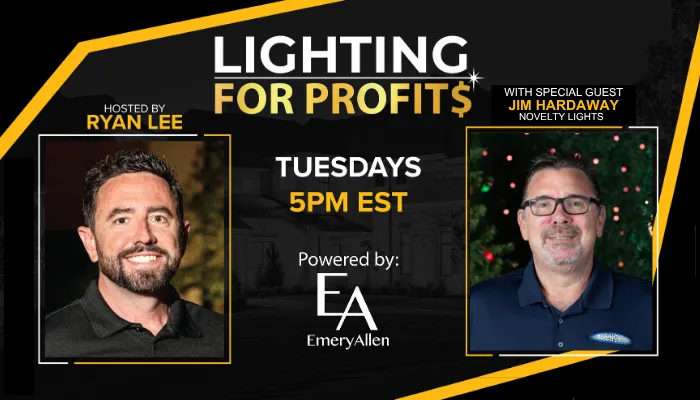
Jim Hardaway -The Growth Circuit
Lighting for Profits - Episode 245
In this episode, we sit down with Jim Hardaway, Chief Operations Officer of Novelty Lights, to talk about leadership, operational excellence, and the evolution of the lighting industry. With over 36 years of experience across entertainment lighting, architectural solutions, seasonal products, and global sales strategy, Jim shares valuable insights on scaling businesses, driving profitability, and leading with vision in a competitive market.
Watch the episode
Episode Transcript
Welcome to Lighting for Profits podcast, powered by EmeryAllen
Welcome to Lighting for Profits.
All light. All light. All Light, powered by EmeryAllen
Here is your host, Ryan Lee.
Oh, light a lot of light. Here's hoping that I can get through. I don't know what's going on. I got laryngitis or something like that, but we're gonna get through this. Um, my favorite portion of the week is doing this podcast. So get to interview some awesome guests and, uh, get to nerd out on, uh, how to grow an outdoor lighting business. Who would have thought that we could do a podcast about outdoor lighting? So, certainly a lot of fun. Looking forward to the show.
Jim Hardaway is the COO of novelty lights
Uh, Today we got Mr. Jim Hardaway. Jim is the COO of novelty lights. And, um, it's gonna be a good conversation. Novelty, uh, lights came to Light It Up Expo this last year. Um, and, um, appreciate their support, ah, for what they're, what they've done in the industry and what they're doing. Uh, so we're going to get an update on their business, but really kind of dig into, uh, what Jim's role is there and how he adds value to novelty lights and also to the outdoor lighting industry. So, um, if you're looking to grow an outdoor lighting business, probably more specifically, ah, we'll call it a holiday lighting, uh, business. Today's your day.
Landscape Lighting Secrets is hosting its annual Summit September 9-10
But, um, before we have Jim on, I'm going to talk about something that doesn't really matter what business you're in. Um, this will be a helpful topic. Um, so excited to have Jim, uh, Jim Hardaway on, by the way. We are trending. Uh, just looked this up. Just heard that we're the number one landscape lighting show in Denver, Colorado. Yeah, I don't know, kind of weird. Um, so guys, thank you, thank you so much for your support. Um, we're getting, we have more reviews on Apple now we got more on Spotify. It's just, uh, thank you guys so much. If you're bored and you have not done the review yet, um, go hook me up. Go do it. Go do it. Uh, a couple quick announcements. Friday, fly in. If you're in Landscape Lighting Secrets, this is a members only event. It's include. It's free for all members. Uh, July 10th at my house. July 10th, that's coming up in like six weeks. Make sure you register. It's free, but we got to know the headcount for food and stuff like that. So Friday, fly in July 10th at my house, Illuminati members only. I don't have a list. It sounds like I have a list today, but I Got a cough drop in. Um, September 9th and 10th, Park City, Utah. Secret summit. Okay, Secret, um, Summer is our members only event. And, uh, this year we're going to do something different. We are inviting a select few vendors. So we sent out an email if you did not. If you don't know what I'm talking about and you're a vendor and you kind of want to be there, uh, send me an email supportionleighcoaching. com Darcy can get you all those details. Uh, but it's going to be a great event. Two days, Park City, Utah, September 9th and 10th. Again, we got Jim Hardaway, the CEO of Novelty Lights, joining us in just a few minutes.
My son Max is on the mountain bike team and we went camping last weekend
Um, what I want to talk about. So this last weekend, just a few days ago, went camping, uh, with my son Max. And, um, he's on the mountain bike team. Um, he's, uh, he's gonna be a freshman this year, so he's on the like high school team. Um, and, um, it's kind of cool that they even have a team, right? I remember in Texas they had a team, um, they had a gun club. Like, oh, that is sick. Um, they don't have a gun club here, but they got a mountain bike team. And um, so we go camping and basically the mountain bike team has this annual, uh, team camp. And so, um, we, we're going camping. And you know, he's 13, so I'm trying to teach him how to like, take care of himself and you know, trying, uh, to like, yeah, tell him to teach him how to be self sufficient. And so I'm delegating, um, trying. He's helping me with some things on the trailer and he's doing a great job, like, hey, did you get this? Did you get that? And he's helping me load the bikes and I was asking him a few things like, hey, did you get that? He's like, oh, yeah, yeah. And like certain things was like, wait, you almost forgot your helmet. Like you almost forgot your shoes. They were kind of normal things, but he ended up getting everything. So we go, we leave and I'm brushing my teeth and all of a sudden he goes, I'm like, hey, uh, you going to brush your teeth? And he's like, oh, man. Yeah, I forgot my toothbrush and my deodorant. And I'm like, oh, great, we're camping for like two nights. No, no toothbrush, no deodorant. And he's 13 years old, uh, going through puberty. So this is not a good, not, not a good thing. Um, but the good news is he did. You know, we did have his bike. We had his helmet. We had his gear. So I'm like, you know, that's really all we needed. Uh, we're there to have fun. Um, but it reminded me in business how important it is to have checklists and really, like, delegated responsibilities. Um, I remember when we were in growth mode of our lighting business. Uh, you know, I used to, like, answer the phones, and then I used to do the ordering. And then I used to, like, you know, do the installs. Like, you used to do everything. Um, and then as we grew, my brother kind of started to oversee the install. So now I wasn't doing installs anymore. Uh, but I was doing the phones and ordering. And then I hired an admin, and she was doing the phones, and I was just doing the ordering. Then finally, I delegated everything. I was like, cool, I don't have to work as much anymore. Right? So she was doing the ordering. Well, she was doing the ordering. Then the guys would go to the installs. We had problems. Like, the guys would show up to an install and then be like, hey, we're missing two lights. And I'm like, what do you mean you're missing two lights? And I look at my thing. I'm like, I ordered the two lights. So then I go to, uh, my admin. I'm like, hey, did you order these lights? Yeah, I ordered the lights. They were there. I put them out. Like, she. She had, like, signed off on it. Well, the guys, you know, didn't get them for whatever reason. Either they were in a. The wrong spot or in a wrong box or whatever else it is, Right? And so we figured out that we had to change our process. And we basically just had a checklist so the guys would have to sign off on, like, actual that. Did they actually get those fixtures? They see them before they left the shop, Right? Because we didn't want them getting to the job site. Like, hey, I need something, and now I'm the delivery guy, right? And so they started to do that, and in the morning, they'd call, hey, I don't see the lights. Did you look on the shelf? Oh, yeah, here they are. Like, wow. One conversation just saved me over an hour of driving there and back. Sometimes it was 45 minutes each way. You know what I mean? So, um, that was huge. And then we found out that, okay, even when they started checking the stuff, they weren't checking everything. If there was a box and it said, like, Smith, they would grab the stuff and then all of a sudden, it was supposed to be right because they figured our admin had it right. Well, she had it right. And we realized our manufacturer or distributor shipped it. Wrong. Right. Sometimes it was just mislabeled. Something small, something dumb. Right. I mean, like, not even trying to assign blame, it was just like, there was something wrong. And so we realized there needed to be multiple checkpoints. There was a checkpoint for when the materials were ordered and actually received. Okay. She would, like, literally open up everything and make sure it was all there. And then there was a checkpoint when these guys would load it up under the truck. Right. And so all of a sudden, we had very few, if any, like, missing items. Right. Like, the problem was solved.
When you start your own business, you expect everyone to have common sense
This is when I talked about, like, are you putting out fires every day or are you preventing the fire from happening? This is preventing the fire from happening. So, you know, it's pretty easy when you. When you start your own business and you're like, okay, I'm gonna go install landscape lighting, you have this certain level of common sense, and you expect everyone else to have that, right? So you're like, okay, I'm gonna go do the install. I need the fixtures, the lamps, the wire, the transformer, the timer, uh, the connections, my tools. Like, in your head, you have this checklist. It's just in your head. But then you go and hire someone and you expect them to have the same common sense. Well, guess what? Like, you go to install 20 lights, they only have 18. So, um, that when you actually pause and give yourself time to actually develop these systems and checklists, you're going to prevent these fires from happening. Because people don't have the same level, level of common sense. Okay?
Bottleneck number one is poor preparation before you even get to the job site
So I'm gonna give you guys just quick, like, I don't know, three, four, five, uh, bottlenecks, uh, that can screw up your systems, that can screw up your operations and screw up your efficiency. So number one, bottleneck number one is just poor preparation. Okay, so are you actually prepared before you even get to the job site?
Right.
Well, um, you know, I thought everything was gonna be fine because I'm like, dude, we solved that. I'm good. So, you know, I'll be out on the. On the lake wake surfing all day while these guys are doing an install. Right. Well, turns out the guys didn't have some of the hardware, the screws, the caulk, the. The drill bit, um, the sand for the expansion joints, whatever it was, there was always something that they couldn't find in the truck. So then they have to Go to Home Depot, go to the store to go buy something that we already had on the truck, right? Uh, we already had it. But no, they had to go and waste time, right? So then they call me at the end of the day, oh, hey, boss. Yeah, we're not going to get it done. What aren't you going to get it done? It was 20 lights. You should be done, right? Well, yeah, we couldn't find this. We had to go to the store, and then that took 90 minutes and blah, blah, blah. So bottleneck number two is truck chaos. Like, you can have all the right supplies, you can have all the right preparation, but then all of a sudden, if your truck is disorganized, where they can't find simple things. I mean, I remember showing up and being like, what couldn't you find? And I go and, uh, go to the drawer, you know, three down, whatever. I'm like this drill bit. Oh, yeah, like what? So now all of a sudden, we couldn't finish a job that we were supposed to get completed, which you're like, oh, who cares? I got, I got time in my schedule. Well, not really. You only have 200 working days. 225. Like, whatever market you're in, you only have a limited number of working days, which you can make money on. Okay? So, um, that's, that could screw up a lot of things. You could be selling jobs, feeling like, hey, I just sold $60,000 this month. I'm gonna, I'm gonna make a lot of money. But if you, if your efficiency's not there and you're doing a one day job in two, you're gonna be wondering where all the money is at the end of the month.
Okay.
Bottleneck number three, um, you know, because we solved these problems and things got better. Okay. Um, but what I, what I realized at this point was like, bottleneck number three was labor efficiency. Okay? So, um, this is where you need to actually figure out what your, uh, what your efficiency is. Because I can't tell you, like, okay, two guys should do this and three guys should do that. Because everyone has different pricing, everyone has, um, different levels of installs, uh, that they're doing. If you're just putting like 20 lights in the front yard, uplighting a house and some trees, that's going to go a lot faster than 20 down lights in trees or 10 down lights and trees and 10 custom lights on the eaves and in the, in the outdoor kitchen or whatever else it is, right? So you got to figure this out. But, like, can your can your crew install $10,000 a day? You know, and if they can, like how many guys does that take and is that profitable? Because just installing a certain number a day doesn't mean you're profitable. Um, you really want to start to understand, like, what's your revenue per man hour? How many lights per man hour can you install? It seems like it's about one light per man hour on average, which as I talk to people, um, but what are your numbers? Okay, um, uh, let me give you an example. If you're installing on average, you know, $10,000 deals, okay, let's say you're selling, let's say, let's say that, let's say you're selling a $10,000 deal on average. Um, and, but your crew, let's say you got a two man crew, they're only capable of installing $4,000 a day. Okay? That's just their capacity. And maybe sometimes it's five thousand and sometimes it's three, whatever. But let's just say on average it's four thousand dollars a day and you're selling ten thousand dollar deals. Well, that ten thousand dollars job is automatically going to be a three day install because their capacity is four thousand. So two days is eight thousand. Like something's got to give. Either you hire a third person and make their capacity ten thousand, you know, in two days, make their capacity five thousand a day. Or you, you got it. Or you got to change something. Because if you're like, daily overhead is costing you, you know, two to $3,000 a day, you're just not going to make any money doing that. And this is where I see people selling jobs but not making money. So you could also raise your price. Some people are afraid to do that. Depends on what. If you're already at like, you know, 600 bucks a light selling $10,000 deals, you might not be able to raise your price. So you might have to fix your capacity issue, right? But the point is you need to be aware of these things in order to fix them. So look at your labor efficiency. See what you're, uh, at. If your average job is $4,000 and your guys can install $4,000, and that's what you do every day, and that means you can knock out $20,000 a week. And that works, then that works, right? Just know your numbers. What works best for your company? If you go ask on a free Facebook group, like what, what is the norm? Well, the norm isn't the same as what it should be for you, because someone might live in, uh, the market in Wisconsin is different than the market in Florida. Different than the market in Texas.
Right.
The seasons are different. All these types of things are different. The labor, uh, the labor rates are different. So make sure you guys look at labor efficiency.
The fourth bottleneck is owner dependency. If the business is dependent on you, then how
Um, and then the fourth callback is really just reworking callbacks. I mean, how many times is that happening in a week? How much money is it costing you? Um, there's the obvious of, like, it's costing you money to go, uh, now you can't go just like, do another job because you're fixing the current one. But is it also potentially costing you a relationship? You know, when I look at people's businesses and I see, okay, how much repeat business do you have? How many referrals do you have? Sometimes, like, it's the dumb things. Like, it's like, well, yeah, if you would have just not had callbacks right after they spent $12,000 with you, you would have gotten a referral. But now you didn't because of one dumb mistake. Because you didn't set the timer right, because you didn't have the right checklist to make sure you didn't leave tools. You didn't walk the property three times before you left. You didn't clean up trash, whatever it was.
Right?
And so, um, um, what is the opportunity cost? Not just the actual cost of callbacks and rework. And the opportunity cost is way bigger than the actual cost. I'm telling you that. So that's the fourth bottleneck. And then finally the fifth and final bottleneck is really just owner dependency. You know, can. Can the crew install without you? Can orders be placed without you? Can the office staff schedule the job? Like, can the sales team go sell it and then the office staff, um, you know, order the materials, get it scheduled, and the crew go get it done? Because this is, this is probably the biggest constraint. If the business is dependent on you to do these things, then, then how. How are you going to find time to grow? You know, I, I interview business, uh, owners every single week. And when I ask them about, like, okay, where are you trying to get, where are you trying to be? Sometimes people don't have very clear answers. They don't have a clear, very, very clear vision. And at first I was like, why? How do you, uh, I was judgmental. Like, how do you not know? Like, how you, you're a visionary, right? But the reality is it's. They. You don't have time. You're so busy working in the business, you. You haven't not set aside Time for visionary time. You haven't set aside time to plan. You haven't set aside time to prevent these fires from even happening. And this is where the money is made. If you can, uh, get rid of this owner dependency now, suddenly you can find time to analyze your marketing and see what's working. What, what lever should I double down on? What lever should I turn off? Um, what, what are some strategic relationships I could go after, um, to help really put fuel on this, on this business. Right. And so, um, I promise you, like, working harder is not. That might work for a sprint. It might work for, like this week, maybe this month, maybe this year, but, like, it's not the strategy. Okay. Um, you need to be more intentional and solve these problems. Um, most people are trying to get more leads, and I'm like, man, why try to get more leads if your operations is broken, if your sales is broken, if your pricing is broken, don't worry about those things and getting more leads through the system until the system is actually a system. Right? So, um, we're going to talk about that today. We're going to talk about, uh, you know, Jim, his, uh, role as a COO and kind of what they do to systematize their business and what operational efficiency looks like for them as well.
Emory Allen makes premium LED lamps for lighting professionals who demand the best
So again, in just a couple of minutes, we're going to have Jim Hardaway on. Um, I don't know why, I just felt like a country day. You guys know this. Friends don't let friends install subpar lamps. So, uh, Emory Allen luckily makes premium LED lamps for lighting professionals who demand the best. So don't settle for less. Upgrade your designs and installations today with Emory Allen. Reach out to Jackson L. His email is Jackson and then the letter L. Jacksonlryallen .com to learn more and take advantage of their contractor pricing, just email jackson lry allen.c om. don't forget to mention that you heard about them here on Lighting for Profits and they will hook you up with that discounted contractor pricing.
Light it Up Expo brings together landscape lighting, holiday lighting and permanent lighting
All right, all right. Let's get to the show. Let's get our guests coming on. What do you guys say? Where is our guest intro? There it is. Plus, I need a drink. Welcome. Welcome to the show, Mr. Jim Hardaway. What's up, Jim?
Hey, Ryan. Well, everything. Everything's up.
I love it, man. Thanks for joining me. I'm, uh, I don't know, is it, is it too early to geek out on holiday lighting? June 1st of June?
No, because while you have Christmas in July right around the corner. Right, Perfect. And you know There's a lot of Christmas lighting that is actually bought in different holiday periods. Like um, we've got the Americas250 happening. So uh, C6 Strawberry lights in the red, white and blue configuration. RGB color changing programmable lights. You know it can be used on uh, America's 250 coming up. So there's always something to celebrate.
I agree, I totally agree. Well uh, thanks for coming on the show. Thanks for coming uh, to Light it Up Expo. I appreciate your guys support there. Um, you know Light it up is really all about bringing together the landscape lighting, the holiday lighting, the permanent lighting industries together because there's so much overlap and I think you know, even if I'm listener right now thinking like yeah, I don't do a lot of holiday lighting or if I do I wait till October like you said. Like why not just send a quick email, a text to your clients and remind uh, them that it's the 250th year of America and they should have red, white and blue lights all over their house. Like I mean there's, there's opportunity to combine these industries for sure. So appreciate your guys support.
Yeah, absolutely.
Jim Hardaway has been in lighting for 37 years
Do you want to just do a quick introduction of who Jim Hardaway is and who novelty lights is?
Sure, I'll make it as quick as I can. Um, I've been in lighting for 37 years. Uh, all aspects of the lighting industry from entertainment, lighting club, uh, theater lighting, architectural lighting, general commercial lighting, landscape lighting, kind of ran the gambit and full uh, circle. I'm back to almost where I started with the entertainment side, um, with the, the holiday light. Um, so I've, in my career I've done all sorts of different things. I've been a product development person. I developed the first uh, solid state RGB laser projection systems. I'm uh, sure you guys, yeah, and I'm sure you guys have seen those little red um, green lasers that project on the front of the houses that do all of that, uh, the laser lights on your house, um, sparkle effects or whatever. So I came up with that concept years ago and, and uh, someone else of course took it and made it cheaper and yada yada yada. So I didn't make a million off of that one but it was a lot of fun. So I've been doing a lot of things in the lighting business and um, I always find joy in holiday lighting.
What is it about the holiday lighting industry that you love most
What is it about the holiday lighting industry that you love most?
Well, I think just lighting in general is. So someone told me years ago once you get into lighting, you'll never leave. And I didn't understand that until half maybe got halfway through my career that I totally got it. And I, um, think one of the basic premises of it is like, lighting brings joy to people. From a residential lighting perspective, your inside lighting or your commercial lighting, interior lighting, it's mostly about comfort and security. Right. Holiday lighting is uniquely positioned to bring joy. Right. So it's instead of functional lighting, it's, uh, it's just joy. It's part of our culture in our country. Our lighting culture surrounding Christmas, which dates back to, um, actually the first date or the first recorded Christmas lights were in Colorado. So Colorado is instrumental.
Really?
Yeah.
And it just so happens to be. That's where you guys are. Okay.
Okay. And then our company, Novelty License, but a business since 1999, um, when it was first conceived, it was conceived by a gentleman who, um, was the son of a, ah, man who had started another lighting company, more of a residential, uh, lighting company company in, in Colorado. And he thought, you know what, I'm gonna put lighting on the Internet. E Commerce. Right. And so he did. And he started out with novelty lights such as lava lamps and things like that.
Okay.
And then as he was looking around the marketplace, he saw that there was opportunity to, um, import Christmas lights and holiday lighting and started to do that, adding that to the, the repertoire. And then he saw the opportunity to bring in bulk product and supply the Christmas lights installers. And so he created the B2B side of the, of the website. The B2C still exists, but for a lot of what we do, it's designed around supporting the installers.
So do you guys still sell, um, lava lamps?
No, no lava lamps anymore. But a lot of novelty, what you would consider novelty lights, like the old bubble lights. Right. The incandescent bubble lights that, that our grandparents used to have in the trees that bubble. Um, so, you know, things like that.
Okay, very cool.
Yeah. But for the most part, we've converted to seasonal, uh, decor lighting.
Yeah, I had a lava lamp. I don't know why I'm so infatuated by that, but I had one as a kid, so I thought maybe I should get another lava lamp.
Well, now, I mean, there's a company in, uh, uh, the Bay Area, Silicon Valley that uses lava lamps to create, ah, uh, encryption.
I don't know what that means.
Like the way the bubble. They created some system where the, there's video cameras on it. And then the way the way the bubbles are really going, it changes the algorithm for the Encryption. It's crazy.
I knew that. So that's how Facebook and Google does it. Okay. All lava lamps these days. Y.
You're selling to business owners, so you have a different perspective
So I want to talk a little bit about, uh, well, there's a few different angles I want to go. I. I don't know. Like, so, you know, we. We deal with you. Like you said, you're selling to business owners. Um, I feel like you guys have a certain perspective that's different than, like, you know, if you go into, like, a Facebook group and contractors are, like, talking about things they want or things that they struggle with, um, you guys have a different relationship. You have a different side to that. I feel like most business owners, their passion is what fuels them. I mean, they. They're addicted to light, they're addicted to what they do, they love what they do, but they're just not usually good at running a business. So, um, I'm wondering. I'm like, maybe they should be the COO of their business and then hire a CEO. Or maybe they should be the CEO and hire a coo.
What does a COO do that's different than an owner or president
Talk to us a little bit about the difference. Like what? As you've gone through your career, you've had lots of different positions, and you guys are a pretty big company, but, like, what does a COO do that's different than, like, the owner or the president?
So part of when you were doing your intro, I thought, wow, Ryan already knows what it's like to be a coo, uh, because you're talking about systems and information. Uh, you can't see it on my back wall, but there's a Gino Wickman quote, uh, that I have on my back wall here. It says, systemize the predictable so you can humanize the exceptional. Right, Nice. So I'm all about the systemization portion of it. So, um, when I came to Novelty, which is a couple years ago now, Novelty, um, is part of a three company group. Uh, I've been involved with that three company group since 2004. I've, uh, held, uh, titles of CEO, I've held titles of vice president of sales and marketing, et cetera, et cetera. But they asked me to come here and be the COO of the company, which basically I'm running the company from a day to day perspective. I'm running the operations, I'm overseeing the sales and marketing. I'm overseeing human resource. So pretty much all aspects of it. And then the other part of it is I also have to take the other portion of my experience with lighting, which is market research, seeing what the competitors are doing, um, being Either a fast follower or an innovator and trying to inject new ideas into the product segment as well, or going to trade shows and seeing opportunities in product, um, from that perspective and trying to get to the market with it faster than others. So it's very comprehensive as what the CEO does.
Companies have to have a visionary. Right. And then you also have an integrator
One of the things that in my last position where I was actually more of what's called an integrator, and as an integrator, um, companies have a visionary. They have to have someone with vision. Right. Like Apple, Tim Cook. Visionary. Right. And then you also have to have an integrator, which is usually the ops person that is integrating the vision within the organization. So, um, there's nothing wrong with not being the, the visionary inside of your company. You just have to know your role and then hire someone to fill the seat. Ah, visionary. Or a CEO or CFO or whatever. Right.
How much, how much time do you spend, like managing people, um, versus, you know, like building processes and building these systems? Sure.
Um, it's really the key is, is if you build a good, solid leadership team, then you could spend more time on the higher level stuff. Um, so the first step is making sure that you have the seats identified. I want to be a $50 million business. Right now I'm X. So in order to be a $50 million business, I have to have these roles. Right. And then these people need to be in those roles. And then assigning the roles or the seats to those particular people, um, and then developing and training your leadership team looking to be accountable. So if your leadership team is good and they have accountability, then your job as a COO can be a lot different because you're now looking at higher level. You're at a 30,000 foot level or a 50,000 foot level for the most part. Obviously you get sucked down into the lower altitudes when things happen. But yeah, yeah,
yeah, I think, um, you know, just the more I hear you talk, I feel like, um, it's, it's the reason why I think in these small businesses and I, and I, when I started my business, it was the same thing. It was just like you just start it and you don't really have a plan. You're not thinking, I want to become a $50 million company. You know, it's like I just want to make enough money to pay the bills. And then it starts to grow. And then all of a sudden it's like this monster that you're like, wait, what's happening here? Um, I think the key is like hiring someone. So there's A book called who not how. Uh, it's like, the answer is who? Like, who in your business could you hire or promote to help you build these processes that are maybe better at building those things than you? Because as a visionary, I suck at those. I mean, I know enough about COO to know, like, I have an integrator that works for me because I know these are the things that need to get done, but I'm not the one to do them, you know? So this is where we're at. This is where we're trying to get. What processes do we need to get us there? Sure.
And I mean, to keep it simple. Uh, and a COO is like an orchestra leader. He puts the band together, the orchestra together, and he conducts the orchestra and makes the music with the orchestra. Right. Um, if you're an owner operator, it's a little bit different. But at some point, you have to recognize where your limitations end and other people's begin. Right. Um. All my career, I've kind of likened myself. I've owned my own businesses before, and some failed and some were right. Um, but I likened myself to be a king maker, not a king. So I know my role. I know what my strengths in weakness businesses are. I stay out of accounting because I suck with numbers. I can read a P. L. I can read all that stuff. I can interpret it. I can understand where problems are in it. But, yeah, don't have me document. That's huge.
I think a lot of people are afraid to hire too, because they think, like, again, we. We always think our common sense is everybody else's. Right. And so I'm like, well, man, I'm afraid to hire Jim because, like, then he'll just want to start his own business one day. He's really good. But, like, then. Then he'll want to start his own business. Like, well, no, Jim's already tried that. He's already. He already knows. Like. Like, I like the way you put it. Like, I don't want to be a king. I want to be a king maker. Like, you can help build the kingdom and still get. Make a lot of money, get a lot of accomplishment, get all the things that you want internally. Um, and not everyone wants to start their own business. Just because you're a visionary, just because you want to start your own business doesn't mean everyone else. And everyone kind of does want a side hustle, because that's like the trend with Instagram and everything else. But then they only have to try it once or twice to realize, okay, maybe this Isn't for me. Uh, there's a lot of risk. There's a lot of things that you have to do and be willing to do as the owner of the company. So.
I love when people start their own businesses. I think early on, um,
Yeah, I appreciate you sharing that.
Yeah. I think early on, um, um, first of all, I think the people that start their own business, businesses are very brave people. Right. They're, they're, they're taking on an assigned risk, and sometimes it's calculated, sometimes it's not calculated. Right. The calculated was safer, of course. Right. But I love when people start their own businesses. Um, and I think that that gives people, um, they have, they have a strength that not everybody has. Right. And they have that self, uh, assuredness, and they're willing to take, Take those risks. But at the same token, folks need to look outside of themselves. And first of all, setting goals is a very key, important thing. Like, I set my goals 20, 32 years ago in the business of where I wanted to be. Right. And I created a plan to get there. So I think that's kind of a key aspect to it as well.
Yeah. Nice. Cool.
Did 14 trade shows this year. Light it up was one of them
Well, let's talk about, um, I guess kind of the industry you said right now is trade, ah, show. Or did you finish trade show season?
I have another two shows.
Okay.
Did 14 this year.
Yeah. So 14 shows. Light it up was one of them. But what was lighted up, I mean, it was our second year. I hope it was good. I hope you guys are coming back. Was it good?
Yeah, we're gonna come back the again. I like to empower my, my people. I mean, the first year I came here, I managed every aspect of all the trade shows, and I went to 99 of them. I, um, have confidence that my people can execute trade shows now. So I let them go out and do a lot of these shows. I didn't actually go to the landscape lighting the Light it up show. Um, but the feedback that I got from my people is that they want to do it again, that they felt it was beneficial and worthwhile. Um, it has a different jam, um, than some of the other ones that we do, uh, which is good because I like unique things.
Cool. That's awesome.
You guys just moved to a new place. Congrats on the growth
Uh, what m else is new? You guys just moved to a new place. You guys are working on your own business. Uh, what else is happening?
Yeah, so we actually maxed out. We were in the last location for about 10 years and we maxed out our space. Space. We couldn't grow anymore. It was, uh, 70, 72, 000 square feet originally. It was smaller than we then we rented another uh, building across the street from us and it was very complex because you know, we're in, in the busy season, we're shipping thousands of orders a day, right. So um, bringing stuff from one building to another. So we knew that we had to get into one facility. So um, and in order for us to grow we had to increase, increase our product, uh, mix, bring in new product, uh, categories and stuff. And so in that we found a new building that's 92,000 square foot with 32,000. Yeah. So we um, uh, it's big, it's all one facility. So we don't have to have that inefficiency that you're talking about of uh, doing fulfillment, uh, of um, backfilling inventory to our rabbit picking. So but anyways it's uh, we're happy. We're in the middle of also launching a new brand, rebuilding new brand logo, um, new, uh, kind of more of a, of a different vision, um, from the company that we've been working on years. So we're, we're really excited about it.
When, when will that be launched?
So the new logo is going to be official, I believe in July as far as when. So we're kind of rolling it out like something big is coming. Right. Um, and then we all. What we also want to do is we want to get our showroom done. So we have a new showroom. It's a 3,000 square foot showroom, uh, that's going to have a lot of commercial decor in it as well as all the functional, um, supplies that all the installers from the local market, they're going to be able to come in and just, and shop uh, very easily. Um, with the new, with the new showroom. So that's gonna, that should be done. My goal is by the end of June to have the showroom ready and then we'll do a soft launch of the new building and we'll have a lot of social media going on about it.
Nice. Yeah, that's awesome. Congrats on the growth. That's cool.
You guys are expanding the warehouse, getting into new product categories
Thank you.
You know, I think it's interesting because if someone's been in the industry a long time, like I'd say I don't know what long time means, but let's say over 15 years they're of the mindset of like, ah, you know, back in the day it was good, it's, it's dying and like all this stuff. And here you guys are expanding the warehouse, getting into new product categories, stuff like that. So it's, it's really cool to see.
Um, it's challenging, don't get me wrong. When, when uh, the gentleman who created the company, uh, back when he started going into this part of the market There was like three companies that were in, in the space. Now there's 20 plus and direct competition with China selling shop.
So
there are still challenges. But um, my favorite line from Jurassic park, that life finds a way. Well, business finds a way. Right?
What are some areas you think contractors are missing out on with lighting
Yeah.
What are. When you, when you look at like what you guys offer versus what people are buying and like what the market's doing, what are some areas you think that contractors are missing out? Like maybe, maybe it's just lack of knowledge or lack of uh, training or whatever it is. But you're like man, I don't know why they're not doing more of this because this, this is a mover, they're not taking advantage of it.
Well I think that to a certain degree that they are, they're starting to take advantage of it especially if they're also um, incorporating permanent lighting. Uh, our sister company American Lighting is launching new permanent lighting uh, solution um, and we'll be selling that as a distributor uh for that because it has, it has a role in the, in the marketplace. It doesn't replace Christmas lights but it's a nice add on uh, to Christmas lights to prevent having to go up on ladders and put C9s across the roof line. Right. Um, so I think to a certain degree that they are, I think making sure that you're uh, because the season is short and if you don't make the money that you need to make in the season, um, and that's due to uh, a supply issue like you're buying from the wrong company that runs out of things and whatnot. I think that's important for, for um, landscapers and folks that are doing the in season uh Christmas lights installers, they should make sure that they're buying from folks that are going to run out or. But the color, temperature, the white's not going to change the next year. Right.
Well I like, I like what you said earlier how like holiday lighting, you know, compared to some other types of lighting like holiday lighting brings joy. Right. And for years I used to say like people need landscape lighting, uh, if they don't they're gonna die and all this, all this weird stuff. But I actually truly believe that people need light in their life. But um, I ah, had this like epiphany, I don't know, maybe a year ago or something like that and I was like you know what the coolest thing about lighting is that people want it. It's not a, uh, demand, like a need. Like, oh my gosh, like my. I have to have my air conditioning on, on, because it's literally 110 degrees outside. Like, like you, you need air conditioning, you need water, you need these things. Right? So, but that's the coolest thing about lighting is like, people, right, because they want it. Like, people go on vacation because they want it. They don't have to go and spend 10, 15 grand on a vacation. They literally, they just want to, you know, and that joy lasts for seven days when they're on vacation. With lighting, it can last every single night. You know what I mean? So, like, that's, I don't know. It's one of the coolest things about our industry is like, it's high margin, you can make a lot of money, but you're actually giving people what they want. Like, they need a roof, but it's not like, okay, 50 grand for a roof. Like, yeah, I need, I know I need that. But it doesn't feel good, doesn't bring joy. Lighting, like, actually brings joy. Like, man, that, that looks so good. It makes me feel, feel a certain way when I drive up to my house, when I go to my backyard.
Like, absolutely. And, and in landscape lighting and, and landscape lighting, that, that crosses over as architectural lighting because there's the, the up lights and your cylinders and things like that. Right. Um, it, it accentuates people's largest investment in life. Like, your house is your largest investment in life other than your kids and their education, probably. But when it comes to physical things, your, your home is your castle. Right? And so by being able to illuminate your landscape lighting and your architectural features of your, of the house that you've worked so hard to, to build or to buy, um, it brings a sense of joy and accomplishment to you as you're pulling up to that house. It's an emotional experience.
Bearings, how, how much, you know, because it is, you know, we'll call it a, like, it's a joy. It's not a demand type call.
How much does your business like novelty lights fluctuate with economic trends
How much does your business like novelty lights? How much do you guys, uh, fluctuate with economic trends? Like if the, if the economy is going to dip this year, are you guys dipping on par with that? Are you, are you able to, like, be an anomaly?
Like, well, again, it goes back to. We don't do a lot of landscape lighting. It's mostly, well, just holiday lighting. Yeah. Um, I can tell you that we're up in a troubled economy. Um, and a lot. And that, that comes to, people are wanting to stay at home, they're doing staycations or they're in their rv, so they want to have some, some, some decorative lights around or like an American flag, LED flag on their, their RV or whatever. They're, they're, they're pulling these things into their lives because a, it's not hugely expensive, it's not budget prohibitive. Right. But it's got an emotional tie to them. So typically in a down economy, people don't skimp on Christmas. Christmas is Christmas. They'll go into debt for Christmas. That's awesome. Right? So knock on wood. It, we, we don't, we don't get hit like that. Um, now the installers might have a different experience because they've got maybe a lease for a three year program with the homeowner to do their Christmas lights every Christmas. Right. Um, maybe those budgets get looked at a little bit differently nowadays, you know, so there might be an impact, uh, from that perspective.
Yeah, I appreciate, because I think a lot of people think, oh, yeah, well, um, this isn't the best industry because, you know, it's not protected when there's a down economy. And my experience has been like yours, it's like, well, I don't know, we're not like catering necessarily to the poor people selling them Christmas, uh, lights and landscape lighting. So like these people, they might take a hit, you know, they might see, well, our stocks went down, but they still have money. They're still gonna go on their vacation. Yeah, they're still gonna invest in their happiness and their joy. So it's, uh, just such a cool industry because the fact that the economy can go down but their holiday lighting budget stays the same is, is incredible. That's awesome.
I agree. So it's a pretty safe industry from that perspective.
What separates the hundred K, the hundred thousand dollar holiday lighting companies
When you, when you look at your customers, um, do you, I mean, do you guys know who Your like, top 10 clients are and who your like, top worst 10 clients are?
Um, well, I implemented a CRM system almost a year or almost two years ago. And so, yes, I know exactly all of top 10, top 2020. Um, I learned a few decades ago not to put negative, uh, information into a CRM because it can accidentally get leaked out. Um, so we know who the top ones are and through the data, I know which ones didn't buy again. And then I can go and approach them, uh, in a different way, uh, to bring them back, uh, to the fold. So to Speak. So CRM has been uh, a important investment.
So what in your opinion? I mean you see buying trends I'm sure, but, and you probably have some information just in like conversations and relationships. But what separates the hundred K, the hundred thousand dollar holiday lighting companies or the fifty thousand dollars ones to versus the ones doing five hundred K a million, two million dollars. Like what, what are they doing differently?
I think a lot of it is systemization. Um, uh, being able to run, run crews, ah, more and more crews, add on like duplicate the process in more locations. Right. Um, I think that's a big difference. Um, I think could be a needs assessment, like maybe ah, a power window washing company or a landscape company during the, the three months of the year or four months of the year that are you know, dealing with frozen tundra. Like how much money do I actually need to keep my operation going through that? So uh, and so maybe the goal isn't to grow to, to be 100k customer. Maybe they're okay with what they're getting. It's all different. But I think the larger customers are more systemized.
Yeah, that makes sense. And like you said, I think um, they are. It's not just like in one city that they're doing these massive mass numbers there. They've, they've kind of like expanded out a little bit.
Dale Carnegie. Dale Carnegie. The process of duplication there is, there is no new unique business formula. It's the old formula is just repurposed to the new environment. Right,
I know, um, I'm not going to say his name but um, if, just because I would say if he was here but um, he was giving me a hard time. He's like man, you got to come up with some different uh, information. You got to come up with some different content. I'm like, I'm not, excuse me, I'm not in the content game. I'm in the helping people grow their business game. And I'm telling you these are foundational principles that once people master, I will stop talking about them. But they haven't mastered them. Okay. And it's like you have the Bible, like until you're, you're like good with the Bible, we're not going to come out with more scripture. Like there's so many things in there that people just overlook. So yeah, I agree. Like there's certain business principles, marketing, sales process, people. I mean, yeah, technology changes, products change, we got AI like all these things. But like at the, at the foundational level there's certain things that need to happen to get to certain levels.
Oh yeah, absolutely.
What's the fastest path to success to bolting on holiday lighting
So I want to ask you, uh, a little bit of uh, I think this will be helpful for the listeners if someone wants to, let's say there's someone who has isn't. Maybe they're just like dabbling a little bit into holiday lighting or they've never done it. Uh, what's the fastest path to success to bolting on holiday lighting?
Um, from what I've experienced with us, because I redefined our partner program, what it means to partner with novelty lights. So when you go to our website, you can actually see clearly what the value proposition is for being a partner. And part of that's discounting. Part of that's uh, availability of product. Um, and part of that is lead, lead generation, lead resources. Right. So there's a lot of folks that will put up the signs on the side of the road says we install Christmas lights. And I'm sure that works to a certain degree. Um, but there's Facebook Marketplace, uh, uh, advertising and Google pay per click and all sorts of different ways to do it. And there's, you know, we offer. And there's other folks that offer lead, uh, resources where you buy leads, qualified leads, um, for, for that and follow up with those, um, trying to secure the business.
You guys. So you guys get leads for your partners.
Yeah, so we have a lead service where they can sign up for the lead service and they, they can buy the lead. Um, depending on the price. It depends on whether the lead's been just one person buys the lead or goes to one person. Right. Or one company or if it's a lower price and maybe two, two companies get that lead and fight over it. So um, leads are important. Getting trained. Train. Getting trained is important. One of the things that we do differently is we're, we don't compete against our customers. So we're not, we're not training certified installers and then having our own installers people, our installers going out and doing installations. So we're not competing against our customers. We're solely a supplier for the installers. Right. But we have a lot of blogs and we have uh, uh, an entry level one on one process that you can uh, get access to that teaches you all the basic fundamentals, which is good to know before you go out.
And so I was going to say how do you get training? But it was. Is you log in online or.
Yeah, so we'll go online and there's a link that says partner with us. You complete that partnership form, it goes to one of Our commercial account managers, they reach out to you, ask you a few questions, get you set up with a code that gives you access to all of our back end, which has our training, uh, courses, training materials, blogs, etc, as well as a sizable discount for your first year, um, so that you can then invest and spend less and make more margin for your next years than the next years after that, etc. Etc. Okay, so partner.
How much inventory should someone buy to get started with lighting business
So obviously if someone's getting started, fastest path is leads, uh, education, anything else?
Um, I think that's the, that's the. Well, I'm obviously having uh, supply. Right? I mean now you don't how much
inventory they buy to get started. Like, because they're gonna need to, like you said, they're gonna need some money for advertising to generate leads. I've seen people tie up too much inventory or they're like, yeah, I don't have any money. I'm like, they're sitting on $15,000 of product that they don't know how to sell. Um, but then I've seen on the other hand where people are like, crap, I, I need inventory, I've sold, I need to get this in. So how much should they have?
Well if you look at most roof lines on most houses because when people hire installers, they're really wanting them to primarily do the roof line of the house with the C9s or the C7s. Right? To get that regal, that, ah, you know, high end residential, even spaced, perfectly angled Christmas lights across the front of their house. Right. Um, ah, so uh, typically a 50 foot, 100 foot, 500 or maybe just a 500 foot kit that you can cut up and to do um, six, six homes using that one kit of materials. The only differential is the um, most common is warm white. So you'll learn that through our training that warm white is the most widely adopted, um, color, temperature or for your C9s. So you can feel pretty safe investing in just a kit of uh, 500ft with everything you need to do multiple homes. So it's not a huge investment. And then if you're doing business with a company that has a ton of stock and can deliver to you within two to three days to anywhere you are in the United States, then you don't have to have a lot of initial overhead. So you buy what you need for your leases because you're going to want to have that recurring revenue next year. Going to sign people up for three years in a row to do the exact same thing for three years. And then every year you're doing that you try to upsell them new things to add on to what they're doing initially.
Cool. What are, what are some of those upsells? Um, what are, what are some things that have really good margin that people should be paying attention to?
Tree wraps where you're wrapping the tree, the trunks of the trees and then um, you know the top tops of the trees. Adding, adding uh, motifs like snowflakes and things or Moravian stars and other things that light up, that make the trees look spectacular outside. Those are great upsells. Wreaths, garlands, lit wreaths, lit garlands, pre decorated, um, or not. Those are, those are huge upsells, um, net lights for your bushes, uh, your reindeer or maybe a um, a photo op display where maybe it's Santa waving and people can put their head in their face inside of that and become like an Instagram house. So there's all sorts of things you can do to upsell. We also have a course that teaches installers how to upsell commercial decor. It's like a 10 PowerPoint series on uh, how to upsell commercial decor where you can get some large ticket items into your um, folks budget over a three year period. So it doesn't seem like that heavy of investment for them. Um, but it gives you the reoccurring revenue and uh, a satisfied customer
when you have someone that's newer or I don't know, maybe, maybe they're not, maybe they're 10 years in. But what are some of the mistakes you see, uh, like first year installers make?
Uh, well I guess it depends. It could range from buying your lights on TEMU to uh, they're like wait,
why would I pay? Why would I buy from a distributor I can just buy straight from uh,
or whatever.
What, what is the risk with that? Talk to us real quick about if they, if they do that, what they're going to get versus what they think they're going to get.
So our company, part of our value add is that. And again I've actually lived in China. Most of the lights now are made in China, Cambodia, Thailand, Vietnam, etc. Right. More so the latter nowadays all your intelligent smart lighting like your uh, youth lighting, permanent lighting, is made in China because it's more high tech and it can't be transferred to these other countries yet. Um, so the pitfalls is if you do that, there's zero, zero recourse. If they ship to you and it's the wrong thing or they ship to you a substandard product, you're not getting a Refund, Right.
But it looks the exact same, Jim. Ah, that's what they told me. It's the same thing.
Uh, in Chinese they say, uh, it's similar but not exact. I lived there for seven years so I could speak.
They do a great job of making it look the same. They really do. And then all of a sudden on the outside, then you turn it on. Doesn't last as long. Corrodes out like all these problems and uh, you know it is, it is frustrating even for me. I don't care like where people buy their product. I mean I want them to buy a quality product for sure because that's how they're going to scale a business. But you know, if they're buying quality, that's really what matters. But people come in and they think they're going to outsmart the system. I'm like, I mean these people, they don't understand like the relationships that you guys have, the quality control, all these things going into it to make sure that you're putting out the, the best quality possible.
We have an office going in short,
short process, you know.
Yeah, well we have an office in China and that office helps uh, us to inspect production runs. So they'll go to all the different countries and inspect production runs. They'll give us a uh, production inspection report. We can reject certain things, accept certain things, etc. So we, we do quality control offshore. Right. So that's a value add uh, that we provide as well. And the other thing is, is we have a local address. We've been in business for 26 years and if something doesn't go right, well there's recourse. You have recourse with us and we provide excellent old fashioned customer service, um, in languages that you can speak.
Good point.
How do people get in touch with noveltylights
Well, um, I guess uh, as we wrap up here, um, and yeah, thanks for coming on, I really appreciate it. Um, how do people get a hold of you? What's the best way to get interested in.
To me personally, the company is noveltylights. com. um, we also have an 800 uh number which is 800-209-6122. If you go to our website and you, you fill out the form for partner with us, you're going to get a call back from one of our account, uh, executives who knows lighting knows even like your competition in the area, um, and can help you figure out what's the best bulbs and the best color of wire etc for that particular community. Um, because we have all of this information in our system so we can help you get started. If you're existing, we can help you convert to our product. And so the main pathway through is through our contact forms on our website. Partner with us. You'll get the great value.
Okay, very cool.
Jim: Are we doing a discount for listeners potentially
Um, all right, so this. This question could be the last one, and it could be the most awkward one because I forgot to ask you before. Before we hit the live. You know, the. Before we hit the record button. Um, are we doing it. Are we doing a discount for. For listeners potentially?
Well, that's. That's the way to do it. So if you do the partner with us, and then you can put in your comment that you saw, uh, me, uh, here on, um, uh, Lighting for Profits, right? Uh, yeah. And you'll. You'll get the best discount available for a new partner.
Okay, cool. Okay, sweet.
Could be up to 20 off.
Okay, cool. So, um, when you guys go to noveltylights. com, uh, partner with us. Ah. Make sure when you're filling out that, uh, that form that you mentioned, Lighting for Profits, to get the best discount possible for you guys. Good. Well, I'm glad because I thought, man, I forgot to ask before, and I. If you were like, no, there's no discount, uh, that could have been on.
Well, the good news is I'm the CEO. That's another thing that I can do. I can actually just on the fly, say,
we got the right guy, guys. Ah, we got the right guy. So, see, this is why I only. I only do business with people that I like. There's just something about it. If, even if, like, I'm gonna buy something and I. And I'm gonna save 50% or some crazy thing, like, if I don't like that person, I just can't. Just can't do it. I gotta. I gotta like the people.
Yeah, I got it.
Well, awesome, Jim, thank, um, you so much for coming on here.
Jim: We're close to signing an agreement for Lighting for Profits
Anything else? Uh, we need to let the audience know before we wrap up.
Uh, no, I think we've covered pretty much everything.
Good deal. Well, thanks again for being on the show. Um, you guys go to noveltylights. om, fill, uh, out the, uh, uh, Partner With Us form, mentioned Lighting for Profits in there, and then, uh. Yeah, I guess we'll plan on seeing you. We're pretty close to signing this, uh, this agreement for Lighting for. Can't even keep track of my own names here. Uh, light it up in 20, 27. Uh, but right now, just pencil in the first week of March, because, um, it should be. It should be that, but it's not inked yet. You know what I'm saying?
So I'm sure I'll get an email from you.
Yep. We'll definitely reach out. So thanks for being part of that. Thanks for being part of the lighting community and for everything you guys do there at Novelty Lights. Thanks a lot, Jim.
You're welcome, Ryan. Take care.
Go hire a gym. Go hire a coo. Your business, operational, efficient
All right, guys, go make it happen. Go hire a gym. Go hire a coo. Your business, operational, efficient. Let's go.
Jim Hardaway -The Growth Circuit
Lighting for Profits - Episode 245
In this episode, we sit down with Jim Hardaway, Chief Operations Officer of Novelty Lights, to talk about leadership, operational excellence, and the evolution of the lighting industry. With over 36 years of experience across entertainment lighting, architectural solutions, seasonal products, and global sales strategy, Jim shares valuable insights on scaling businesses, driving profitability, and leading with vision in a competitive market.
Watch the episode
Episode Transcript
Welcome to Lighting for Profits podcast, powered by EmeryAllen
Welcome to Lighting for Profits.
All light. All light. All Light, powered by EmeryAllen
Here is your host, Ryan Lee.
Oh, light a lot of light. Here's hoping that I can get through. I don't know what's going on. I got laryngitis or something like that, but we're gonna get through this. Um, my favorite portion of the week is doing this podcast. So get to interview some awesome guests and, uh, get to nerd out on, uh, how to grow an outdoor lighting business. Who would have thought that we could do a podcast about outdoor lighting? So, certainly a lot of fun. Looking forward to the show.
Jim Hardaway is the COO of novelty lights
Uh, Today we got Mr. Jim Hardaway. Jim is the COO of novelty lights. And, um, it's gonna be a good conversation. Novelty, uh, lights came to Light It Up Expo this last year. Um, and, um, appreciate their support, ah, for what they're, what they've done in the industry and what they're doing. Uh, so we're going to get an update on their business, but really kind of dig into, uh, what Jim's role is there and how he adds value to novelty lights and also to the outdoor lighting industry. So, um, if you're looking to grow an outdoor lighting business, probably more specifically, ah, we'll call it a holiday lighting, uh, business. Today's your day.
Landscape Lighting Secrets is hosting its annual Summit September 9-10
But, um, before we have Jim on, I'm going to talk about something that doesn't really matter what business you're in. Um, this will be a helpful topic. Um, so excited to have Jim, uh, Jim Hardaway on, by the way. We are trending. Uh, just looked this up. Just heard that we're the number one landscape lighting show in Denver, Colorado. Yeah, I don't know, kind of weird. Um, so guys, thank you, thank you so much for your support. Um, we're getting, we have more reviews on Apple now we got more on Spotify. It's just, uh, thank you guys so much. If you're bored and you have not done the review yet, um, go hook me up. Go do it. Go do it. Uh, a couple quick announcements. Friday, fly in. If you're in Landscape Lighting Secrets, this is a members only event. It's include. It's free for all members. Uh, July 10th at my house. July 10th, that's coming up in like six weeks. Make sure you register. It's free, but we got to know the headcount for food and stuff like that. So Friday, fly in July 10th at my house, Illuminati members only. I don't have a list. It sounds like I have a list today, but I Got a cough drop in. Um, September 9th and 10th, Park City, Utah. Secret summit. Okay, Secret, um, Summer is our members only event. And, uh, this year we're going to do something different. We are inviting a select few vendors. So we sent out an email if you did not. If you don't know what I'm talking about and you're a vendor and you kind of want to be there, uh, send me an email supportionleighcoaching. com Darcy can get you all those details. Uh, but it's going to be a great event. Two days, Park City, Utah, September 9th and 10th. Again, we got Jim Hardaway, the CEO of Novelty Lights, joining us in just a few minutes.
My son Max is on the mountain bike team and we went camping last weekend
Um, what I want to talk about. So this last weekend, just a few days ago, went camping, uh, with my son Max. And, um, he's on the mountain bike team. Um, he's, uh, he's gonna be a freshman this year, so he's on the like high school team. Um, and, um, it's kind of cool that they even have a team, right? I remember in Texas they had a team, um, they had a gun club. Like, oh, that is sick. Um, they don't have a gun club here, but they got a mountain bike team. And um, so we go camping and basically the mountain bike team has this annual, uh, team camp. And so, um, we, we're going camping. And you know, he's 13, so I'm trying to teach him how to like, take care of himself and you know, trying, uh, to like, yeah, tell him to teach him how to be self sufficient. And so I'm delegating, um, trying. He's helping me with some things on the trailer and he's doing a great job, like, hey, did you get this? Did you get that? And he's helping me load the bikes and I was asking him a few things like, hey, did you get that? He's like, oh, yeah, yeah. And like certain things was like, wait, you almost forgot your helmet. Like you almost forgot your shoes. They were kind of normal things, but he ended up getting everything. So we go, we leave and I'm brushing my teeth and all of a sudden he goes, I'm like, hey, uh, you going to brush your teeth? And he's like, oh, man. Yeah, I forgot my toothbrush and my deodorant. And I'm like, oh, great, we're camping for like two nights. No, no toothbrush, no deodorant. And he's 13 years old, uh, going through puberty. So this is not a good, not, not a good thing. Um, but the good news is he did. You know, we did have his bike. We had his helmet. We had his gear. So I'm like, you know, that's really all we needed. Uh, we're there to have fun. Um, but it reminded me in business how important it is to have checklists and really, like, delegated responsibilities. Um, I remember when we were in growth mode of our lighting business. Uh, you know, I used to, like, answer the phones, and then I used to do the ordering. And then I used to, like, you know, do the installs. Like, you used to do everything. Um, and then as we grew, my brother kind of started to oversee the install. So now I wasn't doing installs anymore. Uh, but I was doing the phones and ordering. And then I hired an admin, and she was doing the phones, and I was just doing the ordering. Then finally, I delegated everything. I was like, cool, I don't have to work as much anymore. Right? So she was doing the ordering. Well, she was doing the ordering. Then the guys would go to the installs. We had problems. Like, the guys would show up to an install and then be like, hey, we're missing two lights. And I'm like, what do you mean you're missing two lights? And I look at my thing. I'm like, I ordered the two lights. So then I go to, uh, my admin. I'm like, hey, did you order these lights? Yeah, I ordered the lights. They were there. I put them out. Like, she. She had, like, signed off on it. Well, the guys, you know, didn't get them for whatever reason. Either they were in a. The wrong spot or in a wrong box or whatever else it is, Right? And so we figured out that we had to change our process. And we basically just had a checklist so the guys would have to sign off on, like, actual that. Did they actually get those fixtures? They see them before they left the shop, Right? Because we didn't want them getting to the job site. Like, hey, I need something, and now I'm the delivery guy, right? And so they started to do that, and in the morning, they'd call, hey, I don't see the lights. Did you look on the shelf? Oh, yeah, here they are. Like, wow. One conversation just saved me over an hour of driving there and back. Sometimes it was 45 minutes each way. You know what I mean? So, um, that was huge. And then we found out that, okay, even when they started checking the stuff, they weren't checking everything. If there was a box and it said, like, Smith, they would grab the stuff and then all of a sudden, it was supposed to be right because they figured our admin had it right. Well, she had it right. And we realized our manufacturer or distributor shipped it. Wrong. Right. Sometimes it was just mislabeled. Something small, something dumb. Right. I mean, like, not even trying to assign blame, it was just like, there was something wrong. And so we realized there needed to be multiple checkpoints. There was a checkpoint for when the materials were ordered and actually received. Okay. She would, like, literally open up everything and make sure it was all there. And then there was a checkpoint when these guys would load it up under the truck. Right. And so all of a sudden, we had very few, if any, like, missing items. Right. Like, the problem was solved.
When you start your own business, you expect everyone to have common sense
This is when I talked about, like, are you putting out fires every day or are you preventing the fire from happening? This is preventing the fire from happening. So, you know, it's pretty easy when you. When you start your own business and you're like, okay, I'm gonna go install landscape lighting, you have this certain level of common sense, and you expect everyone else to have that, right? So you're like, okay, I'm gonna go do the install. I need the fixtures, the lamps, the wire, the transformer, the timer, uh, the connections, my tools. Like, in your head, you have this checklist. It's just in your head. But then you go and hire someone and you expect them to have the same common sense. Well, guess what? Like, you go to install 20 lights, they only have 18. So, um, that when you actually pause and give yourself time to actually develop these systems and checklists, you're going to prevent these fires from happening. Because people don't have the same level, level of common sense. Okay?
Bottleneck number one is poor preparation before you even get to the job site
So I'm gonna give you guys just quick, like, I don't know, three, four, five, uh, bottlenecks, uh, that can screw up your systems, that can screw up your operations and screw up your efficiency. So number one, bottleneck number one is just poor preparation. Okay, so are you actually prepared before you even get to the job site?
Right.
Well, um, you know, I thought everything was gonna be fine because I'm like, dude, we solved that. I'm good. So, you know, I'll be out on the. On the lake wake surfing all day while these guys are doing an install. Right. Well, turns out the guys didn't have some of the hardware, the screws, the caulk, the. The drill bit, um, the sand for the expansion joints, whatever it was, there was always something that they couldn't find in the truck. So then they have to Go to Home Depot, go to the store to go buy something that we already had on the truck, right? Uh, we already had it. But no, they had to go and waste time, right? So then they call me at the end of the day, oh, hey, boss. Yeah, we're not going to get it done. What aren't you going to get it done? It was 20 lights. You should be done, right? Well, yeah, we couldn't find this. We had to go to the store, and then that took 90 minutes and blah, blah, blah. So bottleneck number two is truck chaos. Like, you can have all the right supplies, you can have all the right preparation, but then all of a sudden, if your truck is disorganized, where they can't find simple things. I mean, I remember showing up and being like, what couldn't you find? And I go and, uh, go to the drawer, you know, three down, whatever. I'm like this drill bit. Oh, yeah, like what? So now all of a sudden, we couldn't finish a job that we were supposed to get completed, which you're like, oh, who cares? I got, I got time in my schedule. Well, not really. You only have 200 working days. 225. Like, whatever market you're in, you only have a limited number of working days, which you can make money on. Okay? So, um, that's, that could screw up a lot of things. You could be selling jobs, feeling like, hey, I just sold $60,000 this month. I'm gonna, I'm gonna make a lot of money. But if you, if your efficiency's not there and you're doing a one day job in two, you're gonna be wondering where all the money is at the end of the month.
Okay.
Bottleneck number three, um, you know, because we solved these problems and things got better. Okay. Um, but what I, what I realized at this point was like, bottleneck number three was labor efficiency. Okay? So, um, this is where you need to actually figure out what your, uh, what your efficiency is. Because I can't tell you, like, okay, two guys should do this and three guys should do that. Because everyone has different pricing, everyone has, um, different levels of installs, uh, that they're doing. If you're just putting like 20 lights in the front yard, uplighting a house and some trees, that's going to go a lot faster than 20 down lights in trees or 10 down lights and trees and 10 custom lights on the eaves and in the, in the outdoor kitchen or whatever else it is, right? So you got to figure this out. But, like, can your can your crew install $10,000 a day? You know, and if they can, like how many guys does that take and is that profitable? Because just installing a certain number a day doesn't mean you're profitable. Um, you really want to start to understand, like, what's your revenue per man hour? How many lights per man hour can you install? It seems like it's about one light per man hour on average, which as I talk to people, um, but what are your numbers? Okay, um, uh, let me give you an example. If you're installing on average, you know, $10,000 deals, okay, let's say you're selling, let's say, let's say that, let's say you're selling a $10,000 deal on average. Um, and, but your crew, let's say you got a two man crew, they're only capable of installing $4,000 a day. Okay? That's just their capacity. And maybe sometimes it's five thousand and sometimes it's three, whatever. But let's just say on average it's four thousand dollars a day and you're selling ten thousand dollar deals. Well, that ten thousand dollars job is automatically going to be a three day install because their capacity is four thousand. So two days is eight thousand. Like something's got to give. Either you hire a third person and make their capacity ten thousand, you know, in two days, make their capacity five thousand a day. Or you, you got it. Or you got to change something. Because if you're like, daily overhead is costing you, you know, two to $3,000 a day, you're just not going to make any money doing that. And this is where I see people selling jobs but not making money. So you could also raise your price. Some people are afraid to do that. Depends on what. If you're already at like, you know, 600 bucks a light selling $10,000 deals, you might not be able to raise your price. So you might have to fix your capacity issue, right? But the point is you need to be aware of these things in order to fix them. So look at your labor efficiency. See what you're, uh, at. If your average job is $4,000 and your guys can install $4,000, and that's what you do every day, and that means you can knock out $20,000 a week. And that works, then that works, right? Just know your numbers. What works best for your company? If you go ask on a free Facebook group, like what, what is the norm? Well, the norm isn't the same as what it should be for you, because someone might live in, uh, the market in Wisconsin is different than the market in Florida. Different than the market in Texas.
Right.
The seasons are different. All these types of things are different. The labor, uh, the labor rates are different. So make sure you guys look at labor efficiency.
The fourth bottleneck is owner dependency. If the business is dependent on you, then how
Um, and then the fourth callback is really just reworking callbacks. I mean, how many times is that happening in a week? How much money is it costing you? Um, there's the obvious of, like, it's costing you money to go, uh, now you can't go just like, do another job because you're fixing the current one. But is it also potentially costing you a relationship? You know, when I look at people's businesses and I see, okay, how much repeat business do you have? How many referrals do you have? Sometimes, like, it's the dumb things. Like, it's like, well, yeah, if you would have just not had callbacks right after they spent $12,000 with you, you would have gotten a referral. But now you didn't because of one dumb mistake. Because you didn't set the timer right, because you didn't have the right checklist to make sure you didn't leave tools. You didn't walk the property three times before you left. You didn't clean up trash, whatever it was.
Right?
And so, um, um, what is the opportunity cost? Not just the actual cost of callbacks and rework. And the opportunity cost is way bigger than the actual cost. I'm telling you that. So that's the fourth bottleneck. And then finally the fifth and final bottleneck is really just owner dependency. You know, can. Can the crew install without you? Can orders be placed without you? Can the office staff schedule the job? Like, can the sales team go sell it and then the office staff, um, you know, order the materials, get it scheduled, and the crew go get it done? Because this is, this is probably the biggest constraint. If the business is dependent on you to do these things, then, then how. How are you going to find time to grow? You know, I, I interview business, uh, owners every single week. And when I ask them about, like, okay, where are you trying to get, where are you trying to be? Sometimes people don't have very clear answers. They don't have a clear, very, very clear vision. And at first I was like, why? How do you, uh, I was judgmental. Like, how do you not know? Like, how you, you're a visionary, right? But the reality is it's. They. You don't have time. You're so busy working in the business, you. You haven't not set aside Time for visionary time. You haven't set aside time to plan. You haven't set aside time to prevent these fires from even happening. And this is where the money is made. If you can, uh, get rid of this owner dependency now, suddenly you can find time to analyze your marketing and see what's working. What, what lever should I double down on? What lever should I turn off? Um, what, what are some strategic relationships I could go after, um, to help really put fuel on this, on this business. Right. And so, um, I promise you, like, working harder is not. That might work for a sprint. It might work for, like this week, maybe this month, maybe this year, but, like, it's not the strategy. Okay. Um, you need to be more intentional and solve these problems. Um, most people are trying to get more leads, and I'm like, man, why try to get more leads if your operations is broken, if your sales is broken, if your pricing is broken, don't worry about those things and getting more leads through the system until the system is actually a system. Right? So, um, we're going to talk about that today. We're going to talk about, uh, you know, Jim, his, uh, role as a COO and kind of what they do to systematize their business and what operational efficiency looks like for them as well.
Emory Allen makes premium LED lamps for lighting professionals who demand the best
So again, in just a couple of minutes, we're going to have Jim Hardaway on. Um, I don't know why, I just felt like a country day. You guys know this. Friends don't let friends install subpar lamps. So, uh, Emory Allen luckily makes premium LED lamps for lighting professionals who demand the best. So don't settle for less. Upgrade your designs and installations today with Emory Allen. Reach out to Jackson L. His email is Jackson and then the letter L. Jacksonlryallen .com to learn more and take advantage of their contractor pricing, just email jackson lry allen.c om. don't forget to mention that you heard about them here on Lighting for Profits and they will hook you up with that discounted contractor pricing.
Light it Up Expo brings together landscape lighting, holiday lighting and permanent lighting
All right, all right. Let's get to the show. Let's get our guests coming on. What do you guys say? Where is our guest intro? There it is. Plus, I need a drink. Welcome. Welcome to the show, Mr. Jim Hardaway. What's up, Jim?
Hey, Ryan. Well, everything. Everything's up.
I love it, man. Thanks for joining me. I'm, uh, I don't know, is it, is it too early to geek out on holiday lighting? June 1st of June?
No, because while you have Christmas in July right around the corner. Right, Perfect. And you know There's a lot of Christmas lighting that is actually bought in different holiday periods. Like um, we've got the Americas250 happening. So uh, C6 Strawberry lights in the red, white and blue configuration. RGB color changing programmable lights. You know it can be used on uh, America's 250 coming up. So there's always something to celebrate.
I agree, I totally agree. Well uh, thanks for coming on the show. Thanks for coming uh, to Light it Up Expo. I appreciate your guys support there. Um, you know Light it up is really all about bringing together the landscape lighting, the holiday lighting, the permanent lighting industries together because there's so much overlap and I think you know, even if I'm listener right now thinking like yeah, I don't do a lot of holiday lighting or if I do I wait till October like you said. Like why not just send a quick email, a text to your clients and remind uh, them that it's the 250th year of America and they should have red, white and blue lights all over their house. Like I mean there's, there's opportunity to combine these industries for sure. So appreciate your guys support.
Yeah, absolutely.
Jim Hardaway has been in lighting for 37 years
Do you want to just do a quick introduction of who Jim Hardaway is and who novelty lights is?
Sure, I'll make it as quick as I can. Um, I've been in lighting for 37 years. Uh, all aspects of the lighting industry from entertainment, lighting club, uh, theater lighting, architectural lighting, general commercial lighting, landscape lighting, kind of ran the gambit and full uh, circle. I'm back to almost where I started with the entertainment side, um, with the, the holiday light. Um, so I've, in my career I've done all sorts of different things. I've been a product development person. I developed the first uh, solid state RGB laser projection systems. I'm uh, sure you guys, yeah, and I'm sure you guys have seen those little red um, green lasers that project on the front of the houses that do all of that, uh, the laser lights on your house, um, sparkle effects or whatever. So I came up with that concept years ago and, and uh, someone else of course took it and made it cheaper and yada yada yada. So I didn't make a million off of that one but it was a lot of fun. So I've been doing a lot of things in the lighting business and um, I always find joy in holiday lighting.
What is it about the holiday lighting industry that you love most
What is it about the holiday lighting industry that you love most?
Well, I think just lighting in general is. So someone told me years ago once you get into lighting, you'll never leave. And I didn't understand that until half maybe got halfway through my career that I totally got it. And I, um, think one of the basic premises of it is like, lighting brings joy to people. From a residential lighting perspective, your inside lighting or your commercial lighting, interior lighting, it's mostly about comfort and security. Right. Holiday lighting is uniquely positioned to bring joy. Right. So it's instead of functional lighting, it's, uh, it's just joy. It's part of our culture in our country. Our lighting culture surrounding Christmas, which dates back to, um, actually the first date or the first recorded Christmas lights were in Colorado. So Colorado is instrumental.
Really?
Yeah.
And it just so happens to be. That's where you guys are. Okay.
Okay. And then our company, Novelty License, but a business since 1999, um, when it was first conceived, it was conceived by a gentleman who, um, was the son of a, ah, man who had started another lighting company, more of a residential, uh, lighting company company in, in Colorado. And he thought, you know what, I'm gonna put lighting on the Internet. E Commerce. Right. And so he did. And he started out with novelty lights such as lava lamps and things like that.
Okay.
And then as he was looking around the marketplace, he saw that there was opportunity to, um, import Christmas lights and holiday lighting and started to do that, adding that to the, the repertoire. And then he saw the opportunity to bring in bulk product and supply the Christmas lights installers. And so he created the B2B side of the, of the website. The B2C still exists, but for a lot of what we do, it's designed around supporting the installers.
So do you guys still sell, um, lava lamps?
No, no lava lamps anymore. But a lot of novelty, what you would consider novelty lights, like the old bubble lights. Right. The incandescent bubble lights that, that our grandparents used to have in the trees that bubble. Um, so, you know, things like that.
Okay, very cool.
Yeah. But for the most part, we've converted to seasonal, uh, decor lighting.
Yeah, I had a lava lamp. I don't know why I'm so infatuated by that, but I had one as a kid, so I thought maybe I should get another lava lamp.
Well, now, I mean, there's a company in, uh, uh, the Bay Area, Silicon Valley that uses lava lamps to create, ah, uh, encryption.
I don't know what that means.
Like the way the bubble. They created some system where the, there's video cameras on it. And then the way the way the bubbles are really going, it changes the algorithm for the Encryption. It's crazy.
I knew that. So that's how Facebook and Google does it. Okay. All lava lamps these days. Y.
You're selling to business owners, so you have a different perspective
So I want to talk a little bit about, uh, well, there's a few different angles I want to go. I. I don't know. Like, so, you know, we. We deal with you. Like you said, you're selling to business owners. Um, I feel like you guys have a certain perspective that's different than, like, you know, if you go into, like, a Facebook group and contractors are, like, talking about things they want or things that they struggle with, um, you guys have a different relationship. You have a different side to that. I feel like most business owners, their passion is what fuels them. I mean, they. They're addicted to light, they're addicted to what they do, they love what they do, but they're just not usually good at running a business. So, um, I'm wondering. I'm like, maybe they should be the COO of their business and then hire a CEO. Or maybe they should be the CEO and hire a coo.
What does a COO do that's different than an owner or president
Talk to us a little bit about the difference. Like what? As you've gone through your career, you've had lots of different positions, and you guys are a pretty big company, but, like, what does a COO do that's different than, like, the owner or the president?
So part of when you were doing your intro, I thought, wow, Ryan already knows what it's like to be a coo, uh, because you're talking about systems and information. Uh, you can't see it on my back wall, but there's a Gino Wickman quote, uh, that I have on my back wall here. It says, systemize the predictable so you can humanize the exceptional. Right, Nice. So I'm all about the systemization portion of it. So, um, when I came to Novelty, which is a couple years ago now, Novelty, um, is part of a three company group. Uh, I've been involved with that three company group since 2004. I've, uh, held, uh, titles of CEO, I've held titles of vice president of sales and marketing, et cetera, et cetera. But they asked me to come here and be the COO of the company, which basically I'm running the company from a day to day perspective. I'm running the operations, I'm overseeing the sales and marketing. I'm overseeing human resource. So pretty much all aspects of it. And then the other part of it is I also have to take the other portion of my experience with lighting, which is market research, seeing what the competitors are doing, um, being Either a fast follower or an innovator and trying to inject new ideas into the product segment as well, or going to trade shows and seeing opportunities in product, um, from that perspective and trying to get to the market with it faster than others. So it's very comprehensive as what the CEO does.
Companies have to have a visionary. Right. And then you also have an integrator
One of the things that in my last position where I was actually more of what's called an integrator, and as an integrator, um, companies have a visionary. They have to have someone with vision. Right. Like Apple, Tim Cook. Visionary. Right. And then you also have to have an integrator, which is usually the ops person that is integrating the vision within the organization. So, um, there's nothing wrong with not being the, the visionary inside of your company. You just have to know your role and then hire someone to fill the seat. Ah, visionary. Or a CEO or CFO or whatever. Right.
How much, how much time do you spend, like managing people, um, versus, you know, like building processes and building these systems? Sure.
Um, it's really the key is, is if you build a good, solid leadership team, then you could spend more time on the higher level stuff. Um, so the first step is making sure that you have the seats identified. I want to be a $50 million business. Right now I'm X. So in order to be a $50 million business, I have to have these roles. Right. And then these people need to be in those roles. And then assigning the roles or the seats to those particular people, um, and then developing and training your leadership team looking to be accountable. So if your leadership team is good and they have accountability, then your job as a COO can be a lot different because you're now looking at higher level. You're at a 30,000 foot level or a 50,000 foot level for the most part. Obviously you get sucked down into the lower altitudes when things happen. But yeah, yeah,
yeah, I think, um, you know, just the more I hear you talk, I feel like, um, it's, it's the reason why I think in these small businesses and I, and I, when I started my business, it was the same thing. It was just like you just start it and you don't really have a plan. You're not thinking, I want to become a $50 million company. You know, it's like I just want to make enough money to pay the bills. And then it starts to grow. And then all of a sudden it's like this monster that you're like, wait, what's happening here? Um, I think the key is like hiring someone. So there's A book called who not how. Uh, it's like, the answer is who? Like, who in your business could you hire or promote to help you build these processes that are maybe better at building those things than you? Because as a visionary, I suck at those. I mean, I know enough about COO to know, like, I have an integrator that works for me because I know these are the things that need to get done, but I'm not the one to do them, you know? So this is where we're at. This is where we're trying to get. What processes do we need to get us there? Sure.
And I mean, to keep it simple. Uh, and a COO is like an orchestra leader. He puts the band together, the orchestra together, and he conducts the orchestra and makes the music with the orchestra. Right. Um, if you're an owner operator, it's a little bit different. But at some point, you have to recognize where your limitations end and other people's begin. Right. Um. All my career, I've kind of likened myself. I've owned my own businesses before, and some failed and some were right. Um, but I likened myself to be a king maker, not a king. So I know my role. I know what my strengths in weakness businesses are. I stay out of accounting because I suck with numbers. I can read a P. L. I can read all that stuff. I can interpret it. I can understand where problems are in it. But, yeah, don't have me document. That's huge.
I think a lot of people are afraid to hire too, because they think, like, again, we. We always think our common sense is everybody else's. Right. And so I'm like, well, man, I'm afraid to hire Jim because, like, then he'll just want to start his own business one day. He's really good. But, like, then. Then he'll want to start his own business. Like, well, no, Jim's already tried that. He's already. He already knows. Like. Like, I like the way you put it. Like, I don't want to be a king. I want to be a king maker. Like, you can help build the kingdom and still get. Make a lot of money, get a lot of accomplishment, get all the things that you want internally. Um, and not everyone wants to start their own business. Just because you're a visionary, just because you want to start your own business doesn't mean everyone else. And everyone kind of does want a side hustle, because that's like the trend with Instagram and everything else. But then they only have to try it once or twice to realize, okay, maybe this Isn't for me. Uh, there's a lot of risk. There's a lot of things that you have to do and be willing to do as the owner of the company. So.
I love when people start their own businesses. I think early on, um,
Yeah, I appreciate you sharing that.
Yeah. I think early on, um, um, first of all, I think the people that start their own business, businesses are very brave people. Right. They're, they're, they're taking on an assigned risk, and sometimes it's calculated, sometimes it's not calculated. Right. The calculated was safer, of course. Right. But I love when people start their own businesses. Um, and I think that that gives people, um, they have, they have a strength that not everybody has. Right. And they have that self, uh, assuredness, and they're willing to take, Take those risks. But at the same token, folks need to look outside of themselves. And first of all, setting goals is a very key, important thing. Like, I set my goals 20, 32 years ago in the business of where I wanted to be. Right. And I created a plan to get there. So I think that's kind of a key aspect to it as well.
Yeah. Nice. Cool.
Did 14 trade shows this year. Light it up was one of them
Well, let's talk about, um, I guess kind of the industry you said right now is trade, ah, show. Or did you finish trade show season?
I have another two shows.
Okay.
Did 14 this year.
Yeah. So 14 shows. Light it up was one of them. But what was lighted up, I mean, it was our second year. I hope it was good. I hope you guys are coming back. Was it good?
Yeah, we're gonna come back the again. I like to empower my, my people. I mean, the first year I came here, I managed every aspect of all the trade shows, and I went to 99 of them. I, um, have confidence that my people can execute trade shows now. So I let them go out and do a lot of these shows. I didn't actually go to the landscape lighting the Light it up show. Um, but the feedback that I got from my people is that they want to do it again, that they felt it was beneficial and worthwhile. Um, it has a different jam, um, than some of the other ones that we do, uh, which is good because I like unique things.
Cool. That's awesome.
You guys just moved to a new place. Congrats on the growth
Uh, what m else is new? You guys just moved to a new place. You guys are working on your own business. Uh, what else is happening?
Yeah, so we actually maxed out. We were in the last location for about 10 years and we maxed out our space. Space. We couldn't grow anymore. It was, uh, 70, 72, 000 square feet originally. It was smaller than we then we rented another uh, building across the street from us and it was very complex because you know, we're in, in the busy season, we're shipping thousands of orders a day, right. So um, bringing stuff from one building to another. So we knew that we had to get into one facility. So um, and in order for us to grow we had to increase, increase our product, uh, mix, bring in new product, uh, categories and stuff. And so in that we found a new building that's 92,000 square foot with 32,000. Yeah. So we um, uh, it's big, it's all one facility. So we don't have to have that inefficiency that you're talking about of uh, doing fulfillment, uh, of um, backfilling inventory to our rabbit picking. So but anyways it's uh, we're happy. We're in the middle of also launching a new brand, rebuilding new brand logo, um, new, uh, kind of more of a, of a different vision, um, from the company that we've been working on years. So we're, we're really excited about it.
When, when will that be launched?
So the new logo is going to be official, I believe in July as far as when. So we're kind of rolling it out like something big is coming. Right. Um, and then we all. What we also want to do is we want to get our showroom done. So we have a new showroom. It's a 3,000 square foot showroom, uh, that's going to have a lot of commercial decor in it as well as all the functional, um, supplies that all the installers from the local market, they're going to be able to come in and just, and shop uh, very easily. Um, with the new, with the new showroom. So that's gonna, that should be done. My goal is by the end of June to have the showroom ready and then we'll do a soft launch of the new building and we'll have a lot of social media going on about it.
Nice. Yeah, that's awesome. Congrats on the growth. That's cool.
You guys are expanding the warehouse, getting into new product categories
Thank you.
You know, I think it's interesting because if someone's been in the industry a long time, like I'd say I don't know what long time means, but let's say over 15 years they're of the mindset of like, ah, you know, back in the day it was good, it's, it's dying and like all this stuff. And here you guys are expanding the warehouse, getting into new product categories, stuff like that. So it's, it's really cool to see.
Um, it's challenging, don't get me wrong. When, when uh, the gentleman who created the company, uh, back when he started going into this part of the market There was like three companies that were in, in the space. Now there's 20 plus and direct competition with China selling shop.
So
there are still challenges. But um, my favorite line from Jurassic park, that life finds a way. Well, business finds a way. Right?
What are some areas you think contractors are missing out on with lighting
Yeah.
What are. When you, when you look at like what you guys offer versus what people are buying and like what the market's doing, what are some areas you think that contractors are missing out? Like maybe, maybe it's just lack of knowledge or lack of uh, training or whatever it is. But you're like man, I don't know why they're not doing more of this because this, this is a mover, they're not taking advantage of it.
Well I think that to a certain degree that they are, they're starting to take advantage of it especially if they're also um, incorporating permanent lighting. Uh, our sister company American Lighting is launching new permanent lighting uh, solution um, and we'll be selling that as a distributor uh for that because it has, it has a role in the, in the marketplace. It doesn't replace Christmas lights but it's a nice add on uh, to Christmas lights to prevent having to go up on ladders and put C9s across the roof line. Right. Um, so I think to a certain degree that they are, I think making sure that you're uh, because the season is short and if you don't make the money that you need to make in the season, um, and that's due to uh, a supply issue like you're buying from the wrong company that runs out of things and whatnot. I think that's important for, for um, landscapers and folks that are doing the in season uh Christmas lights installers, they should make sure that they're buying from folks that are going to run out or. But the color, temperature, the white's not going to change the next year. Right.
Well I like, I like what you said earlier how like holiday lighting, you know, compared to some other types of lighting like holiday lighting brings joy. Right. And for years I used to say like people need landscape lighting, uh, if they don't they're gonna die and all this, all this weird stuff. But I actually truly believe that people need light in their life. But um, I ah, had this like epiphany, I don't know, maybe a year ago or something like that and I was like you know what the coolest thing about lighting is that people want it. It's not a, uh, demand, like a need. Like, oh my gosh, like my. I have to have my air conditioning on, on, because it's literally 110 degrees outside. Like, like you, you need air conditioning, you need water, you need these things. Right? So, but that's the coolest thing about lighting is like, people, right, because they want it. Like, people go on vacation because they want it. They don't have to go and spend 10, 15 grand on a vacation. They literally, they just want to, you know, and that joy lasts for seven days when they're on vacation. With lighting, it can last every single night. You know what I mean? So, like, that's, I don't know. It's one of the coolest things about our industry is like, it's high margin, you can make a lot of money, but you're actually giving people what they want. Like, they need a roof, but it's not like, okay, 50 grand for a roof. Like, yeah, I need, I know I need that. But it doesn't feel good, doesn't bring joy. Lighting, like, actually brings joy. Like, man, that, that looks so good. It makes me feel, feel a certain way when I drive up to my house, when I go to my backyard.
Like, absolutely. And, and in landscape lighting and, and landscape lighting, that, that crosses over as architectural lighting because there's the, the up lights and your cylinders and things like that. Right. Um, it, it accentuates people's largest investment in life. Like, your house is your largest investment in life other than your kids and their education, probably. But when it comes to physical things, your, your home is your castle. Right? And so by being able to illuminate your landscape lighting and your architectural features of your, of the house that you've worked so hard to, to build or to buy, um, it brings a sense of joy and accomplishment to you as you're pulling up to that house. It's an emotional experience.
Bearings, how, how much, you know, because it is, you know, we'll call it a, like, it's a joy. It's not a demand type call.
How much does your business like novelty lights fluctuate with economic trends
How much does your business like novelty lights? How much do you guys, uh, fluctuate with economic trends? Like if the, if the economy is going to dip this year, are you guys dipping on par with that? Are you, are you able to, like, be an anomaly?
Like, well, again, it goes back to. We don't do a lot of landscape lighting. It's mostly, well, just holiday lighting. Yeah. Um, I can tell you that we're up in a troubled economy. Um, and a lot. And that, that comes to, people are wanting to stay at home, they're doing staycations or they're in their rv, so they want to have some, some, some decorative lights around or like an American flag, LED flag on their, their RV or whatever. They're, they're, they're pulling these things into their lives because a, it's not hugely expensive, it's not budget prohibitive. Right. But it's got an emotional tie to them. So typically in a down economy, people don't skimp on Christmas. Christmas is Christmas. They'll go into debt for Christmas. That's awesome. Right? So knock on wood. It, we, we don't, we don't get hit like that. Um, now the installers might have a different experience because they've got maybe a lease for a three year program with the homeowner to do their Christmas lights every Christmas. Right. Um, maybe those budgets get looked at a little bit differently nowadays, you know, so there might be an impact, uh, from that perspective.
Yeah, I appreciate, because I think a lot of people think, oh, yeah, well, um, this isn't the best industry because, you know, it's not protected when there's a down economy. And my experience has been like yours, it's like, well, I don't know, we're not like catering necessarily to the poor people selling them Christmas, uh, lights and landscape lighting. So like these people, they might take a hit, you know, they might see, well, our stocks went down, but they still have money. They're still gonna go on their vacation. Yeah, they're still gonna invest in their happiness and their joy. So it's, uh, just such a cool industry because the fact that the economy can go down but their holiday lighting budget stays the same is, is incredible. That's awesome.
I agree. So it's a pretty safe industry from that perspective.
What separates the hundred K, the hundred thousand dollar holiday lighting companies
When you, when you look at your customers, um, do you, I mean, do you guys know who Your like, top 10 clients are and who your like, top worst 10 clients are?
Um, well, I implemented a CRM system almost a year or almost two years ago. And so, yes, I know exactly all of top 10, top 2020. Um, I learned a few decades ago not to put negative, uh, information into a CRM because it can accidentally get leaked out. Um, so we know who the top ones are and through the data, I know which ones didn't buy again. And then I can go and approach them, uh, in a different way, uh, to bring them back, uh, to the fold. So to Speak. So CRM has been uh, a important investment.
So what in your opinion? I mean you see buying trends I'm sure, but, and you probably have some information just in like conversations and relationships. But what separates the hundred K, the hundred thousand dollar holiday lighting companies or the fifty thousand dollars ones to versus the ones doing five hundred K a million, two million dollars. Like what, what are they doing differently?
I think a lot of it is systemization. Um, uh, being able to run, run crews, ah, more and more crews, add on like duplicate the process in more locations. Right. Um, I think that's a big difference. Um, I think could be a needs assessment, like maybe ah, a power window washing company or a landscape company during the, the three months of the year or four months of the year that are you know, dealing with frozen tundra. Like how much money do I actually need to keep my operation going through that? So uh, and so maybe the goal isn't to grow to, to be 100k customer. Maybe they're okay with what they're getting. It's all different. But I think the larger customers are more systemized.
Yeah, that makes sense. And like you said, I think um, they are. It's not just like in one city that they're doing these massive mass numbers there. They've, they've kind of like expanded out a little bit.
Dale Carnegie. Dale Carnegie. The process of duplication there is, there is no new unique business formula. It's the old formula is just repurposed to the new environment. Right,
I know, um, I'm not going to say his name but um, if, just because I would say if he was here but um, he was giving me a hard time. He's like man, you got to come up with some different uh, information. You got to come up with some different content. I'm like, I'm not, excuse me, I'm not in the content game. I'm in the helping people grow their business game. And I'm telling you these are foundational principles that once people master, I will stop talking about them. But they haven't mastered them. Okay. And it's like you have the Bible, like until you're, you're like good with the Bible, we're not going to come out with more scripture. Like there's so many things in there that people just overlook. So yeah, I agree. Like there's certain business principles, marketing, sales process, people. I mean, yeah, technology changes, products change, we got AI like all these things. But like at the, at the foundational level there's certain things that need to happen to get to certain levels.
Oh yeah, absolutely.
What's the fastest path to success to bolting on holiday lighting
So I want to ask you, uh, a little bit of uh, I think this will be helpful for the listeners if someone wants to, let's say there's someone who has isn't. Maybe they're just like dabbling a little bit into holiday lighting or they've never done it. Uh, what's the fastest path to success to bolting on holiday lighting?
Um, from what I've experienced with us, because I redefined our partner program, what it means to partner with novelty lights. So when you go to our website, you can actually see clearly what the value proposition is for being a partner. And part of that's discounting. Part of that's uh, availability of product. Um, and part of that is lead, lead generation, lead resources. Right. So there's a lot of folks that will put up the signs on the side of the road says we install Christmas lights. And I'm sure that works to a certain degree. Um, but there's Facebook Marketplace, uh, uh, advertising and Google pay per click and all sorts of different ways to do it. And there's, you know, we offer. And there's other folks that offer lead, uh, resources where you buy leads, qualified leads, um, for, for that and follow up with those, um, trying to secure the business.
You guys. So you guys get leads for your partners.
Yeah, so we have a lead service where they can sign up for the lead service and they, they can buy the lead. Um, depending on the price. It depends on whether the lead's been just one person buys the lead or goes to one person. Right. Or one company or if it's a lower price and maybe two, two companies get that lead and fight over it. So um, leads are important. Getting trained. Train. Getting trained is important. One of the things that we do differently is we're, we don't compete against our customers. So we're not, we're not training certified installers and then having our own installers people, our installers going out and doing installations. So we're not competing against our customers. We're solely a supplier for the installers. Right. But we have a lot of blogs and we have uh, uh, an entry level one on one process that you can uh, get access to that teaches you all the basic fundamentals, which is good to know before you go out.
And so I was going to say how do you get training? But it was. Is you log in online or.
Yeah, so we'll go online and there's a link that says partner with us. You complete that partnership form, it goes to one of Our commercial account managers, they reach out to you, ask you a few questions, get you set up with a code that gives you access to all of our back end, which has our training, uh, courses, training materials, blogs, etc, as well as a sizable discount for your first year, um, so that you can then invest and spend less and make more margin for your next years than the next years after that, etc. Etc. Okay, so partner.
How much inventory should someone buy to get started with lighting business
So obviously if someone's getting started, fastest path is leads, uh, education, anything else?
Um, I think that's the, that's the. Well, I'm obviously having uh, supply. Right? I mean now you don't how much
inventory they buy to get started. Like, because they're gonna need to, like you said, they're gonna need some money for advertising to generate leads. I've seen people tie up too much inventory or they're like, yeah, I don't have any money. I'm like, they're sitting on $15,000 of product that they don't know how to sell. Um, but then I've seen on the other hand where people are like, crap, I, I need inventory, I've sold, I need to get this in. So how much should they have?
Well if you look at most roof lines on most houses because when people hire installers, they're really wanting them to primarily do the roof line of the house with the C9s or the C7s. Right? To get that regal, that, ah, you know, high end residential, even spaced, perfectly angled Christmas lights across the front of their house. Right. Um, ah, so uh, typically a 50 foot, 100 foot, 500 or maybe just a 500 foot kit that you can cut up and to do um, six, six homes using that one kit of materials. The only differential is the um, most common is warm white. So you'll learn that through our training that warm white is the most widely adopted, um, color, temperature or for your C9s. So you can feel pretty safe investing in just a kit of uh, 500ft with everything you need to do multiple homes. So it's not a huge investment. And then if you're doing business with a company that has a ton of stock and can deliver to you within two to three days to anywhere you are in the United States, then you don't have to have a lot of initial overhead. So you buy what you need for your leases because you're going to want to have that recurring revenue next year. Going to sign people up for three years in a row to do the exact same thing for three years. And then every year you're doing that you try to upsell them new things to add on to what they're doing initially.
Cool. What are, what are some of those upsells? Um, what are, what are some things that have really good margin that people should be paying attention to?
Tree wraps where you're wrapping the tree, the trunks of the trees and then um, you know the top tops of the trees. Adding, adding uh, motifs like snowflakes and things or Moravian stars and other things that light up, that make the trees look spectacular outside. Those are great upsells. Wreaths, garlands, lit wreaths, lit garlands, pre decorated, um, or not. Those are, those are huge upsells, um, net lights for your bushes, uh, your reindeer or maybe a um, a photo op display where maybe it's Santa waving and people can put their head in their face inside of that and become like an Instagram house. So there's all sorts of things you can do to upsell. We also have a course that teaches installers how to upsell commercial decor. It's like a 10 PowerPoint series on uh, how to upsell commercial decor where you can get some large ticket items into your um, folks budget over a three year period. So it doesn't seem like that heavy of investment for them. Um, but it gives you the reoccurring revenue and uh, a satisfied customer
when you have someone that's newer or I don't know, maybe, maybe they're not, maybe they're 10 years in. But what are some of the mistakes you see, uh, like first year installers make?
Uh, well I guess it depends. It could range from buying your lights on TEMU to uh, they're like wait,
why would I pay? Why would I buy from a distributor I can just buy straight from uh,
or whatever.
What, what is the risk with that? Talk to us real quick about if they, if they do that, what they're going to get versus what they think they're going to get.
So our company, part of our value add is that. And again I've actually lived in China. Most of the lights now are made in China, Cambodia, Thailand, Vietnam, etc. Right. More so the latter nowadays all your intelligent smart lighting like your uh, youth lighting, permanent lighting, is made in China because it's more high tech and it can't be transferred to these other countries yet. Um, so the pitfalls is if you do that, there's zero, zero recourse. If they ship to you and it's the wrong thing or they ship to you a substandard product, you're not getting a Refund, Right.
But it looks the exact same, Jim. Ah, that's what they told me. It's the same thing.
Uh, in Chinese they say, uh, it's similar but not exact. I lived there for seven years so I could speak.
They do a great job of making it look the same. They really do. And then all of a sudden on the outside, then you turn it on. Doesn't last as long. Corrodes out like all these problems and uh, you know it is, it is frustrating even for me. I don't care like where people buy their product. I mean I want them to buy a quality product for sure because that's how they're going to scale a business. But you know, if they're buying quality, that's really what matters. But people come in and they think they're going to outsmart the system. I'm like, I mean these people, they don't understand like the relationships that you guys have, the quality control, all these things going into it to make sure that you're putting out the, the best quality possible.
We have an office going in short,
short process, you know.
Yeah, well we have an office in China and that office helps uh, us to inspect production runs. So they'll go to all the different countries and inspect production runs. They'll give us a uh, production inspection report. We can reject certain things, accept certain things, etc. So we, we do quality control offshore. Right. So that's a value add uh, that we provide as well. And the other thing is, is we have a local address. We've been in business for 26 years and if something doesn't go right, well there's recourse. You have recourse with us and we provide excellent old fashioned customer service, um, in languages that you can speak.
Good point.
How do people get in touch with noveltylights
Well, um, I guess uh, as we wrap up here, um, and yeah, thanks for coming on, I really appreciate it. Um, how do people get a hold of you? What's the best way to get interested in.
To me personally, the company is noveltylights. com. um, we also have an 800 uh number which is 800-209-6122. If you go to our website and you, you fill out the form for partner with us, you're going to get a call back from one of our account, uh, executives who knows lighting knows even like your competition in the area, um, and can help you figure out what's the best bulbs and the best color of wire etc for that particular community. Um, because we have all of this information in our system so we can help you get started. If you're existing, we can help you convert to our product. And so the main pathway through is through our contact forms on our website. Partner with us. You'll get the great value.
Okay, very cool.
Jim: Are we doing a discount for listeners potentially
Um, all right, so this. This question could be the last one, and it could be the most awkward one because I forgot to ask you before. Before we hit the live. You know, the. Before we hit the record button. Um, are we doing it. Are we doing a discount for. For listeners potentially?
Well, that's. That's the way to do it. So if you do the partner with us, and then you can put in your comment that you saw, uh, me, uh, here on, um, uh, Lighting for Profits, right? Uh, yeah. And you'll. You'll get the best discount available for a new partner.
Okay, cool. Okay, sweet.
Could be up to 20 off.
Okay, cool. So, um, when you guys go to noveltylights. com, uh, partner with us. Ah. Make sure when you're filling out that, uh, that form that you mentioned, Lighting for Profits, to get the best discount possible for you guys. Good. Well, I'm glad because I thought, man, I forgot to ask before, and I. If you were like, no, there's no discount, uh, that could have been on.
Well, the good news is I'm the CEO. That's another thing that I can do. I can actually just on the fly, say,
we got the right guy, guys. Ah, we got the right guy. So, see, this is why I only. I only do business with people that I like. There's just something about it. If, even if, like, I'm gonna buy something and I. And I'm gonna save 50% or some crazy thing, like, if I don't like that person, I just can't. Just can't do it. I gotta. I gotta like the people.
Yeah, I got it.
Well, awesome, Jim, thank, um, you so much for coming on here.
Jim: We're close to signing an agreement for Lighting for Profits
Anything else? Uh, we need to let the audience know before we wrap up.
Uh, no, I think we've covered pretty much everything.
Good deal. Well, thanks again for being on the show. Um, you guys go to noveltylights. om, fill, uh, out the, uh, uh, Partner With Us form, mentioned Lighting for Profits in there, and then, uh. Yeah, I guess we'll plan on seeing you. We're pretty close to signing this, uh, this agreement for Lighting for. Can't even keep track of my own names here. Uh, light it up in 20, 27. Uh, but right now, just pencil in the first week of March, because, um, it should be. It should be that, but it's not inked yet. You know what I'm saying?
So I'm sure I'll get an email from you.
Yep. We'll definitely reach out. So thanks for being part of that. Thanks for being part of the lighting community and for everything you guys do there at Novelty Lights. Thanks a lot, Jim.
You're welcome, Ryan. Take care.
Go hire a gym. Go hire a coo. Your business, operational, efficient
All right, guys, go make it happen. Go hire a gym. Go hire a coo. Your business, operational, efficient. Let's go.
© Landscape Lighting Secrets. All rights reserved.