
The Content Hub
Want access to FREE amazing content from Ryan?
Lighting for Profits is your #1 source for all things landscape lighting. Whether you are looking to learn about lighting design, lighting installation, or just need helpful tips on how to start or grow your landscape lighting business, you are in the right place.
With over 14 years of experience in the landscape lighting industry, Ryan Lee reveals the secrets behind his success growing and exiting a multi million dollar landscape lighting company. Click one of the links below to check out the Lighting For Profits podcast, and discover how to go from overworked business operator, to 7 figure owner.
Aaron Cooper - The Future Answers
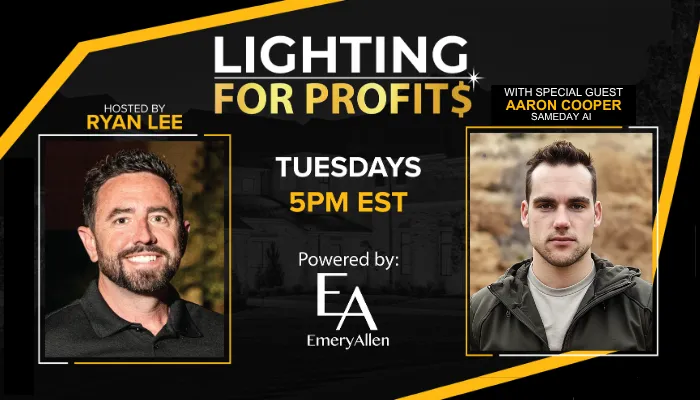
Lighting for Profits - Episode 249
What if every missed call was costing you money? In this episode, Aaron Cooper, CEO of Sameday AI, shares how AI is transforming the home service industry by answering calls 24/7, capturing more leads, booking more jobs, and creating a better customer experience—without adding more staff. Whether you're a contractor, home service business owner, or entrepreneur looking to work smarter, you'll discover practical ways to use AI to grow your business, improve operations, and gain more freedom.
Watch the episode
Episode Transcript
Welcome to Lighting for Profits. All Light. All out. Let's go
Welcome to Lighting for Profits. All light. All light. All Light. Powered by EmeryAllen. Here is your host, Ryan Lee.
All light.
All out.
All light. Let's go.
Ryan Lee: Today's episode of Lighting for Profits is all about AI
Favorite day of the week, it's time for Lighting for Profits. I'm Ryan Lee and uh, we're gonna do this thing. So, uh, I want to give a shout out to Emory Allen for, uh, helping us put this on every single week. Today's gonna be an awesome episode. Everyone always is talking about, like, leads and I just need to grow business and I need more leads and I need more business. We're going to talk about something that might change your perspective on that and it's really going to help you out, capitalize on the leads that you do have. So going to be a great show. We got Mr. Aaron Cooper, the founder, the CEO of Same Day AI. So Aaron is, uh, here local in, uh, Utah and uh, they actually came and supported Light it Up Expo. And so they're, I would, I would say newer to the outdoor lighting industry, but they're not new to business. They're definitely not new to home services. They've got so many case studies of, of what they've done for people. So we're going to be talking all things AI today. And so if you're looking to start or grow a landscape lighting business or pretty much any business like he, Aaron's got your back the same day AI team definitely does.
Landscape Lighting Secrets is hosting its second annual fly in on Friday
So, uh, before we have him on, just a couple things. Uh, number one, in three days, Friday, fly in. The second ever is happening right here at my house in my living room. Um, I think I told my wife yesterday, so she's like, when are they coming? But, um, I think that's why the, the maids showed up today. The house is like perfect. So, uh, I'm excited to host our second ever Friday fly in at my house. You have to be a member of Landscape Lighting Secrets, but it's free, it's included. So we've got a handful of people coming and we're going to mastermind. If you don't know what that is, we're basically going to work on your business and make sure we punch you in the face enough to get you to take action. So it's going to be awesome. And then September 9th and 10th, also in Utah in Park City, which is an awesome place to be in September. Um, we are doing our members, uh, only meeting secret summit. We're also inviting a select few. We're not inviting everybody. It's. This is not a huge event like Light It Up Expo. But we're inviting a handful of vendors. Um, and so if you are a vendor and you're like, hey, I want to be in front of, uh, outdoor lighting people looking to grow their business, then just email me at supportionleacoaching. com supportionleighcoaching. com and finally, I just announced it this last week. We have gone public. Not the company. I just went public with an announcement. That's all. But Light It Up Expo, we've got the contract, We've got everything in place. It's happening March 1st through March 4th, 2027. You might go. Well, dude, that's a long ways away. Well, we have to plan things that far in advance to make sure we provide an epic, epic experience. But we announced the location. It's in Las Vegas. So Vegas is going to be awesome. Bunch of lighting nerds are going to tear down that town. March 1 through 4, 2027. Get your ticket now. Go to lightitup expo. com if you missed out last year, you, you don't know what you missed if you were in that room. You know, the power of proximity and, uh, you know, what others missed out on. So make sure to go get your ticket. Um, again, guys, in just a couple minutes, we got the CEO of same day AI on the show, Mr. Aaron Cooper. So excited to talk, uh, shop with him and help you guys grow, uh, grow your business.
I just got back from Vegas. I went and, um, uh, previewed venue
So before we have him on, quick story, okay. Recently, five days ago, I spent almost $1,000 for 90 minutes, $1,000 for 90 minutes to learn this very, very important lesson. So I actually just got back from Vegas. I went and, um, uh, previewed the venue that we're doing Light, uh, It Up Expo at. It's gonna be at the Flamingo. Um, and it's a really cool space, guys. It's awesome. We got breakout rooms, we got the general session, we got expo area, and it's all ours. It's just going to be, it's going to be killer. So it's bigger and better, um, than Orlando was last year, but got back from Vegas. And who takes their family to Vegas? I was like, what should we be doing this? Um, and it's kind of crazy, but the reason we went down, my daughter had a dance competition. And so we're like, hey, if we're going to go down there, we might as, well, you know, see the sites, whatever. And so we went to the Sphere, went to the Sphere for the very first time. Incredible experience. Um, the downside is it's a hundred. It was $130 plus per ticket, okay? So there's six of us. And so by the time you do, like the ticket fee and the surcharge and the convenience fee and the doo wops and the Hinghams or what jobs, all sudden, it was a thousand bucks. And so, um, you know, they've got it figured out. We watched a movie. We watched the wizard of Oz, okay? They're not. They're selling an experience, not an item, okay? Just like in our industry, we don't sell lights. We sell a transformation. People don't want to buy lights for 200 bucks, right? Some of you are still selling lights at 200 bucks a light. No one wants to buy that, okay? Someone will gladly invest $10,000 to transforming their space to something they can enjoy every single night and have this experience and have their own sanctuary. Yeah, that's totally worth it. They're going to be there the next 15 years. Why would they not do that? Right? Just like the sphere doesn't sell movie tickets, they sell an experience, okay? But that's, that's not, that's not what I spent a thousand dollars to learn, okay? Um, that was just something I noticed.
Certainty is what we all want in life, right?
Um, anyway, the beginning of the wizard of Oz, Dorothy, um, is. She's on her way. She's on the Yellow Brick road, she's on her way to, uh, see the wizard of Oz, and she comes across the scarecrow. And Dorothy is talking to the scarecrow and she's like, well, how can you talk if you don't have a brain? And, uh, the Scarecrow says, well, I don't know, actually, he's never thought about that. But some people with brains do an awful lot of talking, don't they? And it's so true. It's like so many people just talk too much. But Scarecrow, um, you know, he thought he was a failure because he didn't have a brain. He even said, I'm a failure. I don't have a brain. And so, um, he asked Dorothy, he said, hey, do you think the wizard would give me some brains? And this was the lesson. Dorothy replies and says, you know what? I couldn't say. But even if he didn't, you'd be no worse off than you are now. Okay? Again, he asked, do you think the wizard would give me brains? And she said, I couldn't say. But even if he didn't, you'd be no worse off now, or, uh, worse off than you are now. And so she wasn't certain that the wizard of Oz could help the Scarecrow the scarecrow wasn't certain. Right. Certainty is. Isn't that what we all want? I mean, if we all knew that the business that we were just starting was going to work out, like, would we take faster action? If we knew that, um, uh, the first employee we were going to hire was going to work out, it wasn't going to be a waste. If we knew that paying them more would get them to be more productive and to stay longer, if we knew that spending money on marketing was going to work every time, if we had that certainty, what about going to an event? We're talking about Light It Up Expo. If you knew that you were going to get that transformation, if you knew you were going to get a return on your investment, would you go, uh, what about hiring a coach? What about joining a community? What about buying a car? Whatever it is, like, most m of us want certainty in life, and I get that. I do too. Right. But here's the challenge. The problem with certainty is that the human response when you're not sure of something is to what is to think about it. Right? And so your prospects do the same thing. If they were certain that you were going to, you know, if you, if you give someone a proposal for $12,000 and they knew that you were going to do all the things that you knew and that you were going to stand behind your product and they were getting an awesome design and they were going to feel a certain way, would they do it? Yeah, they would do it 100% of the time. But they have uncertainty, right? And so you have uncertainty as well. And the problem is, when you think about it, how does putting time in between that decision help you out? Because the human brain, you see, wasn't designed to make us happy. The brain was actually designed to keep us safe. Okay? So, um, maybe you've heard the phrase, uh, you're only as strong as your weakest link, right? And so God. God knows that when God designed us, he knew if he didn't design us for our weakest link, right, Then we wouldn't survive. Right? And so, like, when you think about the first people on Earth, were they as sophisticated as we are now? Did they have the same level of intelligence? They have the same, uh, ecosystem? No, it was different. Like, we were designed as cavemen, and our brain, as a caveman, is literally just, like, wired to just be safe, like, stay in the cave, go kill and eat something when you need it, and then come back in the cave. Right. Well, if, if we didn't survive the caveman era, we'd never be able to thrive in the era that we're in now. Right. Because our brains aren't designed to take risk. They're not designed to be successful business people and. And scale a business. It's just how it is. Our brains are wired to keep us safe.
Um, have you ever gone cliff jumping? Not just jumping into water
Um, have you ever gone cliff jumping? Like, you know, jumping into water? Not just jumping off a cliff. You wouldn't be able to answer that if you had. But, um, couple months ago, we were in Moab, and I took my kids cliff jumping. We've done it before in different lakes. And cliff jumping is kind of like fishing. Like, when you. When someone's like, how. How big a fish was it? You catch like a 12 inch. But you're always like, it must have been like 15, 18 inches. Like, how. How high was the cliff? It's like eight feet. And you're like, it's at least 15, maybe 20. Like, for some reason when you're at the top, it feels way higher. Right. Uh, but I love cliff jumping because it's scary. And my mind is telling me, like, don't do that. And it's telling you that to keep you safe. It's not. It's not going to tell you to do something because to go for happiness, that's just how it is. Right? And so we were jumping off this cliff. I think it was 20ft, maybe 25, which means it was probably 12. Okay. But it seemed really high. And, um, the longer you're there, if you guys have ever done this, the longer you stand there, the harder it is to jump. You're like, okay, I'm going to do this. No, I'm not going to do this. And the longer you wait thinking about it, your mind talks you out of it. Well, that's exactly how life is. The longer you think about, should I go to the event, Should I hire the coach, should I join the community, should I invest in the marketing? I don't know. Like, people have been scammed before. It's gonna. Your brain's gonna keep you safe and it's gonna hold you back because that's the caveman inside you. Right? So you have to rewire your brain. You have to start thinking differently than your natural self state is going to think. Right? And in fact, when. When we were at the top of this cliff, my daughter and I were up there, and there was this other little girl, and I was like, hey, are you going to do it? She seemed like she wanted to, but she was nervous. And, uh, she's like, yeah, um, I'm going to do it because if not. And I swear I could hear her dad, I don't even know who her dad was, but I'm sure her dad or mom told her this. She's like, yeah, because if I don't, I'm going to get home and regret it and feel like I wish I would have done it. And then she just like jumped off the cliff. And, uh, she's like, here. No, she's like, here, help me count down. So we're like 5, 4, 3, 2, 1. And she jumped off. So I thought that was just so cool because here's this little kid setting the example. Now it's easier as a kid because your, your brain's not smart. Like, you're just not developed enough to know that, like, you probably shouldn't be jumping off this cliff right now. Right? And so as adults, it's harder to make these riskier decisions, but do it like Dorothy said, like, you're not going to be any worse off than where you're at right now. That's how I make all my decisions. Like, well, how, how bad is this consequence? You know? And certainty is interesting because you can't get certainty by hearing from others. Like, just because it worked for someone else doesn't mean it's going to work for you. Just because someone else jumped off a 20 foot cliff and didn't get hurt doesn't mean you're not going to get hurt. The only way, the only way to get certainty is for you to become your own certainty. You have to take action in order to understand what that certainty is for you. Right? Um, but the truth of the matter is if you want something that you don't have, which all of us do, okay, you're going to have to be willing to do something that you haven't done, which, you know, means you're going to have to take risk. By, by definition, like taking risk means there's uncertainty involved. And so the only way for you to get certainty, I mean, I can guarantee, guarantee it, that's not going to give you certainty, right? You could see other people who've jumped off the cliff, but the only way for you to, to, not to, to know that you're not going to get hurt by jumping off the cliff is to jump off the cliff.
Right?
Because the reality is it might not work. You might get hurt, you might not enjoy the conference, you might not like the coach, you might not like the community. But every decision I've, uh, made where I've maybe had some regret later wasn't because the thing I joined or the thing I did didn't work. It was just maybe I needed to take some responsibility. And yeah, I bought into marketing. That didn't work. And guess what? You move on. You now have certainty that that thing doesn't work for you. And this is why you see this happening all the time. You'll be like, wait, I saw Facebook ads working for this person. So that's now your certainty. There's no certainty. And that why does it work for them and not for you? Right? You have to become your own certainty. And I'll just tell you this. The most successful people that I either know personally or that like I follow and I read their books and listen to, um, that's, this is one thing they all have in common. They're all willing to take action with uncertainty and they become their own certainty. Okay? And understanding that it might not all work out exactly like it did for someone else or like you think it's in your mind, right? It might not be exactly as you thought, but knowing that you'll succeed no matter what and that you'll overcome any challenge and step into that uncertainty and become your own certainty. Those are the people that are winning. Those are the people that are going to continue to dominate.
It's time to take action and start taking different actions than you have previously
And like Dorothy said, like, I couldn't say if it's going to work out for you. I couldn't say if you're going to get the brains right? But even if you didn't, you'd be no worse off than you are now. So it's time to rise up. It's time to take action and start taking different actions than you have in the past. Step into the uncertainty and you'll suddenly realize certainty, good or bad. That's what I spent a thousand dollars to learn. And crazy, uh, that I, why can't I turn off work? I'm sitting there watching a movie and I'm thinking about all these parallels in business. Kind of crazy, but um, had an awesome time. Highly recommend you go invest a thousand bucks and go watch wizard of Oz at the Sphere. Alright guys. Hey, um, one of the reasons I'm so passionate about helping people make a ton of money is so that they can afford to over deliver and provide that red carpet white glove experience to their clients. And uh, you know, it's, it's easier to grow your business when you deliver a red carpet white glove experience. You, you're going to get more repeat business, you're going to get more referrals. And you do that by using a High quality product. Okay? Emory Allen. They make premium LED lamps for lighting professionals who demand the best. Don't settle for less. Upgrade your designs and installations today with Emory Allen. All you need to do to get the hookup, just email Jackson L. His last name starts with L, his first name starts with Jackson. So therefore his email is jacksonlryallen .com. just email jackson lrealin. com. he will hook you up with that discounted contractor price. If you mentioned that you heard about him here on Lighting for Profits. So highly, highly recommend Emerald.
Aaron Cooper: It seems like no one lets kids run free nowadays
All right, guys, it's that time. Let's get to our guest. What do you say? Let's go. Let's get the intro going. Welcome to the show, Mr. M. Aaron Cooper. What's up, Aaron?
Hey, how you doing, Ryan?
Oh, I'm doing awesome, man. Get to, uh, nerd out on business and lighting and AI. I mean, what else is there?
Oh, I know, it's crazy these days. I think I was talking to my wife last week about, you know, what it was like to, you know, when we were, when we were younger, like in the early 90s, you know, before. Before cell phones, especially before, you know, you really had a computer in your house. And now there's just like so much. I don't know if I. If I miss it or if I could never go back. You know what I mean?
Yeah, no, I totally hear you.
So many things to play around with now and with. With so much AI stuff especially. You can build literally anything.
I. I literally am like. I'm, uh, like 50, 52. I could go back to just like, man, let's go to the simple days where, you know, I would, like, ride my dirt bike around the neighborhood and pissed off the old guy or just, like, ride my bike down to the BMX track and get hurt and, like, you just didn't know anything else. That was freaking awesome. And I'm like, I, uh, kind of want my kids to have that. But then you experience some of, like, the technology and what it can do, and you're like, what in the world? This is insane.
I know, I know. Now I could talk about that for hours, though. Just the idea. I don't know. Do you have. Do you have kids?
Yeah, I got four kids. They're like 12 to 18. They're all about to have birthdays.
What about. Oh, say, what about kids? Uh, like, not just be. I mean, I don't know about you guys, but it just seems like no one really lets their kids run free or, like, run around the neighborhood or even outside of the neighborhood nowadays. I don't know what it is, but there's this, you know, how technology has come, um, as far as it has, but also like, along with that, it's just like, I don't know, it seems like most kids are just inside or, or near their homes rather than, you know, at least I feel like for us, we were literally. Our parents had no idea where we were and we were gone. And I'm talking like 10 years old.
Yeah, I would say we're not, we're not that cool of parents, but we're, we're pretty cool. Like, our kids will go, our neighborhood's awesome. So they're always out playing night games and doing the stuff that we did as kids, which is cool. And then, um, I'll encourage them. Like, they'll take their bikes to the gas station, they'll take their bikes to Smith's. Like, they'll go do stuff, which is, which is way cool. Because I'm like, okay, you guys gotta learn to get out and have fun. So it probably just depends on where you're at. Like, I feel like of all the different places, I haven't been everywhere in the world, but I've been to certain cities where I can tell you there's no way I would let my kids do what they do here. Uh.
Oh, yeah, I remember, dude. I remember when I was, uh, I was probably 13, I believe, and I played. I got way into paintball, which I feel like went through a pretty, a pretty popular phase there. It's still around, but it's got really into paintball. One of my, one of my neighbors kids, I'd go play with him. He's like, hey, like my friend, there's this, this tournament going on in Mexicali, Mexico, which I grew up fairly close to the border. It was like a 20 minute drive. He's like, my friends. My friend's mom says he'll take us. Never met these people before. End up in the car. My parents, I mean, my parents are great, by the way. Obviously all my, all me and all my brothers and sisters were still around. You know, we're doing great.
No one got kidnapped.
Yeah, no one got kidnapped. But, uh, I remember I go to Mexico, um, which sounds crazy, but like I said, it was like 20 minutes away to this paintball tournament. And my friend's mom, actually not my friend's friend's mom, who I had never met before, drops us off at this thing. She leaves for the whole day, comes back, comes back at like 9:00'. Clock. night and she's just wasted out of her mind. And she's driving her at her Suburban and she's like screaming. And my other, and this other kid who's 13 is screaming, mom, why did
you do this again?
And I'm just in the back, you know, in the middle of Mexico, just like, oh man. And so the, he convinces his mom to, to get in the passenger seat. And so this kid who I remember, he's 13, is driving through Mexicali, Mexico to get us back across the border. And like, dang, that was the kind of stuff.
So he, he drove the rest of the way. It was, it was better for a 13 year old who doesn't know how to drive to drive than the drunk mom at that point.
She was really drunk. Yeah, it was bad. I think at one point he, he drove us to like his dad's house because his dad lived in Mexico in this city, Mexicali. And so he drove there and we stopped there and I'm like hanging out, middle of the night, this guy's house. Um, and then we get back in the car and drive back across the border. But like, sorry, that was like a pretty crazy tangent, but kids these days, uh, like they don't have that, that kind of experience. Maybe, maybe kids, our days didn't. That wasn't really a normal thing necessarily either, but. Well, I don't know.
Yeah, the technology is changing everything. I, I remember this was, uh, I don't know, it was like right after high school or I don't know, somewhere. I don't remember when the Internet came out.
It came out earlier than I thought it did. But I remember my, one of my friends going
It came out earlier than I thought it did. But I remember my, one of my friends going, hey man, you, you want to check your email? And I'm like, I don't even know what that means. Like, what are you talking about? And he like takes me to this computer and it's like doing the dial up thing. And uh, that gave me a flashback the other day when I was trying to build something with AI and it was taking longer than normal, which means it took like 20 seconds instead of three seconds. And I'm like, yeah, uh, what is going. Come on. Like, how long does this take? And it's just like we take for granted what we really have. Um, I just went through the Chick Fil a drive through today and it took long, longer than it normally should. It's still not as long as a Wendy's or a McDonald's drive through. But I was just like, what's going on up here? You know you just get so used to, like, the speed and the rhythm and, like, how things go. So, yeah, it's scary because it sets a new standard, you know, of what's not only possible, but what's acceptable.
Uh, yeah.
Aaron Cooper is the CEO of Same Day AI, a local staffing company
How are, how are. Well, actually, before we get into that, would you just do a quick intro? Like, who is Aaron Cooper and who is Same Day AI?
Uh, yeah.
So, uh, Aaron, a guy that survived Mexico.
And dude, I can tell you some more stories. Dude, it was, uh, it was crazy
where I grew up.
But, um, yeah, CEO of Same Day AI. We've been around nearly five years now. Um, you know, what we focus on is we work with local service businesses, plumbers, roofers, lighting businesses, landscaping businesses, pest control, um, primarily to help them answer their phones and schedule appointments directly into your phones, into your CRM. Um, we started, like I said, five years ago. I was, um, at one point the chief marketing officer for a pest control company called Alta Pest Control. When, uh, I was there, we had about 16 locations. I left there and then I led growth, growth marketing for another pest control company called Aptiv Environmental. And, you know, both those experiences, um, I learned a ton about, um, what were sort of the blockers that were keeping us from really growing. And it felt like it was very much geared towards our ability to actually handle all of the leads that we are creating. You know, we. You'd spend at least in pest control, we'd spend hundreds of dollars just to generate a phone call. You know, especially now on Google local services and these other platforms, you're going to spend a lot of money just for that call. And on average, even now with AI, businesses are still, at least who aren't using it are still missing, you know, 15 or 20% of these leads. Ah, that, like I said, they're spending hundreds of dollars to generate. And so that's what we do is we build AI with the intent of making it great enough, especially around its ability to sell, but great enough for you to use it to answer these phones and completely book and schedule appointments for you to go out and do your. Do your duty.
That's awesome, man. Now, I. So I love this. I love what you guys do. Um, when I started my business, I was just like a lot of our listeners here, okay, Um, I didn't have a rich uncle. I didn't. I didn't know really how to start a business. You just do it and like, yeah, there's a lot of things you just don't know, right? So you just start knocking doors and start generating jobs. And then you're slow. And you, you know, like, you just figure it out. Well, I remember I was literally. I was our maintenance guy because people started to have maintenance requests. It's like, hey, I got a light out. Well, we couldn't send the install team because they were making money, right? So I was like, I guess I'll. I'll go. And so I'm in the. I'm in a tree, changing a light bulb. Miss a phone call. Normal. I miss phone calls all the time. Get out of the tree. Call back this late. Super nice lady. I was in Texas. Everyone was in Texas. Even if they're mean, they're nice. They're like, I hate you. And you're like, thank you so much. Like, the way they say it, they're just so nice about it, right? But she's like, hey, thanks for calling, but, you know, we got a hold of someone else, and I. It was probably 45 minutes, an hour after she had called. She's like, we got a hold of someone else, so we're good. I'm like, yeah, totally understand. I mean, um, I'm assuming you want to get multiple bids, so why don't I just schedule a time to come out and meet with you tomorrow? She's like, oh, no, we'll probably just go with them. I mean, if.
For some.
If anything changes, I'll definitely give you a call. And it was, like, over. And I was like, what? But, uh. But what about me? And at the time, our average job was five grand, which. That now, like, an average ticket for landscape lighting is like 10 to 12,000, but that was $5,000. And I was like, damn it. I just lost $5,000. And then I started doing the math. I'm like, wait a minute. There's other people that I called back that weren't as honest as her. They just didn't answer my call. I just never got a hold of them. And, you know, not, uh, that. It's not that everybody that called me was going to give me five grand, but that's kind of what I was thinking. I was like, even if a percentage of them, I was like, there's five grand here. Five, five, five, five. All sudden, it was like $60,000. In my mind. Now, this was in 2008. Okay? I started in 2007. This experience was 2008. And so I didn't have, like, there was probably answering services that I didn't know about, but definitely no, like, same day. AI. And I was like, yeah, Uh, I was. At this point, I Was torn. Like, should I get an office manager? And I was like, well, I can't afford an office manager because I'm not making enough money. Because if I get an office manager, I can't work out of my house anymore. I'd have to get a shop and a shop and then an office. And I just.
You need to answer every single phone call. One of the first things I tell people is like
But that one experience, literally that day, I started looking for a shop and an office manager because I was like, it's not that I can't afford one. I can't afford not to. Like, all these missed calls. And now here you're presenting an opportunity where I don't have to get a shop, I don't have to get an office manager. I can, like, alleviate a lot of overhead really quick and just turn something on quickly. So I. I, uh, love this conversation.
Oh, 100%.
I. One of the first things I tell people is like, you need. You need to answer every single phone call. And people go, oh, I do. I'm like, that's just not possible. Like, if you're the business owner and the salesperson and the installer and, uh. So I'll ask them, like, no, no, yeah, I just call them back. I go. Calling someone back is different than answering your phone every single time. So that's.
There's a lot of things. There's a lot of things in your business, though, that run that way or even in your own life. Like, you don't. You just don't realize how much things add up. It's kind of like your, you know, all of your. Your streaming subscriptions, you know, you get every. Everyone goes through that phase once or twice a year where they're like, dang it, how many of these things am I paying for? Right? And then you go. You go total up the bill. If. If you're somewhat frugal, you go total the bill and you're like, dude, I spent 600 last year on, um, streaming services, and I probably used it like. I mean, people. Everyone uses, like, a Netflix, right? But collectively, it's. It's insane.
Yeah. Because you have to buy. I think we got the Hulu one, the Apple one, the. You got them all because there's the new series out, and they go on the different one.
Yeah. Then you're like, oh, sport. At least for us, it's like, oh, sports. You know, it's football season now, so I gotta get YouTube TV or something.
But it really.
It really adds up. And, like, your leads, especially if you're. You're paying for, um, phone calls, like, the same thing happens Oh, I got Thumbtack and I got Angie. I've got Google local services turned on. I hired this guy who um, is helping us with some, some pay per click ads on Google as well. You know, I just talked to a business owner who was spending $6,000 a month for SEO and they write two blogs a month and like they don't really know how much, you know, what that's even generating. Like that's $6,000 a month. Like that's a, that's a significant amount of money for two blogs a month.
Right.
But there's so many things that are running that way. Everyone's always focused at, you know, top of the funnel, just being sort of reactive to the leads and then hoping that the bills are covered at the end of the month.
Right.
And then a certain portion of people come out on top and they maybe are really successful. Um, then there's a portion of people that are really on top of that stuff. And then there's, you know, it seems like um, a large majority of people who are just simply human and great at what they do, but they allow these leaky buckets, like their business becomes a really leaky bucket with all these leads and all these other things that they're spending money on.
Yeah, I think I know why that happens is because just when you look at the flow of like, of a business, you know, it starts with marketing. Like you don't have a business if you don't have customers. So naturally people think, okay, well my biggest problem is leads. And so they do that and then we know then after a lead you have to like convert it, you have to, you know, get the sell and then you have operations, you have like the installation and those things. So it's kind of like marketing sales and operations. But the weird thing is even though it does go in that flow to your point, you have to work on it in the reverse order. Like if you don't have a really good operations, then yeah, you might get a lead. But like one who, like uh, who's answering the phone, who's what? Automations are set in place to make sure you're capturing it. And then even if you do do that and convert a cell, what are you doing on the operations to ensure that you deliver the five star red carpet white glove experience so that you get a repeat business, so that you get a referral. And so people just have it backwards. They just get hung up on that marketing thing and they haven't ever thought about the whole thing and how it all works together. Um, and that's, that's where the magic happens. That's where you see the businesses that are killing it. They've reverse engineered it and started in reverse order and they're really good operations, really good at sales before they turn on the marketing. So that when they turn on the marketing to your point, they don't have the leaky buckets. And I see it so many times, they'll, I'll have people, they'll say, hey, I tried the, the marketing thing that you said to do or whatever, right? And in landscape lighting, I mean we're high ticket, we're like $10,000. So like, yeah, uh, if they, in most cases they only need like one cell to make any marketing work. You know what I mean? Like Most marketing isn't $6,000 a month, right? So if they're spending a thousand or two thousand dollars on something and they just got one ten thousand dollar deal would be worth it. But a lot of times like, oh, ah man, it's like, well yeah, if they would have just answered one more phone or answered the phone, like they could have converted that one ten thousand dollar opportunity and suddenly there would be an roi and instead they abandoned the whole marketing channel and now they don't have anything to feed their business down the road.
Yeah.
Only people in $1.52 million homes are investing in landscape lighting
So where, where in landscape lighting? You know, I, I'm not as, um, tuned in on to landscape lighting on the whole marketing funnel. Like where are people creating most of their leads?
So same as most. No, it's different because like it's in like general home services. A lot of it's like demand driven, you know, like, yeah, someone's, it's 102 degrees here in Utah and your air conditioning breaks. I don't care what it costs, just get out here. That doesn't. There's not a lot of people that are like, oh my gosh, if I don't get landscape lighting today, I'm gonna die, you know?
Yeah.
Um, and I used to think that was a negative, but then I realized, man, it's such a cool thing because people also don't wake up and go, oh man, I gotta go spend $15,000 and go on a vacation. I gotta go spend 60 grand to go skiing in Vail for the week. I gotta go to Europe and spend 70 grand. Like they do it because they get to, they want to. It's a reward, it's an accomplishment. It's like I get to do this. And so typically only, only people that live in like I would say million and really $1.52 million homes and up are investing in landscape lighting. And so it's a smaller, uh, demographic of course, but there's a lot of people that live in $2 million homes that want, that are already investing in like their pool, their backyard, their cabana, their landscaping. So typically it comes after that. Typically it's like, hey, we want to spend more time outside. And when we come out here we just spent all this money on, on installing a backyard that we don't, it's not, it's not what we thought because they are working during the day, during the day they go out and whatever, but they're, they're working during the day to pay for all this stuff. And then night with, with lighting you can create textures and shadows and all sorts of really cool stuff that you can't see during the day. And so it's kind of like the icing on the cake for any outdoor project. Lighting their home makes them feel like a palace when they're pulling up. So it's not demand driven. Um, so traditional marketing is social. Um, media can work, but that's like a three hour class on how to make that work. Uh, most people try it and it doesn't work because again, no one's going on to social media to buy outdoor lighting. And most business owners are looking to get like a lower funnel, like, hey, I'm going to show you an ad and you're going to give me $10,000 for lighting. That's not happening a lot on Facebook. You can, but it's not, um, most of the time if you're doing it wrong. Google Ads are big because those are like, if someone types in landscape lighting installer near me, that's someone who's already had lighting before. They're already educated, they're looking for it. So those are really good. Direct, um, mail can be really good. Um, the best one, the best channel is by far away what I just call referral partners. So home builders, pool builders, artificial turf, um, backyard, backyard builders. I mean anyone who's already doing work for a high end homeowner, that person is going to want to get landscape lighting. So those are, those are the most qualified ones for sure.
Yeah, that makes sense. That's really cool.
How are backyard builders effectively sending leads over? Is it just a text message
So, so do you, I mean what then, you know, from like a marketing lead perspective, if you, let's say you're, you're really dialed in on the referral side of it. Like how are these, how are these, um, backyard builders effectively sending the leads over? Is it just, are you getting cc'd in a text message. And does anyone really do that at any kind of scale? Yeah. How does that work?
I don't know of any, like, automated way. Um, mostly that's what it is. It's a text or an email introduction saying, hey, uh, this, you know, make sure you, uh, connect with Aaron. He's our lighting guy. Um, as we near the end of our project, a lot of our customers are asking about outdoor lighting. They can take care of you. They can even do a free demo. Uh, but just let the. Let the introduction here. So that's the best way. And when you get those introductions, those types of people, they're not typical. I mean, sometimes they are, but most of the time they're less like, well, when can you get it done? You know, they're not like, going to get three quotes and do all that. They just, they just know that if they trust the builder or whoever referred them, they're going to trust their recommendation.
Yeah, no, that makes sense.
Do you feel like you need a platform to aggregate referrals
So, uh, what about using. Like, do you, do you. I don't know. I'm just trying to think. Like, do you feel like you're. Do you feel like you need a platform? Like something that could help you, like, aggregate those referrals, make, you know, make the experience a lot better? I mean, is. Is there anything like that? Or do you. Do people try to standardize that?
I don't. I mean, I. It would be awesome. I don't, I don't. I haven't seen anything. I haven't. I don't. I haven't built anything like that. But it would be cool to be able to have a place where they could either submit a referral or something like that. And it keeps track of them. The hardest part is this. So let's say, um, I reach out to a builder, okay, I asked my existing client and I say, hey, who built your home? And so they connect me and, uh, I get in front of the builder and then the builder's like, I mean, they could just not connect with you. That's one. You never get ahold of them. So there could be an automation or some type of system for that, but let's just say they meet with them. This happens quite a bit. They meet with them and then nothing happens from there. They go, yeah, this sounds good. We'll definitely keep you in mind. Um, and I teach a whole system and, like, script behind what to do when that happens. But generally speaking, that's usually what happens. They get the meeting and then nothing happens from there. And then it's hard for these people to follow up, either because they're too busy or because they're not motivated. Um, so they do, they do the, the first outreach, but then that's where everything stops.
Got it.
And it might be like six months, a year later, they're like, hey, man, I got a project for you. And so that's not very motivating for someone to go out and do all these cold calls. I, I, dude, I'll do anything. I'll do, I'm a long term guy. I know this isn't about a sprint, you know, so I would go do that. I'm just going to go plant as many seeds as possible because I know that some are going to have a project next week, you know.
Yeah.
Um, but yeah, if there was some type of software that could help, uh, I guess develop that relationship, that would be amazing.
Yeah. That is crazy.
You can refer up to 10% of total contract value, which is huge
Do you, so whenever you get these referrals, do you ever like, do you ever like, uh, grease the wheels a little bit? Like, do you, do you guys have like referral bonuses or commissions or things you guys exchange?
Yeah, yeah. I mean, depending on your business, like, I, I always would refer up to 10% of the total contract value, which is huge. I mean, yeah, in some cases we would call, like, I would call in a landscaper and they go, oh, we already, we already do lighting. I'm like, okay, so let's meet up anyway. And so if I can meet up with them, I could sell them. Because I go, well, tell me, how many lighting projects do you do a year? Oh, not that many. Not that many, Right. So you just basically dig into the pain. Well, we do eight a year. Why aren't you doing 16? Well, we're too busy with the other thing. Oh, okay. So it's not that much of a priority. You know, what if, what if we could help you get to 16, 20, 30 jobs, you know, and then when they do those eight jobs, they only are putting in like 15, 20 lights. Where if I came in and did a design, it would have like 25 or 30. And then where they're charging, you know, 250 a light, I'm charging 400 a light. So all of a sudden that 10% isn't just a percentage anymore. It's a real dollar amount that's actually feeding them more than what they would make on their own, if that makes sense.
Yeah, yeah. So, so you're coming in, you're going to a landscaping business who would effectively be a competitor and saying, hey, like, when this happens, just call me in kind of like the celebrity shot, I come in and, and sell them on this, get this higher ticket value. You literally do nothing than what you would have done before and I give you 10% of the deal.
That's exactly right. And there's so much more value too because all I have to do is share one experience and say, you know, it's interesting. We had a, we had someone that called us to do lighting before and, or to add on to their lighting. And I said, well, why didn't you call the person who, who uh, did it? And they said, oh, we, it was a landscaper. And they, we can't get them out here. And so now you just lost a customer because you couldn't change a light bulb. Right? So it's. Yeah, yeah, you, you might be able to make good money on the front end, but if you're not taking care of your customer on the back end, what happens when they move? Because part of my uh, momentum in business was turning one customer into two, three, four. It was really making them be exponential. So um, we had customers that I thought were just going to be a one time deal. They gave me 10 grand, 20 grand, whatever. Well, like two years later when they sold their business or they got a promotion, they bought a new house and suddenly that turned into a $40,000 project and then they gave me a referral to another 40,000. So that's how it's done. So these landscapers don't realize that. Yeah, by just throwing in some lights and then now not changing a light bulb, they're losing out on future business as well. Then on top of that, when we go and really over deliver and really deliver an awesome lighting design, it's a better experience for the client. We tell the client, hey, text that landscaper and tell them what an awesome experience it was working with us. And so they're not normally getting those texts, you know, so there's lots of reasons why we could turn a competitor into a partner for sure.
Dang, that's really cool. That's like really, really cool. Um, you got like my gears going. I'm like, dang, like, especially now that I do software, I've been kind of out of the marketing game a bit as far as it, as far as like running ah, a business like this,
we should definitely connect because you've got that mind, you know? Um, yeah, you've been in the game. I think if I just talked basically and told you, like, here's where we're at, here's our challenges, here's what we're good at. Here's what we're not. How do we get these guys to convert? How do we get them to do their first job? Because that's really what it's about is like, how do we get them to do the very first job? If they can, uh, do one job with us, then we can show them that, like, it's, it's even better than
they thought, you know, Totally. Well for us, dude, as far as like, same day AI goes and like our own team, you know, we pay tens of thousands of dollars a month for, for tools and features. I mean, even just our, our HubSpot alone, we pay $80,000 a year for it. Then we, you know, we have tons and tons of other tools that we pay for for prospecting and phones and all this stuff. And we were just like, wait a second, why don't we just build this ourselves? Like, build all this into our own app and just like use what we sell? You know, in software, you call it like dog fooding. You eat your own what you kill, I guess. But, um, you're talking about this referrals. And I'm like, man, how would you like, if you, if there is there a way that you can just. Because now with AI, ah, you literally, you literally can just think of something and it goes and gets built to the point now where within the same day app, like we have, uh, an agent in the app that you can talk to and you know, you have all the tools and all this stuff that we do, like AI that can answer phones and it understands how to work with jobber and understands how to schedule things into House call Pro. But then you can talk to that same agent and it'll like, build new features and stuff for you.
Uh, oh, that's killer.
And I'm thinking, I'm like, man, so somebody had this like, referral pipeline and there was things that could just be better, like more efficient or more competitive. You know, maybe a way to like, scale that even further instead of just having two or three and all the work that it takes to build these relationships, you come up with some way to, to make it easy for people to recognize you for that type of deal.
Yeah, yeah.
Like how, how would business owners use that? Like, how would they use that ability for you to just make a platform? I don't know if that means, you know, gift cards you can like plug in an API that allows you to mail gift cards to people and it just starts shipping them out. I don't know.
Yeah, yeah. But no, I'M happy to. I mean, we should connect here, um, sometime and. Yeah, kind of just, uh, throw some things at the wall and see what sticks.
How do you train AI to stick to your specific processes
Wait, so I got a question on your, on your software. So let's say I, you know, lighting business signs up. Um, there's. We've got anywhere people that just still answer their own phones. They don't have anyone to people that do have an office manager, let's just say the guy who's not answering any phone calls. How do you, like, how do you train the AI to make sure that it's going to, like, stick to your specific processes?
Yeah. I mean, now the AI, you know, AI is like, pretty deterministic. And there's like, ways, you know, well, to start, there's a lot of guardrails that we put in that aren't, you know, what you can write in a prompt, such as, you know, as the AI is talking to tools like Jobber or Housecall Pro, you know, as those requests are coming back to that tools, APIs. We have things that aren't AI in between that, that will basically filter through and then block anything that doesn't sound right or shouldn't be right.
Got, uh, it.
And so there's levers that you, you know, switches you can turn on within the app to say, okay, like, don't ever cancel a job or don't ever reschedule this type of appointment. And so if that were to happen, which it's very rare now, more, More likely three years ago, like with like, older AI but if that were to happen, then those things would block it.
Can you, can you do things like, uh, pre qualify? So, for example, again, if my air conditioning goes out today or if I'm, if I'm, uh, a. An H Vac company, like, I want my booking rate to basically be 100%. Like, if someone calls, they need us. Like, let's go out with outdoor lighting. It's not like that because there's a lot of uneducated homeowners and they think they see some lights at Costco and they're like, oh, it's too hot outside. I'll just hire a pro. They, in their mind, they think it's going to be like 500 bucks, 1,000 bucks. It's like. But when you use our quality materials, we couldn't even like, install one light for 500 bucks. You know, I mean, it's just like our transformer is a few hundred bucks. Fixtures are expensive, all that. So is there a way to teach it how to pre qualify? And like, I have a script I could feed it to say, like, hey, is it okay if I tell you a bit about who we are and what we do? And here's a. Here's a ballpark price of ten grand. Does that seem about what you're looking for? And they say, no, it's harder than we thought. Oh, well, how much were you thinking? Like, could it have a conversation like that before it actually books the appointment?
Uh, yeah. So that's something we do really common. I mean, it's. Most industries will have, like, a version of that as well. So, like H Vac. There's a lot of times a year where they might not be worried about, like, what the capacity is of their technicians, but then they have, like, a really hot month. Their technicians are going to be booked out, and they might be booked out for weeks. And so, um, what they do is they have the AI figure out things such as, like, how old is the unit? Um, how if the customers don't know how old their H Vac system is, which, frankly, I have no idea how old mine is.
Right.
Then how old is your home? How long have you lived there? You know, and just being able to drill down into those things, you know, as they come to figure out. Okay. And it can go even further and say, let's say you have multiple people going out and doing these, um, uh, I want to say inspections, but just basically going out on these sales jobs.
Yeah. Which is called, like, a design appointment.
Okay. So let's say you have someone who's better than another. You can, uh, you can even prioritize sending them out to jobs that might even be bigger or happy, a bigger opportunity.
Oh, cool.
To improve your close rate. We call that scheduling for dollars.
Nice.
Right?
So, yeah, no, that's way cool.
Who are most of your customers? Are they using it for main answering service
So, um, who. Who are most of your customers? Are they using it for, like, their main answering service? Are they using it for a backup? Um, after hours? Like, what. What is ideal?
Yeah, we started out doing a lot of backup calls. I mean, like I said, we've been doing this for about five years, but now we have people who are pretty. Pretty adamant about going all in. Sorry, do you hear the ice machine in the background?
It's fine.
Um, this is the.
This is the fun part of doing a live show, you know?
Yeah, it's totally fine. Um, it's okay. Um, just my. My niece and nephews. So what was I saying? I totally lost my train.
What were we talking about? Um, I lost my train of thought.
Scheduling for dollars, wasn't it yeah, but
then I asked something else. I think, well, answer this.
Jonathan Wisman: AI can help businesses save money and generate more revenue
So, um, you know, obviously we're talking about like answering the phone. Um, and in, in our, in any industry, it's, I think it's super. You. Oh, that's what it was. You were asking about like, or talking about like after hours versus it's just like, oh yeah, could someone use this for their full time answering service or I guess one concern I think people are going to have is like, well, what if they want to talk to a human?
Yeah, so that's a big focus for people now is like, how much of this can I truly automate? Especially when you get into like private equity, uh, where EBITDA is such a huge factor and like what kind of multiples they can get if they try to sell their business. It's becoming really common for like H vac plumbing type businesses, roofing businesses, to try to fully automate their front office. That way they can, you know, save, save a bit of money on overhead. Um, I personally, like, or same day specifically, like, we don't necessarily take that approach. We don't see AI as necessarily the best way to try to save money per se, but instead try to focus on how can it create more opportunity, like how can it generate more revenue. We think that like the saving money aspect of it is a personal decision that you can decide, you know, because I think in the future like it could very much like let's say 90 of your competitors all use AI agents and maybe it's so good that you literally can never tell. I just think that's just really hard to replicate. Regardless, and we by far, I, I would, you know, my opinion, have the best AI out there. But it could be very much a competitive advantage to say that you don't use AI, right. And you do have a person or the business owner is answering the call and the person that you talk to is definitely the person that just showed up at your door. That being said, like, if you can change sort of your attitude towards AI and think, okay, like, how can this actually help me convert at a higher rate than I could possibly do it before? How can this AI be able to draw insights or ask questions that I wouldn't even be aware of, how can it learn and actually get better at, uh, making sure that I do send the right salesperson out to this job? Like what are some insights that it can maybe collect whether in before the call or during the call that I wouldn't even have thought of? Right. And it's sort of those subtle it's those subtle details that people just aren't thinking about. I think we referenced this earlier in that people are just losing track or not aware of how much they are spending on all these different lead channels. Right.
Yeah.
How much does it really cost you? Like, how much is your time worth to go out to a bad appointment? Um, you know, like, there's, there's businesses. You know, we talked to thousands of companies now, and there's businesses who are like, oh, what's your service area? Well, I have three technicians and we serve all the way up from Brigham City, Utah down to Spanish Fork, you know, and if you're not, if you're not from Utah, that's like a bigger two and a half hour drive. Yeah. You know, and they're just dispatching left and right, these, these two or three people.
You know what I mean?
And it's like, okay, like, why don't we, you know, going in, like, we'll do. We do. I mean, it's weird. We do AI, but, you know, we end up doing so much consulting, but we'll come in and say, okay, like, what if we can. What if we contents your service area to like, Leighton and Ogden, right? Where you get 40 of your jobs and just like have your, have your guys go and knock doors right after they do a job and try to generate more leads that way and like, pack your schedule with like, stuff that you can like self generate and self qualify versus, like going out and, you know, making 150 bucks.
Yeah. I mean, it's refreshing to hear you kind of talk about this stuff because I think I share the same sentiment. Like, I don't think, at least right now, I don't think AI, Um, I mean, we look, when we look at just the outdoor lighting opportunity, I'm not looking at like hiring same day AI to save money to like cut out an office manager. Um, I'm looking, and it's funny because I went to, um, an AI event with Jonathan Wisman a couple months ago and everyone was like, so what would you learn? Would you learn? And I learned some cool tools and stuff like that. But one of the biggest takeaways was something so simple. And he talks about, he's like, what you want to do is basically hire an A player, an A plus player and strap a supercomputer to their back. Basically strap this AI to their back. Right. And so that's, that's not about saving money. It's about capturing more. And that's what you're talking about. It's like well, what if we use and we keep our office manager, have her do things that might be, you know, higher level tasks for her. And then, uh, now all of a sudden we have AI to capture those four extra. I mean, if you could get four extra jobs, I mean, that's $40,000 a month from just answering the phone. You know, that's, that's really what this is about. It's not about saving money, it's about getting more. And now all of a sudden you have an extra $40,000 at 50% profit margin to play with. That's 20. That's 20 grand. Um, now you can make different decisions. Now all of a sudden you can try different marketing things. Now, now, now you can plug some holes in your bucket and make sure that you're, you're doing these things the right way. So I'm glad you kind of talked about that because I think most people are looking at AI to save money and I don't think that's what it's about. Yeah.
And I think the reason that's the perspective is, at least in the tech world where I come from, you know, there's a lot of investor money coming into AI, uh, companies. And those AI companies are looking for ways to more quickly justify that and justify higher contract values. And so naturally the first line of like early adopters that are going to pay the most money are going to be these private equity funds and stuff. Right. Who the saving money is.
Fine.
And that's totally fine. Like, we have plenty of private equity groups and people that use same day AI. That being said, they really only account for a small, small sliver per small percentage of the entire trade services industry. Home services industry. Right. In reality, like a lot of these companies are people that are, you know, just trying to put food on the table.
Yeah.
Uh, wanting their ambitious business owners, they want to be successful, but there's just so much to do. Um, and so for us it's like, okay, how can we enable you to do what you do but be able to like, do all the things that you can only dream of? And so I think I mentioned this earlier in that, yeah, we have AI that answers the phone, qualifies and scheduled appointments. That's like our bread and butter. And that's like the foundation for all this. But now you can come into the app and say, okay, I need to be able to schedule appointments on my website. Like if, say, someone does refer someone over, but then the neighbor that they referred over is just not the kind of person to make a phone Call to begin with. Right? Like homeowners, people that own homes, like the demographics, the, uh, their mentality is just completely changing. And so we created the ability for people for you to come into the same day app and just generate an online scheduling widget. So regardless of if you use Jobber or use something else, like you can customize and create this online scheduling flow that can fully qualify people. Just like the voice AI would nice, uh, but allow people to book an appointment within a couple steps just straight from your website.
Yeah, I, uh, like that.
And so it's like being able to put AI in front of people from whatever perspective. And that's the kind of thing that like, gets you that extra X percent, you know, for whatever amount of dollars you're spending on trying to create that lead or, or even not even looking at four. From just a purely paid marketing perspective, like, your time is super valuable.
Most of the effort that goes into getting referrals is wasted, Dan says
And how much money or how much effort did you put into, like, trying to even generate that referral? How much did those signs cost that you putting in the yard? And how much time do you spend if you have more than one guy, not just yourself, like getting them to put the sign in? Go ask the homeowner, hey, can I, can I place this sign in my car? The thing that you are counting, uh, on to get those referrals, like all of that labor where all that effort, you know, most of it, in my opinion, gets wasted.
I know it's sad because it's so, it's true. I mean, everyone's focused on like, the marketing and getting more leads, and then, you know, you, you, you miss a phone call, like, how much did that cost you? You know, for me it was five grand. Now it's ten grand.
So many businesses now, it seems like they're investing money in wrong places
Um, what, what are some other areas that you've noticed? I know you guys are obviously, you know, focus on answering, but what are some other areas that you found businesses are missing, um, in their funnel to kind of like optimize their lead gen. What are there other areas you've seen that they're screwing up on?
Well, now it's changed. It's changing so quickly and so dramatically. So many businesses now, it seems like they're, you know, dedicating a lot of money to the wrong places. I think I can't remember if I mentioned it before we started here, but just a business, um, that I met recently who spends like six grand a month on SEO and they get, they get just a couple blogs produced.
Yeah, yeah.
Like, dude, we have within the app now the ability for people to go in and host their website. So you can go say your website's on like, uh, some online, you know, wix. Right. You can just migrate your URL over, the AI will go through and copy your entire website, and then it'll create new SEO for you every single day. Right. And literally cost pennies to do that. It's like, sure, you should do SEO, especially now that you have, like, you know, AI search engines, basically, people finding you now on chat GBT. Like, SEO is still important, but you're spending $6,000 a month for these SEO agencies, which was fairly normal like six months ago. Here, give me one. Sorry, it's my nephews. I knew I mentioned this before we started. I was like, yeah, I'm pretty sure people are going to come back from the beach. But, um, it was normal 10 years ago to spend six grand a month on SEO, like SEO and trying to rank on Google and see if you can get your Google my business, you know, to produce, you know, was. Was really important. Now it's like, okay, how do I become relevant to these AI chat experiences that people are using if it's chat GBT, perplexity, Google AI. But people also don't realize, like, $6,000 a month is crazy to spend on SEO.
Yeah, yeah, right?
And even then, like, you don't even know if it's. If that person that you're spending that money on is even doing it. Well, we're like, okay, like, why don't we just create the platform or the place for you to put your website in this specific case, put your website and then you can just ask it, is this up, uh, to date, and it can check the entire Internet in the blink of an eye and discover what you know. Google just updated how they, how they do SEO like, three months ago, and it crashed things for a lot of people. This AI will know that now, and your website can just build itself.
That's sweet. Is that, Is that already in your platform and that's coming out?
That is in our platform. Uh, we're kind of rolling it out with some beta customers right now. Okay. But it's very easy to do.
Aaron, thanks for taking time out of your holiday to talk to us
Well, Aaron, uh, this has been a great conversation, man. I appreciate you taking time out of your holiday, your vacation there. Um, what if someone wants to reach out, Get a hold of you, Get a, Get a hold of your team? What's the, what's the best place to do that?
Yeah, I mean, I, I like to talk to people directly. You know, you can take my number. 385-53941.04. Or you can just go to go sameday. com and book a demo there, and we'll. We'll jump on a call with you pretty quickly and walk you through everything we built.
Okay? Love it, man. Well, like I said, I appreciate you jumping on here, and, uh, when you get back in town, let's definitely connect. Let's build some stuff for the lighting community.
I like it, dude. 100. That'd be sick.
You got to take action because the cost of inaction is always way more
All right, get back to vacation mode. Um, guys, the biggest thing is you got to take action because, um, we didn't even get into pricing and stuff like that. But I know. I know some of it. It's not a lot, and I promise you, it's going to cost you. The cost of inaction is always way more. Uh, we're just trying to land a couple more deals, answer more phone calls. So if you, uh, if you don't have a proven process to answer every single phone call, I highly, highly recommend you reach out to Aaron and his team. Um, whatever his phone number he said it was. Or go same day I dot com.
Go sameday. com or sameday. AI they both work.
Wait, I screwed it up. Whatever Aaron said. Say it again.
Yeah. Go sameday. com.
don't.
Don't worry about it.
You'll.
You'll find us.
Yeah. Or Google it. Yeah. All right, sounds good. Well, I appreciate you guys. Go take action. Don't miss any more phone calls. Plug the holes in your bucket before you get more leads. That's the name of the game. Guys, have a great week. We'll talk to you next.
Aaron Cooper - The Future Answers
Lighting for Profits - Episode 249
What if every missed call was costing you money? In this episode, Aaron Cooper, CEO of Sameday AI, shares how AI is transforming the home service industry by answering calls 24/7, capturing more leads, booking more jobs, and creating a better customer experience—without adding more staff. Whether you're a contractor, home service business owner, or entrepreneur looking to work smarter, you'll discover practical ways to use AI to grow your business, improve operations, and gain more freedom.
Watch the episode
Episode Transcript
Welcome to Lighting for Profits. All Light. All out. Let's go
Welcome to Lighting for Profits. All light. All light. All Light. Powered by EmeryAllen. Here is your host, Ryan Lee.
All light.
All out.
All light. Let's go.
Ryan Lee: Today's episode of Lighting for Profits is all about AI
Favorite day of the week, it's time for Lighting for Profits. I'm Ryan Lee and uh, we're gonna do this thing. So, uh, I want to give a shout out to Emory Allen for, uh, helping us put this on every single week. Today's gonna be an awesome episode. Everyone always is talking about, like, leads and I just need to grow business and I need more leads and I need more business. We're going to talk about something that might change your perspective on that and it's really going to help you out, capitalize on the leads that you do have. So going to be a great show. We got Mr. Aaron Cooper, the founder, the CEO of Same Day AI. So Aaron is, uh, here local in, uh, Utah and uh, they actually came and supported Light it Up Expo. And so they're, I would, I would say newer to the outdoor lighting industry, but they're not new to business. They're definitely not new to home services. They've got so many case studies of, of what they've done for people. So we're going to be talking all things AI today. And so if you're looking to start or grow a landscape lighting business or pretty much any business like he, Aaron's got your back the same day AI team definitely does.
Landscape Lighting Secrets is hosting its second annual fly in on Friday
So, uh, before we have him on, just a couple things. Uh, number one, in three days, Friday, fly in. The second ever is happening right here at my house in my living room. Um, I think I told my wife yesterday, so she's like, when are they coming? But, um, I think that's why the, the maids showed up today. The house is like perfect. So, uh, I'm excited to host our second ever Friday fly in at my house. You have to be a member of Landscape Lighting Secrets, but it's free, it's included. So we've got a handful of people coming and we're going to mastermind. If you don't know what that is, we're basically going to work on your business and make sure we punch you in the face enough to get you to take action. So it's going to be awesome. And then September 9th and 10th, also in Utah in Park City, which is an awesome place to be in September. Um, we are doing our members, uh, only meeting secret summit. We're also inviting a select few. We're not inviting everybody. It's. This is not a huge event like Light It Up Expo. But we're inviting a handful of vendors. Um, and so if you are a vendor and you're like, hey, I want to be in front of, uh, outdoor lighting people looking to grow their business, then just email me at supportionleacoaching. com supportionleighcoaching. com and finally, I just announced it this last week. We have gone public. Not the company. I just went public with an announcement. That's all. But Light It Up Expo, we've got the contract, We've got everything in place. It's happening March 1st through March 4th, 2027. You might go. Well, dude, that's a long ways away. Well, we have to plan things that far in advance to make sure we provide an epic, epic experience. But we announced the location. It's in Las Vegas. So Vegas is going to be awesome. Bunch of lighting nerds are going to tear down that town. March 1 through 4, 2027. Get your ticket now. Go to lightitup expo. com if you missed out last year, you, you don't know what you missed if you were in that room. You know, the power of proximity and, uh, you know, what others missed out on. So make sure to go get your ticket. Um, again, guys, in just a couple minutes, we got the CEO of same day AI on the show, Mr. Aaron Cooper. So excited to talk, uh, shop with him and help you guys grow, uh, grow your business.
I just got back from Vegas. I went and, um, uh, previewed venue
So before we have him on, quick story, okay. Recently, five days ago, I spent almost $1,000 for 90 minutes, $1,000 for 90 minutes to learn this very, very important lesson. So I actually just got back from Vegas. I went and, um, uh, previewed the venue that we're doing Light, uh, It Up Expo at. It's gonna be at the Flamingo. Um, and it's a really cool space, guys. It's awesome. We got breakout rooms, we got the general session, we got expo area, and it's all ours. It's just going to be, it's going to be killer. So it's bigger and better, um, than Orlando was last year, but got back from Vegas. And who takes their family to Vegas? I was like, what should we be doing this? Um, and it's kind of crazy, but the reason we went down, my daughter had a dance competition. And so we're like, hey, if we're going to go down there, we might as, well, you know, see the sites, whatever. And so we went to the Sphere, went to the Sphere for the very first time. Incredible experience. Um, the downside is it's a hundred. It was $130 plus per ticket, okay? So there's six of us. And so by the time you do, like the ticket fee and the surcharge and the convenience fee and the doo wops and the Hinghams or what jobs, all sudden, it was a thousand bucks. And so, um, you know, they've got it figured out. We watched a movie. We watched the wizard of Oz, okay? They're not. They're selling an experience, not an item, okay? Just like in our industry, we don't sell lights. We sell a transformation. People don't want to buy lights for 200 bucks, right? Some of you are still selling lights at 200 bucks a light. No one wants to buy that, okay? Someone will gladly invest $10,000 to transforming their space to something they can enjoy every single night and have this experience and have their own sanctuary. Yeah, that's totally worth it. They're going to be there the next 15 years. Why would they not do that? Right? Just like the sphere doesn't sell movie tickets, they sell an experience, okay? But that's, that's not, that's not what I spent a thousand dollars to learn, okay? Um, that was just something I noticed.
Certainty is what we all want in life, right?
Um, anyway, the beginning of the wizard of Oz, Dorothy, um, is. She's on her way. She's on the Yellow Brick road, she's on her way to, uh, see the wizard of Oz, and she comes across the scarecrow. And Dorothy is talking to the scarecrow and she's like, well, how can you talk if you don't have a brain? And, uh, the Scarecrow says, well, I don't know, actually, he's never thought about that. But some people with brains do an awful lot of talking, don't they? And it's so true. It's like so many people just talk too much. But Scarecrow, um, you know, he thought he was a failure because he didn't have a brain. He even said, I'm a failure. I don't have a brain. And so, um, he asked Dorothy, he said, hey, do you think the wizard would give me some brains? And this was the lesson. Dorothy replies and says, you know what? I couldn't say. But even if he didn't, you'd be no worse off than you are now. Okay? Again, he asked, do you think the wizard would give me brains? And she said, I couldn't say. But even if he didn't, you'd be no worse off now, or, uh, worse off than you are now. And so she wasn't certain that the wizard of Oz could help the Scarecrow the scarecrow wasn't certain. Right. Certainty is. Isn't that what we all want? I mean, if we all knew that the business that we were just starting was going to work out, like, would we take faster action? If we knew that, um, uh, the first employee we were going to hire was going to work out, it wasn't going to be a waste. If we knew that paying them more would get them to be more productive and to stay longer, if we knew that spending money on marketing was going to work every time, if we had that certainty, what about going to an event? We're talking about Light It Up Expo. If you knew that you were going to get that transformation, if you knew you were going to get a return on your investment, would you go, uh, what about hiring a coach? What about joining a community? What about buying a car? Whatever it is, like, most m of us want certainty in life, and I get that. I do too. Right. But here's the challenge. The problem with certainty is that the human response when you're not sure of something is to what is to think about it. Right? And so your prospects do the same thing. If they were certain that you were going to, you know, if you, if you give someone a proposal for $12,000 and they knew that you were going to do all the things that you knew and that you were going to stand behind your product and they were getting an awesome design and they were going to feel a certain way, would they do it? Yeah, they would do it 100% of the time. But they have uncertainty, right? And so you have uncertainty as well. And the problem is, when you think about it, how does putting time in between that decision help you out? Because the human brain, you see, wasn't designed to make us happy. The brain was actually designed to keep us safe. Okay? So, um, maybe you've heard the phrase, uh, you're only as strong as your weakest link, right? And so God. God knows that when God designed us, he knew if he didn't design us for our weakest link, right, Then we wouldn't survive. Right? And so, like, when you think about the first people on Earth, were they as sophisticated as we are now? Did they have the same level of intelligence? They have the same, uh, ecosystem? No, it was different. Like, we were designed as cavemen, and our brain, as a caveman, is literally just, like, wired to just be safe, like, stay in the cave, go kill and eat something when you need it, and then come back in the cave. Right. Well, if, if we didn't survive the caveman era, we'd never be able to thrive in the era that we're in now. Right. Because our brains aren't designed to take risk. They're not designed to be successful business people and. And scale a business. It's just how it is. Our brains are wired to keep us safe.
Um, have you ever gone cliff jumping? Not just jumping into water
Um, have you ever gone cliff jumping? Like, you know, jumping into water? Not just jumping off a cliff. You wouldn't be able to answer that if you had. But, um, couple months ago, we were in Moab, and I took my kids cliff jumping. We've done it before in different lakes. And cliff jumping is kind of like fishing. Like, when you. When someone's like, how. How big a fish was it? You catch like a 12 inch. But you're always like, it must have been like 15, 18 inches. Like, how. How high was the cliff? It's like eight feet. And you're like, it's at least 15, maybe 20. Like, for some reason when you're at the top, it feels way higher. Right. Uh, but I love cliff jumping because it's scary. And my mind is telling me, like, don't do that. And it's telling you that to keep you safe. It's not. It's not going to tell you to do something because to go for happiness, that's just how it is. Right? And so we were jumping off this cliff. I think it was 20ft, maybe 25, which means it was probably 12. Okay. But it seemed really high. And, um, the longer you're there, if you guys have ever done this, the longer you stand there, the harder it is to jump. You're like, okay, I'm going to do this. No, I'm not going to do this. And the longer you wait thinking about it, your mind talks you out of it. Well, that's exactly how life is. The longer you think about, should I go to the event, Should I hire the coach, should I join the community, should I invest in the marketing? I don't know. Like, people have been scammed before. It's gonna. Your brain's gonna keep you safe and it's gonna hold you back because that's the caveman inside you. Right? So you have to rewire your brain. You have to start thinking differently than your natural self state is going to think. Right? And in fact, when. When we were at the top of this cliff, my daughter and I were up there, and there was this other little girl, and I was like, hey, are you going to do it? She seemed like she wanted to, but she was nervous. And, uh, she's like, yeah, um, I'm going to do it because if not. And I swear I could hear her dad, I don't even know who her dad was, but I'm sure her dad or mom told her this. She's like, yeah, because if I don't, I'm going to get home and regret it and feel like I wish I would have done it. And then she just like jumped off the cliff. And, uh, she's like, here. No, she's like, here, help me count down. So we're like 5, 4, 3, 2, 1. And she jumped off. So I thought that was just so cool because here's this little kid setting the example. Now it's easier as a kid because your, your brain's not smart. Like, you're just not developed enough to know that, like, you probably shouldn't be jumping off this cliff right now. Right? And so as adults, it's harder to make these riskier decisions, but do it like Dorothy said, like, you're not going to be any worse off than where you're at right now. That's how I make all my decisions. Like, well, how, how bad is this consequence? You know? And certainty is interesting because you can't get certainty by hearing from others. Like, just because it worked for someone else doesn't mean it's going to work for you. Just because someone else jumped off a 20 foot cliff and didn't get hurt doesn't mean you're not going to get hurt. The only way, the only way to get certainty is for you to become your own certainty. You have to take action in order to understand what that certainty is for you. Right? Um, but the truth of the matter is if you want something that you don't have, which all of us do, okay, you're going to have to be willing to do something that you haven't done, which, you know, means you're going to have to take risk. By, by definition, like taking risk means there's uncertainty involved. And so the only way for you to get certainty, I mean, I can guarantee, guarantee it, that's not going to give you certainty, right? You could see other people who've jumped off the cliff, but the only way for you to, to, not to, to know that you're not going to get hurt by jumping off the cliff is to jump off the cliff.
Right?
Because the reality is it might not work. You might get hurt, you might not enjoy the conference, you might not like the coach, you might not like the community. But every decision I've, uh, made where I've maybe had some regret later wasn't because the thing I joined or the thing I did didn't work. It was just maybe I needed to take some responsibility. And yeah, I bought into marketing. That didn't work. And guess what? You move on. You now have certainty that that thing doesn't work for you. And this is why you see this happening all the time. You'll be like, wait, I saw Facebook ads working for this person. So that's now your certainty. There's no certainty. And that why does it work for them and not for you? Right? You have to become your own certainty. And I'll just tell you this. The most successful people that I either know personally or that like I follow and I read their books and listen to, um, that's, this is one thing they all have in common. They're all willing to take action with uncertainty and they become their own certainty. Okay? And understanding that it might not all work out exactly like it did for someone else or like you think it's in your mind, right? It might not be exactly as you thought, but knowing that you'll succeed no matter what and that you'll overcome any challenge and step into that uncertainty and become your own certainty. Those are the people that are winning. Those are the people that are going to continue to dominate.
It's time to take action and start taking different actions than you have previously
And like Dorothy said, like, I couldn't say if it's going to work out for you. I couldn't say if you're going to get the brains right? But even if you didn't, you'd be no worse off than you are now. So it's time to rise up. It's time to take action and start taking different actions than you have in the past. Step into the uncertainty and you'll suddenly realize certainty, good or bad. That's what I spent a thousand dollars to learn. And crazy, uh, that I, why can't I turn off work? I'm sitting there watching a movie and I'm thinking about all these parallels in business. Kind of crazy, but um, had an awesome time. Highly recommend you go invest a thousand bucks and go watch wizard of Oz at the Sphere. Alright guys. Hey, um, one of the reasons I'm so passionate about helping people make a ton of money is so that they can afford to over deliver and provide that red carpet white glove experience to their clients. And uh, you know, it's, it's easier to grow your business when you deliver a red carpet white glove experience. You, you're going to get more repeat business, you're going to get more referrals. And you do that by using a High quality product. Okay? Emory Allen. They make premium LED lamps for lighting professionals who demand the best. Don't settle for less. Upgrade your designs and installations today with Emory Allen. All you need to do to get the hookup, just email Jackson L. His last name starts with L, his first name starts with Jackson. So therefore his email is jacksonlryallen .com. just email jackson lrealin. com. he will hook you up with that discounted contractor price. If you mentioned that you heard about him here on Lighting for Profits. So highly, highly recommend Emerald.
Aaron Cooper: It seems like no one lets kids run free nowadays
All right, guys, it's that time. Let's get to our guest. What do you say? Let's go. Let's get the intro going. Welcome to the show, Mr. M. Aaron Cooper. What's up, Aaron?
Hey, how you doing, Ryan?
Oh, I'm doing awesome, man. Get to, uh, nerd out on business and lighting and AI. I mean, what else is there?
Oh, I know, it's crazy these days. I think I was talking to my wife last week about, you know, what it was like to, you know, when we were, when we were younger, like in the early 90s, you know, before. Before cell phones, especially before, you know, you really had a computer in your house. And now there's just like so much. I don't know if I. If I miss it or if I could never go back. You know what I mean?
Yeah, no, I totally hear you.
So many things to play around with now and with. With so much AI stuff especially. You can build literally anything.
I. I literally am like. I'm, uh, like 50, 52. I could go back to just like, man, let's go to the simple days where, you know, I would, like, ride my dirt bike around the neighborhood and pissed off the old guy or just, like, ride my bike down to the BMX track and get hurt and, like, you just didn't know anything else. That was freaking awesome. And I'm like, I, uh, kind of want my kids to have that. But then you experience some of, like, the technology and what it can do, and you're like, what in the world? This is insane.
I know, I know. Now I could talk about that for hours, though. Just the idea. I don't know. Do you have. Do you have kids?
Yeah, I got four kids. They're like 12 to 18. They're all about to have birthdays.
What about. Oh, say, what about kids? Uh, like, not just be. I mean, I don't know about you guys, but it just seems like no one really lets their kids run free or, like, run around the neighborhood or even outside of the neighborhood nowadays. I don't know what it is, but there's this, you know, how technology has come, um, as far as it has, but also like, along with that, it's just like, I don't know, it seems like most kids are just inside or, or near their homes rather than, you know, at least I feel like for us, we were literally. Our parents had no idea where we were and we were gone. And I'm talking like 10 years old.
Yeah, I would say we're not, we're not that cool of parents, but we're, we're pretty cool. Like, our kids will go, our neighborhood's awesome. So they're always out playing night games and doing the stuff that we did as kids, which is cool. And then, um, I'll encourage them. Like, they'll take their bikes to the gas station, they'll take their bikes to Smith's. Like, they'll go do stuff, which is, which is way cool. Because I'm like, okay, you guys gotta learn to get out and have fun. So it probably just depends on where you're at. Like, I feel like of all the different places, I haven't been everywhere in the world, but I've been to certain cities where I can tell you there's no way I would let my kids do what they do here. Uh.
Oh, yeah, I remember, dude. I remember when I was, uh, I was probably 13, I believe, and I played. I got way into paintball, which I feel like went through a pretty, a pretty popular phase there. It's still around, but it's got really into paintball. One of my, one of my neighbors kids, I'd go play with him. He's like, hey, like my friend, there's this, this tournament going on in Mexicali, Mexico, which I grew up fairly close to the border. It was like a 20 minute drive. He's like, my friends. My friend's mom says he'll take us. Never met these people before. End up in the car. My parents, I mean, my parents are great, by the way. Obviously all my, all me and all my brothers and sisters were still around. You know, we're doing great.
No one got kidnapped.
Yeah, no one got kidnapped. But, uh, I remember I go to Mexico, um, which sounds crazy, but like I said, it was like 20 minutes away to this paintball tournament. And my friend's mom, actually not my friend's friend's mom, who I had never met before, drops us off at this thing. She leaves for the whole day, comes back, comes back at like 9:00'. Clock. night and she's just wasted out of her mind. And she's driving her at her Suburban and she's like screaming. And my other, and this other kid who's 13 is screaming, mom, why did
you do this again?
And I'm just in the back, you know, in the middle of Mexico, just like, oh man. And so the, he convinces his mom to, to get in the passenger seat. And so this kid who I remember, he's 13, is driving through Mexicali, Mexico to get us back across the border. And like, dang, that was the kind of stuff.
So he, he drove the rest of the way. It was, it was better for a 13 year old who doesn't know how to drive to drive than the drunk mom at that point.
She was really drunk. Yeah, it was bad. I think at one point he, he drove us to like his dad's house because his dad lived in Mexico in this city, Mexicali. And so he drove there and we stopped there and I'm like hanging out, middle of the night, this guy's house. Um, and then we get back in the car and drive back across the border. But like, sorry, that was like a pretty crazy tangent, but kids these days, uh, like they don't have that, that kind of experience. Maybe, maybe kids, our days didn't. That wasn't really a normal thing necessarily either, but. Well, I don't know.
Yeah, the technology is changing everything. I, I remember this was, uh, I don't know, it was like right after high school or I don't know, somewhere. I don't remember when the Internet came out.
It came out earlier than I thought it did. But I remember my, one of my friends going
It came out earlier than I thought it did. But I remember my, one of my friends going, hey man, you, you want to check your email? And I'm like, I don't even know what that means. Like, what are you talking about? And he like takes me to this computer and it's like doing the dial up thing. And uh, that gave me a flashback the other day when I was trying to build something with AI and it was taking longer than normal, which means it took like 20 seconds instead of three seconds. And I'm like, yeah, uh, what is going. Come on. Like, how long does this take? And it's just like we take for granted what we really have. Um, I just went through the Chick Fil a drive through today and it took long, longer than it normally should. It's still not as long as a Wendy's or a McDonald's drive through. But I was just like, what's going on up here? You know you just get so used to, like, the speed and the rhythm and, like, how things go. So, yeah, it's scary because it sets a new standard, you know, of what's not only possible, but what's acceptable.
Uh, yeah.
Aaron Cooper is the CEO of Same Day AI, a local staffing company
How are, how are. Well, actually, before we get into that, would you just do a quick intro? Like, who is Aaron Cooper and who is Same Day AI?
Uh, yeah.
So, uh, Aaron, a guy that survived Mexico.
And dude, I can tell you some more stories. Dude, it was, uh, it was crazy
where I grew up.
But, um, yeah, CEO of Same Day AI. We've been around nearly five years now. Um, you know, what we focus on is we work with local service businesses, plumbers, roofers, lighting businesses, landscaping businesses, pest control, um, primarily to help them answer their phones and schedule appointments directly into your phones, into your CRM. Um, we started, like I said, five years ago. I was, um, at one point the chief marketing officer for a pest control company called Alta Pest Control. When, uh, I was there, we had about 16 locations. I left there and then I led growth, growth marketing for another pest control company called Aptiv Environmental. And, you know, both those experiences, um, I learned a ton about, um, what were sort of the blockers that were keeping us from really growing. And it felt like it was very much geared towards our ability to actually handle all of the leads that we are creating. You know, we. You'd spend at least in pest control, we'd spend hundreds of dollars just to generate a phone call. You know, especially now on Google local services and these other platforms, you're going to spend a lot of money just for that call. And on average, even now with AI, businesses are still, at least who aren't using it are still missing, you know, 15 or 20% of these leads. Ah, that, like I said, they're spending hundreds of dollars to generate. And so that's what we do is we build AI with the intent of making it great enough, especially around its ability to sell, but great enough for you to use it to answer these phones and completely book and schedule appointments for you to go out and do your. Do your duty.
That's awesome, man. Now, I. So I love this. I love what you guys do. Um, when I started my business, I was just like a lot of our listeners here, okay, Um, I didn't have a rich uncle. I didn't. I didn't know really how to start a business. You just do it and like, yeah, there's a lot of things you just don't know, right? So you just start knocking doors and start generating jobs. And then you're slow. And you, you know, like, you just figure it out. Well, I remember I was literally. I was our maintenance guy because people started to have maintenance requests. It's like, hey, I got a light out. Well, we couldn't send the install team because they were making money, right? So I was like, I guess I'll. I'll go. And so I'm in the. I'm in a tree, changing a light bulb. Miss a phone call. Normal. I miss phone calls all the time. Get out of the tree. Call back this late. Super nice lady. I was in Texas. Everyone was in Texas. Even if they're mean, they're nice. They're like, I hate you. And you're like, thank you so much. Like, the way they say it, they're just so nice about it, right? But she's like, hey, thanks for calling, but, you know, we got a hold of someone else, and I. It was probably 45 minutes, an hour after she had called. She's like, we got a hold of someone else, so we're good. I'm like, yeah, totally understand. I mean, um, I'm assuming you want to get multiple bids, so why don't I just schedule a time to come out and meet with you tomorrow? She's like, oh, no, we'll probably just go with them. I mean, if.
For some.
If anything changes, I'll definitely give you a call. And it was, like, over. And I was like, what? But, uh. But what about me? And at the time, our average job was five grand, which. That now, like, an average ticket for landscape lighting is like 10 to 12,000, but that was $5,000. And I was like, damn it. I just lost $5,000. And then I started doing the math. I'm like, wait a minute. There's other people that I called back that weren't as honest as her. They just didn't answer my call. I just never got a hold of them. And, you know, not, uh, that. It's not that everybody that called me was going to give me five grand, but that's kind of what I was thinking. I was like, even if a percentage of them, I was like, there's five grand here. Five, five, five, five. All sudden, it was like $60,000. In my mind. Now, this was in 2008. Okay? I started in 2007. This experience was 2008. And so I didn't have, like, there was probably answering services that I didn't know about, but definitely no, like, same day. AI. And I was like, yeah, Uh, I was. At this point, I Was torn. Like, should I get an office manager? And I was like, well, I can't afford an office manager because I'm not making enough money. Because if I get an office manager, I can't work out of my house anymore. I'd have to get a shop and a shop and then an office. And I just.
You need to answer every single phone call. One of the first things I tell people is like
But that one experience, literally that day, I started looking for a shop and an office manager because I was like, it's not that I can't afford one. I can't afford not to. Like, all these missed calls. And now here you're presenting an opportunity where I don't have to get a shop, I don't have to get an office manager. I can, like, alleviate a lot of overhead really quick and just turn something on quickly. So I. I, uh, love this conversation.
Oh, 100%.
I. One of the first things I tell people is like, you need. You need to answer every single phone call. And people go, oh, I do. I'm like, that's just not possible. Like, if you're the business owner and the salesperson and the installer and, uh. So I'll ask them, like, no, no, yeah, I just call them back. I go. Calling someone back is different than answering your phone every single time. So that's.
There's a lot of things. There's a lot of things in your business, though, that run that way or even in your own life. Like, you don't. You just don't realize how much things add up. It's kind of like your, you know, all of your. Your streaming subscriptions, you know, you get every. Everyone goes through that phase once or twice a year where they're like, dang it, how many of these things am I paying for? Right? And then you go. You go total up the bill. If. If you're somewhat frugal, you go total the bill and you're like, dude, I spent 600 last year on, um, streaming services, and I probably used it like. I mean, people. Everyone uses, like, a Netflix, right? But collectively, it's. It's insane.
Yeah. Because you have to buy. I think we got the Hulu one, the Apple one, the. You got them all because there's the new series out, and they go on the different one.
Yeah. Then you're like, oh, sport. At least for us, it's like, oh, sports. You know, it's football season now, so I gotta get YouTube TV or something.
But it really.
It really adds up. And, like, your leads, especially if you're. You're paying for, um, phone calls, like, the same thing happens Oh, I got Thumbtack and I got Angie. I've got Google local services turned on. I hired this guy who um, is helping us with some, some pay per click ads on Google as well. You know, I just talked to a business owner who was spending $6,000 a month for SEO and they write two blogs a month and like they don't really know how much, you know, what that's even generating. Like that's $6,000 a month. Like that's a, that's a significant amount of money for two blogs a month.
Right.
But there's so many things that are running that way. Everyone's always focused at, you know, top of the funnel, just being sort of reactive to the leads and then hoping that the bills are covered at the end of the month.
Right.
And then a certain portion of people come out on top and they maybe are really successful. Um, then there's a portion of people that are really on top of that stuff. And then there's, you know, it seems like um, a large majority of people who are just simply human and great at what they do, but they allow these leaky buckets, like their business becomes a really leaky bucket with all these leads and all these other things that they're spending money on.
Yeah, I think I know why that happens is because just when you look at the flow of like, of a business, you know, it starts with marketing. Like you don't have a business if you don't have customers. So naturally people think, okay, well my biggest problem is leads. And so they do that and then we know then after a lead you have to like convert it, you have to, you know, get the sell and then you have operations, you have like the installation and those things. So it's kind of like marketing sales and operations. But the weird thing is even though it does go in that flow to your point, you have to work on it in the reverse order. Like if you don't have a really good operations, then yeah, you might get a lead. But like one who, like uh, who's answering the phone, who's what? Automations are set in place to make sure you're capturing it. And then even if you do do that and convert a cell, what are you doing on the operations to ensure that you deliver the five star red carpet white glove experience so that you get a repeat business, so that you get a referral. And so people just have it backwards. They just get hung up on that marketing thing and they haven't ever thought about the whole thing and how it all works together. Um, and that's, that's where the magic happens. That's where you see the businesses that are killing it. They've reverse engineered it and started in reverse order and they're really good operations, really good at sales before they turn on the marketing. So that when they turn on the marketing to your point, they don't have the leaky buckets. And I see it so many times, they'll, I'll have people, they'll say, hey, I tried the, the marketing thing that you said to do or whatever, right? And in landscape lighting, I mean we're high ticket, we're like $10,000. So like, yeah, uh, if they, in most cases they only need like one cell to make any marketing work. You know what I mean? Like Most marketing isn't $6,000 a month, right? So if they're spending a thousand or two thousand dollars on something and they just got one ten thousand dollar deal would be worth it. But a lot of times like, oh, ah man, it's like, well yeah, if they would have just answered one more phone or answered the phone, like they could have converted that one ten thousand dollar opportunity and suddenly there would be an roi and instead they abandoned the whole marketing channel and now they don't have anything to feed their business down the road.
Yeah.
Only people in $1.52 million homes are investing in landscape lighting
So where, where in landscape lighting? You know, I, I'm not as, um, tuned in on to landscape lighting on the whole marketing funnel. Like where are people creating most of their leads?
So same as most. No, it's different because like it's in like general home services. A lot of it's like demand driven, you know, like, yeah, someone's, it's 102 degrees here in Utah and your air conditioning breaks. I don't care what it costs, just get out here. That doesn't. There's not a lot of people that are like, oh my gosh, if I don't get landscape lighting today, I'm gonna die, you know?
Yeah.
Um, and I used to think that was a negative, but then I realized, man, it's such a cool thing because people also don't wake up and go, oh man, I gotta go spend $15,000 and go on a vacation. I gotta go spend 60 grand to go skiing in Vail for the week. I gotta go to Europe and spend 70 grand. Like they do it because they get to, they want to. It's a reward, it's an accomplishment. It's like I get to do this. And so typically only, only people that live in like I would say million and really $1.52 million homes and up are investing in landscape lighting. And so it's a smaller, uh, demographic of course, but there's a lot of people that live in $2 million homes that want, that are already investing in like their pool, their backyard, their cabana, their landscaping. So typically it comes after that. Typically it's like, hey, we want to spend more time outside. And when we come out here we just spent all this money on, on installing a backyard that we don't, it's not, it's not what we thought because they are working during the day, during the day they go out and whatever, but they're, they're working during the day to pay for all this stuff. And then night with, with lighting you can create textures and shadows and all sorts of really cool stuff that you can't see during the day. And so it's kind of like the icing on the cake for any outdoor project. Lighting their home makes them feel like a palace when they're pulling up. So it's not demand driven. Um, so traditional marketing is social. Um, media can work, but that's like a three hour class on how to make that work. Uh, most people try it and it doesn't work because again, no one's going on to social media to buy outdoor lighting. And most business owners are looking to get like a lower funnel, like, hey, I'm going to show you an ad and you're going to give me $10,000 for lighting. That's not happening a lot on Facebook. You can, but it's not, um, most of the time if you're doing it wrong. Google Ads are big because those are like, if someone types in landscape lighting installer near me, that's someone who's already had lighting before. They're already educated, they're looking for it. So those are really good. Direct, um, mail can be really good. Um, the best one, the best channel is by far away what I just call referral partners. So home builders, pool builders, artificial turf, um, backyard, backyard builders. I mean anyone who's already doing work for a high end homeowner, that person is going to want to get landscape lighting. So those are, those are the most qualified ones for sure.
Yeah, that makes sense. That's really cool.
How are backyard builders effectively sending leads over? Is it just a text message
So, so do you, I mean what then, you know, from like a marketing lead perspective, if you, let's say you're, you're really dialed in on the referral side of it. Like how are these, how are these, um, backyard builders effectively sending the leads over? Is it just, are you getting cc'd in a text message. And does anyone really do that at any kind of scale? Yeah. How does that work?
I don't know of any, like, automated way. Um, mostly that's what it is. It's a text or an email introduction saying, hey, uh, this, you know, make sure you, uh, connect with Aaron. He's our lighting guy. Um, as we near the end of our project, a lot of our customers are asking about outdoor lighting. They can take care of you. They can even do a free demo. Uh, but just let the. Let the introduction here. So that's the best way. And when you get those introductions, those types of people, they're not typical. I mean, sometimes they are, but most of the time they're less like, well, when can you get it done? You know, they're not like, going to get three quotes and do all that. They just, they just know that if they trust the builder or whoever referred them, they're going to trust their recommendation.
Yeah, no, that makes sense.
Do you feel like you need a platform to aggregate referrals
So, uh, what about using. Like, do you, do you. I don't know. I'm just trying to think. Like, do you feel like you're. Do you feel like you need a platform? Like something that could help you, like, aggregate those referrals, make, you know, make the experience a lot better? I mean, is. Is there anything like that? Or do you. Do people try to standardize that?
I don't. I mean, I. It would be awesome. I don't, I don't. I haven't seen anything. I haven't. I don't. I haven't built anything like that. But it would be cool to be able to have a place where they could either submit a referral or something like that. And it keeps track of them. The hardest part is this. So let's say, um, I reach out to a builder, okay, I asked my existing client and I say, hey, who built your home? And so they connect me and, uh, I get in front of the builder and then the builder's like, I mean, they could just not connect with you. That's one. You never get ahold of them. So there could be an automation or some type of system for that, but let's just say they meet with them. This happens quite a bit. They meet with them and then nothing happens from there. They go, yeah, this sounds good. We'll definitely keep you in mind. Um, and I teach a whole system and, like, script behind what to do when that happens. But generally speaking, that's usually what happens. They get the meeting and then nothing happens from there. And then it's hard for these people to follow up, either because they're too busy or because they're not motivated. Um, so they do, they do the, the first outreach, but then that's where everything stops.
Got it.
And it might be like six months, a year later, they're like, hey, man, I got a project for you. And so that's not very motivating for someone to go out and do all these cold calls. I, I, dude, I'll do anything. I'll do, I'm a long term guy. I know this isn't about a sprint, you know, so I would go do that. I'm just going to go plant as many seeds as possible because I know that some are going to have a project next week, you know.
Yeah.
Um, but yeah, if there was some type of software that could help, uh, I guess develop that relationship, that would be amazing.
Yeah. That is crazy.
You can refer up to 10% of total contract value, which is huge
Do you, so whenever you get these referrals, do you ever like, do you ever like, uh, grease the wheels a little bit? Like, do you, do you guys have like referral bonuses or commissions or things you guys exchange?
Yeah, yeah. I mean, depending on your business, like, I, I always would refer up to 10% of the total contract value, which is huge. I mean, yeah, in some cases we would call, like, I would call in a landscaper and they go, oh, we already, we already do lighting. I'm like, okay, so let's meet up anyway. And so if I can meet up with them, I could sell them. Because I go, well, tell me, how many lighting projects do you do a year? Oh, not that many. Not that many, Right. So you just basically dig into the pain. Well, we do eight a year. Why aren't you doing 16? Well, we're too busy with the other thing. Oh, okay. So it's not that much of a priority. You know, what if, what if we could help you get to 16, 20, 30 jobs, you know, and then when they do those eight jobs, they only are putting in like 15, 20 lights. Where if I came in and did a design, it would have like 25 or 30. And then where they're charging, you know, 250 a light, I'm charging 400 a light. So all of a sudden that 10% isn't just a percentage anymore. It's a real dollar amount that's actually feeding them more than what they would make on their own, if that makes sense.
Yeah, yeah. So, so you're coming in, you're going to a landscaping business who would effectively be a competitor and saying, hey, like, when this happens, just call me in kind of like the celebrity shot, I come in and, and sell them on this, get this higher ticket value. You literally do nothing than what you would have done before and I give you 10% of the deal.
That's exactly right. And there's so much more value too because all I have to do is share one experience and say, you know, it's interesting. We had a, we had someone that called us to do lighting before and, or to add on to their lighting. And I said, well, why didn't you call the person who, who uh, did it? And they said, oh, we, it was a landscaper. And they, we can't get them out here. And so now you just lost a customer because you couldn't change a light bulb. Right? So it's. Yeah, yeah, you, you might be able to make good money on the front end, but if you're not taking care of your customer on the back end, what happens when they move? Because part of my uh, momentum in business was turning one customer into two, three, four. It was really making them be exponential. So um, we had customers that I thought were just going to be a one time deal. They gave me 10 grand, 20 grand, whatever. Well, like two years later when they sold their business or they got a promotion, they bought a new house and suddenly that turned into a $40,000 project and then they gave me a referral to another 40,000. So that's how it's done. So these landscapers don't realize that. Yeah, by just throwing in some lights and then now not changing a light bulb, they're losing out on future business as well. Then on top of that, when we go and really over deliver and really deliver an awesome lighting design, it's a better experience for the client. We tell the client, hey, text that landscaper and tell them what an awesome experience it was working with us. And so they're not normally getting those texts, you know, so there's lots of reasons why we could turn a competitor into a partner for sure.
Dang, that's really cool. That's like really, really cool. Um, you got like my gears going. I'm like, dang, like, especially now that I do software, I've been kind of out of the marketing game a bit as far as it, as far as like running ah, a business like this,
we should definitely connect because you've got that mind, you know? Um, yeah, you've been in the game. I think if I just talked basically and told you, like, here's where we're at, here's our challenges, here's what we're good at. Here's what we're not. How do we get these guys to convert? How do we get them to do their first job? Because that's really what it's about is like, how do we get them to do the very first job? If they can, uh, do one job with us, then we can show them that, like, it's, it's even better than
they thought, you know, Totally. Well for us, dude, as far as like, same day AI goes and like our own team, you know, we pay tens of thousands of dollars a month for, for tools and features. I mean, even just our, our HubSpot alone, we pay $80,000 a year for it. Then we, you know, we have tons and tons of other tools that we pay for for prospecting and phones and all this stuff. And we were just like, wait a second, why don't we just build this ourselves? Like, build all this into our own app and just like use what we sell? You know, in software, you call it like dog fooding. You eat your own what you kill, I guess. But, um, you're talking about this referrals. And I'm like, man, how would you like, if you, if there is there a way that you can just. Because now with AI, ah, you literally, you literally can just think of something and it goes and gets built to the point now where within the same day app, like we have, uh, an agent in the app that you can talk to and you know, you have all the tools and all this stuff that we do, like AI that can answer phones and it understands how to work with jobber and understands how to schedule things into House call Pro. But then you can talk to that same agent and it'll like, build new features and stuff for you.
Uh, oh, that's killer.
And I'm thinking, I'm like, man, so somebody had this like, referral pipeline and there was things that could just be better, like more efficient or more competitive. You know, maybe a way to like, scale that even further instead of just having two or three and all the work that it takes to build these relationships, you come up with some way to, to make it easy for people to recognize you for that type of deal.
Yeah, yeah.
Like how, how would business owners use that? Like, how would they use that ability for you to just make a platform? I don't know if that means, you know, gift cards you can like plug in an API that allows you to mail gift cards to people and it just starts shipping them out. I don't know.
Yeah, yeah. But no, I'M happy to. I mean, we should connect here, um, sometime and. Yeah, kind of just, uh, throw some things at the wall and see what sticks.
How do you train AI to stick to your specific processes
Wait, so I got a question on your, on your software. So let's say I, you know, lighting business signs up. Um, there's. We've got anywhere people that just still answer their own phones. They don't have anyone to people that do have an office manager, let's just say the guy who's not answering any phone calls. How do you, like, how do you train the AI to make sure that it's going to, like, stick to your specific processes?
Yeah. I mean, now the AI, you know, AI is like, pretty deterministic. And there's like, ways, you know, well, to start, there's a lot of guardrails that we put in that aren't, you know, what you can write in a prompt, such as, you know, as the AI is talking to tools like Jobber or Housecall Pro, you know, as those requests are coming back to that tools, APIs. We have things that aren't AI in between that, that will basically filter through and then block anything that doesn't sound right or shouldn't be right.
Got, uh, it.
And so there's levers that you, you know, switches you can turn on within the app to say, okay, like, don't ever cancel a job or don't ever reschedule this type of appointment. And so if that were to happen, which it's very rare now, more, More likely three years ago, like with like, older AI but if that were to happen, then those things would block it.
Can you, can you do things like, uh, pre qualify? So, for example, again, if my air conditioning goes out today or if I'm, if I'm, uh, a. An H Vac company, like, I want my booking rate to basically be 100%. Like, if someone calls, they need us. Like, let's go out with outdoor lighting. It's not like that because there's a lot of uneducated homeowners and they think they see some lights at Costco and they're like, oh, it's too hot outside. I'll just hire a pro. They, in their mind, they think it's going to be like 500 bucks, 1,000 bucks. It's like. But when you use our quality materials, we couldn't even like, install one light for 500 bucks. You know, I mean, it's just like our transformer is a few hundred bucks. Fixtures are expensive, all that. So is there a way to teach it how to pre qualify? And like, I have a script I could feed it to say, like, hey, is it okay if I tell you a bit about who we are and what we do? And here's a. Here's a ballpark price of ten grand. Does that seem about what you're looking for? And they say, no, it's harder than we thought. Oh, well, how much were you thinking? Like, could it have a conversation like that before it actually books the appointment?
Uh, yeah. So that's something we do really common. I mean, it's. Most industries will have, like, a version of that as well. So, like H Vac. There's a lot of times a year where they might not be worried about, like, what the capacity is of their technicians, but then they have, like, a really hot month. Their technicians are going to be booked out, and they might be booked out for weeks. And so, um, what they do is they have the AI figure out things such as, like, how old is the unit? Um, how if the customers don't know how old their H Vac system is, which, frankly, I have no idea how old mine is.
Right.
Then how old is your home? How long have you lived there? You know, and just being able to drill down into those things, you know, as they come to figure out. Okay. And it can go even further and say, let's say you have multiple people going out and doing these, um, uh, I want to say inspections, but just basically going out on these sales jobs.
Yeah. Which is called, like, a design appointment.
Okay. So let's say you have someone who's better than another. You can, uh, you can even prioritize sending them out to jobs that might even be bigger or happy, a bigger opportunity.
Oh, cool.
To improve your close rate. We call that scheduling for dollars.
Nice.
Right?
So, yeah, no, that's way cool.
Who are most of your customers? Are they using it for main answering service
So, um, who. Who are most of your customers? Are they using it for, like, their main answering service? Are they using it for a backup? Um, after hours? Like, what. What is ideal?
Yeah, we started out doing a lot of backup calls. I mean, like I said, we've been doing this for about five years, but now we have people who are pretty. Pretty adamant about going all in. Sorry, do you hear the ice machine in the background?
It's fine.
Um, this is the.
This is the fun part of doing a live show, you know?
Yeah, it's totally fine. Um, it's okay. Um, just my. My niece and nephews. So what was I saying? I totally lost my train.
What were we talking about? Um, I lost my train of thought.
Scheduling for dollars, wasn't it yeah, but
then I asked something else. I think, well, answer this.
Jonathan Wisman: AI can help businesses save money and generate more revenue
So, um, you know, obviously we're talking about like answering the phone. Um, and in, in our, in any industry, it's, I think it's super. You. Oh, that's what it was. You were asking about like, or talking about like after hours versus it's just like, oh yeah, could someone use this for their full time answering service or I guess one concern I think people are going to have is like, well, what if they want to talk to a human?
Yeah, so that's a big focus for people now is like, how much of this can I truly automate? Especially when you get into like private equity, uh, where EBITDA is such a huge factor and like what kind of multiples they can get if they try to sell their business. It's becoming really common for like H vac plumbing type businesses, roofing businesses, to try to fully automate their front office. That way they can, you know, save, save a bit of money on overhead. Um, I personally, like, or same day specifically, like, we don't necessarily take that approach. We don't see AI as necessarily the best way to try to save money per se, but instead try to focus on how can it create more opportunity, like how can it generate more revenue. We think that like the saving money aspect of it is a personal decision that you can decide, you know, because I think in the future like it could very much like let's say 90 of your competitors all use AI agents and maybe it's so good that you literally can never tell. I just think that's just really hard to replicate. Regardless, and we by far, I, I would, you know, my opinion, have the best AI out there. But it could be very much a competitive advantage to say that you don't use AI, right. And you do have a person or the business owner is answering the call and the person that you talk to is definitely the person that just showed up at your door. That being said, like, if you can change sort of your attitude towards AI and think, okay, like, how can this actually help me convert at a higher rate than I could possibly do it before? How can this AI be able to draw insights or ask questions that I wouldn't even be aware of, how can it learn and actually get better at, uh, making sure that I do send the right salesperson out to this job? Like what are some insights that it can maybe collect whether in before the call or during the call that I wouldn't even have thought of? Right. And it's sort of those subtle it's those subtle details that people just aren't thinking about. I think we referenced this earlier in that people are just losing track or not aware of how much they are spending on all these different lead channels. Right.
Yeah.
How much does it really cost you? Like, how much is your time worth to go out to a bad appointment? Um, you know, like, there's, there's businesses. You know, we talked to thousands of companies now, and there's businesses who are like, oh, what's your service area? Well, I have three technicians and we serve all the way up from Brigham City, Utah down to Spanish Fork, you know, and if you're not, if you're not from Utah, that's like a bigger two and a half hour drive. Yeah. You know, and they're just dispatching left and right, these, these two or three people.
You know what I mean?
And it's like, okay, like, why don't we, you know, going in, like, we'll do. We do. I mean, it's weird. We do AI, but, you know, we end up doing so much consulting, but we'll come in and say, okay, like, what if we can. What if we contents your service area to like, Leighton and Ogden, right? Where you get 40 of your jobs and just like have your, have your guys go and knock doors right after they do a job and try to generate more leads that way and like, pack your schedule with like, stuff that you can like self generate and self qualify versus, like going out and, you know, making 150 bucks.
Yeah. I mean, it's refreshing to hear you kind of talk about this stuff because I think I share the same sentiment. Like, I don't think, at least right now, I don't think AI, Um, I mean, we look, when we look at just the outdoor lighting opportunity, I'm not looking at like hiring same day AI to save money to like cut out an office manager. Um, I'm looking, and it's funny because I went to, um, an AI event with Jonathan Wisman a couple months ago and everyone was like, so what would you learn? Would you learn? And I learned some cool tools and stuff like that. But one of the biggest takeaways was something so simple. And he talks about, he's like, what you want to do is basically hire an A player, an A plus player and strap a supercomputer to their back. Basically strap this AI to their back. Right. And so that's, that's not about saving money. It's about capturing more. And that's what you're talking about. It's like well, what if we use and we keep our office manager, have her do things that might be, you know, higher level tasks for her. And then, uh, now all of a sudden we have AI to capture those four extra. I mean, if you could get four extra jobs, I mean, that's $40,000 a month from just answering the phone. You know, that's, that's really what this is about. It's not about saving money, it's about getting more. And now all of a sudden you have an extra $40,000 at 50% profit margin to play with. That's 20. That's 20 grand. Um, now you can make different decisions. Now all of a sudden you can try different marketing things. Now, now, now you can plug some holes in your bucket and make sure that you're, you're doing these things the right way. So I'm glad you kind of talked about that because I think most people are looking at AI to save money and I don't think that's what it's about. Yeah.
And I think the reason that's the perspective is, at least in the tech world where I come from, you know, there's a lot of investor money coming into AI, uh, companies. And those AI companies are looking for ways to more quickly justify that and justify higher contract values. And so naturally the first line of like early adopters that are going to pay the most money are going to be these private equity funds and stuff. Right. Who the saving money is.
Fine.
And that's totally fine. Like, we have plenty of private equity groups and people that use same day AI. That being said, they really only account for a small, small sliver per small percentage of the entire trade services industry. Home services industry. Right. In reality, like a lot of these companies are people that are, you know, just trying to put food on the table.
Yeah.
Uh, wanting their ambitious business owners, they want to be successful, but there's just so much to do. Um, and so for us it's like, okay, how can we enable you to do what you do but be able to like, do all the things that you can only dream of? And so I think I mentioned this earlier in that, yeah, we have AI that answers the phone, qualifies and scheduled appointments. That's like our bread and butter. And that's like the foundation for all this. But now you can come into the app and say, okay, I need to be able to schedule appointments on my website. Like if, say, someone does refer someone over, but then the neighbor that they referred over is just not the kind of person to make a phone Call to begin with. Right? Like homeowners, people that own homes, like the demographics, the, uh, their mentality is just completely changing. And so we created the ability for people for you to come into the same day app and just generate an online scheduling widget. So regardless of if you use Jobber or use something else, like you can customize and create this online scheduling flow that can fully qualify people. Just like the voice AI would nice, uh, but allow people to book an appointment within a couple steps just straight from your website.
Yeah, I, uh, like that.
And so it's like being able to put AI in front of people from whatever perspective. And that's the kind of thing that like, gets you that extra X percent, you know, for whatever amount of dollars you're spending on trying to create that lead or, or even not even looking at four. From just a purely paid marketing perspective, like, your time is super valuable.
Most of the effort that goes into getting referrals is wasted, Dan says
And how much money or how much effort did you put into, like, trying to even generate that referral? How much did those signs cost that you putting in the yard? And how much time do you spend if you have more than one guy, not just yourself, like getting them to put the sign in? Go ask the homeowner, hey, can I, can I place this sign in my car? The thing that you are counting, uh, on to get those referrals, like all of that labor where all that effort, you know, most of it, in my opinion, gets wasted.
I know it's sad because it's so, it's true. I mean, everyone's focused on like, the marketing and getting more leads, and then, you know, you, you, you miss a phone call, like, how much did that cost you? You know, for me it was five grand. Now it's ten grand.
So many businesses now, it seems like they're investing money in wrong places
Um, what, what are some other areas that you've noticed? I know you guys are obviously, you know, focus on answering, but what are some other areas that you found businesses are missing, um, in their funnel to kind of like optimize their lead gen. What are there other areas you've seen that they're screwing up on?
Well, now it's changed. It's changing so quickly and so dramatically. So many businesses now, it seems like they're, you know, dedicating a lot of money to the wrong places. I think I can't remember if I mentioned it before we started here, but just a business, um, that I met recently who spends like six grand a month on SEO and they get, they get just a couple blogs produced.
Yeah, yeah.
Like, dude, we have within the app now the ability for people to go in and host their website. So you can go say your website's on like, uh, some online, you know, wix. Right. You can just migrate your URL over, the AI will go through and copy your entire website, and then it'll create new SEO for you every single day. Right. And literally cost pennies to do that. It's like, sure, you should do SEO, especially now that you have, like, you know, AI search engines, basically, people finding you now on chat GBT. Like, SEO is still important, but you're spending $6,000 a month for these SEO agencies, which was fairly normal like six months ago. Here, give me one. Sorry, it's my nephews. I knew I mentioned this before we started. I was like, yeah, I'm pretty sure people are going to come back from the beach. But, um, it was normal 10 years ago to spend six grand a month on SEO, like SEO and trying to rank on Google and see if you can get your Google my business, you know, to produce, you know, was. Was really important. Now it's like, okay, how do I become relevant to these AI chat experiences that people are using if it's chat GBT, perplexity, Google AI. But people also don't realize, like, $6,000 a month is crazy to spend on SEO.
Yeah, yeah, right?
And even then, like, you don't even know if it's. If that person that you're spending that money on is even doing it. Well, we're like, okay, like, why don't we just create the platform or the place for you to put your website in this specific case, put your website and then you can just ask it, is this up, uh, to date, and it can check the entire Internet in the blink of an eye and discover what you know. Google just updated how they, how they do SEO like, three months ago, and it crashed things for a lot of people. This AI will know that now, and your website can just build itself.
That's sweet. Is that, Is that already in your platform and that's coming out?
That is in our platform. Uh, we're kind of rolling it out with some beta customers right now. Okay. But it's very easy to do.
Aaron, thanks for taking time out of your holiday to talk to us
Well, Aaron, uh, this has been a great conversation, man. I appreciate you taking time out of your holiday, your vacation there. Um, what if someone wants to reach out, Get a hold of you, Get a, Get a hold of your team? What's the, what's the best place to do that?
Yeah, I mean, I, I like to talk to people directly. You know, you can take my number. 385-53941.04. Or you can just go to go sameday. com and book a demo there, and we'll. We'll jump on a call with you pretty quickly and walk you through everything we built.
Okay? Love it, man. Well, like I said, I appreciate you jumping on here, and, uh, when you get back in town, let's definitely connect. Let's build some stuff for the lighting community.
I like it, dude. 100. That'd be sick.
You got to take action because the cost of inaction is always way more
All right, get back to vacation mode. Um, guys, the biggest thing is you got to take action because, um, we didn't even get into pricing and stuff like that. But I know. I know some of it. It's not a lot, and I promise you, it's going to cost you. The cost of inaction is always way more. Uh, we're just trying to land a couple more deals, answer more phone calls. So if you, uh, if you don't have a proven process to answer every single phone call, I highly, highly recommend you reach out to Aaron and his team. Um, whatever his phone number he said it was. Or go same day I dot com.
Go sameday. com or sameday. AI they both work.
Wait, I screwed it up. Whatever Aaron said. Say it again.
Yeah. Go sameday. com.
don't.
Don't worry about it.
You'll.
You'll find us.
Yeah. Or Google it. Yeah. All right, sounds good. Well, I appreciate you guys. Go take action. Don't miss any more phone calls. Plug the holes in your bucket before you get more leads. That's the name of the game. Guys, have a great week. We'll talk to you next.
© Landscape Lighting Secrets. All rights reserved.