
The Content Hub
Want access to FREE amazing content from Ryan?
Lighting for Profits is your #1 source for all things landscape lighting. Whether you are looking to learn about lighting design, lighting installation, or just need helpful tips on how to start or grow your landscape lighting business, you are in the right place.
With over 14 years of experience in the landscape lighting industry, Ryan Lee reveals the secrets behind his success growing and exiting a multi million dollar landscape lighting company. Click one of the links below to check out the Lighting For Profits podcast, and discover how to go from overworked business operator, to 7 figure owner.
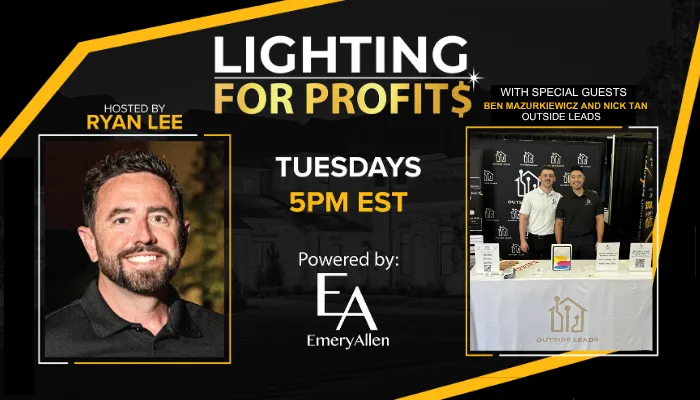
Ben Mazurkiewicz and Nick Tan - The Lead Formula
Lighting for Profits - Episode 250
Discover how outdoor lighting businesses can generate more qualified leads, book more projects, and increase revenue using targeted online advertising and proven marketing strategies. In this episode, we break down what's working today to help lighting contractors attract the right customers and grow with confidence.
Watch the episode
Episode Transcript
Today is the 250th episode of Lighting for Profits
Lighting for Profits, the number one landscape lighting show in the world. Oh, yeah.
Welcome to Lighting for Profits. All light. All light.
All light.
Powered by Emery Allen. Here is your host, Ryan Lee.
A lot.
A lot of light.
Welcome, welcome, welcome to the number one. The number one outdoor lighting show in the US of A. Guys, we are celebrating the 250th year of America. So you know what I thought, why don't we just plan it? Let's do the 250th episode of Lighting for Profits. See, we thought about this five years ago. I don't know how, but it did. The stars did align. Today is the 250th episode of Lighting for Profits. So it's going to be a party, it's going to be a special episode. Uh, and somehow it just so happens to line up with the fact that it's this the month of the celebration of the 250th year of the independence of the United States of America. So we definitely got the number one outdoor lighting show in America. I don't know about the rest of the world, but for, for sure, today in America. So, um, seriously, guys, it's pretty awesome that we get to celebrate 250 years of America, which is like such a short period of time. Just go to. Well, I've only been to Europe, right? I've been to Greece. Um, that's old. But I've never been to like, uh, Egypt. And you go to some of these places and you're like, dang, America is not old. 250 years is nothing. Um, but it's really cool to celebrate, come together as a country. Come together as, um, just united. You know, it's the United States of America. So that's pretty cool because there's so much division in the world. And, um, that's really what I'm trying to do here on Lighting for Profit. So it's cool that we get to celebrate our 250th episode. Kind of surreal, kind of crazy. I didn't have a goal to get to 100 or 200 or 250 or anything. But, um, that's what I really, I'm trying to unite. I'm trying to bring the lighting industry together. Um, and, uh, it's not easy. So, um, but I seriously cannot. Um, thank you guys so much for your support. Um, Emory Allen has been a huge part of our story, ah, For a good portion of these 250 episodes. Um, so if you're looking to start, grow, scale, whatever you want to call it, an outdoor lighting business. This is the place. Today's gonna be an awesome show.
We're going to talk about how to get more leads in your business
Um, one of the things when I ask people on strategy sessions, when people reach out to us, um, we ask them like, what's your biggest obstacle? And uh, it's literally like 90% of the time the same answer. Uh, people go, well, I need more leads. I need more leads. I need more business. And, uh, so we're going to talk about how to get more leads in your business. We're going to talk about all things marketing. Um, and so it's going to be a great show.
Ben and Nick Tan are the founders of Outside Leads
We've got the founders, uh, of outside leads, um, Mr. Ben. I'm not even going to try to say your last name, bro. Ben. Let him introduce himself. And Nick Tan. Thank you, Nick, for having a nice, easy last name. Three letters, like my last name. Um, Ben. I mean, I don't know, maybe, maybe we should change it. We'll just call him Ben. Maz. Maz. I'm not sure. But, um, Ben and Nick, the founders of Outside Leads. So you've probably, if you haven't already, I'm sure you have. Maybe you didn't know, but you've probably seen their Facebook ads. So they clearly know how to get their message in front of people. Um, and we're going to talk all things marketing with them. So super excited to have them on.
Secret Summit is happening September 9th and 10th in Utah
A couple quick announcements. Uh, September 9th and 10th, Park City, Utah. It's two months away, less than two months now. Um, is Secret Summit. This is our members only event. So if you're like on the fence, like, I don't know, like, is landscape lighting secrets a scam? Even though we've been around since 2020, like, if you're just like not sure, you should probably join now because you're going to want to be in that room. Uh, it's once a year. It's only once a year. It's our members only meetup. Um, we do all sorts of, um, uh, things we can't even tell you about, you know, because it's a secret society. So. But we are inviting a handful of vendors, um, to participate, uh, as well. So that's going to be kind of cool. Uh, if you need information on that, just email Support. Ryan Lee, coaching .com and Darcy can hook you up. Also made an announcement a couple weeks ago, but Light It Up Expo is happening 2027. So I still got some time but, um, we're gonna, we're gonna be doing some promotions and stuff like that here. But if you want to get, uh, get on the early bird, go to lightitupexpo .com it's going to be in Las Vegas. It's going to be easy to sell tickets, which that's not why we did it there. But, um, I'm just hoping that we can actually add some value because if people don't show up because they're still out from the night before, it's going to be hard to help. But, uh, Light It Up Expo is going to be awesome. Las Vegas at the Flamingo going, um, to be really, really cool. So that's pretty much it again, guys.
Today's show celebrates 250th episode with some highlights and low lights
On Today's show, the 250th episode, aligning with the 250th year celebration of the US of A. Uh, we got Ben and Nick, the founders of Outside leads. Um, before we have them on, you know, I've got something on my mind. And, um, this, to be honest, this, this hurts. What I want to share today was I had this episode actually mapped out in my mind for about the last three months. And, uh, then when I went to, like, put my notes together, I was pretty disappointed because, um, you know, you see the Instagram, you see the social media, you see all the, the highlights. Well, we're going to talk about some of the highlights, but we're also going to talk about some of the low lights. And, um, I'm just a pessimistic person. I'm sorry, did I say pessimistic? I'm an optimistic person because I like to be optimistic. I. I choose, okay, I choose my attitude. And things could be really bad in my life. And I'm like, I'm going to be optimistic. I'm going to have a positive attitude. And that can come across as fake sometimes, you know, or it could come across online as like, oh, yeah, everything's great. Well, not always. Just, I'm choosing to celebrate, um, happiness. And so, um, this last, uh, just a couple days ago, I ran, uh, for the second time. I did it last year, my first time. This year was my second time. I did the Spartan Beast. If you don't know anything about the Spartan Beast, um, they have them all around the world. But this one here in Utah is literally one of the, I think they said one of the top five hardest in the world, um, 21K, which is supposed to be 13 miles. And I had my watch on. Yeah, we ran 14, uh, 14 miles, 4,500ft elevation, which is the real kicker. And 30 obstacles. Um, some of the obstacles are fairly easy, I would say, and some of them are really freaking hard. Last, um, year, it took me over five hours. Five hours of continuous effort. I was like, I was, I was drained. And, um, so I go, you know what? I'm gonna, I'm gonna do it. I'm gonna come back even stronger next year. Next year I'm gonna beat that five hour mark. In fact, I might even be able to do four hours because I, I didn't know what was ahead of me. I didn't know what 4, 500ft elevation was and 14 miles and 30 obstacles. I had never done it right. So I thought, well, this year is going to be not a cakewalk, but I'm going to beat the time. And so I trained, um, and then I stopped training because I got busy. I was going out of town for work. I was going out of town with the family. Um, I made some other excuses probably. Um, I just didn't train as hard as I told myself I was going to. I'm like, I got all year. Well, because I had all year. I didn't start day one right. Um, I even started doing squats. Okay, I've never done a leg day in my life. Um, if you've met me, you can tell. Um, but I did leg days, right? And I started doing squats. And I'm starting to develop a little muscle down there. It's crazy, but here's the truth. I failed. Oh, my gosh. I failed my goal, like, by a lot this year. Not only did I not get under five hours, it took me over six hours to finish. Six hours and ten minutes. Um, man, it was brutal. It was the hottest day of the year so far. I think they broke the record yesterday or something like that again, but it was over 100 degrees, 104 degrees.
Um,
I rolled my ankle and fell and somehow hurt my other hill. Like, my other foot was bruised.
I'm like, what?
Like my right foot is rolled ankle and my left is a hurt foot that was on like mile eight. And I thought I had five more miles to go. I still had six. I mean there was that, ah, uh, at, ah, mile eight, I literally changed my mind because I was like, I can't run anymore. I can't do these things. I'm, um, I'm, um, weak, right? And my goal switched from like, okay, I'm not getting a pr to. I just got to finish this thing. I literally was like working my way, mile by mile, going, I don't know if I can finish. I seriously just kept doubting myself. And I was thinking, okay, how am I going to quit. Where am I going to quit? I mean, I was just pissed. Um, I was just pissed. Um, but I just stuck it out. And six hours, 10 minutes later, I'm looking at my clock and my watch. It's getting close to five hours, and I'm not even close. I'm like, oh, gosh, what a loser, right? Um, the thing that I am proud of is that I even finished, because I. I literally was as getting close to mentally checking out. And, uh, it reminded me of the danger of setting goals. You know, goals are interesting. You read a lot of. A lot of influencers, a lot of educators. They'll tell you, oh, you got to have a goal. You gotta have a goal. And goals are. Are great. Like, I. You know, but you either hit it or you don't. And so. But then what? Like, even if you hit your goal or you don't hit your goal, like, the fact that I didn't get my goal of getting under five hours, and I really wanted four hours, I got.
You set hard goals because they challenge you. Um, that's why you set them
It was two hours longer than my goal. Like, that's crazy. Um, but my life right now is no different than if I would have hit my goal or not. Like, I might have been happier for, like, a day or two or something like that, but, like, my life's the same, right? And that's it. And so I. I literally had. It took me, like, two days to come to grips with this. Um, that the goal, whether you hit the goal or not is not the. Not the win. The win is that you became a different person. Like, my life is, you know, I become a long way. I mean, I'm stronger, I'm more disciplined, I'm healthier, I eat better, I'm happier. I wake up earlier. Uh, I show up better for my family. I show up better for my clients. Um, that's why you set hard goals. And whether you hit it or not to me is just irrelevant. It's like, okay, I didn't do it. So what? Now what? My kids don't love me anymore. They could care less. They're like, oh, why'd you do that? Um, it challenges you. These. These hard goals, they challenge you. They help you become a different version of yourself. And so I've always enjoyed pushing myself to see what's possible. And in the case of the Spartan, you know, I. I learned that I'm. It's not possible. It obviously was not possible for me to hit that. And the truth is, like, I didn't deserve to. To finish under five hours. Like, I made a lot of excuses. I didn't start training when I should have. You know, I waited till the last minute. You know, the last couple months I was starting to put it on, but I was running. And this isn't a running race. The 14 miles, a lot of is literally climbing up, like, steep terrain where you're, you're literally like almost falling backwards and then you have to go down it. So you're not like gaining speed going down because you're like holding onto plants and rocks and stuff to make sure you just don't go down this steep terrain. It's like, for sure if the, if, if it's even a run, it's a double black diamond, right? And so, um, I just, I didn't deserve it. I'm not ready. Right. And I do believe that if I would have worked harder and trained harder, I, I wouldn't have gotten hurt. I would have, I would have pushed through. I would have been able to do that in the short amount of time because there was other people. I think the fastest person. I'm not sure how old they were, but I think, I think the fastest person did it in like three and a half hours. And I did it in six hours and 10. So that's a lot of time difference. I'm sure they had more muscle than me. I'm sure they trained for. I'm sure they probably did one the day. You know, like, this is what they, what they do. I haven't put in the reps. Right. And that's kind of how business is. You know, we all want the payoff, and I'm guilty of this too. So this isn't a place of judgment, by the way. We all want the payoff, but we aren't willing to do whatever it takes. And it's true. I would love, like, major payoffs and not have to go do the things, but that's just not how the world works.
So I want to ask you what things in your business are you skipping
So I want to ask you what, what things in your business are you skipping? What are the leg days in your business that you're skipping? And it's usually the hard stuff, you know, it's usually the hard stuff. You know, working on yourself as a leader, taking accountability and ownership for your weaknesses, your lack of ability to lead. That's not easy. Um, what else? It could be hiring, ah, your replacement. It could be investing in training your team. Most of us say we don't have time for that because we got to go do installs. What about investing in yourself? Do you have a coach? Do you have a life coach? Do you have a Mentor, Are you part of a community working? Um, smarter, not harder. Okay? Everyone goes through the same thing. You just think, I'll just, I'll figure it out one day. How hard are you willing to work to figure out that? It's not about matter of how hard you work, it's how smart you work. You have to be willing to put in the reps if you want the payoff. It's just, it just does not happen overnight. And I learned that obviously with the Spartan. Um, and if you are stuck, like, I'm talking, like, some of you guys have been doing the same thing. I mean, I admire your discipline. You're like, nope, head down, like, gonna go, I'm just gonna grind. It's been like five years, 10 years. You're still in the same spot. Like, something's got to change. Okay? M. If you don't have something or if you have, if, if you want something that you don't have, you're gonna have to be willing to do something you've never done. That's just a simple truth, right? And so for those of you looking for certainty, well, news flash, like, it doesn't exist until certainty only comes after you take action. So, like, I'm certain that I didn't finish Spartan. And under my goal, like, I don't know, could I, could I finish faster? I don't know. Until I do that, right? Um, and opportunities are all around us and most of us just make excuses. So the opportunities that are sitting right in front of you are costing you more to, to not take advantage of than they would to just try it. Because, like, worst case scenario, like me, like, I did the Spartan, I didn't hit my goal. I declared it to you guys. I declared it to the world. So now I gotta, you know, put my head down and be like, yeah, I freaking sucked. Um, and all I can do is laugh it off so that I feel less embarrassed, right? But that's the worst case scenario. I'm still a better human being because I did it right. And that's a lot like business, guys. You're just going to have to figure it out as you go. Um, fear is around us. Doubt is around us. You're not going to develop less fear. You're not going to develop less doubt. It's always going to be there. Even the mega successful people, they have probably bigger fears because their risks are even bigger than yours. But they're not waiting. They're taking action. Okay? So, you know, the most successful people, they know, they know that if they do Fail like I did on my Spartan, um, you know, to hit my goal. I still finish, but I failed on my goal big time. They're still going to come out ahead, way better than they were before. And so I promise you guys, it's the same for you and your business. Whatever that thing is that's holding you back, step into the fear and you will find courage. That's what it is. You just got to develop that courage muscle and exercise it over and over and over. And it's reps, right? So I've got areas in my life where I've exercised those reps and I'm freaking disciplined and I'm just a beast. And then I've got the Spartan beast where I'm not so much of a beast. So, um, it's okay. Guys get 1% better every day. And it's about who you become along the journey. Not the destination, not the goal. So make, um, sure you're using your goals accordingly. I'm going to do. No, I'm going to do new health goals because I like that, I like hitting it, but it again, I'm just kind of reminding myself that it's not about whether I hit it or not. It's more about like what transformation occurred throughout that process.
Emory Allen makes premium LED lamps for lighting professionals who demand the best
So. All right, guys, by the way, hey, shout out to Chris Rios. You know, when we started the show, um, he did that cool, uh, recording for us.
The number one landscape lighting show in the world.
Oh yeah, I was actually at a, uh, it was a train, it was like a holiday lighting training and a landscape lighting training years ago. And uh, he had a couple beers in him and recorded that for me. So that was cool. Um, but, uh, of course want to give, uh, a shout out to, uh, Emory Allen. So one of the reasons I'm so passionate about helping people make a ton of money is so that they can afford to over deliver and really provide that red carpet white glove experience to their clients. So when you're, when you're trying to deliver that red carpet white glove experience, you're going to get more repeat business, you're going to get more referrals, you're going to increase your lifetime value, which we're going to talk about on today's call. Talking, um, about marketing. But you do that by delivering a high quality product. If you're using cheap products just to deliver a low price, like it's going to be hard to constantly over deliver. Luckily, Emory Allen makes premium LED lamps for lighting professionals who demand the best. So don't settle for less, just Upgrade your designs and installations today with Emory Allen. If you have not taken advantage of the homie hookup, just email Jackson. His email is Jackson L, as in the letter L, Jacksonlryallen. com and he, uh, will hook you up with that discounted contractor pricing. All you need to do is mention that you heard about him here on Lighting for profits. Just email Jackson lrealin. com. all right, guys, I promised you. We're going to talk about how to grow your business, how to get more leads. Let's get our guests on the show. What do you guys say? Let's see if I can find my, uh, guest intro music. Oh, there it is.
Ben Mazerkowitz and Nick Tan welcome us with outside leads
All right.
Please help me welcome Mr. Ben and Nick with outside leads. What's up, Ben? What's up, Nick? How's it going, by the way, Ben, Um, why don't you introduce yourself real quick?
Yeah, that'll be Ben Mazerkowitz. Uh, very common, of course, through that. Just like your life. Uh, Ben Maz is perfect. That's my Instagram handle, too. It's always fun.
Yeah, Ben Maz is way cooler than what you just said.
It's, uh, it's a tongue twister. But,
hey, thanks for being here, Ben. And Nick, uh, t. Nick Tan.
Yes, sir.
We got that. Right, Right.
Yep. Yeah, nailed it.
Nick and I started Outside Leads as a home service agency
Why don't you guys just do a quick introduction of who you are, uh, how. How did you get started in this business? Like, give. Just give us a quick backstory real quick.
Yeah, sure thing. So I can kind of start on our journey. Nick and I together, uh, kind of met through the marketing world, uh, where we started Outside Leads as a home service agency. So we worked with a lot of landscapers, hardscapers, general contractors, roofers, things of the nature, um, and kind of the starting point and how we got into the outdoor, ah, lighting world. My older brother started working with and still works with Outdoor Lighting Perspectives of Chicago. Uh, that's where I'm based. Um, and at the time, we didn't know much about the industry. This is rewinding back three to four years. But it became very appealing from the advertising perspective in that, um, it's a luxury service. People buy it because they want it, not because they necessarily need it, even though our job is to convince them why they do need it. Um, so again, it became very appealing. So that was sort of our first dive into the outdoor lighting world. We took our systems from home service brought directly into Lighting for Landscape Permanent Holiday, and just saw fantastic results. Saw a huge opportunity in the space that there really wasn't a standalone specialist, um, in the marketing world for lighting. You know, when we were with home service, we would talk to some lighting guys who ultimately said, you know, they had to teach them the difference between landscape and permanent, permanent versus holiday and things of nature. Um, and when someone can step in and have full education surrounding that is a huge advantage. So uh, Ultra lighting has been our focus now for the past four years. Uh, all things digital marketing. Um, and that's, that's the base of it. Nick, anything you want to add to that?
No, Nope, that was uh, yeah, that was the gist of it.
Yeah. No, I appreciate it. And you're dead on. Like that happens all the time where someone's like, you know, they'll start talking to a marketing company or whatever and then all of a sudden they start posting blogs. And it's like, I remember I had this one time we started doing um, misting systems. You know, it's. I was in Texas and it got hot and people wanted patio misters and like, okay, so let's try that. And um, then we hired a marketing company and they posted a blog and it showed a picture of a greenhouse with like misters. And I was like, what is going on? Like they clearly don't know what we're doing. And so you're right. Like I think it makes sense when you can niche down because then you can speak the language. You get that there's not that two month education on like, oh, so you guys don't do solar lights? Oh, uh, yeah, we'll turn off those ads, um, and thousands of dollars down the drain.
Ben: Outdoor lighting is protected regardless of what's going on in economy
So, um, uh, Ben, you mentioned something how like you, it excited you because it was a luxury item. You know, I think most marketers and even people starting a business or uh, it's almost like a deterrent of like, oh, I'm going to go after like the, the demand based stuff like H Vac and, and some of those other ones. You um, like that. How come you like the fact that people want landscape lighting and not necessarily need it?
Yeah, so I like this point and I like to divide industries. Kind of like you said, the wants versus the needs. Uh, you need your roof done because a hailstorm ruined it, or like you need an H Vac unit because you know, shut down whatever it might be. So there is obvious demand but people don't necessarily want to pay for that. You know, it's sometimes a burden, vice versa. Outdoor lighting is, you know, in addition to their home, you know, something that they're excited about, something that they want to invest in something that they're willing to pay for. So from an advertising perspective, um, putting a business out there for a service that people are excited to purchase is, let's just say, a lot more fun, um, than advertising for something that, you know, people are dreading or trying to get the cheapest cost or getting 10 to 12 different quotes or whatever it might be.
I, I think it's one of those points that I don't think most business owners spend enough time really coming to grips with and understanding. Because, um, it's one of those reasons why outdoor lighting is protected, uh, regardless of what's going on in the economy. Because people like, yeah, if you don't need something, you're going to restrict, like, yeah, we don't need that. But rich people still want shit. They're just like, I still want to go to Italy on that vacation. I still want to go skiing in Val. I still want to enjoy my backyard. And to do that at night, you kind of need some lights. And so, um, the, the people who have the negative mindset are always like, I mean, I don't know, man. I just saw an article today. They said a recession might be starting. Mike. They've been saying that ever since I was born. Like, I swear, every year of my life, it's like, hey, man, because you keep your cash, keep your cash, man. Recession's about to start. Like, what. When is it going to actually start? Or has it started or when's it going? I feel like we're protected. I feel like we're protected because we just give people things that they want and we're not trying to sell to poor people.
So it's, I also think, to your point there, like, when, when, uh, business owners hear that and they get nervous about investing into advertising because they think, you know, demand's not going to be there. Um, there's less people advertising, which means less competition. So, you know, it's an easier time to actually advertise and kind of stand out.
Yeah, totally agree.
Landscape lighting is the harder one to do than holiday or Christmas lighting
I want to ask you about the different verticals because it's kind of like, I feel like it's just, you know, landscape lighting, holiday or Christmas lighting, and then permanent lighting. Um, one of the reasons I love landscape lighting and I think it's better than the other two, and I would arm wrestle someone that's not as strong as me over that, uh, is because landscape lighting is the harder one. Like you said. Like, it's, it's actually not as simple like Christmas. I don't want to Minimize what you guys do. But like, seriously, like you could just walk down the street with a sign that says Christmas lights and get leads in November. You know what I mean? Um, landscape lighting is not like that. Like it's, it's a little bit harder. Um, how do you guys vary your approach when you got someone that wants permanent lighting leads versus Christmas or landscape or they want all three, how are you guys working that into the mix?
What's the best way to generate leads for landscape lighting companies
Yeah, um, so I, I talk to a lot of, you know, the lighting business owners every day. I'm the one on the calls and whatnot. So that's the first thing that I'll ask is, you know, what's the vertical you want to focus on and generate leads for? Um, because we don't want to come at it from a cookie cutter approach and just prescribe a solution when we don't really even know what the problem is and specifically for what service. So with landscape lighting, I would say the biggest thing, um, that we've seen across the board where when people have success is of course we need really good ads. Um, especially with, you know, the Facebook update last year, it's not really about targeting or pressing buttons in Facebook. Um, 90% of the results is going to come from just having a really, really good creative, um, the second thing is, especially with meta, just not using instant lead forms. So we only focus on landing pages now. And one, it allows you just to convey a much stronger brand and be able to pre sell them, especially with these higher ticket jobs where they're thinking about it a lot more and things of that sort. So there's kind of the first layer of ROI that I like to call it, where of course we're looking at the cost per lead, then we're looking at ah, how many of those leads are actually converting to appointments and then closed jobs. So we typically see a good return there. And then there's kind of that secondary layer, especially with meta, when you run a really strong ad creative, um, people go onto your website. So then you need a really strong website and brand presence, a good organic presence, you know, have a good strong gbp, things of that sort. And then there's just traffic being driven there as well. So a lot of the times our clients will tell us, hey, someone actually found us on Facebook that went to search us up and then called and then became a client.
Yep, I see that all the time that happens even with referrals. There's a lot of business owners that I've talked to and they're like, oh man, no, I'M good. I don't need, I don't need help with marketing or anything like that. Been around 22 years. All word of mouth, baby. I'm like, cool. So you just told me that you hate money because, like, even a referral, it's like, hey, man, you guys should use Ben, uh, and Nick, like, go, here's their number. You know, they're with outside leads. Like, there's a really good chance they're just going to Google outside leads first before they even call you. And so all of a sudden you have a crappy website, doesn't convert, or maybe it doesn't show up like that good as it should. Now all sudden you just generated a lead for your competitor, you know, and people just don't know. Like, that's not how it works. The funnel isn't always streamlined. Um, sometimes they hop around a little bit. So. I'm glad you brought that up.
Yeah, yeah, exactly. It's not always just super linear. It would be great if it was. But yeah, there's definitely that kind of omnipresence approach that we definitely need to think about. Um, with permanent, A, uh, little different, it is a little bit more linear because less of a higher ticket item, um, probably a little bit more well known, easier to also show in ad creatives and whatnot. So. But even then, you know, still definitely lots of brand awareness. And then to your point with holiday, um, not very difficult when it's holiday season. So as long as you have a good ad creative and good landing page, you can absolutely smash it.
Talk about what makes up a good ad creative
Talk about what makes up a good ad creative. Because I think people hear that and it, they're like, okay, well what does that mean? Because you said it's not as much about targeting and, and you know, ad sets and all that, but, um, someone's listening. What are some tips you could give them on how to come up with a, a good ad for their company?
Yeah, I think, um, you know, Ben and I have talked a lot about this and just looking at, you know, the hundreds of ads that we've created and there's a couple common themes. I think one is just having the owner on camera. Even though it's uncomfortable sometimes, but that's a huge part of it. I don't think it's enough just to showcase the product anymore or just showcase some lights on a house. I think you actually have to have the owner on camera. You know, it could be something that's educational, it could be a direct script, um, things like that. Good, high quality content like B roll that we can layer over, you know, even if it's just a voiceover type of ad. But of course, with landscape, we want to have high quality footage if we're going to convey a high quality product. So I think that's the start of it. Um, and then other than that, it just becomes one of those things where, uh, we want to test a bunch of stuff. So even though we have probably 80% of the foundation there when it comes to the ads, we also still like to test different variations of hooks or direct offers and things like that, um, just to kind of match that specific service area.
With uptick in competition, social media is the best way to separate yourself
I don't know if you have anything else to add to that, Ben.
Yeah, definitely. So if for those who have like talked to us before, they know that we really push the personal creative side, Uh, I think with uptick in competition, it's the best way to separate yourself from. If people are scrolling and they see a picture of a house with lights, it's like, okay, cool versus scrolling. Seeing, you know, an owner introducing themselves, their business in their local area and then actually talking about exactly what they installed. Um, I always like to say that the best advertisements are the videos that don't scream, you know, advertisement or sponsored ad. It's just natural to the timeline. Facebook and Instagram is what I call like interruption marketing because no one is scrolling. Tickets sold on a 10, 15, 20K landscape lighting job. So it's like, what could we put out there? Very natural to the timeline to get them in, very engaged and that's, uh, you know, hitting certain pain points and desires surrounding, you know, the landscape lighting world. But also taking that direct introduction approach.
Yeah, good stuff. Honestly, it took me way longer than I want to admit to learn some of this stuff because when I had my lighting business, I didn't, I mean, I didn't even have a Facebook account forever. And I think I got one in like 2015 or something like that. And then so I was like, I, uh, might as well get a business one. And I would just post pictures of cool lighting projects because they looked cool. And I was like, this project was awesome because they 50 grand and look, it's awesome. And it would get like 2 likes and it's pretty. The answers to everything is always right in front of us. It's pretty simple. Like you just said it, but it's called social media. People come on to Instagram, Facebook to be social. They're not coming on there to look at pretty pictures of landscape lighting that they don't even know what that is. Um, and what did it even look like before? Like, is there a transformation? Like, that's cool, whatever. But it's social and it's media. And so when you do put that human touch on it, like again, I, I figured that out when I started this business. It's like that's all I do is I just like I'm in, I'm in everything, you know. And yeah, not everyone's gonna like it. Not everyone's gonna want it. And they didn't go on there to listen to a lighting podcast and that's fine. They can just scroll on and then other people are going to stop and pause and be like, who? Wait, this is, this is helpful, this is valuable information. So yeah, I think once people realize it's like whether it, if it's not the owner or somebody else, like someone's got to be on there, it's social media, it's, it's been named that the whole time. So yeah, nothing's changed there.
Yeah, face to the brand and we even say it doesn't have to be the owner. It helps obviously if we know that if they see the owner in the ad, owner calls them, the owner goes to the appointment. That makes, you know, you gain that trust factor a lot quicker, which can make the sales process a little bit more streamlined. Um, but if the first time they're hearing about them or knowing them is that um, at home appointment might make things a little bit different.
You do social media management and Google Ads. So what do you guys do at outside leads
So uh, what do you guys do at outside leads? You do social media management and Google Ads.
So all that kind of anything. Digital marketing, website design, SEO, Facebook and Instagram ads, Google Ads, social media management, uh, AI lead management, CRMs really.
Okay, so if you have someone that comes to you and it's just a weak website, um, can you, can you modify it or do they have to start all over or could you be like, hey, we need to add a form here, add your phone number here because again like you know, your results, they're gonna, they're gonna measure you if they get results or not. And if, if they already have kind of weak branding or weak website or something like that that's gonna affect your performance. So what do you guys do there?
Yeah, generally if there is a weak website, we would recommend starting from scratch. You know, our non negotiables for a website. It's like a five page home about us, uh, services or just landscape lighting. If that's all you offer the gallery and the contact us, like those are the five all you need. Anything more is just, you know, a cherry on Top, um, the biggest thing with websites in the actual lighting world is that it has to be very visual. You know, as people are scrolling on that homepage, they should see 10 or more images right, right away because that's what you're selling. Um, if they can't immediately understand what you do and then if you don't make it easy for them to contact you, you know, you might be losing a lot through your website. So I know Nick, like we touched on ads, but we always promote the organic foundation. Back to Nick's point that there's so much indirect leads that you get from paid ads because they'll see you, then they'll search you, they'll look at your website, they look at your reviews, your um, presence on your socials, and if that's, you know, just as dial isn't dialed in as your ads, then you'll reap the rewards.
Yeah, I've seen that too. So, um, I guess what types of things should they be posting regularly on their social media and how often we
advocate two to three times per week to post. And that's what we follow with, with our clients, um, that we work with and we follow like traditional social media plans where it's not just look at this project we did, but you know, a value post and education, educational post, a quick tip, a call to action, posting for holidays. So it's really, you know, just growing a brand and not just saying permanent lighting project, you know, in Chicago, landscape lighting project we did in Plainfield. Um, coming more from the approach of the professional, as if it was the owner posting, um, and really providing value. And I think that's the good way to gain trust organically, similar to the way we do it for paid ads.
Yeah, I don't think people realize that, like they're, they're all interconnected. And so if, if you really have a crappy, like, organic, uh, presence and then you, you expect to just turn on ads and everything to be awesome. It's just not the same. This is why you have people, um, even in our community. Right. I mean, you'll have someone say, oh my gosh, I'm killing it with these guys. I'm killing it on social media, I'm killing it on Google Ads, whatever. And then someone else tries the simplets, let's say the exact same campaign but similar, whatever. Like, I don't know, it's just not working for me. And you can usually find out why. It's like, well, yeah, your branding's not the same. Your, your landers are not the same like all these different things. You haven't posted on social media for two months and the last time you did was actually kind of like a boring post. Not uh, valuable because again people don't go, it's non linear like you said Nick. Like they don't just always click the link, go to landing page, flout the thing, get the lead by lights, um, it can get messy. So if you guys uh, for, let's just say for landscape lighting, not holiday, not permanent, someone uh, comes to you and they're like man, I'm broke. I mean I've got some money but very little and I, I need to start with something. What should I do? Should I do Google Ads or should I do Instagram ads?
Yeah, I think uh, the first thing we always recommend, um, and we help people out with this as well is what we call cash injection campaigns, um, which are just super low hanging fruit where they're just reactivation campaigns. So kind of doing SMS blast or email blast to old leads that are just collecting dust or maybe got an estimate, didn't close and things of that sort. So ideally if you can get a job or two from that then that kind of funds the marketing campaign. Um, but I think from a budget perspective probably meta because with Google it's just expensive and you know the leads are much higher intent of course, um, when they're coming in. But you probably need at least 2,500, 3,000 bucks, you know, just for ad spend to get uh, a good sufficient amount of leads.
Talk about why it matters to have a larger budget for Google Ads
Whereas talk a little bit about how'd
you come up with that budget. Talk about why it matters to have a larger budget for Google Ads just
because the, it's all based on like ppc which means you have to select keywords and you know the, the most competitive keywords depending on the service area of course. But you know, sometimes it could be 10, 15 bucks just for a click, you know, let alone um, how many that actually convert on the landing page and things of that sort. So you just need a lot of clicks to even get enough data, um, for it to be, you know, somewhat successful. Once it's working and it's doing really well then you know it's great. But at kind of the initial start you just need a little bit more for testing.
Yep, I'd agree with that. Um, obviously there's a learning phase, a testing phase for both mediums. So like bigger budgets in Google buy more presence, like in more room to test. They don't like necessarily by rank, you know, your relevance and your Quality score do. But the more you spend the quicker you'll reach that point. So it really depends on the exact number because you know, depending on budget. We do advocate Google Ads for landscape lighting because you know, it's high intent, it is very search based. Um, when people want landscape lighting that's where they're going. Google now chat, gbt, Gemini, you know, Grok, whatever it might be. But also you could get a lot out of just 500 on Facebook. If you spend that, you could reach tens of thousands of people in an area, get all these impressions and there's a lot of like indirect, like we're saying the non linear marketing, um, leads that you can get from them.
Gotcha. Um, talk about like you know, social media, like you've mentioned a couple times, it's uh, it's interruption marketing. You know, it's like Google. If someone types in like you know, outdoor lighting designer near me, like yeah, I, I know, I want that lead. Social, um, media, we don't have that luxury necessarily. I mean there is some targeting you can do in the content like you said, uh, or the creative of the ad, but we don't necessarily know intent. And so um, how do you treat them? Like are you actually going for the lead? Are you trying to get them to just get uh, to an email list? Like what part of the funnel are people in, uh, on, on social media when it comes to landscape lighting?
Yeah, uh, it's, it's very high intent. So we're very big on just like the full customer journey. Nick mentioned that we'd never run our ads to a lead form. And for those who have, I guarantee that they've had leads who don't remember filling out, say quote that they never filled it out wrong phone numbers, um, things the nature because Facebook pushes volume. You know, if you have your information saved on Facebook, you click on it, auto fills it submits in five seconds. Like, like where's the intent from that?
The landing page is where buyers go after filling out an extensive form
So we already touched on you know, the visual, the creative is the first piece but the destination is just as important. Um, that's where we go to the landing page. You know, even taking them off of Facebook is an extra layer of friction. So it's the acceptance of I'm not scrolling on Facebook anymore. I'm now going to a different tab, uh, to learn more about this after L Business. Um, there, you know we still have an extensive form asking, you know, what service, all their contact information, address information, things of the nature. But now we have further room to educate about their services, show more Visuals. We, uh, have people film videos there as well, saying, you know, thank you for your interest. Here's a little bit about our business. After they fill out the form, they go to a thank you page. Again, back to encapsulating this whole buyer journey and keeping them very interested and excited. Uh, people on the thank you page will film, you know, thank you for your inquiry. Here are the next steps. So really the main thing, you know, just back to the point, and I sound like a broken record, but it's keeping them in tune, keeping them excited about the service. You know, back to the point of interruption. We interrupted, interrupted them with the creative. Now let's keep them in with the landing page and even more so with the thank you page. And then everything after that was speed to lead. Um, gets the appointment booked more seamlessly than it does chasing a lead form lead with, you know, 17 phone calls and 13 text messages.
Yeah, got it.
Matt Berg: People are filming videos for ads. Where do you guys recommend
Uh, we did have one question from Dalton Zane. He's talking about recording, you know, advertisement videos. Uh, where should we be recording this? Should it be gonna be at your house with a nice background? Should be on the job site. Where do you guys recommend. People are filming these videos for ads.
The. Yeah, the best ones are, I like to say it's, you know, everyone. Everyone does it. The nighttime demo. Like, after you do an install, you go there, you walk through with the customer and you talk about what you did, you look at it. It's almost put that, uh, into an advertisement. Those work very, very well because you are positioning yourself as a professional. You're speaking the language. Again, not screaming advertising, but at the same time, you could stand in front of your truck, you could stand in front of your own house, you could stand in the backyard. It really doesn't matter. Depending on the edits as you're speaking, it's always recommended to transition to show what you're talking about. So if you offer multiple services, so it's, you know, here at Ben's Outdoor Lighting, we offer landscape lighting and architectural lighting and, uh, up lighting and bistro lighting, whatever it might be. You want to be very visual in your videos and not just show you. Maybe show you for the first 10 seconds and then show off the projects.
I think the only thing I'd add to that is, um, you know, for. If you want to attract a, ah, you know, certain avatar or house or whatever it is, like showcase the house. That is your ideal client. So if you have a big project and you want more big projects, showcase, you know, a bigger project. We're showcasing smaller projects and things of that sort. That's kind of the leads you'll start to attract.
Yeah, interesting. I know I had a lady, I mean, I just always like to show off the bigger jobs anyway. Right. So that's what we had on our website and we did small jobs. I just wasn't as proud of those. And a lady called in one time and she's like, wait, do you do it? Do you only do big homes? I'm like, we try to, you know, but I'm like, no, if you're like a regular person and need lights, we might be able to help you. You know our minimum is three grand or whatever. But so yeah, I think you can, you can do a lot of your pre qualifying or a lot of educating and stuff through, through that content. For sure.
Yeah. It's also one of those things. It's uh, if you show a small job, it's harder to attract the trust of like those bigger jobs that you want. Whereas if you show a massive job, it's, you can have anything below, you know, in terms of leads and who you're attracting.
Yeah, good point.
A little difficult.
Yeah. Nice shout out from Matt Berg. Ben and Nick killed it on my site. Now climbing the Google ladder.
Thank you very much Matt.
Much appreciated that new site, Matt.
What's an appropriate budget budget for getting started with social media
Um, okay, so how long, um, you talked about Google and like the budget there. What, what's an appropriate budget budget for getting started with social media. And how long does it take? You said there's a learning curve or not learning curve but a learning, a process. How long does it take to get
results specifically for Google? You're asking social media.
So like Instagram, Facebook budget, um, and uh, time.
So yeah, um, it varies by platform. I'd start with Google and Google's more competitive. If you really want to step in and see results quicker, we Recommend Like a 2000amonth budget. Say it's very healthy. Um, anything less. Like I said, if you have some big spenders in the area, you know you're ultimately losing that bid. So you're kind of behind in that position. You're not getting as many opportunities. So if the budget fits, you have 2k a month to spend on Google Ads. Absolutely do it. There's no reason not to Facebook, you don't have to spend as much. Facebook spending model is different cost per 1000 impressions. So to break it down, if your CPMs are $30 and you spend $30 a day, you'll get a thousand impressions on your ad, which is great. So we recommend a Minimum of a thousand dollars a month. The average cost per lead, you know, in the landscape lighting world, um, annually, let's say, ranges from, like, 40 to $80. So if you're spending 30 bucks, then you could expect a lead, you know, every two to three days. In the permanent lighting world that you're spending $30, cost for leads are lower. You're getting a lead every one to two days. And then once you reach those metrics, it's very predictable to say, okay, I'm spending $30 and getting one lead per day. Let's double my budget and now get two leads per day. So in both platforms, unfortunately, you know, the more you spend, the more you get out, the more you spend, the quicker you can test and see those results. And that's what we really promote. We really like to set those expectations. Because the company spending 1,000 hours will get leads. Half the leads, ultimately, as the company spending 2,000 in the same area.
Yep. Now, this is good. This is a conversation I want to have, because this is why when I. What I teach in my program is, uh, pricing, sales, and then marketing. Because if we just, like, turn on marketing and you guys get these results and you get two leads and all that, but you're not pricing at the right amount. Like, it. At some point, it won't matter. You won't even notice at first because you're like, oh, Ben, Nick, you guys are awesome. I just sold a $10,000 job. You know, but if it should have been 13, at some point, the cash is gonna catch up or the lack thereof, right? And so we start with pricing. We start with sales. Because, again, you guys can generate all the leads in the world. If we're not closing at, uh, what we should. And sometimes it's not far off. Sometimes these guys just needed, like, one extra deal a month, let alone, man, if they could just close one extra deal a week, the marketing has insane roi. And if not, it's like, oh, I don't know. Like, I see a lot of people making marketing decisions that are just terrible. They'll turn on a service like yours, and then, like, it gets slow for a month or two, and they're like, yep, gotta turn it off, just not working anymore. Whatever. I'm like, what? No. Like, you just had, like, all this momentum and you made $60,000. Like, you made enough money and you just were bad with cash and spent it, and so now you're broke. That's not how this works. It's the long game. And lifetime value is something that you guys are going to love me to talk about business. Uh, owners are going to hate me to talk about. But um, Dan Kennedy was the one, I think who came up with the phrase, whoever can afford to spend the most on marketing will win. And that's because of lifetime value. You know, if we. And um, I'm probably no secret why you guys are in the landscape lighting industry is high ticket. I mean if you had to produce those same results, getting someone lawn care leads at $59amo, it's just, man, they got to do a lot of work to pay for that 1500 bucks. You know, like we don't need met, we just need like a job in the landscape lighting world. So when you get three or four, then that's good because it might get slow in July, it might get slow in August. Just traditional marketing always does. It's just how it is. So you should be better at referral partner marketing because that doesn't always get slow that time. And then when you can understand the lifetime value, it's like, okay, cool. I didn't just make, you know, $60,000 in jobs. With these six jobs this month, like I actually made 120,000, but I only got paid on 60 right now. It's just I'm going to upsell them $10,000. It might be two years from now, um, and I'm going to get a referral from them. It might be two days from now. It depends on how good your back end systems are. And that's where people miss the boat. And then they, they, they try something and then they stop it and it's like you're never going to get growth. You, you have to get, um. We were kind of mapping it out the other day at our Friday fly in. If you want a million dollar business and you're just kind of decent at converting leads to appointments and you're just decent at sales, you need about 700 leads in a year and that's a lot of leads. So where are you going to get them from? Like where are you, where are you going to get those leads from? Um, is it possible to do with just social media? In most cases, no. You're going to need a marketing mix. You're going to need a variety of things and you're going to have to be good at repeat business. You're going to have to get good at referrals, you're going to have to do the yard signs, you're going to have to play the small ball stuff so that when you do turn on your Social media and get some doubles. Like heck.
Yeah.
Like we're gonna score some runs. So. Yeah.
Nick: Our business only works if we retain our clients
Um, do you guys ever get into that light lifetime value or is that a conversation. Ah. That your customers don't want to have or what do you, what do you guys do?
I think like, we, I don't, I don't know how much we all actually get into it with our clients, but it's something we like, you know, it's very important to us as a marketing agency. Um, you know, our business only works if we retain our clients and you know, do, do great work for them. And we, like you said, most people have probably seen our ads. We constantly, you know, spend on our ads and uh, things of that sort. So for us, like, lifetime value is, you know, very important. Uh, to your point with Dan Kennedy. Yeah, we, I've been following Dan Kennedy, Russell Brunson, all those guys for a long time and you know, know, always, always love the fact that, you know, they would run low ticket funnels, break even month one, but no month two, they would get X amount of money back. And then you look at kind of that overall ROI for three months and you know, you're sitting at like 5 to 10x. But sometimes it doesn't feel that way, you know, when you're either kind of losing money up front or, um, maybe at a 1x ROI up front and just break even, things of that sort. So for us, we, we talk about it all the time.
Yep. I'll add on that, uh, like we're very big on expectation setting and it's that like if you could spend a thousand dollars in 10x20x in one month, you know, we, we'd be very rich as marketing agency owners, you know, it's like we'd have a lot of clients if all it took was a thousand dollars to see extreme growth. It's very, very rare for a company to, let's say, spend $1,000 a month for a year, advertise all throughout the year and not see a very, very good return. Like too often we see companies who sign on, um, for a month, two weeks in, they spend $500. Their first few appointments didn't go well. You know, they get cold feet and they don't want to carry on to the investment. You know, it's like social media especially is, like you said, it's another stream. It shouldn't be the only one that you rely on. Um, but it could be a huge boost. And financially, if it makes sense, you should absolutely stick with it. So I Think that's part of our strategy as well, is really making sure from an investment perspective that you don't only have a thousand or two thousand hours to spend. And if you don't make, you know, 10x off of that, then you're putting yourself in a huge hole. Um, and that's where we like to recommend, you know, organic website, SEO, social media management, yard signs, reactivation campaigns, things of the nature. So I'd say to both Nick's point, but also to clients, um, no matter how much you spend, if you stick with it, you know, you'll definitely see a return.
I think I may have told you guys this story when I. So when I sold my lighting business, I actually didn't know what I was going to do. I just knew there's no way I'm starting another lighting business in Utah because I was like, people are so cheap in Utah. I grew up there. I'm one of them, you know. And so, uh, then I meet Keith Rosser. He's got a multi million dollar landscape lighting business in Utah. I'm like, okay, that guy's a stud, because this is not an easy market. Um, and so I just had some friends in Texas that were bus. I had tons of friends that were business owners and they're like, dude, how did you, how did you do so well with landscape lighting only? Like, can you, can you, can we, I, uh, know you're good at marketing. Can we hire you? I was like, okay. So I just had a digital marketing agency without really trying. So I was doing what you guys are doing. I was doing Facebook ads, Google websites, all that. Well, one of my clients, um, was a pest control company. And I can't remember the exact numbers, but I got him somewhere around like 40 or 50 leads, uh, in a month. And he was like, dude, this is awesome, you know. And then the next month was July or whatever, you know, and he got less. He got like 30. He was like, dude, man, like, what's going on? You know, we only got 20 leads, 30 leads or whatever. And I was like, oh. I mean, it's just like what happens? I don't know what else to tell you. Well, you see you riding your dirt bike a lot in Utah, like, are you sure you're working? And I was just like, you know what? Like that just pissed me off, you know. And uh, it was actually one of the reasons where I was like, I'm not doing digital marketing because you guys, you can't control so many variables, you know. And uh, but the reason I share that is because marketing agencies, whether you guys agree with this or not, it's just true. You guys have a bad rap. I mean, every, everyone thinks I hire the marketing agency. It always works the first 60 days, but then after that, I don't even think these guys are working. Um, they're just collecting the paycheck and blah, blah, blah. Uh, what, what do you do to overcome that? Because what, what you said is right, Ben. Like, it's not. You're not making a thousand dollar decision. You're actually making a $12,000 a year decision. If, if it's. If that's the budget we're going for and it's either going to work or it's not. But you gotta, you gotta, you gotta take the. Take it all the pieces together. And some months you win, and some months you might break even, and some months you might lose. But are you winning over the year because too many people are cutting it off. Oh, uh, I'm done with this agency. Whatever. And it's like, okay, maybe the agency is not perfect. Maybe, whatever. But if you would have kept going like another month or two, you would have spiked and made another 100 grand or whatever. So what do you guys did do to overcome that?
It's. It's really big again.
On expectations surrounding exactly that. I mean, that's always an uphill battle
On really just like the conversation on expectations surrounding exactly that. Um, you guys ever get accused of
just riding your dirt bike in Utah?
Not yet, but maybe when we're in Park City,
I will have you guys know Nick, uh, Nick was at my house. The. Not, not this Nick. Nick Wojack was at my house. And he's like, is that right? Your bike only has 60 hours on it or whatever. I mean, yeah, I don't ride that much and that bike's like six years old or whatever, so maybe seven years old. Um, but, you know, it's just, it's just what people see and whatever they believe and whatever else and they don't know. I mean, that's always an uphill battle, I think for a marketing agency like your guys, is how do you constantly re. Earn the trust? You know what I mean? That's. I think that's the name of your game. If you can do that, um, your clients get success and yeah, you're going to. You're gonna have success.
Yeah, for us, I mean, it's. It's looking at the long term. And you know, like, we really, uh, on. We're big on like communication and transparency in those first 30 to 90 days because people get emotional and they get nervous when they don't see this tremendous returns in three months. And we want to reiterate that we are seeing good metrics. We've only spent $3,000. You know, when you double that budget in three months, you know, that's when you really start to gain serious traction. You know, just for example, some people are making a huge return in month one, others aren't making a huge return until month five. So it's really, um, communicating, you know, what's working, what's not best, next steps, this is normal. Um, and always making sure that of course we're in line with our service and what we provide. Um, and making sure that, you know, they're providing what they need to provide as well.
Yeah, I'll add on to that. Um, I think a lot of, I mean we know a lot of marketing agencies just being in the space and I think a lot of marketing agencies just over promise because they want to get the sale on the call and they'll say anything to basically get that sale. Um, for us we just, we want to be as transparent as possible, set the right expectations. You know, like Ben said, sometimes we are able to just knock it out the park right away and everything aligns. Sometimes it just takes a bit more time. So we just kind of say it's not a matter of if it's going to work, it's just a matter of when. Um, the other thing as well, we also have skin in the game. We don't sign anyone to long term contracts. Everything's month to month with us. So if we don't crush and we don't, you know, uh, communicate with you, we're transparent about everything. Even when things are bad. We like to be very transparent and say, hey, here's the solutions, here's what we're doing, here's what, we're going to test things of that sort because we want to make sure we have skin in the game and be able to retain every single client that we work with. And we don't want our value to be, you know, you signed a six month contract with us so you got to pay us kind of thing.
Okay, sweet man.
Ben and Nick discuss marketing with Emory Allen in this episode
Um, I could probably talk for days about marketing but um, I have another appointment.
Fair enough.
I do appreciate you guys coming on. This stuff is awesome, man. I love it. And for me it's really, really crucial. I mean as a, I don't really like, I don't want to identify as a business coach because I think there's so much more value to what landscape lighting provides with community. And we have a Buyer's group or like a lot of different things. But if I identify as a coach, like, I can only do so much. Like if the client isn't getting success with their marketing, it doesn't matter how good their sales process is. You know what I mean? They need the 700 leads. Um, that's key. So it's really crucial. So I love these conversations. I appreciate you coming on. If people want to get a hold of you, what's the best way? Where do you want them to go?
You can go to our website, outsideleads. com uh, email contact@outsideleads. com or through phone cell is 815-546-4713.
Okay, um, and I will say this guys, um, we've got, uh, we've got a partnership. And when I say partnership, just so everyone knows, like, I don't have any equity in outside leads. They don't have any equity. I, I refer to partners, just like I do referral partners. Like I'm trying to partner, partner with a lot of different companies in the landscape lighting world to provide value to our community. Um, so I want to tell you this for two reasons. Number one, if you're in Landscape Lighting Secrets, um, Ben and Nick have been, I would say more than generous, um, in their offer, uh, to you guys as members. So, uh, thank you. Thank you, Ben. Thank you, Nick. I, I seriously appreciate that. I mean it's, it's pretty massive. We, you guys know we had that a guy join not too long ago and he's like, he didn't even know. He's like, what? I'm getting like, you know, hundreds of dollars off per month, you know, and that's, that's not why he joined our program, but kind of a nice surprise. So I'm telling for two reasons. Number one, if you're in Landscape Lighting Secrets, don't forget to mention that to these guys. So you guys get the hookup. And if you're not in Landscape Lighting Secrets, it's almost worth joining our program just to get the discount, uh, with outside leads. Let's just say it's, it's that substantial. So we are, like I said, we've got a ton, I don't know how many now, 20, uh, some partners or whatever, inside Landscape Lighting Secrets. So the, you take advantage of a few different offers. Uh, even if you didn't show up to a coaching call or anything like that, you're going to save money by being in our program. So, um, what was the website again? Outsideleads. com that's it. Okay, so go check them out, guys. Outsideleads. com Nick, Ben, really appreciate you guys. Thanks for coming on, nerding out all the things marketing. Appreciate you guys.
Anytime. Thanks for having us.
No worries. 250, baby.
200.
You guys made it to the 250th episode honor.
That's awesome.
I mean, you know, America. America. Emory Allen and lighting for profits.
That's it.
All right, guys, have an awesome week. Thank you for listening to 250
All right, guys, have an awesome week. Uh, 250. Thanks for being on the 250 episode, guys. Thank you, everyone. Go spend a ton of money on advertising. Get tons of leads, make tons of money over deliver.
Ben Mazurkiewicz and Nick Tan - The Lead Formula
Lighting for Profits - Episode 250
Discover how outdoor lighting businesses can generate more qualified leads, book more projects, and increase revenue using targeted online advertising and proven marketing strategies. In this episode, we break down what's working today to help lighting contractors attract the right customers and grow with confidence.
Watch the episode
Episode Transcript
Today is the 250th episode of Lighting for Profits
Lighting for Profits, the number one landscape lighting show in the world. Oh, yeah.
Welcome to Lighting for Profits. All light. All light.
All light.
Powered by Emery Allen. Here is your host, Ryan Lee.
A lot.
A lot of light.
Welcome, welcome, welcome to the number one. The number one outdoor lighting show in the US of A. Guys, we are celebrating the 250th year of America. So you know what I thought, why don't we just plan it? Let's do the 250th episode of Lighting for Profits. See, we thought about this five years ago. I don't know how, but it did. The stars did align. Today is the 250th episode of Lighting for Profits. So it's going to be a party, it's going to be a special episode. Uh, and somehow it just so happens to line up with the fact that it's this the month of the celebration of the 250th year of the independence of the United States of America. So we definitely got the number one outdoor lighting show in America. I don't know about the rest of the world, but for, for sure, today in America. So, um, seriously, guys, it's pretty awesome that we get to celebrate 250 years of America, which is like such a short period of time. Just go to. Well, I've only been to Europe, right? I've been to Greece. Um, that's old. But I've never been to like, uh, Egypt. And you go to some of these places and you're like, dang, America is not old. 250 years is nothing. Um, but it's really cool to celebrate, come together as a country. Come together as, um, just united. You know, it's the United States of America. So that's pretty cool because there's so much division in the world. And, um, that's really what I'm trying to do here on Lighting for Profit. So it's cool that we get to celebrate our 250th episode. Kind of surreal, kind of crazy. I didn't have a goal to get to 100 or 200 or 250 or anything. But, um, that's what I really, I'm trying to unite. I'm trying to bring the lighting industry together. Um, and, uh, it's not easy. So, um, but I seriously cannot. Um, thank you guys so much for your support. Um, Emory Allen has been a huge part of our story, ah, For a good portion of these 250 episodes. Um, so if you're looking to start, grow, scale, whatever you want to call it, an outdoor lighting business. This is the place. Today's gonna be an awesome show.
We're going to talk about how to get more leads in your business
Um, one of the things when I ask people on strategy sessions, when people reach out to us, um, we ask them like, what's your biggest obstacle? And uh, it's literally like 90% of the time the same answer. Uh, people go, well, I need more leads. I need more leads. I need more business. And, uh, so we're going to talk about how to get more leads in your business. We're going to talk about all things marketing. Um, and so it's going to be a great show.
Ben and Nick Tan are the founders of Outside Leads
We've got the founders, uh, of outside leads, um, Mr. Ben. I'm not even going to try to say your last name, bro. Ben. Let him introduce himself. And Nick Tan. Thank you, Nick, for having a nice, easy last name. Three letters, like my last name. Um, Ben. I mean, I don't know, maybe, maybe we should change it. We'll just call him Ben. Maz. Maz. I'm not sure. But, um, Ben and Nick, the founders of Outside Leads. So you've probably, if you haven't already, I'm sure you have. Maybe you didn't know, but you've probably seen their Facebook ads. So they clearly know how to get their message in front of people. Um, and we're going to talk all things marketing with them. So super excited to have them on.
Secret Summit is happening September 9th and 10th in Utah
A couple quick announcements. Uh, September 9th and 10th, Park City, Utah. It's two months away, less than two months now. Um, is Secret Summit. This is our members only event. So if you're like on the fence, like, I don't know, like, is landscape lighting secrets a scam? Even though we've been around since 2020, like, if you're just like not sure, you should probably join now because you're going to want to be in that room. Uh, it's once a year. It's only once a year. It's our members only meetup. Um, we do all sorts of, um, uh, things we can't even tell you about, you know, because it's a secret society. So. But we are inviting a handful of vendors, um, to participate, uh, as well. So that's going to be kind of cool. Uh, if you need information on that, just email Support. Ryan Lee, coaching .com and Darcy can hook you up. Also made an announcement a couple weeks ago, but Light It Up Expo is happening 2027. So I still got some time but, um, we're gonna, we're gonna be doing some promotions and stuff like that here. But if you want to get, uh, get on the early bird, go to lightitupexpo .com it's going to be in Las Vegas. It's going to be easy to sell tickets, which that's not why we did it there. But, um, I'm just hoping that we can actually add some value because if people don't show up because they're still out from the night before, it's going to be hard to help. But, uh, Light It Up Expo is going to be awesome. Las Vegas at the Flamingo going, um, to be really, really cool. So that's pretty much it again, guys.
Today's show celebrates 250th episode with some highlights and low lights
On Today's show, the 250th episode, aligning with the 250th year celebration of the US of A. Uh, we got Ben and Nick, the founders of Outside leads. Um, before we have them on, you know, I've got something on my mind. And, um, this, to be honest, this, this hurts. What I want to share today was I had this episode actually mapped out in my mind for about the last three months. And, uh, then when I went to, like, put my notes together, I was pretty disappointed because, um, you know, you see the Instagram, you see the social media, you see all the, the highlights. Well, we're going to talk about some of the highlights, but we're also going to talk about some of the low lights. And, um, I'm just a pessimistic person. I'm sorry, did I say pessimistic? I'm an optimistic person because I like to be optimistic. I. I choose, okay, I choose my attitude. And things could be really bad in my life. And I'm like, I'm going to be optimistic. I'm going to have a positive attitude. And that can come across as fake sometimes, you know, or it could come across online as like, oh, yeah, everything's great. Well, not always. Just, I'm choosing to celebrate, um, happiness. And so, um, this last, uh, just a couple days ago, I ran, uh, for the second time. I did it last year, my first time. This year was my second time. I did the Spartan Beast. If you don't know anything about the Spartan Beast, um, they have them all around the world. But this one here in Utah is literally one of the, I think they said one of the top five hardest in the world, um, 21K, which is supposed to be 13 miles. And I had my watch on. Yeah, we ran 14, uh, 14 miles, 4,500ft elevation, which is the real kicker. And 30 obstacles. Um, some of the obstacles are fairly easy, I would say, and some of them are really freaking hard. Last, um, year, it took me over five hours. Five hours of continuous effort. I was like, I was, I was drained. And, um, so I go, you know what? I'm gonna, I'm gonna do it. I'm gonna come back even stronger next year. Next year I'm gonna beat that five hour mark. In fact, I might even be able to do four hours because I, I didn't know what was ahead of me. I didn't know what 4, 500ft elevation was and 14 miles and 30 obstacles. I had never done it right. So I thought, well, this year is going to be not a cakewalk, but I'm going to beat the time. And so I trained, um, and then I stopped training because I got busy. I was going out of town for work. I was going out of town with the family. Um, I made some other excuses probably. Um, I just didn't train as hard as I told myself I was going to. I'm like, I got all year. Well, because I had all year. I didn't start day one right. Um, I even started doing squats. Okay, I've never done a leg day in my life. Um, if you've met me, you can tell. Um, but I did leg days, right? And I started doing squats. And I'm starting to develop a little muscle down there. It's crazy, but here's the truth. I failed. Oh, my gosh. I failed my goal, like, by a lot this year. Not only did I not get under five hours, it took me over six hours to finish. Six hours and ten minutes. Um, man, it was brutal. It was the hottest day of the year so far. I think they broke the record yesterday or something like that again, but it was over 100 degrees, 104 degrees.
Um,
I rolled my ankle and fell and somehow hurt my other hill. Like, my other foot was bruised.
I'm like, what?
Like my right foot is rolled ankle and my left is a hurt foot that was on like mile eight. And I thought I had five more miles to go. I still had six. I mean there was that, ah, uh, at, ah, mile eight, I literally changed my mind because I was like, I can't run anymore. I can't do these things. I'm, um, I'm, um, weak, right? And my goal switched from like, okay, I'm not getting a pr to. I just got to finish this thing. I literally was like working my way, mile by mile, going, I don't know if I can finish. I seriously just kept doubting myself. And I was thinking, okay, how am I going to quit. Where am I going to quit? I mean, I was just pissed. Um, I was just pissed. Um, but I just stuck it out. And six hours, 10 minutes later, I'm looking at my clock and my watch. It's getting close to five hours, and I'm not even close. I'm like, oh, gosh, what a loser, right? Um, the thing that I am proud of is that I even finished, because I. I literally was as getting close to mentally checking out. And, uh, it reminded me of the danger of setting goals. You know, goals are interesting. You read a lot of. A lot of influencers, a lot of educators. They'll tell you, oh, you got to have a goal. You gotta have a goal. And goals are. Are great. Like, I. You know, but you either hit it or you don't. And so. But then what? Like, even if you hit your goal or you don't hit your goal, like, the fact that I didn't get my goal of getting under five hours, and I really wanted four hours, I got.
You set hard goals because they challenge you. Um, that's why you set them
It was two hours longer than my goal. Like, that's crazy. Um, but my life right now is no different than if I would have hit my goal or not. Like, I might have been happier for, like, a day or two or something like that, but, like, my life's the same, right? And that's it. And so I. I literally had. It took me, like, two days to come to grips with this. Um, that the goal, whether you hit the goal or not is not the. Not the win. The win is that you became a different person. Like, my life is, you know, I become a long way. I mean, I'm stronger, I'm more disciplined, I'm healthier, I eat better, I'm happier. I wake up earlier. Uh, I show up better for my family. I show up better for my clients. Um, that's why you set hard goals. And whether you hit it or not to me is just irrelevant. It's like, okay, I didn't do it. So what? Now what? My kids don't love me anymore. They could care less. They're like, oh, why'd you do that? Um, it challenges you. These. These hard goals, they challenge you. They help you become a different version of yourself. And so I've always enjoyed pushing myself to see what's possible. And in the case of the Spartan, you know, I. I learned that I'm. It's not possible. It obviously was not possible for me to hit that. And the truth is, like, I didn't deserve to. To finish under five hours. Like, I made a lot of excuses. I didn't start training when I should have. You know, I waited till the last minute. You know, the last couple months I was starting to put it on, but I was running. And this isn't a running race. The 14 miles, a lot of is literally climbing up, like, steep terrain where you're, you're literally like almost falling backwards and then you have to go down it. So you're not like gaining speed going down because you're like holding onto plants and rocks and stuff to make sure you just don't go down this steep terrain. It's like, for sure if the, if, if it's even a run, it's a double black diamond, right? And so, um, I just, I didn't deserve it. I'm not ready. Right. And I do believe that if I would have worked harder and trained harder, I, I wouldn't have gotten hurt. I would have, I would have pushed through. I would have been able to do that in the short amount of time because there was other people. I think the fastest person. I'm not sure how old they were, but I think, I think the fastest person did it in like three and a half hours. And I did it in six hours and 10. So that's a lot of time difference. I'm sure they had more muscle than me. I'm sure they trained for. I'm sure they probably did one the day. You know, like, this is what they, what they do. I haven't put in the reps. Right. And that's kind of how business is. You know, we all want the payoff, and I'm guilty of this too. So this isn't a place of judgment, by the way. We all want the payoff, but we aren't willing to do whatever it takes. And it's true. I would love, like, major payoffs and not have to go do the things, but that's just not how the world works.
So I want to ask you what things in your business are you skipping
So I want to ask you what, what things in your business are you skipping? What are the leg days in your business that you're skipping? And it's usually the hard stuff, you know, it's usually the hard stuff. You know, working on yourself as a leader, taking accountability and ownership for your weaknesses, your lack of ability to lead. That's not easy. Um, what else? It could be hiring, ah, your replacement. It could be investing in training your team. Most of us say we don't have time for that because we got to go do installs. What about investing in yourself? Do you have a coach? Do you have a life coach? Do you have a Mentor, Are you part of a community working? Um, smarter, not harder. Okay? Everyone goes through the same thing. You just think, I'll just, I'll figure it out one day. How hard are you willing to work to figure out that? It's not about matter of how hard you work, it's how smart you work. You have to be willing to put in the reps if you want the payoff. It's just, it just does not happen overnight. And I learned that obviously with the Spartan. Um, and if you are stuck, like, I'm talking, like, some of you guys have been doing the same thing. I mean, I admire your discipline. You're like, nope, head down, like, gonna go, I'm just gonna grind. It's been like five years, 10 years. You're still in the same spot. Like, something's got to change. Okay? M. If you don't have something or if you have, if, if you want something that you don't have, you're gonna have to be willing to do something you've never done. That's just a simple truth, right? And so for those of you looking for certainty, well, news flash, like, it doesn't exist until certainty only comes after you take action. So, like, I'm certain that I didn't finish Spartan. And under my goal, like, I don't know, could I, could I finish faster? I don't know. Until I do that, right? Um, and opportunities are all around us and most of us just make excuses. So the opportunities that are sitting right in front of you are costing you more to, to not take advantage of than they would to just try it. Because, like, worst case scenario, like me, like, I did the Spartan, I didn't hit my goal. I declared it to you guys. I declared it to the world. So now I gotta, you know, put my head down and be like, yeah, I freaking sucked. Um, and all I can do is laugh it off so that I feel less embarrassed, right? But that's the worst case scenario. I'm still a better human being because I did it right. And that's a lot like business, guys. You're just going to have to figure it out as you go. Um, fear is around us. Doubt is around us. You're not going to develop less fear. You're not going to develop less doubt. It's always going to be there. Even the mega successful people, they have probably bigger fears because their risks are even bigger than yours. But they're not waiting. They're taking action. Okay? So, you know, the most successful people, they know, they know that if they do Fail like I did on my Spartan, um, you know, to hit my goal. I still finish, but I failed on my goal big time. They're still going to come out ahead, way better than they were before. And so I promise you guys, it's the same for you and your business. Whatever that thing is that's holding you back, step into the fear and you will find courage. That's what it is. You just got to develop that courage muscle and exercise it over and over and over. And it's reps, right? So I've got areas in my life where I've exercised those reps and I'm freaking disciplined and I'm just a beast. And then I've got the Spartan beast where I'm not so much of a beast. So, um, it's okay. Guys get 1% better every day. And it's about who you become along the journey. Not the destination, not the goal. So make, um, sure you're using your goals accordingly. I'm going to do. No, I'm going to do new health goals because I like that, I like hitting it, but it again, I'm just kind of reminding myself that it's not about whether I hit it or not. It's more about like what transformation occurred throughout that process.
Emory Allen makes premium LED lamps for lighting professionals who demand the best
So. All right, guys, by the way, hey, shout out to Chris Rios. You know, when we started the show, um, he did that cool, uh, recording for us.
The number one landscape lighting show in the world.
Oh yeah, I was actually at a, uh, it was a train, it was like a holiday lighting training and a landscape lighting training years ago. And uh, he had a couple beers in him and recorded that for me. So that was cool. Um, but, uh, of course want to give, uh, a shout out to, uh, Emory Allen. So one of the reasons I'm so passionate about helping people make a ton of money is so that they can afford to over deliver and really provide that red carpet white glove experience to their clients. So when you're, when you're trying to deliver that red carpet white glove experience, you're going to get more repeat business, you're going to get more referrals, you're going to increase your lifetime value, which we're going to talk about on today's call. Talking, um, about marketing. But you do that by delivering a high quality product. If you're using cheap products just to deliver a low price, like it's going to be hard to constantly over deliver. Luckily, Emory Allen makes premium LED lamps for lighting professionals who demand the best. So don't settle for less, just Upgrade your designs and installations today with Emory Allen. If you have not taken advantage of the homie hookup, just email Jackson. His email is Jackson L, as in the letter L, Jacksonlryallen. com and he, uh, will hook you up with that discounted contractor pricing. All you need to do is mention that you heard about him here on Lighting for profits. Just email Jackson lrealin. com. all right, guys, I promised you. We're going to talk about how to grow your business, how to get more leads. Let's get our guests on the show. What do you guys say? Let's see if I can find my, uh, guest intro music. Oh, there it is.
Ben Mazerkowitz and Nick Tan welcome us with outside leads
All right.
Please help me welcome Mr. Ben and Nick with outside leads. What's up, Ben? What's up, Nick? How's it going, by the way, Ben, Um, why don't you introduce yourself real quick?
Yeah, that'll be Ben Mazerkowitz. Uh, very common, of course, through that. Just like your life. Uh, Ben Maz is perfect. That's my Instagram handle, too. It's always fun.
Yeah, Ben Maz is way cooler than what you just said.
It's, uh, it's a tongue twister. But,
hey, thanks for being here, Ben. And Nick, uh, t. Nick Tan.
Yes, sir.
We got that. Right, Right.
Yep. Yeah, nailed it.
Nick and I started Outside Leads as a home service agency
Why don't you guys just do a quick introduction of who you are, uh, how. How did you get started in this business? Like, give. Just give us a quick backstory real quick.
Yeah, sure thing. So I can kind of start on our journey. Nick and I together, uh, kind of met through the marketing world, uh, where we started Outside Leads as a home service agency. So we worked with a lot of landscapers, hardscapers, general contractors, roofers, things of the nature, um, and kind of the starting point and how we got into the outdoor, ah, lighting world. My older brother started working with and still works with Outdoor Lighting Perspectives of Chicago. Uh, that's where I'm based. Um, and at the time, we didn't know much about the industry. This is rewinding back three to four years. But it became very appealing from the advertising perspective in that, um, it's a luxury service. People buy it because they want it, not because they necessarily need it, even though our job is to convince them why they do need it. Um, so again, it became very appealing. So that was sort of our first dive into the outdoor lighting world. We took our systems from home service brought directly into Lighting for Landscape Permanent Holiday, and just saw fantastic results. Saw a huge opportunity in the space that there really wasn't a standalone specialist, um, in the marketing world for lighting. You know, when we were with home service, we would talk to some lighting guys who ultimately said, you know, they had to teach them the difference between landscape and permanent, permanent versus holiday and things of nature. Um, and when someone can step in and have full education surrounding that is a huge advantage. So uh, Ultra lighting has been our focus now for the past four years. Uh, all things digital marketing. Um, and that's, that's the base of it. Nick, anything you want to add to that?
No, Nope, that was uh, yeah, that was the gist of it.
Yeah. No, I appreciate it. And you're dead on. Like that happens all the time where someone's like, you know, they'll start talking to a marketing company or whatever and then all of a sudden they start posting blogs. And it's like, I remember I had this one time we started doing um, misting systems. You know, it's. I was in Texas and it got hot and people wanted patio misters and like, okay, so let's try that. And um, then we hired a marketing company and they posted a blog and it showed a picture of a greenhouse with like misters. And I was like, what is going on? Like they clearly don't know what we're doing. And so you're right. Like I think it makes sense when you can niche down because then you can speak the language. You get that there's not that two month education on like, oh, so you guys don't do solar lights? Oh, uh, yeah, we'll turn off those ads, um, and thousands of dollars down the drain.
Ben: Outdoor lighting is protected regardless of what's going on in economy
So, um, uh, Ben, you mentioned something how like you, it excited you because it was a luxury item. You know, I think most marketers and even people starting a business or uh, it's almost like a deterrent of like, oh, I'm going to go after like the, the demand based stuff like H Vac and, and some of those other ones. You um, like that. How come you like the fact that people want landscape lighting and not necessarily need it?
Yeah, so I like this point and I like to divide industries. Kind of like you said, the wants versus the needs. Uh, you need your roof done because a hailstorm ruined it, or like you need an H Vac unit because you know, shut down whatever it might be. So there is obvious demand but people don't necessarily want to pay for that. You know, it's sometimes a burden, vice versa. Outdoor lighting is, you know, in addition to their home, you know, something that they're excited about, something that they want to invest in something that they're willing to pay for. So from an advertising perspective, um, putting a business out there for a service that people are excited to purchase is, let's just say, a lot more fun, um, than advertising for something that, you know, people are dreading or trying to get the cheapest cost or getting 10 to 12 different quotes or whatever it might be.
I, I think it's one of those points that I don't think most business owners spend enough time really coming to grips with and understanding. Because, um, it's one of those reasons why outdoor lighting is protected, uh, regardless of what's going on in the economy. Because people like, yeah, if you don't need something, you're going to restrict, like, yeah, we don't need that. But rich people still want shit. They're just like, I still want to go to Italy on that vacation. I still want to go skiing in Val. I still want to enjoy my backyard. And to do that at night, you kind of need some lights. And so, um, the, the people who have the negative mindset are always like, I mean, I don't know, man. I just saw an article today. They said a recession might be starting. Mike. They've been saying that ever since I was born. Like, I swear, every year of my life, it's like, hey, man, because you keep your cash, keep your cash, man. Recession's about to start. Like, what. When is it going to actually start? Or has it started or when's it going? I feel like we're protected. I feel like we're protected because we just give people things that they want and we're not trying to sell to poor people.
So it's, I also think, to your point there, like, when, when, uh, business owners hear that and they get nervous about investing into advertising because they think, you know, demand's not going to be there. Um, there's less people advertising, which means less competition. So, you know, it's an easier time to actually advertise and kind of stand out.
Yeah, totally agree.
Landscape lighting is the harder one to do than holiday or Christmas lighting
I want to ask you about the different verticals because it's kind of like, I feel like it's just, you know, landscape lighting, holiday or Christmas lighting, and then permanent lighting. Um, one of the reasons I love landscape lighting and I think it's better than the other two, and I would arm wrestle someone that's not as strong as me over that, uh, is because landscape lighting is the harder one. Like you said. Like, it's, it's actually not as simple like Christmas. I don't want to Minimize what you guys do. But like, seriously, like you could just walk down the street with a sign that says Christmas lights and get leads in November. You know what I mean? Um, landscape lighting is not like that. Like it's, it's a little bit harder. Um, how do you guys vary your approach when you got someone that wants permanent lighting leads versus Christmas or landscape or they want all three, how are you guys working that into the mix?
What's the best way to generate leads for landscape lighting companies
Yeah, um, so I, I talk to a lot of, you know, the lighting business owners every day. I'm the one on the calls and whatnot. So that's the first thing that I'll ask is, you know, what's the vertical you want to focus on and generate leads for? Um, because we don't want to come at it from a cookie cutter approach and just prescribe a solution when we don't really even know what the problem is and specifically for what service. So with landscape lighting, I would say the biggest thing, um, that we've seen across the board where when people have success is of course we need really good ads. Um, especially with, you know, the Facebook update last year, it's not really about targeting or pressing buttons in Facebook. Um, 90% of the results is going to come from just having a really, really good creative, um, the second thing is, especially with meta, just not using instant lead forms. So we only focus on landing pages now. And one, it allows you just to convey a much stronger brand and be able to pre sell them, especially with these higher ticket jobs where they're thinking about it a lot more and things of that sort. So there's kind of the first layer of ROI that I like to call it, where of course we're looking at the cost per lead, then we're looking at ah, how many of those leads are actually converting to appointments and then closed jobs. So we typically see a good return there. And then there's kind of that secondary layer, especially with meta, when you run a really strong ad creative, um, people go onto your website. So then you need a really strong website and brand presence, a good organic presence, you know, have a good strong gbp, things of that sort. And then there's just traffic being driven there as well. So a lot of the times our clients will tell us, hey, someone actually found us on Facebook that went to search us up and then called and then became a client.
Yep, I see that all the time that happens even with referrals. There's a lot of business owners that I've talked to and they're like, oh man, no, I'M good. I don't need, I don't need help with marketing or anything like that. Been around 22 years. All word of mouth, baby. I'm like, cool. So you just told me that you hate money because, like, even a referral, it's like, hey, man, you guys should use Ben, uh, and Nick, like, go, here's their number. You know, they're with outside leads. Like, there's a really good chance they're just going to Google outside leads first before they even call you. And so all of a sudden you have a crappy website, doesn't convert, or maybe it doesn't show up like that good as it should. Now all sudden you just generated a lead for your competitor, you know, and people just don't know. Like, that's not how it works. The funnel isn't always streamlined. Um, sometimes they hop around a little bit. So. I'm glad you brought that up.
Yeah, yeah, exactly. It's not always just super linear. It would be great if it was. But yeah, there's definitely that kind of omnipresence approach that we definitely need to think about. Um, with permanent, A, uh, little different, it is a little bit more linear because less of a higher ticket item, um, probably a little bit more well known, easier to also show in ad creatives and whatnot. So. But even then, you know, still definitely lots of brand awareness. And then to your point with holiday, um, not very difficult when it's holiday season. So as long as you have a good ad creative and good landing page, you can absolutely smash it.
Talk about what makes up a good ad creative
Talk about what makes up a good ad creative. Because I think people hear that and it, they're like, okay, well what does that mean? Because you said it's not as much about targeting and, and you know, ad sets and all that, but, um, someone's listening. What are some tips you could give them on how to come up with a, a good ad for their company?
Yeah, I think, um, you know, Ben and I have talked a lot about this and just looking at, you know, the hundreds of ads that we've created and there's a couple common themes. I think one is just having the owner on camera. Even though it's uncomfortable sometimes, but that's a huge part of it. I don't think it's enough just to showcase the product anymore or just showcase some lights on a house. I think you actually have to have the owner on camera. You know, it could be something that's educational, it could be a direct script, um, things like that. Good, high quality content like B roll that we can layer over, you know, even if it's just a voiceover type of ad. But of course, with landscape, we want to have high quality footage if we're going to convey a high quality product. So I think that's the start of it. Um, and then other than that, it just becomes one of those things where, uh, we want to test a bunch of stuff. So even though we have probably 80% of the foundation there when it comes to the ads, we also still like to test different variations of hooks or direct offers and things like that, um, just to kind of match that specific service area.
With uptick in competition, social media is the best way to separate yourself
I don't know if you have anything else to add to that, Ben.
Yeah, definitely. So if for those who have like talked to us before, they know that we really push the personal creative side, Uh, I think with uptick in competition, it's the best way to separate yourself from. If people are scrolling and they see a picture of a house with lights, it's like, okay, cool versus scrolling. Seeing, you know, an owner introducing themselves, their business in their local area and then actually talking about exactly what they installed. Um, I always like to say that the best advertisements are the videos that don't scream, you know, advertisement or sponsored ad. It's just natural to the timeline. Facebook and Instagram is what I call like interruption marketing because no one is scrolling. Tickets sold on a 10, 15, 20K landscape lighting job. So it's like, what could we put out there? Very natural to the timeline to get them in, very engaged and that's, uh, you know, hitting certain pain points and desires surrounding, you know, the landscape lighting world. But also taking that direct introduction approach.
Yeah, good stuff. Honestly, it took me way longer than I want to admit to learn some of this stuff because when I had my lighting business, I didn't, I mean, I didn't even have a Facebook account forever. And I think I got one in like 2015 or something like that. And then so I was like, I, uh, might as well get a business one. And I would just post pictures of cool lighting projects because they looked cool. And I was like, this project was awesome because they 50 grand and look, it's awesome. And it would get like 2 likes and it's pretty. The answers to everything is always right in front of us. It's pretty simple. Like you just said it, but it's called social media. People come on to Instagram, Facebook to be social. They're not coming on there to look at pretty pictures of landscape lighting that they don't even know what that is. Um, and what did it even look like before? Like, is there a transformation? Like, that's cool, whatever. But it's social and it's media. And so when you do put that human touch on it, like again, I, I figured that out when I started this business. It's like that's all I do is I just like I'm in, I'm in everything, you know. And yeah, not everyone's gonna like it. Not everyone's gonna want it. And they didn't go on there to listen to a lighting podcast and that's fine. They can just scroll on and then other people are going to stop and pause and be like, who? Wait, this is, this is helpful, this is valuable information. So yeah, I think once people realize it's like whether it, if it's not the owner or somebody else, like someone's got to be on there, it's social media, it's, it's been named that the whole time. So yeah, nothing's changed there.
Yeah, face to the brand and we even say it doesn't have to be the owner. It helps obviously if we know that if they see the owner in the ad, owner calls them, the owner goes to the appointment. That makes, you know, you gain that trust factor a lot quicker, which can make the sales process a little bit more streamlined. Um, but if the first time they're hearing about them or knowing them is that um, at home appointment might make things a little bit different.
You do social media management and Google Ads. So what do you guys do at outside leads
So uh, what do you guys do at outside leads? You do social media management and Google Ads.
So all that kind of anything. Digital marketing, website design, SEO, Facebook and Instagram ads, Google Ads, social media management, uh, AI lead management, CRMs really.
Okay, so if you have someone that comes to you and it's just a weak website, um, can you, can you modify it or do they have to start all over or could you be like, hey, we need to add a form here, add your phone number here because again like you know, your results, they're gonna, they're gonna measure you if they get results or not. And if, if they already have kind of weak branding or weak website or something like that that's gonna affect your performance. So what do you guys do there?
Yeah, generally if there is a weak website, we would recommend starting from scratch. You know, our non negotiables for a website. It's like a five page home about us, uh, services or just landscape lighting. If that's all you offer the gallery and the contact us, like those are the five all you need. Anything more is just, you know, a cherry on Top, um, the biggest thing with websites in the actual lighting world is that it has to be very visual. You know, as people are scrolling on that homepage, they should see 10 or more images right, right away because that's what you're selling. Um, if they can't immediately understand what you do and then if you don't make it easy for them to contact you, you know, you might be losing a lot through your website. So I know Nick, like we touched on ads, but we always promote the organic foundation. Back to Nick's point that there's so much indirect leads that you get from paid ads because they'll see you, then they'll search you, they'll look at your website, they look at your reviews, your um, presence on your socials, and if that's, you know, just as dial isn't dialed in as your ads, then you'll reap the rewards.
Yeah, I've seen that too. So, um, I guess what types of things should they be posting regularly on their social media and how often we
advocate two to three times per week to post. And that's what we follow with, with our clients, um, that we work with and we follow like traditional social media plans where it's not just look at this project we did, but you know, a value post and education, educational post, a quick tip, a call to action, posting for holidays. So it's really, you know, just growing a brand and not just saying permanent lighting project, you know, in Chicago, landscape lighting project we did in Plainfield. Um, coming more from the approach of the professional, as if it was the owner posting, um, and really providing value. And I think that's the good way to gain trust organically, similar to the way we do it for paid ads.
Yeah, I don't think people realize that, like they're, they're all interconnected. And so if, if you really have a crappy, like, organic, uh, presence and then you, you expect to just turn on ads and everything to be awesome. It's just not the same. This is why you have people, um, even in our community. Right. I mean, you'll have someone say, oh my gosh, I'm killing it with these guys. I'm killing it on social media, I'm killing it on Google Ads, whatever. And then someone else tries the simplets, let's say the exact same campaign but similar, whatever. Like, I don't know, it's just not working for me. And you can usually find out why. It's like, well, yeah, your branding's not the same. Your, your landers are not the same like all these different things. You haven't posted on social media for two months and the last time you did was actually kind of like a boring post. Not uh, valuable because again people don't go, it's non linear like you said Nick. Like they don't just always click the link, go to landing page, flout the thing, get the lead by lights, um, it can get messy. So if you guys uh, for, let's just say for landscape lighting, not holiday, not permanent, someone uh, comes to you and they're like man, I'm broke. I mean I've got some money but very little and I, I need to start with something. What should I do? Should I do Google Ads or should I do Instagram ads?
Yeah, I think uh, the first thing we always recommend, um, and we help people out with this as well is what we call cash injection campaigns, um, which are just super low hanging fruit where they're just reactivation campaigns. So kind of doing SMS blast or email blast to old leads that are just collecting dust or maybe got an estimate, didn't close and things of that sort. So ideally if you can get a job or two from that then that kind of funds the marketing campaign. Um, but I think from a budget perspective probably meta because with Google it's just expensive and you know the leads are much higher intent of course, um, when they're coming in. But you probably need at least 2,500, 3,000 bucks, you know, just for ad spend to get uh, a good sufficient amount of leads.
Talk about why it matters to have a larger budget for Google Ads
Whereas talk a little bit about how'd
you come up with that budget. Talk about why it matters to have a larger budget for Google Ads just
because the, it's all based on like ppc which means you have to select keywords and you know the, the most competitive keywords depending on the service area of course. But you know, sometimes it could be 10, 15 bucks just for a click, you know, let alone um, how many that actually convert on the landing page and things of that sort. So you just need a lot of clicks to even get enough data, um, for it to be, you know, somewhat successful. Once it's working and it's doing really well then you know it's great. But at kind of the initial start you just need a little bit more for testing.
Yep, I'd agree with that. Um, obviously there's a learning phase, a testing phase for both mediums. So like bigger budgets in Google buy more presence, like in more room to test. They don't like necessarily by rank, you know, your relevance and your Quality score do. But the more you spend the quicker you'll reach that point. So it really depends on the exact number because you know, depending on budget. We do advocate Google Ads for landscape lighting because you know, it's high intent, it is very search based. Um, when people want landscape lighting that's where they're going. Google now chat, gbt, Gemini, you know, Grok, whatever it might be. But also you could get a lot out of just 500 on Facebook. If you spend that, you could reach tens of thousands of people in an area, get all these impressions and there's a lot of like indirect, like we're saying the non linear marketing, um, leads that you can get from them.
Gotcha. Um, talk about like you know, social media, like you've mentioned a couple times, it's uh, it's interruption marketing. You know, it's like Google. If someone types in like you know, outdoor lighting designer near me, like yeah, I, I know, I want that lead. Social, um, media, we don't have that luxury necessarily. I mean there is some targeting you can do in the content like you said, uh, or the creative of the ad, but we don't necessarily know intent. And so um, how do you treat them? Like are you actually going for the lead? Are you trying to get them to just get uh, to an email list? Like what part of the funnel are people in, uh, on, on social media when it comes to landscape lighting?
Yeah, uh, it's, it's very high intent. So we're very big on just like the full customer journey. Nick mentioned that we'd never run our ads to a lead form. And for those who have, I guarantee that they've had leads who don't remember filling out, say quote that they never filled it out wrong phone numbers, um, things the nature because Facebook pushes volume. You know, if you have your information saved on Facebook, you click on it, auto fills it submits in five seconds. Like, like where's the intent from that?
The landing page is where buyers go after filling out an extensive form
So we already touched on you know, the visual, the creative is the first piece but the destination is just as important. Um, that's where we go to the landing page. You know, even taking them off of Facebook is an extra layer of friction. So it's the acceptance of I'm not scrolling on Facebook anymore. I'm now going to a different tab, uh, to learn more about this after L Business. Um, there, you know we still have an extensive form asking, you know, what service, all their contact information, address information, things of the nature. But now we have further room to educate about their services, show more Visuals. We, uh, have people film videos there as well, saying, you know, thank you for your interest. Here's a little bit about our business. After they fill out the form, they go to a thank you page. Again, back to encapsulating this whole buyer journey and keeping them very interested and excited. Uh, people on the thank you page will film, you know, thank you for your inquiry. Here are the next steps. So really the main thing, you know, just back to the point, and I sound like a broken record, but it's keeping them in tune, keeping them excited about the service. You know, back to the point of interruption. We interrupted, interrupted them with the creative. Now let's keep them in with the landing page and even more so with the thank you page. And then everything after that was speed to lead. Um, gets the appointment booked more seamlessly than it does chasing a lead form lead with, you know, 17 phone calls and 13 text messages.
Yeah, got it.
Matt Berg: People are filming videos for ads. Where do you guys recommend
Uh, we did have one question from Dalton Zane. He's talking about recording, you know, advertisement videos. Uh, where should we be recording this? Should it be gonna be at your house with a nice background? Should be on the job site. Where do you guys recommend. People are filming these videos for ads.
The. Yeah, the best ones are, I like to say it's, you know, everyone. Everyone does it. The nighttime demo. Like, after you do an install, you go there, you walk through with the customer and you talk about what you did, you look at it. It's almost put that, uh, into an advertisement. Those work very, very well because you are positioning yourself as a professional. You're speaking the language. Again, not screaming advertising, but at the same time, you could stand in front of your truck, you could stand in front of your own house, you could stand in the backyard. It really doesn't matter. Depending on the edits as you're speaking, it's always recommended to transition to show what you're talking about. So if you offer multiple services, so it's, you know, here at Ben's Outdoor Lighting, we offer landscape lighting and architectural lighting and, uh, up lighting and bistro lighting, whatever it might be. You want to be very visual in your videos and not just show you. Maybe show you for the first 10 seconds and then show off the projects.
I think the only thing I'd add to that is, um, you know, for. If you want to attract a, ah, you know, certain avatar or house or whatever it is, like showcase the house. That is your ideal client. So if you have a big project and you want more big projects, showcase, you know, a bigger project. We're showcasing smaller projects and things of that sort. That's kind of the leads you'll start to attract.
Yeah, interesting. I know I had a lady, I mean, I just always like to show off the bigger jobs anyway. Right. So that's what we had on our website and we did small jobs. I just wasn't as proud of those. And a lady called in one time and she's like, wait, do you do it? Do you only do big homes? I'm like, we try to, you know, but I'm like, no, if you're like a regular person and need lights, we might be able to help you. You know our minimum is three grand or whatever. But so yeah, I think you can, you can do a lot of your pre qualifying or a lot of educating and stuff through, through that content. For sure.
Yeah. It's also one of those things. It's uh, if you show a small job, it's harder to attract the trust of like those bigger jobs that you want. Whereas if you show a massive job, it's, you can have anything below, you know, in terms of leads and who you're attracting.
Yeah, good point.
A little difficult.
Yeah. Nice shout out from Matt Berg. Ben and Nick killed it on my site. Now climbing the Google ladder.
Thank you very much Matt.
Much appreciated that new site, Matt.
What's an appropriate budget budget for getting started with social media
Um, okay, so how long, um, you talked about Google and like the budget there. What, what's an appropriate budget budget for getting started with social media. And how long does it take? You said there's a learning curve or not learning curve but a learning, a process. How long does it take to get
results specifically for Google? You're asking social media.
So like Instagram, Facebook budget, um, and uh, time.
So yeah, um, it varies by platform. I'd start with Google and Google's more competitive. If you really want to step in and see results quicker, we Recommend Like a 2000amonth budget. Say it's very healthy. Um, anything less. Like I said, if you have some big spenders in the area, you know you're ultimately losing that bid. So you're kind of behind in that position. You're not getting as many opportunities. So if the budget fits, you have 2k a month to spend on Google Ads. Absolutely do it. There's no reason not to Facebook, you don't have to spend as much. Facebook spending model is different cost per 1000 impressions. So to break it down, if your CPMs are $30 and you spend $30 a day, you'll get a thousand impressions on your ad, which is great. So we recommend a Minimum of a thousand dollars a month. The average cost per lead, you know, in the landscape lighting world, um, annually, let's say, ranges from, like, 40 to $80. So if you're spending 30 bucks, then you could expect a lead, you know, every two to three days. In the permanent lighting world that you're spending $30, cost for leads are lower. You're getting a lead every one to two days. And then once you reach those metrics, it's very predictable to say, okay, I'm spending $30 and getting one lead per day. Let's double my budget and now get two leads per day. So in both platforms, unfortunately, you know, the more you spend, the more you get out, the more you spend, the quicker you can test and see those results. And that's what we really promote. We really like to set those expectations. Because the company spending 1,000 hours will get leads. Half the leads, ultimately, as the company spending 2,000 in the same area.
Yep. Now, this is good. This is a conversation I want to have, because this is why when I. What I teach in my program is, uh, pricing, sales, and then marketing. Because if we just, like, turn on marketing and you guys get these results and you get two leads and all that, but you're not pricing at the right amount. Like, it. At some point, it won't matter. You won't even notice at first because you're like, oh, Ben, Nick, you guys are awesome. I just sold a $10,000 job. You know, but if it should have been 13, at some point, the cash is gonna catch up or the lack thereof, right? And so we start with pricing. We start with sales. Because, again, you guys can generate all the leads in the world. If we're not closing at, uh, what we should. And sometimes it's not far off. Sometimes these guys just needed, like, one extra deal a month, let alone, man, if they could just close one extra deal a week, the marketing has insane roi. And if not, it's like, oh, I don't know. Like, I see a lot of people making marketing decisions that are just terrible. They'll turn on a service like yours, and then, like, it gets slow for a month or two, and they're like, yep, gotta turn it off, just not working anymore. Whatever. I'm like, what? No. Like, you just had, like, all this momentum and you made $60,000. Like, you made enough money and you just were bad with cash and spent it, and so now you're broke. That's not how this works. It's the long game. And lifetime value is something that you guys are going to love me to talk about business. Uh, owners are going to hate me to talk about. But um, Dan Kennedy was the one, I think who came up with the phrase, whoever can afford to spend the most on marketing will win. And that's because of lifetime value. You know, if we. And um, I'm probably no secret why you guys are in the landscape lighting industry is high ticket. I mean if you had to produce those same results, getting someone lawn care leads at $59amo, it's just, man, they got to do a lot of work to pay for that 1500 bucks. You know, like we don't need met, we just need like a job in the landscape lighting world. So when you get three or four, then that's good because it might get slow in July, it might get slow in August. Just traditional marketing always does. It's just how it is. So you should be better at referral partner marketing because that doesn't always get slow that time. And then when you can understand the lifetime value, it's like, okay, cool. I didn't just make, you know, $60,000 in jobs. With these six jobs this month, like I actually made 120,000, but I only got paid on 60 right now. It's just I'm going to upsell them $10,000. It might be two years from now, um, and I'm going to get a referral from them. It might be two days from now. It depends on how good your back end systems are. And that's where people miss the boat. And then they, they, they try something and then they stop it and it's like you're never going to get growth. You, you have to get, um. We were kind of mapping it out the other day at our Friday fly in. If you want a million dollar business and you're just kind of decent at converting leads to appointments and you're just decent at sales, you need about 700 leads in a year and that's a lot of leads. So where are you going to get them from? Like where are you, where are you going to get those leads from? Um, is it possible to do with just social media? In most cases, no. You're going to need a marketing mix. You're going to need a variety of things and you're going to have to be good at repeat business. You're going to have to get good at referrals, you're going to have to do the yard signs, you're going to have to play the small ball stuff so that when you do turn on your Social media and get some doubles. Like heck.
Yeah.
Like we're gonna score some runs. So. Yeah.
Nick: Our business only works if we retain our clients
Um, do you guys ever get into that light lifetime value or is that a conversation. Ah. That your customers don't want to have or what do you, what do you guys do?
I think like, we, I don't, I don't know how much we all actually get into it with our clients, but it's something we like, you know, it's very important to us as a marketing agency. Um, you know, our business only works if we retain our clients and you know, do, do great work for them. And we, like you said, most people have probably seen our ads. We constantly, you know, spend on our ads and uh, things of that sort. So for us, like, lifetime value is, you know, very important. Uh, to your point with Dan Kennedy. Yeah, we, I've been following Dan Kennedy, Russell Brunson, all those guys for a long time and you know, know, always, always love the fact that, you know, they would run low ticket funnels, break even month one, but no month two, they would get X amount of money back. And then you look at kind of that overall ROI for three months and you know, you're sitting at like 5 to 10x. But sometimes it doesn't feel that way, you know, when you're either kind of losing money up front or, um, maybe at a 1x ROI up front and just break even, things of that sort. So for us, we, we talk about it all the time.
Yep. I'll add on that, uh, like we're very big on expectation setting and it's that like if you could spend a thousand dollars in 10x20x in one month, you know, we, we'd be very rich as marketing agency owners, you know, it's like we'd have a lot of clients if all it took was a thousand dollars to see extreme growth. It's very, very rare for a company to, let's say, spend $1,000 a month for a year, advertise all throughout the year and not see a very, very good return. Like too often we see companies who sign on, um, for a month, two weeks in, they spend $500. Their first few appointments didn't go well. You know, they get cold feet and they don't want to carry on to the investment. You know, it's like social media especially is, like you said, it's another stream. It shouldn't be the only one that you rely on. Um, but it could be a huge boost. And financially, if it makes sense, you should absolutely stick with it. So I Think that's part of our strategy as well, is really making sure from an investment perspective that you don't only have a thousand or two thousand hours to spend. And if you don't make, you know, 10x off of that, then you're putting yourself in a huge hole. Um, and that's where we like to recommend, you know, organic website, SEO, social media management, yard signs, reactivation campaigns, things of the nature. So I'd say to both Nick's point, but also to clients, um, no matter how much you spend, if you stick with it, you know, you'll definitely see a return.
I think I may have told you guys this story when I. So when I sold my lighting business, I actually didn't know what I was going to do. I just knew there's no way I'm starting another lighting business in Utah because I was like, people are so cheap in Utah. I grew up there. I'm one of them, you know. And so, uh, then I meet Keith Rosser. He's got a multi million dollar landscape lighting business in Utah. I'm like, okay, that guy's a stud, because this is not an easy market. Um, and so I just had some friends in Texas that were bus. I had tons of friends that were business owners and they're like, dude, how did you, how did you do so well with landscape lighting only? Like, can you, can you, can we, I, uh, know you're good at marketing. Can we hire you? I was like, okay. So I just had a digital marketing agency without really trying. So I was doing what you guys are doing. I was doing Facebook ads, Google websites, all that. Well, one of my clients, um, was a pest control company. And I can't remember the exact numbers, but I got him somewhere around like 40 or 50 leads, uh, in a month. And he was like, dude, this is awesome, you know. And then the next month was July or whatever, you know, and he got less. He got like 30. He was like, dude, man, like, what's going on? You know, we only got 20 leads, 30 leads or whatever. And I was like, oh. I mean, it's just like what happens? I don't know what else to tell you. Well, you see you riding your dirt bike a lot in Utah, like, are you sure you're working? And I was just like, you know what? Like that just pissed me off, you know. And uh, it was actually one of the reasons where I was like, I'm not doing digital marketing because you guys, you can't control so many variables, you know. And uh, but the reason I share that is because marketing agencies, whether you guys agree with this or not, it's just true. You guys have a bad rap. I mean, every, everyone thinks I hire the marketing agency. It always works the first 60 days, but then after that, I don't even think these guys are working. Um, they're just collecting the paycheck and blah, blah, blah. Uh, what, what do you do to overcome that? Because what, what you said is right, Ben. Like, it's not. You're not making a thousand dollar decision. You're actually making a $12,000 a year decision. If, if it's. If that's the budget we're going for and it's either going to work or it's not. But you gotta, you gotta, you gotta take the. Take it all the pieces together. And some months you win, and some months you might break even, and some months you might lose. But are you winning over the year because too many people are cutting it off. Oh, uh, I'm done with this agency. Whatever. And it's like, okay, maybe the agency is not perfect. Maybe, whatever. But if you would have kept going like another month or two, you would have spiked and made another 100 grand or whatever. So what do you guys did do to overcome that?
It's. It's really big again.
On expectations surrounding exactly that. I mean, that's always an uphill battle
On really just like the conversation on expectations surrounding exactly that. Um, you guys ever get accused of
just riding your dirt bike in Utah?
Not yet, but maybe when we're in Park City,
I will have you guys know Nick, uh, Nick was at my house. The. Not, not this Nick. Nick Wojack was at my house. And he's like, is that right? Your bike only has 60 hours on it or whatever. I mean, yeah, I don't ride that much and that bike's like six years old or whatever, so maybe seven years old. Um, but, you know, it's just, it's just what people see and whatever they believe and whatever else and they don't know. I mean, that's always an uphill battle, I think for a marketing agency like your guys, is how do you constantly re. Earn the trust? You know what I mean? That's. I think that's the name of your game. If you can do that, um, your clients get success and yeah, you're going to. You're gonna have success.
Yeah, for us, I mean, it's. It's looking at the long term. And you know, like, we really, uh, on. We're big on like communication and transparency in those first 30 to 90 days because people get emotional and they get nervous when they don't see this tremendous returns in three months. And we want to reiterate that we are seeing good metrics. We've only spent $3,000. You know, when you double that budget in three months, you know, that's when you really start to gain serious traction. You know, just for example, some people are making a huge return in month one, others aren't making a huge return until month five. So it's really, um, communicating, you know, what's working, what's not best, next steps, this is normal. Um, and always making sure that of course we're in line with our service and what we provide. Um, and making sure that, you know, they're providing what they need to provide as well.
Yeah, I'll add on to that. Um, I think a lot of, I mean we know a lot of marketing agencies just being in the space and I think a lot of marketing agencies just over promise because they want to get the sale on the call and they'll say anything to basically get that sale. Um, for us we just, we want to be as transparent as possible, set the right expectations. You know, like Ben said, sometimes we are able to just knock it out the park right away and everything aligns. Sometimes it just takes a bit more time. So we just kind of say it's not a matter of if it's going to work, it's just a matter of when. Um, the other thing as well, we also have skin in the game. We don't sign anyone to long term contracts. Everything's month to month with us. So if we don't crush and we don't, you know, uh, communicate with you, we're transparent about everything. Even when things are bad. We like to be very transparent and say, hey, here's the solutions, here's what we're doing, here's what, we're going to test things of that sort because we want to make sure we have skin in the game and be able to retain every single client that we work with. And we don't want our value to be, you know, you signed a six month contract with us so you got to pay us kind of thing.
Okay, sweet man.
Ben and Nick discuss marketing with Emory Allen in this episode
Um, I could probably talk for days about marketing but um, I have another appointment.
Fair enough.
I do appreciate you guys coming on. This stuff is awesome, man. I love it. And for me it's really, really crucial. I mean as a, I don't really like, I don't want to identify as a business coach because I think there's so much more value to what landscape lighting provides with community. And we have a Buyer's group or like a lot of different things. But if I identify as a coach, like, I can only do so much. Like if the client isn't getting success with their marketing, it doesn't matter how good their sales process is. You know what I mean? They need the 700 leads. Um, that's key. So it's really crucial. So I love these conversations. I appreciate you coming on. If people want to get a hold of you, what's the best way? Where do you want them to go?
You can go to our website, outsideleads. com uh, email contact@outsideleads. com or through phone cell is 815-546-4713.
Okay, um, and I will say this guys, um, we've got, uh, we've got a partnership. And when I say partnership, just so everyone knows, like, I don't have any equity in outside leads. They don't have any equity. I, I refer to partners, just like I do referral partners. Like I'm trying to partner, partner with a lot of different companies in the landscape lighting world to provide value to our community. Um, so I want to tell you this for two reasons. Number one, if you're in Landscape Lighting Secrets, um, Ben and Nick have been, I would say more than generous, um, in their offer, uh, to you guys as members. So, uh, thank you. Thank you, Ben. Thank you, Nick. I, I seriously appreciate that. I mean it's, it's pretty massive. We, you guys know we had that a guy join not too long ago and he's like, he didn't even know. He's like, what? I'm getting like, you know, hundreds of dollars off per month, you know, and that's, that's not why he joined our program, but kind of a nice surprise. So I'm telling for two reasons. Number one, if you're in Landscape Lighting Secrets, don't forget to mention that to these guys. So you guys get the hookup. And if you're not in Landscape Lighting Secrets, it's almost worth joining our program just to get the discount, uh, with outside leads. Let's just say it's, it's that substantial. So we are, like I said, we've got a ton, I don't know how many now, 20, uh, some partners or whatever, inside Landscape Lighting Secrets. So the, you take advantage of a few different offers. Uh, even if you didn't show up to a coaching call or anything like that, you're going to save money by being in our program. So, um, what was the website again? Outsideleads. com that's it. Okay, so go check them out, guys. Outsideleads. com Nick, Ben, really appreciate you guys. Thanks for coming on, nerding out all the things marketing. Appreciate you guys.
Anytime. Thanks for having us.
No worries. 250, baby.
200.
You guys made it to the 250th episode honor.
That's awesome.
I mean, you know, America. America. Emory Allen and lighting for profits.
That's it.
All right, guys, have an awesome week. Thank you for listening to 250
All right, guys, have an awesome week. Uh, 250. Thanks for being on the 250 episode, guys. Thank you, everyone. Go spend a ton of money on advertising. Get tons of leads, make tons of money over deliver.
© Landscape Lighting Secrets. All rights reserved.