
The Content Hub
Want access to FREE amazing content from Ryan?
Lighting for Profits is your #1 source for all things landscape lighting. Whether you are looking to learn about lighting design, lighting installation, or just need helpful tips on how to start or grow your landscape lighting business, you are in the right place.
With over 14 years of experience in the landscape lighting industry, Ryan Lee reveals the secrets behind his success growing and exiting a multi million dollar landscape lighting company. Click one of the links below to check out the Lighting For Profits podcast, and discover how to go from overworked business operator, to 7 figure owner.
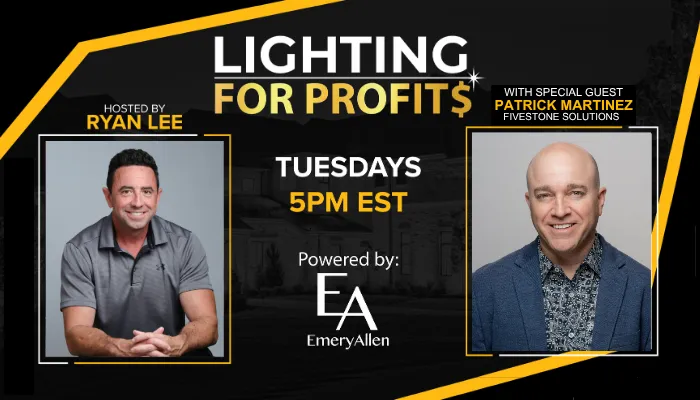
Patrick Martinez - Close More. Sell Better.
Lighting for Profits - Episode 259
In this episode, Patrick Martinez, Founder of Elite Sales Academy, shares practical sales strategies for luxury contractors. With over 30 years of experience in entrepreneurship, sales leadership, and business coaching, Patrick breaks down how contractors can increase revenue, improve closing ratios, and build scalable sales systems—all while creating exceptional client experiences.
Watch the episode
Episode Transcript
Introduction To The Podcast And Setting The Stage For Business Growth
Welcome to Lighting for Profits. All light, All light.. All light. Powered by EmeryAllen.
Here is your host, Ryan Lee.
All light. All light.
All light.
All light. Let's go. Welcome, welcome, welcome to the number one landscape lighting show in Thousand Oaks, California. I'm your host, Ryan Lee. Looking forward to hanging out, guys. If you're looking to start or grow a landscape lighting business, you're definitely in the right place. And I will say today, um, I've been going to like other industries because I know some of you guys don't want to hear this, but sometimes other industries are way more advanced than the outdoor lighting industry. And so it's been really, really cool because I've been able to tap into a completely new network and I've met some amazing people and I'm like, hey, help us, like, help us get to where you guys are. And so today's one of those days. So to technically, even if you're not looking to grow your outdoor lighting business, you could be looking to grow a lot of different types of businesses. But if you're an artist, you're going to want to listen to, uh, this episode because we're going to talk about how to help you grow your business. We've got Patrick Martinez, the founder of Five Stone Solutions. And, uh, we're going to be nerding out on some business. We're going to be talking about, um, some ways to really, uh, streamline your sales process and really use leverage in your business to help you grow. So it's not always by working harder, I can tell you that because I learned the hard way. I thought that was the definition of being an entrepreneur. Just outwork the next guy. Uh, but, um, that's not, um, not really the case. So looking forward to having Patrick Martinez with Five Stone Solutions on the show in just a couple minutes. And, um, before we have on, have him on just a couple things. Number one, we are about to start promoting the heck out of Light It Up Expo. We're going to have limited spots for vendors, actually limited number of tickets for attendees as well. So you're going to want to take advantage of that. Uh, but for now, just put it like, just mark it out on your calendar, pencil it in, light it up expo. com march one through four in Las Vegas. It's going to be an awesome show. We've got so many cool things planned and I just kind of want to plant that seed for you guys. Um, also, big shout out to Lights for Decorators, owner Jimmy Tompkins, his entire team. Um, you guys know what you Know, we're entering in the holiday lighting season. Uh, so there's gonna be a lot of Christmas light sales, a lot of permanent lighting. Uh, they're an incredible resource. Obviously have great products, but one of the things I like about them is they're always trying to help you grow your business. So we had Jimmy come speak to us at Secret Summit last week or two weeks ago now, I guess. But, um, just. He just knows his stuff. He just knows how to run a tight ship, knows how to run a business, and knows his numbers, which is really important. So, um, if you want to win in your market, go to lightsfordecorators. com, get in touch with him, get in touch with his team, and get on the latest training schedule. Um, and again, guys, in just a few minutes, we're gonna have Patrick Martinez, the founder of Five Stone Solutions, and really, um, looking forward to our conversation with him. I don't know why, but just the last few days, I was thinking about, um, the lighting industry.
The Crucial Difference Between Being A Lighting Artist And A Business Architect
And I was thinking, like, man, what. What separates those that are just, like, absolutely killing it, and then those that are still kind of struggling, those that still just haven't figured out how to get traction in their business. And, um, one thing that's kind of true in, in any, anybody's business in the outdoor lighting industry is most, you know, lighting business owners spend their time designing beautiful lighting systems. And it's honestly, it's one of the coolest things about our industry. It's like, um, I don't know how passionate I would be about selling roofs. I mean, I'm sure you can, like, tap into some passion somewhere. But, um, you know, like, lighting design is pretty cool. And like, being able to create something and transform a space, and then the way just to see and feel how the homeowners react to that, it's a pretty cool experience, right? And so I think a lot of us have felt that we. We know that, like, and so it's easy to kind of like, lean in to the design side and really, because we're able to, like, tap into that artistry. And, um, that's pretty unique. Like, you don't get that in a lot of industries. And so what I want to talk about is, like, the difference between the lighting artist and the business architect and really kind of like, when you need to tap into each one. Because in my opinion, there are businesses out there that are just so heavy on the lighting artistry that they never. They're not really ever getting traction in business. And sometimes they go out of business because they never put on the business architect hat. And, uh, and then there's other people that are, like, so heavy on the business architect side that they kind of forgot about the lighting artistry. So how. How do we blend those? How do we merge those? And, um. And which one do you need to focus on? At which phase? Right. And so, um, especially in this industry, most people got into it because their artistic talent, like, it's pretty special, like I said, compared to other industries, that you're able to, like, check that box and you're able to, like, exercise, um, the artistic side and your creativity, like, it's. It's really fun. Right. But you know, that artistic talent that got you into business won't necessarily keep you in business. Okay. And so, like, being the best lighting designer in the world doesn't automatically create the best business. And I see a lot of people falling in love with design, which, again, I can appreciate, but they spend so much time on that that they forget that they're actually running a business, not a charity. And the numbers, the expenses, everything piles up, and there's nothing to show at the end of the season. And you see this in pretty much every industry, not just outdoor lighting, but the market usually rewards the company that communicates its value best, not necessarily the company with the most technical or the most, uh, design skill. Right. And if I'm an artist, like, that's. That's super frustrating because it's like, do you know who I am? Like, do you know my creativity? Like, I'm so much better. But if you're not able to communicate that value, like, you're just going to get left behind. Okay.
Embracing The Emotional Connection In Landscape Lighting And The Pursuit Of Freedom
Um, and I don't know, there's just like this. This paradox between the two. And for whatever reason, I've always appreciated both. Like, I love the fact that I can go create something, and then, like, tonight the lights turn on and those customers are like, wow, like, this is the coolest experience I've ever had. Would you build a pool for us? I'm like, what, do you want me to build a pool for you? I just did your lighting. And they're like, well, because that's the coolest experience I've ever had. Right. So it's awesome. Um, for a couple reasons. One, because we're actually giving someone something that they want, not necessarily something they need, which is interesting. Um, people want to go on badass trips to Europe and spend $60,000 a day on a yacht. Like, they want to do that, and they feel good doing it. They. They don't necessarily want to go spend $60,000 on a roof. You know what I mean? They will because they need to. But, but lighting is like that. It's like we're giving someone something that they want. And it doesn't just end in a week like these cool vacations. Like, it continues to give back every single night for like the next 10 or 15 years. Right? So it's pretty dang cool what we're able to do. But I've always been drawn to the business side because I'm like, I didn't get into business to like, what did I see the other day? Um, someone said they left their nine to five so that they could work five to nine, right? Like, most of us get into business thinking, I want freedom. Like, I'm sick of working for this asshole boss. I'm sick of like doing all these things for someone else. I'll just do it for myself.
Designing Your Dream Business Using An Architect's Mindset For Growth And Success
And then I can go to my kids games and I can go on vacation when I want. And then all of a sudden, what happens? Like, we become trapped by the very thing that was supposed to give us the freedom. And so I want you to think about this in a different way. What if you could still use your artistic side, but not just into this lighting design phase? Like, what if you could, uh, use your artistic side to build your dream business? It's like an architect, okay? An architect is an artist. Like, they, they create different blueprints. And so an architect creates a blueprint that other people can follow. And when you're designing your business, not just designing lighting, you're doing the same thing. You're designing a business that other people can follow. And I've really thought about this a lot because what I'm doing now I think can be misconstrued a little bit. Um, people that know me well from in person events and friends and stuff like that, they know who I am. Like, you can't hide from who you are. Um, but online, social media, I'm not posting all the stuff. Like, if I have one cool thing that looks awesome, I've probably already tried 10 things that failed. I just didn't talk about those because that's not what you do with social media, right? And so some of the stuff I'm doing can get misconstrued. But it's like, just because I'm so passionate and focused on the business and helping you guys make money doesn't mean I'm anti design. In fact, the way I design events, the way I design experiences, is me exercising that creativity. And that artistic side of my brain, I just happen to believe that you can do both. If you're an artist, it doesn't mean you have to be a starving artist. Like, that just frustrates the crap out of me because there's so many talented people that are doing good work and no one knows about them. In fact, I went to, um. You know, I was in the industry. I. I started my lighting business in 2007, and I had heard about Illy, the international landscape Lighting Institute. I had heard about them, uh, but never gave. I mean, why would I go to some event that's thousands of dollars and it's going to take a week? I already know how to put lights in the ground. Like, why would I go to that? I never understood the value. So in 2019, I sold my business. I think I went to my first Illy in 2020 or 2021 because I wanted to. I wanted to see what was out there. You know, people were going to be coming and asking me, should I do, uh, should I do this, should I do that? I don't want to tell them, no, I didn't do it. I want to go experience it myself and then have a real opinion. So I go to this illy International Landscape Lighting Institute, and it was an incredible experience. I mean, after being in the industry over 12 years, I learned a ton about design. It changed the way I thought. It changed my perspective. And one of the first things I said to Jan Moyer, who started Elli, and to the president of Elli, Jesse, I said, you guys suck at marketing. I was like, oh, my gosh. You guys suck at marketing because you guys have an awesome product, you have an awesome experience, and no one even knows about it, Right?
Balancing Creativity With Business Acumen: Strategies For Scaling And Avoiding Stagnation
And that's what I mean is, like, you can do both. Like, you can be passionate and good at that, but, like, you need to get good at business if you want to stick around, if you want to scale. And these things matter. These conversations need to happen because people ask me all the time if they're getting new into business, like, what light should I use for this? Or whose product should I buy, or who should I hire for this? And when should I hire this person? And the answer always is the same. The answer is it depends. Because if you're gonna. If you're trying to grow a lighting business, that's heavy on the artistic side, and that means you don't trust people, because no one can design as good as you. No one can install as good as you. You're an artist. How could someone be as good as you? You're this unique artist. Well, then you're gonna grow your business differently than I grew mine, okay? Because I want to exercise that artist side. But it's not just in one field. It's not just in lighting design. It's in the design of the entire business. Okay? And again, if I'm going to be in business and I'm going to work 5 to 9, 5am to 9pm and later in the lighting industry, I better make a shit ton of money. And people feel guilty for making money. Like, why? This is how, this is when I talk about over deliver. Like, you know, over deliver on your client experience. You can't do that if you're not making any money. But if you're making a lot of money, you can afford to over deliver. You can afford to overpay your people, you can afford to recruit higher caliber. So instead of hiring B's and C's, you can hire an A player who's actually going to be disciplined, who's actually going to show up, who's actually going to put in the work and over deliver for your customer. That can only happen if you're a profitable business. Okay? So, um, I guess what I want to leave you with is just to encourage you. Like in my mind, you can have both. You can be a, an amazing artist, a great designer and a business professional and a, uh, business architect. Okay? And I think the ultimate outdoor lighting business does both. I don't think. You pick one. I do think that, you know, um, creative minds tend to, we tend to do the thing that's more natural for us or more comfortable for us. And so this is another way to kind of gauge like, hey, are you. If you're comfortable right now, you probably need to do something else, right? If you want growth, if you're happy and you're fine and you know, then great, like live your life. The way I look at it is like, I need redundancy. If I get hurt today, what's going to happen to my income? Uh, is someone else going to be replacing me? And most of the time, this is why the term starving artist exists. Because that person gets so infatuated on what they do, they're unwilling to hire other people because they're not as good as them. Um, and they don't share the same standards because they don't have a standard. Right. But if you will become a business architect and design your business accordingly, I promise you, you can do both.
Making Sacrifices For Scalability: Balancing Artistry With Business Architecture For Long-Term Success
Um, you're going to have to make some Sacrifices. What are you willing to say no to? Is going to come up a lot. And you're going to have to say no to some things. You might not be able to go and choose from 27 different suppliers to create that masterpiece. Uh, but maybe you can. Maybe you can do just one or two masterpieces a year. And everything else, trust me, is still way better than what most people are putting out. But you now have a scalable business. So just remember that your customers need your artistry. Like, that's fine. That's good, right? Uh, but your employees, your team members, they need your architecture. Um, you're going to have to figure out when to put on the different hat. And remember that your family, your circle, uh, they need both. They need you to do both. So, uh, make sure your designated time to be the artist and designated time to be the architecture. That's all I got for you guys. Uh, let's see. You guys want to know how to get more jobs whether you're an artist or not, one, uh, of the ways is to just differentiate yourself. So, uh, one of the easiest ways to do that is just use better product. Um, don't let a bad lamp ruin your client experience. Emory Allen. They make the premium LED lamps for lighting professionals that demand the best. So don't settle for less. Just reach out to them. Today, um, it was kind of funny. We were at Secret Summit, and I was introducing, uh, Tom and Jackson. They were there and they were like, oh, is that jackson l@emeryallen. com. um, if you guys want to reach out to them, do email Jackson. His last name is starts with L. So Jackson L@emeralen. com. but the cool thing is they do offer discounted contractor pricing. All you need to do is mention that you heard about them here on Lighting for Profits, and they will hook you up. So Again, it's Jackson. Lreallen. com.
Introduction of Patrick Martinez and His Extensive Experience in Specialty Contracting
all right, guys, did I say we got Patrick coming on the show? I say it's time, um, to get into it. So if you guys are ready, I'm ready. Unless I need a drink. Let's do it. Welcome, welcome, Mr. Patrick Martinez. What's up, Patrick?
What is going on? What is going on, man?
Thanks for coming on the show today. I appreciate it, man. Looking forward to, um, talking all things business with you.
Yeah, this will be fun. This will be super fun. I listen to the show a bunch, so this will be super cool. I like. I like the energy you bring to this and I like the intro. Um, I have comments on the intro, too. But I'll let you do your thing.
Dude, let's start there. I don't care. Well, before the comments, because I do, I do want that. I um, the reason I do that by the way, is because I believe that this show is so valuable because I can bring on so many different, uh, perspectives, you know, and we're gonna hear your perspective today. But I am kind of selfish and I'm like, I, I want to get my like, energy out. I'm like a dog that's got to go for a run in the morning and then, then we can focus on you. So yeah, after, after you introduce yourself, you can pick.
Yeah.
Think apart, give me ideas, uh, whatever. That's great because the rest of the show's about you.
Yeah, that's cool. That was cool. Um, yeah, so my name is Patrick. No, I'm with Five Stone Solutions. I've been in the specialty contracting space for over 30 years. So audio, video, lighting, shading, technology, networks, all that good stuff. And uh, we run a company, um, called fivestone Solutions. There's four of us here that work here and uh, we do one on one coaching, we do sales playbooks, we do how to help you find your next sales superstar. Um, but the, you know, the thing we're most excited about for your audience I think is our, is our weekly sales training program. We, uh, meet every Friday morning, Today's Friday, we had a session this morning and we meet every Friday morning talking about sales, sales strategy and all that good stuff for specialty contractors. So that's, that's kind of our, what we do around here all week.
Very cool. So what, uh, and how long has five Stone Solutions been around? How long have you had this business?
Yeah, about 12 years. Uh, full time for 12 years. Just been growing steadily. Um, and you know, been in, like I said, I was in the contracting space, high end construction, all that kind of stuff for decades and decades.
And were you an integrator? What type of business were you?
Yeah, I was a very, I was a full service integrator back in the day, before there was that was that common. Um, so I started my first integration company in 96, probably before some of your listeners were born. And then over the years, you know, grew that business, sold that business, merged with other businesses, did other roll ups, did all kinds of stuff. So did, uh, that. And then 12 years ago went full time consulting, uh, and coaching for specialty contractors and also manufacturing companies. So, so you mentioned like Emory Allen, like those types of companies are also about half our business is made up of like manufacturing companies. Then about half our business is made up of contractors of various types. So we nice. Our specialty is subject matter expert salespeople. So I've been turning nerds into salespeople for 30 years and I was my first customer. So that's what we do.
That's cool. Well, obviously you had a lot of like experience, you know, helping people, growing your business because you're hiring salespeople, training them, stuff like that.
Yeah.
What prompted you 12 years ago to go, you know, what make maybe, maybe there's something else here. We could actually start a company around education.
The Entrepreneurial Drive: Diversification, Building Businesses, And Reigniting Passion
Yeah, yeah. It was similar what you said. It's kind of a diversification thing. It started out like part time and then I was like, oh well this is kind of cool because I, I get, I get bored, you know, you might relate to that. So if I can have a part in building lots of businesses, it's more exciting to me than just building one business that I'm working on. So you know, I build my business but then I get to help others build their businesses and the building is what excites me. Um, the day to day running, not always so much. I think a lot of entrepreneurs can relate to that. But uh, the building is exciting. So that, and that's why I just kind of diversified into that and help, you know, help these other companies.
That's cool. Yeah. I felt like I'm always chasing my next like adrenaline hit. And so I remember when I first, I sold my first like $10,000 job and then the first 20,000 and the 50,000 and those were like amazing moments. I thought oh my gosh, this is going to change my life. And uh, now like I tell people, I'm like, I could go knock doors and sell like two ten thousand dollar jobs right now in the next like five hours and it just would do nothing. It's just like I need to, I need a heavier drug. The heavier drug is someone new comes in, they follow my script and they have a call me and they go, dude, I just closed this eight thousand dollar deal. They gave me four thousand dollars. I'm like, let's go. It's like the best thing ever.
Exactly. I had one of those on a uh, one on one call this week. It's. He had sold his first design package, you know, before doing all the work. I know, we'll talk about that later. But he had sold his first design package where he got paid to do the design before he did it, before he lifted the pencil. And that's how he started his one on one call, he was so stoked about that.
That's sweet.
Mindset change, you know.
So, yeah, um, well talk, let's talk about the, the real quick.
Uh, yeah.
What are your thoughts on the lighting artist versus the business architect?
Yeah, I love it. I think that's a really good point and I think it, it taps into this broader thing of the visionary versus the integrator, which is part of the EOS business model. Not to get too nerdy but you know, you have some, some people who are natural visionary artists who are then for the, the excitement of the thing and then you have like the blocking and tackling integrator business folks. And um, in smaller businesses it's hard to have both at yin and yang. But as, as soon as your business grows big enough where you can get some support, it's really critical to kind of support. If you're the visionary artist, you got to get some people to do the blocking and tackling that you don't want to do so that you stay in business. Um, but until you get to that point, what you said is 100 true is just you got to like adapt and be able to do both sides good enough until you can grow enough. And then if you're hard business, hard numbers, and you don't have that creativity or passion for the business, it's hard to make sales and make money because you people don't, you know, people don't buy from companies, people buy from people. And if you're not super passionate about landscape lighting or you know, permanent lighting or all the different things that you guys do, it's hard to make those sales. So, so I think the yin and yang is really, is really critical and, and the other thing I encourage all my contractors I work with is don't forget why you got into this business. So many guys get into the business and like you, your, your monologue about like the grind and working five, nine, all that, like, it's so true. And they fast forward 10 years, they got eight guys working for them. Um, they got four trucks, they got a mortgage like, and they forget why they got in the business because they haven't been to a finished project in a year. They haven't been to a trade show to see anything fun and exciting in three years. They haven't walked the client through the final install in too long because there's somebody else doing that and they lose that kind of passion and excitement. So I just encourage you guys get out, you know, and remember why you did this. Go look at big Gnarly projects. Go experience what it is you do so you don't forget. And get your office folks out too. You know, you can't just lock people in office and not let them see what you guys do. Everybody needs to be passionate about, about what you guys are working on.
Yeah, well said.
Bridging The Gap: From Visionary Artist To Business Integrator For Sustainable Growth
Um, what, what would you say to someone who's, I feel like the most, most of the people. Not everybody, of course, but most of the people that are listening are kind of that like visionary artist. They, they're probably listening, going, like, okay, I know I'm supposed to do that, but like, how, you know, like, I know I'm supposed to hire an integrator. I need someone to help me build these systems because, yeah, they're not, they're not going to do that. Like, it's just like you're asking, you know, them to do something that's not really possible in their mind. How do you do that? Like, how do you get to that spot where you go, okay, I'm not just an operator anymore. I'm a business owner and I'm putting these people in these seats.
Yeah, well, one of it's part of, it's money. Like you're gonna have some money. Not a lot, but it's some money in a process to get more money. Um, the other thing is I really encourage people like your program super great. Like, get into a program of some sort, get a coach of some sort, get a mentor of some sort. Like, get some other people that are kind of dripping into your life on a regular. Not, um, just. You can't just go to like an annual conference and get all rah, rah, rah and expect to deliver for the next 364 days. Work that way. So, um, you got to get things, you know, where you're getting regularly dripped on, like your program. You know, our program meets weekly. We have a weekly scorecard that salespeople have to fill out before they come to the session. You know, there's like some accountability is really key and just regular touches on that stuff. And then through that you'll start to figure out your plan of what's next. Because you'll have. These people are going to have you read books, these groups are going to have you do things. And like, that starts to help formulate what your next, what your next steps are.
Yeah, very cool. Yeah, it falls in line with like, we, we just finished our, um, our secret summit. It's our members only thing. And this year we did, um, the theme was intentional success, and it was it was like, you know, you and I, we see like behind the scenes of all these companies. And I just realized I'm like, man, no one's actually like, I say, like, I want to fly private jet. I want to fly on a private jet. Like, not really because I've never really put the plan in place to do that. Right. It's just cool to like fantasize about it or whatever. And there's, there's no successful business person out there that just got lucky. It's just like they woke up and they had this business that runs without them and everything else. And it really is just like getting intentional. And then how bad do you really want it? Because some people like me saying I want to fly private. Like, it's cool to say, but like, it's just, it's just not going to happen until I like actually put the plan in place and reverse it down here for sure.
A, uh, big part of our program is just goal setting. Like we, we do like annual, we do a big annual goal setting session or two sessions actually. It's pretty fun. Remember, that'll be coming up in a couple of months here because we're getting into it, but, um, you know, kind of setting those goals. But then you can't just set the goals and like, let them run. Like, you have to check in, you have to hold yourself accountable, you have to score things. And so we, we do these regular check ins on reflecting on your day and your goals and all that stuff. And you. But you're right, it has to be intentional. I love the title of that. It's just so great because you do. You're not gonna accidentally, you're not gonna accidentally get successful. You're not gonna accidentally get in shape. Um, you know, you're not gonna accidentally get rich. You're not gonna accidentally get rich.
This sucks. This podcast sucks.
Exactly. Exactly. Exactly. Yeah. Yeah. It's gotta be said, it's got to be that gazelle intensity, right? Like either gonna get in shape or get rich or get your business tidy. Um, while also, here's the really hard part too, while also not losing that passion because you don't want the business to just be a bunch of checkboxes and goals. Like, you guys are in a very creative business and we need to be still fostering that creativity.
Yeah. Yeah. I think that that passion for, for these guys is easy because they're just like so addicted to it. It's just natural. Like, you know, I've got friends that are like, it's natural for them to like, love working out. I still freaking hate working out. I hate it makes me like literally nauseous. And so I'm like, I love.
I wish I had. I wish. I love.
Yeah. So they're, they're wired to be passionate, which is cool. Um, they're definitely not wired to do the other stuff.
Systems Over Passion: The Power of Accountability and Structure in Achieving Fitness and Business Goals
Yeah. And for, so for me, I, I'm bummed that I don't naturally love to work out. So in place of that, and this is where it kind of corresponds with what you were talking about in the monologue. In place of that, I have a system. So I have a checklist of how, how many times a week I'm supposed to lift weights, how many times a week I'm supposed to do cardio. Um, I have like, I have some hand issues, so I have like a list of times I'm supposed to do my stupid, my stupid hand exercises, you know, and I have like my metrics that I hit for the week that I track in my little tracker. And in place of that passion, I have the accountability of that, and that's what helps me, like, get it done. So.
Very cool. Yeah, that's awesome. Well, you just mentioned that you got a New Orleans. One of your members just came to you with his first like, win for design or getting paid for design work. Ah, we should talk about that. Because when I first came, when I sold my lighting business in 19, I started getting active on social media, all that. And then I see in a lot of the outdoor lighting groups, people are like, hey, um, do you charge for quotes? Do you charge for designs? Do you do all this? And I'm like, well, like, I think one, we gotta understand what the definition of a design is.
Mhm.
Because like, I was going to someone's house and within 30 minutes telling them like, hey, we could do like 30 lights and it's 12 grand. To me, that didn't feel like a design, it felt like a quote. I'm like, didn't charge for that because I just told them that and they gave me a deposit. But, uh, to me, a design is like putting a design together. I mean, we're talking like light fixture placement, what types, the wiring diagram, the voltage drop, all the stuff. Um, but talk a little bit about that because I do think there is a need for it.
Charging For Design Services: Crafting Value and Intellectual Property in Landscape Lighting Projects
Uh, but what are the deliverables? And walk us through your process on that.
Yeah, good question. So we try to get you to charge for design services as often as possible. We don't necessarily want to create a bunch of friction in the buying process. So if somebody calls you for a quote, it's like, hey, um, I need to just like, like you said, like 12 lights, or we call them in the indoor space, like four cans and a fan. Right. There's not a lot of design work there. So, uh, but you know, we're looking at, like, more complex projects like you're talking about. And what we're trying to do is get to a point where about half of the value of the design service is deliverables and about half of it is your intellectual property. So everybody who's in this space or these specialty contracting spaces, you have decades of information in your brain that has value, and so it needs to be positioned as such that you're not going to just tell them all what to do so they can go get it all from someone else. Right. And so, um, what we're trying to talk about, you know, for your space, deliverables, like you said, plans, load schedules, some light electrical engineering. Right. Like to make sure we're going to have enough, you know, there's not too much voltage drop and all that stuff. But really the layout of where things are going and the types of fixtures. And if I'm going to come out to your house and rope up some stuff, uh, so you can keep it over the weekend and take a look at it, like, all of that kind of stuff should be part of your design services package if you're in landscape lighting space. And so, you know, I work with a lot of integrators, I work with a lot of interior lighting designers and shade contractors and all any kind of specialty contractor. They all have a certain element of design. So gotta look at what your deliverable package could be and then not forget that the real value is in your intellectual property and you shepherding them through the process to help them figure out what it is that they really need and want and what's possible and what's possible.
Yep, I like that. So how would you approach it? Um, someone. Someone just calls in, a homeowner calls, uh, my lighting company today. Am I charging to go out on that first visit or I'm going out there to like, introduce this whole concept?
The Art of the Discovery Visit: Pre-Qualifying Clients and Securing Design Fees
Yeah, yeah. So it's great, great, great point. Here's the thing. The, the chat and this is the challenge. You know, this is, this is the Challenging Podcast. Go change the name of it to, uh, the Challenging Podcast. Um, anything you say after. Hi, my name is Ryan. This is how we work diminishes the value of the design service offering. And if they get you out to the house and you're a problem solver. You want to prove how smart you are. You want to show them all the cool stuff, and you start talking and offering ideas and you start solving. You don't realize it, but you start solving problems, right? Then it gets harder and harder to sell that design service because you have. You're already giving away the milk. So, yeah, uh, in an ideal world, yes, you would pre qualify it into being more than just a quick holiday project, you know, some kind of small project. Um, you know, you'd pre qualify a deal on the phone and then you'd explain how your design service works, and then you get some sort of verbal, verbal affirmation. Some of my clients take a credit card over the phone and then you're off to the races, mostly want some sort of verbal confirmation. And then you'll go out and see them and you'll have like, you know, your design contract or your single page or whatever it is kind of pre filled out so that you can get it approved. But really the purpose of that visit is not a discovery visit like it used to be. It's a get my paper sign, get money visit. And that's what the mindset changes for a lot of people. That, it's really hard that mindset change because we want to solve problems. And this is why for a lot of my clients, the big shift happens when the non technical people start selling design services. We don't let anybody who knows anything go out to the house until we have a contract and a check. So you build that physical barrier where you have somebody who's excited about the technology, who works for your company that knows kind of, oh, we could do this. Oh, that's kind of cool. Or whatever. But really what you want to do is you want to talk to Ryan. And before you can talk to Ryan, you got to sign my paper and give me some money.
Moving Beyond Line-Item Pricing: Embracing Expertise and Strategic Pricing Models
And so that's kind of like the big picture model that we're trying to get to.
Yeah. Yeah, I could see that. That's cool. It makes sense. I mean, I've. I'm guilty of the like, oh, I'm just doing discovery and I'm like, oh, I just gave you all of our stuff because I like to help people. That makes sense.
Yeah.
What would I pay for? I'm like, I don't know what you would pay for. I think I just gave you most of it.
Yeah, uh, exactly, exactly. The other thing that's kind of a kissing cousin to that is getting our clients away from Line item pricing. A lot of our clients are still in the line item pricing game. So, you know, we try to get you in professional. We're trying to take you from a technician doing a technical sale to a professional sale, which is you're getting paid for your expertise. You're providing a proposal and a design with drawings and support. Support. You're not giving them a shopping list and you're not answering all their questions for free.
Okay, very cool. So how do you guide someone, um, to come up with their first price for a design, uh, with drawings and all that stuff? Is it based on hourly, Is it a package? Like, how are they? How are they? Because I've had people ask me that. They're like, well, like, yeah, uh, even if I know my hourly, like, I don't know how long it will take until I like, get to know them and everything else.
Right, exactly. It's. That is a tricky question. So I'm gonna, I'm gonna not answer your question and then I'll try to answer your question. The non answer to your question is that it doesn't matter because anything $1 or more is $1 or more than you would have gotten yesterday when I didn't do this. So.
So you see, you just at least need like a commitment to go out there.
It's giving a commitment. It's, it's removing the tire kickers from the process. It's creating a little bit of, of a gateway for them to get through to be really committed to you and then it helps you get paid. But it. I don't a lot. Again, a lot of our people are engineers, right? They hyper focus on how much should I charge. And I just try to tell them right off the bat it doesn't matter. And then once you realize it doesn't matter. Now let's try to come up with a pricing model that makes sense. Sometimes it's based on square footage. It might be based on number of loads. It might be based on areas that you want to light. It might be based on how long you think it's going to take. Like, all of that stuff becomes much less important when you realize you're still at least $1 ahead than you were yesterday.
I love it. Yeah, I mean, that's a better way of phrasing what I, I think I told someone. I was like, if, if you don't know, you don't know. So like, let's, uh, just say you charge 500 bucks and you get out there and you're like, damn, I should have charged $2,500. Well, now you know, for next time. But at least you made the 500 bucks because you weren't going to get that before.
That's a great point, is it doesn't have to be permanent. This is not. You're not setting some stone tablet with your pricing model in it. And a lot of guys get. Again, we work with subject, ah, matter experts, engineer nerds, all this stuff. Like that's, that's who I am. That's who we are. You know, I was on a track to become, uh, a structural engineer before I found out that this is funner. So the, you know, knowing that the numbers don't matter and then it's not permanent. Permanent is really key to just kind of loosen up the grip on things and just try to see what, what's going to work for your company.
I know, I don't know where that, like somewhere that gets implanted into people's mind. Like, and for some reason my mind never got that same like, commandment because I'm like, you just raise your price and then if you need to lower it, like right now, then you can. You know what I mean? Like, there's no one, like, there's no principal watching over you. Like, you own your business. You actually create all the rules.
My business doesn't have any rules at all.
I just make them up as I go.
Yeah, I'm not surprised by that. Yeah.
Workshop Announcement and Pricing Strategies: Simple Jobs Fast, Complex Jobs Paid
Yeah. So it's uh, just giving it a try and trying something new is really key. And knowing that we have clients that are charging, you know, you said 500 or 2500. We have clients charging 5, 10, 20, 50, $50,000 for design work. Nobody's dying and they're just getting paid. So just keep in mind that, uh, nobody's gonna die from this stuff. Just give it a shot and see what you come up with. And having, you know, but having the tools. So on that note on the tools, I'll give you a little plug if that's okay. Um, we're doing actually a workshop on this whole topic in, in at the end of September, September 30th. So, um, we're gonna do a three hour block, sit down with a group of people. People. And you're going to build your entire process. If you've never done design sales or you've done a little bit, or you've done some of what I call the halfway, where you like charge a little deposit and then you give the money back or all we're going to fix all that stuff in this Three hour workshop coming up in a week and a half.
That's, it's very cool. And I think we're going to do um, uh, we're going to do ah, an offer for listeners. Is that, is that right? We'll do an offer.
Yeah, yeah, that's right. We're gonna do um. So the workshop is 500 bucks for three hours. Um, 500 bucks covers three people from your company. If you need more than three people, we have a discount to add more people. And then for listeners of this show, we have a coupon code if you will, called 100 off. And uh, that'll work to get you 100 bucks off the workshop. So the workshop be 400 for you and three or for three people from your company.
Okay, sweet. So we'll put a link, we'll uh, put a link in the show notes.
Yeah, we have a link. Little kind of like webpage. It talks about everything we're going to cover in the workshop and then you'll be able to put that code in 100 bucks off.
Okay, awesome. Yeah. And the promo code is 100 like the number 100 off.
Yes.
Well, very cool. So um, I want to ask you on that though, like have you found that um, when people say okay fine, I believe you, I went to the workshop, I'm doing this, is it all in or all out or does it depend on it? Like you said like the pre qualification and be like, oh, this is just like a six thousand dollar job. They're clearly not a design fee person or is there a way to still do the design fee without losing that opportunity?
Great point. Yeah. So pre qualification is really key part of that pre qualification is how they found you and if they can be trusted.
Right, okay, cool.
If they have found you through some Google search and they're searching everybody and talking to everybody, you can't really trust them. You don't really know them. If they're referred to you by like your architect or your you know, landscape. Landscape architect. I don't know who all the cois for you guys are but like landscape architects or whatever, then you kind of have a little bit more of a confidence in the project. So you may be able to either skip the design services altogether or give them some sort of discount or tell them what you're doing or whatever. Um, but it kind of depends a lot through that pre qualification and then there's some projects that you just need to go get done. You know we used to call them, and when I was younger we used to call them the quote and do. Like, we're just going to give you a number. We're just going to get it done. Quote and do. And so those are not really those design projects that the. The model is. If it's something that is simple and fast, we. We want you to be as fast as possible, which means I want you to quote the job as fast as possible. I want you to be able to start the job as fast as possible and get lights in the ground like you guys say, which I love that phrase. So if it's complex or involved, I want you to get paid. And that's, uh, one of the big differentiators there. So many times I see guys do. Either way, it's complicated, and they do it all for free. It's super simple. And they wait two weeks to get the client a number or the prospect a number.
I've seen both, too. Yeah.
Yeah. So if it's simple, do it fast. If it's complicated, get paid for your work.
Lead Attribution and Understanding Your Sales Process: The Importance of Context
I like that. That's good. Yeah. People should write that down, because I think that's why, like, I feel like I've flipped depending on the week on how I feel about this topic. And I think it's because it depends on who I've talked to. And I'm like, yeah, uh, you just spent 80 hours and you didn't even get the job. Like, what? Yeah, no, that. No, don't ever charge for design because you. Whatever, you know, it's like, I don't know. So, um, I think that's interesting. So, um, what about, um. Uh, what was I going to ask on that? Oh, I guess what I was going to say, that's why I love geeking out on business with you. Um, anytime someone gets a job or they're like, yeah, I've got this opportunity coming up, I owe literally, like, probably 90% of the time, like, oh, what was the lead source? And because it matters, you know, what and what. And they're like, uh, I don't know. I'm like, no, you. You have to know, because we don't live in a vacuum. Like, every sales present, even though your process could be the same, the actual script, the actual, like, wording and. And like, choreography is going to be a little bit different based on who they are. And like, you said, like, if. If they trust you, you trust them.
Yeah, I. The term we use is lead attribution. So where did this lead come from? Huh? Where can you attribute this lead? And every salesperson that I work with, they get. It gets beat into Their brain that the very first thing they're going to start to go down that road is where did this thing come from? And we don't really accept like the Internet. So if somebody says oh, I found you on the Internet or I found you on Google. Our, our salespeople that we coach are required to continue asking questions. Was this actually on Google? Was it chat GPT? Was it some other thing? Did you see us, any of our reviews? Did you like, how did you, what were you searching for?
What'd you type in?
Yeah, yeah, what did you type in? Like trying to get a little more information on uh, what that actual attribution is because you'd be so surprised when you see people. Where'd you find us?
Closing Ratios and Design Fees: Understanding the Impact on Sales Performance
Oh, the Internet. Okay, cool. Was it like a Google search or was it like an AI search or what was it? Oh, actually uh, my contractor told you to call. Told me to call you.
M. What?
We're just so default to say Internet because probably what they did, the contractor told him to call and they went and googled you and did some research and then that's what's locked into their brain. But they're. The reality was the contractor told him to call.
Man, I could go on like a three hour tangent right now about marketing and sales. I'm not going to do it, I'm not going to do it. Stay focused. I can do hard things. So what about um, okay, so we, we charge for the design or we don't, whatever, you know, we pre qualified. Uh, when we get out there, I see people on both sides of the spectrum talking about closing rates, um, landscape, lighting. Let's say an average ticket is 10 to 15k. Should I be bragging to my buddies that I'm at 90% or should I be bragging to my buddies that I'm at 50 or bragging that I'm at 30?
Yeah, super great, super great question. Statistically, if you do not charge for design services in the specialty contractor space, so that covers a lot of um, areas, right. You're gonna get, you're gonna, you're gonna close about 35 to 30, 35% of what you price. So if you price 100k this month, you're gonna get like 35k. If you don't charge for design services, if you do charge for design services of uh, the stuff you actually price, that closing ratio goes up to 80 to 90%.
Wow.
Because you're only pricing the stuff that people are invested in. They're serious and they want to be a partner and they Want to participate in the process. So that's my first answer. If you're not charging for design services and you're closing more than 50%, so you said like 50 or 90, then you're not charging enough money because you should be losing some of that work to get closer to that statistic. So a high close ratio is not always a quote, unquote good thing.
I love this conversation because even just what you like inserted there, this is why like every question that someone asked me now I'm like, ah, uh, it depends because it truly does. Did you charge for design service or not?
Navigating Business Advice: The Importance of Context, Tiers, and Mentorship
Like if you are, then yeah, you're going to expect a higher close rate and what is your pricing and did you pre qualify? Like some people don't pre qualify and their closing rates lower. Um, some people pre qualify heavy, heavy, heavy and they're going to be higher. So yeah, I just, I want people to think differently. A lot of people just go to Facebook groups now and like, oh, I have a question, I'm not going to think about what my real question is and like just going to like ask like what should I charge? I'm like, well it depends, you know, like uh, we need more um, information to help you. And the problem is people don't ask those good follow up questions. So then they get advice and 90% of it is bad advice based on someone who's not running their same business
model, not running the same business model, not in the same market, not doing the same type level of work. You know we talked about this morning on the fact that like, you know, we have this macro niche of um, you know, high end residential clients, right? That's my target audience is high end residential clients. I want more of those. How do I get more high? But you got to realize that within that high end residential clients there's like four tiers of people. Some are coming to you with a bunch of problems and a bunch of broken crap. Some are trying to just do like some basic troubleshooting and fixing. And then the top tier, the top two are like planning and building and really doing something great. And so you know, within that hierarchy you might be really good at the break, fix, tune up stuff. You might be really great at the high end planning. But knowing where in the four tiers you need to be focused your efforts, that's really key. It's not just high end homeowners. So when I hear people like offer that type of advice or when I hear like people go, oh, I went to chat GPT and I asked this question, it's like, yeah, but you need the context and the context. Where do you want to be? So that's where, like when you were talking about the beginning, that's where like a good coach or a good mentor matters because they can ask those contextual questions and they get to know you so they know like, what you're looking for. Like, when I'm in my group with our, with our Friday members and somebody asked a question, I'll be like, yeah, here's how I would answer this question for everybody, Bob, but for you, this is this. And that's what, you know, that's what's really key about having people to kind of pour into you and your business.
That's huge, man. That's huge. Um, okay, so we're gonna do. We're gonna pause real quick.
Introducing 'You Make The Call' Segment and Call Source Partnership for Outbound Sales
I forgot to tell you this, but we're gonna. We started this new segment called you make the call. I'm just gonna ask you if it's just a few questions.
No pressure. Yeah.
Everyone's going to judge you and.
Okay, perfect. Awesome.
Decide. This is, this is how they're going to decide the fate of the rest of your life and your success.
Leave my day. It's my first this day.
Yeah. Yeah. So this is, uh, like I said, it's called you make the call. We brought on a new partner called call Source. And these guys are awesome. They have an outbound call center. So we found a lot of people are going out. They're small, they don't have time to follow up. Even if they have an admin, their admin's not following up. So. So they'll literally like install a dedicated person to do all the follow ups for you. All outbound stuff? No, inbound, because most people are already answering their phone, but this is all outbound stuff. So, um, if you guys want to try Call Source, they have a link called try.callsource. com LFP relighting for profits. Try callsource. com LFP and they're going to hook you up with 50% off your first month just to try them out. So.
Cool.
Ah.
Rapid Fire Questions: Dream Vacations, Coffee vs. Dessert, Reading Habits, and Financial Goals
So we're gonna play along. You ready to play along?
Oh, yeah, let's do it.
Okay. Um, we're gonna start out easy. Dream vacation. Mountain, uh, cabin or beach house roll?
Beach house. That's a quick one. We do, like, the mountains, too. We do mountains. I mean, I'm in Southern California, so we got it all the same as, you know. Well, you're gonna have a lot of beaches, but
Lake Beaches.
Lake beaches. Yeah, yeah, yeah, yeah, yeah. But, uh, so where. What about.
Where would you. Where would your favorite beach vacation be?
Um, our local spot is. We have, like, a. I'm just near Malibu, so we have Zuma, and then we go up to, like, Ventura, Santa Barbara. So that kind of Gold coast right there is our. Is our hot spot. Beaches. So that's where we like to go.
Okay, very cool.
And then mountains for us is kind of outside the sequoias in the Central California area. There's some good mountain spots out there.
Okay, sweet.
We're a little spoiled here. Yeah.
Give up coffee forever or give up dessert forever?
Um, that's a real easy one because I don't drink coffee, and I'm addicted to refined sugar, so that's an easy one. I give up coffee forever.
Yeah, duh. Ah. Uh, what's your favorite dessert?
I, uh, I like chocolate of any sort. Um, but I also like gelatos and ice cream. So, like, you know, chocolate gelato is probably going to be the pinnacle or chocolate and ice cream meat. So.
All right, very cool. Um, all right. Uh, you read or listen to books?
I am a reader, and not only that, I'm a taver. So I have, like. I'll put, like, hundreds of tabs and books that I'm reading, and I have a whole system, and I'm kind of a nut job, but, yeah, definitely paper book guy.
And will you go back and reference those tabs? Or they're just there.
Yeah. So here, a little insight into my, uh, OCD neuroses. Yeah. Because I can go back and I can kind of essentially read a book from tab to tab and just get to the stuff that I really cared about at the time and kind of be reminded of what we were doing. So.
Okay, very cool. See, this is why we do this. Like you, I learned all sorts of crazy stuff that I had no idea I was gonna learn that today.
Sales Skill Focus: Asking Better Questions, Handling Objections, and CRM Compliance
Yeah. No, this is cool. This is cool. I love it.
Um, all right, so, um, you can make an extra 500k per year, but you have to work an extra 25 hours per week or just stay where you're at.
How long do I have to work that? 25. 25 hours. Oh, uh, that's a tough one.
You got to do it 25 hours per week for 12 months.
Yeah, yeah, yeah. I'd probably do the 25 hour. I'm an addict. Although I don't know where I would put the 25 hours, so. But yeah, I like working. I like. I like the thrill of the thing. So, yeah, I'm probably in on the 25 hours.
I know. See, that's my problem, is I'm addicted to business. So it's like, oh, you just need me to go work on my business.
Yeah.
And then what?
Oh, and then you're gonna pay me more money. Sounds great.
Working out, eating better. Yeah. There's some other difficulties.
Yeah.
All right. You, uh, are a sales trainer. You can only train one. One skill the rest of your career. Asking better questions or handling objections.
Uh, asking better questions, I think, is. Especially in the technical space, is an area that's really overlooked. We, as. As technical people, we have a tendency to show up and throw up, and we know all the answers, and we think we're the smartest guy in the room. And so a lot of times, uh, we struggle in that area. So asking better questions is where it's at.
Very cool. Actually, we just did this exercise. We did an improv, um, to start off our secret, um, summit. And we got mixed reviews. Some people were like, I hate that. Which is to be expected. A bunch of introverts in a room. Um, but, uh, we talked about, uh, asking better questions. And what we. The exercise we did was like, I would ask you a question, and then whatever you say, I have to repeat it back before I say the next thing. And it was. It's very difficult to do because, like you said, we show up and throw up. I'm just thinking about. Instead of like, oh, what Patrick just said, I'm thinking about what I want to say because I'm the expert. And then you wonder why you suck at cells.
Yeah. So we do a great, uh, we do a variation on that where you have to say just the last word. So they have to wait until the last word, repeat the last word, and then. And then they get to ask a question. Another improv skit we'll do is called questions only. So we'll have contest where you have two salespeople going at it, and they're only allowed to respond in questions, and then somebody inevitably will make a statement, and then they're out. And then another salesperson jumps in, and you kind of do round robin like that. And that works. As a technical salesperson, that really works your brain hard because.
Yeah.
Uh, we're so used to making statements and, you know, technical statements at that. So.
All right. Your best salesperson refuses to use the CRM. I know this has never happened, but keeps producing. Enforce the standard or make an exception.
Uh, oh, man. That is okay. I. In. This happens Every single day. Uh, what I do in this situation is I set a target revenue goal where I can hire them an assistant. So they have to use a CRM until they make enough money to hire an assistant, and then they can have an assistant to put the CRM data.
That's cool.
So, but it's got, you know, it's a target that they have to hit, and. And then they can. And then they're off the hook. Until then, they got to listen to me at them every week. So.
Okay, last, uh, one. Build the company quickly and accept some chaos or grow more slowly with strong systems.
Yeah, I'm naturally a systems guy, but I realize that's not always the way to go, so I support chaos in my client companies. In my own company, I'm a little harder to support. Chaos. Yeah.
Yeah. Okay, cool.
Mastering Client Interactions: Building Authority Through Questions and Understanding Emotional Connections
Well, thanks, uh, for playing, and, uh, yeah, that's kind of fun. Uh, new segment just to get our. Get to know our guests on a different way. So.
Yeah.
Thank you, Cold Source. Appreciate you guys.
Yeah, it's awesome.
Um, all right, so we got just a little bit more time I want to wrap up because there's a couple more things I wanted to ask you specifically about, like, the sales process and stuff like that.
Yeah.
Um, there's no secret. I've told people this before. I'm doing this show to gain more intelligence myself. I'm like, why am I taking the most notes on my own show? You guys, come on. I hope somebody else is paying attention here. Um, really good stuff so far. Thank you so much.
Yeah.
Um, okay, so this is what can happen, especially in landscape lighting. Um, you know, these are successful people that are buying lights. They're, uh, attorneys, CEOs, business owners. Um, they're affluent. So how does one establish authority with one of these, like, affluent customers without sounding arrogant?
Yeah. So it's back to, uh, what we were just talking about, about asking good questions. If you ask. So we have question buckets. We talk about figurative question bucket. There might be some rapport questions. There might be some qualifying questions. There might be some technical questions. And good salespeople go into those different buckets and pull questions out. And if you ask good, thoughtful questions and you take notes on a pen with a pen and paper as they're talking, then you immediately gain their trust. And I say the pen and paper thing, um, in the old days, wasn't a big deal, but now with all these AI note takers and stuff, I am a strong advocate for still taking notes with pen and paper. You can have The AI note taker writing shotgun.
Sure.
And you're not. You might not even be taking notes for you, you're taking notes for them. And the analogy I give everybody every time is what happens when you have a waiter that comes and takes your order, ordered a restaurant and doesn't write it down.
It pisses me off.
Do you feel great about that? Are you impressed? No, no.
Because I already, I like, I know there's a good chance that they're going to forget that I said no sour cream.
Exactly. Mine is no onion, so. Thank you.
I'm gonna get, I'm gonna get sour cream. You're gonna get onions. And I'm like, dude, I would have been fine with onions. Like, why did I get no onions?
Yeah, I'm not impressed.
I.
Because here's the thing. For the waiter, the minimum acceptable standard is my order 100% correct.
Right.
That's what matters.
That's the minimum. Yeah.
Yeah. So I, so I want you guys taking notes, I want you writing pen and paper, I want you asking thoughtful questions. We have a whole, like, we call it meeting 101, which is like all this stuff that we take you through on how to run an effective discovery meeting. And that's, you know, that's the way you get, you gain authority is through good questions. Because your questions will reveal how smart you are. You don't have to tell anybody how smart you are. Your questions will reveal how smart you are.
Oh, wow, that's so good. Um, I mean, I know you got a whole program around this, so I don't even know where you would start, but could you throw out one or two questions that you think are effective that most salespeople tend to overlook? Maybe?
Yeah, sure. Good. Open ended questions. Um, I like a lot about when I'm dealing with luxury homeowners, a lot about how. Tell me how you use this space. Tell me what your thoughts are for this. Tell me what you've seen here. Tell me what you've heard about that. Um, you know, so open ended, but getting them to open up and share their emotional connection. Again, people don't buy from companies, people buy from people. And most of what we do in the specialty contractor space is luxury and most of it is emotion. Like there's a lot of emotional connection to this stuff. So I want to get them talking about this. Tell me, explain to me your vision for this area or are you guys going to do any expansion over here? Or I see this yard isn't as developed here.
The Addictive Nature of Landscape Lighting Design and Presenting Solutions With Options
Do you have a plan for this Are you like, you know, just getting them opened up, you know, getting them to explore that kind of stuff?
That's cool. And it's so true. Like, it's awesome because you're talking about like what we do. Even though have you ever sold, um, or designed or installed landscape lighting at my own house.
That's it. Yeah. And I just, actually just bought eight more lights because I was like, oh, I can do something over here now. So, you know, it's kind of addict. I mean, as your listeners know, it's a little bit addicting because you can start doing really cool stuff. And I haven't even introduced any color yet. And that's another thing where I'm thinking about like, oh, that would be probably the next step is a little bit of color.
All right, cool. It is addictive. I mean, that's why it's like if you can just get your foot in the door, even if it's like phase one of the front yard, you're going to get the whole project if you can over deliver and be the business architect and all these other things. Right. So, yeah, now it's so good. Um, I guess, um, I still. You still got a couple more minutes?
Yeah, I'm good, I'm good.
Okay. Because I got a couple more things.
3 hour job. I have a 3 hour drive to my son's football game facing me in the square in the face.
So dang. Three hours.
Yeah, we got a job. We got a game on the other side of Los Angeles. And anytime you have to try to get through Los Angeles on a Friday afternoon is never.
Oh. So it's probably like. Yeah, 20 miles away. That makes sense.
I think it's 80 miles away, but yeah, forgot LA.
Yeah. Um, talk to, talk to us about the, your approach on the clothes. Um, um, you know, I, I realize it's landscape lighting. It's different than what, you know, you do, but in, in a way, like it's like you said, it's high end homeowners. Is it multiple options? Is it just the best solution that the person thinks because they're the expert. Like, how do you go about that?
So good. Such a good question. First of all, are you charging for design services? Right. Did you charge for design services? Um, if you did or did not, it doesn't really change my answer. But I just want to bring that to your point. That's part of the deal. Um, uh, we like to do budget pricing, not line item pricing. And we have what we call the benefit budget builder, which is three benefits. Um, of this thing. We're going to do two features, like, real specific features. You might even mention a brand name in there. You get. Might mention some numbers, like, really technical, um, and then one price. So, you know, if you're doing some pool lighting, you know, benefits might be, you know, show off the architecture of the pool at night or whatever. And then some feature might be like 23 in ground lights and made by so and so or whatever. And then one price. So benefits, features, price. So that's that. I always, always, always want something for them to say no to. I don't want you. It's funny that you said that. I specifically teach. Do not be the expert that comes to you with the perfect solution. They come to you with a perfect solution. They're going to assert their control one way or another. So if you have given them the perfect solution and they start making cuts now, they're cutting into your core perfect solution. Create the perfect solution. Give them some options that float around the edges and let them cut into some of the accessories.
Cut out. For a second there, you were saying, let them cut out something.
Yeah, let them, you know, you have some options, and let them cut out, like, some of those options without cutting into the meat of, uh, the stuff mistake that's in the middle of the plate. So give them some options. To say no to is really key. Never the perfect solution.
This is so good, man. Um, it's just so good. I mean, like you said, it's an emotional sell. Um, when you, when you think about it logically, like, I'm like, okay, if you just went to someone, you're like, hey, do you want to buy some lights for $60,000?
Right?
What, you think I'm an idiot? You know what I mean? Like, it's not even. Like, it's. No, like, it's, it's definitely emotional. Um, when you do charge for the design, you know, the renderings, the, the, the drawings, like, all this stuff, like, that's starting to tap into that emotional experience. How are you going to use this space, uh, allowing them to say no to something. I mean, I feel like we accomplished a lot, so thank you for kind of walking us through. And I know there's a lot more to it, obviously, but that, that, that was really, really good stuff, um, as maybe my last one.
Lifelong Sales Lessons: The Power of Asking Questions and Overcoming Ego
Uh, you've been doing sales, I mean, your own business, teaching, helping, coaching, all these things for 30 years, I guess. Now what. What's something about sales that you understand today that you wish you would have understood, say, 20 years ago? Maybe even just 10 years ago.
Yeah, I think as a technical salesperson, it's definitely the show up and throw up, up. Um, I learned that from one of my mentors, Jack Daly, and that was really a key thing. So show up and throw up and then watching out for my ego and my need to be right in the sales process, like pushing my, what my vision is too hard and letting my ego get in the way and my need to be correct and right on something technical. There's just no upside to it. So, um, how do we avoid all that? Again, it sounds like a broken record today. This. I don't usually talk about asking good questions this much and in one conversation, but we're back to asking good questions. So that's something I wish I would have learned earlier is just asking better questions.
So good. Yep.
Workshop Deep Dive: Building Design Services Programs and Practical Sales Role-Playing
I. I love it, man. Um, well, again, you guys have the workshop coming up. Announce, um, the dates again.
Yeah, yeah, yeah.
If you know the link, you could say that. I don't know what the link is, but we'll put it in the show notes.
Uh, it's kind of like a little sub link. So. Well, you can find us at Five Stone to catch Fivestone Academy .com will take you to our. One of our pages and then you. There's a big giant banner right now because the. Because the workshop is coming up. So workshop is September 30th, 10:00am Pacific Time. That's our magic time. Every time we do something, it's 10am Pacific Time. So it's three hours long. It's a working session. It's not a webinar of me talking. You're going to get a trail guide. Those are things that we send out in advance. We. You're gonna have a trail guide and we're gonna work through it. We're gonna build your design services program. Everything from the emotional stuff about, like, how to message it to the deliverables of, like, what can you actually execute and complete, um, with your current resources? Like, we're not going to give you, you know, we're gonna treat every company the same. There's some companies can do more than other companies in terms of what they can provide for deliverables. So soup to nuts. It's for everybody in the specialty contractor space. Even if you think you're an expert at, um, charging for design services, I guarantee you're going to learn something because we've been doing it a long time and you're going to get some insights. We're also going to do so in addition to Building all the tools. So it's not theory. Um, we're building tools. I'm also having a live guest that's going to come in, and we're going to do a live role practice where I'm going to be a homeowner. He's going to sell me design services, and I'm going to ask him questions. I'm going to have complaints, I'm going to have objections, and he's going to actually, um, overcome those with me live on the call. So you'll actually get to see somebody messaging it who's really good at it. Um, message it well, and it's going to be. It's going to be just tons and tons of value, and then you're going to leave with your program built, including, like, how do I get my salespeople to sell this? How do I incentivize them? Like, all kinds of stuff. There's so much good stuff that's good to come out of this. And it's 500 bucks for three people. It's a total bargain. We're gonna. Very cool do this one, and then we'll see how it goes. So, um, yeah.
Awesome, man. Well, thanks, uh, again, Patrick. I really appreciate it. Congrats, um, to you on all your success and just everything you're doing.
It's.
It's amazing.
So it's great.
Yeah.
I love watching you. I love watching your journey too, man. It's just been so great. So it's really cool.
Thanks. I'm living the dream. Living the dream. As they say, not every day is the dream, but we're going the right way, the right trajectory, so that feels good.
Yeah.
Uh, all right, so, guys, check out Fivestone Academy. Highly, uh, recommend the workshop. Sounds like an incredible deal. Uh, if you are listening to this, watching this, you can use the promo code 100 off to save 100 bucks. So what are you waiting for? Uh, it's coming up, so. And it sounds like that trail guide's cool, too, so I'm sure you can probably register, but, you know, the day before, but you're probably not going to get the trail guide in time, so.
Final Thoughts and Recommendations for Implementing Business Growth Strategies
Yeah, exactly. I'll be scrambling a little bit. Yeah, yeah.
Get it now. Um, yeah. Thanks, Patrick. I appreciate you coming on the show today. Best of luck to you.
Thanks for having me on. Awesome. See ya.
All right, guys, take it easy now. Uh, just go implement everything because, you know, Patrick said it's easy. One thing at a time, guys. You got this. I'm in your corner. Keep moving forward.
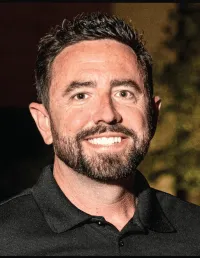
Patrick Martinez - Close More. Sell Better.
Lighting for Profits - Episode 259
In this episode, Patrick Martinez, Founder of Elite Sales Academy, shares practical sales strategies for luxury contractors. With over 30 years of experience in entrepreneurship, sales leadership, and business coaching, Patrick breaks down how contractors can increase revenue, improve closing ratios, and build scalable sales systems—all while creating exceptional client experiences.
Watch the episode
Episode Transcript
Introduction To The Podcast And Setting The Stage For Business Growth
Welcome to Lighting for Profits. All light, All light.. All light. Powered by EmeryAllen.
Here is your host, Ryan Lee.
All light. All light.
All light.
All light. Let's go. Welcome, welcome, welcome to the number one landscape lighting show in Thousand Oaks, California. I'm your host, Ryan Lee. Looking forward to hanging out, guys. If you're looking to start or grow a landscape lighting business, you're definitely in the right place. And I will say today, um, I've been going to like other industries because I know some of you guys don't want to hear this, but sometimes other industries are way more advanced than the outdoor lighting industry. And so it's been really, really cool because I've been able to tap into a completely new network and I've met some amazing people and I'm like, hey, help us, like, help us get to where you guys are. And so today's one of those days. So to technically, even if you're not looking to grow your outdoor lighting business, you could be looking to grow a lot of different types of businesses. But if you're an artist, you're going to want to listen to, uh, this episode because we're going to talk about how to help you grow your business. We've got Patrick Martinez, the founder of Five Stone Solutions. And, uh, we're going to be nerding out on some business. We're going to be talking about, um, some ways to really, uh, streamline your sales process and really use leverage in your business to help you grow. So it's not always by working harder, I can tell you that because I learned the hard way. I thought that was the definition of being an entrepreneur. Just outwork the next guy. Uh, but, um, that's not, um, not really the case. So looking forward to having Patrick Martinez with Five Stone Solutions on the show in just a couple minutes. And, um, before we have on, have him on just a couple things. Number one, we are about to start promoting the heck out of Light It Up Expo. We're going to have limited spots for vendors, actually limited number of tickets for attendees as well. So you're going to want to take advantage of that. Uh, but for now, just put it like, just mark it out on your calendar, pencil it in, light it up expo. com march one through four in Las Vegas. It's going to be an awesome show. We've got so many cool things planned and I just kind of want to plant that seed for you guys. Um, also, big shout out to Lights for Decorators, owner Jimmy Tompkins, his entire team. Um, you guys know what you Know, we're entering in the holiday lighting season. Uh, so there's gonna be a lot of Christmas light sales, a lot of permanent lighting. Uh, they're an incredible resource. Obviously have great products, but one of the things I like about them is they're always trying to help you grow your business. So we had Jimmy come speak to us at Secret Summit last week or two weeks ago now, I guess. But, um, just. He just knows his stuff. He just knows how to run a tight ship, knows how to run a business, and knows his numbers, which is really important. So, um, if you want to win in your market, go to lightsfordecorators. com, get in touch with him, get in touch with his team, and get on the latest training schedule. Um, and again, guys, in just a few minutes, we're gonna have Patrick Martinez, the founder of Five Stone Solutions, and really, um, looking forward to our conversation with him. I don't know why, but just the last few days, I was thinking about, um, the lighting industry.
The Crucial Difference Between Being A Lighting Artist And A Business Architect
And I was thinking, like, man, what. What separates those that are just, like, absolutely killing it, and then those that are still kind of struggling, those that still just haven't figured out how to get traction in their business. And, um, one thing that's kind of true in, in any, anybody's business in the outdoor lighting industry is most, you know, lighting business owners spend their time designing beautiful lighting systems. And it's honestly, it's one of the coolest things about our industry. It's like, um, I don't know how passionate I would be about selling roofs. I mean, I'm sure you can, like, tap into some passion somewhere. But, um, you know, like, lighting design is pretty cool. And like, being able to create something and transform a space, and then the way just to see and feel how the homeowners react to that, it's a pretty cool experience, right? And so I think a lot of us have felt that we. We know that, like, and so it's easy to kind of like, lean in to the design side and really, because we're able to, like, tap into that artistry. And, um, that's pretty unique. Like, you don't get that in a lot of industries. And so what I want to talk about is, like, the difference between the lighting artist and the business architect and really kind of like, when you need to tap into each one. Because in my opinion, there are businesses out there that are just so heavy on the lighting artistry that they never. They're not really ever getting traction in business. And sometimes they go out of business because they never put on the business architect hat. And, uh, and then there's other people that are, like, so heavy on the business architect side that they kind of forgot about the lighting artistry. So how. How do we blend those? How do we merge those? And, um. And which one do you need to focus on? At which phase? Right. And so, um, especially in this industry, most people got into it because their artistic talent, like, it's pretty special, like I said, compared to other industries, that you're able to, like, check that box and you're able to, like, exercise, um, the artistic side and your creativity, like, it's. It's really fun. Right. But you know, that artistic talent that got you into business won't necessarily keep you in business. Okay. And so, like, being the best lighting designer in the world doesn't automatically create the best business. And I see a lot of people falling in love with design, which, again, I can appreciate, but they spend so much time on that that they forget that they're actually running a business, not a charity. And the numbers, the expenses, everything piles up, and there's nothing to show at the end of the season. And you see this in pretty much every industry, not just outdoor lighting, but the market usually rewards the company that communicates its value best, not necessarily the company with the most technical or the most, uh, design skill. Right. And if I'm an artist, like, that's. That's super frustrating because it's like, do you know who I am? Like, do you know my creativity? Like, I'm so much better. But if you're not able to communicate that value, like, you're just going to get left behind. Okay.
Embracing The Emotional Connection In Landscape Lighting And The Pursuit Of Freedom
Um, and I don't know, there's just like this. This paradox between the two. And for whatever reason, I've always appreciated both. Like, I love the fact that I can go create something, and then, like, tonight the lights turn on and those customers are like, wow, like, this is the coolest experience I've ever had. Would you build a pool for us? I'm like, what, do you want me to build a pool for you? I just did your lighting. And they're like, well, because that's the coolest experience I've ever had. Right. So it's awesome. Um, for a couple reasons. One, because we're actually giving someone something that they want, not necessarily something they need, which is interesting. Um, people want to go on badass trips to Europe and spend $60,000 a day on a yacht. Like, they want to do that, and they feel good doing it. They. They don't necessarily want to go spend $60,000 on a roof. You know what I mean? They will because they need to. But, but lighting is like that. It's like we're giving someone something that they want. And it doesn't just end in a week like these cool vacations. Like, it continues to give back every single night for like the next 10 or 15 years. Right? So it's pretty dang cool what we're able to do. But I've always been drawn to the business side because I'm like, I didn't get into business to like, what did I see the other day? Um, someone said they left their nine to five so that they could work five to nine, right? Like, most of us get into business thinking, I want freedom. Like, I'm sick of working for this asshole boss. I'm sick of like doing all these things for someone else. I'll just do it for myself.
Designing Your Dream Business Using An Architect's Mindset For Growth And Success
And then I can go to my kids games and I can go on vacation when I want. And then all of a sudden, what happens? Like, we become trapped by the very thing that was supposed to give us the freedom. And so I want you to think about this in a different way. What if you could still use your artistic side, but not just into this lighting design phase? Like, what if you could, uh, use your artistic side to build your dream business? It's like an architect, okay? An architect is an artist. Like, they, they create different blueprints. And so an architect creates a blueprint that other people can follow. And when you're designing your business, not just designing lighting, you're doing the same thing. You're designing a business that other people can follow. And I've really thought about this a lot because what I'm doing now I think can be misconstrued a little bit. Um, people that know me well from in person events and friends and stuff like that, they know who I am. Like, you can't hide from who you are. Um, but online, social media, I'm not posting all the stuff. Like, if I have one cool thing that looks awesome, I've probably already tried 10 things that failed. I just didn't talk about those because that's not what you do with social media, right? And so some of the stuff I'm doing can get misconstrued. But it's like, just because I'm so passionate and focused on the business and helping you guys make money doesn't mean I'm anti design. In fact, the way I design events, the way I design experiences, is me exercising that creativity. And that artistic side of my brain, I just happen to believe that you can do both. If you're an artist, it doesn't mean you have to be a starving artist. Like, that just frustrates the crap out of me because there's so many talented people that are doing good work and no one knows about them. In fact, I went to, um. You know, I was in the industry. I. I started my lighting business in 2007, and I had heard about Illy, the international landscape Lighting Institute. I had heard about them, uh, but never gave. I mean, why would I go to some event that's thousands of dollars and it's going to take a week? I already know how to put lights in the ground. Like, why would I go to that? I never understood the value. So in 2019, I sold my business. I think I went to my first Illy in 2020 or 2021 because I wanted to. I wanted to see what was out there. You know, people were going to be coming and asking me, should I do, uh, should I do this, should I do that? I don't want to tell them, no, I didn't do it. I want to go experience it myself and then have a real opinion. So I go to this illy International Landscape Lighting Institute, and it was an incredible experience. I mean, after being in the industry over 12 years, I learned a ton about design. It changed the way I thought. It changed my perspective. And one of the first things I said to Jan Moyer, who started Elli, and to the president of Elli, Jesse, I said, you guys suck at marketing. I was like, oh, my gosh. You guys suck at marketing because you guys have an awesome product, you have an awesome experience, and no one even knows about it, Right?
Balancing Creativity With Business Acumen: Strategies For Scaling And Avoiding Stagnation
And that's what I mean is, like, you can do both. Like, you can be passionate and good at that, but, like, you need to get good at business if you want to stick around, if you want to scale. And these things matter. These conversations need to happen because people ask me all the time if they're getting new into business, like, what light should I use for this? Or whose product should I buy, or who should I hire for this? And when should I hire this person? And the answer always is the same. The answer is it depends. Because if you're gonna. If you're trying to grow a lighting business, that's heavy on the artistic side, and that means you don't trust people, because no one can design as good as you. No one can install as good as you. You're an artist. How could someone be as good as you? You're this unique artist. Well, then you're gonna grow your business differently than I grew mine, okay? Because I want to exercise that artist side. But it's not just in one field. It's not just in lighting design. It's in the design of the entire business. Okay? And again, if I'm going to be in business and I'm going to work 5 to 9, 5am to 9pm and later in the lighting industry, I better make a shit ton of money. And people feel guilty for making money. Like, why? This is how, this is when I talk about over deliver. Like, you know, over deliver on your client experience. You can't do that if you're not making any money. But if you're making a lot of money, you can afford to over deliver. You can afford to overpay your people, you can afford to recruit higher caliber. So instead of hiring B's and C's, you can hire an A player who's actually going to be disciplined, who's actually going to show up, who's actually going to put in the work and over deliver for your customer. That can only happen if you're a profitable business. Okay? So, um, I guess what I want to leave you with is just to encourage you. Like in my mind, you can have both. You can be a, an amazing artist, a great designer and a business professional and a, uh, business architect. Okay? And I think the ultimate outdoor lighting business does both. I don't think. You pick one. I do think that, you know, um, creative minds tend to, we tend to do the thing that's more natural for us or more comfortable for us. And so this is another way to kind of gauge like, hey, are you. If you're comfortable right now, you probably need to do something else, right? If you want growth, if you're happy and you're fine and you know, then great, like live your life. The way I look at it is like, I need redundancy. If I get hurt today, what's going to happen to my income? Uh, is someone else going to be replacing me? And most of the time, this is why the term starving artist exists. Because that person gets so infatuated on what they do, they're unwilling to hire other people because they're not as good as them. Um, and they don't share the same standards because they don't have a standard. Right. But if you will become a business architect and design your business accordingly, I promise you, you can do both.
Making Sacrifices For Scalability: Balancing Artistry With Business Architecture For Long-Term Success
Um, you're going to have to make some Sacrifices. What are you willing to say no to? Is going to come up a lot. And you're going to have to say no to some things. You might not be able to go and choose from 27 different suppliers to create that masterpiece. Uh, but maybe you can. Maybe you can do just one or two masterpieces a year. And everything else, trust me, is still way better than what most people are putting out. But you now have a scalable business. So just remember that your customers need your artistry. Like, that's fine. That's good, right? Uh, but your employees, your team members, they need your architecture. Um, you're going to have to figure out when to put on the different hat. And remember that your family, your circle, uh, they need both. They need you to do both. So, uh, make sure your designated time to be the artist and designated time to be the architecture. That's all I got for you guys. Uh, let's see. You guys want to know how to get more jobs whether you're an artist or not, one, uh, of the ways is to just differentiate yourself. So, uh, one of the easiest ways to do that is just use better product. Um, don't let a bad lamp ruin your client experience. Emory Allen. They make the premium LED lamps for lighting professionals that demand the best. So don't settle for less. Just reach out to them. Today, um, it was kind of funny. We were at Secret Summit, and I was introducing, uh, Tom and Jackson. They were there and they were like, oh, is that jackson l@emeryallen. com. um, if you guys want to reach out to them, do email Jackson. His last name is starts with L. So Jackson L@emeralen. com. but the cool thing is they do offer discounted contractor pricing. All you need to do is mention that you heard about them here on Lighting for Profits, and they will hook you up. So Again, it's Jackson. Lreallen. com.
Introduction of Patrick Martinez and His Extensive Experience in Specialty Contracting
all right, guys, did I say we got Patrick coming on the show? I say it's time, um, to get into it. So if you guys are ready, I'm ready. Unless I need a drink. Let's do it. Welcome, welcome, Mr. Patrick Martinez. What's up, Patrick?
What is going on? What is going on, man?
Thanks for coming on the show today. I appreciate it, man. Looking forward to, um, talking all things business with you.
Yeah, this will be fun. This will be super fun. I listen to the show a bunch, so this will be super cool. I like. I like the energy you bring to this and I like the intro. Um, I have comments on the intro, too. But I'll let you do your thing.
Dude, let's start there. I don't care. Well, before the comments, because I do, I do want that. I um, the reason I do that by the way, is because I believe that this show is so valuable because I can bring on so many different, uh, perspectives, you know, and we're gonna hear your perspective today. But I am kind of selfish and I'm like, I, I want to get my like, energy out. I'm like a dog that's got to go for a run in the morning and then, then we can focus on you. So yeah, after, after you introduce yourself, you can pick.
Yeah.
Think apart, give me ideas, uh, whatever. That's great because the rest of the show's about you.
Yeah, that's cool. That was cool. Um, yeah, so my name is Patrick. No, I'm with Five Stone Solutions. I've been in the specialty contracting space for over 30 years. So audio, video, lighting, shading, technology, networks, all that good stuff. And uh, we run a company, um, called fivestone Solutions. There's four of us here that work here and uh, we do one on one coaching, we do sales playbooks, we do how to help you find your next sales superstar. Um, but the, you know, the thing we're most excited about for your audience I think is our, is our weekly sales training program. We, uh, meet every Friday morning, Today's Friday, we had a session this morning and we meet every Friday morning talking about sales, sales strategy and all that good stuff for specialty contractors. So that's, that's kind of our, what we do around here all week.
Very cool. So what, uh, and how long has five Stone Solutions been around? How long have you had this business?
Yeah, about 12 years. Uh, full time for 12 years. Just been growing steadily. Um, and you know, been in, like I said, I was in the contracting space, high end construction, all that kind of stuff for decades and decades.
And were you an integrator? What type of business were you?
Yeah, I was a very, I was a full service integrator back in the day, before there was that was that common. Um, so I started my first integration company in 96, probably before some of your listeners were born. And then over the years, you know, grew that business, sold that business, merged with other businesses, did other roll ups, did all kinds of stuff. So did, uh, that. And then 12 years ago went full time consulting, uh, and coaching for specialty contractors and also manufacturing companies. So, so you mentioned like Emory Allen, like those types of companies are also about half our business is made up of like manufacturing companies. Then about half our business is made up of contractors of various types. So we nice. Our specialty is subject matter expert salespeople. So I've been turning nerds into salespeople for 30 years and I was my first customer. So that's what we do.
That's cool. Well, obviously you had a lot of like experience, you know, helping people, growing your business because you're hiring salespeople, training them, stuff like that.
Yeah.
What prompted you 12 years ago to go, you know, what make maybe, maybe there's something else here. We could actually start a company around education.
The Entrepreneurial Drive: Diversification, Building Businesses, And Reigniting Passion
Yeah, yeah. It was similar what you said. It's kind of a diversification thing. It started out like part time and then I was like, oh well this is kind of cool because I, I get, I get bored, you know, you might relate to that. So if I can have a part in building lots of businesses, it's more exciting to me than just building one business that I'm working on. So you know, I build my business but then I get to help others build their businesses and the building is what excites me. Um, the day to day running, not always so much. I think a lot of entrepreneurs can relate to that. But uh, the building is exciting. So that, and that's why I just kind of diversified into that and help, you know, help these other companies.
That's cool. Yeah. I felt like I'm always chasing my next like adrenaline hit. And so I remember when I first, I sold my first like $10,000 job and then the first 20,000 and the 50,000 and those were like amazing moments. I thought oh my gosh, this is going to change my life. And uh, now like I tell people, I'm like, I could go knock doors and sell like two ten thousand dollar jobs right now in the next like five hours and it just would do nothing. It's just like I need to, I need a heavier drug. The heavier drug is someone new comes in, they follow my script and they have a call me and they go, dude, I just closed this eight thousand dollar deal. They gave me four thousand dollars. I'm like, let's go. It's like the best thing ever.
Exactly. I had one of those on a uh, one on one call this week. It's. He had sold his first design package, you know, before doing all the work. I know, we'll talk about that later. But he had sold his first design package where he got paid to do the design before he did it, before he lifted the pencil. And that's how he started his one on one call, he was so stoked about that.
That's sweet.
Mindset change, you know.
So, yeah, um, well talk, let's talk about the, the real quick.
Uh, yeah.
What are your thoughts on the lighting artist versus the business architect?
Yeah, I love it. I think that's a really good point and I think it, it taps into this broader thing of the visionary versus the integrator, which is part of the EOS business model. Not to get too nerdy but you know, you have some, some people who are natural visionary artists who are then for the, the excitement of the thing and then you have like the blocking and tackling integrator business folks. And um, in smaller businesses it's hard to have both at yin and yang. But as, as soon as your business grows big enough where you can get some support, it's really critical to kind of support. If you're the visionary artist, you got to get some people to do the blocking and tackling that you don't want to do so that you stay in business. Um, but until you get to that point, what you said is 100 true is just you got to like adapt and be able to do both sides good enough until you can grow enough. And then if you're hard business, hard numbers, and you don't have that creativity or passion for the business, it's hard to make sales and make money because you people don't, you know, people don't buy from companies, people buy from people. And if you're not super passionate about landscape lighting or you know, permanent lighting or all the different things that you guys do, it's hard to make those sales. So, so I think the yin and yang is really, is really critical and, and the other thing I encourage all my contractors I work with is don't forget why you got into this business. So many guys get into the business and like you, your, your monologue about like the grind and working five, nine, all that, like, it's so true. And they fast forward 10 years, they got eight guys working for them. Um, they got four trucks, they got a mortgage like, and they forget why they got in the business because they haven't been to a finished project in a year. They haven't been to a trade show to see anything fun and exciting in three years. They haven't walked the client through the final install in too long because there's somebody else doing that and they lose that kind of passion and excitement. So I just encourage you guys get out, you know, and remember why you did this. Go look at big Gnarly projects. Go experience what it is you do so you don't forget. And get your office folks out too. You know, you can't just lock people in office and not let them see what you guys do. Everybody needs to be passionate about, about what you guys are working on.
Yeah, well said.
Bridging The Gap: From Visionary Artist To Business Integrator For Sustainable Growth
Um, what, what would you say to someone who's, I feel like the most, most of the people. Not everybody, of course, but most of the people that are listening are kind of that like visionary artist. They, they're probably listening, going, like, okay, I know I'm supposed to do that, but like, how, you know, like, I know I'm supposed to hire an integrator. I need someone to help me build these systems because, yeah, they're not, they're not going to do that. Like, it's just like you're asking, you know, them to do something that's not really possible in their mind. How do you do that? Like, how do you get to that spot where you go, okay, I'm not just an operator anymore. I'm a business owner and I'm putting these people in these seats.
Yeah, well, one of it's part of, it's money. Like you're gonna have some money. Not a lot, but it's some money in a process to get more money. Um, the other thing is I really encourage people like your program super great. Like, get into a program of some sort, get a coach of some sort, get a mentor of some sort. Like, get some other people that are kind of dripping into your life on a regular. Not, um, just. You can't just go to like an annual conference and get all rah, rah, rah and expect to deliver for the next 364 days. Work that way. So, um, you got to get things, you know, where you're getting regularly dripped on, like your program. You know, our program meets weekly. We have a weekly scorecard that salespeople have to fill out before they come to the session. You know, there's like some accountability is really key and just regular touches on that stuff. And then through that you'll start to figure out your plan of what's next. Because you'll have. These people are going to have you read books, these groups are going to have you do things. And like, that starts to help formulate what your next, what your next steps are.
Yeah, very cool. Yeah, it falls in line with like, we, we just finished our, um, our secret summit. It's our members only thing. And this year we did, um, the theme was intentional success, and it was it was like, you know, you and I, we see like behind the scenes of all these companies. And I just realized I'm like, man, no one's actually like, I say, like, I want to fly private jet. I want to fly on a private jet. Like, not really because I've never really put the plan in place to do that. Right. It's just cool to like fantasize about it or whatever. And there's, there's no successful business person out there that just got lucky. It's just like they woke up and they had this business that runs without them and everything else. And it really is just like getting intentional. And then how bad do you really want it? Because some people like me saying I want to fly private. Like, it's cool to say, but like, it's just, it's just not going to happen until I like actually put the plan in place and reverse it down here for sure.
A, uh, big part of our program is just goal setting. Like we, we do like annual, we do a big annual goal setting session or two sessions actually. It's pretty fun. Remember, that'll be coming up in a couple of months here because we're getting into it, but, um, you know, kind of setting those goals. But then you can't just set the goals and like, let them run. Like, you have to check in, you have to hold yourself accountable, you have to score things. And so we, we do these regular check ins on reflecting on your day and your goals and all that stuff. And you. But you're right, it has to be intentional. I love the title of that. It's just so great because you do. You're not gonna accidentally, you're not gonna accidentally get successful. You're not gonna accidentally get in shape. Um, you know, you're not gonna accidentally get rich. You're not gonna accidentally get rich.
This sucks. This podcast sucks.
Exactly. Exactly. Exactly. Yeah. Yeah. It's gotta be said, it's got to be that gazelle intensity, right? Like either gonna get in shape or get rich or get your business tidy. Um, while also, here's the really hard part too, while also not losing that passion because you don't want the business to just be a bunch of checkboxes and goals. Like, you guys are in a very creative business and we need to be still fostering that creativity.
Yeah. Yeah. I think that that passion for, for these guys is easy because they're just like so addicted to it. It's just natural. Like, you know, I've got friends that are like, it's natural for them to like, love working out. I still freaking hate working out. I hate it makes me like literally nauseous. And so I'm like, I love.
I wish I had. I wish. I love.
Yeah. So they're, they're wired to be passionate, which is cool. Um, they're definitely not wired to do the other stuff.
Systems Over Passion: The Power of Accountability and Structure in Achieving Fitness and Business Goals
Yeah. And for, so for me, I, I'm bummed that I don't naturally love to work out. So in place of that, and this is where it kind of corresponds with what you were talking about in the monologue. In place of that, I have a system. So I have a checklist of how, how many times a week I'm supposed to lift weights, how many times a week I'm supposed to do cardio. Um, I have like, I have some hand issues, so I have like a list of times I'm supposed to do my stupid, my stupid hand exercises, you know, and I have like my metrics that I hit for the week that I track in my little tracker. And in place of that passion, I have the accountability of that, and that's what helps me, like, get it done. So.
Very cool. Yeah, that's awesome. Well, you just mentioned that you got a New Orleans. One of your members just came to you with his first like, win for design or getting paid for design work. Ah, we should talk about that. Because when I first came, when I sold my lighting business in 19, I started getting active on social media, all that. And then I see in a lot of the outdoor lighting groups, people are like, hey, um, do you charge for quotes? Do you charge for designs? Do you do all this? And I'm like, well, like, I think one, we gotta understand what the definition of a design is.
Mhm.
Because like, I was going to someone's house and within 30 minutes telling them like, hey, we could do like 30 lights and it's 12 grand. To me, that didn't feel like a design, it felt like a quote. I'm like, didn't charge for that because I just told them that and they gave me a deposit. But, uh, to me, a design is like putting a design together. I mean, we're talking like light fixture placement, what types, the wiring diagram, the voltage drop, all the stuff. Um, but talk a little bit about that because I do think there is a need for it.
Charging For Design Services: Crafting Value and Intellectual Property in Landscape Lighting Projects
Uh, but what are the deliverables? And walk us through your process on that.
Yeah, good question. So we try to get you to charge for design services as often as possible. We don't necessarily want to create a bunch of friction in the buying process. So if somebody calls you for a quote, it's like, hey, um, I need to just like, like you said, like 12 lights, or we call them in the indoor space, like four cans and a fan. Right. There's not a lot of design work there. So, uh, but you know, we're looking at, like, more complex projects like you're talking about. And what we're trying to do is get to a point where about half of the value of the design service is deliverables and about half of it is your intellectual property. So everybody who's in this space or these specialty contracting spaces, you have decades of information in your brain that has value, and so it needs to be positioned as such that you're not going to just tell them all what to do so they can go get it all from someone else. Right. And so, um, what we're trying to talk about, you know, for your space, deliverables, like you said, plans, load schedules, some light electrical engineering. Right. Like to make sure we're going to have enough, you know, there's not too much voltage drop and all that stuff. But really the layout of where things are going and the types of fixtures. And if I'm going to come out to your house and rope up some stuff, uh, so you can keep it over the weekend and take a look at it, like, all of that kind of stuff should be part of your design services package if you're in landscape lighting space. And so, you know, I work with a lot of integrators, I work with a lot of interior lighting designers and shade contractors and all any kind of specialty contractor. They all have a certain element of design. So gotta look at what your deliverable package could be and then not forget that the real value is in your intellectual property and you shepherding them through the process to help them figure out what it is that they really need and want and what's possible and what's possible.
Yep, I like that. So how would you approach it? Um, someone. Someone just calls in, a homeowner calls, uh, my lighting company today. Am I charging to go out on that first visit or I'm going out there to like, introduce this whole concept?
The Art of the Discovery Visit: Pre-Qualifying Clients and Securing Design Fees
Yeah, yeah. So it's great, great, great point. Here's the thing. The, the chat and this is the challenge. You know, this is, this is the Challenging Podcast. Go change the name of it to, uh, the Challenging Podcast. Um, anything you say after. Hi, my name is Ryan. This is how we work diminishes the value of the design service offering. And if they get you out to the house and you're a problem solver. You want to prove how smart you are. You want to show them all the cool stuff, and you start talking and offering ideas and you start solving. You don't realize it, but you start solving problems, right? Then it gets harder and harder to sell that design service because you have. You're already giving away the milk. So, yeah, uh, in an ideal world, yes, you would pre qualify it into being more than just a quick holiday project, you know, some kind of small project. Um, you know, you'd pre qualify a deal on the phone and then you'd explain how your design service works, and then you get some sort of verbal, verbal affirmation. Some of my clients take a credit card over the phone and then you're off to the races, mostly want some sort of verbal confirmation. And then you'll go out and see them and you'll have like, you know, your design contract or your single page or whatever it is kind of pre filled out so that you can get it approved. But really the purpose of that visit is not a discovery visit like it used to be. It's a get my paper sign, get money visit. And that's what the mindset changes for a lot of people. That, it's really hard that mindset change because we want to solve problems. And this is why for a lot of my clients, the big shift happens when the non technical people start selling design services. We don't let anybody who knows anything go out to the house until we have a contract and a check. So you build that physical barrier where you have somebody who's excited about the technology, who works for your company that knows kind of, oh, we could do this. Oh, that's kind of cool. Or whatever. But really what you want to do is you want to talk to Ryan. And before you can talk to Ryan, you got to sign my paper and give me some money.
Moving Beyond Line-Item Pricing: Embracing Expertise and Strategic Pricing Models
And so that's kind of like the big picture model that we're trying to get to.
Yeah. Yeah, I could see that. That's cool. It makes sense. I mean, I've. I'm guilty of the like, oh, I'm just doing discovery and I'm like, oh, I just gave you all of our stuff because I like to help people. That makes sense.
Yeah.
What would I pay for? I'm like, I don't know what you would pay for. I think I just gave you most of it.
Yeah, uh, exactly, exactly. The other thing that's kind of a kissing cousin to that is getting our clients away from Line item pricing. A lot of our clients are still in the line item pricing game. So, you know, we try to get you in professional. We're trying to take you from a technician doing a technical sale to a professional sale, which is you're getting paid for your expertise. You're providing a proposal and a design with drawings and support. Support. You're not giving them a shopping list and you're not answering all their questions for free.
Okay, very cool. So how do you guide someone, um, to come up with their first price for a design, uh, with drawings and all that stuff? Is it based on hourly, Is it a package? Like, how are they? How are they? Because I've had people ask me that. They're like, well, like, yeah, uh, even if I know my hourly, like, I don't know how long it will take until I like, get to know them and everything else.
Right, exactly. It's. That is a tricky question. So I'm gonna, I'm gonna not answer your question and then I'll try to answer your question. The non answer to your question is that it doesn't matter because anything $1 or more is $1 or more than you would have gotten yesterday when I didn't do this. So.
So you see, you just at least need like a commitment to go out there.
It's giving a commitment. It's, it's removing the tire kickers from the process. It's creating a little bit of, of a gateway for them to get through to be really committed to you and then it helps you get paid. But it. I don't a lot. Again, a lot of our people are engineers, right? They hyper focus on how much should I charge. And I just try to tell them right off the bat it doesn't matter. And then once you realize it doesn't matter. Now let's try to come up with a pricing model that makes sense. Sometimes it's based on square footage. It might be based on number of loads. It might be based on areas that you want to light. It might be based on how long you think it's going to take. Like, all of that stuff becomes much less important when you realize you're still at least $1 ahead than you were yesterday.
I love it. Yeah, I mean, that's a better way of phrasing what I, I think I told someone. I was like, if, if you don't know, you don't know. So like, let's, uh, just say you charge 500 bucks and you get out there and you're like, damn, I should have charged $2,500. Well, now you know, for next time. But at least you made the 500 bucks because you weren't going to get that before.
That's a great point, is it doesn't have to be permanent. This is not. You're not setting some stone tablet with your pricing model in it. And a lot of guys get. Again, we work with subject, ah, matter experts, engineer nerds, all this stuff. Like that's, that's who I am. That's who we are. You know, I was on a track to become, uh, a structural engineer before I found out that this is funner. So the, you know, knowing that the numbers don't matter and then it's not permanent. Permanent is really key to just kind of loosen up the grip on things and just try to see what, what's going to work for your company.
I know, I don't know where that, like somewhere that gets implanted into people's mind. Like, and for some reason my mind never got that same like, commandment because I'm like, you just raise your price and then if you need to lower it, like right now, then you can. You know what I mean? Like, there's no one, like, there's no principal watching over you. Like, you own your business. You actually create all the rules.
My business doesn't have any rules at all.
I just make them up as I go.
Yeah, I'm not surprised by that. Yeah.
Workshop Announcement and Pricing Strategies: Simple Jobs Fast, Complex Jobs Paid
Yeah. So it's uh, just giving it a try and trying something new is really key. And knowing that we have clients that are charging, you know, you said 500 or 2500. We have clients charging 5, 10, 20, 50, $50,000 for design work. Nobody's dying and they're just getting paid. So just keep in mind that, uh, nobody's gonna die from this stuff. Just give it a shot and see what you come up with. And having, you know, but having the tools. So on that note on the tools, I'll give you a little plug if that's okay. Um, we're doing actually a workshop on this whole topic in, in at the end of September, September 30th. So, um, we're gonna do a three hour block, sit down with a group of people. People. And you're going to build your entire process. If you've never done design sales or you've done a little bit, or you've done some of what I call the halfway, where you like charge a little deposit and then you give the money back or all we're going to fix all that stuff in this Three hour workshop coming up in a week and a half.
That's, it's very cool. And I think we're going to do um, uh, we're going to do ah, an offer for listeners. Is that, is that right? We'll do an offer.
Yeah, yeah, that's right. We're gonna do um. So the workshop is 500 bucks for three hours. Um, 500 bucks covers three people from your company. If you need more than three people, we have a discount to add more people. And then for listeners of this show, we have a coupon code if you will, called 100 off. And uh, that'll work to get you 100 bucks off the workshop. So the workshop be 400 for you and three or for three people from your company.
Okay, sweet. So we'll put a link, we'll uh, put a link in the show notes.
Yeah, we have a link. Little kind of like webpage. It talks about everything we're going to cover in the workshop and then you'll be able to put that code in 100 bucks off.
Okay, awesome. Yeah. And the promo code is 100 like the number 100 off.
Yes.
Well, very cool. So um, I want to ask you on that though, like have you found that um, when people say okay fine, I believe you, I went to the workshop, I'm doing this, is it all in or all out or does it depend on it? Like you said like the pre qualification and be like, oh, this is just like a six thousand dollar job. They're clearly not a design fee person or is there a way to still do the design fee without losing that opportunity?
Great point. Yeah. So pre qualification is really key part of that pre qualification is how they found you and if they can be trusted.
Right, okay, cool.
If they have found you through some Google search and they're searching everybody and talking to everybody, you can't really trust them. You don't really know them. If they're referred to you by like your architect or your you know, landscape. Landscape architect. I don't know who all the cois for you guys are but like landscape architects or whatever, then you kind of have a little bit more of a confidence in the project. So you may be able to either skip the design services altogether or give them some sort of discount or tell them what you're doing or whatever. Um, but it kind of depends a lot through that pre qualification and then there's some projects that you just need to go get done. You know we used to call them, and when I was younger we used to call them the quote and do. Like, we're just going to give you a number. We're just going to get it done. Quote and do. And so those are not really those design projects that the. The model is. If it's something that is simple and fast, we. We want you to be as fast as possible, which means I want you to quote the job as fast as possible. I want you to be able to start the job as fast as possible and get lights in the ground like you guys say, which I love that phrase. So if it's complex or involved, I want you to get paid. And that's, uh, one of the big differentiators there. So many times I see guys do. Either way, it's complicated, and they do it all for free. It's super simple. And they wait two weeks to get the client a number or the prospect a number.
I've seen both, too. Yeah.
Yeah. So if it's simple, do it fast. If it's complicated, get paid for your work.
Lead Attribution and Understanding Your Sales Process: The Importance of Context
I like that. That's good. Yeah. People should write that down, because I think that's why, like, I feel like I've flipped depending on the week on how I feel about this topic. And I think it's because it depends on who I've talked to. And I'm like, yeah, uh, you just spent 80 hours and you didn't even get the job. Like, what? Yeah, no, that. No, don't ever charge for design because you. Whatever, you know, it's like, I don't know. So, um, I think that's interesting. So, um, what about, um. Uh, what was I going to ask on that? Oh, I guess what I was going to say, that's why I love geeking out on business with you. Um, anytime someone gets a job or they're like, yeah, I've got this opportunity coming up, I owe literally, like, probably 90% of the time, like, oh, what was the lead source? And because it matters, you know, what and what. And they're like, uh, I don't know. I'm like, no, you. You have to know, because we don't live in a vacuum. Like, every sales present, even though your process could be the same, the actual script, the actual, like, wording and. And like, choreography is going to be a little bit different based on who they are. And like, you said, like, if. If they trust you, you trust them.
Yeah, I. The term we use is lead attribution. So where did this lead come from? Huh? Where can you attribute this lead? And every salesperson that I work with, they get. It gets beat into Their brain that the very first thing they're going to start to go down that road is where did this thing come from? And we don't really accept like the Internet. So if somebody says oh, I found you on the Internet or I found you on Google. Our, our salespeople that we coach are required to continue asking questions. Was this actually on Google? Was it chat GPT? Was it some other thing? Did you see us, any of our reviews? Did you like, how did you, what were you searching for?
What'd you type in?
Yeah, yeah, what did you type in? Like trying to get a little more information on uh, what that actual attribution is because you'd be so surprised when you see people. Where'd you find us?
Closing Ratios and Design Fees: Understanding the Impact on Sales Performance
Oh, the Internet. Okay, cool. Was it like a Google search or was it like an AI search or what was it? Oh, actually uh, my contractor told you to call. Told me to call you.
M. What?
We're just so default to say Internet because probably what they did, the contractor told him to call and they went and googled you and did some research and then that's what's locked into their brain. But they're. The reality was the contractor told him to call.
Man, I could go on like a three hour tangent right now about marketing and sales. I'm not going to do it, I'm not going to do it. Stay focused. I can do hard things. So what about um, okay, so we, we charge for the design or we don't, whatever, you know, we pre qualified. Uh, when we get out there, I see people on both sides of the spectrum talking about closing rates, um, landscape, lighting. Let's say an average ticket is 10 to 15k. Should I be bragging to my buddies that I'm at 90% or should I be bragging to my buddies that I'm at 50 or bragging that I'm at 30?
Yeah, super great, super great question. Statistically, if you do not charge for design services in the specialty contractor space, so that covers a lot of um, areas, right. You're gonna get, you're gonna, you're gonna close about 35 to 30, 35% of what you price. So if you price 100k this month, you're gonna get like 35k. If you don't charge for design services, if you do charge for design services of uh, the stuff you actually price, that closing ratio goes up to 80 to 90%.
Wow.
Because you're only pricing the stuff that people are invested in. They're serious and they want to be a partner and they Want to participate in the process. So that's my first answer. If you're not charging for design services and you're closing more than 50%, so you said like 50 or 90, then you're not charging enough money because you should be losing some of that work to get closer to that statistic. So a high close ratio is not always a quote, unquote good thing.
I love this conversation because even just what you like inserted there, this is why like every question that someone asked me now I'm like, ah, uh, it depends because it truly does. Did you charge for design service or not?
Navigating Business Advice: The Importance of Context, Tiers, and Mentorship
Like if you are, then yeah, you're going to expect a higher close rate and what is your pricing and did you pre qualify? Like some people don't pre qualify and their closing rates lower. Um, some people pre qualify heavy, heavy, heavy and they're going to be higher. So yeah, I just, I want people to think differently. A lot of people just go to Facebook groups now and like, oh, I have a question, I'm not going to think about what my real question is and like just going to like ask like what should I charge? I'm like, well it depends, you know, like uh, we need more um, information to help you. And the problem is people don't ask those good follow up questions. So then they get advice and 90% of it is bad advice based on someone who's not running their same business
model, not running the same business model, not in the same market, not doing the same type level of work. You know we talked about this morning on the fact that like, you know, we have this macro niche of um, you know, high end residential clients, right? That's my target audience is high end residential clients. I want more of those. How do I get more high? But you got to realize that within that high end residential clients there's like four tiers of people. Some are coming to you with a bunch of problems and a bunch of broken crap. Some are trying to just do like some basic troubleshooting and fixing. And then the top tier, the top two are like planning and building and really doing something great. And so you know, within that hierarchy you might be really good at the break, fix, tune up stuff. You might be really great at the high end planning. But knowing where in the four tiers you need to be focused your efforts, that's really key. It's not just high end homeowners. So when I hear people like offer that type of advice or when I hear like people go, oh, I went to chat GPT and I asked this question, it's like, yeah, but you need the context and the context. Where do you want to be? So that's where, like when you were talking about the beginning, that's where like a good coach or a good mentor matters because they can ask those contextual questions and they get to know you so they know like, what you're looking for. Like, when I'm in my group with our, with our Friday members and somebody asked a question, I'll be like, yeah, here's how I would answer this question for everybody, Bob, but for you, this is this. And that's what, you know, that's what's really key about having people to kind of pour into you and your business.
That's huge, man. That's huge. Um, okay, so we're gonna do. We're gonna pause real quick.
Introducing 'You Make The Call' Segment and Call Source Partnership for Outbound Sales
I forgot to tell you this, but we're gonna. We started this new segment called you make the call. I'm just gonna ask you if it's just a few questions.
No pressure. Yeah.
Everyone's going to judge you and.
Okay, perfect. Awesome.
Decide. This is, this is how they're going to decide the fate of the rest of your life and your success.
Leave my day. It's my first this day.
Yeah. Yeah. So this is, uh, like I said, it's called you make the call. We brought on a new partner called call Source. And these guys are awesome. They have an outbound call center. So we found a lot of people are going out. They're small, they don't have time to follow up. Even if they have an admin, their admin's not following up. So. So they'll literally like install a dedicated person to do all the follow ups for you. All outbound stuff? No, inbound, because most people are already answering their phone, but this is all outbound stuff. So, um, if you guys want to try Call Source, they have a link called try.callsource. com LFP relighting for profits. Try callsource. com LFP and they're going to hook you up with 50% off your first month just to try them out. So.
Cool.
Ah.
Rapid Fire Questions: Dream Vacations, Coffee vs. Dessert, Reading Habits, and Financial Goals
So we're gonna play along. You ready to play along?
Oh, yeah, let's do it.
Okay. Um, we're gonna start out easy. Dream vacation. Mountain, uh, cabin or beach house roll?
Beach house. That's a quick one. We do, like, the mountains, too. We do mountains. I mean, I'm in Southern California, so we got it all the same as, you know. Well, you're gonna have a lot of beaches, but
Lake Beaches.
Lake beaches. Yeah, yeah, yeah, yeah, yeah. But, uh, so where. What about.
Where would you. Where would your favorite beach vacation be?
Um, our local spot is. We have, like, a. I'm just near Malibu, so we have Zuma, and then we go up to, like, Ventura, Santa Barbara. So that kind of Gold coast right there is our. Is our hot spot. Beaches. So that's where we like to go.
Okay, very cool.
And then mountains for us is kind of outside the sequoias in the Central California area. There's some good mountain spots out there.
Okay, sweet.
We're a little spoiled here. Yeah.
Give up coffee forever or give up dessert forever?
Um, that's a real easy one because I don't drink coffee, and I'm addicted to refined sugar, so that's an easy one. I give up coffee forever.
Yeah, duh. Ah. Uh, what's your favorite dessert?
I, uh, I like chocolate of any sort. Um, but I also like gelatos and ice cream. So, like, you know, chocolate gelato is probably going to be the pinnacle or chocolate and ice cream meat. So.
All right, very cool. Um, all right. Uh, you read or listen to books?
I am a reader, and not only that, I'm a taver. So I have, like. I'll put, like, hundreds of tabs and books that I'm reading, and I have a whole system, and I'm kind of a nut job, but, yeah, definitely paper book guy.
And will you go back and reference those tabs? Or they're just there.
Yeah. So here, a little insight into my, uh, OCD neuroses. Yeah. Because I can go back and I can kind of essentially read a book from tab to tab and just get to the stuff that I really cared about at the time and kind of be reminded of what we were doing. So.
Okay, very cool. See, this is why we do this. Like you, I learned all sorts of crazy stuff that I had no idea I was gonna learn that today.
Sales Skill Focus: Asking Better Questions, Handling Objections, and CRM Compliance
Yeah. No, this is cool. This is cool. I love it.
Um, all right, so, um, you can make an extra 500k per year, but you have to work an extra 25 hours per week or just stay where you're at.
How long do I have to work that? 25. 25 hours. Oh, uh, that's a tough one.
You got to do it 25 hours per week for 12 months.
Yeah, yeah, yeah. I'd probably do the 25 hour. I'm an addict. Although I don't know where I would put the 25 hours, so. But yeah, I like working. I like. I like the thrill of the thing. So, yeah, I'm probably in on the 25 hours.
I know. See, that's my problem, is I'm addicted to business. So it's like, oh, you just need me to go work on my business.
Yeah.
And then what?
Oh, and then you're gonna pay me more money. Sounds great.
Working out, eating better. Yeah. There's some other difficulties.
Yeah.
All right. You, uh, are a sales trainer. You can only train one. One skill the rest of your career. Asking better questions or handling objections.
Uh, asking better questions, I think, is. Especially in the technical space, is an area that's really overlooked. We, as. As technical people, we have a tendency to show up and throw up, and we know all the answers, and we think we're the smartest guy in the room. And so a lot of times, uh, we struggle in that area. So asking better questions is where it's at.
Very cool. Actually, we just did this exercise. We did an improv, um, to start off our secret, um, summit. And we got mixed reviews. Some people were like, I hate that. Which is to be expected. A bunch of introverts in a room. Um, but, uh, we talked about, uh, asking better questions. And what we. The exercise we did was like, I would ask you a question, and then whatever you say, I have to repeat it back before I say the next thing. And it was. It's very difficult to do because, like you said, we show up and throw up. I'm just thinking about. Instead of like, oh, what Patrick just said, I'm thinking about what I want to say because I'm the expert. And then you wonder why you suck at cells.
Yeah. So we do a great, uh, we do a variation on that where you have to say just the last word. So they have to wait until the last word, repeat the last word, and then. And then they get to ask a question. Another improv skit we'll do is called questions only. So we'll have contest where you have two salespeople going at it, and they're only allowed to respond in questions, and then somebody inevitably will make a statement, and then they're out. And then another salesperson jumps in, and you kind of do round robin like that. And that works. As a technical salesperson, that really works your brain hard because.
Yeah.
Uh, we're so used to making statements and, you know, technical statements at that. So.
All right. Your best salesperson refuses to use the CRM. I know this has never happened, but keeps producing. Enforce the standard or make an exception.
Uh, oh, man. That is okay. I. In. This happens Every single day. Uh, what I do in this situation is I set a target revenue goal where I can hire them an assistant. So they have to use a CRM until they make enough money to hire an assistant, and then they can have an assistant to put the CRM data.
That's cool.
So, but it's got, you know, it's a target that they have to hit, and. And then they can. And then they're off the hook. Until then, they got to listen to me at them every week. So.
Okay, last, uh, one. Build the company quickly and accept some chaos or grow more slowly with strong systems.
Yeah, I'm naturally a systems guy, but I realize that's not always the way to go, so I support chaos in my client companies. In my own company, I'm a little harder to support. Chaos. Yeah.
Yeah. Okay, cool.
Mastering Client Interactions: Building Authority Through Questions and Understanding Emotional Connections
Well, thanks, uh, for playing, and, uh, yeah, that's kind of fun. Uh, new segment just to get our. Get to know our guests on a different way. So.
Yeah.
Thank you, Cold Source. Appreciate you guys.
Yeah, it's awesome.
Um, all right, so we got just a little bit more time I want to wrap up because there's a couple more things I wanted to ask you specifically about, like, the sales process and stuff like that.
Yeah.
Um, there's no secret. I've told people this before. I'm doing this show to gain more intelligence myself. I'm like, why am I taking the most notes on my own show? You guys, come on. I hope somebody else is paying attention here. Um, really good stuff so far. Thank you so much.
Yeah.
Um, okay, so this is what can happen, especially in landscape lighting. Um, you know, these are successful people that are buying lights. They're, uh, attorneys, CEOs, business owners. Um, they're affluent. So how does one establish authority with one of these, like, affluent customers without sounding arrogant?
Yeah. So it's back to, uh, what we were just talking about, about asking good questions. If you ask. So we have question buckets. We talk about figurative question bucket. There might be some rapport questions. There might be some qualifying questions. There might be some technical questions. And good salespeople go into those different buckets and pull questions out. And if you ask good, thoughtful questions and you take notes on a pen with a pen and paper as they're talking, then you immediately gain their trust. And I say the pen and paper thing, um, in the old days, wasn't a big deal, but now with all these AI note takers and stuff, I am a strong advocate for still taking notes with pen and paper. You can have The AI note taker writing shotgun.
Sure.
And you're not. You might not even be taking notes for you, you're taking notes for them. And the analogy I give everybody every time is what happens when you have a waiter that comes and takes your order, ordered a restaurant and doesn't write it down.
It pisses me off.
Do you feel great about that? Are you impressed? No, no.
Because I already, I like, I know there's a good chance that they're going to forget that I said no sour cream.
Exactly. Mine is no onion, so. Thank you.
I'm gonna get, I'm gonna get sour cream. You're gonna get onions. And I'm like, dude, I would have been fine with onions. Like, why did I get no onions?
Yeah, I'm not impressed.
I.
Because here's the thing. For the waiter, the minimum acceptable standard is my order 100% correct.
Right.
That's what matters.
That's the minimum. Yeah.
Yeah. So I, so I want you guys taking notes, I want you writing pen and paper, I want you asking thoughtful questions. We have a whole, like, we call it meeting 101, which is like all this stuff that we take you through on how to run an effective discovery meeting. And that's, you know, that's the way you get, you gain authority is through good questions. Because your questions will reveal how smart you are. You don't have to tell anybody how smart you are. Your questions will reveal how smart you are.
Oh, wow, that's so good. Um, I mean, I know you got a whole program around this, so I don't even know where you would start, but could you throw out one or two questions that you think are effective that most salespeople tend to overlook? Maybe?
Yeah, sure. Good. Open ended questions. Um, I like a lot about when I'm dealing with luxury homeowners, a lot about how. Tell me how you use this space. Tell me what your thoughts are for this. Tell me what you've seen here. Tell me what you've heard about that. Um, you know, so open ended, but getting them to open up and share their emotional connection. Again, people don't buy from companies, people buy from people. And most of what we do in the specialty contractor space is luxury and most of it is emotion. Like there's a lot of emotional connection to this stuff. So I want to get them talking about this. Tell me, explain to me your vision for this area or are you guys going to do any expansion over here? Or I see this yard isn't as developed here.
The Addictive Nature of Landscape Lighting Design and Presenting Solutions With Options
Do you have a plan for this Are you like, you know, just getting them opened up, you know, getting them to explore that kind of stuff?
That's cool. And it's so true. Like, it's awesome because you're talking about like what we do. Even though have you ever sold, um, or designed or installed landscape lighting at my own house.
That's it. Yeah. And I just, actually just bought eight more lights because I was like, oh, I can do something over here now. So, you know, it's kind of addict. I mean, as your listeners know, it's a little bit addicting because you can start doing really cool stuff. And I haven't even introduced any color yet. And that's another thing where I'm thinking about like, oh, that would be probably the next step is a little bit of color.
All right, cool. It is addictive. I mean, that's why it's like if you can just get your foot in the door, even if it's like phase one of the front yard, you're going to get the whole project if you can over deliver and be the business architect and all these other things. Right. So, yeah, now it's so good. Um, I guess, um, I still. You still got a couple more minutes?
Yeah, I'm good, I'm good.
Okay. Because I got a couple more things.
3 hour job. I have a 3 hour drive to my son's football game facing me in the square in the face.
So dang. Three hours.
Yeah, we got a job. We got a game on the other side of Los Angeles. And anytime you have to try to get through Los Angeles on a Friday afternoon is never.
Oh. So it's probably like. Yeah, 20 miles away. That makes sense.
I think it's 80 miles away, but yeah, forgot LA.
Yeah. Um, talk to, talk to us about the, your approach on the clothes. Um, um, you know, I, I realize it's landscape lighting. It's different than what, you know, you do, but in, in a way, like it's like you said, it's high end homeowners. Is it multiple options? Is it just the best solution that the person thinks because they're the expert. Like, how do you go about that?
So good. Such a good question. First of all, are you charging for design services? Right. Did you charge for design services? Um, if you did or did not, it doesn't really change my answer. But I just want to bring that to your point. That's part of the deal. Um, uh, we like to do budget pricing, not line item pricing. And we have what we call the benefit budget builder, which is three benefits. Um, of this thing. We're going to do two features, like, real specific features. You might even mention a brand name in there. You get. Might mention some numbers, like, really technical, um, and then one price. So, you know, if you're doing some pool lighting, you know, benefits might be, you know, show off the architecture of the pool at night or whatever. And then some feature might be like 23 in ground lights and made by so and so or whatever. And then one price. So benefits, features, price. So that's that. I always, always, always want something for them to say no to. I don't want you. It's funny that you said that. I specifically teach. Do not be the expert that comes to you with the perfect solution. They come to you with a perfect solution. They're going to assert their control one way or another. So if you have given them the perfect solution and they start making cuts now, they're cutting into your core perfect solution. Create the perfect solution. Give them some options that float around the edges and let them cut into some of the accessories.
Cut out. For a second there, you were saying, let them cut out something.
Yeah, let them, you know, you have some options, and let them cut out, like, some of those options without cutting into the meat of, uh, the stuff mistake that's in the middle of the plate. So give them some options. To say no to is really key. Never the perfect solution.
This is so good, man. Um, it's just so good. I mean, like you said, it's an emotional sell. Um, when you, when you think about it logically, like, I'm like, okay, if you just went to someone, you're like, hey, do you want to buy some lights for $60,000?
Right?
What, you think I'm an idiot? You know what I mean? Like, it's not even. Like, it's. No, like, it's, it's definitely emotional. Um, when you do charge for the design, you know, the renderings, the, the, the drawings, like, all this stuff, like, that's starting to tap into that emotional experience. How are you going to use this space, uh, allowing them to say no to something. I mean, I feel like we accomplished a lot, so thank you for kind of walking us through. And I know there's a lot more to it, obviously, but that, that, that was really, really good stuff, um, as maybe my last one.
Lifelong Sales Lessons: The Power of Asking Questions and Overcoming Ego
Uh, you've been doing sales, I mean, your own business, teaching, helping, coaching, all these things for 30 years, I guess. Now what. What's something about sales that you understand today that you wish you would have understood, say, 20 years ago? Maybe even just 10 years ago.
Yeah, I think as a technical salesperson, it's definitely the show up and throw up, up. Um, I learned that from one of my mentors, Jack Daly, and that was really a key thing. So show up and throw up and then watching out for my ego and my need to be right in the sales process, like pushing my, what my vision is too hard and letting my ego get in the way and my need to be correct and right on something technical. There's just no upside to it. So, um, how do we avoid all that? Again, it sounds like a broken record today. This. I don't usually talk about asking good questions this much and in one conversation, but we're back to asking good questions. So that's something I wish I would have learned earlier is just asking better questions.
So good. Yep.
Workshop Deep Dive: Building Design Services Programs and Practical Sales Role-Playing
I. I love it, man. Um, well, again, you guys have the workshop coming up. Announce, um, the dates again.
Yeah, yeah, yeah.
If you know the link, you could say that. I don't know what the link is, but we'll put it in the show notes.
Uh, it's kind of like a little sub link. So. Well, you can find us at Five Stone to catch Fivestone Academy .com will take you to our. One of our pages and then you. There's a big giant banner right now because the. Because the workshop is coming up. So workshop is September 30th, 10:00am Pacific Time. That's our magic time. Every time we do something, it's 10am Pacific Time. So it's three hours long. It's a working session. It's not a webinar of me talking. You're going to get a trail guide. Those are things that we send out in advance. We. You're gonna have a trail guide and we're gonna work through it. We're gonna build your design services program. Everything from the emotional stuff about, like, how to message it to the deliverables of, like, what can you actually execute and complete, um, with your current resources? Like, we're not going to give you, you know, we're gonna treat every company the same. There's some companies can do more than other companies in terms of what they can provide for deliverables. So soup to nuts. It's for everybody in the specialty contractor space. Even if you think you're an expert at, um, charging for design services, I guarantee you're going to learn something because we've been doing it a long time and you're going to get some insights. We're also going to do so in addition to Building all the tools. So it's not theory. Um, we're building tools. I'm also having a live guest that's going to come in, and we're going to do a live role practice where I'm going to be a homeowner. He's going to sell me design services, and I'm going to ask him questions. I'm going to have complaints, I'm going to have objections, and he's going to actually, um, overcome those with me live on the call. So you'll actually get to see somebody messaging it who's really good at it. Um, message it well, and it's going to be. It's going to be just tons and tons of value, and then you're going to leave with your program built, including, like, how do I get my salespeople to sell this? How do I incentivize them? Like, all kinds of stuff. There's so much good stuff that's good to come out of this. And it's 500 bucks for three people. It's a total bargain. We're gonna. Very cool do this one, and then we'll see how it goes. So, um, yeah.
Awesome, man. Well, thanks, uh, again, Patrick. I really appreciate it. Congrats, um, to you on all your success and just everything you're doing.
It's.
It's amazing.
So it's great.
Yeah.
I love watching you. I love watching your journey too, man. It's just been so great. So it's really cool.
Thanks. I'm living the dream. Living the dream. As they say, not every day is the dream, but we're going the right way, the right trajectory, so that feels good.
Yeah.
Uh, all right, so, guys, check out Fivestone Academy. Highly, uh, recommend the workshop. Sounds like an incredible deal. Uh, if you are listening to this, watching this, you can use the promo code 100 off to save 100 bucks. So what are you waiting for? Uh, it's coming up, so. And it sounds like that trail guide's cool, too, so I'm sure you can probably register, but, you know, the day before, but you're probably not going to get the trail guide in time, so.
Final Thoughts and Recommendations for Implementing Business Growth Strategies
Yeah, exactly. I'll be scrambling a little bit. Yeah, yeah.
Get it now. Um, yeah. Thanks, Patrick. I appreciate you coming on the show today. Best of luck to you.
Thanks for having me on. Awesome. See ya.
All right, guys, take it easy now. Uh, just go implement everything because, you know, Patrick said it's easy. One thing at a time, guys. You got this. I'm in your corner. Keep moving forward.
© Landscape Lighting Secrets. All rights reserved.