
The Content Hub
Want access to FREE amazing content from Ryan?
Lighting for Profits is your #1 source for all things landscape lighting. Whether you are looking to learn about lighting design, lighting installation, or just need helpful tips on how to start or grow your landscape lighting business, you are in the right place.
With over 14 years of experience in the landscape lighting industry, Ryan Lee reveals the secrets behind his success growing and exiting a multi million dollar landscape lighting company. Click one of the links below to check out the Lighting For Profits podcast, and discover how to go from overworked business operator, to 7 figure owner.
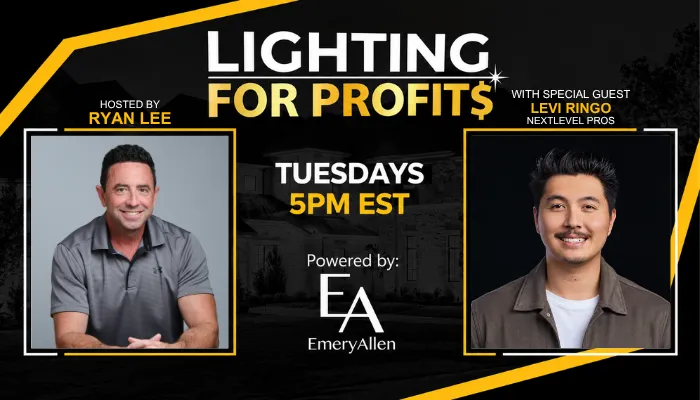
Levi Ringo - Marketing Millions
Lighting for Profits - Episode 262
How do you scale a business into a $233M acquisition? Levi, founder of Next Level Pros, shares his expertise in business strategy, marketing, lead generation, and sales optimization. From managing $2.2M in monthly ad spend to generating over 25,000 leads per month, he reveals the strategies behind scaling businesses, building powerful brands, and driving sustainable growth.
Watch the episode
Episode Transcript
Welcome to Lighting for Profits. All light. All light.
All Light.
Powered by EmeryAllen. Here is your host, Ryan Lee. All light. All light. All light. Welcome, welcome, welcome to the number one. It's the number one outdoor lighting show in Pasco. Pasco, Washington. What? Man, we are really trending. Guys, I'm excited. I'm Ryan Lee, your host of Lighting for Profits powered by EmeryAllen. Uh, by the way, would you like to talk to someone who ran Facebook ads and not just like a couple ads here and there, but someone who managed a $2.2 million monthly ad spend? That's what we got on the show today. We got Levi Ringo with Next Level Pros. And this guy's got an awesome story. And um, not just an awesome story, but leads with value and all the stuff that, uh, we're striving for here on the show, Lighting for Profit. So excited to be joined by Levi Ringo with Next Level Pros. Um, they were actually built, uh, a solar, uh, company and was, and he was part of an acquisition of over $200 million. I think it was $233 million. Um, don't forget every single digit on that one because not a lot of people have done that. So super, uh, excited to have Levi on the show. If you're looking to start or grow normally a landscape lighting business, but today, pretty much any business, you're in the right place. We're here to educate, here to motivate, here to help you dominate. So a, uh, couple quick reminders. Number one, we got Light It Up Expo. We started promoting the show. So go to lightitup expo. com, get your tickets today. By the way, we are doing an early bird promo special. So depending on when you're listening to this, if you're live then you get the hookup. Go check your email because I already sent you a promo code for the show. Um, but it's going to be awesome show. We got amazing, um, vendors already, uh, securing their booth sponsorships, uh, speakers, uh, it's gonna be awesome. So Light It Up Expo. If you're looking to grow your business, that's the place to be. We're in Vegas at the Flamingo. So go to lightitup expo. com and um, again in just a few minutes we got Levi Ringo coming on the show. Want to give a special shout out to Lights for Decorators? Go to lightsford decorators. com. if you're looking for holiday lighting product, permanent lighting, landscape lighting, they got you, um, their whole team wants you to win and really win your local market. So they got tons of trainings, lots of different things reach out to [email protected] om and again, before we have Levi on, I just, man, I've got, I've always got something on my mind. I gotta like scratch that itch. Um, I remember starting my uh, outdoor lighting business and honestly like I had no idea what I was doing. Um, I had, I'd come from like a window cleaning background and I'd never sold outdoor lighting before, I'd never installed it, never designed it, went and did a couple jobs and then I was trying to put my marketing, um, brain to use and, but I didn't know, I didn't even know who, who I was trying to target. I just thought anyone who would get, give me money would be a good client. And so I tried everything. I mean I was trying flyers, um, like knocking doors, um, I tried uh, Valpak. You guys remember Valpak? I don't even know if they're still around, but like, imagine trying to sell high end outdoor lighting in Valpak. So when I say I tried everything, I pretty much think I tried everything. And I think I just have that type of personality. Uh, like I'm not afraid to fail. Um, I'm almost willing to try everything. Like I won't eat pickles and mustard and I won't do cocaine. But like, other than that, like I'm pretty much will try everything when it comes to at least business. Okay. And so what I wanted to do was had a lot of people, I had a lot of people ask me recently like, hey, what would you do if you're in my situation? I've got, um, I want to grow, I'm stuck here. What should I do to add an extra, you know, million to my revenue? So here's exactly what I would do. And this is based on what I did in the past. And this is based on like I'm just going to leave out all the not to do's because there's a lot of not to do stuff in there. But um, this is what I would do if I were you and you wanted to add another seven figures to your outdoor lighting business. Uh, number one, I would max out my Google pay per click. Okay? Most people, it sounds to me when I say it, it sounds like common sense, but most people aren't doing this and people will go, oh, I tried Google, it didn't work. Like what, what do you mean it didn't work? Um, if you're trying Google and it didn't work, then something's wrong and it's not Google. Like, if someone's typing in the term, uh, outdoor lighting installer near me, like, you want that lead. Okay, um, so, uh, there's a way to do all this stuff. Okay, but the what is, um, max out your Google pay per click. You're probably looking about three grand a month, um, to do that. And that's going to generate an awesome return because these are people that are actively searching, looking for outdoor lighting. Okay, different, ah, than social media, which is a little bit, uh, more reactive. Okay. They're not necessarily on Facebook or Instagram looking for an outdoor lighting company. Um, although you can do some retargeting to, uh, uh, go after their interests and stuff like that. But max out your Google pay per click, guys. You're missing out on hundreds of thousands of dollars of opportunity. We did about, uh, 450 grand a year, um, just from pay per click on a $2,000 a month, uh, spend. So, um, massive, massive opportunity. If you're not doing it right or you're not doing it at all, like, fix it. The next thing I'll do is direct mail. So I pick, like, don't just send it out to everybody. Again, get super specific on who you're actually trying to target. Um, and it's like, pick the top 10,000 homes, the nice neighborhoods, the areas that you want to go. I'd rather like, send, um, the same 10,000 people a mailer over and over like every month, as opposed to sending a hundred thousand people one mailer one time. Okay, so get super specific. That's probably going to cost you around five grand a month, depending on, like, what type of direct mail you do and how often you're sending it and how many people you're sending it to. Um, that's also going to bring in a massive return. Probably not the first time you send it out. Okay, that's normal. Like I always say, the first is the worst. So if you say if you spend five grand, you don't get anything. It doesn't mean it didn't work. Just didn't work yet. Okay? So, um, chances are someone saw your postcard and was like, oh, that's cool. But maybe the offer wasn't like, awesome. Uh, maybe there's some tweaks you could make on it. Or maybe just timing is bad and they had to run their kid to soccer practice or something like that, and so you need to hit them again and build that relationship. And a lot of times it's that second, third, fourth, fifth time and the More you do it, uh, the more people start to recognize your brand and the more leads you get down the road. So if it's your last 5k, I probably wouldn't throw it into direct mail. But as a bigger strategy for sure, five grand a month, um, is going to get you a return on your investment. And then I would go, I would be using money on meta, uh, I'd be going on social media, Facebook, uh, Instagram. For our industry, it's a little bit different. Like it's, you're not gonna um, get a ton of like direct response on your first ad. So you gotta realize that there's different areas of the funnel. You're trying to build a relationship and there's people that don't even know who you are right now. There's people that don't even know what outdoor lighting is yet. And they're gonna like see your ad and be like, oh, that's awesome, I want that. But then again, it's not like what they're looking for right now. So if you do meta ads, if you do social media, you need to make sure you have a really good follow up, follow up game. You gotta make sure you have a really good email sequence, something to keep um, building value behind the scenes. Because you paid for that lead and most of you like call them, don't get a hold of them and go, oh, Facebook leads suck. Well that's just not true. It's just they suck right now or they sucks the way you're doing it. Okay, so I'd be spending a couple grand a month on social media to start building that pipeline. And what's nice is once you grab that traffic, you own it. So now you have those emails, you can do a lead magnet. There's lots of different things you can do to gather those emails. But now you own that traffic. You don't have to keep paying Facebook for that traffic. And retargeting most people miss, this is so simple. If someone goes to your website because Google pay per click, or your direct mail postcard, or your yard sign, your truck wrap, whatever it is, and you're not retargeting them, you're completely missing out on a massive opportunity to uh, gain more people. So, um, simple strategy there. Then I'd be, of course I'd be doing like yard signs, door hangers, um, there's other media, um, like home mag, rsvp. These are like home improvement magazines. Um, they're going to be about two grand a month each have a full page ad in there. So there's another 4k. But if right now you're starting to go, man, that's already like over ten grand a month and that overwhelms you. Well, if you're trying to grow a $600,000 business, then this strategy is not for you. But if you're trying to grow a 2 million, 3 million, $5 million business, be prepared to start investing in your business. And these are investments, they're not expenses. So when you invest four grand, you're expected to get more out of it. Okay, um, but homemade rsvp, Absolutely. They're not going to bring. They might not be as good of a return as some of the other ones, like your own direct mail, but it's still another piece of the pie that you're grabbing. Okay, um, the last thing I would do, um, is I would hire a full time. Well, actually I'd be knocking doors. Okay. And if you're not going to hire like a full time, like door knocker, you should absolutely, at least at a minimum, be knocking the 20 doors nearest your project today. So if you sell a job, you're out there doing the install, you'll be knocking all those doors. Okay? If you do that, every single job, the 20 nearest doors, you're going to get a job. Okay? You're already in the right neighborhood. You're already like, you've already already got your demographic, they see you for credibility. Go knock some doors, secure some jobs. And then the last thing I would do is I would be hiring a full time account manager. This is for referral partners. So, um, you're going to pay them like four grand a month as a base to get started. And then after like 30, 60 days, they're going to switch to 100% commission. But they're going to call on your home builders, your pool builders, landscape architects, interior designers, artificial turf companies, landscapers, like, the list goes on. Realtors, like, but they're going to manage those people. They're going to go out and create those relationships, those contacts and sell lighting to their customers. Okay, um, if you do this, you will add seven figures, probably more to your business. Um, the hard part is executing because you know, it's one thing to have a good idea and talk about it, it's another thing to do it. So the last thing I'll say is above and beyond is like, you're about to deploy a lot of capital, you're going to spend a lot of money if you just do that and like get the client and then go do the job. Like you're going to make some money, but you're not going to get like wealthy. You might make like 10, 15%, um, at the end of the day, if you want to like double or even triple that, the way to do that is to maximize your client lifetime value. So that means when you get a client today and they give you $10,000 to do their lighting job, like, what are you doing to build that relationship? Because it doesn't end there. That just helps you pay for the ad spend that you just had. But what are you doing to get repeat business? What are you doing to get their backyard for another 10,000? What are you doing to get their next home when they move two, three years from now, when they sell their business, when they get richer, when they get a promotion? What are you doing to get a referral? Right? And when you start doing these types of activities by checking in with your clients, asking for referrals, providing a red carpet white glove service with your service plan, upselling additional services, um, a lot of you guys have different things to sell them when you do this, that's when the game becomes easy. Okay? So the money's out there, the opportunities out there. Most of you guys are just so stuck working in your business, you don't even have time to come up for air. So highly, highly recommend, dedicate a day, a week to be a business owner. You can still get stuck in the business Monday through Thursday, whatever you want to do. But Friday or Tuesday or Wednesday, whatever day is your owner day, be an owner, be an, get intentional, map this stuff out, invest in yourself and make sure these investments pay off by, um, increasing your customer lifetime value. So that was a lot. I know you guys came here for Levi, so let's get this show on the road before we have Levi. Come on. I do want to give a special shout out to, um, Emory Allen. Gotta have some music, right? Friends don't let friends install garbage lamps. So if you want less callbacks, more referrals and repeat business. Speaking of adding to that, uh, average client lifetime value, stick with Emory Allen. Uh, the best way to do it is just email Jackson. His email is jacksonlryallen. com he will hook you up with that discounted contractor pricing. Just mentioned that you heard about him here on Lighting for Profits. Email jackson l@emryallen. com all right, guys, let's get this thing going. What do you say? And I'm thirsty. All right, let's welcome to the show Mr. Levi Ringo. What's up, Levi?
What up? Uh, what a. What an Intro song for me, you know? You know I love to get down.
Yeah, man, I know you got. I know you're in the big studio, so I got like, I got like 12 hands going on here. Turn off this camera, start this one.
Yeah.
You know, play the music.
Sure.
Where's Eric? Can. Eric. Why didn't Eric come to me for this episode?
He's the best. He's. But that's why he's with me.
Uh, that's true. Well, dude, I'm stoked to have you on. Um, it's been really fun hanging out with you the last little bit, um, exposing you to the outdoor lighting industry and, um, just kind of seeing what you guys are up to. I'll be at your place, um, here in a couple weeks, so we should talk about that too. Yeah.
Yeah. It's been awesome, you know, meeting you earlier this year, I would have never thought I would be interested in outdoor lighting as a whole. Never thought about it twice. Like you said at the beginning of the podcast, just like, ah, you know, it is what it is. But then getting exposed to you and your community, I'm like, wow, this industry is ready to just break through into something really special. It's really cool what you got going. And so an honor to be here. Thanks for having me.
Yeah, dude, I'm stoked. Um, before, actually, I was going to have you introduce yourself, but I'm going to forget this question if I don't. So we'll intro after. What is it about the outdoor lighting industry? Because again, most people just flies under the radar. No one even knows it's an industry. Even those of us that are in it are kind of surprised that we get to do this. But you've. You've seen all the industries, you know, you've been in. You're still in a lot of them. What, what is it that that gives you that, like, you know, makes your heart flutter?
The thing about the outdoor lighting industry that appeals to me specifically as a business owner, but even now as a consumer is it's one of those things I love industries that are built around things that you don't think about. Like, I watched a tick tock last night about how scaffolding businesses operate and how they work. And it's like, those are things I don't ever think about until it's presented right in front of you. And then to meet you earlier this year and have an expert in this industry kind of educate me on it, I'm like, hm, this is kind of interesting. I didn't know that there was a niche. I always thought outdoor lighting was kind of a thing that you just added on, or you buy a couple stakes of lights from Home Depot, and you just put them in your ground and call it a day. But then to see other people's passion for lighting kind of really highlighted something different. To me, it's really cool when you can. I love when people are passionate about something, and so when they are passionate about something, it rubs off into me, and I'm like, you know, okay, I believe in this. And I think something really special about you, Ryan, is like, a lot of people talk about visionaries and how important it is to be a visionary in their business and in their operation. But I think there is one level further than being a visionary that's really important, and that's what I think you are, which is an evangelist. And I think the biggest difference between an evangelist and a visionary is a visionary is trying to convince you that outdoor lighting is sick. But for you as an evangelist, you're not trying to convince me in outdoor lighting. You are trying to get me to believe that you believe in outdoor lighting. And I think those are the type of people that have people gravitate towards them in a way that's like, you know what? I don't really care what it is that Ryan believes in. I'm just gonna. I believe in Ryan, so I'm just gonna follow it. So then when I got to come out and see your event and got to interact with everybody in the industry and see boots on the ground, what's happening? I fell in love with the people. The culture that you've created is incredible, and it just makes me want to see people win, because everybody's kind of found their little pocket, and they are really, really passionate about it. And so there's the. The emotional attachment I have to what you're building. But then from a financial standpoint, understanding the model for this industry, it's primed to blow up, meaning based off the margins that I understand for the general outdoor lighting business. You know, 60% gross is what you're looking for, gross profit margin, and around a, uh, 20% net margin, you're ready to rock and crank and invest back into your business to really grow into something special. And because nobody has done it, it gives the opportunity to a lot of people to do it at a very large scale and be the first. And by just a few different leverage points, I think that there are a lot more lighting companies that can go from doing a million dollars a year to 10, $15 million a year by just doing a few simple things. So that's what gets me excited for the lighting industry as a whole.
Dude, that is so awesome. Like, seriously, it like gets my blood going because I'm like, I, it's probably a little bit of like validation, you know, it's kind of like, man, I've been in this industry for almost 20 years now and like, I believe in it so much and I see the other people's passion. So it's almost like to, to hear like an outsider, like validate that. It's, it's, it's really cool. And I'm sure it's really cool for listeners to hear that too.
And I, and I mean it too. Like, I, I've been around a lot of industries and seen a lot of people speak about their expertise with their background and their niche and whatnot, but there's very few that I've had enough belief in outside of just meeting you and just knowing you for the short time. So like, it's the outdoor lighting space I think has the potential to be something really, really special over the next three to ten years.
Can't wait, baby. It's gonna happen. I keep telling everyone, um, we're the ugly girl in middle school that's about to get hot.
Gosh. And the glow up is just around the corner. Just around the corner. Jenny Craig just released their, their, their nutrition meals, you know, back in the day. You know, you might be too young for that, but.
Oh yeah,
I know about you.
Like, you're my dad. Um, okay, so now we, we have to go formal. Like who are you? Who, who is Levi Ringo? Like how did you get into the, the home service space and. Yeah, tell us about you.
Yeah, I mean I, I stumbled into. Has been a wild, wild journey. It really kind of starts with me getting kicked out of college. I got kicked out of college and I had.
Will you tell us what you did or didn't do?
Yeah, I went to a private college in Idaho called byu. Idaho. Our apartment past curfew and that served me a three month suspension. Opposite gender, both guys and girls. So it wasn't. You know, honestly, I wish it was cooler than what it sounded like I got kicked out for. Yeah, that's kind of weird because, you know, uh, I didn't close anything that night, if that, if that's answering your question. It was just we had some friends over past curfew and I got served a three month suspension. You know, I went in to the disciplinary office, I got the call and I Was like, uh, ah, it'll be fine. And they said what the issue was. And I said, I was the upperclassman, you know, the everybody else was their first or second semester there. I knew better, but I should be the one to take responsibility. Don't let them get in trouble. And I thought, I mean, that's great, that's gonna, they're gonna love that. Unfortunately, they're like, you know what, you're exactly right. We're gonna suspend you for three months and everybody else is gonna be found. I'm like, all right. So then I had about a week to get off of campus and somebody knocked on my door and introduced me to door to door sales. And they said, hey, we're gonna do a preseason in Hawaii. Would you like to go? And I was like, well, I got nothing better to do. And so moved to Hawaii, did door to door sales. And it was awesome. I've never been to Hawaii before. Now I got to live there with a couple guys and I learned about door to door sales and I was very, very talented at it. And I wish in hindsight, what applied myself more because I mean, living in Hawaii, it's. Living in Hawaii, it's so sick. And from there got the opportunity. They relocated me to Seattle to go start, uh, up a team in Seattle. So I recruited like 10 or 12 guys and we went out there and at 19 years old, I was really good at sales. I, uh, thought that that meant that translated directly to me being a great sales manager. Not the case. And unfortunately didn't. I was focused on the wrong things. I didn't get my guys to sell. And I cared more about being liked than holding people accountable. And unfortunately I got let go, uh, the whole team got let go. And my dreams just went out the window. And my pride and ego wanted me to stay out in Seattle, which is where I was. And so I ended up living in my car for like six months, trying to figure out what my next move was. Lived in my 2011 Nissan Sentra, and at 6ft tall, not very comfortable. And I just worked odds and ends jobs until my childhood best friend from St. Louis, which is where I grew up, moved to a small place in Washington state called Tri Cities, Washington and his family, who I call mom, dad, brother and sister, they found out about my living situation, moved me into their house, they allowed me to crash in one of their rooms. They had extra space for me and to start over. And a, uh, part of that start over was I sold cars for a little bit just to make ends meet. Try to figure out what the hell I'm going to do with my life now. I'm now 20 years old and I hated selling cars more than anything. It was awful. I'm not really a car guy. And it was really crappy used car dealership. And it's exactly what you'd imagine it would be, environment wise. And so I was so desperate, I started scouring the Internet for new jobs and I stumbled into a craigslist ad because that's how desperate I was and trying to find something new. And I saw a craigslist ad that said, startup company need help now call me. That's really it. I called the number, they asked me to come out for an interview to their office. And I show up at this guy's house and I called the number and I was like, hey, I'm so sorry, I think I put in the wrong address. I'm gonna be late. I showed up at this random house and I'm new to the area, I've lived here before. And that person gaslit me into making me feel dumb that I show up at house. He's like, no, the office is inside, so just come on then. And I was like, all right. So I walked. Yeah, yeah, like how dumb could I be? And I walk into his garage out in the shop and it was like maybe 200 or so square feet, a few cubicles, concrete floors, no ac, no heat, and an L shaped desk that took up what felt like a fourth of the room. And I walk in and I sit down and talk with this guy for an hour. And he pitched me this vision. There was about maybe less than six people in that room. And he said, we're going to build the largest residential solar company in the nation and we're going to sell it for over a hundred million dollars in five years. I thought, man, this guy is crazy. But I like crazy. And his vision was just bigger than mine. And that's kind of what made me think to myself what else I got going on. I love entrepreneurship. I love hustle. I've never thought about this whole industry, but let's do it. Let's just see what happens. It can't get worse than what I was doing before. So signed up and we decided to, to start building the solar company. And so I started off just doing solar designs and engineering stuff and had no business doing it, had no background. And luckily, five years later, we sold that solar company for $233 million through private equity. And that's what got me into the home service and Trades. And then after we sold it, we started up what we do now, Next level Pros, which we do consulting, acquisitions for home service and trades companies. And it's been a fun journey ever since. So I've been in the industry for about 10 years now, which is crazy, man.
10 years. You think you would have gotten something done by then?
You know, I know a third of my life and I'm just slumming it in Tri Cities, Washington.
Yeah, um, that's insane. Every time I hear, and I haven't even heard all the, the pieces of that story, but just uh, when I think about like what you guys did in five, five years, like that's just, it does, like my mind doesn't compute. It, like how is that even possible?
It was, I mean, from the very beginning. So Chris, who's now really close friend and business partner, he was the guy that I spoke with. It was his house that we built this company in. And it kind of goes back to what I was explaining to you at the very beginning. It's. He's an evangelist. And I, I mean to this day I don't. I'm not passionate about solar. Whether I'm running QCELL or ITECH and what the wad. Like, I just uh, I'm not passionate about it, but I was passionate with what the vehicle of solar provided for myself and those around me, which was an opportunity to impact our community, build something and be a part of something bigger than just what solar was supposed to be. And that mixed in with having a killer team, a, uh, really profound vision that was unbelievably clear and timing in the market and finding the ability to build each other up in an industry that was relatively new, but find our niche and just double down on it all the way allowed us to scale really, really fast. And I think that's where it comes down to our, Our company was built by design from the very beginning. It was never just by default. And oh, uh, this year we did great. From m. The very beginning, we had a five year vision and we mapped that out and we executed from the very start. And that doesn't mean that sometimes you don't take a detour here and there and things change and you know, Covid hit and that changed our, our business model a lot. But the mission was still the same. And so we knew that we had such a great team and a great culture that we could pivot anytime. Because the mission, the North Star, was always, always, always the same. And so culture, I think was the byproduct the success was the byproduct of our culture because I could talk about all the. The nuance strategies that we used, but if it wasn't for our team having such a strong culture, we wouldn't have been able to find solutions for anything. And we had a lot of great people that worked for our company that are doing incredible things now. So the culture was everything for us.
It's just amazing. A couple things are just, like, triggering off on my radar. Number one is, like, I. Of all the outdoor lighting business owners that I work with and that I know I don't think most people are that intentional. And I. And I know for the majority of my, like, lighting career, I wasn't either. I was just trying to pay the bills and, like, just get by and just do whatever, you know, and that's easy, like, slump to fall into. And so I think, like, just recognizing that, like. Like, you don't build a $200 million business on accident, you know, and then, like, thinking so much bigger and how. How impactful is. I mean, I asked Chris when I was with you guys a couple weeks ago. I was like, how did you guys not stop at, like, 80 mil? You know, like, a lot of people would be like, uh, we're at 40. We're at 80. Like, you could easily stop there and called that a success. And he's like, oh, well, we wanted to do five bill or 10 bill. It was some huge number. I'm like, okay, so it was a failure. Like, that's freaking awesome because it's like just being around. Like, I love being around that mindset of, like, just go big. And, like, okay, if you fail and only get 200 million, then you'll have to go onto a lighting podcast.
No, it. It's true. It's. In my opinion, bigger action propels you to take more action than small. And, like, setting the big. You know, the. The Bhags are important, the big, hairy, audacious goals, because there's something about that that requires you to move faster than now. It's like, if I wanted to go lose a hundred pounds, which I don't, because I'm freaking jacked, but if I needed to, for some reason, that is a bigger goal for me that I know I need to make a change now than if I need to lose five pounds, because I could just. I could get to that when I get to it. And so from the very first interview I did, it was, hey, we're selling this for over a hundred million dollars in five years. We're going to do this with or without you. And I'd love for you to be a part of it. It's like, hm, okay. I actually would like to be a part of that. So don't leave me out of that one. So how can I contribute towards that? And that never changed. The mission never changed. And that, like, as I look back, everyone always likes to ask me about, you know, the, the Facebook strategies, the how do we sell this and find it and all this stuff. But in reality, as I look back, we failed a lot of times in our business growing that we made a lot of mistakes that we had to change. But nobody ever judges us off of that. They only judge us by what the outcome was, which is this, you know, cool number we sold for nine figures. But if it. I keep coming back to this. Our culture was very, very special. It's the only way we're able to sell our company that fast. But we had over 1200 employees within a few years nationwide in 20 locations, 10 different states. That doesn't happen just overnight. Everything has to be intentional, otherwise things go away. Which when in 2023, 2022 23, the industry changed and a lot of solar companies went out of business because of the announcement of the big beautiful bill. And we were one of the few companies that could, that made it through a majority of that, which was really, really cool. And to sell at the peak time was like, felt like divine intervention. And so. But not. It wasn't just pizza parties on our culture. It was how are we doing things every day when we show up. And that was by sticking to our word and believing the mission and making sure that everybody was a part of it.
That's so cool to hear you talk about it because I think one of the most challenging pieces of being a business owner, like, you kind of hit on it when you went from like, I'm an all star salesperson, so I should be a good manager. They're not the same. Sometimes we think like, oh, because I'm passionate about lighting and I'm good at installing lighting or I'm good at selling lighting. I, I can be a lighting business owner. But it's hard like now and all of a sudden you have to be a manager and you have to like, deal with emotions and you have to manage people and build culture. You know, like, I think about you and like, if I were to interview like your boss who you sold cars for, or like, were you a dishwasher or did I make that up?
No, I, I've done. I worked in a Couple restaurants, for sure.
Okay. I feel like you did, uh, you're Asian enough that I'm like, I know
you ran a dishwasher.
So, um, I. I feel like if I ask those guys, they. They might not have the same opinion as of, like, oh, he. He's an all star employee. Right. And so we're always trying to attract the A plus players, but I think, like, you were an A plus player the whole time, but you needed someone to, like, share a vision big enough with you and. And an opportunity big enough with you for you to, like, light up and to, like, step into that role. I feel like, uh.
Oh, yeah. Like, if it wasn't for the team that we had, the people that I was surrounding myself with when I first was a part of this solar company, I'm looking at everybody. I'm like, these are people I want to be around. These are what people I want to be like. They inspired me to believe in myself. And I love Kanye West. I'm a big fan. Controversial, but he has a quote. And I. I got to see Kanye west perform live earlier this year, and it really just altered my brain chemistry and reaffirmed my feelings for him. But he has this quote where, if you love Kanye, if you're a fan of Kanye, you're a fan of yourself. And when I surround myself with people that I'm a fan of, like yourself and, you know, my business partners and other people that I meet, it makes me believe in myself more. It makes me want to do something special. And my life motto has always been, do cool with cool people, and it always will pay for itself. And just by being obsessed with doing cool things, things that I'm proud of, things that I want to do with cool people, and collaboration, it's how I'm able to come on a cool podcast like this and meet other people in the industry and be able to do really special, unique things where I get to be blessed and live a very privileged and abundant life. And I think that's really cool. But it really starts with people surrounding yourself with the right people. And I look at a lot of business owners, and there's, like, a horde of equity and control and power. But in reality, we didn't get to our $200 million exit with one or two owners. We had 13 people on the cap table, which is pretty unique. And when people. I say that to people, it's like, oh, how? What? And I look at the other business owners that I talk to, and it's just one or two people, a couple. Chucks in a truck. And I'm like, you will never get to where you want to without help. And nobody will ever care about your product or service as much as you. And like you were saying, you got guys that are really passionate about lighting. And when I was there, I didn't realize how much nuance and science there was to getting the lighting just right on your tree. And it's a really special gift in knowledge base. And nobody will ever care as much as you do about your business. And they shouldn't unless you bring them in and incentivize them properly to do so. And if it wasn't for that, like, I have a lot of weaknesses, although I've got great strengths that you know, very few weaknesses, obviously. Just kidding. But there's people that are supposed to be there to fill a role and fill in gaps that you just can't. And that's what's really cool about our solar company is we were able to build what I felt like were the avengers of the industry. And that is proof because now in what we're doing today with next level pros, a lot of our partners here were from that sodium solar company. And we even have a lot of employees that came over from our solar company that are now working for us today, which I think is the proof and testament of the culture that we created.
What would you say to the business owner? They're listening to this. Most of these guys, like, again, they're so passionate, they're so good at what they do, like in terms of the art and the craft, um, but struggle on the business side, like, how do you, how do you go about creating that vision and creating that culture and, and attracting someone like yourself who's like, you know, like, you could have just stayed average, I feel like. But it's like this, this like awesome culture and opportunity attracted you there and then it allowed you to blossom. Like, there's so many good people out there to hire, but everyone's always saying the same thing. Oh man, no one wants to work and you know this. And then they blame. There's. They blame it on everyone else instead of taking that accountability. So what, what could they change? What could they do differently?
It's a good. It's a great question. It's first getting really clear with what you want out of life, even outside of the business that you are building. What is the business like, why is it serving you? Like, what do you want it to serve you for? What is the lifestyle that you're wanting to create? I. I don't necessarily believe in lazy people, but believe in unclear people. And once you get really clear, it's really easy to take action after that. Like, if you really want to lose weight and you know the systems to do it, you're going to take action. But when you don't know how to do it, a lot of times you sit in inaction just because you don't know. And so sitting down with yourself, with your spouse, with whoever it is that you want to be part of that vision is like, hey, what do I want over the next five years? And zooming out a little bit really helps because I think a lot of people do a lot of yearly planning, especially at this time of the year. The year's almost over. New Year's is coming up. So it's like, hey, what? What do I want for 2027? But where do you want to be in five years? Because a lot of people overestimate what they could do in one year and underestimate what they can do in five. And so when you zoom out a little bit farther, you can kind of. It's not as crazy to think a little bit bigger. And so when you can think a little bit bigger like that, what do I want? Maybe you want to sell your company. Maybe you want to pass it down to one of your children. Maybe you want to continue working and grow it to be even bigger. What is the lifestyle that you want this business to provide? So that would be probably step one. Step two is getting your team involved in building that vision with you. Obviously, like, you're the business owner. But it's one thing for me to tell you what it is, it's another thing to build it together. And even if that means you kind of have to nurture and nudge people into where you want them to be, just the buy in that they have, if they feel like that they built it with you, is much different than if you just tell them, hey, we're going to sell for a hundred million dollars. And your employees are like, I don't give a shit.
I don't know.
Like, what does that serve me? It serves me nothing.
Yep.
So instead it's like, hey, this is the vision. Instead, we want to sell for a hundred million dollars in five years. And in five years it's going to be really, really, really hard. We're going to make a lot of mistakes. I'm not the best manager and leader in the world, meaning I'm probably going to make a lot of mistakes with managing you, but I'm looking for somebody to be a part of this and build it with me, because I can't do this. There's just five of us in the shop right now. We're going to need more help, meaning opportunities for you to grow in leadership roles and positions. And in five years at $100 million company, this is what the organization chart is going to look like. I'm going to need a CMO and a, uh, COO, and I'm going to need VPs and blah, blah, blah. And this is where you could fit into if you want to make the choice to grow into this. And if you don't, that's also okay. But this is where we're going. I'd love to build it with you instead of leaving you behind. Like, having conversations like that that are very honest and very transparent makes me feel like as an employee, wait, I could do this too. Even though I don't have ownership in the company, I take a sense of ownership in my role. And that's where it all starts. Like a lot of people mask. I talk to companies all the time about their culture, and it shocks me how often people tell me they have a good culture. But then you start digging in and it's just words. People mask a really good culture by having pizza parties and they get swag and they do a little Christmas bowling night or something. But that's all just stuff to mask what the real problem is. Your real culture is what your employees deem as normal. That is your true company culture doesn't matter. There's not enough donuts and pizza parties that can fix a really bad culture. So whatever they think is normal, if they think it's normal that their boss is going to show up late, that their paychecks don't come on time, if, you know people are saying we're going to change, and then nothing changes. It's like being in a really crappy relationship. And people say you're going to change and do all these things and, oh, we're going to go on date night every single week. And you know, yeah. And then you just don't follow through with it. They think that's normal. That is what your real culture is. It's not in the big things and the big gestures. It's in the little things that you do every single day. So, like, if you're really, really wanting to build a special culture, start with just the small stuff. It's not about the big stuff. It's about how you talk to your team. Are they a part of the vision that you're trying to build and following through on your word, man, I think
honestly, this is huge because, I mean, just, uh, you know, I've got my own set of weaknesses and like when I started my business and even now, it's not the first thing. Like, I'm, I'm very talented with certain things and then very untalented with others. Like, I think for most business owners, they're not naturally thinking like, how can I build culture? And they, and if they are, it's a pizza party or a bowling party, it's more like, how can we grow sales? And da da, da. And it's very, um, I don't know, it's very selfish. You know, it's like, hey, we want to grow the business to 5 million again. If you're not making your team part of that story and like thinking the very first thought, how does that help them? Then, like, you, you're, you're gonna lose. You're not gonna build a $5 million business. You know, you're not gonna build a hundred million dollar business for sure. So, um, I think it's all, it's all intentional.
Yeah, it's, it's intentional. It's like if, if you know that's a weakness is you can't, you know, you struggle with that kind of personal touch, then bring somebody in that doesn't struggle with that. Because so many times we'll make mistakes. Like, we made tons and tons and tons of mistakes. I made lots of mistakes with building our last company and still even to this day. But when I work and collaborate with people, my team has trust in me. That, hey, I know I'm going to own up to my mistake if I make one. But my team can also trust that, hey, there will be more mistakes in the future, but we're going to figure out together. And instead of a, uh, coup that happens behind your back because you pretend everything's okay and that you're the boss and everything. And so when you have a really strong culture, it gives you more permission to make mistakes, take risks, because you can have belief in your team and your team has belief in you. And it makes everyone's life better and easier to build and to go fast without constantly having to worry about, am I making this person happy? Oh, is the team going to be mad about this? Like, it doesn't matter because you can have trust. It's like the five dysfunctions of a team. The top dysfunction is trust first and the ability to conflict. And so can I go back to the team when I make mistake Take accountability. But then can somebody hold me accountable to my mistakes? And if I mess up, like, that's what it's all about. And when you do that, it doesn't matter what your marketing strategy is. It doesn't matter what your sales strategy is, your financials, any of that stuff. The culture can fix all of that. Because now you've created a winning culture, a true winning culture, and a culture of solving problems. When I used to hire people, experience is important, but do I have trust and competency in their ability to solve problems even outside of their experience? That's what mattered to me more. Are, uh, they. Should they be on the bus? Because even if I put them in the wrong seat, I can find a better seat for them if needed, but it's more important to just get them on the freaking bus, so.
Good. All right. Um, I gotta ask you about marketing because I told people we were gonna talk about marketing, but I love culture.
Culture's always one of those things where people don't think about it, but it is like the root success to what happened for us. Like, yeah, ah, it was everything. So I love it.
I love these types of conversations because, like, I've got like this, like, we're gonna talk about this, and then it just goes off the rails, but in a good way. And it's. It is like the foundation, you know, I always, like, say, like, even if I'm gonna talk about sales, marketing, culture, whatever, it always starts with belief. There's always something before the actual problem that you think you have. So very cool.
Absolutely. But yeah, let's talk about marketing.
Well, before we talk about marketing, um, I saw, I saw you guys had the call source sign up. We. We got a new segment that's, uh, that's actually brought to you by call Source. Do you want to play the game? Yes. You want to play the game? It's the.
Play the game.
It's called. You make the call. Okay, so just some fun questions just to get to know Levi. Um, uh, summer. Summer, like, you know, personal summer business, whatever. But curious. Uh, barbecue or, uh, Mexican barbecue? Barbecue. Or pizza Barbecue. Barbecue. Or sushi Barbecue. Oh, uh, wait, dude, you're Asian.
I know. I'm like, culturally the least Asian. Asian person out there. I was an Asian adopted into white family and grew up in a predominantly black area. So, like, culturally, I don't even know where I stand, but barbecue all day. I love Southern barbecue.
That's it. Is barbecue going to take no matter what? That's the top food. If we're going out for your birthday?
If we're going out for my birthday, I would say barbecue's number three, but I would probably put either Mediterranean food or Hawaiian food number one for me. I love that more.
That's okay. That feels more Levi. Yeah. Okay. I thought you were Hawaiian when we first met.
I know a lot of people do because I get. I'm kind of tall for an Asian guy and I get really tan, like really dark. So.
So tan. Um, all right, so you go on vacation. Do you want to just lay at the beach or do you want to go tour around and like, have an agenda?
Oh, uh, I'm a beach rock guy until I die. I want to ride at the beach. Yeah, don't talk to me. Let me sleep on the beach. And then I wake up, get a nice cold sandwich and ice cream, I go right to bed.
All right, five star hotel with average food or just like a basic hotel but surrounded by incredible restaurants?
Oh, that's a good question. I think I'm gonna go my. Maybe controversial. I'm gonna go five star hotel with average food because how else am I going to flex on the gram, you know, House.
Yeah.
I also gonna post up my Instagram stories, you know.
Yeah, it's all about the gram these days.
It's all about the content.
Um, all right, I was, I couldn't even think of this one. But you've traveled a decent amount. I feel like, what's your, what's your favorite destination, favorite beach, favorite whatever.
Favorite place I've ever been to was Japan by far. I got to go there for three weeks last year and it was so cool. I didn't really travel a lot growing up and my perception of places that I've traveled to have always been very close minded. But whenever I go, I'm like, wow, this opened up my eyes of what the world is really like. Japan was like that. The hospital. You know, I was raised being told that Japan is so cold. People like, uh, towards people, like, they're very closed off, they're not very friendly. People are miserable there and it's just too congested and all of these things. And I was there. Some of the friendliest people I've ever met, some of the kindest people that would go out of the way to come say hi to me, uh, willing to help the hospitalities unlike anything in the States. Even the Disneyland in Tokyo had better hospitality and customer service than here in the States, which was crazy for me because I thought, no way. Disneyland and Disney World here is supposed to be peak. But Disneyland. The employees in Tokyo. The hospitality was unreal. So the food was great. History's incredible. There's just so much to it. I only scratch the surface, being there for only three weeks. So Japan.
Okay. Love it. All right. Uh, a little bit of business. Uh, fewer customers buying bigger projects or twice as many customers buying smaller projects.
Fewer customers, bigger projects. We typically. I feel like when you have, like, the cheaper customers, always the headache customers, and we always trying to cut a deal as well as with fewer customers, bigger projects, I can usually get better margins, and I'd rather do have a higher leverage of my time than less leverage of my time by stretching out too thin.
Very cool. Yeah, I feel like that's how it is in the outdoor lighting industry. There are. There are some people, uh, I've kind of done similar questions to this, like in Facebook groups where people are like, oh, I want more clients because they have more referrals and stuff like that. But I'm with you. Like, better margins, you still get referrals, but you're getting referrals to bigger projects anyway. So.
Yeah, I'd rather have one customer that pays me 10 million a year than 10 million customers that pay me a dollar. That sounds like my worst case scenario.
Yeah, that's a great way of putting it. So only 10 mil, huh? Okay.
Yeah, yeah. That's just my side hustle, you know?
All right. Um, you're booked out six weeks. Did I write this right? Yeah. Keep advertising and. And sell the weight or reduce spending until production catches up.
Now we're solving production, man. If I'm booked out six weeks, I'm doing anything I can to fix my operational processes and hiring or whatever I can to. Okay, how can I get production down to two weeks so I can spend more? My goal is how can I spend as much money as possible and scale? So my answer to that question, assuming that the margins are still good, would be to never reduce spend, be how can I spend more?
Okay, cool. Love it, man. Well, thanks for playing. Uh, you make the call powered by Call Source.
Gosh, that. That was electric. I loved that.
It's fun.
Shout out Call Source. We love Call Source. They're the best.
So, yeah, I mean, I met Call Source because of Trent originally. And then I'm like, wait, you guys are using them? They support a lot of stuff that you guys do. So, uh, flew out there. That's where we met. Was that where we met?
Yeah, that was where we met. At Indra's house.
At Indra's house. Okay. So, yeah, yeah. They've been awesome. They're giving all of our. I don't even know if I should say it on air because it's not all of our listeners, but our listeners do get 50 off their first month. So if you guys want to try them out, literally, like, it's like a human. They're humans. They call people for you because you probably forgot to follow up on your old cells. So they will go call a ton of people for you. Just go to try.callsource .com lfp try.callsource. com LFP and they will hook you up 50% off your first month. Thank you. Call source.
Whoa. Shout out. Call source.
Yeah, so, um, all right, well, let's get back into it. I want to, uh, uh, talk about a little bit of marketing, a little bit of sales before we wrap up. Um, you basically, you had a 45. So, you know, just to give people some context, um, I put together Secret Summit. I do it every year, and I get very intentional on like, the choreography and like, who's speaking and what the topic is and stuff like that. And actually this year's topic, like, theme was, uh, actually intentional success. And it was awesome to, like, have just met you and like, bring you into the room because it just. Everything just lined up perfectly. Um, we had, um, you were there, you, all the amazing speakers and stuff like that. Um, you were the only one that was not from the industry. You know, like, like, what am I doing here? And so I think people are a little bit like, all right, who's this guy? Whatever. But after you spoke, it was only a 45 minute slot. Um, I remember the last day, someone text me a picture and I was up in my room just like, uh, crying because it was over and I was exhausted. But someone sent me a pic and there was like, all these people hanging around and like, there was almost like a line to talk to you. Uh, it was cool. It was awesome. I was like, man, I'm so glad that Levi was willing to come and just pour into our community because we need guys like you. We need support from these other, like, epic industries. So, um, but you talked about marketing. You talked about really kind of how to create like an unlimited budget. And I think people were like, wait, what, uh, is this, Is that even possible? But obviously it struck a nerve with people and people were interested and stuff like that. Um, you, I don't know if we should go, like, how to do that or like, how did you even. How did you get up to $2 million a month? In ad spend. Like that's insane.
Yeah, yeah, I'm happy to go until we could do something else later, whatever it is, but just really the theory of being able to spend as much as you want on marketing, I kind of talked about it during, you know, your segment with Call Source is I want to find ways I can spend more money. That's it. I love spending money in all different facets of my life, but I want to spend more money and that includes my marketing efforts. Because typically he who spends the most typically wins when it comes to marketing. And so how can I build a system that scales with me me? Well, I think a lot of people when they, they go with their marketing, a lot of these guys in these trades, they're not marketers. Let's just call it what it is. I was trying to find a nice way to say it, but I'm just going to be real. They're. Most of these guys are not marketers. And that's okay. You're not supposed to be. So what typically happens, the problem is they either go higher internally or they go hire marketing agency. But the problem is because they're not marketers or know enough about marketing, they don't know how to manage it. So not only are they outsourcing the work, but they're outsourcing the strategy. And marketing is a lot like baby making. And I would never outsource my baby making, the baby maker of your business. Uh, so why would you ever do that inside of your business? And so even if you outsource the execution, you should never outsource the strategy. And that starts with just understanding just enough so you know what's working, what's not. And here's the problem. When you hire a marketing agency or even talk to a marketer that you hire internally is a lot of the times they'll spit off a bunch of numbers to you. That sound good, right? Hey, cost per lead is really low this week, this week or this month or hey, we've got really a, ah, really healthy cost per impression. We're getting a lot of clicks. Look, as a business owner, you don't care. The only thing that matters really at its core is, is your AC customer acquisition cost, your cac, is that healthy and are you meeting your revenue goals and targets? That's it. If you could look at those two numbers, if I only give you two numbers to look at every single time, it'd be those two. Marketing agencies like to talk about roas or return on ad spend. They'll say, hey, for Every dollar you're spending, you're getting, you know, $4 back. That's an okay number to look at. But the problem is, is that can often hide the real issues, which is your customer acquisition costs, AKA your profitability. And so if that's not healthy, then you're losing money on every job. And it's so funny. I went into a company recently that is doing really well. They do $40 million a year in revenue. And within 30 seconds, you know, I asked them what their customer acquisition costs. They're like 100, 200 bucks. I was like, if that is in their average tickets, about like, thirteen hundred dollars. And I was like, if that's true, I'll get you anything that you want. And within, like, 30 seconds, I diagnosed that it wasn't. Their customer acquisition cost from Facebook was actually higher than their average ticket at that time, meaning they were losing money on every job that they were selling. And if you're not tracking that number, you don't know to look for that number. Money just comes in the. The door. Revenue is getting collected, like, sick. But then it just dissipates, and you're like, where the hell did that go? Why are my margins like this? Well, it's because you're looking at the wrong numbers. So the numbers you guys have to be looking at is your customer acquisition cost, which is your total ad spend divided by number of jobs sold. And that will give you your average customer acquisition cost. And then the second is your revenue goals that you set for yourself. How close are you to achieving them? So those two things really, at its core, if you're tracking those two numbers, that will dictate are you on track or off track. Now, if you're on track for your revenue goals, your amount of sales that you're trying to get, and your customer acquisition cost is healthy, you should be spending more. Now, the. The rule we like to give to people is you should be spending between about 8 to 12% of your revenue in marketing efforts, which for some people, it's like, what? That's crazy. Yeah, it's crazy. Only if you don't want to scale. So if you're serious about growing, you have to be pouring that fuel back into the fire. And so if you're spending 10 of your marketing and your average ticket is $10,000, that means I can reasonably afford to spend about a thousand dollars to acquire each customer. And if my acquisition cost is a thousand dollars or less, I used to tell my marketing team, whatever our target acquisition cost was, if it's that or less. You have a green light to spend more. Yeah, you should never slow down on that, because if that is the case and your margins are true, and you're spending 10% like you should be, and it is 10% of your revenue and your margins, your net margin, your gross margin are really healthy, then you have permission to spend more without even a hesitation. In fact, I would tell my marketing team to spend more. I would be stoked if we said, hey, this month we're going to spend a million, and we spent 1.2 at the close of the month. I'm like, that means because the rules I set that we made more money, we did it more profitably. So that's good on us. Now, if your acquisition cost is above, or, sorry, your real acquisition cost is above your target, then you need to slow down your spend. You need to pump the brakes somewhere, and you need to fix something that isn't working. And so to answer your question, how do you even get to that spot? Well, you got to build a system that scales with you, and the two numbers that allow you to do that, to spend an unlimited amount of money is your customer acquisition costs. And then understanding what your revenue goals are, those two things, you should have a green light to spend on anything and everything to bring you a better return.
Man, I love it. I, I mean, I, I, I could hear that every day and not get, not get sick of it. Um, it's so important because again, we have, uh, we have this, like, passionate audience. Artists, designers just like, love what they do. And then it's like, but they want to grow, otherwise they wouldn't be listening to this podcast. You know, they wouldn't be in Landscape lighting secrets. So they want to grow. But then there's still that fear of like, it's like if, let's say they're stuck at 500k, well, corporate, according to your numbers, like 8 to 12%. I tell people, I'm like, dude, I'd be going 15, because I'm also going to talk about, I talked about at the beginning of the show, like, I'm going to increase the customer lifetime value and all these other things to eventually bring these numbers down. But I'm going to spend 15 because maybe people don't know who I am, my brand isn't, you know, well known or whatever. Um, but, um, what was I going to say? Oh, but the thing is, like, 8, whether it's 8 to 12, 15, whatever, like, you have to do it off the number where you want to be. You know, they Might go, I'm at 500k right now, so I'm just going to do 10%. So I'll spend 50 grand. I was like, well then you're going to be a $500,000 business.
Yeah.
You're not going to be a million dollar business. And then they're like, man, I don't know, is it, why is my, why is anyone else slow right now? How do I get more leads? Well, you buy them. Yeah.
You either buy them with your money or your time.
Yeah.
And it's like with, I love that you said you have to be thinking in the framework of where you're already supposed to be at. Uh, you know, in the framework of I'm a 10 million dollar company instead of the 1 million dollar company I'm currently at. Like I used to be a fitness and nutrition coach and so I always relate things to, to fitness and nutrition. But when I used to calculate people's calories and macros, I'm not calculating based, I would calculate based on where they're at but in order to hit their goals I would have to recalculate based on where they want to be so I can arbitrage the difference, understand what I should be doing in between. So like if somebody wanted is 250 pounds and they wanted to be 200 pounds, I am not letting them eat 250 grams of protein. They're going to be eating 200 grams of protein instead and they're we're going to be adjusting their calories down to be at the place that they want to be and vice versa if they want to bulk. So marketing spend and all of the spend that your investments that you're doing in your business, whether it's time or money, you need to be thinking in the framework of mind of not currently where you're at, but what would the person in the future be doing at the size that you want to be at because your future self would thank your current self are taking action today.
I love it that honestly like I didn't even read, like I didn't know who Benjamin Hardy was and like be your future self and all these other things and but when I remember there was a specific point point in my business where I was like the low price guy, I was wondering how to get more leads. I just remember being stuck and we were stuck uh, at about a million bucks in a year. And then I remember thinking like, well how did these other businesses do it? They have an admin and they have salespeople and they have teams I have to do a lot of this. I can't afford to hire these people. And then it was just like this little light bulb where I was like, oh, um, I'm not charging enough. I don't make enough money to be able to afford these people. So if I raise my prices, and Now I have $60,000 extra a year, I can pay someone to do the other job. And when they do their job, they're doing it better than me. So now we're more efficient and we get more customers and uh, like the whole thing just adds up. So you truly, truly, in every aspect of your business, in your life, if you're trying to lose weight or build muscle, whatever it is, you have to start thinking and acting like the person in the business you want to be, not like who you are today for sure.
Absolutely. It's like uh, I was listening to a podcast. I don't know where it was, but they were like, just do a 30 day sprint of method acting. Like, just be the character for like 30 days. Anything that you think that, that the person that you want to be would be doing, just do it for 30 days. Because naturally you just fall into the habits of the person that you want to be. And so you just method act in this character for 30 days and eventually you start realizing, oh, this is not as far off from where I actually was. And it's a lot simpler than I think. It's just half the time as we're battling in our own head of like uh, ah, like agony and pain and scarcity, typically of uh, not taking any action at all. But the risk is equally the same by not doing anything than it is to just do it itself.
I feel like the risk is worse just staying where you're ah, at, you know? Yeah, like I'd rather, I'd rather try something and fail than just stay stuck.
Daryl, uh, who you met this last week, he told me. Something that's always stuck with me is you're always closer to your worst case scenario than you already think. So you might as well focus on the best case scenario. Because for most of us, like, worst case scenario is what, we go bankrupt, the company goes under, and we move into our mom's basement. But in reality, like, she's a good cook actually. Yeah, I know. She makes great cookies. She's a fantastic.
Not bad.
Yeah. So it's like the worst case scenario. You're only a few decisions away from that already. So you might as well think of what the best case scenario is. The abundance mindset of look at the bigger piece of the pie that the opportunity presents itself to be. I might as well focus on making those changes rather than focusing on the few steps away I am from my worst case scenario already.
That's huge. I wish, like, you've had so many just, like, little nuggets that if people could just take one of those from the show, that that decision making framework would change people's lives.
Oh, I hope so.
And their children's lives.
I hope so. It changed my life when Daryl told that to me. So. Shout out, Daryl.
Yeah. Uh, it's freaking epic. Um, all right, so I guess as we wrap up here, um, talk a little bit about marketing. Like you said, there's. You measure where your customer, uh, acquisition costs coming in. There's other variables that can affect that, such as your pricing, um, your average ticket, like your closing rate, stuff like that. Um, obviously it's important to, like, pay attention to some of those numbers. But is there anything that you've seen as you guys have, like, peeked behind the curtain on some of these businesses? Is there an area that's always just red hot where you're like, okay, it is. You got to close better. You got to raise your price more. You gotta raise, uh, your average ticket. Is there one or two that you think that people should focus on?
I'll give you a few gold nuggets. Uh, one, most of the time, I'd say 98% of customer or clients that we work with or companies that we talk to, 98% of the time they have a pricing issue. They're not priced well enough. And so if their margins are messed up, if your gross profit margins messed up, your easiest way to fix that is lowering your cogs or increasing your price. And in my opinion, increasing the price is a lot easier to do than lowering your cogs. And so increasing your price like you were talking about it, uh, gives you the ability to function at a higher level and, and to provide a better service. Because if you start pricing yourself in the middle as everybody else, you'll get eaten up alive. You either need to be priced the highest in your market or the lowest. You can be successful in both. You could be the Louis Vuitton experience or you could be the Walmart experience. Both make a lot of money and they both work. But what do you want to be a part of? Personally, I bias towards. I want to provide that Louis Vuitton experience to my customers. I want them to have a personal shopper and a glass of wine when they walk in and they sit down with their feet up and have a warm towel. And that is the experience I want to provide. Which when I got to come out to your event, it felt like that's the experience that other members wanted to provide to their consumers too. Or you could go the Ross route, where you walk in, it's all about high volume, nothing super organized. They have to have security there to pat you down, and you got butt cracks everywhere. It could work. It's just you're gonna have to do a lot more volume of that. And so when you start with pricing correctly, it gives you the margin to pass that along to the customer. And one thing that we teach is a lot of people in the past have always said, customer comes first. The customer is always right. But personally, we at next level pros believe the opposite. The business comes first. And so a lot of people, they think the customer comes first, then the employees in the business. But we flip that over. The business should always come first, then your employees come second, and then your customers come last. The reason why is if your business isn't profitable the way it should be, you can't reinvest that into your team. I mean, you brought it up exactly that, Ryan, uh, just a few minutes ago of, dude, if you could pay your guys the best, they'll do the best work and they'll do it better than you can. But it starts. You can't do that if you don't have the margin to do that. So the business has to come first. Then that allows you to take care of your employees better than anyone else. And if your employees are happy, then they'll take care of your customer, and then your customers will be happy. So it's actually better for the customer that the business comes first rather than the customer coming first and the business coming last. Because when you put the customer first, it looks like this. The customer's like, uh, is that the best price they could do? You give them a 15% discount.
Great.
You provide the service. Then your employee wants to get a raise, but you can't because you have no more money in the bank. You. You keep giving these discounts out. But then mistakes always happen. No matter how good of technicians you have, something's going to happen and go wrong. And the customer's like, hey, you know, they hit a water line when digging for these lights, and now my sprinklers don't work. You guys should fix it. And you don't have the margin to do that, so you can't make it even right with the customer. And then if your company's not around for a year because you went bankrupt, then you can't fix those repairs or those warranties that you promised that you could. And so in the long run, it actually hurts the customer more by not being priced correctly. That typically means raising your prices so you can provide that better experience to your customer. And we even used to, in our sales process, tell that directly to the customer in their face if they gave us a price. Objection. Say, Mr. Customer, why would it be important to you that I'm profitable? Then they give you all the reasons why, and you don't even need to sell them. Perfect. That's exactly why we're priced the way that we are and not like the other guys down the block. So if you're looking for someone cheaper, I've got a few guys I can recommend you to that are great, but they're gonna be a lot cheaper, and they don't provide the same things that we do. Or you can hit it with other clothes of cool. Yeah, we could take some. We could take some money off. But what things part of our service or experience would you want to remove? None of them. Okay, Perfect. That's exactly why we're priced the way that we're priced.
Yep.
And so pricing is typically the first thing I see. The second thing I typically see with companies, if I were to give, another thing would be not offering financing and then not offering financing the right way. Those two things could change your business overnight and explode without doing much more effort. Just being a little more intentional. If your average ticket is over $1,000, you should have a financing partner in your back pocket at all times, and you should be pushing that as a part of your sale, assuming that everyone's going to finance and not pay cash. Because when people don't offer financing, the reason we don't is people are really scared and nervous, and we feel like we're saying that they're poor, but it's only weird if you make it weird. So if you just say, oh, yeah, most of our customers finance anyways. It's just part of our process. We've got great programs. We just want to see what you qualify for. And with these numbers, I don't even want you to make a decision if this is a good fit for you. Let's just see. So you have all the options available, and you can make the decision that's best for you. And what happens is, now you're not selling a 5,000, 10,000, $20,000 landscaping package. You're selling a hundred dollars a month. And most people can stomach that $80 a month, whatever the. The program is. Most of the programs out there right now for home service and trades, you can find loans that are six, 12 months. No. No payments, no interest. Meaning if they want to pay it off early, they can pay it off early. But they have 12 months to decide. Meaning you could fight through the objections of wanting to sit on it, even if they have the cash and you can just get them to start the project right now instead of procrastinating, kicking the can down road.
The. The road.
So increasing your prices, pushing your financing, those two things could change your business overnight today.
So. Good man. Um, thank you so much for sharing. Uh, people already know me as like, the price Nazi. I'm like, raise your price, Raise your price. Um, some of you actually need to raise your value and then raise your price because doesn't always work. But. Yeah, um, raise your price. But the financing thing that. I'm not the king. You're the king. Like, we're going to like, transform the outdoor lighting industry with that. Because no one, no one gets it. Like, it's going to. It's going to change everything. I. I truly believe that it could double a business. And in 12 months, if nothing else changed, like, they don't have to even do more marketing. They're just going to close more deals because of this.
Absolutely. I think I even said that we both said that on the panel at your event was if you push financing the right way, you could double your revenue tomorrow, like, every single time, because you'll get more sales. And that means you can increase your price in as a byproduct of that. Because, you know, if your average ticket is $10,000 and you're pushing financing increasing at $5,000, so now your average ticket is 15 grand. Only affects the customer, you know, 20 bucks a month.
Yeah.
So they don't even see that extra price pass along to them. And if you really, really care about your customer, you get them approved for the financing. A lot of times what happens is the. The job you bid it out was 10 grand. But the reason you bid it out, because customers don't know what they can and can't afford. They're always worried about what it is, what the final price is going to be. But then you get them approved for financing, and they say, hey, you actually approved up to $30,000. We want to build you that Disney World lighting in your backyard. I remember that you brought up wanting some pool exterior lights and some, you know, X, Y and Z. You can actually give them what they want because financially it's only going to change their monthly payment by a few bucks here and there. So now you can actually provide the better service for them.
Yeah, yeah, yeah. Um, that's huge, man. Well, um, you're amazing. I, I just, I'm so glad that we're friends. Um, thank you so much for pouring into our community at Summit here. Just the stuff that I glean from you when we're hanging out. What's the event? Tell, tell everyone about the event that you guys have coming up because I'm going to come up to that for, for it as well. But yeah, can, can anyone come?
Anyone can come. Anyone is more than welcome to come. If you are interested in coming to one of our events. We host them every single quarter at our headquarters here in Washington State. It's specifically set up for our community and our portfolio companies that we own. And we host these in person events. They're two day workshops and then if you're in our higher tier membership, there's a two day mastermind piggybacked right after the workshop. But we deep dive rotation of topics. So for our event next week we are going to be deep diving sales and specifically not just how to get better at sales, but how to build the sales organization internally. So we'll also be teaching you how to train sales reps so you can be self sustainable and grow a robust sales training team in your organization so that way you can scale. So we'll be teaching things like how to sell financing, how to do role playing, how to do sales training. On top of that we'll also be teaching you how to get better at sales so you can get in the field, get better at sales and lead from the front. And so those would be the first two days and the last two days we have a really killer mastermind lined up for our members. But if you're not a member of our community, you can pay a la carte to come to the event and just try it out just to see if it's a good fit for you or not. And that's next week.
What's the best way if they want to get information or get a ticket to that? Uh, it's next Wednesday. I forgot it's next week. Next Wednesday. Thursday, the 21st, 22nd of October. Is there a place we should send them or just send me a DM or what?
Yeah, send uh, two ways. You can go to our website. Go next levelpros .com in the events tab you can get your tickets there. We're also going to be releasing all of next year's dates, too. And if you have any questions, you can find me on Instagram. Levi, Ringo. And you can just shoot me a dm and, uh, I. I'll get back to you as soon as I can.
That's amazing. All right, dude, that was awesome. Thanks so much for coming on the show. And, uh, let me know how I can repay you. That was epic.
Of course. Thanks for having me. It was a blast. Thanks, Ryan.
And thanks to Eric for making me look like a schmuck over here with my one camera angle.
Shout out. Eric, behind the scenes. He's the best.
That's. Look at this guy. Look at this guy.
Yeah, we gotta come, uh, up there. Dude.
Oh, man. Uh. Oh, look down. All right, Levi, Eric, next level pros. You guys are amazing. Thanks so much.
Thank you.
Have an awesome week.
Levi Ringo - Marketing Millions
Lighting for Profits - Episode 262
How do you scale a business into a $233M acquisition? Levi, founder of Next Level Pros, shares his expertise in business strategy, marketing, lead generation, and sales optimization. From managing $2.2M in monthly ad spend to generating over 25,000 leads per month, he reveals the strategies behind scaling businesses, building powerful brands, and driving sustainable growth.
Watch the episode
Episode Transcript
Welcome to Lighting for Profits. All light. All light.
All Light.
Powered by EmeryAllen. Here is your host, Ryan Lee. All light. All light. All light. Welcome, welcome, welcome to the number one. It's the number one outdoor lighting show in Pasco. Pasco, Washington. What? Man, we are really trending. Guys, I'm excited. I'm Ryan Lee, your host of Lighting for Profits powered by EmeryAllen. Uh, by the way, would you like to talk to someone who ran Facebook ads and not just like a couple ads here and there, but someone who managed a $2.2 million monthly ad spend? That's what we got on the show today. We got Levi Ringo with Next Level Pros. And this guy's got an awesome story. And um, not just an awesome story, but leads with value and all the stuff that, uh, we're striving for here on the show, Lighting for Profit. So excited to be joined by Levi Ringo with Next Level Pros. Um, they were actually built, uh, a solar, uh, company and was, and he was part of an acquisition of over $200 million. I think it was $233 million. Um, don't forget every single digit on that one because not a lot of people have done that. So super, uh, excited to have Levi on the show. If you're looking to start or grow normally a landscape lighting business, but today, pretty much any business, you're in the right place. We're here to educate, here to motivate, here to help you dominate. So a, uh, couple quick reminders. Number one, we got Light It Up Expo. We started promoting the show. So go to lightitup expo. com, get your tickets today. By the way, we are doing an early bird promo special. So depending on when you're listening to this, if you're live then you get the hookup. Go check your email because I already sent you a promo code for the show. Um, but it's going to be awesome show. We got amazing, um, vendors already, uh, securing their booth sponsorships, uh, speakers, uh, it's gonna be awesome. So Light It Up Expo. If you're looking to grow your business, that's the place to be. We're in Vegas at the Flamingo. So go to lightitup expo. com and um, again in just a few minutes we got Levi Ringo coming on the show. Want to give a special shout out to Lights for Decorators? Go to lightsford decorators. com. if you're looking for holiday lighting product, permanent lighting, landscape lighting, they got you, um, their whole team wants you to win and really win your local market. So they got tons of trainings, lots of different things reach out to [email protected] om and again, before we have Levi on, I just, man, I've got, I've always got something on my mind. I gotta like scratch that itch. Um, I remember starting my uh, outdoor lighting business and honestly like I had no idea what I was doing. Um, I had, I'd come from like a window cleaning background and I'd never sold outdoor lighting before, I'd never installed it, never designed it, went and did a couple jobs and then I was trying to put my marketing, um, brain to use and, but I didn't know, I didn't even know who, who I was trying to target. I just thought anyone who would get, give me money would be a good client. And so I tried everything. I mean I was trying flyers, um, like knocking doors, um, I tried uh, Valpak. You guys remember Valpak? I don't even know if they're still around, but like, imagine trying to sell high end outdoor lighting in Valpak. So when I say I tried everything, I pretty much think I tried everything. And I think I just have that type of personality. Uh, like I'm not afraid to fail. Um, I'm almost willing to try everything. Like I won't eat pickles and mustard and I won't do cocaine. But like, other than that, like I'm pretty much will try everything when it comes to at least business. Okay. And so what I wanted to do was had a lot of people, I had a lot of people ask me recently like, hey, what would you do if you're in my situation? I've got, um, I want to grow, I'm stuck here. What should I do to add an extra, you know, million to my revenue? So here's exactly what I would do. And this is based on what I did in the past. And this is based on like I'm just going to leave out all the not to do's because there's a lot of not to do stuff in there. But um, this is what I would do if I were you and you wanted to add another seven figures to your outdoor lighting business. Uh, number one, I would max out my Google pay per click. Okay? Most people, it sounds to me when I say it, it sounds like common sense, but most people aren't doing this and people will go, oh, I tried Google, it didn't work. Like what, what do you mean it didn't work? Um, if you're trying Google and it didn't work, then something's wrong and it's not Google. Like, if someone's typing in the term, uh, outdoor lighting installer near me, like, you want that lead. Okay, um, so, uh, there's a way to do all this stuff. Okay, but the what is, um, max out your Google pay per click. You're probably looking about three grand a month, um, to do that. And that's going to generate an awesome return because these are people that are actively searching, looking for outdoor lighting. Okay, different, ah, than social media, which is a little bit, uh, more reactive. Okay. They're not necessarily on Facebook or Instagram looking for an outdoor lighting company. Um, although you can do some retargeting to, uh, uh, go after their interests and stuff like that. But max out your Google pay per click, guys. You're missing out on hundreds of thousands of dollars of opportunity. We did about, uh, 450 grand a year, um, just from pay per click on a $2,000 a month, uh, spend. So, um, massive, massive opportunity. If you're not doing it right or you're not doing it at all, like, fix it. The next thing I'll do is direct mail. So I pick, like, don't just send it out to everybody. Again, get super specific on who you're actually trying to target. Um, and it's like, pick the top 10,000 homes, the nice neighborhoods, the areas that you want to go. I'd rather like, send, um, the same 10,000 people a mailer over and over like every month, as opposed to sending a hundred thousand people one mailer one time. Okay, so get super specific. That's probably going to cost you around five grand a month, depending on, like, what type of direct mail you do and how often you're sending it and how many people you're sending it to. Um, that's also going to bring in a massive return. Probably not the first time you send it out. Okay, that's normal. Like I always say, the first is the worst. So if you say if you spend five grand, you don't get anything. It doesn't mean it didn't work. Just didn't work yet. Okay? So, um, chances are someone saw your postcard and was like, oh, that's cool. But maybe the offer wasn't like, awesome. Uh, maybe there's some tweaks you could make on it. Or maybe just timing is bad and they had to run their kid to soccer practice or something like that, and so you need to hit them again and build that relationship. And a lot of times it's that second, third, fourth, fifth time and the More you do it, uh, the more people start to recognize your brand and the more leads you get down the road. So if it's your last 5k, I probably wouldn't throw it into direct mail. But as a bigger strategy for sure, five grand a month, um, is going to get you a return on your investment. And then I would go, I would be using money on meta, uh, I'd be going on social media, Facebook, uh, Instagram. For our industry, it's a little bit different. Like it's, you're not gonna um, get a ton of like direct response on your first ad. So you gotta realize that there's different areas of the funnel. You're trying to build a relationship and there's people that don't even know who you are right now. There's people that don't even know what outdoor lighting is yet. And they're gonna like see your ad and be like, oh, that's awesome, I want that. But then again, it's not like what they're looking for right now. So if you do meta ads, if you do social media, you need to make sure you have a really good follow up, follow up game. You gotta make sure you have a really good email sequence, something to keep um, building value behind the scenes. Because you paid for that lead and most of you like call them, don't get a hold of them and go, oh, Facebook leads suck. Well that's just not true. It's just they suck right now or they sucks the way you're doing it. Okay, so I'd be spending a couple grand a month on social media to start building that pipeline. And what's nice is once you grab that traffic, you own it. So now you have those emails, you can do a lead magnet. There's lots of different things you can do to gather those emails. But now you own that traffic. You don't have to keep paying Facebook for that traffic. And retargeting most people miss, this is so simple. If someone goes to your website because Google pay per click, or your direct mail postcard, or your yard sign, your truck wrap, whatever it is, and you're not retargeting them, you're completely missing out on a massive opportunity to uh, gain more people. So, um, simple strategy there. Then I'd be, of course I'd be doing like yard signs, door hangers, um, there's other media, um, like home mag, rsvp. These are like home improvement magazines. Um, they're going to be about two grand a month each have a full page ad in there. So there's another 4k. But if right now you're starting to go, man, that's already like over ten grand a month and that overwhelms you. Well, if you're trying to grow a $600,000 business, then this strategy is not for you. But if you're trying to grow a 2 million, 3 million, $5 million business, be prepared to start investing in your business. And these are investments, they're not expenses. So when you invest four grand, you're expected to get more out of it. Okay, um, but homemade rsvp, Absolutely. They're not going to bring. They might not be as good of a return as some of the other ones, like your own direct mail, but it's still another piece of the pie that you're grabbing. Okay, um, the last thing I would do, um, is I would hire a full time. Well, actually I'd be knocking doors. Okay. And if you're not going to hire like a full time, like door knocker, you should absolutely, at least at a minimum, be knocking the 20 doors nearest your project today. So if you sell a job, you're out there doing the install, you'll be knocking all those doors. Okay? If you do that, every single job, the 20 nearest doors, you're going to get a job. Okay? You're already in the right neighborhood. You're already like, you've already already got your demographic, they see you for credibility. Go knock some doors, secure some jobs. And then the last thing I would do is I would be hiring a full time account manager. This is for referral partners. So, um, you're going to pay them like four grand a month as a base to get started. And then after like 30, 60 days, they're going to switch to 100% commission. But they're going to call on your home builders, your pool builders, landscape architects, interior designers, artificial turf companies, landscapers, like, the list goes on. Realtors, like, but they're going to manage those people. They're going to go out and create those relationships, those contacts and sell lighting to their customers. Okay, um, if you do this, you will add seven figures, probably more to your business. Um, the hard part is executing because you know, it's one thing to have a good idea and talk about it, it's another thing to do it. So the last thing I'll say is above and beyond is like, you're about to deploy a lot of capital, you're going to spend a lot of money if you just do that and like get the client and then go do the job. Like you're going to make some money, but you're not going to get like wealthy. You might make like 10, 15%, um, at the end of the day, if you want to like double or even triple that, the way to do that is to maximize your client lifetime value. So that means when you get a client today and they give you $10,000 to do their lighting job, like, what are you doing to build that relationship? Because it doesn't end there. That just helps you pay for the ad spend that you just had. But what are you doing to get repeat business? What are you doing to get their backyard for another 10,000? What are you doing to get their next home when they move two, three years from now, when they sell their business, when they get richer, when they get a promotion? What are you doing to get a referral? Right? And when you start doing these types of activities by checking in with your clients, asking for referrals, providing a red carpet white glove service with your service plan, upselling additional services, um, a lot of you guys have different things to sell them when you do this, that's when the game becomes easy. Okay? So the money's out there, the opportunities out there. Most of you guys are just so stuck working in your business, you don't even have time to come up for air. So highly, highly recommend, dedicate a day, a week to be a business owner. You can still get stuck in the business Monday through Thursday, whatever you want to do. But Friday or Tuesday or Wednesday, whatever day is your owner day, be an owner, be an, get intentional, map this stuff out, invest in yourself and make sure these investments pay off by, um, increasing your customer lifetime value. So that was a lot. I know you guys came here for Levi, so let's get this show on the road before we have Levi. Come on. I do want to give a special shout out to, um, Emory Allen. Gotta have some music, right? Friends don't let friends install garbage lamps. So if you want less callbacks, more referrals and repeat business. Speaking of adding to that, uh, average client lifetime value, stick with Emory Allen. Uh, the best way to do it is just email Jackson. His email is jacksonlryallen. com he will hook you up with that discounted contractor pricing. Just mentioned that you heard about him here on Lighting for Profits. Email jackson l@emryallen. com all right, guys, let's get this thing going. What do you say? And I'm thirsty. All right, let's welcome to the show Mr. Levi Ringo. What's up, Levi?
What up? Uh, what a. What an Intro song for me, you know? You know I love to get down.
Yeah, man, I know you got. I know you're in the big studio, so I got like, I got like 12 hands going on here. Turn off this camera, start this one.
Yeah.
You know, play the music.
Sure.
Where's Eric? Can. Eric. Why didn't Eric come to me for this episode?
He's the best. He's. But that's why he's with me.
Uh, that's true. Well, dude, I'm stoked to have you on. Um, it's been really fun hanging out with you the last little bit, um, exposing you to the outdoor lighting industry and, um, just kind of seeing what you guys are up to. I'll be at your place, um, here in a couple weeks, so we should talk about that too. Yeah.
Yeah. It's been awesome, you know, meeting you earlier this year, I would have never thought I would be interested in outdoor lighting as a whole. Never thought about it twice. Like you said at the beginning of the podcast, just like, ah, you know, it is what it is. But then getting exposed to you and your community, I'm like, wow, this industry is ready to just break through into something really special. It's really cool what you got going. And so an honor to be here. Thanks for having me.
Yeah, dude, I'm stoked. Um, before, actually, I was going to have you introduce yourself, but I'm going to forget this question if I don't. So we'll intro after. What is it about the outdoor lighting industry? Because again, most people just flies under the radar. No one even knows it's an industry. Even those of us that are in it are kind of surprised that we get to do this. But you've. You've seen all the industries, you know, you've been in. You're still in a lot of them. What, what is it that that gives you that, like, you know, makes your heart flutter?
The thing about the outdoor lighting industry that appeals to me specifically as a business owner, but even now as a consumer is it's one of those things I love industries that are built around things that you don't think about. Like, I watched a tick tock last night about how scaffolding businesses operate and how they work. And it's like, those are things I don't ever think about until it's presented right in front of you. And then to meet you earlier this year and have an expert in this industry kind of educate me on it, I'm like, hm, this is kind of interesting. I didn't know that there was a niche. I always thought outdoor lighting was kind of a thing that you just added on, or you buy a couple stakes of lights from Home Depot, and you just put them in your ground and call it a day. But then to see other people's passion for lighting kind of really highlighted something different. To me, it's really cool when you can. I love when people are passionate about something, and so when they are passionate about something, it rubs off into me, and I'm like, you know, okay, I believe in this. And I think something really special about you, Ryan, is like, a lot of people talk about visionaries and how important it is to be a visionary in their business and in their operation. But I think there is one level further than being a visionary that's really important, and that's what I think you are, which is an evangelist. And I think the biggest difference between an evangelist and a visionary is a visionary is trying to convince you that outdoor lighting is sick. But for you as an evangelist, you're not trying to convince me in outdoor lighting. You are trying to get me to believe that you believe in outdoor lighting. And I think those are the type of people that have people gravitate towards them in a way that's like, you know what? I don't really care what it is that Ryan believes in. I'm just gonna. I believe in Ryan, so I'm just gonna follow it. So then when I got to come out and see your event and got to interact with everybody in the industry and see boots on the ground, what's happening? I fell in love with the people. The culture that you've created is incredible, and it just makes me want to see people win, because everybody's kind of found their little pocket, and they are really, really passionate about it. And so there's the. The emotional attachment I have to what you're building. But then from a financial standpoint, understanding the model for this industry, it's primed to blow up, meaning based off the margins that I understand for the general outdoor lighting business. You know, 60% gross is what you're looking for, gross profit margin, and around a, uh, 20% net margin, you're ready to rock and crank and invest back into your business to really grow into something special. And because nobody has done it, it gives the opportunity to a lot of people to do it at a very large scale and be the first. And by just a few different leverage points, I think that there are a lot more lighting companies that can go from doing a million dollars a year to 10, $15 million a year by just doing a few simple things. So that's what gets me excited for the lighting industry as a whole.
Dude, that is so awesome. Like, seriously, it like gets my blood going because I'm like, I, it's probably a little bit of like validation, you know, it's kind of like, man, I've been in this industry for almost 20 years now and like, I believe in it so much and I see the other people's passion. So it's almost like to, to hear like an outsider, like validate that. It's, it's, it's really cool. And I'm sure it's really cool for listeners to hear that too.
And I, and I mean it too. Like, I, I've been around a lot of industries and seen a lot of people speak about their expertise with their background and their niche and whatnot, but there's very few that I've had enough belief in outside of just meeting you and just knowing you for the short time. So like, it's the outdoor lighting space I think has the potential to be something really, really special over the next three to ten years.
Can't wait, baby. It's gonna happen. I keep telling everyone, um, we're the ugly girl in middle school that's about to get hot.
Gosh. And the glow up is just around the corner. Just around the corner. Jenny Craig just released their, their, their nutrition meals, you know, back in the day. You know, you might be too young for that, but.
Oh yeah,
I know about you.
Like, you're my dad. Um, okay, so now we, we have to go formal. Like who are you? Who, who is Levi Ringo? Like how did you get into the, the home service space and. Yeah, tell us about you.
Yeah, I mean I, I stumbled into. Has been a wild, wild journey. It really kind of starts with me getting kicked out of college. I got kicked out of college and I had.
Will you tell us what you did or didn't do?
Yeah, I went to a private college in Idaho called byu. Idaho. Our apartment past curfew and that served me a three month suspension. Opposite gender, both guys and girls. So it wasn't. You know, honestly, I wish it was cooler than what it sounded like I got kicked out for. Yeah, that's kind of weird because, you know, uh, I didn't close anything that night, if that, if that's answering your question. It was just we had some friends over past curfew and I got served a three month suspension. You know, I went in to the disciplinary office, I got the call and I Was like, uh, ah, it'll be fine. And they said what the issue was. And I said, I was the upperclassman, you know, the everybody else was their first or second semester there. I knew better, but I should be the one to take responsibility. Don't let them get in trouble. And I thought, I mean, that's great, that's gonna, they're gonna love that. Unfortunately, they're like, you know what, you're exactly right. We're gonna suspend you for three months and everybody else is gonna be found. I'm like, all right. So then I had about a week to get off of campus and somebody knocked on my door and introduced me to door to door sales. And they said, hey, we're gonna do a preseason in Hawaii. Would you like to go? And I was like, well, I got nothing better to do. And so moved to Hawaii, did door to door sales. And it was awesome. I've never been to Hawaii before. Now I got to live there with a couple guys and I learned about door to door sales and I was very, very talented at it. And I wish in hindsight, what applied myself more because I mean, living in Hawaii, it's. Living in Hawaii, it's so sick. And from there got the opportunity. They relocated me to Seattle to go start, uh, up a team in Seattle. So I recruited like 10 or 12 guys and we went out there and at 19 years old, I was really good at sales. I, uh, thought that that meant that translated directly to me being a great sales manager. Not the case. And unfortunately didn't. I was focused on the wrong things. I didn't get my guys to sell. And I cared more about being liked than holding people accountable. And unfortunately I got let go, uh, the whole team got let go. And my dreams just went out the window. And my pride and ego wanted me to stay out in Seattle, which is where I was. And so I ended up living in my car for like six months, trying to figure out what my next move was. Lived in my 2011 Nissan Sentra, and at 6ft tall, not very comfortable. And I just worked odds and ends jobs until my childhood best friend from St. Louis, which is where I grew up, moved to a small place in Washington state called Tri Cities, Washington and his family, who I call mom, dad, brother and sister, they found out about my living situation, moved me into their house, they allowed me to crash in one of their rooms. They had extra space for me and to start over. And a, uh, part of that start over was I sold cars for a little bit just to make ends meet. Try to figure out what the hell I'm going to do with my life now. I'm now 20 years old and I hated selling cars more than anything. It was awful. I'm not really a car guy. And it was really crappy used car dealership. And it's exactly what you'd imagine it would be, environment wise. And so I was so desperate, I started scouring the Internet for new jobs and I stumbled into a craigslist ad because that's how desperate I was and trying to find something new. And I saw a craigslist ad that said, startup company need help now call me. That's really it. I called the number, they asked me to come out for an interview to their office. And I show up at this guy's house and I called the number and I was like, hey, I'm so sorry, I think I put in the wrong address. I'm gonna be late. I showed up at this random house and I'm new to the area, I've lived here before. And that person gaslit me into making me feel dumb that I show up at house. He's like, no, the office is inside, so just come on then. And I was like, all right. So I walked. Yeah, yeah, like how dumb could I be? And I walk into his garage out in the shop and it was like maybe 200 or so square feet, a few cubicles, concrete floors, no ac, no heat, and an L shaped desk that took up what felt like a fourth of the room. And I walk in and I sit down and talk with this guy for an hour. And he pitched me this vision. There was about maybe less than six people in that room. And he said, we're going to build the largest residential solar company in the nation and we're going to sell it for over a hundred million dollars in five years. I thought, man, this guy is crazy. But I like crazy. And his vision was just bigger than mine. And that's kind of what made me think to myself what else I got going on. I love entrepreneurship. I love hustle. I've never thought about this whole industry, but let's do it. Let's just see what happens. It can't get worse than what I was doing before. So signed up and we decided to, to start building the solar company. And so I started off just doing solar designs and engineering stuff and had no business doing it, had no background. And luckily, five years later, we sold that solar company for $233 million through private equity. And that's what got me into the home service and Trades. And then after we sold it, we started up what we do now, Next level Pros, which we do consulting, acquisitions for home service and trades companies. And it's been a fun journey ever since. So I've been in the industry for about 10 years now, which is crazy, man.
10 years. You think you would have gotten something done by then?
You know, I know a third of my life and I'm just slumming it in Tri Cities, Washington.
Yeah, um, that's insane. Every time I hear, and I haven't even heard all the, the pieces of that story, but just uh, when I think about like what you guys did in five, five years, like that's just, it does, like my mind doesn't compute. It, like how is that even possible?
It was, I mean, from the very beginning. So Chris, who's now really close friend and business partner, he was the guy that I spoke with. It was his house that we built this company in. And it kind of goes back to what I was explaining to you at the very beginning. It's. He's an evangelist. And I, I mean to this day I don't. I'm not passionate about solar. Whether I'm running QCELL or ITECH and what the wad. Like, I just uh, I'm not passionate about it, but I was passionate with what the vehicle of solar provided for myself and those around me, which was an opportunity to impact our community, build something and be a part of something bigger than just what solar was supposed to be. And that mixed in with having a killer team, a, uh, really profound vision that was unbelievably clear and timing in the market and finding the ability to build each other up in an industry that was relatively new, but find our niche and just double down on it all the way allowed us to scale really, really fast. And I think that's where it comes down to our, Our company was built by design from the very beginning. It was never just by default. And oh, uh, this year we did great. From m. The very beginning, we had a five year vision and we mapped that out and we executed from the very start. And that doesn't mean that sometimes you don't take a detour here and there and things change and you know, Covid hit and that changed our, our business model a lot. But the mission was still the same. And so we knew that we had such a great team and a great culture that we could pivot anytime. Because the mission, the North Star, was always, always, always the same. And so culture, I think was the byproduct the success was the byproduct of our culture because I could talk about all the. The nuance strategies that we used, but if it wasn't for our team having such a strong culture, we wouldn't have been able to find solutions for anything. And we had a lot of great people that worked for our company that are doing incredible things now. So the culture was everything for us.
It's just amazing. A couple things are just, like, triggering off on my radar. Number one is, like, I. Of all the outdoor lighting business owners that I work with and that I know I don't think most people are that intentional. And I. And I know for the majority of my, like, lighting career, I wasn't either. I was just trying to pay the bills and, like, just get by and just do whatever, you know, and that's easy, like, slump to fall into. And so I think, like, just recognizing that, like. Like, you don't build a $200 million business on accident, you know, and then, like, thinking so much bigger and how. How impactful is. I mean, I asked Chris when I was with you guys a couple weeks ago. I was like, how did you guys not stop at, like, 80 mil? You know, like, a lot of people would be like, uh, we're at 40. We're at 80. Like, you could easily stop there and called that a success. And he's like, oh, well, we wanted to do five bill or 10 bill. It was some huge number. I'm like, okay, so it was a failure. Like, that's freaking awesome because it's like just being around. Like, I love being around that mindset of, like, just go big. And, like, okay, if you fail and only get 200 million, then you'll have to go onto a lighting podcast.
No, it. It's true. It's. In my opinion, bigger action propels you to take more action than small. And, like, setting the big. You know, the. The Bhags are important, the big, hairy, audacious goals, because there's something about that that requires you to move faster than now. It's like, if I wanted to go lose a hundred pounds, which I don't, because I'm freaking jacked, but if I needed to, for some reason, that is a bigger goal for me that I know I need to make a change now than if I need to lose five pounds, because I could just. I could get to that when I get to it. And so from the very first interview I did, it was, hey, we're selling this for over a hundred million dollars in five years. We're going to do this with or without you. And I'd love for you to be a part of it. It's like, hm, okay. I actually would like to be a part of that. So don't leave me out of that one. So how can I contribute towards that? And that never changed. The mission never changed. And that, like, as I look back, everyone always likes to ask me about, you know, the, the Facebook strategies, the how do we sell this and find it and all this stuff. But in reality, as I look back, we failed a lot of times in our business growing that we made a lot of mistakes that we had to change. But nobody ever judges us off of that. They only judge us by what the outcome was, which is this, you know, cool number we sold for nine figures. But if it. I keep coming back to this. Our culture was very, very special. It's the only way we're able to sell our company that fast. But we had over 1200 employees within a few years nationwide in 20 locations, 10 different states. That doesn't happen just overnight. Everything has to be intentional, otherwise things go away. Which when in 2023, 2022 23, the industry changed and a lot of solar companies went out of business because of the announcement of the big beautiful bill. And we were one of the few companies that could, that made it through a majority of that, which was really, really cool. And to sell at the peak time was like, felt like divine intervention. And so. But not. It wasn't just pizza parties on our culture. It was how are we doing things every day when we show up. And that was by sticking to our word and believing the mission and making sure that everybody was a part of it.
That's so cool to hear you talk about it because I think one of the most challenging pieces of being a business owner, like, you kind of hit on it when you went from like, I'm an all star salesperson, so I should be a good manager. They're not the same. Sometimes we think like, oh, because I'm passionate about lighting and I'm good at installing lighting or I'm good at selling lighting. I, I can be a lighting business owner. But it's hard like now and all of a sudden you have to be a manager and you have to like, deal with emotions and you have to manage people and build culture. You know, like, I think about you and like, if I were to interview like your boss who you sold cars for, or like, were you a dishwasher or did I make that up?
No, I, I've done. I worked in a Couple restaurants, for sure.
Okay. I feel like you did, uh, you're Asian enough that I'm like, I know
you ran a dishwasher.
So, um, I. I feel like if I ask those guys, they. They might not have the same opinion as of, like, oh, he. He's an all star employee. Right. And so we're always trying to attract the A plus players, but I think, like, you were an A plus player the whole time, but you needed someone to, like, share a vision big enough with you and. And an opportunity big enough with you for you to, like, light up and to, like, step into that role. I feel like, uh.
Oh, yeah. Like, if it wasn't for the team that we had, the people that I was surrounding myself with when I first was a part of this solar company, I'm looking at everybody. I'm like, these are people I want to be around. These are what people I want to be like. They inspired me to believe in myself. And I love Kanye West. I'm a big fan. Controversial, but he has a quote. And I. I got to see Kanye west perform live earlier this year, and it really just altered my brain chemistry and reaffirmed my feelings for him. But he has this quote where, if you love Kanye, if you're a fan of Kanye, you're a fan of yourself. And when I surround myself with people that I'm a fan of, like yourself and, you know, my business partners and other people that I meet, it makes me believe in myself more. It makes me want to do something special. And my life motto has always been, do cool with cool people, and it always will pay for itself. And just by being obsessed with doing cool things, things that I'm proud of, things that I want to do with cool people, and collaboration, it's how I'm able to come on a cool podcast like this and meet other people in the industry and be able to do really special, unique things where I get to be blessed and live a very privileged and abundant life. And I think that's really cool. But it really starts with people surrounding yourself with the right people. And I look at a lot of business owners, and there's, like, a horde of equity and control and power. But in reality, we didn't get to our $200 million exit with one or two owners. We had 13 people on the cap table, which is pretty unique. And when people. I say that to people, it's like, oh, how? What? And I look at the other business owners that I talk to, and it's just one or two people, a couple. Chucks in a truck. And I'm like, you will never get to where you want to without help. And nobody will ever care about your product or service as much as you. And like you were saying, you got guys that are really passionate about lighting. And when I was there, I didn't realize how much nuance and science there was to getting the lighting just right on your tree. And it's a really special gift in knowledge base. And nobody will ever care as much as you do about your business. And they shouldn't unless you bring them in and incentivize them properly to do so. And if it wasn't for that, like, I have a lot of weaknesses, although I've got great strengths that you know, very few weaknesses, obviously. Just kidding. But there's people that are supposed to be there to fill a role and fill in gaps that you just can't. And that's what's really cool about our solar company is we were able to build what I felt like were the avengers of the industry. And that is proof because now in what we're doing today with next level pros, a lot of our partners here were from that sodium solar company. And we even have a lot of employees that came over from our solar company that are now working for us today, which I think is the proof and testament of the culture that we created.
What would you say to the business owner? They're listening to this. Most of these guys, like, again, they're so passionate, they're so good at what they do, like in terms of the art and the craft, um, but struggle on the business side, like, how do you, how do you go about creating that vision and creating that culture and, and attracting someone like yourself who's like, you know, like, you could have just stayed average, I feel like. But it's like this, this like awesome culture and opportunity attracted you there and then it allowed you to blossom. Like, there's so many good people out there to hire, but everyone's always saying the same thing. Oh man, no one wants to work and you know this. And then they blame. There's. They blame it on everyone else instead of taking that accountability. So what, what could they change? What could they do differently?
It's a good. It's a great question. It's first getting really clear with what you want out of life, even outside of the business that you are building. What is the business like, why is it serving you? Like, what do you want it to serve you for? What is the lifestyle that you're wanting to create? I. I don't necessarily believe in lazy people, but believe in unclear people. And once you get really clear, it's really easy to take action after that. Like, if you really want to lose weight and you know the systems to do it, you're going to take action. But when you don't know how to do it, a lot of times you sit in inaction just because you don't know. And so sitting down with yourself, with your spouse, with whoever it is that you want to be part of that vision is like, hey, what do I want over the next five years? And zooming out a little bit really helps because I think a lot of people do a lot of yearly planning, especially at this time of the year. The year's almost over. New Year's is coming up. So it's like, hey, what? What do I want for 2027? But where do you want to be in five years? Because a lot of people overestimate what they could do in one year and underestimate what they can do in five. And so when you zoom out a little bit farther, you can kind of. It's not as crazy to think a little bit bigger. And so when you can think a little bit bigger like that, what do I want? Maybe you want to sell your company. Maybe you want to pass it down to one of your children. Maybe you want to continue working and grow it to be even bigger. What is the lifestyle that you want this business to provide? So that would be probably step one. Step two is getting your team involved in building that vision with you. Obviously, like, you're the business owner. But it's one thing for me to tell you what it is, it's another thing to build it together. And even if that means you kind of have to nurture and nudge people into where you want them to be, just the buy in that they have, if they feel like that they built it with you, is much different than if you just tell them, hey, we're going to sell for a hundred million dollars. And your employees are like, I don't give a shit.
I don't know.
Like, what does that serve me? It serves me nothing.
Yep.
So instead it's like, hey, this is the vision. Instead, we want to sell for a hundred million dollars in five years. And in five years it's going to be really, really, really hard. We're going to make a lot of mistakes. I'm not the best manager and leader in the world, meaning I'm probably going to make a lot of mistakes with managing you, but I'm looking for somebody to be a part of this and build it with me, because I can't do this. There's just five of us in the shop right now. We're going to need more help, meaning opportunities for you to grow in leadership roles and positions. And in five years at $100 million company, this is what the organization chart is going to look like. I'm going to need a CMO and a, uh, COO, and I'm going to need VPs and blah, blah, blah. And this is where you could fit into if you want to make the choice to grow into this. And if you don't, that's also okay. But this is where we're going. I'd love to build it with you instead of leaving you behind. Like, having conversations like that that are very honest and very transparent makes me feel like as an employee, wait, I could do this too. Even though I don't have ownership in the company, I take a sense of ownership in my role. And that's where it all starts. Like a lot of people mask. I talk to companies all the time about their culture, and it shocks me how often people tell me they have a good culture. But then you start digging in and it's just words. People mask a really good culture by having pizza parties and they get swag and they do a little Christmas bowling night or something. But that's all just stuff to mask what the real problem is. Your real culture is what your employees deem as normal. That is your true company culture doesn't matter. There's not enough donuts and pizza parties that can fix a really bad culture. So whatever they think is normal, if they think it's normal that their boss is going to show up late, that their paychecks don't come on time, if, you know people are saying we're going to change, and then nothing changes. It's like being in a really crappy relationship. And people say you're going to change and do all these things and, oh, we're going to go on date night every single week. And you know, yeah. And then you just don't follow through with it. They think that's normal. That is what your real culture is. It's not in the big things and the big gestures. It's in the little things that you do every single day. So, like, if you're really, really wanting to build a special culture, start with just the small stuff. It's not about the big stuff. It's about how you talk to your team. Are they a part of the vision that you're trying to build and following through on your word, man, I think
honestly, this is huge because, I mean, just, uh, you know, I've got my own set of weaknesses and like when I started my business and even now, it's not the first thing. Like, I'm, I'm very talented with certain things and then very untalented with others. Like, I think for most business owners, they're not naturally thinking like, how can I build culture? And they, and if they are, it's a pizza party or a bowling party, it's more like, how can we grow sales? And da da, da. And it's very, um, I don't know, it's very selfish. You know, it's like, hey, we want to grow the business to 5 million again. If you're not making your team part of that story and like thinking the very first thought, how does that help them? Then, like, you, you're, you're gonna lose. You're not gonna build a $5 million business. You know, you're not gonna build a hundred million dollar business for sure. So, um, I think it's all, it's all intentional.
Yeah, it's, it's intentional. It's like if, if you know that's a weakness is you can't, you know, you struggle with that kind of personal touch, then bring somebody in that doesn't struggle with that. Because so many times we'll make mistakes. Like, we made tons and tons and tons of mistakes. I made lots of mistakes with building our last company and still even to this day. But when I work and collaborate with people, my team has trust in me. That, hey, I know I'm going to own up to my mistake if I make one. But my team can also trust that, hey, there will be more mistakes in the future, but we're going to figure out together. And instead of a, uh, coup that happens behind your back because you pretend everything's okay and that you're the boss and everything. And so when you have a really strong culture, it gives you more permission to make mistakes, take risks, because you can have belief in your team and your team has belief in you. And it makes everyone's life better and easier to build and to go fast without constantly having to worry about, am I making this person happy? Oh, is the team going to be mad about this? Like, it doesn't matter because you can have trust. It's like the five dysfunctions of a team. The top dysfunction is trust first and the ability to conflict. And so can I go back to the team when I make mistake Take accountability. But then can somebody hold me accountable to my mistakes? And if I mess up, like, that's what it's all about. And when you do that, it doesn't matter what your marketing strategy is. It doesn't matter what your sales strategy is, your financials, any of that stuff. The culture can fix all of that. Because now you've created a winning culture, a true winning culture, and a culture of solving problems. When I used to hire people, experience is important, but do I have trust and competency in their ability to solve problems even outside of their experience? That's what mattered to me more. Are, uh, they. Should they be on the bus? Because even if I put them in the wrong seat, I can find a better seat for them if needed, but it's more important to just get them on the freaking bus, so.
Good. All right. Um, I gotta ask you about marketing because I told people we were gonna talk about marketing, but I love culture.
Culture's always one of those things where people don't think about it, but it is like the root success to what happened for us. Like, yeah, ah, it was everything. So I love it.
I love these types of conversations because, like, I've got like this, like, we're gonna talk about this, and then it just goes off the rails, but in a good way. And it's. It is like the foundation, you know, I always, like, say, like, even if I'm gonna talk about sales, marketing, culture, whatever, it always starts with belief. There's always something before the actual problem that you think you have. So very cool.
Absolutely. But yeah, let's talk about marketing.
Well, before we talk about marketing, um, I saw, I saw you guys had the call source sign up. We. We got a new segment that's, uh, that's actually brought to you by call Source. Do you want to play the game? Yes. You want to play the game? It's the.
Play the game.
It's called. You make the call. Okay, so just some fun questions just to get to know Levi. Um, uh, summer. Summer, like, you know, personal summer business, whatever. But curious. Uh, barbecue or, uh, Mexican barbecue? Barbecue. Or pizza Barbecue. Barbecue. Or sushi Barbecue. Oh, uh, wait, dude, you're Asian.
I know. I'm like, culturally the least Asian. Asian person out there. I was an Asian adopted into white family and grew up in a predominantly black area. So, like, culturally, I don't even know where I stand, but barbecue all day. I love Southern barbecue.
That's it. Is barbecue going to take no matter what? That's the top food. If we're going out for your birthday?
If we're going out for my birthday, I would say barbecue's number three, but I would probably put either Mediterranean food or Hawaiian food number one for me. I love that more.
That's okay. That feels more Levi. Yeah. Okay. I thought you were Hawaiian when we first met.
I know a lot of people do because I get. I'm kind of tall for an Asian guy and I get really tan, like really dark. So.
So tan. Um, all right, so you go on vacation. Do you want to just lay at the beach or do you want to go tour around and like, have an agenda?
Oh, uh, I'm a beach rock guy until I die. I want to ride at the beach. Yeah, don't talk to me. Let me sleep on the beach. And then I wake up, get a nice cold sandwich and ice cream, I go right to bed.
All right, five star hotel with average food or just like a basic hotel but surrounded by incredible restaurants?
Oh, that's a good question. I think I'm gonna go my. Maybe controversial. I'm gonna go five star hotel with average food because how else am I going to flex on the gram, you know, House.
Yeah.
I also gonna post up my Instagram stories, you know.
Yeah, it's all about the gram these days.
It's all about the content.
Um, all right, I was, I couldn't even think of this one. But you've traveled a decent amount. I feel like, what's your, what's your favorite destination, favorite beach, favorite whatever.
Favorite place I've ever been to was Japan by far. I got to go there for three weeks last year and it was so cool. I didn't really travel a lot growing up and my perception of places that I've traveled to have always been very close minded. But whenever I go, I'm like, wow, this opened up my eyes of what the world is really like. Japan was like that. The hospital. You know, I was raised being told that Japan is so cold. People like, uh, towards people, like, they're very closed off, they're not very friendly. People are miserable there and it's just too congested and all of these things. And I was there. Some of the friendliest people I've ever met, some of the kindest people that would go out of the way to come say hi to me, uh, willing to help the hospitalities unlike anything in the States. Even the Disneyland in Tokyo had better hospitality and customer service than here in the States, which was crazy for me because I thought, no way. Disneyland and Disney World here is supposed to be peak. But Disneyland. The employees in Tokyo. The hospitality was unreal. So the food was great. History's incredible. There's just so much to it. I only scratch the surface, being there for only three weeks. So Japan.
Okay. Love it. All right. Uh, a little bit of business. Uh, fewer customers buying bigger projects or twice as many customers buying smaller projects.
Fewer customers, bigger projects. We typically. I feel like when you have, like, the cheaper customers, always the headache customers, and we always trying to cut a deal as well as with fewer customers, bigger projects, I can usually get better margins, and I'd rather do have a higher leverage of my time than less leverage of my time by stretching out too thin.
Very cool. Yeah, I feel like that's how it is in the outdoor lighting industry. There are. There are some people, uh, I've kind of done similar questions to this, like in Facebook groups where people are like, oh, I want more clients because they have more referrals and stuff like that. But I'm with you. Like, better margins, you still get referrals, but you're getting referrals to bigger projects anyway. So.
Yeah, I'd rather have one customer that pays me 10 million a year than 10 million customers that pay me a dollar. That sounds like my worst case scenario.
Yeah, that's a great way of putting it. So only 10 mil, huh? Okay.
Yeah, yeah. That's just my side hustle, you know?
All right. Um, you're booked out six weeks. Did I write this right? Yeah. Keep advertising and. And sell the weight or reduce spending until production catches up.
Now we're solving production, man. If I'm booked out six weeks, I'm doing anything I can to fix my operational processes and hiring or whatever I can to. Okay, how can I get production down to two weeks so I can spend more? My goal is how can I spend as much money as possible and scale? So my answer to that question, assuming that the margins are still good, would be to never reduce spend, be how can I spend more?
Okay, cool. Love it, man. Well, thanks for playing. Uh, you make the call powered by Call Source.
Gosh, that. That was electric. I loved that.
It's fun.
Shout out Call Source. We love Call Source. They're the best.
So, yeah, I mean, I met Call Source because of Trent originally. And then I'm like, wait, you guys are using them? They support a lot of stuff that you guys do. So, uh, flew out there. That's where we met. Was that where we met?
Yeah, that was where we met. At Indra's house.
At Indra's house. Okay. So, yeah, yeah. They've been awesome. They're giving all of our. I don't even know if I should say it on air because it's not all of our listeners, but our listeners do get 50 off their first month. So if you guys want to try them out, literally, like, it's like a human. They're humans. They call people for you because you probably forgot to follow up on your old cells. So they will go call a ton of people for you. Just go to try.callsource .com lfp try.callsource. com LFP and they will hook you up 50% off your first month. Thank you. Call source.
Whoa. Shout out. Call source.
Yeah, so, um, all right, well, let's get back into it. I want to, uh, uh, talk about a little bit of marketing, a little bit of sales before we wrap up. Um, you basically, you had a 45. So, you know, just to give people some context, um, I put together Secret Summit. I do it every year, and I get very intentional on like, the choreography and like, who's speaking and what the topic is and stuff like that. And actually this year's topic, like, theme was, uh, actually intentional success. And it was awesome to, like, have just met you and like, bring you into the room because it just. Everything just lined up perfectly. Um, we had, um, you were there, you, all the amazing speakers and stuff like that. Um, you were the only one that was not from the industry. You know, like, like, what am I doing here? And so I think people are a little bit like, all right, who's this guy? Whatever. But after you spoke, it was only a 45 minute slot. Um, I remember the last day, someone text me a picture and I was up in my room just like, uh, crying because it was over and I was exhausted. But someone sent me a pic and there was like, all these people hanging around and like, there was almost like a line to talk to you. Uh, it was cool. It was awesome. I was like, man, I'm so glad that Levi was willing to come and just pour into our community because we need guys like you. We need support from these other, like, epic industries. So, um, but you talked about marketing. You talked about really kind of how to create like an unlimited budget. And I think people were like, wait, what, uh, is this, Is that even possible? But obviously it struck a nerve with people and people were interested and stuff like that. Um, you, I don't know if we should go, like, how to do that or like, how did you even. How did you get up to $2 million a month? In ad spend. Like that's insane.
Yeah, yeah, I'm happy to go until we could do something else later, whatever it is, but just really the theory of being able to spend as much as you want on marketing, I kind of talked about it during, you know, your segment with Call Source is I want to find ways I can spend more money. That's it. I love spending money in all different facets of my life, but I want to spend more money and that includes my marketing efforts. Because typically he who spends the most typically wins when it comes to marketing. And so how can I build a system that scales with me me? Well, I think a lot of people when they, they go with their marketing, a lot of these guys in these trades, they're not marketers. Let's just call it what it is. I was trying to find a nice way to say it, but I'm just going to be real. They're. Most of these guys are not marketers. And that's okay. You're not supposed to be. So what typically happens, the problem is they either go higher internally or they go hire marketing agency. But the problem is because they're not marketers or know enough about marketing, they don't know how to manage it. So not only are they outsourcing the work, but they're outsourcing the strategy. And marketing is a lot like baby making. And I would never outsource my baby making, the baby maker of your business. Uh, so why would you ever do that inside of your business? And so even if you outsource the execution, you should never outsource the strategy. And that starts with just understanding just enough so you know what's working, what's not. And here's the problem. When you hire a marketing agency or even talk to a marketer that you hire internally is a lot of the times they'll spit off a bunch of numbers to you. That sound good, right? Hey, cost per lead is really low this week, this week or this month or hey, we've got really a, ah, really healthy cost per impression. We're getting a lot of clicks. Look, as a business owner, you don't care. The only thing that matters really at its core is, is your AC customer acquisition cost, your cac, is that healthy and are you meeting your revenue goals and targets? That's it. If you could look at those two numbers, if I only give you two numbers to look at every single time, it'd be those two. Marketing agencies like to talk about roas or return on ad spend. They'll say, hey, for Every dollar you're spending, you're getting, you know, $4 back. That's an okay number to look at. But the problem is, is that can often hide the real issues, which is your customer acquisition costs, AKA your profitability. And so if that's not healthy, then you're losing money on every job. And it's so funny. I went into a company recently that is doing really well. They do $40 million a year in revenue. And within 30 seconds, you know, I asked them what their customer acquisition costs. They're like 100, 200 bucks. I was like, if that is in their average tickets, about like, thirteen hundred dollars. And I was like, if that's true, I'll get you anything that you want. And within, like, 30 seconds, I diagnosed that it wasn't. Their customer acquisition cost from Facebook was actually higher than their average ticket at that time, meaning they were losing money on every job that they were selling. And if you're not tracking that number, you don't know to look for that number. Money just comes in the. The door. Revenue is getting collected, like, sick. But then it just dissipates, and you're like, where the hell did that go? Why are my margins like this? Well, it's because you're looking at the wrong numbers. So the numbers you guys have to be looking at is your customer acquisition cost, which is your total ad spend divided by number of jobs sold. And that will give you your average customer acquisition cost. And then the second is your revenue goals that you set for yourself. How close are you to achieving them? So those two things really, at its core, if you're tracking those two numbers, that will dictate are you on track or off track. Now, if you're on track for your revenue goals, your amount of sales that you're trying to get, and your customer acquisition cost is healthy, you should be spending more. Now, the. The rule we like to give to people is you should be spending between about 8 to 12% of your revenue in marketing efforts, which for some people, it's like, what? That's crazy. Yeah, it's crazy. Only if you don't want to scale. So if you're serious about growing, you have to be pouring that fuel back into the fire. And so if you're spending 10 of your marketing and your average ticket is $10,000, that means I can reasonably afford to spend about a thousand dollars to acquire each customer. And if my acquisition cost is a thousand dollars or less, I used to tell my marketing team, whatever our target acquisition cost was, if it's that or less. You have a green light to spend more. Yeah, you should never slow down on that, because if that is the case and your margins are true, and you're spending 10% like you should be, and it is 10% of your revenue and your margins, your net margin, your gross margin are really healthy, then you have permission to spend more without even a hesitation. In fact, I would tell my marketing team to spend more. I would be stoked if we said, hey, this month we're going to spend a million, and we spent 1.2 at the close of the month. I'm like, that means because the rules I set that we made more money, we did it more profitably. So that's good on us. Now, if your acquisition cost is above, or, sorry, your real acquisition cost is above your target, then you need to slow down your spend. You need to pump the brakes somewhere, and you need to fix something that isn't working. And so to answer your question, how do you even get to that spot? Well, you got to build a system that scales with you, and the two numbers that allow you to do that, to spend an unlimited amount of money is your customer acquisition costs. And then understanding what your revenue goals are, those two things, you should have a green light to spend on anything and everything to bring you a better return.
Man, I love it. I, I mean, I, I, I could hear that every day and not get, not get sick of it. Um, it's so important because again, we have, uh, we have this, like, passionate audience. Artists, designers just like, love what they do. And then it's like, but they want to grow, otherwise they wouldn't be listening to this podcast. You know, they wouldn't be in Landscape lighting secrets. So they want to grow. But then there's still that fear of like, it's like if, let's say they're stuck at 500k, well, corporate, according to your numbers, like 8 to 12%. I tell people, I'm like, dude, I'd be going 15, because I'm also going to talk about, I talked about at the beginning of the show, like, I'm going to increase the customer lifetime value and all these other things to eventually bring these numbers down. But I'm going to spend 15 because maybe people don't know who I am, my brand isn't, you know, well known or whatever. Um, but, um, what was I going to say? Oh, but the thing is, like, 8, whether it's 8 to 12, 15, whatever, like, you have to do it off the number where you want to be. You know, they Might go, I'm at 500k right now, so I'm just going to do 10%. So I'll spend 50 grand. I was like, well then you're going to be a $500,000 business.
Yeah.
You're not going to be a million dollar business. And then they're like, man, I don't know, is it, why is my, why is anyone else slow right now? How do I get more leads? Well, you buy them. Yeah.
You either buy them with your money or your time.
Yeah.
And it's like with, I love that you said you have to be thinking in the framework of where you're already supposed to be at. Uh, you know, in the framework of I'm a 10 million dollar company instead of the 1 million dollar company I'm currently at. Like I used to be a fitness and nutrition coach and so I always relate things to, to fitness and nutrition. But when I used to calculate people's calories and macros, I'm not calculating based, I would calculate based on where they're at but in order to hit their goals I would have to recalculate based on where they want to be so I can arbitrage the difference, understand what I should be doing in between. So like if somebody wanted is 250 pounds and they wanted to be 200 pounds, I am not letting them eat 250 grams of protein. They're going to be eating 200 grams of protein instead and they're we're going to be adjusting their calories down to be at the place that they want to be and vice versa if they want to bulk. So marketing spend and all of the spend that your investments that you're doing in your business, whether it's time or money, you need to be thinking in the framework of mind of not currently where you're at, but what would the person in the future be doing at the size that you want to be at because your future self would thank your current self are taking action today.
I love it that honestly like I didn't even read, like I didn't know who Benjamin Hardy was and like be your future self and all these other things and but when I remember there was a specific point point in my business where I was like the low price guy, I was wondering how to get more leads. I just remember being stuck and we were stuck uh, at about a million bucks in a year. And then I remember thinking like, well how did these other businesses do it? They have an admin and they have salespeople and they have teams I have to do a lot of this. I can't afford to hire these people. And then it was just like this little light bulb where I was like, oh, um, I'm not charging enough. I don't make enough money to be able to afford these people. So if I raise my prices, and Now I have $60,000 extra a year, I can pay someone to do the other job. And when they do their job, they're doing it better than me. So now we're more efficient and we get more customers and uh, like the whole thing just adds up. So you truly, truly, in every aspect of your business, in your life, if you're trying to lose weight or build muscle, whatever it is, you have to start thinking and acting like the person in the business you want to be, not like who you are today for sure.
Absolutely. It's like uh, I was listening to a podcast. I don't know where it was, but they were like, just do a 30 day sprint of method acting. Like, just be the character for like 30 days. Anything that you think that, that the person that you want to be would be doing, just do it for 30 days. Because naturally you just fall into the habits of the person that you want to be. And so you just method act in this character for 30 days and eventually you start realizing, oh, this is not as far off from where I actually was. And it's a lot simpler than I think. It's just half the time as we're battling in our own head of like uh, ah, like agony and pain and scarcity, typically of uh, not taking any action at all. But the risk is equally the same by not doing anything than it is to just do it itself.
I feel like the risk is worse just staying where you're ah, at, you know? Yeah, like I'd rather, I'd rather try something and fail than just stay stuck.
Daryl, uh, who you met this last week, he told me. Something that's always stuck with me is you're always closer to your worst case scenario than you already think. So you might as well focus on the best case scenario. Because for most of us, like, worst case scenario is what, we go bankrupt, the company goes under, and we move into our mom's basement. But in reality, like, she's a good cook actually. Yeah, I know. She makes great cookies. She's a fantastic.
Not bad.
Yeah. So it's like the worst case scenario. You're only a few decisions away from that already. So you might as well think of what the best case scenario is. The abundance mindset of look at the bigger piece of the pie that the opportunity presents itself to be. I might as well focus on making those changes rather than focusing on the few steps away I am from my worst case scenario already.
That's huge. I wish, like, you've had so many just, like, little nuggets that if people could just take one of those from the show, that that decision making framework would change people's lives.
Oh, I hope so.
And their children's lives.
I hope so. It changed my life when Daryl told that to me. So. Shout out, Daryl.
Yeah. Uh, it's freaking epic. Um, all right, so I guess as we wrap up here, um, talk a little bit about marketing. Like you said, there's. You measure where your customer, uh, acquisition costs coming in. There's other variables that can affect that, such as your pricing, um, your average ticket, like your closing rate, stuff like that. Um, obviously it's important to, like, pay attention to some of those numbers. But is there anything that you've seen as you guys have, like, peeked behind the curtain on some of these businesses? Is there an area that's always just red hot where you're like, okay, it is. You got to close better. You got to raise your price more. You gotta raise, uh, your average ticket. Is there one or two that you think that people should focus on?
I'll give you a few gold nuggets. Uh, one, most of the time, I'd say 98% of customer or clients that we work with or companies that we talk to, 98% of the time they have a pricing issue. They're not priced well enough. And so if their margins are messed up, if your gross profit margins messed up, your easiest way to fix that is lowering your cogs or increasing your price. And in my opinion, increasing the price is a lot easier to do than lowering your cogs. And so increasing your price like you were talking about it, uh, gives you the ability to function at a higher level and, and to provide a better service. Because if you start pricing yourself in the middle as everybody else, you'll get eaten up alive. You either need to be priced the highest in your market or the lowest. You can be successful in both. You could be the Louis Vuitton experience or you could be the Walmart experience. Both make a lot of money and they both work. But what do you want to be a part of? Personally, I bias towards. I want to provide that Louis Vuitton experience to my customers. I want them to have a personal shopper and a glass of wine when they walk in and they sit down with their feet up and have a warm towel. And that is the experience I want to provide. Which when I got to come out to your event, it felt like that's the experience that other members wanted to provide to their consumers too. Or you could go the Ross route, where you walk in, it's all about high volume, nothing super organized. They have to have security there to pat you down, and you got butt cracks everywhere. It could work. It's just you're gonna have to do a lot more volume of that. And so when you start with pricing correctly, it gives you the margin to pass that along to the customer. And one thing that we teach is a lot of people in the past have always said, customer comes first. The customer is always right. But personally, we at next level pros believe the opposite. The business comes first. And so a lot of people, they think the customer comes first, then the employees in the business. But we flip that over. The business should always come first, then your employees come second, and then your customers come last. The reason why is if your business isn't profitable the way it should be, you can't reinvest that into your team. I mean, you brought it up exactly that, Ryan, uh, just a few minutes ago of, dude, if you could pay your guys the best, they'll do the best work and they'll do it better than you can. But it starts. You can't do that if you don't have the margin to do that. So the business has to come first. Then that allows you to take care of your employees better than anyone else. And if your employees are happy, then they'll take care of your customer, and then your customers will be happy. So it's actually better for the customer that the business comes first rather than the customer coming first and the business coming last. Because when you put the customer first, it looks like this. The customer's like, uh, is that the best price they could do? You give them a 15% discount.
Great.
You provide the service. Then your employee wants to get a raise, but you can't because you have no more money in the bank. You. You keep giving these discounts out. But then mistakes always happen. No matter how good of technicians you have, something's going to happen and go wrong. And the customer's like, hey, you know, they hit a water line when digging for these lights, and now my sprinklers don't work. You guys should fix it. And you don't have the margin to do that, so you can't make it even right with the customer. And then if your company's not around for a year because you went bankrupt, then you can't fix those repairs or those warranties that you promised that you could. And so in the long run, it actually hurts the customer more by not being priced correctly. That typically means raising your prices so you can provide that better experience to your customer. And we even used to, in our sales process, tell that directly to the customer in their face if they gave us a price. Objection. Say, Mr. Customer, why would it be important to you that I'm profitable? Then they give you all the reasons why, and you don't even need to sell them. Perfect. That's exactly why we're priced the way that we are and not like the other guys down the block. So if you're looking for someone cheaper, I've got a few guys I can recommend you to that are great, but they're gonna be a lot cheaper, and they don't provide the same things that we do. Or you can hit it with other clothes of cool. Yeah, we could take some. We could take some money off. But what things part of our service or experience would you want to remove? None of them. Okay, Perfect. That's exactly why we're priced the way that we're priced.
Yep.
And so pricing is typically the first thing I see. The second thing I typically see with companies, if I were to give, another thing would be not offering financing and then not offering financing the right way. Those two things could change your business overnight and explode without doing much more effort. Just being a little more intentional. If your average ticket is over $1,000, you should have a financing partner in your back pocket at all times, and you should be pushing that as a part of your sale, assuming that everyone's going to finance and not pay cash. Because when people don't offer financing, the reason we don't is people are really scared and nervous, and we feel like we're saying that they're poor, but it's only weird if you make it weird. So if you just say, oh, yeah, most of our customers finance anyways. It's just part of our process. We've got great programs. We just want to see what you qualify for. And with these numbers, I don't even want you to make a decision if this is a good fit for you. Let's just see. So you have all the options available, and you can make the decision that's best for you. And what happens is, now you're not selling a 5,000, 10,000, $20,000 landscaping package. You're selling a hundred dollars a month. And most people can stomach that $80 a month, whatever the. The program is. Most of the programs out there right now for home service and trades, you can find loans that are six, 12 months. No. No payments, no interest. Meaning if they want to pay it off early, they can pay it off early. But they have 12 months to decide. Meaning you could fight through the objections of wanting to sit on it, even if they have the cash and you can just get them to start the project right now instead of procrastinating, kicking the can down road.
The. The road.
So increasing your prices, pushing your financing, those two things could change your business overnight today.
So. Good man. Um, thank you so much for sharing. Uh, people already know me as like, the price Nazi. I'm like, raise your price, Raise your price. Um, some of you actually need to raise your value and then raise your price because doesn't always work. But. Yeah, um, raise your price. But the financing thing that. I'm not the king. You're the king. Like, we're going to like, transform the outdoor lighting industry with that. Because no one, no one gets it. Like, it's going to. It's going to change everything. I. I truly believe that it could double a business. And in 12 months, if nothing else changed, like, they don't have to even do more marketing. They're just going to close more deals because of this.
Absolutely. I think I even said that we both said that on the panel at your event was if you push financing the right way, you could double your revenue tomorrow, like, every single time, because you'll get more sales. And that means you can increase your price in as a byproduct of that. Because, you know, if your average ticket is $10,000 and you're pushing financing increasing at $5,000, so now your average ticket is 15 grand. Only affects the customer, you know, 20 bucks a month.
Yeah.
So they don't even see that extra price pass along to them. And if you really, really care about your customer, you get them approved for the financing. A lot of times what happens is the. The job you bid it out was 10 grand. But the reason you bid it out, because customers don't know what they can and can't afford. They're always worried about what it is, what the final price is going to be. But then you get them approved for financing, and they say, hey, you actually approved up to $30,000. We want to build you that Disney World lighting in your backyard. I remember that you brought up wanting some pool exterior lights and some, you know, X, Y and Z. You can actually give them what they want because financially it's only going to change their monthly payment by a few bucks here and there. So now you can actually provide the better service for them.
Yeah, yeah, yeah. Um, that's huge, man. Well, um, you're amazing. I, I just, I'm so glad that we're friends. Um, thank you so much for pouring into our community at Summit here. Just the stuff that I glean from you when we're hanging out. What's the event? Tell, tell everyone about the event that you guys have coming up because I'm going to come up to that for, for it as well. But yeah, can, can anyone come?
Anyone can come. Anyone is more than welcome to come. If you are interested in coming to one of our events. We host them every single quarter at our headquarters here in Washington State. It's specifically set up for our community and our portfolio companies that we own. And we host these in person events. They're two day workshops and then if you're in our higher tier membership, there's a two day mastermind piggybacked right after the workshop. But we deep dive rotation of topics. So for our event next week we are going to be deep diving sales and specifically not just how to get better at sales, but how to build the sales organization internally. So we'll also be teaching you how to train sales reps so you can be self sustainable and grow a robust sales training team in your organization so that way you can scale. So we'll be teaching things like how to sell financing, how to do role playing, how to do sales training. On top of that we'll also be teaching you how to get better at sales so you can get in the field, get better at sales and lead from the front. And so those would be the first two days and the last two days we have a really killer mastermind lined up for our members. But if you're not a member of our community, you can pay a la carte to come to the event and just try it out just to see if it's a good fit for you or not. And that's next week.
What's the best way if they want to get information or get a ticket to that? Uh, it's next Wednesday. I forgot it's next week. Next Wednesday. Thursday, the 21st, 22nd of October. Is there a place we should send them or just send me a DM or what?
Yeah, send uh, two ways. You can go to our website. Go next levelpros .com in the events tab you can get your tickets there. We're also going to be releasing all of next year's dates, too. And if you have any questions, you can find me on Instagram. Levi, Ringo. And you can just shoot me a dm and, uh, I. I'll get back to you as soon as I can.
That's amazing. All right, dude, that was awesome. Thanks so much for coming on the show. And, uh, let me know how I can repay you. That was epic.
Of course. Thanks for having me. It was a blast. Thanks, Ryan.
And thanks to Eric for making me look like a schmuck over here with my one camera angle.
Shout out. Eric, behind the scenes. He's the best.
That's. Look at this guy. Look at this guy.
Yeah, we gotta come, uh, up there. Dude.
Oh, man. Uh. Oh, look down. All right, Levi, Eric, next level pros. You guys are amazing. Thanks so much.
Thank you.
Have an awesome week.
© Landscape Lighting Secrets. All rights reserved.