
The Content Hub
Want access to FREE amazing content from Ryan?
Lighting for Profits is your #1 source for all things landscape lighting. Whether you are looking to learn about lighting design, lighting installation, or just need helpful tips on how to start or grow your landscape lighting business, you are in the right place.
With over 14 years of experience in the landscape lighting industry, Ryan Lee reveals the secrets behind his success growing and exiting a multi million dollar landscape lighting company. Click one of the links below to check out the Lighting For Profits podcast, and discover how to go from overworked business operator, to 7 figure owner.
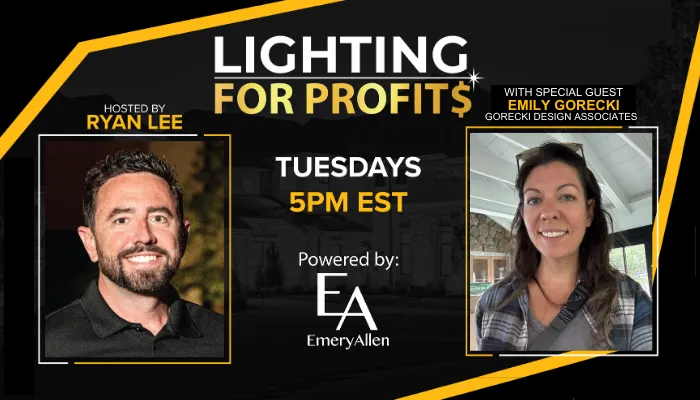
Emily Gorecki - Architected Light
Lighting for Profits - Episode 228
Emily is an Architectural and Landscape Lighting Designer with over 20 years in the industry and 13 years running her own solo practice. Specializing in high-end residential and hospitality projects, her work blends interior and landscape lighting to create intentional, award-winning spaces. A two-time AIA awardee, USGBC award winner, educator, and ILLI board member, Emily is passionate about advancing lighting design excellence through education and real-world experience.
Watch the episode
Episode Transcript
Welcome to Lighting for Profits. Here is your host, Ryan Lee
Welcome to Lighting for Profits. All light, All Light, All Light. Powered by EmeryAllen. Here is your host, Ryan Lee. Oh, light. All light, all light.
Welcome to the number one landscape lighting show in Camden, Maine
Welcome, welcome, welcome to the number one landscape lighting show in, Camden. Is it Camden? I think it's Camden, Maine. Yes, that's right. So it's the number one landscape lighting show in Camden, Maine. I can't believe it. You know, you could see the harbor from Camden. I mean it is the harbor. Looking forward to the show today if you're looking to start or grow a landscape lighting business. Honestly, I mean, I can't think of a better place. This is probably going to be the place where you want to end up. So super excited Today we've got Ms. Emily Gorecki with, with Gorecki Design Associates. And we were just chatting before. I'm really excited to have her on. This is going to be, an awesome episode because we're going to kind of dive into design, dive into her story, how she got to where she's at. and she's got her own business. She's does amazing work. Go check out her website. And then she's also on the board of illy, the International Landscape Lighting Institute. So kind of a big deal if you ask me. anyway, we're here to educate, we're here to motivate, to help you dominate. I want to help you grow your lighting business and I want to help you do it the right way.
Light It Up Expo is coming up March 3 through 6 in Orlando
And so a couple reminders before we get started. number one, Light It Up Expo. You know, if I say it fast, Light It Up Expo, then like my voice to text it says Lighted Up Expo. And it's not Lighted Up Expo, it's Light It Up Expo is coming up March 3 through 6. And it's starting to get a little bit of urgency. We got 35 days from whatever today is until the big show. And the, we have some pre show classes that are filling up. So there's a Landscape Lighting 1, a permanent lighting one and a holiday lighting class. The landscape lighting one is almost full. That one's our most popular one and it's almost full. So those are free, they're included with your ticket. But it's first come, first serve. So I hate to be the bear, bad news. But at some point it will fill up and you'll be like, yeah, but can you get me? And I'm like, no, you should have bought your ticket like last month. Right? So go to light it up expo. com, get your ticket and stop procrastinating Come hang out in Orlando. This is the gathering place for the outdoor lighting industry. Again. In just a few minutes, we got Emily Gorecki with Gorecki Design Associates, and we're going to be. We're going to be nerding out on lighting design. It's going to be an awesome, awesome, episode. It really is going to be good. You guys know me, dude, I. I go. I. I just go hard into the business stuff, right? Pricing, sales, marketing. that doesn't mean I don't love design. I love design. Like, the design is what makes it all work. Like, you light up a property and you're like, I did that. And your client's like, oh, my gosh, this is amazing. It makes me feel this way. And it reminds me of this. It reminds me of that. Like, we're literally changing people's lives through lighting design. So it's going to be an awesome show.
The last, uh, 12 months, maybe 18 months, have been difficult
before we have Emily on, I wanted to share something. I want to be a little bit vulnerable because, I'm very optimistic. Like, even if I'm having a bad day, I just put on a smile and I'm like, let's go. Even if life is hard, I'm like, it's okay. I'm happy. Right? Am I happy? But I just. I just choose to have a positive attitude. Okay? And, But that doesn't mean that I don't have a negative attitude sometimes. It doesn't mean that bad things don't happen to me. It doesn't mean that my life's not hard. Like, sometimes it's hard, sometimes it sucks. Right? And I want to share this, be a little bit vulnerable with you. The last, 12 months, maybe 18 months, they've been difficult. It's been hard. And, definitely the hardest part of growing this movement, landscape, lighting, secrets, Light It Up Expo, and some of the other things that we're working on. Right? and I want to explain why and kind of talk about what's going on. you see, when you start a business, the first part, even if it's, like, extremely difficult, it doesn't matter. It's the honeymoon phase of your business. You're like, even if it's hard, it's like, man, it's still. It's still sexy, it's still fun, it's new, you know, even if you're not making any money, it's just like, I don't know, it's different. It just fills a gap. It fills a need. And so I went through the honeymoon phase of Growing this business the first few years, right? But after a while, and maybe you, maybe you can relate. Like, after you start your business, after a while you're kind of like, okay, like, is this what I want to do? Like, it's starting to get either, like, kind of old or a little bit boring. You know, if you're really good at it, it's like, I don't know, it's. It becomes less challenging, right? Or you just hit rock bottom and you're, like, not making any money. I mean, there's several things that can happen there, right? And, I've been blessed to be able to do well financially. And so, like, that's not boring. But I knew a couple years ago that I was starting to kind of get comfortable. And I. And I hit this, like, again, just. I would just call it comfortable. And I wasn't quite getting bored, but I thought, I could see, like, if I stay on this trajectory, it's just not going to be sexy anymore. Right. And so, I knew that something had to change. So I decided that I needed to hire, my replacement in the sales position. Okay. And I actually, in the last, like I said, 12, maybe 18 months, I went through a few different people, going through this process. And I'm sharing this because it really. In hopes that I can help just one of you, with your recruiting, with your hiring, with your training, with your retaining of team members. Okay. And yeah, I mentioned there's kind of like four stages. It's not just hiring, it's not just recruiting. you don't forget about the training, don't forget about the retaining. Because just like a client, like, we do all this work to, like, attract clients to us. But just because you get a client doesn't mean you're going to keep a client. There's still work that needs to happen. There's a client journey in there, right? And the same thing is true with our team members. We bring on a team member, like, oh, we got them. They're. They're a great person and we're a great company. Well, that's just like half the battle.
Where I failed was the training and the retaining
You still need to train them, you still need to retain them. Like, what value are you giving to that relationship? and, when I went through this process to bring on a salesperson, I tried it all myself. I was like, oh, man, I've owned a ton of businesses. I've done this before. I've hired hundreds of people, like, whoop dee doo, right? And so I try it in house. And you Know what? I attracted good people. I feel like I did pretty dang good on the recruiting side and I feel like I did pretty decent on the hiring side. But where I failed was the training and the retaining. Okay? So I lacked some, I would call expertise. I lack some ability and process, in this existing business of mine, to be able to provide that value to these people. And again, these are great people. but finally, after going through this process and kind of getting fed up with my failure as a leader to put these things in place, I decided, you know what? I already know what to do. Why am I not doing this? So I decided to invest in hiring a firm to help me do what they do best. Just like, someone's gonna hire you, like, could they do their own lighting design? Could they go buy their own products? Yes. It's not like you're the only one that knows stuff. They could go to YouTube, they could buy their stuff. But are there going to be some failures for them along the way? Absolutely. Right? So it's like, duh, why, why am I not, like, taking my own advice here? So went ahead and, hired a firm. It was $16,000, okay? I spent 16 grand. And some people would be like, oh my gosh, that's such a ripoff. You're dumb. You're an idiot. I'm like, yeah, sometimes, but not always, okay? And so I hired a company and it wasn't just hiring like a recruiter to be like, oh, yeah, hey, we found a guy here, here's a guy. And then you just put him in your system. And then all of a sudden, again, I have my weaknesses of training and retaining. What's cool about this, this business that I invested in, this process, this system is, it's a system, okay? So we get the recruiter, we get the onboarding, we get the scripts. They pre screen these individuals. They basically interview people for you and tell you like, these are the top five, right? They provide coaching for me. They provide coaching for them. It's a system. All I did was invest in a system. And I just hired another person through this process. And so I'm confident that this $16,000 investment is going to be an investment. It's not going to be an expense. It's not like, oh man, now I'm going to make 16,000 less dollars, right? It's like, no, I have no problem investing in that because I know if, if my investment pays off that, that $16. 16,000. I wish it was $16, but the $16,000 is going to be worth 32, 64, 128, 256, 512. I don't know. Just keep doubling the numbers. My math only goes so far, guys.
The thing that held me back was, I don't have time
Okay, but honestly, throughout this process, I mean, a lot of ups and downs and. And honestly, like, the thing that held me back was the. The, thought the whole time is like, I don't have time. I don't have time to train someone. I don't have time to hire someone. I don't have time, blah, blah, blah. I just made excuses. And we all do that. We all make excuses because it's way easier to make an excuse than to actually take action and get uncomfortable and do something that you already probably know you should be doing in your business. You just haven't. Because it's easier not to, right? And when I pulled the trigger, the guy goes, all right, you know, he gave me, like, the sales pitch or whatever. He's like, all right, 16 grand. I'm like, all right, let's do it. And he's like, ah, all right, well, when do you want to get started? I'm like, I want to get started right now. He goes, well, I thought you said you had a conference coming up. I thought you said you had this and that and, like, all this stuff. I'm like, I do, but, like, you know, I could put this off forever or I could just do it. So it wasn't easy. I mean, these last couple of months have been extremely difficult. I put in, like, I've been working basically not every day. Okay. But most like five, at least five days a week, 7am to 10pm okay. And what I've been doing is re engineering my process to make sure that, like, I don't hire someone and be like, hey, here's a process. And, test it out for me. Because I don't want to ruin a good person by giving them a bad process. So I personally have been going through this, going through the scripts, getting on sales calls, testing things, and trying this and trying that. And so now I've worked out the kinks. And so I'm delivering a workable, proven process instead of one that I think will work. You know, delivering that to someone. Right? Because I've done it my way. And a lot of this was because my coach. My coach is like, no, you can't just hand them a broken system that you think might work. You're going to ruin a good individual. I'm like, yeah, good point. Like that. That one piece of advice might be worth $16,000, right? And so, it's been crazy, but, I'm excited because, like I said, I didn't want to hire a great person and then have them test out my process I think might work. But now I've proven it. I know it works like I've been doing it, and, like, it works. So, we'll be introducing you to you, here in the next little bit. I don't know if maybe we'll have them on the podcast. I don't know. but Joel is the newest member of Landscape Botting Secrets. So this is going to allow me to get back into my unique genius. It's going to allow me to do the things that, I'm more valuable at. Ah. Than just, like, onboarding people into our program. You know what I mean? And so I share that with you because if you're exhausted, you're frustrated, you're bored in your business, it's probably not because you're doing too much. I mean, maybe a little that. Right. But it's because you're doing the wrong things for too long. You know, you want to be, like, the hero. It's like, well, stop being the hero. replace yourself. And hiring isn't about finding the right person. I feel like a lot of times we find the right person, and if you pulled the trigger on someone, you thought they were the right person, but something else broke after that. It was the training or it was the retaining or the hiring, the onboarding. Like, there's all these different things. So it's not about finding the right person. It's really more about becoming the kind of business that the right person can succeed in. Okay. So until you build that, every hire that you make is going to feel like a gamble instead of an investment in your own growth. So hopefully, hopefully that helps someone. Like I said, it hasn't been easy. And who knows? Maybe Joel calls me tonight. He's like, hey, I quit. You suck. I, hope not. but I don't think that's the case because we've got a really awesome process. Right. So I'll keep you guys updated, as it goes through, but just want to be a little bit vulnerable.
Emory Allen makes premium LED lamps for lighting professionals who demand the best
Share that with you, like, if you want. Like, how bad do you really want what you say you want? Are you willing to go through some adversity? Are you willing to go through some pain? Because it's always easier to just sit on the couch. You know what I mean? but if you say you want this thing, this bigger business, this greater impact, whatever it is like, what are you willing to do? And what are you willing to give up? Are you willing to give up sitting on the couch? Are you willing to actually go through some pain? Because growth is always on the other side of pain. And, it's going to hurt. And it's crazy because then in your mind you're like, why am I doing this? It was easier. I should stop, right? So your, your conscious mind is telling you to stop. You have to really practice and condition these muscles so that you recognize that pain is like, oh, that means keep going. That means I'm growing. That means something good is about to happen. So hopefully that helps someone. let's see. Where's my, Oh, there it is. So listen, hey, if you like callbacks, angry clients and project do overs, well, then by all means, skip Emory Allen. But if you want your installs to look like a million bucks, well, you know what to do. Emory Allen makes premium LED lamps for lighting professionals who demand the best. Don't settle for less. Upgrade your designs and installations with Emory Allen. Reach out to tom g@emryallen .com. get hooked up with the discounted contractor pricing. All you need to do is mention that you heard about him here on Lighting for Profits, and he will hook you up. Just email tomgmryallen .com again, that's Tom Gmaryn.com. thank you, Emory Allen. And, go email him now and get hooked up.
Emily Gorecki joins us to talk about lighting design
All right, guys, I don't know about you, but, I've been hearing myself talk all day in my head. So I think it's time to get, Emily on the show. Let's get the, music going. Well, not with that one. Where is it? Oh, yeah. See, I told you, Emily, whatever you say can and will be used against you. Here we go. Welcome to the show, Ms. Emily Gorecki. What's up, Emily?
Hey. Not much. Not much. Just, unwinding after a long day saving the world in lighting design, you know?
Yes. Saving the world with lighting design. Is there. Has there been some, atrocities out there that you've had to go in and fix? lately?
Every day on different levels.
That's awesome. Well, thanks for joining me. I, I'm really looking forward to the conversation here. you know, this show, is for the community. Like, I love it because, like, it literally can help grow the industry so much. But there is also a part of me that's a little bit selfish because allows me to get to know people and pick, their brains and try to steal all their superpowers. So thanks for coming.
Thanks for having me.
Emily Grecki specializes in interior, landscape lighting design
Well, I guess maybe just do like a quick introduction of who you are, where you're from and what do you do.
Sure. So, my name is Emily Grecki. I am from M originally Connecticut, living in Maine, Camden, as you mentioned a couple minutes ago. and what I do is solely everything based on lighting design. And I mean everything from parking lots, sometimes, much to my chagrin, to like warehouses to homes. Residential is kind of like my specialty. interior, and landscape lighting design. But I would say at this point in time, my business is probably 60% interior lighting, 40% landscape lighting. on a lot of projects in the last 12 months, I've been lucky enough to do the house interior and the landscape lighting, which is new to me and it's a lot of fun to do, like, both aspects of it. And then maybe twice a year I get contracted to do some fun, like small hospitality space, whether that's like a restaurant or a library. I, was lucky enough to be part of a private high school project in Connecticut for a couple of years, which was a lot of fun. So I have a really diverse, really diverse background. And my line card, every day of phone calls that comes in is oftentimes like major diversity from not only like what project types I have, but also where we are in the project, like still planning, construction, after the fact, site aiming. So every day is something very different, which helps keep my brain focused, shockingly.
That's cool.
You've been in lighting design since you were 19
So how long have you been in lighting design?
That's a painful question. I have technically been in lighting design since I was 19. Just, just after my 19th birthday.
So that's really, that's cool. How did you even find out that it was a thing?
when I was in university for interior design, we had to take different design classes like textile design and furniture design. And one of the sessions that we were required to take was lighting design. And it was taught by a well, known residential lighting designer who when I handed in my final presentation, said to me, oh, you seem to kind of enjoy, you know, lighting design. And I'm like, yeah, okay, I guess so. I mean, I'm 19. I kind of am enjoying this again, like, diversity of learning everything about interior design. and he asked me to come to work for him. And, that was December of my 19th birthday.
Wow.
And, so I started working with him part time, cutting my teeth on like 50 to 60,000 square foot houses. Like, really fun stuff.
You're probably about 60% interior, 40% exterior lighting designer
So right now, you said six, probably about 60% interior, 40% exterior, and then there's lots of little subcategories along there. What's your favorite type of lighting to design or space?
It would still be, I would say, the high, level residential lighting design, and I'll say the interior and the landscape together, but mostly the interior lighting at this point is really where I tend to soar, because you get clients that sometimes want to spread their wings with creativity and, like, lean into, like, the interior architecture of their spaces and kind of do something that's, like, fun and avant garde, and I am, like, I'm there for it. So it's. It's definitely the way that I have the most fun.
So how often does that happen where you have a client that's just like, you know what? We don't know what we want because, you know, most people don't understand lighting design. They know. They know it's good when they've seen it. Maybe at a particular space, a, restaurant, hotel, or something like that, or maybe someone's house. But do they say, like, all right, like, just do it, or like, And then you. You come up with the budget for them? Like, how does that work?
it depends on the project. It really depends on the project. Sometimes the architect or the interior design team, usually the architect at most phases, has some level of, like, design intent that they are sharing with me. And then I'm able to say, hey, instead of this, what if we did something like this? And that's where, like, the best collaboration happens, is an architect that goes in and says, hey, we have this client, they're doing something totally different. We want to kind of push the envelope. Here are some sample images of things that I want to try to produce. What do you think? And then I take it and I say, what if we did this instead? And they usually. Hopefully, they'll, like, hop on board with that, and then we, like, run with it into this sunset together, like, happily. it's really that collaboration that works the best.
That's cool.
Yeah.
When did you start your own business? Thirteen and a half years ago
So, and. And when did you start your own business?
Thirteen and a half years ago. Thirteen years ago.
Okay.
I always remember because my dog is 13 years old, and I got him, like, six months into my business. So I sometimes look back at, like, puppy photos to remember what year it was. but it's just under 14 years.
Nice. Congrats. I mean, most businesses don't make it past year five. So, you know, you're doing something right.
Or I just keep telling myself that and letting the years tick by.
Well, no, that's awesome. And I've checked out your website. and it's awesome. Like, it's just really, really good. So when, like, when did you know that you, that you had something special, that you could do your own business and actually make it 13 years?
I don't know if I ever really did. I think that my distaste for, like, corporate America out, you know, kind of outweighed my want of struggling as a business owner and muddling through. so that kind of keeps me rumbling for a lot of it. And then probably like year, maybe like year seven, it was like, oh, this is second nature now. Like, at this point in time, it's pretty second nature to me to be on my own in my own business and, you know, jumping from project to project and diversifying myself.
If you go back to those early years, what was the hardest part? Getting started. I mean, you, I feel like now you've got, you know, relationships with architects and, you're probably getting referrals, which we can talk about, but, like, getting started, what did you do to build the business?
I mean, I still do a lot of what I did back in the early days. you know, every year I go through and I create myself like a little baby portfolio. It's probably less. I mean, I haven't probably done this now in maybe three to four years because I haven't really had to, thankfully. But I'll go through and create like a baby portfolio and like look up 10 architects that I really want to work with. I do this now more on like the landscape side of things. Trying to like, bring more business into the landscape fold a little bit more here. but I just send them like, hey, here's my portfolio. I'd love to connect, I'd love to like, reach out and collaborate with you guys. and early on, the biggest hurdle for me was I know that I didn't know everything. So, you know, I try to stay humble. Even like today, I try to stay very humble about things. But as like a baby designer, you know that you don't know everything. And a lot of that came from the fact that I started, after I worked with my mentor for many years, I went into corporate, like high level corporate, lighting design for a large international design firm. And you know, you there, you have the ranks, you have like a tech, you have a junior designer, you have a designer, you have a senior designer. And then if you're lucky, you have an associate over top of that and all those different layers you learn from, but you also realize, like, oh, I have like 10 people ahead of me that I have to try to become at some point. Like, that's the end goal is to become the associate. And so when you go off on your own. And at the time I was like a junior designer and I was like, ripped off on my own out of the corporate world of, like, corporate design, because it just wasn't my cup of tea, like large corporate design. but I knew from that how many layers of people there were ahead of me that I'm trying to now encompass as my own self, you know, so it. It was humbling. And I just, you know, I remember many nights like, I can't do this, like, panic attack, meltdowns internally. And then, you know, you just. You just do it. You just do it. And I wasn't afraid to say to a lot of people, like, I'm, you know, I'm mulling my way through some of this stuff. Like, I appreciate patience again, just like, staying humble with the process and learning from as many people as I can. those were definitely the early years. And now I'm at the point where I'm like, I got this seven years past my little. My little, you know, hump of feeling confident. Now things are smooth sailing for the most part.
So you. You promoted, you. You started your own business so you could promote yourself to associate. You're like, no, I'm essentially going for this.
Yeah, exactly. Yeah, essentially. I was like, I, like, jumped ship as a junior designer. And. And off I went. But it was also very different. Like in. When I left the. My. My corporate job, as a junior designer, I, you know, was working in, you know, we. We were doing corporate, America, like, headquarters, like large headquarter corporations, like what we call, like, starchitect, collaborations, like, with like, Frank Erie and Myelin Studios, like large architecture firms. So I kind of knew that, like, that wasn't the realm of design that I like to be in. I kind of like the residential side of things. So the pivot from where I was in the corporate world, like the corporate. Even like the large headquarter world, even though I was just a junior there. Translates easier on your own as a residential lighting designer because, you know, you're not dealing with sometimes like, large MEP firms right away as, like a baby, you know, residential lighting designer. I'm not coordinating with, you know, all these other people coming in and having impact on my designs. so it was not as tricky. You just have to stay humble.
Yeah, yeah, exactly.
You mentioned this baby portfolio that you used to do more of
You mentioned this baby portfolio that you used to do more of. What is that? What does that look like? How do you present that? How do you get that in front of people?
Yeah. So for me, that is diverse, drawing sets. So for me, if I'm reaching out to an interior architect, that, you know, not in charge, like regular architect, not landscape architect, it's. It's drawing sets. It's, drawing sets through different phases of design to show them that, like, I understand when you want a deliverable in schematics or I understand when you want a deliverable in construction documents. so it's, it's different layers of processes and phase, drawings. And then it's also some completed photos. Very few though, completed photos. and then lots of fixture schedules and load schedules, some dimming narratives, just again, to show them, like, competency. Here's my drawing sets. I know how to work with you guys. I know what your processes look like. This will be an easy fold in. and then now with landscape, it's much more visual. with landscape lighting, but again with landscape architects, it can be, hey, here are sample drawings that I've done. And with landscape, it can be as simple as a photo of a tree with some markup on it versus getting a full drafted autocad plan from someone. So I try to show a diversity of projects that I've worked on so that I don't, like, scare anybody away. but I'm showing that I can puddle hop into pretty much any project that someone hands me at this point.
Okay, cool.
Yeah.
When did you start getting into exterior lighting and landscape lighting
So you started your business, when do you remember? Like when did you actually start getting into more of the exterior lighting and landscape lighting?
It would have been 2010 when I first went through Italy.
oh, really? Okay. Yeah. And how'd you. Did you just like, find Jan's book or did you. How'd you find out about.
That's a really funny story. I was at the time working for Elliptipar, which is now the leading quotient, which is a lighting, manufacturer. And the fun part, quick segue about the lighting Quotient and Ellipticar is that it was founded by a gentleman named Sylvanar, Shemetz, and he was one of the original, I think 12. I could have that number wrong. Might be 11 lighting designers who hung their shingle out initially as like, we are lighting designers way back in the day. And then when he decided to go into fixture manufacturing to solve some design issues that he felt weren't being acknowledged by fixture manufacturers at the time he started to lift a par. And so it was kind of fun to be like in this working environment that had like these legacy lighting designers coming in and like this legacy name with it. but I worked there for just under four years, between like I was in college still and then half out of college for like a four year period. And what ended up happening was I got a call from my CEO and she said to me, hey, I'm going to this thing called the Landscape Lighting Institute. At the time it was just lli and she said, I want you to come with me. And I'm like, okay. Like, I don't know what this means. Okay, this is great, you know, so off, ah, we went to Troy, and I was just kind of like thrown into this. Literally. It was almost like overnight, like packer bags, we've got a room, we're going baby. And I'm like, okay. Because I'm adventurous enough for anything. And so that ended up being the course that I went through in 2010 with, along with her. And it's funny because like the 2010 landscape lighting session I think has like the most people still like in and involved with like.
Oh really?
Totally. Oh yeah. We're like, we were like the most passionate. I don't know.
That's where the legends were formed. 2010.
I mean, I mean probably three quarters of our group stayed involved with, with the, with everything for at least I would say six to eight years. If not, like, there's still some folks that are still active and heavily active with it. It was like the most retention rate. Yeah, yeah, but it was fun. Like I lived in Connecticut at the time and so I was an easy drive. It was only maybe two hours, just under two hours to Troy at that point. So I would go up, and you know, CJAN and whatnot, like between sessions to help out with documentation sometimes. And so yeah, that was like the leap in head first into the deep end.
That's way cool. I love it. So you just went there on a whim. I mean it's not like you're like, oh, I can't wait to get into that. And then you did what was impressive or what attracted you to it, what, helped you light up.
it's much more artistic than I can be on the interior environment. Like I have a very like nuts and bolts brain. I like things that are like mathematical and physics related with lighting. so like Part of me really geeks out, like, the engineering side or, like, the technical side of, like, integration in a house, and, like, aiming angles and making things fit and drawing details and sections. But on the outside, in, like, the landscape world, I can just, like, let it rip and be as fun and playful as I want to be. And nothing is really, really super permanent, unless we're talking about, like, hardscape lighting, then things are very permanent. But, like, you know, if I don't like where this uplight is because it's, you know, under a branch, and I underestimated it, I could just move the fixture a couple feet to the side and, you know, and fix it. So for me, landscape blending is much more fluid. It's more artistic. I like getting away from my computer and being in the dirt, and hanging out and being part of, like, the team and install. I love it. So it's. It's, like, where I have a lot of fun.
All right, admit it. Do you ever get to a project and someone has a fixture that's actually in the right spot, but you just want to get your hands dirty? You're like, move that two inches to the left.
No, because if someone is watching, who does landscape lighting installs for me, like, literally, I touch every fixture because I'm just ocd, but I'm like, oh, oh, oh, oh, oh. And it's like, you know, I feel bad because, like, the guys who are digging these fixtures in are looking at me like, you move that an inch. You know, it wasn't perfect. I have to touch every fixture just about on a project because I'm a little bit ocd, especially at night time. It's like, move that over three quarters of an inch. so, no, I. I pretty much get in there as much as I can.
I'm the same way. I used to go back and I would. We'd flag the job. I'm like, no, move that one inch. Like, oh, yeah, you crazy. I'm like, no, but look, explain why. Like, no, because you see the way that the branch is coming over. Like, we got to move it over here. It's gonna have a hot spot, whatever it is.
So, see, people say, are you crazy? And I'm like, yes, absolutely. Now move. Shoe shoot. Like, give me. Get out of my way.
Well, yeah, it's.
I want to talk about actually putting the designs together for interior lighting projects
It's interesting that you talk about that, because I feel like when you. I want to talk about actually putting the designs together, and I've never done interior lighting design, so correct me if I'm wrong. But you mentioned it's kind of like more mathematical and you know, like the exact like footprint and beam spread and all this stuff. And so you're like, okay, this is going to be two feet from the wall. And all this is like, it's perfect, it's controlled, like there's nothing going to change. Whereas, like, you can't say, like always put up lights 12 inches from a tree because that's there. There's no law that says that. It just doesn't work. Right. what was my question with that? Oh, I don't know. I think that most people that are listening to this, they don't. Sometimes they don't know, like, do I mark up a plan? Like, is that when the design happens or does this design happen like out in the field?
for me, it happens out in the field. So I do a really thorough layer of like infrastructure planning. And I always tell my clients that like, we, can plan zones, we can plan like, you know, basically transformers and stuff like that. I can kind of have an idea in my mind of like how many uplights I kind of am looking for around a tree based upon how big it is. But I am loosely placing fixtures on a plan and then when they get there, I am physically putting them in place, or flagging them if I have to once, I'm there on site. But my plans are pretty loosey goosey until I get them in the ground and night one happens. So for me, like, my documentation is pretty loose and then I end up doing like a really rock solid, like record documentation set that shows exactly where things are. You know, like, the great example of that is, on a project where all of a sudden, you know, the client decides to put in like a giant swing between a couple of trees at nighttime and doesn't tell me and it's like, oh, that's not lit at all. That'd be great to like that. And then we're like stealing fixtures from one location to kind of put in this other location. That's like a surprise design feature for us. and so my process progress sets, I should say, for fixture counts and for pricing and whatnot, are much more just fluid fixture counts, really. Fluid fixture counts, not location specific.
And so when you say fluid, meaning, like you, have a hundred spotlights, like, you'll go to the client and say, actually we, now that we're here, we see that we want to add a couple over here. You would do that or you try to stick within the actual budget.
Yeah, I Stick within it. Because what I do is when I have like a, a plan, whether that's like a drone footage or something like that, when I have like an over overview of it, I will go out on site and say, oh, this tree is really big. We need six up lights, four down lights, you know, two stake mounts, six well lights, whatever it is. And I'm just arbitrarily putting them on the plan around the tree. So I remember in my mind like, oh, this tree needs 10 up lights and you know, it might be half, well, half steak, whatever. and then when I'm there on site, my guys kind of locate them where the plan is. But then I'm really fine tuning it all and creating the lighting plane much more thoroughly when I'm there and everything's being installed before night one and everything's on.
That's awesome.
Yeah. Doing the walkabout helps me say, oh, here's a row of hedges. I need three fixtures per little hedge cluster in order to make it feel symmetric going down this whole driveway space. So I get there and I physically count them all, but they're quite arbitrary in the plan until you know, we do like a record document set.
And so when you're doing those designs and doing this walkabout, is that during the day or is that in the evening?
During the day.
Okay.
Yep.
Do you ever go back at night to aim?
Oh yeah. Oh yeah. The in my contracts that for every day that the install team is there installing, I'm there that night aiming. So if the install takes seven days, I'm there for six nights tweaking it consistently each of those nights.
That's awesome. Just as, as they go, you're like, turn on that zone, aim, adjust.
Yeah. Because also too like I might get into night three and all of a sudden half the rest of the landscape comes to life and I'm like, my light levels are too bright or like, oh, I'm not bright enough over there because now this set of lights is on. You know, it helps just break down the nighttime aiming. And plus one of the biggest things that I am always concerned about is like the, the I call like the, the nosy. not nosy, more like curious homeowners that want to see how it's going. And I'm like, no, no, no, no, please don't look at nothing is aimed. The shields aren't directed. Like please don't look. So to kind of prevent against some of that too. I try to keep up with when something's on. I want it to kind of be aimed and like, roughly where we want it to be. So if they come and walk outside when we're gone, they're not like, oh, I really don't know what the heck that woman is doing. She. This looks horrible. You know, which has happened before. Which has happened before. Not, not like that comment, but like the feedback the next day of all the clients came out at like midnight, one o', clock, eight, you know, in the morning and sent out an email that they were really happy with the way things looked. And I'm like. Because we spent the time. Night aiming it the first night.
Yeah, I guess that's what. That's. I've never done the aiming every night. I'm usually wait till the end because I'm fearful of those things. I don't have a problem sending a client in the house, but there is those things. it's dark over there. Like. Yeah, well, it's dark because we haven't turned on any lights.
Yep. Yeah. And I, you know, I, I'm more concerned with. Well, I'm less concerned with someone thinking like, an area is dark because hopefully they have the plan and they know, like, oh, there's fixtures going in there. I'm more concerned with them seeing the lights on and being unhappy with what they see because they're actually a foot off of where they should be or the shields aren't in the right direction. You know, that sort of scenario.
Yeah, yeah.
That always sticks in their mind, like when they see it and they don't love it the first time. Even like interior lighting, you know, they see it and it's not fully aimed yet, and you're like, no, please reserve judgment. But they always come back to it, like, oh, remember where we didn't like that fixture? Where was that one fixture? I'm like, it wasn't aimed, it wasn't placed properly. Like, erased it from the memory bank. Please.
I know.
Aiming down on lighting makes a huge difference in first impressions
Yeah. I mean, first impressions, you know.
Yes. Happens a lot in my interior, lighting. you know, when I have a bunch of adjustable down lights in a living room and they're all aiming down, it feels like a lobby of like a, you know, a hotel. We'll say. And then, you know, after I aim everything and the artwork all comes to. Kind of comes to life and the feeling of the room is very different. Clients are always saying to me, wow, we didn't realize what an impact aiming would have on the lighting on the inside of the house. So it's, it's critical.
Sometimes I'll get hired just to do a construction set
Do you Ever do any just designs and like, okay, you'll design something in California or not on site to aim and kind of project manager.
Yep. But not in landscape. Not in landscape. I won't, I won't take a project on that. I can't go and aim in landscape. But interior lies. yeah, I don't love that. But yeah, client. Sometimes I'll get hired just to do like a construction set, like a document set. And then it's up to the contractors and everybody to bring it through to fruition. And I don't ever get to see the project. Sadly, it doesn't happen as much anymore, I think because people realize that I don't love that process. So for some reason I don't like have those kinds of folks like reaching out to me a whole lot any longer. And but it happens, it probably happened earlier in my career where I got a lot of spec houses and you know, it's like, we don't need to worry about aiming these. No, there's no client yet. You know, don't worry about it. And I'm over here like panicking.
How would you recommend? So I know this happened to me. It happened to a lot of. Happens to a lot of people. They'll have an architect or in a landscape architect, usually they'll send over the plans and say, all right, give me a quote. This is for my client. And we know that that landscape architect does not understand lighting design. They might have like two up lights on a tree that needs like a lot of down lighting and more up lights and all that stuff.
It's either poorly designed or poorly specified. How would you recommend approaching that knowing that, you know, we don't have 14 years of experience and maybe I don't have another job coming up. Like I want to, I want to get this job. I want to impress the person, but I also don't want to do the project injustice. how would you recommend going about that?
So in that scenario, you are the design build team coming in.
Design build.
Okay. So you're the design build team coming in. You are handed a plan from a landscape architect that has some lighting on it and it's kind of wimpy. And you're looking at an idea of how to like bring that up with adding more fixtures in and like we need to look at some of this.
Yeah. And they already knowing that they. Unless they've got a specific fixture, brand and it's just not the right optics. All the stuff where you're like Man, I, I just want, like a blank slate. I don't want to lose this project because I know if I can impress him, then it can lead to more work. And then maybe once I get in with him, he'll listen to my ideas. So I don't want to offend him. That's. That's kind of the scenario.
I'm a big fan of the collaborative conceptual conversations, the ccc. Right. I just made that up, but it sounds good.
somewhere, what is the ccc?
Like, I just made that up, but it sounds good, so we'll go with that. And what happens is, when I come on to, like, a project, if there's already a basic lighting plan, which happens a lot, like on, the interior side of things, we do permit sets that go out for permitting, and sometimes those go out for pricing. And it's like, you know, two down lights in a room and a center ceiling fixture. And meanwhile, this client has like 30 million pieces of artwork everywhere. Like, that's not real realistic and it's not going to do the job. So coming into a project, if I had a landscape architect and I was positioning myself to be the design professional in the install, like just taking off the installer hat for a second and putting on the designer hat for a moment, I would probably ask them, you know, is there any ability to work through some concepts that might enhance the landscape that they have provided in plan? Because you are concerned for not just only, like, coverage, but also for, like, some cohesion and maybe some, you know, safety if there's stairs involved. And just generally speaking, like, is there a way to enhance some of the concepts that you have already produced? Landscape architect. and can we look at some other ideas and branch through this? And a lot of times they're like, yes, heaven. Like, thank God we don't want to do lighting design. Yes. Like, I just put something in here. They're really open to that. But I try to bridge that a little bit with saying to them, you know, can we possibly look at another avenue for products? Can we look at enhancing some, more concepts in here? Like, I'm noticing that maybe there's not as much uplighting happening on some of the trees that we probably would want. are you open to that conversation at all? Like adding some fixtures in or. I always love to say, are we married to the fixture schedule that's already here on this page? Because these are products that I wouldn't necessarily suggest for this application. And I'm wondering if you'd be open to Further suggestions. And I'm happy to bring fixture samples along. I'm happy to look at some, sample imagery. Like, maybe let's do a baby mock up if we have to, with something. If it's like a step light or a linear fixture in Hardscape. But they hear that kind of stuff usually. And does other designers really geek out with other designers? So, like, if I bring to the table to them, like, hey, can we touch this? Can we. Can we, you know, manipulate this design at all? Usually they are very willing to have conversation about that. Very willing.
Awesome.
It's always collaborative, like, can we do this
Thanks for sharing that.
Yeah. But it's always like, the collaborative, can we do this? You know what I mean? Can we look at further opportunities here? So. Because I don't want to exclude them for what they've done so far in the project. so I try to use a lot of, like, we statements to make him, you know, everybody understand that I'm not stepping on your toes. I want to work with you to bring out the best of the landscape that we possibly can.
I love that.
Collaborative communication opens door for design concept conversations with architects
Well said. All right, so wait, what? It was collab. Do you even remember what CCC stood for?
collaborative communication. No, collaborative. Conceptual communication. I think I said.
Yeah, well, rewind the tape, Rewind the tape. We're gonna have to figure this out later.
Conceptual. Collaborative communication, Something along those lines. But it's true, you know, I. I preach about this in, like, a lot of lectures that I give where, you know, you wouldn't want to say to a client, we're gonna put path lights on the stairs. It's more about saying to them, let's create a subtle, ah, illumination technique to give your stairs some not only safety for guests coming, but also to perhaps, like, you know, provide some level of texture on the stone that the steps might be. or, like, let's lean into the symmetry of the stairs or lean away from that, and let's look at something that's maybe more asymmetric so I don't get stuck on, like, fixture specific conversation. It's purely design concept conversation. And oftentimes that's, like, opens up the door for the collaborative conceptual conversation with my landscape architects.
That's awesome. The old ccc.
Using design language in presentations can help elevate your brand, says Illy
Well, that's one of the things I loved about Illy, or I love about Illy is like, because I. I think I'm a lot like, are, the people listening to this where it's just like, more just blue collar. Like, let's just put some path lights on the stairs. You know what I mean?
Why did you have an accent. When you said that, by the way. Can I just ask that question?
It's just because I go further south, you know, when I start talking in my blue collar, you know, it starts up north, and then he's more blue collar. Further south you go. So I don't know, because, I mean, I. My God. No, it worked for me. Like, why do I need to do this? But then it just. Like, when I went to Italy, my eyes were opened up to, like. And again, my vocabulary is just basic vocabulary. Like, I just. I don't normally think in terms of that, but you start surrounding yourself with people like yourself, and it's like, oh, wait, now all of a sudden, I'm starting to use some of that terminology, and that can just elevate your brand. And I'm so much about growing your business. There's lots of different ways, but this design language can help elevate it. And that. Just the way you describe that. I'm going to, like, go back and replay that, because that is a different conversation, like you said, than going to a landscape architect. And, like, can we put some different path lights on these steps? It was just totally different.
Yep. And I. I realized this because I went to school for design. We didn't really do a lot of conceptual conversation, but we started it. You know what I mean? Like, we started to talk about conceptual design. And even. Even at Elite, we talk about, like, the conceptual design process and how to describe it. And then we all get out there at the end of the event, and we're like. We put five path lights on microphones. We put five path lights on, you know, and, like, it all goes out the window. so it's kind of funny because, like, going back and. And just having, like, some makeup of my presentation.
Is that the one you were. You're making fun of mine? My. My man.
I have enough. I have. I have been a mentor so many times, and I have flubbed so many of, like, the introductions and just, like, discussion points myself, because back in the old days, we used to, like, light your face with, like, a microphone so there's somebody underneath you with, like, a headlamp, like, lighting.
Like.
Like creepily lighting up, lighting your face, and you couldn't see anybody in the audience. And I would just, like, have this anxiety moment, and I. Yes. And I would just start talking, and I was like, I have no idea what I would say. And it was the worst. And, like, this isn't representative of what I do in my real job or how I communicate in my real world world, I don't know. But I tried, though, sometimes to forecast, conversation pieces with folks. And it. You know, again, like, in one of my presentations that I had given, at one point, I gave, like, you know, bullet points. Like, this is what the contractor says. This is how a designer speaks about this. And coming up with, like, you know, just some sample conversation pieces to start thinking about things more like, a designer helps you also get out of, like, stuck in the contractor bucket and into the designer bucket, which is 10 out of 10 questions that I get is like, especially from a lot of, like, the design build teams, the Southern accents you were just talking about who, like, who come to me and say, we do install really well, but we can't figure out how to, like, segue into doing design better. How can. How can you help us? How can. How can I do this? You know, what advice do you have? And it's like, practice these conceptual conversations. You know, come up with a couple of pieces. I mean, there's only so many things you can say about lighting. I have to be honest with you about, like, balance and cohesion. You know.
Those are big words, and I learned a lot of them there. That's why I want to go back, because it's been a couple years. I'm like, okay, I forgot what cohesion is, and when do I say that? So, like, it is awesome, though. Like, it's. It's. The truth is, like, you are the average of the people that you. You hang around with. So that's just, That's like, a huge takeaway for me. going through the illy experience is like, you do leave with that, like, distinguished vocabulary, and it is awkward. I remember, like, practicing, like, my speech. I'm like, these people are gonna laugh at me because they. You can tell that, like, this isn't my normal language. Nine to five. you know, and I don't know.
Why I was just having this conversation with someone over the last week of, like, I have no idea why. When we're at Italy and we're doing, like, the client, like, the presentations, everything that we do in our own normal businesses and our own normal vocabulary goes out the window. And again, we're like. We put three up, lights on this tree. It's like, that's. That's not how we communicate in our businesses at all with clients or with. Or with, you know, with other design professionals. But here we are. I, don't know. It's so funny.
There's not a lot of lighting designers in the, in this country
Makes me chuckle.
Well, it's us. Yeah. Don't let us contractors, like, wear off on you guys. It's supposed to be the other way around.
You know, it's funny. I. I have a quick. I have a quick story about that that's really funny. So I, I was sitting at a dinner table with a couple of young gents from the south, at an. At an event like, last year at some point, and I asked them what they did, like, in the lighting world. Okay, so obviously landscape lighting, but what do you guys do? And they. They said to me, well, you know. Well, ma'. Am. And they're, you know, in a little Southern accents. Well, ma', am, we do permanent lighting. And I looked at them and I said, I don't know what that means, because everything that I do I thought was permanent. I don't. I don't know what permanent lighting means because I was. I'm, like, so far removed sometimes from, like, what's happening in, like, the holiday lighting and let's call it the permanent lighting channels.
I.
The table laughed because I was just like, I don't really know what that means, guys. I hear you, but I don't know what that means. Like, what is. I thought everything was permanent lighting, except it's holiday, obviously.
But, were people taking up their landscape lights and taking them with them? Is this not permanent? What's going on?
That sounds like. I don't know what this means. Permanent lighting.
That's awesome.
Yeah. Yeah, that was a good one. Yeah.
Well, you know, it's interesting because I think there's, Like, in your world, like, you have this journey, this, you know, this light design journey that's very. It came from corporate, and it's like. Like, I remember the first time learning that someone could do lighting design but not install it. I was like, what. How does that. Like, I don't even know what that means because a lot of. A lot of us on, the contractor side is like, well, you just go, like, knock a door, and they say they want landscape lighting, and then you just, like, go install it. And then you're a lot. You call yourself a lighting designer because, you know, sounds better than salesperson, but you're not really a lighting designer. You're just a lighting installer, right? And so there's like, these two worlds, I think, colliding, and I love it. I don't know. I don't know if the lighting design loves it or not, but I think it's awesome because there's these contractors that are hungry for more, and they, like, you, like, they told you, like, hey, we're good at, like, installing, but we want to elevate our, our designs because that's something that can totally differentiate yourself and get you into bigger and better projects too.
Yeah, I encourage it. I mean, there's not, there's not a lot of lighting designers in the, in this country. There's not. I mean, when I was in Connecticut, I think there were four of us. And now in Maine, I think there's five of us. Maybe four or five. I mean, it's. If you think of it, I have two interior designers in the building that I work in. I have three architects within a block of myself. You know, so it's like, it's like the lighting design community. We are. So we are in desperate need of, like, younger generation coming in behind us to, like, take the junior designer positions and start to learn, you know, from, you know, honestly, folks that are like my age that are at the point in their career where they kind of want to start investing in being like a mentor or at least having somebody else underneath them to help, you know, do some of the, the drafting and perhaps some of like, the fixture scheduling and whatnot. I mean, it's necessary. So I encourage as many people as possible to get involved in the lighting community. On the design side, there's also so many layers to it that not everybody has to float in the same layer of lighting design. There are so many minutiaes to the lighting design world. there's a spot for everybody. So I, I encourage it.
You know, I think it's interesting because like I said, at first it was like this foreign thing, and I. Now, I totally understand your business model, but if there's a, design build, you know, lighting contractor out there that wants to get it, get their foot in the door with you or someone like you in their area. Right? Because you, you just want to design it, but then you need to partner with someone that actually is going to install it to your specification and everything. What. How do they do that? How do they. How do they reach someone like yourself in their area to form a partnership?
I think it's going to. For me, it. That answer is probably going to be. It's the same as coordinating with any other designer that they want to try to get in touch with. You know, part of what's tricky is a lot of landscape lighting professionals that come from, like, traditional green channel market, like irrigation specialists that start doing lighting design and then want to move up through that, or people who just enter landscape Lighting as like the little silo of landscape lighting. there's not a lot of education and resources on how to collaborate with the traditional, I call it traditional like design field. So like in order for me to have collaborative efforts with an installer, I need somebody who understands the design process holistically. And I don't mean like pulling out a piece of paper, I mean like phases of design. I mean like where the roles are, where our boundaries are, how to communicate with people, how to reach out to other teams. You know, on some of the lighting projects that I'm on we might have an MEP firm because there's such insane heavy buried electrical components to a multi property, like multi structure property that there's an MEP from involved. So like having a build team that knows the questions to ask, when to ask it, when to ask for information and how to fold into the design process is critical. which is, which is much harder to find. It's much harder to find. you know, which is I think probably why a lot of designers sometimes end up hiring someone to partner with and like taking them under their umbrella because it's, there's not really a school that teaches that process unless you go and do a completely like sidebar design curriculum, ah, somewhere that shows you process. And I don't you know like going to go to persons for some kind of lighting design, you know, commercial lighting design or Berkeley. but like aside from that I don't really know of much that exists to introduce the folks that are in the silo of landscape lighting to how the process of design actually works.
Do you have one contractor that you work with when it comes to installation
So do you have like one specific contractor that you work with or do you have multiple when it comes to installation for.
Currently I have one. Currently I have one. So yeah. And I will say that that's mostly my New England based projects outside of New England. I mean I have to have others because I can't just, just like you know, plop people on a plane or like expect them to travel all over the place. So we'll see. I have a couple of projects that are more hardscapey in Florida right now that are happening. that's going to be interesting because it's, it's not really landscape but it's all low voltage work. it's hardscape kind of low voltage stuff. So yeah, yeah, I mean I like diversifying because you know, especially like the install side, you know, I'm, I'm, I'm pretty rigid in like my requirements. So I also know that, like, the. The marriage between the two has to be perfect.
Yeah. Make sure they're willing to put up with you.
Yeah, kind of. Yeah. Like, you know, it's funny. It's like, you know, hey, can you guys run a zoom call to go through with the contractors, the schedule? Like, some folks, like, whoa, you know, we don't, we don't know how to use zoom. And I'm like, oh, that's a barrier right there that I'm not really willing to deal with. You know, you can't figure out how to use zoom. you know, so, I mean, it's 20, 26. Like, come on.
Yeah, that's awesome.
You know, so, yeah, there are some barriers.
When you approach a landscape lighting project, you get an opportunity to design or whatever
So when you. When you approach a landscape lighting project, you get an opportunity to design or whatever. What, what are some of the kind of like, the basic lighting principles that you, I guess, subscribe to that you feel like everyone should kind of start with when starting a landscape lighting project?
When you say principles, what do you mean by principles specifically?
I guess, where do you start? What's going on in your mind? Are you thinking of, like, is that based on, like, what the customer tells you? Is it based on what you know is going to look best? Like,
Okay, so I guess, I guess for me, when I first get brought on to, like, a landscape lighting project, as far as principles are concerned, my very first. First thing which has nothing to do with principles is the infrastructure of it all and making sure that I have enough infrastructure or can add it before I even think about principles. Like, if I go into an existing landscape project and, you know, it's got, like, there's one right now that I'm working on, up here in Maine, and it has a barn up, a driveway, a little guest house, and then down the driveway there's the main house with gardens that wrap around, and it's on the ocean. And at the very top of the driveway, there's a giant rock with their name and, like, the house number on it. So I know that they have some basic layer of landscape lighting around the house. But if I can't get an infrastructure of power out to the end of the driveway, where that stone is that they want to light, I have to, like, back off on design principles until I know it's feasible. So for me, before I even, like, get involved with principles and, like, thinking conceptually about the lighting plan, it's, where can I run power to? What are they willing to spend the money on, and what do I have to cut from my concept to. Or. Or expand on my concept to make them happy within the constraints of infrastructure. So it becomes.
Okay, yeah, no, that makes sense. Does, does it, does that change? Like, will you, like, you. You got this vision of, like, hey, we should probably get some lighting out here. Will you tell them, like, hey, I want to get some lighting out here? Is it feasible to get power out here?
Yes. And so it's more. What it runs into is more like, you know, are we willing to pay somebody to trench up, you know, 150ft to the top of the driveway? You know, on a lot of the houses that I work on, they all have some level of home control system. Do you want to pay for a module to be added, or is this going to be a smart switch? Do you really want to have the integrator come back out again and update the system and add new loads on, or are we working within what's existing here right now? So it becomes like, I have to do a ground zero, you know, baseline infrastructure gathering session to even understand, like, what I can propose. but all the time when I'm, like, driving down the driveway the first time and I see, like, vignettes, it's kind of what I always am looking for is like, what is the vignette? When I'm coming down the driveway, is it the house and the beautiful, you know, 100-year-old, apple tree that's next to it and the ocean behind it? Like, what is the vignette? And then from there, then I start to go into, like, my principles in my mind, you know, I'm like, that would look killer uplift. I have stairs here. You know, I go into, like, safety. What needs. What needs to be lit versus what wants to be lit. Where's my safety? Where's my aesthetic? You know, I mean, where's my security? In a lot of cases, residentially, security is not really, like, the main leader. So it kind of gets punted to the side, you know, so it's like safety. Where are their stairs? How can I light them? How would that look? What is the layer of lighting look like? I don't really get into, like, brightness balancing or, focal, pointing until I actually have fixtures that are there, because that can be done with fine tuning brightness levels and whatnot and moving fixtures around while I'm on site. But it becomes like, what's the vignette? And I think the way that, you know, Jan, and Illy always has kind of preached it is like, what is the focal point. Like, you know, where are you? Where are your viewing angles from? But for me it's always like, what's the vignette? Where, where am I going to get like the most bang for their buck on landscape lighting, Maybe it's just 100 year old Apple tree and then making sure like their stairs are lit and trying to do some downloading from that. So it's always the principles are conceptually, what do I want to illuminate, what do I have to eliminate for like secure, for safety. And then you back into what is in my toolbox to make this happen. Like In Lighting Design 101, we're always taught like day one of lighting design in our classes. it's never I have up lights from this manufacturer that I need to use because I like them. It's what exactly conceptually am I trying to do? Am I trying to get like soft up lighting layers? Am I trying to get, get well lights? Do I need to use stake mounts? It's like, what am I trying to do? Then what in my toolbox will get me there to achieve the effect that I'm looking for? So it's always the concept first and then the physical mechanics behind it after the fact of like fix your types and manufacturers m and all that kind of stuff.
I love that. I think the contractor mind is the opposite. More like, okay, I have these tools now what can I do instead of saying like, here's the conceptual design now which tools should I use to design? So I love that. and I love how you actually explained it, I think, because that's how my mind thinks too. It's like I'm just thinking of a vignette. I don't naturally think, okay, now where's the focal point and then what brightness layers and like, what about balance and what about depth? Like, I'm just not leading with those things. I think at some point they kind of reveal themselves as you reverse engineer the plan. But I think that's helpful for me at least because I feel like, oh, crap, I'm not a good lighting designer because I didn't lead with balance and I didn't lead with depth or the focal point or the light levels or whatever. So I think that's cool how you explain that.
Yeah. And also too, I mean, focal points sometimes become apparent. Like if I go down someone's driveway and they have a statue, I'm like, okay, there's a focal point. You know what I mean? But if it's like a, what I call, like A normal home that doesn't have any outdoor artwork, let's say it's much harder to sometimes to find the focal point. And so I'm less about the focal point and more just about like what is the vignette and also like what is the usability. You know, a lot of times in, especially in Maine, all of my properties out here are oceanfront. So it's like, okay, a lot of my clients have boats, they're coming in at night time or they're viewing from sometimes like the ocean side or from like a dock, they're hanging out at the end of the dock where they might have like a sitting area. So it becomes more along the lines of like what is the user space when I'm in the space. Which is also different for sometimes landscape lighting where I'm oftentimes like just viewing it from perhaps like the pool or I'm m doing it from inside the house outward. I also have to think a lot about like when I'm in the space, how does it make me feel? or how do I create like fun layers about, you know, being in the landscape, interacting with it at that time through, you know, the, the months where the sun is down low enough to enjoy it.
I know that that's what's tough because like when you do the, the, the reveal project at Eli, I mean it's, it's, you know, you've got some shielding on there that's like, okay. But if I walk through the space, of course I'll get glare at that point. So I mean, how much of that goes through your mind as you're like, well, I mean, obviously from the back patio, that's like my primary viewing angle. But when you're out there, is it okay to have a little glare? You're just not going to like submit that photo for the contest, right?
In landscape lighting, being honest with clients is key
Yeah. And I mean, you know, I, I bring those realities up with the clients. Like, you know, right now the viewing, the, the, the greater perspective is from your office with your floor to ceiling window looking out. It is not when you're walking outside past the window at nighttime because we will see into the of fixtures at that point. You know, so it's being honest with them about like, hey, this is, this is my main intent. And if we go outside those main intent parameters, you will see fixtures at some point. But I've also gotten like super bougie with like, you know, custom painted interior shrouds and all this kind of stuff to make as minimal as possible. It's what Happens when you're a lighting designer and you're, like, really into it. You're just like, hey, let's. Let's make this. Hey, can you guys do this instead? You know, I'm not afraid to ask questions of manufacturers and. And get some fun things up and moving, you know, and it's also you mentioned before that, like, a lot of the contractor bubble tends to go from, like, the product first because it's what they know. That's also the hard part, though, is, like, in the landscape lighting realm, I always encourage people to get really involved with other, manufacturers that don't necessarily, like, you won't see at a traditional distributorship, because there's a lot of manufacturers that I see from interior lighting that also make, like, landscape lines or outdoor lines or outdoor, like, wet location products that are really bloody awesome. And, you know, a lot of times I feel bad because, like, the vertical of landscape lighting doesn't make themselves accessible to knowing those products even exist. So, you know, it's kind of hard because sometimes I get a phone call from someone and they'll say, do you know anybody who does this? And I'm like, yeah, look at so and so. And they're like, well, I never knew that this even existed. And m. I'm like, yeah, because there's a big world of lighting out there. Big world of light.
I love. I love the boosh. Yeah. If you want to get bougie, follow Emily's. I love it. So,
Would you come back on again to talk about lighting design
All right, well, by the way, I've got about 50 million more questions, so, we're. But we're not going to keep going. We're. We're gonna. We're gonna. We're gonna pause here, but I want to have you back. Would you come back on again? We can talk lighting design.
I will talk to the wall about lighting. So, you know, love it. I'll talk to anybody about lighting. I mean, like, you know.
Yeah, I mean, we actually have an audience. You don't even have to talk to the wall. It should be. It should be cool.
Are you launching or do you already have some educational sessions for people
So, I have a note here. Like, you have. Are you launching or do you already have some educational, like, sessions and opportunities that you have for people?
Kind of. It's been rumbling in my mind, and I would be very open to this because it's something that I get questioned on a lot after I do a presentation somewhere is usually some of, like, the landscape lighting folks come to me and say, how do I learn more about, like, the process that seems to be like, the trigger word for a lot of folks is like, how do I upgrade the process to do bigger designs? Like, better? And a lot of, like, their words are like, better designs, bigger designs. How do I work with other design professionals, again, like landscape architects and folks like that, or regular architects doing landscaping? and so it's been something that's kind of been rumbling is like, okay, you know, am I going to go out on a limb here and do some kind of, like, educational session at some point to walk people through these processes a little bit more? So it's rumbling, it's in the background and it's rumbling. But I keep getting questions after every Ilia. I probably have, like, five or six people that come up to me and say, where can I learn more about this? And I'm like, nowhere really right now. Sadly, it doesn't really exist.
You should just ask me whatever question you have now because my flight's leaving in three hours.
Yeah, sadly, sadly, sadly. And it's like, oh, where can I learn how to do, you know, this level of drawing? Or, where can I learn how to do better conceptual conversations with clients? And it's like, oh, God, that kind of education doesn't really exist. And it doesn't for, like, the residential world in general. Like, a lot of residential lighting designers on the interior side start out in theatrical lighting because the practices of theatrical lighting are very similar for, like, art lighting and backgrounds and focusing and whatnot. like, again, I mentioned, like, persons, I think Berkeley, they all have lighting programs, but they tend to be focused, from what I understand, more in the commercial world, more in, like, commercial lighting design, and less in, like, the residential realm. So it's really hard to learn residential lighting design unless you have a diverse background or you have a really good mentor, kind of leading you through that.
Yeah, yeah. Very cool. this literally just happened today. I got a call. So I live literally 20 minutes away from BYU, university, and they just started in January, a required class on landscape lighting.
Oh, that's phenomenal.
And I'm like, what? Like, this is insane. And so I'm going to talk to them and see how I can get involved and get the design community. I'm sure I'll be reaching out to you, so it's just cool that I'm like, what? A university has a landscape body class?
So awesome.
It just, like, made my day and I'm like, right here, so I could totally go help and stuff like that.
So, yeah, I taught lighting design at my. From the, my alma mater. I Taught their lighting design class. After my mentor retired from teaching, I took that on. So I taught for them. I think it was, like, six or seven years. Six years? Yeah. And then there was another university in Connecticut that I taught for. It was like a. An LED retrofit class for, like, a bunch of, like, electricians and guys that were just going in and doing, like, the energy retrofits and how to. How to tell if the LED retrofits were good quality and how to make the spaces not suck when they replaced them with LED lighting. And that was years ago when, like, we were still a little bit of, like, a mindset field of LED retrofit lighting, and retrofit bulbs and stuff. So I love to teach. When I moved to Maine, it was one of the things that I missed is that there's not a program around here. We have architecture programs, but they don't teach lighting. And I'm like, you've got to be kidding me. It's like, really not even, like, not even, like, a semester, so it's imperative, so. Good. I'm glad to hear that that BYU is stepping up and doing some lighting education, because they should.
Yeah, it's pretty cool. So I'll keep you posted and let you know what happens.
cool.
Well, so if people want to get a hold of you, what's the best way to. To reach out?
Oh, God, I had no idea. probably, probably through my carrier, pigeon. smoke signals are pretty good these days. No, I'm just kidding. they can go to my website, you know, Greky Design Associates. com. you can find my, email address there. My cell phone number, you know, I'm pretty sure accessible.
Okay, that's awesome. Well, Emily, thank you so much for joining me.
Ah.
And I learned a lot. I hope other people were taking notes. And if you guys didn't take something away, well, that's your problem, Emily. You totally delivered. I really appreciate you coming on the show, and we'll definitely have you back.
No problem. Thanks, Ryan. Thanks, everybody.
All right, guys, go to Gorecky Design Associates. com, check out our work, and, pay attention. We'll be announcing the future classes that she's teaching whenever that happens. See you guys.
Emily Gorecki - Architected Light
Lighting for Profits - Episode 228
Emily is an Architectural and Landscape Lighting Designer with over 20 years in the industry and 13 years running her own solo practice. Specializing in high-end residential and hospitality projects, her work blends interior and landscape lighting to create intentional, award-winning spaces. A two-time AIA awardee, USGBC award winner, educator, and ILLI board member, Emily is passionate about advancing lighting design excellence through education and real-world experience.
Watch the episode
Episode Transcript
Welcome to Lighting for Profits. Here is your host, Ryan Lee
Welcome to Lighting for Profits. All light, All Light, All Light. Powered by EmeryAllen. Here is your host, Ryan Lee. Oh, light. All light, all light.
Welcome to the number one landscape lighting show in Camden, Maine
Welcome, welcome, welcome to the number one landscape lighting show in, Camden. Is it Camden? I think it's Camden, Maine. Yes, that's right. So it's the number one landscape lighting show in Camden, Maine. I can't believe it. You know, you could see the harbor from Camden. I mean it is the harbor. Looking forward to the show today if you're looking to start or grow a landscape lighting business. Honestly, I mean, I can't think of a better place. This is probably going to be the place where you want to end up. So super excited Today we've got Ms. Emily Gorecki with, with Gorecki Design Associates. And we were just chatting before. I'm really excited to have her on. This is going to be, an awesome episode because we're going to kind of dive into design, dive into her story, how she got to where she's at. and she's got her own business. She's does amazing work. Go check out her website. And then she's also on the board of illy, the International Landscape Lighting Institute. So kind of a big deal if you ask me. anyway, we're here to educate, we're here to motivate, to help you dominate. I want to help you grow your lighting business and I want to help you do it the right way.
Light It Up Expo is coming up March 3 through 6 in Orlando
And so a couple reminders before we get started. number one, Light It Up Expo. You know, if I say it fast, Light It Up Expo, then like my voice to text it says Lighted Up Expo. And it's not Lighted Up Expo, it's Light It Up Expo is coming up March 3 through 6. And it's starting to get a little bit of urgency. We got 35 days from whatever today is until the big show. And the, we have some pre show classes that are filling up. So there's a Landscape Lighting 1, a permanent lighting one and a holiday lighting class. The landscape lighting one is almost full. That one's our most popular one and it's almost full. So those are free, they're included with your ticket. But it's first come, first serve. So I hate to be the bear, bad news. But at some point it will fill up and you'll be like, yeah, but can you get me? And I'm like, no, you should have bought your ticket like last month. Right? So go to light it up expo. com, get your ticket and stop procrastinating Come hang out in Orlando. This is the gathering place for the outdoor lighting industry. Again. In just a few minutes, we got Emily Gorecki with Gorecki Design Associates, and we're going to be. We're going to be nerding out on lighting design. It's going to be an awesome, awesome, episode. It really is going to be good. You guys know me, dude, I. I go. I. I just go hard into the business stuff, right? Pricing, sales, marketing. that doesn't mean I don't love design. I love design. Like, the design is what makes it all work. Like, you light up a property and you're like, I did that. And your client's like, oh, my gosh, this is amazing. It makes me feel this way. And it reminds me of this. It reminds me of that. Like, we're literally changing people's lives through lighting design. So it's going to be an awesome show.
The last, uh, 12 months, maybe 18 months, have been difficult
before we have Emily on, I wanted to share something. I want to be a little bit vulnerable because, I'm very optimistic. Like, even if I'm having a bad day, I just put on a smile and I'm like, let's go. Even if life is hard, I'm like, it's okay. I'm happy. Right? Am I happy? But I just. I just choose to have a positive attitude. Okay? And, But that doesn't mean that I don't have a negative attitude sometimes. It doesn't mean that bad things don't happen to me. It doesn't mean that my life's not hard. Like, sometimes it's hard, sometimes it sucks. Right? And I want to share this, be a little bit vulnerable with you. The last, 12 months, maybe 18 months, they've been difficult. It's been hard. And, definitely the hardest part of growing this movement, landscape, lighting, secrets, Light It Up Expo, and some of the other things that we're working on. Right? and I want to explain why and kind of talk about what's going on. you see, when you start a business, the first part, even if it's, like, extremely difficult, it doesn't matter. It's the honeymoon phase of your business. You're like, even if it's hard, it's like, man, it's still. It's still sexy, it's still fun, it's new, you know, even if you're not making any money, it's just like, I don't know, it's different. It just fills a gap. It fills a need. And so I went through the honeymoon phase of Growing this business the first few years, right? But after a while, and maybe you, maybe you can relate. Like, after you start your business, after a while you're kind of like, okay, like, is this what I want to do? Like, it's starting to get either, like, kind of old or a little bit boring. You know, if you're really good at it, it's like, I don't know, it's. It becomes less challenging, right? Or you just hit rock bottom and you're, like, not making any money. I mean, there's several things that can happen there, right? And, I've been blessed to be able to do well financially. And so, like, that's not boring. But I knew a couple years ago that I was starting to kind of get comfortable. And I. And I hit this, like, again, just. I would just call it comfortable. And I wasn't quite getting bored, but I thought, I could see, like, if I stay on this trajectory, it's just not going to be sexy anymore. Right. And so, I knew that something had to change. So I decided that I needed to hire, my replacement in the sales position. Okay. And I actually, in the last, like I said, 12, maybe 18 months, I went through a few different people, going through this process. And I'm sharing this because it really. In hopes that I can help just one of you, with your recruiting, with your hiring, with your training, with your retaining of team members. Okay. And yeah, I mentioned there's kind of like four stages. It's not just hiring, it's not just recruiting. you don't forget about the training, don't forget about the retaining. Because just like a client, like, we do all this work to, like, attract clients to us. But just because you get a client doesn't mean you're going to keep a client. There's still work that needs to happen. There's a client journey in there, right? And the same thing is true with our team members. We bring on a team member, like, oh, we got them. They're. They're a great person and we're a great company. Well, that's just like half the battle.
Where I failed was the training and the retaining
You still need to train them, you still need to retain them. Like, what value are you giving to that relationship? and, when I went through this process to bring on a salesperson, I tried it all myself. I was like, oh, man, I've owned a ton of businesses. I've done this before. I've hired hundreds of people, like, whoop dee doo, right? And so I try it in house. And you Know what? I attracted good people. I feel like I did pretty dang good on the recruiting side and I feel like I did pretty decent on the hiring side. But where I failed was the training and the retaining. Okay? So I lacked some, I would call expertise. I lack some ability and process, in this existing business of mine, to be able to provide that value to these people. And again, these are great people. but finally, after going through this process and kind of getting fed up with my failure as a leader to put these things in place, I decided, you know what? I already know what to do. Why am I not doing this? So I decided to invest in hiring a firm to help me do what they do best. Just like, someone's gonna hire you, like, could they do their own lighting design? Could they go buy their own products? Yes. It's not like you're the only one that knows stuff. They could go to YouTube, they could buy their stuff. But are there going to be some failures for them along the way? Absolutely. Right? So it's like, duh, why, why am I not, like, taking my own advice here? So went ahead and, hired a firm. It was $16,000, okay? I spent 16 grand. And some people would be like, oh my gosh, that's such a ripoff. You're dumb. You're an idiot. I'm like, yeah, sometimes, but not always, okay? And so I hired a company and it wasn't just hiring like a recruiter to be like, oh, yeah, hey, we found a guy here, here's a guy. And then you just put him in your system. And then all of a sudden, again, I have my weaknesses of training and retaining. What's cool about this, this business that I invested in, this process, this system is, it's a system, okay? So we get the recruiter, we get the onboarding, we get the scripts. They pre screen these individuals. They basically interview people for you and tell you like, these are the top five, right? They provide coaching for me. They provide coaching for them. It's a system. All I did was invest in a system. And I just hired another person through this process. And so I'm confident that this $16,000 investment is going to be an investment. It's not going to be an expense. It's not like, oh man, now I'm going to make 16,000 less dollars, right? It's like, no, I have no problem investing in that because I know if, if my investment pays off that, that $16. 16,000. I wish it was $16, but the $16,000 is going to be worth 32, 64, 128, 256, 512. I don't know. Just keep doubling the numbers. My math only goes so far, guys.
The thing that held me back was, I don't have time
Okay, but honestly, throughout this process, I mean, a lot of ups and downs and. And honestly, like, the thing that held me back was the. The, thought the whole time is like, I don't have time. I don't have time to train someone. I don't have time to hire someone. I don't have time, blah, blah, blah. I just made excuses. And we all do that. We all make excuses because it's way easier to make an excuse than to actually take action and get uncomfortable and do something that you already probably know you should be doing in your business. You just haven't. Because it's easier not to, right? And when I pulled the trigger, the guy goes, all right, you know, he gave me, like, the sales pitch or whatever. He's like, all right, 16 grand. I'm like, all right, let's do it. And he's like, ah, all right, well, when do you want to get started? I'm like, I want to get started right now. He goes, well, I thought you said you had a conference coming up. I thought you said you had this and that and, like, all this stuff. I'm like, I do, but, like, you know, I could put this off forever or I could just do it. So it wasn't easy. I mean, these last couple of months have been extremely difficult. I put in, like, I've been working basically not every day. Okay. But most like five, at least five days a week, 7am to 10pm okay. And what I've been doing is re engineering my process to make sure that, like, I don't hire someone and be like, hey, here's a process. And, test it out for me. Because I don't want to ruin a good person by giving them a bad process. So I personally have been going through this, going through the scripts, getting on sales calls, testing things, and trying this and trying that. And so now I've worked out the kinks. And so I'm delivering a workable, proven process instead of one that I think will work. You know, delivering that to someone. Right? Because I've done it my way. And a lot of this was because my coach. My coach is like, no, you can't just hand them a broken system that you think might work. You're going to ruin a good individual. I'm like, yeah, good point. Like that. That one piece of advice might be worth $16,000, right? And so, it's been crazy, but, I'm excited because, like I said, I didn't want to hire a great person and then have them test out my process I think might work. But now I've proven it. I know it works like I've been doing it, and, like, it works. So, we'll be introducing you to you, here in the next little bit. I don't know if maybe we'll have them on the podcast. I don't know. but Joel is the newest member of Landscape Botting Secrets. So this is going to allow me to get back into my unique genius. It's going to allow me to do the things that, I'm more valuable at. Ah. Than just, like, onboarding people into our program. You know what I mean? And so I share that with you because if you're exhausted, you're frustrated, you're bored in your business, it's probably not because you're doing too much. I mean, maybe a little that. Right. But it's because you're doing the wrong things for too long. You know, you want to be, like, the hero. It's like, well, stop being the hero. replace yourself. And hiring isn't about finding the right person. I feel like a lot of times we find the right person, and if you pulled the trigger on someone, you thought they were the right person, but something else broke after that. It was the training or it was the retaining or the hiring, the onboarding. Like, there's all these different things. So it's not about finding the right person. It's really more about becoming the kind of business that the right person can succeed in. Okay. So until you build that, every hire that you make is going to feel like a gamble instead of an investment in your own growth. So hopefully, hopefully that helps someone. Like I said, it hasn't been easy. And who knows? Maybe Joel calls me tonight. He's like, hey, I quit. You suck. I, hope not. but I don't think that's the case because we've got a really awesome process. Right. So I'll keep you guys updated, as it goes through, but just want to be a little bit vulnerable.
Emory Allen makes premium LED lamps for lighting professionals who demand the best
Share that with you, like, if you want. Like, how bad do you really want what you say you want? Are you willing to go through some adversity? Are you willing to go through some pain? Because it's always easier to just sit on the couch. You know what I mean? but if you say you want this thing, this bigger business, this greater impact, whatever it is like, what are you willing to do? And what are you willing to give up? Are you willing to give up sitting on the couch? Are you willing to actually go through some pain? Because growth is always on the other side of pain. And, it's going to hurt. And it's crazy because then in your mind you're like, why am I doing this? It was easier. I should stop, right? So your, your conscious mind is telling you to stop. You have to really practice and condition these muscles so that you recognize that pain is like, oh, that means keep going. That means I'm growing. That means something good is about to happen. So hopefully that helps someone. let's see. Where's my, Oh, there it is. So listen, hey, if you like callbacks, angry clients and project do overs, well, then by all means, skip Emory Allen. But if you want your installs to look like a million bucks, well, you know what to do. Emory Allen makes premium LED lamps for lighting professionals who demand the best. Don't settle for less. Upgrade your designs and installations with Emory Allen. Reach out to tom g@emryallen .com. get hooked up with the discounted contractor pricing. All you need to do is mention that you heard about him here on Lighting for Profits, and he will hook you up. Just email tomgmryallen .com again, that's Tom Gmaryn.com. thank you, Emory Allen. And, go email him now and get hooked up.
Emily Gorecki joins us to talk about lighting design
All right, guys, I don't know about you, but, I've been hearing myself talk all day in my head. So I think it's time to get, Emily on the show. Let's get the, music going. Well, not with that one. Where is it? Oh, yeah. See, I told you, Emily, whatever you say can and will be used against you. Here we go. Welcome to the show, Ms. Emily Gorecki. What's up, Emily?
Hey. Not much. Not much. Just, unwinding after a long day saving the world in lighting design, you know?
Yes. Saving the world with lighting design. Is there. Has there been some, atrocities out there that you've had to go in and fix? lately?
Every day on different levels.
That's awesome. Well, thanks for joining me. I, I'm really looking forward to the conversation here. you know, this show, is for the community. Like, I love it because, like, it literally can help grow the industry so much. But there is also a part of me that's a little bit selfish because allows me to get to know people and pick, their brains and try to steal all their superpowers. So thanks for coming.
Thanks for having me.
Emily Grecki specializes in interior, landscape lighting design
Well, I guess maybe just do like a quick introduction of who you are, where you're from and what do you do.
Sure. So, my name is Emily Grecki. I am from M originally Connecticut, living in Maine, Camden, as you mentioned a couple minutes ago. and what I do is solely everything based on lighting design. And I mean everything from parking lots, sometimes, much to my chagrin, to like warehouses to homes. Residential is kind of like my specialty. interior, and landscape lighting design. But I would say at this point in time, my business is probably 60% interior lighting, 40% landscape lighting. on a lot of projects in the last 12 months, I've been lucky enough to do the house interior and the landscape lighting, which is new to me and it's a lot of fun to do, like, both aspects of it. And then maybe twice a year I get contracted to do some fun, like small hospitality space, whether that's like a restaurant or a library. I, was lucky enough to be part of a private high school project in Connecticut for a couple of years, which was a lot of fun. So I have a really diverse, really diverse background. And my line card, every day of phone calls that comes in is oftentimes like major diversity from not only like what project types I have, but also where we are in the project, like still planning, construction, after the fact, site aiming. So every day is something very different, which helps keep my brain focused, shockingly.
That's cool.
You've been in lighting design since you were 19
So how long have you been in lighting design?
That's a painful question. I have technically been in lighting design since I was 19. Just, just after my 19th birthday.
So that's really, that's cool. How did you even find out that it was a thing?
when I was in university for interior design, we had to take different design classes like textile design and furniture design. And one of the sessions that we were required to take was lighting design. And it was taught by a well, known residential lighting designer who when I handed in my final presentation, said to me, oh, you seem to kind of enjoy, you know, lighting design. And I'm like, yeah, okay, I guess so. I mean, I'm 19. I kind of am enjoying this again, like, diversity of learning everything about interior design. and he asked me to come to work for him. And, that was December of my 19th birthday.
Wow.
And, so I started working with him part time, cutting my teeth on like 50 to 60,000 square foot houses. Like, really fun stuff.
You're probably about 60% interior, 40% exterior lighting designer
So right now, you said six, probably about 60% interior, 40% exterior, and then there's lots of little subcategories along there. What's your favorite type of lighting to design or space?
It would still be, I would say, the high, level residential lighting design, and I'll say the interior and the landscape together, but mostly the interior lighting at this point is really where I tend to soar, because you get clients that sometimes want to spread their wings with creativity and, like, lean into, like, the interior architecture of their spaces and kind of do something that's, like, fun and avant garde, and I am, like, I'm there for it. So it's. It's definitely the way that I have the most fun.
So how often does that happen where you have a client that's just like, you know what? We don't know what we want because, you know, most people don't understand lighting design. They know. They know it's good when they've seen it. Maybe at a particular space, a, restaurant, hotel, or something like that, or maybe someone's house. But do they say, like, all right, like, just do it, or like, And then you. You come up with the budget for them? Like, how does that work?
it depends on the project. It really depends on the project. Sometimes the architect or the interior design team, usually the architect at most phases, has some level of, like, design intent that they are sharing with me. And then I'm able to say, hey, instead of this, what if we did something like this? And that's where, like, the best collaboration happens, is an architect that goes in and says, hey, we have this client, they're doing something totally different. We want to kind of push the envelope. Here are some sample images of things that I want to try to produce. What do you think? And then I take it and I say, what if we did this instead? And they usually. Hopefully, they'll, like, hop on board with that, and then we, like, run with it into this sunset together, like, happily. it's really that collaboration that works the best.
That's cool.
Yeah.
When did you start your own business? Thirteen and a half years ago
So, and. And when did you start your own business?
Thirteen and a half years ago. Thirteen years ago.
Okay.
I always remember because my dog is 13 years old, and I got him, like, six months into my business. So I sometimes look back at, like, puppy photos to remember what year it was. but it's just under 14 years.
Nice. Congrats. I mean, most businesses don't make it past year five. So, you know, you're doing something right.
Or I just keep telling myself that and letting the years tick by.
Well, no, that's awesome. And I've checked out your website. and it's awesome. Like, it's just really, really good. So when, like, when did you know that you, that you had something special, that you could do your own business and actually make it 13 years?
I don't know if I ever really did. I think that my distaste for, like, corporate America out, you know, kind of outweighed my want of struggling as a business owner and muddling through. so that kind of keeps me rumbling for a lot of it. And then probably like year, maybe like year seven, it was like, oh, this is second nature now. Like, at this point in time, it's pretty second nature to me to be on my own in my own business and, you know, jumping from project to project and diversifying myself.
If you go back to those early years, what was the hardest part? Getting started. I mean, you, I feel like now you've got, you know, relationships with architects and, you're probably getting referrals, which we can talk about, but, like, getting started, what did you do to build the business?
I mean, I still do a lot of what I did back in the early days. you know, every year I go through and I create myself like a little baby portfolio. It's probably less. I mean, I haven't probably done this now in maybe three to four years because I haven't really had to, thankfully. But I'll go through and create like a baby portfolio and like look up 10 architects that I really want to work with. I do this now more on like the landscape side of things. Trying to like, bring more business into the landscape fold a little bit more here. but I just send them like, hey, here's my portfolio. I'd love to connect, I'd love to like, reach out and collaborate with you guys. and early on, the biggest hurdle for me was I know that I didn't know everything. So, you know, I try to stay humble. Even like today, I try to stay very humble about things. But as like a baby designer, you know that you don't know everything. And a lot of that came from the fact that I started, after I worked with my mentor for many years, I went into corporate, like high level corporate, lighting design for a large international design firm. And you know, you there, you have the ranks, you have like a tech, you have a junior designer, you have a designer, you have a senior designer. And then if you're lucky, you have an associate over top of that and all those different layers you learn from, but you also realize, like, oh, I have like 10 people ahead of me that I have to try to become at some point. Like, that's the end goal is to become the associate. And so when you go off on your own. And at the time I was like a junior designer and I was like, ripped off on my own out of the corporate world of, like, corporate design, because it just wasn't my cup of tea, like large corporate design. but I knew from that how many layers of people there were ahead of me that I'm trying to now encompass as my own self, you know, so it. It was humbling. And I just, you know, I remember many nights like, I can't do this, like, panic attack, meltdowns internally. And then, you know, you just. You just do it. You just do it. And I wasn't afraid to say to a lot of people, like, I'm, you know, I'm mulling my way through some of this stuff. Like, I appreciate patience again, just like, staying humble with the process and learning from as many people as I can. those were definitely the early years. And now I'm at the point where I'm like, I got this seven years past my little. My little, you know, hump of feeling confident. Now things are smooth sailing for the most part.
So you. You promoted, you. You started your own business so you could promote yourself to associate. You're like, no, I'm essentially going for this.
Yeah, exactly. Yeah, essentially. I was like, I, like, jumped ship as a junior designer. And. And off I went. But it was also very different. Like in. When I left the. My. My corporate job, as a junior designer, I, you know, was working in, you know, we. We were doing corporate, America, like, headquarters, like large headquarter corporations, like what we call, like, starchitect, collaborations, like, with like, Frank Erie and Myelin Studios, like large architecture firms. So I kind of knew that, like, that wasn't the realm of design that I like to be in. I kind of like the residential side of things. So the pivot from where I was in the corporate world, like the corporate. Even like the large headquarter world, even though I was just a junior there. Translates easier on your own as a residential lighting designer because, you know, you're not dealing with sometimes like, large MEP firms right away as, like a baby, you know, residential lighting designer. I'm not coordinating with, you know, all these other people coming in and having impact on my designs. so it was not as tricky. You just have to stay humble.
Yeah, yeah, exactly.
You mentioned this baby portfolio that you used to do more of
You mentioned this baby portfolio that you used to do more of. What is that? What does that look like? How do you present that? How do you get that in front of people?
Yeah. So for me, that is diverse, drawing sets. So for me, if I'm reaching out to an interior architect, that, you know, not in charge, like regular architect, not landscape architect, it's. It's drawing sets. It's, drawing sets through different phases of design to show them that, like, I understand when you want a deliverable in schematics or I understand when you want a deliverable in construction documents. so it's, it's different layers of processes and phase, drawings. And then it's also some completed photos. Very few though, completed photos. and then lots of fixture schedules and load schedules, some dimming narratives, just again, to show them, like, competency. Here's my drawing sets. I know how to work with you guys. I know what your processes look like. This will be an easy fold in. and then now with landscape, it's much more visual. with landscape lighting, but again with landscape architects, it can be, hey, here are sample drawings that I've done. And with landscape, it can be as simple as a photo of a tree with some markup on it versus getting a full drafted autocad plan from someone. So I try to show a diversity of projects that I've worked on so that I don't, like, scare anybody away. but I'm showing that I can puddle hop into pretty much any project that someone hands me at this point.
Okay, cool.
Yeah.
When did you start getting into exterior lighting and landscape lighting
So you started your business, when do you remember? Like when did you actually start getting into more of the exterior lighting and landscape lighting?
It would have been 2010 when I first went through Italy.
oh, really? Okay. Yeah. And how'd you. Did you just like, find Jan's book or did you. How'd you find out about.
That's a really funny story. I was at the time working for Elliptipar, which is now the leading quotient, which is a lighting, manufacturer. And the fun part, quick segue about the lighting Quotient and Ellipticar is that it was founded by a gentleman named Sylvanar, Shemetz, and he was one of the original, I think 12. I could have that number wrong. Might be 11 lighting designers who hung their shingle out initially as like, we are lighting designers way back in the day. And then when he decided to go into fixture manufacturing to solve some design issues that he felt weren't being acknowledged by fixture manufacturers at the time he started to lift a par. And so it was kind of fun to be like in this working environment that had like these legacy lighting designers coming in and like this legacy name with it. but I worked there for just under four years, between like I was in college still and then half out of college for like a four year period. And what ended up happening was I got a call from my CEO and she said to me, hey, I'm going to this thing called the Landscape Lighting Institute. At the time it was just lli and she said, I want you to come with me. And I'm like, okay. Like, I don't know what this means. Okay, this is great, you know, so off, ah, we went to Troy, and I was just kind of like thrown into this. Literally. It was almost like overnight, like packer bags, we've got a room, we're going baby. And I'm like, okay. Because I'm adventurous enough for anything. And so that ended up being the course that I went through in 2010 with, along with her. And it's funny because like the 2010 landscape lighting session I think has like the most people still like in and involved with like.
Oh really?
Totally. Oh yeah. We're like, we were like the most passionate. I don't know.
That's where the legends were formed. 2010.
I mean, I mean probably three quarters of our group stayed involved with, with the, with everything for at least I would say six to eight years. If not, like, there's still some folks that are still active and heavily active with it. It was like the most retention rate. Yeah, yeah, but it was fun. Like I lived in Connecticut at the time and so I was an easy drive. It was only maybe two hours, just under two hours to Troy at that point. So I would go up, and you know, CJAN and whatnot, like between sessions to help out with documentation sometimes. And so yeah, that was like the leap in head first into the deep end.
That's way cool. I love it. So you just went there on a whim. I mean it's not like you're like, oh, I can't wait to get into that. And then you did what was impressive or what attracted you to it, what, helped you light up.
it's much more artistic than I can be on the interior environment. Like I have a very like nuts and bolts brain. I like things that are like mathematical and physics related with lighting. so like Part of me really geeks out, like, the engineering side or, like, the technical side of, like, integration in a house, and, like, aiming angles and making things fit and drawing details and sections. But on the outside, in, like, the landscape world, I can just, like, let it rip and be as fun and playful as I want to be. And nothing is really, really super permanent, unless we're talking about, like, hardscape lighting, then things are very permanent. But, like, you know, if I don't like where this uplight is because it's, you know, under a branch, and I underestimated it, I could just move the fixture a couple feet to the side and, you know, and fix it. So for me, landscape blending is much more fluid. It's more artistic. I like getting away from my computer and being in the dirt, and hanging out and being part of, like, the team and install. I love it. So it's. It's, like, where I have a lot of fun.
All right, admit it. Do you ever get to a project and someone has a fixture that's actually in the right spot, but you just want to get your hands dirty? You're like, move that two inches to the left.
No, because if someone is watching, who does landscape lighting installs for me, like, literally, I touch every fixture because I'm just ocd, but I'm like, oh, oh, oh, oh, oh. And it's like, you know, I feel bad because, like, the guys who are digging these fixtures in are looking at me like, you move that an inch. You know, it wasn't perfect. I have to touch every fixture just about on a project because I'm a little bit ocd, especially at night time. It's like, move that over three quarters of an inch. so, no, I. I pretty much get in there as much as I can.
I'm the same way. I used to go back and I would. We'd flag the job. I'm like, no, move that one inch. Like, oh, yeah, you crazy. I'm like, no, but look, explain why. Like, no, because you see the way that the branch is coming over. Like, we got to move it over here. It's gonna have a hot spot, whatever it is.
So, see, people say, are you crazy? And I'm like, yes, absolutely. Now move. Shoe shoot. Like, give me. Get out of my way.
Well, yeah, it's.
I want to talk about actually putting the designs together for interior lighting projects
It's interesting that you talk about that, because I feel like when you. I want to talk about actually putting the designs together, and I've never done interior lighting design, so correct me if I'm wrong. But you mentioned it's kind of like more mathematical and you know, like the exact like footprint and beam spread and all this stuff. And so you're like, okay, this is going to be two feet from the wall. And all this is like, it's perfect, it's controlled, like there's nothing going to change. Whereas, like, you can't say, like always put up lights 12 inches from a tree because that's there. There's no law that says that. It just doesn't work. Right. what was my question with that? Oh, I don't know. I think that most people that are listening to this, they don't. Sometimes they don't know, like, do I mark up a plan? Like, is that when the design happens or does this design happen like out in the field?
for me, it happens out in the field. So I do a really thorough layer of like infrastructure planning. And I always tell my clients that like, we, can plan zones, we can plan like, you know, basically transformers and stuff like that. I can kind of have an idea in my mind of like how many uplights I kind of am looking for around a tree based upon how big it is. But I am loosely placing fixtures on a plan and then when they get there, I am physically putting them in place, or flagging them if I have to once, I'm there on site. But my plans are pretty loosey goosey until I get them in the ground and night one happens. So for me, like, my documentation is pretty loose and then I end up doing like a really rock solid, like record documentation set that shows exactly where things are. You know, like, the great example of that is, on a project where all of a sudden, you know, the client decides to put in like a giant swing between a couple of trees at nighttime and doesn't tell me and it's like, oh, that's not lit at all. That'd be great to like that. And then we're like stealing fixtures from one location to kind of put in this other location. That's like a surprise design feature for us. and so my process progress sets, I should say, for fixture counts and for pricing and whatnot, are much more just fluid fixture counts, really. Fluid fixture counts, not location specific.
And so when you say fluid, meaning, like you, have a hundred spotlights, like, you'll go to the client and say, actually we, now that we're here, we see that we want to add a couple over here. You would do that or you try to stick within the actual budget.
Yeah, I Stick within it. Because what I do is when I have like a, a plan, whether that's like a drone footage or something like that, when I have like an over overview of it, I will go out on site and say, oh, this tree is really big. We need six up lights, four down lights, you know, two stake mounts, six well lights, whatever it is. And I'm just arbitrarily putting them on the plan around the tree. So I remember in my mind like, oh, this tree needs 10 up lights and you know, it might be half, well, half steak, whatever. and then when I'm there on site, my guys kind of locate them where the plan is. But then I'm really fine tuning it all and creating the lighting plane much more thoroughly when I'm there and everything's being installed before night one and everything's on.
That's awesome.
Yeah. Doing the walkabout helps me say, oh, here's a row of hedges. I need three fixtures per little hedge cluster in order to make it feel symmetric going down this whole driveway space. So I get there and I physically count them all, but they're quite arbitrary in the plan until you know, we do like a record document set.
And so when you're doing those designs and doing this walkabout, is that during the day or is that in the evening?
During the day.
Okay.
Yep.
Do you ever go back at night to aim?
Oh yeah. Oh yeah. The in my contracts that for every day that the install team is there installing, I'm there that night aiming. So if the install takes seven days, I'm there for six nights tweaking it consistently each of those nights.
That's awesome. Just as, as they go, you're like, turn on that zone, aim, adjust.
Yeah. Because also too like I might get into night three and all of a sudden half the rest of the landscape comes to life and I'm like, my light levels are too bright or like, oh, I'm not bright enough over there because now this set of lights is on. You know, it helps just break down the nighttime aiming. And plus one of the biggest things that I am always concerned about is like the, the I call like the, the nosy. not nosy, more like curious homeowners that want to see how it's going. And I'm like, no, no, no, no, please don't look at nothing is aimed. The shields aren't directed. Like please don't look. So to kind of prevent against some of that too. I try to keep up with when something's on. I want it to kind of be aimed and like, roughly where we want it to be. So if they come and walk outside when we're gone, they're not like, oh, I really don't know what the heck that woman is doing. She. This looks horrible. You know, which has happened before. Which has happened before. Not, not like that comment, but like the feedback the next day of all the clients came out at like midnight, one o', clock, eight, you know, in the morning and sent out an email that they were really happy with the way things looked. And I'm like. Because we spent the time. Night aiming it the first night.
Yeah, I guess that's what. That's. I've never done the aiming every night. I'm usually wait till the end because I'm fearful of those things. I don't have a problem sending a client in the house, but there is those things. it's dark over there. Like. Yeah, well, it's dark because we haven't turned on any lights.
Yep. Yeah. And I, you know, I, I'm more concerned with. Well, I'm less concerned with someone thinking like, an area is dark because hopefully they have the plan and they know, like, oh, there's fixtures going in there. I'm more concerned with them seeing the lights on and being unhappy with what they see because they're actually a foot off of where they should be or the shields aren't in the right direction. You know, that sort of scenario.
Yeah, yeah.
That always sticks in their mind, like when they see it and they don't love it the first time. Even like interior lighting, you know, they see it and it's not fully aimed yet, and you're like, no, please reserve judgment. But they always come back to it, like, oh, remember where we didn't like that fixture? Where was that one fixture? I'm like, it wasn't aimed, it wasn't placed properly. Like, erased it from the memory bank. Please.
I know.
Aiming down on lighting makes a huge difference in first impressions
Yeah. I mean, first impressions, you know.
Yes. Happens a lot in my interior, lighting. you know, when I have a bunch of adjustable down lights in a living room and they're all aiming down, it feels like a lobby of like a, you know, a hotel. We'll say. And then, you know, after I aim everything and the artwork all comes to. Kind of comes to life and the feeling of the room is very different. Clients are always saying to me, wow, we didn't realize what an impact aiming would have on the lighting on the inside of the house. So it's, it's critical.
Sometimes I'll get hired just to do a construction set
Do you Ever do any just designs and like, okay, you'll design something in California or not on site to aim and kind of project manager.
Yep. But not in landscape. Not in landscape. I won't, I won't take a project on that. I can't go and aim in landscape. But interior lies. yeah, I don't love that. But yeah, client. Sometimes I'll get hired just to do like a construction set, like a document set. And then it's up to the contractors and everybody to bring it through to fruition. And I don't ever get to see the project. Sadly, it doesn't happen as much anymore, I think because people realize that I don't love that process. So for some reason I don't like have those kinds of folks like reaching out to me a whole lot any longer. And but it happens, it probably happened earlier in my career where I got a lot of spec houses and you know, it's like, we don't need to worry about aiming these. No, there's no client yet. You know, don't worry about it. And I'm over here like panicking.
How would you recommend? So I know this happened to me. It happened to a lot of. Happens to a lot of people. They'll have an architect or in a landscape architect, usually they'll send over the plans and say, all right, give me a quote. This is for my client. And we know that that landscape architect does not understand lighting design. They might have like two up lights on a tree that needs like a lot of down lighting and more up lights and all that stuff.
It's either poorly designed or poorly specified. How would you recommend approaching that knowing that, you know, we don't have 14 years of experience and maybe I don't have another job coming up. Like I want to, I want to get this job. I want to impress the person, but I also don't want to do the project injustice. how would you recommend going about that?
So in that scenario, you are the design build team coming in.
Design build.
Okay. So you're the design build team coming in. You are handed a plan from a landscape architect that has some lighting on it and it's kind of wimpy. And you're looking at an idea of how to like bring that up with adding more fixtures in and like we need to look at some of this.
Yeah. And they already knowing that they. Unless they've got a specific fixture, brand and it's just not the right optics. All the stuff where you're like Man, I, I just want, like a blank slate. I don't want to lose this project because I know if I can impress him, then it can lead to more work. And then maybe once I get in with him, he'll listen to my ideas. So I don't want to offend him. That's. That's kind of the scenario.
I'm a big fan of the collaborative conceptual conversations, the ccc. Right. I just made that up, but it sounds good.
somewhere, what is the ccc?
Like, I just made that up, but it sounds good, so we'll go with that. And what happens is, when I come on to, like, a project, if there's already a basic lighting plan, which happens a lot, like on, the interior side of things, we do permit sets that go out for permitting, and sometimes those go out for pricing. And it's like, you know, two down lights in a room and a center ceiling fixture. And meanwhile, this client has like 30 million pieces of artwork everywhere. Like, that's not real realistic and it's not going to do the job. So coming into a project, if I had a landscape architect and I was positioning myself to be the design professional in the install, like just taking off the installer hat for a second and putting on the designer hat for a moment, I would probably ask them, you know, is there any ability to work through some concepts that might enhance the landscape that they have provided in plan? Because you are concerned for not just only, like, coverage, but also for, like, some cohesion and maybe some, you know, safety if there's stairs involved. And just generally speaking, like, is there a way to enhance some of the concepts that you have already produced? Landscape architect. and can we look at some other ideas and branch through this? And a lot of times they're like, yes, heaven. Like, thank God we don't want to do lighting design. Yes. Like, I just put something in here. They're really open to that. But I try to bridge that a little bit with saying to them, you know, can we possibly look at another avenue for products? Can we look at enhancing some, more concepts in here? Like, I'm noticing that maybe there's not as much uplighting happening on some of the trees that we probably would want. are you open to that conversation at all? Like adding some fixtures in or. I always love to say, are we married to the fixture schedule that's already here on this page? Because these are products that I wouldn't necessarily suggest for this application. And I'm wondering if you'd be open to Further suggestions. And I'm happy to bring fixture samples along. I'm happy to look at some, sample imagery. Like, maybe let's do a baby mock up if we have to, with something. If it's like a step light or a linear fixture in Hardscape. But they hear that kind of stuff usually. And does other designers really geek out with other designers? So, like, if I bring to the table to them, like, hey, can we touch this? Can we. Can we, you know, manipulate this design at all? Usually they are very willing to have conversation about that. Very willing.
Awesome.
It's always collaborative, like, can we do this
Thanks for sharing that.
Yeah. But it's always like, the collaborative, can we do this? You know what I mean? Can we look at further opportunities here? So. Because I don't want to exclude them for what they've done so far in the project. so I try to use a lot of, like, we statements to make him, you know, everybody understand that I'm not stepping on your toes. I want to work with you to bring out the best of the landscape that we possibly can.
I love that.
Collaborative communication opens door for design concept conversations with architects
Well said. All right, so wait, what? It was collab. Do you even remember what CCC stood for?
collaborative communication. No, collaborative. Conceptual communication. I think I said.
Yeah, well, rewind the tape, Rewind the tape. We're gonna have to figure this out later.
Conceptual. Collaborative communication, Something along those lines. But it's true, you know, I. I preach about this in, like, a lot of lectures that I give where, you know, you wouldn't want to say to a client, we're gonna put path lights on the stairs. It's more about saying to them, let's create a subtle, ah, illumination technique to give your stairs some not only safety for guests coming, but also to perhaps, like, you know, provide some level of texture on the stone that the steps might be. or, like, let's lean into the symmetry of the stairs or lean away from that, and let's look at something that's maybe more asymmetric so I don't get stuck on, like, fixture specific conversation. It's purely design concept conversation. And oftentimes that's, like, opens up the door for the collaborative conceptual conversation with my landscape architects.
That's awesome. The old ccc.
Using design language in presentations can help elevate your brand, says Illy
Well, that's one of the things I loved about Illy, or I love about Illy is like, because I. I think I'm a lot like, are, the people listening to this where it's just like, more just blue collar. Like, let's just put some path lights on the stairs. You know what I mean?
Why did you have an accent. When you said that, by the way. Can I just ask that question?
It's just because I go further south, you know, when I start talking in my blue collar, you know, it starts up north, and then he's more blue collar. Further south you go. So I don't know, because, I mean, I. My God. No, it worked for me. Like, why do I need to do this? But then it just. Like, when I went to Italy, my eyes were opened up to, like. And again, my vocabulary is just basic vocabulary. Like, I just. I don't normally think in terms of that, but you start surrounding yourself with people like yourself, and it's like, oh, wait, now all of a sudden, I'm starting to use some of that terminology, and that can just elevate your brand. And I'm so much about growing your business. There's lots of different ways, but this design language can help elevate it. And that. Just the way you describe that. I'm going to, like, go back and replay that, because that is a different conversation, like you said, than going to a landscape architect. And, like, can we put some different path lights on these steps? It was just totally different.
Yep. And I. I realized this because I went to school for design. We didn't really do a lot of conceptual conversation, but we started it. You know what I mean? Like, we started to talk about conceptual design. And even. Even at Elite, we talk about, like, the conceptual design process and how to describe it. And then we all get out there at the end of the event, and we're like. We put five path lights on microphones. We put five path lights on, you know, and, like, it all goes out the window. so it's kind of funny because, like, going back and. And just having, like, some makeup of my presentation.
Is that the one you were. You're making fun of mine? My. My man.
I have enough. I have. I have been a mentor so many times, and I have flubbed so many of, like, the introductions and just, like, discussion points myself, because back in the old days, we used to, like, light your face with, like, a microphone so there's somebody underneath you with, like, a headlamp, like, lighting.
Like.
Like creepily lighting up, lighting your face, and you couldn't see anybody in the audience. And I would just, like, have this anxiety moment, and I. Yes. And I would just start talking, and I was like, I have no idea what I would say. And it was the worst. And, like, this isn't representative of what I do in my real job or how I communicate in my real world world, I don't know. But I tried, though, sometimes to forecast, conversation pieces with folks. And it. You know, again, like, in one of my presentations that I had given, at one point, I gave, like, you know, bullet points. Like, this is what the contractor says. This is how a designer speaks about this. And coming up with, like, you know, just some sample conversation pieces to start thinking about things more like, a designer helps you also get out of, like, stuck in the contractor bucket and into the designer bucket, which is 10 out of 10 questions that I get is like, especially from a lot of, like, the design build teams, the Southern accents you were just talking about who, like, who come to me and say, we do install really well, but we can't figure out how to, like, segue into doing design better. How can. How can you help us? How can. How can I do this? You know, what advice do you have? And it's like, practice these conceptual conversations. You know, come up with a couple of pieces. I mean, there's only so many things you can say about lighting. I have to be honest with you about, like, balance and cohesion. You know.
Those are big words, and I learned a lot of them there. That's why I want to go back, because it's been a couple years. I'm like, okay, I forgot what cohesion is, and when do I say that? So, like, it is awesome, though. Like, it's. It's. The truth is, like, you are the average of the people that you. You hang around with. So that's just, That's like, a huge takeaway for me. going through the illy experience is like, you do leave with that, like, distinguished vocabulary, and it is awkward. I remember, like, practicing, like, my speech. I'm like, these people are gonna laugh at me because they. You can tell that, like, this isn't my normal language. Nine to five. you know, and I don't know.
Why I was just having this conversation with someone over the last week of, like, I have no idea why. When we're at Italy and we're doing, like, the client, like, the presentations, everything that we do in our own normal businesses and our own normal vocabulary goes out the window. And again, we're like. We put three up, lights on this tree. It's like, that's. That's not how we communicate in our businesses at all with clients or with. Or with, you know, with other design professionals. But here we are. I, don't know. It's so funny.
There's not a lot of lighting designers in the, in this country
Makes me chuckle.
Well, it's us. Yeah. Don't let us contractors, like, wear off on you guys. It's supposed to be the other way around.
You know, it's funny. I. I have a quick. I have a quick story about that that's really funny. So I, I was sitting at a dinner table with a couple of young gents from the south, at an. At an event like, last year at some point, and I asked them what they did, like, in the lighting world. Okay, so obviously landscape lighting, but what do you guys do? And they. They said to me, well, you know. Well, ma'. Am. And they're, you know, in a little Southern accents. Well, ma', am, we do permanent lighting. And I looked at them and I said, I don't know what that means, because everything that I do I thought was permanent. I don't. I don't know what permanent lighting means because I was. I'm, like, so far removed sometimes from, like, what's happening in, like, the holiday lighting and let's call it the permanent lighting channels.
I.
The table laughed because I was just like, I don't really know what that means, guys. I hear you, but I don't know what that means. Like, what is. I thought everything was permanent lighting, except it's holiday, obviously.
But, were people taking up their landscape lights and taking them with them? Is this not permanent? What's going on?
That sounds like. I don't know what this means. Permanent lighting.
That's awesome.
Yeah. Yeah, that was a good one. Yeah.
Well, you know, it's interesting because I think there's, Like, in your world, like, you have this journey, this, you know, this light design journey that's very. It came from corporate, and it's like. Like, I remember the first time learning that someone could do lighting design but not install it. I was like, what. How does that. Like, I don't even know what that means because a lot of. A lot of us on, the contractor side is like, well, you just go, like, knock a door, and they say they want landscape lighting, and then you just, like, go install it. And then you're a lot. You call yourself a lighting designer because, you know, sounds better than salesperson, but you're not really a lighting designer. You're just a lighting installer, right? And so there's like, these two worlds, I think, colliding, and I love it. I don't know. I don't know if the lighting design loves it or not, but I think it's awesome because there's these contractors that are hungry for more, and they, like, you, like, they told you, like, hey, we're good at, like, installing, but we want to elevate our, our designs because that's something that can totally differentiate yourself and get you into bigger and better projects too.
Yeah, I encourage it. I mean, there's not, there's not a lot of lighting designers in the, in this country. There's not. I mean, when I was in Connecticut, I think there were four of us. And now in Maine, I think there's five of us. Maybe four or five. I mean, it's. If you think of it, I have two interior designers in the building that I work in. I have three architects within a block of myself. You know, so it's like, it's like the lighting design community. We are. So we are in desperate need of, like, younger generation coming in behind us to, like, take the junior designer positions and start to learn, you know, from, you know, honestly, folks that are like my age that are at the point in their career where they kind of want to start investing in being like a mentor or at least having somebody else underneath them to help, you know, do some of the, the drafting and perhaps some of like, the fixture scheduling and whatnot. I mean, it's necessary. So I encourage as many people as possible to get involved in the lighting community. On the design side, there's also so many layers to it that not everybody has to float in the same layer of lighting design. There are so many minutiaes to the lighting design world. there's a spot for everybody. So I, I encourage it.
You know, I think it's interesting because like I said, at first it was like this foreign thing, and I. Now, I totally understand your business model, but if there's a, design build, you know, lighting contractor out there that wants to get it, get their foot in the door with you or someone like you in their area. Right? Because you, you just want to design it, but then you need to partner with someone that actually is going to install it to your specification and everything. What. How do they do that? How do they. How do they reach someone like yourself in their area to form a partnership?
I think it's going to. For me, it. That answer is probably going to be. It's the same as coordinating with any other designer that they want to try to get in touch with. You know, part of what's tricky is a lot of landscape lighting professionals that come from, like, traditional green channel market, like irrigation specialists that start doing lighting design and then want to move up through that, or people who just enter landscape Lighting as like the little silo of landscape lighting. there's not a lot of education and resources on how to collaborate with the traditional, I call it traditional like design field. So like in order for me to have collaborative efforts with an installer, I need somebody who understands the design process holistically. And I don't mean like pulling out a piece of paper, I mean like phases of design. I mean like where the roles are, where our boundaries are, how to communicate with people, how to reach out to other teams. You know, on some of the lighting projects that I'm on we might have an MEP firm because there's such insane heavy buried electrical components to a multi property, like multi structure property that there's an MEP from involved. So like having a build team that knows the questions to ask, when to ask it, when to ask for information and how to fold into the design process is critical. which is, which is much harder to find. It's much harder to find. you know, which is I think probably why a lot of designers sometimes end up hiring someone to partner with and like taking them under their umbrella because it's, there's not really a school that teaches that process unless you go and do a completely like sidebar design curriculum, ah, somewhere that shows you process. And I don't you know like going to go to persons for some kind of lighting design, you know, commercial lighting design or Berkeley. but like aside from that I don't really know of much that exists to introduce the folks that are in the silo of landscape lighting to how the process of design actually works.
Do you have one contractor that you work with when it comes to installation
So do you have like one specific contractor that you work with or do you have multiple when it comes to installation for.
Currently I have one. Currently I have one. So yeah. And I will say that that's mostly my New England based projects outside of New England. I mean I have to have others because I can't just, just like you know, plop people on a plane or like expect them to travel all over the place. So we'll see. I have a couple of projects that are more hardscapey in Florida right now that are happening. that's going to be interesting because it's, it's not really landscape but it's all low voltage work. it's hardscape kind of low voltage stuff. So yeah, yeah, I mean I like diversifying because you know, especially like the install side, you know, I'm, I'm, I'm pretty rigid in like my requirements. So I also know that, like, the. The marriage between the two has to be perfect.
Yeah. Make sure they're willing to put up with you.
Yeah, kind of. Yeah. Like, you know, it's funny. It's like, you know, hey, can you guys run a zoom call to go through with the contractors, the schedule? Like, some folks, like, whoa, you know, we don't, we don't know how to use zoom. And I'm like, oh, that's a barrier right there that I'm not really willing to deal with. You know, you can't figure out how to use zoom. you know, so, I mean, it's 20, 26. Like, come on.
Yeah, that's awesome.
You know, so, yeah, there are some barriers.
When you approach a landscape lighting project, you get an opportunity to design or whatever
So when you. When you approach a landscape lighting project, you get an opportunity to design or whatever. What, what are some of the kind of like, the basic lighting principles that you, I guess, subscribe to that you feel like everyone should kind of start with when starting a landscape lighting project?
When you say principles, what do you mean by principles specifically?
I guess, where do you start? What's going on in your mind? Are you thinking of, like, is that based on, like, what the customer tells you? Is it based on what you know is going to look best? Like,
Okay, so I guess, I guess for me, when I first get brought on to, like, a landscape lighting project, as far as principles are concerned, my very first. First thing which has nothing to do with principles is the infrastructure of it all and making sure that I have enough infrastructure or can add it before I even think about principles. Like, if I go into an existing landscape project and, you know, it's got, like, there's one right now that I'm working on, up here in Maine, and it has a barn up, a driveway, a little guest house, and then down the driveway there's the main house with gardens that wrap around, and it's on the ocean. And at the very top of the driveway, there's a giant rock with their name and, like, the house number on it. So I know that they have some basic layer of landscape lighting around the house. But if I can't get an infrastructure of power out to the end of the driveway, where that stone is that they want to light, I have to, like, back off on design principles until I know it's feasible. So for me, before I even, like, get involved with principles and, like, thinking conceptually about the lighting plan, it's, where can I run power to? What are they willing to spend the money on, and what do I have to cut from my concept to. Or. Or expand on my concept to make them happy within the constraints of infrastructure. So it becomes.
Okay, yeah, no, that makes sense. Does, does it, does that change? Like, will you, like, you. You got this vision of, like, hey, we should probably get some lighting out here. Will you tell them, like, hey, I want to get some lighting out here? Is it feasible to get power out here?
Yes. And so it's more. What it runs into is more like, you know, are we willing to pay somebody to trench up, you know, 150ft to the top of the driveway? You know, on a lot of the houses that I work on, they all have some level of home control system. Do you want to pay for a module to be added, or is this going to be a smart switch? Do you really want to have the integrator come back out again and update the system and add new loads on, or are we working within what's existing here right now? So it becomes like, I have to do a ground zero, you know, baseline infrastructure gathering session to even understand, like, what I can propose. but all the time when I'm, like, driving down the driveway the first time and I see, like, vignettes, it's kind of what I always am looking for is like, what is the vignette? When I'm coming down the driveway, is it the house and the beautiful, you know, 100-year-old, apple tree that's next to it and the ocean behind it? Like, what is the vignette? And then from there, then I start to go into, like, my principles in my mind, you know, I'm like, that would look killer uplift. I have stairs here. You know, I go into, like, safety. What needs. What needs to be lit versus what wants to be lit. Where's my safety? Where's my aesthetic? You know, I mean, where's my security? In a lot of cases, residentially, security is not really, like, the main leader. So it kind of gets punted to the side, you know, so it's like safety. Where are their stairs? How can I light them? How would that look? What is the layer of lighting look like? I don't really get into, like, brightness balancing or, focal, pointing until I actually have fixtures that are there, because that can be done with fine tuning brightness levels and whatnot and moving fixtures around while I'm on site. But it becomes like, what's the vignette? And I think the way that, you know, Jan, and Illy always has kind of preached it is like, what is the focal point. Like, you know, where are you? Where are your viewing angles from? But for me it's always like, what's the vignette? Where, where am I going to get like the most bang for their buck on landscape lighting, Maybe it's just 100 year old Apple tree and then making sure like their stairs are lit and trying to do some downloading from that. So it's always the principles are conceptually, what do I want to illuminate, what do I have to eliminate for like secure, for safety. And then you back into what is in my toolbox to make this happen. Like In Lighting Design 101, we're always taught like day one of lighting design in our classes. it's never I have up lights from this manufacturer that I need to use because I like them. It's what exactly conceptually am I trying to do? Am I trying to get like soft up lighting layers? Am I trying to get, get well lights? Do I need to use stake mounts? It's like, what am I trying to do? Then what in my toolbox will get me there to achieve the effect that I'm looking for? So it's always the concept first and then the physical mechanics behind it after the fact of like fix your types and manufacturers m and all that kind of stuff.
I love that. I think the contractor mind is the opposite. More like, okay, I have these tools now what can I do instead of saying like, here's the conceptual design now which tools should I use to design? So I love that. and I love how you actually explained it, I think, because that's how my mind thinks too. It's like I'm just thinking of a vignette. I don't naturally think, okay, now where's the focal point and then what brightness layers and like, what about balance and what about depth? Like, I'm just not leading with those things. I think at some point they kind of reveal themselves as you reverse engineer the plan. But I think that's helpful for me at least because I feel like, oh, crap, I'm not a good lighting designer because I didn't lead with balance and I didn't lead with depth or the focal point or the light levels or whatever. So I think that's cool how you explain that.
Yeah. And also too, I mean, focal points sometimes become apparent. Like if I go down someone's driveway and they have a statue, I'm like, okay, there's a focal point. You know what I mean? But if it's like a, what I call, like A normal home that doesn't have any outdoor artwork, let's say it's much harder to sometimes to find the focal point. And so I'm less about the focal point and more just about like what is the vignette and also like what is the usability. You know, a lot of times in, especially in Maine, all of my properties out here are oceanfront. So it's like, okay, a lot of my clients have boats, they're coming in at night time or they're viewing from sometimes like the ocean side or from like a dock, they're hanging out at the end of the dock where they might have like a sitting area. So it becomes more along the lines of like what is the user space when I'm in the space. Which is also different for sometimes landscape lighting where I'm oftentimes like just viewing it from perhaps like the pool or I'm m doing it from inside the house outward. I also have to think a lot about like when I'm in the space, how does it make me feel? or how do I create like fun layers about, you know, being in the landscape, interacting with it at that time through, you know, the, the months where the sun is down low enough to enjoy it.
I know that that's what's tough because like when you do the, the, the reveal project at Eli, I mean it's, it's, you know, you've got some shielding on there that's like, okay. But if I walk through the space, of course I'll get glare at that point. So I mean, how much of that goes through your mind as you're like, well, I mean, obviously from the back patio, that's like my primary viewing angle. But when you're out there, is it okay to have a little glare? You're just not going to like submit that photo for the contest, right?
In landscape lighting, being honest with clients is key
Yeah. And I mean, you know, I, I bring those realities up with the clients. Like, you know, right now the viewing, the, the, the greater perspective is from your office with your floor to ceiling window looking out. It is not when you're walking outside past the window at nighttime because we will see into the of fixtures at that point. You know, so it's being honest with them about like, hey, this is, this is my main intent. And if we go outside those main intent parameters, you will see fixtures at some point. But I've also gotten like super bougie with like, you know, custom painted interior shrouds and all this kind of stuff to make as minimal as possible. It's what Happens when you're a lighting designer and you're, like, really into it. You're just like, hey, let's. Let's make this. Hey, can you guys do this instead? You know, I'm not afraid to ask questions of manufacturers and. And get some fun things up and moving, you know, and it's also you mentioned before that, like, a lot of the contractor bubble tends to go from, like, the product first because it's what they know. That's also the hard part, though, is, like, in the landscape lighting realm, I always encourage people to get really involved with other, manufacturers that don't necessarily, like, you won't see at a traditional distributorship, because there's a lot of manufacturers that I see from interior lighting that also make, like, landscape lines or outdoor lines or outdoor, like, wet location products that are really bloody awesome. And, you know, a lot of times I feel bad because, like, the vertical of landscape lighting doesn't make themselves accessible to knowing those products even exist. So, you know, it's kind of hard because sometimes I get a phone call from someone and they'll say, do you know anybody who does this? And I'm like, yeah, look at so and so. And they're like, well, I never knew that this even existed. And m. I'm like, yeah, because there's a big world of lighting out there. Big world of light.
I love. I love the boosh. Yeah. If you want to get bougie, follow Emily's. I love it. So,
Would you come back on again to talk about lighting design
All right, well, by the way, I've got about 50 million more questions, so, we're. But we're not going to keep going. We're. We're gonna. We're gonna. We're gonna pause here, but I want to have you back. Would you come back on again? We can talk lighting design.
I will talk to the wall about lighting. So, you know, love it. I'll talk to anybody about lighting. I mean, like, you know.
Yeah, I mean, we actually have an audience. You don't even have to talk to the wall. It should be. It should be cool.
Are you launching or do you already have some educational sessions for people
So, I have a note here. Like, you have. Are you launching or do you already have some educational, like, sessions and opportunities that you have for people?
Kind of. It's been rumbling in my mind, and I would be very open to this because it's something that I get questioned on a lot after I do a presentation somewhere is usually some of, like, the landscape lighting folks come to me and say, how do I learn more about, like, the process that seems to be like, the trigger word for a lot of folks is like, how do I upgrade the process to do bigger designs? Like, better? And a lot of, like, their words are like, better designs, bigger designs. How do I work with other design professionals, again, like landscape architects and folks like that, or regular architects doing landscaping? and so it's been something that's kind of been rumbling is like, okay, you know, am I going to go out on a limb here and do some kind of, like, educational session at some point to walk people through these processes a little bit more? So it's rumbling, it's in the background and it's rumbling. But I keep getting questions after every Ilia. I probably have, like, five or six people that come up to me and say, where can I learn more about this? And I'm like, nowhere really right now. Sadly, it doesn't really exist.
You should just ask me whatever question you have now because my flight's leaving in three hours.
Yeah, sadly, sadly, sadly. And it's like, oh, where can I learn how to do, you know, this level of drawing? Or, where can I learn how to do better conceptual conversations with clients? And it's like, oh, God, that kind of education doesn't really exist. And it doesn't for, like, the residential world in general. Like, a lot of residential lighting designers on the interior side start out in theatrical lighting because the practices of theatrical lighting are very similar for, like, art lighting and backgrounds and focusing and whatnot. like, again, I mentioned, like, persons, I think Berkeley, they all have lighting programs, but they tend to be focused, from what I understand, more in the commercial world, more in, like, commercial lighting design, and less in, like, the residential realm. So it's really hard to learn residential lighting design unless you have a diverse background or you have a really good mentor, kind of leading you through that.
Yeah, yeah. Very cool. this literally just happened today. I got a call. So I live literally 20 minutes away from BYU, university, and they just started in January, a required class on landscape lighting.
Oh, that's phenomenal.
And I'm like, what? Like, this is insane. And so I'm going to talk to them and see how I can get involved and get the design community. I'm sure I'll be reaching out to you, so it's just cool that I'm like, what? A university has a landscape body class?
So awesome.
It just, like, made my day and I'm like, right here, so I could totally go help and stuff like that.
So, yeah, I taught lighting design at my. From the, my alma mater. I Taught their lighting design class. After my mentor retired from teaching, I took that on. So I taught for them. I think it was, like, six or seven years. Six years? Yeah. And then there was another university in Connecticut that I taught for. It was like a. An LED retrofit class for, like, a bunch of, like, electricians and guys that were just going in and doing, like, the energy retrofits and how to. How to tell if the LED retrofits were good quality and how to make the spaces not suck when they replaced them with LED lighting. And that was years ago when, like, we were still a little bit of, like, a mindset field of LED retrofit lighting, and retrofit bulbs and stuff. So I love to teach. When I moved to Maine, it was one of the things that I missed is that there's not a program around here. We have architecture programs, but they don't teach lighting. And I'm like, you've got to be kidding me. It's like, really not even, like, not even, like, a semester, so it's imperative, so. Good. I'm glad to hear that that BYU is stepping up and doing some lighting education, because they should.
Yeah, it's pretty cool. So I'll keep you posted and let you know what happens.
cool.
Well, so if people want to get a hold of you, what's the best way to. To reach out?
Oh, God, I had no idea. probably, probably through my carrier, pigeon. smoke signals are pretty good these days. No, I'm just kidding. they can go to my website, you know, Greky Design Associates. com. you can find my, email address there. My cell phone number, you know, I'm pretty sure accessible.
Okay, that's awesome. Well, Emily, thank you so much for joining me.
Ah.
And I learned a lot. I hope other people were taking notes. And if you guys didn't take something away, well, that's your problem, Emily. You totally delivered. I really appreciate you coming on the show, and we'll definitely have you back.
No problem. Thanks, Ryan. Thanks, everybody.
All right, guys, go to Gorecky Design Associates. com, check out our work, and, pay attention. We'll be announcing the future classes that she's teaching whenever that happens. See you guys.
© Landscape Lighting Secrets. All rights reserved.