
The Content Hub
Want access to FREE amazing content from Ryan?
Lighting for Profits is your #1 source for all things landscape lighting. Whether you are looking to learn about lighting design, lighting installation, or just need helpful tips on how to start or grow your landscape lighting business, you are in the right place.
With over 14 years of experience in the landscape lighting industry, Ryan Lee reveals the secrets behind his success growing and exiting a multi million dollar landscape lighting company. Click one of the links below to check out the Lighting For Profits podcast, and discover how to go from overworked business operator, to 7 figure owner.
Rob Zito - ROI Unlocked
Lighting for Profits - Episode 237
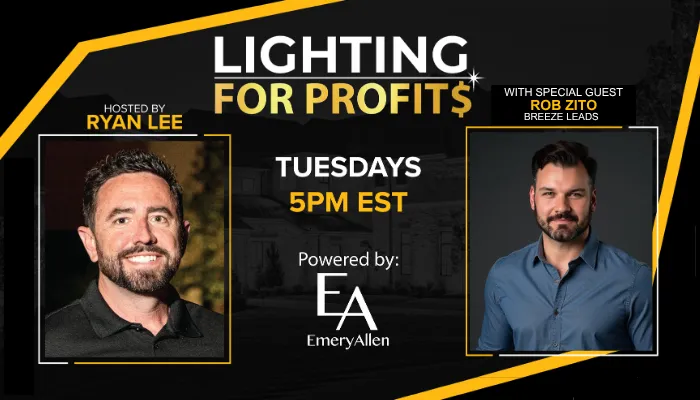
In this episode, Rob Zito shares how he helps landscape lighting businesses turn on a steady flow of ready-to-buy customers using AI data, automation, and smart marketing systems. With 14+ years of experience, he breaks down simple, results-driven strategies that deliver real ROI—no fluff, just results. Plus, a glimpse into balancing business, real estate ventures, and family life.
Watch the episode
Episode Transcript
Welcome to Lighting for Profits. All light, All light
Welcome to Lighting for Profits. All light, All light, All light. Powered by Emery Allen. Here is your host, Ryan Lee. All right. All light, all light.
Rob Zito with Breeze Leads will talk about text marketing for landscape lighting
Welcome, welcome, welcome to the number one landscape lighting show in Cleveland, Ohio. That's right. We are going international. Cleveland, Ohio. guys, we got an awesome show lined up. We got the owner, the main squeeze, the CEO of Breeze Leads, Mr. Rob Zito coming on the show. And, this is going to be an awesome discussion, an awesome episode, because honestly, there's a lot of times in my life where I'm right and then there's just a lot of times in my life where I'm wrong. And, this is one of those things where, I would have lost a lot of money had I placed a bet on do you would text marketing work for landscape Lighting? Like, I'm just gonna admit it, like, I would have lost money on this bet, but I've got so many clients now that are absolutely crushing it with this service. And so I'm really excited to have Rob come, on and talk about, like, the ins and outs and what separates it. Because we've had, you know, you've heard of other people in the groups and the Facebook groups, like, oh, I tried it and it worked for me. It's like, well, how did it not work for someone? But then someone else is like, it's like one of their main revenue, generators. Right? So, we got Rob Zito with Breeze Leads coming on. And, we're going to be talking about not just text marketing, but we're going to be talking about marketing in general. Because, if you want to grow a business, you want to scale a business, it's not going to be by waiting for your customers to refer you. It's not going to be like, a hope. I'm going to hope that I can grow this year. It's going to be proactive, intentional investing in your success. And, that's what we're going to be talking about. So excited to have Rob join us in just a few minutes. as always, I want to thank you guys for your support. We got the reviews coming in. It feels really good. I'm not gonna lie. You guys know it's hard to like, go put out good work and, and then get the review right. So I'm just extremely grateful, for those of you that have taken the time to do a five star review on Apple or Spotify, thank you so much. And if you haven't, then, you know, feel some guilt, feel some shame, do some stuff Even if you don't give me a five star review, I'm grateful for your support.
Mike Zito volunteered to teach a landscape lighting class at a university
all right, so again we got Rob Zito coming on with breeze leads in just a few minutes. you know, just the other day I had the coolest experience. I got the opportunity to go teach. Okay, I got to go teach a landscape lighting class at a university. Okay. At, ah, byu, believe it or not, they have a landscape lighting class. It's a required class. Right now it only happens once a year. I'm going to see what I can do to up that to two times a year. But right now it's once a year and it's a required class for all landscape majors. It's crazy. It's crazy. I'm like, what? This exists? And, it was so cool. It was so fun. my kids are like, wait, you get paid? Are you a professor? I'm like, nah, I call myself a professor, but I'm not okay. It's just volunteer. and honestly I just, I would do it every week if I could. It was just so much fun. And it was really cool to see these young kids really passionate about learning about landscape lighting. And you know, they, they wanted me to talk about the bidding process. You know, they've been all semester. They're working on their final lighting designs right now. They have to prepare a project and specify, you know what wattage and beam spreads and, and wiring diagrams and the whole thing. It's really, really cool. But, they wanted me to talk about sales and pricing and the bidding process and stuff like that. And you know, I really wanted to just like go full non textbook. I mean, there really is no textbook on landscape lighting. The closest thing is, and it really is a textbook is Jan Moyer's book. Okay. and what's cool about Illy, the International Landscape Lighting Institute is they walk you through that book over like a five day period. And so, but I didn't want to get into like this. There is no textbook on like the bidding process for landscape lighting. Okay. And so what I did is just like, Mike, is it okay if I just walk you through like, like I used to have a light. A landscape lighting business. Exactly the process. I used to build this up to several million dollars a year. And they were like, heck yeah, let's, let's hear it. Right? And so that's, that's my way of teaching. I don't like a lot of theory. I don't like a lot of, you know, there's things that like, might look good on paper, but then you go to apply them in the real world and it's like, eh, you're dealing with human beings, and you know, human beings aren't, the same on paper. Right. And so there's a few things that need to happen, in the sales process if you want to increase your odds of closing the deal. And you'd be surprised, you guys, if you realized how much money you were losing. And it's funny because we're going to be talking about marketing today. Some people think that marketing doesn't work and then you realize it's their sales process. Like, oh, I get the leads but I can't close them. it's just easier to blame the marketing company and be like, oh, they're crappy leads. But if you were just better at sales, then suddenly you'd have an ROI that you could justify that marketing spend and you'd be surprised about just what, One extra deal a month. One extra deal a month.
If you're running a lighting business now, you're making 20% net
So let's say that you are running a lighting business now and you're making 20% net. Okay? Net is after everything's said and done, your overhead, after you pay yourself like the business profits, 20%, which is a pretty good lighting business. Some, some are doing 15%, some are doing zero. Some, are doing 25, even 30. I had one client doing 30%. But 20% is pretty standard for a small business. here's how this works. If you get one extra deal per month, okay? One extra deal above and beyond what you're doing now, above and beyond what your skill set and your ability is now, those extra deals, which I call marginal deals, they pay out way more than 20% because your existing infrastructure is covering all of the overhead and everything. And that's why you're making 20%. And so let's say you're a million dollar business, okay? And you make 20%. But if you figured out how to sell one extra $10,000 deal a month, then you would bring in an extra 100. Excuse me, 120 grand a year in revenue. I think I had. Instead of Chick Fil A, I had teriyaki sticks today. Don't do that. That's a bad idea. Okay? but if you, if you sold one extra deal at $10,000 a month for 12 months, you're gonna have an extra 120 grand in revenue. And if you went off your normal margins, you'd make 20%, right? Make $24,000. But here's what's Cool about these marginal deals because everything's already covered. You get paid out at a higher amount. So this $120,000 actually pays out at 50 and sometimes even 60%. So what that means is you have an extra $60,000 in cash in your pocket because you got better at sales, because you got better at marketing, right? Maybe. Maybe your sales stayed the same, but you figure out how to get more leads through the system, right? There's lots of little levers that you can pull on here. but I don't. I don't even like to, like, increase my. My lead flow until I'm really, really good at pricing, until I'm m really, really good at sales. Because if you have too many leads, you can just feel busy. You know, you might as well, like, take advantage of what you have in front of you and close all those deals. So when you do that, when you get better at sales, you just get one extra deal per month. You can literally add an extra 50, 60k in your pocket. Okay? M. That's how important this is, because you've already done all the hard work, you've already done the heavy lifting, and you're leaving the gravy, all the easy stuff to someone else, right? And, you're missing out on huge potential. And then what's cool is if you get even a little bit better, it goes from not just getting one extra deal a month, but actually one extra deal a week. And, that's four times. So now we're adding an extra $200,000 in your pocket at the end of the year. This is called leverage. This is called momentum. This is what can happen when you become a master at different areas of your business. One of the things, one of the strategies that I talked to this class at BYU about was the concept of a price marinade. Okay? And by the way, you'll see the price marinade a lot in your life when you're actually looking for it. sometimes you're just, like, going through life and not really aware of your surroundings. But once you are aware of this, you'll see it happening a lot. And here's the challenge, here's the problem. People might. Even if you're in landscape lighting secrets, even if you've gone through my entire course and, like, feel like you've mastered it, you usually haven't. Okay? Most people that think they know what it is still aren't doing it correctly. They might get like, seven or eight out of the ten things right about it, but they're still missing one or two things. There's still a level of mastery that you're missing out on. For example, some people think when they hear Price Marinade, if they. If they're going to go quote someone a $20,000 project, that they'll say, well, I'm going to. The Price marinade says to say it up front, like, let's marinate them and not wait till the very end. And that's true, but the problem is they're saying, this could be a $20,000 project. And so they think, yeah, I'm doing the Price Marinade. Well, you're doing the price marinade. You're just not doing it correctly, okay? Because the price, with the way the price marinade works, the best is if you double the number that you think it is, okay? So if you think it's 20, you better say 40. Now, most people don't have the balls to say this because they're afraid of what you're probably thinking right now. I ain't saying 40 grand. Like, you're afraid of scaring them off, right? In Texas, you're afraid of getting shot because people have guns there, okay? And I get the fear, but that's okay. Fear is just a, thing that can be overcome, okay? And so it's really, really important when you do the Price Marinade to double the number that you think it is. And I learned this by experience, because I used to be, like, when I. When I figured all this stuff out, people at the very end of the conversation, you guys know this.
You're in landscape lighting. Do you want clients feeling sticker shock or sticker relief
You're in landscape lighting. What's the. What's the number one objection you get at the end? You know, what's. What's the feeling that they get? What do most people say the first time they've ever heard a number about landscape lighting? Oh, wow. That's a lot more than we were thinking it was going to be. Okay. And that emotion, that feeling, is called sticker shock. Okay? Sticker shock is. It doesn't matter. You. You. If you go to someone, they live. They live in a $10 million house. You could deliver a $50,000 proposal. They're still going to get sticker shock. Because if. Well, if they've never had landscape lighting, if they've had landscape lighting before, they're not going to have it. But if they've had. If they've never had it, they're going to make $50,000. What? They could literally have a garage full of exotic cars, $3 million in cars, and they're going to go $50,000. Wow. And it's like, we're going insane. Like, what. Why do you think 50,000 is a lot for lighting when you have these cars and these houses and these trips, right? It's because they don't know. They're just ignorant. They're not terrible people. They're not bad people. They're just ignorant. Okay? There was a time when you were ignorant with landscape lighting. There was a time when I was ignorant. I thought $4,000 was a ton of money. I thought whoever was gonna pay $4,000 for landscape lighting was an idiot. Like, who would pay $4,000, put lights on their house, right? So there's a. There's an ignorance process here. And so you're always going to have sticker shock. So what price marinade does. It gets the sticker shock over with. Okay. And then the reason why you want to double it is because you need a couple things. Number one, you need a decoy offer. You need to change the perspective. Okay? They're looking here. You need them looking up here. And when that happens at the end, when you come in with a. With a $20,000 instead of a $40,000, they get the exact opposite of sticker shock. It's called sticker relief. Sticker relief, okay. Do you want your. Do you want your clients feeling sticker shock or sticker relief when you get to the end to ask for that check? Well, obviously, you want them to feel sticker relief, right? And you'll literally have people saying, oh, wow, that's not bad. So it's only 20, as opposed to. If you just went in with a $20,000 quote, they're like, Dang, 20,000. That seems like a lot. So you're giving them perspective. See, they don't have perspective. And when people screw this up is when they say the number that they think is the number. I did this for a long time, and here's the problem I would throw out. it's probably. It could be as high as 20. And they're like, wow, it's a lot higher than we thought it was going to be. Then I would go in and I would do the proposal, and guess what the proposal came out to? 23,25. Now you're screwed. You did sticker shock, and then you did sticker shock. Again, that's not sticker relief. Like, that feels even worse. You know, you should have just waited, right? So this is where people screw these things up. And this is the difference between you staying stuck, getting frustrated, saying, oh, that doesn't work for me, not my market, not not with my customers making excuses. The difference between that and those that are just absolutely crushing it, killing it, landing deal after deal after deal at higher average tickets in the lighting community right now. So it gives you that level of protection. So let's say you told them 40 grand and then it came in at 25, it's still sticker relief. If you would have told them 20 and it came at 25, you're shooting yourself in the foot. Right? So that's how the price marinade works. You have to throw out a number very early on. There's, there's much more to it that I, I don't have time to do, like on my, my, whatever this is called, monologue or whatever for the podcast.
Mastering your sales process is key to making great deals
But I want to encourage you. And if you guys are in Landscape Lighting Secrets, if you're a member, if you're Illuminati member, go into the modules. I break it down, all the exact same thing, things that you need to say at the chosen time to make sure you master this. And then you just practice, go out and, you, it's called marry the process, divorce the results, go out and do it. And if you screw up, who cares? Because you're just married to the process. The, the, the result doesn't matter. If you screw up, who cares? You just screwed up, you'll just get better. Right? So I want to encourage you guys to go out there. You use these tools, there's many others, and you have to have this, just one tool in the sales process. When you master this one, you go master the next tool, you master the next one, you master the next one. And it's part of that whole client journey. And some people, are doing really good with some of the tools, but they're not explaining to the client what's about to happen. You need to pre educate your process and tell them, hey, just so you know, when I show up, we're going to walk the property. I'm going to put a proposal together for you, give you guys a price. That way you guys can decide if this is something you want to move forward with. We can get you on the schedule. Okay. That may seem, you might even hear that and go, yeah, yeah. no, I know that I do that. No, you don't. If I shadowed you today, would you say it exactly like that? Are you saying that on the initial phone call? Are you saying it when you show up at the door? There's a lot of places to screw things up here. And just because you're getting deals doesn't mean that you're, that's good. But do you want to be great? And that's the difference. Like, how can you squeeze out an extra deal a month? How can you squeeze out an extra deal a week? It's by perfecting this sales process. And once you perfected that sales process, then it's really, really hard to blame anyone else because you're accepting this responsibility. And then it's really easy to make a lot of money because, you know, we're going to talk about marketing right now. you get these leads, you're maximizing every single opportunity. So encourage you guys to go do something new. Get uncomfortable, marry the process, divorce the results. Hey, you know what? On that note, stop settling for cheap, unreliable lamps that ruin your projects and your reputation. In fact, Emory Allen's line of premium LED lamps deliver the performance, longevity, and color consistency your clients expect. Trusted by lighting designers and installers around the country and backed by decades of lighting expertise, don't settle for less. Upgrade your designs and installations today with Emory Allen. All you need to do is reach out to them by emailing jackson l. @emryallen. com. that he'll get you hooked up with the discounted contractor pricing. Just email jackson lry allen. com and don't forget to mention that you heard about him here on Lighting for Profits. Again, just email Jackson lry Allen dot com.
Rob Zito: Welcome to the show, guys. What's up, Rob
All right, I think, we've made it to that section where we're going to talk about marketing. I hope you guys are ready. This should be a fun conversation. So let's get this thing going. Welcome to the show, Mr. Rob Zito. What's up, Rob?
How's it going? I like that intro music. Speaking of international and Cleveland got the rock and roll going. I like it.
You know, you got to keep it fresh. I don't. I don't even really listen to a lot of podcasts, so I don't even know how to do a podcast, but I've been doing one for four years now or five or something like that. I just, you know, I call it edutainment. You got to be educational, but you got to provide some entertainment. Don't you think?
Your Emory Allen ad was. Was actually so good, I didn't know if it was a joke or if it was real. As far as you're like music, I loved it. It was very seamless, so I like it.
You know, not. Every. Not every time is seamless because I'm sitting here hitting buttons myself and like you would, it'd be pretty easy. I do it every week. So you just like, just hit the button. But I, I change up the music. You know, I want it, I want it to be fresh. So thank you, appreciate that.
Rob Zitto is the owner, founder of Breeze Leads
Speaking of entertainment and high quality content over here in the Cleveland studio. Is my background look okay or is it mirrored? Is it all backwards?
I know it looks great.
Yeah, at least everything's backwards. But it makes sense now. Okay, perfect.
No, like it actually reads Breeze Leads.
Perfect.
It's not easier. You're zered. well, thanks for joining me man. Do me a favor. Just do a quick introduction of, of who you are and, and what you do and what your life's like.
Yeah, for sure. my name is Rob Zitto. As Ryan mentioned earlier, I'm the owner, founder of Breeze Leads. it's actually a company that kind of got born out of accident and necessity. so we have been real estate investors, my wife and I for 14 years. Started out with needing a place to live after college and instead of running like everybody else, I figured hey, let's be a landlord in a duplex and figure out, you know, see how that works. pretty much learned every lesson I could possibly learn as a brand new homeowner and owning a duplex in, in Lakewood, Ohio, for some of you northeast Ohio people where the house was 120 years old. So everything went wrong all the time but it was a great crash course and to being a landlord, being a property owner and also being an investor. So from there we pretty much bought and renovated a house every single year and the those steps came, were very difficult but each year was a little bit easier. So we scaled that. we now have a large portfolio of rental, homes, decent portfolio of vacation rental, Airbnb homes and then we also flip and renovate about 18 houses a year. I mention all that simply because we're really, really good at homeowner data and homeowner insights and finding out the addresses of, of those homeowners. especially when in real estate we're looking for value add, ah, distressed homes, people who need to move on from the house whether it's money related, divorce related, etc, so that's how we got really good at this data side. we tried cold calling, we tried direct mailers, we tried door hangers with all of those off market properties we were trying to purchase and texting really stood out as the leader. texting and email we just did really well with. So after filling up you know, our real estate portfolio with projects throughout the entire year. A, lot of our contractors we didn't use all the time. It was guys who kind of came in and came out for big projects like kitchen countertops, roofing, etc, had reached out to us and said, how do you get all these, you know, houses off market? And we explained the process to them, and then we actually kind of rolled it out to them, and then started filling out their order books and started filling out sales. So after that worked, I said, hey, I think this is, you know, a business behind this. There's a service behind this, and I think high ticket works best. And two years running now, here we are. Landscape, lighting is by far our biggest niche. In 2025, we had over 30 landscape lighting customers use, us throughout the entire year. And this year I think we're looking at somewhere around that 60 range. So, big benefit of that is that we know the industry inside and out because we live it every single day. We're having customer conversations, as Ryan mentioned earlier. so having that knowledge is crucial. And anybody who works with us now or works with us in the future kind of gets that hive mind and that expertise of working with homeowners, who are interested in landscape lighting, or are new to it, need to replace a system, whatever that may be. So it's been a really fun ride. you know, my wife and I have been going to AOLP events and light it up events as recently as last month. And we really enjoy, you know, talking to landscape lighting owners, talking to fellow business owners, couples who have worked together in this business. It's been a lot of fun and really enjoying it so far.
That's cool.
How did you find the landscape lighting industry? Um, it's a great question
so how did you find the landscape lighting industry?
it's a great question. I, I actually the first person we ever worked with was in our home, I guess, our Snowbird home of southwest Florida. So they wanted to target Naples, Florida, homeowners. And obviously those come with some really big tickets. And I said, hey, I don't know. I've done this for roofing, I've done this for painting. I've never done it for landscape lighting. Let's try it out. I think in the first two months he did over $100,000 in sales, one of them being, know, an $80,000 ticket. But that was enough for me and him to kind of move forward and say, hey, let's, let's look into this, industry a little bit more. And again, it's, it's Been great to work with, the landscape lighting industry as, as you know and as everyone knows, you can get to big tickets relatively quickly and it only takes one lead and a good sales process to get there. So it's been great.
That's so cool. I mean, like I said when I was getting started, like just without any information, if you're like, hey, would you bet on this? You know, one way or the other, like, I would have lost a lot of money because like, if you said, yeah, I can send out a text and I can generate a lead that's going to get you an $80,000 landscape lighting job. Just saying it out loud just doesn't like. I know this is what you do every day, but it sounds kind of crazy.
Doesn't is crazy and it's, it's funny. And again, until you actually are in the business and experiencing it day in, day out, I have heard so many people, and I'm not trying to knock this industry at all, but I've heard so many people, because it's such a visually appealing and a visual industry have tried and failed. The typical magazines or the state magazines or regional magazines that show all your beautiful projects and they'll have certain websites or promos or numbers attached to it and it's crickets, which is so surprising to me because when I'm looking through those as a homeowner, I want a lot of the things in those magazines and I may or may not call them. But yeah, when it comes to texting, we purposely do not send any links, any photos with our text messages simply because we try to stay anti spam, we want to stay compliant. But yeah, it works, it works really well. And I think at the end of the day you just need a very small percentage of people that have been wanting to do it for a long time and you're just the easy button right in front of them. So I think that's really the key. When you're texting such large amounts of people and drip texting them throughout the month, you just have to be in front of the right person at the right time.
Yeah, totally. So I think I, I, anyone who's like in the landscape lighting industry that hasn't been in another industry, like we kind of take for granted what we have here because you as a, let's call you an outsider, you know, like you're not a landscape lighting person, you have that perspective to be like, no, this is like high ticket and, and like we have an unfair advantage because we can sell an $80,000 job, a $10,000 job. There's other industries where they have to do the same marketing, and they're only able to generate a lead for a $300 customer, an $800 carpet cleaning, whatever it is. Like, we have an unfair advantage because we're selling ten $20,000 things. And I would imagine even as a marketer, it might feel like an unfair advantage because again, like, we're not. We don't have to go for everybody. We just need to get, like, laser focused. And I mean, yeah, if it, yeah, it was an $80,000 job, but you only need to get, like, a few of those a year to justify a couple of those a year to justify the monthly spend for your service, you know?
Yeah, absolutely. based on a lot of the customers who had gotten back to us and some case studies we've done, for some companies and some franchises, we're looking at a different 23x ROI as of 2025, and the sales results we've seen. So pretty much if you pay us a dollar, we're going to try to throw you back $23 in revenue every single year. So that math works for me and it works for a lot of our customers. So it's been fun.
That's crazy. Just so people know, like, 23 is not normal. And like, if, if you can get like a 5x return, like, you're, you're fine. You know what I mean? there's some things that you'd want to do on the back end to, like, get repeat business and referrals and stuff like that. If it's a lower, return on ad spend. But at the end of the day, like, I, I've always. My number I lead with is like, if you're in growth mode, especially if you don't have a brand, you're gonna have to spend 15, if not 20% of your revenue, on, on marketing. Like, some people think I'm crazy for saying it's that much, but again, it's like, well, if you just want to stay small, then, then don't spend any. You know what I mean? But if, if people don't know your brand and you don't have repeat business and you don't have all this other stuff, like, yeah, you're gonna have to spend, a lot, a lot more money. As when we scaled our business, we started at like 15%. So that means if you want to do a million dollars, then are you willing to spend $150,000 this year to, to make the phone ring, you know, and some people just aren't willing to do that. Now, over time, that number dropped for us because we were able to keep it at 150. But then as we went up to 2 million and beyond, now we have more repeat business. Now we're better asking for referrals. We have other systems in place where we're not having to spend proportionately. But, you mentioned, like, it's really just getting in front of the right person at the right time.
How do you curate your lists? Like, how do you decide
How do you curate your lists? Like, how do you decide? Obviously, I tell you, like, okay, I'm in this city and these are the nice neighborhoods, but how do you actually decide who gets these texts and when do they get them?
Yeah, I think basically we're trying to do a, strategy session with each one of our clients when they start up with us, or if they just want to have a refresh on their campaign in general. So what's your service area? What's kind of maybe your inner circle, your primary zip codes or your high, income homeowner zip codes you really want to target. And then from there I always suggest to have a minimum house value. So what's your target Persona? What's your target client? And then what's that minimum house value to where it makes sense from a high ticket, having enough discretionary income, whatever that is. So then that way every single text we send out is at least pointing to one of your target Personas. And then just from our response rates, we know we're going to hit that monthly lead, 20 plus monthly leads every single month. So it comes from that on the back end. There's a little bit of secret sauce in what we do, but, we take multiple data sources of homeowners that have been proven that I've used for seven years now. we take multiple sources. It's expensive data. and then we scrub that against each other to make sure that every single text that we're sending is verified, verified to the home ownership and the best data available from there. There's also some intent, AI scrubs that we do as far as homeowners that have shown intent, with landscape, lighting, some other things. And we're also testing some more information we're getting, via meta and some other sources. But, again, when we're texting 5,000 homeowners a month and you only need 20 of those leads to be qualified and be interested, it's a relatively small number of people that's, that's interested. But because we approach it in such a casual and organic way. a lot of the times we are mentioning the clients and company's name. So you know, John Smith is going to look up, you know, XYZ Landscape lighting before he calls or before he texts back. And that just shows credence to how you should be taking care of your website consistently. You should be updating your Facebook post with jobs you've been doing recently. And then obviously Google reviews, always powerful, always making sure those Google reviews are up to date and you get as many as you can.
Okay, so that's interesting.
Making sure that customer is looking first is key to success in landscape lighting
I was going to ask you, like, what else, what separates those that are like doing really well versus ones that are just doing not good or mediocre? So it is making sure that that customer is in most cases you're saying googling or looking. Is there a link to the website or they're just Googling them?
Yeah, no, no link. So the text is very simple. It's just saying, hi, you know, we're in XYZ City, doing a, outdoor lighting installation. Have any landscape lighting needs, Question mark? It's very organic. It's very a way you'd almost text your friend in a professional sense. from there I get texts like this sometimes. there's been times I actually needed, at one of my vacation rentals, I needed a tree to be gone. they texted me at the right time. I then googled the company, felt good about it, went forward. They knocked out the palm tree removal in two days. So, that's why we always like to put the company name because it builds trust with the client. And then again, if you have a good brand and a good, review base to show, let's show it off and let's get that comfortable, get that customer or lead comfortable with your business and move forward.
Cool. Yeah, I like that.
Speed to lead in this business is everything
So you said, is it 5,000? Is that how many you're initially texting?
Yep, 5,000. And that's ripped throughout the month. So I think that adds up to be about 250 texts every single business day. and then whatever zip time zone you're in, we're going to text 9:00am to 3:00pm so then that way whenever a text is answered, someone on your sales team can always answer it within their business day so that you don't have leads that sit over the weekend or leads that sit overnight. Because speed to lead in this business is everything.
Yeah. Why, why is speed delete so important?
people are busy. I think a lot of people, especially when it has something to do with your phone as the communication tool, just have add. so if you can close that communication gap within 15 minutes or less. We see our consultation rates in the 70 or 80 percentile. we've purposely hired multiple members of our team this year just to close from. When we get a text back from a lead that say they're interested, we're doing some soft pre qualification, we want to get that lead into our clients hands within five minutes or less. Typically it's going to be within three minutes or less. So we always say if that client can call that lead within 10 minutes, that's a, you know, 13 to 15 minute gap and that's going to be a successful lead at that point in time.
Cool.
But people get busy, they move on to the next thing. I mean look at people who doom scroll that forgot what they just what video they saw two minutes before. It's the same situation here. So have to be quick with those leads.
I know. I got a text from my niece just the other day and she's like, hey, Uncle Ryan, I got this business idea. I want to run value. And I was like, oh, this is like, this is so cool. I get to like spend time with my niece and I get to nerd out on business. Like that's a pretty fulfilling text for me to get. Two days goes by and I'm look, I'm looking for another text. I'm like, oh my gosh. Because I since I clicked on it, it showed red already. I'm like, how did I miss that? I felt so bad and guilty that I didn't even reply to my niece. You know what I mean? So like the odds of me replying to a landscape lighting thing or a tree removal or whatever, even if I need it just goes like you said it, just out of sight, out of mind, really, really quick. So I I've had people tell me that I this isn't even talking about like text marketing, but just, you know, leads in general. I share the story about me missing a phone call doing maintenance in a tree called a lady back an hour later, which is at least I'm calling her back is that way I thought, you know, an hour is no big deal. She's like, oh, no, we're good, we found someone. I'm like, you found someone? They already gave you a quote. No, they're coming tomorrow. I'm like, yeah, I can come m tomorrow. No, we're good. At the time, our average job was $5,000 and I literally Was like, what the hell, I just lost $5,000 just because I, I mean I was, I was changing a light bulb in a tree. Like, I'm a good human being. Like I'm a good business owner, aren't I? And people tell me all the time, like, oh, no, I, I answer all my calls. You know, you don't. Like, how do you answer all your calls and be in a sales appointment at the same time? They go, well, no, I call them back. That's not the same thing. You know, you can't wait an hour. it literally has to be within five minutes.
People who have the means and are wealthy really value good communication
So this is when we talk about other things like, okay, get an answering service, get a va. Whatever else it is. Did you, did you say that you guys do the initial one? So if I'm a homeowner and I respond to the text, do you guys reply to that or that gets sent to the business?
Yeah, so we'll reply and we'll basically do a soft brake qualification just to make sure that they're not tire kickers or just to try to find out maybe what project they're trying to to do. Whether they explain the project or they need a repair on their current system or it's outdated or whatever it is. And that way when the, when we pass it off to the client, they can have a great conversation as if they've been involved the whole time, which is pretty much how we're texting it. And then after we send over that lead, we're going to text the homeowner and say, you know, John is going to call from 1, 2, 3, number be on the lookout. So John can call from his business phone or cell phone, whatever number we mentioned. And then that homeowner is ready for that phone call when it comes in. Which again shows credence to how, how important the speed to leave is part because people forget things and something you just talked about is, you know, people who have the means and are wealthy really value good communication and they value convenience and speed. So people talk about wanting to get an $80,000, you know, high ticket job. The person who has the money to pay $80,000 to get a landscape lighting job probably has a lot of balls in the air. Whether it's social things, businesses, you know, they're a doctor, they're a lawyer, whatever that may be. You have to be quick and you have to be very professional in your communication. And just because, just in sales in general, just because they don't answer the phone on the first call doesn't Mean, it's a dead lead. Leave a voicemail, shoot them a text, be professionally persistent. I think that's really the biggest thing too is with the clients who have done the best with us. And I'm talking, you know, big time numbers, $120,000 in their first month with us. They're the ones who call immediately. They'll leave a voicemail, they'll then shoot a text. Just trying to cover the whole gambit of just making sure that whatever that client wants to communicate in as far as whether it's texting or call to have the appointment, they're doing that. And then on top of that, they're nurturing that lead. So they don't just quit after the first day. They might, if it's in the morning, they might shoot them one last text before the end of the day or follow up first thing in the morning. So, speed of leads, important, but professional communication, being professionally persistent, and then on top of that, just nurturing the lead. I mean, they, they obviously expressed interest. These are serious people. We're not, you know, shooting over tire kicker leads. So just keep following up with them and you'll be surprised how quickly they can turn into sales. one, one last thing I'll mention really quick too, is the power of kind of your messages in your inbox. So we get leads all the time where we sent our initial text 2, 3, 4, 5 months ago. So they may not have been ready at the time, but they're simply going into their phone and saying, hey, I remember that landscape lighting company reaching out to me. They'll type in the company name, they'll type in exterior lighting, landscape lighting, whatever that keyword is that we're putting in the text. Boom. Our text comes up, they give a call or they shoot over the lead. That happens all the time. And that's another reason why I say that you should be marketing 12 months a year, because you never know when the right time is for those homeowners, as far as when they have time to make that decision. So that's another powerful piece that's actually happened by accident. I didn't think that those leads would come in. And they seriously come in every single month for our clients, which is pretty cool.
Yeah, that's killer. I could totally see that happen. And I've. Sir, I. I search in my text. I haven't had this exact same scenario, but I search my text all the time and I'm like, what was the key word? Yeah, if I was them, what would I have said in this Text, you know? well, I love. I love that you hit on it and you went quick. So I do want to reiterate, like, if you just ask the. A general human being, like, hey, did you, Did you. Did you call them? You know, if, like, let's say the text came through. Like, did you call. Yeah, I called him. Like, you actually called them or you texted them? Oh, no. Well, I sent them a text because people are afraid to make phone calls now because it's just easier to text. You know, a lot of business owners listening to this are gonna be like, oh, yeah, I called them. And if you really call them out, like, did you call them? Well, no, I. I sent him a text. Like, no, like, you just don't know. Like, you said, you need to meet where your client or homeowner, where they're at. Sometimes they want to text, and that's totally appropriate. Sometimes they'd rather you just call them. You know, and if you call them and, you leave a voicemail and they're at work and they can't talk right now, then they'll shoot you a text. So I think it's really. You went fast over that. But I think that's really important. Like, you have to call and text and not just assume. Oh, yeah, I text some. I reached out because maybe the text got buried, maybe the voicemail got buried, you know, whatever it is. So I really like that. And then how often you said, you know, you got to nurture the lead at some point, like you said, like, five months later, they might just reach out on their own or whatever. But after that, that day of, like, I call them, I send them a text. I don't hear anything back. When. When is the next. What. What does the next sequence look like?
Yeah, I think original day, day. The leads created reach, out to them a number of different ways. I think the next day is very important, too. And then from there, just use your judgment. Maybe it's three days, maybe it's five days, depending on the day of the week. If it's Monday, you know, if it's Friday, reach out on Monday. So, I think more than anything, just, again, be professionally persistent. Don't bug them. But they did show intent. They could be busy. They could be on vacation, or again, they said yes, and then something else came up. So I just think following a normal sequence where it might be, you know, day zero is the day you get the lead, reach, out on day one, and then again on day five, maybe day 15, whatever that may be and then keep them in your system. You know, maybe after a month, I would probably potentially leave them alone if you haven't heard anything. But I would also say re. Engage us. So that's something that again, the power users or power clients of ours use us for.
Is we're technically the original thread of communication with these customers
Is we're technically the original thread of communication with these customers. So we're the one who sent the initial text and then sometimes there's some back and forth, with that customer or excuse me, with that lead. If you can't engage into a lead, you can never get in touch with them. Reach out to us. We'll shoot a message in the original thread and sometimes that revives Elite. So that's, that's another situation where it's like, we're a resource. We want to have our clients do awesome. We're not in this as a cash grab month, you know, one month in and haha, I got your money, ran away. We want to build relationships for years to come. And again, there's nothing better that I like seeing and posting about. When our customers have these awesome sales months, reach out to us. We want to close the gaps too because every lead took a lot of hard work, both from buying the list, researching the list, texting the list. You know, our employees are constantly engaging with leads, all day long it would stink to basically get all the way through that process. We finally pass it over to the client and then boom, it's gone. So there's always ways to, re. Engage that lead and you should always reach out to us if for whatever reason you can't, engage with that lead at the time they originally communicated.
Nice. Okay, cool.
How many of those leads convert to appointments? Do you have any data on that
So about 250 texts a day, you think your numbers are telling you after about 5,000, you're going to probably get someone around 20 leads. How many of those convert to appointments? Do you have any data on that?
Yeah, so, and another thing too, I want to say 20 plus leads. I know a lot of the times, especially when talking about leads, first off, these are exclusive. So these aren't Angies or home leads or whatever that is to where we basically take a lead and shoot it out to six people and create a feeding frenzy. these are exclusive to our clients. We typically only work with one client in a, in a geographical area or a service area because it's easy for them, it's easy for the client. but yeah, we'll, we'll get 20 plus leads. So there's normal months where we're going to get 33 leads and the Client should be penalized for that. It's just, that was a great month and we drove a lot of leads.
So.
I think I forgot your question after explaining way too much.
What was my question? Well, you said how many?
Close.
How many? Well, no, how many convert to appointments, I would say, because if you get 30, even 33 leads, like, you know, some people you just never get any traction and like nothing ever happened. But then some people you do get on the phone and they're like, oh, okay, yeah, we pre qualify them, let's meet with them. Any, like, any percentages on how many go to appointments?
Yeah, it's, it's in the 70s, the 80s. And again that's very dependent on what the average ticket size is for the client. So we've got some companies who are, you know, their average ticket might be four or five grand. So obviously their appointment rate might be higher. But the, the higher ticket guys, the guys who are looking for the 20s and 25 pluses, their appointment rate might be 60, but they're fine with that. So it's going to be somewhere probably in that 70 to 80 range. Especially if you're calling them very quickly.
Okay, cool. Yeah. Now, I mean like I said, I think we're spoiled in the landscape lighting industry because it doesn't matter really how many leads. To me everything's about roi. If if I just got one lead, but I also got one appointment and one close out of it and it was a twenty thousand dollar job. I'm like Rob, how do I give you more money? You know, and most people I think would agree if, if I, if I said, hey, I've got literally a twenty thousand dollar job right here and I'm going to give it to you. The only thing I need is 15%, you know, so whatever that. What is 15 of 20,000? 3,000 bucks. Is that right? Yeah. So like give me 3,000, I'll give you a $20,000 deal like most people are going to take, take the deal. I mean that's a, that's a, it's a high amount of dollars. I'd rather spend less than 3,000, but I would be willing to spend $3,000 for a twenty thousand dollar job. So that's really what it comes down to.
I was just curious on kind of what numbers to expect. But let's say 20 to 35 leads per month
I was just curious on kind of what numbers to expect. So 20 to like you said 20 plus. But let's say 20 to 35 leads per month. And so yeah, they're, they're running multiple sales calls a week for sure off of Just, just the leads that you guys are providing.
Yeah, And a lot of times too, we'll purposely text in a zip code and then kind of move on to the next zip code. So we do that on purpose to make sure that you can hopefully have your guys kind of stay in the same territory or same city, when they're knocking out multiple appointments in a week. So that's another added benefit.
How often are you changing up the list? You know, because, just because you sent out one text to 5,000 people, I mean, some people just disregarded it immediately. But that doesn't mean they're not interested. Right. They just. Not right now. So are you hitting them over and over and over or are you switching zip codes?
We're, we're very, we like to be like kind of the premium supplier and we, we take a lot of our texting software and our spam and our compliance very seriously. So a lot of times we're going to text 1 Number 364 days a year. we don't want to spam people, we don't want to bug people. So if they didn't get to us that first year, they're probably not going to hear from us until that next year. I'm sure you could probably drive way more results if we bang people over the head, but that's just not something I'm willing to do. and I think, you know, our clients are happy for that too, because, you know, we're not spamming people, we're not soliciting people, and we're just, you know, just a little quick soft touch. And if, if we don't get you this year, we'll reach out next year
and so then they'd be on the list for next year.
Yep.
Yeah. I mean, I don't know, like, the marketer in me is going crazy hearing that. Like, what? No, like you, you can't do that. You know, but I already told you, I would have been wrong on this deal from the get go. So don't, don't take my advice.
You could get a bad Google review for any reason
I do think that your, that your clients, that the lighting designers, the contractors, I think they would appreciate that though, because I know one of the biggest fears and maybe you can speak to this is like, oh, well, I don't want to do that because, you know, like, you know, I have all five star reviews and I heard my friend did text marketing and someone gave him a one star review because they were, they were spamming them. Like, how, how do you address that? Or is that how you Address it. You just send them one text a year.
Yeah, I mean, so, I mean really, you could, you could get a bad Google review for any reason. So you could send a direct mailer to somebody and they just, they got really upset because it got stuck in their mailbox and they couldn't pull it out and they just wanted to shake their fist at the clouds. So you can get a bad Google review for any reason. What I will say is Google wants, Google wants customers to leave reviews on pages if they're actually engaged in business with that business. So they can't get upset because they saw a tv, ad or a commercial or whatever that may be. So we've had success in getting some of those negative reviews removed. I will say it doesn't happen a ton, but it does happen from time to time. So we've had success in getting those, reviews removed. Which again is, I would say is probably one of the biggest reasons why people are kind of scared to move on. Which as we've, we've talked about this in the past, it's crazy to be, you know, it's not really an abundance mindset to not do something that could have 23x ROI and could probably potentially give you, who knows, maybe 100 reviews over the whole year lifespan of doing this because one bad review might come in. And again, we've had a lot of success on getting rid of reviews if they didn't actually engage in your business and they just got mad about a text. So we've had success with that. We're also working with a company, that specializes in that. That's all they do day in and day out. So all of our clients can use that resource. but yeah, I would say that's, that's probably the biggest contention point we get is people love their Google reviews, which again, I, I come from the Airbnb world. So I get it. We can give somebody a perfect stay and everything went awesome, but they leave us a four star on one little piece in part and boom. The, the, you know, Airbnb is trying to shut down our, our Airbnb and we're not, you know, super host or whatever that may be. So I get it. I completely understand. I know how hard people work for those Google reviews. But what I will say is don't let the fear of something very small happening get in the way of something big happening to where again, you could have a hundred plus customers from this and you could drive how many reviews from that.
So yeah, very well said. Like you Said someone, you could put a flyer on their door. And then there's like, oh, well, these, these people are destroying the environment or whatever it is. So I think, I don't know, I. I've gone through all those phases and I mean, I've never done the Airbnb thing. So like, that has real consequences. Like, now all of a sudden you're not a super host, and now all of a sudden you're not going to get as many rentals. But, like, in, in our world, if you just have a 4.9 rating instead of a five people, I mean, I get, I've been there where you like, literally lose sleep. Like, I can't believe that a hole, you know, like, I did everything, I bent backwards and then they did this. You know, like, I get that that's frustrating, but, like, that's just an emotional reaction. It has no impact. In fact, there's. They've even done studies where, like, businesses with like 4.9 get better results than like a 5.0 rating. You know, like, it actually shows that, like, you're human and, and they want to see, like, how you're dealing with the response instead of like, are you blowing up on them and blaming them or be like, hey, we, we don't even see you as a customer. We'd love to. You know, we care about customer service. Just contact us, whatever. So I think it can actually help people. It reminds me of like, like people, you know, as, you know, people are obsessed in the landscape lighting industry about reviews and like, it's gotta be perfect. But like, let's just say worst case scenario, you sign up with Breeze leads, you start making tons of money and the one star review happens. Because I always, I always measure my decisions. Like, am I okay with the worst case scenario happening? Like, if I launch Landscape Lighting Secrets and everyone tells me to F off and I hate you and I don't make any money for six months, if I'm okay with that happening, I'm going to do it. If I'm not okay with that happening, I'm not going to do it. So let's just say worst case scenario, you get a one star review. And if that happens, what it does, and I'm just like, from a psychology standpoint, it motivates that business owner to go ask for more 5 star reviews to bury that. Right? So it actually is a good thing to get a one star review because it makes the business owner work harder and ask more people, would you mind giving us a five star review? It's actually A good thing for your business. Same thing within our program. When we, when we have someone join in an area, let's say someone's in Cleveland and then someone else is in Cleveland and joins the person who's already in our program, starts showing up to more calls, starts implementing more stuff. And it's not like I'm trying to get people in m in the same market, but when it does happen, that person always works harder. And so, like, sometimes those things that we're most afraid of are the thing that we need to push us to go to that next level.
Yeah, there's no question, I think Tony Robbins says action conquers fear. And every time there's something I'm putting off or don't want to do, at, the end of the day, just take action. And typically that fear either completely goes away and you forget about it, or like you said, the, the, the pros outweigh the cons and it's not a big deal.
Well, I, absolutely, I absolutely love what you're doing. like I said, I, I, I was shocked. I was surprised that, like, you could actually get text marketing to work. So willing, to admit when I'm wrong. And I know we've got several members of Landscape Lighting Secrets using your program, and it's a big part of their revenue now. You know what I mean? and it truly is like doing the things that you mentioned, like making sure your, lead or speed to lead is super fast, making sure that you've got good five star reviews, making sure your website looks good, like all those things matter. and so I would highly encourage anyone to, try it before we wrap up.
General, you said you've been in masterminds and been in stuff
And I know you're going to, you've got an offer for us for the podcast listeners too, but I just want to ask you, General, you said you've been in masterminds and been in stuff like that. Like, what has your experience been like, as have you? Like, are, you, do you have a coach? Are you in a mastermind? Like, what do you do to like, keep your, you mentioned Tony Robbins. Like, what do you do to keep your mindset fresh? You've got, you've had a lot of success already in real estate and business and everything else, but you're still out here fighting and like grinding and, and showing up. What are, what are you doing personally to, to make sure you stay fresh like that?
Yeah, I think for the longest time it was, it was just trying to prove myself that I could do it as a business owner. I came from, you know, the, the traditional corporate ladder, climbed all the way up there, got up there and looked around and said this kind of sucks. Don't want to get yelled at by, you know, a private owner for the rest of my life. And I was looking at 50 year old guys that were just hating going into their jobs. So I was pretty motivated from an early age to, to do something on my own and knew that it was going to take some different perspective and a different mindset to do that. So I've seeked out people who have been genuine. a lot of it's actually been through the real estate masterminds, which typically a lot of that is about personal growth, and about abundance mindset and things like that. But I would, I would say I think masterminds get a, a bad rap a lot of the times. You know, it's kind of take your money, take your money and run culture. But I totally disagree. It's all about what you put into it and what you get out of it. Similar to what you've been talking about earlier, which you could offer all the programs and all the coaching you want, but people actually have to come and take action to do it. but I would definitely, tell people, go join a mastermind. You know, whether it's locally or nationally, there's a number of programs out there, but change it up every two or three years because after two or three years you get really comfortable with the group. You may not be listening as much when you do the quarterly masterminds. You may not be participating as much, but when you're thrown into a new group, you all of a sudden have different perspectives. there's different people in the group. You're going to touch base with different people and just again, there's always things that can be gleaned from people who have a growth mindset, which has been again so exciting to work with with you, your Landscape Lighting Secrets members and even people that light it up. it's very infectious to be around other people who have a growth mindset and are willing to admit that they might not know, a ton about landscape lighting, but they're awesome in holiday and they know they're going to crush landscape lighting too. So just be around people with a growth mindset and typically you'll find the answers through that.
Yeah, that's cool.
It's really important that, like, I mean, of course we had manufacturers
Well, I forgot to thank you. I mean we were, we were really stoked that you came to light it up. You know, when I put together like the, the booths and the speakers and just all that stuff. It's really important that, like, I mean, of course we had a lot of manufacturers and distributors there, right? But we, we need, like, I won't say we need, but we need, we need like the support of you guys there too. Because it's one thing for me to like, tell people, like, hey, you need to, you do marketing, you know, like, you need to invest in yourself or whatever. But, like, they need, they need to know, okay, well, who do I hire and how do I hire him and stuff like that. So I really appreciate you, you, guys being part of that.
What was maybe a takeaway for you from Light, uh, it Up Expo
What was maybe a takeaway for you from Light, it Up Expo.
A takeaway would be how big, how big the industry is getting. So talking to, some of the guys who have been around landscape lighting for a while, like, you know, Ryan J. And some others, and saying how crazy and how much of a rush there is into this industry, you know, from adjacent industries, from hardscaping, holiday lighting, whatever that may be, which again, I'm newer to the industry, so for me, everybody's new. But I feel like a lot of companies are starting to feel that push. so again, I don't think there's a better time to make sure that your company's optimized and running well and you're trying to get as many customers as possible. Because when there is more capacity, when there's more landscape lighting customers out there, or, excuse me, companies out there that could eat at your bottom line if you're not doing the right things, if you're not growing your sales. So it's something definitely to look over, your back for and always try to grow because if you're not growing, you're gonna die. So.
Yeah, no, I, that's a good point. I think there's like two mentalities. There's the mentality of people that are maybe like, already in the industry, they're afraid of growth. Like, oh, man, like, last thing I want is someone signing up with breeze leads, because then, you know, they're going to take my customer or whatever, right? And I'm like, man, the more awareness, the more people that are doing marketing and creating awareness, it creates more leads for everyone. So if you get a company that does direct mail or text or whatever it is, and they don't have really good branding, they don't have good SEO, like all that stuff, it can actually generate leads for you if you do. That's what happened in my business in Texas, we got leads all the time and from, from lead sources, we're like, oh, what, How'd you hear about us? And they say, oh, you know Lux magazine? I'm like, lux? I don't even heard of that magazine. Like, how did, how did we get leads from lead sources we weren't participating in? It's because we had really good brand. We had, you know, they saw us everywhere. And when, when they went online, they saw us, they saw our five star reviews. So, it, this is this like kind of gold rush that's about to happen. It's, it's going to make a lot of people mad because they're not willing to grow, they're not willing to level up. And then it's going to make a lot of people a lot of money and a lot of success because they are willing to step up and level up.
Landscape Lighting Secrets is giving away 300 bucks off first two months
So, you've got, are you, are you doing a deal for listeners?
Yeah.
Lighting for profits.
Yeah, for sure. So our typical price is 19.95amonth. We purposely don't do any long term contracts. We are month to month on purpose. Purpose to try to make sure that we're driving ROI month in, month out. but for this podcast, if you joined us for the entire time, appreciate that. And as a thank you, we're going to do 300 bucks off the first two months. Typically, that third month you're not really going to care because at that point in time you're probably going to see the ROI and you're not going to really care if that promo falls off. But yeah, happy to do that. I'm sure we can attach the promo code somewhere on here, but it's going to be LFP 300. reach out to me for the payment link details. But yeah, happy to do that.
Okay, that's awesome. Thanks for doing that, man. We're always trying to give as much value away as we can, so we just saved some people 600 bucks. LFP 300. When you reach out. What's your, what's your website?
Breeze Leads Co. It should be at the bottom corner here, I think.
Okay, cool. I appreciate you. And by the way, if you guys are in Landscape Lighting Secrets, and I mean if, if you're not, I'm, I don't know if this is a sales pitch or not, but I'm just telling you, you do get a better deal. So make sure you tell Rob, I'm Illuminati, I'm a member of, lls. You guys get a better deal and it keeps going as long as you're a Member of Landscape Lighting Secrets. So, it's been a lot of fun. We're. We're growing our community. So, like, you know, we've got, like, coaching, we got training, we've got community. And now we're kind of also adding on this whole buyers group thing. So now, I mean, thanks to, you know, your generosity and other vendors, our members are saving, like, over. They can save over $20,000 a year just. Just by being a member. Our program doesn't even cost that much. You know what I mean? So, even if people didn't show up to a coaching call, it's going to make sense for them to join our program to get, the better hookup with you. But if. If, if that's not on your radar, that's not on your agenda. Make sure you take advantage of this LFP 300 code. thank you, Rob. I appreciate it, man.
Absolutely.
You need to invest not just in yourself, but in your business
All right, I think that's it. Did we cover everything? Do we need to bring up anything else?
Yeah, I think so.
Okay. All right, guys, make sure, no matter what you do, just make sure you put your foot on the gas this year. waiting, hoping. Those aren't strategies. I love referrals, I love word of mouth. But if you really want to scale, you want to grow your business, invest in yourself, join a mastermind. Join, like, there's people out there that have already failed way more than you need to. get in front of those people, and they're all going to tell you the same stuff. Like, you need to invest not just in yourself, but in your business. And you're not going to grow by a million dollars this year by sitting on your hands. You're going to have to invest. You're gonna have to make the phone ring. Luckily, there's awesome opportunities out there that can get you 23x. I mean, I don't know. That's crazy. 23. even if you don't get that much, you're gonna get some return. So, go out and get it. Thanks, Rob.
Sounds good. Appreciate you having me on, Ryan. Thank you.
Go implement. Go do the hard thing, the thing that you're most afraid of
All right, guys, take it easy. Go implement. Go do the hard thing, the thing that you're most afraid of. Go punch it in the throat and get it done. See you guys. Have a great week.
Rob Zito - ROI Unlocked
Lighting for Profits - Episode 237
In this episode, Rob Zito shares how he helps landscape lighting businesses turn on a steady flow of ready-to-buy customers using AI data, automation, and smart marketing systems. With 14+ years of experience, he breaks down simple, results-driven strategies that deliver real ROI—no fluff, just results. Plus, a glimpse into balancing business, real estate ventures, and family life.
Watch the episode
Episode Transcript
Welcome to Lighting for Profits. All light, All light
Welcome to Lighting for Profits. All light, All light, All light. Powered by Emery Allen. Here is your host, Ryan Lee. All right. All light, all light.
Rob Zito with Breeze Leads will talk about text marketing for landscape lighting
Welcome, welcome, welcome to the number one landscape lighting show in Cleveland, Ohio. That's right. We are going international. Cleveland, Ohio. guys, we got an awesome show lined up. We got the owner, the main squeeze, the CEO of Breeze Leads, Mr. Rob Zito coming on the show. And, this is going to be an awesome discussion, an awesome episode, because honestly, there's a lot of times in my life where I'm right and then there's just a lot of times in my life where I'm wrong. And, this is one of those things where, I would have lost a lot of money had I placed a bet on do you would text marketing work for landscape Lighting? Like, I'm just gonna admit it, like, I would have lost money on this bet, but I've got so many clients now that are absolutely crushing it with this service. And so I'm really excited to have Rob come, on and talk about, like, the ins and outs and what separates it. Because we've had, you know, you've heard of other people in the groups and the Facebook groups, like, oh, I tried it and it worked for me. It's like, well, how did it not work for someone? But then someone else is like, it's like one of their main revenue, generators. Right? So, we got Rob Zito with Breeze Leads coming on. And, we're going to be talking about not just text marketing, but we're going to be talking about marketing in general. Because, if you want to grow a business, you want to scale a business, it's not going to be by waiting for your customers to refer you. It's not going to be like, a hope. I'm going to hope that I can grow this year. It's going to be proactive, intentional investing in your success. And, that's what we're going to be talking about. So excited to have Rob join us in just a few minutes. as always, I want to thank you guys for your support. We got the reviews coming in. It feels really good. I'm not gonna lie. You guys know it's hard to like, go put out good work and, and then get the review right. So I'm just extremely grateful, for those of you that have taken the time to do a five star review on Apple or Spotify, thank you so much. And if you haven't, then, you know, feel some guilt, feel some shame, do some stuff Even if you don't give me a five star review, I'm grateful for your support.
Mike Zito volunteered to teach a landscape lighting class at a university
all right, so again we got Rob Zito coming on with breeze leads in just a few minutes. you know, just the other day I had the coolest experience. I got the opportunity to go teach. Okay, I got to go teach a landscape lighting class at a university. Okay. At, ah, byu, believe it or not, they have a landscape lighting class. It's a required class. Right now it only happens once a year. I'm going to see what I can do to up that to two times a year. But right now it's once a year and it's a required class for all landscape majors. It's crazy. It's crazy. I'm like, what? This exists? And, it was so cool. It was so fun. my kids are like, wait, you get paid? Are you a professor? I'm like, nah, I call myself a professor, but I'm not okay. It's just volunteer. and honestly I just, I would do it every week if I could. It was just so much fun. And it was really cool to see these young kids really passionate about learning about landscape lighting. And you know, they, they wanted me to talk about the bidding process. You know, they've been all semester. They're working on their final lighting designs right now. They have to prepare a project and specify, you know what wattage and beam spreads and, and wiring diagrams and the whole thing. It's really, really cool. But, they wanted me to talk about sales and pricing and the bidding process and stuff like that. And you know, I really wanted to just like go full non textbook. I mean, there really is no textbook on landscape lighting. The closest thing is, and it really is a textbook is Jan Moyer's book. Okay. and what's cool about Illy, the International Landscape Lighting Institute is they walk you through that book over like a five day period. And so, but I didn't want to get into like this. There is no textbook on like the bidding process for landscape lighting. Okay. And so what I did is just like, Mike, is it okay if I just walk you through like, like I used to have a light. A landscape lighting business. Exactly the process. I used to build this up to several million dollars a year. And they were like, heck yeah, let's, let's hear it. Right? And so that's, that's my way of teaching. I don't like a lot of theory. I don't like a lot of, you know, there's things that like, might look good on paper, but then you go to apply them in the real world and it's like, eh, you're dealing with human beings, and you know, human beings aren't, the same on paper. Right. And so there's a few things that need to happen, in the sales process if you want to increase your odds of closing the deal. And you'd be surprised, you guys, if you realized how much money you were losing. And it's funny because we're going to be talking about marketing today. Some people think that marketing doesn't work and then you realize it's their sales process. Like, oh, I get the leads but I can't close them. it's just easier to blame the marketing company and be like, oh, they're crappy leads. But if you were just better at sales, then suddenly you'd have an ROI that you could justify that marketing spend and you'd be surprised about just what, One extra deal a month. One extra deal a month.
If you're running a lighting business now, you're making 20% net
So let's say that you are running a lighting business now and you're making 20% net. Okay? Net is after everything's said and done, your overhead, after you pay yourself like the business profits, 20%, which is a pretty good lighting business. Some, some are doing 15%, some are doing zero. Some, are doing 25, even 30. I had one client doing 30%. But 20% is pretty standard for a small business. here's how this works. If you get one extra deal per month, okay? One extra deal above and beyond what you're doing now, above and beyond what your skill set and your ability is now, those extra deals, which I call marginal deals, they pay out way more than 20% because your existing infrastructure is covering all of the overhead and everything. And that's why you're making 20%. And so let's say you're a million dollar business, okay? And you make 20%. But if you figured out how to sell one extra $10,000 deal a month, then you would bring in an extra 100. Excuse me, 120 grand a year in revenue. I think I had. Instead of Chick Fil A, I had teriyaki sticks today. Don't do that. That's a bad idea. Okay? but if you, if you sold one extra deal at $10,000 a month for 12 months, you're gonna have an extra 120 grand in revenue. And if you went off your normal margins, you'd make 20%, right? Make $24,000. But here's what's Cool about these marginal deals because everything's already covered. You get paid out at a higher amount. So this $120,000 actually pays out at 50 and sometimes even 60%. So what that means is you have an extra $60,000 in cash in your pocket because you got better at sales, because you got better at marketing, right? Maybe. Maybe your sales stayed the same, but you figure out how to get more leads through the system, right? There's lots of little levers that you can pull on here. but I don't. I don't even like to, like, increase my. My lead flow until I'm really, really good at pricing, until I'm m really, really good at sales. Because if you have too many leads, you can just feel busy. You know, you might as well, like, take advantage of what you have in front of you and close all those deals. So when you do that, when you get better at sales, you just get one extra deal per month. You can literally add an extra 50, 60k in your pocket. Okay? M. That's how important this is, because you've already done all the hard work, you've already done the heavy lifting, and you're leaving the gravy, all the easy stuff to someone else, right? And, you're missing out on huge potential. And then what's cool is if you get even a little bit better, it goes from not just getting one extra deal a month, but actually one extra deal a week. And, that's four times. So now we're adding an extra $200,000 in your pocket at the end of the year. This is called leverage. This is called momentum. This is what can happen when you become a master at different areas of your business. One of the things, one of the strategies that I talked to this class at BYU about was the concept of a price marinade. Okay? And by the way, you'll see the price marinade a lot in your life when you're actually looking for it. sometimes you're just, like, going through life and not really aware of your surroundings. But once you are aware of this, you'll see it happening a lot. And here's the challenge, here's the problem. People might. Even if you're in landscape lighting secrets, even if you've gone through my entire course and, like, feel like you've mastered it, you usually haven't. Okay? Most people that think they know what it is still aren't doing it correctly. They might get like, seven or eight out of the ten things right about it, but they're still missing one or two things. There's still a level of mastery that you're missing out on. For example, some people think when they hear Price Marinade, if they. If they're going to go quote someone a $20,000 project, that they'll say, well, I'm going to. The Price marinade says to say it up front, like, let's marinate them and not wait till the very end. And that's true, but the problem is they're saying, this could be a $20,000 project. And so they think, yeah, I'm doing the Price Marinade. Well, you're doing the price marinade. You're just not doing it correctly, okay? Because the price, with the way the price marinade works, the best is if you double the number that you think it is, okay? So if you think it's 20, you better say 40. Now, most people don't have the balls to say this because they're afraid of what you're probably thinking right now. I ain't saying 40 grand. Like, you're afraid of scaring them off, right? In Texas, you're afraid of getting shot because people have guns there, okay? And I get the fear, but that's okay. Fear is just a, thing that can be overcome, okay? And so it's really, really important when you do the Price Marinade to double the number that you think it is. And I learned this by experience, because I used to be, like, when I. When I figured all this stuff out, people at the very end of the conversation, you guys know this.
You're in landscape lighting. Do you want clients feeling sticker shock or sticker relief
You're in landscape lighting. What's the. What's the number one objection you get at the end? You know, what's. What's the feeling that they get? What do most people say the first time they've ever heard a number about landscape lighting? Oh, wow. That's a lot more than we were thinking it was going to be. Okay. And that emotion, that feeling, is called sticker shock. Okay? Sticker shock is. It doesn't matter. You. You. If you go to someone, they live. They live in a $10 million house. You could deliver a $50,000 proposal. They're still going to get sticker shock. Because if. Well, if they've never had landscape lighting, if they've had landscape lighting before, they're not going to have it. But if they've had. If they've never had it, they're going to make $50,000. What? They could literally have a garage full of exotic cars, $3 million in cars, and they're going to go $50,000. Wow. And it's like, we're going insane. Like, what. Why do you think 50,000 is a lot for lighting when you have these cars and these houses and these trips, right? It's because they don't know. They're just ignorant. They're not terrible people. They're not bad people. They're just ignorant. Okay? There was a time when you were ignorant with landscape lighting. There was a time when I was ignorant. I thought $4,000 was a ton of money. I thought whoever was gonna pay $4,000 for landscape lighting was an idiot. Like, who would pay $4,000, put lights on their house, right? So there's a. There's an ignorance process here. And so you're always going to have sticker shock. So what price marinade does. It gets the sticker shock over with. Okay. And then the reason why you want to double it is because you need a couple things. Number one, you need a decoy offer. You need to change the perspective. Okay? They're looking here. You need them looking up here. And when that happens at the end, when you come in with a. With a $20,000 instead of a $40,000, they get the exact opposite of sticker shock. It's called sticker relief. Sticker relief, okay. Do you want your. Do you want your clients feeling sticker shock or sticker relief when you get to the end to ask for that check? Well, obviously, you want them to feel sticker relief, right? And you'll literally have people saying, oh, wow, that's not bad. So it's only 20, as opposed to. If you just went in with a $20,000 quote, they're like, Dang, 20,000. That seems like a lot. So you're giving them perspective. See, they don't have perspective. And when people screw this up is when they say the number that they think is the number. I did this for a long time, and here's the problem I would throw out. it's probably. It could be as high as 20. And they're like, wow, it's a lot higher than we thought it was going to be. Then I would go in and I would do the proposal, and guess what the proposal came out to? 23,25. Now you're screwed. You did sticker shock, and then you did sticker shock. Again, that's not sticker relief. Like, that feels even worse. You know, you should have just waited, right? So this is where people screw these things up. And this is the difference between you staying stuck, getting frustrated, saying, oh, that doesn't work for me, not my market, not not with my customers making excuses. The difference between that and those that are just absolutely crushing it, killing it, landing deal after deal after deal at higher average tickets in the lighting community right now. So it gives you that level of protection. So let's say you told them 40 grand and then it came in at 25, it's still sticker relief. If you would have told them 20 and it came at 25, you're shooting yourself in the foot. Right? So that's how the price marinade works. You have to throw out a number very early on. There's, there's much more to it that I, I don't have time to do, like on my, my, whatever this is called, monologue or whatever for the podcast.
Mastering your sales process is key to making great deals
But I want to encourage you. And if you guys are in Landscape Lighting Secrets, if you're a member, if you're Illuminati member, go into the modules. I break it down, all the exact same thing, things that you need to say at the chosen time to make sure you master this. And then you just practice, go out and, you, it's called marry the process, divorce the results, go out and do it. And if you screw up, who cares? Because you're just married to the process. The, the, the result doesn't matter. If you screw up, who cares? You just screwed up, you'll just get better. Right? So I want to encourage you guys to go out there. You use these tools, there's many others, and you have to have this, just one tool in the sales process. When you master this one, you go master the next tool, you master the next one, you master the next one. And it's part of that whole client journey. And some people, are doing really good with some of the tools, but they're not explaining to the client what's about to happen. You need to pre educate your process and tell them, hey, just so you know, when I show up, we're going to walk the property. I'm going to put a proposal together for you, give you guys a price. That way you guys can decide if this is something you want to move forward with. We can get you on the schedule. Okay. That may seem, you might even hear that and go, yeah, yeah. no, I know that I do that. No, you don't. If I shadowed you today, would you say it exactly like that? Are you saying that on the initial phone call? Are you saying it when you show up at the door? There's a lot of places to screw things up here. And just because you're getting deals doesn't mean that you're, that's good. But do you want to be great? And that's the difference. Like, how can you squeeze out an extra deal a month? How can you squeeze out an extra deal a week? It's by perfecting this sales process. And once you perfected that sales process, then it's really, really hard to blame anyone else because you're accepting this responsibility. And then it's really easy to make a lot of money because, you know, we're going to talk about marketing right now. you get these leads, you're maximizing every single opportunity. So encourage you guys to go do something new. Get uncomfortable, marry the process, divorce the results. Hey, you know what? On that note, stop settling for cheap, unreliable lamps that ruin your projects and your reputation. In fact, Emory Allen's line of premium LED lamps deliver the performance, longevity, and color consistency your clients expect. Trusted by lighting designers and installers around the country and backed by decades of lighting expertise, don't settle for less. Upgrade your designs and installations today with Emory Allen. All you need to do is reach out to them by emailing jackson l. @emryallen. com. that he'll get you hooked up with the discounted contractor pricing. Just email jackson lry allen. com and don't forget to mention that you heard about him here on Lighting for Profits. Again, just email Jackson lry Allen dot com.
Rob Zito: Welcome to the show, guys. What's up, Rob
All right, I think, we've made it to that section where we're going to talk about marketing. I hope you guys are ready. This should be a fun conversation. So let's get this thing going. Welcome to the show, Mr. Rob Zito. What's up, Rob?
How's it going? I like that intro music. Speaking of international and Cleveland got the rock and roll going. I like it.
You know, you got to keep it fresh. I don't. I don't even really listen to a lot of podcasts, so I don't even know how to do a podcast, but I've been doing one for four years now or five or something like that. I just, you know, I call it edutainment. You got to be educational, but you got to provide some entertainment. Don't you think?
Your Emory Allen ad was. Was actually so good, I didn't know if it was a joke or if it was real. As far as you're like music, I loved it. It was very seamless, so I like it.
You know, not. Every. Not every time is seamless because I'm sitting here hitting buttons myself and like you would, it'd be pretty easy. I do it every week. So you just like, just hit the button. But I, I change up the music. You know, I want it, I want it to be fresh. So thank you, appreciate that.
Rob Zitto is the owner, founder of Breeze Leads
Speaking of entertainment and high quality content over here in the Cleveland studio. Is my background look okay or is it mirrored? Is it all backwards?
I know it looks great.
Yeah, at least everything's backwards. But it makes sense now. Okay, perfect.
No, like it actually reads Breeze Leads.
Perfect.
It's not easier. You're zered. well, thanks for joining me man. Do me a favor. Just do a quick introduction of, of who you are and, and what you do and what your life's like.
Yeah, for sure. my name is Rob Zitto. As Ryan mentioned earlier, I'm the owner, founder of Breeze Leads. it's actually a company that kind of got born out of accident and necessity. so we have been real estate investors, my wife and I for 14 years. Started out with needing a place to live after college and instead of running like everybody else, I figured hey, let's be a landlord in a duplex and figure out, you know, see how that works. pretty much learned every lesson I could possibly learn as a brand new homeowner and owning a duplex in, in Lakewood, Ohio, for some of you northeast Ohio people where the house was 120 years old. So everything went wrong all the time but it was a great crash course and to being a landlord, being a property owner and also being an investor. So from there we pretty much bought and renovated a house every single year and the those steps came, were very difficult but each year was a little bit easier. So we scaled that. we now have a large portfolio of rental, homes, decent portfolio of vacation rental, Airbnb homes and then we also flip and renovate about 18 houses a year. I mention all that simply because we're really, really good at homeowner data and homeowner insights and finding out the addresses of, of those homeowners. especially when in real estate we're looking for value add, ah, distressed homes, people who need to move on from the house whether it's money related, divorce related, etc, so that's how we got really good at this data side. we tried cold calling, we tried direct mailers, we tried door hangers with all of those off market properties we were trying to purchase and texting really stood out as the leader. texting and email we just did really well with. So after filling up you know, our real estate portfolio with projects throughout the entire year. A, lot of our contractors we didn't use all the time. It was guys who kind of came in and came out for big projects like kitchen countertops, roofing, etc, had reached out to us and said, how do you get all these, you know, houses off market? And we explained the process to them, and then we actually kind of rolled it out to them, and then started filling out their order books and started filling out sales. So after that worked, I said, hey, I think this is, you know, a business behind this. There's a service behind this, and I think high ticket works best. And two years running now, here we are. Landscape, lighting is by far our biggest niche. In 2025, we had over 30 landscape lighting customers use, us throughout the entire year. And this year I think we're looking at somewhere around that 60 range. So, big benefit of that is that we know the industry inside and out because we live it every single day. We're having customer conversations, as Ryan mentioned earlier. so having that knowledge is crucial. And anybody who works with us now or works with us in the future kind of gets that hive mind and that expertise of working with homeowners, who are interested in landscape lighting, or are new to it, need to replace a system, whatever that may be. So it's been a really fun ride. you know, my wife and I have been going to AOLP events and light it up events as recently as last month. And we really enjoy, you know, talking to landscape lighting owners, talking to fellow business owners, couples who have worked together in this business. It's been a lot of fun and really enjoying it so far.
That's cool.
How did you find the landscape lighting industry? Um, it's a great question
so how did you find the landscape lighting industry?
it's a great question. I, I actually the first person we ever worked with was in our home, I guess, our Snowbird home of southwest Florida. So they wanted to target Naples, Florida, homeowners. And obviously those come with some really big tickets. And I said, hey, I don't know. I've done this for roofing, I've done this for painting. I've never done it for landscape lighting. Let's try it out. I think in the first two months he did over $100,000 in sales, one of them being, know, an $80,000 ticket. But that was enough for me and him to kind of move forward and say, hey, let's, let's look into this, industry a little bit more. And again, it's, it's Been great to work with, the landscape lighting industry as, as you know and as everyone knows, you can get to big tickets relatively quickly and it only takes one lead and a good sales process to get there. So it's been great.
That's so cool. I mean, like I said when I was getting started, like just without any information, if you're like, hey, would you bet on this? You know, one way or the other, like, I would have lost a lot of money because like, if you said, yeah, I can send out a text and I can generate a lead that's going to get you an $80,000 landscape lighting job. Just saying it out loud just doesn't like. I know this is what you do every day, but it sounds kind of crazy.
Doesn't is crazy and it's, it's funny. And again, until you actually are in the business and experiencing it day in, day out, I have heard so many people, and I'm not trying to knock this industry at all, but I've heard so many people, because it's such a visually appealing and a visual industry have tried and failed. The typical magazines or the state magazines or regional magazines that show all your beautiful projects and they'll have certain websites or promos or numbers attached to it and it's crickets, which is so surprising to me because when I'm looking through those as a homeowner, I want a lot of the things in those magazines and I may or may not call them. But yeah, when it comes to texting, we purposely do not send any links, any photos with our text messages simply because we try to stay anti spam, we want to stay compliant. But yeah, it works, it works really well. And I think at the end of the day you just need a very small percentage of people that have been wanting to do it for a long time and you're just the easy button right in front of them. So I think that's really the key. When you're texting such large amounts of people and drip texting them throughout the month, you just have to be in front of the right person at the right time.
Yeah, totally. So I think I, I, anyone who's like in the landscape lighting industry that hasn't been in another industry, like we kind of take for granted what we have here because you as a, let's call you an outsider, you know, like you're not a landscape lighting person, you have that perspective to be like, no, this is like high ticket and, and like we have an unfair advantage because we can sell an $80,000 job, a $10,000 job. There's other industries where they have to do the same marketing, and they're only able to generate a lead for a $300 customer, an $800 carpet cleaning, whatever it is. Like, we have an unfair advantage because we're selling ten $20,000 things. And I would imagine even as a marketer, it might feel like an unfair advantage because again, like, we're not. We don't have to go for everybody. We just need to get, like, laser focused. And I mean, yeah, if it, yeah, it was an $80,000 job, but you only need to get, like, a few of those a year to justify a couple of those a year to justify the monthly spend for your service, you know?
Yeah, absolutely. based on a lot of the customers who had gotten back to us and some case studies we've done, for some companies and some franchises, we're looking at a different 23x ROI as of 2025, and the sales results we've seen. So pretty much if you pay us a dollar, we're going to try to throw you back $23 in revenue every single year. So that math works for me and it works for a lot of our customers. So it's been fun.
That's crazy. Just so people know, like, 23 is not normal. And like, if, if you can get like a 5x return, like, you're, you're fine. You know what I mean? there's some things that you'd want to do on the back end to, like, get repeat business and referrals and stuff like that. If it's a lower, return on ad spend. But at the end of the day, like, I, I've always. My number I lead with is like, if you're in growth mode, especially if you don't have a brand, you're gonna have to spend 15, if not 20% of your revenue, on, on marketing. Like, some people think I'm crazy for saying it's that much, but again, it's like, well, if you just want to stay small, then, then don't spend any. You know what I mean? But if, if people don't know your brand and you don't have repeat business and you don't have all this other stuff, like, yeah, you're gonna have to spend, a lot, a lot more money. As when we scaled our business, we started at like 15%. So that means if you want to do a million dollars, then are you willing to spend $150,000 this year to, to make the phone ring, you know, and some people just aren't willing to do that. Now, over time, that number dropped for us because we were able to keep it at 150. But then as we went up to 2 million and beyond, now we have more repeat business. Now we're better asking for referrals. We have other systems in place where we're not having to spend proportionately. But, you mentioned, like, it's really just getting in front of the right person at the right time.
How do you curate your lists? Like, how do you decide
How do you curate your lists? Like, how do you decide? Obviously, I tell you, like, okay, I'm in this city and these are the nice neighborhoods, but how do you actually decide who gets these texts and when do they get them?
Yeah, I think basically we're trying to do a, strategy session with each one of our clients when they start up with us, or if they just want to have a refresh on their campaign in general. So what's your service area? What's kind of maybe your inner circle, your primary zip codes or your high, income homeowner zip codes you really want to target. And then from there I always suggest to have a minimum house value. So what's your target Persona? What's your target client? And then what's that minimum house value to where it makes sense from a high ticket, having enough discretionary income, whatever that is. So then that way every single text we send out is at least pointing to one of your target Personas. And then just from our response rates, we know we're going to hit that monthly lead, 20 plus monthly leads every single month. So it comes from that on the back end. There's a little bit of secret sauce in what we do, but, we take multiple data sources of homeowners that have been proven that I've used for seven years now. we take multiple sources. It's expensive data. and then we scrub that against each other to make sure that every single text that we're sending is verified, verified to the home ownership and the best data available from there. There's also some intent, AI scrubs that we do as far as homeowners that have shown intent, with landscape, lighting, some other things. And we're also testing some more information we're getting, via meta and some other sources. But, again, when we're texting 5,000 homeowners a month and you only need 20 of those leads to be qualified and be interested, it's a relatively small number of people that's, that's interested. But because we approach it in such a casual and organic way. a lot of the times we are mentioning the clients and company's name. So you know, John Smith is going to look up, you know, XYZ Landscape lighting before he calls or before he texts back. And that just shows credence to how you should be taking care of your website consistently. You should be updating your Facebook post with jobs you've been doing recently. And then obviously Google reviews, always powerful, always making sure those Google reviews are up to date and you get as many as you can.
Okay, so that's interesting.
Making sure that customer is looking first is key to success in landscape lighting
I was going to ask you, like, what else, what separates those that are like doing really well versus ones that are just doing not good or mediocre? So it is making sure that that customer is in most cases you're saying googling or looking. Is there a link to the website or they're just Googling them?
Yeah, no, no link. So the text is very simple. It's just saying, hi, you know, we're in XYZ City, doing a, outdoor lighting installation. Have any landscape lighting needs, Question mark? It's very organic. It's very a way you'd almost text your friend in a professional sense. from there I get texts like this sometimes. there's been times I actually needed, at one of my vacation rentals, I needed a tree to be gone. they texted me at the right time. I then googled the company, felt good about it, went forward. They knocked out the palm tree removal in two days. So, that's why we always like to put the company name because it builds trust with the client. And then again, if you have a good brand and a good, review base to show, let's show it off and let's get that comfortable, get that customer or lead comfortable with your business and move forward.
Cool. Yeah, I like that.
Speed to lead in this business is everything
So you said, is it 5,000? Is that how many you're initially texting?
Yep, 5,000. And that's ripped throughout the month. So I think that adds up to be about 250 texts every single business day. and then whatever zip time zone you're in, we're going to text 9:00am to 3:00pm so then that way whenever a text is answered, someone on your sales team can always answer it within their business day so that you don't have leads that sit over the weekend or leads that sit overnight. Because speed to lead in this business is everything.
Yeah. Why, why is speed delete so important?
people are busy. I think a lot of people, especially when it has something to do with your phone as the communication tool, just have add. so if you can close that communication gap within 15 minutes or less. We see our consultation rates in the 70 or 80 percentile. we've purposely hired multiple members of our team this year just to close from. When we get a text back from a lead that say they're interested, we're doing some soft pre qualification, we want to get that lead into our clients hands within five minutes or less. Typically it's going to be within three minutes or less. So we always say if that client can call that lead within 10 minutes, that's a, you know, 13 to 15 minute gap and that's going to be a successful lead at that point in time.
Cool.
But people get busy, they move on to the next thing. I mean look at people who doom scroll that forgot what they just what video they saw two minutes before. It's the same situation here. So have to be quick with those leads.
I know. I got a text from my niece just the other day and she's like, hey, Uncle Ryan, I got this business idea. I want to run value. And I was like, oh, this is like, this is so cool. I get to like spend time with my niece and I get to nerd out on business. Like that's a pretty fulfilling text for me to get. Two days goes by and I'm look, I'm looking for another text. I'm like, oh my gosh. Because I since I clicked on it, it showed red already. I'm like, how did I miss that? I felt so bad and guilty that I didn't even reply to my niece. You know what I mean? So like the odds of me replying to a landscape lighting thing or a tree removal or whatever, even if I need it just goes like you said it, just out of sight, out of mind, really, really quick. So I I've had people tell me that I this isn't even talking about like text marketing, but just, you know, leads in general. I share the story about me missing a phone call doing maintenance in a tree called a lady back an hour later, which is at least I'm calling her back is that way I thought, you know, an hour is no big deal. She's like, oh, no, we're good, we found someone. I'm like, you found someone? They already gave you a quote. No, they're coming tomorrow. I'm like, yeah, I can come m tomorrow. No, we're good. At the time, our average job was $5,000 and I literally Was like, what the hell, I just lost $5,000 just because I, I mean I was, I was changing a light bulb in a tree. Like, I'm a good human being. Like I'm a good business owner, aren't I? And people tell me all the time, like, oh, no, I, I answer all my calls. You know, you don't. Like, how do you answer all your calls and be in a sales appointment at the same time? They go, well, no, I call them back. That's not the same thing. You know, you can't wait an hour. it literally has to be within five minutes.
People who have the means and are wealthy really value good communication
So this is when we talk about other things like, okay, get an answering service, get a va. Whatever else it is. Did you, did you say that you guys do the initial one? So if I'm a homeowner and I respond to the text, do you guys reply to that or that gets sent to the business?
Yeah, so we'll reply and we'll basically do a soft brake qualification just to make sure that they're not tire kickers or just to try to find out maybe what project they're trying to to do. Whether they explain the project or they need a repair on their current system or it's outdated or whatever it is. And that way when the, when we pass it off to the client, they can have a great conversation as if they've been involved the whole time, which is pretty much how we're texting it. And then after we send over that lead, we're going to text the homeowner and say, you know, John is going to call from 1, 2, 3, number be on the lookout. So John can call from his business phone or cell phone, whatever number we mentioned. And then that homeowner is ready for that phone call when it comes in. Which again shows credence to how, how important the speed to leave is part because people forget things and something you just talked about is, you know, people who have the means and are wealthy really value good communication and they value convenience and speed. So people talk about wanting to get an $80,000, you know, high ticket job. The person who has the money to pay $80,000 to get a landscape lighting job probably has a lot of balls in the air. Whether it's social things, businesses, you know, they're a doctor, they're a lawyer, whatever that may be. You have to be quick and you have to be very professional in your communication. And just because, just in sales in general, just because they don't answer the phone on the first call doesn't Mean, it's a dead lead. Leave a voicemail, shoot them a text, be professionally persistent. I think that's really the biggest thing too is with the clients who have done the best with us. And I'm talking, you know, big time numbers, $120,000 in their first month with us. They're the ones who call immediately. They'll leave a voicemail, they'll then shoot a text. Just trying to cover the whole gambit of just making sure that whatever that client wants to communicate in as far as whether it's texting or call to have the appointment, they're doing that. And then on top of that, they're nurturing that lead. So they don't just quit after the first day. They might, if it's in the morning, they might shoot them one last text before the end of the day or follow up first thing in the morning. So, speed of leads, important, but professional communication, being professionally persistent, and then on top of that, just nurturing the lead. I mean, they, they obviously expressed interest. These are serious people. We're not, you know, shooting over tire kicker leads. So just keep following up with them and you'll be surprised how quickly they can turn into sales. one, one last thing I'll mention really quick too, is the power of kind of your messages in your inbox. So we get leads all the time where we sent our initial text 2, 3, 4, 5 months ago. So they may not have been ready at the time, but they're simply going into their phone and saying, hey, I remember that landscape lighting company reaching out to me. They'll type in the company name, they'll type in exterior lighting, landscape lighting, whatever that keyword is that we're putting in the text. Boom. Our text comes up, they give a call or they shoot over the lead. That happens all the time. And that's another reason why I say that you should be marketing 12 months a year, because you never know when the right time is for those homeowners, as far as when they have time to make that decision. So that's another powerful piece that's actually happened by accident. I didn't think that those leads would come in. And they seriously come in every single month for our clients, which is pretty cool.
Yeah, that's killer. I could totally see that happen. And I've. Sir, I. I search in my text. I haven't had this exact same scenario, but I search my text all the time and I'm like, what was the key word? Yeah, if I was them, what would I have said in this Text, you know? well, I love. I love that you hit on it and you went quick. So I do want to reiterate, like, if you just ask the. A general human being, like, hey, did you, Did you. Did you call them? You know, if, like, let's say the text came through. Like, did you call. Yeah, I called him. Like, you actually called them or you texted them? Oh, no. Well, I sent them a text because people are afraid to make phone calls now because it's just easier to text. You know, a lot of business owners listening to this are gonna be like, oh, yeah, I called them. And if you really call them out, like, did you call them? Well, no, I. I sent him a text. Like, no, like, you just don't know. Like, you said, you need to meet where your client or homeowner, where they're at. Sometimes they want to text, and that's totally appropriate. Sometimes they'd rather you just call them. You know, and if you call them and, you leave a voicemail and they're at work and they can't talk right now, then they'll shoot you a text. So I think it's really. You went fast over that. But I think that's really important. Like, you have to call and text and not just assume. Oh, yeah, I text some. I reached out because maybe the text got buried, maybe the voicemail got buried, you know, whatever it is. So I really like that. And then how often you said, you know, you got to nurture the lead at some point, like you said, like, five months later, they might just reach out on their own or whatever. But after that, that day of, like, I call them, I send them a text. I don't hear anything back. When. When is the next. What. What does the next sequence look like?
Yeah, I think original day, day. The leads created reach, out to them a number of different ways. I think the next day is very important, too. And then from there, just use your judgment. Maybe it's three days, maybe it's five days, depending on the day of the week. If it's Monday, you know, if it's Friday, reach out on Monday. So, I think more than anything, just, again, be professionally persistent. Don't bug them. But they did show intent. They could be busy. They could be on vacation, or again, they said yes, and then something else came up. So I just think following a normal sequence where it might be, you know, day zero is the day you get the lead, reach, out on day one, and then again on day five, maybe day 15, whatever that may be and then keep them in your system. You know, maybe after a month, I would probably potentially leave them alone if you haven't heard anything. But I would also say re. Engage us. So that's something that again, the power users or power clients of ours use us for.
Is we're technically the original thread of communication with these customers
Is we're technically the original thread of communication with these customers. So we're the one who sent the initial text and then sometimes there's some back and forth, with that customer or excuse me, with that lead. If you can't engage into a lead, you can never get in touch with them. Reach out to us. We'll shoot a message in the original thread and sometimes that revives Elite. So that's, that's another situation where it's like, we're a resource. We want to have our clients do awesome. We're not in this as a cash grab month, you know, one month in and haha, I got your money, ran away. We want to build relationships for years to come. And again, there's nothing better that I like seeing and posting about. When our customers have these awesome sales months, reach out to us. We want to close the gaps too because every lead took a lot of hard work, both from buying the list, researching the list, texting the list. You know, our employees are constantly engaging with leads, all day long it would stink to basically get all the way through that process. We finally pass it over to the client and then boom, it's gone. So there's always ways to, re. Engage that lead and you should always reach out to us if for whatever reason you can't, engage with that lead at the time they originally communicated.
Nice. Okay, cool.
How many of those leads convert to appointments? Do you have any data on that
So about 250 texts a day, you think your numbers are telling you after about 5,000, you're going to probably get someone around 20 leads. How many of those convert to appointments? Do you have any data on that?
Yeah, so, and another thing too, I want to say 20 plus leads. I know a lot of the times, especially when talking about leads, first off, these are exclusive. So these aren't Angies or home leads or whatever that is to where we basically take a lead and shoot it out to six people and create a feeding frenzy. these are exclusive to our clients. We typically only work with one client in a, in a geographical area or a service area because it's easy for them, it's easy for the client. but yeah, we'll, we'll get 20 plus leads. So there's normal months where we're going to get 33 leads and the Client should be penalized for that. It's just, that was a great month and we drove a lot of leads.
So.
I think I forgot your question after explaining way too much.
What was my question? Well, you said how many?
Close.
How many? Well, no, how many convert to appointments, I would say, because if you get 30, even 33 leads, like, you know, some people you just never get any traction and like nothing ever happened. But then some people you do get on the phone and they're like, oh, okay, yeah, we pre qualify them, let's meet with them. Any, like, any percentages on how many go to appointments?
Yeah, it's, it's in the 70s, the 80s. And again that's very dependent on what the average ticket size is for the client. So we've got some companies who are, you know, their average ticket might be four or five grand. So obviously their appointment rate might be higher. But the, the higher ticket guys, the guys who are looking for the 20s and 25 pluses, their appointment rate might be 60, but they're fine with that. So it's going to be somewhere probably in that 70 to 80 range. Especially if you're calling them very quickly.
Okay, cool. Yeah. Now, I mean like I said, I think we're spoiled in the landscape lighting industry because it doesn't matter really how many leads. To me everything's about roi. If if I just got one lead, but I also got one appointment and one close out of it and it was a twenty thousand dollar job. I'm like Rob, how do I give you more money? You know, and most people I think would agree if, if I, if I said, hey, I've got literally a twenty thousand dollar job right here and I'm going to give it to you. The only thing I need is 15%, you know, so whatever that. What is 15 of 20,000? 3,000 bucks. Is that right? Yeah. So like give me 3,000, I'll give you a $20,000 deal like most people are going to take, take the deal. I mean that's a, that's a, it's a high amount of dollars. I'd rather spend less than 3,000, but I would be willing to spend $3,000 for a twenty thousand dollar job. So that's really what it comes down to.
I was just curious on kind of what numbers to expect. But let's say 20 to 35 leads per month
I was just curious on kind of what numbers to expect. So 20 to like you said 20 plus. But let's say 20 to 35 leads per month. And so yeah, they're, they're running multiple sales calls a week for sure off of Just, just the leads that you guys are providing.
Yeah, And a lot of times too, we'll purposely text in a zip code and then kind of move on to the next zip code. So we do that on purpose to make sure that you can hopefully have your guys kind of stay in the same territory or same city, when they're knocking out multiple appointments in a week. So that's another added benefit.
How often are you changing up the list? You know, because, just because you sent out one text to 5,000 people, I mean, some people just disregarded it immediately. But that doesn't mean they're not interested. Right. They just. Not right now. So are you hitting them over and over and over or are you switching zip codes?
We're, we're very, we like to be like kind of the premium supplier and we, we take a lot of our texting software and our spam and our compliance very seriously. So a lot of times we're going to text 1 Number 364 days a year. we don't want to spam people, we don't want to bug people. So if they didn't get to us that first year, they're probably not going to hear from us until that next year. I'm sure you could probably drive way more results if we bang people over the head, but that's just not something I'm willing to do. and I think, you know, our clients are happy for that too, because, you know, we're not spamming people, we're not soliciting people, and we're just, you know, just a little quick soft touch. And if, if we don't get you this year, we'll reach out next year
and so then they'd be on the list for next year.
Yep.
Yeah. I mean, I don't know, like, the marketer in me is going crazy hearing that. Like, what? No, like you, you can't do that. You know, but I already told you, I would have been wrong on this deal from the get go. So don't, don't take my advice.
You could get a bad Google review for any reason
I do think that your, that your clients, that the lighting designers, the contractors, I think they would appreciate that though, because I know one of the biggest fears and maybe you can speak to this is like, oh, well, I don't want to do that because, you know, like, you know, I have all five star reviews and I heard my friend did text marketing and someone gave him a one star review because they were, they were spamming them. Like, how, how do you address that? Or is that how you Address it. You just send them one text a year.
Yeah, I mean, so, I mean really, you could, you could get a bad Google review for any reason. So you could send a direct mailer to somebody and they just, they got really upset because it got stuck in their mailbox and they couldn't pull it out and they just wanted to shake their fist at the clouds. So you can get a bad Google review for any reason. What I will say is Google wants, Google wants customers to leave reviews on pages if they're actually engaged in business with that business. So they can't get upset because they saw a tv, ad or a commercial or whatever that may be. So we've had success in getting some of those negative reviews removed. I will say it doesn't happen a ton, but it does happen from time to time. So we've had success in getting those, reviews removed. Which again is, I would say is probably one of the biggest reasons why people are kind of scared to move on. Which as we've, we've talked about this in the past, it's crazy to be, you know, it's not really an abundance mindset to not do something that could have 23x ROI and could probably potentially give you, who knows, maybe 100 reviews over the whole year lifespan of doing this because one bad review might come in. And again, we've had a lot of success on getting rid of reviews if they didn't actually engage in your business and they just got mad about a text. So we've had success with that. We're also working with a company, that specializes in that. That's all they do day in and day out. So all of our clients can use that resource. but yeah, I would say that's, that's probably the biggest contention point we get is people love their Google reviews, which again, I, I come from the Airbnb world. So I get it. We can give somebody a perfect stay and everything went awesome, but they leave us a four star on one little piece in part and boom. The, the, you know, Airbnb is trying to shut down our, our Airbnb and we're not, you know, super host or whatever that may be. So I get it. I completely understand. I know how hard people work for those Google reviews. But what I will say is don't let the fear of something very small happening get in the way of something big happening to where again, you could have a hundred plus customers from this and you could drive how many reviews from that.
So yeah, very well said. Like you Said someone, you could put a flyer on their door. And then there's like, oh, well, these, these people are destroying the environment or whatever it is. So I think, I don't know, I. I've gone through all those phases and I mean, I've never done the Airbnb thing. So like, that has real consequences. Like, now all of a sudden you're not a super host, and now all of a sudden you're not going to get as many rentals. But, like, in, in our world, if you just have a 4.9 rating instead of a five people, I mean, I get, I've been there where you like, literally lose sleep. Like, I can't believe that a hole, you know, like, I did everything, I bent backwards and then they did this. You know, like, I get that that's frustrating, but, like, that's just an emotional reaction. It has no impact. In fact, there's. They've even done studies where, like, businesses with like 4.9 get better results than like a 5.0 rating. You know, like, it actually shows that, like, you're human and, and they want to see, like, how you're dealing with the response instead of like, are you blowing up on them and blaming them or be like, hey, we, we don't even see you as a customer. We'd love to. You know, we care about customer service. Just contact us, whatever. So I think it can actually help people. It reminds me of like, like people, you know, as, you know, people are obsessed in the landscape lighting industry about reviews and like, it's gotta be perfect. But like, let's just say worst case scenario, you sign up with Breeze leads, you start making tons of money and the one star review happens. Because I always, I always measure my decisions. Like, am I okay with the worst case scenario happening? Like, if I launch Landscape Lighting Secrets and everyone tells me to F off and I hate you and I don't make any money for six months, if I'm okay with that happening, I'm going to do it. If I'm not okay with that happening, I'm not going to do it. So let's just say worst case scenario, you get a one star review. And if that happens, what it does, and I'm just like, from a psychology standpoint, it motivates that business owner to go ask for more 5 star reviews to bury that. Right? So it actually is a good thing to get a one star review because it makes the business owner work harder and ask more people, would you mind giving us a five star review? It's actually A good thing for your business. Same thing within our program. When we, when we have someone join in an area, let's say someone's in Cleveland and then someone else is in Cleveland and joins the person who's already in our program, starts showing up to more calls, starts implementing more stuff. And it's not like I'm trying to get people in m in the same market, but when it does happen, that person always works harder. And so, like, sometimes those things that we're most afraid of are the thing that we need to push us to go to that next level.
Yeah, there's no question, I think Tony Robbins says action conquers fear. And every time there's something I'm putting off or don't want to do, at, the end of the day, just take action. And typically that fear either completely goes away and you forget about it, or like you said, the, the, the pros outweigh the cons and it's not a big deal.
Well, I, absolutely, I absolutely love what you're doing. like I said, I, I, I was shocked. I was surprised that, like, you could actually get text marketing to work. So willing, to admit when I'm wrong. And I know we've got several members of Landscape Lighting Secrets using your program, and it's a big part of their revenue now. You know what I mean? and it truly is like doing the things that you mentioned, like making sure your, lead or speed to lead is super fast, making sure that you've got good five star reviews, making sure your website looks good, like all those things matter. and so I would highly encourage anyone to, try it before we wrap up.
General, you said you've been in masterminds and been in stuff
And I know you're going to, you've got an offer for us for the podcast listeners too, but I just want to ask you, General, you said you've been in masterminds and been in stuff like that. Like, what has your experience been like, as have you? Like, are, you, do you have a coach? Are you in a mastermind? Like, what do you do to like, keep your, you mentioned Tony Robbins. Like, what do you do to keep your mindset fresh? You've got, you've had a lot of success already in real estate and business and everything else, but you're still out here fighting and like grinding and, and showing up. What are, what are you doing personally to, to make sure you stay fresh like that?
Yeah, I think for the longest time it was, it was just trying to prove myself that I could do it as a business owner. I came from, you know, the, the traditional corporate ladder, climbed all the way up there, got up there and looked around and said this kind of sucks. Don't want to get yelled at by, you know, a private owner for the rest of my life. And I was looking at 50 year old guys that were just hating going into their jobs. So I was pretty motivated from an early age to, to do something on my own and knew that it was going to take some different perspective and a different mindset to do that. So I've seeked out people who have been genuine. a lot of it's actually been through the real estate masterminds, which typically a lot of that is about personal growth, and about abundance mindset and things like that. But I would, I would say I think masterminds get a, a bad rap a lot of the times. You know, it's kind of take your money, take your money and run culture. But I totally disagree. It's all about what you put into it and what you get out of it. Similar to what you've been talking about earlier, which you could offer all the programs and all the coaching you want, but people actually have to come and take action to do it. but I would definitely, tell people, go join a mastermind. You know, whether it's locally or nationally, there's a number of programs out there, but change it up every two or three years because after two or three years you get really comfortable with the group. You may not be listening as much when you do the quarterly masterminds. You may not be participating as much, but when you're thrown into a new group, you all of a sudden have different perspectives. there's different people in the group. You're going to touch base with different people and just again, there's always things that can be gleaned from people who have a growth mindset, which has been again so exciting to work with with you, your Landscape Lighting Secrets members and even people that light it up. it's very infectious to be around other people who have a growth mindset and are willing to admit that they might not know, a ton about landscape lighting, but they're awesome in holiday and they know they're going to crush landscape lighting too. So just be around people with a growth mindset and typically you'll find the answers through that.
Yeah, that's cool.
It's really important that, like, I mean, of course we had manufacturers
Well, I forgot to thank you. I mean we were, we were really stoked that you came to light it up. You know, when I put together like the, the booths and the speakers and just all that stuff. It's really important that, like, I mean, of course we had a lot of manufacturers and distributors there, right? But we, we need, like, I won't say we need, but we need, we need like the support of you guys there too. Because it's one thing for me to like, tell people, like, hey, you need to, you do marketing, you know, like, you need to invest in yourself or whatever. But, like, they need, they need to know, okay, well, who do I hire and how do I hire him and stuff like that. So I really appreciate you, you, guys being part of that.
What was maybe a takeaway for you from Light, uh, it Up Expo
What was maybe a takeaway for you from Light, it Up Expo.
A takeaway would be how big, how big the industry is getting. So talking to, some of the guys who have been around landscape lighting for a while, like, you know, Ryan J. And some others, and saying how crazy and how much of a rush there is into this industry, you know, from adjacent industries, from hardscaping, holiday lighting, whatever that may be, which again, I'm newer to the industry, so for me, everybody's new. But I feel like a lot of companies are starting to feel that push. so again, I don't think there's a better time to make sure that your company's optimized and running well and you're trying to get as many customers as possible. Because when there is more capacity, when there's more landscape lighting customers out there, or, excuse me, companies out there that could eat at your bottom line if you're not doing the right things, if you're not growing your sales. So it's something definitely to look over, your back for and always try to grow because if you're not growing, you're gonna die. So.
Yeah, no, I, that's a good point. I think there's like two mentalities. There's the mentality of people that are maybe like, already in the industry, they're afraid of growth. Like, oh, man, like, last thing I want is someone signing up with breeze leads, because then, you know, they're going to take my customer or whatever, right? And I'm like, man, the more awareness, the more people that are doing marketing and creating awareness, it creates more leads for everyone. So if you get a company that does direct mail or text or whatever it is, and they don't have really good branding, they don't have good SEO, like all that stuff, it can actually generate leads for you if you do. That's what happened in my business in Texas, we got leads all the time and from, from lead sources, we're like, oh, what, How'd you hear about us? And they say, oh, you know Lux magazine? I'm like, lux? I don't even heard of that magazine. Like, how did, how did we get leads from lead sources we weren't participating in? It's because we had really good brand. We had, you know, they saw us everywhere. And when, when they went online, they saw us, they saw our five star reviews. So, it, this is this like kind of gold rush that's about to happen. It's, it's going to make a lot of people mad because they're not willing to grow, they're not willing to level up. And then it's going to make a lot of people a lot of money and a lot of success because they are willing to step up and level up.
Landscape Lighting Secrets is giving away 300 bucks off first two months
So, you've got, are you, are you doing a deal for listeners?
Yeah.
Lighting for profits.
Yeah, for sure. So our typical price is 19.95amonth. We purposely don't do any long term contracts. We are month to month on purpose. Purpose to try to make sure that we're driving ROI month in, month out. but for this podcast, if you joined us for the entire time, appreciate that. And as a thank you, we're going to do 300 bucks off the first two months. Typically, that third month you're not really going to care because at that point in time you're probably going to see the ROI and you're not going to really care if that promo falls off. But yeah, happy to do that. I'm sure we can attach the promo code somewhere on here, but it's going to be LFP 300. reach out to me for the payment link details. But yeah, happy to do that.
Okay, that's awesome. Thanks for doing that, man. We're always trying to give as much value away as we can, so we just saved some people 600 bucks. LFP 300. When you reach out. What's your, what's your website?
Breeze Leads Co. It should be at the bottom corner here, I think.
Okay, cool. I appreciate you. And by the way, if you guys are in Landscape Lighting Secrets, and I mean if, if you're not, I'm, I don't know if this is a sales pitch or not, but I'm just telling you, you do get a better deal. So make sure you tell Rob, I'm Illuminati, I'm a member of, lls. You guys get a better deal and it keeps going as long as you're a Member of Landscape Lighting Secrets. So, it's been a lot of fun. We're. We're growing our community. So, like, you know, we've got, like, coaching, we got training, we've got community. And now we're kind of also adding on this whole buyers group thing. So now, I mean, thanks to, you know, your generosity and other vendors, our members are saving, like, over. They can save over $20,000 a year just. Just by being a member. Our program doesn't even cost that much. You know what I mean? So, even if people didn't show up to a coaching call, it's going to make sense for them to join our program to get, the better hookup with you. But if. If, if that's not on your radar, that's not on your agenda. Make sure you take advantage of this LFP 300 code. thank you, Rob. I appreciate it, man.
Absolutely.
You need to invest not just in yourself, but in your business
All right, I think that's it. Did we cover everything? Do we need to bring up anything else?
Yeah, I think so.
Okay. All right, guys, make sure, no matter what you do, just make sure you put your foot on the gas this year. waiting, hoping. Those aren't strategies. I love referrals, I love word of mouth. But if you really want to scale, you want to grow your business, invest in yourself, join a mastermind. Join, like, there's people out there that have already failed way more than you need to. get in front of those people, and they're all going to tell you the same stuff. Like, you need to invest not just in yourself, but in your business. And you're not going to grow by a million dollars this year by sitting on your hands. You're going to have to invest. You're gonna have to make the phone ring. Luckily, there's awesome opportunities out there that can get you 23x. I mean, I don't know. That's crazy. 23. even if you don't get that much, you're gonna get some return. So, go out and get it. Thanks, Rob.
Sounds good. Appreciate you having me on, Ryan. Thank you.
Go implement. Go do the hard thing, the thing that you're most afraid of
All right, guys, take it easy. Go implement. Go do the hard thing, the thing that you're most afraid of. Go punch it in the throat and get it done. See you guys. Have a great week.
© Landscape Lighting Secrets. All rights reserved.