
The Content Hub
Want access to FREE amazing content from Ryan?
Lighting for Profits is your #1 source for all things landscape lighting. Whether you are looking to learn about lighting design, lighting installation, or just need helpful tips on how to start or grow your landscape lighting business, you are in the right place.
With over 14 years of experience in the landscape lighting industry, Ryan Lee reveals the secrets behind his success growing and exiting a multi million dollar landscape lighting company. Click one of the links below to check out the Lighting For Profits podcast, and discover how to go from overworked business operator, to 7 figure owner.
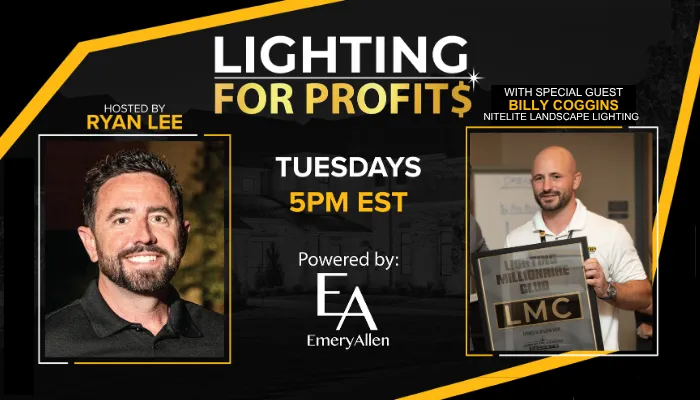
Billy Coggins - Million Dollar Glow
Lighting for Profits - Episode 240
From wrestler to entrepreneur, William Coggins shares how discipline, vision, and precision built a seven-figure outdoor lighting brand. In this episode, we dive into business growth, creative design, and the mindset behind building something that lasts—both in work and in life.
Watch the episode
Episode Transcript
If you're looking to start or grow a landscape lighting business, this is the show
Welcome to Lighting for Profits. All light, All light. All light.
Powered by Emey Allen. Here is your host, Ryan Lee.
All light, all light, all light. Welcome, welcome, welcome to the number one landscape lighting show in Long Island, New York. We are taking over the world. So excited. Definitely my favorite day of the week. Get to hang out, nerd out, outdoor lighting. So if you're looking to, start or grow a landscape lighting business, you're definitely in the right place today. Really looking forward to an awesome conversation with a client, a friend, someone who's just kicking ass, really doing such a good job, growing their business, growing their family. and, let's face it, I am sometimes selfish. I like to do this show to, gain knowledge, inspiration from others. I'm always taking notes. I'm excited to have Mr. Billy Coggins, with Nightlight landscape lighting on the show today. He's been on before, but, as always, we want to check in with him and see what's new, in his world. And so, again, if you're looking to, to grow your landscape lighting business, this is, this is the episode. This is, this is it. So thank you guys so much for your support. it's, it's, this is just such a, an awesome, opportunity. We get to, really, kind of grow the industry together by having amazing people on the show. still accepting those five star reviews. We did pass 100, which is cool on Apple, and now we're getting. I can't remember how many we have on Spotify, but I'll take what I can get. So if you're bored and you're like, hey, yeah, I want to do something good in the world today, then hook me up with a five star review. So, like I said, guys, in just a few minutes we're gonna have Billy Coggins on the show.
I went to an AI mastery class last week
before we have him on, I, want to give you a quick update. So last week, or actually just got back a couple days ago, I went to, an AI mastery class. And, you know, this, this class, by the way, a ticket to go to this for three days is 5,500 bucks. So not cheap. but I, you know, I practice what I preach. Invest in yourself, invest in education. And you know, when I got my real education, my marketing degree, my mba, I didn't really want to, like, there was nothing I was interested in learning about. But now I love learning because, like, I really wanted to learn about AI. So 5500 is like a no brainer for me. But, you know, 10, 15 years ago, I would have been like, hell no. It's too much money. So I would just encourage you to move forward, on wherever you're at, you know, if you think, you know, 500 bucks is a lot for education, then go do it. Pull the trigger, take action. That's how you get certainty.
A lot of people are asking me how was the AI class for outdoor lighting
A lot of people are, you know, asking me, like, how was the class and how was it? And it's like, I wanted to go well. Like, a lot of people were afraid to invest in themselves, you know, and, and I was too. I'm like, yeah, it might not work, but you don't know until you take action. So. But I want to give you guys just a quick overview. There's no way I'm going to be able to teach you what I learned in 72 hours. we had, we had long days. I mean, it was actually three days of 12 hour classes. We were going like 8, 8 in the morning till 8 at night, 8 food in the room. We didn't leave. You know, I mean, it was, it was intense. So, really, really cool. the reason I went was because I've been overwhelmed, to be honest. I mean, you hear all these different AI tools coming out every day and people going, oh, you got to use this one. You got to do this and you got to do that. And I was just like, it's not that I felt AI was a shiny object, but I felt certain tools were. And I was like, well, which one do you use? Right? So, in fact, you're probably wondering right now, like, what tools should I use? And I'm not actually going to tell you. I might give you a couple of tools that I think are cool. But, it's not so much about that. What, what I learned, and we did, we did learn some, like, cool new tools and stuff like that. But I really had a mindset shift. I mean, I had this, like this epiphany moment where I was like, I get it. This, this is how AI is going to happen, not only in my business, but in really any small business that wants to, wants to scale and wants to really stick around. you know, I, I used to think, I used to say something along the lines of, like, you know what, we're in the customer service industry. We just happen to design and install outdoor lighting, right? And I believe that, you know, I said it for years, right? And I still believe that. and then there was a shift a few years ago where I Thought, you know what? The best outdoor lighting companies, they may not be the best designers, they may not be the best installers, but they're the best marketers. Those are the ones that are taking over. Those are the ones that are the loudest in a market and they're growing, they're getting more business because they're the best marketers. So it shifted to be like, we're really, really good marketers who happen to design and install some really badass outdoor lighting. Now today, my mindset has shifted again. And I believe that the future best outdoor lighting companies are AI companies. AI companies who just happen to design and install some really, really cool outdoor lighting. because what I saw not only learned, but then a preview into like, what's coming was just like mind blowing to where I'm like, okay, the ceiling is now, shifting. it used to be like a big outdoor lighting company would be like $5 million with AI. It's going to be transformational. We're going to see the first 25 million dollar outdoor lighting business. And I'm not talking like a franchise. I'm talking like a solo person with a few locations doing 25mil because of what AI can assist and the speed of implementation and all these things. Right? And so, I want to just share a few of my takeaways. and again, even though I learned some really, really cool tools and ways to use them, I don't have time to. And I don't really want to be like the AI expert today to be like, oh, do this and do this and do this.
I literally built an app and an entire website in under an hour using AI
So I just want to kind of talk about the shift in thinking that I had and some of the things that you guys can use today, like right now in your business. and trust me, like, the tools are cool. I literally built an app and an entire website in under an hour just talking, like, just talking to AI. And what I explained to it, it built way better and it wouldn't have taken an hour except for it was my first time and I was still learning the tools, right? So you can do these things in like, In fact, actually this morning I built another website. We've got Friday Fly in coming. this Friday for Illuminati ah, members. I built a website for that in like 20 minutes. I got the code, I sent it to Jerrica. It was live, like this morning. It's crazy.
Use these tips to help you scale your AI systems as you scale
So, but here's what I want to talk about. Just a few helpful tips. Maybe you guys already know this stuff. Maybe I'm way Far behind. I don't know. So when you guys know, when you go into like chat, GPT or Claude or whatever agent you use, there's lots of different, Grok. There's lots of different agents you guys can use, right? But then you go into like the search, like to put a prompt in. I was always like, what, what are the different drop downs? Right? And it's like the versions and they say, oh, this one's faster and this one's deeper, whatever. But it's kind of like, you don't want to use the, the latest and greatest on every search. If you're just like trying to come up with some ideas, you don't need the latest and greatest, like deep search tool. Okay? And the analogy I was thinking about was like, if you're just gonna like run to Home Depot, you probably don't need. You're probably not gonna drive your Ferrari. You know, it's gonna be more fuel, tire wear, like engine wear and stuff like that. You're just gonna like drive your Honda Civic, you know what I mean? you're gonna get your daily driver and go to the store, right? But then you're going on a date night, you're taking your lady out, like, yeah, your baller status, you want to do it, right? Okay? So there's certain tools that you want to use for different experiences, okay? And right now, if you're on the $20 a month plan, like, maybe this doesn't affect you immediately, but I promise you, as you scale, like I started, I started building these websites and stuff like that. Like, you go through credits like crazy because you're using like, it's like hiring like the top CEO in the world is going to cost you more than just like an entry level coder, you know what I mean? And so I want you to understand that because it will affect you eventually as you scale your AI systems. I know personally, me, it's going to save me thousands of dollars per month as I scale.
Context is everything with AI, so give it some context
the next big tip that really like, was huge for me was context. Okay? Context is everything. So, before I went to this class, I, might have said something and then I hear people, I see people's prompts and stuff like that. They'll say like, you know, a basic prompt like, hey, help me grow my. What are the top three things I should do to grow my outdoor lighting business? Like, okay, that's pretty good, you know, but like, what it's going to give you is not necessarily what's best for you. Because it doesn't have any context. So a better prompt would be give it some context. Like, hey, you know what? I've been in business five years. I've got my business to 650 grand a year. I've got two installers. I do all the sales. I've got a virtual assistant. I'm really good at sales, but I kind of struggle with leadership. Every time I hire someone, they last about 12 months. And it's just really hard to find good people. Give it some context and just talk to it like you would instead of type to it. That's another big thing. Typing is a different voice than talking. So talk into it. And I'm telling you, when you give it this context, you're going to get, a completely different, result. along those lines, you guys, AI is not magic, okay? AI is not magic. So it's basically, a series of patterns. All it does is go out and look for patterns. And so the easiest way to, to view this, in fact, we all made some, like, sample videos and stuff like that. And this one group made a video and they, they put in their, their prompt or whatever, and it made a van with like two fronts. You know, it was like the front van and the front van together and just like driving down the road. And you've seen pictures like that where it's like, that's weird. It added a sixth finger or added like a weird nostril or whatever, you know, like, because AI, again, it's not magic. It's basically filling in the gaps. It's filling in predictable patterns. And so it thinks it's doing the right thing. So it doesn't mean it's always right. Okay? So it's easy to see that on a picture or a video. It's hard to see that in text. So a lot of times we, will feed it information like, hey, help me grow my business, blah, blah, blah, these are my things, right? And then it will spit out stuff. And you think it's correct, but it's not. Okay? It's just filling in a pattern and it doesn't have enough data and information to fill in the pattern completely. So you have to realize that you might be overestimating what these tools can do for you at this time. Okay, that, that's, that's just huge. Like, I just want everyone understand that, because again, from an image standpoint or video, like, you see that and you're like, oh, that's weird. That doesn't make sense. And people Go. Oh, it's hallucinating. It's not hallucinating, it's guessing on the pattern that it's trying to predict. Okay. And eventually when it has been fed more and more information, it will fill in some of those patterns. So certain models are better at predicting those patterns. So that's why, you'll see. I did a, I did a rendering the other day. I'm building a cabin and I put my cabin plans in there and I put a, give me a, give me a real, real life rendering into chat, GPT and it gave me a really cool rendering. And then I put the exact same prompt into Claude and it looked like a freaking, like second grader, did this. It was, it was not a, it was not a rendering. It was like, I don't know what it was. It wasn't the same thing. So you see that because they have different strengths and weaknesses. So, make sure that you guys are giving it plenty of context. and then I'm going to skip a few here. maybe the last one I would say is this is, a lot of people tell it what they want. Okay, so, give you an example. You might say, hey, I want to build me an SOP for a new installer. Installing landscape lighting seems like a normal prompt. the problem with that is again, you're not giving it a lot of context. Okay, so you need some context in the beginning, but also you're telling it instead of giving it permission to help you build the badass sop. So if you give it permission to go out and look for other patterns, other SOPs that have been created similar to what you're looking for, then it's not going to just be so narrow minded and only do what you're telling it to do. and so, one of the things that I like to do when I do my prompts is I'll say something at the end like, hey, by the way, before you actually finalize this or write anything, ask me every question you need so that nothing gets left out, right? Because that gives it permission to go out outside the box a little bit. Instead of just being like, here, build this SOP and start with this and do this and do this and do this, like you're not really going to take advantage of the full capabilities of it. So those are just the quick highlights. so much I want to go over in terms of like, use this tool for this and use this for this. But it doesn't, it's not really it doesn't really matter. What does matter is that you have to understand is like, I believe that every company out there needs an AI executive. And so I've already started my search. I've already actually made an offer to someone. I'm trying to get someone hired to be my AI executive that can help us implement a lot of this stuff. Because it's hard as a visionary, as like the owner of the company, it's hard to do everything right. And so I want, I want this AI executive to be my AI implementer, to basically audit our entire business, say, well, this person should, should be using more AI here and this person should be using AI here. we can do this for marketing, we can do this for sales and everything, right? And so might, want to look at an AI executive. I think every company in the future is going to have one, like really soon. So, huge, huge role if you can get someone hired for that. And then, I think that's it. I would say, the biggest benefit for me was being able to just eliminate all distractions, go sit in a room with other people in a similar, situation as me, learn from some people that are way further ahead of this game than myself. And that's powerful. You know, I mean, anyone can. You can go right now and use AI to learn about AI, but how much time are you actually dedicating to it and, how often are you getting distracted? So if you can go attend an event like this where you lock yourself in a room for three days, you just get so much more traction, so much more quickly. so highly, highly recommend you guys dedicate some time to learning AI for your own business. learn that not not only just the different tools, but, the different strategies. So, yeah, I was planning on going over more, but I'm already over time.
Emory Allen makes premium LED lamps for lighting professionals who demand the best
So, all right, let's see. Where's our music? Hey, by the way, if you've been listening for a while, you know I care about that client experience. listen, it's an easy way to differentiate yourself from the competition. So don't let a bad lamp ruin your client experience. Emory Allen makes premium LED lamps for lighting professionals who demand the best. Don't settle for less. Upgrade your designs and installations today with Emery Allen. All you need to do is reach out to jackson l@ emryallen.com to learn more and take advantage of their contractor pricing. Just email jackson l. com. thanks jackson l. com Now I appreciate you guys over at Emory Allen. They are always putting Out. awesome product. Great customer service as well.
Ryan Lee: When are you gonna have an AI version of yourself do this podcast
All right, let's get this show going. What do you guys say? Welcome. Welcome to the show, Mr. Billy Goggins. What's up, Billy?
What's up, Ryan?
I love that. It's a good looking hat, man.
It's a good looking hat. Keeps me. Keeps me looking. Right.
Do you only wear it when you come on Lighting for profits? My daily hat.
That's my daily hat. I like, I like this. I forget what this is called. Like, these type of hats, though. I don't know if you can, but they just fit better, you know? Yeah, couple. Couple people now have given me hats like this, and I'm a fan. I gotta get this name, maybe this brand, from you, so I can get it branded with Nightlight.
So, yeah, I'll, we can have Darcy get you that. I know. I. I'm. I'm like, I guess I'm a clothing and a hat snob. I didn't know that, but soft T shirts. Yeah. Try to keep it real.
When are you gonna have an AI version of yourself do this podcast? Because when you were talking about that, I was like, is this even the real Ryan Lee or.
Well, dude, I mean, there's, I can't even remember what it's called right now. Google LMN or whatever. I. I seriously, like, there's so many tools you. You can do that. So, like, you. You could just go program it and say, hey, I want to do a podcast. You have your virtual AI. I've already created that. you could have other people do a podcast. Talking about Nightlight and this, this up and coming Billy Coggins taking over the world and winning awards and being a mentor at Illy and all this stuff. I mean, and it just makes that shit up. And then, you know, you share it with the world and people are like, dang,
I need. So, yeah, I need an AI just to talk good about me all day.
Yeah, no, it's. It's insane. It's gonna go fast too, I think. it's just like, I don't know. It's gonna go fast. Pretty soon you won't even have to, like. Like, I'm not kidding. When I was talking, like, building these websites and stuff, I don't download an app, so I literally just like, talk to it. Just, like, you talk into your phone and you just say, like, these are the elements I want. It builds it. I'm like, how does it. How do I put this live? It's like, oh, here, put it here. You don't have to create an account and it's live. I'm like, what in the friggin hell?
Yeah, it's, it's wild. And, and I think you're spot on with having that AI, assistant or executive. Is it part of like the leadership team? Right, like having someone kind of heading that entire division. Yeah. hopefully they're just managing bots and not anyone that's actually going to be on payroll. But yeah, it's, it is, it's hard to conceptualize, doing that as a visionary because my mind just goes in too many different directions at once and I'll actually never get anything done. Yeah, but if someone could like imagine you have someone in your team 40 hours a week just working on AI tools, like how that would, that would just be exponential growth, exponential potential of the business. because you just have 30 agents working on your business at all times. It's really mind blowing to think about.
I know. That's why like as soon as, so some of, some of those agents and sub agents, like they call it the multi agent stuff. It's, it's already out. But it's not like, it's not good enough to just like unleash the beast, right? Yeah, but it's good enough to like, you know, try, you know, experiment and stuff like that. So yeah, like at some point though, you literally, like, you can go, you can go right now, I can't remember the name of the website, but you can go get like an AI skill and, and it's a CEO skill. So instead of being like, hey, this is, this is a CEO of a lighting company. Like it's already trained on that skill. And then you hire like a developer with that skill and a marketing with that skill. Like all the things and they're like dollars instead of hundreds of thousands of dollars, you know, so. And then you literally, you have a human that's just managing that and assigning like, hey, you get this, this amount of budget, you get to make these, these are your decisions. that's insane.
Yeah, I look forward to seeing what
you do with that for now. I mean, I, I just, I'm gonna have someone, I literally have, I'm trying to hire her right now to just like, and like implement because you know, it's fun, you go to these things and. But it's hard to implement everything. So I'm like, okay, these are, I already know, like These are the 20 areas that we need it. But I'm not Gonna do it. I'm doing a podcast, you know, so I think I need an AI implementer so I'm gonna do it.
Billy Coggins is a landscape lighting designer and father of two sons
Well, it's good to catch up with you, man. So you've been on before. Do you want to just do a quick introduction of who Billy Coggins is and where you're at and what you're doing and why you're doing it?
Yeah, I feel like every time I come on, I say my wife is pregnant, we're having another kid. And so it's like once every like year and a half I come on the show. but yeah, I'm a father of two boys, 1 and 2 years old. The husband, part time wrestling coach at this point. but having expecting our third in August. So we're really excited about that. that's all the family stuff. Other than that. you know, work wise we just do landscape lighting. We got out of holiday lighting 20, 25 was our first year not doing holiday lighting anymore. And you know, learn from that experience of kind of like how to fill that season up and what that means for like the, the backlog coming into 2026, and all that stuff. but I think we've made the right decision. I'm happy with it. and I always kind of said when m. When we built this business and up on the landscape lighting side that we would kind of get rid of that necessary evil. that I felt like it was. And so that's so wrong to call like the holidays like an evil time. Right. But for anyone, like the holiday lighting business, you know, if you, if you're not fully, if you're not in love with it, it can be it can be tough. but but yeah, just continuing to grow as a lighting designer, continuing to grow as a, as a entrepreneur and excited about 2026 and what the future has to hold.
Nice man.
You decided to chop the holiday, uh, lighting. What was the fear there?
Well, I guess you know, you brought it up. You decided to, to chop the holiday, lighting. what was the fear there? I mean, you know, obviously that you had some revenue, some guaranteed revenue coming in. Was that kind of the biggest thing?
Yeah, I don't think it was a fear other than just like, okay, if I'm being rational about this, it probably doesn't make sense to give away a couple hundred thousand dollars in guaranteed money. Right. And so it was more so of just like I, I'm not, I'm not going back, I'm not going to make this decision and then go back, I need to make sure that I'm in a good position to move forward. And so, we did that. And I'll tell you the one thing that I did, didn't realize the, the, the big learning and taking away thing takeaway for me was I had no problem filling the month of November with landscape lighting projects, filling the month of December with landscape lighting projects. What I didn't take into consideration was in previous years, all of those jobs that I was now installing in November and December, were getting pushed to the next year to fill out March and April. and so I ate up my backlog really fast in those months where now we came into 2026 and maybe we had, you know, two weeks of work that I had that were sold in 2025 instead of six weeks or seven weeks. And so, as we were kind of like capacity planning and scheduling out for the year, you know, towards like the middle of March. And even, and even now I'm just like, how did we catch up on works? Like, I feel like, where is all the work? And it's just because we got it done already, you know what I mean? And now we're just like, you know, we're still booked out a couple weeks, but it's not like that six, seven weeks booked out, you know, and, and so that was a little bit of a learning curve. And and, and next year, like, I just know, like, you know, I really have to just, plan better for the, for the next. Coming for 2027 in, in the spring.
Do you have an idea what you're going to do to get it booked out further earlier on?
Yeah, I mean, it's, it's probably just going to be an adjustment in our advertising spend, and our marketing spend in those months. Just knowing that like, you know, just because I am booked up in, in 2026 through December, like I need to have another four or five weeks scheduled for the next year. and so it's just going to be. I'm gonna have to sell more projects. and and potentially right now we're working on a lot more, strategic partnerships. And so we're excited about that. And we know that could be a year cycle, right? You start building those relationships with strategic partners and it's not going to land the job next month. but those jobs could start landing 12 months from now. So we're putting that work in now, hoping that, in the spring, of 2027, some of that starts coming to fruition.
You led a session at Secret Summit this last year on real estate investment
Nice. So I remember you, you, spoke. You led a session at Secret Summit this last year. Yeah, whenever that was eight months ago or something like that. But, it was awesome. I was like, man, this is. I think that was like one of your first, like, speaking gigs or something, wasn't it?
Yeah, I mean, I had done like a little public speaking before, but, not, you know, just, get in front of a bunch of like minded people, people that I look up to that were in the room, you know, and you had asked me to speak. And so, I was excited to do it. And, yeah, just talk about things I'm passionate about. I feel like if you're talking about things, you know, you know, you should be able to get up in a room and hopefully do, something.
Well, I, I was excited. I was, I don't know if I had, like, low expectations, which I don't know why I would like. I. Look, I asked you to speak for a reason, right? Yeah.
Yeah.
But at the same time I was like, sometimes people are really good at the thing, but not as good at explaining or teaching the thing. You know what I mean? So, I think that's where I was, like, super impressed. I was like, dang, dude. Like, this does not seem like Billy's first rodeo. Like, you, you just killed it. And, and I really appreciated, like, how you went through the different, stages of growth for your business. And I mean, you were giving away quite a bit of valuable information on. This is exactly what I did. So that was, that was killer. how much. I mean, your growth has been phenomenal. And I, and I see people getting stuck. These solo guys. You started solo, you know, you start and then you're doing all the things what, like what, what have you done differently than the guys who are still five, ten years in, stuck at 500k.
I think number one, going back to kind of that talk that I gave in, in Palm beach is, relentlessly chasing a goal that you set. and so, if, if you're not setting sales goals per month, per year, and checking your. And updating yourself, like, I do it daily, exactly where I'm at and kind of what I need to accomplish this week, this month in order to stay on track and get where I need to go, it's really, really hard to get there because all of a sudden 2. 2 months can go by. You didn't realize you're not on track at all. Then you got to make that up. And so I look at my sales numbers daily. like year to date. Year to date. I know exactly what my number is for the year. and every single day you could ask me, like, what my year date sales are and I would know it. That's like just a competitive mindset, right? It's just like I need to know the score. If I don't know the score of the game, it's like, this isn't fun. we're just out here kind of like doing our thing. So, I think that's a really important thing. And then the, the other thing is just like being, being okay with, you know, digging. We spoke about this before we jumped on air, but digging yourself a hole and having to climb your, your way out of it, I think it's something that my dad always kind of talked about. you know, more so in like, the real estate investment side. You always spoke about it, but, like, you know, like, buy the house young and figure out how you're going to pay for it. And, you know, and I did the same thing. And, and then even in business, like hire the office manager and figure out how you're going to make enough sales to pay for and then hire the coo, like, this year and make enough, you know, go out and market and sell enough jobs to pay for it. And, and eventually you do that and then you look for the next addition to the company and to the business and, you know, the mistakes along the way and whatnot. Of course. But, I think it's just being diligent about knowing, that you want to grow and just be relentless about has so good.
I honestly, like, I think I agree with everything you just said. I think that's the reason. The problem is human beings. We all, we're all very similar. We all, like, don't actually want to take risk. Like, we all want guarantees. Like, why would you not, you know, why would you not want to know? If I do this action, this result would happen. Like, that's, that's what we're all seeking. The problem is, especially in business, there are no guarantees. There's just not. And so the people like you that are willing to, like, take action before there's any certainty, then what's cool about action is it actually gives you certainty. And sometimes it's not the certainty you want. You're like, damn it, like, I should not have hired that person. I should not have done that advertising. Like, I should. But now you know that you shouldn't do it. That's the only way to get certainty is to take action.
I. I think that, M. I think that you have to be willing and okay with the potential of failing. Like, you have. You have to. Like, I. I'm constantly being like, if I lost everything tomorrow, like, what would I do? And I truly believe, like, if my business, like, something happened, like, Nightlight just disappeared tomorrow, you can't take away the knowledge that you gained from growing that business. And, like, I would just go start another business. You know what I mean? And, like, I think within a year, I would be, like, right back where I am. And so you can't take away the relationships that I have, the, you know, the things that I've learned, and all these skills. And so, you can't be scared of failure because it's just guaranteeing that you're going to fail. And so, like, just open it up, you know? And some people are just, you know, it depends what stage you're at. Right? My dad's right now, he's 62 in business. He's not going to have the same mindset that I'm having. Right. It would just be idiotic to be like, oh, let's risk it all right now.
I see this as an opportunity to grow my business while I'm retired
You know what I mean? Like, while he's getting ready to retire. but for me, you know, being 33 years old, it's like, I have. I have time. Like, if. If this doesn't work out, like, I have time to start two or three more businesses by the time I retire. and so I just see that as, like, give me so much freedom to just go out there and, like, put it all on the line and try to grow this thing as big as I want it to grow.
Love it, man.
So, um, you guys started the Boston location last month
So, you guys started the Boston, location. how's that been going?
It's going great. Anyone, that's met Brian? you know, I feel like it's. It can be really scary to open a second location and. And have someone kind of, like, repping your brand from so far away and you don't know or see what they're doing on a daily basis. I feel like I got really lucky when it comes down to kind of who I decided to partner with. and that was just, you know, I think fate kind of brought us together in that aspect.
Especially the person. The person you partner with. You have no idea what they could be posting on Instagram at any moment.
At any moment. At any moment. and. And he likes to post on Instagram. And, so, it's going really well. It's going really well. I think that, this year I'm going to be a little bit more involved in, in the actual business of. Of Boston. For some reason, last year I just was like, oh, like, he's got this, you know, he's gonna go out and, like, he's gonna crush it and whatnot, because he just has so much confidence, and I have a lot of confidence in him. but we're gonna be a little bit more strategic this year and kind of how we go about things, dial in our sales process, making sure that we're being consistent, making sure that the SOPs that we run in our Long island location or just dialed in and, you know, followed up in Boston as well. And so I'm excited to see what happens this year in the Boston market for us.
So if. I mean, I know you're still learning and you're still kind of going through this, this phase, I guess, but if you were to just, like, restart it, like, how would you, like, in. What will you say? Sops and all this other stuff, but, like, how would you have done a
better job in Boston?
Yeah.
I remember I had a conversation with you early and, about this, and, you know, I said, you know, I don't want this to fail because I wasn't strategic enough about how I went about it. Because I've made mistakes like that in the past, where I'm like, I'm pretty impulsive. Like, I decided to do something, I just. We just do it. You know what I mean? It's like, I took a step back and I was a little bit more strategic, and I think that worked out, you know? You know, figuring out our partnership, like, our comp structure for him and all that stuff, like, that's where it can get messy really fast. Like, hold on a second. I was supposed to be getting paid. We haven't had a single issue like that. and so that's been really, really good. I would say mostly it's. It's having the sales process nailed down because sales are the lifeblood and the oxygen to that business at that young. Like, you know, and. And from a distance, one little thing changes in a sales process, and you can't really pinpoint what's going wrong anymore. You know what I mean? It's like, I should say, if a couple things change, if one thing's changed, then. And you can pinpoint it, that's great. But, like, if you're not following the process, then, it's really hard to dial in like what the issues are when it comes to sales. So, that's our biggest thing right now is just doing sales training, and doing a little bit more shadowing and just following the process to a T, staying consistent. And if it, if it, you know, let's look at historical data over a month, not just make a change after every single appointment when something doesn't work. Right. Like, let's stay to the process and then go from there. So that, that's our biggest thing that we're focusing on right now.
That's cool. What, I mean, what I heard was, was training. I mean, I heard sops and all this other stuff. But like SOPS is, is such this buzzword the last like five years, you know, like sops, sops. But like I could literally hand anyone the, the, the most perfect SOPs. It's going to grow you to 100 million. Like it doesn't do anything unless you're training on it, unless you're following like you said. So you go out and implement and you do. And then you measure and you go, okay, I'm at 20, close rate. All right, what do I do to get it to 25? Right? Shadow them, train them. Hey, you're not saying this. You're not doing this. Oh yeah, I used to. I stopped doing it. Why? That's our SOP. So that's the only way that SOPs actually work is if you're implementing training. I mean, it's constant, right?
And it's the hard. For me, it's been the hardest thing because you have to self evaluate a lot. Be like, what has worked for. I never had to think about it, right? I never really had to think about like, what was I saying, what was my tone of voice, how did I enter that house and kind of navigate that conversation? and then you start self reflecting and try to teach that to somebody else. it's not easy. And so with time, I'm getting better at it. and with that, my sales team is also getting better. And so, that's been exciting.
That's awesome. Yeah. Well, it's like, what do they say? What, what gets measured gets improved. You know, and you said it earlier when you're talking about like how, how you've gotten to this level, like if you're not, if you don't know the score, then how do you know if you need to like push harder or not? You know?
Yeah.
Up three touchdowns, like, you're probably doing okay, you know, but if you're Down. You gotta. You gotta change something. The game's not over yet. So.
Yep, yep. And so, and then surrounding yourself with people that also care about the score, too, right?
It's important to surround yourself with a team that are aligned with your competitive drive
It's like, that's part of our culture, is just like a competitive drive. like, everyone on my team, you know, was at some point like an athlete or, you know, and so, Because not everyone lives to win on a daily basis. Like, if you're. If. If you don't, that's not important to you, and you just kind of like in cruise control, and you have a boss that is just constantly talking about winning, you know, and like, talking about the score, then you can get burnt out. And so it's important to surround yourself with a team that are just aligned with. With the way that you operate.
You're setting some, you know, big goals that can spiral out of control
Well, yeah, you might have answered my next question. I guess. I mean, I'm just like, how do you. How do you stay engaged? Because at some point, you. You're. You're setting some, you know, big goals that.
Yeah.
you don't need to hit. Like, you know, maybe you do. Maybe you've made hiring decisions to, like, no, we have to do this, otherwise we're gonna have to fire this person. But in a lot of cases, we set goals that are bigger than we need to stretch us, which is good. But is there. Is there a certain exercise or things that you do to stay engaged to make sure that it's like, yeah, our goal is 400 grand this month. But if we don't, like, again, it's easy to be like, oh, well, we did 300. That's pretty good still too. But to push it to that 400.
Yeah.
And.
And it's not, it's more year to date because the monthly things like, change, you know, like this year, I'll just be frank with you. We're not having the start that I wanted to. And, but we have so much kind of in the pipeline that is, like, ready, like, I feel like just right out the edge, right on the tip of my tongue. And. And so, you know, it. You have to kind of. You got to be like water, right? And you got to kind of go with the flow a little bit, just making sure that, that you know the score, you know, because if you do, like, get too hard on yourself, you're like, oh, my God, now I'm 400. Then everyone starts stressing out. You start pressing too much, and it can get, you know, spiral out of control. And so, stick to the process and, and, you know, and Just follow the scoreboard and know that you need to push a little bit. But, don't make it obvious. Like, I don't, like, tell my team, like, hey, we're down. You know what I mean? Like, hey, we need to make a sale this month or else we're screwed. it's more so for my internals. so I kind of, you know how to manage everybody. But, But yeah, so I don't know. Not everyone operates like that. That's not important to everybody. And like you said, like, I don't need to grow the business by 50 every year. And honestly, it's not going to be sustainable for me. Like, I'm not going to grow the business every year. I'm not going to try to double every year. I mean, that's been my goal for the past couple years. But, you know, you didn't attend
my AI class, though.
Yeah. Yeah. 2x is. Is looking like nothing after you can implement 35 AI agents. but, but yeah, so that's kind of where I'm at.
Yeah. The phrase that I learned years ago I like to use is marry the process, divorce the results.
Yep.
Like, it's. It's just. It's just process and it's like, at the end of the month. All right, we didn't hit it. Did. Did we do everything that we could? No, we didn't. We didn't do this.
It's just more fun to try to compete. You know, it's all arbitrary. Like, if you don't hit it, you don't hit it, whatever. But, like, you might as well have fun with it, you know? Like, it's more fun to try to win at something. Like, if, you're not trying to win, it's not fun. So.
How is your social media going? Yeah, it's been great this year
All right, my goal was we were going to do, like, some design stuff, some project walkthroughs, but of course, I'm addicted to business, so we got totally sidetracked.
You can go wherever you want.
Yeah, let's do it. I want to walk through some of your projects. You. I mean, you've been putting out amazing work, photography, videos. Your social media is on point. I'm going to have you share. Oh, I got to change that. I. Oh. Even though we are going to talk design and stuff here, how is your social media going? Is that. Is that still a good, lead source for you?
Yeah, it's been great this, year. We switched a little bit and. And now the team that's doing our social media also is doing all of our, content creation. So not just like editing the content that I give them, but they are, actually filming the content. So they're coming out into the field, you know, once a week or twice a week. And and actually so it's, it's, it's driving up the quality overall because I was just filming with my iPhone and sometimes I'd be rushing and whatnot. So that's been really good.
are they scripting it out for you?
They are, they're scripting it out, but, I don't like everything to be scripted. You know, some of our best performing, ads are, are things that are just kind of off the cuff and are authentic and organic and so, yeah, some things are scripted. You know what I mean? But it's been really good. I think like we're trying to put out a high quality product. You know, just like our landscape lighting. You want to put out a high quality product. the content that we put out needs to match that, because you want to be attracting the right type of clientele. Right. So, making sure that it fits the brand and everything is gelled together nicely.
Yeah, I know that the scripting thing, like I, what I do is I usually just script like an outline, you know, maybe like the hook, maybe like the one sentence or whatever. But I'm terrible with scripts. I would much rather just riff and like. No, okay. These are the bullet points I got to hit on. because it's tough when you start scripting it. You don't feel normal, you don't feel authentic, you don't feel yourself. And it's probably comes across that way.
Yeah, if you can take a script and then make it your own. I, I've done this a lot with like pre qualifying recently where I had like a pre qualification script and I, I used it. I wanted to get proof of concept before I rolled it out to my office because I come out with like a new idea every day and I drive them crazy. so I was doing it myself first and then, you know, after a week of pre qualifying, say 10 or 12 clients, whatever it was, I didn't have to look at the sheet anymore, but I was able to follow the script basically. but in my own words. And it felt way more organic. So I think if you have to try to memorize a script, it becomes off, you know, like a script. But if you can like actually know the point of the script and like where you're going, and have it really memorized of, like, the overall goal. Then it comes off way more authentic.
Very cool.
Let's talk about how you approach your projects and approach design
All right, so I had asked, Billy just to. I'm like, hey, let's. Let's walk through some projects, maybe some projects that had certain challenges, and just kind of want to tap into your brain about, like, how you approach your projects and approach design and how. How you then bring that into your sales process and everything else. So you want to show us a few of these things?
Yeah, absolutely. I will say that, I just got back from ILY today, actually. it was my third time going, second time as a mentor. And, every time I go there, I just, like, you know, come back and I learn something new. you know, and this time, I think I was talking about before. Like, I think I realized that I'm a much better designer than I probably gave myself credit for. But I'm probably, you know, in the same sense. Like, there's so much talent there, and there's so many, like, people that are great at what they do. you can. You can start to get, like, imposter syndrome. You know what I mean? Like, am I really, like, as good as I think I am? So, it was, like, kind of. It was kind of weird because, like, I think I'm really good at design. But then, like, you know, I talk to someone and they can just talk about it in a more fluid manner. so I'm going to be pretty casual when I talk about this, and kind of give you some concepts, and so we'll kind of start to. To run through it. So this is, one of my projects that we did last year. You can see when, when I first had pulled up to the property, this is at the. At the initial consult, client interview, there was solar lights, right? And so this is a 12 acre property on Long Island. It's unbelievable. There's like six or seven houses, on the property. And some people just. They just don't know any better. They know they need light, they go out, they have their, you know, house manager get some solar lights. and so I thought this was pretty funny. And, you know, one of the things that about this property is we wanted to try to avoid the visual clutter as much as possible. And so we really tried to limit how many fixtures were going to be seen during the day, which, which meant, you know, not a lot of pathway lighting, a lot of down lighting throughout the property, and it. Hiding the accent lights as much as possible. Anything, especially anything in Grass obviously, is not going to be protruding. these are also just like all iPhone photos, so you'll see, they're blown out a little bit. but it was really important for the client to, like, not see. They actually made me add this path light at one point just for that top step to kind of delineate it. But, like, to get these steps lit with a downlight in a tree that's kind of hidden over here, was really important. And then just like, giving yourself a visual destination, and kind of like surrounding the space with enough light to feel comfortable, kind of entering up into this pathway to the front door, was really important. So, this is one example. I think having these before and afters is really important as well, to show clients, so you can walk them through this.
Well, yeah, I love the. The daytime versus nighttime shot because, I mean, they know what their house looks like during the day, but they don't know, like, how dramatic it can be at night. So, yeah, it's huge. I mean, they spend so much money on their landscape, on their property, the maintenance and everything else. And then just even that one picture with just a handful of lights has so much more dimension and depth and texture. It all comes out because of your lighting.
Yep. And, and so this one is in the backyard. You know, once again, like, we needed to find a way to light this, spiraling staircase kind of coming down into the. Into the back of the property, really without seeing any light fixtures. And so what we ended up doing was actually putting hard, hard mounting a hardscape, mount onto the actual brick here and be able to kind of just cast that light down the steps and guide people down, into this grass area. So we did that with just two fixtures. and then we just created enough light kind of throughout this tree over here to create a little bit of a ceiling coming down, so it's comfortable. And, and so that came out really nice. And I was, I was really happy with the way that we were able to do that. you know, some design challenges or, or some installation challenges, in this project were, you know, once again, like, the property was so manicured, we didn't want to see, you know, any fixtures as least as possible. but we also wanted to feel natural. This house was built in the 1800s, and so, you know, it needed to be lit in a way that matched the era. and so it couldn't be overlit. It need to be really, really soft. The client specifically had said you know, they want to be able to see, but they don't want to be seen. And it's something that I've always, that I've taken away from this project. They want to be able to kind of navigate their property and enjoy, it, but at the same time. so here's another, photo of that staircase kind of going down.
we go back to those crepe myrtles that had the downlights.
Yep.
What, what, how many lights, like, what type of lights were here?
so we have. There's three lights on each tree here. And so there's two accent lights and just one down light. one pendant light in each one of these. yeah, yeah, yeah. Huge fan of, of pendant lights and crape myrtles. I'll show you another tree actually. Let's see.
And like a 60 degree or what. What do you have in there? Do you remember?
Look at this. Like just that soft kind of halo around the base of the tree and having that dabbling and you know, when the wind is moving, it's all. It looks so nice. but you can't get that. It's very hard to get that with a directional downlight because it's just a harder cutoff. especially when you're mounting it 12ft off the ground.
Yeah.
and so when you have a pendant. This was an SL13 from Sterling. When you have a pendant that, you know, has 100 degree spread on it, has a frosted lens as a hex louver, it really, really, gets rid of that defined edge on that down light and allows it to kind of softly fade out. And so, they're really great in the applications where your lights are going to be mounted at a lower height.
Yeah, it looks awesome.
Landscape lighting can have a profound impact on clients' lives
Yeah. of course, like the iPhone blows it out. But you can see, you know, this is a focal point in the center of this driveway. and so now this tree is, you know, properly celebrated. Every night when the client pulls in, they'll, they'll text me like once a year on this tree and just be like, dude, I can't believe the impact that like every single time. It never gets old. I think it's one thing that, like, people don't understand about landscape lighting is like, you know, you might buy a car and like, after like a couple weeks, you're like, yeah, it's nice, but it gets me from point A to point B for some reason. Like, every time you get home or every time you look out that window and you see that tree lit like, it's that same sense of appreciation, you know, year three as it was day one. It might even be more.
There is, I don't know if there's a way to communicate that. I mean, I don't think there is until people have had it. It's truly the investment that pays off every single night. And you got a good analogy. Like, we've all bought that new car and you're like, dude, I finally got it. This is so cool. And like, literally sometimes it's like two weeks later you're like, okay, it has Cheetos on it now. So, yeah, who cares? Like, it's not that awesome anymore.
Yeah, a hundred percent. And, at ILY the other day, I was walking around with some of the mentors and we're walking through some of the finished spaces on Sunday night. And I was just thinking like, if, if, if clients just knew, you know, like, we all try to put it in, in words, kind of like the impact that it's going to have. but it touches you. It really does touch you on a different level, like emotionally when you're in really, really, really well lit spaces, that are intentional and, you just don't want to leave. Like, we were out there till 2 o' clock in the morning just looking, you know, and we lit it. We knew exactly what was going on. And we're, you know, we see lighting all the time, but it's just one, it's just one of those things where like, it will invite you out into the property more, and you will find yourself just kind of like staring at it, you know, for, for a couple minutes and just like appreciating the beauty. So, you know, we try to put it into words to clients, but, it's really a show me, don't tell me business. that's, I always say that, like, that's why everyone needs to have a great portfolio for sure.
Even then, I feel like we, we somehow convince people to move forward with, you know, with an awesome portfolio. And some of these people are spending tons of money, but they still are themselves taking a risk. They still have uncertainty. And they're like, that's why they're blown away. They're like, oh my gosh, I had no idea. Because it's still like showing them someone else's property when they get to see their own space and in real time. That's the magic.
Yep, 100%. and, and, and maybe taking, you know, a client to a neighboring property or someone, you know, fairly close to them that you lit. And so, you know, if you have clients that you're close with and let you walk the property. I've done that multiple times last year. And, it. Once again, it's just one of those things where it's just way easier to kind of get them excited about it. I love the way that we lit this kind of, like, entryway into the backyard and just like, you know, these climbing flowering vines kind of coming over the fence. And you could just see, like, this fence has been here a long time. Right? It's, It's. It's old. you know, the vines, you know, it takes years, 15, 20 years for that to kind of look like that and, you know, to kind of just like, blast it with up lighting or, you know, mount a fixture to the fence. It just wouldn't do it any justice. And so, you know, to softly illuminate it, kind of coming down with some. With some down lighting over the top of the vines, but also delineating the, you know, highlighting the actual gates so people can enter and exit. I just was. I always love the way that that one came out.
As I'm,
Sometimes you get pushback with more fixtures than is apparent on most projects
As you're going through these, I'm wondering how often do you get a client because you got it on all these scenes, you've got, again, more fixtures than is apparent in a lot of cases. Right. Often you get pushback with them saying, no, we just wanted the tree to be lit, and we don't need the. The three or four downlights outside of it. And when that happens, what do you. What do you do?
So most times, you know, I, I do put a schematic plan together. And so I do, you know, put fixtures on a plan for, for most projects. However, I am kind of talking conceptually about what my intent is way more than describing where every fixture on the plan is going to. And so I would say eight times out of 10, most clients, you know, don't know that there's three lights on that tree.
Okay.
you know, they just know that I have a plan to create this scene for them. and, you know, that I need, you know, X number of fixtures in the whole project, and these are the areas that we're going to light, and we're going to light them really well.
Emily: Concept versus Schematic is the difference between design and architecture
And so, one of the things that we spoke about at ILLY was, was conceptual. And I don't want to get too much into the weeds here, but it is the design podcast, conceptual versus Schematic. And Emily did a great job describing this, conceptual is talking about, you know, we want to take. We want to be able to light this path, this meandering path kind of coming down, highlighting the ground plane. So that way, you know, we can navigate and get guests from, you know, maybe the, the garage or the parking space over to the front door and create this scene that feels comfortable, inviting, you know, without any safety hazards or trip hazards. Right. It's like, that's describing the overall goal, conceptually describing what the plan is. Instead of talking about schematics, which is like, we're gonna light this path with five pathway lights here. We're gonna light this tree with two accent lights and one down light. So that way we can have the path lit for your guest. Right. And it's like, you start getting too much into detail with your clients like that before, you know, maybe the job is sold. You know, they're going to get caught up on the details. Like you said, there was going to be five here, and instead of now you have four. And what's going on. It's like that you haven't even really started the design yet. You can't really say exactly what you're going to do.
Yeah.
and so that was one thing that I took away from Ellie was like, just. Just keep the overall, intent top of mind with the client, and then work on the details in the back end until you have them nailed down before you start spewing too much information to them.
Yeah, well said.
The client historically had lighting temporarily installed for a huge party every year
and let's see if there's anything else on this one. Oh, here we go. I don't know if this goes. No, you're good. let's go into this one a little bit. This one was cool. this was. I don't do a lot of, like, rgb. this was that other photo. Let's put this in here. I don't do a lot of RGB projects. And, this was one that the client historically had lighting, temporarily installed for a huge party that they throw every year. And, they had. They had thought they had seen, like, my vans, and they had passed my office a couple times. And they were like, let's, you know, see what this would look like to get it permanently installed so that, that way we don't have to keep paying for a temporary installation. So we went out there and initially they just wanted a very basic type of design, like nothing that they would use on a nightly basis. when the party wasn't happening. They really just Wanted lighting for the party and, and when I went there, you know, I found 20 acres of property with an absolute beautiful landscape. I'm like, hold on a second. Like I don't think you understand the opportunity that you have here. I don't even know how you've lived in this space with it being dark like this for the past ten years. like let's look into the potential of like lighting this the right way and having the RGB and, and whatnot in different zones for the party that we can always turn on when that party happens. So they ended up, you know, we did a mock up form, we did some things but they ended up moving forward with kind of lighting it, you know, in I would think the proper way to do it. this is with the brightness like turned all the way up. but it was, it was. I don't have a job.
That's nice right now.
Yeah, you can hear Kenny in the background of that one. This is a red redwoods project and it came out absolutely friggin awesome. but you can see from a design standpoint the client didn't love the like the well lights in the ground. Like they didn't want to see any kind of like reflection off the, off the grass or anything like that. so when we got closer to the trunk they actually, they were like, you know, put the accent lights closer to the trunk because I'll have my landscapers like be careful and not hit them because we want to try to block as much glare as possible. This was like a week after, you know, it's like broken fixtures and whatnot. So from a design, design standpoint still holds true to try to use in grade fixtures. you know, when you're in, when you're in turf, when you're in lawn. but a really cool project. Ah, you know that we lit with RGB and something that we don't get to do very often. So I was happy to do it.
They keep it like warm, white, year round and then flip it for the party. That's the point.
They, they hadn't like even when, even when I first installed it, they were just like, yeah, just leave it off. You know, unless the parties. I'm like what are you guys talking about? What do you mean leave it off?
Like a year. This was a once a year install it.
Let's get it perfect. Like I know you're concerned about maybe your neighbors and it's too bright. I was like that's why we put this system in. We can tune it to the exact, you know, level of light that we want. they're like, no, you just leave it off. I was like, okay. So, we left it off for, like, two months. And then finally they called me back, and they were like, we're ha. They're having some guests over. The homeowners are having some guests over, so they would like the lights on for this weekend. And then we turned the lights on for him, and we did our whole thing. And then they haven't shut them off since. They just didn't know what they were missing, you know? and, and now they absolutely love it. And they're constantly messing with the colors and different things for every holiday and whatnot. So, it's cool to see them kind of take full advantage of it.
You just never know.
You never know. so that's kind of, you know, as far as, like, projects, that's what I kind of had to. To go over. you know, but, if you have any questions about, you know, in regards to design or anything like that, you know, I don't know how much time we have, but, you know, I'll answer anything that you have.
No, that was awesome, man.
Billy says you have a moral obligation to tell homeowners what's possible
I appreciate you just kind of walking through, you know, a few projects and stuff like that and just kind of, you know, tapping into your mind on how you approach things and how you deal with clients and what their requests are. And, like, even this one where they're like, hey, we just want this. Some people are just like, yes, ma'. Am. Yes, sir. And you're like, no, like, we can't. Like, we have to at least show you what's possible.
Yeah, I think, I. I read a quote the other day, and this stood out to me. Henry Ford said, if I would have asked my clients what they wanted, they would have told me a faster horse. M. That's cool. It's like, yeah. just because they don't know what's possible, it doesn't mean that they wouldn't want it if you showed it to them. It's just that they don't know. And so at least show them what's possible. At least show them that there's an option. because you never know who you're talking to.
Dude, that's huge. seriously, if everyone would just adopt that and just have that be a takeaway. Yeah, like, we know. We just know more than most homeowners, you know, like. Well, I would say maybe all homeowners yeah, we should, we were, we were ignorant about outdoor lighting at some point in our lives too, you know, and especially you just went to Italy the third time. Your ignorance is getting less and less, you know what I mean?
Yeah.
So the more, you know, we just did the sales, podcast a couple weeks, ago. but he's like, yeah, I, I, he feel, he, he believes that you have a moral obligation to tell people what you have to offer. If you have something that can change someone's lives, you know, really impact someone. And I feel that's how it is with landscape lighting. Doesn't matter if they have a $50,000 budget, but you could transform that property for 200. We have a moral obligation to at least show them what's possible.
Yeah. And once again, it just goes back to like, you know, putting your best work forward and like this. It's not, you're going to lose steam fast. You know, at least I would, by just doing like the bare minimum in every house. Because that's what they told you that they wanted. You know, just one light on every tree. It's like, you know, every homeowner thinks that they can design that because they can. Like they all couldn't count how many trees they have and they can put that many fixtures on each one of them and they can be a lighting designer. Right. it's your job to open them up and start having a different conversation. You know, we're not talking about how many fixtures we're using, we're talking about what we're trying to create, how they use the space, and how it's going to change their lives. And so, you know, start having a different conversation with your client, with your clients and you'll find that, you know, you start having different projects to install.
Great stuff, man. Really appreciate you, Billy. Always love spending time with you. I always learn something, I always get inspired. it's, it's always a good time. So, if people want to reach out and get in touch with you, hire you for a project, start, up a third location with you, whatever it may be. What's, what's the best way to reach out to you?
yeah, just DM me on Instagram Nightlight Landscapes and that's probably the best way. or you can email Me Nightlight Landscapes gmail. com. but yeah, I mean it's a, it's a, it's a great. The lighting family is strong. You know, after getting out of Italy for the last like, couple. Couple days, eight days. you know, reach out. Like, you know, everyone there started by reaching out to somebody and, like, gaining a mentor. and so, like, if you're just getting started, or if you want to get started, you know, reach out to someone, grab onto them. And I've helped so many people get started, over the years, and so, you know, I look, look forward to talking to some of you guys. Love it.
Thanks, Billy. You're the man.
Yeah, talk to you guys soon. Thanks, Ryan.
Okay, guys, go implement everything Billy said should be easy.
See you guys.
Billy Coggins - Million Dollar Glow
Lighting for Profits - Episode 240
From wrestler to entrepreneur, William Coggins shares how discipline, vision, and precision built a seven-figure outdoor lighting brand. In this episode, we dive into business growth, creative design, and the mindset behind building something that lasts—both in work and in life.
Watch the episode
Episode Transcript
If you're looking to start or grow a landscape lighting business, this is the show
Welcome to Lighting for Profits. All light, All light. All light.
Powered by Emey Allen. Here is your host, Ryan Lee.
All light, all light, all light. Welcome, welcome, welcome to the number one landscape lighting show in Long Island, New York. We are taking over the world. So excited. Definitely my favorite day of the week. Get to hang out, nerd out, outdoor lighting. So if you're looking to, start or grow a landscape lighting business, you're definitely in the right place today. Really looking forward to an awesome conversation with a client, a friend, someone who's just kicking ass, really doing such a good job, growing their business, growing their family. and, let's face it, I am sometimes selfish. I like to do this show to, gain knowledge, inspiration from others. I'm always taking notes. I'm excited to have Mr. Billy Coggins, with Nightlight landscape lighting on the show today. He's been on before, but, as always, we want to check in with him and see what's new, in his world. And so, again, if you're looking to, to grow your landscape lighting business, this is, this is the episode. This is, this is it. So thank you guys so much for your support. it's, it's, this is just such a, an awesome, opportunity. We get to, really, kind of grow the industry together by having amazing people on the show. still accepting those five star reviews. We did pass 100, which is cool on Apple, and now we're getting. I can't remember how many we have on Spotify, but I'll take what I can get. So if you're bored and you're like, hey, yeah, I want to do something good in the world today, then hook me up with a five star review. So, like I said, guys, in just a few minutes we're gonna have Billy Coggins on the show.
I went to an AI mastery class last week
before we have him on, I, want to give you a quick update. So last week, or actually just got back a couple days ago, I went to, an AI mastery class. And, you know, this, this class, by the way, a ticket to go to this for three days is 5,500 bucks. So not cheap. but I, you know, I practice what I preach. Invest in yourself, invest in education. And you know, when I got my real education, my marketing degree, my mba, I didn't really want to, like, there was nothing I was interested in learning about. But now I love learning because, like, I really wanted to learn about AI. So 5500 is like a no brainer for me. But, you know, 10, 15 years ago, I would have been like, hell no. It's too much money. So I would just encourage you to move forward, on wherever you're at, you know, if you think, you know, 500 bucks is a lot for education, then go do it. Pull the trigger, take action. That's how you get certainty.
A lot of people are asking me how was the AI class for outdoor lighting
A lot of people are, you know, asking me, like, how was the class and how was it? And it's like, I wanted to go well. Like, a lot of people were afraid to invest in themselves, you know, and, and I was too. I'm like, yeah, it might not work, but you don't know until you take action. So. But I want to give you guys just a quick overview. There's no way I'm going to be able to teach you what I learned in 72 hours. we had, we had long days. I mean, it was actually three days of 12 hour classes. We were going like 8, 8 in the morning till 8 at night, 8 food in the room. We didn't leave. You know, I mean, it was, it was intense. So, really, really cool. the reason I went was because I've been overwhelmed, to be honest. I mean, you hear all these different AI tools coming out every day and people going, oh, you got to use this one. You got to do this and you got to do that. And I was just like, it's not that I felt AI was a shiny object, but I felt certain tools were. And I was like, well, which one do you use? Right? So, in fact, you're probably wondering right now, like, what tools should I use? And I'm not actually going to tell you. I might give you a couple of tools that I think are cool. But, it's not so much about that. What, what I learned, and we did, we did learn some, like, cool new tools and stuff like that. But I really had a mindset shift. I mean, I had this, like this epiphany moment where I was like, I get it. This, this is how AI is going to happen, not only in my business, but in really any small business that wants to, wants to scale and wants to really stick around. you know, I, I used to think, I used to say something along the lines of, like, you know what, we're in the customer service industry. We just happen to design and install outdoor lighting, right? And I believe that, you know, I said it for years, right? And I still believe that. and then there was a shift a few years ago where I Thought, you know what? The best outdoor lighting companies, they may not be the best designers, they may not be the best installers, but they're the best marketers. Those are the ones that are taking over. Those are the ones that are the loudest in a market and they're growing, they're getting more business because they're the best marketers. So it shifted to be like, we're really, really good marketers who happen to design and install some really badass outdoor lighting. Now today, my mindset has shifted again. And I believe that the future best outdoor lighting companies are AI companies. AI companies who just happen to design and install some really, really cool outdoor lighting. because what I saw not only learned, but then a preview into like, what's coming was just like mind blowing to where I'm like, okay, the ceiling is now, shifting. it used to be like a big outdoor lighting company would be like $5 million with AI. It's going to be transformational. We're going to see the first 25 million dollar outdoor lighting business. And I'm not talking like a franchise. I'm talking like a solo person with a few locations doing 25mil because of what AI can assist and the speed of implementation and all these things. Right? And so, I want to just share a few of my takeaways. and again, even though I learned some really, really cool tools and ways to use them, I don't have time to. And I don't really want to be like the AI expert today to be like, oh, do this and do this and do this.
I literally built an app and an entire website in under an hour using AI
So I just want to kind of talk about the shift in thinking that I had and some of the things that you guys can use today, like right now in your business. and trust me, like, the tools are cool. I literally built an app and an entire website in under an hour just talking, like, just talking to AI. And what I explained to it, it built way better and it wouldn't have taken an hour except for it was my first time and I was still learning the tools, right? So you can do these things in like, In fact, actually this morning I built another website. We've got Friday Fly in coming. this Friday for Illuminati ah, members. I built a website for that in like 20 minutes. I got the code, I sent it to Jerrica. It was live, like this morning. It's crazy.
Use these tips to help you scale your AI systems as you scale
So, but here's what I want to talk about. Just a few helpful tips. Maybe you guys already know this stuff. Maybe I'm way Far behind. I don't know. So when you guys know, when you go into like chat, GPT or Claude or whatever agent you use, there's lots of different, Grok. There's lots of different agents you guys can use, right? But then you go into like the search, like to put a prompt in. I was always like, what, what are the different drop downs? Right? And it's like the versions and they say, oh, this one's faster and this one's deeper, whatever. But it's kind of like, you don't want to use the, the latest and greatest on every search. If you're just like trying to come up with some ideas, you don't need the latest and greatest, like deep search tool. Okay? And the analogy I was thinking about was like, if you're just gonna like run to Home Depot, you probably don't need. You're probably not gonna drive your Ferrari. You know, it's gonna be more fuel, tire wear, like engine wear and stuff like that. You're just gonna like drive your Honda Civic, you know what I mean? you're gonna get your daily driver and go to the store, right? But then you're going on a date night, you're taking your lady out, like, yeah, your baller status, you want to do it, right? Okay? So there's certain tools that you want to use for different experiences, okay? And right now, if you're on the $20 a month plan, like, maybe this doesn't affect you immediately, but I promise you, as you scale, like I started, I started building these websites and stuff like that. Like, you go through credits like crazy because you're using like, it's like hiring like the top CEO in the world is going to cost you more than just like an entry level coder, you know what I mean? And so I want you to understand that because it will affect you eventually as you scale your AI systems. I know personally, me, it's going to save me thousands of dollars per month as I scale.
Context is everything with AI, so give it some context
the next big tip that really like, was huge for me was context. Okay? Context is everything. So, before I went to this class, I, might have said something and then I hear people, I see people's prompts and stuff like that. They'll say like, you know, a basic prompt like, hey, help me grow my. What are the top three things I should do to grow my outdoor lighting business? Like, okay, that's pretty good, you know, but like, what it's going to give you is not necessarily what's best for you. Because it doesn't have any context. So a better prompt would be give it some context. Like, hey, you know what? I've been in business five years. I've got my business to 650 grand a year. I've got two installers. I do all the sales. I've got a virtual assistant. I'm really good at sales, but I kind of struggle with leadership. Every time I hire someone, they last about 12 months. And it's just really hard to find good people. Give it some context and just talk to it like you would instead of type to it. That's another big thing. Typing is a different voice than talking. So talk into it. And I'm telling you, when you give it this context, you're going to get, a completely different, result. along those lines, you guys, AI is not magic, okay? AI is not magic. So it's basically, a series of patterns. All it does is go out and look for patterns. And so the easiest way to, to view this, in fact, we all made some, like, sample videos and stuff like that. And this one group made a video and they, they put in their, their prompt or whatever, and it made a van with like two fronts. You know, it was like the front van and the front van together and just like driving down the road. And you've seen pictures like that where it's like, that's weird. It added a sixth finger or added like a weird nostril or whatever, you know, like, because AI, again, it's not magic. It's basically filling in the gaps. It's filling in predictable patterns. And so it thinks it's doing the right thing. So it doesn't mean it's always right. Okay? So it's easy to see that on a picture or a video. It's hard to see that in text. So a lot of times we, will feed it information like, hey, help me grow my business, blah, blah, blah, these are my things, right? And then it will spit out stuff. And you think it's correct, but it's not. Okay? It's just filling in a pattern and it doesn't have enough data and information to fill in the pattern completely. So you have to realize that you might be overestimating what these tools can do for you at this time. Okay, that, that's, that's just huge. Like, I just want everyone understand that, because again, from an image standpoint or video, like, you see that and you're like, oh, that's weird. That doesn't make sense. And people Go. Oh, it's hallucinating. It's not hallucinating, it's guessing on the pattern that it's trying to predict. Okay. And eventually when it has been fed more and more information, it will fill in some of those patterns. So certain models are better at predicting those patterns. So that's why, you'll see. I did a, I did a rendering the other day. I'm building a cabin and I put my cabin plans in there and I put a, give me a, give me a real, real life rendering into chat, GPT and it gave me a really cool rendering. And then I put the exact same prompt into Claude and it looked like a freaking, like second grader, did this. It was, it was not a, it was not a rendering. It was like, I don't know what it was. It wasn't the same thing. So you see that because they have different strengths and weaknesses. So, make sure that you guys are giving it plenty of context. and then I'm going to skip a few here. maybe the last one I would say is this is, a lot of people tell it what they want. Okay, so, give you an example. You might say, hey, I want to build me an SOP for a new installer. Installing landscape lighting seems like a normal prompt. the problem with that is again, you're not giving it a lot of context. Okay, so you need some context in the beginning, but also you're telling it instead of giving it permission to help you build the badass sop. So if you give it permission to go out and look for other patterns, other SOPs that have been created similar to what you're looking for, then it's not going to just be so narrow minded and only do what you're telling it to do. and so, one of the things that I like to do when I do my prompts is I'll say something at the end like, hey, by the way, before you actually finalize this or write anything, ask me every question you need so that nothing gets left out, right? Because that gives it permission to go out outside the box a little bit. Instead of just being like, here, build this SOP and start with this and do this and do this and do this, like you're not really going to take advantage of the full capabilities of it. So those are just the quick highlights. so much I want to go over in terms of like, use this tool for this and use this for this. But it doesn't, it's not really it doesn't really matter. What does matter is that you have to understand is like, I believe that every company out there needs an AI executive. And so I've already started my search. I've already actually made an offer to someone. I'm trying to get someone hired to be my AI executive that can help us implement a lot of this stuff. Because it's hard as a visionary, as like the owner of the company, it's hard to do everything right. And so I want, I want this AI executive to be my AI implementer, to basically audit our entire business, say, well, this person should, should be using more AI here and this person should be using AI here. we can do this for marketing, we can do this for sales and everything, right? And so might, want to look at an AI executive. I think every company in the future is going to have one, like really soon. So, huge, huge role if you can get someone hired for that. And then, I think that's it. I would say, the biggest benefit for me was being able to just eliminate all distractions, go sit in a room with other people in a similar, situation as me, learn from some people that are way further ahead of this game than myself. And that's powerful. You know, I mean, anyone can. You can go right now and use AI to learn about AI, but how much time are you actually dedicating to it and, how often are you getting distracted? So if you can go attend an event like this where you lock yourself in a room for three days, you just get so much more traction, so much more quickly. so highly, highly recommend you guys dedicate some time to learning AI for your own business. learn that not not only just the different tools, but, the different strategies. So, yeah, I was planning on going over more, but I'm already over time.
Emory Allen makes premium LED lamps for lighting professionals who demand the best
So, all right, let's see. Where's our music? Hey, by the way, if you've been listening for a while, you know I care about that client experience. listen, it's an easy way to differentiate yourself from the competition. So don't let a bad lamp ruin your client experience. Emory Allen makes premium LED lamps for lighting professionals who demand the best. Don't settle for less. Upgrade your designs and installations today with Emery Allen. All you need to do is reach out to jackson l@ emryallen.com to learn more and take advantage of their contractor pricing. Just email jackson l. com. thanks jackson l. com Now I appreciate you guys over at Emory Allen. They are always putting Out. awesome product. Great customer service as well.
Ryan Lee: When are you gonna have an AI version of yourself do this podcast
All right, let's get this show going. What do you guys say? Welcome. Welcome to the show, Mr. Billy Goggins. What's up, Billy?
What's up, Ryan?
I love that. It's a good looking hat, man.
It's a good looking hat. Keeps me. Keeps me looking. Right.
Do you only wear it when you come on Lighting for profits? My daily hat.
That's my daily hat. I like, I like this. I forget what this is called. Like, these type of hats, though. I don't know if you can, but they just fit better, you know? Yeah, couple. Couple people now have given me hats like this, and I'm a fan. I gotta get this name, maybe this brand, from you, so I can get it branded with Nightlight.
So, yeah, I'll, we can have Darcy get you that. I know. I. I'm. I'm like, I guess I'm a clothing and a hat snob. I didn't know that, but soft T shirts. Yeah. Try to keep it real.
When are you gonna have an AI version of yourself do this podcast? Because when you were talking about that, I was like, is this even the real Ryan Lee or.
Well, dude, I mean, there's, I can't even remember what it's called right now. Google LMN or whatever. I. I seriously, like, there's so many tools you. You can do that. So, like, you. You could just go program it and say, hey, I want to do a podcast. You have your virtual AI. I've already created that. you could have other people do a podcast. Talking about Nightlight and this, this up and coming Billy Coggins taking over the world and winning awards and being a mentor at Illy and all this stuff. I mean, and it just makes that shit up. And then, you know, you share it with the world and people are like, dang,
I need. So, yeah, I need an AI just to talk good about me all day.
Yeah, no, it's. It's insane. It's gonna go fast too, I think. it's just like, I don't know. It's gonna go fast. Pretty soon you won't even have to, like. Like, I'm not kidding. When I was talking, like, building these websites and stuff, I don't download an app, so I literally just like, talk to it. Just, like, you talk into your phone and you just say, like, these are the elements I want. It builds it. I'm like, how does it. How do I put this live? It's like, oh, here, put it here. You don't have to create an account and it's live. I'm like, what in the friggin hell?
Yeah, it's, it's wild. And, and I think you're spot on with having that AI, assistant or executive. Is it part of like the leadership team? Right, like having someone kind of heading that entire division. Yeah. hopefully they're just managing bots and not anyone that's actually going to be on payroll. But yeah, it's, it is, it's hard to conceptualize, doing that as a visionary because my mind just goes in too many different directions at once and I'll actually never get anything done. Yeah, but if someone could like imagine you have someone in your team 40 hours a week just working on AI tools, like how that would, that would just be exponential growth, exponential potential of the business. because you just have 30 agents working on your business at all times. It's really mind blowing to think about.
I know. That's why like as soon as, so some of, some of those agents and sub agents, like they call it the multi agent stuff. It's, it's already out. But it's not like, it's not good enough to just like unleash the beast, right? Yeah, but it's good enough to like, you know, try, you know, experiment and stuff like that. So yeah, like at some point though, you literally, like, you can go, you can go right now, I can't remember the name of the website, but you can go get like an AI skill and, and it's a CEO skill. So instead of being like, hey, this is, this is a CEO of a lighting company. Like it's already trained on that skill. And then you hire like a developer with that skill and a marketing with that skill. Like all the things and they're like dollars instead of hundreds of thousands of dollars, you know, so. And then you literally, you have a human that's just managing that and assigning like, hey, you get this, this amount of budget, you get to make these, these are your decisions. that's insane.
Yeah, I look forward to seeing what
you do with that for now. I mean, I, I just, I'm gonna have someone, I literally have, I'm trying to hire her right now to just like, and like implement because you know, it's fun, you go to these things and. But it's hard to implement everything. So I'm like, okay, these are, I already know, like These are the 20 areas that we need it. But I'm not Gonna do it. I'm doing a podcast, you know, so I think I need an AI implementer so I'm gonna do it.
Billy Coggins is a landscape lighting designer and father of two sons
Well, it's good to catch up with you, man. So you've been on before. Do you want to just do a quick introduction of who Billy Coggins is and where you're at and what you're doing and why you're doing it?
Yeah, I feel like every time I come on, I say my wife is pregnant, we're having another kid. And so it's like once every like year and a half I come on the show. but yeah, I'm a father of two boys, 1 and 2 years old. The husband, part time wrestling coach at this point. but having expecting our third in August. So we're really excited about that. that's all the family stuff. Other than that. you know, work wise we just do landscape lighting. We got out of holiday lighting 20, 25 was our first year not doing holiday lighting anymore. And you know, learn from that experience of kind of like how to fill that season up and what that means for like the, the backlog coming into 2026, and all that stuff. but I think we've made the right decision. I'm happy with it. and I always kind of said when m. When we built this business and up on the landscape lighting side that we would kind of get rid of that necessary evil. that I felt like it was. And so that's so wrong to call like the holidays like an evil time. Right. But for anyone, like the holiday lighting business, you know, if you, if you're not fully, if you're not in love with it, it can be it can be tough. but but yeah, just continuing to grow as a lighting designer, continuing to grow as a, as a entrepreneur and excited about 2026 and what the future has to hold.
Nice man.
You decided to chop the holiday, uh, lighting. What was the fear there?
Well, I guess you know, you brought it up. You decided to, to chop the holiday, lighting. what was the fear there? I mean, you know, obviously that you had some revenue, some guaranteed revenue coming in. Was that kind of the biggest thing?
Yeah, I don't think it was a fear other than just like, okay, if I'm being rational about this, it probably doesn't make sense to give away a couple hundred thousand dollars in guaranteed money. Right. And so it was more so of just like I, I'm not, I'm not going back, I'm not going to make this decision and then go back, I need to make sure that I'm in a good position to move forward. And so, we did that. And I'll tell you the one thing that I did, didn't realize the, the, the big learning and taking away thing takeaway for me was I had no problem filling the month of November with landscape lighting projects, filling the month of December with landscape lighting projects. What I didn't take into consideration was in previous years, all of those jobs that I was now installing in November and December, were getting pushed to the next year to fill out March and April. and so I ate up my backlog really fast in those months where now we came into 2026 and maybe we had, you know, two weeks of work that I had that were sold in 2025 instead of six weeks or seven weeks. And so, as we were kind of like capacity planning and scheduling out for the year, you know, towards like the middle of March. And even, and even now I'm just like, how did we catch up on works? Like, I feel like, where is all the work? And it's just because we got it done already, you know what I mean? And now we're just like, you know, we're still booked out a couple weeks, but it's not like that six, seven weeks booked out, you know, and, and so that was a little bit of a learning curve. And and, and next year, like, I just know, like, you know, I really have to just, plan better for the, for the next. Coming for 2027 in, in the spring.
Do you have an idea what you're going to do to get it booked out further earlier on?
Yeah, I mean, it's, it's probably just going to be an adjustment in our advertising spend, and our marketing spend in those months. Just knowing that like, you know, just because I am booked up in, in 2026 through December, like I need to have another four or five weeks scheduled for the next year. and so it's just going to be. I'm gonna have to sell more projects. and and potentially right now we're working on a lot more, strategic partnerships. And so we're excited about that. And we know that could be a year cycle, right? You start building those relationships with strategic partners and it's not going to land the job next month. but those jobs could start landing 12 months from now. So we're putting that work in now, hoping that, in the spring, of 2027, some of that starts coming to fruition.
You led a session at Secret Summit this last year on real estate investment
Nice. So I remember you, you, spoke. You led a session at Secret Summit this last year. Yeah, whenever that was eight months ago or something like that. But, it was awesome. I was like, man, this is. I think that was like one of your first, like, speaking gigs or something, wasn't it?
Yeah, I mean, I had done like a little public speaking before, but, not, you know, just, get in front of a bunch of like minded people, people that I look up to that were in the room, you know, and you had asked me to speak. And so, I was excited to do it. And, yeah, just talk about things I'm passionate about. I feel like if you're talking about things, you know, you know, you should be able to get up in a room and hopefully do, something.
Well, I, I was excited. I was, I don't know if I had, like, low expectations, which I don't know why I would like. I. Look, I asked you to speak for a reason, right? Yeah.
Yeah.
But at the same time I was like, sometimes people are really good at the thing, but not as good at explaining or teaching the thing. You know what I mean? So, I think that's where I was, like, super impressed. I was like, dang, dude. Like, this does not seem like Billy's first rodeo. Like, you, you just killed it. And, and I really appreciated, like, how you went through the different, stages of growth for your business. And I mean, you were giving away quite a bit of valuable information on. This is exactly what I did. So that was, that was killer. how much. I mean, your growth has been phenomenal. And I, and I see people getting stuck. These solo guys. You started solo, you know, you start and then you're doing all the things what, like what, what have you done differently than the guys who are still five, ten years in, stuck at 500k.
I think number one, going back to kind of that talk that I gave in, in Palm beach is, relentlessly chasing a goal that you set. and so, if, if you're not setting sales goals per month, per year, and checking your. And updating yourself, like, I do it daily, exactly where I'm at and kind of what I need to accomplish this week, this month in order to stay on track and get where I need to go, it's really, really hard to get there because all of a sudden 2. 2 months can go by. You didn't realize you're not on track at all. Then you got to make that up. And so I look at my sales numbers daily. like year to date. Year to date. I know exactly what my number is for the year. and every single day you could ask me, like, what my year date sales are and I would know it. That's like just a competitive mindset, right? It's just like I need to know the score. If I don't know the score of the game, it's like, this isn't fun. we're just out here kind of like doing our thing. So, I think that's a really important thing. And then the, the other thing is just like being, being okay with, you know, digging. We spoke about this before we jumped on air, but digging yourself a hole and having to climb your, your way out of it, I think it's something that my dad always kind of talked about. you know, more so in like, the real estate investment side. You always spoke about it, but, like, you know, like, buy the house young and figure out how you're going to pay for it. And, you know, and I did the same thing. And, and then even in business, like hire the office manager and figure out how you're going to make enough sales to pay for and then hire the coo, like, this year and make enough, you know, go out and market and sell enough jobs to pay for it. And, and eventually you do that and then you look for the next addition to the company and to the business and, you know, the mistakes along the way and whatnot. Of course. But, I think it's just being diligent about knowing, that you want to grow and just be relentless about has so good.
I honestly, like, I think I agree with everything you just said. I think that's the reason. The problem is human beings. We all, we're all very similar. We all, like, don't actually want to take risk. Like, we all want guarantees. Like, why would you not, you know, why would you not want to know? If I do this action, this result would happen. Like, that's, that's what we're all seeking. The problem is, especially in business, there are no guarantees. There's just not. And so the people like you that are willing to, like, take action before there's any certainty, then what's cool about action is it actually gives you certainty. And sometimes it's not the certainty you want. You're like, damn it, like, I should not have hired that person. I should not have done that advertising. Like, I should. But now you know that you shouldn't do it. That's the only way to get certainty is to take action.
I. I think that, M. I think that you have to be willing and okay with the potential of failing. Like, you have. You have to. Like, I. I'm constantly being like, if I lost everything tomorrow, like, what would I do? And I truly believe, like, if my business, like, something happened, like, Nightlight just disappeared tomorrow, you can't take away the knowledge that you gained from growing that business. And, like, I would just go start another business. You know what I mean? And, like, I think within a year, I would be, like, right back where I am. And so you can't take away the relationships that I have, the, you know, the things that I've learned, and all these skills. And so, you can't be scared of failure because it's just guaranteeing that you're going to fail. And so, like, just open it up, you know? And some people are just, you know, it depends what stage you're at. Right? My dad's right now, he's 62 in business. He's not going to have the same mindset that I'm having. Right. It would just be idiotic to be like, oh, let's risk it all right now.
I see this as an opportunity to grow my business while I'm retired
You know what I mean? Like, while he's getting ready to retire. but for me, you know, being 33 years old, it's like, I have. I have time. Like, if. If this doesn't work out, like, I have time to start two or three more businesses by the time I retire. and so I just see that as, like, give me so much freedom to just go out there and, like, put it all on the line and try to grow this thing as big as I want it to grow.
Love it, man.
So, um, you guys started the Boston location last month
So, you guys started the Boston, location. how's that been going?
It's going great. Anyone, that's met Brian? you know, I feel like it's. It can be really scary to open a second location and. And have someone kind of, like, repping your brand from so far away and you don't know or see what they're doing on a daily basis. I feel like I got really lucky when it comes down to kind of who I decided to partner with. and that was just, you know, I think fate kind of brought us together in that aspect.
Especially the person. The person you partner with. You have no idea what they could be posting on Instagram at any moment.
At any moment. At any moment. and. And he likes to post on Instagram. And, so, it's going really well. It's going really well. I think that, this year I'm going to be a little bit more involved in, in the actual business of. Of Boston. For some reason, last year I just was like, oh, like, he's got this, you know, he's gonna go out and, like, he's gonna crush it and whatnot, because he just has so much confidence, and I have a lot of confidence in him. but we're gonna be a little bit more strategic this year and kind of how we go about things, dial in our sales process, making sure that we're being consistent, making sure that the SOPs that we run in our Long island location or just dialed in and, you know, followed up in Boston as well. And so I'm excited to see what happens this year in the Boston market for us.
So if. I mean, I know you're still learning and you're still kind of going through this, this phase, I guess, but if you were to just, like, restart it, like, how would you, like, in. What will you say? Sops and all this other stuff, but, like, how would you have done a
better job in Boston?
Yeah.
I remember I had a conversation with you early and, about this, and, you know, I said, you know, I don't want this to fail because I wasn't strategic enough about how I went about it. Because I've made mistakes like that in the past, where I'm like, I'm pretty impulsive. Like, I decided to do something, I just. We just do it. You know what I mean? It's like, I took a step back and I was a little bit more strategic, and I think that worked out, you know? You know, figuring out our partnership, like, our comp structure for him and all that stuff, like, that's where it can get messy really fast. Like, hold on a second. I was supposed to be getting paid. We haven't had a single issue like that. and so that's been really, really good. I would say mostly it's. It's having the sales process nailed down because sales are the lifeblood and the oxygen to that business at that young. Like, you know, and. And from a distance, one little thing changes in a sales process, and you can't really pinpoint what's going wrong anymore. You know what I mean? It's like, I should say, if a couple things change, if one thing's changed, then. And you can pinpoint it, that's great. But, like, if you're not following the process, then, it's really hard to dial in like what the issues are when it comes to sales. So, that's our biggest thing right now is just doing sales training, and doing a little bit more shadowing and just following the process to a T, staying consistent. And if it, if it, you know, let's look at historical data over a month, not just make a change after every single appointment when something doesn't work. Right. Like, let's stay to the process and then go from there. So that, that's our biggest thing that we're focusing on right now.
That's cool. What, I mean, what I heard was, was training. I mean, I heard sops and all this other stuff. But like SOPS is, is such this buzzword the last like five years, you know, like sops, sops. But like I could literally hand anyone the, the, the most perfect SOPs. It's going to grow you to 100 million. Like it doesn't do anything unless you're training on it, unless you're following like you said. So you go out and implement and you do. And then you measure and you go, okay, I'm at 20, close rate. All right, what do I do to get it to 25? Right? Shadow them, train them. Hey, you're not saying this. You're not doing this. Oh yeah, I used to. I stopped doing it. Why? That's our SOP. So that's the only way that SOPs actually work is if you're implementing training. I mean, it's constant, right?
And it's the hard. For me, it's been the hardest thing because you have to self evaluate a lot. Be like, what has worked for. I never had to think about it, right? I never really had to think about like, what was I saying, what was my tone of voice, how did I enter that house and kind of navigate that conversation? and then you start self reflecting and try to teach that to somebody else. it's not easy. And so with time, I'm getting better at it. and with that, my sales team is also getting better. And so, that's been exciting.
That's awesome. Yeah. Well, it's like, what do they say? What, what gets measured gets improved. You know, and you said it earlier when you're talking about like how, how you've gotten to this level, like if you're not, if you don't know the score, then how do you know if you need to like push harder or not? You know?
Yeah.
Up three touchdowns, like, you're probably doing okay, you know, but if you're Down. You gotta. You gotta change something. The game's not over yet. So.
Yep, yep. And so, and then surrounding yourself with people that also care about the score, too, right?
It's important to surround yourself with a team that are aligned with your competitive drive
It's like, that's part of our culture, is just like a competitive drive. like, everyone on my team, you know, was at some point like an athlete or, you know, and so, Because not everyone lives to win on a daily basis. Like, if you're. If. If you don't, that's not important to you, and you just kind of like in cruise control, and you have a boss that is just constantly talking about winning, you know, and like, talking about the score, then you can get burnt out. And so it's important to surround yourself with a team that are just aligned with. With the way that you operate.
You're setting some, you know, big goals that can spiral out of control
Well, yeah, you might have answered my next question. I guess. I mean, I'm just like, how do you. How do you stay engaged? Because at some point, you. You're. You're setting some, you know, big goals that.
Yeah.
you don't need to hit. Like, you know, maybe you do. Maybe you've made hiring decisions to, like, no, we have to do this, otherwise we're gonna have to fire this person. But in a lot of cases, we set goals that are bigger than we need to stretch us, which is good. But is there. Is there a certain exercise or things that you do to stay engaged to make sure that it's like, yeah, our goal is 400 grand this month. But if we don't, like, again, it's easy to be like, oh, well, we did 300. That's pretty good still too. But to push it to that 400.
Yeah.
And.
And it's not, it's more year to date because the monthly things like, change, you know, like this year, I'll just be frank with you. We're not having the start that I wanted to. And, but we have so much kind of in the pipeline that is, like, ready, like, I feel like just right out the edge, right on the tip of my tongue. And. And so, you know, it. You have to kind of. You got to be like water, right? And you got to kind of go with the flow a little bit, just making sure that, that you know the score, you know, because if you do, like, get too hard on yourself, you're like, oh, my God, now I'm 400. Then everyone starts stressing out. You start pressing too much, and it can get, you know, spiral out of control. And so, stick to the process and, and, you know, and Just follow the scoreboard and know that you need to push a little bit. But, don't make it obvious. Like, I don't, like, tell my team, like, hey, we're down. You know what I mean? Like, hey, we need to make a sale this month or else we're screwed. it's more so for my internals. so I kind of, you know how to manage everybody. But, But yeah, so I don't know. Not everyone operates like that. That's not important to everybody. And like you said, like, I don't need to grow the business by 50 every year. And honestly, it's not going to be sustainable for me. Like, I'm not going to grow the business every year. I'm not going to try to double every year. I mean, that's been my goal for the past couple years. But, you know, you didn't attend
my AI class, though.
Yeah. Yeah. 2x is. Is looking like nothing after you can implement 35 AI agents. but, but yeah, so that's kind of where I'm at.
Yeah. The phrase that I learned years ago I like to use is marry the process, divorce the results.
Yep.
Like, it's. It's just. It's just process and it's like, at the end of the month. All right, we didn't hit it. Did. Did we do everything that we could? No, we didn't. We didn't do this.
It's just more fun to try to compete. You know, it's all arbitrary. Like, if you don't hit it, you don't hit it, whatever. But, like, you might as well have fun with it, you know? Like, it's more fun to try to win at something. Like, if, you're not trying to win, it's not fun. So.
How is your social media going? Yeah, it's been great this year
All right, my goal was we were going to do, like, some design stuff, some project walkthroughs, but of course, I'm addicted to business, so we got totally sidetracked.
You can go wherever you want.
Yeah, let's do it. I want to walk through some of your projects. You. I mean, you've been putting out amazing work, photography, videos. Your social media is on point. I'm going to have you share. Oh, I got to change that. I. Oh. Even though we are going to talk design and stuff here, how is your social media going? Is that. Is that still a good, lead source for you?
Yeah, it's been great this, year. We switched a little bit and. And now the team that's doing our social media also is doing all of our, content creation. So not just like editing the content that I give them, but they are, actually filming the content. So they're coming out into the field, you know, once a week or twice a week. And and actually so it's, it's, it's driving up the quality overall because I was just filming with my iPhone and sometimes I'd be rushing and whatnot. So that's been really good.
are they scripting it out for you?
They are, they're scripting it out, but, I don't like everything to be scripted. You know, some of our best performing, ads are, are things that are just kind of off the cuff and are authentic and organic and so, yeah, some things are scripted. You know what I mean? But it's been really good. I think like we're trying to put out a high quality product. You know, just like our landscape lighting. You want to put out a high quality product. the content that we put out needs to match that, because you want to be attracting the right type of clientele. Right. So, making sure that it fits the brand and everything is gelled together nicely.
Yeah, I know that the scripting thing, like I, what I do is I usually just script like an outline, you know, maybe like the hook, maybe like the one sentence or whatever. But I'm terrible with scripts. I would much rather just riff and like. No, okay. These are the bullet points I got to hit on. because it's tough when you start scripting it. You don't feel normal, you don't feel authentic, you don't feel yourself. And it's probably comes across that way.
Yeah, if you can take a script and then make it your own. I, I've done this a lot with like pre qualifying recently where I had like a pre qualification script and I, I used it. I wanted to get proof of concept before I rolled it out to my office because I come out with like a new idea every day and I drive them crazy. so I was doing it myself first and then, you know, after a week of pre qualifying, say 10 or 12 clients, whatever it was, I didn't have to look at the sheet anymore, but I was able to follow the script basically. but in my own words. And it felt way more organic. So I think if you have to try to memorize a script, it becomes off, you know, like a script. But if you can like actually know the point of the script and like where you're going, and have it really memorized of, like, the overall goal. Then it comes off way more authentic.
Very cool.
Let's talk about how you approach your projects and approach design
All right, so I had asked, Billy just to. I'm like, hey, let's. Let's walk through some projects, maybe some projects that had certain challenges, and just kind of want to tap into your brain about, like, how you approach your projects and approach design and how. How you then bring that into your sales process and everything else. So you want to show us a few of these things?
Yeah, absolutely. I will say that, I just got back from ILY today, actually. it was my third time going, second time as a mentor. And, every time I go there, I just, like, you know, come back and I learn something new. you know, and this time, I think I was talking about before. Like, I think I realized that I'm a much better designer than I probably gave myself credit for. But I'm probably, you know, in the same sense. Like, there's so much talent there, and there's so many, like, people that are great at what they do. you can. You can start to get, like, imposter syndrome. You know what I mean? Like, am I really, like, as good as I think I am? So, it was, like, kind of. It was kind of weird because, like, I think I'm really good at design. But then, like, you know, I talk to someone and they can just talk about it in a more fluid manner. so I'm going to be pretty casual when I talk about this, and kind of give you some concepts, and so we'll kind of start to. To run through it. So this is, one of my projects that we did last year. You can see when, when I first had pulled up to the property, this is at the. At the initial consult, client interview, there was solar lights, right? And so this is a 12 acre property on Long Island. It's unbelievable. There's like six or seven houses, on the property. And some people just. They just don't know any better. They know they need light, they go out, they have their, you know, house manager get some solar lights. and so I thought this was pretty funny. And, you know, one of the things that about this property is we wanted to try to avoid the visual clutter as much as possible. And so we really tried to limit how many fixtures were going to be seen during the day, which, which meant, you know, not a lot of pathway lighting, a lot of down lighting throughout the property, and it. Hiding the accent lights as much as possible. Anything, especially anything in Grass obviously, is not going to be protruding. these are also just like all iPhone photos, so you'll see, they're blown out a little bit. but it was really important for the client to, like, not see. They actually made me add this path light at one point just for that top step to kind of delineate it. But, like, to get these steps lit with a downlight in a tree that's kind of hidden over here, was really important. And then just like, giving yourself a visual destination, and kind of like surrounding the space with enough light to feel comfortable, kind of entering up into this pathway to the front door, was really important. So, this is one example. I think having these before and afters is really important as well, to show clients, so you can walk them through this.
Well, yeah, I love the. The daytime versus nighttime shot because, I mean, they know what their house looks like during the day, but they don't know, like, how dramatic it can be at night. So, yeah, it's huge. I mean, they spend so much money on their landscape, on their property, the maintenance and everything else. And then just even that one picture with just a handful of lights has so much more dimension and depth and texture. It all comes out because of your lighting.
Yep. And, and so this one is in the backyard. You know, once again, like, we needed to find a way to light this, spiraling staircase kind of coming down into the. Into the back of the property, really without seeing any light fixtures. And so what we ended up doing was actually putting hard, hard mounting a hardscape, mount onto the actual brick here and be able to kind of just cast that light down the steps and guide people down, into this grass area. So we did that with just two fixtures. and then we just created enough light kind of throughout this tree over here to create a little bit of a ceiling coming down, so it's comfortable. And, and so that came out really nice. And I was, I was really happy with the way that we were able to do that. you know, some design challenges or, or some installation challenges, in this project were, you know, once again, like, the property was so manicured, we didn't want to see, you know, any fixtures as least as possible. but we also wanted to feel natural. This house was built in the 1800s, and so, you know, it needed to be lit in a way that matched the era. and so it couldn't be overlit. It need to be really, really soft. The client specifically had said you know, they want to be able to see, but they don't want to be seen. And it's something that I've always, that I've taken away from this project. They want to be able to kind of navigate their property and enjoy, it, but at the same time. so here's another, photo of that staircase kind of going down.
we go back to those crepe myrtles that had the downlights.
Yep.
What, what, how many lights, like, what type of lights were here?
so we have. There's three lights on each tree here. And so there's two accent lights and just one down light. one pendant light in each one of these. yeah, yeah, yeah. Huge fan of, of pendant lights and crape myrtles. I'll show you another tree actually. Let's see.
And like a 60 degree or what. What do you have in there? Do you remember?
Look at this. Like just that soft kind of halo around the base of the tree and having that dabbling and you know, when the wind is moving, it's all. It looks so nice. but you can't get that. It's very hard to get that with a directional downlight because it's just a harder cutoff. especially when you're mounting it 12ft off the ground.
Yeah.
and so when you have a pendant. This was an SL13 from Sterling. When you have a pendant that, you know, has 100 degree spread on it, has a frosted lens as a hex louver, it really, really, gets rid of that defined edge on that down light and allows it to kind of softly fade out. And so, they're really great in the applications where your lights are going to be mounted at a lower height.
Yeah, it looks awesome.
Landscape lighting can have a profound impact on clients' lives
Yeah. of course, like the iPhone blows it out. But you can see, you know, this is a focal point in the center of this driveway. and so now this tree is, you know, properly celebrated. Every night when the client pulls in, they'll, they'll text me like once a year on this tree and just be like, dude, I can't believe the impact that like every single time. It never gets old. I think it's one thing that, like, people don't understand about landscape lighting is like, you know, you might buy a car and like, after like a couple weeks, you're like, yeah, it's nice, but it gets me from point A to point B for some reason. Like, every time you get home or every time you look out that window and you see that tree lit like, it's that same sense of appreciation, you know, year three as it was day one. It might even be more.
There is, I don't know if there's a way to communicate that. I mean, I don't think there is until people have had it. It's truly the investment that pays off every single night. And you got a good analogy. Like, we've all bought that new car and you're like, dude, I finally got it. This is so cool. And like, literally sometimes it's like two weeks later you're like, okay, it has Cheetos on it now. So, yeah, who cares? Like, it's not that awesome anymore.
Yeah, a hundred percent. And, at ILY the other day, I was walking around with some of the mentors and we're walking through some of the finished spaces on Sunday night. And I was just thinking like, if, if, if clients just knew, you know, like, we all try to put it in, in words, kind of like the impact that it's going to have. but it touches you. It really does touch you on a different level, like emotionally when you're in really, really, really well lit spaces, that are intentional and, you just don't want to leave. Like, we were out there till 2 o' clock in the morning just looking, you know, and we lit it. We knew exactly what was going on. And we're, you know, we see lighting all the time, but it's just one, it's just one of those things where like, it will invite you out into the property more, and you will find yourself just kind of like staring at it, you know, for, for a couple minutes and just like appreciating the beauty. So, you know, we try to put it into words to clients, but, it's really a show me, don't tell me business. that's, I always say that, like, that's why everyone needs to have a great portfolio for sure.
Even then, I feel like we, we somehow convince people to move forward with, you know, with an awesome portfolio. And some of these people are spending tons of money, but they still are themselves taking a risk. They still have uncertainty. And they're like, that's why they're blown away. They're like, oh my gosh, I had no idea. Because it's still like showing them someone else's property when they get to see their own space and in real time. That's the magic.
Yep, 100%. and, and, and maybe taking, you know, a client to a neighboring property or someone, you know, fairly close to them that you lit. And so, you know, if you have clients that you're close with and let you walk the property. I've done that multiple times last year. And, it. Once again, it's just one of those things where it's just way easier to kind of get them excited about it. I love the way that we lit this kind of, like, entryway into the backyard and just like, you know, these climbing flowering vines kind of coming over the fence. And you could just see, like, this fence has been here a long time. Right? It's, It's. It's old. you know, the vines, you know, it takes years, 15, 20 years for that to kind of look like that and, you know, to kind of just like, blast it with up lighting or, you know, mount a fixture to the fence. It just wouldn't do it any justice. And so, you know, to softly illuminate it, kind of coming down with some. With some down lighting over the top of the vines, but also delineating the, you know, highlighting the actual gates so people can enter and exit. I just was. I always love the way that that one came out.
As I'm,
Sometimes you get pushback with more fixtures than is apparent on most projects
As you're going through these, I'm wondering how often do you get a client because you got it on all these scenes, you've got, again, more fixtures than is apparent in a lot of cases. Right. Often you get pushback with them saying, no, we just wanted the tree to be lit, and we don't need the. The three or four downlights outside of it. And when that happens, what do you. What do you do?
So most times, you know, I, I do put a schematic plan together. And so I do, you know, put fixtures on a plan for, for most projects. However, I am kind of talking conceptually about what my intent is way more than describing where every fixture on the plan is going to. And so I would say eight times out of 10, most clients, you know, don't know that there's three lights on that tree.
Okay.
you know, they just know that I have a plan to create this scene for them. and, you know, that I need, you know, X number of fixtures in the whole project, and these are the areas that we're going to light, and we're going to light them really well.
Emily: Concept versus Schematic is the difference between design and architecture
And so, one of the things that we spoke about at ILLY was, was conceptual. And I don't want to get too much into the weeds here, but it is the design podcast, conceptual versus Schematic. And Emily did a great job describing this, conceptual is talking about, you know, we want to take. We want to be able to light this path, this meandering path kind of coming down, highlighting the ground plane. So that way, you know, we can navigate and get guests from, you know, maybe the, the garage or the parking space over to the front door and create this scene that feels comfortable, inviting, you know, without any safety hazards or trip hazards. Right. It's like, that's describing the overall goal, conceptually describing what the plan is. Instead of talking about schematics, which is like, we're gonna light this path with five pathway lights here. We're gonna light this tree with two accent lights and one down light. So that way we can have the path lit for your guest. Right. And it's like, you start getting too much into detail with your clients like that before, you know, maybe the job is sold. You know, they're going to get caught up on the details. Like you said, there was going to be five here, and instead of now you have four. And what's going on. It's like that you haven't even really started the design yet. You can't really say exactly what you're going to do.
Yeah.
and so that was one thing that I took away from Ellie was like, just. Just keep the overall, intent top of mind with the client, and then work on the details in the back end until you have them nailed down before you start spewing too much information to them.
Yeah, well said.
The client historically had lighting temporarily installed for a huge party every year
and let's see if there's anything else on this one. Oh, here we go. I don't know if this goes. No, you're good. let's go into this one a little bit. This one was cool. this was. I don't do a lot of, like, rgb. this was that other photo. Let's put this in here. I don't do a lot of RGB projects. And, this was one that the client historically had lighting, temporarily installed for a huge party that they throw every year. And, they had. They had thought they had seen, like, my vans, and they had passed my office a couple times. And they were like, let's, you know, see what this would look like to get it permanently installed so that, that way we don't have to keep paying for a temporary installation. So we went out there and initially they just wanted a very basic type of design, like nothing that they would use on a nightly basis. when the party wasn't happening. They really just Wanted lighting for the party and, and when I went there, you know, I found 20 acres of property with an absolute beautiful landscape. I'm like, hold on a second. Like I don't think you understand the opportunity that you have here. I don't even know how you've lived in this space with it being dark like this for the past ten years. like let's look into the potential of like lighting this the right way and having the RGB and, and whatnot in different zones for the party that we can always turn on when that party happens. So they ended up, you know, we did a mock up form, we did some things but they ended up moving forward with kind of lighting it, you know, in I would think the proper way to do it. this is with the brightness like turned all the way up. but it was, it was. I don't have a job.
That's nice right now.
Yeah, you can hear Kenny in the background of that one. This is a red redwoods project and it came out absolutely friggin awesome. but you can see from a design standpoint the client didn't love the like the well lights in the ground. Like they didn't want to see any kind of like reflection off the, off the grass or anything like that. so when we got closer to the trunk they actually, they were like, you know, put the accent lights closer to the trunk because I'll have my landscapers like be careful and not hit them because we want to try to block as much glare as possible. This was like a week after, you know, it's like broken fixtures and whatnot. So from a design, design standpoint still holds true to try to use in grade fixtures. you know, when you're in, when you're in turf, when you're in lawn. but a really cool project. Ah, you know that we lit with RGB and something that we don't get to do very often. So I was happy to do it.
They keep it like warm, white, year round and then flip it for the party. That's the point.
They, they hadn't like even when, even when I first installed it, they were just like, yeah, just leave it off. You know, unless the parties. I'm like what are you guys talking about? What do you mean leave it off?
Like a year. This was a once a year install it.
Let's get it perfect. Like I know you're concerned about maybe your neighbors and it's too bright. I was like that's why we put this system in. We can tune it to the exact, you know, level of light that we want. they're like, no, you just leave it off. I was like, okay. So, we left it off for, like, two months. And then finally they called me back, and they were like, we're ha. They're having some guests over. The homeowners are having some guests over, so they would like the lights on for this weekend. And then we turned the lights on for him, and we did our whole thing. And then they haven't shut them off since. They just didn't know what they were missing, you know? and, and now they absolutely love it. And they're constantly messing with the colors and different things for every holiday and whatnot. So, it's cool to see them kind of take full advantage of it.
You just never know.
You never know. so that's kind of, you know, as far as, like, projects, that's what I kind of had to. To go over. you know, but, if you have any questions about, you know, in regards to design or anything like that, you know, I don't know how much time we have, but, you know, I'll answer anything that you have.
No, that was awesome, man.
Billy says you have a moral obligation to tell homeowners what's possible
I appreciate you just kind of walking through, you know, a few projects and stuff like that and just kind of, you know, tapping into your mind on how you approach things and how you deal with clients and what their requests are. And, like, even this one where they're like, hey, we just want this. Some people are just like, yes, ma'. Am. Yes, sir. And you're like, no, like, we can't. Like, we have to at least show you what's possible.
Yeah, I think, I. I read a quote the other day, and this stood out to me. Henry Ford said, if I would have asked my clients what they wanted, they would have told me a faster horse. M. That's cool. It's like, yeah. just because they don't know what's possible, it doesn't mean that they wouldn't want it if you showed it to them. It's just that they don't know. And so at least show them what's possible. At least show them that there's an option. because you never know who you're talking to.
Dude, that's huge. seriously, if everyone would just adopt that and just have that be a takeaway. Yeah, like, we know. We just know more than most homeowners, you know, like. Well, I would say maybe all homeowners yeah, we should, we were, we were ignorant about outdoor lighting at some point in our lives too, you know, and especially you just went to Italy the third time. Your ignorance is getting less and less, you know what I mean?
Yeah.
So the more, you know, we just did the sales, podcast a couple weeks, ago. but he's like, yeah, I, I, he feel, he, he believes that you have a moral obligation to tell people what you have to offer. If you have something that can change someone's lives, you know, really impact someone. And I feel that's how it is with landscape lighting. Doesn't matter if they have a $50,000 budget, but you could transform that property for 200. We have a moral obligation to at least show them what's possible.
Yeah. And once again, it just goes back to like, you know, putting your best work forward and like this. It's not, you're going to lose steam fast. You know, at least I would, by just doing like the bare minimum in every house. Because that's what they told you that they wanted. You know, just one light on every tree. It's like, you know, every homeowner thinks that they can design that because they can. Like they all couldn't count how many trees they have and they can put that many fixtures on each one of them and they can be a lighting designer. Right. it's your job to open them up and start having a different conversation. You know, we're not talking about how many fixtures we're using, we're talking about what we're trying to create, how they use the space, and how it's going to change their lives. And so, you know, start having a different conversation with your client, with your clients and you'll find that, you know, you start having different projects to install.
Great stuff, man. Really appreciate you, Billy. Always love spending time with you. I always learn something, I always get inspired. it's, it's always a good time. So, if people want to reach out and get in touch with you, hire you for a project, start, up a third location with you, whatever it may be. What's, what's the best way to reach out to you?
yeah, just DM me on Instagram Nightlight Landscapes and that's probably the best way. or you can email Me Nightlight Landscapes gmail. com. but yeah, I mean it's a, it's a, it's a great. The lighting family is strong. You know, after getting out of Italy for the last like, couple. Couple days, eight days. you know, reach out. Like, you know, everyone there started by reaching out to somebody and, like, gaining a mentor. and so, like, if you're just getting started, or if you want to get started, you know, reach out to someone, grab onto them. And I've helped so many people get started, over the years, and so, you know, I look, look forward to talking to some of you guys. Love it.
Thanks, Billy. You're the man.
Yeah, talk to you guys soon. Thanks, Ryan.
Okay, guys, go implement everything Billy said should be easy.
See you guys.
© Landscape Lighting Secrets. All rights reserved.