
The Content Hub
Want access to FREE amazing content from Ryan?
Lighting for Profits is your #1 source for all things landscape lighting. Whether you are looking to learn about lighting design, lighting installation, or just need helpful tips on how to start or grow your landscape lighting business, you are in the right place.
With over 14 years of experience in the landscape lighting industry, Ryan Lee reveals the secrets behind his success growing and exiting a multi million dollar landscape lighting company. Click one of the links below to check out the Lighting For Profits podcast, and discover how to go from overworked business operator, to 7 figure owner.
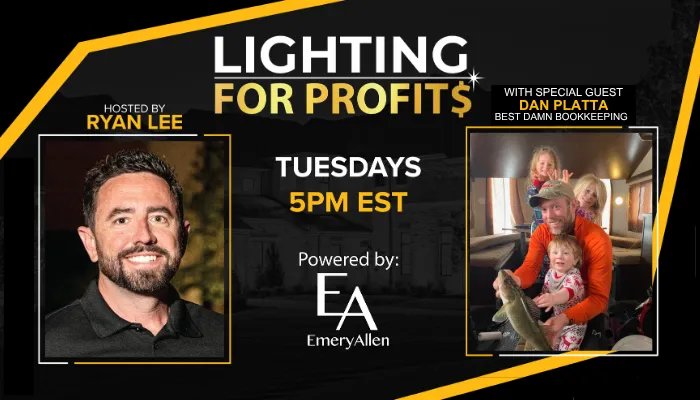
Dan Platta - The Fun Finance
Lighting for Profits - Episode 241
Dan Platta brings a fresh, no-BS take on small business finances—mixing real-world experience with a sense of humor that keeps things fun. From scaling home service businesses to diving deep into bookkeeping strategies, Dan breaks down the numbers in a way that actually makes sense. If you're serious about growing your business but don’t take yourself too seriously, this podcast is your go-to for smart insights, practical tips, and a little nerdy fun along the way.
Watch the episode
Episode Transcript
Welcome to Lighting for Profits. We are going live today. All light. Powered by EmeryAllen
Welcome to Lighting for Profits.
All light. All light.
All light. Powered by EmeryAllen, Ryan Lee.
I don't know what's going on. Sometimes technology is awesome and sometimes it sucks. What's up, guys? Ryan Lee, your host of Lighting for Profits powered by Emory Allen. We are going live today. And, yeah, if you're looking to start or grow an outdoor lighting business, I think today, I think this is the right spot. We'll find out. If you're looking to grow a technology business, it might not be this place for you, but, excited to, nerd out all things outdoor lighting. And, today is going to be especially nerdy because we've got the one, the only, the best damn bookkeeper from Best Damn Bookkeeping, Dan Plata. So, if you know who Dan is, you know, what to expect out of today's show. if you don't know Dan Plata, we're. He somehow has made, finance and recruiting. Somehow. Somehow he's made that great again. I'm not exactly sure how, but is that. Does that look weird on my screen? Does that look weird? I don't know. On my screen it's like looking weird, but maybe it's not like that for everybody. but, yeah, excited for today's show again, we got Dan Plata with Best Ham, Best Damn Bookkeeping coming on the show in just a little bit.
We want to thank you guys for your support on Outdoor Lighting Show
M. Before we have him on, always want to thank you guys so much for your support. This is such a cool opportunity to, nerd out on outdoor lighting every single week. And, quite frankly, bringing on different guests and getting different angles and different ideas and stuff like that, it's just, it's just awesome for the industry. So thank you guys so much for your support. If you're bored and you want to, you know, do something cool today, go give me a five star review on Apple. or if you're not on Apple, go to Spotify. I don't care. Just do that five star review. sometimes it allows you to even write something nice. So that'd be cool. but really, really, thank you guys so much for your support today. It is the number one landscape lighting show in St. Paul, Minnesota. So, yeah, pretty cool. Again, we got Dan Platt coming on in just a couple minutes.
Inside Landscape Lighting Secrets hosts a Friday fly in to help budding businesses
Before we have him on, I want to share a couple things. So, in Inside Landscape Lighting Secrets, we, we, man, we, we throw stuff at the wall all the time. We're like, hey, what works? What doesn't? What should we add? What should we take away? All the different Things. And this, year we decided to try something brand new. I got this idea and I was like, okay, we're gonna do, it's called a Friday fly in. Okay. And so we just did the first ever Friday flying at my house like three days ago. And, it was awesome. So we're doing two a year. We're doing this one would just happen May 1st and then the other one is happening July 10th or something like that. it's in the group, but, So cool. we had nine people, which I was actually expecting a few more. So at, first I was like, oh man, should, shouldn't we have more? But nine was awesome. And actually the feedback after, I was like, so what'd you guys think? And everyone's like, yeah, we're going to tell everyone it sucked. One star review because they don't want more people coming because it was kind of a nice, nice small group. So, but it's really, really cool because these are people that are leaving their businesses, leaving their families, to work on their business. And, the reason we decided to implement this Friday fly in, by the way, it's just included, like, people were already in the program without this. And we just like, hey, let's throw this in as a bonus. It, doesn't cost any extra. we did a shop tour of Keith Rosser's place, the Thursday night before, which was awesome. I mean, the guy's been in business for 25 years. So just to see the behind the scenes and how he does his systems and everything else and meet his team, that's extremely valuable. And then we went to dinner that night. Friday was all day at my house. my mom cooked us lunch. I mean, where elsewhere else you're gonna get a homemade meal? like that. I mean, it was awesome, right? And then we went out to dinner that night and you know, I called it, I called it quits around 8:39. Those guys stuck around and had some beers and stuff like that. So it's just a really, really good time. And so the reason we're doing that is we're really doubling down on this idea of community. and you know, you can get information now. I mean, you got, you know, all the different types of AI out there and stuff like that. And. And we realized that we're not really in the information business. We're in the helping people grow their business business. And the, the most growth I've experienced in my, life has been by learning from others and being part of a Community. And so really, that's, that's the purpose of these Friday fly ins.
You have to be insane to be a successful entrepreneur
And, you know, we went over a lot of different stuff, which I'm not going to share here. But, one of the kind of moments, epiphanies I had is like, you, you literally have to be crazy. You have to be out of your mind to want to start your own business. You have to be insane to, be a successful entrepreneur. And honestly, like, you pretty much do because you're signing up for something where you have, like unlimited hours. You, you gotta work crazy hours, take extreme risks, and, you don't get paid out a lot for, like, sometimes a long period of time and sometimes ever, depending on, like, how serious you take your business. And so, yeah, you know, some people figure it out and they end up making more money, but they still usually are trading time for money. They might be trading less time for more money, but they're still kind of trading that. And so I started thinking about this and I started kind of evaluating, like, who's the most successful people in the outdoor lighting industry? Who's the most successful people in my circle that to have nothing to do with outdoor lighting but have other businesses. And, the crazier the person, the more successful they are. they're crazy enough to think that they can build a business that runs without them. They're crazy enough to think that something can happen, they can create this thing out of nowhere, and it's somehow going to add to the economy. And so if you think about this, in order to build the business that you want, we all have this, like, idea of something better than where we're at. And if you don't, then you're just, like, content. And you're probably not listening to this podcast because you're just happy with where you're at. and you're not going to grow. And like, that is what it is. But if you really want to build this business that you want, you have to become someone different than who you are today. Okay. And because if you were already capable, like, if you, if you were already capable of building your dream business, then you would have already done it, right? And some of you might argue and say, no, I'm capable. I just haven't done it yet. Well, but no, there's something that needs to change. Urgency. Something needs to change. Otherwise, if you were capable 100% of building this dream business, you would have already done it. But there's certain things missing. And so you need to develop those attributes. So this means that you literally have to transform into something different and someone different than who you are today. Right? And so, I decided like, okay, well what, how do we do that? And I started thinking like, okay, I look at these people that are further along than me. I'm like, so what? Like, okay, I, I accept that. I believe that. So how do we start? So step one, you have to start thinking bigger. Okay? You know, I, I meet with people, that are looking to scale and, and, and grow their outdoor lighting business every single week. And to be honest, most people's goals, they're, they're just too small. I mean, you would think everyone would be like, yeah, man, I just want to do a hundred million dollars. Whatever. Like, most people are like, too realistic. They're like, you know what, if I could just grow by like 150, if I could just like do 250. And I'm like, what? Like, that's just weak to me. That's just like, that doesn't force you to be someone different than who you are today. That's just like one move. Like, you could just turn on advertising and do that. You know what I mean? Like, it's not like transformational. It's just linear. It's just like you could just add on. And what I want to help people do is think exponential. I want you to be able to multiply. So instead of like one trading one for one, trading an hour for dollars, like, let's trade an hour for multi, right? And that's just because, you know, you're making a decision from a place you're in now. So it's not that, it's not that crazy, actually. It's just, that's who you are today. You're not capable of thinking bigger and making bigger decisions, right? And so you're not thinking about growing your business from a place you want to be. You're thinking like, okay, this is what I want to do now. So in step one, you literally just have to start thinking bigger. So one of the ways to do this is to surround yourselves with people that are also thinking bigger. Because your inner, your circle, your family, your friends, your close network, they actually don't want you to grow. If you grow, then something, it gets uncomfortable for them because then they question, well, what am I doing with my life, right? So they're going to constantly hold you back. They're not bad people. They just don't want you to take risk because what if it doesn't work, right? And I'm going, we'll take a risk because what if it does work? Right? So this is where you'd insert any type of community. Maybe landscape, lighting, secrets, right? Book a call now. Here's the link. but this is where you insert community, okay? So in order to help you also along this journey, ask yourself these questions like, what is the cost? What is the cost of staying where you're at now? What does your life look like ten years from now, even two years from now? If nothing changes, what is the consequence of not changing? You really need to understand, like, why are you doing all this? And it's not just for money. When we all started, it was for money. Like, it's just like, I need. I don't want to feed my kids ramen anymore. Like, that's. That's normal. But at some point, you need a bigger why than money, because otherwise, you're just gonna stay stuck. You get used to being comfortable, okay? So. And honestly, it doesn't make sense to move to step number two until you are literally obsessed. Until you are obsessed with being dissatisfied with your current situation, okay? Doesn't mean you can't be great grateful. Like, I love gratitude. I'm always grateful for where I'm at.
Step one is defining your goal or dream. Step two is you got to be intentional
But then I'm like, okay, like, I'm not satisfied. I need. I, believe if I'm not growing, I'm dying, okay? So once you become literally obsessed with being dissatisfied with your current situation, then you can move to step two. Step two is you got to be intentional, okay? So, you know, coming up with a dream or a goal, that's easy. You're just like, oh, yeah, I want to do $10 million. But, like, how are you going to do that, right? I mean, a lot of people will tell me, like, yeah, I want to do this, and then I want a franchise, and I want to take over the world. I'm like, cool. I mean, anyone could just say that, right? But what are you doing to intentionally build your dream? It's not just gonna build itself, right? So the beautiful thing here is you actually do have control. Like, it's not a wish anymore. You know, a wish is like, yeah, I hope one day I can do, like that. That's a terrible. It's a failing strategy to hope for things and wish for things because you're not willing to do anything about it. But in this, when you get intentionally, like now, you can build the business the way you want, with who you want, when you want, and it literally starts with you defining your trajectory, defining your target, and then Asking yourself the question, I love this question. What has to be true? What has to be true for me to get to this revenue, this profitability standpoint in this amount of time? Okay, so you're basically just going to reverse engineer your target and fill in the blanks. So you can ask yourself questions like, you know, how much would I need to spend on advertising to generate the necessary amount of leads? You know, let's say you're trying to build a $10 million business. How many leads would I need to generate every year? Right, because it's probably different than what you're generating now because you don't have 10 million dollar business. How many appointments would I need to go on? Okay, leads is one thing, but how many are going to book to appointments? How many appointments would I need to close? What would the average total contract value need to be? How much revenue would I need to install per day? See, these are good questions because some people are fine doing $5,000 jobs. Well, you're gonna have to do a lot more $5,000 jobs to get to 10 million than if you're doing $10,000 jobs. 20,000 dollar jobs, $50,000 jobs, $100,000 jobs, whatever your number is. Okay, how much revenue would I need to install per day? How many working days do I have available? Okay, we're, you're in a different market. If you're up north, you're going to have probably less working days. Okay, how many installers would I need to hire? How many salespeople would I need to hire? How many office admins would I need to hire? How big of a shop space and office space would I need? What kind of tools, how many trucks, insurance, taxes, yada yada yada, the list goes on. Fill in the blanks and build your plan. That's what being intentional M is. So finally, after you are starting thinking bigger now, you've, you're going to be intentional and build a plan. You can move to step three, which is you have to take action. You have to execute on that plan. Okay? Which means you're going to have to take uncomfortable, uncomfortable action. Because again, if you were already prepared and ready, you know, a lot of people are like, I'll do it later, do it next month, I'll do it when I'm ready. Well, that's not how this works. Like you're, you're never ready, okay? So you have to take action before you feel ready, which is kind of the definition of risk. And this is where the rubber meets the road. Are you willing to take the uncomfortable action. Are you willing to take the risks necessary to get you to the point or the trajectory that you've defined? I mean, if you're, if you're unwilling to spend, or I guess I should say invest a million dollars, right, Per year to generate $10 million per year of revenue, then maybe you need to revisit step one. Right? there's going to be some uncomfortable action, some hard things in here. Every single, like every single multi million dollar business owner that I've met, they always have these three steps in common. They're always thinking bigger, they're always intentional, and they're always executing at a high level. They're taking risks that others just simply aren't willing to take. Okay? So anytime I meet a business owner who's, who's not where they want to be, it always comes down to one of these three things. Okay. Now a lot of people, it's kind of easy to check off. Number one. Like, you know, maybe you're thinking bigger. That's kind of the easy part. It's like, oh, I want to, I want to go multi state. I want to do a franchise. Like so many people tell me that, right? But that's, that's the easy part. Like, oh, I'm thinking bigger. Okay. How intentional are you going to be? How, how willing are you to take these risks? So most people just are not intentional enough. That's like just a huge, huge problem. They're, they're not running the business, the business is running them, you know, which then obviously that spills into the lack of step three, where they're not executing at a high level, they're not taking the necessary risk, they're waiting for one day instead of declaring day one. Right? So it's always next time, next month, you know, when I make more, when this happens. And so those are the steps. It's like seriously, start thinking bigger, start getting intentional, and then just take action before you feel ready. That's the key. And these are the traits that these, that the, the, the, the big dogs in the outdoor lighting industry, these are the things they're doing. The big dogs in other industries, that's what they're doing. So just, want to share that with you. currently kind of going through that myself. I mean, I got my business up to a point where it's kind of awesome. And I'm like, okay, like it's kind of been awesome for a little bit. So I'm gonna start getting uncomfortable, I'm gonna start making moves. It's like, oh, buddy, here we go, right?
Everyone wants certainty before they hire someone, right? But you don't
So, if you, if you guys want to join me on my journey, let's take some uncomfortable risks together, some uncomfortable action, because I promise you, you'll feel better later. And the thing is, everyone wants certainty. I want to know before I hire this person that it's going to work out. But you just don't. You have to hire the person and then figure out, all right, I wasn't ready. It didn't work. I'm not as good of a trainer as I. As I thought I was, not as good of a leader, whatever it is. And. And that's when certainty happens. It's after you take the risk, after you take the action. But at least then you have certainty one way or the other, right? So, hopefully that will help you out, with those three steps.
Emory Allen's line of premium LED lamps deliver the performance your clients deserve
All right, hey, listen. Stop settling for cheap, unreliable lamps that ruin your projects and your reputation. Emory Allen's line of premium LED lamps deliver the performance, longevity, and color consistency your clients expect and deserve. Trusted by lighting designers and installers around the world and backed by decades of lighting expertise, don't settle for less. Upgrade your designs and installations today with Emory Allen. Reach out to jackson lry allen. com to learn more and take advantage of their contractor pricing. Again, his email is Jackson L, as in the letter L. Jackson l@emeredyallen .com. don't forget to mention that you heard about him here on Lighting for Profits, and he will hook you up with that discounted contractor pricing. Just email jackson lry allen.c om.
Dan Flatter: Let's get our guest coming on the show
all right, I think it's that time, mainly because I need to get a drink and also because he's waiting in the, background. Let's get our guest coming on the show and, get this show on the road. What do you guys think? What is up? What is up? Welcome to the show, Mr. Dan Flatter. What's up?
Yeah, Somebody say drink? Did you say drink?
I think I was like, yeah, get a beer.
I had this drink.
yeah, I forgot to plan for the show better. Are you drinking?
I. I threw some tequila in here because I was. I've just been on calls all day, and literally my last demo of the day, my voice was, like, going out. I've just been, like, running the gauntlet here. And I was like, we're doing a podcast, and actually my. My show is normally on Wednesday nights, but my guest is coming on tonight. So I got, like, an early, earlier afternoon show after. I got to get off of here and then go get my kids. And then come back and, like, heat up leftovers. I'm gonna be that dad tonight. I'm gonna heat up some leftovers and then, podcast for me, so. But I'm gonna tell you, Ryan, I was so damn inspired, I was writing notes down about, going big, being intentional, and taking risks. So I quick messaged Tommy Mello to see if I could get on his podcast, and just jump off of this one. You know, just trying to go big and take some risks, but he wasn't available, so I'm here. I'm here.
I love it. Wait, you tried to go during my show? You were gonna. Yeah, man.
You said, be like, go, take big risks. Go do big things. And I was like, man, I should go jump on Tommy's podcast right now, you know?
Well, no, I appreciate that, your.
Your.
Your willingness, but I meant to say there's, like, a small asterisk. Like, unless it makes my life worse, don't take those risks. So, what, he just. He stood you? He said no or you didn't get an answer?
I didn't actually do it. I just thought it was I just being funny.
Come on, take action, bro.
Damn it. Now I'm being a little.
Yeah, I thought I was being inspirational.
Yeah, my bad.
Well, I always enjoy spending time with you. and, but.
Dan Plata is the owner of the popular accounting podcast, Good Morning Bookkeeping
But before we jump into it, will you just, introduce yourself? I mean, you've been on the show several times, but, you know, we got new listeners that are always joining in. So. Who is Dan Plata, and who is Best Damn Bookkeeping?
I am Dan Plata, and Dan Plata owns Best Damn Bookkeeping. Oh, I just went third person. I, I've got a bunch of reps in the home service space running home service businesses. And, I also happen to be an accounting nerd. And so as. As that took off and. And started doing bookkeeping for people, it just made sense to keep doing bookkeeping for people. and so we try to make bookkeeping not suck, and we have fun while we do it.
Every decision you make in your business is a mathematical decision
and no matter what business you're in, obviously if you're here, you're probably doing some landscape lighting or thinking about it. Maybe you're in landscaping or in holiday lighting or permanent lighting and thinking about doing landscape lighting. But there's one thing I know with 100% certainty, forever and for always, is that if you're running a small business, you're just playing a math game. Everything is a math game, and you have no excuse. You can't avoid it. Every decision you make in Your business. Like, regardless, of the services that you do, every decision you make is a mathematical decision, even the fluffy ones, like employee engagement. Everything has to have an roi and it always comes down to the numbers. It's not a hobby. It is your life, it is your livelihood, it is your business. And so measure the hell out of it and make sure it's working, damn it. And let's have some fun doing it.
Yes. Let's go.
If someone is decent at running a business, what's the pros and cons
So I just had this thought, like, you've, this is going to be a cool conversation because you've been able to see the behind the scenes. Like you said, it's just a giant math game and you see the numbers and you know what works, what doesn't. You've seen the behind the scenes for a lot of different home service businesses. Interested in your opinion on like, what's awesome about the outdoor lighting industry? We'll call outdoor lighting because landscape lighting, permanent lighting, holiday lighting, what's awesome about that industry? And what are some of the pros and cons based on what you've seen? And, and kind of, you know, I know that might change because some people just are bad at running businesses, but if you were to compare like someone who's decent at running a business in the outdoor lighting industry versus someone in a different home service industry, what's the pros and cons?
Yeah, I, I, I, I don't know if reminisce is the right, right word, but I think it's, it's pretty damn cool the position that I get to sit in where I literally get to watch hundreds of business owners, someday, thousands of business owners, and I, and I help thousands. But like even just of our clientele, I just get to obsess about what works and what doesn't work. And I have like a front row seat to all of it. And some, some I'm, helping do it. So that is, it is a cool thing to be a part of for sure. I don't own a landscape lighting business, so let me just caveat with that. But I, I literally the, the when I started working with you and, and like getting to be part of your community, that was the thing I started talking about with, with other guys in Minneapolis. Now Minnesota is one of the states where you have to have like an electrician's license to do a lot of landscape lighting stuff. Not all states have that, but that's a, a thing to be thinking about. But the average ticket, the value of the relationship, that it's not transactional, that there's A true relationship going on there. Which, like, as a bookkeeping guy, and I'm selling a recurring service that's low margin, not a high margin, one time service, like landscape lighting. But the relationship is equally important. and that is what makes businesses fun. Transactional businesses are not that fun to run because everything feels like a damn transaction. it's like in your marriage and we've all been there before, where it's like, okay, who's getting the kids, who's cooking dinner and who's doing this? And you forget that you're married sometimes. And you just feel like you're running a business and it's a household and it becomes transactional. My wife and I use those words when we're like, we need a date. Like, we used to have fun together all the time. We used to just be best buddies. Now we have these three damn kids that always are, like, asking for stuff and whining about stuff.
Wait, so I, I have a question. So you guys like, am I'm the only one that schedules sex? What's going on here?
I. I've tried to implement a sex calendar and my wife wasn't as about it, but I think I can get her to come around.
I thought it was all transactional. I thought that's just how life was. Okay. I'm learning.
I would prefer to schedule it so that I can guarantee that it happens. Because I'm like Ron Burgundy, man. If it's on the calendar, if it's on the teleprompter, I'm there. I'm there for it. so I, so I think if that was what it took, whatever, I'll be there for it. but no, it is really cool. And I think when I look at landscape lighting, like, the ability to move the needle, and I work with a ton of maid service businesses, and I've run a ton of maid service businesses before. And so I'll like, use that. And bookkeeping is just like a maid service. We just clean digitally instead of clean physically. We're just cleaning up people's QuickBooks accounts. and it's just so different when you're running that type of business. That's so repeat, repeat, repeat, repeat, repeat. There's some value in that recurrency. Right? Which is why, like, maintenance contracts and landscape lighting are neat, but you can't move the needle the same. It's just this like, army of labor. And if you think about a million dollar maid service business, the amount of employees that that needs and the amount of activity that that needs to generate a million bucks is crazy. Like we had a business doing just over a million bucks and, and we had like damn near 30. I think we had 30 employees in that business bookkeeping. I'm doing like 1.3, 1.4 million dollar pace right now. We have 25 people on our team. Granted a lot of them are in training and we're growing like crazy and I want to make sure we're in front of that. You can never be like in front of growth enough but like trying to make sure our people are really trained up. So we're, we're generally like overstaffed and we have a lot of people in the pipeline. You can do that in landscape lighting with like four freaking people.
I mean like your ability to, to, to margin up and actually this is like total digression here, but it's hilarious. We're talking about this right now. I have a buddy that is here installing a new garage door on my house. I worked with him in the corporate world and he left. He was doing some other stuff and he thought about starting a maid service business again. Nothing against maid service businesses. I used to run a bunch of them. but it is definitely an army of labor. And so he said like, what should I get into? And if in Minnesota landscape lighting didn't require a license, I'd have been like, you probably take a hard look at landscape lighting. But I was like, anytime I'm looking at an industry that I would get into, I'm looking at like that barrier to entry can be a friend, but it can also be a foe depending on where you are in the process. Right. And how much time you have to get through that buried entry. Like he could go become an electrician and do it or maybe you could pay for somebody else's license. but I'm like what's the, what's the likelihood that people are going to need the thing? What's the ability to charge for it? and like how much fun is it to go execute? Like how many people do you need per dollar of revenue? The more people kind of sometimes the less fun it is to execute because it just becomes this like super big army. and the same thing I like about garage doors is the same thing I like about landscape lighting is the same thing I like about H Vac and plumbing, where, which is you get three different margin types, you get new product that you get to install and you get to charge money for the thing you install and the labor to install it. And so there's great margin on installs. You get emergency service calls. And maybe not as much in landscape lighting, but obviously in, like, H vac or garage doors. If either of those isn't working, you're like, yeah, what is it going to cost? Somebody better come out here right now. Right?
It's.
And you can do maintenance contracts, and landscape lighting has a little bit of all of those where you can make money off of it in all seasons. Again, like, we're in Minnesota, and so there's some hurdles to get into that space. And he was, like, trying to find something to do tomorrow. And so I literally, like, this. This was over the winter. We met for lunch, and he's like, what should I do?
H Vac and landscape lighting are great spaces to play in
And I was like, man, given. Given where we're at and like, the learning curve for. For H Vac and the learning curve for landscape lighting. I told him, like, I would look at doing garage doors. He's here putting.
Now he's doing it.
No, no. Like, he already, started. He was going. And he. The dude's brilliant. Like, he's gonna freaking crush it. I. I worked with him in the corporate world, and I was just like, man, this guy is gonna be, like, running this company. brilliant dude. And has, like, the right mentality and personality for it. Just. Just super dude. Good dude. but, like, these spaces are great spaces to play in because you can produce a lot of revenue without, as many people. And you can produce it in different ways. And I think that is really important to look at when you're, like, thinking about getting into a business is what different ways can you generate the revenue? What. What are the barriers? If you're new, you know, sometimes less barriers is more friendly depending on where you are. If you've been in it, more barriers can be better because it stops new competitors from coming in. But it's just such a. Such a great space to be in. In landscape lighting, you can move the needle. Like, you were talking about people's goals and like, oh, you want to grow, Grow by a hundred thousand. It's like when you get going in landscape lighting, that's a project sometimes, right? It's like you can move the needle at such a ridiculous pace. versus when you're doing maid services, you're. You're, like, trying to deliver death by a thousand cuts because you're getting it at a few hundred bucks a pop. And window cleaning, you're getting at a few hundred buc.
Pop.
Landscape lighting, you're getting it at tens of thousands of dollars at a Pop. And so it just, it scales. Cool. And you can do a lot of it with, with just a few folks.
That's why I think I'm like, dude, like you know, average ticket, let's call it 10 grand. Like if you're, if you're, if your goal is just do like 150 grand. I, you could just go knock doors.
I was gonna say what are you gonna do the rest of the year? Because there's like a month of work.
Yeah, but I don't, I don't know. So I'm interested to see if you have a perspective on it. On like why you think people make it so complicated. Like where do they screw up the numbers? And I think I have my own opinion on it. But I'm interested to hear what you say before I tell you my opinion. But like where, where are they screwing up? Because it's like you said dude, it's, this is high ticket. We don't need thousands of people. I mean a million dollar business is 100 people giving you 10 grand.
I have two things that I see that hangs people up. And, and it's, they're, they're like I, to me they're obvious but they're not easy necessarily. one is when you are just starting up, you only charge enough to cover your costs. Not the cost of a scaled business. And that. And Mike, who's out here right now, that was the thing I made. I was like, don't charge me what it costs you to get a garage door and for you to install it. Charge me what it costs for you to get a garage door, for you to pay for a company vehicle that somebody else is using and all the fuel that they would be using and the marketing that we had that you would have had to use to get me and the rent that you're going to have to pay someday when you've got your own shop and the insurance, when you've got 10 people on your team, you got a bunch of 20 year old dudes driving your truck and the employee engagement stuff and the travel to send people to training things. Your cogs needs to be 50 or below based on a scale business. So if this garage door costs a thousand bucks, you got to charge me at least two grand. Right? Like you have to. And really the supplies you're installing should be like 30. You got to at least charge me three grand, if not more. Yeah, like you need to charge enough for the scale business.
With landscape lighting, you need to charge for it. You cannot install it for 200 bucks
And, and we talk about that with landscape lighting. Like if, if your fixture costs A hundred dollars. You cannot install it for 200 bucks. You need to be charging 3 or 400 bucks because you, even if you don't have the rent and the utility bills and the admin team and all the other that goes along with a scaled business, you still need to charge for it. And because otherwise that average job of 10,000 bucks, you're charging 5,000 bucks for. But guess what? The market rate is 10,000 bucks. Like the market rate is the market rate. You don't need to, you don't need to decide what the pricing should be. The market decides what the pricing should be. You need to build your cost structure accordingly. But like, just because you're new and you're smaller, maybe, maybe if you're like brand new, you don't charge quite the market rate because you're still like making sure that you can deliver it. But the market rate is the market rate. And we generally know that it's kind of around three to four times the cost of fixture or higher. And so I see that being a problem. They don't charge enough and they don't command enough and they don't bring, from a sales approach, they don't like bring the mentality and like the chest out. Like, this is what it's worth. This is what it costs for like a real professional landscape lighting install. If you're not willing to pay that, go to Home Depot and get the solar ones and then replace 20 of them every single year. Because they all go out because they're all a piece of. Right? Like, sure, go and do that if that's the product you want, but that's not the product we deliver.
it probably took me five years to learn that lesson. I'm not kidding. Cause I was just the guy who was like, well, I can't, man. I'm getting these. This was halogen, so we could buy like a fixture for like 25 bucks. And I'm like, man, like, we're gonna make bank installing these, you know? And then I was, I just kept asking myself, like, how did. How does this work in the real world? How does that business afford this? And how do they stay in business? And how do they afford that kind of advertising? And it was literally like five years in, I had that grand epiphany of like, oh, you idiot. Like you price like who you want to be, not like who you are today.
Because that's, for the job that you want. Not to dress the job. Yeah.
Otherwise there's never budget. There's never. I was like, seriously, I can't afford to hire an admin. And it wasn't a lie, it wasn't a mindset issue. I literally couldn't afford it.
Yeah, not charging enough to pay money.
Yeah. Suddenly you put a sixty thousand dollar a year in there for that and then you go, okay, I need an office space and that's three grand a month. And then at best I would need like two more vans. And then again, that's kind of what I started with, like being intentional and then map it out. It's like you can build this, you just have to be intentional. And then you back into that number and it's like 500 bucks a light. I can't charge 500 bucks a light. Then don't do this business. Yeah, that's really. You can't go, well, I'll just do 300 a light. Like it's just not going to work. You can't just make that decision because you're going to be out of business. You'll never be able to afford those people. You'll never be able to grow.
If the dude with a hot dog cart has aspirations of scaling and having multiple hot dog carts to food, trucks to fix, you know, fix brick and mortar restaurants, he can't charge a buck a hot dog. Right. He's got to charge the same six bucks for a hot dog. And then if you want a meal, it's 10 bucks. He's got to charge the same thing that A and W charges and McDonald's charges and everywhere else charges because eventually he's going to need to pay for all that too. Not just for the metal cart he's pushing around. And so like it, a hot dog is still worth the same thing as a hot dog. It's gourmet as long as somebody else made it. That's all. that's how we define gourmet in our family. That's gourmet. As long as somebody else made it, then it's always gourmet.
Costco hot dog. Is that gourmet?
I guess someone else who depends who cooks it, man, it's gourmet as long as somebody else is buying it and making it for you.
There's nothing worse than hiring out of desperation for the employee or the employer
The, the other thing that I see though that I think is the hang up and I see this with like landscape lighting. People that I'm talking to is it is a relationship based thing because not everybody's your client and I would say most people aren't your client. You have to be really intentional about the relationships that you're building. And they take a While it might be a year or two, it's no different than how I approach recruiting. Our employees are by far the most important part of our business and I refuse to hire people when I interview them. Even if I need a person. I still, when I'm interviewing and I hope to God I never get to the point where I have to recruit when I need somebody. They better already be on a long ass bench of people that I've already recruited and interviewed. But there's nothing worse than hiring out of desperation and just like, like making decisions out of desperation for, for the employee or the employer. And I'll flip it around both ways, right? If you're the employer and you hire somebody out of desperation, you're like, oh, we have so much work on the schedule, I need a pulse. You're gonna hire like the, the first thing that's decent that comes along, right? It sounds like me dating in high school. And, and you're just gonna like put up with, you're gonna put up with shitty behaviors because you don't know any better. And you're gonna think like, this is the best I could do. And then you're gonna post online that good help is hard to find and nobody wants to work anymore. But it's actually just you suck at recruiting and you probably suck at leading too. And so like you can hire out of desperation, but, but you need to recruit in advance. And so you need to know who's at the top of your list. Way before two dudes that I hired in January this year. I interviewed them a year and a half ago. A, freaking year and a half ago. It's the most important relationship. These employees are worth hundreds of thousands of dollars. Just like a landscape lighting client is worth potentially hundreds of thousands of dollars. Their project might be worth 30, but their relationships and who they're going to introduce you to are worth hundreds of thousands of dollars. And so if you don't invest in that relationship and build that relationship and you're, and you're like trying to scoop up work out of desperation, it's going to be tough. Like it, it takes intention number two, be intentional. Like these are valuable relationships and they take time to develop. And the more of them that you can develop, the, the more offshoots and tangents of them that there are. You can't just go run a Google Ad and be like, let me see if I can get some clicks and do some transactions. Like it's just not going to happen. Like, not to say don't run Google Ads. But you have to have the brand awareness, you have to have the relationships built. And I feel the same thing is true with recruiting. I don't want to hire a desperate person either, right? Just like somebody shouldn't come to work for me if I'm desperate. They don't know they're walking into a trap of working for a shitty, desperate business owner that waited until the last minute to try to recruit them. They think they're going to come into an organized professional business. And they get here and it's just chaos because I don't have systems and processes. And I just throw them out into training. Day one, and I'm just like, just follow me and, and I'll say stuff as it pops up, right? And then. And write some stuff down. And then. And then, oh, they quit two weeks later. Nobody likes to work anymore.
did you have a camera on me? Were you following me? That was my little training system.
Hundreds of people. mine too. Mine too. For a long time, right? Like, mine too. For a long time. And for, for so many of us, we, we start with that and then we, we learn different ways of doing it and ways to be more proactive. But, but again, let me flip it around is you don't want to hire somebody that's like unemployed and desperate. They just want a paycheck, right? They're going to take the first job that pays them the most, that hires them. They're not concerned about your core values. They're not concerned about their. About your culture. They're not concerned about where you're going and what the future opportunities are. They're desperate. They're going to make a bad decision. They shouldn't come work for you. There's people that you recruit that shouldn't come work for you. It's not the right fit. But if they're desperate and you're dumb, you might hire them, right? You, like, you should be looking for people that are employed, that are thoughtful, that are proactive. They're saying, I'm looking for what's next. Like, here's the trajectory I'm on. And maybe I'm working in a place where I don't feel like I can grow. They're stagnant, right? They're not going big. They're not being intentional. They're not taking risks. I want to go somewhere where we're going somewhere. And so I'm, Like, if I'm that a player, I'm going out and looking before I quit. Like, I'm not. If I'm an A player. I'm not quitting the bird in the hand. I'm gonna go start looking around at what's out there to find someplace that I'm a better fit. Right. And when you're an employer and you're recruiting in advance, I have, I have Amy, who started yesterday on our team, interviewed her three months ago. And I was like, pretty quickly, you're the first on, my list. And I have like 20 people that I want to hire here. But she leapfrogged over other people. Like, I'm always adding to that list, trying to figure out who's going to be the best one. I was like, man, Amy's got. She's been through some hard. And I love people that have been through hard. They're just tough to break.
With landscape lighting, just like my recruiting, it's so similar
Like, they're relentless. They have just so much grit. she gets what we do. She's done what we do. And she didn't. She was like, nah, I'm good, but let me know when it's time. Right? And so, like, that's the person that I want to get. They're not desperate to get here, but they can't wait to get here. And I'm not desperate to bring them on, but I also, I, need to time it right to bring them on so they can do a really, so we can train them really well and do a, like, get them dialed in with their clients so they can produce really well for their clients. And when you can match that up, everything works smoothly. And with landscape lighting, just like my recruiting, it's so similar. Like, none of this is an emergency, right? We need to do an amazing job. People are spending tens of thousands of dollars on the thing we deliver, right? We need to do an absolutely amazing job. It's so much more important that we find the right clients and that we have the right processes to deliver, like, pun intended, a lights out service.
Hold on.
We have to. So, like, that is just so damn important. And it takes time. With landscape lighting, it's like, I talked to new people. Like, man, I just can't drum it up. And I'm like, well, you're trying to run Google Ads or are you actually out building relationships because you're selling a thing that is a luxury, that is a high value ticket. You need the utmost amount of trust. Like, you need a ton of trust before somebody's gonna just drop 50, 000 bucks on your doorstep. Like, go build some trust. Go build some relationships. Take some time, Invest in it. Be intentional.
Okay, so you just said A lot. That, for you, is common sense, but I need to unpack some of it because a lot of it's not.
Okay, sorry. I do that. I do that. I get, I get carried away. I get carried away.
And then this and then this, and then this and then this. So when I. So when I had my lighting business, I was so focused on marketing and sales and listen, I don't want this to come across the wrong way because it is going to sound very prideful and egotistical, but I've learned I'm damn good at marketing and sales. Okay, I just thought I was mediocre, but when you. I'm really good at it. What I overlooked, and I learned this from you is what is the value of a team member? Because I was always like, man, an average customer, they're worth 10 grand. And then, you know, of course we'll get their repeat business and we'll do their backyard later or their second home, and then they get a referral and it's like, man, these guys are worth like, you know, $50,000, $100,000, whatever. And then like you said, you only need like four or five people to build a million dollar lighting business. So it's like, well, wait a minute. If you do the other math and you go a million dollars divided by let's say five, it could be four, but let's just say five, then that means your average team member is worth $200,000. Not lifetime, but per year.
Per year.
If they're with you for three years, they're worth $600,000. I'm sorry, but that's way larger than any, you know, client is worth in the landscape lighting space. So like, I never really gave them. Now here's, here's what I. Here's what I did overlook. I did. It's not that I was like a terrible boss, but I was not intentional about building culture and doing all these things and building the bench and doing all the stuff that I've learned from you, right? And so now I look at it and I'm like, man, we got a lot of other lighting business owners that are, I would say, decent at sales and marketing. Some of them are really, really good. Most people are decent. And then they're just really bad at the culture thing, at the recruiting, at that. And so when I look at it and I'm like, well, wait a minute, like, you're spending so much time fixing your team's mistakes or getting called back out when they're having to babysit so much Time that doesn't. Now they don't have enough time to grow the business. They don't have enough time to be profitable because they're literally just like going and doing rework or their team's inefficient. So I think that's just important to understand is like, you need to be way more intentional about building this team. Like you said, build a bench. And I would say, like, people are like, you know, what are you paying your guys? Oh, 22 an hour, 25 an hour. I'm like, dude, I'd find a way to recruit an a player at 35 an hour. Heck, give them 40 an hour. And then now you have an A player that doesn't need babysitting, you know, and obviously now you have to be intentional in building the budget. Like, okay, how am I going to actually make money if I'm paying someone that kind of money? Probably need to raise my price, probably need to sell these number of jobs. And again, that's just part of what has to be true. But I don't know, I just want people to maybe do a self audit. How much energy and time and intention are you putting into your team, into recruiting, into training and continuous training? Not just like, oh, they're onboarded, they're good to go.
The happiest businesses are always the ones with the best employees
But how much time every week are you revisiting those SOPs? That's such a buzzword, you know, like an SOP is nothing if you're not revisiting it on a regular basis.
Yep. I have found, this, this might be a universal truth, but it's definitely a plot of truth. I have yet to see this not play out. Is the best businesses every single time. Which goes along with the happiest business owners. Right? Because there's plenty of us that aren't happy running businesses. And we've all been there, We've all been in our business in a moment where we're like, God, this kind of sucks right now. I'm not as happy as I'd like to be given, given this is mine, right? And I get to freaking call the shots. And everything that's here is because of me and is my fault. And there's a lot of unhappy of us. the ones that are the most successful and the happiest are always the ones with the best employees. They're always the ones that are the best recruiters. They're not the best marketers, they're not the best sales. You can get good at marketing and sales, which recruiting is marketing and sales too. Like it's just reverse, audience. But, but whoever puts their energy into that and gets good at marketing and selling and like, building relationships on the employee side, that transfers to the customer side. Like, you will be good at it too, on the customer side. And it helps because you're so damn confident in your team.
Right?
If you have a team just of a players, it's so easy to go sell your service. It sells itself. Like, hey, the customers sell it for you. I find that over and over again. I tell our team all the time, like, you guys are the sales people. I just do the demos. I'm just the expectation setter. Everybody that shows up on my demo schedule is coming because you guys kick ass. And therefore everybody's saying, like, you got to use best damn bookkeeping. And, and therefore, like, I just need to tell them how we do our thing.
As long as you don't screw it up, then they're in. Yeah.
Ah, that's. And I'll screw it up every once in a while. I'll screw it up every once in a while. but it also, I. This just happened today. It also gives me the confidence to fire shitty clients. And we have to do that too, right? Like, not every employee is meant to work for us. Not everybody's the right cultural fit for what we're trying to build. Not every customer is right for us either. And that's okay, too. That doesn't make them a bad person. Right? That doesn't. M Mean, they're. They're doing something wrong. It just means, like, they don't fit our systems and our processes. And if you're trying to build something awesome and you're like, here's the three fixtures we use. And they're like, I want you to order these from China to. So I can lower my price. You have to be in a position where you'd be like, no, you're just not our client. Or if they're like, hey, I need you to do this next week. And you're like, no, we're three, four weeks out because we're in high demand. This is a luxury service. Like, this is our schedule. And they're like, no, I'm not going to use you if you're not. if you can't do it next week, then you're like, good. I don't. You're going to be the worst client ever, if that's your attitude. Right? So. So I. I think there's just some things we need to learn in this. Again, out of desperation. It's the Same thing on recruiting and sales and marketing and recruiting are the same thing. It's like, you just don't want to deal with desperate people. They're like, oh, my God, I need this. Oh, my God. Right? Like, there's never anybody that is like, constantly in a sense of urgency. I think we've all had relationships like that where everything is on fire, and it's constantly like, this needs to be done right away. It's frustratingly annoying to deal with people like that. Like, there's just no. There's no joy in it. and. And again, I always kind of go back to the same. The same lesson with employees. Like, the successful ones, they love their business because it's so much fun to run a business with a bunch of a players. And at the end of the day, like, if you're running your own business, you're doing it to have fun. Like, don't. Don't be dishonest with yourself. You. You could go get a job anywhere tomorrow. You're so employable because of the skill sets that you have. I know we all, like, as business owners, we always like to joke about, like, nobody would hire me. Like, I'm unemployable. Like, that's the thing we say because we're goofy and we like running our own business. We could all go get a job doing anything tomorrow. Like, we've. We've cut our teeth on so much stuff. The reason we choose to run our own business is literally to have fun.
Plata says running your own business has to be enjoyable
It's so much more fun. But it can, We can also learn to hate it, right? So it's like, if it's yours and it's all your fault, make it fun. Like, have some damn fun with it. And it can be, but it's really hard to be if you bring on shitty employees and deal with shitty employees.
You've done a good job at that. You know, Like, I remember someone, told me they were watching one of our calls or something like that, that you were running or whatever, and they were like, wait, that. That guy's one of Ryan's coaches? You guys are listening to that guy? And she was just like, what? What's happening? And it's like, yeah, he's awesome. Like, you, like, you. You know who your audience is, and you, like, speak the language and you talk about hunting and fishing and drinking beer and, like, I mean, you know, we joke about how you make, you know, bookkeeping fun again or whatever, but, like, it's true. You know what I mean? Like, you're able to like, get us excited about, like, recruiting and finance, which are the most boring topics in the world.
Yeah. Gotta make it fun. It's all. It's like having kids, right? Everything's a game. Everything's a game. You just gotta have fun with it.
Yeah, you've done good. I was stoked that you were going to do your own thing. And then of course, when you came out with the name and the logo, I'm like, this is perfect.
This is just classic Plata. Yeah, classic.
I. I could never pull it off. Like, it would not come across as authentic with you. It's a hundred percent. Yeah. Damn Platter.
And that was, the last time I was on. We talked a lot about goal setting and like, building a business that you'll love. And again, it always starts with the employees. But I had to be so intentional about that because, like, leaving a partnership and deciding to do it on my own, it was, I had to reckon with that. Like, what's the point of it all? I could go back and probably make three times as much money in the corporate world. I just now, I mean, like, I've been out of the corporate world for a decade. As of this September, I am just now, like, for 10 years, I've made less than I was making in the corporate world. I was well compensated and. And who knows what I'd been making 10 years later. Right? But. But like, it wasn't about that.
Right?
Like, it. There's still so much upside and I will make however much I make by. By helping a bunch of people. But, like, it also has to be enjoyable or what's the point of it all? It's just gotta be. And. And the beauty of when you run your own businesses, it's yours. So. So if you're not having fun with it, there's one person that can do something about that tomorrow, right? It's you.
Not today. We have to wait till tomorrow. okay.
Well, you probably got, you know, think about what it is that you're.
Dinner tonight and stuff. Yeah, that's true.
Yeah. You still need to, like, go get your kids and cook dinner and stuff like that.
You got another podcast after this, so.
Yeah, you're right. Tomorrow, Gotta do that. I gotta send out a bunch of pricing. I won't be able to do it.
Okay, we gotta. These are super nerdy things, but I. They're really, really important. I used to hear the B word, the budget word, and I just was like, dude, let's never do that or say that word again. Because it felt very, Restrictive. A budget. It's like, oh, well, I can't buy that. And I can't buy that because it's not in the budget. Right. And then I, had that shift where it was like, oh no, it's empowering. It's not a trap. It's empowering. And that's kind of what I was talking about at the beginning. Like get intentional. maybe. I mean, I put you on the spot a little bit.
When thinking about budgeting, it starts with sales and marketing
You hear people say you got to know your numbers, got to know your numbers and budget and stuff like that. What are some top numbers in a budget that would be important? Like what numbers should everyone be at least somewhat aware of when it comes to building a budget, going over their P and L, to help them make data driven decisions.
When I think about like budgeting, we usually all start with revenue and that is like us just throwing a freaking wet noodle against the wall to see if it'll stick. And it's, and it's a pipe dream without a thing to back it up. And so when I think about budgeting, it actually starts with sales. And marketing is how much are we willing to invest to get us to where we need to go?
Cool.
We can look at our historical data and say when I spend X amount on marketing, it gives me, you know, an acquisition cost of X to get so many clients. And my average client is whatever size. And so I look at that to figure out what type of sales I expect. And if it's not the sales that I want, then I better do more marketing. Right. Or like figure out, figure out how to get my acquisition costs down by making my marketing work better. Winner. And so I usually start like, I'll, I'll, I'll think through what I think is, is doable. Like the, the pipe dream of where we want sales to get to and revenue to get to. But really it's a function of our sales and marketing, and, and our ability to recruit it.
So as an example, let's say I'm a. Because we have a lot of people who have like Christmas light businesses and then they're wanting to bolt on landscape lighting or you have a landscape lighting business already and they're, they want to double that. You're literally saying, all right, I'm at zero. I want to do 500k in landscape lighting over the next 12 months. I know I'm probably going to have to spend 10. I'm just making up a percentage here kind of to plug in a number. But 10 to 12%. So say am I willing to spend $50,000 on advertising to generate enough leads, to generate enough sales.
It costs more than that. It probably costs you 20%. It, it works its way and sometimes 30, it works its way down towards 10 which is like a good long run target. Once you have existing clients that are referring you for free and you have repeat revenue tied to existing clients, then your percentage works its way to 10. New clients usually cost you 20 to 30. And so if you're selling a thousand dollar job, I'd expect it to cost you 200 bucks to 300 bucks to go get that thousand dollar job. If you're selling a ten thousand dollar job, you should be willing to pay two to three grand to go get that job. Like that's super, super normal in home services that your brand new client is going to cost that much.
If you're focused on customer acquisition, you miss out on referral opportunities
Now you talked earlier about lifetime value of a client. Hopefully they repeat add stuff on refer you, you know, like stuff or whatever.
To your point, if you're focused on the relationship because most people don't do that, they do it wrong. They, they spend that customer acquisition, they get the client like okay, move on to the next. It's like whoa, whoa, whoa, like what about the repeat? What about the referral? Like you're missing out on the whole. That's how you get that customer acquisition down from 30% down to 10 is through those efforts.
Scaling a business is not for everybody. Super true, super true. Like, it comes with different challenges
So now I'm super stoked you're bringing this up because honestly if you go and ask the average business just Facebook group, whatever business owner, Facebook group, especially in outdoor lighting, most people will be like oh you know, 10%, that's the number. And I'm like no, it's way higher than that. I mean if you want to grow. Because a lot of people are like oh no, I just do word of mouth. I'm like well then show me a scaled business that is predictable on word of mouth. It's just not possible. If you want to go from zero to that, you know you're going to have to have a higher customer acquisition costs and then it will lower down like you said, with repeat and repeat referral.
Usually when I hear somebody say word of mouth, they're still on the truck, right? They don't. And a lot of them haven't started charging enough because they still aren't charging enough to cover what it costs to actually scale a business. They're the, the generally cheap dude out there that, that is kind of like undercutting everybody and just not charging enough because they've just grown through word of mouth. They haven't tried to scale anything, and that's fine. Scaling a business is not for everybody. Like, it comes with different sets of challenges that not everybody is equipped for. Like, I see it, right? I won't tell our clients, but there's some of our clients that shouldn't be a business owner. They just don't. They don't have. They don't have exactly the three things you said. They have no desire to go big. They're unintentional. They're just kind of like, showing up and going through the motions. And they will not take risks. They'll talk to me about how they want to grow, and then I'll look at their marketing. And they're spending 3% a year. I'm like, you should just go get a job. You'll make more money without all the stress. Like, I don't know why you thought, running a business, like, it's so risky and you're not willing to take risks. And, like, I can show you the data and you're still like, yeah, I don't know if I'm gonna, like, do that marketing thing. And I'm like, well, otherwise you're just gonna sit here and bitch to me that you're not growing. So, like, go do something about it, right? But you're, like, too afraid, right? If you have a low risk tolerance and everything is scary, maybe it's not for you. Like, it's not for everybody. It's like having kids. It's great, but I don't recommend it for everybody. Super true, super true.
Very true. No, I. I think it's good. I mean, like I said, I, I think especially in those initial stages and I look at my business, I actually didn't even know my numbers when we first started. So I, I can't say, like, if it was 20, 30%, whatever, I, I was not smart enough to track my numbers. But I know when I did start tracking it, of course that number went down. But I was always in growth mode, so I was always willing to reinvest more back in to growth. And the reality is, when you're doing marketing, not everything works all the time in the same in every market. So we would have certain things that, like, one year was freaking awesome, the next year it was down. And so again, if you have a risk tolerance and you're willing to continue to invest in that, if not, if you only have a small bucket and you invest in one thing and it doesn't work, well, the game's over, right? But if you're able to invest in five different things. Yeah. Two of them don't work. Game's still on because three are still working. And I think I see a lot of people falling into that trap where they're not willing to reinvest that large percentage. And some of it's because they're getting bad advice from Facebook groups. Oh, I, my, I put in 3%. I've been in business 20 years. Like. Yeah, but does that person have the business that you actually want?
20 years and it's still you and a helper.
Yeah. So you got to be careful, like, who you're getting advice from, what the context is, and those types of things. Because,
You always have a trade off between how fast you want to grow and
Okay, so. But real quick, because I know we're getting short on time, let's say if you go that high, can the number still work? Can we still build a budget knowing it's going to cost us potentially 20, 30% for our first batch of clients?
Yeah. I mean, like, you have to. You always have a trade off of how fast you want to grow and how much money you want to make right now. The faster you want to grow, the less money you make right now. And you have to. There's no right answer to that. You have to decide. I, I point to myself, invest in bookkeeping. Two and a half years ago, I restarted this company from, zero. I had to decide how fast am I willing to grow this thing? And I didn't really need a lot of marketing. I needed to build a lot of relationships. And I do a podcast and I go to trade shows. And so I do. It's not like running ads to get bookkeeping clients. It's creating content, it's creating relationships. And so there's an expense to that. But my biggest cost in investment in growing is training people. Because it takes me three to six months to get somebody that's like lights out and fill them up on a recurring service schedule. And for a year, I made $0. I didn't pay it. I didn't take a salary, I didn't take a distribution. Not everybody is willing to take that risk. Right. I went from zero to 600,000 in two and a half years. We're at like a 1.4 million dollar pace. And like, I have 26 clients in a wait list right now. I tried to got to grow a little faster. But now we make plenty of money. Right. But. But not everybody's willing to take that risk. And so you have to decide how much are you willing to reinvest if you Want. If you sit and tell me, like, yeah, I want to grow and be a million dollar business and I'm gonna grow so fast and you're not willing to put 20 to 30% in and you're gonna do 3 to 5%, I'm gonna tell you, like, you have a disconnect between, like, what's in your head and what reality is and you gotta like, there's no right answer to how fast you should grow.
Right.
I have three little kids, and so I kind of don't, like, I don't want to always be working.
Right.
I, have three little kids. I want to spend a lot of time with them. I love to hunt fish. I want to, I want to make sure that I have tons of time to go hunting and fishing with other business owners and with my family. And so, yeah, I'll spend money to get the freedom. Right. I don't want to work 80 hours a week. I get sucked into like a lot of 60 to 70 hour weeks, but I don't want to work 80 hours a week.
way to put your foot down.
Yeah. And I want to be able to do some of it from a tree stand or from a boat or from wherever. but, but there's no, like, right answer to that question. Just don't be, don't be dishonest with yourself about what you really want and, and what you're really willing to give up to get there. You have to be honest about that and like, meet in the middle and understand what it takes. You got to go big, you got to be intentional, you got to take risks and, and you have to decide how, how big and how intentional and how risky this has been.
Awesome, man. I know you got to go get your kids. You got to do another podcast, if people want to get in touch with you, which, by the way, guys, I mean, this, I, I don't try to make this about like an advertisement or anything like that, but I've got a ton of clients using Dan. awesome service. I love the way that it's not just bookkeeping. Like a traditional bookkeeper is just like, you pay your money and you're not really sure what happens.
They, they send it to your tax person eventually.
Yeah, things are organized, so that feels good. I think, they're reconciled, but maybe, the way that you break it down, you give people reports, they can literally see, like, okay, are you up? Are you down? Should you spend more here? Should you. Do you have more budget for hiring, like, all this stuff? So if people want to reach out to you, what's the best way to do that?
I'll. I'm gonna take it one level farther. We send them a report that's color coded. Red, yellow.
Colors.
Yeah, color coded red, yellow, green. And we record a video for every client every single month, telling them what it all means. Because, like, if I send you a PDF, you ain't gonna look at it. You're a small business owner. I know you better than that. I know how I would be. I'd be like, oh, PDF, you want me to read it? So we actually read it for them and tell them what it says. so if that's cool to you guys, go check out www.bestdambookkeeping. com. scope it out. If you want to book time with me, my calendar link is on there.
Dan: Brian, I got to get you back on my podcast
Grab time. We can nerd out on your business. And I got a podcast in, like, an hour and a half here. But if you want to go check out my podcast, which. Brian, I got to get you back on my podcast. I haven't swapped CG back in for a little bit.
Well, I think I. I might get an invite every week. I just don't ever show up. Is that the one or is that another one?
Oh, you're too busy trying to get on Tommy's podcast? Probably.
I'm intentional.
Yeah, yeah, yeah. but my podcast is Home Service Happy Hour. We have a beer, maybe a couple beers, and we just do. We just bull. We. And we talk about business stuff and life stuff and. And it's just meant to be fun and. And a lot of. And we're gonna drop some knowledge in there at the same time.
I love it. Well, go check them out, guys. Bestandbookkeeping. com and what is it?
The Happy Hour Home Service Happy Hour podcast.
There you go. All right. Okay. That was awesome, Dan. Thanks for leaning, in. And thanks for all you do for the lighting community.
Hell, yeah.
Great night, man.
You too.
Okay, See you guys. Go imp.
Dan Platta - The Fun Finance
Lighting for Profits - Episode 241
Dan Platta brings a fresh, no-BS take on small business finances—mixing real-world experience with a sense of humor that keeps things fun. From scaling home service businesses to diving deep into bookkeeping strategies, Dan breaks down the numbers in a way that actually makes sense. If you're serious about growing your business but don’t take yourself too seriously, this podcast is your go-to for smart insights, practical tips, and a little nerdy fun along the way.
Watch the episode
Episode Transcript
Welcome to Lighting for Profits. We are going live today. All light. Powered by EmeryAllen
Welcome to Lighting for Profits.
All light. All light.
All light. Powered by EmeryAllen, Ryan Lee.
I don't know what's going on. Sometimes technology is awesome and sometimes it sucks. What's up, guys? Ryan Lee, your host of Lighting for Profits powered by Emory Allen. We are going live today. And, yeah, if you're looking to start or grow an outdoor lighting business, I think today, I think this is the right spot. We'll find out. If you're looking to grow a technology business, it might not be this place for you, but, excited to, nerd out all things outdoor lighting. And, today is going to be especially nerdy because we've got the one, the only, the best damn bookkeeper from Best Damn Bookkeeping, Dan Plata. So, if you know who Dan is, you know, what to expect out of today's show. if you don't know Dan Plata, we're. He somehow has made, finance and recruiting. Somehow. Somehow he's made that great again. I'm not exactly sure how, but is that. Does that look weird on my screen? Does that look weird? I don't know. On my screen it's like looking weird, but maybe it's not like that for everybody. but, yeah, excited for today's show again, we got Dan Plata with Best Ham, Best Damn Bookkeeping coming on the show in just a little bit.
We want to thank you guys for your support on Outdoor Lighting Show
M. Before we have him on, always want to thank you guys so much for your support. This is such a cool opportunity to, nerd out on outdoor lighting every single week. And, quite frankly, bringing on different guests and getting different angles and different ideas and stuff like that, it's just, it's just awesome for the industry. So thank you guys so much for your support. If you're bored and you want to, you know, do something cool today, go give me a five star review on Apple. or if you're not on Apple, go to Spotify. I don't care. Just do that five star review. sometimes it allows you to even write something nice. So that'd be cool. but really, really, thank you guys so much for your support today. It is the number one landscape lighting show in St. Paul, Minnesota. So, yeah, pretty cool. Again, we got Dan Platt coming on in just a couple minutes.
Inside Landscape Lighting Secrets hosts a Friday fly in to help budding businesses
Before we have him on, I want to share a couple things. So, in Inside Landscape Lighting Secrets, we, we, man, we, we throw stuff at the wall all the time. We're like, hey, what works? What doesn't? What should we add? What should we take away? All the different Things. And this, year we decided to try something brand new. I got this idea and I was like, okay, we're gonna do, it's called a Friday fly in. Okay. And so we just did the first ever Friday flying at my house like three days ago. And, it was awesome. So we're doing two a year. We're doing this one would just happen May 1st and then the other one is happening July 10th or something like that. it's in the group, but, So cool. we had nine people, which I was actually expecting a few more. So at, first I was like, oh man, should, shouldn't we have more? But nine was awesome. And actually the feedback after, I was like, so what'd you guys think? And everyone's like, yeah, we're going to tell everyone it sucked. One star review because they don't want more people coming because it was kind of a nice, nice small group. So, but it's really, really cool because these are people that are leaving their businesses, leaving their families, to work on their business. And, the reason we decided to implement this Friday fly in, by the way, it's just included, like, people were already in the program without this. And we just like, hey, let's throw this in as a bonus. It, doesn't cost any extra. we did a shop tour of Keith Rosser's place, the Thursday night before, which was awesome. I mean, the guy's been in business for 25 years. So just to see the behind the scenes and how he does his systems and everything else and meet his team, that's extremely valuable. And then we went to dinner that night. Friday was all day at my house. my mom cooked us lunch. I mean, where elsewhere else you're gonna get a homemade meal? like that. I mean, it was awesome, right? And then we went out to dinner that night and you know, I called it, I called it quits around 8:39. Those guys stuck around and had some beers and stuff like that. So it's just a really, really good time. And so the reason we're doing that is we're really doubling down on this idea of community. and you know, you can get information now. I mean, you got, you know, all the different types of AI out there and stuff like that. And. And we realized that we're not really in the information business. We're in the helping people grow their business business. And the, the most growth I've experienced in my, life has been by learning from others and being part of a Community. And so really, that's, that's the purpose of these Friday fly ins.
You have to be insane to be a successful entrepreneur
And, you know, we went over a lot of different stuff, which I'm not going to share here. But, one of the kind of moments, epiphanies I had is like, you, you literally have to be crazy. You have to be out of your mind to want to start your own business. You have to be insane to, be a successful entrepreneur. And honestly, like, you pretty much do because you're signing up for something where you have, like unlimited hours. You, you gotta work crazy hours, take extreme risks, and, you don't get paid out a lot for, like, sometimes a long period of time and sometimes ever, depending on, like, how serious you take your business. And so, yeah, you know, some people figure it out and they end up making more money, but they still usually are trading time for money. They might be trading less time for more money, but they're still kind of trading that. And so I started thinking about this and I started kind of evaluating, like, who's the most successful people in the outdoor lighting industry? Who's the most successful people in my circle that to have nothing to do with outdoor lighting but have other businesses. And, the crazier the person, the more successful they are. they're crazy enough to think that they can build a business that runs without them. They're crazy enough to think that something can happen, they can create this thing out of nowhere, and it's somehow going to add to the economy. And so if you think about this, in order to build the business that you want, we all have this, like, idea of something better than where we're at. And if you don't, then you're just, like, content. And you're probably not listening to this podcast because you're just happy with where you're at. and you're not going to grow. And like, that is what it is. But if you really want to build this business that you want, you have to become someone different than who you are today. Okay. And because if you were already capable, like, if you, if you were already capable of building your dream business, then you would have already done it, right? And some of you might argue and say, no, I'm capable. I just haven't done it yet. Well, but no, there's something that needs to change. Urgency. Something needs to change. Otherwise, if you were capable 100% of building this dream business, you would have already done it. But there's certain things missing. And so you need to develop those attributes. So this means that you literally have to transform into something different and someone different than who you are today. Right? And so, I decided like, okay, well what, how do we do that? And I started thinking like, okay, I look at these people that are further along than me. I'm like, so what? Like, okay, I, I accept that. I believe that. So how do we start? So step one, you have to start thinking bigger. Okay? You know, I, I meet with people, that are looking to scale and, and, and grow their outdoor lighting business every single week. And to be honest, most people's goals, they're, they're just too small. I mean, you would think everyone would be like, yeah, man, I just want to do a hundred million dollars. Whatever. Like, most people are like, too realistic. They're like, you know what, if I could just grow by like 150, if I could just like do 250. And I'm like, what? Like, that's just weak to me. That's just like, that doesn't force you to be someone different than who you are today. That's just like one move. Like, you could just turn on advertising and do that. You know what I mean? Like, it's not like transformational. It's just linear. It's just like you could just add on. And what I want to help people do is think exponential. I want you to be able to multiply. So instead of like one trading one for one, trading an hour for dollars, like, let's trade an hour for multi, right? And that's just because, you know, you're making a decision from a place you're in now. So it's not that, it's not that crazy, actually. It's just, that's who you are today. You're not capable of thinking bigger and making bigger decisions, right? And so you're not thinking about growing your business from a place you want to be. You're thinking like, okay, this is what I want to do now. So in step one, you literally just have to start thinking bigger. So one of the ways to do this is to surround yourselves with people that are also thinking bigger. Because your inner, your circle, your family, your friends, your close network, they actually don't want you to grow. If you grow, then something, it gets uncomfortable for them because then they question, well, what am I doing with my life, right? So they're going to constantly hold you back. They're not bad people. They just don't want you to take risk because what if it doesn't work, right? And I'm going, we'll take a risk because what if it does work? Right? So this is where you'd insert any type of community. Maybe landscape, lighting, secrets, right? Book a call now. Here's the link. but this is where you insert community, okay? So in order to help you also along this journey, ask yourself these questions like, what is the cost? What is the cost of staying where you're at now? What does your life look like ten years from now, even two years from now? If nothing changes, what is the consequence of not changing? You really need to understand, like, why are you doing all this? And it's not just for money. When we all started, it was for money. Like, it's just like, I need. I don't want to feed my kids ramen anymore. Like, that's. That's normal. But at some point, you need a bigger why than money, because otherwise, you're just gonna stay stuck. You get used to being comfortable, okay? So. And honestly, it doesn't make sense to move to step number two until you are literally obsessed. Until you are obsessed with being dissatisfied with your current situation, okay? Doesn't mean you can't be great grateful. Like, I love gratitude. I'm always grateful for where I'm at.
Step one is defining your goal or dream. Step two is you got to be intentional
But then I'm like, okay, like, I'm not satisfied. I need. I, believe if I'm not growing, I'm dying, okay? So once you become literally obsessed with being dissatisfied with your current situation, then you can move to step two. Step two is you got to be intentional, okay? So, you know, coming up with a dream or a goal, that's easy. You're just like, oh, yeah, I want to do $10 million. But, like, how are you going to do that, right? I mean, a lot of people will tell me, like, yeah, I want to do this, and then I want a franchise, and I want to take over the world. I'm like, cool. I mean, anyone could just say that, right? But what are you doing to intentionally build your dream? It's not just gonna build itself, right? So the beautiful thing here is you actually do have control. Like, it's not a wish anymore. You know, a wish is like, yeah, I hope one day I can do, like that. That's a terrible. It's a failing strategy to hope for things and wish for things because you're not willing to do anything about it. But in this, when you get intentionally, like now, you can build the business the way you want, with who you want, when you want, and it literally starts with you defining your trajectory, defining your target, and then Asking yourself the question, I love this question. What has to be true? What has to be true for me to get to this revenue, this profitability standpoint in this amount of time? Okay, so you're basically just going to reverse engineer your target and fill in the blanks. So you can ask yourself questions like, you know, how much would I need to spend on advertising to generate the necessary amount of leads? You know, let's say you're trying to build a $10 million business. How many leads would I need to generate every year? Right, because it's probably different than what you're generating now because you don't have 10 million dollar business. How many appointments would I need to go on? Okay, leads is one thing, but how many are going to book to appointments? How many appointments would I need to close? What would the average total contract value need to be? How much revenue would I need to install per day? See, these are good questions because some people are fine doing $5,000 jobs. Well, you're gonna have to do a lot more $5,000 jobs to get to 10 million than if you're doing $10,000 jobs. 20,000 dollar jobs, $50,000 jobs, $100,000 jobs, whatever your number is. Okay, how much revenue would I need to install per day? How many working days do I have available? Okay, we're, you're in a different market. If you're up north, you're going to have probably less working days. Okay, how many installers would I need to hire? How many salespeople would I need to hire? How many office admins would I need to hire? How big of a shop space and office space would I need? What kind of tools, how many trucks, insurance, taxes, yada yada yada, the list goes on. Fill in the blanks and build your plan. That's what being intentional M is. So finally, after you are starting thinking bigger now, you've, you're going to be intentional and build a plan. You can move to step three, which is you have to take action. You have to execute on that plan. Okay? Which means you're going to have to take uncomfortable, uncomfortable action. Because again, if you were already prepared and ready, you know, a lot of people are like, I'll do it later, do it next month, I'll do it when I'm ready. Well, that's not how this works. Like you're, you're never ready, okay? So you have to take action before you feel ready, which is kind of the definition of risk. And this is where the rubber meets the road. Are you willing to take the uncomfortable action. Are you willing to take the risks necessary to get you to the point or the trajectory that you've defined? I mean, if you're, if you're unwilling to spend, or I guess I should say invest a million dollars, right, Per year to generate $10 million per year of revenue, then maybe you need to revisit step one. Right? there's going to be some uncomfortable action, some hard things in here. Every single, like every single multi million dollar business owner that I've met, they always have these three steps in common. They're always thinking bigger, they're always intentional, and they're always executing at a high level. They're taking risks that others just simply aren't willing to take. Okay? So anytime I meet a business owner who's, who's not where they want to be, it always comes down to one of these three things. Okay. Now a lot of people, it's kind of easy to check off. Number one. Like, you know, maybe you're thinking bigger. That's kind of the easy part. It's like, oh, I want to, I want to go multi state. I want to do a franchise. Like so many people tell me that, right? But that's, that's the easy part. Like, oh, I'm thinking bigger. Okay. How intentional are you going to be? How, how willing are you to take these risks? So most people just are not intentional enough. That's like just a huge, huge problem. They're, they're not running the business, the business is running them, you know, which then obviously that spills into the lack of step three, where they're not executing at a high level, they're not taking the necessary risk, they're waiting for one day instead of declaring day one. Right? So it's always next time, next month, you know, when I make more, when this happens. And so those are the steps. It's like seriously, start thinking bigger, start getting intentional, and then just take action before you feel ready. That's the key. And these are the traits that these, that the, the, the, the big dogs in the outdoor lighting industry, these are the things they're doing. The big dogs in other industries, that's what they're doing. So just, want to share that with you. currently kind of going through that myself. I mean, I got my business up to a point where it's kind of awesome. And I'm like, okay, like it's kind of been awesome for a little bit. So I'm gonna start getting uncomfortable, I'm gonna start making moves. It's like, oh, buddy, here we go, right?
Everyone wants certainty before they hire someone, right? But you don't
So, if you, if you guys want to join me on my journey, let's take some uncomfortable risks together, some uncomfortable action, because I promise you, you'll feel better later. And the thing is, everyone wants certainty. I want to know before I hire this person that it's going to work out. But you just don't. You have to hire the person and then figure out, all right, I wasn't ready. It didn't work. I'm not as good of a trainer as I. As I thought I was, not as good of a leader, whatever it is. And. And that's when certainty happens. It's after you take the risk, after you take the action. But at least then you have certainty one way or the other, right? So, hopefully that will help you out, with those three steps.
Emory Allen's line of premium LED lamps deliver the performance your clients deserve
All right, hey, listen. Stop settling for cheap, unreliable lamps that ruin your projects and your reputation. Emory Allen's line of premium LED lamps deliver the performance, longevity, and color consistency your clients expect and deserve. Trusted by lighting designers and installers around the world and backed by decades of lighting expertise, don't settle for less. Upgrade your designs and installations today with Emory Allen. Reach out to jackson lry allen. com to learn more and take advantage of their contractor pricing. Again, his email is Jackson L, as in the letter L. Jackson l@emeredyallen .com. don't forget to mention that you heard about him here on Lighting for Profits, and he will hook you up with that discounted contractor pricing. Just email jackson lry allen.c om.
Dan Flatter: Let's get our guest coming on the show
all right, I think it's that time, mainly because I need to get a drink and also because he's waiting in the, background. Let's get our guest coming on the show and, get this show on the road. What do you guys think? What is up? What is up? Welcome to the show, Mr. Dan Flatter. What's up?
Yeah, Somebody say drink? Did you say drink?
I think I was like, yeah, get a beer.
I had this drink.
yeah, I forgot to plan for the show better. Are you drinking?
I. I threw some tequila in here because I was. I've just been on calls all day, and literally my last demo of the day, my voice was, like, going out. I've just been, like, running the gauntlet here. And I was like, we're doing a podcast, and actually my. My show is normally on Wednesday nights, but my guest is coming on tonight. So I got, like, an early, earlier afternoon show after. I got to get off of here and then go get my kids. And then come back and, like, heat up leftovers. I'm gonna be that dad tonight. I'm gonna heat up some leftovers and then, podcast for me, so. But I'm gonna tell you, Ryan, I was so damn inspired, I was writing notes down about, going big, being intentional, and taking risks. So I quick messaged Tommy Mello to see if I could get on his podcast, and just jump off of this one. You know, just trying to go big and take some risks, but he wasn't available, so I'm here. I'm here.
I love it. Wait, you tried to go during my show? You were gonna. Yeah, man.
You said, be like, go, take big risks. Go do big things. And I was like, man, I should go jump on Tommy's podcast right now, you know?
Well, no, I appreciate that, your.
Your.
Your willingness, but I meant to say there's, like, a small asterisk. Like, unless it makes my life worse, don't take those risks. So, what, he just. He stood you? He said no or you didn't get an answer?
I didn't actually do it. I just thought it was I just being funny.
Come on, take action, bro.
Damn it. Now I'm being a little.
Yeah, I thought I was being inspirational.
Yeah, my bad.
Well, I always enjoy spending time with you. and, but.
Dan Plata is the owner of the popular accounting podcast, Good Morning Bookkeeping
But before we jump into it, will you just, introduce yourself? I mean, you've been on the show several times, but, you know, we got new listeners that are always joining in. So. Who is Dan Plata, and who is Best Damn Bookkeeping?
I am Dan Plata, and Dan Plata owns Best Damn Bookkeeping. Oh, I just went third person. I, I've got a bunch of reps in the home service space running home service businesses. And, I also happen to be an accounting nerd. And so as. As that took off and. And started doing bookkeeping for people, it just made sense to keep doing bookkeeping for people. and so we try to make bookkeeping not suck, and we have fun while we do it.
Every decision you make in your business is a mathematical decision
and no matter what business you're in, obviously if you're here, you're probably doing some landscape lighting or thinking about it. Maybe you're in landscaping or in holiday lighting or permanent lighting and thinking about doing landscape lighting. But there's one thing I know with 100% certainty, forever and for always, is that if you're running a small business, you're just playing a math game. Everything is a math game, and you have no excuse. You can't avoid it. Every decision you make in Your business. Like, regardless, of the services that you do, every decision you make is a mathematical decision, even the fluffy ones, like employee engagement. Everything has to have an roi and it always comes down to the numbers. It's not a hobby. It is your life, it is your livelihood, it is your business. And so measure the hell out of it and make sure it's working, damn it. And let's have some fun doing it.
Yes. Let's go.
If someone is decent at running a business, what's the pros and cons
So I just had this thought, like, you've, this is going to be a cool conversation because you've been able to see the behind the scenes. Like you said, it's just a giant math game and you see the numbers and you know what works, what doesn't. You've seen the behind the scenes for a lot of different home service businesses. Interested in your opinion on like, what's awesome about the outdoor lighting industry? We'll call outdoor lighting because landscape lighting, permanent lighting, holiday lighting, what's awesome about that industry? And what are some of the pros and cons based on what you've seen? And, and kind of, you know, I know that might change because some people just are bad at running businesses, but if you were to compare like someone who's decent at running a business in the outdoor lighting industry versus someone in a different home service industry, what's the pros and cons?
Yeah, I, I, I, I don't know if reminisce is the right, right word, but I think it's, it's pretty damn cool the position that I get to sit in where I literally get to watch hundreds of business owners, someday, thousands of business owners, and I, and I help thousands. But like even just of our clientele, I just get to obsess about what works and what doesn't work. And I have like a front row seat to all of it. And some, some I'm, helping do it. So that is, it is a cool thing to be a part of for sure. I don't own a landscape lighting business, so let me just caveat with that. But I, I literally the, the when I started working with you and, and like getting to be part of your community, that was the thing I started talking about with, with other guys in Minneapolis. Now Minnesota is one of the states where you have to have like an electrician's license to do a lot of landscape lighting stuff. Not all states have that, but that's a, a thing to be thinking about. But the average ticket, the value of the relationship, that it's not transactional, that there's A true relationship going on there. Which, like, as a bookkeeping guy, and I'm selling a recurring service that's low margin, not a high margin, one time service, like landscape lighting. But the relationship is equally important. and that is what makes businesses fun. Transactional businesses are not that fun to run because everything feels like a damn transaction. it's like in your marriage and we've all been there before, where it's like, okay, who's getting the kids, who's cooking dinner and who's doing this? And you forget that you're married sometimes. And you just feel like you're running a business and it's a household and it becomes transactional. My wife and I use those words when we're like, we need a date. Like, we used to have fun together all the time. We used to just be best buddies. Now we have these three damn kids that always are, like, asking for stuff and whining about stuff.
Wait, so I, I have a question. So you guys like, am I'm the only one that schedules sex? What's going on here?
I. I've tried to implement a sex calendar and my wife wasn't as about it, but I think I can get her to come around.
I thought it was all transactional. I thought that's just how life was. Okay. I'm learning.
I would prefer to schedule it so that I can guarantee that it happens. Because I'm like Ron Burgundy, man. If it's on the calendar, if it's on the teleprompter, I'm there. I'm there for it. so I, so I think if that was what it took, whatever, I'll be there for it. but no, it is really cool. And I think when I look at landscape lighting, like, the ability to move the needle, and I work with a ton of maid service businesses, and I've run a ton of maid service businesses before. And so I'll like, use that. And bookkeeping is just like a maid service. We just clean digitally instead of clean physically. We're just cleaning up people's QuickBooks accounts. and it's just so different when you're running that type of business. That's so repeat, repeat, repeat, repeat, repeat. There's some value in that recurrency. Right? Which is why, like, maintenance contracts and landscape lighting are neat, but you can't move the needle the same. It's just this like, army of labor. And if you think about a million dollar maid service business, the amount of employees that that needs and the amount of activity that that needs to generate a million bucks is crazy. Like we had a business doing just over a million bucks and, and we had like damn near 30. I think we had 30 employees in that business bookkeeping. I'm doing like 1.3, 1.4 million dollar pace right now. We have 25 people on our team. Granted a lot of them are in training and we're growing like crazy and I want to make sure we're in front of that. You can never be like in front of growth enough but like trying to make sure our people are really trained up. So we're, we're generally like overstaffed and we have a lot of people in the pipeline. You can do that in landscape lighting with like four freaking people.
I mean like your ability to, to, to margin up and actually this is like total digression here, but it's hilarious. We're talking about this right now. I have a buddy that is here installing a new garage door on my house. I worked with him in the corporate world and he left. He was doing some other stuff and he thought about starting a maid service business again. Nothing against maid service businesses. I used to run a bunch of them. but it is definitely an army of labor. And so he said like, what should I get into? And if in Minnesota landscape lighting didn't require a license, I'd have been like, you probably take a hard look at landscape lighting. But I was like, anytime I'm looking at an industry that I would get into, I'm looking at like that barrier to entry can be a friend, but it can also be a foe depending on where you are in the process. Right. And how much time you have to get through that buried entry. Like he could go become an electrician and do it or maybe you could pay for somebody else's license. but I'm like what's the, what's the likelihood that people are going to need the thing? What's the ability to charge for it? and like how much fun is it to go execute? Like how many people do you need per dollar of revenue? The more people kind of sometimes the less fun it is to execute because it just becomes this like super big army. and the same thing I like about garage doors is the same thing I like about landscape lighting is the same thing I like about H Vac and plumbing, where, which is you get three different margin types, you get new product that you get to install and you get to charge money for the thing you install and the labor to install it. And so there's great margin on installs. You get emergency service calls. And maybe not as much in landscape lighting, but obviously in, like, H vac or garage doors. If either of those isn't working, you're like, yeah, what is it going to cost? Somebody better come out here right now. Right?
It's.
And you can do maintenance contracts, and landscape lighting has a little bit of all of those where you can make money off of it in all seasons. Again, like, we're in Minnesota, and so there's some hurdles to get into that space. And he was, like, trying to find something to do tomorrow. And so I literally, like, this. This was over the winter. We met for lunch, and he's like, what should I do?
H Vac and landscape lighting are great spaces to play in
And I was like, man, given. Given where we're at and like, the learning curve for. For H Vac and the learning curve for landscape lighting. I told him, like, I would look at doing garage doors. He's here putting.
Now he's doing it.
No, no. Like, he already, started. He was going. And he. The dude's brilliant. Like, he's gonna freaking crush it. I. I worked with him in the corporate world, and I was just like, man, this guy is gonna be, like, running this company. brilliant dude. And has, like, the right mentality and personality for it. Just. Just super dude. Good dude. but, like, these spaces are great spaces to play in because you can produce a lot of revenue without, as many people. And you can produce it in different ways. And I think that is really important to look at when you're, like, thinking about getting into a business is what different ways can you generate the revenue? What. What are the barriers? If you're new, you know, sometimes less barriers is more friendly depending on where you are. If you've been in it, more barriers can be better because it stops new competitors from coming in. But it's just such a. Such a great space to be in. In landscape lighting, you can move the needle. Like, you were talking about people's goals and like, oh, you want to grow, Grow by a hundred thousand. It's like when you get going in landscape lighting, that's a project sometimes, right? It's like you can move the needle at such a ridiculous pace. versus when you're doing maid services, you're. You're, like, trying to deliver death by a thousand cuts because you're getting it at a few hundred bucks a pop. And window cleaning, you're getting at a few hundred buc.
Pop.
Landscape lighting, you're getting it at tens of thousands of dollars at a Pop. And so it just, it scales. Cool. And you can do a lot of it with, with just a few folks.
That's why I think I'm like, dude, like you know, average ticket, let's call it 10 grand. Like if you're, if you're, if your goal is just do like 150 grand. I, you could just go knock doors.
I was gonna say what are you gonna do the rest of the year? Because there's like a month of work.
Yeah, but I don't, I don't know. So I'm interested to see if you have a perspective on it. On like why you think people make it so complicated. Like where do they screw up the numbers? And I think I have my own opinion on it. But I'm interested to hear what you say before I tell you my opinion. But like where, where are they screwing up? Because it's like you said dude, it's, this is high ticket. We don't need thousands of people. I mean a million dollar business is 100 people giving you 10 grand.
I have two things that I see that hangs people up. And, and it's, they're, they're like I, to me they're obvious but they're not easy necessarily. one is when you are just starting up, you only charge enough to cover your costs. Not the cost of a scaled business. And that. And Mike, who's out here right now, that was the thing I made. I was like, don't charge me what it costs you to get a garage door and for you to install it. Charge me what it costs for you to get a garage door, for you to pay for a company vehicle that somebody else is using and all the fuel that they would be using and the marketing that we had that you would have had to use to get me and the rent that you're going to have to pay someday when you've got your own shop and the insurance, when you've got 10 people on your team, you got a bunch of 20 year old dudes driving your truck and the employee engagement stuff and the travel to send people to training things. Your cogs needs to be 50 or below based on a scale business. So if this garage door costs a thousand bucks, you got to charge me at least two grand. Right? Like you have to. And really the supplies you're installing should be like 30. You got to at least charge me three grand, if not more. Yeah, like you need to charge enough for the scale business.
With landscape lighting, you need to charge for it. You cannot install it for 200 bucks
And, and we talk about that with landscape lighting. Like if, if your fixture costs A hundred dollars. You cannot install it for 200 bucks. You need to be charging 3 or 400 bucks because you, even if you don't have the rent and the utility bills and the admin team and all the other that goes along with a scaled business, you still need to charge for it. And because otherwise that average job of 10,000 bucks, you're charging 5,000 bucks for. But guess what? The market rate is 10,000 bucks. Like the market rate is the market rate. You don't need to, you don't need to decide what the pricing should be. The market decides what the pricing should be. You need to build your cost structure accordingly. But like, just because you're new and you're smaller, maybe, maybe if you're like brand new, you don't charge quite the market rate because you're still like making sure that you can deliver it. But the market rate is the market rate. And we generally know that it's kind of around three to four times the cost of fixture or higher. And so I see that being a problem. They don't charge enough and they don't command enough and they don't bring, from a sales approach, they don't like bring the mentality and like the chest out. Like, this is what it's worth. This is what it costs for like a real professional landscape lighting install. If you're not willing to pay that, go to Home Depot and get the solar ones and then replace 20 of them every single year. Because they all go out because they're all a piece of. Right? Like, sure, go and do that if that's the product you want, but that's not the product we deliver.
it probably took me five years to learn that lesson. I'm not kidding. Cause I was just the guy who was like, well, I can't, man. I'm getting these. This was halogen, so we could buy like a fixture for like 25 bucks. And I'm like, man, like, we're gonna make bank installing these, you know? And then I was, I just kept asking myself, like, how did. How does this work in the real world? How does that business afford this? And how do they stay in business? And how do they afford that kind of advertising? And it was literally like five years in, I had that grand epiphany of like, oh, you idiot. Like you price like who you want to be, not like who you are today.
Because that's, for the job that you want. Not to dress the job. Yeah.
Otherwise there's never budget. There's never. I was like, seriously, I can't afford to hire an admin. And it wasn't a lie, it wasn't a mindset issue. I literally couldn't afford it.
Yeah, not charging enough to pay money.
Yeah. Suddenly you put a sixty thousand dollar a year in there for that and then you go, okay, I need an office space and that's three grand a month. And then at best I would need like two more vans. And then again, that's kind of what I started with, like being intentional and then map it out. It's like you can build this, you just have to be intentional. And then you back into that number and it's like 500 bucks a light. I can't charge 500 bucks a light. Then don't do this business. Yeah, that's really. You can't go, well, I'll just do 300 a light. Like it's just not going to work. You can't just make that decision because you're going to be out of business. You'll never be able to afford those people. You'll never be able to grow.
If the dude with a hot dog cart has aspirations of scaling and having multiple hot dog carts to food, trucks to fix, you know, fix brick and mortar restaurants, he can't charge a buck a hot dog. Right. He's got to charge the same six bucks for a hot dog. And then if you want a meal, it's 10 bucks. He's got to charge the same thing that A and W charges and McDonald's charges and everywhere else charges because eventually he's going to need to pay for all that too. Not just for the metal cart he's pushing around. And so like it, a hot dog is still worth the same thing as a hot dog. It's gourmet as long as somebody else made it. That's all. that's how we define gourmet in our family. That's gourmet. As long as somebody else made it, then it's always gourmet.
Costco hot dog. Is that gourmet?
I guess someone else who depends who cooks it, man, it's gourmet as long as somebody else is buying it and making it for you.
There's nothing worse than hiring out of desperation for the employee or the employer
The, the other thing that I see though that I think is the hang up and I see this with like landscape lighting. People that I'm talking to is it is a relationship based thing because not everybody's your client and I would say most people aren't your client. You have to be really intentional about the relationships that you're building. And they take a While it might be a year or two, it's no different than how I approach recruiting. Our employees are by far the most important part of our business and I refuse to hire people when I interview them. Even if I need a person. I still, when I'm interviewing and I hope to God I never get to the point where I have to recruit when I need somebody. They better already be on a long ass bench of people that I've already recruited and interviewed. But there's nothing worse than hiring out of desperation and just like, like making decisions out of desperation for, for the employee or the employer. And I'll flip it around both ways, right? If you're the employer and you hire somebody out of desperation, you're like, oh, we have so much work on the schedule, I need a pulse. You're gonna hire like the, the first thing that's decent that comes along, right? It sounds like me dating in high school. And, and you're just gonna like put up with, you're gonna put up with shitty behaviors because you don't know any better. And you're gonna think like, this is the best I could do. And then you're gonna post online that good help is hard to find and nobody wants to work anymore. But it's actually just you suck at recruiting and you probably suck at leading too. And so like you can hire out of desperation, but, but you need to recruit in advance. And so you need to know who's at the top of your list. Way before two dudes that I hired in January this year. I interviewed them a year and a half ago. A, freaking year and a half ago. It's the most important relationship. These employees are worth hundreds of thousands of dollars. Just like a landscape lighting client is worth potentially hundreds of thousands of dollars. Their project might be worth 30, but their relationships and who they're going to introduce you to are worth hundreds of thousands of dollars. And so if you don't invest in that relationship and build that relationship and you're, and you're like trying to scoop up work out of desperation, it's going to be tough. Like it, it takes intention number two, be intentional. Like these are valuable relationships and they take time to develop. And the more of them that you can develop, the, the more offshoots and tangents of them that there are. You can't just go run a Google Ad and be like, let me see if I can get some clicks and do some transactions. Like it's just not going to happen. Like, not to say don't run Google Ads. But you have to have the brand awareness, you have to have the relationships built. And I feel the same thing is true with recruiting. I don't want to hire a desperate person either, right? Just like somebody shouldn't come to work for me if I'm desperate. They don't know they're walking into a trap of working for a shitty, desperate business owner that waited until the last minute to try to recruit them. They think they're going to come into an organized professional business. And they get here and it's just chaos because I don't have systems and processes. And I just throw them out into training. Day one, and I'm just like, just follow me and, and I'll say stuff as it pops up, right? And then. And write some stuff down. And then. And then, oh, they quit two weeks later. Nobody likes to work anymore.
did you have a camera on me? Were you following me? That was my little training system.
Hundreds of people. mine too. Mine too. For a long time, right? Like, mine too. For a long time. And for, for so many of us, we, we start with that and then we, we learn different ways of doing it and ways to be more proactive. But, but again, let me flip it around is you don't want to hire somebody that's like unemployed and desperate. They just want a paycheck, right? They're going to take the first job that pays them the most, that hires them. They're not concerned about your core values. They're not concerned about their. About your culture. They're not concerned about where you're going and what the future opportunities are. They're desperate. They're going to make a bad decision. They shouldn't come work for you. There's people that you recruit that shouldn't come work for you. It's not the right fit. But if they're desperate and you're dumb, you might hire them, right? You, like, you should be looking for people that are employed, that are thoughtful, that are proactive. They're saying, I'm looking for what's next. Like, here's the trajectory I'm on. And maybe I'm working in a place where I don't feel like I can grow. They're stagnant, right? They're not going big. They're not being intentional. They're not taking risks. I want to go somewhere where we're going somewhere. And so I'm, Like, if I'm that a player, I'm going out and looking before I quit. Like, I'm not. If I'm an A player. I'm not quitting the bird in the hand. I'm gonna go start looking around at what's out there to find someplace that I'm a better fit. Right. And when you're an employer and you're recruiting in advance, I have, I have Amy, who started yesterday on our team, interviewed her three months ago. And I was like, pretty quickly, you're the first on, my list. And I have like 20 people that I want to hire here. But she leapfrogged over other people. Like, I'm always adding to that list, trying to figure out who's going to be the best one. I was like, man, Amy's got. She's been through some hard. And I love people that have been through hard. They're just tough to break.
With landscape lighting, just like my recruiting, it's so similar
Like, they're relentless. They have just so much grit. she gets what we do. She's done what we do. And she didn't. She was like, nah, I'm good, but let me know when it's time. Right? And so, like, that's the person that I want to get. They're not desperate to get here, but they can't wait to get here. And I'm not desperate to bring them on, but I also, I, need to time it right to bring them on so they can do a really, so we can train them really well and do a, like, get them dialed in with their clients so they can produce really well for their clients. And when you can match that up, everything works smoothly. And with landscape lighting, just like my recruiting, it's so similar. Like, none of this is an emergency, right? We need to do an amazing job. People are spending tens of thousands of dollars on the thing we deliver, right? We need to do an absolutely amazing job. It's so much more important that we find the right clients and that we have the right processes to deliver, like, pun intended, a lights out service.
Hold on.
We have to. So, like, that is just so damn important. And it takes time. With landscape lighting, it's like, I talked to new people. Like, man, I just can't drum it up. And I'm like, well, you're trying to run Google Ads or are you actually out building relationships because you're selling a thing that is a luxury, that is a high value ticket. You need the utmost amount of trust. Like, you need a ton of trust before somebody's gonna just drop 50, 000 bucks on your doorstep. Like, go build some trust. Go build some relationships. Take some time, Invest in it. Be intentional.
Okay, so you just said A lot. That, for you, is common sense, but I need to unpack some of it because a lot of it's not.
Okay, sorry. I do that. I do that. I get, I get carried away. I get carried away.
And then this and then this, and then this and then this. So when I. So when I had my lighting business, I was so focused on marketing and sales and listen, I don't want this to come across the wrong way because it is going to sound very prideful and egotistical, but I've learned I'm damn good at marketing and sales. Okay, I just thought I was mediocre, but when you. I'm really good at it. What I overlooked, and I learned this from you is what is the value of a team member? Because I was always like, man, an average customer, they're worth 10 grand. And then, you know, of course we'll get their repeat business and we'll do their backyard later or their second home, and then they get a referral and it's like, man, these guys are worth like, you know, $50,000, $100,000, whatever. And then like you said, you only need like four or five people to build a million dollar lighting business. So it's like, well, wait a minute. If you do the other math and you go a million dollars divided by let's say five, it could be four, but let's just say five, then that means your average team member is worth $200,000. Not lifetime, but per year.
Per year.
If they're with you for three years, they're worth $600,000. I'm sorry, but that's way larger than any, you know, client is worth in the landscape lighting space. So like, I never really gave them. Now here's, here's what I. Here's what I did overlook. I did. It's not that I was like a terrible boss, but I was not intentional about building culture and doing all these things and building the bench and doing all the stuff that I've learned from you, right? And so now I look at it and I'm like, man, we got a lot of other lighting business owners that are, I would say, decent at sales and marketing. Some of them are really, really good. Most people are decent. And then they're just really bad at the culture thing, at the recruiting, at that. And so when I look at it and I'm like, well, wait a minute, like, you're spending so much time fixing your team's mistakes or getting called back out when they're having to babysit so much Time that doesn't. Now they don't have enough time to grow the business. They don't have enough time to be profitable because they're literally just like going and doing rework or their team's inefficient. So I think that's just important to understand is like, you need to be way more intentional about building this team. Like you said, build a bench. And I would say, like, people are like, you know, what are you paying your guys? Oh, 22 an hour, 25 an hour. I'm like, dude, I'd find a way to recruit an a player at 35 an hour. Heck, give them 40 an hour. And then now you have an A player that doesn't need babysitting, you know, and obviously now you have to be intentional in building the budget. Like, okay, how am I going to actually make money if I'm paying someone that kind of money? Probably need to raise my price, probably need to sell these number of jobs. And again, that's just part of what has to be true. But I don't know, I just want people to maybe do a self audit. How much energy and time and intention are you putting into your team, into recruiting, into training and continuous training? Not just like, oh, they're onboarded, they're good to go.
The happiest businesses are always the ones with the best employees
But how much time every week are you revisiting those SOPs? That's such a buzzword, you know, like an SOP is nothing if you're not revisiting it on a regular basis.
Yep. I have found, this, this might be a universal truth, but it's definitely a plot of truth. I have yet to see this not play out. Is the best businesses every single time. Which goes along with the happiest business owners. Right? Because there's plenty of us that aren't happy running businesses. And we've all been there, We've all been in our business in a moment where we're like, God, this kind of sucks right now. I'm not as happy as I'd like to be given, given this is mine, right? And I get to freaking call the shots. And everything that's here is because of me and is my fault. And there's a lot of unhappy of us. the ones that are the most successful and the happiest are always the ones with the best employees. They're always the ones that are the best recruiters. They're not the best marketers, they're not the best sales. You can get good at marketing and sales, which recruiting is marketing and sales too. Like it's just reverse, audience. But, but whoever puts their energy into that and gets good at marketing and selling and like, building relationships on the employee side, that transfers to the customer side. Like, you will be good at it too, on the customer side. And it helps because you're so damn confident in your team.
Right?
If you have a team just of a players, it's so easy to go sell your service. It sells itself. Like, hey, the customers sell it for you. I find that over and over again. I tell our team all the time, like, you guys are the sales people. I just do the demos. I'm just the expectation setter. Everybody that shows up on my demo schedule is coming because you guys kick ass. And therefore everybody's saying, like, you got to use best damn bookkeeping. And, and therefore, like, I just need to tell them how we do our thing.
As long as you don't screw it up, then they're in. Yeah.
Ah, that's. And I'll screw it up every once in a while. I'll screw it up every once in a while. but it also, I. This just happened today. It also gives me the confidence to fire shitty clients. And we have to do that too, right? Like, not every employee is meant to work for us. Not everybody's the right cultural fit for what we're trying to build. Not every customer is right for us either. And that's okay, too. That doesn't make them a bad person. Right? That doesn't. M Mean, they're. They're doing something wrong. It just means, like, they don't fit our systems and our processes. And if you're trying to build something awesome and you're like, here's the three fixtures we use. And they're like, I want you to order these from China to. So I can lower my price. You have to be in a position where you'd be like, no, you're just not our client. Or if they're like, hey, I need you to do this next week. And you're like, no, we're three, four weeks out because we're in high demand. This is a luxury service. Like, this is our schedule. And they're like, no, I'm not going to use you if you're not. if you can't do it next week, then you're like, good. I don't. You're going to be the worst client ever, if that's your attitude. Right? So. So I. I think there's just some things we need to learn in this. Again, out of desperation. It's the Same thing on recruiting and sales and marketing and recruiting are the same thing. It's like, you just don't want to deal with desperate people. They're like, oh, my God, I need this. Oh, my God. Right? Like, there's never anybody that is like, constantly in a sense of urgency. I think we've all had relationships like that where everything is on fire, and it's constantly like, this needs to be done right away. It's frustratingly annoying to deal with people like that. Like, there's just no. There's no joy in it. and. And again, I always kind of go back to the same. The same lesson with employees. Like, the successful ones, they love their business because it's so much fun to run a business with a bunch of a players. And at the end of the day, like, if you're running your own business, you're doing it to have fun. Like, don't. Don't be dishonest with yourself. You. You could go get a job anywhere tomorrow. You're so employable because of the skill sets that you have. I know we all, like, as business owners, we always like to joke about, like, nobody would hire me. Like, I'm unemployable. Like, that's the thing we say because we're goofy and we like running our own business. We could all go get a job doing anything tomorrow. Like, we've. We've cut our teeth on so much stuff. The reason we choose to run our own business is literally to have fun.
Plata says running your own business has to be enjoyable
It's so much more fun. But it can, We can also learn to hate it, right? So it's like, if it's yours and it's all your fault, make it fun. Like, have some damn fun with it. And it can be, but it's really hard to be if you bring on shitty employees and deal with shitty employees.
You've done a good job at that. You know, Like, I remember someone, told me they were watching one of our calls or something like that, that you were running or whatever, and they were like, wait, that. That guy's one of Ryan's coaches? You guys are listening to that guy? And she was just like, what? What's happening? And it's like, yeah, he's awesome. Like, you, like, you. You know who your audience is, and you, like, speak the language and you talk about hunting and fishing and drinking beer and, like, I mean, you know, we joke about how you make, you know, bookkeeping fun again or whatever, but, like, it's true. You know what I mean? Like, you're able to like, get us excited about, like, recruiting and finance, which are the most boring topics in the world.
Yeah. Gotta make it fun. It's all. It's like having kids, right? Everything's a game. Everything's a game. You just gotta have fun with it.
Yeah, you've done good. I was stoked that you were going to do your own thing. And then of course, when you came out with the name and the logo, I'm like, this is perfect.
This is just classic Plata. Yeah, classic.
I. I could never pull it off. Like, it would not come across as authentic with you. It's a hundred percent. Yeah. Damn Platter.
And that was, the last time I was on. We talked a lot about goal setting and like, building a business that you'll love. And again, it always starts with the employees. But I had to be so intentional about that because, like, leaving a partnership and deciding to do it on my own, it was, I had to reckon with that. Like, what's the point of it all? I could go back and probably make three times as much money in the corporate world. I just now, I mean, like, I've been out of the corporate world for a decade. As of this September, I am just now, like, for 10 years, I've made less than I was making in the corporate world. I was well compensated and. And who knows what I'd been making 10 years later. Right? But. But like, it wasn't about that.
Right?
Like, it. There's still so much upside and I will make however much I make by. By helping a bunch of people. But, like, it also has to be enjoyable or what's the point of it all? It's just gotta be. And. And the beauty of when you run your own businesses, it's yours. So. So if you're not having fun with it, there's one person that can do something about that tomorrow, right? It's you.
Not today. We have to wait till tomorrow. okay.
Well, you probably got, you know, think about what it is that you're.
Dinner tonight and stuff. Yeah, that's true.
Yeah. You still need to, like, go get your kids and cook dinner and stuff like that.
You got another podcast after this, so.
Yeah, you're right. Tomorrow, Gotta do that. I gotta send out a bunch of pricing. I won't be able to do it.
Okay, we gotta. These are super nerdy things, but I. They're really, really important. I used to hear the B word, the budget word, and I just was like, dude, let's never do that or say that word again. Because it felt very, Restrictive. A budget. It's like, oh, well, I can't buy that. And I can't buy that because it's not in the budget. Right. And then I, had that shift where it was like, oh no, it's empowering. It's not a trap. It's empowering. And that's kind of what I was talking about at the beginning. Like get intentional. maybe. I mean, I put you on the spot a little bit.
When thinking about budgeting, it starts with sales and marketing
You hear people say you got to know your numbers, got to know your numbers and budget and stuff like that. What are some top numbers in a budget that would be important? Like what numbers should everyone be at least somewhat aware of when it comes to building a budget, going over their P and L, to help them make data driven decisions.
When I think about like budgeting, we usually all start with revenue and that is like us just throwing a freaking wet noodle against the wall to see if it'll stick. And it's, and it's a pipe dream without a thing to back it up. And so when I think about budgeting, it actually starts with sales. And marketing is how much are we willing to invest to get us to where we need to go?
Cool.
We can look at our historical data and say when I spend X amount on marketing, it gives me, you know, an acquisition cost of X to get so many clients. And my average client is whatever size. And so I look at that to figure out what type of sales I expect. And if it's not the sales that I want, then I better do more marketing. Right. Or like figure out, figure out how to get my acquisition costs down by making my marketing work better. Winner. And so I usually start like, I'll, I'll, I'll think through what I think is, is doable. Like the, the pipe dream of where we want sales to get to and revenue to get to. But really it's a function of our sales and marketing, and, and our ability to recruit it.
So as an example, let's say I'm a. Because we have a lot of people who have like Christmas light businesses and then they're wanting to bolt on landscape lighting or you have a landscape lighting business already and they're, they want to double that. You're literally saying, all right, I'm at zero. I want to do 500k in landscape lighting over the next 12 months. I know I'm probably going to have to spend 10. I'm just making up a percentage here kind of to plug in a number. But 10 to 12%. So say am I willing to spend $50,000 on advertising to generate enough leads, to generate enough sales.
It costs more than that. It probably costs you 20%. It, it works its way and sometimes 30, it works its way down towards 10 which is like a good long run target. Once you have existing clients that are referring you for free and you have repeat revenue tied to existing clients, then your percentage works its way to 10. New clients usually cost you 20 to 30. And so if you're selling a thousand dollar job, I'd expect it to cost you 200 bucks to 300 bucks to go get that thousand dollar job. If you're selling a ten thousand dollar job, you should be willing to pay two to three grand to go get that job. Like that's super, super normal in home services that your brand new client is going to cost that much.
If you're focused on customer acquisition, you miss out on referral opportunities
Now you talked earlier about lifetime value of a client. Hopefully they repeat add stuff on refer you, you know, like stuff or whatever.
To your point, if you're focused on the relationship because most people don't do that, they do it wrong. They, they spend that customer acquisition, they get the client like okay, move on to the next. It's like whoa, whoa, whoa, like what about the repeat? What about the referral? Like you're missing out on the whole. That's how you get that customer acquisition down from 30% down to 10 is through those efforts.
Scaling a business is not for everybody. Super true, super true. Like, it comes with different challenges
So now I'm super stoked you're bringing this up because honestly if you go and ask the average business just Facebook group, whatever business owner, Facebook group, especially in outdoor lighting, most people will be like oh you know, 10%, that's the number. And I'm like no, it's way higher than that. I mean if you want to grow. Because a lot of people are like oh no, I just do word of mouth. I'm like well then show me a scaled business that is predictable on word of mouth. It's just not possible. If you want to go from zero to that, you know you're going to have to have a higher customer acquisition costs and then it will lower down like you said, with repeat and repeat referral.
Usually when I hear somebody say word of mouth, they're still on the truck, right? They don't. And a lot of them haven't started charging enough because they still aren't charging enough to cover what it costs to actually scale a business. They're the, the generally cheap dude out there that, that is kind of like undercutting everybody and just not charging enough because they've just grown through word of mouth. They haven't tried to scale anything, and that's fine. Scaling a business is not for everybody. Like, it comes with different sets of challenges that not everybody is equipped for. Like, I see it, right? I won't tell our clients, but there's some of our clients that shouldn't be a business owner. They just don't. They don't have. They don't have exactly the three things you said. They have no desire to go big. They're unintentional. They're just kind of like, showing up and going through the motions. And they will not take risks. They'll talk to me about how they want to grow, and then I'll look at their marketing. And they're spending 3% a year. I'm like, you should just go get a job. You'll make more money without all the stress. Like, I don't know why you thought, running a business, like, it's so risky and you're not willing to take risks. And, like, I can show you the data and you're still like, yeah, I don't know if I'm gonna, like, do that marketing thing. And I'm like, well, otherwise you're just gonna sit here and bitch to me that you're not growing. So, like, go do something about it, right? But you're, like, too afraid, right? If you have a low risk tolerance and everything is scary, maybe it's not for you. Like, it's not for everybody. It's like having kids. It's great, but I don't recommend it for everybody. Super true, super true.
Very true. No, I. I think it's good. I mean, like I said, I, I think especially in those initial stages and I look at my business, I actually didn't even know my numbers when we first started. So I, I can't say, like, if it was 20, 30%, whatever, I, I was not smart enough to track my numbers. But I know when I did start tracking it, of course that number went down. But I was always in growth mode, so I was always willing to reinvest more back in to growth. And the reality is, when you're doing marketing, not everything works all the time in the same in every market. So we would have certain things that, like, one year was freaking awesome, the next year it was down. And so again, if you have a risk tolerance and you're willing to continue to invest in that, if not, if you only have a small bucket and you invest in one thing and it doesn't work, well, the game's over, right? But if you're able to invest in five different things. Yeah. Two of them don't work. Game's still on because three are still working. And I think I see a lot of people falling into that trap where they're not willing to reinvest that large percentage. And some of it's because they're getting bad advice from Facebook groups. Oh, I, my, I put in 3%. I've been in business 20 years. Like. Yeah, but does that person have the business that you actually want?
20 years and it's still you and a helper.
Yeah. So you got to be careful, like, who you're getting advice from, what the context is, and those types of things. Because,
You always have a trade off between how fast you want to grow and
Okay, so. But real quick, because I know we're getting short on time, let's say if you go that high, can the number still work? Can we still build a budget knowing it's going to cost us potentially 20, 30% for our first batch of clients?
Yeah. I mean, like, you have to. You always have a trade off of how fast you want to grow and how much money you want to make right now. The faster you want to grow, the less money you make right now. And you have to. There's no right answer to that. You have to decide. I, I point to myself, invest in bookkeeping. Two and a half years ago, I restarted this company from, zero. I had to decide how fast am I willing to grow this thing? And I didn't really need a lot of marketing. I needed to build a lot of relationships. And I do a podcast and I go to trade shows. And so I do. It's not like running ads to get bookkeeping clients. It's creating content, it's creating relationships. And so there's an expense to that. But my biggest cost in investment in growing is training people. Because it takes me three to six months to get somebody that's like lights out and fill them up on a recurring service schedule. And for a year, I made $0. I didn't pay it. I didn't take a salary, I didn't take a distribution. Not everybody is willing to take that risk. Right. I went from zero to 600,000 in two and a half years. We're at like a 1.4 million dollar pace. And like, I have 26 clients in a wait list right now. I tried to got to grow a little faster. But now we make plenty of money. Right. But. But not everybody's willing to take that risk. And so you have to decide how much are you willing to reinvest if you Want. If you sit and tell me, like, yeah, I want to grow and be a million dollar business and I'm gonna grow so fast and you're not willing to put 20 to 30% in and you're gonna do 3 to 5%, I'm gonna tell you, like, you have a disconnect between, like, what's in your head and what reality is and you gotta like, there's no right answer to how fast you should grow.
Right.
I have three little kids, and so I kind of don't, like, I don't want to always be working.
Right.
I, have three little kids. I want to spend a lot of time with them. I love to hunt fish. I want to, I want to make sure that I have tons of time to go hunting and fishing with other business owners and with my family. And so, yeah, I'll spend money to get the freedom. Right. I don't want to work 80 hours a week. I get sucked into like a lot of 60 to 70 hour weeks, but I don't want to work 80 hours a week.
way to put your foot down.
Yeah. And I want to be able to do some of it from a tree stand or from a boat or from wherever. but, but there's no, like, right answer to that question. Just don't be, don't be dishonest with yourself about what you really want and, and what you're really willing to give up to get there. You have to be honest about that and like, meet in the middle and understand what it takes. You got to go big, you got to be intentional, you got to take risks and, and you have to decide how, how big and how intentional and how risky this has been.
Awesome, man. I know you got to go get your kids. You got to do another podcast, if people want to get in touch with you, which, by the way, guys, I mean, this, I, I don't try to make this about like an advertisement or anything like that, but I've got a ton of clients using Dan. awesome service. I love the way that it's not just bookkeeping. Like a traditional bookkeeper is just like, you pay your money and you're not really sure what happens.
They, they send it to your tax person eventually.
Yeah, things are organized, so that feels good. I think, they're reconciled, but maybe, the way that you break it down, you give people reports, they can literally see, like, okay, are you up? Are you down? Should you spend more here? Should you. Do you have more budget for hiring, like, all this stuff? So if people want to reach out to you, what's the best way to do that?
I'll. I'm gonna take it one level farther. We send them a report that's color coded. Red, yellow.
Colors.
Yeah, color coded red, yellow, green. And we record a video for every client every single month, telling them what it all means. Because, like, if I send you a PDF, you ain't gonna look at it. You're a small business owner. I know you better than that. I know how I would be. I'd be like, oh, PDF, you want me to read it? So we actually read it for them and tell them what it says. so if that's cool to you guys, go check out www.bestdambookkeeping. com. scope it out. If you want to book time with me, my calendar link is on there.
Dan: Brian, I got to get you back on my podcast
Grab time. We can nerd out on your business. And I got a podcast in, like, an hour and a half here. But if you want to go check out my podcast, which. Brian, I got to get you back on my podcast. I haven't swapped CG back in for a little bit.
Well, I think I. I might get an invite every week. I just don't ever show up. Is that the one or is that another one?
Oh, you're too busy trying to get on Tommy's podcast? Probably.
I'm intentional.
Yeah, yeah, yeah. but my podcast is Home Service Happy Hour. We have a beer, maybe a couple beers, and we just do. We just bull. We. And we talk about business stuff and life stuff and. And it's just meant to be fun and. And a lot of. And we're gonna drop some knowledge in there at the same time.
I love it. Well, go check them out, guys. Bestandbookkeeping. com and what is it?
The Happy Hour Home Service Happy Hour podcast.
There you go. All right. Okay. That was awesome, Dan. Thanks for leaning, in. And thanks for all you do for the lighting community.
Hell, yeah.
Great night, man.
You too.
Okay, See you guys. Go imp.
© Landscape Lighting Secrets. All rights reserved.