
The Content Hub
Want access to FREE amazing content from Ryan?
Lighting for Profits is your #1 source for all things landscape lighting. Whether you are looking to learn about lighting design, lighting installation, or just need helpful tips on how to start or grow your landscape lighting business, you are in the right place.
With over 14 years of experience in the landscape lighting industry, Ryan Lee reveals the secrets behind his success growing and exiting a multi million dollar landscape lighting company. Click one of the links below to check out the Lighting For Profits podcast, and discover how to go from overworked business operator, to 7 figure owner.
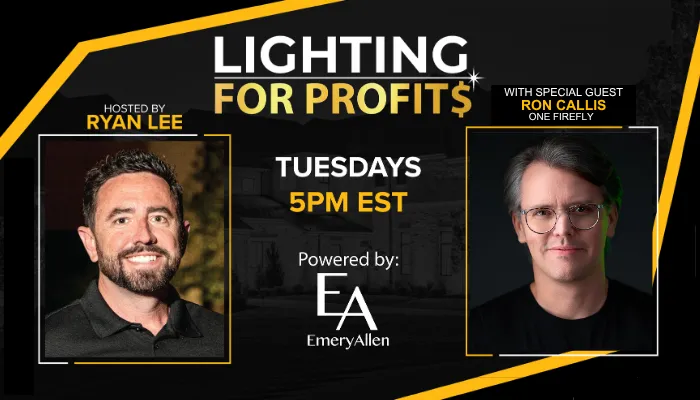
Ron Callis - Built Different
Lighting for Profits - Episode 242
What does it really take to scale a business?
Join Ron Callis as he shares proven insights on marketing, brand-building, and sustainable growth. Learn how One Firefly became a top player in the custom integration industry—and how you can apply these lessons to your own journey.
Watch the episode
Episode Transcript
Welcome to Lighting for Profits. All light. Here is your host, Ryan Lee
Welcome to Lighting for Profits.
All light. All light. All light. Powered by EmeryAllen.
Here is your host, Ryan Lee.
All light. All light. All light.
Welcome to the number one landscape lighting show in Florida. Who knew?
Welcome, welcome, welcome to the number one landscape lighting show in Florida. Who knew? That's right. Number one landscape lighting show in Florida. So excited, guys. My favorite day, favorite time of the day, of the week. Get to nerd out on business. Get to nerd out on outdoor lighting. So what can go wrong? Well, maybe I'm losing my voice. Maybe our guests will lose the Internet. We don't know. We're gonna have a fun show today. We got Mr. Ron Callis, the founder of AH1 Firefly. So, you know, it's interesting, when I talk to business owners, pretty much every day now at this point when I talk to people, I'm like, so why, what's the biggest thing you need? the number one thing they say is leads. So I'm like, this show is going to be epic because most people want more leads. So we're dedicating this show to you. If you've, if you're in a slump, if you're blaming it on the economy, the time of the year, your city, whatever it is, this is going to be a great show for you. We got Mr. Ron Callis with one firefly.
Give me an Apple 5 star review and write something nice on Spotify
So we're going to talk about the things you can do in your business to generate leads today. So I'm excited to have Ron on in just a few minutes. thank you guys so much for your support. Really, really appreciate it. We're up past a hundred reviews on Apple now, which is really, really cool. but we're still looking to grow. We can't do that if you don't go share your experience. So if you remember an awesome episode, an epic guest, whatever it is, go share your thoughts. Give me an Apple 5 star review and write something nice while you're there. It's not intuitive, otherwise I would just send you a link. But, go find it. If you, if you do it, you're a winner. And Spotify, same thing they, you can't write anything on Spotify, but you can do a five star review. So thank you guys for your support. This show is so much fun to do and getting to pick the brains of industry giants and professionals is just amazing. We're growing the industry. It's really, really good.
I want to talk about positive mental attitude for a minute
So, before we have Ron on, I got to talk about one thing. Positive mental attitude, otherwise known as PMA M. I don't think I made this up. I think this has just been ingrained in me for years. But I want to talk about positive mental attitude for a minute. in the last, I think, 24 hours, I think both these conversations happened. yesterday was Monday, and I, was on a. On a call with a client, and I said, hey, how's it going? He's like, oh, you know, it's a, it's a Monday. And I was like, no, no, I don't know. What does that mean? Well, you know, Mondays. And I'm like, wait, hold on. Before we go any further, I gotta stop this conversation because I learned years ago that you get to control and choose your attitude every single day. Now, that doesn't mean it's easy. Like, if you, have a lot of bad things happening, you're, you're. You, find out your guys are stealing and they quit, and you're like, crap, my business is falling apart. It's probably going to be harder to choose a positive attitude in that moment. And in the same moment, if you're having an awesome day and you just closed your fourth deal of the day and you've sold $250,000 this month, and it's only the middle of May, it's probably easier to choose a good attitude. I understand that. But the reality is true that it doesn't really matter what our circumstances. We still get to control our attitude. And the reason I corrected my client in this moment is because, especially as an entrepreneur, you are a leader. You are, the leader of your organization. And whether you say it or not, your team can feel this energy. Like, whatever you're thinking, your energy is putting off that vibe. And I personally think it's super important that we lead by example. And so it's okay to have a bad day. It's okay to have, like, negative things happen to you. It's going to happen. Especially if you own a business, there's going to be hard, hard moments and bad days. But the sooner that you can, you know, process that and rectify it and choose to have a positive attitude and be grateful and have gratitude in all that you do, even in the down moments, like, the, the faster you're going to see success, the faster, you know, there's ups and downs, of course, but the sooner you're going to get out of that trough and get into that high. And so, I thought that was a good conversation because he goes, you know what? You're right. You're absolutely. And he's like, man, I even. I Even know that, like, what's, what's wrong? And like, and he was able to pull himself up at that very moment, be like, all right, I'm gonna have a positive mental attitude from here on out. And so one of the things I told him, and you guys can do too, is like, if you're dreading Mondays, like, something has to change. So why are you dreading Mondays? Is it your team? Is it your environment? Like, what is it about it? And so maybe you need to schedule something on Monday that you actually look forward to. Alright, so, you know, man, Monday's, Monday's coming up. Cool. I can't wait for Monday, because when Monday happens, I get to do this. Or maybe you're dreading it because that's the day you put out fires and your business is chaotic. So maybe instead of just, you know, waiting for the inevitable to happen, why don't you plan and prepare so that you put out the fires before they happen. So you're not dreading the negative. You can do this. You might have to dedicate a Wednesday, a, Thursday, a Friday to do that. But when you build these systems, when you build your business to not even allow the fire to start, you're gonna spend a lot less time putting out fires and dreading those Monday mornings.
Your attitude can shape your results. So I encourage you to look inside your business
The second conversation I had, was actually yesterday too. I was thinking this was a few days ago, but it was actually yesterday and had, a strategy call, with potential new member. And, we were on the call and, you know, we're asking like, things like, you know, what's holding you back and what's good, what's bad, what's ugly, all that. And I. And he said, you know what? One thing that's holding me back is it's just hard to find help. I was like, well, what do you mean by that? Well, you know, it's just, no, no one wants to work. And I said, well, is that true? Like, is that, is that really true? because honestly, I've had those days too where I'm like, gosh, why is it so hard to find good people? And the reality is there's a lot of good people that want to work and they want to work hard and they want to be part of something. They want to be part of a movement, they want to be part of, part of your success. They want to help you build something. Usually when we. When I hear people say it's hard to find, you know, people that want to work, it's not their location, it's not the economy, because why is it that, like, a neighboring business has no problem recruiting? Okay. and not just recruiting, but, like, why do people stay there for 4, 5, 10, 20 years? Well, because they've created culture. They've created something that attracts people. It's much easier to get good people when you're attracting them instead of trying to, like, find them. Right. And so, if you have that attitude of, like, nobody wants to work, well, you're going to attract a lot of people that don't want to work, and your business is not going to be any better for it. And if you change your attitude to say, like, well, yeah, no, I. This is a good economy. I can find people to. And trust me, I've been guilty of this, too. There's a role that I've been trying to fill for about six months in one of my companies. And when I say trying, I haven't been trying. Okay. there's been an opportunity for six months in one of my companies. And, you know, it's frustrating sometimes. I'm like, man, why. Why can't we get that person? Well, like, how much have I really focused on it? And so in the last couple months, I've really put more energy and effort and focus into it. And magically, in the last six weeks, I now have not just one or two, but several people. Several, like, very qualified, highly talented people that are interested in that role. And that's because I focused on it. I made it a priority. Right. And so it's crazy how your attitude can shape your results. It's absolutely insane. So I just want to encourage you to, look inside your business. You know, where in your business are you walking around with that story that's. That's working against you? Where. Are you making excuses? Be honest with yourself. Find that. Challenge it, you know, because, honestly, your attitude is not just affecting your mood, it's truly shaping your results. And that's where it all starts after that. Yeah, there's a blueprint. There's things that you need to do, there's actual steps that you need to do, but it starts with your attitude.
Attitude can make or break a company, a church, a home
So before, we have Ron on, I want to leave you with this quote. this was a quote. I went on a church mission when I was 19 years old. I went to Portugal for two years. And, my second place that I lived, I walked in and I was kind of, like, starting to get a little, homesick. And I wouldn't say depressed, but I was like, man, this is hard, right? And I walked in on the fridge so there was this quote, and that quote, it just stuck with me forever. I mean, that was, you know, 25 years ago or whatever. And, so I want to read that quote today because I think about this often. And if I'm having a hard day or I start to make excuses and I can feel myself doing that, I'll refer back to moments like that to kind of like, pick me up. So the quote is from, Charles Swindle. The longer I live, the more I realize the impact of attitude on life. Attitude to me is more important than facts. It's more important than the past, than education, than money, than circumstances, than failures, than successes, than what other people think, say or do. It is more important than appearance, giftedness, or skill. It will make or break a company, a church, a, home. The remarkable thing is we have a choice every day regarding the attitude we embrace for that day. We cannot change our past. We cannot change the fact that people will act in a certain way. We cannot change the inevitable. The only thing we can do is play the one string we have. And that is our attitude. I am convinced that life is 10% what happens to me and 90% how I react to it. And so it is with you. We are in charge of our attitudes. So, love, that quote. I'm convinced that life is 10% what happens to me and 90% how I react to it. Encourage you guys to check your attitude if you're struggling or having a hard time. Hey, listen, friends don't let friends install subpar lamps. Emory Allen makes premium LED lamps for lighting professionals who demand the best. Don't settle for less. Upgrade your designs and installations today with Emory Allen. Reach out to, Jackson Lebrecht. I'll give you his email. It's jacksonlryallen .com to learn more and take advantage of their contractor pricing again, just email Jackson lry Allen dot com. And, don't forget to mention that you heard about him here on Lighting for Profits. To get that discounted contractor pricing, just email jacksonlryallen. com. whoa. Got got a little carried away with the music there.
Ron Callis: I loved your attitude conversation on today's show
All right, I think it's time, excited for today's show. Let's get the, intro music going. What do you guys say? Let's do this. Plus, I need a drink. Welcome to the show, Mr. Ron Callis. What's up, Ron?
Man, I am inspired.
Are you? I love that. I hope so.
I am. I loved your. Your monologue is. It was so funny. I just got out of a leads team with the leaders at my organization here at One Firefly, and we also run a hiring business called Amplify People. Anyway, all of them together. And I had my own version of that attitude conversation that you just gave to your audience. I really loved your approach, though, in the way you brought that, to the audience. And I completely agree with you. I will hire people and, keep people and coach people, as long as they have the right attitude. We can train a lot of the other requirements, but, teaching people to get out of bed and to know that how they approach their day, it's a choice. Regardless of what's happening to them, how it's always a choice. so, yeah, I thought that was great.
Yeah. Thank you, sir. I appreciate it. Yeah, I, I, I've noticed that even with clients that I'm coaching, you know, we, we have some people that stay with us for 12 months. We have some people that have been in our program since the beginning, you know, five years. and I've had people that are like, hey, you know, it's time to move on. We're not going to renew. And, like, if they, if they've had a bad attitude, I'm like, ah, shucks. You know, like, and if they have a good attitude, I'm like, wait, what? Like, no, I, like, I want to fight for you, you know, because it is contagious, like, one way or the other, like, someone has a good attitude, you're like, dude, I want to be around that. And if they have a negative attitude, I'm like, I kind of don't want to be around that.
It's funny.
Power surge knocks my home Internet out, so we're broadcasting live from home
Speaking of attitude, so this more I'm here in Fort Lauderdale, and there's always storms, and this morning, it stormed, and it. There was a power surge, and it knocked my home Internet out. So I'm coming to you from my home office. But yet we're here live. And so I'm a little nervous because I'm tethered off of my lovely iPhone here, but I've kept a good attitude. I'm like, you know what? I'm gonna assume the best. I'm gonna do my best, and we're gonna try to let the show go on here. I, I think I know I haven't had Internet.
I think I surprised Ron because, like, hey, did I. I don't know if I told you this is live. He's like, live as in, like, we're recording and then we'll go live another day. I'm like, no, live in, like, 20 seconds.
So I was like, we'll cross our fingers. You also, I don't know if you want to go there, but I'm just gonna tease.
Ryan, many small businesses are bottlenecked because they need people
Ryan, you had mentioned you're talking about talent just on your monologue in your intro. And I just. You dropped some wisdom. I'm m just going to restate it in that businesses. And we work with small contractor clients all throughout North America. And so many businesses are bottlenecked because they need people and they don't necessarily have, let's just say robust hiring strategies. so there's two things. One is I've got my favorite book, the book I recommend the most to businesses. so there it is. It's called who by Jeff Smart. And it helps small businesses understand a framework on how to approach their hiring. it's the methods that we practice ourself at one Firefly. And it's the methods we practice at amplify people, which is our hiring business. But if businesses put on their website their culture, their, not just their services, but aspects of who they are, what they believe, their core values, their history, and how they, treat their people, that's going to help attract people that would want to work for a company like that. And the same thing is true for social media. Make your social media feed, certainly put your projects out there, but also put your people out there, celebrate their accomplishments. Maybe they go to a training to a lighting manufacturer and gain a certification. Celebrate them, put them out there. And your potential, future employees are going to be checking out your social media and they're going to see that you're celebrating your people and that becomes a company they would want to work for. So your concept and language around attraction, it's very, very true. Be the company that would attract the type of people that you want in your company culture. Thought that was brilliant.
Okay, this is gold. And I'm gonna totally, just throw the script away for a second here
because, okay, that's what I'm on the show. You never know where it's gonna go.
Ryan: I failed to really learn about recruiting when I had lighting business
Well, I, I mean on my agenda was like, okay, we're gonna talk marketing and then if we have time, we're gonna talk about people. But the, reason I want to reverse it is because you brought it up. And I think it's so, it's so impactful. And the reason like I want to do this is because when I had my lighting business, okay, I had it for 12 years. I'm, really, really good at marketing. I'm really, really good at sales. I figured out the business game. What I failed to really learn at that time was what you just talked about. Like, I would get video testimonials all the time. Like, here's why you should use Majestic. Here's why this is awesome. I, not, not once did I think to have a landing page to be like, this is why you should come work with us and have a testimonial from a guy who'd been with us for five years. To be like, this isn't just a job. Like, this is the coolest thing ever. And it's not about like the fact that we play ping pong, but like, this is so awesome because we're part of building something. Like, why didn't. I didn't know that. Like, I didn't. I literally did not have that knowledge that we should be building this, our own recruiting machine to attract these people. And so I feel like it's my duty. Most of the stuff that I teach isn't like, here's all the stuff I did. That's awesome. It's like, here's all the stuff that I sucked at. If I could go back, here's what I would do. And happens to be a lot of good stuff that I screwed up on.
Very few people ride the bike perfectly the first time they get on the bike. And for the people like you or me, Ryan, and maybe let many of the listeners, if you survive in business, you have the potential to start thriving in business. But you gotta be able to last that long. And one of the most important things I figured out, now I'm at a challenge. I didn't start to figure out the people part. I was about eight or nine years in to my journey before I started to get. I started to become a better listener both to the team and to outsiders that were trying to help me and influence me. Just as you coach your clients, right, not everybody's ready to receive, you might be there delivering wisdom and experience to them, but the other party has to be ready to receive that wisdom. And I started to get better at receiving the wisdom. And as I did, I started to understand the importance that if I could really focus on a, consistent, repeatable process around identifying people that would help ultimately make my business better. And you know, a view of that is, what are the things that I'm weak at? Well, let's bring people into the org so that they're strong and they enjoy it. Right? There's a whole framework of people need to not only be good at something, but they need to enjoy it, it feels a little bit less like work. And those, all of those people exist, I believe in an infinite universe, you just have to be really good at defining what those things are, who those people are, and then executing a consistent process. That book, who the A Method of Hiring, by Jeff Smart. It's a wonderful framework. It's not the only framework. There's probably lots of frameworks, but it's a framework that's very repeatable. And, when you start to grab onto that, and number one, as a leader in your business, believe it. And bringing in quality people that share your core values and are also excellent at whatever the work function you need. Maybe that work function is, finance, maybe it's project management, maybe it's design, maybe it's installation, maybe it's running the warehouse. Doesn't matter what the work function is. You want someone that matches your core values that is excellent at what? Maybe it's sweeping the floors. You want someone that's excellent at sweeping the floors and loves sweeping the floors and shares your core values. And when you start to bring those people into your company, that's when you start to reach an inflection point. You start to accelerate. You know, I tell it like taking the monkey off your back. As a business owner, we have lots of monkeys on our back. And if we can hand those off to somebody else and let them hold the monkey, and when they come into my office, I don't want them handing me the monkey. I want, them holding onto it. Right. And ultimately bringing me problems and solutions. And when you get those people on your team, your business gets to accelerate. And here at One Firefly, we have 80 people on staff grown into one of the larger agencies in North America working with contractors, just like your audience. And that's just. It's not because of me. It's because I've been able to bring in really talented people that are passionate about serving, serving each other, serving our customers, serving our industries. And when you get better at that, you're. You're able to grow your business light. Your quality of life gets better. We as owners, operators, are able to spend more time doing the things that we choose to do or that we're best at. You know, I'm very selfish in that regard. I like to do certain things in my business, and there's certain things in my business I don't want to do, but I want to hire people that love doing those things and are very good at it, and they want to grow a career doing those things. And so as you get better at identifying that, attracting those people, and then keeping and retaining those people. Right. They get to keep that institutional knowledge. Right. It's very expensive to churn through employees, waste a lot of money and energy churning through employees, which means it's better to slow down and hire very meticulously, very methodically.
Yeah. Right.
And when you bring them in, you now get to, take that monkey off your back, hand it to them, and you get to accelerate.
You probably any business owner probably wants both. I tend to lean to getting the physical copy
Hey, is on. Is that book. I. I love listening to books, but is that a physical. Like, I should get the physical copy.
I, I like the physical copy because it has diagrams.
Okay.
But you can totally. You, you probably any business owner probably wants both. You want to listen to it that
I, I, yeah, that type of book. I tend to lean to, to getting the physical copy as well. I'll get, I'll get that.
I'm weird like that. Most books, I buy the physical copy. And even if I buy the audio, because I just, I am surrounded all around my perimeter, probably by 40 or 50 books that are like my regular go to that I recommend based on whatever the situation is with one of my customers or friends. and I, I do morning walks, so I like to listen. I'll listen to it, but then I want to come back and flip and look at the diagram.
So I think this is so awesome about you. I, you know, I met you at cd. it's a huge show for those. You guys don't know. It's for integrators that. I mean, I didn't even know what the term integrator was back then. so I refer to those as AV Guys. Don't hate me. Still love you guys. but, you know, people that do the smart homes and all that stuff, and they, they work for very wealthy people. but I, I didn't know at the time that you have this other business called Amplify People. And I love it. I freaking love it. Because the parallel, as you know, I don't have to teach you anything in this, but the parallel there is like, from a marketing standpoint, all I want to do is find the best customers possible. Like, I don't want to find someone who thinks that $5,000 is a lot for landscape lighting. I want to find someone who's like, oh, it's only five. Like, maybe that's too cheap, you know? Like, I want someone, at least in my world, I want to do like a 10 to $20,000 job. Some people want to do $100,000, jobs, whatever that is. But the point is you're trying to find the A clients, and then you have this, you know, people business, this recruiting business, where it's like, all you want to try to find is the A plus players. Like, where, where are these A plus players? And I think this is just. The parallel is just the same. Like, like you said, like, why do you not have on your website, like, this is why you should work for us. And like, all the messaging to attract those people. And people wonder, like, why is it so hard to find good people? Well, look at your branding. Look at your website. You don't even have a wrapped truck. You meet at a storage unit. Like, why would someone want to be. And I'm not saying you can't find someone, but you. You got to be really good at selling them the dream. You're not selling them a, $10,000, $20,000 lighting package, but you are selling them the dream. So if you can find you, I do think it's possible to find an A plus player. That's going to be early on. But like you said, you got to be meticulous. You can't just accept the, the, the, the warm body that comes in. But there's just so many cool parallels there of, like, how you're marketing for your external client and you're marketing for your internal client, your actual team member.
I'll give another nugget, which is you want to absolutely look at your website as speaking to your customer and speaking to your future employee. Look, everyone should cast a look at their website today. Who are you speaking to? Only a future customer. Then there's a really big opportunity. It's not a problem. It's an opportunity. Remember, attitude matters that I now get to fix my website and make sure I'm speaking to my future employees. Same for your social media. And the little nugget is your, Your jobs, your. Your. Your advertising for a new role. Do not post a job description. Post a job ad. An ad is you are telling the world what you're looking for, and you're also telling them what you're. Why you would be a great place to work. Right? So, look at the language. If you're not selling in that ad, why. Who you're looking for, not only their skills, but the right type of core values, the right type of attitude, and then why that person would really enjoy working at your company, then the companies that are doing that well are the ones that are winning the quality talent. And you're being left with the leftovers. And I would add in terms of a consistent process such as the one mentioned in the who book, a consistent process allows meaning A a consistent process that is deployed and executed consistently regardless of who on your team is hiring. Not just the owner. But what about the PM team? What about the installation text? What about your sales team? You know, and so on and so on and so forth. You want the same process executed every single time. If you don't have that, then you're getting random results, which means randomly you will hire an A player and randomly you will hire Bs, and randomly you will hire Cs. Cs are very expensive. If you hire an A. Here's a little trick. An A will often do the production output of two Bs and you often only have to pay them a little bit more.
I love the way you worded that because most people think A's are expensive. You know what I mean? And you're like, no, see's the most expensive hire you can have. And you know, I see this time and time again because like they're so busy fixing the seas, putting out the fires and doing all this stuff like they don't have time as a, as a small business owner to go build the business because you're basically fixing all the C's work. And, and, and again it's, it's like it started with the, the lack of attraction. It started with like their, their website that's oh great for recruiting, you know, clients, but not team members.
Amen.
Firefly helps small businesses attract, retain and grow employees
I, I think people and, and hiring is one of, not to say hiring but just people, attracting people, retaining people, loving on people, growing people is from my life experience, one of the most important areas that as we got better at that, as I personally got better at that and my team got better at that, business started to get E become easier. I started to make more money. I started to do more of the things that I really enjoy doing in my business and less of the things that I don't so much enjoy doing in my business. And I talk about it so passionately because I, I lived the experience and now through amplified people, people, we help customers at least with a piece of the equation, which is how to follow a consistent hiring process. And just for the. I don't want to make it a commercial. But that business model, it's not a model, of a percentage of salary. It's a flat fee model. So it's just flat fee model. And we do ABC processes within the hiring function of helping People attract talent. It's a very economical model. And the goal is to take a lot of that heavy lifting off the shoulders of the small business owner. And, you know, if people wanted to check it out, they could go to ampeople. com that's, that's the website. A lot of good information on there. and you didn't ask this, but I'll just fill in the blank. Like, how did we land at doing that? It's a. We. We really have focused a lot on people at our business on Firefly. And as we were surveying, like a good business operator, survey your customers, find out what other problems they have that you might be able to solve. We were surveying our customers. You know, we do the marketing for. For many hundreds of. Of contractors across North America. Many of them were telling us their number one bottleneck to growth was people. They didn't know where to find people. They didn't know where to find good people. And we said, well, we, are. We've. We think we're. We're not perfect, but like, we have a good system at, one Firefly, and we want to help our clients grow. That's actually our mission, to help our clients grow. And so if we help solve or try to be a part of the solution, we haven't solved it, but we'd like, try to be a part of the solution around people that we could help our clients grow. And that's actually where we took it on. We're three years into that business, and the business is more than doubling every year, year over year. This year we'll double again, and, we're still sadly, only scratching the surface of the need out there for help. But, it's. It's a topic I'm very passionate about. Although I know we talk about leads and marketing, we can go there.
I know. Well, I just love it because it's. It's the two things that I think businesses need most. They need the leads and they need the, the team members. On both of them. I was going to. I mean, we can kind of transition to marketing. Like I said, there's so many parallels. We could be talking about recruiting a client and recruiting a team member. And it's almost the same thing in my mind, but very similar. how much, how much does branding influence someone's success when they go to, like, turn on marketing?
It's really important to know who you are, who you're trying to serve, what you stand for, why you're different, and why someone should hire you over Someone else. And for many small business owners they have answers to all those questions inside their head and they've written down none of them and none of them are present on their website or in their marketing, messaging or collateral.
And what if. So you're what if some of their initial answers, they write them down right now and they're like, okay, I'm listening to Ron. We're family owned, we care about our customers.
I think that I'm not willing to say there's any right or wrong answers to these questions if you have passion and conviction around why somebody else should care about that. So for example, if you want to say we're family owned and you believe that that then allows you quality of care or attention to the customer, maybe they can call your personal cell versus calling a service. I'm not saying that's good or bad, I'm just making this up. If you have conviction around that mattering what is important and this is going to get a little meta what's important about you speaking to your human audience and your AI audience where AI is now starting to learn about your business and getting you trained into the LLMs because people are on those platforms doing research. The human and the AI need to know who you are, what services you offer, what you stand for, why you're different, how people feel about you and why ultimately you should be selected over an alternative. You can certainly work on polishing those answers, but simply having those answers, having a set of core values, having a mission, something your business stands for, having maybe ah, award winning projects you've submitted to your manufacturers or industry awards and putting and celebrating those on your website, having testimonials and reviews, having interactions on social media, all of those are elements that both your human prospects sad we have to talk about the human and the robots but the humans are going to collect and filter you based on that information. But so are the search engines and the large language models. as more and more of society m the Latest data is 37% as of early 2026 about 37% of customers are starting their research journey now in AI.
85% of all searches still happen in Google. So the question is not if is Google going away
I know that's a shocking number. Curious Ryan, what you do if you go to your friendly ChatGPT or Claude when you're trying to make a purchasing decision. But more and more of our society is going there and those robots, the AI, you don't want them to make something up, you want them to know the answer and the only way they're going to know the answer is that answer exists on your website and out there on the Internet, do you
think, Google, I mean, yeah, like what's going to happen with Google search as we know it today? Because like you said, everyone's using these different LLMs and like it used to be like Google is king and they have Gemini, of course. But what, what do you, what do you think is going to happen?
Google is still king. Google. 85% of all searches that occur still happen in Google. So the question is not if is Google going to go away. Google is evolving very, very rapidly. the data is that Google searches are declining. Single digit declines, but they are declining. But when you and I go to Google and do a search, what's the first thing usually that shows up at the top of search AI? now you're getting a generative search result. So that's the concept I want everyone to think about is you're getting a, you're not necessarily only getting a list of links, right? We're all used to talking about Google and how I rank organically and, and whether I'm in an ad, ad placement at the top or bottom of the page. But now did AI, in this case Gemini, did Gemini know enough about my business as relevant to that search query to surface my brand's name in that search summary. And then separately, many, many people are starting their journey of conducting research in ChatGPT or in perplexity or in Claude or in Gemini, you know, the dedicated Gemini. And it's very different how we, the human are doing those searches. If I'm over, I'm going to go back to Google. Many of us go to Google and we just type a very tight phrase, maybe a sentence. When we're over in our buddy ChatGPT, we're often typing sentences. We're giving more context, we're giving a lot more framing around the situation and what our goals are, what our experiences are, what we think we know and then it gives an answer. And then what do many of us do? Sit and go back and forth and we have a conversation with our AI consultant. So it's very dramatically different the buyer behavior. Which means if AI recommends you, it carries a lot more weight than if only Google lists you in results. And the data, is that when someone sees you in an AI result and clicks over to your website, they're four times more likely to convert, meaning giving you a call or filling out a form on your website. Right, because you're now trusted, you're recommended, you're maybe listed. And then what else do you and I do, Ryan. We might say, okay, I see all these recommendations, but who would be best for me? And you're asking AI to give you a singular recommendation. Well, if your business is not the recommendation, then you may not be getting that phone call. And businesses that understand this and are focused on it are winning in May of 2026. And businesses that are not focused on it, and frankly, were not focused on it a year ago. M. Why? Because the training model is being trained on data from a year ago on the Internet. So when you go into Claude and use Sonnet 4.7 or Opus 4.7, that was trained a year ago. Right. The models in the future will be trained on the Internet of today.
Is it. Did I. Is this a rumor? But is Perplexity, like, more current than, like, chat and Claude and some of these older models?
I'm not willing to say that. But all the AI LLMs are current in that if you activate the function of web crawling, okay, they have their training data, which was trained in the past, but then they also have the ability, just like Google does, to go crawl the Internet today.
Okay.
And so they can serve up, the information, just like Google bots would do, crawling the Internet. Now all of your LLMs are also crawling the Internet.
You know, it's interesting, I like what you said about context, because I'm. I'm a. my kids make fun of me, but, I mean, I've been voice texting for a long time, you know? And so when AI came out, what I used to do was, I would, like, sit on my couch, and I'm like, okay, I'm doing a podcast. I got Ron Callas coming on. I want to make sure I hit on these points where I was just talking to it. Right? Well, now there's like, you know, apps like Whisper Flow, which I use, and so I can record on my computer. And, like, I don't have to. I used to transfer this and go here. Now I'll just sit there and be like, okay, this is what I want to do. And you're totally right. Like, even if you were to type something into an AI, whatever, you're still. Even if you're going to seek a sentence, you're still, like, subconsciously thinking, how can I type this in the shortest sentence possible? Whereas all of a sudden, now when I go to talking, I'm like, okay, I'm looking for an outdoor lighting company. I don't want to. I don't want the cheapest, but I don't want the most Expensive. I've been burned in the past and, and all of a sudden the context just starts flowing and so you're totally dead on like and I think it's, it's going to change even more because more humans are going to adopt this bigger context through voice instead of type through, through eight.
So number one because they're talking to AI, they're giving a, they're having a conversation conversation let's say typing. And now there's like a rapidly growing trend. I'm on that train by the way. I use whisper flow almost everywhere in my life. I type very little. I speak. If I'm dropping a message to my team in Slack, I'm whisper flowing it to them same and I'm why let's just go Technically I type, I'm not a fast typer. I like tap with type with three fingers on this hand, two fingers on this hand. I have a dysfunctional typer and I can type about 30 to 50 words a minute. I can speak about 120 to 150 words a minute. I can communicate verbally exponentially faster than I can type so it's automatically faster. And when I'm talking you gave a perfect explanation so I won't, I won't restate it but you give more context when you speak. So when you give all that context to AI, AI has more information to work with to try to serve you up a quality answer whether it's using it out of its training data or whether it's crawling the Internet live to get that answer. And I just am it's, I'm very passionate about this and I have data to support it I could present you.
Business owners should really care about whether or not they're getting mentioned in AI
Business owners should really really care about whether or not they're getting mentioned in AI or not because the businesses that are getting mentioned are winning the business and the businesses that are not getting mentioned don't even know what they're, they're losing.
So I'll give you well okay, the multi million dollar question is how do we do that? How do we like you said like you can be dominating Google right now. And I've, I've experimented with tons of different like ways of doing this where like then you do an AI search and I don't know is it aeo, is that the proper term?
There's about four or five different acronyms. I mean I just heard the newest one G A I O, Generative, AI Optimization, GEO Generative.
Okay so I'm not alone. I don't know what the term is. You know what all the terms are? yeah. How do we get ranked for AI is how do we do it?
Yeah, I, I'm going to answer you but I'm going to give a stat and it's a stat from my customer base and it's real time data. We talk about your brand showing up in an AI and often there's a reference link for the data AI is presenting. You could click it as a consumer and it'll drive you over to a website. My customers at One Firefly have had more reference visits, referral visits from AI in January through March of 2026 than all of 2025 combined. Q1 2026 for my customer base has generated more referral visits into my customers websites in three months than 12 months of of 2025.
And you're talking not just comparing AI but just all searches in general or is it just AI?
I'm at the moment referring to people that are doing search in ChatGPT, perplexity, Claude or Gemini. That's your, your four major large language models. The and when you're in your website, everyone listening should be able to have view of what's called your Google Analytics, your GA4 data. GA4, it's free service from Google. You can look at all the traffic data on your website and if you have activated an SEO strategy, I'll just say a strategy to improve your visibility in AI, you would have had to have done this in the last six to 12 months or more. Then what you are very likely seeing right now is an explosion of traffic being driven into your website from AI at One Firefly. My data point, my raw data, 9 out of 10 inbound leads to One Fire. AI refers contractors around the country are going to AI asking about websites, digital marketing, SEO, you name it. And when Firefly is getting presented to them as an answer and when they make contact with my team, they go right into a sales conversation. I need a new website. How much does it cost? When can you get started? It's crazy. Like whereas most of the time this would be coming in from forms or we'd get the majority of our leads from trade shows or other places, it's been an explosion from AI and so what I want business owners listening. And this is your question, how do you do it? I want them to know that if they focus on this and allocate time, money and energy and then give it six to 12 months because it's not quick, then you too can understand what it means to have your business more visible in AI recommendations and ultimately getting those traffic flow and those lead flows. So I'm going to, I'm going to start with the end point which is how do you know if it's working? I'm going to compare it. I'm going to use my hands for the people listening. I got my two hands up in the air on one hand in Google, you know that we have always talked about getting ranked. I need to be on page one organically and I need to be in ranked position one, two or three. That is still true. In AI we do not talk about getting ranked. In fact you can't be ranked because large language models, by their definition use transformer technology. It's a black box and it will literally deliver different answers every time you give it a query. It's not black and white and consistent. So what we look at is your brand getting mentioned, across a search, across all the large language models. What percentage of the time on a topic is your brand getting mentioned? So the concept is called AI visibility and what we're looking at in the reporting is based on frequency of brand mention. So Google, we're looking at your ranking in Google AI we're looking at when a consumer is doing a search for land outdoor landscape lighting in my, you know, best outdoor landscape lighting expert in my city and you need to insert that city and you have to then have a Persona. It's a luxury homeowner. Ah, when a luxury homeowner is doing that query, when you're doing the reporting, the reality is that luxury homeowner might search many different ways for that type of subject. So number one, you have to create all the derivative phrases that a consumer might do a search and then you cross matrix that across all the common large language models and all of their models. Simple example, Claude has sonnet and opus and what you have is then a large data set and we're then running the analysis. What percentage of the time is my brand Acme lighting getting mentioned when that type of search happens? And that's how you know month over month, quarter over quarter, whether the needle is moving in my favor because now my hands are over here. The overarching activity is I need to do a quality SEO effort. I need to put practice local SEO on site SEO, technical SEO back offsite SEO and there's the four pillars of SEO. And if I practice that in a well informed way I will see my business grow in AI visibility and I will see my business also improve in Google rankings. So it's really neat for the business owners listening is now there's more reason than ever to design and execute an SEO strategy for their business. And then the last little.
This is so good.
Last little nugget is every business owner here. These are going to be some scary numbers for some, but I'm just going to tell you what my life experience is at one Firefly. If you're less than a million dollars in revenue, you need to be investing at least 5 to 10% of revenue and marketing. And if you are between 1 and $10 million in revenue, you need to be investing around 2 to 5% of revenue. And if you're over 10 billion in revenue, you need to be Investing around 1 to 2% in revenue. And out of that spend should be an SEO strategy, that is focused on exactly the service solutions and brands and geographies where you want to attract customers, customers. And that's often more money than a lot of small business owners know they need to invest. I'm going to tell you, you can do too little to matter. And that was what I would want people to be careful about. Any charlatans or people selling you smoke and mirrors where, hey, $500, I'm going to get you found in AI BS. It will not happen and they will take your money.
I, I have no, dog in the fight other than I do care about people's success. I genuinely want people to succeed and I will probably scare people even more than what you were saying, Ron. I think if you're sub 1 million, it's 10 to 20%. Okay, that's fair. And the reason I'll even go as high as 20 and most people, and trust me, I didn't used to think like this. Okay, so if you think I'm crazy, that's fine. One day you'll realize I am crazy.
Especially in landscape lighting, you need to consider the lifetime value
So, especially in landscape lighting, you need to consider the lifetime value, not just, I mean, yeah, you need to think about cash flow and you need to think about, okay, how much am I going to make today? Can I keep enough money to stay in business 30 days? But you look at the lifetime value and if you are really, really good about asking for referrals, asking, putting door hangers out on the five nearest doors, putting out yard signs, playing small ball. If you can play small ball, you can afford to spend 20%. You could even do 25, maybe 30%. I know that's crazy, but you literally could afford to do that because now all of a sudden you get another lead, a second, a third, a fourth and that costs you zero. And now all of a sudden that brings those numbers back down. And the reason I say so aggressive when you're small, because I agree with you. It's like you, you can underspend and you expect these grandiose results. It's like, well, you don't have the brand, you don't have the repeat business, you don't have the referrals. Like that just doesn't exist for you. You don't have the company at 5, 10 million. They have the unfair advantage. You don't have that yet. So you have to pay to play and it's going to hurt. And this is where it gets probably even more painful and people probably just cover their ears right now is like, you have to spend for who you want to be. You know, if you're a $500,000 business and you want to be a million, you don't get to go, okay, I'll do 10% of 500,000. No, no, you want to be a million dollars, you got to spend for that. So it might be 150, 200, $250,000. And then it's not that hard. It's scary for sure. But then you could say, okay, if that were true, if I was going to build a million dollar business and I had to spend 250 grand to do that, what would have to be true? And that's not a crazy number. There's people that spend a million dollars for a million dollar business. You're just investing a quarter of that, you know, but you got to be good at these other things. You got to be good playing small ball. You got to get a lot of base hits after that. So that all sudden you get a double and it scores two runs, you get a home run, it scores four. That to me is the name of the game is like whoever can afford to spend the most to acquire a customer and obviously stay in business, they're going to win every time because it's scalable to infinity.
I love everything you're saying And I agree 100%.
Another perspective that I would have your audience consider. It's how ad spend is invested across tactics
Another perspective that I would have your audience consider. It's, it's not only the spend, it's how the spend is invested across, the tactics that are deployed. And so I'll just give you a, two big levers. One lever is advertising, right? I could invest all of, let's just throw a number, $250,000. I could invest, I don't recommend, but I could invest all of that budget in say a Google advertising or a social advertising strategy. And the benefit of that strategy, My agency does all of the above. So I'm not diminishing any strategy. But you need to execute or enter into commitments, eyes wide open. When you move into an advertising strategy such as Google Ads or say Meta ads, which those are, they're different places in the funnel, the sales funnel, you have to understand that you're investing in the visibility of your brand and business to get in front of a particular type of customer. And you need that ad spend in that month to generate opportunities that you then close so that you get what's called a return on ad spend. So if I invested $250,000 in ads, I need that work to, I need that investment to ultimately generate not 250,000 in jobs because you aren't 100 profitable audience. You have some gross margin overhead and you have some net profit as a business.
What's the gross margin on a lighting project typically? 65%
And so Ryan, you tell me what's a typical net profit for a, let's just say what's the the, the typical gross margin on a lighting project? We're not going to say for the business because gross for the, the, the job is going to be different than the overall net profitability for the business.
You're talking gross or net.
So what's the gross? If, if if someone listening sells. Let's, let's do really simple numbers. If they sell a hundred thousand dollar lighting job, what is the, the profit, they would just garner from that project?
Typically gross gross is going to be 65%. So you take out labor, materials, that's 35%.
Okay, labor and materials. So 65% gross margin. And then what's a typical for that business? Fictitious business. What's the net profitability typically for that business?
20%. All right, so if they're 20, if they're not working with me, they're like negative five. And then once they work with me, it's probably 25.
Your clients are netting at 25. That's an amazing, that's an awesome business.
It depends, like I said, I mean if you're aggressive growing and reinvesting back, it could be down at 10. But it's intentional 10 versus like crap, what am I doing? I'm going out of business 10.
So, all right, so let's walk off the gross margin off a project. $65,000. Right. Then I need to score in this example, I can't even do the math. Four of those jobs just to break even on the ad spend from my advertising spend. I need to not get, I need to get enough opportunities that I close that I've only broke even. I haven't actually made any money yet because I spent $250,000 on ads, right? And then if you really look at the net on the business is 20%. That's after all your overhead, owner's expenses, all the other expenses in the business. you've got to sell more than that. Now, I'm going to compare that to, what I would recommend in an integrated strategy. You, the business owner, are investing in a content strategy or an SEO strategy. When I am investing in SEO, it has a negative. It does not deliver the potential for any fruit right away. I'm going to be invest, by the way, it's not going to cost 250,000 a year or, a month. It's going to cost thousands of dollars a month, but I'm going to invest that money. And what I'm doing is I'm filling a bucket a drop at a time, or maybe a couple of drips at a time, or maybe I even turn the faucet on to a nice slow roll and I'm filling the bucket, but I still have to fill the bucket. And that bucket is putting your brand out into the search engines and the large language models so that you're getting indexed, so that your business has the potential to show up in a Google search result, and so that your business has the potential to show up in an AI recommendation that takes six to 12 months of good hard work. So, but here's the, here's the benefit. I don't recommend this. I could theoretically stop investing in SEO, and I've already got a flywheel that's turning and it's going to keep turning. It will slow down if I stop, so don't stop. But even if I stopped, I've planted a tree, I've given it water and fertilizer, and it's starting to bear fruit. Even if I stop feeding it fertilizer, that tree is still, for multiple seasons, going to bear me fruit.
Mm.
That is the benefit of an SEO strategy. So what's best for probably most of your listeners is an integrated strategy. For sure, I have the appropriate level of advertising, the appropriate level of SEO investment so that I'm able to feed my family today and also prepare to feed my family tomorrow.
Totally agree. I mean, most of us are not. I mean, you're not going to be listening to this podcast if you have like a rich uncle or you just came from inheritance and you're like, hey, you know what? We Got time, no worries. Like, most of us need money today. You know, it's like I still need the instant gratification. I still have real bills to pay tomorrow. but I'm totally with you. I felt like when I built my lighting business, I didn't even know some of this stuff, but it was happening. And you literally create this unfair advantage where I'm like, dude, there's no way someone can just come in today and dominate like we are. We already planted the flag, like, you know.
I want to talk to you about something real quick before it gets late
So I want to talk to you about something real quick before I know we're getting late. Do you have, like, five more minutes?
I'm good. Yeah. You're my last meeting of the day.
Okay. I actually have. I have a hard stop coming up soon because I do have one more, call I gotta do.
You're like a legend in the integration space. I mean, everybody knows you
But I want. I gotta ask you this. And it has to do with marketing, but it's not digital marketing. We both. You're like, you're like a legend in the, integration space. I mean, you go to these shows and it's like, oh, there's Ron cold.
I just have gray hair. That's all it is. So you live long enough and you, you, you, you don't hurt people. You start to be considered in certain ways.
But you, you guys do great work. I mean, everybody knows you. You're well represented. You guys always are teaching classes and, and people rely on you guys to, to feed us this, this knowledge. Right?
I'm on a mission to bring outdoor lighting to integrators
I'm on this mission to bring outdoor lighting to integrators. And so I want to get your feedback on this because again, it has to do with marketing. my positioning is this, and I would just be interested to hear your honest take on it. My opinion is that the integrators, they own the space. I mean, if someone's gonna hire an integrator, they're not poor, okay? Like, they can afford to do outdoor lighting and other things, right? And so my mission is like, hey, how do we, how do we bring that in? And my, My. The. Some of the sessions that I've taught at, like Light of Palooza and Cedia is like, guys, why your client, your homeowner, is going to invest in outdoor lighting? Like, that's. I didn't. That's not an opinion. That's in a fact. At this point, the only question is, do you want to partake in that? And so my whole thing is like, why would you not want to be part of that? Like, the lighting is going to tie into the controls, which now adds value to your relationship, your system, all that. And why would you want to just like, wait to see what happens? Like, is it going to be a handyman, an electrician? Like, do we really know what's going to happen here? So my thing is, like, I have a network of people all around the US and I want to pair these people up and say, hey, do, do five at minimum, maybe 10 jobs together. You will be personally trained and handheld to learn design, installation, pricing, sales, all the entire process, how to set up a maintenance plan, all that for 10 jobs. After that you can then go, wow, that was awesome. Thank you so much. We now are trained. We don't need you anymore. Bye. Bye. My network will still be grateful because they got 10 jobs, out of it. But I feel like at the end of that, 90% of them are going to go, you know what? This is not for us. This was a little bit more complicated. We're not necessarily like wanting to get outside and trench and that's not our thing. let's just keep the thing going. Like, let's just keep this partnership going. And then the 10% that are really go getters and they've got the guy that's super passionate about outdoor lighting and he wants to go do nighttime demos or whatever that is, then those people can actually start up their own division. Is that crazy?
No, it's, it's, it's super smart. And my is the question, how could the audience do more of that or gain more of those partnerships?
Yeah, like, as long as it's not crazy. You know, everybody, you know how they think, you know how they make decisions. You know what, again, like, their perspective on things. If someone's listening to this and they go, man, I would love to get a referral partner. I would love to partner with Nav guy. What's the best way to do that?
it's going to go back to the basics. all of these integrators in every major city, not even every major minor, every city. What I've Learned in my 26 years doing this is there's wealthy people everywhere. Every single city has your wealthy people. And if there are wealthy people, there are technology contractors, technology integrators, serving them, selling them lighting systems, home automation, security, you know, you name outdoor lighting in some cases. But it's also a fair statement to say that outdoor lighting is very much an emerging category within the technology space. But your audience and the people, many of the people that are in your group and receiving your coaching, are dedicated to that expertise. That's their mastery, that's what they do. And so that's very valuable. So what I would recommend is they put together a biz dev strategy. this is like playing the long game. There's no, in my experience, there's not many, get rich quick schemes. The long game is that you want to suss out who the top integrators in your city are. By the way, you could go to, just as we talked about previously, go to Claude, go to ChatGPT and, and ask it who are the top AV integrators in my town? And it will give you a list. They list the top 50. It will list 50 for you. And what I would do is I would, from a biz dev standpoint, I would make an effort to connect with all of them. Get yourself introduced. I would connect with them on LinkedIn. If you're not on LinkedIn, you all should get on LinkedIn. And so I would connect with them professionally. I would call their office, ask them if you could come in and introduce yourself, meet the owner, buy them lunch, do a little bit of show and tell, learn about their business. So you could refer them and you'd like them to learn about your business. So vice versa, the potential could be there. And I would just make, ah. And then you would design a strategy like I've described, and I would consistently practice it every month, every quarter of, every year. And what's going to happen is you're going to meet all the players and you're going to find who you mesh with, who would be a good connection. And then I would not necessarily do it on call number one, but I would potentially on introduction number two or three, tell them you'd love the opportunity to partner, collaborate on a project. And if you do that, the people listening that do that will absolutely grow their relationships, they'll grow their referral network, and in many cases you'll grow lifelong partnerships of collaboration on projects. So I love it.
I mean, I love, I love everything about it, except it's not a get rich quick scheme. So it was kind of lame, actually.
Yeah. Well, you can always go buy lottery tickets. There's that.
Oh, yeah, thank you. Yeah, we go, go buy lottery tickets. It might be faster, but it might not, not work at all.
It probably wouldn't, but maybe.
Ron, thank you so much.
What's the best way to reach out to integrators
So if people want to reach out to you, again, you got one firefly and then you've got amplify, people, if they're looking to get more leads, they're Looking to get help with recruiting, at least start that conversation. What's the best way to get in touch with you and your team?
Sure. So go to one firefly. com that's spelled out o n e fire firefly. com. you could also, if you're curious about amp people, or amplify people. That website is amp a m m p people dot com. So it's two p's a m m p dash p e o p l e dot com. And then also if anyone wants to listen to me, interviewing integrators, if you want to start to understand the integrators psyche and decision making process, listen to Automation Unplugged. I've been running that podcast since 2017. I think we're on like show 360, something like that. And it's just a lot of the, you want to know who a lot of the top players are around the country, Just look at my guest list on Automation Unplugged. And that would be another. We're on all the, all the places, all the listening places and YouTube you could watch or listen.
Ryan: Thank you so much, Ron. That was great. I appreciate you. Uh, Ryan, it's been my honor and pleasure to
Ryan, it's been my honor and pleasure to spend another hour with you here. I always enjoy when we get to hang out and, and talk same.
somehow your Internet worked. There was a couple like bug outs, But I mean 99%, that was awesome. With 4% megs up upload, I'm, I'm, I'm never going to let you live this down, Mr. Gigabyte.
I, I, yeah, it was my, my upload speed was 4 megabytes per se. It was like awful. Like normally I'm bragging about my gig service but we, we limped along, we got it done.
That was great. Thanks so much Ron. I appreciate you. Great stuff, guys. Now the hard part, Go implement. So if you guys want to reach out, reach out to Ron and his team like, and like he said, check out his podcast. He gave you guys a ton of good, good nuggets to get started. So thanks everyone. Have a great week. Keep moving forward.
We did it.
Thank you so much, Ron. That was awesome.
That was good stuff man. hopefully that was valuable or that's what you wanted to deliver for your audience. We kind of went.
Ron Callis - Built Different
Lighting for Profits - Episode 242
What does it really take to scale a business?
Join Ron Callis as he shares proven insights on marketing, brand-building, and sustainable growth. Learn how One Firefly became a top player in the custom integration industry—and how you can apply these lessons to your own journey.
Watch the episode
Episode Transcript
Welcome to Lighting for Profits. All light. Here is your host, Ryan Lee
Welcome to Lighting for Profits.
All light. All light. All light. Powered by EmeryAllen.
Here is your host, Ryan Lee.
All light. All light. All light.
Welcome to the number one landscape lighting show in Florida. Who knew?
Welcome, welcome, welcome to the number one landscape lighting show in Florida. Who knew? That's right. Number one landscape lighting show in Florida. So excited, guys. My favorite day, favorite time of the day, of the week. Get to nerd out on business. Get to nerd out on outdoor lighting. So what can go wrong? Well, maybe I'm losing my voice. Maybe our guests will lose the Internet. We don't know. We're gonna have a fun show today. We got Mr. Ron Callis, the founder of AH1 Firefly. So, you know, it's interesting, when I talk to business owners, pretty much every day now at this point when I talk to people, I'm like, so why, what's the biggest thing you need? the number one thing they say is leads. So I'm like, this show is going to be epic because most people want more leads. So we're dedicating this show to you. If you've, if you're in a slump, if you're blaming it on the economy, the time of the year, your city, whatever it is, this is going to be a great show for you. We got Mr. Ron Callis with one firefly.
Give me an Apple 5 star review and write something nice on Spotify
So we're going to talk about the things you can do in your business to generate leads today. So I'm excited to have Ron on in just a few minutes. thank you guys so much for your support. Really, really appreciate it. We're up past a hundred reviews on Apple now, which is really, really cool. but we're still looking to grow. We can't do that if you don't go share your experience. So if you remember an awesome episode, an epic guest, whatever it is, go share your thoughts. Give me an Apple 5 star review and write something nice while you're there. It's not intuitive, otherwise I would just send you a link. But, go find it. If you, if you do it, you're a winner. And Spotify, same thing they, you can't write anything on Spotify, but you can do a five star review. So thank you guys for your support. This show is so much fun to do and getting to pick the brains of industry giants and professionals is just amazing. We're growing the industry. It's really, really good.
I want to talk about positive mental attitude for a minute
So, before we have Ron on, I got to talk about one thing. Positive mental attitude, otherwise known as PMA M. I don't think I made this up. I think this has just been ingrained in me for years. But I want to talk about positive mental attitude for a minute. in the last, I think, 24 hours, I think both these conversations happened. yesterday was Monday, and I, was on a. On a call with a client, and I said, hey, how's it going? He's like, oh, you know, it's a, it's a Monday. And I was like, no, no, I don't know. What does that mean? Well, you know, Mondays. And I'm like, wait, hold on. Before we go any further, I gotta stop this conversation because I learned years ago that you get to control and choose your attitude every single day. Now, that doesn't mean it's easy. Like, if you, have a lot of bad things happening, you're, you're. You, find out your guys are stealing and they quit, and you're like, crap, my business is falling apart. It's probably going to be harder to choose a positive attitude in that moment. And in the same moment, if you're having an awesome day and you just closed your fourth deal of the day and you've sold $250,000 this month, and it's only the middle of May, it's probably easier to choose a good attitude. I understand that. But the reality is true that it doesn't really matter what our circumstances. We still get to control our attitude. And the reason I corrected my client in this moment is because, especially as an entrepreneur, you are a leader. You are, the leader of your organization. And whether you say it or not, your team can feel this energy. Like, whatever you're thinking, your energy is putting off that vibe. And I personally think it's super important that we lead by example. And so it's okay to have a bad day. It's okay to have, like, negative things happen to you. It's going to happen. Especially if you own a business, there's going to be hard, hard moments and bad days. But the sooner that you can, you know, process that and rectify it and choose to have a positive attitude and be grateful and have gratitude in all that you do, even in the down moments, like, the, the faster you're going to see success, the faster, you know, there's ups and downs, of course, but the sooner you're going to get out of that trough and get into that high. And so, I thought that was a good conversation because he goes, you know what? You're right. You're absolutely. And he's like, man, I even. I Even know that, like, what's, what's wrong? And like, and he was able to pull himself up at that very moment, be like, all right, I'm gonna have a positive mental attitude from here on out. And so one of the things I told him, and you guys can do too, is like, if you're dreading Mondays, like, something has to change. So why are you dreading Mondays? Is it your team? Is it your environment? Like, what is it about it? And so maybe you need to schedule something on Monday that you actually look forward to. Alright, so, you know, man, Monday's, Monday's coming up. Cool. I can't wait for Monday, because when Monday happens, I get to do this. Or maybe you're dreading it because that's the day you put out fires and your business is chaotic. So maybe instead of just, you know, waiting for the inevitable to happen, why don't you plan and prepare so that you put out the fires before they happen. So you're not dreading the negative. You can do this. You might have to dedicate a Wednesday, a, Thursday, a Friday to do that. But when you build these systems, when you build your business to not even allow the fire to start, you're gonna spend a lot less time putting out fires and dreading those Monday mornings.
Your attitude can shape your results. So I encourage you to look inside your business
The second conversation I had, was actually yesterday too. I was thinking this was a few days ago, but it was actually yesterday and had, a strategy call, with potential new member. And, we were on the call and, you know, we're asking like, things like, you know, what's holding you back and what's good, what's bad, what's ugly, all that. And I. And he said, you know what? One thing that's holding me back is it's just hard to find help. I was like, well, what do you mean by that? Well, you know, it's just, no, no one wants to work. And I said, well, is that true? Like, is that, is that really true? because honestly, I've had those days too where I'm like, gosh, why is it so hard to find good people? And the reality is there's a lot of good people that want to work and they want to work hard and they want to be part of something. They want to be part of a movement, they want to be part of, part of your success. They want to help you build something. Usually when we. When I hear people say it's hard to find, you know, people that want to work, it's not their location, it's not the economy, because why is it that, like, a neighboring business has no problem recruiting? Okay. and not just recruiting, but, like, why do people stay there for 4, 5, 10, 20 years? Well, because they've created culture. They've created something that attracts people. It's much easier to get good people when you're attracting them instead of trying to, like, find them. Right. And so, if you have that attitude of, like, nobody wants to work, well, you're going to attract a lot of people that don't want to work, and your business is not going to be any better for it. And if you change your attitude to say, like, well, yeah, no, I. This is a good economy. I can find people to. And trust me, I've been guilty of this, too. There's a role that I've been trying to fill for about six months in one of my companies. And when I say trying, I haven't been trying. Okay. there's been an opportunity for six months in one of my companies. And, you know, it's frustrating sometimes. I'm like, man, why. Why can't we get that person? Well, like, how much have I really focused on it? And so in the last couple months, I've really put more energy and effort and focus into it. And magically, in the last six weeks, I now have not just one or two, but several people. Several, like, very qualified, highly talented people that are interested in that role. And that's because I focused on it. I made it a priority. Right. And so it's crazy how your attitude can shape your results. It's absolutely insane. So I just want to encourage you to, look inside your business. You know, where in your business are you walking around with that story that's. That's working against you? Where. Are you making excuses? Be honest with yourself. Find that. Challenge it, you know, because, honestly, your attitude is not just affecting your mood, it's truly shaping your results. And that's where it all starts after that. Yeah, there's a blueprint. There's things that you need to do, there's actual steps that you need to do, but it starts with your attitude.
Attitude can make or break a company, a church, a home
So before, we have Ron on, I want to leave you with this quote. this was a quote. I went on a church mission when I was 19 years old. I went to Portugal for two years. And, my second place that I lived, I walked in and I was kind of, like, starting to get a little, homesick. And I wouldn't say depressed, but I was like, man, this is hard, right? And I walked in on the fridge so there was this quote, and that quote, it just stuck with me forever. I mean, that was, you know, 25 years ago or whatever. And, so I want to read that quote today because I think about this often. And if I'm having a hard day or I start to make excuses and I can feel myself doing that, I'll refer back to moments like that to kind of like, pick me up. So the quote is from, Charles Swindle. The longer I live, the more I realize the impact of attitude on life. Attitude to me is more important than facts. It's more important than the past, than education, than money, than circumstances, than failures, than successes, than what other people think, say or do. It is more important than appearance, giftedness, or skill. It will make or break a company, a church, a, home. The remarkable thing is we have a choice every day regarding the attitude we embrace for that day. We cannot change our past. We cannot change the fact that people will act in a certain way. We cannot change the inevitable. The only thing we can do is play the one string we have. And that is our attitude. I am convinced that life is 10% what happens to me and 90% how I react to it. And so it is with you. We are in charge of our attitudes. So, love, that quote. I'm convinced that life is 10% what happens to me and 90% how I react to it. Encourage you guys to check your attitude if you're struggling or having a hard time. Hey, listen, friends don't let friends install subpar lamps. Emory Allen makes premium LED lamps for lighting professionals who demand the best. Don't settle for less. Upgrade your designs and installations today with Emory Allen. Reach out to, Jackson Lebrecht. I'll give you his email. It's jacksonlryallen .com to learn more and take advantage of their contractor pricing again, just email Jackson lry Allen dot com. And, don't forget to mention that you heard about him here on Lighting for Profits. To get that discounted contractor pricing, just email jacksonlryallen. com. whoa. Got got a little carried away with the music there.
Ron Callis: I loved your attitude conversation on today's show
All right, I think it's time, excited for today's show. Let's get the, intro music going. What do you guys say? Let's do this. Plus, I need a drink. Welcome to the show, Mr. Ron Callis. What's up, Ron?
Man, I am inspired.
Are you? I love that. I hope so.
I am. I loved your. Your monologue is. It was so funny. I just got out of a leads team with the leaders at my organization here at One Firefly, and we also run a hiring business called Amplify People. Anyway, all of them together. And I had my own version of that attitude conversation that you just gave to your audience. I really loved your approach, though, in the way you brought that, to the audience. And I completely agree with you. I will hire people and, keep people and coach people, as long as they have the right attitude. We can train a lot of the other requirements, but, teaching people to get out of bed and to know that how they approach their day, it's a choice. Regardless of what's happening to them, how it's always a choice. so, yeah, I thought that was great.
Yeah. Thank you, sir. I appreciate it. Yeah, I, I, I've noticed that even with clients that I'm coaching, you know, we, we have some people that stay with us for 12 months. We have some people that have been in our program since the beginning, you know, five years. and I've had people that are like, hey, you know, it's time to move on. We're not going to renew. And, like, if they, if they've had a bad attitude, I'm like, ah, shucks. You know, like, and if they have a good attitude, I'm like, wait, what? Like, no, I, like, I want to fight for you, you know, because it is contagious, like, one way or the other, like, someone has a good attitude, you're like, dude, I want to be around that. And if they have a negative attitude, I'm like, I kind of don't want to be around that.
It's funny.
Power surge knocks my home Internet out, so we're broadcasting live from home
Speaking of attitude, so this more I'm here in Fort Lauderdale, and there's always storms, and this morning, it stormed, and it. There was a power surge, and it knocked my home Internet out. So I'm coming to you from my home office. But yet we're here live. And so I'm a little nervous because I'm tethered off of my lovely iPhone here, but I've kept a good attitude. I'm like, you know what? I'm gonna assume the best. I'm gonna do my best, and we're gonna try to let the show go on here. I, I think I know I haven't had Internet.
I think I surprised Ron because, like, hey, did I. I don't know if I told you this is live. He's like, live as in, like, we're recording and then we'll go live another day. I'm like, no, live in, like, 20 seconds.
So I was like, we'll cross our fingers. You also, I don't know if you want to go there, but I'm just gonna tease.
Ryan, many small businesses are bottlenecked because they need people
Ryan, you had mentioned you're talking about talent just on your monologue in your intro. And I just. You dropped some wisdom. I'm m just going to restate it in that businesses. And we work with small contractor clients all throughout North America. And so many businesses are bottlenecked because they need people and they don't necessarily have, let's just say robust hiring strategies. so there's two things. One is I've got my favorite book, the book I recommend the most to businesses. so there it is. It's called who by Jeff Smart. And it helps small businesses understand a framework on how to approach their hiring. it's the methods that we practice ourself at one Firefly. And it's the methods we practice at amplify people, which is our hiring business. But if businesses put on their website their culture, their, not just their services, but aspects of who they are, what they believe, their core values, their history, and how they, treat their people, that's going to help attract people that would want to work for a company like that. And the same thing is true for social media. Make your social media feed, certainly put your projects out there, but also put your people out there, celebrate their accomplishments. Maybe they go to a training to a lighting manufacturer and gain a certification. Celebrate them, put them out there. And your potential, future employees are going to be checking out your social media and they're going to see that you're celebrating your people and that becomes a company they would want to work for. So your concept and language around attraction, it's very, very true. Be the company that would attract the type of people that you want in your company culture. Thought that was brilliant.
Okay, this is gold. And I'm gonna totally, just throw the script away for a second here
because, okay, that's what I'm on the show. You never know where it's gonna go.
Ryan: I failed to really learn about recruiting when I had lighting business
Well, I, I mean on my agenda was like, okay, we're gonna talk marketing and then if we have time, we're gonna talk about people. But the, reason I want to reverse it is because you brought it up. And I think it's so, it's so impactful. And the reason like I want to do this is because when I had my lighting business, okay, I had it for 12 years. I'm, really, really good at marketing. I'm really, really good at sales. I figured out the business game. What I failed to really learn at that time was what you just talked about. Like, I would get video testimonials all the time. Like, here's why you should use Majestic. Here's why this is awesome. I, not, not once did I think to have a landing page to be like, this is why you should come work with us and have a testimonial from a guy who'd been with us for five years. To be like, this isn't just a job. Like, this is the coolest thing ever. And it's not about like the fact that we play ping pong, but like, this is so awesome because we're part of building something. Like, why didn't. I didn't know that. Like, I didn't. I literally did not have that knowledge that we should be building this, our own recruiting machine to attract these people. And so I feel like it's my duty. Most of the stuff that I teach isn't like, here's all the stuff I did. That's awesome. It's like, here's all the stuff that I sucked at. If I could go back, here's what I would do. And happens to be a lot of good stuff that I screwed up on.
Very few people ride the bike perfectly the first time they get on the bike. And for the people like you or me, Ryan, and maybe let many of the listeners, if you survive in business, you have the potential to start thriving in business. But you gotta be able to last that long. And one of the most important things I figured out, now I'm at a challenge. I didn't start to figure out the people part. I was about eight or nine years in to my journey before I started to get. I started to become a better listener both to the team and to outsiders that were trying to help me and influence me. Just as you coach your clients, right, not everybody's ready to receive, you might be there delivering wisdom and experience to them, but the other party has to be ready to receive that wisdom. And I started to get better at receiving the wisdom. And as I did, I started to understand the importance that if I could really focus on a, consistent, repeatable process around identifying people that would help ultimately make my business better. And you know, a view of that is, what are the things that I'm weak at? Well, let's bring people into the org so that they're strong and they enjoy it. Right? There's a whole framework of people need to not only be good at something, but they need to enjoy it, it feels a little bit less like work. And those, all of those people exist, I believe in an infinite universe, you just have to be really good at defining what those things are, who those people are, and then executing a consistent process. That book, who the A Method of Hiring, by Jeff Smart. It's a wonderful framework. It's not the only framework. There's probably lots of frameworks, but it's a framework that's very repeatable. And, when you start to grab onto that, and number one, as a leader in your business, believe it. And bringing in quality people that share your core values and are also excellent at whatever the work function you need. Maybe that work function is, finance, maybe it's project management, maybe it's design, maybe it's installation, maybe it's running the warehouse. Doesn't matter what the work function is. You want someone that matches your core values that is excellent at what? Maybe it's sweeping the floors. You want someone that's excellent at sweeping the floors and loves sweeping the floors and shares your core values. And when you start to bring those people into your company, that's when you start to reach an inflection point. You start to accelerate. You know, I tell it like taking the monkey off your back. As a business owner, we have lots of monkeys on our back. And if we can hand those off to somebody else and let them hold the monkey, and when they come into my office, I don't want them handing me the monkey. I want, them holding onto it. Right. And ultimately bringing me problems and solutions. And when you get those people on your team, your business gets to accelerate. And here at One Firefly, we have 80 people on staff grown into one of the larger agencies in North America working with contractors, just like your audience. And that's just. It's not because of me. It's because I've been able to bring in really talented people that are passionate about serving, serving each other, serving our customers, serving our industries. And when you get better at that, you're. You're able to grow your business light. Your quality of life gets better. We as owners, operators, are able to spend more time doing the things that we choose to do or that we're best at. You know, I'm very selfish in that regard. I like to do certain things in my business, and there's certain things in my business I don't want to do, but I want to hire people that love doing those things and are very good at it, and they want to grow a career doing those things. And so as you get better at identifying that, attracting those people, and then keeping and retaining those people. Right. They get to keep that institutional knowledge. Right. It's very expensive to churn through employees, waste a lot of money and energy churning through employees, which means it's better to slow down and hire very meticulously, very methodically.
Yeah. Right.
And when you bring them in, you now get to, take that monkey off your back, hand it to them, and you get to accelerate.
You probably any business owner probably wants both. I tend to lean to getting the physical copy
Hey, is on. Is that book. I. I love listening to books, but is that a physical. Like, I should get the physical copy.
I, I like the physical copy because it has diagrams.
Okay.
But you can totally. You, you probably any business owner probably wants both. You want to listen to it that
I, I, yeah, that type of book. I tend to lean to, to getting the physical copy as well. I'll get, I'll get that.
I'm weird like that. Most books, I buy the physical copy. And even if I buy the audio, because I just, I am surrounded all around my perimeter, probably by 40 or 50 books that are like my regular go to that I recommend based on whatever the situation is with one of my customers or friends. and I, I do morning walks, so I like to listen. I'll listen to it, but then I want to come back and flip and look at the diagram.
So I think this is so awesome about you. I, you know, I met you at cd. it's a huge show for those. You guys don't know. It's for integrators that. I mean, I didn't even know what the term integrator was back then. so I refer to those as AV Guys. Don't hate me. Still love you guys. but, you know, people that do the smart homes and all that stuff, and they, they work for very wealthy people. but I, I didn't know at the time that you have this other business called Amplify People. And I love it. I freaking love it. Because the parallel, as you know, I don't have to teach you anything in this, but the parallel there is like, from a marketing standpoint, all I want to do is find the best customers possible. Like, I don't want to find someone who thinks that $5,000 is a lot for landscape lighting. I want to find someone who's like, oh, it's only five. Like, maybe that's too cheap, you know? Like, I want someone, at least in my world, I want to do like a 10 to $20,000 job. Some people want to do $100,000, jobs, whatever that is. But the point is you're trying to find the A clients, and then you have this, you know, people business, this recruiting business, where it's like, all you want to try to find is the A plus players. Like, where, where are these A plus players? And I think this is just. The parallel is just the same. Like, like you said, like, why do you not have on your website, like, this is why you should work for us. And like, all the messaging to attract those people. And people wonder, like, why is it so hard to find good people? Well, look at your branding. Look at your website. You don't even have a wrapped truck. You meet at a storage unit. Like, why would someone want to be. And I'm not saying you can't find someone, but you. You got to be really good at selling them the dream. You're not selling them a, $10,000, $20,000 lighting package, but you are selling them the dream. So if you can find you, I do think it's possible to find an A plus player. That's going to be early on. But like you said, you got to be meticulous. You can't just accept the, the, the, the warm body that comes in. But there's just so many cool parallels there of, like, how you're marketing for your external client and you're marketing for your internal client, your actual team member.
I'll give another nugget, which is you want to absolutely look at your website as speaking to your customer and speaking to your future employee. Look, everyone should cast a look at their website today. Who are you speaking to? Only a future customer. Then there's a really big opportunity. It's not a problem. It's an opportunity. Remember, attitude matters that I now get to fix my website and make sure I'm speaking to my future employees. Same for your social media. And the little nugget is your, Your jobs, your. Your. Your advertising for a new role. Do not post a job description. Post a job ad. An ad is you are telling the world what you're looking for, and you're also telling them what you're. Why you would be a great place to work. Right? So, look at the language. If you're not selling in that ad, why. Who you're looking for, not only their skills, but the right type of core values, the right type of attitude, and then why that person would really enjoy working at your company, then the companies that are doing that well are the ones that are winning the quality talent. And you're being left with the leftovers. And I would add in terms of a consistent process such as the one mentioned in the who book, a consistent process allows meaning A a consistent process that is deployed and executed consistently regardless of who on your team is hiring. Not just the owner. But what about the PM team? What about the installation text? What about your sales team? You know, and so on and so on and so forth. You want the same process executed every single time. If you don't have that, then you're getting random results, which means randomly you will hire an A player and randomly you will hire Bs, and randomly you will hire Cs. Cs are very expensive. If you hire an A. Here's a little trick. An A will often do the production output of two Bs and you often only have to pay them a little bit more.
I love the way you worded that because most people think A's are expensive. You know what I mean? And you're like, no, see's the most expensive hire you can have. And you know, I see this time and time again because like they're so busy fixing the seas, putting out the fires and doing all this stuff like they don't have time as a, as a small business owner to go build the business because you're basically fixing all the C's work. And, and, and again it's, it's like it started with the, the lack of attraction. It started with like their, their website that's oh great for recruiting, you know, clients, but not team members.
Amen.
Firefly helps small businesses attract, retain and grow employees
I, I think people and, and hiring is one of, not to say hiring but just people, attracting people, retaining people, loving on people, growing people is from my life experience, one of the most important areas that as we got better at that, as I personally got better at that and my team got better at that, business started to get E become easier. I started to make more money. I started to do more of the things that I really enjoy doing in my business and less of the things that I don't so much enjoy doing in my business. And I talk about it so passionately because I, I lived the experience and now through amplified people, people, we help customers at least with a piece of the equation, which is how to follow a consistent hiring process. And just for the. I don't want to make it a commercial. But that business model, it's not a model, of a percentage of salary. It's a flat fee model. So it's just flat fee model. And we do ABC processes within the hiring function of helping People attract talent. It's a very economical model. And the goal is to take a lot of that heavy lifting off the shoulders of the small business owner. And, you know, if people wanted to check it out, they could go to ampeople. com that's, that's the website. A lot of good information on there. and you didn't ask this, but I'll just fill in the blank. Like, how did we land at doing that? It's a. We. We really have focused a lot on people at our business on Firefly. And as we were surveying, like a good business operator, survey your customers, find out what other problems they have that you might be able to solve. We were surveying our customers. You know, we do the marketing for. For many hundreds of. Of contractors across North America. Many of them were telling us their number one bottleneck to growth was people. They didn't know where to find people. They didn't know where to find good people. And we said, well, we, are. We've. We think we're. We're not perfect, but like, we have a good system at, one Firefly, and we want to help our clients grow. That's actually our mission, to help our clients grow. And so if we help solve or try to be a part of the solution, we haven't solved it, but we'd like, try to be a part of the solution around people that we could help our clients grow. And that's actually where we took it on. We're three years into that business, and the business is more than doubling every year, year over year. This year we'll double again, and, we're still sadly, only scratching the surface of the need out there for help. But, it's. It's a topic I'm very passionate about. Although I know we talk about leads and marketing, we can go there.
I know. Well, I just love it because it's. It's the two things that I think businesses need most. They need the leads and they need the, the team members. On both of them. I was going to. I mean, we can kind of transition to marketing. Like I said, there's so many parallels. We could be talking about recruiting a client and recruiting a team member. And it's almost the same thing in my mind, but very similar. how much, how much does branding influence someone's success when they go to, like, turn on marketing?
It's really important to know who you are, who you're trying to serve, what you stand for, why you're different, and why someone should hire you over Someone else. And for many small business owners they have answers to all those questions inside their head and they've written down none of them and none of them are present on their website or in their marketing, messaging or collateral.
And what if. So you're what if some of their initial answers, they write them down right now and they're like, okay, I'm listening to Ron. We're family owned, we care about our customers.
I think that I'm not willing to say there's any right or wrong answers to these questions if you have passion and conviction around why somebody else should care about that. So for example, if you want to say we're family owned and you believe that that then allows you quality of care or attention to the customer, maybe they can call your personal cell versus calling a service. I'm not saying that's good or bad, I'm just making this up. If you have conviction around that mattering what is important and this is going to get a little meta what's important about you speaking to your human audience and your AI audience where AI is now starting to learn about your business and getting you trained into the LLMs because people are on those platforms doing research. The human and the AI need to know who you are, what services you offer, what you stand for, why you're different, how people feel about you and why ultimately you should be selected over an alternative. You can certainly work on polishing those answers, but simply having those answers, having a set of core values, having a mission, something your business stands for, having maybe ah, award winning projects you've submitted to your manufacturers or industry awards and putting and celebrating those on your website, having testimonials and reviews, having interactions on social media, all of those are elements that both your human prospects sad we have to talk about the human and the robots but the humans are going to collect and filter you based on that information. But so are the search engines and the large language models. as more and more of society m the Latest data is 37% as of early 2026 about 37% of customers are starting their research journey now in AI.
85% of all searches still happen in Google. So the question is not if is Google going away
I know that's a shocking number. Curious Ryan, what you do if you go to your friendly ChatGPT or Claude when you're trying to make a purchasing decision. But more and more of our society is going there and those robots, the AI, you don't want them to make something up, you want them to know the answer and the only way they're going to know the answer is that answer exists on your website and out there on the Internet, do you
think, Google, I mean, yeah, like what's going to happen with Google search as we know it today? Because like you said, everyone's using these different LLMs and like it used to be like Google is king and they have Gemini, of course. But what, what do you, what do you think is going to happen?
Google is still king. Google. 85% of all searches that occur still happen in Google. So the question is not if is Google going to go away. Google is evolving very, very rapidly. the data is that Google searches are declining. Single digit declines, but they are declining. But when you and I go to Google and do a search, what's the first thing usually that shows up at the top of search AI? now you're getting a generative search result. So that's the concept I want everyone to think about is you're getting a, you're not necessarily only getting a list of links, right? We're all used to talking about Google and how I rank organically and, and whether I'm in an ad, ad placement at the top or bottom of the page. But now did AI, in this case Gemini, did Gemini know enough about my business as relevant to that search query to surface my brand's name in that search summary. And then separately, many, many people are starting their journey of conducting research in ChatGPT or in perplexity or in Claude or in Gemini, you know, the dedicated Gemini. And it's very different how we, the human are doing those searches. If I'm over, I'm going to go back to Google. Many of us go to Google and we just type a very tight phrase, maybe a sentence. When we're over in our buddy ChatGPT, we're often typing sentences. We're giving more context, we're giving a lot more framing around the situation and what our goals are, what our experiences are, what we think we know and then it gives an answer. And then what do many of us do? Sit and go back and forth and we have a conversation with our AI consultant. So it's very dramatically different the buyer behavior. Which means if AI recommends you, it carries a lot more weight than if only Google lists you in results. And the data, is that when someone sees you in an AI result and clicks over to your website, they're four times more likely to convert, meaning giving you a call or filling out a form on your website. Right, because you're now trusted, you're recommended, you're maybe listed. And then what else do you and I do, Ryan. We might say, okay, I see all these recommendations, but who would be best for me? And you're asking AI to give you a singular recommendation. Well, if your business is not the recommendation, then you may not be getting that phone call. And businesses that understand this and are focused on it are winning in May of 2026. And businesses that are not focused on it, and frankly, were not focused on it a year ago. M. Why? Because the training model is being trained on data from a year ago on the Internet. So when you go into Claude and use Sonnet 4.7 or Opus 4.7, that was trained a year ago. Right. The models in the future will be trained on the Internet of today.
Is it. Did I. Is this a rumor? But is Perplexity, like, more current than, like, chat and Claude and some of these older models?
I'm not willing to say that. But all the AI LLMs are current in that if you activate the function of web crawling, okay, they have their training data, which was trained in the past, but then they also have the ability, just like Google does, to go crawl the Internet today.
Okay.
And so they can serve up, the information, just like Google bots would do, crawling the Internet. Now all of your LLMs are also crawling the Internet.
You know, it's interesting, I like what you said about context, because I'm. I'm a. my kids make fun of me, but, I mean, I've been voice texting for a long time, you know? And so when AI came out, what I used to do was, I would, like, sit on my couch, and I'm like, okay, I'm doing a podcast. I got Ron Callas coming on. I want to make sure I hit on these points where I was just talking to it. Right? Well, now there's like, you know, apps like Whisper Flow, which I use, and so I can record on my computer. And, like, I don't have to. I used to transfer this and go here. Now I'll just sit there and be like, okay, this is what I want to do. And you're totally right. Like, even if you were to type something into an AI, whatever, you're still. Even if you're going to seek a sentence, you're still, like, subconsciously thinking, how can I type this in the shortest sentence possible? Whereas all of a sudden, now when I go to talking, I'm like, okay, I'm looking for an outdoor lighting company. I don't want to. I don't want the cheapest, but I don't want the most Expensive. I've been burned in the past and, and all of a sudden the context just starts flowing and so you're totally dead on like and I think it's, it's going to change even more because more humans are going to adopt this bigger context through voice instead of type through, through eight.
So number one because they're talking to AI, they're giving a, they're having a conversation conversation let's say typing. And now there's like a rapidly growing trend. I'm on that train by the way. I use whisper flow almost everywhere in my life. I type very little. I speak. If I'm dropping a message to my team in Slack, I'm whisper flowing it to them same and I'm why let's just go Technically I type, I'm not a fast typer. I like tap with type with three fingers on this hand, two fingers on this hand. I have a dysfunctional typer and I can type about 30 to 50 words a minute. I can speak about 120 to 150 words a minute. I can communicate verbally exponentially faster than I can type so it's automatically faster. And when I'm talking you gave a perfect explanation so I won't, I won't restate it but you give more context when you speak. So when you give all that context to AI, AI has more information to work with to try to serve you up a quality answer whether it's using it out of its training data or whether it's crawling the Internet live to get that answer. And I just am it's, I'm very passionate about this and I have data to support it I could present you.
Business owners should really care about whether or not they're getting mentioned in AI
Business owners should really really care about whether or not they're getting mentioned in AI or not because the businesses that are getting mentioned are winning the business and the businesses that are not getting mentioned don't even know what they're, they're losing.
So I'll give you well okay, the multi million dollar question is how do we do that? How do we like you said like you can be dominating Google right now. And I've, I've experimented with tons of different like ways of doing this where like then you do an AI search and I don't know is it aeo, is that the proper term?
There's about four or five different acronyms. I mean I just heard the newest one G A I O, Generative, AI Optimization, GEO Generative.
Okay so I'm not alone. I don't know what the term is. You know what all the terms are? yeah. How do we get ranked for AI is how do we do it?
Yeah, I, I'm going to answer you but I'm going to give a stat and it's a stat from my customer base and it's real time data. We talk about your brand showing up in an AI and often there's a reference link for the data AI is presenting. You could click it as a consumer and it'll drive you over to a website. My customers at One Firefly have had more reference visits, referral visits from AI in January through March of 2026 than all of 2025 combined. Q1 2026 for my customer base has generated more referral visits into my customers websites in three months than 12 months of of 2025.
And you're talking not just comparing AI but just all searches in general or is it just AI?
I'm at the moment referring to people that are doing search in ChatGPT, perplexity, Claude or Gemini. That's your, your four major large language models. The and when you're in your website, everyone listening should be able to have view of what's called your Google Analytics, your GA4 data. GA4, it's free service from Google. You can look at all the traffic data on your website and if you have activated an SEO strategy, I'll just say a strategy to improve your visibility in AI, you would have had to have done this in the last six to 12 months or more. Then what you are very likely seeing right now is an explosion of traffic being driven into your website from AI at One Firefly. My data point, my raw data, 9 out of 10 inbound leads to One Fire. AI refers contractors around the country are going to AI asking about websites, digital marketing, SEO, you name it. And when Firefly is getting presented to them as an answer and when they make contact with my team, they go right into a sales conversation. I need a new website. How much does it cost? When can you get started? It's crazy. Like whereas most of the time this would be coming in from forms or we'd get the majority of our leads from trade shows or other places, it's been an explosion from AI and so what I want business owners listening. And this is your question, how do you do it? I want them to know that if they focus on this and allocate time, money and energy and then give it six to 12 months because it's not quick, then you too can understand what it means to have your business more visible in AI recommendations and ultimately getting those traffic flow and those lead flows. So I'm going to, I'm going to start with the end point which is how do you know if it's working? I'm going to compare it. I'm going to use my hands for the people listening. I got my two hands up in the air on one hand in Google, you know that we have always talked about getting ranked. I need to be on page one organically and I need to be in ranked position one, two or three. That is still true. In AI we do not talk about getting ranked. In fact you can't be ranked because large language models, by their definition use transformer technology. It's a black box and it will literally deliver different answers every time you give it a query. It's not black and white and consistent. So what we look at is your brand getting mentioned, across a search, across all the large language models. What percentage of the time on a topic is your brand getting mentioned? So the concept is called AI visibility and what we're looking at in the reporting is based on frequency of brand mention. So Google, we're looking at your ranking in Google AI we're looking at when a consumer is doing a search for land outdoor landscape lighting in my, you know, best outdoor landscape lighting expert in my city and you need to insert that city and you have to then have a Persona. It's a luxury homeowner. Ah, when a luxury homeowner is doing that query, when you're doing the reporting, the reality is that luxury homeowner might search many different ways for that type of subject. So number one, you have to create all the derivative phrases that a consumer might do a search and then you cross matrix that across all the common large language models and all of their models. Simple example, Claude has sonnet and opus and what you have is then a large data set and we're then running the analysis. What percentage of the time is my brand Acme lighting getting mentioned when that type of search happens? And that's how you know month over month, quarter over quarter, whether the needle is moving in my favor because now my hands are over here. The overarching activity is I need to do a quality SEO effort. I need to put practice local SEO on site SEO, technical SEO back offsite SEO and there's the four pillars of SEO. And if I practice that in a well informed way I will see my business grow in AI visibility and I will see my business also improve in Google rankings. So it's really neat for the business owners listening is now there's more reason than ever to design and execute an SEO strategy for their business. And then the last little.
This is so good.
Last little nugget is every business owner here. These are going to be some scary numbers for some, but I'm just going to tell you what my life experience is at one Firefly. If you're less than a million dollars in revenue, you need to be investing at least 5 to 10% of revenue and marketing. And if you are between 1 and $10 million in revenue, you need to be investing around 2 to 5% of revenue. And if you're over 10 billion in revenue, you need to be Investing around 1 to 2% in revenue. And out of that spend should be an SEO strategy, that is focused on exactly the service solutions and brands and geographies where you want to attract customers, customers. And that's often more money than a lot of small business owners know they need to invest. I'm going to tell you, you can do too little to matter. And that was what I would want people to be careful about. Any charlatans or people selling you smoke and mirrors where, hey, $500, I'm going to get you found in AI BS. It will not happen and they will take your money.
I, I have no, dog in the fight other than I do care about people's success. I genuinely want people to succeed and I will probably scare people even more than what you were saying, Ron. I think if you're sub 1 million, it's 10 to 20%. Okay, that's fair. And the reason I'll even go as high as 20 and most people, and trust me, I didn't used to think like this. Okay, so if you think I'm crazy, that's fine. One day you'll realize I am crazy.
Especially in landscape lighting, you need to consider the lifetime value
So, especially in landscape lighting, you need to consider the lifetime value, not just, I mean, yeah, you need to think about cash flow and you need to think about, okay, how much am I going to make today? Can I keep enough money to stay in business 30 days? But you look at the lifetime value and if you are really, really good about asking for referrals, asking, putting door hangers out on the five nearest doors, putting out yard signs, playing small ball. If you can play small ball, you can afford to spend 20%. You could even do 25, maybe 30%. I know that's crazy, but you literally could afford to do that because now all of a sudden you get another lead, a second, a third, a fourth and that costs you zero. And now all of a sudden that brings those numbers back down. And the reason I say so aggressive when you're small, because I agree with you. It's like you, you can underspend and you expect these grandiose results. It's like, well, you don't have the brand, you don't have the repeat business, you don't have the referrals. Like that just doesn't exist for you. You don't have the company at 5, 10 million. They have the unfair advantage. You don't have that yet. So you have to pay to play and it's going to hurt. And this is where it gets probably even more painful and people probably just cover their ears right now is like, you have to spend for who you want to be. You know, if you're a $500,000 business and you want to be a million, you don't get to go, okay, I'll do 10% of 500,000. No, no, you want to be a million dollars, you got to spend for that. So it might be 150, 200, $250,000. And then it's not that hard. It's scary for sure. But then you could say, okay, if that were true, if I was going to build a million dollar business and I had to spend 250 grand to do that, what would have to be true? And that's not a crazy number. There's people that spend a million dollars for a million dollar business. You're just investing a quarter of that, you know, but you got to be good at these other things. You got to be good playing small ball. You got to get a lot of base hits after that. So that all sudden you get a double and it scores two runs, you get a home run, it scores four. That to me is the name of the game is like whoever can afford to spend the most to acquire a customer and obviously stay in business, they're going to win every time because it's scalable to infinity.
I love everything you're saying And I agree 100%.
Another perspective that I would have your audience consider. It's how ad spend is invested across tactics
Another perspective that I would have your audience consider. It's, it's not only the spend, it's how the spend is invested across, the tactics that are deployed. And so I'll just give you a, two big levers. One lever is advertising, right? I could invest all of, let's just throw a number, $250,000. I could invest, I don't recommend, but I could invest all of that budget in say a Google advertising or a social advertising strategy. And the benefit of that strategy, My agency does all of the above. So I'm not diminishing any strategy. But you need to execute or enter into commitments, eyes wide open. When you move into an advertising strategy such as Google Ads or say Meta ads, which those are, they're different places in the funnel, the sales funnel, you have to understand that you're investing in the visibility of your brand and business to get in front of a particular type of customer. And you need that ad spend in that month to generate opportunities that you then close so that you get what's called a return on ad spend. So if I invested $250,000 in ads, I need that work to, I need that investment to ultimately generate not 250,000 in jobs because you aren't 100 profitable audience. You have some gross margin overhead and you have some net profit as a business.
What's the gross margin on a lighting project typically? 65%
And so Ryan, you tell me what's a typical net profit for a, let's just say what's the the, the typical gross margin on a lighting project? We're not going to say for the business because gross for the, the, the job is going to be different than the overall net profitability for the business.
You're talking gross or net.
So what's the gross? If, if if someone listening sells. Let's, let's do really simple numbers. If they sell a hundred thousand dollar lighting job, what is the, the profit, they would just garner from that project?
Typically gross gross is going to be 65%. So you take out labor, materials, that's 35%.
Okay, labor and materials. So 65% gross margin. And then what's a typical for that business? Fictitious business. What's the net profitability typically for that business?
20%. All right, so if they're 20, if they're not working with me, they're like negative five. And then once they work with me, it's probably 25.
Your clients are netting at 25. That's an amazing, that's an awesome business.
It depends, like I said, I mean if you're aggressive growing and reinvesting back, it could be down at 10. But it's intentional 10 versus like crap, what am I doing? I'm going out of business 10.
So, all right, so let's walk off the gross margin off a project. $65,000. Right. Then I need to score in this example, I can't even do the math. Four of those jobs just to break even on the ad spend from my advertising spend. I need to not get, I need to get enough opportunities that I close that I've only broke even. I haven't actually made any money yet because I spent $250,000 on ads, right? And then if you really look at the net on the business is 20%. That's after all your overhead, owner's expenses, all the other expenses in the business. you've got to sell more than that. Now, I'm going to compare that to, what I would recommend in an integrated strategy. You, the business owner, are investing in a content strategy or an SEO strategy. When I am investing in SEO, it has a negative. It does not deliver the potential for any fruit right away. I'm going to be invest, by the way, it's not going to cost 250,000 a year or, a month. It's going to cost thousands of dollars a month, but I'm going to invest that money. And what I'm doing is I'm filling a bucket a drop at a time, or maybe a couple of drips at a time, or maybe I even turn the faucet on to a nice slow roll and I'm filling the bucket, but I still have to fill the bucket. And that bucket is putting your brand out into the search engines and the large language models so that you're getting indexed, so that your business has the potential to show up in a Google search result, and so that your business has the potential to show up in an AI recommendation that takes six to 12 months of good hard work. So, but here's the, here's the benefit. I don't recommend this. I could theoretically stop investing in SEO, and I've already got a flywheel that's turning and it's going to keep turning. It will slow down if I stop, so don't stop. But even if I stopped, I've planted a tree, I've given it water and fertilizer, and it's starting to bear fruit. Even if I stop feeding it fertilizer, that tree is still, for multiple seasons, going to bear me fruit.
Mm.
That is the benefit of an SEO strategy. So what's best for probably most of your listeners is an integrated strategy. For sure, I have the appropriate level of advertising, the appropriate level of SEO investment so that I'm able to feed my family today and also prepare to feed my family tomorrow.
Totally agree. I mean, most of us are not. I mean, you're not going to be listening to this podcast if you have like a rich uncle or you just came from inheritance and you're like, hey, you know what? We Got time, no worries. Like, most of us need money today. You know, it's like I still need the instant gratification. I still have real bills to pay tomorrow. but I'm totally with you. I felt like when I built my lighting business, I didn't even know some of this stuff, but it was happening. And you literally create this unfair advantage where I'm like, dude, there's no way someone can just come in today and dominate like we are. We already planted the flag, like, you know.
I want to talk to you about something real quick before it gets late
So I want to talk to you about something real quick before I know we're getting late. Do you have, like, five more minutes?
I'm good. Yeah. You're my last meeting of the day.
Okay. I actually have. I have a hard stop coming up soon because I do have one more, call I gotta do.
You're like a legend in the integration space. I mean, everybody knows you
But I want. I gotta ask you this. And it has to do with marketing, but it's not digital marketing. We both. You're like, you're like a legend in the, integration space. I mean, you go to these shows and it's like, oh, there's Ron cold.
I just have gray hair. That's all it is. So you live long enough and you, you, you, you don't hurt people. You start to be considered in certain ways.
But you, you guys do great work. I mean, everybody knows you. You're well represented. You guys always are teaching classes and, and people rely on you guys to, to feed us this, this knowledge. Right?
I'm on a mission to bring outdoor lighting to integrators
I'm on this mission to bring outdoor lighting to integrators. And so I want to get your feedback on this because again, it has to do with marketing. my positioning is this, and I would just be interested to hear your honest take on it. My opinion is that the integrators, they own the space. I mean, if someone's gonna hire an integrator, they're not poor, okay? Like, they can afford to do outdoor lighting and other things, right? And so my mission is like, hey, how do we, how do we bring that in? And my, My. The. Some of the sessions that I've taught at, like Light of Palooza and Cedia is like, guys, why your client, your homeowner, is going to invest in outdoor lighting? Like, that's. I didn't. That's not an opinion. That's in a fact. At this point, the only question is, do you want to partake in that? And so my whole thing is like, why would you not want to be part of that? Like, the lighting is going to tie into the controls, which now adds value to your relationship, your system, all that. And why would you want to just like, wait to see what happens? Like, is it going to be a handyman, an electrician? Like, do we really know what's going to happen here? So my thing is, like, I have a network of people all around the US and I want to pair these people up and say, hey, do, do five at minimum, maybe 10 jobs together. You will be personally trained and handheld to learn design, installation, pricing, sales, all the entire process, how to set up a maintenance plan, all that for 10 jobs. After that you can then go, wow, that was awesome. Thank you so much. We now are trained. We don't need you anymore. Bye. Bye. My network will still be grateful because they got 10 jobs, out of it. But I feel like at the end of that, 90% of them are going to go, you know what? This is not for us. This was a little bit more complicated. We're not necessarily like wanting to get outside and trench and that's not our thing. let's just keep the thing going. Like, let's just keep this partnership going. And then the 10% that are really go getters and they've got the guy that's super passionate about outdoor lighting and he wants to go do nighttime demos or whatever that is, then those people can actually start up their own division. Is that crazy?
No, it's, it's, it's super smart. And my is the question, how could the audience do more of that or gain more of those partnerships?
Yeah, like, as long as it's not crazy. You know, everybody, you know how they think, you know how they make decisions. You know what, again, like, their perspective on things. If someone's listening to this and they go, man, I would love to get a referral partner. I would love to partner with Nav guy. What's the best way to do that?
it's going to go back to the basics. all of these integrators in every major city, not even every major minor, every city. What I've Learned in my 26 years doing this is there's wealthy people everywhere. Every single city has your wealthy people. And if there are wealthy people, there are technology contractors, technology integrators, serving them, selling them lighting systems, home automation, security, you know, you name outdoor lighting in some cases. But it's also a fair statement to say that outdoor lighting is very much an emerging category within the technology space. But your audience and the people, many of the people that are in your group and receiving your coaching, are dedicated to that expertise. That's their mastery, that's what they do. And so that's very valuable. So what I would recommend is they put together a biz dev strategy. this is like playing the long game. There's no, in my experience, there's not many, get rich quick schemes. The long game is that you want to suss out who the top integrators in your city are. By the way, you could go to, just as we talked about previously, go to Claude, go to ChatGPT and, and ask it who are the top AV integrators in my town? And it will give you a list. They list the top 50. It will list 50 for you. And what I would do is I would, from a biz dev standpoint, I would make an effort to connect with all of them. Get yourself introduced. I would connect with them on LinkedIn. If you're not on LinkedIn, you all should get on LinkedIn. And so I would connect with them professionally. I would call their office, ask them if you could come in and introduce yourself, meet the owner, buy them lunch, do a little bit of show and tell, learn about their business. So you could refer them and you'd like them to learn about your business. So vice versa, the potential could be there. And I would just make, ah. And then you would design a strategy like I've described, and I would consistently practice it every month, every quarter of, every year. And what's going to happen is you're going to meet all the players and you're going to find who you mesh with, who would be a good connection. And then I would not necessarily do it on call number one, but I would potentially on introduction number two or three, tell them you'd love the opportunity to partner, collaborate on a project. And if you do that, the people listening that do that will absolutely grow their relationships, they'll grow their referral network, and in many cases you'll grow lifelong partnerships of collaboration on projects. So I love it.
I mean, I love, I love everything about it, except it's not a get rich quick scheme. So it was kind of lame, actually.
Yeah. Well, you can always go buy lottery tickets. There's that.
Oh, yeah, thank you. Yeah, we go, go buy lottery tickets. It might be faster, but it might not, not work at all.
It probably wouldn't, but maybe.
Ron, thank you so much.
What's the best way to reach out to integrators
So if people want to reach out to you, again, you got one firefly and then you've got amplify, people, if they're looking to get more leads, they're Looking to get help with recruiting, at least start that conversation. What's the best way to get in touch with you and your team?
Sure. So go to one firefly. com that's spelled out o n e fire firefly. com. you could also, if you're curious about amp people, or amplify people. That website is amp a m m p people dot com. So it's two p's a m m p dash p e o p l e dot com. And then also if anyone wants to listen to me, interviewing integrators, if you want to start to understand the integrators psyche and decision making process, listen to Automation Unplugged. I've been running that podcast since 2017. I think we're on like show 360, something like that. And it's just a lot of the, you want to know who a lot of the top players are around the country, Just look at my guest list on Automation Unplugged. And that would be another. We're on all the, all the places, all the listening places and YouTube you could watch or listen.
Ryan: Thank you so much, Ron. That was great. I appreciate you. Uh, Ryan, it's been my honor and pleasure to
Ryan, it's been my honor and pleasure to spend another hour with you here. I always enjoy when we get to hang out and, and talk same.
somehow your Internet worked. There was a couple like bug outs, But I mean 99%, that was awesome. With 4% megs up upload, I'm, I'm, I'm never going to let you live this down, Mr. Gigabyte.
I, I, yeah, it was my, my upload speed was 4 megabytes per se. It was like awful. Like normally I'm bragging about my gig service but we, we limped along, we got it done.
That was great. Thanks so much Ron. I appreciate you. Great stuff, guys. Now the hard part, Go implement. So if you guys want to reach out, reach out to Ron and his team like, and like he said, check out his podcast. He gave you guys a ton of good, good nuggets to get started. So thanks everyone. Have a great week. Keep moving forward.
We did it.
Thank you so much, Ron. That was awesome.
That was good stuff man. hopefully that was valuable or that's what you wanted to deliver for your audience. We kind of went.
© Landscape Lighting Secrets. All rights reserved.