
The Content Hub
Want access to FREE amazing content from Ryan?
Lighting for Profits is your #1 source for all things landscape lighting. Whether you are looking to learn about lighting design, lighting installation, or just need helpful tips on how to start or grow your landscape lighting business, you are in the right place.
With over 14 years of experience in the landscape lighting industry, Ryan Lee reveals the secrets behind his success growing and exiting a multi million dollar landscape lighting company. Click one of the links below to check out the Lighting For Profits podcast, and discover how to go from overworked business operator, to 7 figure owner.
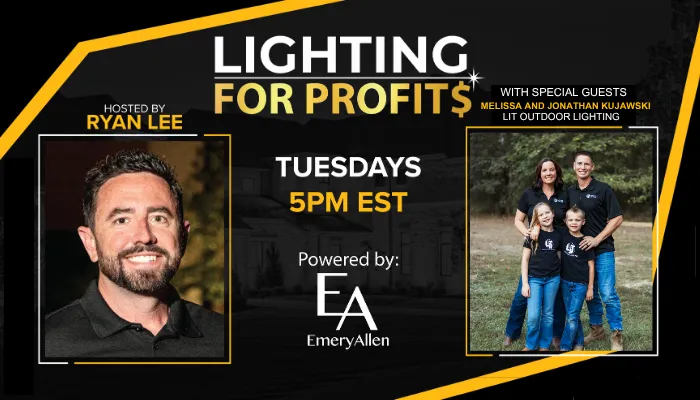
Melissa and Jonathan Kujawski - Bright Beginnings
Lighting for Profits - Episode 244
From a small two-person team in Covington, Louisiana to experiencing accelerated growth through learning, mentorship, and consistency — this podcast shares the real journey behind building in the lighting industry. Hear stories about humble beginnings, challenges, business growth, and the lessons learned along the way with the help of Landscape Lighting Secrets and Ryan Lee.
Watch the episode
Episode Transcript
Welcome to Lighting for Profits, the number one landscape lighting show in Louisiana
Welcome to Lighting for Profits. All light, all light, all light. Powered by EmeryAllen.
Here is your host, Ryan Lee.
Oh, light. All light, all light. Welcome, welcome, welcome to the number one landscape lighting show in Covington, Louisiana. This is going to be an epic show. If you're looking to start or grow a landscape lighting business, you're definitely in the right place.
Landscape Lighting Secrets is looking to grow, grow your outdoor lighting business
I, um, I was talking just a couple minutes ago to our guests, which we got the, the owners, the founders of Lit Outdoor Lighting, Melissa and Jonathan Kajowski. And I was talking to him, I'm like, you know, I really am excited about this. I say I'm excited about every episode because that is true. I'm kind of a super fan of the show myself. But, um, these guys are like living. In my opinion, they're living the American dream. And um, they're just like, they, they've literally got checklists and they're checking things off like this is what we're gonna do, then we're gonna do this and we're gonna do this. So, um, I'm kind of envious. They're, they're working together as a husband and wife team, um, and they're doing really cool things. So excited to have Melissa and John Kajowski on again. They are the founders, the owners of Lit Outdoor Lighting. So we're gonna have an awesome conversation of the growth that they've experimented or experience, experienced over the last few years and then kind of the roadmap, some of the things they've got planned, uh, coming up. It's really, really exciting. So, um, if you were, like I said, looking to grow, grow your outdoor lighting business, this is going to be a show for you. These guys are living, ah, proof of that. Um, by the way, just a couple quick announcements. Um, we've got, uh, next week actually. Yeah, next week, uh, June one through three, I'm going to be in Dallas hanging out with the Redwoods landscape lighting team. So if you want, uh, to get into outdoor lighting, I mean they're going to be literally doing like hands on training for landscape lighting, permanent lighting. If, um, you want to get trained on their products, um, you can come hang out in Dallas. I think it's a free, it is free. It's free training. Um, I'm going to be there the second and third, helping out with some things. But it's June 1through3. So if you want to get a link to that, just shoot me a DM on Instagram or Facebook or you can just connect directly with the Redwoods team. I'll be There in Dallas next week also July 10th, we got the second annual. Well it's not the annual, I don't know, it's been twice a year. The second time ever, uh, Friday, fly in. So this is for members of Landscape Lighting Secrets. It's Illuminati only. If you are in Landscape Lighting Secrets, you're invited to come to a mastermind here at my house. Last, uh, time we did it in the living room. If we have more people, we might have to go to a different venue. My house is not huge so, um, but the plan is to have it in my living room. Again, it's a mastermind. It's free for all members of Landscape Lighting Secret. So if you want to um, have an in person meetup, get to network with others and have a little mastermind, get in the hot seat, get you unstuck. Um, we've got a really cool session planned that's uh, Friday, July 10th and then finally later on in the year, put it on your calendars. September 9th and 10th, here in Park City, Utah we have the annual Secret Summit. This is again members only event, but this year is going to be a little bit different. We're inviting a select handful of vendors. These are our partners, we call them our partners. I don't have equity in their business, they don't have equity in mine. Um, but our partners to uh, kind of help because I found out that some of our members don't even know about some of our vendors and some of the partner hookups we have negotiated discounts with a lot of these vendors saving you tens of thousands of dollars a year. So we're going to actually invite some vendors for a vendor day, um, as well. So if you are a manufacturer, a uh, industry provider, if you feel like you're, you can add value to that event, reach out. Uh, we have an application that you can fill out to see if it might be a good fit for you to be there. It is application based only. And if uh, you're a member of Landscape, uh, Lighting Secrets, make sure to check your email, look inside the content portal. You'll see the link to get registered for the annual Secret Summit again. In just a couple minutes we're going to have Melissa and John Kajowski. Um, these guys are awesome. I mean seriously, the things that they've done in their business so far, um, and what they're planning on doing, I just, I don't know, I just, I love seeing when people take action because um, the information is out there. Um, there's lots of different ways to succeed, but these guys are, like, literally taking us serious, and they're changing their family's life in real time, and they're changing their legacy in real time. So I'm excited to pick their brain, see what's working in their business.
What is an average client worth to you? Think of that number
Um, again, before we have them on, I got one. One other thing I want to talk about so quick. Um, question for you. Um, what is an average client worth to you? Think about, like, who your ideal client avatar is. Okay? Think of the number that comes to mind. What is an average client worth to you? Think of that number and just put it in the back of your mind for a second. Um, the other day I went to Costco and I went. I mean, I. I haven't been to Costco for probably two years, okay? And, uh, I can't even remember why I went. Um, I seriously can't remember. But, um, I was there. And have you ever actually thought about what's happening when you go there? I mean, it's like a well orchestrated experience, right? Um, but you walk in, you, you know, you get your $50 hot dog. By the way, it's been a $50, I swear, since the 90s, you know, like, it's never changed the price. Um, you got your cart full of things that you actually didn't even plan on buying, and you probably don't even need, but somehow you spent, like, $200. Um, my. Now I go and it's like, 500. It used to be 200, now it's 500. I don't know. Maybe that's just me, maybe not. But, um, it's. It's weird how that happens, right? And Costco, uh, knows what they're doing, right? But one of the things that I, uh, found out is Costco doesn't actually make a lot of margin on their products. I mean, how much money can you make on a $50 hot dog, right? Um, they're not trying to get rich on selling hot dogs. They're not trying to get rich on selling paper towels. Bottle of water. I remember when I was buying, like, bottles of water by the pallet, it was like nine cents a bottle. Like, how much money can you make on that? Well, the truth is, they don't make a lot of margin. They make very, very, very, uh, thin margins on their products. But they make a lot of their money on memberships, okay? Memberships. And the memberships are only like, I think I pay, like 120 a year. Maybe 150, something like that for, like, a corporate one. It's not that much money. So you're like, well, how do they even do that? Well, they've done the math. They know what the, their average, uh, member is worth to them, okay? And they can absorb a lot of the cost of their products because they know that they're going to keep that member for a very long time. They're not worried about the profit that they're going to make on one transaction. On one Saturday visit, when you go spend 200, $500, they're not worried so much about that. They want to keep that as low as possible so that you stay in the ecosystem, so that you renew that membership.
Think about how lighting business owners are making decisions about acquiring customers
Okay, so why are we talking about Costco on lighting for profits? Okay, well, I want you to think about how you are making decisions about acquiring customers. Okay? So, and let me, um, explain what I mean. So when most lighting business owners are thinking about getting more leads, the first thing to think about is like, well, how much does it cost? You know, it's like, uh, if I want to run Facebook ads or, uh, how much is the SEO going to be, pay per click, whatever it is. And that makes sense. I mean, you want to know, like, what's the roi? How long is it going to take to get your return on that investment? That makes sense. Um, but the challenge is you're thinking about the immediate roi, like, how much am I going to make so I can pay my truck payment? How much am I going to make so I can pay my mortgage? Right? And I'm not saying this as a, as a place of judgment. I remember being in that same spot. Um, that's real pressure. I'm not trying to minimize that. But that's also the challenge, because when you're in that position, you're in survival mode, okay? And when you're in survival mode, you make survival decisions, and survival decisions will keep you surviving. Right? Um, they won't build you something. They won't build you, um, what. You're this legacy business, right? You'll stay stuck in survival mode and really never graduate to this thriving, uh, mode. Now, in order to get to the next level, the business owners that are actually crushing it, okay, they're making decisions not on the immediate roi, but on the customer lifetime value.
What is your average client worth to you? I'm talking about customer lifetime value
So you remember when I asked you at the beginning, like, what's your, what's your average client worth to you? In most scenarios, you might have thought, okay, my average deal is 8 grand, 10 grand, 20 grand, whatever the number is on that initial one. Right? But that's not what I asked. I was like, what is that client worth to you? And I'm talking about the customer lifetime value, because they're a totally different number. In fact, um, when you look at, um, when you do the math, you know, an average customer doesn't just represent like one install, um, they represent that install a, uh, maintenance agreement, um, an add on maybe six months later. Maybe they start with the front yard, and then they add a few more lights to the front yard, and then six months later they do the backyard. Um, what about referrals? What about, um, uh, people that see you on that street, right? When you add all that up, that first customer that only initially gave you $8,000 to do their lighting, maybe a simple front yard lighting installation, they might be worth 20, 25, 30, 40, even $50,000 over the life of that relationship. Okay? Um, and by the way, then when you're ready to go pro and you, you can actually get a referral partner from them, you know, like, hint, hint, like who their home builder is, pool builder, landscape, uh, architect, their interior designer, ah, home automation company. Then, um, all of a sudden, the lifetime value goes through the roof and it's like, this is how you create an unfair advantage. Okay? So when you know what that number is, the actual lifetime value of your customers, now you have a different data point in which to make decisions. Okay? So now the, the whole conversation about how much you're willing to spend will change, um, drastically. Have you guys heard of Dan Kennedy? Um, Dan Kennedy is someone who. He's, he's honestly just like a marketing legend. He's, he's, he's just super old guy, so he's kind of hard to listen to. Like, sometimes I read his stuff, I'm like, man, he just seems so old. Um, but he's actual marketing genius, okay? And so he said, the business that can afford to spend the most to acquire a customer will win the market. And I freaking love that quote. Um, because it's. That. That doesn't mean it's not the one with the best photos, not the one with the best designs, it's not the one with the most Instagram followers. Um, it's the one who's done the math and is willing to bet on themselves long enough to let the machine pay off. Does that make sense? So when people say, well, how much should I spend on marketing? And they'll ask a generic question, like, what percentage of revenue? You know, the, the like, textbook answer is like, well, spend between 5 and 10% of revenue. It's like, well, what is that number based on? Like, I don't have enough context to be able to give you the appropriate answer. Because if you're trying to grow, if you're trying to go from like 500k to $2 million, then you better be willing to spend a hell of a lot more than 5% of revenue on marketing. Like, I'm not talking 10% or even 15. I'm saying, what if you could spend 20 or 30% to acquire a customer? Like, is that crazy? Like, it might be, but it might not, right? Because it depends entirely on whether your back end is built to capture the value you're promising yourself.
There's marketing, sales, operations, finance is like this whole other bucket
Okay, so this is what I want to talk about. Um, there's really kind of I'm going to. I'm going to. There's. There's maybe more than this, but there's like three machines. There's marketing, sales, operations, okay? And then finance is like this whole other bucket. But finance actually kind of oversees all of these because finance is injected into marketing and sales and operations. So let's just say there's these three buckets. Um, and you, you've heard people say, which is more important, marketing or sales? Um, or, you know, sales or operations? And I'm like, well, my ego side is like, well, uh, my whole career, my whole life is built on sales. So sales is obviously the most important, right? And then someone who's like, really good at operations is like, it's operations. But the, the reality of it is like, marketing is the most important because like, you could have a really awesome, like badass marketing machine with kind of a poor salesperson, like running those leads and they're still going to make sales because the marketing so good. Whereas you could have like a really, really good, like just badass salesperson. But like, the marketing sucks, so they don't get leads and then they're just sitting around, right? And then obviously operations can't happen if you don't have sales. But I think the better, like, maybe not question, but the better way to look at it is not which one's more important, it's just, um, what's the order in which these machines matter the most, right? And, uh, it's actually the opposite. So, you know, you need leads, you need marketing to get sales, and these cells to get operation like installations, right? Well, this is where people screw up big time. They start with marketing because you need more leads, right? Well, the problem is you get more leads into this chaotic system and then you go bankrupt, you go broke because you've got this leaky bucket with all these Holes. And you're just putting all these leads in here and then they're falling out. And like, even if you do land a lead, it's probably not priced right. And even if it is priced right and you screw up the install and it takes you two days when it should have taken you one, then what was the point of even having a business anyway? Okay, so in my opinion, the, the sequence is actually the opposite of kind of importance. And it starts with operations. That means your pricing is locked in. You know your numbers, you know your margins, you know what a job actually costs to deliver. How, how many man hours does it take, you know what you need to be profitable, not what you think, what you know. Okay, so you can't be guessing on pricing, you can't be guessing, um, on these things because really every lead you get before that is, is a potential disaster. Right? Um, and I see people charging four or five hundred bucks a light and they're like, man, I'm making really good money. But then again, it, if it takes them three days to install a 30 light system with three guys, you're likely still losing money. Right? So um, you've got to get the operations down, like your pricing, you've got to get down like how long, like what your efficiency is and all that. Then once that's down, you can move on to sales. Okay, now the sales machine, um, this means a repeatable, you know, structured process for every single conversation. Um, really from that first call to the signed agreement. Right. Um, it means that you know how to handle objections, how to create urgency without being pushy, uh, how to, how to present options that lead to higher average tickets. Okay? Um, this is how you build a sales machine. Then once you have like the operations and the sales machine, and those are like a well oiled machine, then now you can move on to the marketing, right? And really pour the fuel on it with it. Because now every dollar that you spend going into that system is actually going to convert and you actually have this, you know, backend system to feed it more referrals, more repeat business, all that. And that's how you build the customer lifetime value greater than just relying on like, well, how much can I spend to acquire an $8,000 job? Because that, it's not about the $8,000, it's about the customer lifetime value. That makes sense. Um, that's the sequence. Operations, then sales, then marketing. So, um, I'm telling you guys, most of your competitors are still thinking about the hot dog. They're like, how do they do that? How do they do it for a dollar fifty? That's crazy, right? Well, Costco's not making money on the $50 hot dog. They might even be losing money. We, I don't know the answer to that, but they're, they're not making a lot of money on that thing. Right? Um, you need to start thinking about the membership. You need to start playing that long game. So I want you to sit down, ask yourself these three questions. Okay? Number one, do I know my customer lifetime value? Okay. And this is tricky because it's going to take some work to figure out what that is. Do I have a repeatable sales process that my whole team follows? And you might go, I'm the, I am the sales team. Well, um, not necessarily. Like, uh, your technicians should be selling as well, your admin, your office manager. Like, they should be selling as well. And am I getting leads to a machine that can convert them or am I just getting leads? And when you ask those questions, you're going to get certain answers. And then you need to spend time like dissecting that and putting a plan in place to solve those problems. If you guys get intentional on these things, I promise you, like, you're going to see not just like, um, incremental growth, like you're going to see exponential growth. This, this is the difference. This is how you get, go from traction, getting like traction in your business. Like, oh, cool, we're selling an extra job every once in a while to like, momentum where like, it blows up and like, holy cow, like one customer now equals four because we have all of these things on the back end. I'm talking systems to make sure that you get referrals, systems to make sure you get referral partners, systems to make sure you have upsells on lights, systems to, um, get repeat business. Okay? This is how you maximize your lifetime value. And then you stop caring about what it costs to acquire a customer and stop caring about what's what's more important, Marketing or sales or operation? Who cares? What matters is that you have these three machines dialed in, okay? And then once they are, then you put as much money as possible into the marketing machine and it spits out profit on the other side of the operations machine. That's how you build a, um, momentum style business. So, um, that's it. I just wanted to get that rant over with. I hope that helps somebody. Um, if it's confusing, reach out. We'll get on a call. Especially if you guys are in Landscape Lighting Secrets. We can discuss that on one of the weekly, uh, calls that we do.
Emory Allen's premium LED lamps deliver the performance your clients deserve
Okay, um, so, hey, uh, speaking of lifetime value, another good way to increase your client lifetime value. Um, stop settling for cheap, unreliable lamps that can ruin your projects and your reputation. Okay? Emory Allen's line of premium LED lamps deliver the performance, longevity, and color consistency your clients expect and deserve. Trusted by lighting designers and installers around the world and backed by decades of lighting expertise. Don't settle for less. Upgrade your designs and installations today with Emory Allen. All you need to do is reach out. Just email. Okay? Write this down. Jackson L. Jackson. The letter L. Jacksonlryallen. com and, uh, don't forget to mention that you heard about him here on Lighting for Profits. Get that discounted contractor price. Just email jacksonlryallen. com.
This week we get to nerd out on growing a lighting business
All right, so let's get our guests coming on. I told you guys this is going to be an awesome episode. Uh, we get to, uh, nerd out on growing a lighting business. So let's get the music going. Let's go. Please welcome to the show Mr. And Mrs. M. I don't even know how to say that. John and Melissa Kajowski. What's up, guys?
Thanks.
Hey, thanks for having us on.
Appreciate it. I know it's Mr. But is it Mrs. Or Ms. I'm not sure.
Mrs. Yeah, I guess if, you know, they're married, it's M. Mrs. Ms. Go either way.
I think I forgot to pay attention to that in grade school.
One of those things.
Well, thank you guys for joining me. I, um, I'm really excited about this because I. I said in the monologue, it's like, I. I feel like you guys are living the American dream. Um, just from an outside perspective, I get to kind of see a little highlights and, like, see where you guys started and, like, see where you're moving and then, like, just to see your excitement on, like, you're building your family and your business together. So, um, hopefully we can just kind of dissect some of that stuff and get into, like, what's good, what's bad, what's ugly. Does that sound good?
Yeah, we can do that.
Cool.
I love it.
John and Melissa started lit outdoor Lighting four and a half years ago
Well, um, you guys have been on the show before, but for those that don't know who you are, would you want to. Do you want to just do, like, a quick introduction of who you are?
Uh, yeah. Um, obviously we're John and Melissa, but, uh, we have. Our company's called lit outdoor Lighting, and we started together, anyways about four and a half years ago. We're down in, um, Covington, Louisiana, which Nobody's really ever heard of, but it's about an hour north of New Orleans, so we do have the big cities close by, which is nice. Um, we got two little kids, so family company. We stay busy for sure with our little ones in the business. Really. I guess you sadly started it before I was involved, but really, four and a half years of.
All in all in all, in four and a half years, Melissa worked, I both worked in the field. You know, first few years of it, learning, learning the ropes of it, learning exactly what we wanted to do. And now we're evolving.
Yeah.
When did you decide to start your lighting business together
So let's talk about that a little bit, because when you first started, was it was the plan to, to do it together or was this just John's business originally?
Um, it was, it was actually really funny because we were working with our website team and then one of our marketing people now and they wanted. We had pictures from the very first install he did working out of the back of his pickup truck in Indiana and then all the way to like now in our little fleet that we have and stuff. So it's funny to see the changes that have happened. But no, it was just him at first. Uh, we were up in Indiana. I worked at a hospital and he kind of learned lighting from working with my cousin's business who did, um, landscaping, hardscapes and a little bit of lighting. And then my cousin was actually selling his company. So John's like, you know what? I think I'm gonna start my own business. I was like, you have fun with that. Good luck with that. Um, I was kind of the negative one, to be honest, which is not normally me, but, but I loved it. So, yeah, so he, he started it on his own, um, completely by himself, like solo.
So everything at that time, were you thinking, okay, I'm gonna be the breadwinner, Like, I'm gonna pay the bills.
One million.
Yeah. Okay.
Because I literally like, you enjoy your hobby outside.
Uh, she had a great job at a hospital working.
Yeah. But, you know, we were gonna be good. I was like, I'm not. You know, I had the insurance. You know, the things you have to think of as an adult that we don't want to think about. But I was like, no, I can't walk away from all that. You're crazy.
So, you know, it's interesting because people talk about building like a 10 year plan and doing all this stuff, but, like, it's really hard to plan out much further than a couple years because things change. Like, you, you take a step forward and it reveals so much. Sometimes good, sometimes bad, sometimes ugly. But then. Then all of a sudden, that changes. So when did you decide that? Okay. Oh, well, I could, like, work in this business, too, and I'm not going to work at the hospital anymore.
Uh, driving home from a vacation actually was. I'm very, like, impulsive, I guess I would say, in those decisions. Um, we were driving home from Florida from being on a trip, seeing family, and I just kind of looked at him, and I was like, so, what do you think if we, uh, move to Louisiana now? He's like, what are you talking about? I was like, well, I mean, I could maybe join the business, but I didn't want to do it where it snows. I'm like, it doesn't make sense for both of us to not work five months out of the year in the snow and not be able to install lights and be broke. So I'll do it, but let's move to Louisiana by my family. He said, okay. And we literally listed our house. I think 48 hours later.
That was the whole conversation.
That was it. That was literally the conversation. I'm not not exaggerating. That's how it. There was no extensive discussion about it. Or he's like, yeah, if you'll. If you'll join me. He's like, let's. Let's move.
So did you. Did you have a backup plan?
No. None whatsoever.
All in.
I love it.
It'll work. We'll have to make it work.
Yeah.
Yeah. I mean, the problem with a backup plan is, like, it's a possibility. So, you know, you don't do plan A as good as you could because you're like, eh, uh, we always have plan B, I guess.
I guess we knew I could always go back to the hospital life and stuff. I didn't want to. You know, I'm like, if we're going.
But one of the things that was really attractive when we moved down here and having Melissa all in, um, and me as well, we had a common goal. We're dedicated, we're consistent. We, like, that's just. That's how we live our lives every day. So if we put all of our eggs into one basket, I. There was no way we could fail. Like, we wouldn't let it fail. We're too committed. We're gonna find a way either way. So, uh, that's where we're at now. And stuff continues to grow.
You guys earned your lmc back in December, right? Yes
So, um, by the way, congrats. I saw. I thought we were behind. Okay. I know we just sent you the, uh. We have the awards like recognition program in our. In landscape lighting secrets. So you guys earned your lmc. That was in December. Back in December, right? Yes.
There it is. That thing around.
I love that. Just like, pull it out of the truck. Hey, what's up? Yeah, that's awesome. No, it's so cool. I freaking love it. Um, you guys earned it in December. We just barely shipped it to you. I think we're just behind on. On stuff, but had a backlog. But, um, what. What does that represent? Like, what does that mean to you guys?
You know, when we first joined the program and we both kind of looked at each other and that was like a goal for us, you know? I mean, I know it's just a plaque, but it's like, hey, now we have this goal. Like, let's go get it. And we dove in hard. And I mean, it means a lot. It's means a lot of dedication. A lot of. A lot of customers. A lot of happy customers.
Yeah, it was at the first summit. Yeah, we joined in July of 24, and the summit was that September. And you handed out, I don't know how many of them, one or two or something like that to some people at that summit. And I was like, oh, man. I looked at him, was like, I want that. I was like, we gotta get that. I don't know why I was like, that was like a motivator right there. Um, so kind of was always, like, hanging over our heads. That, like, I knew that was like, our first, you know, goal. I don't know. To me, it means, like, we're actually a legit business now. I feel like, in a way, it's always felt like a hobby almost. I mean, it's our business and we. That's our income, and I get that. But it's always felt more of, like, a hobby on the side for some reason still, and not like a career choice. And then you hit that and you're like, oh, shoot, like, we're. We're doing something here now. You know, it's real.
That's awesome. Yeah. I was like, well, this is legit.
Yeah, we should keep this going.
What. What were some of the. Like, I remember when you guys. I remember having some of these conversations when you guys first joined. Um, I mean, you guys were, like, all over the place, right? You got two young kids and you're like. I'm like, so how are you guys doing this? Because you guys started to get, you know, traction pretty quick out of the gates. And I was like, just like, very. I'M always intrigued, like, so, what are you doing different? Because we have other people that aren't getting the results. Like, why are you? And you guys are like, well, we just, you know, listen to the modules in between visits. Uh, and then I gotta run home and pick up the kids. And then we listen to more and, like, do all this stuff.
I think it is the dedication that's really key to success
Like, what would you say, like, were some of those, like, differentiating factors that really helped you guys get traction quicker than most?
I. I think, honestly, it is the dedication that's really. It's not like there's a magic pill or a magic secret. It's just you have to put the work in. I mean, like you said before, a lot of people, you know, they want this or they want their business to succeed, but they have 10,000 excuses. I mean, it's easy to be like, oh, I'm tired. My, you know, baby was up all night last night, or whatever it may be. But then day, like, too bad. You know what I mean? You kind of suck it up and put the grind in, at least in the beginning, to get things going. And I know. I mean, we wanted to learn every aspect of the business. It was new, it was exciting. So I feel like we just had that motivation out the gate. And, like, we didn't have. Like I said, we didn't have a backup plan. I said I was never going back to the hospital. I'm like, we're doing this. We're doing it. It has to work. That's it. There was no. There was no backup. So we're like, there's not an option to let this fail. So it was. We're gonna try every crazy thing we can think of to make it happen. I mean, we started out with yard signs and door tags. That was it. We didn't have any money to put anything in marketing, so that's how we got going.
It definitely didn't happen overnight either. I mean, like, you saying, the consistency with it, you know, we'd lose a sale. We'd go back, we'd analyze that sale. We'd figure out what we did wrong. We'd go to the group and figure out what we did wrong.
Or I'd yell at him.
Yeah, we go through, dissect it, and get it right the next time. Um, and. And just like that, with. With everything, whether there's a sale, an install, um, our pre. Sales, um, yeah, there's. There's always room to grow and improve, and we still stay committed and dedicated every day, um, every week.
Whoa.
I'm sorry. Go ahead.
How did you find time to work on the business while working in the business
What was the dynamic like early on? Were, were you guys doing the sales together? Were you doing the installs together? Like, what. What did that look like?
So I pretty much always been, um, like the behind the scenes person. Like, I handle like, the books and the computer side of things, the communication, the phone answering, all that kind of stuff, like an office admin. Um, and then he did the sales meetings, um, solely. So I schedule everything. He goes handled all the meetings, and then we installed together on all the installs alone. We didn't hire until what, Two years.
Two years ago.
Two. And yeah, Mike's. No, only a year. Mike's only with us for a year and like three months. A year and a half. So our first we. I think we were alone for almost three years.
So when you guys were going through that, I mean, I guess one Melissa, like, you, you know, you got two kids. I remember you're like, I want to be home with them. I want to be able to pick them up, all that. How did you find time? Um, because I think again, it's easier to find excuses, but you just avoided those somehow. How did you find time to work on the business while working in the business and being a mom?
So I think that's where. Not that we lacked, but I think that's why things moved slower than maybe they could have, because it was hard. And honestly, it was at 2:00am I mean, I honestly did the books at pretty much between midnight and 1am like, that's when we worked on the business, was into the night and then five, six hours of sleep up and do it again, go install, get the kids, see them, get them down, and then work on the computer at night? That was pretty much how it ran.
Wow. So when. When was that moment or, you know, what was that period of like, okay, something's got to change. Um, this is, this is a lot. Because at some point you did. You hired an installer.
Yeah. I think Christmas pushed us over the edge. That year is really, what do you
say, Christmas and our bodies get tired. You know, summers are hot here and it's like, man, you know, we're still very young.
Yeah.
Dewey, do we really want to, you know, keep doing it like this forever? Um, you know, it was good, you know, when we were doing it, but we're like, do we want to do this all by ourselves, you know, for the next 10 years? And then the answer was no. So we started hiring. And once we hired Mike, um, it was great. I mean, our whole business changed. Our whole concept of outlook, of everything changed. And then recently we hired another employee as well. Another. So we have two full time installers and uh, we kind of have quarterly goals where we're hoping to hire another full time next couple months. Yeah, another full time employee the next couple months as well. So.
Do you guys have an admin or are you still doing that
Okay, so your first one was a technician, then your second hire was a technician. Do you guys have an admin or are you still doing that? Melissa?
That's still me now.
Okay.
But we did just bring on, um, I mean, I'm the admin, but we just brought on, actually a friend of mine that I've known for 10 years. He lives in Florida. Um, but he's been a huge asset. I'd almost call him more of like a business partner, even though it's not technically a business partner, I guess. But he's doing like all my marketing now and he's, he attends calls with me. He's, he's connected me with a bookkeeper friend of his who's going to start doing my book. So I'm starting to kind of offload things. And we're really going through our whole business honestly with like a fine tooth comb right now is what we're really doing. Like, we're re designing everything and just kind of going back through the process that we have. And he's making them exponentially better and smoother. Um, so is he technically an admin? I don't know. I don't even know what his title would be. He's like a Jack of all trades for us right now. Um, but he's been a huge, huge saving grace for us. And I feel like taking us to like the next step of growth that we're trying to get to.
You know, I think a lot of people in that phase of going from like, do everything yourself to like handing it off, there's a, there's a lot of fear of like, well, can I find someone? And then even when people do find them, they're not really good at like, like training, like recruiting training, managing. Like, what are, what are some of the things that you guys have done to make sure that handoff? I mean, if someone stayed with you a year, you're obviously doing something right because some people can't keep someone for six weeks, you know.
Uh, well, I think, uh, hey, we treat them really well. We treat them like family. We've always treated them that way from day one. Um, our training is very slow. We're trying to get that better. Um, but we went through everything, you know, repetition, repetition, hey, this is the way we do it. Um, when it was just Melissa and I in the field, you know, we had an expectation of how every job should look. So, you know, explaining that out getting, uh, worksheets and check sheets, um, to keep everything just a little more organized, um, to where it just becomes more of a routine. But we still have those checklists to make sure we're hitting those. And every customer is getting that same experience.
I think that's what we're working on now, too. I wouldn't say we were the best at having everything laid out. And that's one thing. At the Expo we were at, um, we got a lot of listening to Kenny Kaufman talk, and he was talking about, you know, build a business that you can sell even if you never plan to. Um, we're like, wow, we're really not doing that yet. It's like the whole business has been in our brain for four years. We really need to get stuff out of our heads and make it reproducible. So if we do want to open another location or sell it one day or whatever, the future may hold. So that's something that DJs really helping us do. We're doing SOPs, we're making training videos right now. Um, we're really trying to hone in on that so that we aren't mad at our employees if they don't do some things. I'm like, well, that's not. He'll come home. Like, not mad. Our employees are amazing. They really are. But, like, something silly happens. I can't think of an example right now. And he'll be. I'm like, well, did you teach them that? Did you ever tell them that's what you wanted? It's the trailer stocking. The trailer's never put back the right way. And I'm like, did you ever actually walk them in there and say, this is how everything needs to look at the end of the day, or whatever, you know? Yeah, so we're working on that. Uh, I would say it's probably an area that we're need some more growth in, but we're addressing it now for sure.
Yeah. Well, honestly, just having the ability to recognize that is huge. Because, you know, I'm guilty of it too. We all are. We just expect everyone to have our same level of passion and common sense. And it's like, well, at some point, we didn't know how the trailer was organized like that either. You know what I mean? Like, it. It became that way over a series of, of repetitions and, and experiences and stuff like that. So it truly Is like working with these people, making sure they understand just not what to do, but why. It's so important. Like, because if they understand the why, like, oh, so that it. It also saves us an hour a day. And then if it saves us an hour a day, then we can do this. And then it means I can make more money. Oh, heck yeah, I'll do that.
And we try to include them in those conversations. Like, we just did a review for Mike and we asked them, you know, this is where we see an area of improvement. How can we help you do that? What are we missing? What do you need? And he's like, oh, actually it was something simple, like a cart. They wanted, like a cart to pull the tool down. And I'm like, I'll just go get you one. That's fine. So it's like, ask them and then actually follow through with it. You know, let them be included. Not just making, like, we don't have to make all decisions. They can be part of the decision making process so they feel a little bit more ownership of the company. And hey, what tools are you missing? Hey, what did you need? You know, what was not okay this week? Or what could we have done better? And they'll tell us and then we'll
make the job easier.
And it's like, little something silly.
You have to make employees feel invested in, feel included in the project
I was actually literally looking up, like, incentives for employees or just like, motivators and stuff. And like he said, we. We try to make them family, like, buy them m lunch every now and then. We'll give them, like, cash, um, as I guess called a tip or however you want to word it, bonuses at the end of the week. If we had a great week. I, um, made them, like, a snack bag that I keep in the trailer that I refill every week for them now. Just like, little silly things. But it just to show, like, hey, you are appreciated because, yes, we're paying them, obviously, and pay them well. They're worth it. You know, if you want to keep somebody, pay them well. They'll stay. Um, but it's more than that, you know, I mean, you got to make them invested in, feel included. Yeah, yeah, yeah.
Another good thing, we kind of have, like, a group chat where we will send, you know, pictures of jobs or, you know, kind of send funny jokes or whatever. It's kind of brought us all a little closer together too, which has been nice.
What is that on just text or do you guys use a specific thing for that?
That's just on text, but yeah.
Uh, well, I realized they never see the Nighttime, like, they never get to see the reveal. They never get to see the fruit of the labor. Like, they're installing it all. And then John goes and gets to see the customer at night and reveal it all. And so they're kind of missing that connection. So I'm like, well, I think they probably want to see what they're doing. So now we text them all the time, and if a customer says, like, a positive, hey, you know, Kate was super pumped. You know, he said how nice you guys were. Whatever. Here's the pictures. Great job. And just kind of like, we do appreciate you. You are included in the whole process. Not just put the lights in the ground and leave.
And it's also been a good learning tool for us, too, because we can say, hey, you know, this is why we put the light in this position. This is the effect we got. This is why we did it. So they can see that. So it's m. Not just, oh, put a light exactly where I'm putting a flag right now. Now they understand why. So I think it's been a good growing thing for them as well, too.
Yeah.
Yeah, I love that.
If you could go back, what would you do differently
Well, if you guys could go back, like, um, if you could go back a few years, are there any things that you would have done differently? Would you. Would you have done things sooner? Would you have waited on certain things? Like, what are some of those? If you could go back a few. I love these questions. What if you could go back? What would you do?
Change it all now?
Uh, start a roofing business.
Don't think I haven't talked about it.
Another business.
Yeah, we talk about that all the time. Um, hiring earlier, I think we both say, for sure I would have waited a lot less time to hire somebody.
Yeah, we were always scared, and we always waited till we absolutely needed to,
um, never feel like we could afford it. And obviously, the finances. Scary, you know, scary having to be responsible for somebody else's paycheck.
We've never hired and filled a position like, man, I really wish we didn't do that. Or, you know, something always gets easier. It frees something up. So that's been great in our experience.
Yeah.
Anywhere from, you know, install text to, you know, the new admin, back of the house, however you want to call it, um, keeping us on target, um, on schedules. We're really good at hitting goals or, uh, checking off to do lists. So he kind of builds those, and, you know, we give him an idea where we want to be and build a plan to get there. And, you know, it Makes it easier and makes us grow faster.
Hire people smarter than you earlier on. Yeah, that would be the, the best advice I would give somebody new starting out. I wish I had brought in more like business minded people, maybe more marketing people in the beginning. You know, at the start I feel like we're kind of re doing everything now, which is fine, but we could have saved ourselves a lot of headache and time if we had brought in other people earlier on.
Got it.
Now that you've bought back some of your time, what has changed
Well, so now that you guys have bought back some of your time, you know, you're out of the field I think. John, you said you like, you know, maybe lay out the guys and stuff like that, but you're not the one trenching and burying the wire and stuff like that. Of course, but now with some of this time that you bought back, what, like what has changed about your daily routines and maybe your vision and, and some of the tasks that you're working on now?
Yes, we definitely kind of implied that 1080, 10 rule, um, where I get the guys set up. Uh, then a lot of my day consists now of we use Company Cam now, uh, which has been great for organization for us. So while I'm doing my sales meeting or maybe I'll kind of work in company Cam and get our designs, get our layouts, how we're going to run wires, um, so it makes it easier for our crews to a fishy efficiently, efficiently install these landscape lighting systems. Uh, so that, that's been huge for me. And then working on sales always. Um, we're always constantly working on that, working on our uh, presentations and just like most said, you know, we're kind of going back through fine tuning everything to make us look a little bit better. Uh, brand consistency, uh, our marketing has been next level in the last three months.
Uh, I've had a lot of meetings.
Yeah.
Working on, I've met like every vendor. Like, like you said, you know, we don't always take advantage of all the vendors that you connect us with. But I've been meeting with most of them, you know, throughout the last couple months. And just like we signed up with Send Gym, we have a great deal by the way, for everybody doesn't know that with Send Gym. Um, so we're doing those now, uh, the neighbor mailers and stuff. Um, so just branching out and definitely spending more on marketing now. Um, realizing, you know, that we're ready to push for more the leads. Like you were saying at the beginning of the show, I totally agree with you because everyone's always like I need leads, I need Leads, I'm like, but can you close them? Like, that's why I saw other business. I'm like, but if you get a lead, can you close it? Because if not, then stop trying to get the leads because you're just. They're useless to you at that point. So. I totally agree with that. I feel like we really worked on operations. We really worked on the sales process, which I feel like is really honed in, and now we're, like, really focusing and dumping it on the marketing hardcore.
Nice. Well, and that's kind of the key to everything. Like, if you can, like the Dan Kennedy quote, like, if you can afford to spend the most to acquire the customer, then you almost have, like, an unlimited marketing budget. There isn't a budget. You're not, uh. You're not restricted. It's just a matter of, like, how much do you actually want? Because you could put. You could get enough business to do $3 million, but can your sales team handle that? Can your installation team? Like, now the budget is a different number. It's just like, whoa, whoa. We gotta, like, not do that much.
You guys finally made a five year plan for your business
So, um, I guess that kind of leads me to. And I do want to ask you guys, like, what you guys are doing for marketing, but. But now that you've had. You have time, I feel like, to think now, you know, you have time to, like, get more intentional and, like, you're not just working to, like, pay the bills anymore. You're like, okay, we. We caught our breath. Like, this feels good. Like, what do we really want? Like, um, have you guys had those conversations? Like, what. What does the next couple years look like for you? And how. How has that changed since buying back your time and kind of developing that vision?
We actually finally had the conversation recently, honestly, when we brought DJ on, because I feel like that was one of our downfalls or something. That's always been a struggle for us is making decisions. Like, we're. It's just the two of us. It's like, always a 50 50. And, uh, we don't. We'll talk something to the grave, and then at the end of the night, still not have a decision made on it or be too scared to, like, pull the trigger on it. So we just keep doing the same circle all the time. And I think that's why it took three years to hire someone. Like, well, do we want to? Well, maybe we do want to. Maybe we don't want to. Maybe we should keep. But us. Maybe we should not have this at all. Like, I mean, this was like a Three year conversation, literally. Um, so no, we finally, yes, made a five year plan of what we want our business to ultimately look like in five years from now. And then we went through with DJ and reverse engineered it back. So now we have it broken into quarters for the next five years of how to get to where we decide we wanted to be. Um, and then each quarter we have like weekly to dos that we meet for like three hours every week with him and we come up with weekly to do plans. And if it doesn't get us towards one of those rocks, it's not on the to do list. Like you can't. Because I'm very good about wasting my time doing other little tasks. So I can say I did a whole bunch of things today, but if they're not like getting us towards that five year goal, then I'm just wasting my time. So it's really just like laser focusing in on, on that actual plan. Finally. That we finally agreed on it. It seems like the easiest part. Like, what do you mean?
I don't know.
You want to. But that was like the hardest thing was, I don't know. Well, what do we want? I don't know what I want. Like five years.
Well, I think a lot of people are like that, myself included. And so I think the, the advice I have is like, just pick a target. You don't have to. Like, it reminds me when we were moving back from Texas to Utah, I just sold my lighting business. We're like, what? Where are we going to live? And it was like, well, I don't know, we could live here, we could live there. It was like, uh, there's a lot of options. And I finally was like, we're just gonna live here and if we don't like, it will move. You know what I mean? So like you pick a target, you start heading that direction and then you go, whose idea was this? Is this John's idea? This is crazy. We're not doing this. This is dumb, right? You can always change. You don't, you're not, you're not like married to it, you know, like you in a marriage, you can't change. Sorry guys. But like in this target you can change. You know what I mean? So, and you don't know until you start moving toward it if it feels right or off. So I always just tell people, like, just pick a target. And so if you guys take the feeling that you have now, you just did that, you picked a target, you reverse engineered it, you have that feeling of m. Like, wow, we Actually have like direction and intention and all this. Imagine that feeling and then go back a couple years when you were just working to work, talk about those feelings. Like compare and contrast that. Like, what did you feel like before? How do you feel now?
Definitely defeated before. Honestly. Uh, I feel like you just feel like you're in a hamster wheel. And like we said late nights and never ended. There was never an end in sight and we're like, this is how we're just gonna die. It's just working, sweating to death and you know, trying to just check off the to do list for the day all the time. Yeah, it was just like there was no long term vision at all, which it's defeating, honestly. I mean, it was working. Like you said, the bills were paid. So to me, you know, there's money in the bank, we're doing great. Um, but that really wasn't us doing great. Looking back, we thought we worth the time, but now looking back at it, I'm like, we were a hot disaster. Works to do all these things now.
Now it feels much more organized, uh,
much calmer at the house.
Yeah.
Good. That's awesome.
Less marriage tension. I'd say it's been better for our marriage for sure, actually having a, a forward looking goal here.
Yeah, well, it is, it's just, it's just a breath of fresh air. It um, it feel to me when I've, I've been in both sides of that too.
A whole mindset shift happens when you own your own business
It just like, it's a feeling of freedom and it's a feeling of like, hey, like we control our own destiny now. We know if we do these steps this month, this quarter, this year, that we're going to get to this point and then we do that for three years, five years, we're going to be at that point and like now that's achievement. And when I, that's when I always talk about like surviving and thriving. I feel like before you guys were like doing a great job surviving, like probably surviving better than most, but you were still surviving. You know, it wasn't an accomplishment. It was like, uh, we didn't die today, we didn't file bankruptcy, we didn't get divorced. Now it's like, oh no. Like this is. Yeah, this is winning. That's awesome. Good way to describe it.
Yeah, no, definitely a whole mindset shift happens. There's no doubt about it. Just where like I said, we're probably a little slower to, to get there just because it took us long to, to decide what we wanted.
I think it was a good learning Curve too, because we learned how the business should go. Um, now we're learning how the business operates and we're alert. We feel more like business owners now for sure than, than just working in the field, grinding every day now. It's. We have a plan. We have, you know, multiple jobs out there, multiple trucks out there. People see our brand. It, it really does feel like more of a legit business now.
What are you guys doing for marketing beyond existing strategies that work
Um, what, so what are you guys doing? You guys got you, um, got you bought back your time. Now you've got this plan to get to, you know, certain size or whatever. What are you guys doing for marketing? Are you, uh, doubling down on existing strategies that work? Are you, are you going to try some new ones that you've got some uncertainty, uh, about. Like, uh, what's kind of the plan with marketing?
Yeah, we're kind of all over the place doing different things. Um, we've, I mean we've always done the basics of yard signs and door tags. I say it every time because people forget about those. And we get so much business off door tags and yard signs to this day.
Uh, and the truck and trailer.
And the truck and trailer. Honestly, I'd say those are probably our three, like top finds right now. When people, because we always ask, and a lot of times it's that they've seen our trucker trailer or whatnot. Um, and then we're doing send gym mailers. We're just doing um, like the neighbor mailer they have there, which is awesome. So it ties in with jobber. We use jobber for CRM. So anytime, uh, an invoice is paid or a job's closed or have it triggered, there's like a three drip postcard that goes out to the 15 closest neighbors of that house. Um, so we're using that, which I think that's kind of a long game, right? I know like direct mail. You can't try it for a month and say it works or doesn't work. So we just started that, uh, maybe two or three months ago. So I can't really tell you if it's amazing or not yet. We're in it for the long haul and we'll let you know. But, um, that's kind of a new thing. We put some money in. Uh, we have Google Ads running always. Um, I have a really good website team who, I love my website team. So they kick butt on my SEO. Um, and then we've got DJ coming in doing all of our, like posting, Facebook, Instagram, he's doing, we're working on creating some more YouTube videos. Um, he's doing, like, LinkedIn, Pinterest board. He's doing all these different social platforms, um, as well. What am I missing?
Seems like the marketing mix, that was a lot.
Yeah, we're not doing any, like, Facebook ads or anything. We do it for Christmas usually, but I don't, like. I don't know. We've never had success with them. Meta ads for landscape lighting, but we'll do them for Christmas.
Okay, cool.
Let's talk about the yard signs and door hangers
So when you guys mention yard signs and door hangers, which I love, by the way, because it is. It's the, like, simple, easy stuff that most people just forget because it's almost too simple. Are you guys, um. Let's talk about the yard signs. Is that just on completed projects or are you guys doing bandit signs? Are you putting signs everywhere every week? Like, what's the strategy there?
So, for example, on a job, first thing we do, we'll put a yard sign in the yard. You know, so everybody sees it. We'll do seven houses around on. In every direction with door tags.
Okay.
And then yard signs, you know, if we're in that neighborhood, we'll have a yard sign outside of that neighborhood, hopefully. Right. Um, and then on, you know, bigger intersections, areas, uh, that we want to go in, you know, maybe once a month, we'll take a day, put some yard signs out. We're not, you know, putting out thousands, but in areas, targeted areas that we want to be in, uh, in front of neighborhoods that we do a lot of work in, where they see our trucks every time they pull out, pull in their neighborhood. If they can see our sign, uh, we just want to be first on their mind.
Okay, very cool. And then the door tags, you said it's just the seven nearest homes from the project.
You're doing seven in every direction, as we usually do. So.
But it's not just on any time you're at a house. I mean, if he goes for a maintenance, you know, if we're doing maintenance on a house, door tag on the whole neighbor, you know, your door tagging, the 7x7 again. So anytime our guys, like, that's on their checklist number one on any visit they're doing. They're responsible to door tag everybody.
Yeah. It truly is consistency. I used to get so frustrated because I would show up and just spot check a job, and I'd be like, oh, my gosh, where's the yard sign guys?
Right.
It's the littlest things, but they work. They really work. They're so important. And. And it was nice. He was recently on a call or on a sales meeting and he asked somebody how they found out about us too. He always double checks. And she's like, everywhere. She's like, I see you guys everywhere. What do you mean? She's like, you're all over the place. And we're like, yes, we did it. We're there. We're everywhere. So, like, I post in like the mom's pages. Every Facebook, you know, town, I feel like, has 10 moms pages you can join. So I joined those and I slip in a little business thing in there every now and then. They always have like a business posting day, um, getting on. Those are really helpful. And they're free. You know, it's a free way to post. And then we're working on the referral partner. We just did lights for a pool builder recently. Um, so working on, you know, building that relationship. And then we just met with the. Is he the HOA president? No. What is his title? In Terra Bell, one of the neighborhoods right next door that we do a lot of work in, we met with like the head HOA building and grounds director. Yeah. But that's a huge referring us now. So I think that's kind of our next focus is just keep up on the referral partner relationships.
Yeah, that's cool. Well, like, when I. When we. When I started the podcast, I was talking about like customer lifetime value. Like if you can. If you literally can afford. And I know it sounds crazy, like if, if, If I said I'll give you this $10,000, you know, project, but you need to give me $3,000. I mean, that, that seems like a lot of money, you know. Cause it's like, dang, that's 30%. That's more than we are going to make on this thing. Like, why would I do that? Well, the reason you would do it. Well, the reason you wouldn't do it is because if it was just one job, then it would be a bad decision. But if you do the things that you guys are doing and you're putting out the door tags, the yard signs, then all of a sudden you get like, someone sees that door hanger. Now it goes from 30% down to 15 because you can, you know, do them. If it's, let's say it's another $10,000 job. Now you can divide that and then let's say it's like, oh, well then also you got a referral because you have that built into your system now. It goes to just 10% per. Per each one so the math can work out, but you have to be really, really good on those back end marketing things to make it work. Otherwise it's 30% and you're going to go bankrupt quick. Right?
Yeah, it's true. Like the whole cliche, like it's, you know, spend money to make money or whatever is true. And that was hard for us in the beginning. It's like it's a hard pill to swallow when you see a lot of money pumping out.
You have to know what your average lifetime customer value is
But it does come back. You have to just kind of trust the process and you have to be willing to do it.
And that consistency. We actually just. It's funny you brought up a lifetime value because we had this customer that we've done our Christmas lights for about four years, but I originally met her with for landscape lights. Never got the job. It was a back doc. She had just moved in. We ended up following up with her for Christmas lights. We got her Christmas lights the first year. The next year she had her Christmas lights again. She bought her uncle's Christmas lights as well. Next year she bought her lights, her Chris, her uncle's Christmas lights and the neighbor's Christmas lights. Uh, we did landscape lights on the front of her house, we added onto the front of her house. We ended up doing her uh, commercial seafood buildings. And then we went back and did her backyard. And now we're going back to put audio in. So talk about a lifetime value of a customer right there. I mean from, from a simple, I think it was like 1100 Christmas light job to I mean a big client. That was a big client.
That's such a good example because I, you know, I found the reason. You guys have been in Secrets long enough to know how we've kind of divided up how it went from like everyone in the same program to now it's like spark and then ignite luminary and stuff like that. And the reason is because like I, I speak so much on profitability and raise your price and raise your price. But like there's a time and a place because like if you are slow, I mean if you're booked out like eight weeks, then yeah, raise your price. You know what I mean? But if you're slow and you can't, like you're desperate, you need a job, like you might need to lower it and maybe break even just to get that job. Like you take that lady for example, if you tried to make like all your money, all your profit on that one very first Christmas light job and then she decides to say no, you Just, like, lost tens of thousands of dollars, you know? And so it's. It's really being, like, intentional about who you're working with and when it makes sense to do these things. And I don't know what you charged her originally, but my point is, some people are trying to, like, squeeze out. They'll listen to a podcast like this and be like, oh, I got to make profit on every job. And I'm like, yeah, that's the goal. But, like, if you have to, like, negotiate and do less because you understand what your average lifetime customer value is, and sometimes you win, sometimes you lose. Sometimes you might just make less on that person, but sometimes it might be that lady who ends up buying her neighbor's lights and her business lights and everything else.
It's so true. And I think some people, like, we do get so stuck sometimes in, like, price per fixture, but it's not that simple. And. And I don't think you have to pick a price and stick to it. Like you said, every day or every time, like, he'll be at a meeting, like, hey, this is like a really nice new neighborhood. We're not in this community yet. Like, we need to make sure we get this job, even if we don't make quite as much on this one. I'm like, absolutely, I'm fine with that. Let's do it. Get in that door. So then we're again, door tagging. We're in a new community that we want to start taking over. We're going to put a sign at the front of the community. We're gonna do all those things. The mailers are gonna get direct mailed now three times. It's going to be worth it. So, like, you kind of have to be able to flex the pricing. I think, you know, on a. Not always, but on a case by case basis at some point, depending on the situation. Obviously you need, like, an average or know where you can't go below to totally bankrupt yourself all the time. But there are definitely times where it's well worth it to not, uh, make a whole lot on a job if you see the future value of it.
Well, and I think, um, it was at the last secret summit. I think it was Jimmy Tompkins talking about this. He's talking about once you understand, like, what your daily overhead is, you know, let's say it's, you know, 2,500 bucks or whatever. Some people, if you go into, like, a Facebook group, just any of the lighting Facebook groups today, and someone asked a question. I've seen this Question, uh, a hundred times. You know, what would you guys do in this situation? This customer, I told them it's 10,000. They said, I'll do it if it's 6,000. Everyone's like, Next. You know, not your customer. And I'm like, uh, I don't know how I feel about that. Like, I would be like, what if you could get it for 7,000, 8,000, you know, because, like, we don't know enough information. Like, what if, like, I would be willing to. The people go, oh, I could sit home and not make any money. That's not true. Like, if I have a business that the overhead is 2500 a day, then I need to at least cover as much of that as possible. So I'd rather lose, like, $200 today than 2,500. You know what I mean? So there is a time and a place for those things. And I think it's. It's hard because you listen to a podcast, join a group, you know, Facebook group, whatever it is. And it's in blanket advice. Works for certain things, but you really need to get specific on where you're at in your business, what your goals are, what you're trying to do. So I love the idea of, like you said, like, hey, if I have to come down on a price to break into this neighborhood, because I understand the value of customer lifetime value and what we're going to do on the back end to recoup that fee, no problem at all.
More of offering rebate for them, doing something for us
Yeah, I think, too, one thing we're working on is, uh, m. More of offering, like, a rebate for them, doing something for us. So what I mean by that, I know, like, for example, we met. I will never forget this. We met with a sales guy one time for a new roof, which we didn't end up getting in Indiana, and he started the price at like, 30 or $40,000. I don't remember. It was something like that. And then at the end of the day, he's like, well, we get it down to 16,000. I'm like, how in the world did we just cut this? You were trying to charge me 40 in case I'd say yes, but you can actually still only make charge me 16. Like. I was like, you're so shady. It made me so mad. So I've always thought of that. I'm like, I don't want to do that. I don't want to say, you know, your package is 10, but, okay, fine, I'll do it for five, because to me, I'm, um, like, wait, A minute you were trying to charge me. What? And you can still do it. So there's like a yes, we can come down, but only so far. But we'll do it more of like
a we ask for something.
Right. Like we'll give you a rebate afterwards if you do X, Y and Z. Join our Facebook, post your personal page, post the three moms groups or whatever. Like build this package up. Like if you do all these things that you prove that are done, I'll give you $1,000 rebate. Because I know that that's so valuable in marketing when it comes from their personal page or, you know, you have to yard sign for this many days. You know, a referral, Give us a referral. Referrals give everybody. Why is people credit if they give us a referral?
Yeah.
Um, but maybe think about building it that way instead of just like, oh, I'll just knock off a couple grand, you know, just because.
Right.
Necessarily do that all the time.
But no, I love it because it, I mean, it's part of the negotiation strategy. You want them to feel like they have to work for it and then you're like, hey, well the only way I can do this, I always lead with my best price. But I, I've got a marketing budget. If you'll be my marketing budget for the next couple weeks and do the yard sign, the testimonial, the post in the next door, then we can do that. But I, I definitely got to have those things done.
Yeah, that's what it was, a rebate.
Just give you $5,000 off, like what the heck.
We're gonna be that. But as long as they're doing something, because it's very valuable if somebody posts on their personal page.
Tags.
Tags our business and we get a more audience, more followers, like, mhm, that's big for us.
Yep, that's huge. Well, I love what you guys are doing because again, like, you know, if, if you paid someone a thousand bucks to go do that to post on their thing and then you got a job out of it, it might be like, oh my gosh, like they got $1,000. We're barely going to make $1,000 on this thing. And we have the risk and the insurance and the warranty and all this stuff. But you know, like, I'm going to do a yard sign, I'm going to do the send gym, I'm going to do the, the door. The door tags. We're going to ask for referrals. So it's okay. We're going to get two more jobs out of it. It's like the best thousand dollars.
You're going to invest a lot of angles, for sure.
Your average ticket has almost doubled from two years ago, John
Um, have you guys noticed that your average ticket has gone up over time? Because some of those things.
Yeah, it's almost doubled, actually. We were just calculating that recently. And it's almost doubled from one two years ago. I think I was looking at from two years ago to now.
What, what would you attribute that to? Mostly, is it the clients you're meeting with your process? Like, what, what changed?
I think we raised prices for sure. Um, we are more confident charging more than we used to be.
I think we look a lot more professional too, from our, our whole sales process. Um, so we add a lot more value. Um, we really try to educate them. And what makes us difference than any other, you know, landscape company coming up, putting the same light everywhere. Uh, the design aspect of it. Uh, we're not really selling fixtures. We're selling a whole experience. Uh, giving that value to the customers to a point to where it's harder for them to say no now, I think. Um, and we're designing complete, uh, jobs where a lot of companies won't.
And you did renderings too?
Yeah, we do some renderings here and there. Uh, following up better, uh, if we have to do. We don't love doing demos, but, you know, it comes with the territory. Every once in a while we'll do one closing, uh, rates usually much better on that. We usually sell more lights, um, when we do those. But yeah, all the little, little steps and processes have.
I think the professionalism has been a lot of it honest. Like we have like a, you know, like a high quality leave behind. Like we have a folder with a bunch of information that we leave with every client. So we just kind of. I mean, I think the confidence too, honestly, you just learn over time. Like, I think you've become a super great salesman walking in. I mean, and the price marinade works. I've gotten bolder about giving them a price mar on the phone ahead of time, which has helped because I used to hate doing it and I wouldn't do it. And then he'd yell at me because I didn't do it.
Because you could tell.
So you're saying I might be the cause of breaking up marriages? Is that, wow, this is.
That was like, probably the biggest area that she's like, you didn't do it again?
I could tell. I could tell at the meeting. I'm like, you didn't do it? They have no idea.
I Make myself do it. And I do it on every call.
That's hilarious. You didn't do it. I could tell.
I can tell he'd be so mad. He's like, couldn't. Closer. I sticker shocked him again. I'm like, whoops.
Why is that so hard, by the way?
I don't know. I don't know why. And I'm on the phone. It's not like they can even see me. But I like, this weird phobia of, like, giving somebody a number on the phone. I don't have any logical explanation for it all. Ryan. And just hated doing it.
No, I mean, I'm not trying. This isn't about you. Like, it's hard for everybody. And I'm just trying to kind of tap into your brain right now because
I'm, like, afraid of, like, their reaction. They're like, oh, my gosh. I didn't think it was that. And I'm like, I'm so sorry. Yeah. Like, I didn't know how to, like, respond. I guess well enough.
Yeah.
When the objection would come. But the funny thing is, I rarely get anyone that says anything back like, okay, but there's one to numb. Like, they're more relieved. I think that at least I got a number to think about. I rarely ever have anyone be like, oh, never mind. That's too much. I don't think. I don't. Maybe.
But I think that is the fear. It's like, well, because I don't want to, like, give them a negative reaction. And we're going to go meet with them, but when I want to book
them, like, I want it in the beginning, I'm like, we just. We got to get every meeting right. Stop sending me to pointless meetings. And I'm like, just go. Maybe over, and they'll fall.
He's like, you're good at sells. You could sell anyone. Get out there, John.
Then I just. I think, you know, you learn and you grow up in your business, and you realize that that's just a waste of everybody's time. So now I don't mind doing it, because if.
If I scare them off, I'm okay with it. But it's very rare
If I scare them off, I'm okay with it. Like, if I scared you off, we were probably never gonna close it anyway, so it's okay. But it's very rare. I mean, maybe one or two I can think of that were like, oh, never mind. Because they thought it was, like, 500. Like, they were thinking they're getting, like, Gobi lights, you know?
Yeah.
So. But otherwise, they're like, oh, okay.
That's so cool. That's awesome.
Ryan Love: What advice would you give budding entrepreneurs today
Well, we can go ahead and wrap up. Um, I, I mean like I said, I really appreciate you guys jumping on here. Um, this is just cool to like be part of this little tiny speck of your journey. But if you could go and give people advice, you know, someone who like, the best thing I found is so rewarding. Um, and you guys even just offered up to a couple members in landscape lighting secrets, like, hey, if you guys want to come and just see what we're doing. We're not, you know, the people that know everything. But if you guys want to come. So I know you guys understand this, but it's so fun to just reach back into your past and grab someone that's like a chapter behind you or two chapters behind and be able to help them. What would some advice if as we wrap up, like, what would be some of that advice you would give them? Um, to someone who's a couple chapters
behind, I would say just make a decision and go with it. Whether you, if it's the right decision or not the right decision. You don't know that yet. You just, you gotta just move, stop being stagnant and waiting to make a final decision. You know, you don't. You have to make the decision and then look at the data and determine if it was the right decision or not. You can't keep being wishy washy about things. So just, just jump and say, you know, today I'm going to charge this. Whatever it is, whatever decision your business you're stuck on, just pick one, pick a way and roll with it. And you can always switch it later. We've switched a million times different things. Um, but we would be farther, faster if we could just make decisions and roll with them, overthinking everything.
And then definitely just don't be scared to do something, you know, you'll figure it out, get out there, do it, get your hands dirty. You might not get it the first time, but you're going to learn so much doing it. And then the next time you do, it's going to be easy. Um, just, you know, and I know some. So some people get so scared of doing, you know, certain things. Yeah. If it makes you nervous, just keep going.
There's that song. If it makes you nervous, it's probably worth it. We literally sing that to each other all the time.
It's a song.
Yeah, there's. Look at. I don't even know who sings it now. I can't think of the name. But look up if it makes you nervous? It's probably worth it. You'll find the song. Listen to it. That's like, our family motto. Sing it with our kids.
And I love it.
Like, it's a. It's true for life. I think it started more of a dirt bikes, but
that's awesome.
But it's a good little motto to have for your company, too. If it gets scares, you hiring scary. You know, spending money on marketing scary. All that. You should probably be doing it, you know?
Well said. Well, um, I'm a fan of the Kajowskis. Thank you guys so much for being on here. Um, keep doing what you're doing. Honestly, you're inspiring me. You're inspiring. I know a bunch of others in the community, so thank you guys so much for being part of the program. Thank you for coming on the show today and wish, uh, you guys the best. Uh, for you guys listening, we got some good gold nuggets today, so make sure you guys implement. Um, the Kajowsis are doing amazing job, but it's because they're implementing and they're taking action, and they're. They're literally living their own advice that they gave today. So, um, get out there and make it happen. Thanks, everybody.
Thanks for having us.
Thanks, Ryan.
All right, guys, keep moving forward. Go take action. And, uh, what was it? What was the song again?
If it makes you nervous, it's probably worth it.
Love it. If it makes you nervous, it's probably worth it. See you guys.
Melissa and Jonathan Kujawski - Bright Beginnings
Lighting for Profits - Episode 244
From a small two-person team in Covington, Louisiana to experiencing accelerated growth through learning, mentorship, and consistency — this podcast shares the real journey behind building in the lighting industry. Hear stories about humble beginnings, challenges, business growth, and the lessons learned along the way with the help of Landscape Lighting Secrets and Ryan Lee.
Watch the episode
Episode Transcript
Welcome to Lighting for Profits, the number one landscape lighting show in Louisiana
Welcome to Lighting for Profits. All light, all light, all light. Powered by EmeryAllen.
Here is your host, Ryan Lee.
Oh, light. All light, all light. Welcome, welcome, welcome to the number one landscape lighting show in Covington, Louisiana. This is going to be an epic show. If you're looking to start or grow a landscape lighting business, you're definitely in the right place.
Landscape Lighting Secrets is looking to grow, grow your outdoor lighting business
I, um, I was talking just a couple minutes ago to our guests, which we got the, the owners, the founders of Lit Outdoor Lighting, Melissa and Jonathan Kajowski. And I was talking to him, I'm like, you know, I really am excited about this. I say I'm excited about every episode because that is true. I'm kind of a super fan of the show myself. But, um, these guys are like living. In my opinion, they're living the American dream. And um, they're just like, they, they've literally got checklists and they're checking things off like this is what we're gonna do, then we're gonna do this and we're gonna do this. So, um, I'm kind of envious. They're, they're working together as a husband and wife team, um, and they're doing really cool things. So excited to have Melissa and John Kajowski on again. They are the founders, the owners of Lit Outdoor Lighting. So we're gonna have an awesome conversation of the growth that they've experimented or experience, experienced over the last few years and then kind of the roadmap, some of the things they've got planned, uh, coming up. It's really, really exciting. So, um, if you were, like I said, looking to grow, grow your outdoor lighting business, this is going to be a show for you. These guys are living, ah, proof of that. Um, by the way, just a couple quick announcements. Um, we've got, uh, next week actually. Yeah, next week, uh, June one through three, I'm going to be in Dallas hanging out with the Redwoods landscape lighting team. So if you want, uh, to get into outdoor lighting, I mean they're going to be literally doing like hands on training for landscape lighting, permanent lighting. If, um, you want to get trained on their products, um, you can come hang out in Dallas. I think it's a free, it is free. It's free training. Um, I'm going to be there the second and third, helping out with some things. But it's June 1through3. So if you want to get a link to that, just shoot me a DM on Instagram or Facebook or you can just connect directly with the Redwoods team. I'll be There in Dallas next week also July 10th, we got the second annual. Well it's not the annual, I don't know, it's been twice a year. The second time ever, uh, Friday, fly in. So this is for members of Landscape Lighting Secrets. It's Illuminati only. If you are in Landscape Lighting Secrets, you're invited to come to a mastermind here at my house. Last, uh, time we did it in the living room. If we have more people, we might have to go to a different venue. My house is not huge so, um, but the plan is to have it in my living room. Again, it's a mastermind. It's free for all members of Landscape Lighting Secret. So if you want to um, have an in person meetup, get to network with others and have a little mastermind, get in the hot seat, get you unstuck. Um, we've got a really cool session planned that's uh, Friday, July 10th and then finally later on in the year, put it on your calendars. September 9th and 10th, here in Park City, Utah we have the annual Secret Summit. This is again members only event, but this year is going to be a little bit different. We're inviting a select handful of vendors. These are our partners, we call them our partners. I don't have equity in their business, they don't have equity in mine. Um, but our partners to uh, kind of help because I found out that some of our members don't even know about some of our vendors and some of the partner hookups we have negotiated discounts with a lot of these vendors saving you tens of thousands of dollars a year. So we're going to actually invite some vendors for a vendor day, um, as well. So if you are a manufacturer, a uh, industry provider, if you feel like you're, you can add value to that event, reach out. Uh, we have an application that you can fill out to see if it might be a good fit for you to be there. It is application based only. And if uh, you're a member of Landscape, uh, Lighting Secrets, make sure to check your email, look inside the content portal. You'll see the link to get registered for the annual Secret Summit again. In just a couple minutes we're going to have Melissa and John Kajowski. Um, these guys are awesome. I mean seriously, the things that they've done in their business so far, um, and what they're planning on doing, I just, I don't know, I just, I love seeing when people take action because um, the information is out there. Um, there's lots of different ways to succeed, but these guys are, like, literally taking us serious, and they're changing their family's life in real time, and they're changing their legacy in real time. So I'm excited to pick their brain, see what's working in their business.
What is an average client worth to you? Think of that number
Um, again, before we have them on, I got one. One other thing I want to talk about so quick. Um, question for you. Um, what is an average client worth to you? Think about, like, who your ideal client avatar is. Okay? Think of the number that comes to mind. What is an average client worth to you? Think of that number and just put it in the back of your mind for a second. Um, the other day I went to Costco and I went. I mean, I. I haven't been to Costco for probably two years, okay? And, uh, I can't even remember why I went. Um, I seriously can't remember. But, um, I was there. And have you ever actually thought about what's happening when you go there? I mean, it's like a well orchestrated experience, right? Um, but you walk in, you, you know, you get your $50 hot dog. By the way, it's been a $50, I swear, since the 90s, you know, like, it's never changed the price. Um, you got your cart full of things that you actually didn't even plan on buying, and you probably don't even need, but somehow you spent, like, $200. Um, my. Now I go and it's like, 500. It used to be 200, now it's 500. I don't know. Maybe that's just me, maybe not. But, um, it's. It's weird how that happens, right? And Costco, uh, knows what they're doing, right? But one of the things that I, uh, found out is Costco doesn't actually make a lot of margin on their products. I mean, how much money can you make on a $50 hot dog, right? Um, they're not trying to get rich on selling hot dogs. They're not trying to get rich on selling paper towels. Bottle of water. I remember when I was buying, like, bottles of water by the pallet, it was like nine cents a bottle. Like, how much money can you make on that? Well, the truth is, they don't make a lot of margin. They make very, very, very, uh, thin margins on their products. But they make a lot of their money on memberships, okay? Memberships. And the memberships are only like, I think I pay, like 120 a year. Maybe 150, something like that for, like, a corporate one. It's not that much money. So you're like, well, how do they even do that? Well, they've done the math. They know what the, their average, uh, member is worth to them, okay? And they can absorb a lot of the cost of their products because they know that they're going to keep that member for a very long time. They're not worried about the profit that they're going to make on one transaction. On one Saturday visit, when you go spend 200, $500, they're not worried so much about that. They want to keep that as low as possible so that you stay in the ecosystem, so that you renew that membership.
Think about how lighting business owners are making decisions about acquiring customers
Okay, so why are we talking about Costco on lighting for profits? Okay, well, I want you to think about how you are making decisions about acquiring customers. Okay? So, and let me, um, explain what I mean. So when most lighting business owners are thinking about getting more leads, the first thing to think about is like, well, how much does it cost? You know, it's like, uh, if I want to run Facebook ads or, uh, how much is the SEO going to be, pay per click, whatever it is. And that makes sense. I mean, you want to know, like, what's the roi? How long is it going to take to get your return on that investment? That makes sense. Um, but the challenge is you're thinking about the immediate roi, like, how much am I going to make so I can pay my truck payment? How much am I going to make so I can pay my mortgage? Right? And I'm not saying this as a, as a place of judgment. I remember being in that same spot. Um, that's real pressure. I'm not trying to minimize that. But that's also the challenge, because when you're in that position, you're in survival mode, okay? And when you're in survival mode, you make survival decisions, and survival decisions will keep you surviving. Right? Um, they won't build you something. They won't build you, um, what. You're this legacy business, right? You'll stay stuck in survival mode and really never graduate to this thriving, uh, mode. Now, in order to get to the next level, the business owners that are actually crushing it, okay, they're making decisions not on the immediate roi, but on the customer lifetime value.
What is your average client worth to you? I'm talking about customer lifetime value
So you remember when I asked you at the beginning, like, what's your, what's your average client worth to you? In most scenarios, you might have thought, okay, my average deal is 8 grand, 10 grand, 20 grand, whatever the number is on that initial one. Right? But that's not what I asked. I was like, what is that client worth to you? And I'm talking about the customer lifetime value, because they're a totally different number. In fact, um, when you look at, um, when you do the math, you know, an average customer doesn't just represent like one install, um, they represent that install a, uh, maintenance agreement, um, an add on maybe six months later. Maybe they start with the front yard, and then they add a few more lights to the front yard, and then six months later they do the backyard. Um, what about referrals? What about, um, uh, people that see you on that street, right? When you add all that up, that first customer that only initially gave you $8,000 to do their lighting, maybe a simple front yard lighting installation, they might be worth 20, 25, 30, 40, even $50,000 over the life of that relationship. Okay? Um, and by the way, then when you're ready to go pro and you, you can actually get a referral partner from them, you know, like, hint, hint, like who their home builder is, pool builder, landscape, uh, architect, their interior designer, ah, home automation company. Then, um, all of a sudden, the lifetime value goes through the roof and it's like, this is how you create an unfair advantage. Okay? So when you know what that number is, the actual lifetime value of your customers, now you have a different data point in which to make decisions. Okay? So now the, the whole conversation about how much you're willing to spend will change, um, drastically. Have you guys heard of Dan Kennedy? Um, Dan Kennedy is someone who. He's, he's honestly just like a marketing legend. He's, he's, he's just super old guy, so he's kind of hard to listen to. Like, sometimes I read his stuff, I'm like, man, he just seems so old. Um, but he's actual marketing genius, okay? And so he said, the business that can afford to spend the most to acquire a customer will win the market. And I freaking love that quote. Um, because it's. That. That doesn't mean it's not the one with the best photos, not the one with the best designs, it's not the one with the most Instagram followers. Um, it's the one who's done the math and is willing to bet on themselves long enough to let the machine pay off. Does that make sense? So when people say, well, how much should I spend on marketing? And they'll ask a generic question, like, what percentage of revenue? You know, the, the like, textbook answer is like, well, spend between 5 and 10% of revenue. It's like, well, what is that number based on? Like, I don't have enough context to be able to give you the appropriate answer. Because if you're trying to grow, if you're trying to go from like 500k to $2 million, then you better be willing to spend a hell of a lot more than 5% of revenue on marketing. Like, I'm not talking 10% or even 15. I'm saying, what if you could spend 20 or 30% to acquire a customer? Like, is that crazy? Like, it might be, but it might not, right? Because it depends entirely on whether your back end is built to capture the value you're promising yourself.
There's marketing, sales, operations, finance is like this whole other bucket
Okay, so this is what I want to talk about. Um, there's really kind of I'm going to. I'm going to. There's. There's maybe more than this, but there's like three machines. There's marketing, sales, operations, okay? And then finance is like this whole other bucket. But finance actually kind of oversees all of these because finance is injected into marketing and sales and operations. So let's just say there's these three buckets. Um, and you, you've heard people say, which is more important, marketing or sales? Um, or, you know, sales or operations? And I'm like, well, my ego side is like, well, uh, my whole career, my whole life is built on sales. So sales is obviously the most important, right? And then someone who's like, really good at operations is like, it's operations. But the, the reality of it is like, marketing is the most important because like, you could have a really awesome, like badass marketing machine with kind of a poor salesperson, like running those leads and they're still going to make sales because the marketing so good. Whereas you could have like a really, really good, like just badass salesperson. But like, the marketing sucks, so they don't get leads and then they're just sitting around, right? And then obviously operations can't happen if you don't have sales. But I think the better, like, maybe not question, but the better way to look at it is not which one's more important, it's just, um, what's the order in which these machines matter the most, right? And, uh, it's actually the opposite. So, you know, you need leads, you need marketing to get sales, and these cells to get operation like installations, right? Well, this is where people screw up big time. They start with marketing because you need more leads, right? Well, the problem is you get more leads into this chaotic system and then you go bankrupt, you go broke because you've got this leaky bucket with all these Holes. And you're just putting all these leads in here and then they're falling out. And like, even if you do land a lead, it's probably not priced right. And even if it is priced right and you screw up the install and it takes you two days when it should have taken you one, then what was the point of even having a business anyway? Okay, so in my opinion, the, the sequence is actually the opposite of kind of importance. And it starts with operations. That means your pricing is locked in. You know your numbers, you know your margins, you know what a job actually costs to deliver. How, how many man hours does it take, you know what you need to be profitable, not what you think, what you know. Okay, so you can't be guessing on pricing, you can't be guessing, um, on these things because really every lead you get before that is, is a potential disaster. Right? Um, and I see people charging four or five hundred bucks a light and they're like, man, I'm making really good money. But then again, it, if it takes them three days to install a 30 light system with three guys, you're likely still losing money. Right? So um, you've got to get the operations down, like your pricing, you've got to get down like how long, like what your efficiency is and all that. Then once that's down, you can move on to sales. Okay, now the sales machine, um, this means a repeatable, you know, structured process for every single conversation. Um, really from that first call to the signed agreement. Right. Um, it means that you know how to handle objections, how to create urgency without being pushy, uh, how to, how to present options that lead to higher average tickets. Okay? Um, this is how you build a sales machine. Then once you have like the operations and the sales machine, and those are like a well oiled machine, then now you can move on to the marketing, right? And really pour the fuel on it with it. Because now every dollar that you spend going into that system is actually going to convert and you actually have this, you know, backend system to feed it more referrals, more repeat business, all that. And that's how you build the customer lifetime value greater than just relying on like, well, how much can I spend to acquire an $8,000 job? Because that, it's not about the $8,000, it's about the customer lifetime value. That makes sense. Um, that's the sequence. Operations, then sales, then marketing. So, um, I'm telling you guys, most of your competitors are still thinking about the hot dog. They're like, how do they do that? How do they do it for a dollar fifty? That's crazy, right? Well, Costco's not making money on the $50 hot dog. They might even be losing money. We, I don't know the answer to that, but they're, they're not making a lot of money on that thing. Right? Um, you need to start thinking about the membership. You need to start playing that long game. So I want you to sit down, ask yourself these three questions. Okay? Number one, do I know my customer lifetime value? Okay. And this is tricky because it's going to take some work to figure out what that is. Do I have a repeatable sales process that my whole team follows? And you might go, I'm the, I am the sales team. Well, um, not necessarily. Like, uh, your technicians should be selling as well, your admin, your office manager. Like, they should be selling as well. And am I getting leads to a machine that can convert them or am I just getting leads? And when you ask those questions, you're going to get certain answers. And then you need to spend time like dissecting that and putting a plan in place to solve those problems. If you guys get intentional on these things, I promise you, like, you're going to see not just like, um, incremental growth, like you're going to see exponential growth. This, this is the difference. This is how you get, go from traction, getting like traction in your business. Like, oh, cool, we're selling an extra job every once in a while to like, momentum where like, it blows up and like, holy cow, like one customer now equals four because we have all of these things on the back end. I'm talking systems to make sure that you get referrals, systems to make sure you get referral partners, systems to make sure you have upsells on lights, systems to, um, get repeat business. Okay? This is how you maximize your lifetime value. And then you stop caring about what it costs to acquire a customer and stop caring about what's what's more important, Marketing or sales or operation? Who cares? What matters is that you have these three machines dialed in, okay? And then once they are, then you put as much money as possible into the marketing machine and it spits out profit on the other side of the operations machine. That's how you build a, um, momentum style business. So, um, that's it. I just wanted to get that rant over with. I hope that helps somebody. Um, if it's confusing, reach out. We'll get on a call. Especially if you guys are in Landscape Lighting Secrets. We can discuss that on one of the weekly, uh, calls that we do.
Emory Allen's premium LED lamps deliver the performance your clients deserve
Okay, um, so, hey, uh, speaking of lifetime value, another good way to increase your client lifetime value. Um, stop settling for cheap, unreliable lamps that can ruin your projects and your reputation. Okay? Emory Allen's line of premium LED lamps deliver the performance, longevity, and color consistency your clients expect and deserve. Trusted by lighting designers and installers around the world and backed by decades of lighting expertise. Don't settle for less. Upgrade your designs and installations today with Emory Allen. All you need to do is reach out. Just email. Okay? Write this down. Jackson L. Jackson. The letter L. Jacksonlryallen. com and, uh, don't forget to mention that you heard about him here on Lighting for Profits. Get that discounted contractor price. Just email jacksonlryallen. com.
This week we get to nerd out on growing a lighting business
All right, so let's get our guests coming on. I told you guys this is going to be an awesome episode. Uh, we get to, uh, nerd out on growing a lighting business. So let's get the music going. Let's go. Please welcome to the show Mr. And Mrs. M. I don't even know how to say that. John and Melissa Kajowski. What's up, guys?
Thanks.
Hey, thanks for having us on.
Appreciate it. I know it's Mr. But is it Mrs. Or Ms. I'm not sure.
Mrs. Yeah, I guess if, you know, they're married, it's M. Mrs. Ms. Go either way.
I think I forgot to pay attention to that in grade school.
One of those things.
Well, thank you guys for joining me. I, um, I'm really excited about this because I. I said in the monologue, it's like, I. I feel like you guys are living the American dream. Um, just from an outside perspective, I get to kind of see a little highlights and, like, see where you guys started and, like, see where you're moving and then, like, just to see your excitement on, like, you're building your family and your business together. So, um, hopefully we can just kind of dissect some of that stuff and get into, like, what's good, what's bad, what's ugly. Does that sound good?
Yeah, we can do that.
Cool.
I love it.
John and Melissa started lit outdoor Lighting four and a half years ago
Well, um, you guys have been on the show before, but for those that don't know who you are, would you want to. Do you want to just do, like, a quick introduction of who you are?
Uh, yeah. Um, obviously we're John and Melissa, but, uh, we have. Our company's called lit outdoor Lighting, and we started together, anyways about four and a half years ago. We're down in, um, Covington, Louisiana, which Nobody's really ever heard of, but it's about an hour north of New Orleans, so we do have the big cities close by, which is nice. Um, we got two little kids, so family company. We stay busy for sure with our little ones in the business. Really. I guess you sadly started it before I was involved, but really, four and a half years of.
All in all in all, in four and a half years, Melissa worked, I both worked in the field. You know, first few years of it, learning, learning the ropes of it, learning exactly what we wanted to do. And now we're evolving.
Yeah.
When did you decide to start your lighting business together
So let's talk about that a little bit, because when you first started, was it was the plan to, to do it together or was this just John's business originally?
Um, it was, it was actually really funny because we were working with our website team and then one of our marketing people now and they wanted. We had pictures from the very first install he did working out of the back of his pickup truck in Indiana and then all the way to like now in our little fleet that we have and stuff. So it's funny to see the changes that have happened. But no, it was just him at first. Uh, we were up in Indiana. I worked at a hospital and he kind of learned lighting from working with my cousin's business who did, um, landscaping, hardscapes and a little bit of lighting. And then my cousin was actually selling his company. So John's like, you know what? I think I'm gonna start my own business. I was like, you have fun with that. Good luck with that. Um, I was kind of the negative one, to be honest, which is not normally me, but, but I loved it. So, yeah, so he, he started it on his own, um, completely by himself, like solo.
So everything at that time, were you thinking, okay, I'm gonna be the breadwinner, Like, I'm gonna pay the bills.
One million.
Yeah. Okay.
Because I literally like, you enjoy your hobby outside.
Uh, she had a great job at a hospital working.
Yeah. But, you know, we were gonna be good. I was like, I'm not. You know, I had the insurance. You know, the things you have to think of as an adult that we don't want to think about. But I was like, no, I can't walk away from all that. You're crazy.
So, you know, it's interesting because people talk about building like a 10 year plan and doing all this stuff, but, like, it's really hard to plan out much further than a couple years because things change. Like, you, you take a step forward and it reveals so much. Sometimes good, sometimes bad, sometimes ugly. But then. Then all of a sudden, that changes. So when did you decide that? Okay. Oh, well, I could, like, work in this business, too, and I'm not going to work at the hospital anymore.
Uh, driving home from a vacation actually was. I'm very, like, impulsive, I guess I would say, in those decisions. Um, we were driving home from Florida from being on a trip, seeing family, and I just kind of looked at him, and I was like, so, what do you think if we, uh, move to Louisiana now? He's like, what are you talking about? I was like, well, I mean, I could maybe join the business, but I didn't want to do it where it snows. I'm like, it doesn't make sense for both of us to not work five months out of the year in the snow and not be able to install lights and be broke. So I'll do it, but let's move to Louisiana by my family. He said, okay. And we literally listed our house. I think 48 hours later.
That was the whole conversation.
That was it. That was literally the conversation. I'm not not exaggerating. That's how it. There was no extensive discussion about it. Or he's like, yeah, if you'll. If you'll join me. He's like, let's. Let's move.
So did you. Did you have a backup plan?
No. None whatsoever.
All in.
I love it.
It'll work. We'll have to make it work.
Yeah.
Yeah. I mean, the problem with a backup plan is, like, it's a possibility. So, you know, you don't do plan A as good as you could because you're like, eh, uh, we always have plan B, I guess.
I guess we knew I could always go back to the hospital life and stuff. I didn't want to. You know, I'm like, if we're going.
But one of the things that was really attractive when we moved down here and having Melissa all in, um, and me as well, we had a common goal. We're dedicated, we're consistent. We, like, that's just. That's how we live our lives every day. So if we put all of our eggs into one basket, I. There was no way we could fail. Like, we wouldn't let it fail. We're too committed. We're gonna find a way either way. So, uh, that's where we're at now. And stuff continues to grow.
You guys earned your lmc back in December, right? Yes
So, um, by the way, congrats. I saw. I thought we were behind. Okay. I know we just sent you the, uh. We have the awards like recognition program in our. In landscape lighting secrets. So you guys earned your lmc. That was in December. Back in December, right? Yes.
There it is. That thing around.
I love that. Just like, pull it out of the truck. Hey, what's up? Yeah, that's awesome. No, it's so cool. I freaking love it. Um, you guys earned it in December. We just barely shipped it to you. I think we're just behind on. On stuff, but had a backlog. But, um, what. What does that represent? Like, what does that mean to you guys?
You know, when we first joined the program and we both kind of looked at each other and that was like a goal for us, you know? I mean, I know it's just a plaque, but it's like, hey, now we have this goal. Like, let's go get it. And we dove in hard. And I mean, it means a lot. It's means a lot of dedication. A lot of. A lot of customers. A lot of happy customers.
Yeah, it was at the first summit. Yeah, we joined in July of 24, and the summit was that September. And you handed out, I don't know how many of them, one or two or something like that to some people at that summit. And I was like, oh, man. I looked at him, was like, I want that. I was like, we gotta get that. I don't know why I was like, that was like a motivator right there. Um, so kind of was always, like, hanging over our heads. That, like, I knew that was like, our first, you know, goal. I don't know. To me, it means, like, we're actually a legit business now. I feel like, in a way, it's always felt like a hobby almost. I mean, it's our business and we. That's our income, and I get that. But it's always felt more of, like, a hobby on the side for some reason still, and not like a career choice. And then you hit that and you're like, oh, shoot, like, we're. We're doing something here now. You know, it's real.
That's awesome. Yeah. I was like, well, this is legit.
Yeah, we should keep this going.
What. What were some of the. Like, I remember when you guys. I remember having some of these conversations when you guys first joined. Um, I mean, you guys were, like, all over the place, right? You got two young kids and you're like. I'm like, so how are you guys doing this? Because you guys started to get, you know, traction pretty quick out of the gates. And I was like, just like, very. I'M always intrigued, like, so, what are you doing different? Because we have other people that aren't getting the results. Like, why are you? And you guys are like, well, we just, you know, listen to the modules in between visits. Uh, and then I gotta run home and pick up the kids. And then we listen to more and, like, do all this stuff.
I think it is the dedication that's really key to success
Like, what would you say, like, were some of those, like, differentiating factors that really helped you guys get traction quicker than most?
I. I think, honestly, it is the dedication that's really. It's not like there's a magic pill or a magic secret. It's just you have to put the work in. I mean, like you said before, a lot of people, you know, they want this or they want their business to succeed, but they have 10,000 excuses. I mean, it's easy to be like, oh, I'm tired. My, you know, baby was up all night last night, or whatever it may be. But then day, like, too bad. You know what I mean? You kind of suck it up and put the grind in, at least in the beginning, to get things going. And I know. I mean, we wanted to learn every aspect of the business. It was new, it was exciting. So I feel like we just had that motivation out the gate. And, like, we didn't have. Like I said, we didn't have a backup plan. I said I was never going back to the hospital. I'm like, we're doing this. We're doing it. It has to work. That's it. There was no. There was no backup. So we're like, there's not an option to let this fail. So it was. We're gonna try every crazy thing we can think of to make it happen. I mean, we started out with yard signs and door tags. That was it. We didn't have any money to put anything in marketing, so that's how we got going.
It definitely didn't happen overnight either. I mean, like, you saying, the consistency with it, you know, we'd lose a sale. We'd go back, we'd analyze that sale. We'd figure out what we did wrong. We'd go to the group and figure out what we did wrong.
Or I'd yell at him.
Yeah, we go through, dissect it, and get it right the next time. Um, and. And just like that, with. With everything, whether there's a sale, an install, um, our pre. Sales, um, yeah, there's. There's always room to grow and improve, and we still stay committed and dedicated every day, um, every week.
Whoa.
I'm sorry. Go ahead.
How did you find time to work on the business while working in the business
What was the dynamic like early on? Were, were you guys doing the sales together? Were you doing the installs together? Like, what. What did that look like?
So I pretty much always been, um, like the behind the scenes person. Like, I handle like, the books and the computer side of things, the communication, the phone answering, all that kind of stuff, like an office admin. Um, and then he did the sales meetings, um, solely. So I schedule everything. He goes handled all the meetings, and then we installed together on all the installs alone. We didn't hire until what, Two years.
Two years ago.
Two. And yeah, Mike's. No, only a year. Mike's only with us for a year and like three months. A year and a half. So our first we. I think we were alone for almost three years.
So when you guys were going through that, I mean, I guess one Melissa, like, you, you know, you got two kids. I remember you're like, I want to be home with them. I want to be able to pick them up, all that. How did you find time? Um, because I think again, it's easier to find excuses, but you just avoided those somehow. How did you find time to work on the business while working in the business and being a mom?
So I think that's where. Not that we lacked, but I think that's why things moved slower than maybe they could have, because it was hard. And honestly, it was at 2:00am I mean, I honestly did the books at pretty much between midnight and 1am like, that's when we worked on the business, was into the night and then five, six hours of sleep up and do it again, go install, get the kids, see them, get them down, and then work on the computer at night? That was pretty much how it ran.
Wow. So when. When was that moment or, you know, what was that period of like, okay, something's got to change. Um, this is, this is a lot. Because at some point you did. You hired an installer.
Yeah. I think Christmas pushed us over the edge. That year is really, what do you
say, Christmas and our bodies get tired. You know, summers are hot here and it's like, man, you know, we're still very young.
Yeah.
Dewey, do we really want to, you know, keep doing it like this forever? Um, you know, it was good, you know, when we were doing it, but we're like, do we want to do this all by ourselves, you know, for the next 10 years? And then the answer was no. So we started hiring. And once we hired Mike, um, it was great. I mean, our whole business changed. Our whole concept of outlook, of everything changed. And then recently we hired another employee as well. Another. So we have two full time installers and uh, we kind of have quarterly goals where we're hoping to hire another full time next couple months. Yeah, another full time employee the next couple months as well. So.
Do you guys have an admin or are you still doing that
Okay, so your first one was a technician, then your second hire was a technician. Do you guys have an admin or are you still doing that? Melissa?
That's still me now.
Okay.
But we did just bring on, um, I mean, I'm the admin, but we just brought on, actually a friend of mine that I've known for 10 years. He lives in Florida. Um, but he's been a huge asset. I'd almost call him more of like a business partner, even though it's not technically a business partner, I guess. But he's doing like all my marketing now and he's, he attends calls with me. He's, he's connected me with a bookkeeper friend of his who's going to start doing my book. So I'm starting to kind of offload things. And we're really going through our whole business honestly with like a fine tooth comb right now is what we're really doing. Like, we're re designing everything and just kind of going back through the process that we have. And he's making them exponentially better and smoother. Um, so is he technically an admin? I don't know. I don't even know what his title would be. He's like a Jack of all trades for us right now. Um, but he's been a huge, huge saving grace for us. And I feel like taking us to like the next step of growth that we're trying to get to.
You know, I think a lot of people in that phase of going from like, do everything yourself to like handing it off, there's a, there's a lot of fear of like, well, can I find someone? And then even when people do find them, they're not really good at like, like training, like recruiting training, managing. Like, what are, what are some of the things that you guys have done to make sure that handoff? I mean, if someone stayed with you a year, you're obviously doing something right because some people can't keep someone for six weeks, you know.
Uh, well, I think, uh, hey, we treat them really well. We treat them like family. We've always treated them that way from day one. Um, our training is very slow. We're trying to get that better. Um, but we went through everything, you know, repetition, repetition, hey, this is the way we do it. Um, when it was just Melissa and I in the field, you know, we had an expectation of how every job should look. So, you know, explaining that out getting, uh, worksheets and check sheets, um, to keep everything just a little more organized, um, to where it just becomes more of a routine. But we still have those checklists to make sure we're hitting those. And every customer is getting that same experience.
I think that's what we're working on now, too. I wouldn't say we were the best at having everything laid out. And that's one thing. At the Expo we were at, um, we got a lot of listening to Kenny Kaufman talk, and he was talking about, you know, build a business that you can sell even if you never plan to. Um, we're like, wow, we're really not doing that yet. It's like the whole business has been in our brain for four years. We really need to get stuff out of our heads and make it reproducible. So if we do want to open another location or sell it one day or whatever, the future may hold. So that's something that DJs really helping us do. We're doing SOPs, we're making training videos right now. Um, we're really trying to hone in on that so that we aren't mad at our employees if they don't do some things. I'm like, well, that's not. He'll come home. Like, not mad. Our employees are amazing. They really are. But, like, something silly happens. I can't think of an example right now. And he'll be. I'm like, well, did you teach them that? Did you ever tell them that's what you wanted? It's the trailer stocking. The trailer's never put back the right way. And I'm like, did you ever actually walk them in there and say, this is how everything needs to look at the end of the day, or whatever, you know? Yeah, so we're working on that. Uh, I would say it's probably an area that we're need some more growth in, but we're addressing it now for sure.
Yeah. Well, honestly, just having the ability to recognize that is huge. Because, you know, I'm guilty of it too. We all are. We just expect everyone to have our same level of passion and common sense. And it's like, well, at some point, we didn't know how the trailer was organized like that either. You know what I mean? Like, it. It became that way over a series of, of repetitions and, and experiences and stuff like that. So it truly Is like working with these people, making sure they understand just not what to do, but why. It's so important. Like, because if they understand the why, like, oh, so that it. It also saves us an hour a day. And then if it saves us an hour a day, then we can do this. And then it means I can make more money. Oh, heck yeah, I'll do that.
And we try to include them in those conversations. Like, we just did a review for Mike and we asked them, you know, this is where we see an area of improvement. How can we help you do that? What are we missing? What do you need? And he's like, oh, actually it was something simple, like a cart. They wanted, like a cart to pull the tool down. And I'm like, I'll just go get you one. That's fine. So it's like, ask them and then actually follow through with it. You know, let them be included. Not just making, like, we don't have to make all decisions. They can be part of the decision making process so they feel a little bit more ownership of the company. And hey, what tools are you missing? Hey, what did you need? You know, what was not okay this week? Or what could we have done better? And they'll tell us and then we'll
make the job easier.
And it's like, little something silly.
You have to make employees feel invested in, feel included in the project
I was actually literally looking up, like, incentives for employees or just like, motivators and stuff. And like he said, we. We try to make them family, like, buy them m lunch every now and then. We'll give them, like, cash, um, as I guess called a tip or however you want to word it, bonuses at the end of the week. If we had a great week. I, um, made them, like, a snack bag that I keep in the trailer that I refill every week for them now. Just like, little silly things. But it just to show, like, hey, you are appreciated because, yes, we're paying them, obviously, and pay them well. They're worth it. You know, if you want to keep somebody, pay them well. They'll stay. Um, but it's more than that, you know, I mean, you got to make them invested in, feel included. Yeah, yeah, yeah.
Another good thing, we kind of have, like, a group chat where we will send, you know, pictures of jobs or, you know, kind of send funny jokes or whatever. It's kind of brought us all a little closer together too, which has been nice.
What is that on just text or do you guys use a specific thing for that?
That's just on text, but yeah.
Uh, well, I realized they never see the Nighttime, like, they never get to see the reveal. They never get to see the fruit of the labor. Like, they're installing it all. And then John goes and gets to see the customer at night and reveal it all. And so they're kind of missing that connection. So I'm like, well, I think they probably want to see what they're doing. So now we text them all the time, and if a customer says, like, a positive, hey, you know, Kate was super pumped. You know, he said how nice you guys were. Whatever. Here's the pictures. Great job. And just kind of like, we do appreciate you. You are included in the whole process. Not just put the lights in the ground and leave.
And it's also been a good learning tool for us, too, because we can say, hey, you know, this is why we put the light in this position. This is the effect we got. This is why we did it. So they can see that. So it's m. Not just, oh, put a light exactly where I'm putting a flag right now. Now they understand why. So I think it's been a good growing thing for them as well, too.
Yeah.
Yeah, I love that.
If you could go back, what would you do differently
Well, if you guys could go back, like, um, if you could go back a few years, are there any things that you would have done differently? Would you. Would you have done things sooner? Would you have waited on certain things? Like, what are some of those? If you could go back a few. I love these questions. What if you could go back? What would you do?
Change it all now?
Uh, start a roofing business.
Don't think I haven't talked about it.
Another business.
Yeah, we talk about that all the time. Um, hiring earlier, I think we both say, for sure I would have waited a lot less time to hire somebody.
Yeah, we were always scared, and we always waited till we absolutely needed to,
um, never feel like we could afford it. And obviously, the finances. Scary, you know, scary having to be responsible for somebody else's paycheck.
We've never hired and filled a position like, man, I really wish we didn't do that. Or, you know, something always gets easier. It frees something up. So that's been great in our experience.
Yeah.
Anywhere from, you know, install text to, you know, the new admin, back of the house, however you want to call it, um, keeping us on target, um, on schedules. We're really good at hitting goals or, uh, checking off to do lists. So he kind of builds those, and, you know, we give him an idea where we want to be and build a plan to get there. And, you know, it Makes it easier and makes us grow faster.
Hire people smarter than you earlier on. Yeah, that would be the, the best advice I would give somebody new starting out. I wish I had brought in more like business minded people, maybe more marketing people in the beginning. You know, at the start I feel like we're kind of re doing everything now, which is fine, but we could have saved ourselves a lot of headache and time if we had brought in other people earlier on.
Got it.
Now that you've bought back some of your time, what has changed
Well, so now that you guys have bought back some of your time, you know, you're out of the field I think. John, you said you like, you know, maybe lay out the guys and stuff like that, but you're not the one trenching and burying the wire and stuff like that. Of course, but now with some of this time that you bought back, what, like what has changed about your daily routines and maybe your vision and, and some of the tasks that you're working on now?
Yes, we definitely kind of implied that 1080, 10 rule, um, where I get the guys set up. Uh, then a lot of my day consists now of we use Company Cam now, uh, which has been great for organization for us. So while I'm doing my sales meeting or maybe I'll kind of work in company Cam and get our designs, get our layouts, how we're going to run wires, um, so it makes it easier for our crews to a fishy efficiently, efficiently install these landscape lighting systems. Uh, so that, that's been huge for me. And then working on sales always. Um, we're always constantly working on that, working on our uh, presentations and just like most said, you know, we're kind of going back through fine tuning everything to make us look a little bit better. Uh, brand consistency, uh, our marketing has been next level in the last three months.
Uh, I've had a lot of meetings.
Yeah.
Working on, I've met like every vendor. Like, like you said, you know, we don't always take advantage of all the vendors that you connect us with. But I've been meeting with most of them, you know, throughout the last couple months. And just like we signed up with Send Gym, we have a great deal by the way, for everybody doesn't know that with Send Gym. Um, so we're doing those now, uh, the neighbor mailers and stuff. Um, so just branching out and definitely spending more on marketing now. Um, realizing, you know, that we're ready to push for more the leads. Like you were saying at the beginning of the show, I totally agree with you because everyone's always like I need leads, I need Leads, I'm like, but can you close them? Like, that's why I saw other business. I'm like, but if you get a lead, can you close it? Because if not, then stop trying to get the leads because you're just. They're useless to you at that point. So. I totally agree with that. I feel like we really worked on operations. We really worked on the sales process, which I feel like is really honed in, and now we're, like, really focusing and dumping it on the marketing hardcore.
Nice. Well, and that's kind of the key to everything. Like, if you can, like the Dan Kennedy quote, like, if you can afford to spend the most to acquire the customer, then you almost have, like, an unlimited marketing budget. There isn't a budget. You're not, uh. You're not restricted. It's just a matter of, like, how much do you actually want? Because you could put. You could get enough business to do $3 million, but can your sales team handle that? Can your installation team? Like, now the budget is a different number. It's just like, whoa, whoa. We gotta, like, not do that much.
You guys finally made a five year plan for your business
So, um, I guess that kind of leads me to. And I do want to ask you guys, like, what you guys are doing for marketing, but. But now that you've had. You have time, I feel like, to think now, you know, you have time to, like, get more intentional and, like, you're not just working to, like, pay the bills anymore. You're like, okay, we. We caught our breath. Like, this feels good. Like, what do we really want? Like, um, have you guys had those conversations? Like, what. What does the next couple years look like for you? And how. How has that changed since buying back your time and kind of developing that vision?
We actually finally had the conversation recently, honestly, when we brought DJ on, because I feel like that was one of our downfalls or something. That's always been a struggle for us is making decisions. Like, we're. It's just the two of us. It's like, always a 50 50. And, uh, we don't. We'll talk something to the grave, and then at the end of the night, still not have a decision made on it or be too scared to, like, pull the trigger on it. So we just keep doing the same circle all the time. And I think that's why it took three years to hire someone. Like, well, do we want to? Well, maybe we do want to. Maybe we don't want to. Maybe we should keep. But us. Maybe we should not have this at all. Like, I mean, this was like a Three year conversation, literally. Um, so no, we finally, yes, made a five year plan of what we want our business to ultimately look like in five years from now. And then we went through with DJ and reverse engineered it back. So now we have it broken into quarters for the next five years of how to get to where we decide we wanted to be. Um, and then each quarter we have like weekly to dos that we meet for like three hours every week with him and we come up with weekly to do plans. And if it doesn't get us towards one of those rocks, it's not on the to do list. Like you can't. Because I'm very good about wasting my time doing other little tasks. So I can say I did a whole bunch of things today, but if they're not like getting us towards that five year goal, then I'm just wasting my time. So it's really just like laser focusing in on, on that actual plan. Finally. That we finally agreed on it. It seems like the easiest part. Like, what do you mean?
I don't know.
You want to. But that was like the hardest thing was, I don't know. Well, what do we want? I don't know what I want. Like five years.
Well, I think a lot of people are like that, myself included. And so I think the, the advice I have is like, just pick a target. You don't have to. Like, it reminds me when we were moving back from Texas to Utah, I just sold my lighting business. We're like, what? Where are we going to live? And it was like, well, I don't know, we could live here, we could live there. It was like, uh, there's a lot of options. And I finally was like, we're just gonna live here and if we don't like, it will move. You know what I mean? So like you pick a target, you start heading that direction and then you go, whose idea was this? Is this John's idea? This is crazy. We're not doing this. This is dumb, right? You can always change. You don't, you're not, you're not like married to it, you know, like you in a marriage, you can't change. Sorry guys. But like in this target you can change. You know what I mean? So, and you don't know until you start moving toward it if it feels right or off. So I always just tell people, like, just pick a target. And so if you guys take the feeling that you have now, you just did that, you picked a target, you reverse engineered it, you have that feeling of m. Like, wow, we Actually have like direction and intention and all this. Imagine that feeling and then go back a couple years when you were just working to work, talk about those feelings. Like compare and contrast that. Like, what did you feel like before? How do you feel now?
Definitely defeated before. Honestly. Uh, I feel like you just feel like you're in a hamster wheel. And like we said late nights and never ended. There was never an end in sight and we're like, this is how we're just gonna die. It's just working, sweating to death and you know, trying to just check off the to do list for the day all the time. Yeah, it was just like there was no long term vision at all, which it's defeating, honestly. I mean, it was working. Like you said, the bills were paid. So to me, you know, there's money in the bank, we're doing great. Um, but that really wasn't us doing great. Looking back, we thought we worth the time, but now looking back at it, I'm like, we were a hot disaster. Works to do all these things now.
Now it feels much more organized, uh,
much calmer at the house.
Yeah.
Good. That's awesome.
Less marriage tension. I'd say it's been better for our marriage for sure, actually having a, a forward looking goal here.
Yeah, well, it is, it's just, it's just a breath of fresh air. It um, it feel to me when I've, I've been in both sides of that too.
A whole mindset shift happens when you own your own business
It just like, it's a feeling of freedom and it's a feeling of like, hey, like we control our own destiny now. We know if we do these steps this month, this quarter, this year, that we're going to get to this point and then we do that for three years, five years, we're going to be at that point and like now that's achievement. And when I, that's when I always talk about like surviving and thriving. I feel like before you guys were like doing a great job surviving, like probably surviving better than most, but you were still surviving. You know, it wasn't an accomplishment. It was like, uh, we didn't die today, we didn't file bankruptcy, we didn't get divorced. Now it's like, oh no. Like this is. Yeah, this is winning. That's awesome. Good way to describe it.
Yeah, no, definitely a whole mindset shift happens. There's no doubt about it. Just where like I said, we're probably a little slower to, to get there just because it took us long to, to decide what we wanted.
I think it was a good learning Curve too, because we learned how the business should go. Um, now we're learning how the business operates and we're alert. We feel more like business owners now for sure than, than just working in the field, grinding every day now. It's. We have a plan. We have, you know, multiple jobs out there, multiple trucks out there. People see our brand. It, it really does feel like more of a legit business now.
What are you guys doing for marketing beyond existing strategies that work
Um, what, so what are you guys doing? You guys got you, um, got you bought back your time. Now you've got this plan to get to, you know, certain size or whatever. What are you guys doing for marketing? Are you, uh, doubling down on existing strategies that work? Are you, are you going to try some new ones that you've got some uncertainty, uh, about. Like, uh, what's kind of the plan with marketing?
Yeah, we're kind of all over the place doing different things. Um, we've, I mean we've always done the basics of yard signs and door tags. I say it every time because people forget about those. And we get so much business off door tags and yard signs to this day.
Uh, and the truck and trailer.
And the truck and trailer. Honestly, I'd say those are probably our three, like top finds right now. When people, because we always ask, and a lot of times it's that they've seen our trucker trailer or whatnot. Um, and then we're doing send gym mailers. We're just doing um, like the neighbor mailer they have there, which is awesome. So it ties in with jobber. We use jobber for CRM. So anytime, uh, an invoice is paid or a job's closed or have it triggered, there's like a three drip postcard that goes out to the 15 closest neighbors of that house. Um, so we're using that, which I think that's kind of a long game, right? I know like direct mail. You can't try it for a month and say it works or doesn't work. So we just started that, uh, maybe two or three months ago. So I can't really tell you if it's amazing or not yet. We're in it for the long haul and we'll let you know. But, um, that's kind of a new thing. We put some money in. Uh, we have Google Ads running always. Um, I have a really good website team who, I love my website team. So they kick butt on my SEO. Um, and then we've got DJ coming in doing all of our, like posting, Facebook, Instagram, he's doing, we're working on creating some more YouTube videos. Um, he's doing, like, LinkedIn, Pinterest board. He's doing all these different social platforms, um, as well. What am I missing?
Seems like the marketing mix, that was a lot.
Yeah, we're not doing any, like, Facebook ads or anything. We do it for Christmas usually, but I don't, like. I don't know. We've never had success with them. Meta ads for landscape lighting, but we'll do them for Christmas.
Okay, cool.
Let's talk about the yard signs and door hangers
So when you guys mention yard signs and door hangers, which I love, by the way, because it is. It's the, like, simple, easy stuff that most people just forget because it's almost too simple. Are you guys, um. Let's talk about the yard signs. Is that just on completed projects or are you guys doing bandit signs? Are you putting signs everywhere every week? Like, what's the strategy there?
So, for example, on a job, first thing we do, we'll put a yard sign in the yard. You know, so everybody sees it. We'll do seven houses around on. In every direction with door tags.
Okay.
And then yard signs, you know, if we're in that neighborhood, we'll have a yard sign outside of that neighborhood, hopefully. Right. Um, and then on, you know, bigger intersections, areas, uh, that we want to go in, you know, maybe once a month, we'll take a day, put some yard signs out. We're not, you know, putting out thousands, but in areas, targeted areas that we want to be in, uh, in front of neighborhoods that we do a lot of work in, where they see our trucks every time they pull out, pull in their neighborhood. If they can see our sign, uh, we just want to be first on their mind.
Okay, very cool. And then the door tags, you said it's just the seven nearest homes from the project.
You're doing seven in every direction, as we usually do. So.
But it's not just on any time you're at a house. I mean, if he goes for a maintenance, you know, if we're doing maintenance on a house, door tag on the whole neighbor, you know, your door tagging, the 7x7 again. So anytime our guys, like, that's on their checklist number one on any visit they're doing. They're responsible to door tag everybody.
Yeah. It truly is consistency. I used to get so frustrated because I would show up and just spot check a job, and I'd be like, oh, my gosh, where's the yard sign guys?
Right.
It's the littlest things, but they work. They really work. They're so important. And. And it was nice. He was recently on a call or on a sales meeting and he asked somebody how they found out about us too. He always double checks. And she's like, everywhere. She's like, I see you guys everywhere. What do you mean? She's like, you're all over the place. And we're like, yes, we did it. We're there. We're everywhere. So, like, I post in like the mom's pages. Every Facebook, you know, town, I feel like, has 10 moms pages you can join. So I joined those and I slip in a little business thing in there every now and then. They always have like a business posting day, um, getting on. Those are really helpful. And they're free. You know, it's a free way to post. And then we're working on the referral partner. We just did lights for a pool builder recently. Um, so working on, you know, building that relationship. And then we just met with the. Is he the HOA president? No. What is his title? In Terra Bell, one of the neighborhoods right next door that we do a lot of work in, we met with like the head HOA building and grounds director. Yeah. But that's a huge referring us now. So I think that's kind of our next focus is just keep up on the referral partner relationships.
Yeah, that's cool. Well, like, when I. When we. When I started the podcast, I was talking about like customer lifetime value. Like if you can. If you literally can afford. And I know it sounds crazy, like if, if, If I said I'll give you this $10,000, you know, project, but you need to give me $3,000. I mean, that, that seems like a lot of money, you know. Cause it's like, dang, that's 30%. That's more than we are going to make on this thing. Like, why would I do that? Well, the reason you would do it. Well, the reason you wouldn't do it is because if it was just one job, then it would be a bad decision. But if you do the things that you guys are doing and you're putting out the door tags, the yard signs, then all of a sudden you get like, someone sees that door hanger. Now it goes from 30% down to 15 because you can, you know, do them. If it's, let's say it's another $10,000 job. Now you can divide that and then let's say it's like, oh, well then also you got a referral because you have that built into your system now. It goes to just 10% per. Per each one so the math can work out, but you have to be really, really good on those back end marketing things to make it work. Otherwise it's 30% and you're going to go bankrupt quick. Right?
Yeah, it's true. Like the whole cliche, like it's, you know, spend money to make money or whatever is true. And that was hard for us in the beginning. It's like it's a hard pill to swallow when you see a lot of money pumping out.
You have to know what your average lifetime customer value is
But it does come back. You have to just kind of trust the process and you have to be willing to do it.
And that consistency. We actually just. It's funny you brought up a lifetime value because we had this customer that we've done our Christmas lights for about four years, but I originally met her with for landscape lights. Never got the job. It was a back doc. She had just moved in. We ended up following up with her for Christmas lights. We got her Christmas lights the first year. The next year she had her Christmas lights again. She bought her uncle's Christmas lights as well. Next year she bought her lights, her Chris, her uncle's Christmas lights and the neighbor's Christmas lights. Uh, we did landscape lights on the front of her house, we added onto the front of her house. We ended up doing her uh, commercial seafood buildings. And then we went back and did her backyard. And now we're going back to put audio in. So talk about a lifetime value of a customer right there. I mean from, from a simple, I think it was like 1100 Christmas light job to I mean a big client. That was a big client.
That's such a good example because I, you know, I found the reason. You guys have been in Secrets long enough to know how we've kind of divided up how it went from like everyone in the same program to now it's like spark and then ignite luminary and stuff like that. And the reason is because like I, I speak so much on profitability and raise your price and raise your price. But like there's a time and a place because like if you are slow, I mean if you're booked out like eight weeks, then yeah, raise your price. You know what I mean? But if you're slow and you can't, like you're desperate, you need a job, like you might need to lower it and maybe break even just to get that job. Like you take that lady for example, if you tried to make like all your money, all your profit on that one very first Christmas light job and then she decides to say no, you Just, like, lost tens of thousands of dollars, you know? And so it's. It's really being, like, intentional about who you're working with and when it makes sense to do these things. And I don't know what you charged her originally, but my point is, some people are trying to, like, squeeze out. They'll listen to a podcast like this and be like, oh, I got to make profit on every job. And I'm like, yeah, that's the goal. But, like, if you have to, like, negotiate and do less because you understand what your average lifetime customer value is, and sometimes you win, sometimes you lose. Sometimes you might just make less on that person, but sometimes it might be that lady who ends up buying her neighbor's lights and her business lights and everything else.
It's so true. And I think some people, like, we do get so stuck sometimes in, like, price per fixture, but it's not that simple. And. And I don't think you have to pick a price and stick to it. Like you said, every day or every time, like, he'll be at a meeting, like, hey, this is like a really nice new neighborhood. We're not in this community yet. Like, we need to make sure we get this job, even if we don't make quite as much on this one. I'm like, absolutely, I'm fine with that. Let's do it. Get in that door. So then we're again, door tagging. We're in a new community that we want to start taking over. We're going to put a sign at the front of the community. We're gonna do all those things. The mailers are gonna get direct mailed now three times. It's going to be worth it. So, like, you kind of have to be able to flex the pricing. I think, you know, on a. Not always, but on a case by case basis at some point, depending on the situation. Obviously you need, like, an average or know where you can't go below to totally bankrupt yourself all the time. But there are definitely times where it's well worth it to not, uh, make a whole lot on a job if you see the future value of it.
Well, and I think, um, it was at the last secret summit. I think it was Jimmy Tompkins talking about this. He's talking about once you understand, like, what your daily overhead is, you know, let's say it's, you know, 2,500 bucks or whatever. Some people, if you go into, like, a Facebook group, just any of the lighting Facebook groups today, and someone asked a question. I've seen this Question, uh, a hundred times. You know, what would you guys do in this situation? This customer, I told them it's 10,000. They said, I'll do it if it's 6,000. Everyone's like, Next. You know, not your customer. And I'm like, uh, I don't know how I feel about that. Like, I would be like, what if you could get it for 7,000, 8,000, you know, because, like, we don't know enough information. Like, what if, like, I would be willing to. The people go, oh, I could sit home and not make any money. That's not true. Like, if I have a business that the overhead is 2500 a day, then I need to at least cover as much of that as possible. So I'd rather lose, like, $200 today than 2,500. You know what I mean? So there is a time and a place for those things. And I think it's. It's hard because you listen to a podcast, join a group, you know, Facebook group, whatever it is. And it's in blanket advice. Works for certain things, but you really need to get specific on where you're at in your business, what your goals are, what you're trying to do. So I love the idea of, like you said, like, hey, if I have to come down on a price to break into this neighborhood, because I understand the value of customer lifetime value and what we're going to do on the back end to recoup that fee, no problem at all.
More of offering rebate for them, doing something for us
Yeah, I think, too, one thing we're working on is, uh, m. More of offering, like, a rebate for them, doing something for us. So what I mean by that, I know, like, for example, we met. I will never forget this. We met with a sales guy one time for a new roof, which we didn't end up getting in Indiana, and he started the price at like, 30 or $40,000. I don't remember. It was something like that. And then at the end of the day, he's like, well, we get it down to 16,000. I'm like, how in the world did we just cut this? You were trying to charge me 40 in case I'd say yes, but you can actually still only make charge me 16. Like. I was like, you're so shady. It made me so mad. So I've always thought of that. I'm like, I don't want to do that. I don't want to say, you know, your package is 10, but, okay, fine, I'll do it for five, because to me, I'm, um, like, wait, A minute you were trying to charge me. What? And you can still do it. So there's like a yes, we can come down, but only so far. But we'll do it more of like
a we ask for something.
Right. Like we'll give you a rebate afterwards if you do X, Y and Z. Join our Facebook, post your personal page, post the three moms groups or whatever. Like build this package up. Like if you do all these things that you prove that are done, I'll give you $1,000 rebate. Because I know that that's so valuable in marketing when it comes from their personal page or, you know, you have to yard sign for this many days. You know, a referral, Give us a referral. Referrals give everybody. Why is people credit if they give us a referral?
Yeah.
Um, but maybe think about building it that way instead of just like, oh, I'll just knock off a couple grand, you know, just because.
Right.
Necessarily do that all the time.
But no, I love it because it, I mean, it's part of the negotiation strategy. You want them to feel like they have to work for it and then you're like, hey, well the only way I can do this, I always lead with my best price. But I, I've got a marketing budget. If you'll be my marketing budget for the next couple weeks and do the yard sign, the testimonial, the post in the next door, then we can do that. But I, I definitely got to have those things done.
Yeah, that's what it was, a rebate.
Just give you $5,000 off, like what the heck.
We're gonna be that. But as long as they're doing something, because it's very valuable if somebody posts on their personal page.
Tags.
Tags our business and we get a more audience, more followers, like, mhm, that's big for us.
Yep, that's huge. Well, I love what you guys are doing because again, like, you know, if, if you paid someone a thousand bucks to go do that to post on their thing and then you got a job out of it, it might be like, oh my gosh, like they got $1,000. We're barely going to make $1,000 on this thing. And we have the risk and the insurance and the warranty and all this stuff. But you know, like, I'm going to do a yard sign, I'm going to do the send gym, I'm going to do the, the door. The door tags. We're going to ask for referrals. So it's okay. We're going to get two more jobs out of it. It's like the best thousand dollars.
You're going to invest a lot of angles, for sure.
Your average ticket has almost doubled from two years ago, John
Um, have you guys noticed that your average ticket has gone up over time? Because some of those things.
Yeah, it's almost doubled, actually. We were just calculating that recently. And it's almost doubled from one two years ago. I think I was looking at from two years ago to now.
What, what would you attribute that to? Mostly, is it the clients you're meeting with your process? Like, what, what changed?
I think we raised prices for sure. Um, we are more confident charging more than we used to be.
I think we look a lot more professional too, from our, our whole sales process. Um, so we add a lot more value. Um, we really try to educate them. And what makes us difference than any other, you know, landscape company coming up, putting the same light everywhere. Uh, the design aspect of it. Uh, we're not really selling fixtures. We're selling a whole experience. Uh, giving that value to the customers to a point to where it's harder for them to say no now, I think. Um, and we're designing complete, uh, jobs where a lot of companies won't.
And you did renderings too?
Yeah, we do some renderings here and there. Uh, following up better, uh, if we have to do. We don't love doing demos, but, you know, it comes with the territory. Every once in a while we'll do one closing, uh, rates usually much better on that. We usually sell more lights, um, when we do those. But yeah, all the little, little steps and processes have.
I think the professionalism has been a lot of it honest. Like we have like a, you know, like a high quality leave behind. Like we have a folder with a bunch of information that we leave with every client. So we just kind of. I mean, I think the confidence too, honestly, you just learn over time. Like, I think you've become a super great salesman walking in. I mean, and the price marinade works. I've gotten bolder about giving them a price mar on the phone ahead of time, which has helped because I used to hate doing it and I wouldn't do it. And then he'd yell at me because I didn't do it.
Because you could tell.
So you're saying I might be the cause of breaking up marriages? Is that, wow, this is.
That was like, probably the biggest area that she's like, you didn't do it again?
I could tell. I could tell at the meeting. I'm like, you didn't do it? They have no idea.
I Make myself do it. And I do it on every call.
That's hilarious. You didn't do it. I could tell.
I can tell he'd be so mad. He's like, couldn't. Closer. I sticker shocked him again. I'm like, whoops.
Why is that so hard, by the way?
I don't know. I don't know why. And I'm on the phone. It's not like they can even see me. But I like, this weird phobia of, like, giving somebody a number on the phone. I don't have any logical explanation for it all. Ryan. And just hated doing it.
No, I mean, I'm not trying. This isn't about you. Like, it's hard for everybody. And I'm just trying to kind of tap into your brain right now because
I'm, like, afraid of, like, their reaction. They're like, oh, my gosh. I didn't think it was that. And I'm like, I'm so sorry. Yeah. Like, I didn't know how to, like, respond. I guess well enough.
Yeah.
When the objection would come. But the funny thing is, I rarely get anyone that says anything back like, okay, but there's one to numb. Like, they're more relieved. I think that at least I got a number to think about. I rarely ever have anyone be like, oh, never mind. That's too much. I don't think. I don't. Maybe.
But I think that is the fear. It's like, well, because I don't want to, like, give them a negative reaction. And we're going to go meet with them, but when I want to book
them, like, I want it in the beginning, I'm like, we just. We got to get every meeting right. Stop sending me to pointless meetings. And I'm like, just go. Maybe over, and they'll fall.
He's like, you're good at sells. You could sell anyone. Get out there, John.
Then I just. I think, you know, you learn and you grow up in your business, and you realize that that's just a waste of everybody's time. So now I don't mind doing it, because if.
If I scare them off, I'm okay with it. But it's very rare
If I scare them off, I'm okay with it. Like, if I scared you off, we were probably never gonna close it anyway, so it's okay. But it's very rare. I mean, maybe one or two I can think of that were like, oh, never mind. Because they thought it was, like, 500. Like, they were thinking they're getting, like, Gobi lights, you know?
Yeah.
So. But otherwise, they're like, oh, okay.
That's so cool. That's awesome.
Ryan Love: What advice would you give budding entrepreneurs today
Well, we can go ahead and wrap up. Um, I, I mean like I said, I really appreciate you guys jumping on here. Um, this is just cool to like be part of this little tiny speck of your journey. But if you could go and give people advice, you know, someone who like, the best thing I found is so rewarding. Um, and you guys even just offered up to a couple members in landscape lighting secrets, like, hey, if you guys want to come and just see what we're doing. We're not, you know, the people that know everything. But if you guys want to come. So I know you guys understand this, but it's so fun to just reach back into your past and grab someone that's like a chapter behind you or two chapters behind and be able to help them. What would some advice if as we wrap up, like, what would be some of that advice you would give them? Um, to someone who's a couple chapters
behind, I would say just make a decision and go with it. Whether you, if it's the right decision or not the right decision. You don't know that yet. You just, you gotta just move, stop being stagnant and waiting to make a final decision. You know, you don't. You have to make the decision and then look at the data and determine if it was the right decision or not. You can't keep being wishy washy about things. So just, just jump and say, you know, today I'm going to charge this. Whatever it is, whatever decision your business you're stuck on, just pick one, pick a way and roll with it. And you can always switch it later. We've switched a million times different things. Um, but we would be farther, faster if we could just make decisions and roll with them, overthinking everything.
And then definitely just don't be scared to do something, you know, you'll figure it out, get out there, do it, get your hands dirty. You might not get it the first time, but you're going to learn so much doing it. And then the next time you do, it's going to be easy. Um, just, you know, and I know some. So some people get so scared of doing, you know, certain things. Yeah. If it makes you nervous, just keep going.
There's that song. If it makes you nervous, it's probably worth it. We literally sing that to each other all the time.
It's a song.
Yeah, there's. Look at. I don't even know who sings it now. I can't think of the name. But look up if it makes you nervous? It's probably worth it. You'll find the song. Listen to it. That's like, our family motto. Sing it with our kids.
And I love it.
Like, it's a. It's true for life. I think it started more of a dirt bikes, but
that's awesome.
But it's a good little motto to have for your company, too. If it gets scares, you hiring scary. You know, spending money on marketing scary. All that. You should probably be doing it, you know?
Well said. Well, um, I'm a fan of the Kajowskis. Thank you guys so much for being on here. Um, keep doing what you're doing. Honestly, you're inspiring me. You're inspiring. I know a bunch of others in the community, so thank you guys so much for being part of the program. Thank you for coming on the show today and wish, uh, you guys the best. Uh, for you guys listening, we got some good gold nuggets today, so make sure you guys implement. Um, the Kajowsis are doing amazing job, but it's because they're implementing and they're taking action, and they're. They're literally living their own advice that they gave today. So, um, get out there and make it happen. Thanks, everybody.
Thanks for having us.
Thanks, Ryan.
All right, guys, keep moving forward. Go take action. And, uh, what was it? What was the song again?
If it makes you nervous, it's probably worth it.
Love it. If it makes you nervous, it's probably worth it. See you guys.
© Landscape Lighting Secrets. All rights reserved.