
The Content Hub
Want access to FREE amazing content from Ryan?
Lighting for Profits is your #1 source for all things landscape lighting. Whether you are looking to learn about lighting design, lighting installation, or just need helpful tips on how to start or grow your landscape lighting business, you are in the right place.
With over 14 years of experience in the landscape lighting industry, Ryan Lee reveals the secrets behind his success growing and exiting a multi million dollar landscape lighting company. Click one of the links below to check out the Lighting For Profits podcast, and discover how to go from overworked business operator, to 7 figure owner.
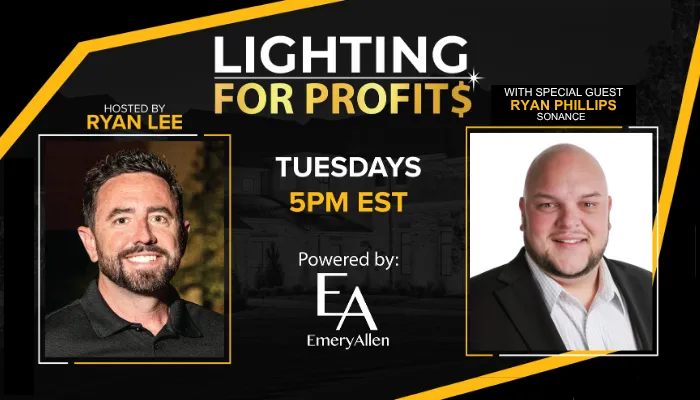
Ryan Phillips - Built Smarter
Lighting for Profits - Episode 247
Join Ryan Phillips, a CEDIA industry professional with over 20 years of experience in Audio/Video Design, Automation, Lighting, Shades, and Construction. In this podcast, Ryan shares insights on creating seamless technology experiences that enhance both residential and commercial spaces without compromising design. From outdoor living solutions and smart home innovation to elegant system integration, each episode explores how technology can deliver exceptional performance while remaining beautifully invisible. Whether you're an integrator, designer, builder, or homeowner, you'll gain practical knowledge and industry expertise to help you create spaces where technology and design work together effortlessly.
Watch the episode
Episode Transcript
Today we're talking all things outdoor audio with Ryan Phillips
Welcome to Lighting for Profits.
All light, all light, all light. Powered by EmeryAllen.
Here is your host, Ryan Lee.
All light, all light, all light. Welcome, welcome, welcome to the number one landscape lighting show and today maybe the number one outdoor audio show in Magnolia, Texas. We're about to find out. Really, uh, really excited. This show is so fun. You guys get to bring on amazing guests, different topics, different vendors. Uh, listen, if you uh, are getting value out of the show, I would appreciate a five star review if you haven't done it already. Um, but excited for Today we've got Mr. Ryan Phillips. He is the national sales manager. Uh, I guess I probably should have asked him the, the exact title but national sales manager Green Channel for Sonance. And so today we're going to be talking all things outdoor audio. And uh, you know, it was really cool. We had um, it was almost, it was kind of like a last minute thing, uh, where lighted, uh, up Expo a few months ago I decided, you know, it'd be really good to have some outdoor audio presence there. And Ryan uh, made it happen. He showed up, he did a class and it was one of those things where again it was kind of like a last minute thing but it ended up being one of people's favorite classes, um, at Light it Up Expo. So it was really, really cool. So I'm excited to have him on. So if you have been, uh, if you've heard about outdoor audio or you're wondering like, should I get into this? Like what, what's the good, the bad, the ugly? Well, this is the episode you're going to want to make, uh, sure you pay attention to. So, um, a couple reminders, uh, coming up here in, I don't know, two weeks, Friday, uh, fly in, uh, July 10th here at my house. This is for Illuminati members only. So if you're thinking about getting into landscape Lighting Secrets and you're like, I don't know, like book a call now and come, you know, because then you can come hang out at my house. It's a free, uh, Mastermind for members only. And this is a really good chance for you guys to get in, uh, in person and network and get coaching and feedback and mastermind where we actually just help you get unstuck from where you're at. So uh, that's really cool. If you're in Landscape Lighting Secrets, make sure you register. It's free, but you do have to register so we can plan on food and seats and find out if everyone could fit in my living room because it's actually not that big. Um, so July 10th, Friday, fly in. September 9th and 10th, Park City, Utah. Secret summit. This is our annual members only event. But if you're a vendor, okay, if you're thinking, man, how do I, how do I get in touch with, uh, lighting professionals that are looking to grow their business? You might want to come to Secret Summit. It's the first time we've ever invited vendors. Um, there's some details to it. You have to apply to come. You can't just, you know, pay to be a sponsor. Uh, but there, there are some, uh, opportunities if you're a vendor. So, uh, email me@supportionleecoaching. com and finally, speaking of Light It Up Expo, we got everything finalized. And, uh, we know the dates, we know the location. We're not going to tell you everything right now, but we do know, put it on your calendar, March 1st through March 4th, 2027. Uh, just go to lightitup expo. com and you actually get your name on the wait list because pretty soon we're going to be announcing where it's at and all the details and all that stuff. But if you're on the wait list, you are going to get the homie hookup. Okay? So, uh, make sure you go to lightitup expo .com, get on the wait list, and, uh, soon we'll be announcing all the things. We're still kind of trying to organize the schedule and stuff like that, and, um, kind, uh, of the, the show layout and whatnot, but at least put it on your calendar. March 1st through 4, 2027. So that's gonna be awesome. Um, and, um, again, in just a few minutes, we got Ryan Phillips with Sonance. So if you're looking to grow the outdoor lighting segment of your business, which there's so much opportunity. Guys, I'm excited for this conversation because so many people are missing out on, uh, a really, really big opportunity. Uh, but again, he's coming on in just a couple minutes.
One of the most popular questions I get is how much should I charge
Before we have him on, I do got to just talk about one thing. So, uh, man, it's, it's almost frustrating because I talked to so many people and like, they'll, they'll, they'll start really good. Okay? They'll be like, man, I, I'm selling jobs and things are good. And I just sold the $8,000 job, and I just sold a $23,000 job, and I sold a $60,000 job. And like, man, those, those sound really, really good. But how is it that that same person just sometimes 30 days later or 60 or 90 days later can all of a sudden be out of money, can be broken. And sometimes it's like, well, the lead slowed down or whatever, you know? But, um, here's what's happening. Um, and by the way, how much do you. How much money do you think an outdoor lighting company should make? Like, if we just. If you, If I just said, what's a. What's a reasonable net profit percentage? Like, what comes to your mind? Um, for me, what comes into my mind is like, I think I've been conditioned to think that 20% is, like, the number that, like, every business shoots for. It's like, hey, you got to do this and you got to do this, and then at the end, you should make 20%. I don't know where that came from. Like, why not make 10%? Why not make 30? Why not make 50? I don't know. Someone made up 20%. Am I the only one that thinks 20%, um, is like, what we've been conditioned to think? But the cool. One of the coolest things about being a business owner is it's your business, it's your game, it's your rules. You can do whatever you want. So if I say, oh, you should make 20%, you should be like, why, I'll just make 25, or I'll just make 30, or I'll make 40. Like, you get to choose whatever it is you want, okay? And so one of the things that when people especially, especially newbies, but not always the newbies, sometimes it's people that have been in the game a few years. Um, a lot of people have the same questions, okay. And one of the most popular questions I get is, how much should I charge? Okay. And they'll say, well, you know, I did some, uh, espionage, and I found out that my competitors are charging this, so I'll go a little bit lower than that. Right? That's kind of like the traditional method. And to be honest, I could give you a pretty close number for, like, flat rate pricing, regardless of the size of your business. Um, and say, hey, you should charge this much money, and I'll just throw out a number. You should charge 400 bucks a light. Okay? But the reality is, like, that's not going to help you very much. It might help you, like, with your first couple of jobs, but you really need to understand your, your numbers. Um, like, how much does it currently cost you to wake up in the morning and start your day? You know, and when you're getting started, if it's just you and you don't have an office and you don't have, uh, trucks and you don't have insurance. You're like, I got insurance. I've had car insurance since I was 16. Um, if you don't have overhead, well, it's not going to cost you as much. But remember, at some point, you will have overhead. You will have, you know, salaries to pay, you'll have insurance to pay, you'll have truck payments, you'll have, um, an office manager. You'll have an office and all those things, right? So how much will it cost you when you actually have your business up and running like a business? And this is, this seems so simple, but I, it took me years to figure this stuff out. And unfortunately, I see the same pattern happening over and over and over, even to this day with people in their lighting businesses. They're pricing like who they are today instead of pricing like who they want to be. So it's easy to say, like, well, I don't have to charge 400 bucks light. Um, I can buy lights for 50 bucks and I can buy a transformer and wire, and I'm all in for this. So I'll just charge 200 bucks a light. Well, that's not going to help you grow a business, okay? Um, you have to start pricing like who you want to be. And who you want to be is what I mean. Do you want to be a million dollar business? Do you want to be a $2 million business? And what overhead did those businesses have? Do you have two trucks on the road? Do you have an install team? Do you have a maintenance team? Um, what type of products are you using? Are you going to stay using the cheaper products, or are you going to elevate your brand and use a higher quality, um, product? Right? And so one of the things, and here's the deal, like, this activity I'm going to propose to you is so boring. It is not sexy at all. I would rather just go knock doors and sell a $10,000 job. Like, it's just easier and sexier to go, like, design and sell lights, right? But the boring stuff is what wins in business, okay? And this is super boring. Those of you that go, yeah, yeah, I've done that before. Even if you've done it before, if you did it six months ago, you need to do the activity again because your numbers and your perspective have changed. So you need to add up all your expenses. You can just do this on a spreadsheet, okay? And if you have a monthly expense, call it insurance. Well, you need to times it by 12. If you have an annual expense, then it's just an annual expense. You don't have to times it by anything. Um, but figure out how much it costs you to operate your business every single year. Like figure out your, your annual expenses. Okay? Uh, so again, monthly expenses get times by 12. If you, um, do. You don't have an office right now, what would an office cost you? Because people go, well, I can't afford it. I can't afford to hire an office manager. I can't afford to get a shop. I can't afford to get a second truck. Well, that's because you didn't plan for it, you didn't budget for it. So put those numbers in here. You're like, hey, I need a new truck.
You need to figure out what it costs you to operate your dream business
It's going to be $800 a month. Okay? That's $9,600 for the year. 9,600 goes on the spreadsheet for a new truck. Well, I can't afford an office manager. That would be $60,000 a year. Okay, 60, $60,000 goes on the spreadsheet. Well, if I get an office manager, I would have to get a shop. That's $3,000 a month. $36,000 goes into the spreadsheet. Okay? You need to figure out what it costs you to operate your dream business. Do this for like, do like two tabs, one current and one future. Okay? And so you can figure out exactly how much you're going to need to charge. Because it costs you money to wake up every day. Whether you realize it or not, whether you agree with me or not, there is a real number that happens. And then you need to measure how long it takes you to do an installation. Okay? If you're a one man show, or maybe it's you and a helper, or maybe it's just you have two guys that do all your installs, or maybe you have two teams. Whatever it is, how long does it take you to do an installation? And I've found I was in Texas, okay, And we had a lot of Hispanics that worked for us. Those guys are machines. I didn't even realize that at the time, but now I've talked to other people that hire lazy white people and they're like so slow. I'm like, like, holy cow, this is crazy. Right? But you need to figure out how long does it take you, not somebody else, to do an installation. Um, and sometimes people aren't slow just because they're lazy. It really. Sometimes it's like you're Doing super custom stuff, right? And some people are just slow, right? Some people, especially newer, they're like doing everything, burying everything, and then all of a sudden, like they test the system after the connections are buried and go, oh, it doesn't work. And then they're unburying connections and going through that whole thing and everything. So figure, um, out how long it takes you to do an installation. In my experience, and I've asked a lot of different people this question, it seems like an average is people are able to install about one light fixture per man hour, okay? So if you're just like a solo person and you're working a 10 hour day, it seems like on average you're able to do 10 lights a day. Um, again, average, you might go, that's crazy. I can do 20. Well then good job. You know what I mean? Or, man, I can't do that many. So whatever your number is, you're going to want to know, uh, this number. So let's run this scenario, um, out. Let's say you have a two man crew and it takes your crew two days to do a 20 light install, okay? Um, and you might go, well, that's fine. It can take two days because I sold it at 400 bucks a light. Ryan Lee said charge 400 bucks a light, right? This is where I could get into trouble because, uh, you can't just take blanket advice off a podcast, okay? You do $400 a light, you got 20 lights. It's pretty easy math. It's eight grand, right? Well, if you add up your daily overhead, okay? And you do the math and say, let's say your overhead of your dream business is going to be $3,000, okay? Well, if it takes you one day, you have $3,000. That's the day, right? That's what it costs you per day. And then let's say your materials for those 20 lights is about 2 grand, okay? So now all of a sudden Your total is $5,000. Well, you charged eight, so now you have $3,000 profit. Like heck yeah. That's freaking awesome. Okay, um, here's where people get into trouble. That $8,000 install took two days, okay? And so you thought, oh, I priced 400 per light, like we're golden. Well, now all of a sudden it took two days. And remember, your daily overhead was 3,000 daily. So now you have 3,000 times two. You're already at 6,000. You add on your $2,000 material, you're at 8,000, which is what you charged. So you broke even, you didn't lose money, but there's no profit. What happens if that customer calls you back and you need to send the crew back out? Right? Uh, what if you need to go warranty something? There's no profit. And guys, we're not in business to be non profits, okay? You have an llc, you have an S corp, you have something, a for profit entity, and it's your duty, your obligation to make a profit so that you can over deliver for your clients, okay? And so if you don't know your numbers, this can screw you up big time. You can hear someone say, oh, well, yeah, man, just charge 400 bucks a light. Just charge 500 a light. Just make 20%. And that's the danger of going off of just like averages and blanket recommendations. Because you could do the same math and go, okay, uh, I'm going to make 20% on this. I know the materials cost me two, uh, thousand dollars and then my labor is this. And then you forget about your daily overhead. And you only charge, let's say $5,000 because you go, well, it's 2,000 of materials and I'm paying my guys like 250 a day each, so that's 500, and if it takes them two days, that's a thousand. So I'm only in at 3,000 and I want to make 20%. So you come up with 5,000. It's like by the time you pay your 3,000 and your 2,000, you're losing money. So there's a lot of people out there working really, really hard, celebrating wins, celebrating sales, celebrating success that are losing at the end of the month. And it's so frustrating for me because I'm like, guys, you just have to know your numbers and then you just have to say what has to be true. Okay, so what has to be true to be able to cover the overhead, cover the materials, and make your desired profit? People go, what's my desired profit? I'm like, as much as freaking possible, okay? It's supply and demand. The market will dictate what you can charge.
A lot of people are charging what they think someone's going to pay
And a lot of people are charging what they think someone's going to pay. Oh, uh, I don't know, this person seems cheap. I'm gonna have to give them a deal. Well, that's not how business works. You have to charge what you have to charge to make your business profitable. If you can't make those numbers work, then you either go out of business or solve the problem. And solving the problem is, well, raising your price, closing more deals, getting higher quality leads. Like, those are the things that you need to focus on. And unfortunately, most people don't do that and they never solve the problem. And then they go broke and they either have to quit or file bankruptcy. Right? So you need to really understand these things. It's like if, if you go, well, I can't charge those prices in my market, then you should quit. You shouldn't own a business. You have to be able to charge those prices in order to cover your expenses and create a desired profit so that you can serve your client at the highest level. Okay? And just the next time you think, I don't know, is someone going to pay that? Why would someone spend $500,000 on a car? You can get a brand new car for $50,000. Well, they spend 500k because it makes them feel differently, makes them feel better. They're not buying a $500,000 car to save money. They're not buying it because there's not a cheaper option. Okay? There's always gonna be a cheaper option. So if you're struggling with pricing, you need to increase your value. Because the moment that your value is above your price, people pull the trigger. Okay? And so if you're wondering why, oh, uh, I can't charge this, it's because your value so low and your price is so high. Well, instead of lowering your price to meet your value, just raise your value over your price and you can charge whatever you want. Okay? So this is the key, this is why I'm so passionate about talking profitability and pricing all the time. Because there's a, there's a way, there's a proven model that works. It only works if you work it. So you guys have to trust the process.
Emory Allen makes premium LED lamps for lighting professionals who demand the best
All right? Um, hey, speaking of trusting the process over delivering, providing a red carpet white glove experience, um, when you do provide that, you know, red carpet white glove experience, you're going to get more repeat business, you're going to get more referrals. And you do that by using a high quality product. Okay? So Emory Allen, they make premium LED lamps for lighting professionals who demand the best. Don't settle for less. Upgrade your designs, upgrade your installations. Today with Emory Allen, all you need to do is email Jackson. And his email is Jackson L as in the letter l jacksonlryallen. com and take advantage of their contractor pricing. If you do mention that you heard about them, um, here on Lighting for Profits, they will hook you up with their best pricing. Just email jacksonlryallen .com. Thank you, Emery Allen.
Ryan Phillips joins us to talk about outdoor audio on Light it Up Expo
All right, so, uh, I think it's time, I think. Uh, Ryan looks ready. Let's get him on the show. Are you guys ready? Are you guys ready to nerd out on some outdoor audio? I know I am, so let's get this going. Welcome to the show, Mr. Ryan Phillips. What's up, Ryan?
What's up, man? How are you?
I'm excited to nerd out on Outdoor Audio, man. I'm doing good. Good.
Looking forward to it.
So it's kind of cool. Um, you and I just met, like, a few months ago, and Roger, uh, Ramsey, uh, with Ewing, introduced us. I was talking to him, and I was like, man, I don't know. It'd be sweet to get outdoor audio. He goes, I know. I know what to do. And he took over from there. He called you. He called me, organized this whole thing. So I'm grateful for him for making the introduction, because I feel like it's just the start of, uh, something really, really big in the outdoor lighting industry, which is weird to say outdoor lighting and outdoor audio, but they're just so. There's just so much potential in combining them. So thanks for being part of Light it Up Expo, and thanks for being here.
Yeah, no, I appreciate it, man. I appreciate the invite. I think, uh, there's a lot of parallel between, uh, between these industries, and, um, had the opportunity to dive into that over the last couple years, and I think it's an exciting opportunity to share what we've got and, um, what this category can do for guys that are already out there in the space doing similar stuff.
Yeah, yeah. Um, well, actually, before we get started, just.
Eric Johnson is the national sales manager for green and production channels with Sonance
Would you mind just doing a quick introduction of who you are and what you do?
Sure, sure. Uh, so I'm currently the national sales manager for green and production channels, uh, with Sonance. And so, you know, I've. I've been in this industry, um, you know, for 21 years this year, so spent the vast majority of my adult life and audio, video and, um, you know, did. Did a bunch in indoor, you know, as a. In an integration capacity early on, and move, uh, to the manufacturing side about nine years ago, um, you know, with Sonance. But I had a chance to sell this stuff before. Um, and, you know, the outdoor category has always been, you know, probably my favorite thing that we manufacture. Um, it's definitely the system in my own house that, you know, that gets used the most, um, particularly by, you know, my kids and. And when folks come over and we entertain, um, and so it's loads and loads and loads of fun to play with. Um, I think it's cool to get paid to listen to music for a living. It's a, it's a great gig if you can get it. Um, but, um, but now, man, it's, you know, for the last three years I, um, had the opportunity to really dive deep into the entire green industry and figure out, uh, you know, how to, to solve for a gap that um, I think as an industry is, is not the best, um, has done the best job at like reaching all the folks that want it. The demand is through the roof. Um, you know this, this year in particular has been gangbusters, right, in terms of outdoor audio. It's been awesome and we see, you know, a ton of growth. Having had the opportunity to dive in, um, you know, several years ago and start to understand, learn the green industry, um, try to get the language down, understand how these businesses operate, what all of your members and folks that are in that landscape, lighting capacity, um, deal with on a daily basis and types of projects that they do. There's just so much parallel, uh, with that and what we do in the outdoor audio space. So, um, yeah, it's been a blast. I'm still learning a ton in this space for sure.
Yeah.
Um, uh, but it's exciting and I've had a blast doing it.
Nice man. I appreciate it. Well, like, uh, I mentioned it was really kind of a, it wasn't a, I guess it was a last minute add on. It wasn't a last, it wasn't ah, a last minute thought because I've always thought it would be good to like make it part of it. But I was like, oh, we'll get, we'll get Lighted up expo going and then we'll bring in outdoor audio like three, four years later. And I'm like, why would I do that? I literally had like people asking like, hey, will there be an outdoor audio thing? I'm like, what am I thinking? So it was kind of a last minute, but it was a very popular class, very well attended.
Light it up was one of the most engaging audiences that I've had
Um, what was your experience like there? What, what did you think of the crowd?
Yeah, it was engaging. Um, you know, I've, I've had the opportunity to, to attend um, in, in a couple different capacities. Early on into this journey, I spent a lot of time, um, as a guest in, in multiple trade shows within the, the, the this channel and um, get a chance to interact with guys that are, you know, doing projects, talking to, you know, the, the contractors that are doing the work and learning about their projects and, and finding those, those similarities and ways that, um, what we do can dovetail into what they do. And what I liked about Light it up, um, you know, honestly, man, it was one of the most engaging audiences that I've had a chance to get in front of. Not just in the class setting, but even when we had a chance to get outside and do some demos and you know, the types of questions that were getting asked, it was very. It seems like the appetite's really there. Um, there's a lot of hunger for it. And, um, you know, the ability for us to. To kind of plug in to that was, uh, was obviously super exciting. But, um, there. There was energy at that, at that show that, um, it was different than some of the other stuff that I've had a chance to be a part of.
That's cool. Yeah, I thought so too. I'm like, man, everybody here is very intentional. You can tell they want help, they're asking the questions, they're really looking forward to it. So I thought the same thing.
Was there anything that you learned through that experience? Were there any surprises
Um, was there anything that you learned through that experience? Were there any surprises or epiphanies? You're like, oh, well, I didn't know that. Uh, do you have to go back to the basics more with this, like, channel? Are you, like, I don't know, like, was there any epiphanies for you where you're like, oh, well, man, these guys have way more opportunity than I thought or, or anything like that?
Yeah, I think, I think one of the. Some of the feedback that I got, there were a handful of guys that, that I talked to a couple different companies that had kind of gone down the path already. So, like, they, they gotten in whether they were, you know, had used our product in the past or it was competitive stuff. Um, one of the bigger takeaways was some of the successes that guys had had who had really kind of just started to either dove in head first or even just tiptoeing around, but from a marketing perspective had added, um, you know, outdoor lighting and audio to their. Their brand. Right. And they, they started to market that way. And the feedback that I got from them, which was completely unsolicited, but really, really very, very welcomed, was, man, the second I started talking about audio, it's like, you know, I felt like my lead volume doubled. And I thought that was really, really interesting feedback, particularly being that it was 100% organic, um, in the moment. And, and it was a light bulb moment for me because, to be fair, I've, I've used that advice for, for guys that are in that, um, I've seen since then, um, you know, to, to provide them with, you know, a little bit of. Of an extra layer of. Hey, by the way, this worked for several guys that got off the ground. I mean, you had a couple attendees that. I've been in lighting for a few years now. And that was the resounding feedback was when you market for it and you tell people you're doing it, the doors that. That opens because there is such a huge appetite for it and crazy demand that people gravitated toward that. So that was a cool takeaway. Um, I definitely didn't expect to get that.
It was, yeah, that's awesome.
I got that. But it was really, really cool. Uh, and you know, that, that was early, uh, in the show, and I think that kind of set the tone.
Right.
And you know, from then on it was, uh, you know, it was, it was powerful, man. It was, it was really cool.
We'll make sure to keep planting those guys in the audience for you. Just make sure to tip accordingly.
You know, I was gonna say make sure they get their 100 bucks and move on.
Green Channel sells the most outdoor audio with sonance
Um, so, you know, you mentioned like, Green Channel. Um, what historically, what channel sells the most outdoor audio with sonance?
You know, it varies. Yeah, it's, it's pretty evenly split. I mean, look, we're, we're well diversified in a lot of different places. Um, you know, we've, we, We've got, you know, some fantastic dealers that do, um, you know, our dealer network is incredible. It's the strength of the company. And like, that's, you know, those are guys that do it, you know, really, really, really well with that. Um, but, you know, a lot of times, depending on the size of the project, man, it can vary on, you know, whether guys have the appetite or the, the availability to, to do that. Um, we, we've seen it do well in our retail space. Um, we've seen it do well, you know, through, through distribution, um, that we're, we're a part of. I mean, I would say it's, you know, on aver, um, it's well blended. Um, but I think that the issue is, um, the buying public is looking for a solution that they don't know how to get. Like, they're not aware that what we do and the degree of, you know, both the performance, the blended aesthetic that we're able to provide even exists. Um, and then when, you know, when you find out that, you know, from a cost, price point perspective, we're kind of in line with a, with a good lighting project, uh, just in terms of general costs, they're typically going to parallel really well, um, for anybody that's, that's already buying a lighting project, I think it's a, you know, it's, it's an easy parallel to, to have. And the homeowners are looking for it. Um, they're solving it right now with Bluetooth speakers, man. I mean that's, you know, that's, that's what, you know, folks are taking it out, you know, little battery speaker outside. And um, that's, that's kind of the go to. And look, it serves its purpose. But for folks that really intend to use their space, um, you know, in a broader capacity and they're doing a lot of entertaining, the opportunity to put a permanently wired solution into their backyard and into their outdoor living experiences is just a notion that I don't think most people know exists. And so having guys in your space that are out there beating the drum for it and growing the category, I think that's all we could ask for. Right? The rising tide will raise all ships.
I imagine you are a lot like us, uh, when it comes to audio. Like, I remember going up to this house. It was, it was about a 3 million dollar house and like we were doing the neighbor actually. Okay. And so, uh, but I look next door, it's like a three million dollar house and he's got all these solar lights, you know. So like, it just kind of makes you sick a little bit. Imagine you walk into someone's property and they got the Bluetooth and like, yeah, it sounds pretty good. It's almost, we have the same like any lights better than no light and any audio is better than no audio. So they, they don't, they don't know what they don't know. Their perspective is like, no, we got, that has some bass. Like, it's not a big deal. So how do we, how do we change that? How do we, what's the value proposition and how do we sell outdoor audio?
Well, I think, I think what's really changed, um, you know, a whole lot in, in the last 10 or 11 years is the way that people approach outdoor living just in general as a, as a total category. Um, I think historically the, the outdoor, the green industry has been hyper segmented based on like trade discipline. Right? So you've got hardscape guy, you've got a landscape guy, you've got a, you know, lighting guy, you've, you've got a, you know, an outdoor kitchen guy, you know, you've got a pergola or patio Cover guy. Um, and I think in the last 10 years, you've started to see a lot more growth in that design build, um, you know, kind of turnkey outfit which is just capitalizing on where the market's headed. Um, you know, one of the perspectives that I think I share often when we talk to folks in the industry is to kind of do a short history lesson and think back to 10 years ago. Outdoor living was kind of a destination type experience, right? It was, you know, the pool was out, away from the house, and when we went out to the pool as a family, it was, we're going to go there like we were, you know, going to the beach for a day or whatever. And if we built a fire pit, it was kind of remote and it was, it was a destination type event. And, um, I feel like people are moving, started to move that experience a little closer to the home and, um, you know, tuck it a little tighter on the, on the, on the property line or the boundary line to the house. And, um, you know, for all the history buffs that are listening out there, right then we had this, um, you know, event in 2020 that, that kind of locked everybody in their house and people got tired of, you know, staring at the same walls and the same kitchen and this notion that we could carbon copy our, our indoor living experience in an outdoor capacity and have all the same amenities that we had inside, but also outside, um, really accelerated the, the growth of this category. Um, you know, the, the, the, the hardscape is the square footage, the, the pergola, the patio cover is, you know, is the shade or the temperature control in that environment. Um, you know, if there's a kitchen, there's functionality in that, right? It's a, it's a cooler place to cook. Um, and then lighting obviously adds to that. You know, the ability to extend the use of that space into the night, both in a functional capacity, but also in something that looks really nice. What we've always found is the entertainment aspect is what gives whoever's using that space, whether it's, you know, it's, it's an internal family event with, you know, your immediate family or if you're entertaining folks, uh, it gives you a reason to be there, right? And so whether it's watching the game or listening to music or some combination of the two of those things, that's what allows you to really extend and give you a reason to stay in that space longer. And going back to what you were, um, kind of kicking around when, uh, you started the show today. Was, um, around referrals and what gets people excited about it. That's the stuff that they truly love and that they truly remember, and that's what drives referral. And when you can deliver an experience like that that, uh, makes the environment comfortable and it mimics all the same performance and the functionality that they have inside and we do it outside, I think that's what makes it stick. And I think, you know, time's gone by, people are looking for more of it and we're delivering more of it. And, and, uh, you know, I think it's, I think it's growing. I think the outdoor audio space right now is probably close to where the lighting industry was maybe 15, 20 years ago. You know, it's, it's on the cusp of, you know, really taking off. And, um, we've seen that over the last several years and I don't know, I don't expect it to slow down.
I don't know if we've had penetration for a dedicated outdoor audio company
Um, what are, what are like top, top guys producing? I don't, I don't know if, if you would know their revenues or, or maybe purchases from you guys. Like, what, what is a good outdoor audio company do?
Well, I don't know if we had some, if we had some dedicated guys in that capacity. I don't know that we've, uh, we've had the penetration for like a dedicated outdoor audio company, per se. Um, if. So I'd love to meet them.
Um, well, even if it's just like a big, like you said, outdoor living guy or like, who, who, who are some of your.
What are the categories that are, are selling the most outdoor audio
What are the categories that are, are selling the most outdoor audio? I guess.
Yeah. So I think, I think the design build firms that, that, okay, really place the focus on how somebody lives in that space and, and, yeah, and how they, you know, how they, how they can recreate that indoor living experience outside that. That is a focus that I see across the country as I go from, you know, different geographies all over the country that as a, uh, as a through line is probably the most impactful. But, you know, those are folks that for the most part have all the different trades or verticals in house, or if not, they've got great subs that they're using to, to supplement, you know, a portion or part of, of those projects, um, behind a full turnkey outfit. Honestly, man, it's, it's lighting or pool guys, right? Like, lighting and pool companies do really, really, really well with audio. Um, you know, and I've said this, uh, I've said this before, but I would, I would echo this largely a good outdoor audio system is not designed for people to go outside and, like, do dedicated listening. It's not an audio file type experience. What audio does outside is it enhances whatever other activity you're doing at the time, right? So if I'm cooking, and I want that to be more fun, I'm going to listen to music while I'm doing it, if I'm in the pool. And I want that to be a more exciting and more engaging event. Like, I'm going to create ambiance by incorporating an audio system. And so it's really designed not to be the focal point, but to kind of be the glue that holds that entire experience together. And quite frankly, I think there's value in it in every vertical at this point. Um, where we've seen success is, you know, again, is. Is the turnkey outfits, and then I would say lighting and pools, um, behind that. But I think Hardscape guys have an opportunity, too. And, you know, getting those guys to. To come around, um, is part of the work that we're doing today.
So, um, it's interesting when I hear you talk about that, and you said. You said the term earlier, blended aesthetic. I'm thinking kind of all this coming together because, um. So I had this experience, I sold this lighting job, and they were, you know, like every other homeowner, we're going to get you so many referrals. And you're like, okay, yeah, I'm not giving you a deal, right? So they said that, but they're like, we're having this party, and you guys are awesome, and we want it. We want to get you all these referrals. And all of our friends are rich and all this stuff, so they go, do the party. And afterward, I go, hey, how'd the party go? You know, did you get us a bunch of leads? And they're like, you know, it's crazy. Like, no one actually mentioned the lighting. And I was like, what the hell? Do I suck at lighting? You know what I mean? Like, and she goes, no, it's like the fact that they didn't, like, goes to show you, like, we didn't. We didn't want it to be about the lights. We wanted to be about our backyard and the experience and these. And people kept saying, wow, we love your backyard. We love the trees. I never knew that you had this. I never know this. And so it was kind of the same thing that you're talking about is, like, when you're going out to cook or when you're going out to swim or when you're having people by the fire pit, you don't want them to say, like, I really like your outdoor audio. You just want them to feel it. You just want them to feel like something's different here. This is amazing. Like, I feel so good. And, and yeah, it might be one of those things that they notice, but it's not center stage. It's just the thing that makes the experience come together. And I feel like lighting is like that at night. Audio can be that during the day or night.
Yeah, well, and look, I mean we, we liken a well designed audio system just like we would, uh, a well designed lighting system that the coverage is even, it's comfortable to be in. Right. We, we create a sound stage that people can move effortlessly through that's just consistent no matter where you go. And so like, you know, as, as an example of that, if you go to a, to a resort, you're going to get that type of experience. Nobody's going to go to a resort and go, man, the speakers at that resort were awesome. Like, I'm so glad I stayed there. And I'm going to go back for that. It's a combination of all of those elements and the way that they, you know, spark that, that sensory reaction to the environment itself, it's just another layer that adds nuance to what that feeling is like back there.
You talked about increasing value but not reducing price with outdoor audio
You know, I thought it was interesting. You were talking earlier about, um, value in sales and you talked about increasing value but not reducing price. And um, you know, one of the things that, that we've taught historically is luxury is a feeling. It's, it's not tied to a brand. It's not tied to a, a material or a textile or, or in a lot of cases, it's not even tied to a price point. Man. You know, there's, there's kids out there, you know, working, you know, high school college jobs, making 15 bucks an hour, running around in $600 tennis shoes. That's a luxury buy for somebody that's making that money. Right. And, but every time they put them on, they feel awesome. And there's not a, uh, there's not a way to describe that unless you can put somebody in that, in the driver's seat of that feeling. And when you deliver a turnkey backyard just like the one you were talking about, like, that's how you show it. And you know, we've got the ability to, to demonstrate that, um, you know, we, there are tools and kits and stuff that you can use to, to Kind of bring that to life at least a little bit and show it to somebody, but they have to really experience it and feel it. Right? Um, just like you talked about with a $500,000 car, you got to drive it before you know what it feels like and know how to understand it and so, and understand why it's worth that. And um, yeah, I think this is, this is just like that. It's one component that goes into building that ideal outdoor living environment.
Do, do you need a demo kit? Like, does someone need that to sell outdoor audio?
I, I would tell you it's, it's a, it's a critical component that allows you to land the message in 15 minutes with no words. Um, whereas someone that's as long winded as I am could explain it to you, but it'd take me 45. And even then you wouldn't under. You know, you wouldn't get it till you got it. Um, you know, I think, I think that as a tool, I think it's definitely helpful. Um, but you know, for, for somebody that's running a business, it's getting it. I mean, step one is just, is offering, right? And it's talking, talking to them and letting them know, hey, this is something that we can do and it's something that you're probably going to want. You know, there's, there's data that we shared in the class, um, you know, that I, uh, that we did it. Light it up. Um, and there's surveys that are quite frankly a couple years old, but surveys from, you know, American Society of Landscape Architects that talks about half the specified projects are going to incorporate a wired audio solution. Houzz. com did a survey talking to homeowners. Hey, when you do your backyard, what are things that you're going to want to put in there? Is it a fire pit? Is it kitchen? And you know, they kind of rank all those. It was the same number, right? It was about half. And um, and that was a couple of years ago. I can tell you definitively with as cheap as technology has gotten in the last, especially in the last five years, outdoor TV costs are way down. Regular TV costs are, you know, they're so commoditized now. I mean, you can get a six for, you get 100 inch TV for 1600 bucks at Costco. So like, people want to recreate that indoor living experience outside. And the entertainment side of it is one that's, um, highly sought after. Um, the question is, is, you know, who, who's going to be the, the group that, um, you know, the company that, that executes on that and, and puts it into, into play for somebody. And so, um, yeah. Is a demo kit valuable? 100%. Um, is it everything? No, but, but it's, you know, there's, there's some data on that that, that'll tell you you've got a pretty high close rate when you take one out and.
Right.
It's, quite frankly, unless you've got a showroom, the only way that you're going to be able to, to get somebody to understand the concept. And, um, I joke when I train it, but I, I have been thrown out of some really nice backyards, um, just because early in my career I went in guns blazing. Oh, we're gonna need, you know, 24 satellites and six subwoofers. And, you know, when somebody hears that without any context, it's, you know, hey, thanks, but no thanks. Um, I don't think we're on the same page. Um, and what I found by talking to, even talking to guys at the. It lighted up is, you know, the amount of times where a homeowner will tell you, hey, I want to do lights out here. I think I need six. Here's where I want to put them. And then being the professionals, you know, that, that we are, we, we go in and say, well, it's actually not six fixtures. In order to get these six areas lit, it's actually going to take 28 fixtures to do that. Right. And here's why. It's the same talk track when you talk through audio. And that's where a lot of the parallel in the industries comes into play, is it doesn't have to be, um, you know, this, this, this notion of more speakers is louder and more subs is louder. There's, there's a lot of reason why, um, you know, the appropriate amount of coverage is important for the same reason it's important to be balanced and comfortable in lighting. It's exact same thing in audio. The reality is you get better detail at low volume, the more speakers you have.
Yeah.
And so that's, that's the principle that we can showcase if somebody does it on site.
Um, that's what I love about the demo too, because no one, no one's buying speakers. I mean, it's fun to geek out and be like, well, it's got this many whatever, but like, no one really wants that. They're buying the experience, you know, and so if you can just say like, turn it on. I like that. Okay. For that, it's $12,000 or whatever the number is. It doesn't matter how much wire, what type of connections, uh, how many speakers. I mean, I heard someone say the analogy, like, if someone's painting your house, it's not like, how, how many gallons of paint and how many rollers are you using. Like, it, it, it doesn't matter. Like, I just need my house painted. Like, I need it to look good and I need it to be this color. So they're not asking for a number of gallons and they're not telling you, I want you to use 32 gallons. Is that. And I want. So it's like, no, I just want my house painted. So we are the artists, we are the ones that have to say, like, no, this is. If you want this experience that you just heard. And that's why I love, I love the demo. It's kind of like a cheat code. It's like, just let them hear it. And they can't, they can't dispute that it sounds awesome. And to your point, I like it because even when I have some outdoor, some old outdoor audio at my house, I don't have enough speakers. And I didn't know that at the time, but then, uh, since then, I've walked properties that have, like, not just double the amount of speakers, but probably like four times the amount of speakers that I have. And I'm like, oh, my gosh. Like, it's freaking awesome because you. Literally everywhere you go, it's exactly the same level.
The coolest thing about landscape lighting is that people don't need it
And, uh, that's, to me, what a well designed system is, so you don't have to crank it up. So, yeah, I love, I love what you're saying.
Yeah, that, that, that. And you know, you mentioned the blended esthetic. Like, you can accomplish that performance and hide it all where nobody has to see anything, and it just kind of comes to life. You can get your own little version of Disney magic in your backyard. You know what I mean? With, uh, with that type of experience. It is. And it, you know, I know it's cliche, but it, it's true and it's really, really, really cool. Um, and it's, you know, honestly, on the, on the business end of it, it's a check that people are excited to stroke because it is fun. And, um, you know, it's, it's not, you know, no disrespect to our friends in irrigation, but, like, nobody gets excited about their sprinklers except guys that are in that industry. Right? And like, um, you know, it's, it's, it's not selling insurance man, these are toys. And it's fun and it's engaging and it brings people together and it, it, you know, gives you a chance to create an environment and ambiance that is just unlike most yards today.
So I use, I used to have this, uh, mentality and mindset when I, when I first started doing what I'm doing now with landscape lighting secrets, I would, I would try to trick the people I'm teaching. You know, I would get up and speak and like, do people need landscape lighting or do they want it? And they're like, they want it. I'm like, no, they need it. If they don't get it, they're going to die. And, like, all this stuff, right? Which I kind of actually still feel that way. But I had this, uh, epiphany maybe about 18 months ago. I was like, wait a minute. The coolest thing about landscape lighting, and I'm going to throw outdoor audio in there as well, is that they don't need it. They, they, they literally invest in it because they want it. Like, they don't need to go on a vacation and drop 15 grand or, you know, 60 grand to Vel for the week. They go because they want to, and it makes them feel good. And they're like, I earned this. And this is freaking awesome. That's the coolest part about it. Like you said, it's like they love it. Like, they get to stroke that check because they're like, man, I get to do this. And that's really cool. Like, if we are selling irrigation or roofs or H vac, like, yeah, you have to have those things. So, like, good job, you know, but, like, no one brags about their new H vac system, their, their audio. They're going to be like, hey, neighbor, get your ass over here. Listen to this. You know, as soon as their friends
come over, crank it.
Yes, exactly. That's cool. They got it because they wanted it, not because they had to. Which that's our competitive advantage. That's if we can tap into those emotions. It's like, hey, you're not going to, you're not going to buy outdoor audio because you have to. Like, you're going to. Because you're a badass. Like, you get to. You earned this. And now you're going to provide this experience to you, your family, your friends or neighbors, all your get togethers. You're literally creating this experience. It's going to remind you of your Disney trip, remind you of your trip to that all inclusive, or to your trip to Europe or Whatever it is. And now you get to relive that every single time you turn on your audio.
Yeah, I agree a thousand percent, man. I mean that's, that's all we're trying to do is, is make that space more fun, make it more usable, more livable, longer. And you know, again, going back to what you said, it's such an easy way to catch a referral because it is the type of nuance that, you know, makes people want to stay. Right. Um, and the longer they hang and the more that they enjoy it, the more they're going to want to do it themselves. And so it's, it's sticky too, man. It's a sticky, sticky business. You know, a lot of, uh, I would tell you a lot of the, the first time system deployments that I see, um, typically get either undersold or under designed and not, not by the fault of anybody, but there's a lot of fear. Um, I don't want to, you know, I don't want to piss off my neighbors, right. I want it. I want something that's, that's fun and that's engaging and it's um, you know, that gives me that atmosphere. Um, but I don't want to, you know, I don't want to be, uh, that neighbor. And what they'll find is with a well designed system, there's a degree of comfort and there's a degree of performance. If you want to turn it up a little and you know, without being disruptive, it's very doable. And what happens over time is, you know, somebody will put in a system that might only be smaller. One, one phase or one zone of their yard and you know, three to six months in, they realize they're, you know, they started out at 60% volume and then it was 70, and then 80, and then three months in, they're like, man, nobody's complained. I love this. I want to do it in this part of the yard. I want to do in that part of the yard. I want to, you know, I want to do it at this other house because it, you know, turns out it's really, really, really cool. And so we see a lot of return business opportunity on that. And again, it's, it's because it's, it's a fun check to stroke. So, um, yeah, I, you know, I'd encourage anybody that hasn't had the experience to, or the, the opportunity to experience, uh, you know, well designed system. Like, man, once, once you've been in a space that's done well, it's really, really hard to forget. And you know, if there's, there's any, you know, takeaway on the, you know, on the business side of that, man, it's whatever you can do to show that to somebody, whether it's a showroom, whether it's a demo, whether it's your own house, whatever, um, once somebody experiences it done right, it's impossible for them to accept anything less. And I think there's a hell of a lot of value in that conversation when you're, um, you know, when you're, when you're obviously trying to sell it as part of your initiative.
The biggest fear that we run into for outdoor audio is the integration
What, what are some, I, uh, mean, you've trained so many different people and been around these conversations, but what, what are some, maybe common misconceptions about outdoor audio that's held people back or some fears or just uncertainties, um, that once they get in, you're like, they're, they're kind of have the opposite reaction of like, oh, that wasn't that bad.
I think the biggest fear that we run into for, for guys that I would consider, like non audio or non CD industry guys is the, the fear of the integration. Um, you know, how do I get music from my phone into the speakers that I want to listen to? And the cool part is, you know, especially in, even in the last few years, the delivery method that you can utilize to, to get, um, you know, any type of sound out of your phone and onto a system like that has, has evolved a ton and there's so many different options. Um, you know, we're, we're going to advocate for what, excuse me, for wi fi solutions just because the range is better and the, um, there's no disruption, you know, if you get a phone call, right? It's, it's superior to Bluetooth in that regard. But I, uh, think there's a lot of fear and trepidation. The other side of it is, and this is just the reality of this is a laws of physics conversation. But, you know, the, the amplifier in the system is a lot like a lighting transformer, right? It's the head end. It's what drives the power. It's what allows us to, to get the volume we're looking for. When it does its job, particularly as volume goes up, it generates heat. And so the hardest part is learning how to specify the right one and figuring out where you're going to physically place it. We've got some solutions that'll keep you from having to go inside somebody's house for small systems. Um, but I Think there's fear and trepidation. Well, I don't want to make a wall penetration into somebody's garage or I don't. I'm uncomfortable putting equipment inside somebody's house. And while it's not necessary every time, um, you know, to do something, to do a bigger project or more robust solution, you're kind of limited by the electronics, right? I mean, we're fighting. We're fighting against, you know, a machine that, you know, is creating its own heat. And when you think about, you know, my geography, I know you're formerly from Texas, but I'm still here. So it's, you know, late June in Texas. You know what, you know, what it's like outside for me right now. Um, and then that goes the same, you know, across the entire. The entire South. And it's not exclusive. I mean, August, almost anywhere in the US Is going to be hot. And, you know, that's where we run into issues of, you know, potential failure if it's not designed well. And so, um, that becomes the hurdle to overcome. The good news is, is in the last three years, again, we've, We've assembled some products that kind of help with that, um, and the continued education to get guys comfortable with deploying these pieces, whether it's in an outdoor kitchen cabinet or wired into a basement maybe, or into a garage. Like, there's ways to do it where you don't have to become a full blown AV integrator in order to deliver a simple audio solution or even connect it to a tv. You can integrate a ton of it. And technology has helped, like I said, in the last few years, and just the evolution of all the different choices that are out there. So for what I, for my part, I can help sift through that a little bit. That's what I try to coach and train, um, and just make it easier for guys to jump off, go feet first in. And. And go. But I can promise you it's not a short of. There's no shortage of appetite on the customer end. It's. It's, uh, it's finding the guys that are willing to do that, um, and capitalize on the opportunity that, you know, that we want to help, help support. So.
Cool.
Are you planning on coming back to Light It Up 2027
Well, uh, I don't want to put you on the spot, but I kind of do. Um, we had a lot of people that had fomo. They didn't come to light it up. And literally they were like, so. Well, I mean, are you gonna have outdoor audio at the next one? You know, I'm like, well, you don't have to wait a year to get trained. You know what I mean? Or. This isn't the only place to learn outdoor audio. But are you planning on coming back? People want to know, are you coming back to light it up 2027, man,
I tell you what, uh, was, ah, it was a blast. Especially considering how tumultuous and how quickly we threw that together and how we kind of.
We're gonna give you nine months instead of nine days to get ready this time. Okay.
Yeah, look, I, I think that, that that event was one of those, that, um, you know, that, that I could see a considerable amount of, of, uh, you know, value in it across the board. Right. It's, it's, it's, it's a win, win type event for, for us and for, for the folks that are there. Um, you know, I'd love to participate in that, um, largely just to continue to further my own education. Selfishly, I mean, you know, when I go to those shows, I spend as much time learning and trying to further, um, my understanding so I could help our company understand where better to solve for folks in adjacent industries to what our primary line of business is. Um, and so selfishly, I take the opportunity to, to dive into that. But I love seeing the light bulbs go off in the room. I love seeing, you know, people's faces for the, you know, when they experience it for the first time. I mean, that's, that's what keeps us rolling. And so, yeah, I mean, you know, I'd love to, love to, to uh, to engage that again. And you know, for the folks that have been through that, you know, maybe there's an opportunity to do more advanced conversation, you know, in a different capacity and you know, mix that up a little bit while, while not, you know, leaving out guys that weren't able to make that course. Like, you know, I'd love to, love to figure out what that looks like.
Yeah, that's actually a good idea because as we, I mean, that's, uh, Some people are afraid of growth. Some people are like, wait a minute, why are you growing the industry? Blah, blah, blah. Right? Well, one of the advantages to growth, I mean, if we, if we have, if we put on a conference and it only has 50 attendees, number one, like, it's hard to get vendors to want to come support something like that, right? So as we grow, it's like, okay, it's more attractive. But then as we grow too now we can get more specific and we can have like, oh, no, that's our, that's our intro to outdoor Audio. This is our intermediate and this is our advanced. We can have uh, training for owners, we can have training for technicians. There's, there's so many benefits, uh, to growth and that's really the future of Light It Up. So I'm glad. Um, I'll probably actually reach out to you and see if maybe we do that maybe this next year. We do like a beginner and an advanced so that the people that are, have already done, you know, five, ten installs. They're like, no, I'm ready for the next level. I don't want to sit through the same intro one again.
What would be the best way for someone to get started with Light It Up
So, um, talk about, I guess real quick, if someone again, again, people were literally like, so are you doing it next year? I'm like, you don't have to, I don't. Pretty sure you don't have to wait 12 months. What would be the best if someone wants to get started now, what's the best way to get started? Do they buy, um, equipment, uh, for their own house? Do they, Is there a training they can attend? Is there like, what would you suggest to someone who's listening right now who's like, okay, I like this, I want to take the next step.
Yeah, I think, I think there's a couple different ways to go about that. Um, you know, there's a handful of. We do, we work with, um, you know, the major distribution brands throughout the U.S. right. So we're, you know, pocketed in different geographies with some of those different partners, uh, all over the place. Um, realistically, uh, you know, I've got no problem having a conversation with somebody, um, even one on one and just saying, look like, tell me, tell me what it looks like for you. What's your appetite? And then let me help you find the right vehicle to get in front of the right folks. Or maybe it's something with, ah, an event that we've got that I can bring them along for. I actually had that happen, um, with several folks that we met through Light It Up. Um, you know, recently I ran into or invited a handful of them, um, right back in Florida, uh, not a month ago. And so it's cool to get to see, see folks again and said hey, if you want to deep dive this or send folks that weren't able to come to Light it up to this event. Um, we actually already did that, um, and we'll continue to do so. I don't have a specific calendared, like necessarily public event that we're tied into, but I'm Happy to work through you and your team and get connected with the folks that are interested in some capacity and um, try to help network in that regard and, and find the right vehicle for them. Um, yeah, I would say best case scenario is, you know, like I said, through you and your team, get in touch and you know, let's, let's collaborate a little bit and figure out, you know, where we can plug in to, to get folks off the ground. And um, I think every scenario is different too, man. That's, that's the hard part is every company's size is, is a little different. Um, and so um, what their appetite is and how big a project they're looking to tackle, you know, all that stuff that I can, I can help kind of sift through and vet for them and be a resource for.
Yeah, you know, what if, if we do. I mean, we talked about doing something at my house even, and then you're, you know, and we will, we'll put the word out when we do that. But, um, I just. One of the things I admire about you and again, not knowing you a very long time, but you're, you're a guy that just goes all in. You're there to serve, you're. You're there to make sure that red carpet, white glove experience is there. And so I could see that happening where almost organically these, um, almost, you know, many regional trainings could happen where someone reaches out and then if I have some of like, hey, all you Texas guys, we've got something going on in DFW or Houston or whatever. So, so and so's place, make sure you guys show up. Um, something like that could be very interesting.
So, uh, yeah, it's for me. I appreciate you saying that, man. I try to live that, um. Bandwidth is hard. Um, you know, I'm, I haven't invented
more than 24 hours in a day yet. Like, what's wrong with you?
Yeah, I know man, it's, it's rough. I, you know, I, I try to live that, man. And sometimes I just, I out kick my own coverage and, and I don't mean to, um, you know, if I run into those situations, but um, you know, at the end of the day, if we could get stuff on the books and get scheduled, I'm happy to meet directly with, with folks even if that's the case or if I know I'm going to be in a geography, I have no problem, you know, reaching out and, and connecting with, uh, you know, with anybody while I'm, while I'm there and helping them along the way. Um, but scheduling uh, is important but we, you know the good news is from a company perspective is we've got a growing team that's, that's able to support um, this type of work in, in lots of different places that are local to other pieces of geography, uh, outside of Texas and some of the specific places I tend to travel more frequently. So um, again you know, I'd say if somebody wants to get rolling like you know, work through you know, your, your you and your team and let's get them um, get them in touch and more than happy to um, you know, to, to talk to anybody that's interested in jumping in feet first.
Cool.
Well if people want to learn more about Sonance and what you guys are doing
Well if people want to learn more about Sonance and what you guys are doing over there, I don't even know what is the website, what's the best way to, what's the best place to send people.
There's a, there's a, there's a ton of information um, @sonance. com that can walk you through some of our philosophy and what we stand for and um, give you some insight into who we are as a company along with a considerable amount of product information. The way that we kind of present in that regard is more experience based. Um, it's less skew driven and uh, more about the environments that people are looking to uh, incorporate audio solutions into. Uh, and we've got a, you know, for, for guys that may already be in it or that are interested in like some of the technical aspect. I've got a dedicated YouTube channel that's got installation videos stuff and um, you know, and it's, it's just sonance on YouTube. Um, but um, yeah we're continuing to develop those assets and provide resources for uh, anybody in, in lots of different capacities. And there's some cool, cool indoor stuff that we do that you know, we don't talk about very often. Um, that, that you may stumble upon um, in a category like invisible speakers inside your house, which is definitely a thing. Um, you have to see it to believe it. Great dad joke. You can't.
Um, good luck.
Yeah, good luck. But um, but yeah that, that's, that's where I would check out and, and again I'm happy to connect with anybody and provide um, you know, some of the, the more curated industry and green channel assets that, that I've got that aren't quite as public because it's still you know, kind of in its. And it's in this growth phase. But um, you know, happy to Happy to help and educate anybody when we have the chance.
Awesome. Well, uh, Ryan, thank you so much. Seriously, thank you for being part of Light It Up. Thank, uh, you for coming on here. You've already done a training for us internally at Landscape Lighting Secrets, so just appreciate you for continuing to show up. Um, this. I'm excited. I think this is gonna be a big deal for our industry, and, uh, there's gonna be a few that really gravitate to it earlier. They're gonna just have that. That head start, that competitive advantage. So thanks for, uh, being part of it. Thanks for, uh, showing up for everybody. And, guys, if you're listening, make sure to not just listen, take action. Um, I guarantee. And the coolest thing is you could just literally, like, send out a sample text, email, phone call to your voicemail, uh, drop to your client, uh, base and let them know what you're doing. You'll probably get some leads. When you do, then you can be like, okay, nine, one, one, I need help. Come help me. And, uh, we got your back. So thanks again, Ryan. I appreciate you, man.
Appreciate you, man. Thank you a ton.
All right, guys, go make it happen. And, uh, most of all, take action and keep moving forward
All right, guys, go make it happen. Check out Sonance on YouTube. I like that idea a lot. And, uh, most of all, take action and keep moving forward. Thanks, everyone. Sa.
Ryan Phillips - Built Smarter
Lighting for Profits - Episode 247
Join Ryan Phillips, a CEDIA industry professional with over 20 years of experience in Audio/Video Design, Automation, Lighting, Shades, and Construction. In this podcast, Ryan shares insights on creating seamless technology experiences that enhance both residential and commercial spaces without compromising design. From outdoor living solutions and smart home innovation to elegant system integration, each episode explores how technology can deliver exceptional performance while remaining beautifully invisible. Whether you're an integrator, designer, builder, or homeowner, you'll gain practical knowledge and industry expertise to help you create spaces where technology and design work together effortlessly.
Watch the episode
Episode Transcript
Today we're talking all things outdoor audio with Ryan Phillips
Welcome to Lighting for Profits.
All light, all light, all light. Powered by EmeryAllen.
Here is your host, Ryan Lee.
All light, all light, all light. Welcome, welcome, welcome to the number one landscape lighting show and today maybe the number one outdoor audio show in Magnolia, Texas. We're about to find out. Really, uh, really excited. This show is so fun. You guys get to bring on amazing guests, different topics, different vendors. Uh, listen, if you uh, are getting value out of the show, I would appreciate a five star review if you haven't done it already. Um, but excited for Today we've got Mr. Ryan Phillips. He is the national sales manager. Uh, I guess I probably should have asked him the, the exact title but national sales manager Green Channel for Sonance. And so today we're going to be talking all things outdoor audio. And uh, you know, it was really cool. We had um, it was almost, it was kind of like a last minute thing, uh, where lighted, uh, up Expo a few months ago I decided, you know, it'd be really good to have some outdoor audio presence there. And Ryan uh, made it happen. He showed up, he did a class and it was one of those things where again it was kind of like a last minute thing but it ended up being one of people's favorite classes, um, at Light it Up Expo. So it was really, really cool. So I'm excited to have him on. So if you have been, uh, if you've heard about outdoor audio or you're wondering like, should I get into this? Like what, what's the good, the bad, the ugly? Well, this is the episode you're going to want to make, uh, sure you pay attention to. So, um, a couple reminders, uh, coming up here in, I don't know, two weeks, Friday, uh, fly in, uh, July 10th here at my house. This is for Illuminati members only. So if you're thinking about getting into landscape Lighting Secrets and you're like, I don't know, like book a call now and come, you know, because then you can come hang out at my house. It's a free, uh, Mastermind for members only. And this is a really good chance for you guys to get in, uh, in person and network and get coaching and feedback and mastermind where we actually just help you get unstuck from where you're at. So uh, that's really cool. If you're in Landscape Lighting Secrets, make sure you register. It's free, but you do have to register so we can plan on food and seats and find out if everyone could fit in my living room because it's actually not that big. Um, so July 10th, Friday, fly in. September 9th and 10th, Park City, Utah. Secret summit. This is our annual members only event. But if you're a vendor, okay, if you're thinking, man, how do I, how do I get in touch with, uh, lighting professionals that are looking to grow their business? You might want to come to Secret Summit. It's the first time we've ever invited vendors. Um, there's some details to it. You have to apply to come. You can't just, you know, pay to be a sponsor. Uh, but there, there are some, uh, opportunities if you're a vendor. So, uh, email me@supportionleecoaching. com and finally, speaking of Light It Up Expo, we got everything finalized. And, uh, we know the dates, we know the location. We're not going to tell you everything right now, but we do know, put it on your calendar, March 1st through March 4th, 2027. Uh, just go to lightitup expo. com and you actually get your name on the wait list because pretty soon we're going to be announcing where it's at and all the details and all that stuff. But if you're on the wait list, you are going to get the homie hookup. Okay? So, uh, make sure you go to lightitup expo .com, get on the wait list, and, uh, soon we'll be announcing all the things. We're still kind of trying to organize the schedule and stuff like that, and, um, kind, uh, of the, the show layout and whatnot, but at least put it on your calendar. March 1st through 4, 2027. So that's gonna be awesome. Um, and, um, again, in just a few minutes, we got Ryan Phillips with Sonance. So if you're looking to grow the outdoor lighting segment of your business, which there's so much opportunity. Guys, I'm excited for this conversation because so many people are missing out on, uh, a really, really big opportunity. Uh, but again, he's coming on in just a couple minutes.
One of the most popular questions I get is how much should I charge
Before we have him on, I do got to just talk about one thing. So, uh, man, it's, it's almost frustrating because I talked to so many people and like, they'll, they'll, they'll start really good. Okay? They'll be like, man, I, I'm selling jobs and things are good. And I just sold the $8,000 job, and I just sold a $23,000 job, and I sold a $60,000 job. And like, man, those, those sound really, really good. But how is it that that same person just sometimes 30 days later or 60 or 90 days later can all of a sudden be out of money, can be broken. And sometimes it's like, well, the lead slowed down or whatever, you know? But, um, here's what's happening. Um, and by the way, how much do you. How much money do you think an outdoor lighting company should make? Like, if we just. If you, If I just said, what's a. What's a reasonable net profit percentage? Like, what comes to your mind? Um, for me, what comes into my mind is like, I think I've been conditioned to think that 20% is, like, the number that, like, every business shoots for. It's like, hey, you got to do this and you got to do this, and then at the end, you should make 20%. I don't know where that came from. Like, why not make 10%? Why not make 30? Why not make 50? I don't know. Someone made up 20%. Am I the only one that thinks 20%, um, is like, what we've been conditioned to think? But the cool. One of the coolest things about being a business owner is it's your business, it's your game, it's your rules. You can do whatever you want. So if I say, oh, you should make 20%, you should be like, why, I'll just make 25, or I'll just make 30, or I'll make 40. Like, you get to choose whatever it is you want, okay? And so one of the things that when people especially, especially newbies, but not always the newbies, sometimes it's people that have been in the game a few years. Um, a lot of people have the same questions, okay. And one of the most popular questions I get is, how much should I charge? Okay. And they'll say, well, you know, I did some, uh, espionage, and I found out that my competitors are charging this, so I'll go a little bit lower than that. Right? That's kind of like the traditional method. And to be honest, I could give you a pretty close number for, like, flat rate pricing, regardless of the size of your business. Um, and say, hey, you should charge this much money, and I'll just throw out a number. You should charge 400 bucks a light. Okay? But the reality is, like, that's not going to help you very much. It might help you, like, with your first couple of jobs, but you really need to understand your, your numbers. Um, like, how much does it currently cost you to wake up in the morning and start your day? You know, and when you're getting started, if it's just you and you don't have an office and you don't have, uh, trucks and you don't have insurance. You're like, I got insurance. I've had car insurance since I was 16. Um, if you don't have overhead, well, it's not going to cost you as much. But remember, at some point, you will have overhead. You will have, you know, salaries to pay, you'll have insurance to pay, you'll have truck payments, you'll have, um, an office manager. You'll have an office and all those things, right? So how much will it cost you when you actually have your business up and running like a business? And this is, this seems so simple, but I, it took me years to figure this stuff out. And unfortunately, I see the same pattern happening over and over and over, even to this day with people in their lighting businesses. They're pricing like who they are today instead of pricing like who they want to be. So it's easy to say, like, well, I don't have to charge 400 bucks light. Um, I can buy lights for 50 bucks and I can buy a transformer and wire, and I'm all in for this. So I'll just charge 200 bucks a light. Well, that's not going to help you grow a business, okay? Um, you have to start pricing like who you want to be. And who you want to be is what I mean. Do you want to be a million dollar business? Do you want to be a $2 million business? And what overhead did those businesses have? Do you have two trucks on the road? Do you have an install team? Do you have a maintenance team? Um, what type of products are you using? Are you going to stay using the cheaper products, or are you going to elevate your brand and use a higher quality, um, product? Right? And so one of the things, and here's the deal, like, this activity I'm going to propose to you is so boring. It is not sexy at all. I would rather just go knock doors and sell a $10,000 job. Like, it's just easier and sexier to go, like, design and sell lights, right? But the boring stuff is what wins in business, okay? And this is super boring. Those of you that go, yeah, yeah, I've done that before. Even if you've done it before, if you did it six months ago, you need to do the activity again because your numbers and your perspective have changed. So you need to add up all your expenses. You can just do this on a spreadsheet, okay? And if you have a monthly expense, call it insurance. Well, you need to times it by 12. If you have an annual expense, then it's just an annual expense. You don't have to times it by anything. Um, but figure out how much it costs you to operate your business every single year. Like figure out your, your annual expenses. Okay? Uh, so again, monthly expenses get times by 12. If you, um, do. You don't have an office right now, what would an office cost you? Because people go, well, I can't afford it. I can't afford to hire an office manager. I can't afford to get a shop. I can't afford to get a second truck. Well, that's because you didn't plan for it, you didn't budget for it. So put those numbers in here. You're like, hey, I need a new truck.
You need to figure out what it costs you to operate your dream business
It's going to be $800 a month. Okay? That's $9,600 for the year. 9,600 goes on the spreadsheet for a new truck. Well, I can't afford an office manager. That would be $60,000 a year. Okay, 60, $60,000 goes on the spreadsheet. Well, if I get an office manager, I would have to get a shop. That's $3,000 a month. $36,000 goes into the spreadsheet. Okay? You need to figure out what it costs you to operate your dream business. Do this for like, do like two tabs, one current and one future. Okay? And so you can figure out exactly how much you're going to need to charge. Because it costs you money to wake up every day. Whether you realize it or not, whether you agree with me or not, there is a real number that happens. And then you need to measure how long it takes you to do an installation. Okay? If you're a one man show, or maybe it's you and a helper, or maybe it's just you have two guys that do all your installs, or maybe you have two teams. Whatever it is, how long does it take you to do an installation? And I've found I was in Texas, okay, And we had a lot of Hispanics that worked for us. Those guys are machines. I didn't even realize that at the time, but now I've talked to other people that hire lazy white people and they're like so slow. I'm like, like, holy cow, this is crazy. Right? But you need to figure out how long does it take you, not somebody else, to do an installation. Um, and sometimes people aren't slow just because they're lazy. It really. Sometimes it's like you're Doing super custom stuff, right? And some people are just slow, right? Some people, especially newer, they're like doing everything, burying everything, and then all of a sudden, like they test the system after the connections are buried and go, oh, it doesn't work. And then they're unburying connections and going through that whole thing and everything. So figure, um, out how long it takes you to do an installation. In my experience, and I've asked a lot of different people this question, it seems like an average is people are able to install about one light fixture per man hour, okay? So if you're just like a solo person and you're working a 10 hour day, it seems like on average you're able to do 10 lights a day. Um, again, average, you might go, that's crazy. I can do 20. Well then good job. You know what I mean? Or, man, I can't do that many. So whatever your number is, you're going to want to know, uh, this number. So let's run this scenario, um, out. Let's say you have a two man crew and it takes your crew two days to do a 20 light install, okay? Um, and you might go, well, that's fine. It can take two days because I sold it at 400 bucks a light. Ryan Lee said charge 400 bucks a light, right? This is where I could get into trouble because, uh, you can't just take blanket advice off a podcast, okay? You do $400 a light, you got 20 lights. It's pretty easy math. It's eight grand, right? Well, if you add up your daily overhead, okay? And you do the math and say, let's say your overhead of your dream business is going to be $3,000, okay? Well, if it takes you one day, you have $3,000. That's the day, right? That's what it costs you per day. And then let's say your materials for those 20 lights is about 2 grand, okay? So now all of a sudden Your total is $5,000. Well, you charged eight, so now you have $3,000 profit. Like heck yeah. That's freaking awesome. Okay, um, here's where people get into trouble. That $8,000 install took two days, okay? And so you thought, oh, I priced 400 per light, like we're golden. Well, now all of a sudden it took two days. And remember, your daily overhead was 3,000 daily. So now you have 3,000 times two. You're already at 6,000. You add on your $2,000 material, you're at 8,000, which is what you charged. So you broke even, you didn't lose money, but there's no profit. What happens if that customer calls you back and you need to send the crew back out? Right? Uh, what if you need to go warranty something? There's no profit. And guys, we're not in business to be non profits, okay? You have an llc, you have an S corp, you have something, a for profit entity, and it's your duty, your obligation to make a profit so that you can over deliver for your clients, okay? And so if you don't know your numbers, this can screw you up big time. You can hear someone say, oh, well, yeah, man, just charge 400 bucks a light. Just charge 500 a light. Just make 20%. And that's the danger of going off of just like averages and blanket recommendations. Because you could do the same math and go, okay, uh, I'm going to make 20% on this. I know the materials cost me two, uh, thousand dollars and then my labor is this. And then you forget about your daily overhead. And you only charge, let's say $5,000 because you go, well, it's 2,000 of materials and I'm paying my guys like 250 a day each, so that's 500, and if it takes them two days, that's a thousand. So I'm only in at 3,000 and I want to make 20%. So you come up with 5,000. It's like by the time you pay your 3,000 and your 2,000, you're losing money. So there's a lot of people out there working really, really hard, celebrating wins, celebrating sales, celebrating success that are losing at the end of the month. And it's so frustrating for me because I'm like, guys, you just have to know your numbers and then you just have to say what has to be true. Okay, so what has to be true to be able to cover the overhead, cover the materials, and make your desired profit? People go, what's my desired profit? I'm like, as much as freaking possible, okay? It's supply and demand. The market will dictate what you can charge.
A lot of people are charging what they think someone's going to pay
And a lot of people are charging what they think someone's going to pay. Oh, uh, I don't know, this person seems cheap. I'm gonna have to give them a deal. Well, that's not how business works. You have to charge what you have to charge to make your business profitable. If you can't make those numbers work, then you either go out of business or solve the problem. And solving the problem is, well, raising your price, closing more deals, getting higher quality leads. Like, those are the things that you need to focus on. And unfortunately, most people don't do that and they never solve the problem. And then they go broke and they either have to quit or file bankruptcy. Right? So you need to really understand these things. It's like if, if you go, well, I can't charge those prices in my market, then you should quit. You shouldn't own a business. You have to be able to charge those prices in order to cover your expenses and create a desired profit so that you can serve your client at the highest level. Okay? And just the next time you think, I don't know, is someone going to pay that? Why would someone spend $500,000 on a car? You can get a brand new car for $50,000. Well, they spend 500k because it makes them feel differently, makes them feel better. They're not buying a $500,000 car to save money. They're not buying it because there's not a cheaper option. Okay? There's always gonna be a cheaper option. So if you're struggling with pricing, you need to increase your value. Because the moment that your value is above your price, people pull the trigger. Okay? And so if you're wondering why, oh, uh, I can't charge this, it's because your value so low and your price is so high. Well, instead of lowering your price to meet your value, just raise your value over your price and you can charge whatever you want. Okay? So this is the key, this is why I'm so passionate about talking profitability and pricing all the time. Because there's a, there's a way, there's a proven model that works. It only works if you work it. So you guys have to trust the process.
Emory Allen makes premium LED lamps for lighting professionals who demand the best
All right? Um, hey, speaking of trusting the process over delivering, providing a red carpet white glove experience, um, when you do provide that, you know, red carpet white glove experience, you're going to get more repeat business, you're going to get more referrals. And you do that by using a high quality product. Okay? So Emory Allen, they make premium LED lamps for lighting professionals who demand the best. Don't settle for less. Upgrade your designs, upgrade your installations. Today with Emory Allen, all you need to do is email Jackson. And his email is Jackson L as in the letter l jacksonlryallen. com and take advantage of their contractor pricing. If you do mention that you heard about them, um, here on Lighting for Profits, they will hook you up with their best pricing. Just email jacksonlryallen .com. Thank you, Emery Allen.
Ryan Phillips joins us to talk about outdoor audio on Light it Up Expo
All right, so, uh, I think it's time, I think. Uh, Ryan looks ready. Let's get him on the show. Are you guys ready? Are you guys ready to nerd out on some outdoor audio? I know I am, so let's get this going. Welcome to the show, Mr. Ryan Phillips. What's up, Ryan?
What's up, man? How are you?
I'm excited to nerd out on Outdoor Audio, man. I'm doing good. Good.
Looking forward to it.
So it's kind of cool. Um, you and I just met, like, a few months ago, and Roger, uh, Ramsey, uh, with Ewing, introduced us. I was talking to him, and I was like, man, I don't know. It'd be sweet to get outdoor audio. He goes, I know. I know what to do. And he took over from there. He called you. He called me, organized this whole thing. So I'm grateful for him for making the introduction, because I feel like it's just the start of, uh, something really, really big in the outdoor lighting industry, which is weird to say outdoor lighting and outdoor audio, but they're just so. There's just so much potential in combining them. So thanks for being part of Light it Up Expo, and thanks for being here.
Yeah, no, I appreciate it, man. I appreciate the invite. I think, uh, there's a lot of parallel between, uh, between these industries, and, um, had the opportunity to dive into that over the last couple years, and I think it's an exciting opportunity to share what we've got and, um, what this category can do for guys that are already out there in the space doing similar stuff.
Yeah, yeah. Um, well, actually, before we get started, just.
Eric Johnson is the national sales manager for green and production channels with Sonance
Would you mind just doing a quick introduction of who you are and what you do?
Sure, sure. Uh, so I'm currently the national sales manager for green and production channels, uh, with Sonance. And so, you know, I've. I've been in this industry, um, you know, for 21 years this year, so spent the vast majority of my adult life and audio, video and, um, you know, did. Did a bunch in indoor, you know, as a. In an integration capacity early on, and move, uh, to the manufacturing side about nine years ago, um, you know, with Sonance. But I had a chance to sell this stuff before. Um, and, you know, the outdoor category has always been, you know, probably my favorite thing that we manufacture. Um, it's definitely the system in my own house that, you know, that gets used the most, um, particularly by, you know, my kids and. And when folks come over and we entertain, um, and so it's loads and loads and loads of fun to play with. Um, I think it's cool to get paid to listen to music for a living. It's a, it's a great gig if you can get it. Um, but, um, but now, man, it's, you know, for the last three years I, um, had the opportunity to really dive deep into the entire green industry and figure out, uh, you know, how to, to solve for a gap that um, I think as an industry is, is not the best, um, has done the best job at like reaching all the folks that want it. The demand is through the roof. Um, you know this, this year in particular has been gangbusters, right, in terms of outdoor audio. It's been awesome and we see, you know, a ton of growth. Having had the opportunity to dive in, um, you know, several years ago and start to understand, learn the green industry, um, try to get the language down, understand how these businesses operate, what all of your members and folks that are in that landscape, lighting capacity, um, deal with on a daily basis and types of projects that they do. There's just so much parallel, uh, with that and what we do in the outdoor audio space. So, um, yeah, it's been a blast. I'm still learning a ton in this space for sure.
Yeah.
Um, uh, but it's exciting and I've had a blast doing it.
Nice man. I appreciate it. Well, like, uh, I mentioned it was really kind of a, it wasn't a, I guess it was a last minute add on. It wasn't a last, it wasn't ah, a last minute thought because I've always thought it would be good to like make it part of it. But I was like, oh, we'll get, we'll get Lighted up expo going and then we'll bring in outdoor audio like three, four years later. And I'm like, why would I do that? I literally had like people asking like, hey, will there be an outdoor audio thing? I'm like, what am I thinking? So it was kind of a last minute, but it was a very popular class, very well attended.
Light it up was one of the most engaging audiences that I've had
Um, what was your experience like there? What, what did you think of the crowd?
Yeah, it was engaging. Um, you know, I've, I've had the opportunity to, to attend um, in, in a couple different capacities. Early on into this journey, I spent a lot of time, um, as a guest in, in multiple trade shows within the, the, the this channel and um, get a chance to interact with guys that are, you know, doing projects, talking to, you know, the, the contractors that are doing the work and learning about their projects and, and finding those, those similarities and ways that, um, what we do can dovetail into what they do. And what I liked about Light it up, um, you know, honestly, man, it was one of the most engaging audiences that I've had a chance to get in front of. Not just in the class setting, but even when we had a chance to get outside and do some demos and you know, the types of questions that were getting asked, it was very. It seems like the appetite's really there. Um, there's a lot of hunger for it. And, um, you know, the ability for us to. To kind of plug in to that was, uh, was obviously super exciting. But, um, there. There was energy at that, at that show that, um, it was different than some of the other stuff that I've had a chance to be a part of.
That's cool. Yeah, I thought so too. I'm like, man, everybody here is very intentional. You can tell they want help, they're asking the questions, they're really looking forward to it. So I thought the same thing.
Was there anything that you learned through that experience? Were there any surprises
Um, was there anything that you learned through that experience? Were there any surprises or epiphanies? You're like, oh, well, I didn't know that. Uh, do you have to go back to the basics more with this, like, channel? Are you, like, I don't know, like, was there any epiphanies for you where you're like, oh, well, man, these guys have way more opportunity than I thought or, or anything like that?
Yeah, I think, I think one of the. Some of the feedback that I got, there were a handful of guys that, that I talked to a couple different companies that had kind of gone down the path already. So, like, they, they gotten in whether they were, you know, had used our product in the past or it was competitive stuff. Um, one of the bigger takeaways was some of the successes that guys had had who had really kind of just started to either dove in head first or even just tiptoeing around, but from a marketing perspective had added, um, you know, outdoor lighting and audio to their. Their brand. Right. And they, they started to market that way. And the feedback that I got from them, which was completely unsolicited, but really, really very, very welcomed, was, man, the second I started talking about audio, it's like, you know, I felt like my lead volume doubled. And I thought that was really, really interesting feedback, particularly being that it was 100% organic, um, in the moment. And, and it was a light bulb moment for me because, to be fair, I've, I've used that advice for, for guys that are in that, um, I've seen since then, um, you know, to, to provide them with, you know, a little bit of. Of an extra layer of. Hey, by the way, this worked for several guys that got off the ground. I mean, you had a couple attendees that. I've been in lighting for a few years now. And that was the resounding feedback was when you market for it and you tell people you're doing it, the doors that. That opens because there is such a huge appetite for it and crazy demand that people gravitated toward that. So that was a cool takeaway. Um, I definitely didn't expect to get that.
It was, yeah, that's awesome.
I got that. But it was really, really cool. Uh, and you know, that, that was early, uh, in the show, and I think that kind of set the tone.
Right.
And you know, from then on it was, uh, you know, it was, it was powerful, man. It was, it was really cool.
We'll make sure to keep planting those guys in the audience for you. Just make sure to tip accordingly.
You know, I was gonna say make sure they get their 100 bucks and move on.
Green Channel sells the most outdoor audio with sonance
Um, so, you know, you mentioned like, Green Channel. Um, what historically, what channel sells the most outdoor audio with sonance?
You know, it varies. Yeah, it's, it's pretty evenly split. I mean, look, we're, we're well diversified in a lot of different places. Um, you know, we've, we, We've got, you know, some fantastic dealers that do, um, you know, our dealer network is incredible. It's the strength of the company. And like, that's, you know, those are guys that do it, you know, really, really, really well with that. Um, but, you know, a lot of times, depending on the size of the project, man, it can vary on, you know, whether guys have the appetite or the, the availability to, to do that. Um, we, we've seen it do well in our retail space. Um, we've seen it do well, you know, through, through distribution, um, that we're, we're a part of. I mean, I would say it's, you know, on aver, um, it's well blended. Um, but I think that the issue is, um, the buying public is looking for a solution that they don't know how to get. Like, they're not aware that what we do and the degree of, you know, both the performance, the blended aesthetic that we're able to provide even exists. Um, and then when, you know, when you find out that, you know, from a cost, price point perspective, we're kind of in line with a, with a good lighting project, uh, just in terms of general costs, they're typically going to parallel really well, um, for anybody that's, that's already buying a lighting project, I think it's a, you know, it's, it's an easy parallel to, to have. And the homeowners are looking for it. Um, they're solving it right now with Bluetooth speakers, man. I mean that's, you know, that's, that's what, you know, folks are taking it out, you know, little battery speaker outside. And um, that's, that's kind of the go to. And look, it serves its purpose. But for folks that really intend to use their space, um, you know, in a broader capacity and they're doing a lot of entertaining, the opportunity to put a permanently wired solution into their backyard and into their outdoor living experiences is just a notion that I don't think most people know exists. And so having guys in your space that are out there beating the drum for it and growing the category, I think that's all we could ask for. Right? The rising tide will raise all ships.
I imagine you are a lot like us, uh, when it comes to audio. Like, I remember going up to this house. It was, it was about a 3 million dollar house and like we were doing the neighbor actually. Okay. And so, uh, but I look next door, it's like a three million dollar house and he's got all these solar lights, you know. So like, it just kind of makes you sick a little bit. Imagine you walk into someone's property and they got the Bluetooth and like, yeah, it sounds pretty good. It's almost, we have the same like any lights better than no light and any audio is better than no audio. So they, they don't, they don't know what they don't know. Their perspective is like, no, we got, that has some bass. Like, it's not a big deal. So how do we, how do we change that? How do we, what's the value proposition and how do we sell outdoor audio?
Well, I think, I think what's really changed, um, you know, a whole lot in, in the last 10 or 11 years is the way that people approach outdoor living just in general as a, as a total category. Um, I think historically the, the outdoor, the green industry has been hyper segmented based on like trade discipline. Right? So you've got hardscape guy, you've got a landscape guy, you've got a, you know, lighting guy, you've, you've got a, you know, an outdoor kitchen guy, you know, you've got a pergola or patio Cover guy. Um, and I think in the last 10 years, you've started to see a lot more growth in that design build, um, you know, kind of turnkey outfit which is just capitalizing on where the market's headed. Um, you know, one of the perspectives that I think I share often when we talk to folks in the industry is to kind of do a short history lesson and think back to 10 years ago. Outdoor living was kind of a destination type experience, right? It was, you know, the pool was out, away from the house, and when we went out to the pool as a family, it was, we're going to go there like we were, you know, going to the beach for a day or whatever. And if we built a fire pit, it was kind of remote and it was, it was a destination type event. And, um, I feel like people are moving, started to move that experience a little closer to the home and, um, you know, tuck it a little tighter on the, on the, on the property line or the boundary line to the house. And, um, you know, for all the history buffs that are listening out there, right then we had this, um, you know, event in 2020 that, that kind of locked everybody in their house and people got tired of, you know, staring at the same walls and the same kitchen and this notion that we could carbon copy our, our indoor living experience in an outdoor capacity and have all the same amenities that we had inside, but also outside, um, really accelerated the, the growth of this category. Um, you know, the, the, the, the hardscape is the square footage, the, the pergola, the patio cover is, you know, is the shade or the temperature control in that environment. Um, you know, if there's a kitchen, there's functionality in that, right? It's a, it's a cooler place to cook. Um, and then lighting obviously adds to that. You know, the ability to extend the use of that space into the night, both in a functional capacity, but also in something that looks really nice. What we've always found is the entertainment aspect is what gives whoever's using that space, whether it's, you know, it's, it's an internal family event with, you know, your immediate family or if you're entertaining folks, uh, it gives you a reason to be there, right? And so whether it's watching the game or listening to music or some combination of the two of those things, that's what allows you to really extend and give you a reason to stay in that space longer. And going back to what you were, um, kind of kicking around when, uh, you started the show today. Was, um, around referrals and what gets people excited about it. That's the stuff that they truly love and that they truly remember, and that's what drives referral. And when you can deliver an experience like that that, uh, makes the environment comfortable and it mimics all the same performance and the functionality that they have inside and we do it outside, I think that's what makes it stick. And I think, you know, time's gone by, people are looking for more of it and we're delivering more of it. And, and, uh, you know, I think it's, I think it's growing. I think the outdoor audio space right now is probably close to where the lighting industry was maybe 15, 20 years ago. You know, it's, it's on the cusp of, you know, really taking off. And, um, we've seen that over the last several years and I don't know, I don't expect it to slow down.
I don't know if we've had penetration for a dedicated outdoor audio company
Um, what are, what are like top, top guys producing? I don't, I don't know if, if you would know their revenues or, or maybe purchases from you guys. Like, what, what is a good outdoor audio company do?
Well, I don't know if we had some, if we had some dedicated guys in that capacity. I don't know that we've, uh, we've had the penetration for like a dedicated outdoor audio company, per se. Um, if. So I'd love to meet them.
Um, well, even if it's just like a big, like you said, outdoor living guy or like, who, who, who are some of your.
What are the categories that are, are selling the most outdoor audio
What are the categories that are, are selling the most outdoor audio? I guess.
Yeah. So I think, I think the design build firms that, that, okay, really place the focus on how somebody lives in that space and, and, yeah, and how they, you know, how they, how they can recreate that indoor living experience outside that. That is a focus that I see across the country as I go from, you know, different geographies all over the country that as a, uh, as a through line is probably the most impactful. But, you know, those are folks that for the most part have all the different trades or verticals in house, or if not, they've got great subs that they're using to, to supplement, you know, a portion or part of, of those projects, um, behind a full turnkey outfit. Honestly, man, it's, it's lighting or pool guys, right? Like, lighting and pool companies do really, really, really well with audio. Um, you know, and I've said this, uh, I've said this before, but I would, I would echo this largely a good outdoor audio system is not designed for people to go outside and, like, do dedicated listening. It's not an audio file type experience. What audio does outside is it enhances whatever other activity you're doing at the time, right? So if I'm cooking, and I want that to be more fun, I'm going to listen to music while I'm doing it, if I'm in the pool. And I want that to be a more exciting and more engaging event. Like, I'm going to create ambiance by incorporating an audio system. And so it's really designed not to be the focal point, but to kind of be the glue that holds that entire experience together. And quite frankly, I think there's value in it in every vertical at this point. Um, where we've seen success is, you know, again, is. Is the turnkey outfits, and then I would say lighting and pools, um, behind that. But I think Hardscape guys have an opportunity, too. And, you know, getting those guys to. To come around, um, is part of the work that we're doing today.
So, um, it's interesting when I hear you talk about that, and you said. You said the term earlier, blended aesthetic. I'm thinking kind of all this coming together because, um. So I had this experience, I sold this lighting job, and they were, you know, like every other homeowner, we're going to get you so many referrals. And you're like, okay, yeah, I'm not giving you a deal, right? So they said that, but they're like, we're having this party, and you guys are awesome, and we want it. We want to get you all these referrals. And all of our friends are rich and all this stuff, so they go, do the party. And afterward, I go, hey, how'd the party go? You know, did you get us a bunch of leads? And they're like, you know, it's crazy. Like, no one actually mentioned the lighting. And I was like, what the hell? Do I suck at lighting? You know what I mean? Like, and she goes, no, it's like the fact that they didn't, like, goes to show you, like, we didn't. We didn't want it to be about the lights. We wanted to be about our backyard and the experience and these. And people kept saying, wow, we love your backyard. We love the trees. I never knew that you had this. I never know this. And so it was kind of the same thing that you're talking about is, like, when you're going out to cook or when you're going out to swim or when you're having people by the fire pit, you don't want them to say, like, I really like your outdoor audio. You just want them to feel it. You just want them to feel like something's different here. This is amazing. Like, I feel so good. And, and yeah, it might be one of those things that they notice, but it's not center stage. It's just the thing that makes the experience come together. And I feel like lighting is like that at night. Audio can be that during the day or night.
Yeah, well, and look, I mean we, we liken a well designed audio system just like we would, uh, a well designed lighting system that the coverage is even, it's comfortable to be in. Right. We, we create a sound stage that people can move effortlessly through that's just consistent no matter where you go. And so like, you know, as, as an example of that, if you go to a, to a resort, you're going to get that type of experience. Nobody's going to go to a resort and go, man, the speakers at that resort were awesome. Like, I'm so glad I stayed there. And I'm going to go back for that. It's a combination of all of those elements and the way that they, you know, spark that, that sensory reaction to the environment itself, it's just another layer that adds nuance to what that feeling is like back there.
You talked about increasing value but not reducing price with outdoor audio
You know, I thought it was interesting. You were talking earlier about, um, value in sales and you talked about increasing value but not reducing price. And um, you know, one of the things that, that we've taught historically is luxury is a feeling. It's, it's not tied to a brand. It's not tied to a, a material or a textile or, or in a lot of cases, it's not even tied to a price point. Man. You know, there's, there's kids out there, you know, working, you know, high school college jobs, making 15 bucks an hour, running around in $600 tennis shoes. That's a luxury buy for somebody that's making that money. Right. And, but every time they put them on, they feel awesome. And there's not a, uh, there's not a way to describe that unless you can put somebody in that, in the driver's seat of that feeling. And when you deliver a turnkey backyard just like the one you were talking about, like, that's how you show it. And you know, we've got the ability to, to demonstrate that, um, you know, we, there are tools and kits and stuff that you can use to, to Kind of bring that to life at least a little bit and show it to somebody, but they have to really experience it and feel it. Right? Um, just like you talked about with a $500,000 car, you got to drive it before you know what it feels like and know how to understand it and so, and understand why it's worth that. And um, yeah, I think this is, this is just like that. It's one component that goes into building that ideal outdoor living environment.
Do, do you need a demo kit? Like, does someone need that to sell outdoor audio?
I, I would tell you it's, it's a, it's a critical component that allows you to land the message in 15 minutes with no words. Um, whereas someone that's as long winded as I am could explain it to you, but it'd take me 45. And even then you wouldn't under. You know, you wouldn't get it till you got it. Um, you know, I think, I think that as a tool, I think it's definitely helpful. Um, but you know, for, for somebody that's running a business, it's getting it. I mean, step one is just, is offering, right? And it's talking, talking to them and letting them know, hey, this is something that we can do and it's something that you're probably going to want. You know, there's, there's data that we shared in the class, um, you know, that I, uh, that we did it. Light it up. Um, and there's surveys that are quite frankly a couple years old, but surveys from, you know, American Society of Landscape Architects that talks about half the specified projects are going to incorporate a wired audio solution. Houzz. com did a survey talking to homeowners. Hey, when you do your backyard, what are things that you're going to want to put in there? Is it a fire pit? Is it kitchen? And you know, they kind of rank all those. It was the same number, right? It was about half. And um, and that was a couple of years ago. I can tell you definitively with as cheap as technology has gotten in the last, especially in the last five years, outdoor TV costs are way down. Regular TV costs are, you know, they're so commoditized now. I mean, you can get a six for, you get 100 inch TV for 1600 bucks at Costco. So like, people want to recreate that indoor living experience outside. And the entertainment side of it is one that's, um, highly sought after. Um, the question is, is, you know, who, who's going to be the, the group that, um, you know, the company that, that executes on that and, and puts it into, into play for somebody. And so, um, yeah. Is a demo kit valuable? 100%. Um, is it everything? No, but, but it's, you know, there's, there's some data on that that, that'll tell you you've got a pretty high close rate when you take one out and.
Right.
It's, quite frankly, unless you've got a showroom, the only way that you're going to be able to, to get somebody to understand the concept. And, um, I joke when I train it, but I, I have been thrown out of some really nice backyards, um, just because early in my career I went in guns blazing. Oh, we're gonna need, you know, 24 satellites and six subwoofers. And, you know, when somebody hears that without any context, it's, you know, hey, thanks, but no thanks. Um, I don't think we're on the same page. Um, and what I found by talking to, even talking to guys at the. It lighted up is, you know, the amount of times where a homeowner will tell you, hey, I want to do lights out here. I think I need six. Here's where I want to put them. And then being the professionals, you know, that, that we are, we, we go in and say, well, it's actually not six fixtures. In order to get these six areas lit, it's actually going to take 28 fixtures to do that. Right. And here's why. It's the same talk track when you talk through audio. And that's where a lot of the parallel in the industries comes into play, is it doesn't have to be, um, you know, this, this, this notion of more speakers is louder and more subs is louder. There's, there's a lot of reason why, um, you know, the appropriate amount of coverage is important for the same reason it's important to be balanced and comfortable in lighting. It's exact same thing in audio. The reality is you get better detail at low volume, the more speakers you have.
Yeah.
And so that's, that's the principle that we can showcase if somebody does it on site.
Um, that's what I love about the demo too, because no one, no one's buying speakers. I mean, it's fun to geek out and be like, well, it's got this many whatever, but like, no one really wants that. They're buying the experience, you know, and so if you can just say like, turn it on. I like that. Okay. For that, it's $12,000 or whatever the number is. It doesn't matter how much wire, what type of connections, uh, how many speakers. I mean, I heard someone say the analogy, like, if someone's painting your house, it's not like, how, how many gallons of paint and how many rollers are you using. Like, it, it, it doesn't matter. Like, I just need my house painted. Like, I need it to look good and I need it to be this color. So they're not asking for a number of gallons and they're not telling you, I want you to use 32 gallons. Is that. And I want. So it's like, no, I just want my house painted. So we are the artists, we are the ones that have to say, like, no, this is. If you want this experience that you just heard. And that's why I love, I love the demo. It's kind of like a cheat code. It's like, just let them hear it. And they can't, they can't dispute that it sounds awesome. And to your point, I like it because even when I have some outdoor, some old outdoor audio at my house, I don't have enough speakers. And I didn't know that at the time, but then, uh, since then, I've walked properties that have, like, not just double the amount of speakers, but probably like four times the amount of speakers that I have. And I'm like, oh, my gosh. Like, it's freaking awesome because you. Literally everywhere you go, it's exactly the same level.
The coolest thing about landscape lighting is that people don't need it
And, uh, that's, to me, what a well designed system is, so you don't have to crank it up. So, yeah, I love, I love what you're saying.
Yeah, that, that, that. And you know, you mentioned the blended esthetic. Like, you can accomplish that performance and hide it all where nobody has to see anything, and it just kind of comes to life. You can get your own little version of Disney magic in your backyard. You know what I mean? With, uh, with that type of experience. It is. And it, you know, I know it's cliche, but it, it's true and it's really, really, really cool. Um, and it's, you know, honestly, on the, on the business end of it, it's a check that people are excited to stroke because it is fun. And, um, you know, it's, it's not, you know, no disrespect to our friends in irrigation, but, like, nobody gets excited about their sprinklers except guys that are in that industry. Right? And like, um, you know, it's, it's, it's not selling insurance man, these are toys. And it's fun and it's engaging and it brings people together and it, it, you know, gives you a chance to create an environment and ambiance that is just unlike most yards today.
So I use, I used to have this, uh, mentality and mindset when I, when I first started doing what I'm doing now with landscape lighting secrets, I would, I would try to trick the people I'm teaching. You know, I would get up and speak and like, do people need landscape lighting or do they want it? And they're like, they want it. I'm like, no, they need it. If they don't get it, they're going to die. And, like, all this stuff, right? Which I kind of actually still feel that way. But I had this, uh, epiphany maybe about 18 months ago. I was like, wait a minute. The coolest thing about landscape lighting, and I'm going to throw outdoor audio in there as well, is that they don't need it. They, they, they literally invest in it because they want it. Like, they don't need to go on a vacation and drop 15 grand or, you know, 60 grand to Vel for the week. They go because they want to, and it makes them feel good. And they're like, I earned this. And this is freaking awesome. That's the coolest part about it. Like you said, it's like they love it. Like, they get to stroke that check because they're like, man, I get to do this. And that's really cool. Like, if we are selling irrigation or roofs or H vac, like, yeah, you have to have those things. So, like, good job, you know, but, like, no one brags about their new H vac system, their, their audio. They're going to be like, hey, neighbor, get your ass over here. Listen to this. You know, as soon as their friends
come over, crank it.
Yes, exactly. That's cool. They got it because they wanted it, not because they had to. Which that's our competitive advantage. That's if we can tap into those emotions. It's like, hey, you're not going to, you're not going to buy outdoor audio because you have to. Like, you're going to. Because you're a badass. Like, you get to. You earned this. And now you're going to provide this experience to you, your family, your friends or neighbors, all your get togethers. You're literally creating this experience. It's going to remind you of your Disney trip, remind you of your trip to that all inclusive, or to your trip to Europe or Whatever it is. And now you get to relive that every single time you turn on your audio.
Yeah, I agree a thousand percent, man. I mean that's, that's all we're trying to do is, is make that space more fun, make it more usable, more livable, longer. And you know, again, going back to what you said, it's such an easy way to catch a referral because it is the type of nuance that, you know, makes people want to stay. Right. Um, and the longer they hang and the more that they enjoy it, the more they're going to want to do it themselves. And so it's, it's sticky too, man. It's a sticky, sticky business. You know, a lot of, uh, I would tell you a lot of the, the first time system deployments that I see, um, typically get either undersold or under designed and not, not by the fault of anybody, but there's a lot of fear. Um, I don't want to, you know, I don't want to piss off my neighbors, right. I want it. I want something that's, that's fun and that's engaging and it's um, you know, that gives me that atmosphere. Um, but I don't want to, you know, I don't want to be, uh, that neighbor. And what they'll find is with a well designed system, there's a degree of comfort and there's a degree of performance. If you want to turn it up a little and you know, without being disruptive, it's very doable. And what happens over time is, you know, somebody will put in a system that might only be smaller. One, one phase or one zone of their yard and you know, three to six months in, they realize they're, you know, they started out at 60% volume and then it was 70, and then 80, and then three months in, they're like, man, nobody's complained. I love this. I want to do it in this part of the yard. I want to do in that part of the yard. I want to, you know, I want to do it at this other house because it, you know, turns out it's really, really, really cool. And so we see a lot of return business opportunity on that. And again, it's, it's because it's, it's a fun check to stroke. So, um, yeah, I, you know, I'd encourage anybody that hasn't had the experience to, or the, the opportunity to experience, uh, you know, well designed system. Like, man, once, once you've been in a space that's done well, it's really, really hard to forget. And you know, if there's, there's any, you know, takeaway on the, you know, on the business side of that, man, it's whatever you can do to show that to somebody, whether it's a showroom, whether it's a demo, whether it's your own house, whatever, um, once somebody experiences it done right, it's impossible for them to accept anything less. And I think there's a hell of a lot of value in that conversation when you're, um, you know, when you're, when you're obviously trying to sell it as part of your initiative.
The biggest fear that we run into for outdoor audio is the integration
What, what are some, I, uh, mean, you've trained so many different people and been around these conversations, but what, what are some, maybe common misconceptions about outdoor audio that's held people back or some fears or just uncertainties, um, that once they get in, you're like, they're, they're kind of have the opposite reaction of like, oh, that wasn't that bad.
I think the biggest fear that we run into for, for guys that I would consider, like non audio or non CD industry guys is the, the fear of the integration. Um, you know, how do I get music from my phone into the speakers that I want to listen to? And the cool part is, you know, especially in, even in the last few years, the delivery method that you can utilize to, to get, um, you know, any type of sound out of your phone and onto a system like that has, has evolved a ton and there's so many different options. Um, you know, we're, we're going to advocate for what, excuse me, for wi fi solutions just because the range is better and the, um, there's no disruption, you know, if you get a phone call, right? It's, it's superior to Bluetooth in that regard. But I, uh, think there's a lot of fear and trepidation. The other side of it is, and this is just the reality of this is a laws of physics conversation. But, you know, the, the amplifier in the system is a lot like a lighting transformer, right? It's the head end. It's what drives the power. It's what allows us to, to get the volume we're looking for. When it does its job, particularly as volume goes up, it generates heat. And so the hardest part is learning how to specify the right one and figuring out where you're going to physically place it. We've got some solutions that'll keep you from having to go inside somebody's house for small systems. Um, but I Think there's fear and trepidation. Well, I don't want to make a wall penetration into somebody's garage or I don't. I'm uncomfortable putting equipment inside somebody's house. And while it's not necessary every time, um, you know, to do something, to do a bigger project or more robust solution, you're kind of limited by the electronics, right? I mean, we're fighting. We're fighting against, you know, a machine that, you know, is creating its own heat. And when you think about, you know, my geography, I know you're formerly from Texas, but I'm still here. So it's, you know, late June in Texas. You know what, you know, what it's like outside for me right now. Um, and then that goes the same, you know, across the entire. The entire South. And it's not exclusive. I mean, August, almost anywhere in the US Is going to be hot. And, you know, that's where we run into issues of, you know, potential failure if it's not designed well. And so, um, that becomes the hurdle to overcome. The good news is, is in the last three years, again, we've, We've assembled some products that kind of help with that, um, and the continued education to get guys comfortable with deploying these pieces, whether it's in an outdoor kitchen cabinet or wired into a basement maybe, or into a garage. Like, there's ways to do it where you don't have to become a full blown AV integrator in order to deliver a simple audio solution or even connect it to a tv. You can integrate a ton of it. And technology has helped, like I said, in the last few years, and just the evolution of all the different choices that are out there. So for what I, for my part, I can help sift through that a little bit. That's what I try to coach and train, um, and just make it easier for guys to jump off, go feet first in. And. And go. But I can promise you it's not a short of. There's no shortage of appetite on the customer end. It's. It's, uh, it's finding the guys that are willing to do that, um, and capitalize on the opportunity that, you know, that we want to help, help support. So.
Cool.
Are you planning on coming back to Light It Up 2027
Well, uh, I don't want to put you on the spot, but I kind of do. Um, we had a lot of people that had fomo. They didn't come to light it up. And literally they were like, so. Well, I mean, are you gonna have outdoor audio at the next one? You know, I'm like, well, you don't have to wait a year to get trained. You know what I mean? Or. This isn't the only place to learn outdoor audio. But are you planning on coming back? People want to know, are you coming back to light it up 2027, man,
I tell you what, uh, was, ah, it was a blast. Especially considering how tumultuous and how quickly we threw that together and how we kind of.
We're gonna give you nine months instead of nine days to get ready this time. Okay.
Yeah, look, I, I think that, that that event was one of those, that, um, you know, that, that I could see a considerable amount of, of, uh, you know, value in it across the board. Right. It's, it's, it's, it's a win, win type event for, for us and for, for the folks that are there. Um, you know, I'd love to participate in that, um, largely just to continue to further my own education. Selfishly, I mean, you know, when I go to those shows, I spend as much time learning and trying to further, um, my understanding so I could help our company understand where better to solve for folks in adjacent industries to what our primary line of business is. Um, and so selfishly, I take the opportunity to, to dive into that. But I love seeing the light bulbs go off in the room. I love seeing, you know, people's faces for the, you know, when they experience it for the first time. I mean, that's, that's what keeps us rolling. And so, yeah, I mean, you know, I'd love to, love to, to uh, to engage that again. And you know, for the folks that have been through that, you know, maybe there's an opportunity to do more advanced conversation, you know, in a different capacity and you know, mix that up a little bit while, while not, you know, leaving out guys that weren't able to make that course. Like, you know, I'd love to, love to figure out what that looks like.
Yeah, that's actually a good idea because as we, I mean, that's, uh, Some people are afraid of growth. Some people are like, wait a minute, why are you growing the industry? Blah, blah, blah. Right? Well, one of the advantages to growth, I mean, if we, if we have, if we put on a conference and it only has 50 attendees, number one, like, it's hard to get vendors to want to come support something like that, right? So as we grow, it's like, okay, it's more attractive. But then as we grow too now we can get more specific and we can have like, oh, no, that's our, that's our intro to outdoor Audio. This is our intermediate and this is our advanced. We can have uh, training for owners, we can have training for technicians. There's, there's so many benefits, uh, to growth and that's really the future of Light It Up. So I'm glad. Um, I'll probably actually reach out to you and see if maybe we do that maybe this next year. We do like a beginner and an advanced so that the people that are, have already done, you know, five, ten installs. They're like, no, I'm ready for the next level. I don't want to sit through the same intro one again.
What would be the best way for someone to get started with Light It Up
So, um, talk about, I guess real quick, if someone again, again, people were literally like, so are you doing it next year? I'm like, you don't have to, I don't. Pretty sure you don't have to wait 12 months. What would be the best if someone wants to get started now, what's the best way to get started? Do they buy, um, equipment, uh, for their own house? Do they, Is there a training they can attend? Is there like, what would you suggest to someone who's listening right now who's like, okay, I like this, I want to take the next step.
Yeah, I think, I think there's a couple different ways to go about that. Um, you know, there's a handful of. We do, we work with, um, you know, the major distribution brands throughout the U.S. right. So we're, you know, pocketed in different geographies with some of those different partners, uh, all over the place. Um, realistically, uh, you know, I've got no problem having a conversation with somebody, um, even one on one and just saying, look like, tell me, tell me what it looks like for you. What's your appetite? And then let me help you find the right vehicle to get in front of the right folks. Or maybe it's something with, ah, an event that we've got that I can bring them along for. I actually had that happen, um, with several folks that we met through Light It Up. Um, you know, recently I ran into or invited a handful of them, um, right back in Florida, uh, not a month ago. And so it's cool to get to see, see folks again and said hey, if you want to deep dive this or send folks that weren't able to come to Light it up to this event. Um, we actually already did that, um, and we'll continue to do so. I don't have a specific calendared, like necessarily public event that we're tied into, but I'm Happy to work through you and your team and get connected with the folks that are interested in some capacity and um, try to help network in that regard and, and find the right vehicle for them. Um, yeah, I would say best case scenario is, you know, like I said, through you and your team, get in touch and you know, let's, let's collaborate a little bit and figure out, you know, where we can plug in to, to get folks off the ground. And um, I think every scenario is different too, man. That's, that's the hard part is every company's size is, is a little different. Um, and so um, what their appetite is and how big a project they're looking to tackle, you know, all that stuff that I can, I can help kind of sift through and vet for them and be a resource for.
Yeah, you know, what if, if we do. I mean, we talked about doing something at my house even, and then you're, you know, and we will, we'll put the word out when we do that. But, um, I just. One of the things I admire about you and again, not knowing you a very long time, but you're, you're a guy that just goes all in. You're there to serve, you're. You're there to make sure that red carpet, white glove experience is there. And so I could see that happening where almost organically these, um, almost, you know, many regional trainings could happen where someone reaches out and then if I have some of like, hey, all you Texas guys, we've got something going on in DFW or Houston or whatever. So, so and so's place, make sure you guys show up. Um, something like that could be very interesting.
So, uh, yeah, it's for me. I appreciate you saying that, man. I try to live that, um. Bandwidth is hard. Um, you know, I'm, I haven't invented
more than 24 hours in a day yet. Like, what's wrong with you?
Yeah, I know man, it's, it's rough. I, you know, I, I try to live that, man. And sometimes I just, I out kick my own coverage and, and I don't mean to, um, you know, if I run into those situations, but um, you know, at the end of the day, if we could get stuff on the books and get scheduled, I'm happy to meet directly with, with folks even if that's the case or if I know I'm going to be in a geography, I have no problem, you know, reaching out and, and connecting with, uh, you know, with anybody while I'm, while I'm there and helping them along the way. Um, but scheduling uh, is important but we, you know the good news is from a company perspective is we've got a growing team that's, that's able to support um, this type of work in, in lots of different places that are local to other pieces of geography, uh, outside of Texas and some of the specific places I tend to travel more frequently. So um, again you know, I'd say if somebody wants to get rolling like you know, work through you know, your, your you and your team and let's get them um, get them in touch and more than happy to um, you know, to, to talk to anybody that's interested in jumping in feet first.
Cool.
Well if people want to learn more about Sonance and what you guys are doing
Well if people want to learn more about Sonance and what you guys are doing over there, I don't even know what is the website, what's the best way to, what's the best place to send people.
There's a, there's a, there's a ton of information um, @sonance. com that can walk you through some of our philosophy and what we stand for and um, give you some insight into who we are as a company along with a considerable amount of product information. The way that we kind of present in that regard is more experience based. Um, it's less skew driven and uh, more about the environments that people are looking to uh, incorporate audio solutions into. Uh, and we've got a, you know, for, for guys that may already be in it or that are interested in like some of the technical aspect. I've got a dedicated YouTube channel that's got installation videos stuff and um, you know, and it's, it's just sonance on YouTube. Um, but um, yeah we're continuing to develop those assets and provide resources for uh, anybody in, in lots of different capacities. And there's some cool, cool indoor stuff that we do that you know, we don't talk about very often. Um, that, that you may stumble upon um, in a category like invisible speakers inside your house, which is definitely a thing. Um, you have to see it to believe it. Great dad joke. You can't.
Um, good luck.
Yeah, good luck. But um, but yeah that, that's, that's where I would check out and, and again I'm happy to connect with anybody and provide um, you know, some of the, the more curated industry and green channel assets that, that I've got that aren't quite as public because it's still you know, kind of in its. And it's in this growth phase. But um, you know, happy to Happy to help and educate anybody when we have the chance.
Awesome. Well, uh, Ryan, thank you so much. Seriously, thank you for being part of Light It Up. Thank, uh, you for coming on here. You've already done a training for us internally at Landscape Lighting Secrets, so just appreciate you for continuing to show up. Um, this. I'm excited. I think this is gonna be a big deal for our industry, and, uh, there's gonna be a few that really gravitate to it earlier. They're gonna just have that. That head start, that competitive advantage. So thanks for, uh, being part of it. Thanks for, uh, showing up for everybody. And, guys, if you're listening, make sure to not just listen, take action. Um, I guarantee. And the coolest thing is you could just literally, like, send out a sample text, email, phone call to your voicemail, uh, drop to your client, uh, base and let them know what you're doing. You'll probably get some leads. When you do, then you can be like, okay, nine, one, one, I need help. Come help me. And, uh, we got your back. So thanks again, Ryan. I appreciate you, man.
Appreciate you, man. Thank you a ton.
All right, guys, go make it happen. And, uh, most of all, take action and keep moving forward
All right, guys, go make it happen. Check out Sonance on YouTube. I like that idea a lot. And, uh, most of all, take action and keep moving forward. Thanks, everyone. Sa.
© Landscape Lighting Secrets. All rights reserved.