
The Content Hub
Want access to FREE amazing content from Ryan?
Lighting for Profits is your #1 source for all things landscape lighting. Whether you are looking to learn about lighting design, lighting installation, or just need helpful tips on how to start or grow your landscape lighting business, you are in the right place.
With over 14 years of experience in the landscape lighting industry, Ryan Lee reveals the secrets behind his success growing and exiting a multi million dollar landscape lighting company. Click one of the links below to check out the Lighting For Profits podcast, and discover how to go from overworked business operator, to 7 figure owner.
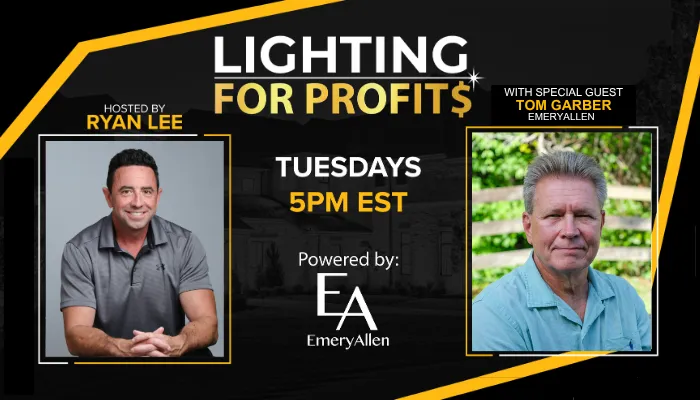
Tom Garber - What Makes Great Lighting?
Lighting for Profits - Episode 257
With 35+ years in the lighting industry, our guest has helped develop innovative lighting products across multiple channels while contributing to the standards that shape the industry. As an American Lighting Association member, engineering committee member, and UL Technical Committee member for UL 1838, 1598, and 153, he brings a unique perspective on where lighting technology, innovation, and industry standards meet.
Watch the episode
Episode Transcript
This episode of Lighting for Profits is powered by EmeryAllen
Welcome to Lighting for Profits. All light. All light, All light. Powered by EmeryAllen. Here is your host, Ryan Lee. Oh, light a lot. All light. Let's go. It's another episode of Lighting for Profits, powered by EmeryAllen. And I'm your host, Ryan Lee. It's going to be an awesome show. We got the founder, the owner, the CEO, the chief engineer, the lighting expert of EmeryAllen uh, on the show today. So it's gonna be a fun show anytime. Um, I have Tom on. I like to reminisce a little bit because it still kind of blows my mind that I get to do what I do. And like, Tom and Emory Allen is, is a really big part of that. And, um, I'm at this point, I'm like, I think Tom, the more I get to know him, is like, he's just a really good guy. So, like, it might not be a business decision. He might just be, like, donating to charity or something like that, supporting Lighting for Profits. I don't know. Um, but either way, I'm super grateful. Um, and so it's, it's always fun having him on the show because we talk about how we met and I tried to steal his name and some other things and stuff like that. But, uh, we got Tom Garber with Emory Allen, and, uh, they've made a big splash in this industry over the last several years. So excited to have him on. And, uh, looks like we are. Yep, it's confirmed. The number one landscape lighting show in Charleston, South Carolina. So that's cool. Um, really excited for Light, uh, It Up. Light it up Expo 2027. We're going to start to do a big push of that here in the next few weeks. I, I don't know when it's going to start, but we are going to open it up at some point and be like, get your ticket now. We're going to give you an offer that's like, too good to, uh, turn down. So light it up expo. com. uh, it's going to be March 1 through 4. Put it on your calendars. Las Vegas. Um, it's going to be an epic show, uh, about twice the size as it was last year, so it's gonna be really, really cool. Uh, put it on your calendars. March one through four, 2027. And, uh, Emory Allen, of course, is the platinum sponsor for Light It Up Expo. So excited to talk, uh, about that as well.
Tom Garber says everyone should be offering outdoor lighting now
And, uh, again, we're gonna have Tom Garber, uh, with Emory Allen on in just a few minutes before we have m him On a couple things. Just got to hang out last week at, uh, the huge convention and helped, uh, uh, on a training day that Lights for Decorators was doing. And, uh, so big shout out to them. It was just. I just love being part of those opportunities. Uh, Jimmy with Lights, uh, for Decorators and Omni, uh, JC is part of that team now. So he's, I mean, going. He's over delivering for that community. Um, so if you're looking for landscape lighting, holiday lighting, or permanent lighting, they don't just sell product. I mean, they are, they're there to help you win. Okay? So like me going out there and helping is a big part of that. Um, but they want you to win, right? And so they've got free trainings all throughout the year. If you're looking to get into landscape lighting or holiday or permanent lighting, go to lightsfordecorators .com, get in touch with their team, connect with Jimmy, connect with, uh, JC because they got a good thing going on over there. So. And, uh, actually this week, I think, man, it's kind of crazy. I'm, uh, between my own event and other events I'll be attending, I think I'm on the road like seven weeks in a row. I'm not, I'm like, not gone the whole time. I go out, I come home and do all that. But I think it's like seven weeks in a row. This week I'll be in Denver at Cedia, uh, Cedia Expo. Most people in the lighting world don't know what Cedia is, but, um, man, it's such a cool show. Um, I go for several reasons. Number one, because, like, it doesn't. I could go to like a roofing show, and I'm going to be there taking notes. There's always something to learn. It doesn't have to be specifically on, like, how to design and install lighting. Like, there's a lot of things you can learn from other industries. And so I'm going for that. Um, I go for inspiration because I think, you know, when I, When I, when you go to cda, you see, oh my gosh, like, so many vendors, uh, I think they have over 10,000 attendees. And these are home automation experts. Okay. Like, if you think about, like, how many home automation experts, like how many people in the, in the United States can afford to hire an integrator? You know, that's what they call themselves, integrators. It's like they're the top of the food chain. Okay. And they have this industry event that has thousands and Thousands and thousands of people. It gives me inspiration to see what is possible with the outdoor lighting industry. Okay? Because like, the integrators, they're like the top of the food chain. Like, poor people. Don't hire them. You know, like, you have to have some extra coin to have smart home, uh, automation. And so, um, when I go to these events, my message to pretty much everyone in the room is like, listen, everyone here should be offering outdoor lighting now. Maybe not all of them should be designing it and installing it, but certainly all of their customers are going to get outdoor lighting at some point. So why would it not at least come from them? And so if you own a landscape lighting business and you're trying to grow your business, you need to, you need to start thinking, how do I get in front of, uh, these integrators? How do I build a relationship so that when their customer asks them, hey, do you, do you guys do outdoor lighting as well? When you guys are doing the smart home automation, instead of them saying no, they raise their hand and say yes. In fact, we partner with a local lighting company. Okay. And so, um, I'm not the first one to think of this, okay? There's been manufacturers going to this show for years. Um, and I think it takes time to really get traction. Um, but you'll see that, like, I don't know, maybe a small percentage of them actually will start, like an outdoor lighting division and go all in on design and install and become maybe a competitor for you. But a very small percentage. The rest are going to be amazing referral partners. Okay. And, you know, we just were at the end of summer, um, everyone kind of experiences that summer slowdown, slowdown, back to school and people finishing vacations and people just aren't focused on, you know, home improvement projects. And so typically outdoor lighting slows down. If you're following traditional marketing, uh, spend, uh, doesn't mean that's for everybody. But one, uh, way I've found to not necessarily eliminate, but for sure minimize, and in some cases eliminate the summer slowdown is by building referral partner relationships. You know, people could be in the south of France right now vacationing, and they're still, they're not going to stop their outdoor living project, their, their pool construction, their new home, their remodel, um, those things don't stop. And those, they have different timelines. And so traditional marketing, yeah, the phone's not going to ring as much because it's just too hot. People don't go outside. But when you have referral partner relationships, those Projects are constantly going year round. So whether it's the heat of the summer slowdown or maybe you're in a northern market where there's just like 2ft of snow on the ground, a lot of these projects are still moving on. So, um, this is the key to reducing those slower periods for you. Okay. And so, um, I'm going to build relationships, I'm going to, I'm finding who, um, like how does distribution happen, who are the, who are the players and how do people buy product and how do they make money and what motivates them and things like that. And so, um, I've been going for the last few years and I've already been able to give some of my clients like, projects and relationships, uh, and stuff like that. So, uh, I'm excited. Um, it's going to be a great week. Um, and uh, again, always something to learn. And then if you guys ever go, you'll just see like it's, it's massive. And you know, outdoor lighting industry should be on, on, on the same level. I don't understand why it's not. They have so many different types of certifications, um, for technicians, for business owners, for designers, for installers. Like, it's crazy, crazy the number of classes and, and education that they do and stuff like that. So, um, that's really kind of like who I look up to is like, hey, man, that's, that's Lighted up expo one day, uh, where we get to expand and, and really do it big like that. So that's gonna be a lot of fun.
Use different product, use better product to differentiate your business
Uh, oh, there it is. Hey, did I tell you that Tom Garber with Emory Allen is coming on the show today? I, I figured out a really cool way to help you guys grow your business. And it's pretty easy. You just need to differentiate yourself. Okay. And one way to do that is just use different product, use better product. Uh, it's the easiest way to differentiate yourself amongst your competition. Because let's face it, I tell you guys to answer the phone. I tell you to worry about the client journey, but sometimes you just don't have time. You don't care, you don't listen. So if you just use better product, you really don't have to change a whole lot. You can still not answer your phone, but what we don't want to do is let a bad lamp ruin your client experience. So, uh, make sure you guys check out Emory Allen. They make the, the premier, the premium LED lamps for lighting professionals who demand the best. So, um, easy way to get connected with them is send an email to Jackson. His email is Jackson L. Jackson, the letter L. Jacksonlryallen. com and, uh, he will hook you up at that discounted contractor price. Just email jackson lry allen .com and do mention that you heard about him here on Lighting for Profits. Um, I think that's it. I think we're ready. Um, let's get the music going.
Tom Garber is the president of Emory Allen lighting company
Welcome to the show, Mr. Tom Garber. What's up, Tom?
Hey, Brian, how are you doing?
Awesome, man. We get to geek out with, uh, outdoor lighting and do another lighting profits, uh, Lighting for Profits episode. So.
Absolutely.
I love it, man. Um, I was gonna have you introduce yourself, but I literally today Darcy's like, hey, don't forget about those videos that Tom sent. And I'm like, what? What videos? I watched the videos, uh, about an hour ago and, uh, I was like, what the heck are these? So before I go, I asked you, I'm like, what do we do with the video? Just, just play one or two. So I'm gonna play one or two and then we're gonna go from there. Is that cool?
Sure.
Um, actually, I forgot to pull it up. I've got it here, but I got to share my screen. Um, I guess while I'm pulling this up, you've been on the show several times. Most, uh, people know you, but we do have new listeners. So would you just do a quick introduction, uh, introduction of who you are and who Emory Allen is?
Well, uh, my name is Tom Garber. I'm the president of Emory Allen. Emory Allen, where, um, we, uh, celebrated our 11 year anniversary this past June. Uh, we have, we have been in, uh, or I should say I have been in the lighting industry since 1988. Um.
Dang, you're old.
Thanks, Ryan. Yeah. Um. Hey, Kelly, stop the checks. Okay?
That's awesome. Did I say old? I meant man, you're looking good. So, um, not bad for an old guy.
Yeah, not bad. So we, uh, you know, I've been in the industry since, uh, the late 80s, uh, always, uh, been a product development engineer. Worked for Kichler for, I know, seven and a half, eight and a half years. I, uh, was their product development engineer for their landscape lighting program. Uh, we launched a couple of hundred products, both 12 volt and 120 volt, uh, back in the early 90s. Uh, and that was a lot of fun. You know, I got to fly all over the world, um, got to meet a whole bunch of different people and basically introduce a brand new product, product category to the lighting Industry, Um, you know, there's a couple of other players out there doing it, but, um, you know, there wasn't manufacturer, uh, like size, uh, of a Kitcher out there promoting it. So anyway, worked for them for, you know, so many years. Um, moved Charleston, South Carolina, primarily because we got tired of the snow in Cleveland. And, uh, I was director of engineering with. For. For another lighting company called Quizzelle. And from there bounced around to a couple of places, helped people start a couple of businesses down in Florida. Uh, decided to open up our own business and could, uh, have done it anywhere in the United States. And Charleston's been home to us.
Love it, man.
Allen, your company has made a big splash in the landscape lighting industry
Well, I know you guys do a lot in. At me outside of the landscape lighting industry, but I know at least since I've known you for what, five or six years now, you guys have made a big splash and a lot of people are using your product and everyone seems to be super happy. So you've got. You've got something figured out.
Something's going on. That's right. And I think a lot of that has to do with being diversified into a lot of different areas of distribution. Um, you know, interiors, uh, interior, commercial, ah, residential. Uh, you just get. Get into a lot of different things. So you really can't have a product mess up. You know, it's. It means a lot. And, um, I think I was telling you on last show or something like that that we had an opportunity. It was last year, something like that. We were able to do, uh, go in and, uh, land the job at Carnegie hall in New York. Um, and if you go on our Instagram, you can scroll through there and see some pictures of the inside of that. And, you know, that doesn't come, you know, easy. You know, these people, lighting designers, lighting engineers and all that are very, very critical. And you have to have your stuff together. So we're very, very fortunate that we're able to do, you know, such a. An extreme event like that.
Yeah, that's so cool. I mean, that's. That's just like, uh. I don't know that. That's. That's just a project that, I mean, most people would dream about. So. Okay, I'm gonna. I'm gonna play this couple, uh, videos. This first one is on the Ranger. I'm, um, hoping the audio comes through. I think it should, Maybe. Okay, that's cool. Uh, that's. That's the Ranger. Uh, and then we got a scout, I think. I can't remember which one. Maybe I'll play more than one um, here's the scout video. M. Okay, so that's, I mean, this is a lot different than the Emory, uh, Allen I'm used to. That's the first thing I thought. What's going on with these?
Um, you know, just like with any industry and as you tell a lot of your, you know, clients and all of that, I mean, you gotta step out of the box, you gotta be different. Um, it's what sets you apart from everything and everyone else. And if you go on to, you know, know, Facebook, uh, Instagram, just look at different Facebook, uh, ads and things like that, you know, things can get kind of boring and, and all that. And we wanted to do something that is a little bit more eye catching. Um, you know, so people are scrolling across something, they're going to go, whoa, what was that? What I just see? Yeah, they're going to go back to it and look at it again and again. Well, um, earlier this year, earlier this year we, uh, we hired a videographer and um, my son Matthew runs the marketing department and he's got some pretty crazy, far fetched ideas. And as a result, you know, we come up with those couple of, of clips. So, you know, it's all about stepping out of the box, you know, investing in yourself and your business and your company to set you apart from everybody else. And that's kind of what we're going for here.
Mike: The packaging for the iPhone 5S is unique and interesting
Okay, sweet. I want to play one more. Uh, this is a Ranger as well. So I, I saw that and again, my first reaction was like, okay, this is Tom stepping outside the box. This is not normal emerald. I'm like, did you know what rap? It was like, this is cool. And then, um, a couple things stuck out. Mike, I want to ask you, like, what, what's the, what's the significance of like the map and like the terrain and stuff? And then also notice it was like. And there's a lot more layers to the, uh, the ranger fixture. You know, like, I think it's easy to just see it as, as one piece and be like, oh, it's just fixture with a diode in there and probably a lens. Um, so let's kind of go in the order. Like, what's, um, up with the, like, how did you guys decide, like what was going to be shown on the video and stuff like that?
Um, you know what, we'd have to have my son in here to describe that. And I don't have a clue what, what he was thinking, but everything there, everything there has significance. Like if you had seen the box or the tube that these come in. You've seen those, right?
Yeah. Yep.
So they both have maps on it and they're different maps. Um, one of them is the. A map of upstate New York, and that's where him and his wife, um, honeymooned, uh, uh, after he got married. Um, and then the other one is in Tybee island in Georgia. And I don't have a clue why he picked that one.
That's awesome. It looks cool. It looks cool. Um, yeah, no, I mean, just even like seeing the video, like you said, you got to do something different. Like Apple, um, forever has been known for, like, their packaging. You know, you buy this, this, this iPhone, this phone, but it's like an experience just opening it up and your packaging does that. But, but even just the video, before you even buy the product, it does separate it to be. I mean, you could have just shown a picture of the light, you know, and that's what everyone else does. So it does, it does catch your eye. It does catch your attention.
Yeah. And, um, that's what we're going for, so I can't wait to see what the rest of the year brings.
Okay, sweet. Well, it's exciting.
In this episode, Tom puts himself in the hot seat as an engineer
Um, I wanted to, I wanted to like, um, make this episode a little bit different because in the past, I kind of. Past episodes, I kind of asked you about your experience as an engineer. We've talked about kind, um, of like trends in the lighting industry, stuff like that. But, um, I don't know, I was like, I was like, I kind of want to put Tom in the hot seat. And um, it. I don't think it's too hot, but it's, it's warm. Are you, Are you down with some, some hot seat, Warm seat sessions?
You know what, we're in Charleston, South Carolina, and it's over 90 degrees with 90% humidity. I don't think you're going to touch that too much.
Who do you see making moves in the outdoor lighting space
So let's talk about. I kind of want to talk about, um, you know, obviously we're going to talk about Emory Allen, but talk to us about like, you know, you go to a lot of different, uh, shows. Uh, you participate in a lot of things, um, other than yourself. Who, who do you see making moves in the outdoor lighting space?
M. You know, it's. That's a really good question. Um, just from the standpoint is, I don't see a lot going on. Um, you know, certainly Lumion has done a great job with, you know, a couple of their fixtures and, you know, Sterling's done a good job with uh, you know, everything that they make. I think one of the things that's out there that, um, people really haven't jumped on has been, uh, some of Hinkley's products, uh, have been designed to. With this matter over Thread Mesh Tech. I think, uh, Blue Hopper has something similar. But, uh, you know, going to some of the different shows and events and seeing what they have, um, is very, very impressive. Uh, happens to be, you know, one of my good friends. Um, Mike Kachell is the director of engineering over there, and he just lets me know, you know, what's going on and what he's doing and this, that. And so, you know, if people have an opportunity, you know, check out some of, you know, Hinckley's products. Um, you know, that's all pretty cool,
but, you know, and those guys don't. They're not usually representing themselves in, like, the. The Green Channel much, right?
No, there's. They're pretty much still in the, uh, the lighting showroom. I mean, that's where landscape lighting started. Landscape lighting started in residential, uh, decorative, you know, lighting showrooms. And I don't think that they have moved out of there too much. They might be in a couple of green houses, but not. Not too much. They get a lot of commercial work, so, you know, they might have spicked. They might have skipped over the Green Channel and went directly into, um, the spec marketplace.
Do you see opportunities for Emory Allen to expand into different areas
When you're. When you're, uh, seeing like, what other people are doing and innovations or lack thereof, whatever, do you see any, uh, opportunities for Emory Allen to expand into different areas, different, uh, emerging markets or anything like that?
Um, I see opportunities every day. Um, it's just a matter of, you know, human body resources to be able to pull some of this off. I mean, um, you know, business has been very, very good for us where, um, we're taking, you know, market share. We still have a lot of, uh, organic growth and all of that. We're introducing, uh, 41 new products by the end of the year. So there's a ton of other opportunities. It's just a matter of, you know, having the time to do them.
41 new products, like how many light bulbs can you make
a secret between you, me and the fence post is that number was up around 190, and we cut it back to 41 primarily because we're, uh, going through a major, uh. We're going to be going through a major renovation here. And, you know, it's a matter of where do you put all these when you're in the Middle of renovating. So yeah, we dialed that back an awful lot.
That's crazy. Still, I mean, dialed back down from 190 to 41. Is this because of the. The Will it Lamp ah series on Instagram?
They.
Are they challenging you more than you thought or what?
No, no, that was, ah, that was a great uh, uh, experience. But um, no, you know, another part of our business has been ah, commercial hospitality. Uh, you know, I mentioned the thing with Carnegie Hall. There's a, uh, um, there's a restaurant chain that's out of uh, uh, Vancouver, Canada called Earl's. And uh, I don't know if you have any out by you, but they started out in, throughout, uh, Canada and they've moved to different areas, uh, of the United States. I visited one, um, last year after uh, Greg Matthews event. Jackson and I went and checked this place out and it's just incredible. They use all of our, uh, uh, dim to warm technology. Um, and so they've got Emory Allen all over the place. It's, it's absolutely great. So we're just doing so many different things. We got a manufacturer that's right down the street from us, um, that's called uh, Urban Electric, uh, uber, uber high end stuff. I mean, I don't think you can touch a product, you know, for inside your house for under 2,500 bucks. But it's all handmade here in Charleston and the quality is just unbelievable. And that business has really taken off for them and it's taken off for us. So it's just like there's so much stuff going on. It's pretty incredible.
Are you still, uh, with like the new product development and engineering
Are you, how involved are you still, uh, with like the new product development and engineering and all that?
Um, I would say that I've kind of dismissed other areas of the business to other people, other family members and all of that. And the two things that, you know, I really enjoy go doing, going to is a lot of product development. I've done that all my life. Always trying to figure out, you know, the latest and greatest and whatnot. And then the other thing is, you know, I like going out and meeting people and talking to people and um, you know, selling Emory Allen.
Yeah, that's cool. Well, I mean, since, since day one, pretty much that we started doing events. Um, I remember it was like, hey, uh, can, uh, I be a part of, you know, landscape lighting live or something? And I'm like, sure. And they're like, well, when do I get there? I'm like, oh no, you don't get to come. I Was like, what? I don't. What do you mean? Like, be a part of. I didn't know what that meant. Um, and so we're like, okay, we'll just make a spot for Tom, I guess, you know. But, um, now it's kind of cool. I mean, this year, in, like, two weeks, we've got Secret Summit, and it's the first year we're inviting a handful. I mean, very selective. I think there's maybe 10. Uh, they're not even all manufacturers, manufacturer, distributor, marketing, um, companies, just partners of ours. Um, and I think it's gonna be cool. You know, they're all invited for the first day because I feel like it does add a lot of value. It's not like a trade show or anything like that with booths, but just to be in the room. And. And you've. You've always done a very good job at that. You're like, it's not. It's not the. The Emory Allen show or the Tom Garber show, but people always find a way to find you and, you know, ask questions and get to know you. And it's like a. It's like a sniper sales approach, you know, where people just want to do business with people that they like and trust. So, um, you've. You've been an inspiration for that to. To head.
We have our first vendor day coming up in a couple weeks
Now we've got our first kind of like, vendor day, uh, here in a couple weeks. So hopefully it works.
Yeah, no, I think it will. And, you know, I saw the list of, uh, uh, vendors, and I saw the list of, uh, attendees, and I'm really excited. You know, a lot of the vendors, you know, to me, they're not competition, just they're good friends. You know, it's. It's. To me, at this point in my life, it's more about the relationships, uh, that you establish and, you know, helping each other out and. And all of that. So, you know, a lot of these guys, they're. They're good friends. And then, of course, all the attendees, um, you know, they're guys that were with you from day one, and so were we. So, you know, there's some relationships there.
That's cool.
Who is Emory Allen's biggest competition? You didn't answer question
Well, who.
Who is your biggest competition?
You know, um, I would say that our biggest competition are the people that don't really recognize what Emory Allen is all about. And it's. And it's getting to those people, um, whether it's contractors or distributors or all of that, to really, um, show them what they're missing, um, because, you know, the quality of our product, uh, continues to grow, uh, technology continues to change and. And all of that. And so if you're not on top of that, um, you know, uh, you know, there's too many people out there that are just, you know, copying everybody else and all of that. But, you know, you've got to stay on top of the LED chip game and all of that. So it's our job to teach those contractors, those distributors, and all of that, um, why you should be buying an Emory Allen product. So, I don't know. That's a lame answer to what you're.
It was for. It was a very kind answer. To what? To the question. But you definitely didn't answer it. So, um, you, like. What does it rhyme with? Rhymes with.
Just say. What rhyme.
Our biggest competition is us. It's, you know, our biggest. Say the name your biggest competition saved
Say the name your biggest competition saved. Give me a name right now.
It's not. It's, you know, our biggest.
Come on. I want to. I want to.
Our biggest competition is us. Uh, we have to do a better job with selling our product and going out and, uh, you know, training people. People. You know, we've gone around and, you know, the last, you know, couple of months, I don't know, we've been in Florida way too much time, uh, visiting distributors and all of that. And, you know, the one thing that keeps on coming up is training, training, training. It's like, order a food truck, I'm here. You know, what do you. What do you want to know? And, you know, we're not going to give you a bunch of BS or tell you what it's not. You know, we're going to tell you the truth. We'll. We can show you, you know, the difference and, um, you know, proofs and proofs. In the pudding.
You will not be fighting at Light It Up Expo
All right, well, I don't know. I've got this dream that we're going to do this huge cage match in the middle of Light It Up Expo. And, like, people are just gonna fight. So apparently you. You will not be fighting.
No reason to. No reason to. Um, I've already won.
This was just inspired because there's a lot of people in our industry that are, like, wrestlers and, like, it tends to turn into a little bit of, like, talking smack and stuff. And I was like, maybe. Maybe we should just do a cage match, you know? But then I was thinking, you know, if you would just call out your competition and say their name right now, then they would call you out, and then you'd be like the Platinum Fighter or something, you know?
Yeah, there's. There's no need. You know, um, the. The greatest thing about uh, that one of the things that I enjoy is, you know, everybody is going to screw up in business, whether it's going to be a manufacturing problem, a delivery problem, this type of problem, whatever. And we like, we like solving pain, we like taking the pain away. So when people experience pain with their current um, products that they're using and all of that, just check us out and we'll take that pain away.
All right, that sounds good.
Talk about integrated versus drop in lighting fixtures
Well talk about this then. Um, talk about integrated versus drop in and we'll put integrated and modular in the same category. Uh, but just take, talk about you know, emery on lamps in a, in a lamped fixture versus uh, an integrated housing.
Um, it's interesting how that whole thing has, you know, evolved. Now honestly the, in the past the best um, mirror you can get the most light out of an integrated product if it's designed properly. Meaning the integrated um, LED and the drivers and all of that have to be heat sunk onto the, the or into the fixture itself. So the fixture is absorbing and dissipating the heat. So in the past, you know, the only way that you're going to get you know, 800 lumens out of an Mr. 16, uh, size fixture was to go with integrated, ah, you know, type fixture. Yeah, um, not so much the case anymore. We, we have earlier this year came out with an Mr. 16 and 8 watt that I think produces about 875 lumens. Wow. Now this is what I mean about you need to be on top of your game as far as a R and D standpoint and finding out what's doing what and what you can do. There's a lot of new technology out there that you know, you just need to um, you just need to stay up on, on top of. So in the past it was integrated uh, primarily because of, you know, the amount of lumens that you could put out. Um, so you know, if you look at a drop in fixture, whatever you want to call them, um, you always have the ability of changing um, a bulb whether the, um, uh, maybe you want to come back during the, for the seasons and change out a color temperature. Uh, uh, maybe you want to change out a wattage or you know, lumen package or something like that. You know, it's, that's pretty easy to do with a drop in fixture. Um, so what's interesting is a couple of years ago we were approached by a major manufacturer, uh, that wanted us to produce their light bulbs for them. They also have integrated fixtures and I asked them. It's like, you know, what is it that you do better than and one than the other. And they said honestly, we make more money on integrated fixtures than on drop ins. And that's why we like to push integrated fixtures. So that, that's always sat in the back of my head with me.
Yeah, well, I mean just from a, I mean if you're making 20, 20 points off of a $10 lamp versus 20 points off $100 fixture, I mean the math is math, right? It seems like you're going to make more money for sure.
Yeah, yeah.
Like so you're, it's always like, it doesn't concern you because you, you've done all the engineering. Like you've got the heat sinks now for that, you know, 800 plus lumen lamp, but then you still put it inside a fixture that isn't necessarily designed engineered to dissipate that heat. Does, does it not bake inside of that?
So um, there's a video out there floating around somewhere. What we do is we typically take an Mr. M16 fixture, uh, solid brass fixture and we'll take an Mr. M16 lamp, we'll put it inside of that, hook it up, transformer, 15 volts, we'll throw it in a heat chamber and we'll throw it in the heat chamber, turn that heat chamber up to 125 degrees Fahrenheit and let her rip, see what happens. Um, we've yet to burn out an Mr. 16 and I'm talking after nine 12 months worth of 24, 247 heating. So there's, there's a lot of secrets behind that as well. But um, you know, I can say that uh, what the biggest failure point you get at that point is that you start um, burning out all of the moisture from the polycarbonate lens and the polycarbonate lens starts to yellow or turn brown. Um, and this is a fairly high end, very stable, um, uh, polycarbonate. If you use acrylic, that happens a lot quicker. Like there's a couple of bulb manufacturers out there that use acrylic lenses, um, but they can't take that heat nearly what polycarbonate is. So. Okay, that's how we test it.
Um, what about the operating. What's, what's the standard operating range for the majority of your like Mr. 16 by pin type lamps? Volt. What's like the operating voltage?
Voltage or temperature?
Uh, voltage. Like, because some people are like really like they'll just get a 15 volt transformer and hook them all up and as long as they're between like 9 and 15 or would you prefer it be like a higher voltage or on the lower side?
Um, our bulbs are all meant to dim, so you can go either one way or the other. Um, ul, National Electric code and all of that. They talk in terms of less than 15 volts. So, um, you know, if you hook our bulbs up to a let's go dimmer, you can dim those things down to, you know, about, I don't know, 50 lumens, 25 lumens, you can dim them down. So then you take it the other way and you could probably go up to, um, you can't exceed 17 volts on the high end, um, because we don't have the capacitors and all of that, uh, to allow that to happen. Everything is on the low end and not on the high end.
But so let's say someone hooked up a series of, you know, 20 emerald lamps. Is the first one going to be brighter because it dims if it's at 15 and then the one down at the ends at let's say 11 volts is, is one gonna be brighter than the other?
What's interesting is that there is a range in which the bulbs all operate very, very close. And let's say that range from a lumen standpoint and you know, we'll say plus or minus 35 lumens, uh, something that you're really not going to see. Um, we might be operating from 11 volts on up to 15 volts, all about the same. Okay, then, and then after that 11 volt, it starts to uh, decline from there, primarily because that's the way the bulbs were designed to work.
Okay, cool.
Let's Go dimmer is first digital type of dimmer
Um, you, I know you're a big fan of the, um, that you mentioned, like the let's go dimmers. Um, what is it about that dimmer versus, like other dimmers that uh, that you like about it?
Well, um, Dan Utley's done a great job um, with let's Go and, and making that dimmer. Uh, you know, his, I believe is the first digital type of dimmer, uh, made to do what it has to. Um, I think everybody else is pretty much, ah, all ah, analog based and you know, you can't put as m much, uh, wattage on them. They overheat easily. Um, you don't have the type of regulation, dimming regulation on them as the, you know, digital dimmers that let's Go makes.
Okay, cool.
Tom: We started a new segment called you make the call
Um, we're gonna do a game. I don't know if you saw this, but we started a new segment called you make the call. Okay, so we've, we've, uh, it's, it's kind of fun because it allows us to get to know you a little bit. It's a little informal question. Some are fun, some are about business, family. I, uh, try to mix them up, but, um, we've got a new partner called Call Source. And the reason why these guys are cool is because, you know, most business owners have heard this. You probably heard this too. It's like, um, the fortune is in the follow up. And then problem is you start running a landscape lighting business and you don't have time to follow up. You're like, well, man, I just got to make it to the next quote and then I got to get back and do a nighttime adjustment and all these different things. So what they, they're basically, they've got a lot of different, like, call tracking numbers and stuff, but they also have a US based, um, outbound call center. So they'll act as an extension of a lighting company, call people on a regular basis. Hey, just want to check on, see on that follow up on the proposal. Um, could be schedule help, more, more appointments, those types of things. So they put together a deal. It's, uh, 50 off your first month if you do mention lighting for profits. Um, so if you guys want to check it out, you go to try.callsource.comlfp try.callsource. com lfp and they'll get you a demo. Free demo, plus 50, ah, percent off your first month. So, Tom, are you ready to play? You make the call. Sure.
All right, so I know you travel, uh, quite a bit
All right, so I know you travel, uh, quite a bit. You, um, arrive in a new country with a free evening. Do you visit the most famous landmark or do you find the best local restaurant?
I go to bed.
That's awesome. You don't even care if Greg Matthews was like, you've got to try this restaurant. It's the best. It's, you know, five minutes from your hotel. You're like, I'm going to bed.
I'm see it tomorrow.
Okay.
You gotta figure you go to some of these countries that we do, and, you know, you're traveling, you know, 24 plus hours, and so when you land, last thing you think about is food. I just want to get some sleep.
Okay. Um, would you rather take a luxury vacation where everything is planned or an adventure where you make it up as you go?
Um, I like something that's planned.
Okay. I forgot we got rap music for you today since you got your, uh, Tom 2.0 out you know, um, okay, would you rather always arrive at the airport two hours early or regularly show up with only 20 minutes to spare?
Uh, the. Honestly, it depends on the airport. You know, I'm flying off to Cedia as well, and Jax and I were talking, and we'll probably get there about 30 minutes before boarding time. But that's at the Charleston airport. I'd never try to pull that off at, you know, a major.
Chicago.
Yeah, yeah, something. That'd be crazy.
Yeah, it does depend on the airport. You're right. Uh, you. You were first on plane. On the plane or last on the plane kind of guy?
First on the plane.
All right, get that, uh, that overhead space.
That's right.
All right. Uh, mountains or beach?
Beach.
I thought so. I thought so. I'm still. I've been talking about this for years now, but we're coming down at some point because I'm going for a boat ride in the bay.
Good deal.
You have to give up one forever. Steak or seafood?
Um, I think it would have to be seafood.
All right, what's your. What is your favorite seafood?
Um, I mean, Charleston's got some of the best shrimp in the world. I mean, it's just like, you know, eating a candy bar. Just so sweet. It's unbelievable.
Do you like shrimp cocktail?
No, not really.
I don't know why that wasn't on my questions, but now I'm intrigued because I like shrimp, too, but I can't
do cold ketchup on your steak. You know, it's like, what are you talking about?
Yeah, it seems weird. I'm glad. I'm glad because we almost broke up. If you would have been like, oh, my gosh, that's my number one favorite type of shrimp.
No, I mean, you get. You have a shrimp cocktail when you're getting your shrimp at Sam's or Walmart or something like that. But to have some of the shrimp that's available here in Charleston, you don't need anything on it.
Someone's coming to Charleston. They just got one evening. What. What restaurant they should they go to?
I'd go to any of the ones at, uh. On Shem Creek.
Yeah. Okay.
There's probably. Shem Creek is where all the shrimp boats come in.
Okay. So it's just fresh. Fresh seafood.
That's it? That's it.
I like it. Okay. Uh, m. Okay.
Emory Allen can only produce one color temperature
So, Tom, for the rest of your career, Emory Allen can only produce one color temperature. What's it going to be?
I thought you'd at least give me two.
Um, I was going To. That's what's written down on my question. But I, I called an audible.
I mean, it's crazy because, uh, um, throughout the world, wherever we sell our products, it's almost a 50, 50 split between 27 and 3,000.
Really?
Yeah.
And who decides that? The designer.
Um, you know what, A lot of it is based on geography. I mean, in your neck of the woods, believe it or not, the mountain estates all the way down to Vegas, you can't give away a 3000K lamp. It's all, it's all 2700. In Florida, you'll get 3000, you'll get some floor. 4000. New York, you know, it's the same, same thing. So it's, it's really strange.
Yeah. That is interesting.
What color temperature are the lamps on your house? 20.Okay, so did you pick one? What color temperature
Okay, so did you pick one?
What color temperature are the lamps on your house?
20. Well, actually, exterior lighting.
Yes.
3,000.
Really?
Yeah.
It's so weird because that one neighbor that stands out from the whole neighborhood.
Huh. Huh? Yeah. Get them out of here. What's crazy is like, when I got into the lighting game, it was, you know, incandescent. So it was, I was just like trained and conditioned. It's 2700. 2700. But just like, as I got older, I started like, seeing things differently. And I was like, I kind of like, I kind of like 3k on things. And so the reason I did it on my house, I have a white house, so I wanted it to stay white. And when I put 2700 on it, it kind of made it more yellow, you know?
Sure.
So I did it for that. And then what's crazy, I've got a, um, street, ah, light right out here, like on the corner of my lot. And it's like what, 5000k or something? So it's so white that if I didn't tell you, you'd probably think that my lamps are 2700 because it's. You have that, that point of reference. Do you know what I mean? Um, cool headlights, like our newer cars. Yeah, like the, the brighter lights. So my lights, my 3000k in comparison to 5000k, just looks so much more warm. So. Yeah, I like it. But I, I noticed that, that the color, temperature matters more when you have a reference point, when you have something else against it, because otherwise you can't really tell what it is unless you have something to compare it to.
We have one of those ugly street lights behind our house. Uh, we have alleys where we live. And, uh, it's terrible, terrible color. And finally I got up on a ten Foot ladder with some flex seal and I painted that sucker so we couldn't see it. Yeah, that's terrible.
I do leave it there because I didn't install a basketball light and I'm like eh, kind of lights the driveway. Good enough. And it doesn't, it doesn't compete with like the lighting on my house. Um, still there. But um, okay, so, um, you get to build a 10 million dollar company with great culture and lots of freedom or a 50 million dollar company that requires you to be there 60 hours a week.
10 million all day long.
You decide to start a design and installation business
All right. Um, okay, last one you get. You decide to start a design and installation business. Um, what city are you going to go to?
Man, there's so many of them.
Um, um, you know, who's doing well, you know, who's buying lots of product. So would that, would you go there because of that? Or would you, would you like maybe like pick the top city that has purchases or would you go to like a two or three to.
I'd go to some place that doesn't have a lot of uh, installation or professional or whatever. Um, you know, and there are so many, you know, up and down the coast. You could call it from Hilton Head, Charleston's uh, well covered Myrtle Beach. Uh, go over to Nashville. I mean with all the growth that's going on in Nashville, it's so. There's so little lighting. Uh, that's, that's there.
So
Nashville, tough one.
Maybe Nashville maybe.
Maybe Nashville. I'd hate to give up the coast though, my dude. Hilton Head.
I think, I think I see you more as a Hilton Head guy. All right, you open up Hilton Head, I'll open up Nashville.
What is that supposed to mean?
I don't know. I guess just a beach guy. Yeah, you said you wanted, um, beach over mountains, so.
Absolutely.
All right, well, thanks for playing. You make the call, Tom. It's kind of fun get to know you in a different way.
Why haven't you guys gotten into color lighting, rgbw
So, well, I just have a few more questions for you, really around kind of the industry and products and stuff like that. Um, uh, why, why hasn't, why haven't you guys gotten into color, uh, changing rgb,
you know, um, we actually had a full line, uh, developed. And then you go back and you look at what percentage of all lighting that you sell is. Um, rgbw. And uh, for us it would probably be such a small percentage that financially it doesn't make any sense. Um, you know, we're always tight on space and, and all of that. And then on top of that, you know, I Don't want our customer service people or even our customers to become, um, you know, somebody else's IT Department, you know, doing things with routers and this, that, uh, and everything else. So. I'll pass.
Yeah, I mean, it's interesting because there's. There are some companies that definitely do more. That's kind of like their brand. I feel like they. They push that more or they. They find those clients, they want it, whatever, however you want to say it. But I really felt the same way when I had my lighting business. I would bring it up as, um, an option, because if someone wanted it. Okay. Um, but it was really more of a decoy in most cases, because when people chose it, I was like, hey, just so you know, like, this isn't like, it just. It's the easy button. And, like, everything works all the time. In fact, it's. It's actually a little bit more complicated, and you're probably gonna have more problems because now we're involving a lot more technology, and sometimes people would go, oh, well, we're glad you told us that. Let's not do it. Um, and I'm just trying to be upfront and honest. Like, it's not. It's not just foolproof. Cause it isn't just like, lights turn on, lights turn off. There's. There's more to it.
Right, Right. No, um. Um, we'll pass. It takes a lot to get white. Correct. And that's where we're focusing on.
Do you ever consider moving your production to the U.S.
Do you guys. Do you ever consider, uh, moving your production to the.
To the U.S. oh, my gosh. It's a discussion that my son and I have on a constant basis, really. And. And unfortunately, when, uh, when Cree pulled out, um, we got involved with Cree when we first started Emory Allen, they were in rtp, Research Triangle Park, North Carolina. And we, uh, did a lot of development with them, um, hoping to, um, bring that, uh, here. But, um, there aren't any LEDs made here. So you're importing LEDs, you're importing components, you're importing just about everything. Uh, you know, from a overall tariff and all that standpoint, you know, you're gonna wind up paying more for those components than you would if you just brought it over complete.
Yeah, that makes sense. So at least for now, it's stay the same.
It's a. It's a constant, uh, discussion about bringing things back over here. You know, you look at, you know, our products too, and, you know, it's almost 100 ceramic, uh, based. Aren't any ceramic suppliers over Here that can do that either. So you're importing an awful lot of components to assemble it here just to
say it was assembled here. Yeah.
Correct.
That makes sense.
What scares you about the future of the landscape lighting industry
Um, what scares you about the future of the landscape lighting industry? Um,
Uh, nothing.
Nothing really. No uncertainty or, uh, worry about, uh, regulations or um, AI taking all of our jobs or anything like that?
You know, AI is not going to build light bulbs. You know, regulations. There's a lot more regulations on that going on now than a lot of people know about. Um, not just California, but the Department of Energy and, and all this. And I've worked on projects with the Department of Energy that they've implemented a, uh, a law into effect without the technology being available. So, um, yeah, uh, nothing really concerns me all that much right now.
Um. What? Uh, I don't know. I've only got a couple more questions. I'm trying to figure out which one too.
What's something manufacturers tell contractors that you think is complete bs
So, um, is what's something that manufacturers, you've heard, maybe manufacturers or distributors tell contractors you, that you think is complete bs? You don't have to name names. Um, anything you've heard that you're just like, no, that's, that's not right.
I can't put my finger on it. I'm sure that there has been some times where I've turned around and said that's a bunch of. But, um, you know, not. Nothing so blatant that it's just an out and out lie. You know, they might not tell the truth all the way, but anyway.
All right, the last, uh, the last, uh. I think I'm trying to be more like um, 60 Minutes with you. You know, it really put you on the spot.
Talking about manufacturer versus distributor. Um, I know for you, you've had
But, um, let's, let's close. Talking about manufacturer versus distributor. Um, I know for you, you've had, ah, you know, you sell direct, you've got some distribution. Um, there's certain manufacturers that only sell direct. There's some that only go through distribution. I know. It's one of those things that almost gets me in trouble sometimes because it's like I've, I've got relationships with a lot of different people in this industry and then sometimes the distributors don't like the fact that I'm doing something with a direct to contractor and vice versa. Um. What, which, which one's better?
I mean, I don't think anyone is better than another. You just have to kind of understand a lot of the ways of different types of distribution. I've backed off a lot on, um, you know, selling direct, um, to contractors, um, just from the Mere standpoint is we see a lot of contractors, um, going to different types of distribution. Don't get me wrong, we still sell an awful lot, but, you know, we're going, uh, more towards the premium distribution houses that offer their, uh, customers, uh, training and, and, and all of that. And in many cases, you know, some of the distributors said, uh, um, you know, what's it going to take to give some of this direct, um, back to us? And it's like, you know, if you can talk them into it, you can have it. So, um, that's, that's interesting. Um, uh, we sell to well over 200 OEMs all over the world. So, um, I think, I think that attributes a lot to our overall growth. Just, uh, that you open up box, uh, it's got something in it, and then there's a box or a light bulb that's got Emory Allen's name on it. So, you know, we do a little bit of that. Um, I mean, it's no secret, you know, we sell on Amazon. Um, we had to pretty much sell on Amazon and because some of our customers were buying Emory Allen and then selling on Amazon and did an absolutely terrible job with it, and it really ruined our reputation because they didn't have the technical support and, and all of that to go along with it. Um, so we do not allow anybody else to sell on Amazon, um, except for us. Um, and then we actually mark up product that we sell on Amazon, you know, an additional amount. So, you know, I think there's room out there for everyone. You know, there's not. You know, if you look in the middle of Tulsa, Oklahoma or someplace in South Dakota, there's not always the distributors around there. So you do have to, you know, you don't want, you, you want to help people out, so you offer
to
sell at a, uh, contractor pricing.
Got it. Okay, cool. Well, if, uh, people want to get a hold of you, what's the best way to do that? Or did I already tell them the email?
I mean, you can contact, you know, myself tom gary allen. com you can talk to, uh, jackson jackson lrealin. com. um, our phone numbers are all over the place to go onto our website. Um, just, uh, you know, reach out, go on Facebook, Instagram and say that you want, and you can message, uh, all of us and we'll help you out.
Sweet. Or come hang out in Park City in two weeks.
Looking forward to it. Looking forward to it. I hear the weather there is, uh, going to be not too much cooler than it is here.
No, it's going to be magnificent because it. Man, it's been hot here like over a hundred. Uh, but the weather broke. We finally got tons of rain. It's down in like the 80s, like maybe low 90, but Park City is always a little bit cooler. Anyway, it's, it's gonna be nice.
Right? Cool.
Ryan: Tom, thank you so much for coming on the show
Is there anything else we need to, uh, share with the world before we wrap up?
No, I don't think so. Check out our new, you know, Facebook ads and Instagram ads and look for more, you know, that crazy marketing stuff going on.
Love it. Well, Tom, seriously, thank you, uh, for coming on the show. Thank you so much for everything you've done for us for the lighting industry. Um, you're, you're, you've made it so much easier for us to accomplish our mission. Uh, I mean we've got Secret summit, um, and our, uh, the first year when people join our program now we used to charge um, $2,000 to, to do this type of event. Um, now the first year people have to pay. It's not much. And then the second year and beyond, it's free. Um, and you're like a huge part of that. And people are going to see in a couple weeks like, wow, they get to come to this event and it's like fully catered and it's awesome speakers and awesome experience and uh, you're just like a huge catalyst, uh, I know, for inspiring other manufacturers and vendors and stuff to jump on board and to be able to help us, you know, accomplish this mission. And you, you see some of these transformations in these businesses. Some of these guys are going from broke to, you know, million dollars a year in a very short period of time. And it's not, it's not just about the money. It's about the freedom that they're, um, able to create for their families. And uh, the ecosystems are able to give back to their, their own company, their people and their, how they impact their local economy. And people are giving back to charities and just so many things. Um, and I just think that Emory Allen has been such a big part of that. So I really appreciate you, I appreciate your family, uh, your whole team for just over delivering for the lighting community.
Well, thank you very much for saying that. We also do appreciate you and everything that you guys have done for, um, the lighting industry and look forward to many more years of it.
It's gonna be awesome. We'll see you in a couple weeks. I'll make sure the weather cools down for you.
Sounds great. Thanks a lot. Ryan. You guys have a good day, all right?
Have an awesome day. And, uh, I am coming to Charleston. I just don't know when. All right, guys, have a good one. We'll see you next week.
Tom Garber - What Makes Great Lighting?
Lighting for Profits - Episode 257
With 35+ years in the lighting industry, our guest has helped develop innovative lighting products across multiple channels while contributing to the standards that shape the industry. As an American Lighting Association member, engineering committee member, and UL Technical Committee member for UL 1838, 1598, and 153, he brings a unique perspective on where lighting technology, innovation, and industry standards meet.
Watch the episode
Episode Transcript
This episode of Lighting for Profits is powered by EmeryAllen
Welcome to Lighting for Profits. All light. All light, All light. Powered by EmeryAllen. Here is your host, Ryan Lee. Oh, light a lot. All light. Let's go. It's another episode of Lighting for Profits, powered by EmeryAllen. And I'm your host, Ryan Lee. It's going to be an awesome show. We got the founder, the owner, the CEO, the chief engineer, the lighting expert of EmeryAllen uh, on the show today. So it's gonna be a fun show anytime. Um, I have Tom on. I like to reminisce a little bit because it still kind of blows my mind that I get to do what I do. And like, Tom and Emory Allen is, is a really big part of that. And, um, I'm at this point, I'm like, I think Tom, the more I get to know him, is like, he's just a really good guy. So, like, it might not be a business decision. He might just be, like, donating to charity or something like that, supporting Lighting for Profits. I don't know. Um, but either way, I'm super grateful. Um, and so it's, it's always fun having him on the show because we talk about how we met and I tried to steal his name and some other things and stuff like that. But, uh, we got Tom Garber with Emory Allen, and, uh, they've made a big splash in this industry over the last several years. So excited to have him on. And, uh, looks like we are. Yep, it's confirmed. The number one landscape lighting show in Charleston, South Carolina. So that's cool. Um, really excited for Light, uh, It Up. Light it up Expo 2027. We're going to start to do a big push of that here in the next few weeks. I, I don't know when it's going to start, but we are going to open it up at some point and be like, get your ticket now. We're going to give you an offer that's like, too good to, uh, turn down. So light it up expo. com. uh, it's going to be March 1 through 4. Put it on your calendars. Las Vegas. Um, it's going to be an epic show, uh, about twice the size as it was last year, so it's gonna be really, really cool. Uh, put it on your calendars. March one through four, 2027. And, uh, Emory Allen, of course, is the platinum sponsor for Light It Up Expo. So excited to talk, uh, about that as well.
Tom Garber says everyone should be offering outdoor lighting now
And, uh, again, we're gonna have Tom Garber, uh, with Emory Allen on in just a few minutes before we have m him On a couple things. Just got to hang out last week at, uh, the huge convention and helped, uh, uh, on a training day that Lights for Decorators was doing. And, uh, so big shout out to them. It was just. I just love being part of those opportunities. Uh, Jimmy with Lights, uh, for Decorators and Omni, uh, JC is part of that team now. So he's, I mean, going. He's over delivering for that community. Um, so if you're looking for landscape lighting, holiday lighting, or permanent lighting, they don't just sell product. I mean, they are, they're there to help you win. Okay? So like me going out there and helping is a big part of that. Um, but they want you to win, right? And so they've got free trainings all throughout the year. If you're looking to get into landscape lighting or holiday or permanent lighting, go to lightsfordecorators .com, get in touch with their team, connect with Jimmy, connect with, uh, JC because they got a good thing going on over there. So. And, uh, actually this week, I think, man, it's kind of crazy. I'm, uh, between my own event and other events I'll be attending, I think I'm on the road like seven weeks in a row. I'm not, I'm like, not gone the whole time. I go out, I come home and do all that. But I think it's like seven weeks in a row. This week I'll be in Denver at Cedia, uh, Cedia Expo. Most people in the lighting world don't know what Cedia is, but, um, man, it's such a cool show. Um, I go for several reasons. Number one, because, like, it doesn't. I could go to like a roofing show, and I'm going to be there taking notes. There's always something to learn. It doesn't have to be specifically on, like, how to design and install lighting. Like, there's a lot of things you can learn from other industries. And so I'm going for that. Um, I go for inspiration because I think, you know, when I, When I, when you go to cda, you see, oh my gosh, like, so many vendors, uh, I think they have over 10,000 attendees. And these are home automation experts. Okay. Like, if you think about, like, how many home automation experts, like how many people in the, in the United States can afford to hire an integrator? You know, that's what they call themselves, integrators. It's like they're the top of the food chain. Okay. And they have this industry event that has thousands and Thousands and thousands of people. It gives me inspiration to see what is possible with the outdoor lighting industry. Okay? Because like, the integrators, they're like the top of the food chain. Like, poor people. Don't hire them. You know, like, you have to have some extra coin to have smart home, uh, automation. And so, um, when I go to these events, my message to pretty much everyone in the room is like, listen, everyone here should be offering outdoor lighting now. Maybe not all of them should be designing it and installing it, but certainly all of their customers are going to get outdoor lighting at some point. So why would it not at least come from them? And so if you own a landscape lighting business and you're trying to grow your business, you need to, you need to start thinking, how do I get in front of, uh, these integrators? How do I build a relationship so that when their customer asks them, hey, do you, do you guys do outdoor lighting as well? When you guys are doing the smart home automation, instead of them saying no, they raise their hand and say yes. In fact, we partner with a local lighting company. Okay. And so, um, I'm not the first one to think of this, okay? There's been manufacturers going to this show for years. Um, and I think it takes time to really get traction. Um, but you'll see that, like, I don't know, maybe a small percentage of them actually will start, like an outdoor lighting division and go all in on design and install and become maybe a competitor for you. But a very small percentage. The rest are going to be amazing referral partners. Okay. And, you know, we just were at the end of summer, um, everyone kind of experiences that summer slowdown, slowdown, back to school and people finishing vacations and people just aren't focused on, you know, home improvement projects. And so typically outdoor lighting slows down. If you're following traditional marketing, uh, spend, uh, doesn't mean that's for everybody. But one, uh, way I've found to not necessarily eliminate, but for sure minimize, and in some cases eliminate the summer slowdown is by building referral partner relationships. You know, people could be in the south of France right now vacationing, and they're still, they're not going to stop their outdoor living project, their, their pool construction, their new home, their remodel, um, those things don't stop. And those, they have different timelines. And so traditional marketing, yeah, the phone's not going to ring as much because it's just too hot. People don't go outside. But when you have referral partner relationships, those Projects are constantly going year round. So whether it's the heat of the summer slowdown or maybe you're in a northern market where there's just like 2ft of snow on the ground, a lot of these projects are still moving on. So, um, this is the key to reducing those slower periods for you. Okay. And so, um, I'm going to build relationships, I'm going to, I'm finding who, um, like how does distribution happen, who are the, who are the players and how do people buy product and how do they make money and what motivates them and things like that. And so, um, I've been going for the last few years and I've already been able to give some of my clients like, projects and relationships, uh, and stuff like that. So, uh, I'm excited. Um, it's going to be a great week. Um, and uh, again, always something to learn. And then if you guys ever go, you'll just see like it's, it's massive. And you know, outdoor lighting industry should be on, on, on the same level. I don't understand why it's not. They have so many different types of certifications, um, for technicians, for business owners, for designers, for installers. Like, it's crazy, crazy the number of classes and, and education that they do and stuff like that. So, um, that's really kind of like who I look up to is like, hey, man, that's, that's Lighted up expo one day, uh, where we get to expand and, and really do it big like that. So that's gonna be a lot of fun.
Use different product, use better product to differentiate your business
Uh, oh, there it is. Hey, did I tell you that Tom Garber with Emory Allen is coming on the show today? I, I figured out a really cool way to help you guys grow your business. And it's pretty easy. You just need to differentiate yourself. Okay. And one way to do that is just use different product, use better product. Uh, it's the easiest way to differentiate yourself amongst your competition. Because let's face it, I tell you guys to answer the phone. I tell you to worry about the client journey, but sometimes you just don't have time. You don't care, you don't listen. So if you just use better product, you really don't have to change a whole lot. You can still not answer your phone, but what we don't want to do is let a bad lamp ruin your client experience. So, uh, make sure you guys check out Emory Allen. They make the, the premier, the premium LED lamps for lighting professionals who demand the best. So, um, easy way to get connected with them is send an email to Jackson. His email is Jackson L. Jackson, the letter L. Jacksonlryallen. com and, uh, he will hook you up at that discounted contractor price. Just email jackson lry allen .com and do mention that you heard about him here on Lighting for Profits. Um, I think that's it. I think we're ready. Um, let's get the music going.
Tom Garber is the president of Emory Allen lighting company
Welcome to the show, Mr. Tom Garber. What's up, Tom?
Hey, Brian, how are you doing?
Awesome, man. We get to geek out with, uh, outdoor lighting and do another lighting profits, uh, Lighting for Profits episode. So.
Absolutely.
I love it, man. Um, I was gonna have you introduce yourself, but I literally today Darcy's like, hey, don't forget about those videos that Tom sent. And I'm like, what? What videos? I watched the videos, uh, about an hour ago and, uh, I was like, what the heck are these? So before I go, I asked you, I'm like, what do we do with the video? Just, just play one or two. So I'm gonna play one or two and then we're gonna go from there. Is that cool?
Sure.
Um, actually, I forgot to pull it up. I've got it here, but I got to share my screen. Um, I guess while I'm pulling this up, you've been on the show several times. Most, uh, people know you, but we do have new listeners. So would you just do a quick introduction, uh, introduction of who you are and who Emory Allen is?
Well, uh, my name is Tom Garber. I'm the president of Emory Allen. Emory Allen, where, um, we, uh, celebrated our 11 year anniversary this past June. Uh, we have, we have been in, uh, or I should say I have been in the lighting industry since 1988. Um.
Dang, you're old.
Thanks, Ryan. Yeah. Um. Hey, Kelly, stop the checks. Okay?
That's awesome. Did I say old? I meant man, you're looking good. So, um, not bad for an old guy.
Yeah, not bad. So we, uh, you know, I've been in the industry since, uh, the late 80s, uh, always, uh, been a product development engineer. Worked for Kichler for, I know, seven and a half, eight and a half years. I, uh, was their product development engineer for their landscape lighting program. Uh, we launched a couple of hundred products, both 12 volt and 120 volt, uh, back in the early 90s. Uh, and that was a lot of fun. You know, I got to fly all over the world, um, got to meet a whole bunch of different people and basically introduce a brand new product, product category to the lighting Industry, Um, you know, there's a couple of other players out there doing it, but, um, you know, there wasn't manufacturer, uh, like size, uh, of a Kitcher out there promoting it. So anyway, worked for them for, you know, so many years. Um, moved Charleston, South Carolina, primarily because we got tired of the snow in Cleveland. And, uh, I was director of engineering with. For. For another lighting company called Quizzelle. And from there bounced around to a couple of places, helped people start a couple of businesses down in Florida. Uh, decided to open up our own business and could, uh, have done it anywhere in the United States. And Charleston's been home to us.
Love it, man.
Allen, your company has made a big splash in the landscape lighting industry
Well, I know you guys do a lot in. At me outside of the landscape lighting industry, but I know at least since I've known you for what, five or six years now, you guys have made a big splash and a lot of people are using your product and everyone seems to be super happy. So you've got. You've got something figured out.
Something's going on. That's right. And I think a lot of that has to do with being diversified into a lot of different areas of distribution. Um, you know, interiors, uh, interior, commercial, ah, residential. Uh, you just get. Get into a lot of different things. So you really can't have a product mess up. You know, it's. It means a lot. And, um, I think I was telling you on last show or something like that that we had an opportunity. It was last year, something like that. We were able to do, uh, go in and, uh, land the job at Carnegie hall in New York. Um, and if you go on our Instagram, you can scroll through there and see some pictures of the inside of that. And, you know, that doesn't come, you know, easy. You know, these people, lighting designers, lighting engineers and all that are very, very critical. And you have to have your stuff together. So we're very, very fortunate that we're able to do, you know, such a. An extreme event like that.
Yeah, that's so cool. I mean, that's. That's just like, uh. I don't know that. That's. That's just a project that, I mean, most people would dream about. So. Okay, I'm gonna. I'm gonna play this couple, uh, videos. This first one is on the Ranger. I'm, um, hoping the audio comes through. I think it should, Maybe. Okay, that's cool. Uh, that's. That's the Ranger. Uh, and then we got a scout, I think. I can't remember which one. Maybe I'll play more than one um, here's the scout video. M. Okay, so that's, I mean, this is a lot different than the Emory, uh, Allen I'm used to. That's the first thing I thought. What's going on with these?
Um, you know, just like with any industry and as you tell a lot of your, you know, clients and all of that, I mean, you gotta step out of the box, you gotta be different. Um, it's what sets you apart from everything and everyone else. And if you go on to, you know, know, Facebook, uh, Instagram, just look at different Facebook, uh, ads and things like that, you know, things can get kind of boring and, and all that. And we wanted to do something that is a little bit more eye catching. Um, you know, so people are scrolling across something, they're going to go, whoa, what was that? What I just see? Yeah, they're going to go back to it and look at it again and again. Well, um, earlier this year, earlier this year we, uh, we hired a videographer and um, my son Matthew runs the marketing department and he's got some pretty crazy, far fetched ideas. And as a result, you know, we come up with those couple of, of clips. So, you know, it's all about stepping out of the box, you know, investing in yourself and your business and your company to set you apart from everybody else. And that's kind of what we're going for here.
Mike: The packaging for the iPhone 5S is unique and interesting
Okay, sweet. I want to play one more. Uh, this is a Ranger as well. So I, I saw that and again, my first reaction was like, okay, this is Tom stepping outside the box. This is not normal emerald. I'm like, did you know what rap? It was like, this is cool. And then, um, a couple things stuck out. Mike, I want to ask you, like, what, what's the, what's the significance of like the map and like the terrain and stuff? And then also notice it was like. And there's a lot more layers to the, uh, the ranger fixture. You know, like, I think it's easy to just see it as, as one piece and be like, oh, it's just fixture with a diode in there and probably a lens. Um, so let's kind of go in the order. Like, what's, um, up with the, like, how did you guys decide, like what was going to be shown on the video and stuff like that?
Um, you know what, we'd have to have my son in here to describe that. And I don't have a clue what, what he was thinking, but everything there, everything there has significance. Like if you had seen the box or the tube that these come in. You've seen those, right?
Yeah. Yep.
So they both have maps on it and they're different maps. Um, one of them is the. A map of upstate New York, and that's where him and his wife, um, honeymooned, uh, uh, after he got married. Um, and then the other one is in Tybee island in Georgia. And I don't have a clue why he picked that one.
That's awesome. It looks cool. It looks cool. Um, yeah, no, I mean, just even like seeing the video, like you said, you got to do something different. Like Apple, um, forever has been known for, like, their packaging. You know, you buy this, this, this iPhone, this phone, but it's like an experience just opening it up and your packaging does that. But, but even just the video, before you even buy the product, it does separate it to be. I mean, you could have just shown a picture of the light, you know, and that's what everyone else does. So it does, it does catch your eye. It does catch your attention.
Yeah. And, um, that's what we're going for, so I can't wait to see what the rest of the year brings.
Okay, sweet. Well, it's exciting.
In this episode, Tom puts himself in the hot seat as an engineer
Um, I wanted to, I wanted to like, um, make this episode a little bit different because in the past, I kind of. Past episodes, I kind of asked you about your experience as an engineer. We've talked about kind, um, of like trends in the lighting industry, stuff like that. But, um, I don't know, I was like, I was like, I kind of want to put Tom in the hot seat. And um, it. I don't think it's too hot, but it's, it's warm. Are you, Are you down with some, some hot seat, Warm seat sessions?
You know what, we're in Charleston, South Carolina, and it's over 90 degrees with 90% humidity. I don't think you're going to touch that too much.
Who do you see making moves in the outdoor lighting space
So let's talk about. I kind of want to talk about, um, you know, obviously we're going to talk about Emory Allen, but talk to us about like, you know, you go to a lot of different, uh, shows. Uh, you participate in a lot of things, um, other than yourself. Who, who do you see making moves in the outdoor lighting space?
M. You know, it's. That's a really good question. Um, just from the standpoint is, I don't see a lot going on. Um, you know, certainly Lumion has done a great job with, you know, a couple of their fixtures and, you know, Sterling's done a good job with uh, you know, everything that they make. I think one of the things that's out there that, um, people really haven't jumped on has been, uh, some of Hinkley's products, uh, have been designed to. With this matter over Thread Mesh Tech. I think, uh, Blue Hopper has something similar. But, uh, you know, going to some of the different shows and events and seeing what they have, um, is very, very impressive. Uh, happens to be, you know, one of my good friends. Um, Mike Kachell is the director of engineering over there, and he just lets me know, you know, what's going on and what he's doing and this, that. And so, you know, if people have an opportunity, you know, check out some of, you know, Hinckley's products. Um, you know, that's all pretty cool,
but, you know, and those guys don't. They're not usually representing themselves in, like, the. The Green Channel much, right?
No, there's. They're pretty much still in the, uh, the lighting showroom. I mean, that's where landscape lighting started. Landscape lighting started in residential, uh, decorative, you know, lighting showrooms. And I don't think that they have moved out of there too much. They might be in a couple of green houses, but not. Not too much. They get a lot of commercial work, so, you know, they might have spicked. They might have skipped over the Green Channel and went directly into, um, the spec marketplace.
Do you see opportunities for Emory Allen to expand into different areas
When you're. When you're, uh, seeing like, what other people are doing and innovations or lack thereof, whatever, do you see any, uh, opportunities for Emory Allen to expand into different areas, different, uh, emerging markets or anything like that?
Um, I see opportunities every day. Um, it's just a matter of, you know, human body resources to be able to pull some of this off. I mean, um, you know, business has been very, very good for us where, um, we're taking, you know, market share. We still have a lot of, uh, organic growth and all of that. We're introducing, uh, 41 new products by the end of the year. So there's a ton of other opportunities. It's just a matter of, you know, having the time to do them.
41 new products, like how many light bulbs can you make
a secret between you, me and the fence post is that number was up around 190, and we cut it back to 41 primarily because we're, uh, going through a major, uh. We're going to be going through a major renovation here. And, you know, it's a matter of where do you put all these when you're in the Middle of renovating. So yeah, we dialed that back an awful lot.
That's crazy. Still, I mean, dialed back down from 190 to 41. Is this because of the. The Will it Lamp ah series on Instagram?
They.
Are they challenging you more than you thought or what?
No, no, that was, ah, that was a great uh, uh, experience. But um, no, you know, another part of our business has been ah, commercial hospitality. Uh, you know, I mentioned the thing with Carnegie Hall. There's a, uh, um, there's a restaurant chain that's out of uh, uh, Vancouver, Canada called Earl's. And uh, I don't know if you have any out by you, but they started out in, throughout, uh, Canada and they've moved to different areas, uh, of the United States. I visited one, um, last year after uh, Greg Matthews event. Jackson and I went and checked this place out and it's just incredible. They use all of our, uh, uh, dim to warm technology. Um, and so they've got Emory Allen all over the place. It's, it's absolutely great. So we're just doing so many different things. We got a manufacturer that's right down the street from us, um, that's called uh, Urban Electric, uh, uber, uber high end stuff. I mean, I don't think you can touch a product, you know, for inside your house for under 2,500 bucks. But it's all handmade here in Charleston and the quality is just unbelievable. And that business has really taken off for them and it's taken off for us. So it's just like there's so much stuff going on. It's pretty incredible.
Are you still, uh, with like the new product development and engineering
Are you, how involved are you still, uh, with like the new product development and engineering and all that?
Um, I would say that I've kind of dismissed other areas of the business to other people, other family members and all of that. And the two things that, you know, I really enjoy go doing, going to is a lot of product development. I've done that all my life. Always trying to figure out, you know, the latest and greatest and whatnot. And then the other thing is, you know, I like going out and meeting people and talking to people and um, you know, selling Emory Allen.
Yeah, that's cool. Well, I mean, since, since day one, pretty much that we started doing events. Um, I remember it was like, hey, uh, can, uh, I be a part of, you know, landscape lighting live or something? And I'm like, sure. And they're like, well, when do I get there? I'm like, oh no, you don't get to come. I Was like, what? I don't. What do you mean? Like, be a part of. I didn't know what that meant. Um, and so we're like, okay, we'll just make a spot for Tom, I guess, you know. But, um, now it's kind of cool. I mean, this year, in, like, two weeks, we've got Secret Summit, and it's the first year we're inviting a handful. I mean, very selective. I think there's maybe 10. Uh, they're not even all manufacturers, manufacturer, distributor, marketing, um, companies, just partners of ours. Um, and I think it's gonna be cool. You know, they're all invited for the first day because I feel like it does add a lot of value. It's not like a trade show or anything like that with booths, but just to be in the room. And. And you've. You've always done a very good job at that. You're like, it's not. It's not the. The Emory Allen show or the Tom Garber show, but people always find a way to find you and, you know, ask questions and get to know you. And it's like a. It's like a sniper sales approach, you know, where people just want to do business with people that they like and trust. So, um, you've. You've been an inspiration for that to. To head.
We have our first vendor day coming up in a couple weeks
Now we've got our first kind of like, vendor day, uh, here in a couple weeks. So hopefully it works.
Yeah, no, I think it will. And, you know, I saw the list of, uh, uh, vendors, and I saw the list of, uh, attendees, and I'm really excited. You know, a lot of the vendors, you know, to me, they're not competition, just they're good friends. You know, it's. It's. To me, at this point in my life, it's more about the relationships, uh, that you establish and, you know, helping each other out and. And all of that. So, you know, a lot of these guys, they're. They're good friends. And then, of course, all the attendees, um, you know, they're guys that were with you from day one, and so were we. So, you know, there's some relationships there.
That's cool.
Who is Emory Allen's biggest competition? You didn't answer question
Well, who.
Who is your biggest competition?
You know, um, I would say that our biggest competition are the people that don't really recognize what Emory Allen is all about. And it's. And it's getting to those people, um, whether it's contractors or distributors or all of that, to really, um, show them what they're missing, um, because, you know, the quality of our product, uh, continues to grow, uh, technology continues to change and. And all of that. And so if you're not on top of that, um, you know, uh, you know, there's too many people out there that are just, you know, copying everybody else and all of that. But, you know, you've got to stay on top of the LED chip game and all of that. So it's our job to teach those contractors, those distributors, and all of that, um, why you should be buying an Emory Allen product. So, I don't know. That's a lame answer to what you're.
It was for. It was a very kind answer. To what? To the question. But you definitely didn't answer it. So, um, you, like. What does it rhyme with? Rhymes with.
Just say. What rhyme.
Our biggest competition is us. It's, you know, our biggest. Say the name your biggest competition saved
Say the name your biggest competition saved. Give me a name right now.
It's not. It's, you know, our biggest.
Come on. I want to. I want to.
Our biggest competition is us. Uh, we have to do a better job with selling our product and going out and, uh, you know, training people. People. You know, we've gone around and, you know, the last, you know, couple of months, I don't know, we've been in Florida way too much time, uh, visiting distributors and all of that. And, you know, the one thing that keeps on coming up is training, training, training. It's like, order a food truck, I'm here. You know, what do you. What do you want to know? And, you know, we're not going to give you a bunch of BS or tell you what it's not. You know, we're going to tell you the truth. We'll. We can show you, you know, the difference and, um, you know, proofs and proofs. In the pudding.
You will not be fighting at Light It Up Expo
All right, well, I don't know. I've got this dream that we're going to do this huge cage match in the middle of Light It Up Expo. And, like, people are just gonna fight. So apparently you. You will not be fighting.
No reason to. No reason to. Um, I've already won.
This was just inspired because there's a lot of people in our industry that are, like, wrestlers and, like, it tends to turn into a little bit of, like, talking smack and stuff. And I was like, maybe. Maybe we should just do a cage match, you know? But then I was thinking, you know, if you would just call out your competition and say their name right now, then they would call you out, and then you'd be like the Platinum Fighter or something, you know?
Yeah, there's. There's no need. You know, um, the. The greatest thing about uh, that one of the things that I enjoy is, you know, everybody is going to screw up in business, whether it's going to be a manufacturing problem, a delivery problem, this type of problem, whatever. And we like, we like solving pain, we like taking the pain away. So when people experience pain with their current um, products that they're using and all of that, just check us out and we'll take that pain away.
All right, that sounds good.
Talk about integrated versus drop in lighting fixtures
Well talk about this then. Um, talk about integrated versus drop in and we'll put integrated and modular in the same category. Uh, but just take, talk about you know, emery on lamps in a, in a lamped fixture versus uh, an integrated housing.
Um, it's interesting how that whole thing has, you know, evolved. Now honestly the, in the past the best um, mirror you can get the most light out of an integrated product if it's designed properly. Meaning the integrated um, LED and the drivers and all of that have to be heat sunk onto the, the or into the fixture itself. So the fixture is absorbing and dissipating the heat. So in the past, you know, the only way that you're going to get you know, 800 lumens out of an Mr. 16, uh, size fixture was to go with integrated, ah, you know, type fixture. Yeah, um, not so much the case anymore. We, we have earlier this year came out with an Mr. 16 and 8 watt that I think produces about 875 lumens. Wow. Now this is what I mean about you need to be on top of your game as far as a R and D standpoint and finding out what's doing what and what you can do. There's a lot of new technology out there that you know, you just need to um, you just need to stay up on, on top of. So in the past it was integrated uh, primarily because of, you know, the amount of lumens that you could put out. Um, so you know, if you look at a drop in fixture, whatever you want to call them, um, you always have the ability of changing um, a bulb whether the, um, uh, maybe you want to come back during the, for the seasons and change out a color temperature. Uh, uh, maybe you want to change out a wattage or you know, lumen package or something like that. You know, it's, that's pretty easy to do with a drop in fixture. Um, so what's interesting is a couple of years ago we were approached by a major manufacturer, uh, that wanted us to produce their light bulbs for them. They also have integrated fixtures and I asked them. It's like, you know, what is it that you do better than and one than the other. And they said honestly, we make more money on integrated fixtures than on drop ins. And that's why we like to push integrated fixtures. So that, that's always sat in the back of my head with me.
Yeah, well, I mean just from a, I mean if you're making 20, 20 points off of a $10 lamp versus 20 points off $100 fixture, I mean the math is math, right? It seems like you're going to make more money for sure.
Yeah, yeah.
Like so you're, it's always like, it doesn't concern you because you, you've done all the engineering. Like you've got the heat sinks now for that, you know, 800 plus lumen lamp, but then you still put it inside a fixture that isn't necessarily designed engineered to dissipate that heat. Does, does it not bake inside of that?
So um, there's a video out there floating around somewhere. What we do is we typically take an Mr. M16 fixture, uh, solid brass fixture and we'll take an Mr. M16 lamp, we'll put it inside of that, hook it up, transformer, 15 volts, we'll throw it in a heat chamber and we'll throw it in the heat chamber, turn that heat chamber up to 125 degrees Fahrenheit and let her rip, see what happens. Um, we've yet to burn out an Mr. 16 and I'm talking after nine 12 months worth of 24, 247 heating. So there's, there's a lot of secrets behind that as well. But um, you know, I can say that uh, what the biggest failure point you get at that point is that you start um, burning out all of the moisture from the polycarbonate lens and the polycarbonate lens starts to yellow or turn brown. Um, and this is a fairly high end, very stable, um, uh, polycarbonate. If you use acrylic, that happens a lot quicker. Like there's a couple of bulb manufacturers out there that use acrylic lenses, um, but they can't take that heat nearly what polycarbonate is. So. Okay, that's how we test it.
Um, what about the operating. What's, what's the standard operating range for the majority of your like Mr. 16 by pin type lamps? Volt. What's like the operating voltage?
Voltage or temperature?
Uh, voltage. Like, because some people are like really like they'll just get a 15 volt transformer and hook them all up and as long as they're between like 9 and 15 or would you prefer it be like a higher voltage or on the lower side?
Um, our bulbs are all meant to dim, so you can go either one way or the other. Um, ul, National Electric code and all of that. They talk in terms of less than 15 volts. So, um, you know, if you hook our bulbs up to a let's go dimmer, you can dim those things down to, you know, about, I don't know, 50 lumens, 25 lumens, you can dim them down. So then you take it the other way and you could probably go up to, um, you can't exceed 17 volts on the high end, um, because we don't have the capacitors and all of that, uh, to allow that to happen. Everything is on the low end and not on the high end.
But so let's say someone hooked up a series of, you know, 20 emerald lamps. Is the first one going to be brighter because it dims if it's at 15 and then the one down at the ends at let's say 11 volts is, is one gonna be brighter than the other?
What's interesting is that there is a range in which the bulbs all operate very, very close. And let's say that range from a lumen standpoint and you know, we'll say plus or minus 35 lumens, uh, something that you're really not going to see. Um, we might be operating from 11 volts on up to 15 volts, all about the same. Okay, then, and then after that 11 volt, it starts to uh, decline from there, primarily because that's the way the bulbs were designed to work.
Okay, cool.
Let's Go dimmer is first digital type of dimmer
Um, you, I know you're a big fan of the, um, that you mentioned, like the let's go dimmers. Um, what is it about that dimmer versus, like other dimmers that uh, that you like about it?
Well, um, Dan Utley's done a great job um, with let's Go and, and making that dimmer. Uh, you know, his, I believe is the first digital type of dimmer, uh, made to do what it has to. Um, I think everybody else is pretty much, ah, all ah, analog based and you know, you can't put as m much, uh, wattage on them. They overheat easily. Um, you don't have the type of regulation, dimming regulation on them as the, you know, digital dimmers that let's Go makes.
Okay, cool.
Tom: We started a new segment called you make the call
Um, we're gonna do a game. I don't know if you saw this, but we started a new segment called you make the call. Okay, so we've, we've, uh, it's, it's kind of fun because it allows us to get to know you a little bit. It's a little informal question. Some are fun, some are about business, family. I, uh, try to mix them up, but, um, we've got a new partner called Call Source. And the reason why these guys are cool is because, you know, most business owners have heard this. You probably heard this too. It's like, um, the fortune is in the follow up. And then problem is you start running a landscape lighting business and you don't have time to follow up. You're like, well, man, I just got to make it to the next quote and then I got to get back and do a nighttime adjustment and all these different things. So what they, they're basically, they've got a lot of different, like, call tracking numbers and stuff, but they also have a US based, um, outbound call center. So they'll act as an extension of a lighting company, call people on a regular basis. Hey, just want to check on, see on that follow up on the proposal. Um, could be schedule help, more, more appointments, those types of things. So they put together a deal. It's, uh, 50 off your first month if you do mention lighting for profits. Um, so if you guys want to check it out, you go to try.callsource.comlfp try.callsource. com lfp and they'll get you a demo. Free demo, plus 50, ah, percent off your first month. So, Tom, are you ready to play? You make the call. Sure.
All right, so I know you travel, uh, quite a bit
All right, so I know you travel, uh, quite a bit. You, um, arrive in a new country with a free evening. Do you visit the most famous landmark or do you find the best local restaurant?
I go to bed.
That's awesome. You don't even care if Greg Matthews was like, you've got to try this restaurant. It's the best. It's, you know, five minutes from your hotel. You're like, I'm going to bed.
I'm see it tomorrow.
Okay.
You gotta figure you go to some of these countries that we do, and, you know, you're traveling, you know, 24 plus hours, and so when you land, last thing you think about is food. I just want to get some sleep.
Okay. Um, would you rather take a luxury vacation where everything is planned or an adventure where you make it up as you go?
Um, I like something that's planned.
Okay. I forgot we got rap music for you today since you got your, uh, Tom 2.0 out you know, um, okay, would you rather always arrive at the airport two hours early or regularly show up with only 20 minutes to spare?
Uh, the. Honestly, it depends on the airport. You know, I'm flying off to Cedia as well, and Jax and I were talking, and we'll probably get there about 30 minutes before boarding time. But that's at the Charleston airport. I'd never try to pull that off at, you know, a major.
Chicago.
Yeah, yeah, something. That'd be crazy.
Yeah, it does depend on the airport. You're right. Uh, you. You were first on plane. On the plane or last on the plane kind of guy?
First on the plane.
All right, get that, uh, that overhead space.
That's right.
All right. Uh, mountains or beach?
Beach.
I thought so. I thought so. I'm still. I've been talking about this for years now, but we're coming down at some point because I'm going for a boat ride in the bay.
Good deal.
You have to give up one forever. Steak or seafood?
Um, I think it would have to be seafood.
All right, what's your. What is your favorite seafood?
Um, I mean, Charleston's got some of the best shrimp in the world. I mean, it's just like, you know, eating a candy bar. Just so sweet. It's unbelievable.
Do you like shrimp cocktail?
No, not really.
I don't know why that wasn't on my questions, but now I'm intrigued because I like shrimp, too, but I can't
do cold ketchup on your steak. You know, it's like, what are you talking about?
Yeah, it seems weird. I'm glad. I'm glad because we almost broke up. If you would have been like, oh, my gosh, that's my number one favorite type of shrimp.
No, I mean, you get. You have a shrimp cocktail when you're getting your shrimp at Sam's or Walmart or something like that. But to have some of the shrimp that's available here in Charleston, you don't need anything on it.
Someone's coming to Charleston. They just got one evening. What. What restaurant they should they go to?
I'd go to any of the ones at, uh. On Shem Creek.
Yeah. Okay.
There's probably. Shem Creek is where all the shrimp boats come in.
Okay. So it's just fresh. Fresh seafood.
That's it? That's it.
I like it. Okay. Uh, m. Okay.
Emory Allen can only produce one color temperature
So, Tom, for the rest of your career, Emory Allen can only produce one color temperature. What's it going to be?
I thought you'd at least give me two.
Um, I was going To. That's what's written down on my question. But I, I called an audible.
I mean, it's crazy because, uh, um, throughout the world, wherever we sell our products, it's almost a 50, 50 split between 27 and 3,000.
Really?
Yeah.
And who decides that? The designer.
Um, you know what, A lot of it is based on geography. I mean, in your neck of the woods, believe it or not, the mountain estates all the way down to Vegas, you can't give away a 3000K lamp. It's all, it's all 2700. In Florida, you'll get 3000, you'll get some floor. 4000. New York, you know, it's the same, same thing. So it's, it's really strange.
Yeah. That is interesting.
What color temperature are the lamps on your house? 20.Okay, so did you pick one? What color temperature
Okay, so did you pick one?
What color temperature are the lamps on your house?
20. Well, actually, exterior lighting.
Yes.
3,000.
Really?
Yeah.
It's so weird because that one neighbor that stands out from the whole neighborhood.
Huh. Huh? Yeah. Get them out of here. What's crazy is like, when I got into the lighting game, it was, you know, incandescent. So it was, I was just like trained and conditioned. It's 2700. 2700. But just like, as I got older, I started like, seeing things differently. And I was like, I kind of like, I kind of like 3k on things. And so the reason I did it on my house, I have a white house, so I wanted it to stay white. And when I put 2700 on it, it kind of made it more yellow, you know?
Sure.
So I did it for that. And then what's crazy, I've got a, um, street, ah, light right out here, like on the corner of my lot. And it's like what, 5000k or something? So it's so white that if I didn't tell you, you'd probably think that my lamps are 2700 because it's. You have that, that point of reference. Do you know what I mean? Um, cool headlights, like our newer cars. Yeah, like the, the brighter lights. So my lights, my 3000k in comparison to 5000k, just looks so much more warm. So. Yeah, I like it. But I, I noticed that, that the color, temperature matters more when you have a reference point, when you have something else against it, because otherwise you can't really tell what it is unless you have something to compare it to.
We have one of those ugly street lights behind our house. Uh, we have alleys where we live. And, uh, it's terrible, terrible color. And finally I got up on a ten Foot ladder with some flex seal and I painted that sucker so we couldn't see it. Yeah, that's terrible.
I do leave it there because I didn't install a basketball light and I'm like eh, kind of lights the driveway. Good enough. And it doesn't, it doesn't compete with like the lighting on my house. Um, still there. But um, okay, so, um, you get to build a 10 million dollar company with great culture and lots of freedom or a 50 million dollar company that requires you to be there 60 hours a week.
10 million all day long.
You decide to start a design and installation business
All right. Um, okay, last one you get. You decide to start a design and installation business. Um, what city are you going to go to?
Man, there's so many of them.
Um, um, you know, who's doing well, you know, who's buying lots of product. So would that, would you go there because of that? Or would you, would you like maybe like pick the top city that has purchases or would you go to like a two or three to.
I'd go to some place that doesn't have a lot of uh, installation or professional or whatever. Um, you know, and there are so many, you know, up and down the coast. You could call it from Hilton Head, Charleston's uh, well covered Myrtle Beach. Uh, go over to Nashville. I mean with all the growth that's going on in Nashville, it's so. There's so little lighting. Uh, that's, that's there.
So
Nashville, tough one.
Maybe Nashville maybe.
Maybe Nashville. I'd hate to give up the coast though, my dude. Hilton Head.
I think, I think I see you more as a Hilton Head guy. All right, you open up Hilton Head, I'll open up Nashville.
What is that supposed to mean?
I don't know. I guess just a beach guy. Yeah, you said you wanted, um, beach over mountains, so.
Absolutely.
All right, well, thanks for playing. You make the call, Tom. It's kind of fun get to know you in a different way.
Why haven't you guys gotten into color lighting, rgbw
So, well, I just have a few more questions for you, really around kind of the industry and products and stuff like that. Um, uh, why, why hasn't, why haven't you guys gotten into color, uh, changing rgb,
you know, um, we actually had a full line, uh, developed. And then you go back and you look at what percentage of all lighting that you sell is. Um, rgbw. And uh, for us it would probably be such a small percentage that financially it doesn't make any sense. Um, you know, we're always tight on space and, and all of that. And then on top of that, you know, I Don't want our customer service people or even our customers to become, um, you know, somebody else's IT Department, you know, doing things with routers and this, that, uh, and everything else. So. I'll pass.
Yeah, I mean, it's interesting because there's. There are some companies that definitely do more. That's kind of like their brand. I feel like they. They push that more or they. They find those clients, they want it, whatever, however you want to say it. But I really felt the same way when I had my lighting business. I would bring it up as, um, an option, because if someone wanted it. Okay. Um, but it was really more of a decoy in most cases, because when people chose it, I was like, hey, just so you know, like, this isn't like, it just. It's the easy button. And, like, everything works all the time. In fact, it's. It's actually a little bit more complicated, and you're probably gonna have more problems because now we're involving a lot more technology, and sometimes people would go, oh, well, we're glad you told us that. Let's not do it. Um, and I'm just trying to be upfront and honest. Like, it's not. It's not just foolproof. Cause it isn't just like, lights turn on, lights turn off. There's. There's more to it.
Right, Right. No, um. Um, we'll pass. It takes a lot to get white. Correct. And that's where we're focusing on.
Do you ever consider moving your production to the U.S.
Do you guys. Do you ever consider, uh, moving your production to the.
To the U.S. oh, my gosh. It's a discussion that my son and I have on a constant basis, really. And. And unfortunately, when, uh, when Cree pulled out, um, we got involved with Cree when we first started Emory Allen, they were in rtp, Research Triangle Park, North Carolina. And we, uh, did a lot of development with them, um, hoping to, um, bring that, uh, here. But, um, there aren't any LEDs made here. So you're importing LEDs, you're importing components, you're importing just about everything. Uh, you know, from a overall tariff and all that standpoint, you know, you're gonna wind up paying more for those components than you would if you just brought it over complete.
Yeah, that makes sense. So at least for now, it's stay the same.
It's a. It's a constant, uh, discussion about bringing things back over here. You know, you look at, you know, our products too, and, you know, it's almost 100 ceramic, uh, based. Aren't any ceramic suppliers over Here that can do that either. So you're importing an awful lot of components to assemble it here just to
say it was assembled here. Yeah.
Correct.
That makes sense.
What scares you about the future of the landscape lighting industry
Um, what scares you about the future of the landscape lighting industry? Um,
Uh, nothing.
Nothing really. No uncertainty or, uh, worry about, uh, regulations or um, AI taking all of our jobs or anything like that?
You know, AI is not going to build light bulbs. You know, regulations. There's a lot more regulations on that going on now than a lot of people know about. Um, not just California, but the Department of Energy and, and all this. And I've worked on projects with the Department of Energy that they've implemented a, uh, a law into effect without the technology being available. So, um, yeah, uh, nothing really concerns me all that much right now.
Um. What? Uh, I don't know. I've only got a couple more questions. I'm trying to figure out which one too.
What's something manufacturers tell contractors that you think is complete bs
So, um, is what's something that manufacturers, you've heard, maybe manufacturers or distributors tell contractors you, that you think is complete bs? You don't have to name names. Um, anything you've heard that you're just like, no, that's, that's not right.
I can't put my finger on it. I'm sure that there has been some times where I've turned around and said that's a bunch of. But, um, you know, not. Nothing so blatant that it's just an out and out lie. You know, they might not tell the truth all the way, but anyway.
All right, the last, uh, the last, uh. I think I'm trying to be more like um, 60 Minutes with you. You know, it really put you on the spot.
Talking about manufacturer versus distributor. Um, I know for you, you've had
But, um, let's, let's close. Talking about manufacturer versus distributor. Um, I know for you, you've had, ah, you know, you sell direct, you've got some distribution. Um, there's certain manufacturers that only sell direct. There's some that only go through distribution. I know. It's one of those things that almost gets me in trouble sometimes because it's like I've, I've got relationships with a lot of different people in this industry and then sometimes the distributors don't like the fact that I'm doing something with a direct to contractor and vice versa. Um. What, which, which one's better?
I mean, I don't think anyone is better than another. You just have to kind of understand a lot of the ways of different types of distribution. I've backed off a lot on, um, you know, selling direct, um, to contractors, um, just from the Mere standpoint is we see a lot of contractors, um, going to different types of distribution. Don't get me wrong, we still sell an awful lot, but, you know, we're going, uh, more towards the premium distribution houses that offer their, uh, customers, uh, training and, and, and all of that. And in many cases, you know, some of the distributors said, uh, um, you know, what's it going to take to give some of this direct, um, back to us? And it's like, you know, if you can talk them into it, you can have it. So, um, that's, that's interesting. Um, uh, we sell to well over 200 OEMs all over the world. So, um, I think, I think that attributes a lot to our overall growth. Just, uh, that you open up box, uh, it's got something in it, and then there's a box or a light bulb that's got Emory Allen's name on it. So, you know, we do a little bit of that. Um, I mean, it's no secret, you know, we sell on Amazon. Um, we had to pretty much sell on Amazon and because some of our customers were buying Emory Allen and then selling on Amazon and did an absolutely terrible job with it, and it really ruined our reputation because they didn't have the technical support and, and all of that to go along with it. Um, so we do not allow anybody else to sell on Amazon, um, except for us. Um, and then we actually mark up product that we sell on Amazon, you know, an additional amount. So, you know, I think there's room out there for everyone. You know, there's not. You know, if you look in the middle of Tulsa, Oklahoma or someplace in South Dakota, there's not always the distributors around there. So you do have to, you know, you don't want, you, you want to help people out, so you offer
to
sell at a, uh, contractor pricing.
Got it. Okay, cool. Well, if, uh, people want to get a hold of you, what's the best way to do that? Or did I already tell them the email?
I mean, you can contact, you know, myself tom gary allen. com you can talk to, uh, jackson jackson lrealin. com. um, our phone numbers are all over the place to go onto our website. Um, just, uh, you know, reach out, go on Facebook, Instagram and say that you want, and you can message, uh, all of us and we'll help you out.
Sweet. Or come hang out in Park City in two weeks.
Looking forward to it. Looking forward to it. I hear the weather there is, uh, going to be not too much cooler than it is here.
No, it's going to be magnificent because it. Man, it's been hot here like over a hundred. Uh, but the weather broke. We finally got tons of rain. It's down in like the 80s, like maybe low 90, but Park City is always a little bit cooler. Anyway, it's, it's gonna be nice.
Right? Cool.
Ryan: Tom, thank you so much for coming on the show
Is there anything else we need to, uh, share with the world before we wrap up?
No, I don't think so. Check out our new, you know, Facebook ads and Instagram ads and look for more, you know, that crazy marketing stuff going on.
Love it. Well, Tom, seriously, thank you, uh, for coming on the show. Thank you so much for everything you've done for us for the lighting industry. Um, you're, you're, you've made it so much easier for us to accomplish our mission. Uh, I mean we've got Secret summit, um, and our, uh, the first year when people join our program now we used to charge um, $2,000 to, to do this type of event. Um, now the first year people have to pay. It's not much. And then the second year and beyond, it's free. Um, and you're like a huge part of that. And people are going to see in a couple weeks like, wow, they get to come to this event and it's like fully catered and it's awesome speakers and awesome experience and uh, you're just like a huge catalyst, uh, I know, for inspiring other manufacturers and vendors and stuff to jump on board and to be able to help us, you know, accomplish this mission. And you, you see some of these transformations in these businesses. Some of these guys are going from broke to, you know, million dollars a year in a very short period of time. And it's not, it's not just about the money. It's about the freedom that they're, um, able to create for their families. And uh, the ecosystems are able to give back to their, their own company, their people and their, how they impact their local economy. And people are giving back to charities and just so many things. Um, and I just think that Emory Allen has been such a big part of that. So I really appreciate you, I appreciate your family, uh, your whole team for just over delivering for the lighting community.
Well, thank you very much for saying that. We also do appreciate you and everything that you guys have done for, um, the lighting industry and look forward to many more years of it.
It's gonna be awesome. We'll see you in a couple weeks. I'll make sure the weather cools down for you.
Sounds great. Thanks a lot. Ryan. You guys have a good day, all right?
Have an awesome day. And, uh, I am coming to Charleston. I just don't know when. All right, guys, have a good one. We'll see you next week.
© Landscape Lighting Secrets. All rights reserved.